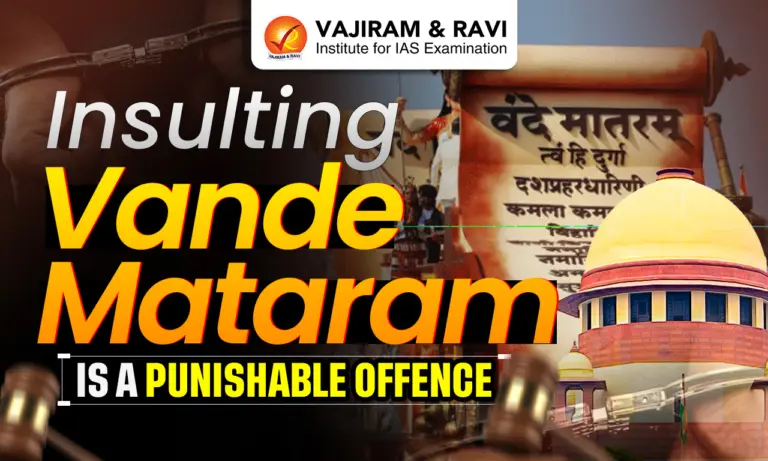
The Union Cabinet has approved a proposal to amend the Prevention of Insults to National Honour Act, 1971 to make any obstruction to the singing of the national song Vande Mataram a punishable offence.
Prevention of Insults to National Honour Act, 1971
The Prevention of Insults to National Honour Act, 1971 was enacted to preserve the dignity and honour of National symbols of India and to prevent acts of deliberate disrespect towards them.
- At present, the Act provides legal protection against insults directed towards: the National Anthem of India, namely Jana Gana Mana, the National Flag of India, and the Constitution of India.
- The law criminalises acts such as burning, mutilating, defacing, defiling, disfiguring, trampling upon, or otherwise showing disrespect towards these national symbols.
- Section 3 of the Prevention of Insults to National Honour Act, 1971 provides that any person who intentionally prevents the singing of the National Anthem or causes disturbance to any assembly engaged in such singing shall be punishable with imprisonment extending up to three years, or with fine, or with both.
The proposed amendment gives Vande Mataram the same statutory protection as the national anthem Jana Gana Mana. The proposed amendment to the Act, after Parliament’s nod, will impose punishment on causing any deliberate obstruction to the singing of Vande Mataram.
Ministry of Home Affairs Directives Regarding Vande Mataram
In February 2026, the Union Ministry of Home Affairs issued detailed guidelines concerning the singing and playing of Vande Mataram at official functions and ceremonial occasions.
- The Ministry directed that all six stanzas of Vande Mataram, totalling 3 minutes 10 seconds, shall be sung at official functions such as the arrival of the President, the unfurling of the tricolour, and governors’ speeches, and other important ceremonial events conducted by government authorities.
- The Ministry further directed that whenever both the National Song and the National Anthem are performed at the same event, Vande Mataram shall be sung or played before Jana Gana Mana.
- The advisory also instructed that members of the assembly present during the rendition of the National Song should stand in attention as a mark of respect.
Although these directives established ceremonial norms, they did not possess statutory force. There was no penal consequence prescribed for failure to comply with the advisory. The proposed amendment to the 1971 Act is intended to provide legal backing to these expectations regarding respect for the National Song.


Supreme Court’s Observations on the Issue
In March 2026, the Supreme Court of India refused to entertain a petition challenging the Ministry of Home Affairs advisory on the singing of Vande Mataram at official events and educational institutions.
- A bench headed by Chief Justice Surya Kant observed that the guidelines were merely advisory in nature and imposed no penal consequences for non-compliance.
However, the proposed amendment to the Prevention of Insults to National Honour Act, 1971 may change the legal position by making intentional obstruction or insult to the National Song a punishable offence.
Vaned Mataram Historical Background
Vaned Mataram was composed by Bankim Chandra Chattopadhyay and was published in his celebrated Bengali novel “Anandamath” during the early 1880s.
- The song portrays India as a mother figure and combines patriotic devotion with spiritual and cultural imagery.
- During the Indian freedom struggle, Vande Mataram became a major slogan of anti-colonial resistance and inspired freedom fighters, revolutionaries, and nationalist movements.
- It played an important role during the Swadeshi Movement and became closely associated with the spirit of sacrifice and national unity.
- In 1937, the Indian National Congress decided that only the first two stanzas of the song would be used at official gatherings in order to address concerns regarding religious imagery in later portions.
- On January 24, 1950, the Constituent Assembly recognised the historic contribution of Vande Mataram in India’s freedom struggle and accorded it the status of the National Song of India.
- The Constituent Assembly also declared that Vande Mataram would be honoured equally with Jana Gana Mana in terms of national respect and cultural significance.

 Last updated on Oct, 2026
→ UPSC 2027 Notification will be released on 13 January 2027 at upsconline.nic.in.
→ Check Nobel Prize 2026 Winners List here.
→ Download PIB PRiSM Monthly Magazine 2026 here.
→ Check UPSC Monthly Current Affairs Magazine The Recitals here.
→ Check out the latest UPSC Syllabus here.
→ Download UPSC Model Answers for Mains 2026
→ UPSC Mains Question Paper 2026 is out now for Essay & GS Paper 1, 2, 3 & 4.
→ UPSC Calendar 2027 has been released.
→ Enroll in Vajiram & Ravi’s UPSC Mains Test Series 2027 for structured answer writing practice, expert evaluation, and exam-oriented feedback.
→ Join Vajiram & Ravi’s UPSC Mentorship Program 2027 for personalized guidance, strategy planning, and one-to-one support from experienced mentors.
→ Go through the UPSC Mains Previous Year Papers to enhance your preparation.
→ UPSC has released UPSC Toppers List 2025 with the Civil Services final result on its official website.
→ Also check Best UPSC Coaching in India
Insulting Vande Mataram is a Punishable Offence FAQs
Q1. What is the recent amendment related to insulting Vande Mataram?+
Q2. What is the Prevention of Insults to National Honour Act, 1971?+
Q3. How will insulting Vande Mataram become punishable under law?+
Q4. Which national symbols are currently protected under the 1971 Act?+
Q5. Who composed Vande Mataram?+
Q6. When was Vande Mataram accorded the status of the National Song?+
Tags: insulting vande mataram is a punishable offence