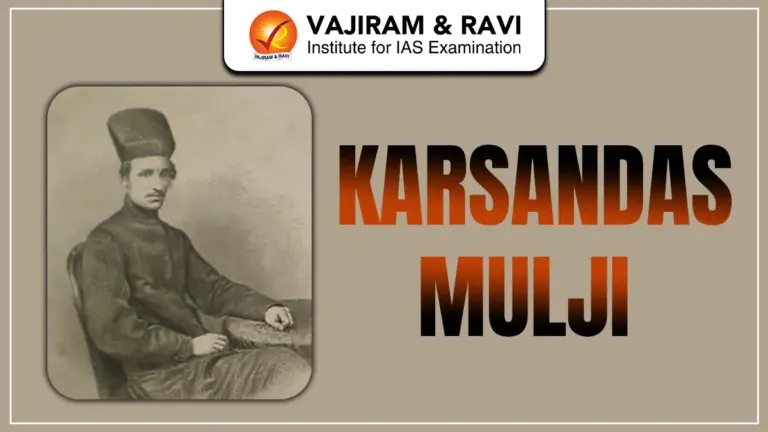
Karsandas Mulji was one of the most influential social reformers and fearless journalists of 19th Century India. Living under colonial rule, he used rational thought, journalism, and moral courage to challenge social orthodoxy, religious exploitation and gender injustice. His writings questioned unquestioned authority at a time when dissent invited social boycott and legal persecution. Karsandas Mulji’s life represents an early intellectual awakening that shaped modern Indian social reform, press freedom and ethical public discourse.
Karsandas Mulji Biography
Karsandas Mulji was born on 25 July 1832 in the Bombay Presidency into a Gujarati Vaishnav Kapol Bania family. He was educated at Elphinstone College and was deeply influenced by English education, scientific reasoning and liberal thought. He actively participated in Gnan Prasarak Mandal and associated with reformers like Narmad and Mahipatram Nilkanth. His support for widow remarriage and overseas travel led to caste excommunication, reflecting the personal cost of reformist conviction. His career combined journalism, administration and reforms until his death on 28 August 1871.
Karsandas Mulji Reforms
Karsandas Mulji emerged as a social reformer driven by rational ethics and public accountability, using journalism as a powerful instrument. The major reforms include:
- Social Reform through Journalism: Karsandas Mulji began journalism in 1851 with Dadabhai Naoroji’s Anglo-Gujarati newspaper Rast Goftar, using print media to communicate reformist ideas to educated Indians across religious and caste boundaries.
- Founding of Satyaprakash (1855): To reach orthodox Hindu society directly, he founded Satyaprakash, a Gujarati newspaper targeting conservative readers, edited by Mulji and published by Rustomji Ranina until 1861.
- Opposition to Religious Exploitation: He openly criticised immoral practices of religious leaders, especially misuse of authority by certain Vaishnav Maharajs, arguing religion must uphold ethics rather than personal power.
- Advocacy for Widow Remarriage: Karsandas Mulji supported widow remarriage as a moral and social necessity, challenging entrenched caste norms, which resulted in his excommunication from his community.
- Promotion of Women’s Education: He strongly supported female education, arguing that social progress depended on intellectual empowerment of women in a society dominated by patriarchal restrictions.
- Critique of Wasteful Rituals: Mulji condemned excessive spending on weddings, funerals, and ritualistic practices, identifying them as economic burdens that deepened poverty among common households.
- Attack on Caste Orthodoxy: His writings questioned caste-based discrimination and social rigidity, urging society to replace inherited privilege with ethical conduct and rational morality.
- Science and Knowledge Dissemination: While serving as Assistant Superintendent of Rajkot State, he published Vignanvilas, a monthly magazine promoting science, industry, and rational knowledge.
- Engagement with Reform Networks: He was an active member of Buddhivardhak Sabha, collaborating with reformers to spread modern education, critical thinking, and social responsibility in Western India.





The Maharaj Libel Case 1862
The Maharaj Libel Case of 1862 became a landmark moment in Indian legal and social history, symbolising resistance against religious authoritarianism and defence of press freedom.
- Background of the Dispute: Mulji criticised coercive practices of Vaishnav Maharajs, particularly agreements forcing followers not to question priests or seek legal remedy against them.
- Publication of Critical Articles: In Satyaprakash, articles questioned the moral conduct of certain Maharajs and accused them of exploiting religious authority for personal and sexual misconduct.
- Defamation Suit Filed: Vaishnav priest Jadunathji Brijratanji filed a libel case against Karsandas Mulji and publisher Nanabhai Ranina in the Bombay Supreme Court.
- Legal Representation: Mulji was defended by Thomas Chisholm Anstey, a prominent lawyer, who argued that the writings served public interest and exposed unethical practices.
- Public Attention and Debate: The trial attracted intense public scrutiny, described as one of the most significant colonial-era trials concerning morality, religion, and freedom of expression.
- Judgement: The court ruled in favour of Karsandas Mulji, holding that his writings were truthful and motivated by public welfare rather than malice. The verdict affirmed that religious leaders were subject to civil law and that criticism in public interest did not constitute defamation.
- Impact:
- The case strengthened journalistic independence, encouraging investigative writing and critical engagement with authority in colonial India.
- The judgement rejected the notion of priests being above law, reinforcing equality before law and ethical accountability in public life.
Karsandas Mulji Awards and Honours
Karsandas Mulji received recognition during and after his lifetime for his intellectual contributions, administrative service and moral courage.
- Government Appointment (1867): The Bombay Government appointed him to administer Kathiawar, reflecting official recognition of his administrative competence and ethical integrity.
- Fellow of University of Bombay: He was nominated as a Fellow of the University of Bombay, acknowledging his scholarly contributions and engagement with higher education.
- Royal Asiatic Society Membership: Mulji became a member of the Royal Asiatic Society of Great Britain and Ireland, highlighting international recognition of his intellectual standing.
- Biographical Recognition: In 1935 B. N. Motiwala’s Karsandas Mulji: A Biographical Study provided a critical scholarly assessment of his social and journalistic legacy. Further Mahipatram Nilkanth authored Uttam Kapol Karsandas Mulji Charitra in 1877, documented his life and reformist contributions.
- Public Institutions Named After Him: The Karsandas Mulji Municipal Library in Matheran commemorates his contributions to knowledge dissemination and public education.
- Cultural Representation: His life and Maharaj Libel Case were portrayed in the 2024 biopic Maharaj, reflecting enduring public interest in his reformist legacy.

 Last updated on March, 2026
→ UPSC Final Result 2025 is now out.
→ UPSC has released UPSC Toppers List 2025 with the Civil Services final result on its official website.
→ Anuj Agnihotri secured AIR 1 in the UPSC Civil Services Examination 2025.
→ UPSC Marksheet 2025 is now out.
→ UPSC Notification 2026 & UPSC IFoS Notification 2026 is now out on the official website at upsconline.nic.in.
→ UPSC Calendar 2026 has been released.
→ Check out the latest UPSC Syllabus 2026 here.
→ UPSC Prelims 2026 will be conducted on 24th May, 2026 & UPSC Mains 2026 will be conducted on 21st August 2026.
→ The UPSC Selection Process is of 3 stages-Prelims, Mains and Interview.
→ Prepare effectively with Vajiram & Ravi’s UPSC Prelims Test Series 2026 featuring full-length mock tests, detailed solutions, and performance analysis.
→ Enroll in Vajiram & Ravi’s UPSC Mains Test Series 2026 for structured answer writing practice, expert evaluation, and exam-oriented feedback.
→ Join Vajiram & Ravi’s Best UPSC Mentorship Program for personalized guidance, strategy planning, and one-to-one support from experienced mentors.
→ Shakti Dubey secures AIR 1 in UPSC CSE Exam 2024.
→ Also check Best UPSC Coaching in India
Karsandas Mulji FAQs
Q1. Who was Karsandas Mulji?+
Q2. Why is Karsandas Mulji famous in Indian history?+
Q3. Which newspaper did Karsandas Mulji publish?+
Q4. What social issues did Karsandas Mulji oppose?+
Q5. What was the significance of the Maharaj Libel Case?+
Tags: karsandas mulji