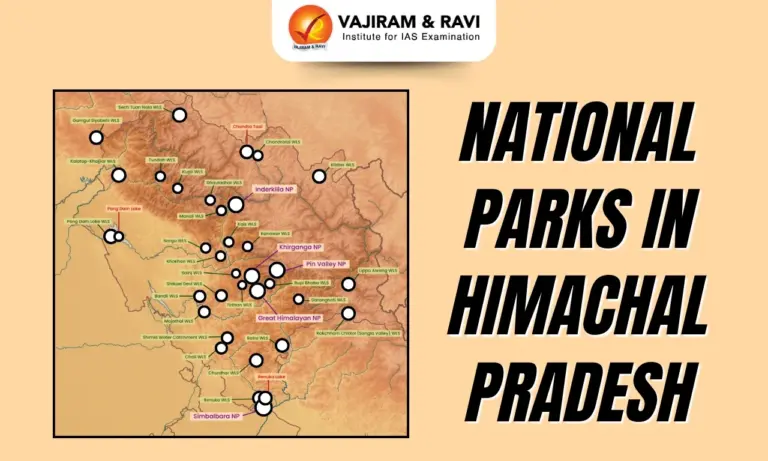
There are five National Parks in Himachal Pradesh that protect some of India’s most fragile Himalayan ecosystems. These parks span cold deserts, glacier-fed valleys, alpine meadows, and Shivalik foothills. Great Himalayan National Park is the only UNESCO World Heritage Site in the state. Pin Valley represents cold desert ecology, while Inderkilla and Khirganga strengthen forest connectivity in Kullu. Simbalbara safeguards Shivalik sal forests and acts as a wildlife corridor with Haryana.
Protected Areas in Himachal Pradesh
Himachal Pradesh has a vast protected area network conserving Himalayan biodiversity across altitudes, river basins, forests, glaciers, and cold deserts.
- National Parks: Five parks protecting alpine, subalpine, and Shivalik ecosystems.
- Wildlife Sanctuaries: Twenty-eight notified sanctuaries covering diverse mountain habitats.
- Ramsar Sites: Three internationally important wetlands supporting migratory birds.
- Ecosystem Coverage: Ranges from cold deserts to sal forests and alpine meadows.
National Parks in Himachal Pradesh
National Parks in Himachal Pradesh and other protected areas are officially recognised regions created to conserve wildlife, forests, rivers, and fragile ecosystems. They restrict human activities such as hunting, logging, mining, and construction. Protected areas include National Parks, Wildlife Sanctuaries, Biosphere Reserves, and Ramsar Sites. These regions protect endangered species, regulate ecological balance, preserve genetic diversity, and safeguard watersheds that support rivers, agriculture, and climate stability across Himalayan landscapes and foothill regions.
Great Himalayan National Park (Kullu)
Great Himalayan National Park lies in the Kullu Valley formed by the Beas River and marks a biogeographic transition zone.
- Location: Situated at Indomalayan-Palearctic biogeographic junction.
- Establishment: Constituted in 1984 and notified as National Park in 1999.
- Global Status: Declared UNESCO World Heritage Site for biodiversity value.
- Topography: Features glaciers, peaks, meadows, and dense conifer forests.
- Vegetation: Ranges from temperate forests to subalpine ecosystems.
- Major Flora: Includes spruce forests, horse chestnut, and alpine grasslands.
- Major Fauna: Bharal, snow leopard, Himalayan brown bear, Himalayan tahr.
- Hydrology: Feeds Tirthan, Sainj, Jiwa Nal, and Parvati rivers.
- Connectivity: Linked with Pin Valley, Rupi Bhaba, and Kanawar sanctuaries.
Pin Valley National Park (Lahaul & Spiti)
Pin Valley National Park lies in the cold desert of Spiti and protects trans-Himalayan ecosystems.
- Location: Situated in Spiti Valley of Lahaul and Spiti district.
- Biosphere Context: Part of Cold Desert Biosphere Reserve.
- River System: Pin River joins Spiti River, a Sutlej tributary.
- Climate Zone: Characterized by extreme cold desert conditions.
- Vegetation: Dominated by alpine grasses and sparse shrubs.
- Wildlife: Supports snow leopard and Himalayan ibex populations.
- Cultural Landscape: Inhabited by Tibetan Buddhist communities.
- Heritage Sites: Houses monasteries like the historic Kungri Gompa.
- Boundaries: Adjacent to GHNP and Rupi Bhaba Wildlife Sanctuary.
Inderkilla National Park (Kullu)
Inderkilla National Park lies within the Kullu Valley and forms a forest continuity zone.
- Location: Situated in Kullu district along Beas River valley.
- River Support: Beas River provides essential water for wildlife.
- Ecosystem Type: Elevation supports temperate to alpine forests.
- Major Fauna: Includes black bear, common leopard, Himalayan ibex.
- Landscape Role: Acts as corridor with GHNP and Khirganga Park.
- Connectivity: Linked with Sainj and Tirthan Wildlife Sanctuaries.
- Conservation Value: Maintains genetic flow between protected forests.
Khirganga National Park (Kullu)
Khirganga National Park lies in Parvati Valley and protects high-altitude ecosystems.
- Location: Located in Parvati River basin of Kullu Valley.
- Tourism Context: Near Manikaran Sahib and trekking routes.
- Vegetation: Dominated by dry alpine scrub and grasslands.
- Wildlife: Supports snow leopard, ibex, bharal, brown fox.
- Park Linkage: Adjacent to GHNP and Inderkilla National Park.
- Geothermal Feature: Known for natural hot springs.
Simbalbara National Park (Sirmaur)
Simbalbara National Park lies in Shivalik foothills along Himachal-Haryana border.
- Location: Situated in Paonta Valley of Sirmaur district.
- Alternate Name: Also known as Colonel Sher Jung National Park.
- Size: Among India’s smallest national parks at around 28 square kilometres.
- Landscape: Located in Shivalik range influenced by Yamuna River.
- Vegetation: Dense sal forests with open grassy glades.
- Fauna: Leopard, sambhar, goral, chital, barking deer, nilgai.
- Corridor Role: Connected with Kalesar Wildlife Sanctuary, Haryana.





Wildlife Sanctuaries in Himachal Pradesh
Himachal Pradesh has twenty-eight Wildlife Sanctuaries protecting river basins, alpine zones, glaciers, forests, and wetlands. These sanctuaries conserve endangered species like snow leopard, musk deer, Himalayan ibex, and migratory birds. Many lie along major rivers such as Beas, Sutlej, Ravi, Chenab, and Yamuna. Several sanctuaries also protect sacred landscapes, high-altitude lakes, wetlands, and cultural heritage sites across the Lesser, Greater, and Trans-Himalayan ranges.
Wildlife Sanctuaries in Himachal Pradesh List
These sanctuaries conserve specific habitats, species, and river ecosystems across the state.
- Chandratal Wildlife Sanctuary: High-altitude lake ecosystem supporting snow leopard and ibex.
- Dhauladhar Wildlife Sanctuary: Lesser Himalayan forest with oak, deodar, and Hanuman Tibba peak.
- Kais Wildlife Sanctuary: Declared to protect endangered musk deer population.
- Kalatop-Khajjiar Wildlife Sanctuary: Deodar forests near Ravi River with pheasants and serow.
- Kugti Wildlife Sanctuary: High-altitude sanctuary between Ravi and Chenab rivers.
- Lippa Asrang Wildlife Sanctuary: Kinnaur sanctuary known for snow leopard presence.
- Pong Dam Lake Wildlife Sanctuary: Man-made wetland on Beas River supporting migratory birds.
- Rakchham Chitkul Wildlife Sanctuary: Sangla Valley sanctuary along Baspa River.
- Renuka Wildlife Sanctuary: Natural freshwater wetland near Yamuna tributary.
- Rupi Bhaba Wildlife Sanctuary: Sutlej riverine sanctuary linking Pin Valley and Govind Park.
- Churdhar Wildlife Sanctuary: Named after Churdhar Peak and sacred Shirgul shrine.
- Kibber Wildlife Sanctuary: Trans-Himalayan sanctuary along Spiti River.
- Manali Wildlife Sanctuary: Close to Manali town with riverine forests.
- Sech Tuan Nala Wildlife Sanctuary: Chamba district sanctuary conserving Himalayan fauna.
- Simbalbara Wildlife Sanctuary: It is recognised both as National Park as well as sanctuary.
- Shikari Devi Wildlife Sanctuary: Named after hilltop temple in Mandi district.
- Talra Wildlife Sanctuary: Protected forest landscape in Sirmaur district.
- Daranghati Wildlife Sanctuary: Upper Sutlej basin forest supporting diverse ungulates.
- Nargu Wildlife Sanctuary: Mandi district sanctuary with rich Himalayan biodiversity.
- Chail Wildlife Sanctuary: High-altitude forests near historic Chail town.
- Tundah Wildlife Sanctuary: Chamba region sanctuary protecting alpine meadows.
- Tirthan Wildlife Sanctuary: River-fed forest ecosystem linked with GHNP.
- Majathal Wildlife Sanctuary: Lesser Himalayan sanctuary with steep forested slopes.
- Gamgul Siyabehi Wildlife Sanctuary: Kangra region sanctuary with mixed forests.
- Gobind Sagar Wildlife Sanctuary: Sutlej reservoir ecosystem near Bhakra Dam.
- Shilli Wildlife Sanctuary: It is the smallest wildlife sanctuary in India.
Ramsar Site in Himachal Pradesh
Himachal Pradesh has three Ramsar-designated wetlands of international ecological importance. These Ramsar Sites conserve wetlands critical for migratory birds, freshwater ecology, river systems, and climate regulation across Himalayan landscapes.
- Chandra Taal: High-altitude lake near Kunzum Pass supporting snow leopard habitat.
- Pong Dam Lake: Beas River reservoir on migratory bird flyway.
- Renuka Lake: Natural freshwater wetland with karst formations and cultural significance.

 Last updated on April, 2026
→ UPSC Final Result 2025 is now out.
→ UPSC has released UPSC Toppers List 2025 with the Civil Services final result on its official website.
→ Anuj Agnihotri secured AIR 1 in the UPSC Civil Services Examination 2025.
→ UPSC Marksheet 2025 is now out.
→ UPSC Notification 2026 & UPSC IFoS Notification 2026 is now out on the official website at upsconline.nic.in.
→ UPSC Calendar 2026 has been released.
→ Check out the latest UPSC Syllabus 2026 here.
→ UPSC Prelims 2026 will be conducted on 24th May, 2026 & UPSC Mains 2026 will be conducted on 21st August 2026.
→ The UPSC Selection Process is of 3 stages-Prelims, Mains and Interview.
→ Prepare effectively with Vajiram & Ravi’s UPSC Prelims Test Series 2026 featuring full-length mock tests, detailed solutions, and performance analysis.
→ Enroll in Vajiram & Ravi’s UPSC Mains Test Series 2026 for structured answer writing practice, expert evaluation, and exam-oriented feedback.
→ Join Vajiram & Ravi’s Best UPSC Mentorship Program for personalized guidance, strategy planning, and one-to-one support from experienced mentors.
→ Shakti Dubey secures AIR 1 in UPSC CSE Exam 2024.
→ Also check Best UPSC Coaching in India
National Parks in Himachal Pradesh FAQs
Q1. How many National Parks are there in Himachal Pradesh?+
Q2. Which National Park in Himachal Pradesh is a UNESCO World Heritage Site?+
Q3. Which National Park represents the cold desert ecosystem of Himachal Pradesh?+
Q4. How many Wildlife Sanctuaries are there in Himachal Pradesh?+
Q5. How many Ramsar Sites are present in Himachal Pradesh?+
Tags: national parks in himachal pradesh