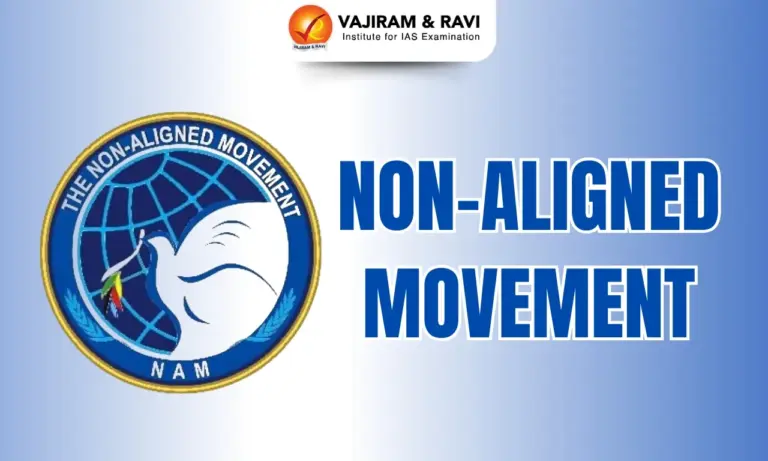
The Non-Aligned Movement (NAM) is a collective platform of sovereign states that chose not to align formally with any major power bloc during the Cold War. It was established in 1961 at Belgrade. It emerged from the shared concerns of newly independent nations seeking to preserve political autonomy, territorial integrity and independent foreign policies. NAM was shaped by leaders like Jawaharlal Nehru, Josip Broz Tito, Gamal Abdel Nasser, Sukarno and Kwame Nkrumah, who aimed to protect developing countries from great power rivalry. Today, with 121 member states, NAM remains the largest international grouping after the United Nations, representing nearly two-thirds of UN membership and about 55% of the global population.
Non-Aligned Movement Objectives
The objectives of the Non-Aligned Movement focus on safeguarding sovereignty, promoting peace and advancing collective interests of developing nations globally.
- Protection of Sovereignty: NAM seeks to protect national independence and territorial integrity of member states against external domination, foreign aggression and political coercion by major powers.
- Promotion of World Peace: The movement aims to reduce global tensions by opposing military alliances, foreign bases and escalation of conflicts through dialogue, mediation and peaceful dispute resolution.
- Support for Developing Countries: NAM works to advance the political, economic and social interests of developing nations, especially those facing poverty, underdevelopment and unequal global economic structures.
- Strengthening Multilateralism: It advocates reform of global institutions, particularly the United Nations, to ensure democratic decision making and fair representation of the Global South.
- Opposition to Imperialism: NAM consistently resists colonialism, neo colonialism, racism, apartheid and all forms of external interference that undermine self determination.
Non-Aligned Movement Principles
The principles of Non-Aligned Movement are derived mainly from the Panchsheel doctrine and the Bandung Conference commitments.
- Mutual Respect for Sovereignty: Member states commit to respecting territorial integrity and political independence of all nations, regardless of size or power.
- Non Interference in Internal Affairs: NAM opposes intervention in domestic matters of states, emphasizing sovereign equality and freedom of policy choice.
- Mutual Non Aggression: Countries pledge to refrain from the use or threat of force against other nations, ensuring peaceful coexistence.
- Equality and Mutual Benefit: NAM promotes cooperation based on equality, rejecting dominance by stronger nations over weaker states.
- Peaceful Coexistence: The movement supports dialogue, diplomacy and peaceful resolution of disputes as core principles of international relations.




Non-Aligned Movement Historical Background
The historical roots of the Non-Aligned Movement lie in post World War II decolonization and Cold War bipolarity.
- Bandung Conference 1955: Asian and African nations met in Indonesia to oppose colonialism and military alliances, laying ideological foundations for NAM.
- Brijuni Declaration 1956: Leaders of India, Yugoslavia and Egypt formally articulated non-alignment principles to avoid superpower domination.
- Belgrade Summit 1961: The first Conference of Heads of State or Government officially established NAM as a global political movement.
- Cold War Role: NAM expanded rapidly during the 1960s-1980s, supporting decolonization, nuclear disarmament and opposition to apartheid.
- Post Cold War Transition: After 1991, NAM shifted focus from bloc politics to development, multilateral cooperation and Global South solidarity.
Non-Aligned Movement Organizational Structure
The organizational structure of the Non-Aligned Movement is flexible, reflecting its non institutional character.
- Summit Conference: The Conference of Heads of State or Government is the highest decision making body, held every few years.
- Chairmanship System: The chair rotates among member states, with Uganda holding chairmanship for 2024-2027 under President Yoweri Museveni.
- Coordinating Bureau: Based at the United Nations headquarters in New York, it manages daily activities, working groups and coordination.
- Ministerial Meetings: Foreign Ministers’ conferences and thematic meetings ensure continuity between summits and policy implementation.
- Working Groups: Specialized groups address issues like UN reform, disarmament, peacekeeping, human rights and economic cooperation.
Non-Aligned Movement Membership
Non-Aligned Movement Membership reflects global diversity and developing world solidarity.
- Member States: The movement currently has 121 full members across Asia, Africa, Latin America, Europe and the Middle East.
- Observer States: Eighteen observer countries participate without full membership, maintaining association with NAM principles.
- International Organizations: Ten international organizations engage with NAM, expanding cooperation beyond nation states.
- Population Representation: NAM countries collectively account for approximately 55 percent of the world’s population, giving it demographic weight.
- Membership Criteria: States must follow Bandung principles, avoid military alliances tied to great power conflicts and support independence movements.
Non-Aligned Movement India’s Position
India has played a central yet evolving role within the Non-Aligned Movement.
- Founding Leadership: India, under Jawaharlal Nehru, was a principal architect of NAM, promoting strategic autonomy and peaceful coexistence.
- Cold War Challenges: India’s close relations with the Soviet Union during the 1970s created doubts among smaller members about its neutrality.
- Post Cold War Shift: Economic liberalization and closer ties with the United States reduced India’s emphasis on NAM diplomacy.
- Selective Engagement: India skipped the 2016 NAM Summit in Venezuela, signaling declining priority while still engaging diplomatically.
- Strategic Autonomy Today: India balances relations through forums like G20, SCO and Quad while advocating a multipolar world aligned with NAM ideals.
Non-Aligned Movement Challenges
The Non-Aligned Movement faces structural and political challenges in the contemporary global order.
- Loss of Original Context: The end of the Cold War reduced the relevance of strict non-alignment between two superpower blocs.
- Internal Diversity: Wide ideological, economic and political differences among members limit unity and decisive collective action.
- Leadership Vacuum: Absence of strong consensus leaders weakens NAM’s global influence and strategic direction.
- Competing Platforms: Emergence of BRICS, G20, SCO and regional blocs has diluted NAM’s centrality in global diplomacy.
- Limited Enforcement Power: NAM resolutions often lack binding mechanisms, reducing their impact on global policy outcomes.
Non-Aligned Movement Recent Developments
Recent developments show Non-Aligned Movement’s efforts to remain relevant in a changing world.
- Uganda Chairmanship 2024: The 19th NAM Summit in Kampala reaffirmed commitment to Global South cooperation and shared prosperity.
- COVID 19 Cooperation: The 2020 virtual summit highlighted collective action against pandemics and global health inequality.
- Focus on Multipolarity: NAM increasingly advocates a balanced world order resisting unilateral dominance and neo colonial practices.
- UN Reform Advocacy: The movement continues to push for restructuring the UN Security Council to reflect contemporary global realities.
- Sustainable Development Agenda: NAM emphasizes climate action, poverty reduction, South-South cooperation and inclusive economic growth.

 Last updated on March, 2026
→ UPSC Final Result 2025 is now out.
→ UPSC has released UPSC Toppers List 2025 with the Civil Services final result on its official website.
→ Anuj Agnihotri secured AIR 1 in the UPSC Civil Services Examination 2025.
→ UPSC Marksheet 2025 is now out.
→ UPSC Notification 2026 & UPSC IFoS Notification 2026 is now out on the official website at upsconline.nic.in.
→ UPSC Calendar 2026 has been released.
→ Check out the latest UPSC Syllabus 2026 here.
→ UPSC Prelims 2026 will be conducted on 24th May, 2026 & UPSC Mains 2026 will be conducted on 21st August 2026.
→ The UPSC Selection Process is of 3 stages-Prelims, Mains and Interview.
→ Prepare effectively with Vajiram & Ravi’s UPSC Prelims Test Series 2026 featuring full-length mock tests, detailed solutions, and performance analysis.
→ Enroll in Vajiram & Ravi’s UPSC Mains Test Series 2026 for structured answer writing practice, expert evaluation, and exam-oriented feedback.
→ Join Vajiram & Ravi’s Best UPSC Mentorship Program for personalized guidance, strategy planning, and one-to-one support from experienced mentors.
→ Shakti Dubey secures AIR 1 in UPSC CSE Exam 2024.
→ Also check Best UPSC Coaching in India
Non-Aligned Movement FAQs
Q1. What is the Non-Aligned Movement?+
Q2. When and where was the Non-Aligned Movement founded?+
Q3. Who were the key founders of the Non-Aligned Movement?+
Q4. How many countries are members of the Non-Aligned Movement today?+
Q5. Why is the Non-Aligned Movement still relevant today?+
Tags: non-aligned movement