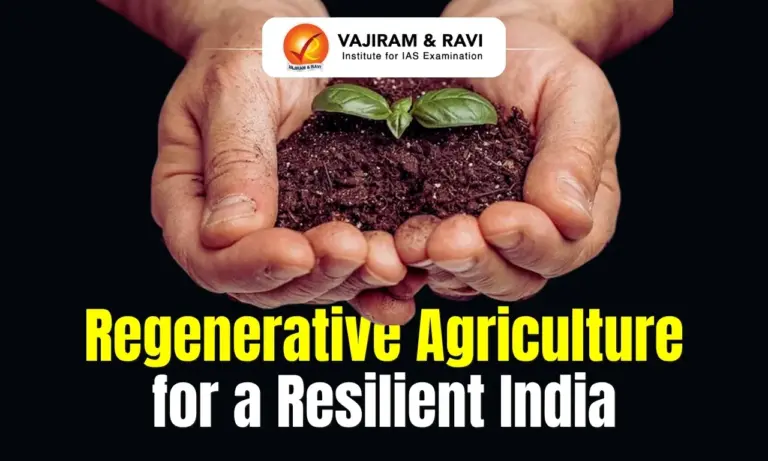
India’s agriculture and allied sectors recorded 4.45% decadal growth during FY2016-FY2025, the highest among previous decades. However, sustaining this growth is becoming difficult amid soil degradation, rising input costs, water stress and climate variability. Regenerative Agriculture offers a pathway to restore the ecological foundations of farming while improving productivity, resource efficiency and farmers’ resilience.
What is Regenerative Agriculture?
Regenerative Agriculture is a farming approach that focuses on restoring soil health, improving biodiversity and making farms more resilient to climate change. It aims to improve the natural health of farmland while ensuring good productivity in the long term.
Unlike conventional farming, which often focuses mainly on maintaining production, Regenerative Agriculture aims to make the soil and farming ecosystem healthier over time. Its core principles include:
- Minimising soil disturbance: Avoiding excessive tilling and disturbance of the soil.
- Protecting living roots: Keeping the roots of perennial crops alive in the soil for longer periods.
- Maintaining soil cover: Keeping the soil covered to protect it and maintain soil health.
- Integrating livestock: Combining livestock with crop farming as part of the farming system.
- Limiting chemical inputs: Reducing excessive use of chemical fertilisers and other chemical inputs.
- Enhancing biodiversity: Encouraging a greater variety of crops, plants and other organisms in the farming system.
Why is Regenerative Agriculture Needed in India?
The need arises from the growing pressure on the natural resources that sustain Indian agriculture.
- Declining soil health: Years of intensive cultivation and heavy chemical use are leaving soils tired and less responsive, affecting their fertility and productivity.
- Rising input requirements: As soil health declines, farmers may need higher levels of inputs to maintain yields, increasing cultivation costs.
- Climate variability: Heatwaves, dry spells and excessive rainfall can damage crops and make farm incomes more uncertain.
- Water stress: Increasing climate variability and water pressure make efficient water use essential for maintaining agricultural productivity.
- Environmental degradation: Declining soil health and weaker ecosystem functions can affect biodiversity and the long-term productivity of farmland.


Key Regenerative Agriculture Practices in India
India is already using several farming practices that reflect the principles of Regenerative Agriculture.
- Natural Farming: Natural farming reduces dependence on synthetic chemical inputs and uses locally prepared biological inputs such as Beejamrut, Jeevamrut, GhanJeevamrut, Neemastra and Dashparni. It also promotes mulching, multi-cropping, continuous soil cover, minimal soil disturbance and livestock integration.
- Soil Health Management: Green manuring, cover cropping and mulching improve soil quality. Green manure adds organic matter and nutrients, cover crops protect the soil and support nutrient cycling, while mulch conserves moisture and regulates soil temperature.
- Micro-Irrigation: Drip and sprinkler systems improve water-use efficiency. Drip Irrigation delivers water closer to plant roots, while sprinkler systems provide more uniform field coverage.
- Integrated Farming Systems: Integrated Farming Systems (IFS) combine crops with livestock, fisheries, horticulture, agroforestry and apiculture. Crop rotation, intercropping and mixed farming allow better use of farm resources.
- Agroforestry: Agroforestry combines trees with agricultural crops, particularly in rainfed areas. It can improve soil moisture, regulate temperatures, store carbon and provide farmers with additional income.
- Scientific Nutrient Management: Practices such as deep placement of supergranular urea, leaf-colour charts, legume intercropping and biological inputs help improve nitrogen-use efficiency and reduce environmental losses.
Regenerative Agriculture Benefits
By rebuilding natural resources, Regenerative Agriculture can generate environmental, economic and livelihood benefits.
Environmental Benefits
- Improved soil fertility: Greater soil organic matter and better soil structure support long-term productivity.
- Better water retention: Healthy soils can retain more moisture and reduce runoff.
- Higher biodiversity: Diverse farming systems provide favourable conditions for pollinators, beneficial insects and soil microorganisms.
- Lower environmental impact: Efficient nutrient and water management reduces resource wastage and pollution.
- Carbon storage: Healthier soils and agroforestry systems can increase carbon sequestration.
- Reduced erosion: Soil cover and improved soil structure protect agricultural land from erosion.
Economic and Livelihood Benefits
- Lower input costs: Reduced dependence on synthetic inputs and excessive irrigation can lower cultivation expenses.
- Diversified incomes: Livestock, fisheries, horticulture and trees provide additional income sources.
- Greater income stability: Diversification can reduce the financial impact of crop failure.
- Long-term productivity: Restoration of soil health helps protect the productive capacity of farmland.
Government Initiatives Promoting Regenerative Agriculture
Government support is addressing different components of regenerative agriculture through targeted schemes.
National Mission on Natural Farming
- Launched in 2024, the National Mission on Natural Farming (NMNF) supports farmers in transitioning towards natural farming.
- It provides an output-based incentive of ₹4,000 per acre per year for two years, covering up to one acre per farmer. It also provides for 10,000 need-based Bio-input Resource Centres and natural farming clusters supported by Community Resource Persons.
- As of 5 March 2026, 18,786 clusters had been formed, covering 8.80 lakh hectares and enrolling 18.19 lakh farmers. Around 33,676 Community Resource Persons had been trained.
Paramparagat Krishi Vikas Yojana
- The Paramparagat Krishi Vikas Yojana (PKVY), launched in 2015, promotes organic farming through clusters, certification and market support.
- Farmers adopting organic farming receive ₹31,500 per hectare over three years. The scheme had covered 16.90 lakh hectares as of 31 October 2025.
Per Drop More Crop
- Implemented since 2015-16, Per Drop More Crop (PDMC) promotes drip and sprinkler irrigation.
- The government provides 55% financial assistance to small and marginal farmers and 45% to other farmers. About 109 lakh hectares had been covered by May 2026, with ₹26,325 crore released as central assistance.
Rainfed Area Development Programme
- The Rainfed Area Development Programme (RAD) promotes Integrated Farming Systems through an area-based cluster approach.
- Farmers receive ₹30,000 per family for adopting IFS, while ₹10,000 per cluster is provided for training and capacity building. The programme had covered 9.53 lakh hectares and benefited 15.73 lakh farmers as of December 2025.
Agroforestry Component under PM-RKVY
- The erstwhile Sub-Mission on Agroforestry was restructured as the Agroforestry Component under Pradhan Mantri Rashtriya Krishi Vikas Yojana (PM-RKVY) from 2023-24.
- It supports nurseries, quality planting material, tissue culture, research, skill development and other agroforestry activities.
- During 2025-26, sanctions of ₹78.31 crore were issued to 27 States/Union Territories, while 135 new nurseries were established and around 176.59 lakh saplings were raised in existing nurseries.
Soil Health Card Scheme
- Launched in 2015, the Soil Health Card Scheme provides farmers with scientific information about the nutrient and physical condition of their soil.
- The card assesses 12 soil parameters and provides crop-specific recommendations on fertilisers, bio-fertilisers, organic inputs and soil treatments.
- As of 13 March 2026, 25.89 crore Soil Health Cards had been generated, while around 7.17 lakh demonstrations had been conducted to promote balanced fertiliser use.
Regenerative Agriculture and Climate Resilience
Regenerative Agriculture helps make Indian farming more resilient to climate-related stresses by improving soil health, conserving resources and strengthening farm ecosystems.
- Better soil moisture: Healthy soils retain more water, helping crops withstand droughts and dry spells.
- Reduced soil erosion: Soil cover and improved soil structure reduce runoff and erosion during heavy rainfall.
- Diversified farming: Integrated Farming Systems combine crops with livestock, fisheries and other activities, reducing the risk of crop failure during climate extremes.
- Agroforestry: Trees improve soil moisture, regulate local temperatures and help farmers cope with unpredictable rainfall, particularly in rainfed areas.
- Efficient water use: Micro-irrigation and better water management reduce water wastage and improve resilience to water stress.
- Better nutrient management: Balanced and efficient use of nutrients improves crop performance while reducing environmental losses.
- Carbon storage: Healthy soils and agroforestry systems can store more carbon, helping reduce greenhouse gas emissions.
Thus, Regenerative Agriculture can help Indian agriculture adapt to climate variability while also contributing to climate-change mitigation. It is closely aligned with SDG 13 (Climate Action), particularly Target 13.1, which focuses on strengthening resilience and adaptive capacity to climate-related hazards.
Challenges in Scaling Regenerative Agriculture
The transition from individual practices to regenerative farming at scale faces several practical barriers.
- Transition uncertainty: Farmers may hesitate to change established practices because the short-term effects on yields and income can be uncertain.
- Knowledge gap: Regenerative farming requires greater awareness and technical guidance.
- Region-specific requirements: India’s diverse soils, crops and agro-climatic conditions require locally suitable models.
- Limited access to inputs: Bio-inputs, quality planting material, irrigation technologies and advisory services are not equally accessible.
- Market limitations: Farmers need reliable markets and better price realisation for organic and sustainably produced crops.
- Capacity constraints: Scaling requires trained extension workers, demonstrations and continuous farmer support.
Way Forward
India needs to move from promoting individual regenerative practices towards integrated, economically viable and region-specific farming systems.
- Strengthen extension services through Krishi Vigyan Kendras, agricultural universities and trained community resource persons.
- Reduce transition risks through demonstrations, technical support and suitable incentives.
- Develop local bio-input systems to make natural and biological inputs easily accessible.
- Promote integrated farming by combining crops with livestock, fisheries, horticulture and trees.
- Expand efficient irrigation in water-stressed and rainfed regions.
- Strengthen value chains and markets for sustainably produced agricultural products.
- Use soil-health data to promote crop-specific and balanced nutrient management.
- Develop region-specific models based on local agro-climatic and socioeconomic conditions.

 Last updated on Oct, 2026
→ UPSC 2027 Notification will be released on 13 January 2027 at upsconline.nic.in.
→ Asian Games 2026 are being held in Aichi-Nagoya, Japan, from 19 September to 4 October.
→ Check Nobel Prize 2026 Winners List here.
→ Download PIB PRiSM Monthly Magazine 2026 here.
→ Check UPSC Monthly Current Affairs Magazine The Recitals here.
→ Check out the latest UPSC Syllabus here.
→ Download UPSC Model Answers for Mains 2026
→ UPSC Mains Question Paper 2026 is out now for Essay & GS Paper 1, 2, 3 & 4.
→ UPSC Calendar 2027 has been released.
→ Enroll in Vajiram & Ravi’s UPSC Mains Test Series 2027 for structured answer writing practice, expert evaluation, and exam-oriented feedback.
→ Join Vajiram & Ravi’s UPSC Mentorship Program 2027 for personalized guidance, strategy planning, and one-to-one support from experienced mentors.
→ Go through the UPSC Mains Previous Year Papers to enhance your preparation.
→ UPSC has released UPSC Toppers List 2025 with the Civil Services final result on its official website.
→ Also check Best UPSC Coaching in India
Regenerative Agriculture for a Resilient India FAQs
Q1. What is Regenerative Agriculture?+
Q2. Why is Regenerative Agriculture important for India?+
Q3. What are the core principles of Regenerative Agriculture?+
Q4. What are the major Regenerative Agriculture practices in India?+
Q5. How does Regenerative Agriculture improve climate resilience?+
Q6. Which government schemes promote Regenerative Agriculture in India?+
Q7. What are the major benefits of Regenerative Agriculture?+
Q8. What are the challenges in scaling Regenerative Agriculture?+
Tags: regenerative agriculture regenerative agriculture for a resilient india