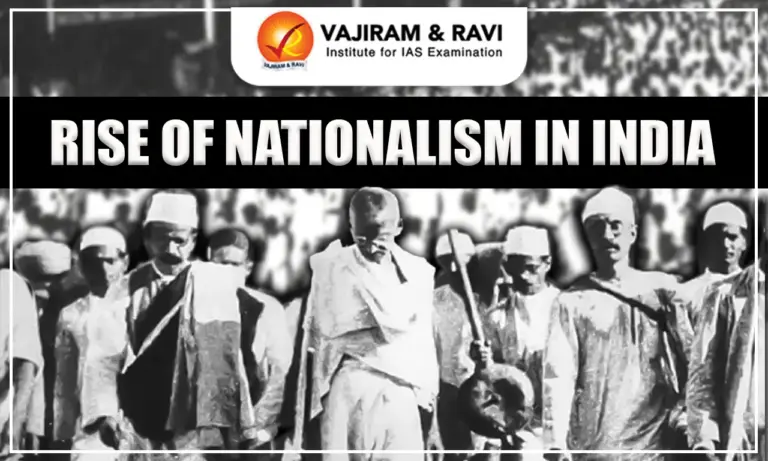
The Rise of Nationalism in India marked a turning point in the country’s history. It began taking shape in the late 19th century, when Indians started developing a shared sense of identity and purpose against British rule. What began as an awakening of collective unity soon grew into a powerful movement that challenged colonial domination. This spirit of nationalism not only inspired reforms and resistance but also laid the groundwork for the freedom struggle that contributed to independence in 1947.
Nationalism in India
Nationalism is the belief and movement that stresses loyalty and devotion to one’s nation. It calls on people to unite around shared identity, history, language, culture, and common aspirations. Often, nationalism grows stronger when a country faces domination or injustice at the hands of outside powers. At its core, it stands for self-rule and collective unity.
Nationalism in India took shape as a response to British colonial rule. The experience of foreign exploitation gradually made Indians recognize their shared past and common future. Literature, social reform, and cultural revival nurtured this collective spirit. Over time, this idea of unity transformed into a powerful movement that bound Indians together in the struggle for independence.
Rise of Nationalism in India
Several developments in the 19th and early 20th centuries pushed Indians toward nationalism:
- British Rule and Exploitation: Heavy taxation, economic drain, and racial discrimination bred deep resentment.
- Western Education: Exposure to ideas of liberty, equality, and democracy from European revolutions inspired educated Indians to demand similar rights.
- Economic Hardship: The collapse of Indian handicrafts, decline of industries, and suffering of farmers revealed the exploitative nature of colonial rule.
- Social and Religious Reform Movements: Thinkers like Raja Ram Mohan Roy and Swami Vivekananda fought social evils and revived cultural pride, fostering unity.
- Rise of the Press: Regional newspapers and journals spread nationalist thought, evaluate British policies, and mobilise public opinion.
- Indian National Congress (1885): Provided a common political platform for Indians to voice grievances and demand reforms.
- Racial Discrimination: Unequal treatment in jobs, education, and law reinforced the need for collective resistance.




Rise of Nationalism in India Major Events
The growth of nationalism in India was not sudden but shaped through a series of turning points. Each major event deepened the people’s resolve against colonial rule and brought India closer to freedom. The table below highlights Rise of Nationalism in India Major Events:
| Rise of Nationalism in India Major Events | ||
|
Event |
Year |
Significance |
|
Formation of Indian National Congress |
1885 |
Created a political platform for Indians; initially sought reforms but later led the independence struggle. |
|
Partition of Bengal |
1905 |
Sparked the Swadeshi Movement; promoted boycott of British goods and use of indigenous products. |
|
1916 |
Led by Tilak and Annie Besant, popularized the demand for self-rule across India. |
|
|
Jallianwala Bagh Massacre |
1919 |
Massacre of unarmed civilians by British troops in Amritsar; intensified anti-British sentiment. |
|
1920-22 |
Gandhi’s nationwide movement; boycott of British institutions and goods; united masses in resistance. |
|
|
Civil Disobedience Movement (Salt March) |
1930-34 |
Gandhi’s Salt March challenged colonial salt laws; inspired widespread nonviolent protest. |
|
1942 |
“Do or Die” call by Gandhi; demanded immediate independence; marked the final mass struggle before 1947. |
|
Legacy of Indian Nationalism
The Indian Nationalist Movement left behind more than just independence in 1947, it gave Indians a new sense of identity and purpose. Its impact can be seen in several ways:
- Unity in Diversity: It brought together people across castes, religions, and regions, shaping a collective national identity.
- Democratic Foundations: The values of liberty, justice, and democracy that guided the struggle later became pillars of the Indian Constitution.
- Social Reform and Awareness: The movement raised awareness against caste discrimination, untouchability, and gender inequality.
- Inspiration for Future Movements: It became a model for other colonies, proving that peaceful mass resistance could succeed.
Empowerment of Common People: Farmers, workers, students, and women actively participated, discovering their ability to drive change.

 Last updated on March, 2026
→ UPSC Final Result 2025 is now out.
→ UPSC has released UPSC Toppers List 2025 with the Civil Services final result on its official website.
→ Anuj Agnihotri secured AIR 1 in the UPSC Civil Services Examination 2025.
→ UPSC Marksheet 2025 is now out.
→ UPSC Notification 2026 & UPSC IFoS Notification 2026 is now out on the official website at upsconline.nic.in.
→ UPSC Calendar 2026 has been released.
→ Check out the latest UPSC Syllabus 2026 here.
→ UPSC Prelims 2026 will be conducted on 24th May, 2026 & UPSC Mains 2026 will be conducted on 21st August 2026.
→ The UPSC Selection Process is of 3 stages-Prelims, Mains and Interview.
→ Prepare effectively with Vajiram & Ravi’s UPSC Prelims Test Series 2026 featuring full-length mock tests, detailed solutions, and performance analysis.
→ Enroll in Vajiram & Ravi’s UPSC Mains Test Series 2026 for structured answer writing practice, expert evaluation, and exam-oriented feedback.
→ Join Vajiram & Ravi’s Best UPSC Mentorship Program for personalized guidance, strategy planning, and one-to-one support from experienced mentors.
→ Shakti Dubey secures AIR 1 in UPSC CSE Exam 2024.
→ Also check Best UPSC Coaching in India
Rise of Nationalism in India FAQs
Q1. What is the rise of nationalism in India?+
Q2. What was the main idea of the rise of nationalism?+
Q3. What was the rise of nationalism in 10th class?+
Q4. When was nationalism started in India?+
Q5. Who is the father of nationalism?+
Tags: rise of nationalism in india