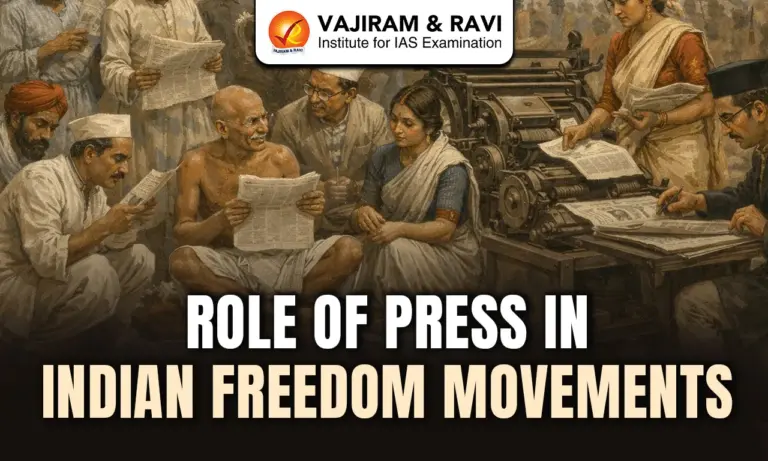
The Role of Press in Indian freedom movement was extremely important in spreading freedom ideas across India. The press played a crucial role by spreading political awareness, shaping public opinion, and mobilising people against colonial rule. In an era without modern communication tools, newspapers and journals became a powerful medium to connect freedom fighters with the masses. The press helped Indians understand British policies, expose colonial exploitation, and develop a sense of national unity and identity.
Role of Press in Indian Freedom Movement
The Role of Press in Indian freedom movement was very important in spreading political awareness, exposing colonial policies, and mobilising public opinion against British rule.
- Awareness against colonial exploitation: The Indian press created awareness about the exploitative economic and administrative policies of British rule. Publications such as Payam-e-Azadi encouraged people to stand against colonial injustice and highlighted the hardships faced by common people.
- Platform for nationalist leaders: Leaders such as Mahatma Gandhi used Young India and Harijan to promote non-violence, social equality and self-reliance. Revolutionary groups like the Ghadar Party used Hindustan Ghadar to mobilise Indians living abroad.
- Mobilisation of mass movements: The press played an important role in organising public opinion during major freedom struggle movements such as the Swadeshi movement, Non-Cooperation movement and Civil Disobedience movement led by Mahatma Gandhi. Newspapers helped spread calls for boycott, protests and nationalist participation.
- Promotion of social reform movement: The press helped spread awareness against social evils such as sati, caste discrimination, child marriage. For Example, Raja Ram Mohan Roy used his newspaper Sambad Kaumudi to strongly criticise the practice of sati, helping change public opinion against it and paving the way for its abolition in 1829.
- Promotion of culture and nationalism: Newspapers like Kesari and Maharatta, edited by Bal Gangadhar Tilak, promoted Indian culture, art and traditions and contributed to a cultural renaissance.
- Connecting different regions: Vernacular newspapers such as Mathrubhumi and Utkal Dipika helped reach semi-literate populations and connected local problems with the national freedom struggle.
- Reach to rural areas: Newspapers were not limited to cities. They were read and discussed in villages, libraries and community gatherings, helping nationalist ideas reach remote populations.
- Voice of women: Print media became an important platform for women to express their social problems, emotions and opposition to injustice in society. Rassundari Devi wrote Amar Jiban, describing her life struggles and experiences. Social reformers like Tarabai Shinde and Pandita Ramabai used writing to strongly criticise gender discrimination, caste restrictions and the poor social condition of women.
- Exchange of political ideas: Newspapers like The Hindu and The Statesman helped nationalist workers share political ideas across regions. International events also influenced nationalist sentiment. For example, news of Japan’s victory over Russia encouraged anti-colonial thinking.
- Opposition to British authoritarianism: Indian newspapers criticised colonial policies. Leaders like Surendranath Banerjee were even jailed for writing critical editorials.
Challenges Faced by Press in India
The British government tried to control the press because it feared the spread of nationalist ideology. Several censorship laws were introduced.
Censorship of Press Act 1799
- It was the first act passed in the direction of imposing restrictions on the Indian press.
- It was passed by Richard Wellesley, who was the Governor-General of India at the time.
- The Act was passed to restrict the French people from spreading any news that was against the British government.
- It also imposed a restriction on all the newspapers and journals that would not be published without first getting approval from the British government.
- All the magazines, journals, pamphlets, books, and newspapers were covered under this act after a modification in 1807.
Licensing Regulation Act 1823
- This ordinance was passed in 1823 by Adams, who was the Governor-General then.
- This act was primarily focused on the Indian newspapers or those that were at least edited by Indians.
- According to the Licensing Regulation, if any newspaper were published without a license, it would be considered a serious criminal violation.
- Publications like Mirat-ul-Akhbar of Raja Rammohan Roy were stopped under these rules.
Metcalfe Act or Press Act 1835
- The Press Act or the Metcalfe Act came to be known as the liberator of the press.
- The act revoked the License Regulations of 1823. It enabled the press to be more liberal, which contributed to the development of the press in India to a great extent.
- The main requirement of the Metcalfe Act was that the printer of the publisher of the newspaper must provide all details regarding the place of publication. If the instructions are not followed, the newspaper shall be stopped from publishing.
Licensing Act 1857
- The act was passed by Lord Canning, the Governor-General of India at the time.
- Any new publications were supposed to be published or printed only with the permission of the Government.
Vernacular Press Act 1878
- It was passed during the viceroyalty of Lord Lytton.
- It gave the colonial government power to monitor and control vernacular newspapers.
- District magistrates were authorised to require publishers to provide security deposits.
- If a newspaper published content considered “seditious” by the government, the deposit could be confiscated.
- The decision of the magistrate was final, and there was no provision for judicial appeal.
- The Act was specifically targeted at newspapers published in Indian languages and did not apply to the English press.
Registration Act, 1867
- The Metcalfe act of 1835 was repealed by the Registration Act of 1867.
- The name of the printer, publisher, and place of publication were now required to be included in the print media, and a copy was required to be submitted to the government.
Newspaper (Incitement to Offences) Act, 1908
- The Newspaper (Incitement to Offense) Act of 1908 empowered magistrates to seize press property that published objectionable material likely to incite murder or violent acts.
- Extremist nationalist activity during and after the Swadeshi movement of 1906 prompted this act.
Indian Press Act, 1910
- This act was a revision of the Vernacular Act, which empowered local governments to demand a security at registration from the printer/publisher and forfeit/deregister an offending newspaper, and the printer of a newspaper was required to submit two copies of each issue to local governments.
During the Second World War, pre-censorship was imposed under the Defense of India Rules. The penalty of imprisonment was increased to five years through amendments to the Press Emergency Act. Furthermore, the Official Secrets Act was amended to provide a maximum penalty of death or transportation for the publication of information likely to be useful to the enemy.





Conclusion
The Role of Press in the Indian freedom movement was crucial in spreading nationalism, exposing colonial rule, and mobilising public opinion. Despite censorship, the press remained a strong medium of resistance and helped lay the foundation of democratic values in independent India.

 Last updated on March, 2026
→ UPSC Final Result 2025 is now out.
→ UPSC has released UPSC Toppers List 2025 with the Civil Services final result on its official website.
→ Anuj Agnihotri secured AIR 1 in the UPSC Civil Services Examination 2025.
→ UPSC Marksheet 2025 is now out.
→ UPSC Notification 2026 & UPSC IFoS Notification 2026 is now out on the official website at upsconline.nic.in.
→ UPSC Calendar 2026 has been released.
→ Check out the latest UPSC Syllabus 2026 here.
→ UPSC Prelims 2026 will be conducted on 24th May, 2026 & UPSC Mains 2026 will be conducted on 21st August 2026.
→ The UPSC Selection Process is of 3 stages-Prelims, Mains and Interview.
→ Prepare effectively with Vajiram & Ravi’s UPSC Prelims Test Series 2026 featuring full-length mock tests, detailed solutions, and performance analysis.
→ Enroll in Vajiram & Ravi’s UPSC Mains Test Series 2026 for structured answer writing practice, expert evaluation, and exam-oriented feedback.
→ Join Vajiram & Ravi’s Best UPSC Mentorship Program for personalized guidance, strategy planning, and one-to-one support from experienced mentors.
→ Shakti Dubey secures AIR 1 in UPSC CSE Exam 2024.
→ Also check Best UPSC Coaching in India
Role of Press in Indian Freedom Movement FAQs
Q1. Why was the press important in the Indian freedom movement?+
Q2. Which newspapers played a major role in spreading nationalist ideas?+
Q3. How did the British control the press?+
Q4. What was the role of vernacular newspapers?+
Q5. Who is called the “liberator of the Indian press”?+
Tags: role of press in indian freedom movement