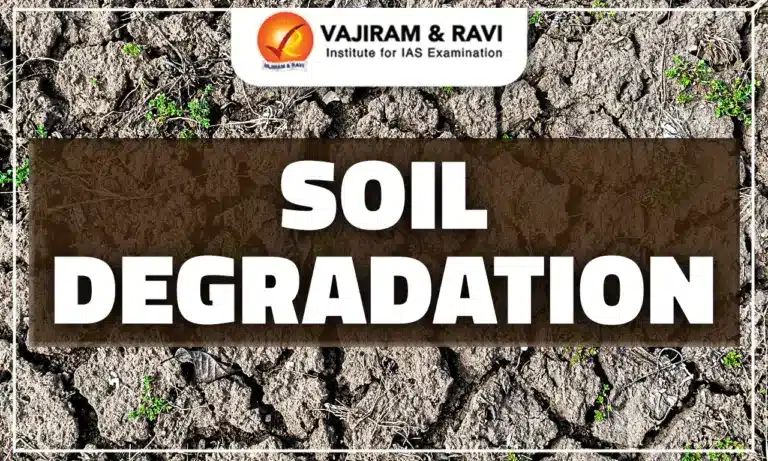
Soil Degradation is the decline in the quality, fertility and productivity of soil because of physical, chemical and biological processes, caused by human activities and natural factors. Soils are important assets that provide the base for all terrestrial ecosystems, making the control of soil degradation important for human survival. In this article, we are going to cover soil degradation, its types, effects and conservation efforts.
Soil Degradation
Soil Degradation means the decline in the soil health like its quality, fertility and productivity due to physical, chemical and biological processes. Soil degradation can be biological, chemical and physical. Currently, about 33% of the world’s soils are severely degraded. About 40% of these degraded soils are in Africa, with remaining concentrated in areas plagued by poverty and hunger. This degradation of soil is linked with food production and nutrition and in order to control this degradation, it is important to adopt localised strategies to reverse degradation, boost agricultural output and fight hunger specially in climate-vulnerable areas.
Soil Degradation can be seen at the physical, chemical and biological level of soils. Examples include declining fertility, loss of organic content, poor structure, erosion from wind or water, salinity shifts from irrigation or urban activities, rising acidity or alkalinity, compaction, sealing of the surface, landslides and contamination from pollutants and toxic substances.
Soil Degradation Types
Soil Degradation happens due to multiple processes. These types include:
- Water Erosion: Activities like sheet erosion, rill, or gully erosion result in a heavy water runoff of soil along with the water.
- Wind erosion leads to the erosion of soil when soil particles are displaced by air currents.
- Salinity develops through salt accumulation in arid lands, high irrigation or urban processes. Due to this the decline of organic matter reduces fertility and water retention.
- Soil acidity and alkalinity imbalances become a restriction in the growth of crops.
- Structural degradation through compaction affects water flow and root penetration.
- The top soil gets replaced by gravity driven movement. Soil contamination from chemicals undermines ecosystems and endangers human health.





Soil Degradation Causes
Soil Degradation is caused due to many many factors:
- Physical Causes: Rainfall, flooding, runoff, wind erosion, tillage, and slope movements strip away fertile topsoil.
- Biological Causes: Human and plant-related activities, microbial imbalance, and poor farming practices reduce productivity.
- Chemical Causes: Alkalinity, acidity, waterlogging, and nutrient depletion alter soil chemistry, weakening its fertility.
- Deforestation: Tree removal disrupts soil stability, binding capacity, and fertility, heightening erosion risks.
- Excess Fertilizers & Pesticides: Overuse disrupts soil organisms, destroys minerals, and creates toxic buildup.
- Mining & Industry: These strip crop cover, pollute soil, and alter its structure, chemistry, and biology.
- Faulty Cultivation: Deep plowing, mono-cropping, and irrigation mismanagement reduce fertility and regeneration.
- Urbanization: Construction causes compaction, altered drainage, erosion, and pollutant-laden runoff.
- Overgrazing: Livestock pressure erodes topsoil, removes vegetation, and reduces crop productivity.
Soil Degradation Effects
Soil Degradation affects the environment and human health in many ways:
- Land Degradation: Fertile soil loss makes 40% of agricultural land severely degraded.
- Desertification: Overgrazing, deforestation, and poor tillage drive aridity, drought, and biodiversity loss.
- Loss of Arable Land: Topsoil erosion leaves productive land barren, threatening food security.
- Increased Flooding: Soil’s diminished water-holding capacity causes higher runoff and flood frequency.
- Waterway Pollution: Sediments, fertilizers, and pesticides clog rivers, damage aquatic ecosystems, and reduce usable water.
Soil Degradation Conservation Methods
Soil Degradation can be controlled by adopting the following strategies:
- Curbing Deforestation: Encourage afforestation, forest protection, and sustainable forestry.
- Land Reclamation: Restore organic matter, manage rangelands, and rehabilitate salinized soils.
- Preventing Salinization: Use salt-tolerant crops, efficient irrigation, and reduced waterlogging.
- Conservation Tillage: Limit deep plowing, retain crop residues, and reduce structural damage.
- Agroforestry: Integrate crops with trees and hedges to prevent erosion, enhance biodiversity, and stabilize soils.
- Permaculture: Adopt sustainable farming by creating interdependent systems, avoiding harmful chemicals, and recycling nutrients.

 Last updated on March, 2026
→ UPSC Final Result 2025 is now out.
→ UPSC has released UPSC Toppers List 2025 with the Civil Services final result on its official website.
→ Anuj Agnihotri secured AIR 1 in the UPSC Civil Services Examination 2025.
→ UPSC Marksheet 2025 is now out.
→ UPSC Notification 2026 & UPSC IFoS Notification 2026 is now out on the official website at upsconline.nic.in.
→ UPSC Calendar 2026 has been released.
→ Check out the latest UPSC Syllabus 2026 here.
→ UPSC Prelims 2026 will be conducted on 24th May, 2026 & UPSC Mains 2026 will be conducted on 21st August 2026.
→ The UPSC Selection Process is of 3 stages-Prelims, Mains and Interview.
→ Prepare effectively with Vajiram & Ravi’s UPSC Prelims Test Series 2026 featuring full-length mock tests, detailed solutions, and performance analysis.
→ Enroll in Vajiram & Ravi’s UPSC Mains Test Series 2026 for structured answer writing practice, expert evaluation, and exam-oriented feedback.
→ Join Vajiram & Ravi’s Best UPSC Mentorship Program for personalized guidance, strategy planning, and one-to-one support from experienced mentors.
→ Shakti Dubey secures AIR 1 in UPSC CSE Exam 2024.
→ Also check Best UPSC Coaching in India
Soil Degradation FAQs
Q1. What is meant by soil degradation?+
Q2. What are the 4 causes of soil degradation? +
Q3. How to control soil degradation? +
Q4. What are the types of soil degradation?+
Q5. What is wind erosion?+
Tags: soil degradation