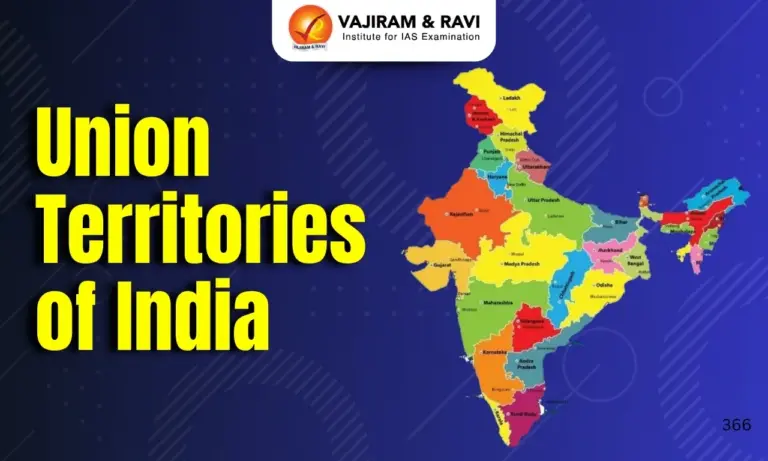
India, as a union of states, is a sovereign, socialist, secular, and democratic republic governed under a Parliamentary system. A Union Territory (UT) is a distinct administrative unit directly governed by the Central Government. The President of India serves as the constitutional head of the Executive at the Union level. These territories hold a unique status due to their historical formation and governance structure.
Union Territories of India
During the 18th century, Chief Commissioners’ Provinces were established, and these regions were directly governed by a Chief Commissioner, who reported to the Governor-General or Viceroy of India, depending on the period. The formation of Union Territories took place following the implementation of the States Reorganisation Act, 1956. It was the Constitution (Seventh Amendment) Act of 1956 that introduced the concept of Union Territories as a distinct administrative framework within India.
List of Union Territories of India
India, as a union of states, is a Sovereign, Secular, and Democratic Republic governed under a Parliamentary system. The President serves as the constitutional head of the Union’s Executive, while Union Territories are administered on their behalf through appointed representatives. The table below provides an overview of these Union Territories, including the capitals and date of creation:
| List of Union Territories of India | |||
| S.no | Union Territory | Capital | Date of Creation |
|
1 |
Puducherry |
Puducherry |
1st November 1954 |
|
2 |
Andaman and Nicobar Islands |
Port Blair |
1st November 1956 |
|
3 |
Chandigarh |
Chandigarh |
1st November 1956 |
|
4 |
Lakshadweep |
Kavaratti |
1st November 1956 |
|
5 |
Delhi |
Delhi |
1st November 1956 |
|
6 |
Jammu and Kashmir |
Srinagar (Summer) Jammu (Winter) |
31st October 2019 |
|
7 |
Ladakh |
Leh |
31st October 2019 |
|
8 |
Dadra and Nagar Haveli and Daman and Diu |
Silvassa and Daman |
26th January 2020 |




Constitutional Provision of Union Territories of India
The Constitutional Provision of Union Territories of India are outlined in Part VIII of the Indian Constitution, specifically in Articles 239 to 241. These provisions establish the framework for governing Union Territories:
- Article 239 of the Constitution of India gives powers to the President to administer Union Territories through appointed administrators.
- Article 239A, introduced in 1962, grants Parliament the authority to establish legislatures and governance structures for certain Union Territories.
- Article 239AA, was added in the constitution after the 69th Constitutional Amendment Act of 1991 which provides special provisions for the administration of the National Capital Territory of Delhi.
Special Provisions for Delhi
The 69th Constitutional Amendment Act of 1991 granted special status to the Union Territory of Delhi, renaming it the National Capital Territory (NCT) of Delhi. The Lieutenant Governor serves as its administrator.
Key provisions under this amendment include:
- Legislative Assembly & Council of Ministers: The amendment established a 70-member legislative assembly, with all members directly elected, replacing the previous Executive Council and Metropolitan Council. Elections are conducted by the Election Commission of India.
- Legislative Powers: The assembly can legislate on matters in the State List and Concurrent List, except for public order, police, and land, which remain under central government control.
- Council of Ministers: The council’s strength is 10% of the assembly’s total members, meaning seven ministers, including the Chief Minister.
Appointment of Ministers
- The Chief Minister is appointed by the President (not the Lieutenant Governor).
- Other ministers are appointed by the President on the advice of the Chief Minister.
- Ministers serve at the pleasure of the President.
Andaman and Nicobar Islands
The Andaman and Nicobar Islands have a humid tropical climate, indigenous tribes, and distinct island groups. The Andaman hosts Negrito tribes, while the Nicobar is home to Mongoloid tribes, preserving unique traditions.
| Andaman and Nicobar Islands | |
| Particulars | Description |
|
Area |
8,249 sq. km |
|
Population |
4 lakh (approx) |
|
Capital |
Port Blair |
|
Languages |
Hindi, Nicobarese, Bengali, Tamil, Malayalam, Telugu |
Dadra and Nagar Haveli and Daman and Diu
Recently, Daman and Diu merged with Dadra and Nagar Haveli to form a single Union Territory, Dadra and Nagar Haveli and Daman and Diu.
From 1954 to 1961, the region operated independently under the “Free Dadra and Nagar Haveli Administration.” However, on 11 August 1961, it was officially integrated into the Indian Union and has since been governed as a Union Territory under the administration of the Government of India.
| Dadra and Nagar Haveli and Daman and Diu | |
| Particulars | Description |
|
Area |
491 sq km |
|
Population |
4 Lakhs (Approx) |
|
Capital |
Silvassa |
|
Languages |
Gujarati, Hindi |
Lakshadweep
Lakshadweep, India’s smallest Union Territory, consists of 12 atolls, three reefs, and 27 coral islands, with only 11 of them inhabited. Initially Hindu, islanders converted to Islam under Arab traders in the 14th century. Renamed in 1973, it has been directly governed by the Union Government since 1956.
| Lakshadweep | |
| Particulars | Description |
|
Area |
32 sq. km |
|
Population |
64,429 ( Approx ) |
|
Capital |
Kavaratti |
|
Principal Languages |
Malayalam, Jeseri (Dweep Bhasha) and Mahal |
Puducherry
Puducherry, a former French colony, includes Puducherry, Karaikal, Mahe, and Yanam, merging with India on 1st November 1954 after 138 years of French rule. Scattered across South India, these regions are bordered by Tamil Nadu, Kerala, Andhra Pradesh, and the Bay of Bengal, each with distinct geographical locations.
| Puducherry | |
| Particulars | Description |
|
Area |
479 sq km |
|
Population |
12,44,464 (Approx) |
|
Capital |
Puducherry |
|
Principal Languages |
Tamil, Telugu, Malayalam, English and French |
Chandigarh
Chandigarh, known as the “City Beautiful,” is a well-planned city nestled in the Shivalik foothills. Designed by French architect Le Corbusier, it represents modern architecture and urban planning. Declared a Union Territory on 1st November 1966, it serves as the joint capital of Punjab and Haryana, bordered by both states.
| Chandigarh | |
|
Particulars |
Description |
|
Area |
114 sq km |
|
Population |
10,54,686 (Approx) |
|
Capital |
Chandigarh |
|
Principal Languages |
Hindi, Punjabi, English |
Ladakh
Ladakh became a Union Territory on 31st October 2019, comprising Leh and Kargil districts. Known for its stunning mountain landscapes and unique culture, Ladakh remains a region of natural beauty and strategic significance.
Jammu and Kashmir
| Jammu and Kashmir | |
|
Union Territories |
India |
|
Capital |
Jammu ( winter ), Srinagar ( summer ) |
|
Area |
222,236 sq.km |
|
Languages |
Urdu, Dogri, Kashmiri, Pahari, Ladakhi, Balti, Gojri and Dari |

 Last updated on March, 2026
→ UPSC Final Result 2025 is now out.
→ UPSC has released UPSC Toppers List 2025 with the Civil Services final result on its official website.
→ Anuj Agnihotri secured AIR 1 in the UPSC Civil Services Examination 2025.
→ UPSC Marksheet 2025 is now out.
→ UPSC Notification 2026 & UPSC IFoS Notification 2026 is now out on the official website at upsconline.nic.in.
→ UPSC Calendar 2026 has been released.
→ Check out the latest UPSC Syllabus 2026 here.
→ UPSC Prelims 2026 will be conducted on 24th May, 2026 & UPSC Mains 2026 will be conducted on 21st August 2026.
→ The UPSC Selection Process is of 3 stages-Prelims, Mains and Interview.
→ Prepare effectively with Vajiram & Ravi’s UPSC Prelims Test Series 2026 featuring full-length mock tests, detailed solutions, and performance analysis.
→ Enroll in Vajiram & Ravi’s UPSC Mains Test Series 2026 for structured answer writing practice, expert evaluation, and exam-oriented feedback.
→ Join Vajiram & Ravi’s Best UPSC Mentorship Program for personalized guidance, strategy planning, and one-to-one support from experienced mentors.
→ Shakti Dubey secures AIR 1 in UPSC CSE Exam 2024.
→ Also check Best UPSC Coaching in India
Union Territories of India FAQs
Q1. Which are 8 union territories in India? +
Q2. Which state is removed from 29?+
Q3. Is India a 28 or 29 state?+
Q4. Are there 9 union territories in India?+
Q5. Was Goa a Union Territory?+
Tags: Union Territories of India