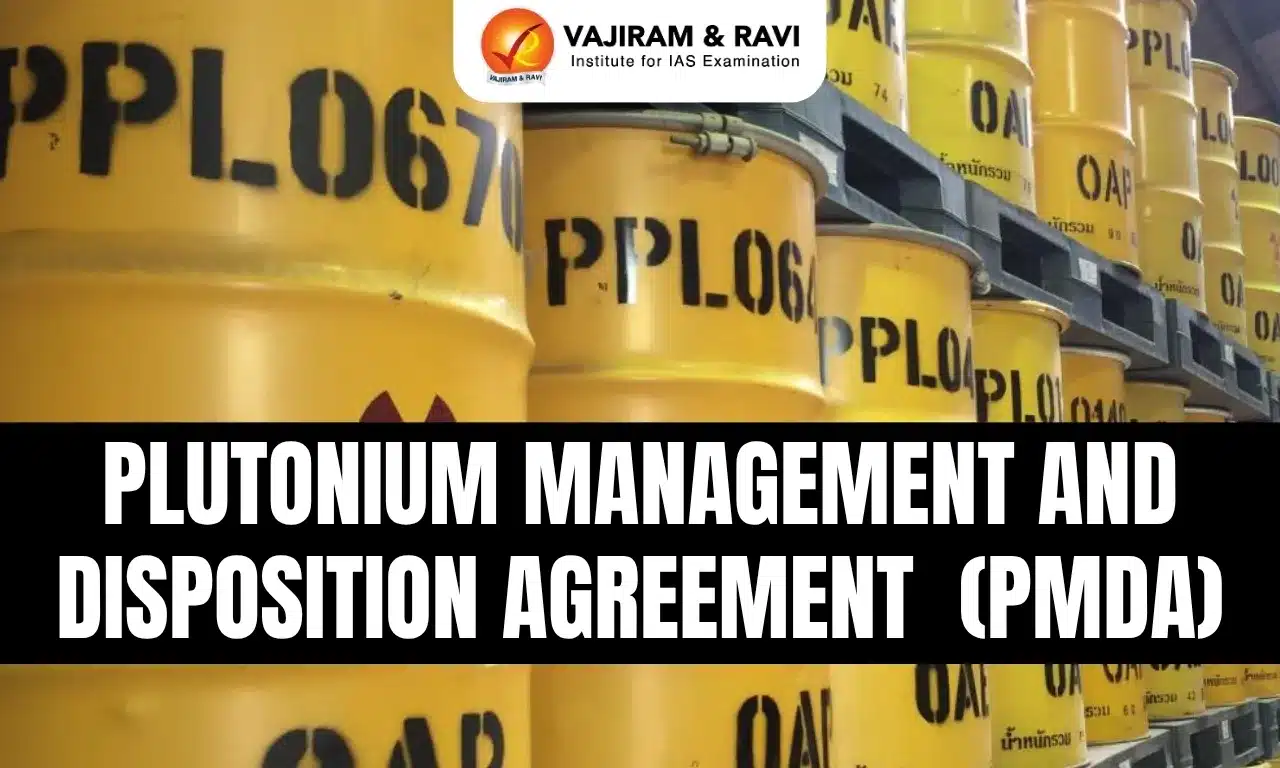
Plutonium Management and Disposition Agreement Latest News
About 100 wild boars were found dead in Nangal Wildlife Sanctuary in March this year, and the postmortem report of the dead wild boars indicates that the wild boars might have died due to toxic waste in Nangal Lake, which is part of the sanctuary.
About Plutonium Management and Disposition Agreement
- It is an agreement between the United States and Russia signed in 2000.
- It came into force in 2011.
- It aimed at reducing vast stockpiles of weapons-grade plutonium left over from thousands of Cold War nuclear warheads.
- After dismantling thousands of warheads after the Cold War, both Moscow and Washington were left with huge stockpiles of weapons-grade plutonium which was costly to store and posed a potential proliferation risk.
- The aim of the PMDA was to dispose of the weapons-grade plutonium, by converting it into safer forms - such as mixed oxide (MOX) fuel or by irradiating plutonium in fast-neutron reactors for electricity production.
- It committed both the United States and Russia to dispose of at least 34 tonnes of weapons-grade plutonium each.
- Russia in 2016 suspended implementation of the agreement, citing U.S. sanctions and what it cast as unfriendly actions against Russia, NATO enlargement, and changes to the way the United States was disposing of its plutonium.
- Russia said at the time that the United States had not abided by the agreement after Washington moved, without Russian approval, to simply dilute the plutonium and dispose of it.
Source: TH
Plutonium Management and Disposition Agreement FAQs
Q1: The Plutonium Management and Disposition Agreement (PMDA) was signed between which two countries?
Ans: United States and Russia
Q2: When did the Plutonium Management and Disposition Agreement come into force?
Ans: 2011
Q3: What was the primary aim of the Plutonium Management and Disposition Agreement (PMDA)?
Ans: To reduce weapons-grade plutonium stockpiles from dismantled Cold War warheads.