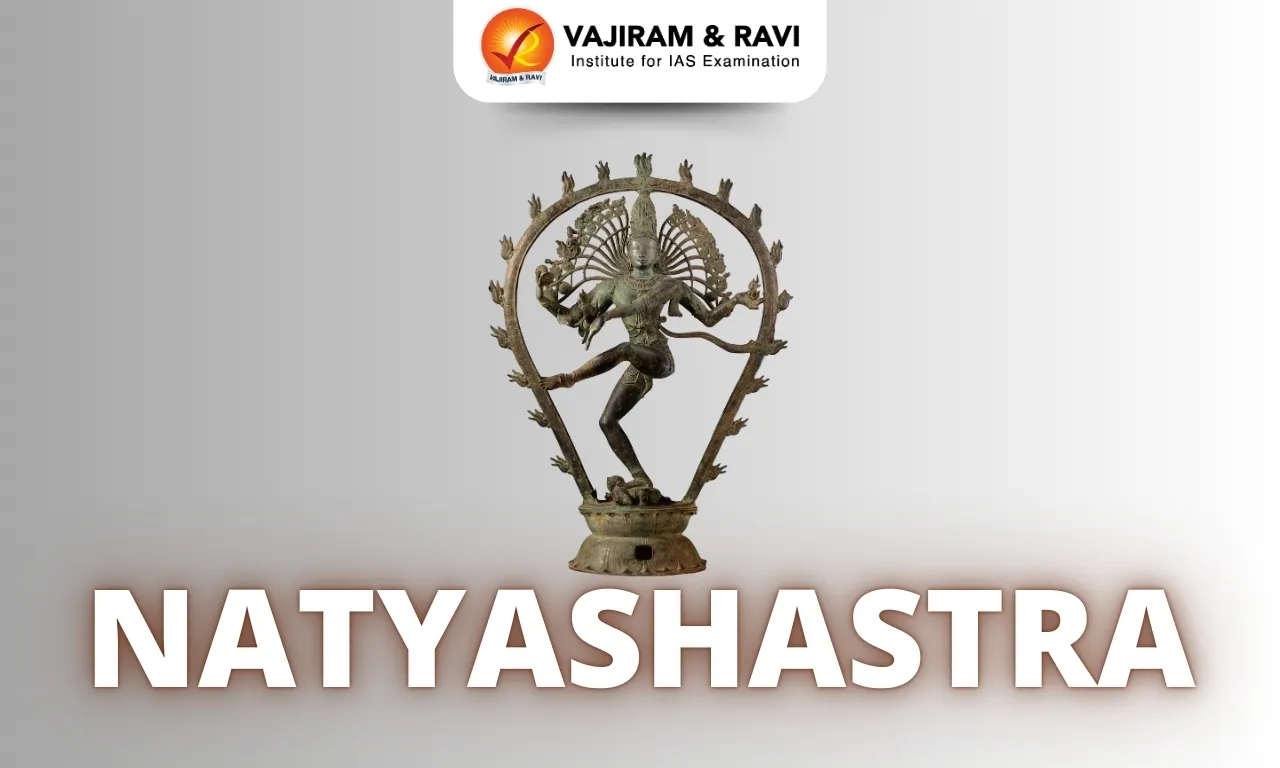
Natyashastra Latest News
The Indira Gandhi National Centre for the Arts (IGNCA) recently organised the academic programme titled ‘Natyashastra – Synthesis of Theory and Praxis’ during the 20th Session of UNESCO’s Intergovernmental Committee for the Safeguarding of Intangible Cultural Heritage at the iconic Red Fort, Delhi.
About Natyashastra
- It is an ancient Sanskrit treatise on performing arts.
- The title is a combination of two Sanskrit words – Natya and Shastra.
- Natya refers to the technique of dance and drama, and shastra refers to science.
- It was composed by the sage Bharata Muni.
- It has been dated to between the second century BCE and the second century CE.
- It is the earliest known treatise on performative arts in South Asia.
- Its primary importance lies in its justification of Indian drama as a vehicle of religious enlightenment.
- It comprises around 36,000 verses detailing drama (natya), performance (abhinaya), music (sangita), emotions (bhava), and aesthetic experience (rasa).
- One of the text's most profound contributions is the articulation of the concept of Rasa, the essential emotional essence that lies at the heart of any great work of art.
- Bharata Muni identified eight primary Rasas - Shringara (love), Hasya (humor), Karuna (compassion), Raudra (anger), Veera (heroism), Bhayanaka (fear), Bibhatsa (disgust), and Adbhuta (wonder).
- He also explained how the skilled performer, through the skillful deployment of bhava (emotional expression), could evoke these sentiments in the audience.
- UNESCO added Natyashastra to its Memory of the World Register, recognizing its global cultural significance.
Key Facts about Indira Gandhi National Centre for the Arts (IGNCA)
- It was established as an autonomous body by the Government of India, under the Ministry of Culture.
- Mandate:
- Document, preserve, conserve and disseminate the Indian arts and cultural heritage.
- Train competent professionals to work in the specialized field of culture.
- The IGNCA has six functional units:
- Kalanidhi, the multi-form library;
- Kalakosa, devoted mainly to the study and publication of fundamental texts, predominantly in Sanskrit;
- Janapada Sampada, the division engaged in lifestyle studies;
- Kaladarsana, the executive unit which transforms researches and studies emanating from the IGNCA into visible forms through exhibitions;
- Cultural Informatics Lab, which applies technology tools for cultural preservation and propagation;
- Sutradhara, the administrative section that acts as a spine supporting and coordinating all the activities.
Source: PIB
Natyashastra FAQs
Q1: What is the Natyashastra?
Ans: It is an ancient Sanskrit treatise on performing arts.
Q2: Who composed the Natyashastra?
Ans: The Natyashastra was composed by the sage Bharata Muni.
Q3: During which period is the Natyashastra believed to have been composed?
Ans: It is dated between the second century BCE and the second century CE.
Q4: Which aspects of performing arts are discussed in the Natyashastra?
Ans: It discusses drama (natya), performance (abhinaya), music (sangita), emotions (bhava), and aesthetic experience (rasa).
Q5: How many primary Rasas were identified by Bharata Muni?
Ans: He identified eight primary Rasas.