Mammogram

Mammogram

Mammogram Latest News

Doctors say a mammogram can pinpoint breast arterial calcifications (BAC) — calcium deposits in breast arteries that are now recognised as markers of underlying vascular damage that can raise cardiovascular risks.

About Mammogram

  • Mammography is a test that uses low-dose X-rays to create images of the breast. These images are called mammograms
  • Healthcare providers use mammograms, or mammography, to look for early signs of breast cancer before symptoms develop. This is called a screening mammogram. 
  • Providers also use mammography to look for any abnormalities if you develop a new symptom, such as a lump, pain, nipple discharge or breast skin changes. This is called a diagnostic mammogram. 
    • Although it’s called a “diagnostic mammogram,” it can’t diagnose breast cancer.
    • However, it can show whether the abnormal findings look like breast cancer.  
    • But these abnormal signs can also be caused by a breast condition that is benign (not cancer).
  • A Mammogram may show:
    • No signs of breast cancer
    • A benign (not cancer) breast condition or other change that does not suggest cancer
    • An abnormal finding that needs follow-up tests to rule out cancer
  • What Happens if a Mammogram is Not Normal?
    • An abnormal mammogram does not always mean that there is cancer.
    • You will need to have additional mammograms, tests, or exams before your provider can tell for sure. 
    • You may also be referred to a breast specialist or a surgeon. 
    • A breast biopsy can determine if tissue is cancerous or noncancerous.

Why Early Diagnosis of Breast Cancer Important?

  • Aside from skin cancer, breast cancer is the most common cancer that affects females.
  • An early diagnosis plays a big role in your breast cancer survival rate. 
  • Routine mammograms are key to catching breast cancer early. 
  • When breast cancer is detected early, the five-year survival rate is 99%. 
  • Mammograms are the gold standard in detecting breast tissue changes before they turn into cancer.

Source: TOI

Mammogram FAQs

Q1: What is mammography?

Ans: It is a test that uses low-dose X-rays to create images of the breast.

Q2: What is the purpose of a screening mammogram?

Ans: To detect early signs of breast cancer before symptoms appear.

Q3: What is a diagnostic mammogram used for?

Ans: To evaluate abnormalities when symptoms like a lump, pain, or nipple discharge occur.

Q4: What can a mammogram indicate about abnormal findings?

Ans: It can show whether they appear suspicious for breast cancer.

Q5: Does an abnormal mammogram always mean cancer?

Ans: No, it does not always mean cancer.

Noyyal River

Noyyal River

Noyyal River Latest News

Farmers dependent on Noyyal river in the region are looking forward to accelerating their campaign for securing the commitment of the next government for its remediation.

About Noyyal River

  • It is a tributary of the Kaveri River and flows through Tamil Nadu.
  • Course
    • It begins from numerous small streams in the Vellingiri Hills of the Western Ghats.
    • It flows through the districts of Coimbatore, Tirupur, and Erode and meets the Cauvery River at the Noyyal village in Karur District.  
  • Total Length: 158 km
  • It is a seasonal river with rapid flows during the monsoon periods. 
  • The Noyyal watershed is connected with a series of 32 tanks, 14 major canals, 23 anicuts, and 55 check dams. 
  • Most of these check dams and anicuts were constructed by the Chola Kings, who ruled the region in the 9th to 12th centuries to augment irrigation and control floods downstream. 
  • Until the early 20th century, the Noyyal was the main drinking water source for the region.  
  • Today the Noyyal is one of the most polluted rivers in India. 

Source: TH

Noyyal River

Q1: The Noyyal River is a tributary of which river?

Ans: It is a tributary of the Cauvery River.

Q2: In which state does the Noyyal River flow?

Ans: It flows through Tamil Nadu.

Q3: Where does the Noyyal River originate?

Ans: It originates from streams in the Vellingiri Hills of the Western Ghats.

Q4: What is the total length of the Noyyal River?

Ans: It is about 158 km long.

Tapir

Tapir

Tapir Latest News

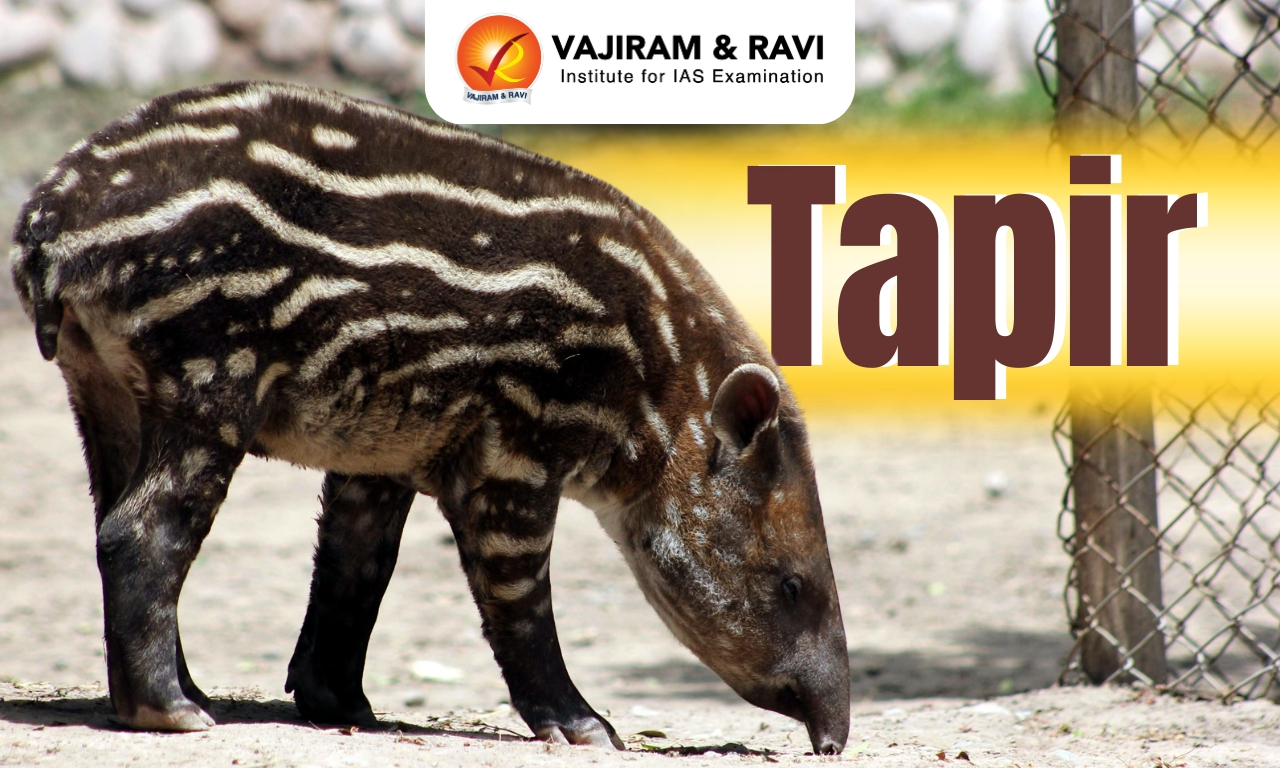
World Tapir Day is celebrated every year on April 27.

About Tapir

  • Tapirs are large herbivorous mammals.
  • They are often called “living fossils” due to their lineage dating back millions of years.
  • Appearance: They have short, flexible snouts, and tapirs use them to grab leaves and fruits.
  • They are also excellent swimmers and spend a lot of time in water.
  • Diet: They’re herbivores and fifty per cent of their diet consists of fruit.
  • Distribution: They inhabit jungle and forest regions of South America, Central America, and Southeast Asia. 
  • There are only four species of tapirs. They live in distinct geographical areas.
    • Malayan Tapir: It is the largest of the tapirs which is native to Southeast Asia. Its black-and-white stripes help it blend into the forest. (IUCN Status: Endangered)
    • Baird’s Tapir: It is Central America's biggest land mammal. It is found in tropical forests and around water. (IUCN Status: Endangered)
    • Lowland Tapir: The South American tapir is the most widespread. It is found in the Amazon Basin and other areas. (IUCN Status: Vulnerable)
    • Mountain Tapir: It is the rarest and found in the high Andes. (IUCN Status: Endangered)
  • Ecological Role: They form an important part of the ecosystem as seed dispersers. 

Source: News On Air

Tapir FAQs

Q1: Tapirs are most closely related to which animals?

Ans: Horses & Rhinoceroses

Q2: What is the ecological role of tapirs?

Ans: Seed dispersers & “Gardeners of the forest”

Organisation of the Petroleum Exporting Countries (OPEC)

Organisation of the Petroleum Exporting Countries

Organisation of the Petroleum Exporting Countries Latest News

The United Arab Emirates has announced it will exit the Organisation of the Petroleum Exporting Countries and the broader OPEC+ alliance, with the decision taking effect from May 1, 2026.

About Organisation of the Petroleum Exporting Countries

  • It is a permanent intergovernmental organization of oil-exporting countries.
  • It was established in 1960 by the five founding members Iran, Iraq, Kuwait, Saudi Arabia, and Venezuela
  • Objective: Its primary objective is to stabilize global oil markets and ensure fair prices for producers along with a steady supply for consumers.
  • Member countries: Currently, it has 12 members, including Algeria, Congo, Equatorial Guinea, Gabon, Libya, Nigeria, and the United Arab Emirates (Decided to quit from May 1 2026).
  • Angola withdrew its membership effective 1 January 2024.
  • Headquarters: Vienna, Austria.
  • OPEC members collectively hold more than 75–80% of the world’s proven crude oil reserves.
  • The organization produces around 35–40% of the world’s total crude oil supply.
  • OPEC plays a crucial role in influencing global oil prices by adjusting production levels.

What is OPEC+?

  • It is an extension of the Organization of the Petroleum Exporting Countries formed in 2016.
  • It consists of 22 oil-exporting countries which meet regularly to decide how much crude oil to sell on the world market.
  • Members of OPEC+: It comprises 12 OPEC countries plus Azerbaijan, Bahrain, Brunei, Kazakhstan, Russia, Mexico, Malaysia, South Sudan, Sudan, and Oman.
  • These nations aim to work together on adjusting crude oil production to bring stability to the oil market.

Source: News On Air

Organisation of the Petroleum Exporting Countries FAQs

Q1: OPEC was established in which year?

Ans: 1960 – Baghdad Conference,

Q2: Where is the headquarters of OPEC located?

Ans: Vienna, Austria

Theridion Himalayana

Theridion Himalayana

Theridion Himalayana Latest News

Recently, scientists discovered a new spider species and named it as Theridion himalayana’.

About Theridion Himalayana

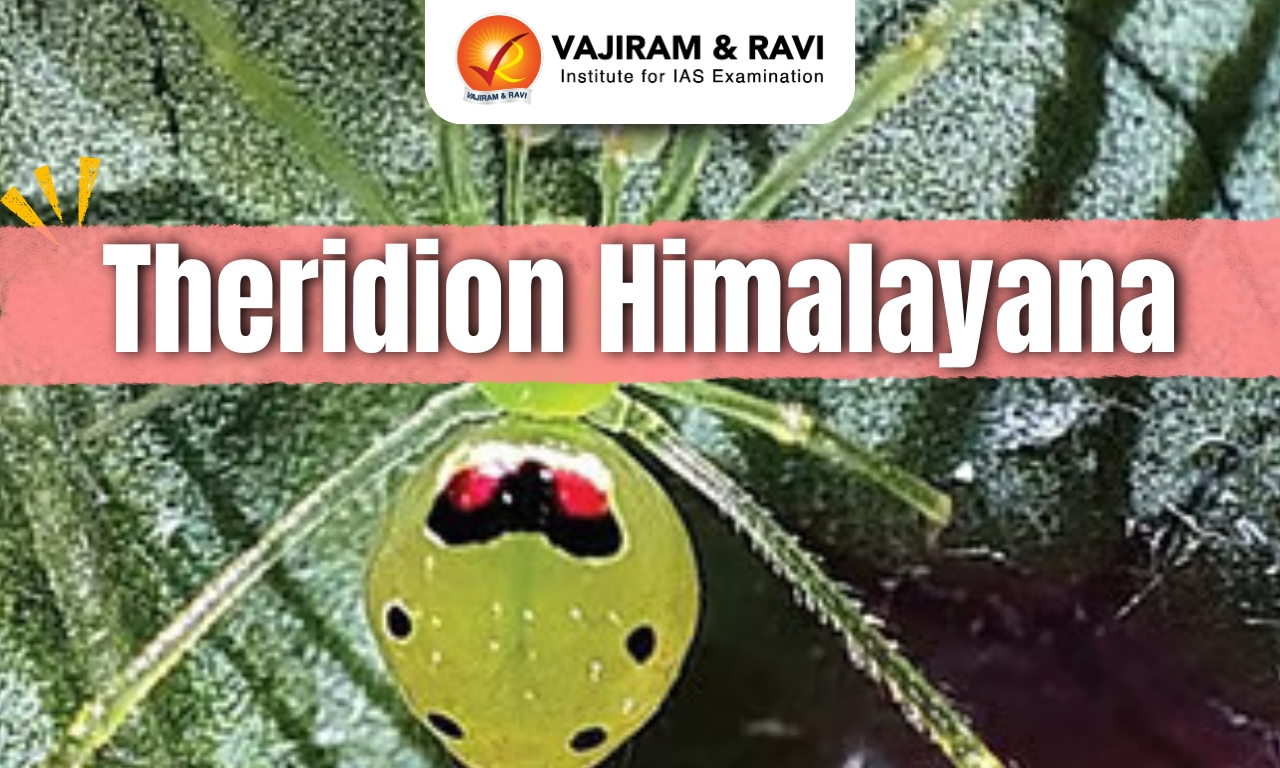
  • It is a new species of ‘happy-face spider’ belongs to the ‘Theridiidae’ family
  • It was discovered in western Himalayas of India.
  • Features
    • It is polymorphic in both sexes and has 32 different morphs that exhibit patterns of a smiling face with dots in colours of red, black and white arranged differently.
    • It has unique reproductive structures.
      • The copulatory ducts of the species are long, strongly curved and project forward, running almost parallel before bending downward at the ends.
      • The fertilisation ducts, on the other hand, are short, thin and point upward, spreading apart in a V-shape.
    • The species preys upon small flies and insects and plays a significant role in insect control in the forests. 
    • It could also be a crucial pollinator for some plants

Source: NIE

Theridion Himalayana FAQ's

Q1: Theridion himalayana is a species of which animal group?

Ans: Spider

Q2: Theridion himalayana was recently discovered in which Indian state?

Ans: Sikkim

Somalia

Somalia

Somalia Latest News

Suspected pirates have boarded a St. Kitts and Nevis-flagged general cargo vessel off Somalia’s waters and were sailing it towards the Somali coastline.

About Somalia

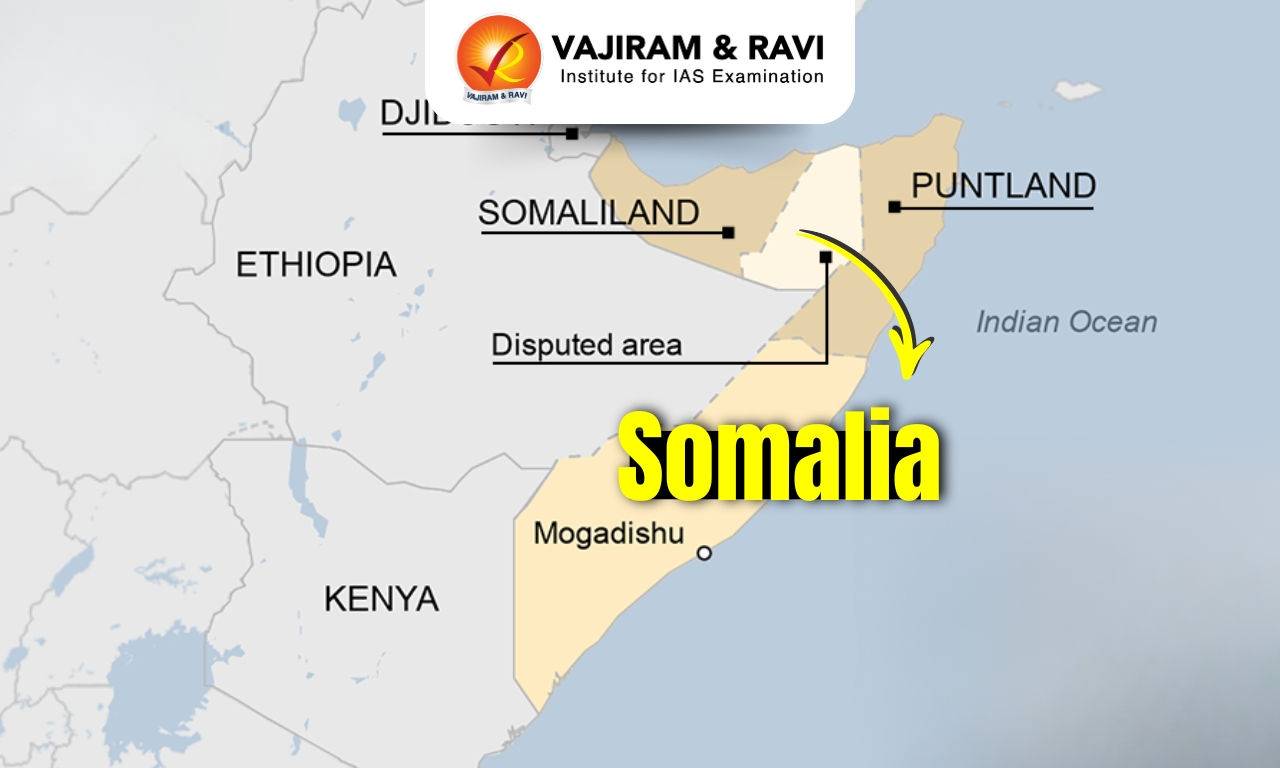
  • It is an African country located in the Horn of Africa.
  • The Equator passes through southern Somalia.
  • Bordering Countries: It is bordered by Djibouti (Northwest), Ethiopia (West), and Kenya (Southwest). 
  • Maritime Borders: The Gulf of Aden and Indian Ocean
  • Capital city: Mogadishu

Geographical Features of Somalia

  • Climate: It has an arid or semiarid climate, and there is little seasonal change in temperature.
  • Relief: The Somali peninsula consists mainly of a tableland of young limestone and sandstone formations.
  • In the extreme north, along the Gulf of Aden is a narrow coastal plain called the Guban.
  • Rivers: Jubba and the Shabeelle
  • Highest Peak: Highest point in Somalia is the 2,460 m tall Mount Shimbiris. 
  • Natural Resources:  It mainly consists of iron ore, uranium, copper, tin, bauxite, gypsum, salt. 

Source: DD News

Somalia FAQs

Q1: Which major river flows through southern Somalia?

Ans: Jubba River & Shabelle River

Q2: What is the capital of Somalia?

Ans: Mogadishu

Holocene Epoch

Holocene Epoch

Holocene Epoch Latest News

A Fossil Bed dating back to the Holocene period has been recently discovered in Thoothukudi, Tamil Nadu.

About Holocene Epoch

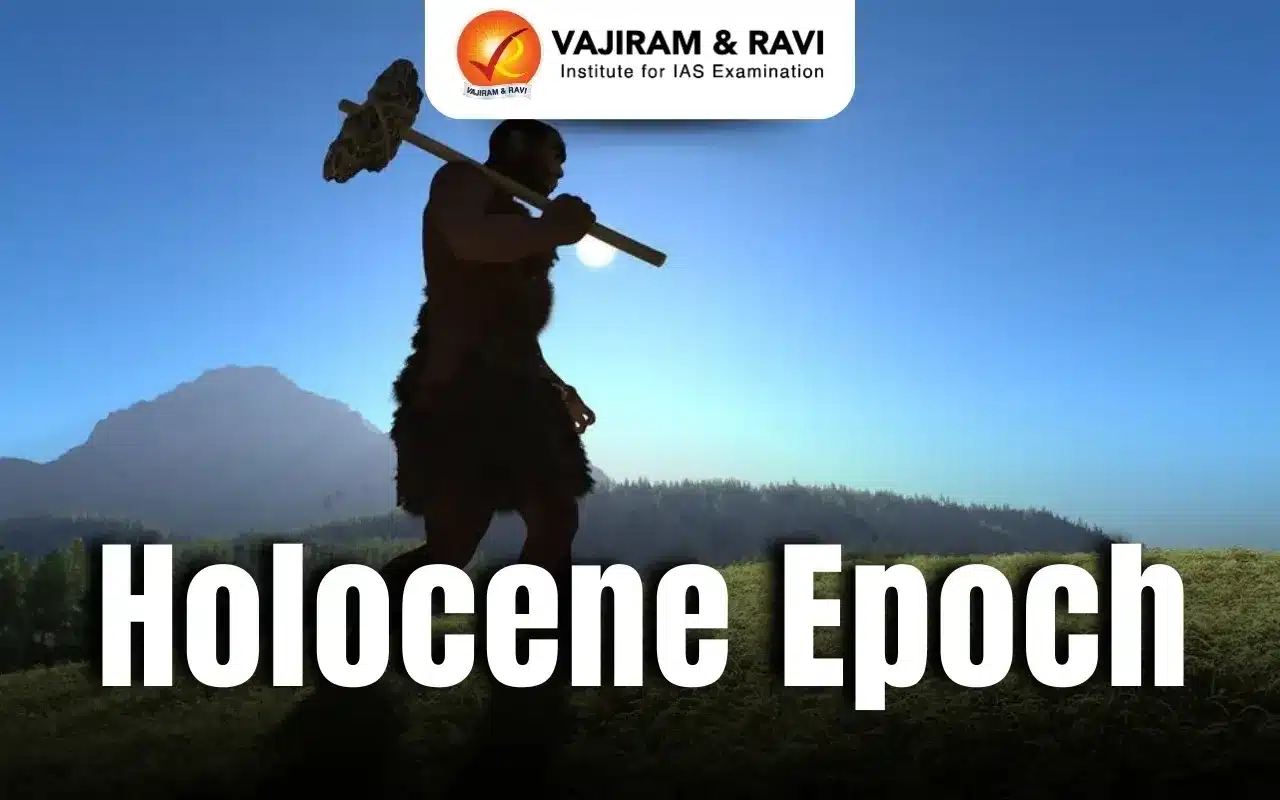
  • It is the current period of geologic time. 
  • The term was introduced by Gervais in 1869 and was accepted as part of valid geological nomenclature by the International Geological Congress in 1885. 
  • Another term that is sometimes used is the ‘’Anthropocene Epoch’’, because its primary characteristic is the global changes caused by human activity.
  • The Holocene Epoch began 12,000 to 11,500 years ago at the end of the last Ice Age (the Pleistocene Epoch) and continues to the present. 
  • Continental motions are negligible over a span of only 10,000 years—less than a kilometer. However, ice melt caused world sea levels to rise about 35 meters in the early part of the Holocene.  
  • It is marked by a significant warming trend and relative climate stability compared to the previous glacial period.
  • The sediments of the Holocene, both continental and marine, cover the largest area of the globe of any epoch in the geologic record, but the Holocene is unique because it coincides with the late and post-Stone Age history of humankind. 
  • Among interglacial periods, the Holocene is unique as the period in which more complex human civilisations and agriculture developed.
  • It also encompasses within it the growth and impacts of the human species worldwide, including all its written history and overall significant transition toward urban living in the present.  
  • The Holocene also witnessed significant technological advancements. From simple stone tools to complex machinery, the progress in technology has been staggering.

Source: NOA

Holocene Epoch FAQs

Q1: What is the Holocene Epoch?

Ans: It is the current period of geologic time.

Q2: When did the Holocene Epoch begin?

Ans: Around 12,000 to 11,500 years ago.

Q3: The Holocene Epoch began after which epoch?

Ans: The Pleistocene Epoch.

Q4: What type of climate characterizes the Holocene Epoch?

Ans: A warm and relatively stable climate.

Q5: What major human developments occurred during the Holocene?

Ans: Agriculture and complex civilizations.

Pompeii

Pompeii

Pompeii Latest News

AI has helped archaeologists at Pompeii reconstruct the face and final moments of a man killed during the AD 79 eruption of Mount Vesuvius.

About Pompeii

  • It is a preserved ancient Roman city located near modern-day Naples, Italy.
  • It lies at the southeastern base of Mount Vesuvius.
  • The area was originally settled in the Bronze Age on an escarpment at the mouth of the Sarnus (modern Sarno) River. 
  • Pompeii was built on a spur formed by a prehistoric lava flow to the north of the mouth of the Sarno River.
  • Pompeii was founded around the 6th century BC by the Samnites, an ancient Italian tribe.
  • It was conquered and absorbed into the Roman Empire in 80 BCE.
  • At its height, the small city had a thriving economy based on trade and agriculture.
  • The population of the town has been estimated at 10-12,000, with one-third being slaves. 
  • The city featured a complex municipal water system, an amphitheater, and a gymnasium.
  • The city was buried in volcanic ash following the eruption of Mt. Vesuvius in 79 CE, instantly killing its inhabitants and preserving the city in a remarkable state of preservation. 
  • Pompeii was basically lost and forgotten until it was rediscovered in 1748.
  • Its excellent state of preservation gives an invaluable insight into Roman everyday life.
  • It is the only archaeological site in the world that provides a complete picture of an ancient Roman city. 
  • It is a UNESCO World Heritage Site.

Source: IT

Pompeii FAQs

Q1: Where is Pompeii located?

Ans: It is located near Naples in Italy.

Q2: At the base of which volcano does Pompeii lie?

Ans: It lies at the base of Mount Vesuvius.

Q3: Near which river was Pompeii originally settled?

Ans: It was settled near the Sarnus (modern Sarno) River.

Q4: When was Pompeii absorbed into the Roman Empire?

Ans: In 80 BCE.

Q5: What happened to Pompeii in 79 CE?

Ans: It was buried under volcanic ash after the eruption of Mount Vesuvius.

Atacama Desert

Atacama Desert

Atacama Desert Latest News

Recently, it was observed that light pollution is threatening the world’s darkest skies in the Atacama desert.

About Atacama Desert

  • Location: It is the driest desert in the world, located in northern Chile.
  • It is nestled between the Andes Mountains on the east and the Pacific Ocean on the west.
  • It forms a continuous strip for nearly 1,000 km along the narrow coast of the northern third of Chile. 
  • Bordered by: It is bordered by Argentina, Peru, and Bolivia
  • It also hosts 12 volcanoes, mainly located in the western outliers of the Andes.
  • Rainfall: Average rainfall in this region is about 1 mm per year. Some locations within the desert have never had any rainfall whatsoever.
  • Temperature: Temperatures are comparatively mild throughout the year. The average temperature in the desert is about 63 degrees F (18 degrees C).
  • Natural Resources: This region has the largest natural supply of Sodium Nitrate, which can be used for producing fertilizers and explosives, amongst other things. 
  • Chinchorro Mummies: The oldest artificially mummified human remains have been found in the Atacama Desert.

Source: TH

Atacama Desert FAQs

Q1: Atacama Desert is located in which country?

Ans: Chile

Q2: Which is the world’s highest active volcano located in Atacama region?

Ans: Ojos del Salado

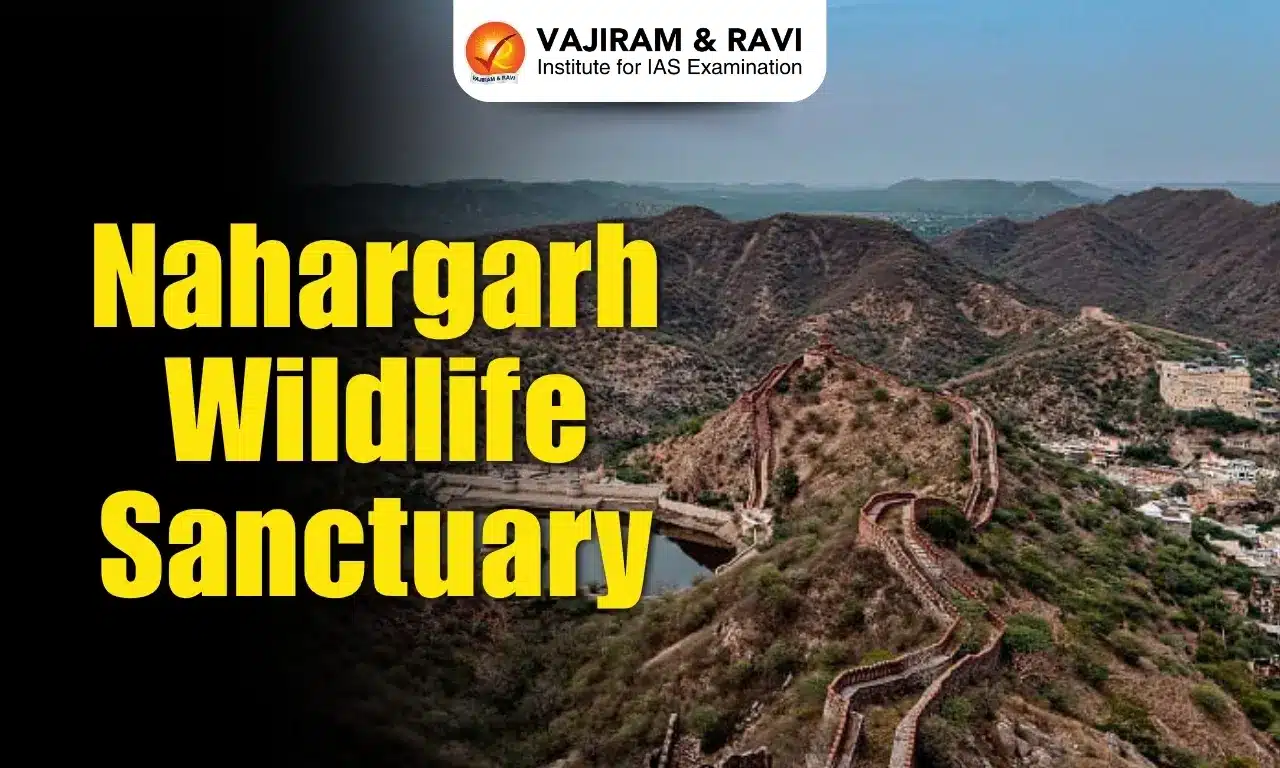
Nahargarh Wildlife Sanctuary

Nahargarh Wildlife Sanctuary

Nahargarh Wildlife Sanctuary Latest News

The Rajasthan High Court recently set aside a National Board for Wildlife panel decision that denied wildlife clearance to Taj Amber, a five-star property located about 97 metres from the Nahargarh Wildlife Sanctuary boundary.

About Nahargarh Wildlife Sanctuary

  • It is located just 20 kilometres from Jaipur, Rajasthan.
  • It’s a small sanctuary of 52 sq.km.  and is situated in the Aravalli range.
  • The sanctuary is named after Nahargarh Fort, a historic fort built in the 18th century by Maharaja Sawai Jai Singh II, the founder of Jaipur. 
  • It connects ecologically with other forest areas like the Ranthambore Tiger Reserve. 
  • Within the sanctuary is the Nahargarh Biological Park, which covers 720 hectares and focuses on conservation, including species like Bengal tigers, Asiatic lions, and sloth bears.  
  • Flora: The sanctuary features a rugged terrain with hills, valleys, seasonal streams, and dry deciduous forests typical of the semi-arid region, including trees such as dhok, babool, khejri, and ber.
  • Fauna: 
    • Common species include leopards, wild boars, deer, lions, tigers, sloth bears, and several small mammals.
    • It’s a haven for bird watchers, with a variety of species, including peacocks, owls, and eagles.
    • It is also home to reptiles like Indian rock pythons, monitor lizards, and amphibians like frogs and toads.

Source: TOI

Nahargarh Wildlife Sanctuary FAQs

Q1: Where is Nahargarh Wildlife Sanctuary located?

Ans: It is located about 20 km from Jaipur in Rajasthan.

Q2: In which mountain range is Nahargarh Wildlife Sanctuary situated?

Ans: It is situated in the Aravalli Range.

Q3: What type of vegetation is found in Nahargarh Wildlife Sanctuary?

Ans: It has dry deciduous forests typical of semi-arid regions.

Enquire Now