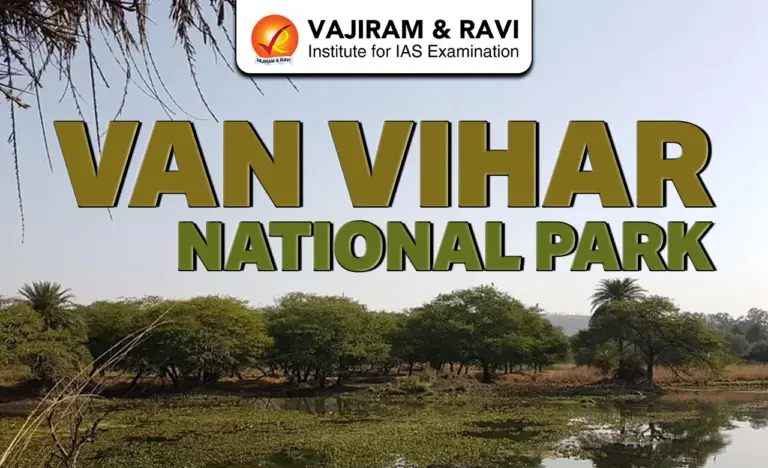
Van Vihar National Park is a unique urban protected area located in Bhopal, Madhya Pradesh. It is known for combining the features of a national park, zoo, rescue centre, and conservation breeding centre, making it one of the most distinctive wildlife sites in India.
Van Vihar is situated along the banks of the famous Upper Lake, which is also a Ramsar Site and part of the Bhoj Wetland. This location enhances the park’s ecological importance by supporting rich biodiversity, especially birds and aquatic life.
Wildlife in Van Vihar National Park
The Van Vihar National Park has a unique system where animals are categorized into carnivores (kept in enclosures) and herbivores (allowed to roam freely), maintaining both safety and ecological balance.
- It serves as a rescue and rehabilitation centre, so many animals here are rescued from circuses, illegal captivity, or human-wildlife conflict zones.
- Major carnivorous animals found in the park include tiger, white tiger, lion, leopard, hyena, and sloth bear, all of which are housed in large naturalistic enclosures.
- The tiger is one of the important species and is protected under national conservation programmes like Project Tiger.
- The presence of lions in the park is unique for Central India, as many of them are rescued from circuses or captivity.
- Leopards and hyenas contribute to maintaining the ecological balance as important predators in the food chain.
- Sloth bears in the park are mostly rescued individuals and are provided specialized care and rehabilitation.
- Herbivorous animals form a major part of the park’s open ecosystem and are allowed to roam freely in natural surroundings.
- Common herbivores include chital (spotted deer), sambar deer, blackbuck, nilgai (blue bull), and chousingha (four-horned antelope).
- These animals play a key role in maintaining vegetation balance and serve as prey base for carnivores in natural ecosystems.
- Their free movement within the park creates a near-natural habitat and enhances ecological authenticity.
- The park also hosts several smaller mammals such as common langur, rhesus monkey, and porcupine.
- These species contribute to seed dispersal and forest regeneration, supporting the overall ecosystem.
- Van Vihar is rich in bird diversity due to its location near a major wetland, attracting both resident and migratory species.
- Common birds include peacock, kingfisher, parrot, heron, and egret.
- Migratory birds such as ducks and geese visit during winter, making the park an important bird-watching site.
- The wetland ecosystem of Upper Lake enhances avian biodiversity and supports breeding and feeding activities.
- Reptiles are also an important part of the park’s biodiversity, especially due to the presence of water bodies.
- Major reptiles include marsh crocodiles (mugger), turtles, and various species of snakes and lizards.
Special Focus Sloth Bear
The Sloth Bear (Melursus ursinus) is a medium-sized bear species native to the Indian subcontinent and is one of the key species protected in Van Vihar National Park located in Bhopal.
- It belongs to the family Ursidae and is easily identified by its shaggy black coat, long snout, and a distinct V- or Y-shaped white patch on its chest.
- The species has long, curved claws which are specially adapted for digging into termite mounds and searching for food underground.
- Sloth bears are primarily insectivorous in nature and feed mainly on termites, ants, and honey, although they also consume fruits like ber and mango during seasonal availability.
- They use their powerful claws to break open termite mounds and produce a loud sucking sound while feeding due to their specialized lips and absence of upper incisors.
- The species is mostly nocturnal, meaning it remains active during the night and rests during the day in caves, burrows, or dense vegetation.
- Sloth bears are generally solitary animals, except during the breeding season or when females are raising their cubs.
- A unique behavioral feature is that the mother carries her cubs on her back, which is rarely seen in other bear species.
- They have a highly developed sense of smell that helps them locate food, but their eyesight is relatively weak.
- Sloth bears inhabit tropical forests, dry deciduous forests, grasslands, and scrublands across India and are found along the outer Himalayan foothills from Punjab to Arunachal Pradesh.
- They are absent in high-altitude Himalayan regions, desert areas like Rajasthan, and large treeless landscapes in southern India.
- The gestation period of sloth bears is around 6–7 months, and females usually give birth to 1–3 cubs at a time.







 Last updated on April, 2026
→ UPSC Final Result 2025 is now out.
→ UPSC has released UPSC Toppers List 2025 with the Civil Services final result on its official website.
→ Anuj Agnihotri secured AIR 1 in the UPSC Civil Services Examination 2025.
→ UPSC Marksheet 2025 is now out.
→ UPSC Notification 2026 & UPSC IFoS Notification 2026 is now out on the official website at upsconline.nic.in.
→ UPSC Calendar 2026 has been released.
→ Check out the latest UPSC Syllabus 2026 here.
→ UPSC Prelims 2026 will be conducted on 24th May, 2026 & UPSC Mains 2026 will be conducted on 21st August 2026.
→ The UPSC Selection Process is of 3 stages-Prelims, Mains and Interview.
→ Prepare effectively with Vajiram & Ravi’s UPSC Prelims Test Series 2026 featuring full-length mock tests, detailed solutions, and performance analysis.
→ Enroll in Vajiram & Ravi’s UPSC Mains Test Series 2026 for structured answer writing practice, expert evaluation, and exam-oriented feedback.
→ Join Vajiram & Ravi’s Best UPSC Mentorship Program for personalized guidance, strategy planning, and one-to-one support from experienced mentors.
→ Shakti Dubey secures AIR 1 in UPSC CSE Exam 2024.
→ Also check Best UPSC Coaching in India
Van Vihar National Park FAQs
Q1. Where is Van Vihar National Park located?+
Q2. Why is Van Vihar National Park unique?+
Q3. Which animals are found in Van Vihar National Park?+
Q4. What role does Van Vihar play in conservation?+
Q5. What is the importance of Upper Lake near the park?+
Tags: geography geography notes van vihar national park