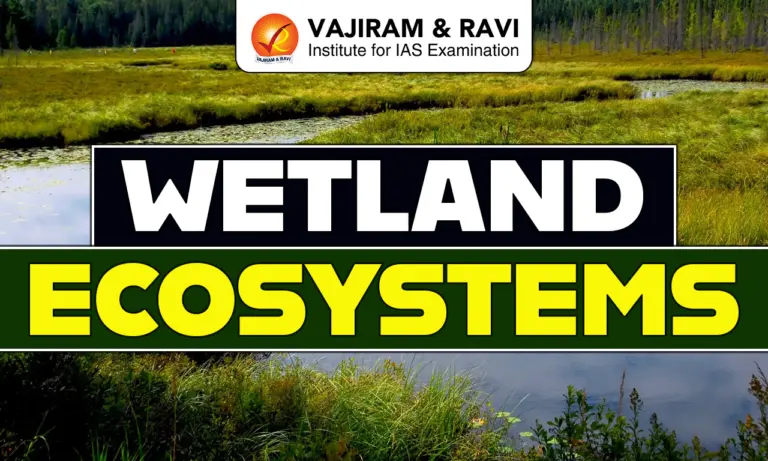
Wetland Ecosystems are areas where land is covered with water either permanently or seasonally, such as marshes, swamps, and mangroves. They support a wide variety of plants and animals and play an important role in maintaining ecological balance. Wetlands also help in water purification, flood control, and provide habitat for wildlife, making them valuable natural resources.
About Wetland
- Wetlands are areas of land that lie between terrestrial (land) and aquatic (water) ecosystems, meaning they are neither completely dry nor fully covered with water. According to the International Union for Conservation of Nature, wetlands are lands that are submerged or saturated with water. They can be natural or man-made, permanent or temporary, and may contain still or flowing water that can be fresh, brackish, or salty. It also includes shallow marine areas where the water depth does not exceed 6 meters during low tide. Examples include mangroves, lake littoral zones, floodplains, and other marshy or swampy areas.
- The Ramsar Convention on Wetlands defines wetlands as:
- areas of marsh, fen, and peatland, whether natural or artificial, permanent or temporary, with water that is fresh, brackish, or salt, including areas of marine water where the depth at low tide does not exceed 6 meters.
Major Types of Wetlands
- Swamps: Swamps are wetlands that remain filled with water most of the time and are mainly covered with trees. They are of two types:
- Freshwater Swamps: These develop on flat land near lakes or rivers where water collects easily and does not flow away quickly. The soil stays wet, allowing plants like cattails, lotus, and cypress to grow well. Such swamps are commonly found in tropical regions near the Equator.
- Saltwater Swamps: These form in coastal areas where land is regularly covered by seawater during high tides. The water here is brackish (a mix of saltwater and freshwater). A famous example is the Sundarbans, which has the largest mangrove forest in the world.
- Marshes: Marshes are wetlands dominated by grasses and soft plants rather than trees. They are usually found along river mouths, coastlines, and bays, and are often flooded and exposed due to tides. They are of two types:
- Freshwater Marshes: These are found away from the sea, often around lakes and rivers. They are mainly covered with grasses and aquatic plants. Many such marshes are located in the prairie regions of North America.
- Saltwater Marshes: These are very rich in biodiversity. They are mostly covered with grasses and algae and provide habitat for many organisms like fish, shellfish, amphibians, and reptiles. Sometimes a few mangrove trees may also be present.
- Bogs: Bogs are wetlands usually found in colder regions like North America, Europe, and Asia. They develop in areas where water collects and does not drain easily. Over time, dead plant material builds up and forms a thick layer called peat. The soil in bogs is more acidic and less fertile compared to other wetlands. Because of this, fewer types of plants and animals are found here, so biodiversity is lower than in swamps and marshes.
- Fen: Fens are wetlands that have a high level of nutrients. They mainly develop in areas where water comes from rainfall. This regular supply of water helps maintain moisture and supports the growth of different types of vegetation.





Significance of Wetland Ecosystems
- Water Regulation: Wetlands help control the flow and storage of water. They absorb excess rainwater during heavy rainfall and release it slowly, which reduces the chances of floods. They also play an important role in recharging groundwater.
- Erosion Control and Land Formation: Wetlands reduce soil erosion by slowing down the movement of water. They help in the transport and deposition of sediments, which supports land formation and protects coastal and river areas from storm damage.
- Water Security and Climate Protection: Wetlands improve the availability and quality of water. They act as natural buffers against floods and storms and help communities adapt to the impacts of climate change.
- High Productivity and Biodiversity: Wetlands are among the most productive ecosystems in the world. They support a large variety of plants and animals and have high nutrient recycling, which helps maintain ecological balance.
- Habitat for Birds and Wildlife: Wetlands provide an important habitat for many species, especially waterbirds and migratory birds. These areas are used for feeding, breeding, and resting during long migrations across regions and continents.
- Source of Food and Livelihood: Wetlands are an important source of food such as fish, shellfish, and rice. They support fisheries and aquaculture, providing livelihood to many people. They also help in maintaining soil fertility and natural pest control.
- Ecological Support Functions: Wetlands support important ecological processes like nutrient cycling and regulation of pests and diseases. These functions help in maintaining the overall health of ecosystems.
- Cultural and Recreational Value: Wetlands have cultural, historical, and religious importance in many societies. They are also popular for recreational activities like bird watching, fishing, photography, and nature walks.
Threats to Wetland Ecosystem
- Changes in Water Flow (Hydrological Regime): Wetlands depend on a proper flow and availability of water. Changes like reduced water supply, irregular flooding, and loss of connection with nearby water bodies can harm wetland ecosystems. These changes affect biodiversity and disturb important processes like nutrient exchange.
- Catchment Area Degradation: When the surrounding land (catchment area) is damaged due to deforestation, construction, or soil erosion, it reduces the ability of wetlands to store water. This weakens the overall health and functioning of the wetland.
- Invasive Species: Many wetlands in India are affected by non-native or exotic species that grow rapidly and disturb the natural ecosystem. For example, water hyacinth spreads quickly and blocks sunlight and oxygen, harming other plants and aquatic life.
- Overuse of Resources: Unsustainable use of wetland resources like excessive fishing, plant harvesting, and overgrazing by animals can damage the ecosystem and reduce its productivity.
- Excessive Water Extraction: Taking too much water from wetlands for agriculture, industry, or domestic use lowers water levels and disturbs the natural balance of the ecosystem.
- Mining Activities: Activities like sand, salt, or laterite mining in and around wetlands damage their structure and reduce their ecological value.
- Pollution and Urbanization (Additional Threat): Discharge of sewage, industrial waste, and chemicals into wetlands pollutes the water. Rapid urban development also leads to encroachment and loss of wetland areas.
India’s Wetlands of International Importance
- India has a wide variety of wetlands and a large number of them. This diversity is due to differences in rainfall, landforms, climate, and physical features across the country. Each wetland is unique and plays an important role in the environment.
- India became a member of the Ramsar Convention on Wetlands on 1 February 1982. At present, India has 98 Ramsar Sites spread across 28 states and union territories, covering a surface area of 1.384.140 ha. These wetlands are recognized for their importance in terms of ecology, water systems, and biodiversity.
- The largest Ramsar site in India is the Sundarban Wetland in West Bengal, covering about 4,230 sq. km. The smallest sites are Renuka Lake and Vembannur Wetland Complex, both covering less than 1 sq. km.
- The oldest Ramsar sites in India are Chilika Lake in Odisha and Keoladeo Ghana National Park in Rajasthan, which were designated in 1981. This shows that India has been committed to wetland conservation for a long time.
Measures Taken to Conserve Wetland Ecosystems
- Amrit Dharohar Programme: This initiative focuses on linking wetland conservation with local livelihoods by promoting eco-friendly tourism. In its first phase, important sites like Sultanpur National Park, Sirpur Wetland, Yashwant Sagar, Bhitarkanika National Park, and Chilika Lake were selected. Training programmes like Alternative Livelihood Programme (ALP) and Paryatan Navik Certificate (PNC) help local people earn income through conservation activities.
- Wetland City Accreditation (WCA): India is promoting sustainable urban planning under the Ramsar Convention on Wetlands through WCA. Cities must protect wetlands as natural flood buffers. In 2025, Indore and Udaipur became the first Indian cities to receive this recognition.
- Wetland Mitras (Citizen Participation): Under the “Save Wetlands Campaign,” local people are encouraged to act as “Wetland Mitras” (Friends of Wetlands). They help monitor wetlands, report pollution or encroachment, and support conservation as part of a people’s movement.
- Green Credit Programme (GCP): This programme allows private companies to earn credits by funding wetland restoration. It encourages the private sector to invest in conservation, including activities like restoring mangroves.
- Wetland Health Cards: The government uses modern tools like satellite data (from Indian Space Research Organisation) along with field data to monitor wetlands. These “health cards” give real-time information about water quality and help take timely action.
- Expansion of Ramsar Sites: India has significantly increased its wetlands under international protection from 26 in 2014 to 98 now. This ensures better conservation through global recognition and legal protection.
- Ground Truthing of Wetlands: To protect even small wetlands, physical verification (ground truthing) is being done along with satellite mapping. This helps identify and protect wetlands that might otherwise be ignored or encroached upon.
- National Plan for Conservation of Aquatic Ecosystems (NPCA): This plan focuses on managing not just the wetland but also its surrounding catchment area. It helps control pollution and siltation at the source for better long-term conservation.
- National Wetlands Conservation Programme (NWCP): Launched in 1985-86, this programme aims to protect important wetlands across India. About 115 wetlands have been identified for priority action. State governments manage these wetlands, while the Ministry of Environment, Forest and Climate Change provides guidelines, funding, and technical support.

 Last updated on April, 2026
→ UPSC Final Result 2025 is now out.
→ UPSC has released UPSC Toppers List 2025 with the Civil Services final result on its official website.
→ Anuj Agnihotri secured AIR 1 in the UPSC Civil Services Examination 2025.
→ UPSC Marksheet 2025 is now out.
→ UPSC Notification 2026 & UPSC IFoS Notification 2026 is now out on the official website at upsconline.nic.in.
→ UPSC Calendar 2026 has been released.
→ Check out the latest UPSC Syllabus 2026 here.
→ UPSC Prelims 2026 will be conducted on 24th May, 2026 & UPSC Mains 2026 will be conducted on 21st August 2026.
→ The UPSC Selection Process is of 3 stages-Prelims, Mains and Interview.
→ Prepare effectively with Vajiram & Ravi’s UPSC Prelims Test Series 2026 featuring full-length mock tests, detailed solutions, and performance analysis.
→ Enroll in Vajiram & Ravi’s UPSC Mains Test Series 2026 for structured answer writing practice, expert evaluation, and exam-oriented feedback.
→ Join Vajiram & Ravi’s Best UPSC Mentorship Program for personalized guidance, strategy planning, and one-to-one support from experienced mentors.
→ Shakti Dubey secures AIR 1 in UPSC CSE Exam 2024.
→ Also check Best UPSC Coaching in India
Wetland Ecosystems FAQs
Q1. What are wetlands?+
Q2. How are wetlands defined internationally?+
Q3. What are the major types of wetlands?+
Q4. Why are wetlands important?+
Q5. What are the main threats to wetlands?+
Tags: geography geography notes Wetland Ecosystems