Airports in India have emerged as a key pillar of economic growth, connectivity and infrastructure development. Rising incomes, rapid urbanisation, expanding tourism and supportive government initiatives have significantly transformed the country’s aviation sector, making India the world’s third-largest domestic aviation market.
Airports in India play a crucial role in facilitating passenger mobility, trade, investment, tourism, logistics and regional integration, while also generating substantial employment opportunities. Over the past decade, India has witnessed remarkable growth in airport infrastructure, with operational airports increasing from 74 in 2014 to over 165 in mid-2026. As India advances towards the vision of Viksit Bharat @2047, a modern, efficient and sustainable airport network will be crucial for strengthening economic competitiveness, multimodal connectivity and balanced regional development.
Airports in India Overview
Airports in India have emerged as critical drivers of India's aviation growth, economic development, and regional integration.
- Expanding Airport Network: India's operational airport network has expanded from 74 airports in 2014 to around 165 airports as of July 2026.
- Growing Airport Passenger Traffic: Indian airports handled approximately 412 million passengers in FY25, making India the world's third-largest domestic aviation market and reflecting strong growth in air travel demand.
- Airport-led Regional Connectivity: Under the UDAN Scheme, over 677 routes have been operationalised, connecting 95 airports and benefiting more than 1.68 crore passengers, particularly in underserved regions as of 30 June 2026.
Different Types of Airports in India
Airports in India can be classified on the basis of their international status, ownership, operational purpose, location and development model.
- International Airports: Airports authorised to handle international passenger and cargo traffic, subject to customs, immigration and other regulatory requirements.
- Domestic Airports: Airports primarily serving domestic air traffic and connecting cities and regions within India.
- Customs Airports: Airports designated to handle specified international operations under customs procedures, even if they do not have the scale of a major international gateway.
- Civil Enclaves: Civilian airport facilities located within or adjacent to defence airfields, where civilian aircraft operate using defence-controlled infrastructure.
- Greenfield Airports: Airports developed on a new site with new infrastructure, generally to create additional capacity or serve emerging urban and economic centres.
- Example: Donyi Polo Airport, the first greenfield airport in Arunachal Pradesh, and Kushinagar International Airport located in Uttar Pradesh.
- Brownfield Airports: Existing airports that are expanded, modernised or redeveloped to increase capacity and improve operational efficiency.
- Example: Vijayawada International Airport. The pre-existing domestic airport (Gannavaram Airport) underwent massive infrastructure upgrades, expansions, and modernisations to achieve international status.
- Regional Airports: Airports serving smaller cities and remote or underserved areas, particularly under regional connectivity initiatives such as UDAN.
- Cargo Airports/Hubs: Airports with specialised cargo terminals, warehousing, cold-chain facilities and logistics infrastructure designed to facilitate high-value and time-sensitive freight movement.
Airports in India Significance


Airports in India are critical infrastructure assets that facilitate economic growth, regional integration, trade, tourism, and strategic connectivity.
- Economic Growth: Airports act as economic growth hubs, with every ₹100 spent on air transport generating nearly ₹325 in economic activity.
- Employment: An International Civil Aviation Organisation (ICAO) study shows that air connectivity has an employment multiplier of 6.1.
- Regional Connectivity: Airports under the UDAN scheme have connected remote and underserved regions, benefiting over 1.68 crore passengers.
- Trade and Logistics: Airports facilitate high-value cargo movement, helping total air cargo traffic rise from 2.53 MMT (FY15) to 5.26 MMT (as of 26th August 2026).
- Tourism and Employment: Airports boost tourism accessibility and support an aviation ecosystem that currently generates 7.7 million jobs, projected to reach 25 million by 2040.
- National Integration and Security: Airports strengthen connectivity in border, island, and northeastern regions while supporting disaster relief, defence logistics, and emergency operations.
- Infrastructure-led Development: Airports serve as key nodes under PM Gati Shakti and the National Logistics Policy, with a target of 350-400 airports by 2047 to support Viksit Bharat.
Airports in India Institutions
India’s civil aviation ecosystem is supported by institutions responsible for policy formulation, safety regulation, airport infrastructure, aviation security, economic regulation, accident investigation and human-resource development. These bodies collectively ensure the safe, efficient and sustainable growth of the aviation sector.
- Ministry of Civil Aviation (MoCA): The nodal ministry responsible for policy formulation, development and regulation of the civil aviation sector. It administers key laws, including the Bharatiya Vayuyan Adhiniyam, 2024, and Aircraft Rules, 1937.
- Directorate General of Civil Aviation (DGCA): The principal aviation safety regulator responsible for aircraft airworthiness, pilot and crew licensing, airline/operator certification and enforcement of safety standards.
- Bureau of Civil Aviation Security (BCAS): Responsible for aviation security, including formulation and monitoring of security standards and measures at domestic and international airports.
- Aircraft Accident Investigation Bureau (AAIB): Investigates aircraft accidents and serious incidents in accordance with national rules and international standards to prevent future accidents.
- Airports Economic Regulatory Authority of India (AERA): A statutory authority under the AERA Act, 2008, responsible for regulating aeronautical tariffs and service-quality standards at major airports.
- Airports Authority of India (AAI): Responsible for airport development and management and Air Navigation Services, including air traffic management and related communication, navigation and surveillance infrastructure.
- AI Assets Holding Limited (AIAHL): A Central Public Sector Enterprise under MoCA responsible for managing and monetising specified assets and liabilities transferred from the erstwhile Air India group following its disinvestment.
- Pawan Hans Limited: A public-sector helicopter service provider offering helicopter operations and connectivity, particularly to remote, difficult and offshore locations.
- Indira Gandhi Rashtriya Uran Akademi (IGRUA): An autonomous aviation training institution under MoCA providing commercial pilot training and aviation-related skill development.
- Rajiv Gandhi National Aviation University (RGNAU): A Central University focused on aviation education, training, research and capacity building in the civil aviation sector.
- DigiYatra Foundation: A Section 8 not-for-profit organisation associated with AAI and airport stakeholders that operates the DigiYatra digital and biometric passenger-processing ecosystem.
Airports in India List
India's rapidly growing aviation network comprises around 165 operational airports, including 34+ international gateways alongside domestic and customs hubs. Managed by the Airports Authority of India and private entities, this infrastructure serves as a vital economic engine connecting major metros, tourist hotspots, and remote regional sectors.
Domestic Airports in India List
Out of the operational airports, some of the important domestic airports in India are as follows:
| No. | Airport Name | City / State |
| Northern India | ||
|
1 |
Jolly Grant Airport (Dehradun) |
Uttarakhand |
|
2 |
Gorakhpur Airport |
Uttar Pradesh |
|
3 |
Jammu Civil Enclave |
Jammu & Kashmir |
|
4 |
Bhuntar Airport (Kullu-Manali) |
Himachal Pradesh |
|
5 |
Pantnagar Airport |
Uttarakhand |
|
6 |
Shimla Airport |
Himachal Pradesh |
| Southern India | ||
|
7 |
Kadapa Airport |
Andhra Pradesh |
|
8 |
Rajahmundry Airport |
Andhra Pradesh |
|
9 |
Tirupati Airport |
Andhra Pradesh |
|
10 |
Belagavi Airport |
Karnataka |
|
11 |
Hubballi Airport |
Karnataka |
| Western & Central India | ||
|
12 |
Jalgaon Airport |
Maharashtra |
|
13 |
Kolhapur Airport |
Maharashtra |
|
14 |
Sindhudurg Airport |
Maharashtra |
|
15 |
Shri Guru Gobind Singh Ji Airport (Nanded) |
Maharashtra |
|
16 |
Nashik Airport (Ozar) |
Maharashtra |
|
17 |
Solapur Airport |
Maharashtra |
|
18 |
Swami Vivekananda Airport |
Chhattisgarh |
|
19 |
Diu Airport |
Daman & Diu |
|
20 |
Surat Airport |
Gujarat |
|
21 |
Vadodara Airport |
Gujarat |
|
22 |
Jagdalpur Airport |
Chhattisgarh |
| Eastern & Northeastern India | ||
|
23 |
Bagdogra Airport |
West Bengal |
International Airports in India List
India has 36 international airports as of 7 July 2026, reflecting the rapid expansion of the country's aviation infrastructure. Some of the major international airports in India are:
| No. | Airport | City / State |
|
1 |
Indira Gandhi International Airport |
Delhi |
|
2 |
Chhatrapati Shivaji Maharaj International Airport |
Mumbai, Maharashtra |
|
3 |
Kempegowda International Airport |
Bengaluru, Karnataka |
|
4 |
Rajiv Gandhi International Airport |
Hyderabad, Telangana |
|
5 |
Chennai International Airport |
Chennai, Tamil Nadu |
|
6 |
Netaji Subhas Chandra Bose International Airport |
Kolkata, West Bengal |
|
7 |
Cochin International Airport |
Kochi, Kerala |
|
8 |
Sardar Vallabhbhai Patel International Airport |
Ahmedabad, Gujarat |
|
9 |
Manohar International Airport (Mopa) |
Goa |
|
10 |
Sri Guru Ram Dass Jee International Airport |
Amritsar, Punjab |
|
11 |
Calicut International Airport |
Kozhikode, Kerala |
|
12 |
Lokpriya Gopinath Bordoloi International Airport |
Guwahati, Assam |
|
13 |
Jaipur International Airport |
Jaipur, Rajasthan |
|
14 |
Thiruvananthapuram International Airport |
Thiruvananthapuram, Kerala |
|
15 |
Veer Savarkar International Airport |
Port Blair, Andaman & Nicobar Islands |
|
16 |
Sheikh ul-Alam International Airport |
Srinagar, Jammu & Kashmir |
|
17 |
Navi Mumbai International Airport |
Navi Mumbai, Maharashtra |
|
18 |
Maharishi Valmiki International Airport |
Ayodhya, Uttar Pradesh |
|
19 |
Kushinagar International Airport |
Kushinagar, Uttar Pradesh |
|
20 |
Madurai International Airport |
Madurai, Tamil Nadu |
Airports in India Major Government Initiatives
The Government of India has undertaken several initiatives to expand infrastructure for airports in India, improve regional connectivity, modernise passenger services and strengthen the wider aviation ecosystem.
- UDAN Regional Connectivity Scheme: Launched in 2016 to make air travel affordable and improve connectivity to underserved and unserved regions by providing viability-gap support and developing regional infrastructure for airports in India.
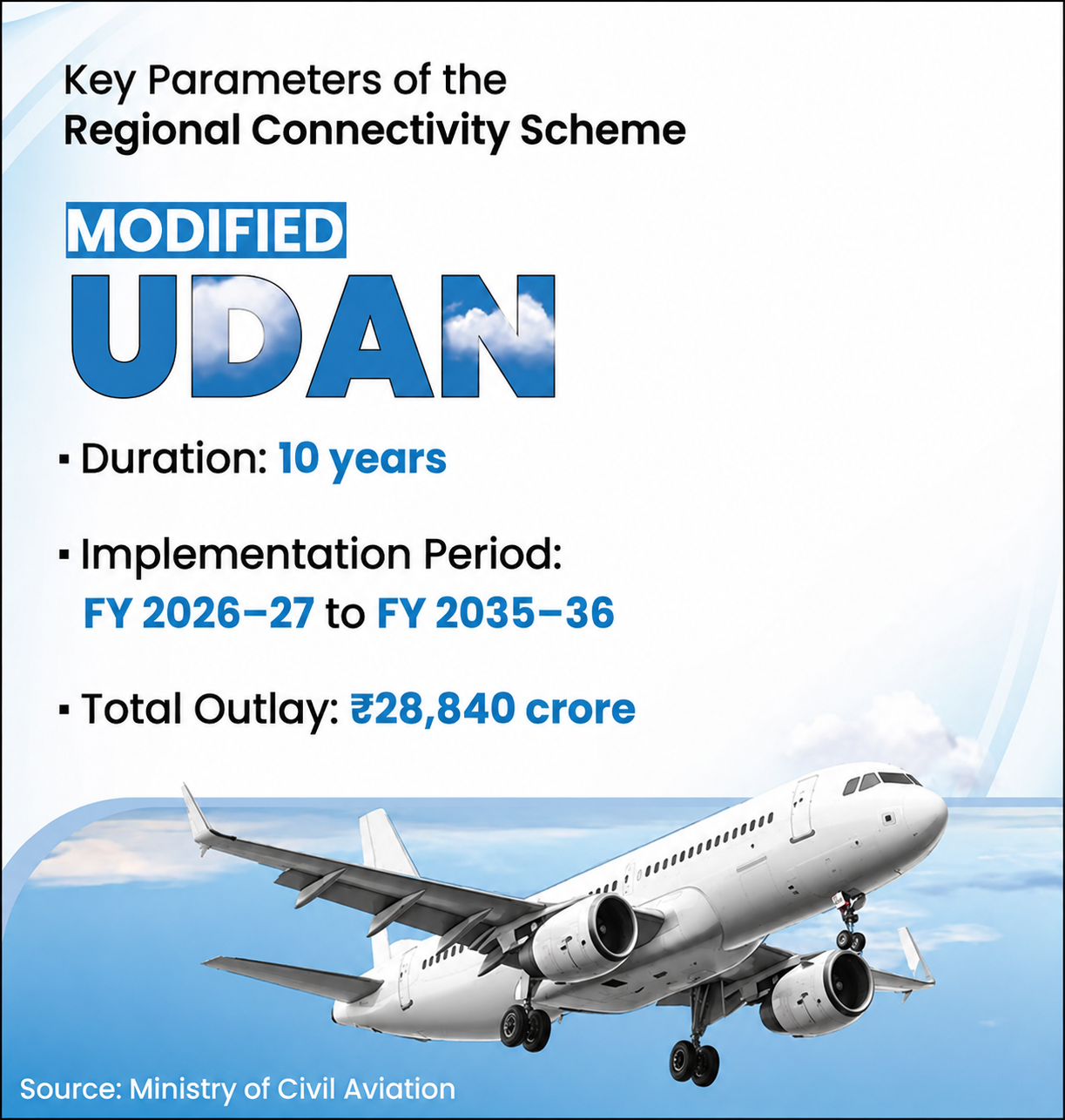
- Modified UDAN, 2026: Approved with an outlay of ₹28,840 crore for FY 2026–27 to FY 2035–36, it aims to deepen regional connectivity, develop 100 airports in India from existing unserved airstrips, support approximately 441 aerodromes, establish 200 modern helipads and provide viability-gap funding to airline operators.
- Greenfield Airports Policy, 2008: Provides the framework for establishing new airports in India, including procedures for site clearance, appraisal, inter-ministerial coordination and regulatory approvals.
- PM Gati Shakti: Promotes integrated planning of airport infrastructure with roads, railways, ports, logistics infrastructure and other economic nodes.
- DigiYatra: Uses biometric and facial-recognition-based digital processing to provide a more seamless and contactless passenger journey at participating airports.
- GAGAN: India's Satellite-Based Augmentation System improves navigation accuracy and supports safer and more efficient aircraft operations. It also has potential applications in disaster management and search-and-rescue operations.
- Krishi UDAN: Facilitates the movement of agricultural and perishable products by air, particularly from hilly, northeastern and tribal regions, helping farmers access distant markets.
- Aircraft Leasing through GIFT IFSC: Government reforms have sought to develop GIFT International Financial Services Centre as a hub for aircraft leasing, financing and related aviation services, reducing dependence on overseas financial centres.
- MRO Promotion: Policy measures aim to develop domestic Maintenance, Repair and Overhaul capabilities and reduce India's dependence on overseas maintenance facilities.
Airports in India Challenges
Despite remarkable growth in the number of airports in India, passenger traffic, and regional connectivity, India's aviation sector faces several structural and operational challenges. Addressing these issues is essential to sustain long-term growth, improve competitiveness, and achieve the vision of expanding the airport network to 350–400 airports by 2047.
- Inadequate Airport Infrastructure: Rising passenger and aircraft traffic is placing increasing pressure on airport capacity and Air Traffic Control (ATC) systems, leading to congestion and operational inefficiencies.
- Gaps in Regional Airport Connectivity: Despite the success of the UDAN scheme, many remote, border, hilly, and underserved regions continue to lack adequate airport infrastructure and sustainable air services.
- High Cost of Operations: Aviation Turbine Fuel (ATF) remains the largest expenditure for airlines, accounting for nearly 45–50% of operating costs, affecting profitability and affordability of air travel.
- Shortage of Skilled Manpower: The aviation sector faces a growing shortage of pilots, engineers, maintenance personnel, and air traffic controllers, which could constrain future expansion.
- Underdeveloped Aviation Ecosystem: Limited domestic MRO facilities and dependence on imported aircraft and components increase maintenance costs and reduce operational competitiveness.
- Financial and Environmental Pressures: Intense competition, declining yields, fuel price volatility, sustainability requirements, and external shocks such as geopolitical conflicts continue to challenge the long-term viability of the aviation sector.
Airports in India Way Forward
Airports will be at the centre of India's aviation growth and infrastructure transformation in the coming decades. With rising passenger traffic, expanding cargo demand, and the goal of becoming a developed nation by 2047, India must focus on creating a modern, efficient, sustainable, and globally competitive airport ecosystem. Strengthening airport infrastructure and connectivity will be crucial for supporting economic growth, regional development, and global integration.
- Expand Airport Infrastructure: Increase the airport network from around 165 airports to over 350 airports by 2047, while modernising existing airports and developing dedicated cargo hubs to meet future passenger and freight demand.
- Strengthen Regional Connectivity: Expand UDAN for underserved regions and strengthen Krishi UDAN and airport-linked cold-chain/cargo infrastructure for agricultural produce.
- Develop a Competitive Aviation Ecosystem: Strengthen domestic MRO (Maintenance, Repair and Overhaul) facilities, promote indigenous aircraft component manufacturing, and enhance aircraft leasing through GIFT City to reduce dependence on foreign services.
- Promote Digital and Smart Airports: Scale up DigiYatra, GAGAN-based navigation systems, AI-enabled airport operations, and automated passenger processing to improve airport efficiency and passenger experience.
- Enhance Skills and Ease of Doing Business: Expand pilot and aviation workforce training, encourage greater participation of women in aviation, and undertake regulatory and tax reforms to improve sectoral competitiveness.
- Build Green and Sustainable Airports: Promote renewable energy-powered airports, Sustainable Aviation Fuel (SAF), carbon-neutral airport infrastructure, and environmentally sustainable Greenfield airport development to support long-term decarbonisation goals.
Airports in India UPSC PYQs
Q1. What is the need for expanding regional air connectivity in India? In this context, discuss the government's UDAN Scheme and its achievements. (UPSC Mains 2024)
Q2. Examine the developments of airports in India through Joint Ventures under the Public-Private Partnership (PPP) model. What are the challenges faced by the authorities in this regard? (UPSC Mains 2017)
Q3. Consider the following airports: (UPSC Prelims 2024)
- Donyi Polo Airport
- Kushinagar International Airport
- Vijayawada International Airport
In the recent past, which of the above have been constructed as Greenfield projects?
(a) 1 and 2 only
(b) 2 and 3 only
(c) 1 and 3 only
(d) 1, 2 and 3
Q4. Which one of the following is the purpose of the 'UDAN' scheme of the Government of India? (UPSC Prelims 2019)
(a) Making available some seats at a capped price to passengers on selected routes
(b) Training young people to become pilots of light combat aircraft
(c) Making new rocket launching facilities available to private enterprises
(d) Providing inexpensive and reliable internet connectivity to rural areas

 Last updated on Oct, 2026
→ UPSC 2027 Notification will be released on 13 January 2027 at upsconline.nic.in.
→ Check Nobel Prize 2026 Winners List here.
→ Download PIB PRiSM Monthly Magazine 2026 here.
→ Check UPSC Monthly Current Affairs Magazine The Recitals here.
→ Check out the latest UPSC Syllabus here.
→ Download UPSC Model Answers for Mains 2026
→ UPSC Mains Question Paper 2026 is out now for Essay & GS Paper 1, 2, 3 & 4.
→ UPSC Calendar 2027 has been released.
→ Enroll in Vajiram & Ravi’s UPSC Mains Test Series 2027 for structured answer writing practice, expert evaluation, and exam-oriented feedback.
→ Join Vajiram & Ravi’s UPSC Mentorship Program 2027 for personalized guidance, strategy planning, and one-to-one support from experienced mentors.
→ Go through the UPSC Mains Previous Year Papers to enhance your preparation.
→ UPSC has released UPSC Toppers List 2025 with the Civil Services final result on its official website.
→ Also check Best UPSC Coaching in India
Airports in India FAQs
Q1. How many operational airports are there in India?+
Q2. Which is the smallest airport in India?+
Q3. Which is the world's No. 1 airport?+
Q4. Which airport in India has the highest traffic?+
Q5. Which is the oldest airport in India?+
Tags: airports in india quest upsc economy notes