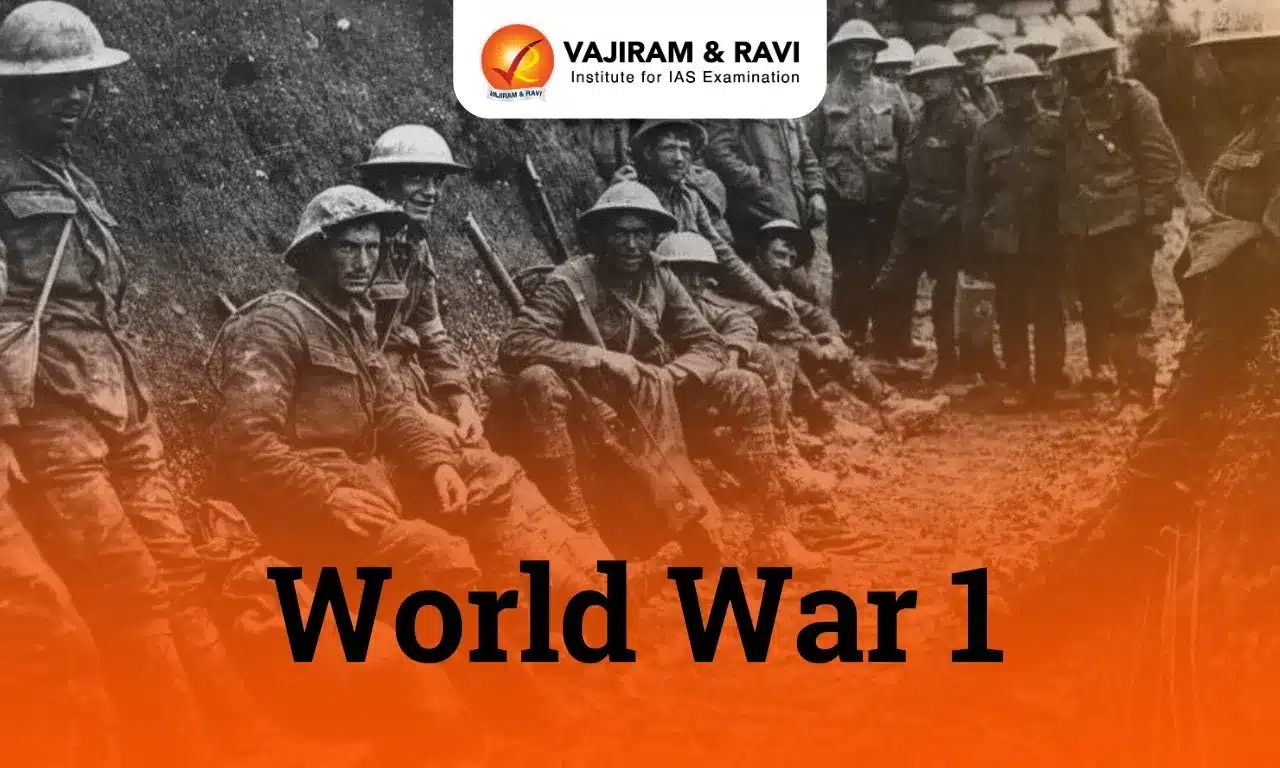
World War 1, commonly referred to as the Great War, was a devastating worldwide conflict that engulfed the world from 1914 to 1918, sparked by the assassination of Archduke Franz Ferdinand of Austria. The war's origins can be traced back to the rising tide of imperialism, nationalism, and militarism that gripped Europe in the late 19th century.
Ethnic tensions escalated as colonial powers fought for dominance over the world, drawing nations into the conflict through a complex web of alliances. The World War 1 began in Europe but quickly escalated, drawing in countries from around the world into a devastating conflict that would claim millions of lives and reshape the global political landscape.
First World War About
The First World War, also known as the Great War, was fought mainly between two major groups: the Allied Powers and Central Powers. The conflict began in Europe but became a global war because the major European powers controlled extensive colonial territories.
World War 1 Major Alliances
World War 1 was fought between two rival global coalitions: the Allied Powers and the Central Powers. Over thirty nations eventually joined through imperial networks.
- The Allied Powers: Countries known as the Allied Powers in World War 1 included Great Britain (including its global empire like India, Canada, Australia), France, and Russia (withdrew in 1917).
- Italy (switched sides to join in 1915), Japan, and the United States (entered the war in 1917) were the later entrants.
- Other key countries included Serbia, Belgium, Romania, and Portugal.
- The Central Powers: The Central Powers in World War 1 included countries such as Germany and Austria-Hungary, which formed the primary foundation.
- Other countries included the Ottoman Empire (joined 1914) and Bulgaria (joined 1915).


World War 1 Causes
World War I, one of the most devastating conflicts in human history, had its roots in several complex and intertwined factors. The causes of World War 1 can be understood through both long-term structural causes and the immediate trigger.
- Imperialism: The late 19th and early 20th centuries saw a rivalry between established European imperial powers like Britain, France, and Russia, and rising powers like Germany, Austria-Hungary, Italy, and Japan.
- These countries were competing fiercely for colonies, economic supremacy, and spheres of influence, fueling tensions.
- By 1900, Germany's industrial and military rise, fueled by iron and steel production, and naval buildup challenging Britain's supremacy, disrupted the European balance of power.
- Japan's victory over Russia in 1904-1905 exposed Russian weaknesses and undermined its global standing. The 1905 victory highlighted Asia's rising power to defeat a European empire and fueled unrest leading to the 1917 Russian Revolution.
- After the 1917 Russian Revolution, the Bolshevik government under Vladimir Lenin withdrew Russia from WWI, citing it as an imperialist conflict driven by capitalist interests, aiming to end Russia's involvement in what they deemed an unjust war.
- Colonialism: The Industrial Revolution fuelled European powers' pursuit of colonial expansion for raw materials and markets, sparking conflicts over territories and resources.
- This race for colonies intensified rivalries and fuelled nationalist sentiments, setting the stage for future confrontations.
- While Germany is generally blamed for World War I, the conflict was ultimately the result of competing colonial aspirations and rivalries among European powers.
- Nationalism and demands of nation-states: The rise of nationalism, both ethnic and linguistic, played a significant role in the outbreak of World War I. Various ethnic groups within Austria-Hungary and the Ottoman Empire aspired to establish their own nation-states.
- Examples: Czechs, Slovaks, Poles, Serbs, and Croats within the Austro-Hungarian Empire and Armenians, Greeks, and Bulgarians within the Ottoman Empire.
- The declining power of the Ottoman Empire (the Sick Man of Europe) in the Balkan region created a power vacuum and fueled nationalist aspirations among various ethnic groups within its territories.
- This desire for self-determination led to conflicts, particularly in the Balkan region.
- The Balkan Wars of 1912-1913, fought between the Balkan states and the Ottoman Empire, further destabilised the region and set the stage for future conflicts.
- Role of Germany: Germany's aggressive pursuit of colonial expansion, naval buildup challenging British supremacy, and unwavering support for Austria-Hungary after the Sarajevo assassination fuelled tensions and escalated the crisis.
- Furthermore, Germany's calculated risk of a localised war and its underestimation of Russia and France's willingness to intervene contributed significantly to the outbreak of a wider European conflict.
- While Germany was not solely responsible, its actions and miscalculations were critical factors that precipitated the descent into World War I.
World War 1 Immediate Cause
The immediate cause of World War 1 was the assassination of Archduke Franz Ferdinand of Austria by a Bosnian Serb nationalist on June 28, 1914.
- This event escalated into a conflict between Austria-Hungary and Serbia, which quickly drew in other powers due to the complex web of alliances and rivalries.
- Mutual Defence Alliances: The complex web of alliances like the Triple Entente (Britain, France, and Russia) and Triple Alliance (Germany, Austria-Hungary, and Italy) bound nations through treaty obligations.
- When Austria-Hungary declared war on Serbia after Sarajevo, Russia had to support its ally, Serbia. Germany then honoured its alliance with Austria-Hungary, leading to declarations of war against Russia and France.
- Britain joined to support its Russian and French allies.
- These interlocking alliances divided Europe into opposing camps, transforming a local crisis into a continent-wide conflagration as countries upheld commitments to respective allies.
World War 1 Key Events
Several events laid the foundation for World War 1; some of the key events of World War 1 were:
|
Events |
Summary |
|
The Moroccan Crisis (1905–1906) |
|
|
British Agreement with Russia (1907) |
|
|
The Bosnia Crisis (1908) |
|
|
The Agadir Crisis (1911) |
|
|
The First Balkan War (1912–1913) |
|
|
The Second Balkan War (1913) |
|
World War 1 Phases
World War I unfolded over several distinct phases from 1914 to 1918. This global war, initially centred in Europe, witnessed the participation of major world powers and their colonial empires, resulting in widespread destruction and loss of life on an unprecedented scale.
- Beginning: The war began on July 28, 1914, with the Austro-Hungarian declaration of war on Serbia after the assassination of Archduke Franz Ferdinand.
- Phase 1: The Opening Campaigns (1914): The war began with the Opening Campaigns, marked by the initial German offensive known as the Schlieffen Plan, which aimed to swiftly defeat France before turning against Russia.
- This phase witnessed major battles like the First Battle of the Marne and the Battle of Tannenberg, where the Allied forces halted the German advance, leading to a stalemate and the establishment of trench warfare along the Western Front.
- Phase 2: Stalemate and Attrition (1915-1917): The second phase was defined by a prolonged stalemate and a war of attrition, characterised by bloody battles like Verdun, the Somme, and Gallipoli, where both sides suffered immense casualties with little territorial gain.
- This phase also saw the entry of new participants, including the Ottoman Empire and Italy, as well as the withdrawal of Russia following the 1917 Bolshevik Revolution.
- Phase 3: The Tide Turns (1917-1918): The final phase witnessed a crucial turning point with the entry of the United States on the Allied side in 1917.
- This phase also saw the implementation of new military tactics and technologies, such as the widespread use of tanks and aircraft.
- Ultimately, the combined efforts of the Allied powers, coupled with the exhaustion of the Central Powers, led to the defeat of Germany and its allies.
- End: The war ended on November 11, 1918, with the signing of the Armistice after the defeat of Germany and its allies.
- Multiple fronts: The conflict took place on multiple fronts in Europe, Africa, and Asia. The main fronts were the Western Front with Germany against Britain, France, and later the U.S., and the Eastern Front with Russia against Germany and Austria-Hungary.
Dates of World War 1 and Timeline
The World War 1 timeline below outlines the major military engagements, political shifts, and turning points of World War I, tracing the war in chronological order from its 1914 spark to the 1919 peace treaty.
|
Date |
Event |
|
June 28, 1914 |
Archduke Franz Ferdinand was assassinated in Sarajevo. |
|
July 28, 1914 |
Austria-Hungary declares war on Serbia, starting WWI. |
|
September 6, 1914 |
Marne battle halts German advance; trench warfare begins. |
|
November 5, 1914 |
Allies declare war on the Ottoman Empire. |
|
April 22, 1915 |
German army initiates chemical warfare at Ypres. |
|
April 25, 1915 |
Allied forces land at Gallipoli, starting a failed campaign. |
|
May 7, 1915 |
German U-boat sinks British ocean liner Lusitania, killing 1,200 people. |
|
February 21, 1916 |
10-month Battle of Verdun begins in France. |
|
May 31, 1916 |
British and German fleets clash at Jutland. |
|
July 1, 1916 |
Battle of the Somme begins; bloodiest British day. |
|
March 15, 1917 |
Tsar Nicholas II abdicates during the Russian Revolution. |
|
April 6, 1917 |
United States officially declares war on Germany. |
|
November 20, 1917 |
Battle of Cambrai marks first large-scale tank use. |
|
Sept 26 – Nov 11, 1918 |
Final Allied Meuse-Argonne offensive clears Western Front. |
|
November 11, 1918 |
Armistice takes effect, ending World War I fighting. |
|
June 28, 1919 |
Treaty of Versailles officially signed by Allied powers. |
World War 1 Consequences
The war in 1914 was unprecedented in human history, characterised by a general conflict between highly organised states utilising modern technology and resources. Its impacts disrupted the international order that had existed in Europe since the Congress of Vienna in 1815.
- Economic Consequences: The participating countries in World War I incurred high financial costs. Germany and Great Britain spent approximately 60% of their GDP on the war.
- To finance the war, countries raised taxes, borrowed money from citizens, and resorted to printing money, leading to post-war inflation.
- Collapse of Empires: The war led to the fall of four major empires - the Russian Empire, German Empire, Austro-Hungarian Empire, and Ottoman Empire. This paved the way for the emergence of new nation-states and the redrawing of borders.
- Rise of New Nation-States and Territorial Changes: The dissolution of the old empires led to the rise of several new nation-states. These newly formed countries, including Poland, Czechoslovakia, Yugoslavia, Finland, Estonia, Latvia, and Lithuania, were largely established along ethnic and nationalist lines.
- The territorial changes were significant, with the dismantling of the Austro-Hungarian Empire into independent states of Austria, Hungary, Czechoslovakia, and Yugoslavia.
- Poland regained territories from Russia and Germany.
- Through the League of Nations mandate system, Great Britain and France gained control over former Ottoman territories in the Middle East, such as Palestine, Syria, Lebanon, and Iraq.
- Weakening of European Powers: The war significantly weakened the major European powers, such as Britain, France, and Germany, both economically and militarily. This paved the way for the rise of new powers, such as the United States and the Soviet Union.
- Rise of Nationalism and Self-Determination: The principle of self-determination, advocated by U.S. President Woodrow Wilson, gained traction, leading to the formation of new nation-states based on ethnic and linguistic identities.
- However, this also laid the groundwork for future conflicts as borders were redrawn, leaving some ethnic groups dissatisfied.
- Social Consequences: World War I had a profound impact on society. Birth rates declined due to the high number of casualties, leaving millions dead, wounded, maimed, and creating widows and orphans.
- Many civilians lost their land and became refugees, seeking shelter in other countries.
- Women played a crucial role in the workforce, replacing men in factories and offices during the war.
- Post-war, many countries granted women more rights, including the right to vote.
- The First World War challenged the dominant role of the upper classes, as the middle and lower classes demanded a say in shaping their countries.
- International Consequences: The global order underwent a significant shift, with the United States establishing itself as a major power and the Soviet Union (formed after the Russian Revolution) inspiring other nations to adopt Communist ideologies.
- This set the stage for the ideological struggle between Capitalism and Communism, known as the Cold War, which would shape the world for decades to come.
- The United States, having emerged victorious without experiencing war on its own territory, became a prominent global power.
- The Russian Revolution of 1917 and social unrest in the aftermath of the war fueled protests and created a pre-revolutionary atmosphere in many countries.
- Extreme nationalism and fear of Communist revolutions pushed some middle-class populations towards right-wing extremism and the rise of fascist movements.
- Creation of the League of Nations: The League of Nations was established as an international diplomatic organization after World War I. Its purpose was to prevent conflicts and resolve disputes between countries before they escalated into full-scale warfare.
- The League had mixed success and served as a precursor to the United Nations, achieving some victories but also facing limitations in its effectiveness.
World War 1 Important Treaties
The end of World War 1 was followed by a series of peace treaties.
|
Treaty |
Signed With |
Key Provisions |
|
Treaty of Versailles |
Germany |
- Signed on June 28, 1919, the Treaty of Versailles marked the official end of World War I and aimed to prevent future conflicts. - Territorial Clauses:
- Military Clauses:
- War Reparations:
|
|
Treaty of Saint-Germain |
Austria |
- Broke up the Austro-Hungarian Empire - Restricted Austria's frontiers to Vienna - Creation of Czechoslovakia from Bohemia and Moravia provinces - Serbia gained control over Bosnia-Herzegovina |
|
Treaty of Neuilly |
Bulgaria |
- Territorial losses for Bulgaria in favour of Romania, Greece, and Yugoslavia |
|
Treaty of Trianon |
Hungary |
- Separated Hungary from Austria - Certain Hungarian territories ceded to Romania, Yugoslavia, and Czechoslovakia |
|
Treaty of Sèvres |
Ottoman Empire |
- Imposed harsh conditions on Turkey - Triggered Turkish national rebellion led by Kemal Atatürk -This rebellion led to war against Greece, which occupied parts of Anatolia |
|
Treaty of Lausanne |
Turkey |
- Detached Syria, Palestine, and Mesopotamia from the Ottoman Empire - Ended Turkey's control over Egypt - Eastern Thrace, including Constantinople, remained under Turkish ownership |
World War 1 and India
India, as a British colony, played a crucial role in World War 1, contributing over a million soldiers and significant economic resources to support the Allied war effort. India provided a massive supply of troops, resources, and materials to support the British war effort.
- Participation of Indians: A large number of Indian soldiers served in the British Indian Army during World War I, fighting in various theatres, including Europe, Africa, and the Middle East.
- Key Battles: Prominent campaigns involving Indian troops were the Battle of Gallipoli (1915), the Mesopotamian Campaign (1914-1918), and the Palestine Campaign (1917-1918).
- India Gate: The iconic India Gate in Delhi was constructed by the British Empire in 1931 to commemorate the casualties of Indians during World War I (and in the Third Anglo-Afghan War).
- Economic Contribution: India's economic resources were heavily exploited by the British to finance the war. India contributed financially through taxes and the purchase of war bonds.
- Indian industries were geared towards producing essential war materials, such as clothing, equipment, and ammunition.
World War I Impact on India
The First World War (1914–1918) fundamentally disrupted India’s economy and society, creating deep financial hardship while accelerating the push for national independence.
- Economic Strain: The war placed a heavy economic burden on India. Resources, finances, and manpower were diverted to support the British war effort, leading to shortages, inflation, and economic hardships for the Indian population.
- Nationalist Movement Gained Momentum: India's significant contributions in terms of soldiers, resources, and finances strengthened the demand for self-governance and independence from British rule. The war exposed Indian soldiers to ideas of self-determination and nationalism, further fueling the independence movement.
- Political Reforms: The British government, acknowledging India's contributions, introduced the Montagu-Chelmsford Reforms of 1919, which aimed to introduce limited self-governance in India. However, these reforms were deemed inadequate by many Indian leaders, further intensifying the calls for independence.
- Rise of Revolutionary Movements: The frustration with British rule and the lack of substantial political reforms led to the rise of revolutionary movements, such as the Ghadar Party and the Hindu-Muslim revolutionaries, seeking to overthrow British colonial rule through armed struggle.
World War 1 UPSC PYQs
Q1: How far is it correct to say that the First World War was fought essentially for the preservation of balance of power? (UPSC Mains 2024)
Q2: To what extent can Germany be held responsible for causing the two World Wars? Discuss critically. (UPSC Mains 2015)

 Last updated on Sep, 2026
→ UPSC 2027 Notification will be released on 13 January 2027 at upsconline.nic.in.
→ Check out the latest UPSC Syllabus here.
→ Download UPSC Model Answers for Mains 2026
→ UPSC Mains Question Paper 2026 is out now for Essay & GS Paper 1, 2, 3 & 4.
→ UPSC Calendar 2027 has been released.
→ Enroll in Vajiram & Ravi’s UPSC Mains Test Series 2027 for structured answer writing practice, expert evaluation, and exam-oriented feedback.
→ Join Vajiram & Ravi’s UPSC Mentorship Program 2027 for personalized guidance, strategy planning, and one-to-one support from experienced mentors.
→ Go through the UPSC Mains Previous Year Papers to enhance your preparation.
→ UPSC has released UPSC Toppers List 2025 with the Civil Services final result on its official website.
→ Also check Best UPSC Coaching in India
World War 1 FAQs
Q1. Why was war world 1 started?+
Q2. Who won WW1 and who lost?+
Q3. How did WW1 end?+
Q4. Who won World War 1?+
Q5. When did World War 1 start?+
Tags: quest UPSC World History Notes world war 1 (1914 -1918)