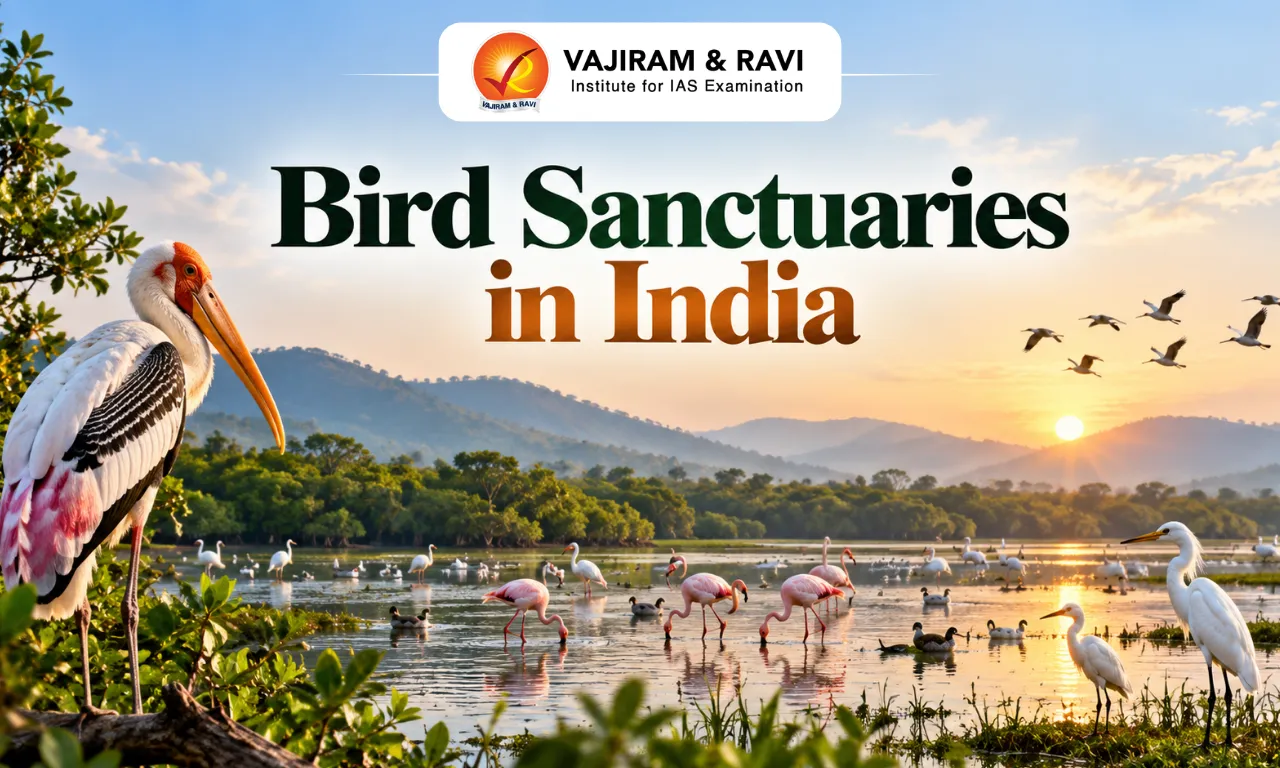
Bird sanctuaries in India play a vital role in conserving the country’s rich avian diversity and protecting habitats essential for resident and migratory birds. Spread across wetlands, lakes, forests, grasslands and coastal ecosystems, these protected areas provide safe spaces for feeding, breeding, nesting and seasonal migration. India hosts several renowned bird habitats, including Keoladeo National Park, Vedanthangal Bird Sanctuary, Ranganathittu Bird Sanctuary and Nal Sarovar Bird Sanctuary.
Besides protecting birds, bird sanctuaries in India support wider biodiversity, maintain ecological balance and contribute to wetland conservation. However, habitat loss, pollution, climate change, invasive species and human disturbance pose growing challenges. Effective conservation therefore requires habitat restoration, scientific monitoring, community participation, stronger enforcement and sustainable management practices.
Bird Sanctuaries in India Definition
A bird sanctuary is a protected area designated primarily to conserve birds and the habitats, feeding grounds, nesting sites and ecosystem on which they depend. In India, such areas generally fall within the broader legal framework of wildlife sanctuaries under the Wildlife Protection Act 1972.
- The Act allows states to notify areas having ecological, faunal, floral or zoological significance as sanctuaries, while permitting certain regulated human activities.
- Bird sanctuaries are especially important for migratory birds, as wetlands and other suitable habitats provide breeding grounds, wintering areas and stopover sites along international migration routes.
Bird Sanctuaries in India List
Bird sanctuaries in India have diverse geography, providing a wide range of habitats for birds, from Himalayan wetlands and river systems to coastal lagoons, mangroves, grasslands and inland lakes.
| State/UT | Bird Sanctuaries |
|
Andhra Pradesh |
• Kolleru Wildlife Sanctuary • Pulicat Lake Bird Sanctuary • Nelapattu Bird Sanctuary • Uppalapadu Bird Sanctuary |
|
Assam |
• Pani-Dihing Bird Sanctuary • Deepor Beel Wildlife Sanctuary |
|
Bihar |
• Kanwar Jheel Bird Sanctuary • Nagi Dam Bird Sanctuary • Nakti Dam Bird Sanctuary • Baraila Jheel Bird Sanctuary • Kusheshwarasthan Bird Sanctuary |
|
Chandigarh |
• City Bird Sanctuary • Sukhna Lake Wildlife Sanctuary |
|
Goa |
• Dr Salim Ali Bird Sanctuary |
|
Gujarat |
• Nal Sarovar Bird Sanctuary • Khijadiya Bird Sanctuary • Porbandar Bird Sanctuary • Thol Lake Wildlife Sanctuary • Kachchh Great Indian Bustard Sanctuary |
|
Haryana |
• Bhindawas Wildlife Sanctuary • Khaparwas Wildlife Sanctuary |
|
Himachal Pradesh |
• Pong Dam Lake Wildlife Sanctuary |
|
Jharkhand |
• Udhwa Lake Bird Sanctuary |
|
Karnataka |
• Ranganathittu Bird Sanctuary • Gudavi Bird Sanctuary • Ghataprabha Bird Sanctuary • Attiveri Bird Sanctuary |
|
Kerala |
• Kumarakom Bird Sanctuary • Thattekad Bird Sanctuary • Mangalavanam Bird Sanctuary • Kadalundi Bird Sanctuary |
|
Maharashtra |
• Karnala Bird Sanctuary • Nandur Madhameshwar Wildlife Sanctuary • Jaikwadi Bird Sanctuary • Mayani Bird Sanctuary |
|
Mizoram |
• Lengteng Wildlife Sanctuary and other bird-rich forest habitats |
|
Odisha |
• Nalbana Bird Sanctuary • Chilika wetland ecosystem: While the entire 900+ square kilometre lagoon is not a single sanctuary, the whole wetland functions as a massive, protected Ramsar Site and the largest wintering ground for migratory waterfowl in the subcontinent. |
|
Puducherry |
• Oussudu Lake / Oussudu Lake Bird Sanctuary |
|
Rajasthan |
• Keoladeo National Park • Tal Chhapar Wildlife Sanctuary |
|
Tamil Nadu |
• Vedanthangal Bird Sanctuary • Koonthankulam Bird Sanctuary • Vaduvur Bird Sanctuary • Vellode Birds Sanctuary • Udayamarthandapuram Bird Sanctuary • Kanjirankulam Bird Sanctuary |
|
Uttar Pradesh |
• Bakhira Wildlife Sanctuary • Saman Bird Sanctuary • Samaspur Wildlife Sanctuary • Sandi Bird Sanctuary • Sur Sarovar Bird Sanctuary • Chandra Shekhar Azad (Nawabganj) Bird Sanctuary • Lakh Bahosi Wildlife Sanctuary • Jai Prakash Narayan Bird Sanctuary (Surha Tal) |
|
West Bengal |
• Chintamoni Kar Bird Sanctuary • Raiganj Wildlife Sanctuary (Kulik) • Rasik Beel Wildlife Sanctuary |
Famous Bird Sanctuaries in India
Several bird sanctuaries in India have exceptional ecological, geographical or conservation significance and are particularly important for India's resident and migratory bird populations.
- Keoladeo National Park, Rajasthan: Formerly known as Bharatpur Bird Sanctuary, Keoladeo National Park is one of India's best-known bird habitats and was designated as one of the UNESCO World Heritage Sites in 1985.
- It supports a large variety of resident and migratory birds and is also a Ramsar wetland.
- Vedanthangal Bird Sanctuary, Tamil Nadu: Vedanthangal is among India's oldest protected waterbird habitats and has a long history of community-supported bird conservation.
- Its wetland attracts large numbers of waterbirds during the migratory season.
- Ranganathittu Bird Sanctuary, Karnataka: Located along the Kaveri River, Ranganathittu is an important nesting and breeding habitat for numerous bird species and is one of Karnataka's best-known bird sanctuaries.
- Kumarakom Bird Sanctuary, Kerala: Situated beside Vembanad Lake, Kumarakom provides habitat for a range of resident and migratory birds and forms part of Kerala's extensive wetland ecosystem.
- Thattekad Bird Sanctuary, Kerala: Thattekad lies along the Periyar River and is particularly known for its forest bird diversity, making it an important destination for birdwatching and avian conservation.
- Salim Ali Bird Sanctuary, Goa: Located on Chorao Island, this sanctuary protects a mangrove ecosystem along the Mandovi River and provides habitat for several wetland and coastal bird species.
- Nal Sarovar Bird Sanctuary, Gujarat: Nal Sarovar is a large wetland complex that supports numerous waterbirds and migratory species and is also recognised internationally as a Ramsar wetland.
- Nandur Madhameshwar, Maharashtra: Located at the confluence of the Godavari and Kadva rivers, Nandur Madhameshwar is an important wetland for migratory and resident birds and is recognised as a Ramsar Site.
Important Facts of Bird Sanctuaries in India
- Largest Bird Sanctuary in India: Nal Sarovar Bird Sanctuary in Gujarat is commonly described in popular reference material as one of India's largest bird sanctuaries.
- Smallest Bird Sanctuary in India: Mangalavanam Bird Sanctuary in Kerala.
- Oldest Bird Sanctuary in India: Vedanthangal Bird Sanctuary is widely recognised for its very long history of community-supported protection of waterbirds.
- Latest Bird Sanctuaries as Ramsar Sites: The 99th Ramsar Site, Shekha Jheel Bird Sanctuary, Uttar Pradesh, was designated a Ramsar Site in April 2026.
- Jai Prakash Narayan Bird Sanctuary (Surha Tal), Uttar Pradesh, subsequently became India's 100th Ramsar Site in June 2026.
- Patna Bird Sanctuary, Uttar Pradesh, and Chhari-Dhand, Gujarat, were among the sites added to India's Ramsar network in January 2026.


Bird Sanctuaries in India and Their Importance
Bird sanctuaries in India perform ecological, economic and conservation functions that extend well beyond protecting individual bird species.
- Conservation of Bird Species: They provide protected breeding, nesting, feeding and resting habitats for resident and migratory birds.
- Protection of Wetlands: Many bird sanctuaries conserve lakes, marshes, lagoons and other wetlands that support complex ecological communities.
- Support for Migratory Birds: Wetlands located along migratory routes provide essential stopover and wintering habitats for birds travelling long distances.
- Maintenance of Ecological Balance: Birds contribute to food webs, pollination, seed dispersal, pest control and nutrient cycling, making them important components of ecosystems.
- Protection of Wider Biodiversity: Conserving bird habitats simultaneously protects fish, amphibians, insects, aquatic plants, reptiles and other wildlife associated with the same ecosystem.
- Climate and Water Benefits: Healthy wetlands can contribute to water regulation, groundwater recharge and climate resilience while supporting biodiversity.
- Livelihood and Ecotourism Opportunities: Well-managed bird habitats can support nature-based tourism and generate livelihood opportunities for local communities.
Bird Sanctuaries in India and Migratory Birds
Bird sanctuaries in India are an important destination for migratory birds because they lie along major international migration routes, particularly the Central Asian Flyway.
- The Central Asian Flyway connects breeding and wintering areas across a broad geographical region, making Indian wetlands strategically important for migratory waterbirds.
- India has also undertaken initiatives to map migratory bird routes and improve conservation planning.
Bird Sanctuaries in India Conservation Laws and Initiatives
Conservation of birds in bird sanctuaries in India is supported by national legislation, international agreements and scientific conservation programmes.
- Wildlife Protection Act 1972: Provides the principal legal framework for wildlife protection and protected areas, including bird sanctuaries.
- Ramsar Convention: Provides an international framework for conservation and wise use of wetlands.
- Important Bird Areas (IBAs): Identify sites of global or national significance for bird conservation.
- Indian Bird Conservation Network (IBCN): Brings together organisations and conservation practitioners to support research and coordinated bird conservation.
- Central Asian Flyway initiatives: Support conservation planning for migratory birds and their habitats, such as Single Species Action Plans.
- This plan is coordinated with other organisations such as the Agreement on the Conservation of African-Eurasian Migratory Waterbirds (AEWA) and the BirdLife Partnership.
Bird Sanctuaries in India Challenges
Bird sanctuaries in India face various challenges, despite legal protections, such as increasing pressure from habitat degradation, pollution, changing hydrology and human activities.
- Habitat Loss: Conversion of wetlands, grasslands and surrounding habitats for agriculture, infrastructure and urbanisation reduces suitable areas for birds.
- Wetland Degradation: Encroachment, excessive water extraction, siltation and changes in natural water flows can reduce the ecological quality of bird habitats.
- Pollution: Industrial effluents, sewage, plastics, pesticides and agricultural runoff can contaminate water and food sources.
- Climate Change: Changing rainfall patterns, rising temperatures, droughts and extreme weather events can alter wetland conditions and migratory patterns.
- Disturbance from Human Activities: Unregulated tourism, boating, fishing, noise and other activities can disturb feeding and nesting birds.
- Invasive Species: Invasive plants and animals can alter wetland structure and compete with native species.
- Illegal Hunting and Wildlife Trade: Poaching and illegal capture remain threats to certain bird species despite statutory protection.
Bird Sanctuaries in India Way Forward
Effective bird conservation requires a landscape-level approach that combines habitat protection, scientific monitoring and community participation.
- Restore degraded wetlands: Re-establish natural water regimes, remove invasive species and restore native vegetation.
- Strengthen habitat connectivity: Protect ecological corridors and surrounding landscapes connecting important bird habitats.
- Improve scientific monitoring: Use bird counts, satellite data, GIS and tagging technologies to track populations and migration.
- Protect migratory routes: Integrate Central Asian Flyway considerations into infrastructure and land-use planning.
- Control pollution: Strengthen sewage treatment, waste management and regulation of agricultural and industrial pollutants around wetlands.
- Promote community participation: Involve local communities in habitat protection, monitoring and sustainable resource management.
- Develop responsible ecotourism: Regulate visitor numbers, boating, noise and infrastructure to minimise disturbance.
- Strengthen enforcement: Improve protection against hunting, illegal trade and habitat encroachment.
- Climate-resilient wetland management: Prepare conservation plans that account for droughts, floods, changing rainfall and other climate risks.
Bird Sanctuaries in India UPSC PYQs
Q1. Match List-I (National Park/Sanctuary) with List-II (state) and select the correct answer using the codes given below the lists: (UPSC Prelims 2004)
| List-I (National / Park Sanctuary) | List-II (State) |
|
A. Kanger Ghati National Park |
1. Chhattisgarh |
|
B. Nagerhole National Park |
2. Haryana |
|
C. Kugti Wildlife Sanctuary |
3. Himachal Pradesh |
|
D. Sultanpur Bird Sanctuary |
4. Karnataka |
Codes:
A B C D
a) 3 2 1 4
b) 1 4 3 2
c) 3 4 1 2
d) 1 2 3 4
Ans: (b)

 Last updated on Sep, 2026
→ UPSC 2027 Notification will be released on 13 January 2027 at upsconline.nic.in.
→ Check out the latest UPSC Syllabus here.
→ Download UPSC Model Answers for Mains 2026
→ UPSC Mains Question Paper 2026 is out now for Essay & GS Paper 1, 2, 3 & 4.
→ UPSC Calendar 2027 has been released.
→ Enroll in Vajiram & Ravi’s UPSC Mains Test Series 2027 for structured answer writing practice, expert evaluation, and exam-oriented feedback.
→ Join Vajiram & Ravi’s UPSC Mentorship Program 2027 for personalized guidance, strategy planning, and one-to-one support from experienced mentors.
→ Go through the UPSC Mains Previous Year Papers to enhance your preparation.
→ UPSC has released UPSC Toppers List 2025 with the Civil Services final result on its official website.
→ Also check Best UPSC Coaching in India
Bird Sanctuaries in India FAQs
Q1. How many bird sanctuaries are there in India?+
Q2. Which is the largest bird sanctuary in India?+
Q3. Which bird sanctuary is a UNESCO World Heritage Site?+
Q4. Which law provides legal protection to bird sanctuaries in India?+
Q5. Which is the oldest bird sanctuary in India?+
Tags: bird sanctuaries in india quest UPSC Environment and Ecology Notes