The United Nations Convention on Biological Diversity, abbreviated as UNCBD, is the principal global framework for conserving biodiversity and promoting its sustainable and equitable use. Adopted at the Rio Earth Summit in 1992, the UNCBD has three core objectives: conservation of biodiversity, sustainable use of its components, and fair and equitable sharing of benefits arising from genetic resources. The UNCBD has evolved through the Cartagena and Nagoya Protocols, Aichi Biodiversity Targets, and the Kunming-Montreal Global Biodiversity Framework (KMGBF).
India became a Party to UNCBD in 1994 and implemented its commitments through the Biological Diversity Act, 2002, the National Biodiversity Authority (NBA), and the NBSAP 2024–30. However, inadequate finance and implementation gaps continue to hinder global biodiversity goals.
UNCBD Background
The Convention on Biological Diversity (CBD) is the principal global legal framework for biodiversity conservation. It seeks to reconcile ecological conservation with sustainable resource use and equitable sharing of benefits from genetic resources.
- Origin: The CBD was initiated under the United Nations Environment Programme in 1988 and was adopted at the Nairobi Conference on 22 May 1992 before being opened for signature at the Rio Earth Summit on 5 June 1992.
- The Convention entered into force on 29 December 1993, following the required 30th ratification, and its first COP was held in Nassau, Bahamas, in 1994.
- The CBD has 196 Parties, making it near-universal, although the United States has signed but not ratified the Convention.
- Three Core Objectives: Article 1 establishes three objectives - conservation of biodiversity, sustainable use of its components, and fair and equitable sharing of benefits arising from genetic resources.
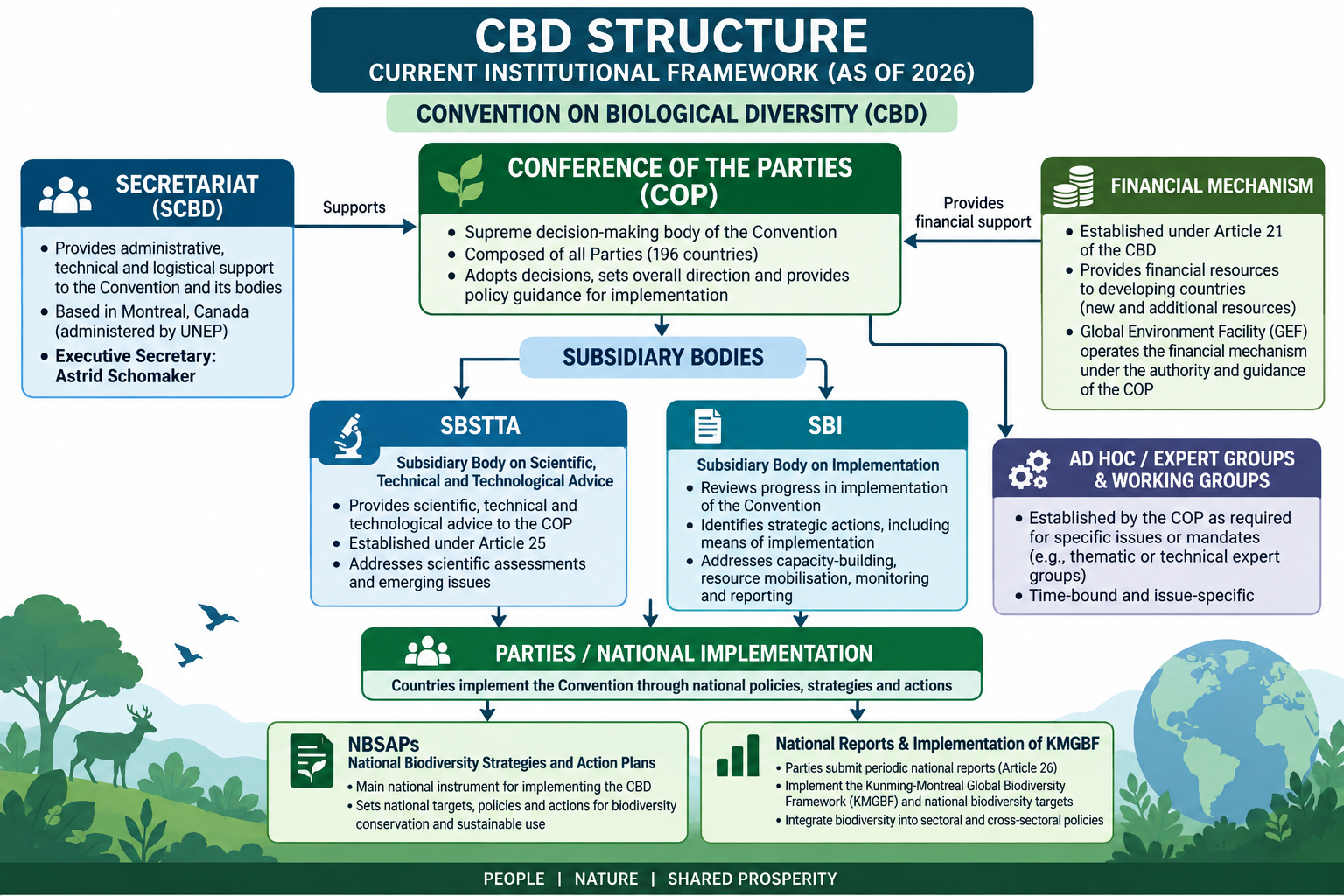
- Institutional Framework: The COP is the supreme decision-making body, while the Subsidiary Body on Scientific, Technical and Technological Advice (SBSTTA) provides scientific and technical advice and the Subsidiary Body on Implementation (SBI) reviews and supports implementation.
- Secretariat: The UNCBD Secretariat is headquartered in Montreal, Canada, and coordinates the Convention’s implementation and intergovernmental processes.
- Ecosystem-based Conservation: The UNCBD promotes an ecosystem approach and thematic programmes covering forests, agriculture, wetlands/inland waters, mountains, islands, and marine and coastal ecosystems.
- Global Biodiversity Framework: The Aichi Biodiversity Targets (2011–2020) provided the earlier global biodiversity framework, while the Kunming–Montreal Global Biodiversity Framework (2022) now guides global action on biodiversity.
- Access and Benefit-sharing: The UNCBD promotes fair and equitable sharing of benefits from genetic resources, including emerging issues concerning Digital Sequence Information (DSI).
- Indigenous and Local Communities: Article 8(j) recognises the importance of traditional knowledge, innovations and practices of Indigenous peoples and local communities for biodiversity conservation and sustainable use.
- Key Conservation Priorities: The Convention promotes protected areas, ecosystem restoration, sustainable wildlife management, and preventing invasive alien species as key tools for addressing biodiversity loss.
- International Biodiversity Day: 22 May is observed as the International Day for Biological Diversity, commemorating the adoption of the UNCBD.
UNCBD Structure
The structure of the UNCBD can be shown in the diagram below


UNCBD Articles
Key articles of the Convention on Biological Diversity are listed below.
| Article | Provision | Key Points |
|
Article 1 |
Objectives |
Conservation of biodiversity; sustainable use; fair and equitable benefit-sharing from genetic resources. |
|
Article 2 |
Use of Terms |
Defines key terms such as biological diversity, biological resources, biotechnology and genetic resources. |
|
Article 3 |
Principle |
States’ sovereign right to exploit their own resources, subject to environmental responsibility. |
|
Article 6 |
General Measures for Conservation & Sustainable Use |
Requires Parties to develop NBSAPs and integrate biodiversity into sectoral policies. |
|
Article 7 |
Identification & Monitoring |
Identification of biodiversity components, processes affecting them and monitoring of threats. |
|
Article 8 |
In-situ Conservation |
Establishment of protected areas; ecosystem restoration; control of invasive alien species; protection of traditional knowledge. |
|
Article 9 |
Ex-situ Conservation |
Conservation outside natural habitats through facilities such as zoos, botanical gardens and gene banks. |
|
Article 10 |
Sustainable Use |
Promotes sustainable use of biodiversity and integration of conservation into decision-making. |
|
Article 11 |
Incentive Measures |
Encourages economically and socially sound incentives for biodiversity conservation. |
|
Article 12 |
Research & Training |
Promotes research, training and capacity-building for biodiversity conservation. |
|
Article 13 |
Public Education & Awareness |
Promotes biodiversity education, awareness and information dissemination. |
|
Article 14 |
Impact Assessment |
Requires Environmental Impact Assessment (EIA) for projects likely to significantly affect biodiversity. |
|
Article 15 |
Access to Genetic Resources |
Recognises national sovereignty over genetic resources and requires access based on prior informed consent (PIC) and mutually agreed terms. |
|
Article 16 |
Technology Transfer |
Promotes access to and transfer of technologies relevant to biodiversity conservation and sustainable use. |
|
Article 17 |
Exchange of Information |
Promotes exchange of scientific, technical and socio-economic information. |
|
Article 18 |
Technical & Scientific Cooperation |
Promotes international cooperation and institutional strengthening. |
|
Article 19 |
Biotechnology & Benefit-sharing |
Covers biotechnology research, access to results/benefits, participation of developing countries and notification/information regarding living modified organisms. |
|
Article 20 |
Financial Resources |
Developed-country Parties are expected to provide new and additional financial resources to developing countries. |
|
Article 21 |
Financial Mechanism |
Establishes a financial mechanism for developing countries; it operates under COP authority or guidance. GEF operates the mechanism pursuant to COP decisions. |
|
Article 22 |
Relationship with Other Conventions |
CBD provisions do not affect rights/obligations under other international agreements except where exercising them would cause serious damage or threat to biodiversity. |
|
Article 23 |
Conference of the Parties (COP) |
Establishes the COP as the supreme decision-making body of the CBD. |
|
Article 25 |
SBSTTA |
Establishes the Subsidiary Body on Scientific, Technical and Technological Advice. |
|
Article 26 |
National Reports |
Parties must submit periodic reports on measures taken to implement the Convention and their effectiveness. |
|
Article 27 |
Settlement of Disputes |
Provides mechanisms for settling disputes between Parties. |
|
Article 28 |
Protocols |
COP may adopt protocols under the CBD, providing the legal basis for instruments such as the Cartagena and Nagoya Protocols. |
UNCBD COPs
The Conference of the Parties (COP) is the supreme decision-making body of the UNCBD. Over successive COPs, the global biodiversity regime has evolved from establishing thematic programmes and protocols to adopting time-bound global biodiversity targets and implementation frameworks.
- COP1 (1994, Nassau, Bahamas): The first substantive COP established the initial work programme and institutional framework for implementing the CBD.
- COP2 (1995, Jakarta, Indonesia): The Jakarta Mandate was adopted to strengthen conservation and sustainable use of marine and coastal biodiversity.
- COP3 (1996, Buenos Aires, Argentina): The COP advanced the Programme of Work on Agricultural Biodiversity, focusing on biodiversity within agricultural systems.
- COP4 (1998, Bratislava, Slovakia): The COP further developed the Convention’s implementation and cross-cutting work programmes.
- First Extraordinary COP (2000, Montreal/Cartagena): The Cartagena Protocol on Biosafety was adopted, establishing rules for the safe handling and transboundary movement of living modified organisms (LMOs).
- COP5 (2000, Nairobi, Kenya): The Ecosystem Approach was endorsed as a key framework for integrated biodiversity management.
- COP6 (2002, The Hague, Netherlands): The COP adopted the Global Strategy for Plant Conservation and established the 2010 Biodiversity Target.
- COP7 (2004, Kuala Lumpur, Malaysia): The Programme of Work on Protected Areas was adopted to strengthen the establishment and effective management of protected areas.
- COP8 (2006, Curitiba, Brazil): The COP advanced work on biodiversity and sustainable development, including issues relating to genetically modified organisms and agricultural biodiversity.
- COP9 (2008, Bonn, Germany): The COP strengthened work on forest biodiversity, agricultural biodiversity and the Strategic Plan, while advancing negotiations on access and benefit-sharing.
- COP10 (2010, Nagoya, Japan): The Nagoya Protocol on Access and Benefit-sharing was adopted, along with the Strategic Plan for Biodiversity 2011–2020 and 20 Aichi Biodiversity Targets.
- COP11 (2012, Hyderabad, India): India hosted the COP, which advanced resource mobilisation for biodiversity, including the Hyderabad Pledge, under which India announced additional financial support for biodiversity conservation.
- COP12 (2014, Pyeongchang, South Korea): The COP conducted a mid-term review of the Strategic Plan 2011–2020 and assessed progress towards the Aichi Biodiversity Targets.
- COP13 (2016, Cancún, Mexico): The COP emphasised mainstreaming biodiversity into agriculture, forestry, fisheries and tourism policies.
- COP14 (2018, Sharm El-Sheikh, Egypt): The COP initiated important groundwork for the post-2020 global biodiversity framework and emphasised investment in biodiversity for people and the planet.
- COP15 (2021–22, Kunming, China and Montreal, Canada): The Kunming–Montreal Global Biodiversity Framework (KMGBF) was adopted, establishing 4 long-term goals for 2050 and 23 targets for 2030, including the 30×30 target under Target 3.
- COP16 (2024–25, Cali, Colombia and Rome, Italy): The COP advanced implementation of the KMGBF, strengthened National Biodiversity Strategy and Action Plans (NBSAPs) and operationalised the multilateral mechanism for benefit-sharing from Digital Sequence Information (DSI), including the Cali Fund; the resumed session in Rome also advanced the biodiversity finance framework.
- COP17 (2026, Yerevan, Armenia): The upcoming COP is scheduled for 19–30 October 2026 and is expected to undertake the first global review of collective progress in implementing the Kunming–Montreal Global Biodiversity Framework.
UNCBD and India
India is a megadiverse country and a committed Party to the CBD, balancing biodiversity conservation with sustainable development and equitable benefit-sharing. Its approach combines legislation, institutional mechanisms, national targets and international cooperation.
- Ratification: India ratified the Convention on Biological Diversity (CBD) in 1994 and implemented its commitments through the Biological Diversity Act 2002, providing the legal framework for conservation, sustainable use and Access and Benefit Sharing (ABS).
- Biological Diversity (Amendment) Act, 2023: The amendment introduced a more registration-based compliance framework and simplified provisions for AYUSH (Ayurveda, Yoga and Naturopathy, Unani, Siddha and Homoeopathy) practitioners and codified traditional knowledge, while facilitating India's bioeconomy.
- Three-tier Institutional Framework: The Biological Diversity Act 2002 establishes the National Biodiversity Authority (NBA) at the national level, State Biodiversity Boards (SBBs) at the state level, and Biodiversity Management Committees (BMCs) at the local level, forming India's three-tier biodiversity governance structure.
- Role of National Biodiversity Authority (NBA): NBA regulates access to biological resources, oversees Access and Benefit Sharing (ABS) and deals with approvals/registrations related to Intellectual Property Rights (IPR) involving biological resources and associated traditional knowledge.
- Protocols under the CBD: India is a Party to the
- Cartagena Protocol on Biosafety (2003),
- Nagoya Protocol on Access and Benefit Sharing (2012) and
- Nagoya–Kuala Lumpur Supplementary Protocol on Liability and Redress (2014).
- India's Global Role: India hosted UNCBD COP11 in Hyderabad in 2012, where it announced the Hyderabad Pledge, reflecting its commitment to biodiversity conservation and resource mobilisation.
- Updated NBSAP & National Biodiversity Targets: India's National Biodiversity Strategy and Action Plan (NBSAP) 2024–30, aligned with the Kunming–Montreal Global Biodiversity Framework (KMGBF), follows a “Whole-of-Government” and “Whole-of-Society” approach with 23 National Biodiversity Targets (NBTs).
- Seventh National Report to the CBD (NR-7), 2026: India submitted its Seventh National Report to the CBD in February 2026, assessing progress through 142 national indicators mapped against 23 NBTs; the report states that all 23 targets are “on track to achieve".
- Article 6 & National Reporting: Article 6 requires Parties to formulate NBSAPs, while Article 26 requires periodic national reports on CBD implementation; India's NR-7 provides an assessment of its progress towards global biodiversity commitments.
UNCBD Reports
The CBD relies on global assessments, national reports and biodiversity action plans to monitor progress and guide policy. These reports provide evidence on biodiversity trends and help assess implementation of global biodiversity commitments.
- Global Biodiversity Outlook (GBO): The CBD Secretariat’s flagship assessment, GBO periodically evaluates global biodiversity status, trends and progress in implementing the Convention; major editions were released in 2001, 2006, 2010, 2015 and 2020.
- Global Biodiversity Outlook - 5 (2020): The report found that none of the 20 Aichi Biodiversity Targets were fully achieved, although six targets showed partial progress, highlighting the need for stronger post-2020 action.
- Key Finding: Calls for a shift away from “business as usual” to address biodiversity loss.
- Eight Transitions: Proposes 8 transformative transitions across human activities to recognise biodiversity’s value, restore ecosystems and reduce harmful impacts.
- Stronger National Action: Urges countries to raise national ambitions in support of the Global Biodiversity Framework.
- Resource Mobilisation: Emphasises mobilisation of adequate financial and other resources and strengthening the enabling environment.
- Mainstreaming Biodiversity: Calls for integrating biodiversity considerations into decision-making and policies across all economic sectors.
- National Reports: Each CBD Party submits National Reports documenting progress in implementing the Convention and its targets; India uses these reports to track its domestic biodiversity commitments and actions.
- National Biodiversity Strategies and Action Plans (NBSAPs): Under Article 6 of the CBD, Parties are required to develop national strategies or plans for biodiversity conservation and integrate biodiversity considerations into relevant sectoral and cross-sectoral policies.
- IPBES Global Assessment (2019): The Intergovernmental Science-Policy Platform on Biodiversity and Ecosystem Services (IPBES) assessed global biodiversity and ecosystem services and estimated that around one million species are threatened with extinction, providing important scientific inputs to subsequent global biodiversity negotiations.
- The Intergovernmental Science-Policy Platform on Biodiversity and Ecosystem Services (IPBES) operates as an independent body that provides scientific evidence to support the United Nations Convention on Biological Diversity (CBD)
- KMGBF Global Review: The first global review of collective progress under the Kunming–Montreal Global Biodiversity Framework (KMGBF) is being prepared ahead of COP17, with assessments indicating that global implementation remains largely off-track, underscoring the need for accelerated action towards the 2030 targets.
UNCBD Challenges
Despite the CBD’s extensive institutional framework, biodiversity conservation continues to face financial, implementation, equity and governance challenges. The effectiveness of the KMGBF will depend on closing these gaps and ensuring meaningful participation of developing countries and local communities.
- Chronic Finance Gap: KMGBF Target 19 seeks to mobilise at least $200 billion annually by 2030, including $30 billion per year from developed to developing countries, but current biodiversity finance remains inadequate compared with the estimated global requirement of $700 billion–$1 trillion annually.
- Repeated Target Failure: The 20 Aichi Biodiversity Targets (2011–2020) were not fully achieved, while the emerging assessment of KMGBF implementation indicates that the world remains largely off-track, raising concerns about repeated failure to meet global biodiversity commitments.
- Weak National Alignment: Many countries have yet to fully align their NBSAPs with the KMGBF, while biodiversity considerations remain insufficiently mainstreamed into agriculture, infrastructure, trade, finance and development planning.
- 30×30 Target Contention: Target 3, which seeks to conserve at least 30% of terrestrial, inland-water, coastal and marine areas by 2030, faces debates over what constitutes effective conservation, recognition of Indigenous Peoples and Local Communities (IPLCs) and the role of OECMs.
- Digital Sequence Information (DSI): Benefit-sharing from the use of digital genetic-sequence information remains contentious despite the establishment of the Cali Fund and multilateral mechanism at COP16, particularly regarding financing, participation and compliance.
- North–South Equity Concerns: Developing countries continue to demand greater financial and technological support, while disagreements persist over the distribution of costs and benefits arising from biodiversity and genetic-resource utilisation.
- IPLC Rights and Participation: Although the KMGBF formally recognises the role of Indigenous Peoples and Local Communities, inadequate financing, institutional barriers and limited decision-making power can restrict their meaningful participation.
- Fragmented Global Governance: Biodiversity governance remains fragmented due to overlaps and coordination challenges involving the UNFCCC, UNCCD, IPBES and the BBNJ Agreement, particularly in areas such as climate–biodiversity linkages and ocean conservation.
- Weak Compliance and Monitoring: The CBD has historically relied more on reporting, review and cooperation than binding enforcement, while the KMGBF’s enhanced monitoring and review framework is still being operationalised.
- India-specific Challenges: India faces the challenge of balancing bioeconomy growth and easier access to biological resources with conservation and equitable Access and Benefit-sharing (ABS), particularly given capacity and implementation gaps at the State Biodiversity Boards and Biodiversity Management Committee (BMC) levels.
UNCBD Way Forward
Effective implementation of the CBD and KMGBF requires moving from target-setting to measurable, adequately financed and inclusive action. The focus should be on stronger national implementation, equitable financing, community participation and robust monitoring.
- Bridge the Finance Gap: Scale up the Global Biodiversity Framework Fund (GBFF) and diversify biodiversity finance through blended finance and biodiversity credits, while implementing Target 18 to reform or eliminate harmful incentives and subsidies.
- Strengthen National Alignment: Countries should align their NBSAPs with the KMGBF, supported by stronger monitoring, peer review and technical assistance through CBD-supported Technical and Scientific Cooperation Support Centres.
- Ensure Effective 30×30 Implementation: Target 3 should be implemented through clear, science-based criteria for OECMs, while ensuring genuine co-governance with Indigenous Peoples and Local Communities rather than exclusionary conservation models.
- Operationalise DSI Benefit-sharing: The Cali Fund and Multilateral Mechanism should be fully operationalised with predictable and adequate contributions from beneficiary industries, particularly pharmaceuticals, biotechnology and agriculture.
- Improve Global Coordination: Greater coordination among the CBD, UNFCCC, UNCCD, BBNJ Agreement and IPBES should reduce policy fragmentation and avoid duplication of reporting and implementation requirements.
- Strengthen Compliance and Review: The Global Review under the KMGBF should evolve into a regular stocktake-and-ratchet mechanism, enabling countries to assess progress, identify gaps and progressively strengthen their commitments.
- Mainstream IPLC Participation: Biodiversity finance should include direct and flexible funding for Indigenous-led conservation, while Indigenous and local knowledge systems should be formally integrated into national biodiversity planning and monitoring.
- Strengthen India’s Implementation: India should enhance the capacity of State Biodiversity Boards and Biodiversity Management Committees (BMCs) for effective ABS implementation and ensure that ease-of-doing-business reforms do not dilute community benefit-sharing.
- Translate Targets into State Action: India should connect its National Biodiversity Targets with concrete, adequately funded state and local biodiversity action plans to ensure implementation at the grassroots level.
- Maintain Political Momentum: Regular high-level political engagement and ministerial dialogue should keep biodiversity on the global agenda and prevent it from being overshadowed by climate, economic and geopolitical priorities.
UNCBD UPSC PYQs
Q1. Consider the following statements (UPSC Prelims 2023).
- In India, the Biodiversity Management Committees are key to the realisation of the objectives of the Nagoya Protocol.
- The Biodiversity Management Committees have important functions in determining access and benefit sharing, including the power to levy collection fees on the access of biological resources within its jurisdiction.
Which of the following statements given above is/are correct?
(a) 1 only
(b) 2 only
(c) Both 1 and 2
(d) Neither 1 nor 2
Ans: (c)

 Last updated on Sep, 2026
→ UPSC 2027 Notification will be released on 13 January 2027 at upsconline.nic.in.
→ Check out the latest UPSC Syllabus here.
→ Download UPSC Model Answers for Mains 2026
→ UPSC Mains Question Paper 2026 is out now for Essay & GS Paper 1, 2, 3 & 4.
→ UPSC Calendar 2027 has been released.
→ Enroll in Vajiram & Ravi’s UPSC Mains Test Series 2027 for structured answer writing practice, expert evaluation, and exam-oriented feedback.
→ Join Vajiram & Ravi’s UPSC Mentorship Program 2027 for personalized guidance, strategy planning, and one-to-one support from experienced mentors.
→ Go through the UPSC Mains Previous Year Papers to enhance your preparation.
→ UPSC has released UPSC Toppers List 2025 with the Civil Services final result on its official website.
→ Also check Best UPSC Coaching in India
UNCBD FAQs
Q1. What are the three main objectives of the UNCBD?+
Q2. When was the UNCBD adopted and when did it enter into force?+
Q3. What are the major protocols under the UNCBD?+
Q4. What is the Kunming–Montreal Global Biodiversity Framework (KMGBF)?+
Q5. What is India's role under the UNCBD?+
Tags: quest uncbd UPSC Environment & Ecology Notes