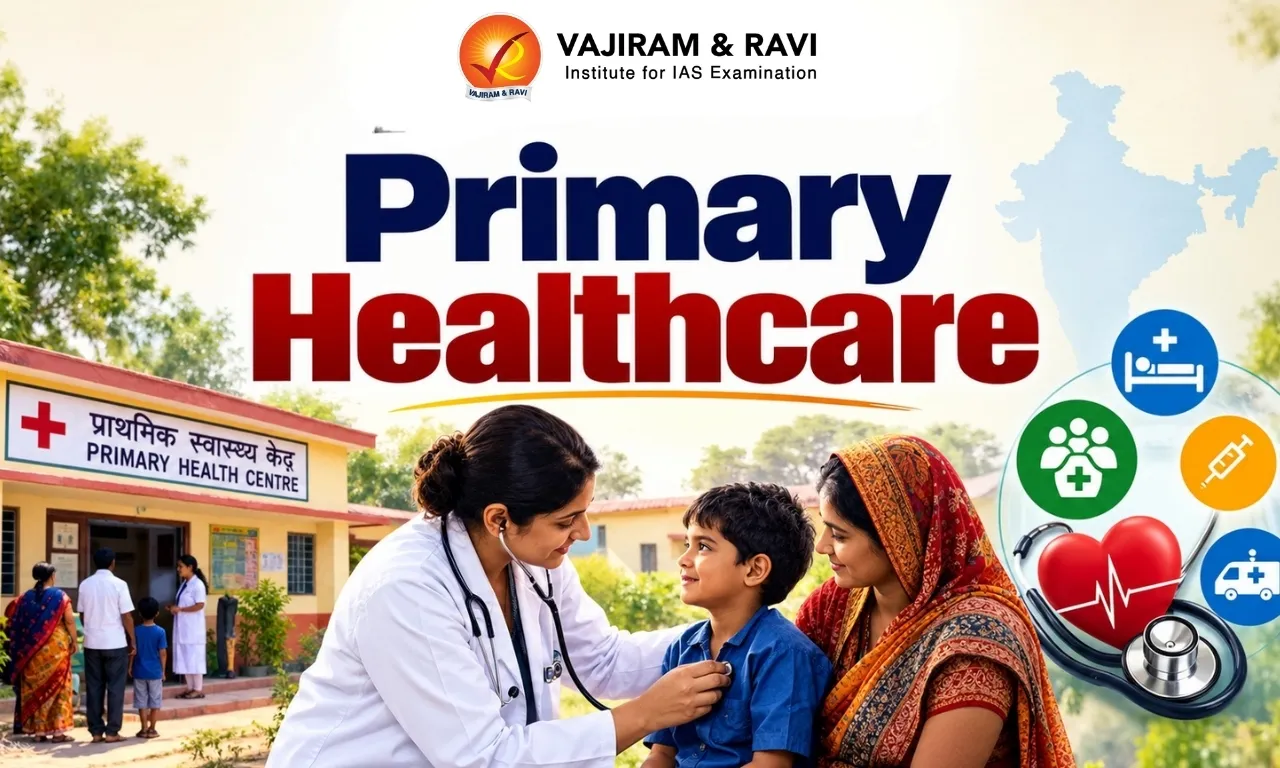
Primary healthcare is the foundation of an equitable and effective health system because it brings essential healthcare closer to individuals, families and communities. The Alma-Ata Declaration of 1978 established PHC as a comprehensive, participatory and socially acceptable approach aimed at achieving “Health for All". In India, the primary healthcare system has evolved from the Bhore Committee recommendations to the current framework of Ayushman Bharat and Ayushman Arogya Mandirs, which aim to provide Comprehensive Primary Healthcare (CPHC).
While India has made significant progress in reducing maternal and child mortality and expanding primary-care infrastructure, challenges related to financing, human resources, quality, urban healthcare and regional disparities persist. Strengthening PHC is therefore essential for Universal Health Coverage, SDG-3 and resilient healthcare delivery.
Primary Healthcare Meaning
Primary healthcare (PHC) is a comprehensive philosophy of healthcare rather than merely the first point of clinical contact. Its evolution reflects a shift from selective disease-oriented interventions towards integrated, preventive, promotive, curative, rehabilitative and palliative care.
- Alma-Ata Definition (1978): Primary Healthcare (PHC) is essential healthcare based on practical, scientifically sound and socially acceptable methods, made universally accessible through community participation and at an affordable cost. It also serves as the first level of contact with the national health system.
- Core Philosophy: PHC adopts a whole-of-society and whole-of-government approach covering health promotion, disease prevention, treatment, rehabilitation and palliative care, delivered as close as possible to where people live and work.
- Alma-Ata to Astana: Alma-Ata emphasised universal access, community participation and eight essential components, while the Astana Declaration (2018) reaffirmed primary healthcare as the foundation of Universal Health Coverage and SDG-3.
- PHC vs Primary Care: Primary healthcare is broader, encompassing comprehensive, intersectoral and community-oriented health action, whereas primary care mainly refers to the first point of clinical contact with the health system.
- Ayushman Arogya Mandirs deliver comprehensive primary healthcare, reflecting India’s shift from a selective to a more comprehensive healthcare approach.
Primary Healthcare Components
Primary Healthcare reflects a comprehensive approach combining preventive, promotive, curative and community-based interventions. Its framework has evolved from the eight essential elements of Alma-Ata (1978) to the three interlinked components of Astana (2018), with India implementing these through a three-tier rural healthcare structure.
Alma-Ata: Eight Essential Elements (1978)
- Health Education: Education on prevailing health problems and their prevention and control.
- Nutrition: Adequate food supply and proper nutrition.
- Water & Sanitation: Access to safe drinking water and basic sanitation.
- Maternal & Child Healthcare: Maternal and child care, including family planning.
- Immunisation: Immunisation against major infectious diseases.
- Endemic Disease Control: Prevention and control of locally endemic diseases.
- Treatment: Appropriate treatment of common diseases and injuries.
- Essential Medicines: Availability of essential drugs
Astana: Three Interlinked Components (2018)
- Primary Care & Essential Public Health Functions: Integrated health services across the life course.
- Multisectoral Policy & Action: Joint action across sectors to address social, economic and environmental determinants of health.
- Empowered People & Communities: Individuals, families and communities participate as active co-producers of health.
India: Three-Tier Primary Healthcare Architecture
- Sub-Health Centre / Ayushman Arogya Mandir:
- Population Norm: 5,000 in plains; 3,000 in hilly/tribal areas.
- Key Role: First point of contact; provides preventive, promotive and Comprehensive Primary Healthcare (CPHC) services; traditionally staffed by Auxiliary Nurse Midwives (ANMs)/ Multipurpose workers (MPWs).
- Primary Health Centre / Ayushman Arogya Mandir:
- Population Norm: 30,000 in plains; 20,000 in hilly/tribal areas.
- Key Role: Medical Officer-led facility providing OPD, minor procedures, Reproductive, Maternal, Newborn, Child, and Adolescent Health (RMNCHA) services and referral support for about six SHCs.
- Community Health Centre:
- Population Norm: 1,20,000 in plains; 80,000 in hilly/tribal areas.
- Key Role: Traditionally envisaged as a 30-bed First Referral Unit providing specialist services in medicine, surgery, obstetrics & gynaecology and paediatrics.


Primary Healthcare in India
India’s primary healthcare system has evolved from a preventive-curative, community-oriented model to a comprehensive and increasingly digital system, supported by successive policies, programmes and financial interventions.
- Evolution and Policy Framework: The Bhore Committee (1946) recommended a universal, tax-funded health service integrating preventive and curative care through a three-tier rural structure.
- The National Health Policies (1983, 2002 and 2017) progressively strengthened public healthcare, with NHP-2017 targeting public health expenditure of 2.5% of GDP by 2025 and promoting Comprehensive Primary Healthcare (CPHC). However, the NHP-2017 target of 2.5% of GDP remains unmet.
- NRHM (2005), later subsumed under NHM (2013), strengthened rural healthcare through Accredited Social Health Activists (ASHAs), Village Health, Sanitation, and Nutrition Committees (VHSNCs), untied funds, and RCH interventions.
- Ayushman Bharat and CPHC: Ayushman Bharat (2018) introduced two pillars: Health and Wellness Centres, renamed Ayushman Arogya Mandirs (AAMs) in 2023, for CPHC, and PM-JAY, providing up to ₹5 lakh per family per year for secondary and tertiary hospitalisation.
- PM-JAY was expanded to cover all citizens aged 70 years and above, irrespective of socioeconomic status, from October 2024.
- The government initially envisaged establishing 1.5 lakh Ayushman Arogya Mandirs by transforming/strengthening existing SHCs and PHCs.
- Health Infrastructure Status: As of 31 March 2023, India had 1,69,615 sub-centres, 31,882 PHCs and 6,359 CHCs.
- By February 2026, more than 1.84 lakh Ayushman Arogya Mandirs had been operationalised.
- Their cumulative footfall was approximately 494.71 crore, with around 41.93 crore teleconsultations, demonstrating the expanding reach of primary and digitally enabled healthcare.
- Health Financing: Government Health Expenditure (GHE) increased from 1.15% of GDP in 2013-14 to 1.84% in 2021-22, before standing at 1.43% of GDP in 2022-23 using the earlier GDP series and 1.48% using the new GDP series with base year 2022-23.
- The government's share of total health expenditure rose from 28.6% to 43.7%, while OOPE declined from 62.6% in 2014-15 to 43.4% in 2022-23.
- Financing and Infrastructure Support: The 15th Finance Commission (2021–26) recommended ₹70,051 crore in health grants to rural and urban local bodies – ₹43,928 crore for rural and ₹26,123 crore for urban bodies – to address primary-care gaps, including diagnostics and building-less SHCs/urban HWCs.
- PM-ABHIM (2021), with an outlay of approximately ₹64,180 crore, focuses on Block Public Health Units, District Integrated Public Health Laboratories, Critical Care Hospital Blocks and other health infrastructure.
- Digital and Community-Based Healthcare: Ayushman Bharat Digital Mission (2021) seeks to create an interoperable digital health ecosystem through ABHA IDs, electronic health records and platforms such as eSanjeevani.
- Community participation remains central through mechanisms such as ASHA workers and Village Health Sanitation and Nutrition Committees, strengthening the linkage between households and the formal health system.
- Health Outcomes: India has simultaneously recorded substantial improvements in key health indicators alongside the expansion and strengthening of primary healthcare:
- MMR declined from 130 (2014–16) to 87 (2022–24, provisional);
- IMR declined from 39 (2014) to 27 (2021); and
- U5 MR declined from 45 to 31 over the same period.
- Institutional deliveries increased from 88.6% in NFHS-5 to 90.6% in NFHS-6, while rotavirus vaccination coverage increased from 36.4% to 85.4%.
Primary Healthcare Schemes in India
India’s primary healthcare system is supported by umbrella health programmes and sector-specific schemes covering maternal and child health, immunisation, nutrition, communicable diseases, NCDs and essential services.
- Umbrella / Health-System Schemes
- National Health Mission (NHM) (2005): Umbrella programme comprising NRHM and NUHM; strengthens primary healthcare through ASHAs, RCH services, free drugs and diagnostics.
- National AYUSH Mission (NAM) (2014): Supports AYUSH-based wellness centres and integration of AYUSH services with primary healthcare.
- Ayushman Bharat–Ayushman Arogya Mandirs (AAMs) (2018): Upgrades SHCs/PHCs to provide 12 Comprehensive Primary Healthcare (CPHC) service packages; renamed AAMs in 2023.
- Ayushman Bharat–PM-JAY (2018): Provides ₹5 lakh per family per year for secondary and tertiary hospitalisation, reducing financial barriers and OOPE.
- PM-ABHIM (2021): Strengthens health infrastructure through building-less Sub-Centres, Urban HWCs, Block Public Health Units and District Public Health Laboratories.
- Ayushman Bharat Digital Mission (ABDM) (2021): Develops digital health infrastructure through ABHA IDs, interoperable health records and teleconsultation.
- Maternal, Newborn, Child & Adolescent Health
- National Family Planning Programme (1952): Provides contraceptive services and sterilisation-related support.
- Janani Suraksha Yojana (JSY) (2005): Provides cash incentives to promote institutional deliveries.
- Janani Shishu Suraksha Karyakram (JSSK) (2011): Provides zero-expense delivery, including free drugs, diagnostics, blood, C-section and transport.
- LaQshya (2011): Improves the quality of labour rooms and maternity operation theatres.
- Navjaat Shishu Suraksha Karyakram (NSSK) (2009): Provides training in essential newborn care and resuscitation at delivery points.
- Rashtriya Bal Swasthya Karyakram (RBSK) (2013): Screens children for the 4 Ds—Defects, Diseases, Deficiencies and Developmental delays.
- Rashtriya Kishor Swasthya Karyakram (RKSK) (2014): Addresses adolescent nutrition, mental health, substance abuse and sexual/reproductive health.
- Pradhan Mantri Surakshit Matritva Abhiyan (PMSMA) (2016): Provides free antenatal check-ups on the 9th of every month, including specialist services.
- SUMAN (Surakshit Matritva Aashwasan) (2019): Ensures assured, dignified and free maternal and newborn healthcare.
- Immunisation & Nutrition
- Universal Immunisation Programme (UIP) (1985): Provides free vaccination against vaccine-preventable diseases.
- National Iron Plus Initiative (NIPI) (2013): Provides a life-cycle approach to anaemia control through iron-folic acid supplementation.
- Mission Indradhanush (2014): Catch-up immunisation for unvaccinated and partially vaccinated children and pregnant women.
- National Deworming Day (NDD) (2015): Periodic deworming of children and adolescents.
- MAA – Mothers' Absolute Affection (2016): Promotes breastfeeding and appropriate infant and young-child feeding.
- POSHAN Abhiyaan (2018): Convergent nutrition programme addressing stunting, wasting and anaemia.
- Communicable Disease Control
- National Leprosy Control Programme (1955), later NLEP – National Leprosy Eradication Programme – Focuses on early detection and multidrug therapy.
- National TB Programme (1962), later RNTCP (1997) and NTEP (2020) – Provides TB detection, diagnosis and free treatment.
- National AIDS Control Programme (NACP) (1992) - HIV/AIDS prevention, testing and treatment support.
- National Vector Borne Disease Control Programme (NVBDCP), launched in 2003 and subsequently administered through the National Centre for Vector Borne Diseases Control (NCVBDC) – Control of malaria, dengue, filariasis and kala-azar.
- Integrated Disease Surveillance Programme (IDSP) (2004) - Disease surveillance, outbreak detection and reporting.
- Pulse Polio Programme (1995) - Supplementary immunisation for polio eradication; India was declared polio-free in 2014.
- NCDs, Mental Health & Essential Services
- National Programme for Control of Blindness (NPCB) (1976) – Provides eye-care services, including cataract management; subsequently expanded to National Programme for Control of Blindness & Visual Impairment (NPCBVI).
- National Mental Health Programme (NMHP) (1982) – Provides mental health services through the District Mental Health Programme and primary-level facilities.
- NPCDCS (2010)- Screening and management of cancer, diabetes, cardiovascular diseases and stroke, increasingly delivered through AAMs.
- National Oral Health Programme (2014) - Integrates oral healthcare into primary-level facilities.
- Free Drugs Service Initiative (2015) – Provides essential medicines free of cost at public health facilities.
- Free Diagnostics Service Initiative (2015) – Provides free diagnostic tests at Sub-Centres and at PHCs.
Primary Healthcare Challenges
Despite expanded infrastructure and improved health outcomes, India’s PHC system continues to face gaps in access, quality, financing, human resources and continuity of care, limiting equitable healthcare delivery.
- Infrastructure & Capacity Gaps: Inadequate PHC/CHC infrastructure persists, particularly in high-focus states such as Bihar and Uttar Pradesh.
- Around 17,788 building-less sub-centres are targeted under PM-ABHIM (2021–26), while some CHCs serve populations exceeding IPHS norms.
- Human Resource Shortages: Rural CHCs face an approximately 80% specialist shortage involving surgeons, physicians, gynaecologists and paediatricians.
- Rural-urban and interstate maldistribution and difficulty retaining specialists in remote areas remain major constraints.
- Financing Constraints: Public health expenditure remains below the NHP-2017 target of 2.5% of GDP, while dependence on Centrally Sponsored Schemes can create fiscal and implementation constraints for states.
- High Out-of-Pocket Expenditure: Although OOPE has declined from 62.6% in 2014–15 to 43.4% in 2022–23, it remains a significant source of catastrophic expenditure and health-related impoverishment.
- Preventive-Curative Imbalance: Preventive care accounts for only around 8.88% of current health expenditure, compared with over 56% on curative care, indicating insufficient emphasis on prevention and health promotion.
- Double Burden of Disease: India faces persistent communicable, maternal and child health challenges alongside rising NCDs such as hypertension, diabetes and cancers, increasing the workload on primary-care facilities.
- Weak Referral & Continuity of Care: Referral linkages between AAMs, PHCs, CHCs and higher facilities remain inadequate, affecting timely specialist care and follow-up, particularly for chronic diseases.
- Urban–Rural & Regional Inequity: Urban primary healthcare, especially for slum and peri-urban populations, remains uneven, while significant interstate differences persist in infrastructure, staffing and service quality.
- Quality & Governance Deficits: Uneven adherence to Indian Public Health Standards (IPHS), variable clinical governance and limited local institutional capacity affect consistency and quality of care. Since health is primarily a state subject, performance varies considerably across states.
- Digital & Emerging Challenges: The benefits of ABDM and eSanjeevani are constrained by connectivity and digital-literacy gaps in remote and tribal areas.
- Rising obesity as per NFHS-6 – 30.7% among women and 27.3% among men (aged 15-49 years) – also highlights the need to strengthen preventive and promotive PHC.
Primary Healthcare Way Forward
India needs to move from infrastructure expansion towards quality, preventive, equitable and accountable primary healthcare, with greater emphasis on financing, human resources, continuity of care and community participation.
- Raise & Protect Public Health Spending: Move towards the NHP-2017 target of 2.5% of GDP and operationalise the 15th Finance Commission’s recommendation of allocating two-thirds of health expenditure to primary healthcare, while protecting primary-care budgets.
- Close Human Resource Gaps: Expand medical and postgraduate seats, strengthen rural retention through service bonds and incentives, and promote task-sharing with Community Health Officers, ANMs and other mid-level providers.
- Strengthen Urban Primary Healthcare: Accelerate Urban Health and Wellness Centres (HWC) coverage in slums and underserved settlements and strengthen NUHM funding and urban local-body capacity.
- Deepen Decentralisation: Improve utilisation of 15th Finance Commission health grants through capacity-building of Panchayati Raj Institutions and Urban Local Bodies, supported by stronger district- and block-level planning.
- Shift Towards Prevention: Scale up NCD screening through AAMs, lifestyle counselling, yoga and health education, while increasing the share of preventive care in health expenditure.
- Strengthen Referral & Continuity of Care: Establish robust two-way electronic referral systems linking AAMs, CHCs and district hospitals, and use ABDM-enabled longitudinal health records for chronic-disease follow-up.
- Improve Financial Protection: Further reduce OOPE through PM-JAY, free diagnostics and free drugs, including the provision of 14 tests at Sub-Centres and 63 tests at PHCs.
- Promote Convergence & Community Participation: Integrate health with POSHAN Abhiyaan, Jal Jeevan Mission, SBM and education, while strengthening community platforms such as VHSNCs and Mahila Arogya Samitis, in line with the Astana Declaration.
- Strengthen Data & Accountability: Integrate HMIS and RCH portals for real-time monitoring and regularly assess PHC performance against IPHS and SDG-3 benchmarks using credible sources such as Health Dynamics/RHS, NHA, NFHS and SRS.
Primary Healthcare UYPSC PYQs
Q1. Besides being a moral imperative of the Welfare State, primary health structure is a necessary precondition for sustainable development.” Analyse. (UPSC Mains 2021)
Q2. Professor Amartya Sen has advocated important reforms in the realms of primary education and primary health care. What are your suggestions to improve their status and performance? (UPSC Mains 2016)

 Last updated on Oct, 2026
→ UPSC 2027 Notification will be released on 13 January 2027 at upsconline.nic.in.
→ Asian Games 2026 are being held in Aichi-Nagoya, Japan, from 19 September to 4 October.
→ Check Nobel Prize 2026 Winners List here.
→ Download PIB PRiSM Monthly Magazine 2026 here.
→ Check UPSC Monthly Current Affairs Magazine The Recitals here.
→ Check out the latest UPSC Syllabus here.
→ Download UPSC Model Answers for Mains 2026
→ UPSC Mains Question Paper 2026 is out now for Essay & GS Paper 1, 2, 3 & 4.
→ UPSC Calendar 2027 has been released.
→ Enroll in Vajiram & Ravi’s UPSC Mains Test Series 2027 for structured answer writing practice, expert evaluation, and exam-oriented feedback.
→ Join Vajiram & Ravi’s UPSC Mentorship Program 2027 for personalized guidance, strategy planning, and one-to-one support from experienced mentors.
→ Go through the UPSC Mains Previous Year Papers to enhance your preparation.
→ UPSC has released UPSC Toppers List 2025 with the Civil Services final result on its official website.
→ Also check Best UPSC Coaching in India
Primary Healthcare FAQs
Q1. What is the meaning of primary healthcare?+
Q2. What are the four principles of primary healthcare?+
Q3. What are primary and secondary healthcare?+
Q4. What is an example of primary healthcare?+
Q5. What is the difference between primary care and primary healthcare?+
Tags: primary healthcare quest UPSC Social Justice Notes