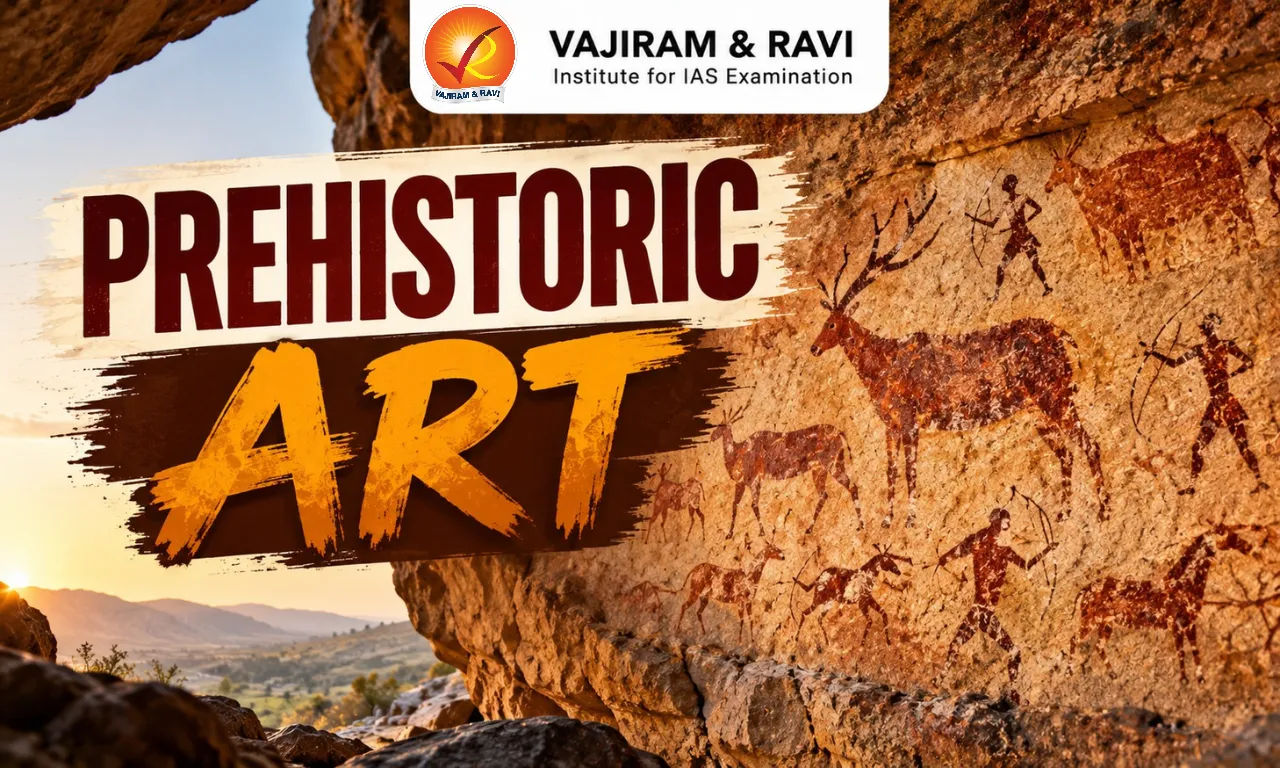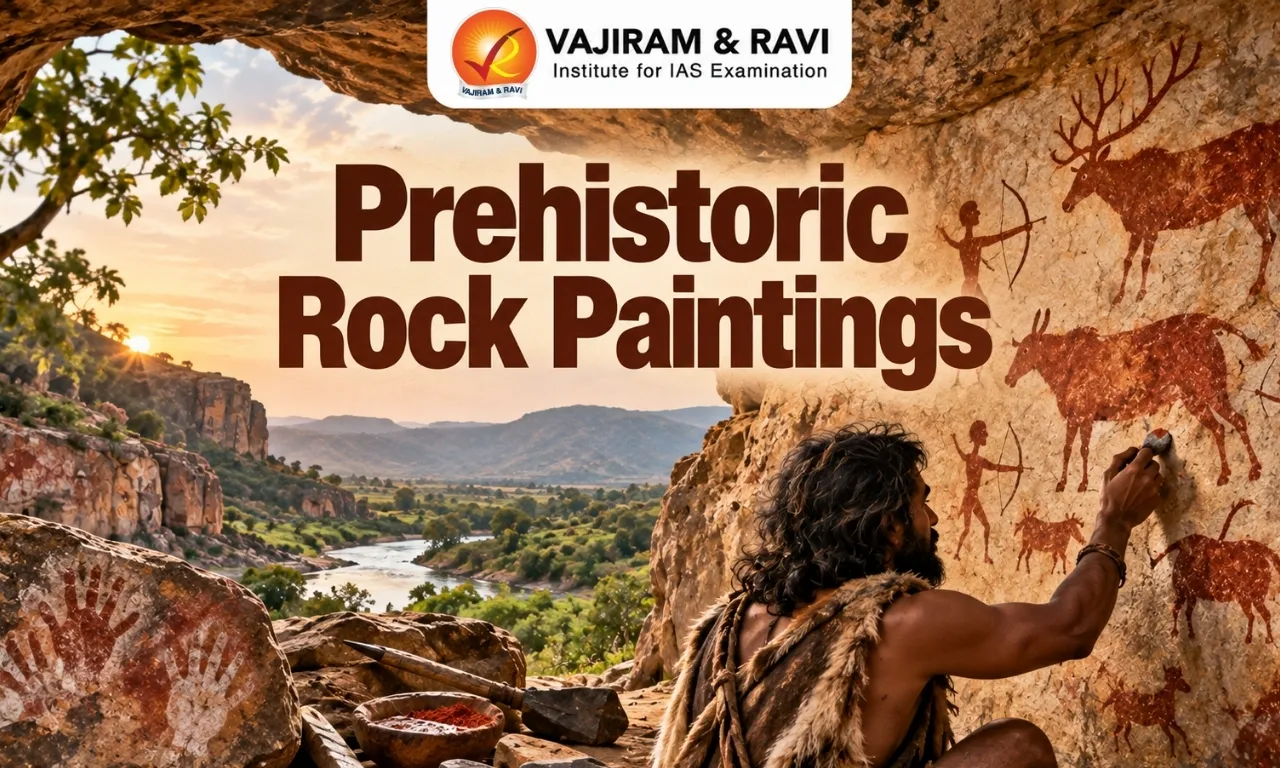
Prehistoric rock paintings are among the earliest forms of human artistic expression, created on cave walls and rock shelters, providing evidence of prehistoric communities through depictions of animals, hunting scenes, human figures, rituals, and everyday activities. Sites such as Bhimbetka preserve a long sequence of rock art traditions.
These paintings are significant for understanding the social life, environment, subsistence practices, and artistic skills of early communities. Over time, rock art transformed in themes, techniques, colours, and styles, moving from predominantly animal and hunting scenes to more varied representations of social, ritual, and symbolic activities.
Prehistoric Rock Paintings Evolution
Prehistoric rock paintings emerged as early humans began expressing their experiences and observations through images on cave walls, rock shelters, and natural rock surfaces.
- In India, early traditions are associated with the Upper Palaeolithic Age and the Mesolithic Age, with paintings depicting animals, hunting activities, human figures, and aspects of daily life.
- Sites such as Bhimbetka and Adamgarh preserve evidence of the long development of this artistic tradition.
Prehistoric Rock Paintings Evolution
Prehistoric rock paintings in India evolved from simple representations of animals and geometric forms to more dynamic and diverse depictions of hunting, social activities, and everyday life.
Upper Palaeolithic Phase
The Upper Palaeolithic phase represents an early stage of rock-art development, where artists primarily focused on large animals and simple forms, reflecting their close engagement with the natural environment.
- Animal Focus: Large animals such as bison, elephants, rhinoceroses, tigers and wild boars were prominently depicted, often with careful attention to their proportions.
- Simple Representation: Stick-like human figures and geometric designs appeared alongside animal figures, indicating relatively simple forms of human representation.
- Early Colour Use: Green and dark red were among the important colours used, with pigments obtained from naturally available materials.
Mesolithic Phase
The Mesolithic phase witnessed a major expansion in the subject matter and artistic expression of rock paintings, particularly through dynamic hunting scenes and representations of social life.
- Hunting Dominance: Paintings frequently portray groups of hunters using bows, arrows, spears, traps and snares to hunt animals.
- Broader Themes: Artists began depicting dancing, honey collection, gathering, food preparation, family activities and children playing, moving beyond purely animal-focused imagery.
- Dynamic Social Scenes: Smaller and more active human figures became common, with paintings conveying movement, cooperation and interaction between humans and animals.
Chalcolithic Phase
The Chalcolithic phase represents a later stage in the development of rock art, when earlier traditions continued while artistic expression became increasingly diverse and connected with changing social conditions.
- Diverse Subjects: Paintings continued to portray human figures, animals, and different activities, demonstrating a wider range of themes.
- Changing Cultural Context: The art reflects the changing economic and social life of communities as prehistoric societies moved towards more settled forms of living.
- Continuity and Transformation: Earlier themes such as animals and hunting continued, while new styles and compositions emerged, showing both continuity and change in rock-art traditions.


Prehistoric Rock Paintings Characteristics
Prehistoric rock paintings reflect the artistic skills, ecological surroundings, and socio-cultural life of early human communities. Indian rock art is characterised by diverse themes, colours, techniques and styles that evolved over different periods.
- Animal Dominance: Animals form a major theme of prehistoric rock art, including deer, bison, cattle, elephants, wild boar and other wild animals. Their frequent representation reflects the close relationship between early communities and their natural surroundings.
- Hunting Scenes: Many paintings portray hunters pursuing or surrounding animals, sometimes using bows, arrows and other hunting implements. Such scenes provide clues about the hunting and gathering economy of prehistoric communities.
- Human Activities: Human figures are shown engaged in hunting, dancing, gathering, travelling and group activities. These representations help reconstruct aspects of prehistoric social organisation and everyday life.
- Use of Natural Colours: Early artists used naturally available mineral and earth pigments, particularly shades of red, yellow, white and green. Red ochre was especially important because of its durability and availability.
- Stylised Figures: Human and animal figures are often represented through simple outlines and stylised forms rather than realistic anatomical details. Despite their simplicity, many figures convey movement and activity effectively.
- Dynamic Representation: A notable feature is the depiction of movement and action. Running animals, hunters, dancers, and group activities give the paintings a sense of dynamism and help communicate events rather than merely individual objects.
- Geometric and Symbolic Motifs: Besides animals and humans, rock art also contains lines, dots, geometric patterns, and other symbolic forms. These suggest that prehistoric art extended beyond direct representations of everyday activities.
- Superimposition: At sites such as Bhimbetka, paintings belonging to different periods occur on the same rock surfaces, with later paintings sometimes appearing over earlier ones. This provides evidence of the long-term continuity and transformation of rock-art traditions.
Prehistoric Rock Paintings Major Sites
India has a rich and geographically diverse tradition of prehistoric rock art. Major sites are concentrated particularly in Central India, but important examples are also found in Uttar Pradesh, Rajasthan, Kerala, Karnataka, Andhra Pradesh and other regions.
Bhimbetka, Madhya Pradesh
Located in the Vindhyan Hills, Bhimbetka is India’s best-known prehistoric rock-art site. Its five clusters of sandstone shelters contain paintings ranging from the Mesolithic to historical periods, depicting animals, hunting, daily activities and rituals. It was inscribed on the UNESCO World Heritage List in 2003.
Lakhudiyar Rock Paintings
Lakhudiyar, a significant prehistoric site near the Suyal River in Uttarakhand, features rock paintings. The name literally translates to "one lakh caves". The paintings feature stick-like human figures, animals, dance groups, and geometric patterns painted with red ochre, black, and white colours.
Adamgarh, Madhya Pradesh
Located near Narmadapuram, Adamgarh is an important Central Indian prehistoric rock-art locality. Its painted shelters contribute to the study of prehistoric artistic traditions and subsistence activities in the Narmada region.
Mirzapur, Uttar Pradesh
Mirzapur is one of the earliest reported centres of rock paintings in India. Rock shelters in the Vindhyan–Kaimur region contain representations of animals, human figures and hunting activities.
Chambal Valley, Madhya Pradesh and Rajasthan
The Chambal Valley contains numerous rock-art sites distributed across different clusters. UNESCO has placed the Rock Art Sites of the Chambal Valley on India’s Tentative List, recognising their archaeological and cultural significance.
Edakkal, Kerala
The Edakkal rock shelter is particularly significant for its rock engravings (petroglyphs) rather than painted compositions. Its carvings include human figures, animals, hunting scenes, weapons, symbols and geometric forms, demonstrating an important prehistoric rock-art tradition in South India.
Pachmarhi, Madhya Pradesh
The Pachmarhi region is another important Central Indian rock-art zone, with painted rock shelters forming part of the wider prehistoric artistic tradition of the Vindhyan–Satpura landscape.
Prehistoric Rock Paintings Significance
Prehistoric rock paintings are valuable archaeological sources for reconstructing the economic life, social organisation, environment, beliefs and artistic traditions of early human communities. Sites such as Bhimbetka preserve a long sequence of human interaction with the landscape and provide evidence of changing cultural practices.
- Source of Prehistoric Knowledge: In the absence of written records, rock paintings, along with tools, pottery, habitats and bones, help scholars reconstruct how prehistoric people lived and understand their past.
- Understanding Lifestyle: Paintings provide insights into the food habits, daily activities, and lifestyle of early humans. Scenes of hunting, gathering, dancing, and food preparation provide glimpses into their everyday existence.
- Evidence of Subsistence Practices: The predominance of hunting scenes at Bhimbetka, including group hunting with spears, bows, arrows, traps and snares, reflects the importance of hunting in the life of Mesolithic communities.
- Understanding Human–Animal Relationship: The frequent depiction of bison, elephants, tigers, deer, antelopes, rhinoceroses and other animals reflects the close interaction between humans and their natural environment. The paintings also portray both hunting and emotional responses towards animals.
- Evidence of Cultural Continuity: Superimposition, where newer paintings were made over older ones, shows that certain rock shelters were repeatedly used, possibly by different generations over long periods. At Bhimbetka, some locations contain as many as 20 layers of paintings.
- Understanding Technological Knowledge: The preparation of colours from rocks and minerals, such as haematite for red and limestone for white, demonstrates knowledge of natural materials.
- The use of plant fibres as brushes and substances such as gum, resin, or animal fat as binding materials.

 Last updated on Oct, 2026
→ UPSC 2027 Notification will be released on 13 January 2027 at upsconline.nic.in.
→ Check Nobel Prize 2026 Winners List here.
→ Download PIB PRiSM Monthly Magazine 2026 here.
→ Check UPSC Monthly Current Affairs Magazine The Recitals here.
→ Check out the latest UPSC Syllabus here.
→ Download UPSC Model Answers for Mains 2026
→ UPSC Mains Question Paper 2026 is out now for Essay & GS Paper 1, 2, 3 & 4.
→ UPSC Calendar 2027 has been released.
→ Enroll in Vajiram & Ravi’s UPSC Mains Test Series 2027 for structured answer writing practice, expert evaluation, and exam-oriented feedback.
→ Join Vajiram & Ravi’s UPSC Mentorship Program 2027 for personalized guidance, strategy planning, and one-to-one support from experienced mentors.
→ Go through the UPSC Mains Previous Year Papers to enhance your preparation.
→ UPSC has released UPSC Toppers List 2025 with the Civil Services final result on its official website.
→ Also check Best UPSC Coaching in India
Prehistoric Rock Paintings FAQs
Q1. What are prehistoric rock paintings?+
Q2. Which site is famous for prehistoric rock paintings?+
Q3. What are ancient rock paintings called?+
Q4. What are the four main types of prehistoric art?+
Q5. Where in India were the first rock paintings discovered?+
Tags: prehistoric rock paintings quest upsc ancient history notes