The Peninsular River System forms an ancient drainage network across India’s plateau, shaped by geological evolution, resistant rocks, regional slopes, faults and the predominantly monsoonal nature of rainfall. The Peninsular drainage is older than the Himalayan drainage system, as indicated by its broad, shallow and largely graded valleys and the mature character of its rivers.
The Western Ghats act as a water divide for most of the Peninsular River System. It directs peninsular rivers towards the Bay of Bengal. Narmada and Tapi are major exceptions flowing westward. The system includes rivers such as the Mahanadi, Godavari, Krishna, Kaveri, Narmada and Tapi, with several medium and smaller rivers. Unlike the Himalayan rivers, most peninsular rivers depend predominantly on monsoonal rainfall and therefore exhibit considerable seasonal variation in discharge; many are non-perennial.
Peninsular River System Geological Evolution
The geological evolution of the Peninsular river system resulted from ancient tectonic movements, subsidence, faulting and gradual tilting that established the present direction and character of its rivers. Three major geological developments are particularly important:
- Subsidence of the Western Flank: During the early Tertiary period, subsidence and partial submergence of the western flank disturbed the earlier symmetrical arrangement of drainage around the original watershed.
- Trough Faulting: The upheaval of the Himalayas was associated with subsidence of the northern flank of the Peninsular block, resulting in trough faulting.
- The Narmada and Tapi subsequently occupied these structural troughs. Their courses therefore differ from those of most east-flowing Peninsular rivers.
- Tilting of the Peninsular Block: A slight northwest-to-southeast tilting of the Peninsular Block provided a broad regional gradient towards the Bay of Bengal, helping orient most major rivers from west to east.
Peninsular River System Features
The Peninsular River System is characterised by mature valleys, relatively fixed courses, seasonal flow, limited meandering and strong geological control across the ancient plateau landscape.
- Ancient drainage: The Peninsular drainage is older than the Himalayan drainage.
- Mature valleys: Rivers generally occupy broad, shallow and largely graded valleys.
- Fixed courses: Most Peninsular rivers have relatively stable courses compared with the frequently shifting channels of many Himalayan rivers.
- Seasonal character: Most rivers depend heavily on monsoon rainfall and experience considerable seasonal variation in discharge.
- Limited meandering: Peninsular rivers generally have relatively fixed courses and limited meandering because of their mature valleys and resistant geological structure.
- Hard-rock terrain: Rivers frequently flow over ancient crystalline and metamorphic rocks.
- Western Ghats water divide: The Western Ghats separate many east-flowing Peninsular rivers from short west-flowing coastal streams.
- Deltas: Major east-flowing rivers form extensive deltas along the eastern coast.
- Estuaries: West-flowing rivers such as Narmada and Tapi form estuarine mouths rather than large deltas.
- Waterfalls and rapids: The steep gradients of several west-flowing rivers create waterfalls and rapids with hydropower potential.
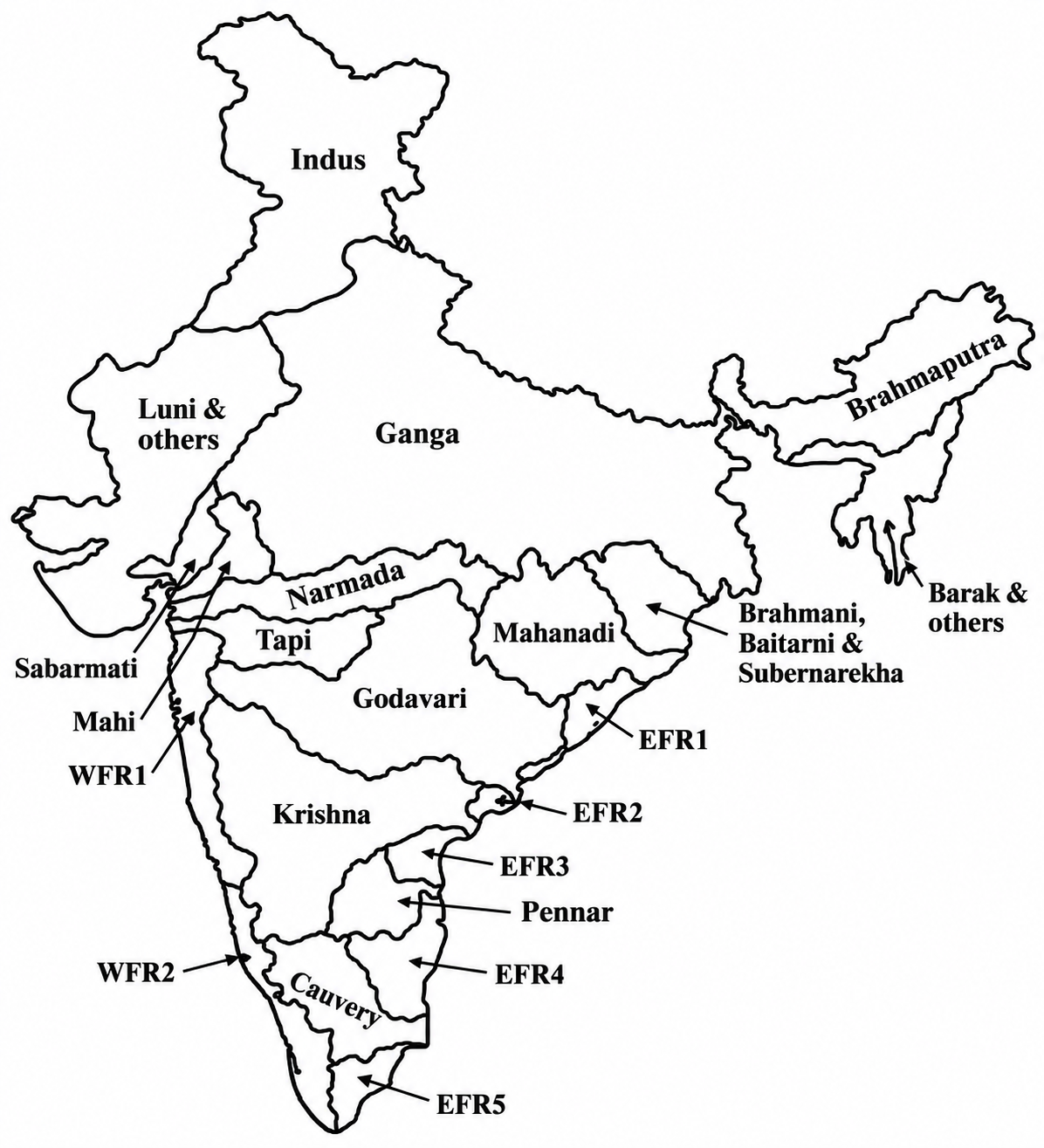
Note: EFR = East-flowing River, WFR = West-flowing River


Peninsular River System Types
The Peninsular river system of India consists of older, mature, and rain-fed rivers that flow over hard igneous and metamorphic rock terrain. Because the general slope of the Peninsular plateau tilts from west to east, the majority of these rivers drain eastward into the Bay of Bengal, while a smaller group flows westward into the Arabian Sea
East-Flowing Rivers
The east-flowing rivers of the Peninsular River System generally originate in the Western Ghats, Central Highlands or Peninsular uplands and ultimately drain into the Bay of Bengal. The major east-flowing rivers are Mahanadi, Godavari, Krishna and Kaveri.
- Mahanadi River: The Mahanadi River originates near Sihawa in Chhattisgarh and flows through Chhattisgarh and Odisha before entering the Bay of Bengal.
- It is about 851 km long and has a catchment area of approximately 1.42 lakh sq. km.
- The river supports irrigation, agriculture, navigation in its lower course and deltaic activities.
- Godavari River: The Godavari River is the largest peninsular river system, originating in Maharashtra and flowing eastward into the Bay of Bengal.
- It rises in the Nasik region of Maharashtra, is about 1,465 km long, and is popularly known as the Dakshin Ganga. Important tributaries include Penganga, Indravati, Pranhita and Manjra.
- Its lower course forms a large delta after the river divides into several distributaries.
- Krishna River: The Krishna River is the second-largest east-flowing Peninsular river, originating near Mahabaleshwar in the Sahyadris and flowing towards the Bay of Bengal.
- It is about 1,401 km long, with major tributaries including the Koyna, Tungabhadra and Bhima. Its basin extends across Maharashtra, Karnataka, Telangana and Andhra Pradesh.
- Kaveri River: The Kaveri River originates in the Brahmagiri Hills of Karnataka and flows through Karnataka and Tamil Nadu before reaching the Bay of Bengal.
- It is about 800 km long, with important tributaries including Kabini, Bhavani and Amravati.
- Its basin receives rainfall from both the southwest and northeast monsoons, giving it comparatively less seasonal fluctuation than several other Peninsular rivers.
- Pennar River: The Pennar River is an important east-flowing peninsular river that rises in the Nandi Hills of Karnataka and flows through Karnataka and Andhra Pradesh before reaching the Bay of Bengal.
- Its basin lies mainly in the relatively dry parts of southern India, making its flow highly dependent on seasonal rainfall.
- The Gandikota canyon of South India was created by the Pennar River.
- Brahmani River: The Brahmani River is an important east-flowing river of eastern India, formed by the confluence of the South Koel and Sankh rivers in Odisha.
- It flows through Odisha and eventually reaches the Bay of Bengal through the coastal deltaic region.
- Baitarani River: The Baitarani River originates in the Gonasika Hills of Odisha and flows generally eastward before joining the coastal drainage of Odisha.
- It contributes to the extensive network of rivers and distributaries along the Odisha coast.
- Subarnarekha River: The Subarnarekha River originates near Nagri in Jharkhand and flows through Jharkhand, West Bengal and Odisha before entering the Bay of Bengal.
- Its basin is associated with the mineral-rich Chotanagpur Plateau, and the river has an important role in the drainage of eastern Peninsular India.
West-Flowing Rivers
The west-flowing rivers of the Peninsular River System generally drain into the Arabian Sea, with the Narmada and Tapi occupying major structural troughs and several shorter rivers descending from the Western Ghats. The principal westward-draining rivers include the Narmada, Tapi, Mahi, Sabarmati, Luni, and Periyar, along with numerous short coastal rivers.
- Narmada River: The Narmada River originates on the western flank of the Amarkantak Plateau and flows westward through a rift valley between the Vindhya and Satpura ranges.
- It is about 1,312 km long and forms notable features, including the Marble Rocks gorge and Dhuandhar Falls near Jabalpur. It enters the Arabian Sea south of Bharuch through a broad estuary.
- Tapi River: The Tapi River is an important west-flowing river originating near Multai in the Betul district of Madhya Pradesh and draining into the Arabian Sea.
- It is about 724 km long and has a drainage area of approximately 65,145 sq. km, with much of its basin lying in Maharashtra.
- Mahi River: The Mahi River is a west-flowing peninsular river that originates in Madhya Pradesh and eventually drains into the Gulf of Khambhat in Gujarat.
- It is among the major Indian drainage basins and is part of the Arabian Sea drainage.
- Sabarmati River: The Sabarmati River rises in the Aravalli region of Rajasthan and flows southwest through Rajasthan and Gujarat before reaching the Gulf of Khambhat.
- Its basin is important for water supply, agriculture and urban settlements, particularly in Gujarat.
- Luni River: The Luni River is the principal river system of Rajasthan west of the Aravallis and represents an important example of inland and seasonal drainage.
- It originates near Pushkar, flows through Rajasthan and ultimately reaches the Rann of Kachchh.
- The river is ephemeral, with its flow strongly dependent on rainfall.
- Periyar River: The Periyar River is an important west-flowing river of Kerala that drains towards the Arabian Sea and supports irrigation, hydropower, drinking-water supply and ecosystems.
- It is among the important medium-sized drainage systems associated with India's Arabian Sea drainage.
- Short West-Coast Rivers: Short west-coast rivers descend rapidly from the Western Ghats to the Arabian Sea because the Ghats lie close to the western coast.
- Important examples include Mandovi, Zuari, Sharavathi, Netravati, Bharathapuzha and other short coastal streams.
- Their steep gradients create rapids and waterfalls, and some have significant hydropower potential.
East-Flowing and West-Flowing Peninsular Rivers of India
| East-Flowing Rivers – Bay of Bengal | West-Flowing Rivers – Arabian Sea |
|
Mahanadi |
Narmada |
|
Godavari |
Tapi (Tapti) |
|
Krishna |
Mahi |
|
Kaveri (Cauvery) |
Sabarmati |
|
Pennar (Penna) |
Damanganga |
|
Brahmani |
Periyar |
|
Baitarani |
Bharathapuzha |
|
Subarnarekha |
Pamba |
|
Vamsadhara |
Netravati |
|
Nagavali (Langulya) |
Sharavathi |
|
Palar |
Mandovi |
|
Ponnaiyar (South Pennar) |
Zuari |
|
Vaigai |
Kali |
|
Tamiraparani |
Aghanashini |
|
Vellar |
Gangavali |
|
Gundar |
Bedti |
|
Vaippar |
Vashishti |
|
- |
Ulhas |
| - |
Savitri |
| - |
Vaitarna |
| - |
Kundalika |
Peninsular River System Significance
The Peninsular River System is significant for agriculture, irrigation, hydropower, drinking water, biodiversity, transport, industry, fisheries and the economic development of plateau and coastal regions.
- Irrigation and Agriculture: Major rivers such as the Godavari, Krishna, Kaveri and Mahanadi provide water for extensive agricultural regions.
- Hydropower Generation: Steep gradients, rapids and waterfalls in several Peninsular rivers provide favourable conditions for hydropower generation.
- Cauvery River: Uses the 101-metre drop of Shivanasamudra Falls to power the historic Shivanasamudra Hydroelectric Project.
- Koyna River: Capitalises on the steep Western Ghats escarpment to drive the 1,960 MW Koyna Underground Hydroelectric Project.
- Drinking Water: River reservoirs and associated water infrastructure supply water to numerous towns and cities.
- The Krishna, Godavari, and Kaveri river systems supply water to major cities through critical infrastructure like the Nagarjuna Sagar, Srirama Sagar, and Krishna Raja Sagara reservoirs.
- Industrial Development: Rivers provide water required by industries and support industrial centres across the Peninsular region.
- Delta Agriculture: The deltas of the Mahanadi, Godavari, Krishna and Kaveri support fertile agricultural landscapes along the eastern coast.
- Biodiversity: River channels, wetlands, estuaries, deltas and riparian ecosystems provide habitats for diverse aquatic and terrestrial species.
- The Godavari River System delta houses the Coringa Wildlife Sanctuary, which operates as a critical combined estuary-delta ecosystem supporting major mangrove forests and diverse aquatic and terrestrial wildlife.
- Fisheries: Rivers, reservoirs, estuaries and deltas support inland and coastal fisheries and associated livelihoods.
Peninsular River System Major Challenges
Major challenges facing the Peninsular River System include seasonal water scarcity, pollution, excessive extraction, sedimentation, altered flows, riverbank degradation, floods, droughts and interstate water disputes.
- Seasonal variability: Heavy dependence on monsoon rainfall creates substantial variations between wet and dry seasons.
- Water scarcity: Several basins experience inadequate water availability during dry periods.
- Pollution: Untreated sewage, industrial effluents, agricultural runoff and solid waste degrade river water.
- Over-extraction: Excessive withdrawal for irrigation, cities and industries can reduce environmental flows.
- Dam and barrage impacts: Flow regulation can alter sediment transport, aquatic habitats and downstream ecosystems.
- Sedimentation: Soil erosion and catchment degradation increase sediment loads in rivers and reservoirs.
- Floods and droughts: Uneven rainfall can produce floods in one basin while other regions experience water shortages.
- Riverbank encroachment: Expansion of settlements towards river channels can reduce natural drainage space.
- Interstate water disputes: Shared basins can generate disputes over allocation and management.
- Climate variability: Changing rainfall patterns and extreme events can increase uncertainty in river flows.
Peninsular River System and Climate Change Impact
Climate change can alter Peninsular river system flows by changing monsoon rainfall, increasing extreme precipitation, intensifying drought conditions and modifying evaporation and water demand.
- Changing Monsoon Patterns: Variations in the timing, duration and intensity of monsoon rainfall can alter seasonal river discharge.
- Kaveri: Irregular monsoon rainfall can cause fluctuations in seasonal river flows and affect water availability.
- More Extreme Rainfall: Short-duration intense rainfall events can increase flash floods, erosion and sediment transport.
- Mahanadi: Intense rainfall events can rapidly increase river discharge and raise flood risks in Odisha.
- Longer Dry Periods: Extended dry periods can reduce river flows, reservoir storage and groundwater recharge.
- Krishna: Prolonged dry periods can reduce river flows and increase water stress in its drought-prone parts of the basin.
- Higher Evaporation: Rising temperatures can increase evaporation from reservoirs, wetlands and river catchments, particularly in already water-stressed regions.
- Tungabhadra: Rising temperatures can increase evaporation from its reservoir, reducing available surface water.
- Agricultural Stress: Changes in river availability can affect irrigation-dependent agriculture, especially in semi-arid Peninsular basins.
- Pennar: Variable rainfall and river flows can increase irrigation stress in its relatively water-scarce basin.
- Ecosystem Impacts: Reduced environmental flows and altered seasonal patterns can affect wetlands, fish populations, estuaries and riparian ecosystems.
- Godavari: Changes in freshwater flows can affect the ecological conditions of its delta and estuarine ecosystems.
Peninsular River System Way Forward
Sustainable management of the Peninsular river system requires basin-level planning, efficient water use, ecological-flow protection, pollution control, watershed restoration and climate-resilient infrastructure.
- Adopt River-Basin Management: Water planning should consider the entire river basin rather than individual projects or administrative boundaries.
- Improve Water-Use Efficiency: Drip irrigation, sprinkler irrigation, crop diversification and efficient urban water management can reduce pressure on rivers.
- Protect Catchments: Afforestation, soil conservation, watershed development and protection of wetlands can improve infiltration and reduce erosion.
- Maintain Environmental Flows: River-management projects should maintain sufficient downstream flows to support ecosystems and communities.
- Strengthen Pollution Control: Sewage treatment, industrial effluent management and agricultural pollution control should be strengthened.
- Improve Reservoir Management: Reservoir operations should integrate flood control, irrigation, drinking water, hydropower and ecological requirements.
- Promote Rainwater Harvesting: Local water harvesting and groundwater recharge can reduce dependence on rivers during dry periods.
- Use GIS and Remote Sensing: Satellite monitoring and GIS can help track river channels, reservoirs, floodplains, land-use changes, sedimentation and water availability.
- Strengthen Interstate Cooperation: Basin-sharing states should use transparent hydrological data, scientific assessments and cooperative mechanisms for water management.
- Develop Climate-Resilient Planning: Future river planning should account for changing rainfall patterns, extreme floods, droughts, rising temperatures and increasing water demand.
- Strengthen Basin-level Institutions: River-basin authorities should use shared hydrological data, real-time monitoring and scientific water accounting to improve allocation and reduce interstate conflicts.
Peninsular River System UPSC PYQs
Q1. Gandikota canyon of South India was created by which one of the following rivers? (UPSC Prelims 2022)
a) Cauvery
b) Manjira
c) Pennar
d) Tungabhadra
Ans: (c)
Q2. Consider the following rivers: (UPSC Prelims 2021)
1) Brahmani
2) Nagavali
3) Subarnarekha
4) Vamsadhara
Which of the above rise from the Eastern Ghats?
a) 1 and 2
b) 2 and 4
c) 3 and 4
d) 1 and 3
Ans: (b)
Q3. The Narmada river flows to the west, while most other large peninsular rivers flow to the east. Why? (UPSC Prelims 2013)
- It occupies a linear rift valley.
- It flows between the Vindhyas and the Satpuras.
- The land slopes to the west from Central India.
Select the correct answer using the codes given below.
a) 1 only
b) 1 and 3 only
c) 2 and 3 only
d) None
Ans: (a)

 Last updated on Oct, 2026
→ UPSC 2027 Notification will be released on 13 January 2027 at upsconline.nic.in.
→ Asian Games 2026 are being held in Aichi-Nagoya, Japan, from 19 September to 4 October.
→ Check Nobel Prize 2026 Winners List here.
→ Download PIB PRiSM Monthly Magazine 2026 here.
→ Check UPSC Monthly Current Affairs Magazine The Recitals here.
→ Check out the latest UPSC Syllabus here.
→ Download UPSC Model Answers for Mains 2026
→ UPSC Mains Question Paper 2026 is out now for Essay & GS Paper 1, 2, 3 & 4.
→ UPSC Calendar 2027 has been released.
→ Enroll in Vajiram & Ravi’s UPSC Mains Test Series 2027 for structured answer writing practice, expert evaluation, and exam-oriented feedback.
→ Join Vajiram & Ravi’s UPSC Mentorship Program 2027 for personalized guidance, strategy planning, and one-to-one support from experienced mentors.
→ Go through the UPSC Mains Previous Year Papers to enhance your preparation.
→ UPSC has released UPSC Toppers List 2025 with the Civil Services final result on its official website.
→ Also check Best UPSC Coaching in India
Peninsular River System FAQs
Q1. Which is the most important peninsular river?+
Q2. Which is the smallest peninsular river in India?+
Q3. Which are the major west-flowing peninsular rivers?+
Q4. Which peninsular rivers flow through rift valleys?+
Q5. Which peninsular river flows into the Rann of Kachchh?+
Tags: peninsular river system quest UPSC Geography Notes