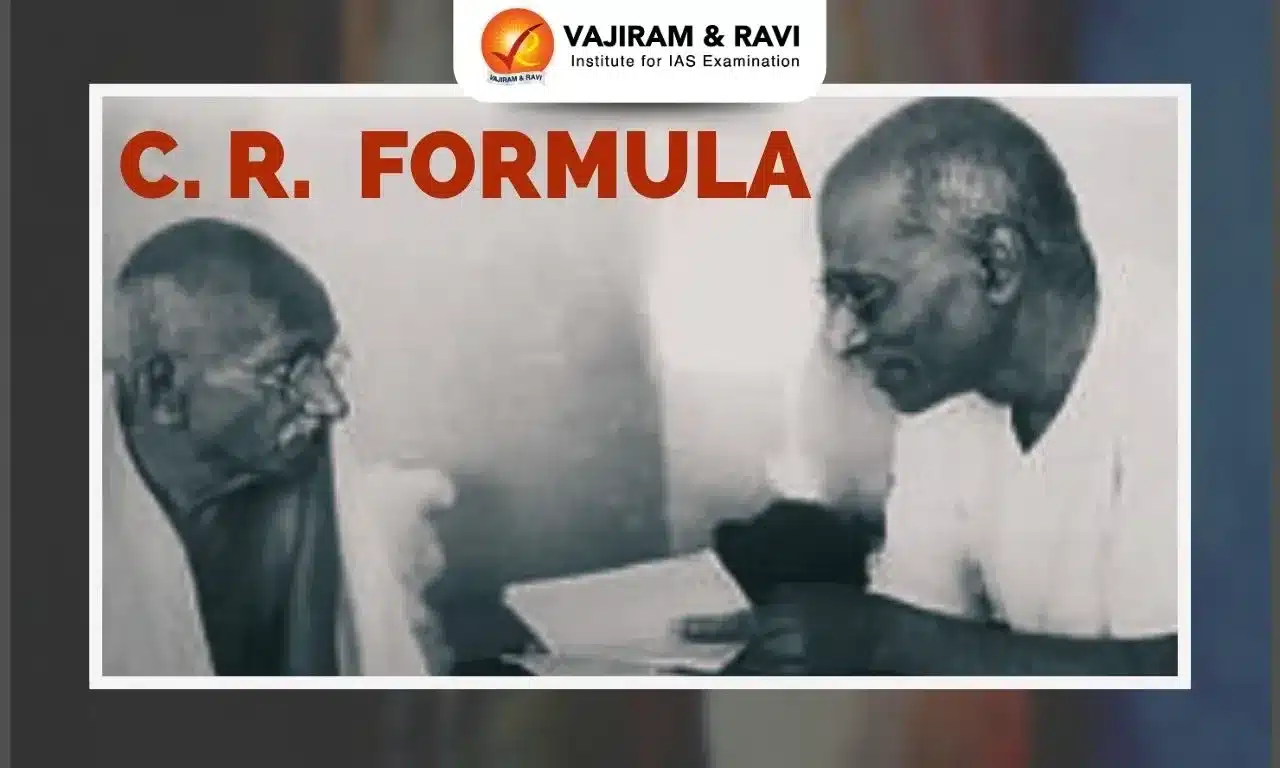
The C R Formula of 1944, proposed by C. Rajagopalachari aimed to resolve the political deadlock between the Indian National Congress (INC) and the Muslim League. As the British government demanded an agreement between these factions before any constitutional progress, the formula sought to promote cooperation by addressing the aspirations of both groups.
It included key proposals for mutual support in the independence movement, the establishment of a provisional government, and plebiscites in Muslim-majority areas for a separate nation. While Mahatma Gandhi supported this initiative, Muhammad Ali Jinnah's firm stance on the two-nation theory led to its eventual failure.
C R Formula Background
During the Second World War, the British government had taken a hardline position, stating that no constitutional advance would be made until the Congress reached an agreement with Muslim leaders. The Muslim League was increasingly advocating for a separate nation, Pakistan for Muslims, while the Indian National Congress opposed any division of the country. To address this stalemate between the two dominant political factions, C. Rajagopalachari, a prominent INC leader and close ally of Mahatma Gandhi, introduced a set of proposals called the C R Formula, also known as the Rajaji Formula.
C R Formula Proposals
The C R Formula sought to create a pathway for collaboration between the Indian National Congress and the Muslim League during intense political strife. By proposing compromises, it aimed to address the conflicting aspirations of both parties. The main proposals of the CR Formula were:
- Muslim League Support for Complete Independence: It called for the Muslim League to support the Congress's demand for complete independence from British rule.
- Cooperation: The League would cooperate with Congress in establishing a provisional government at the centre.
- Post-War Plebiscite for Muslim-Majority Regions: After the war, the populations of Muslim-majority regions in North-West and North-East India would decide through a plebiscite whether to form a separate sovereign state.
- Joint Agreements in Case of Partition: If partition was accepted, there would be joint agreements to ensure the safeguarding of defence, commerce, and communications.
- Condition for Implementation: These proposals would only come into effect if the British government transferred full powers to India.


C R Formula Reactions
The C R Formula generated a spectrum of responses from various political factions. While it represented a tacit acceptance of the Muslim League's demand for Pakistan, it also sparked intense debate within the Congress and among Hindu leaders.
- Gandhi’s Support: Mahatma Gandhi endorsed the formula as a potential compromise.
- Jinnah’s Opposition: Muhammad Ali Jinnah insisted on the two-nation theory and preferred only Muslims from North-West and North-East India to vote in the plebiscite. He also opposed a common central government.
- Congress’ Stance: The Congress was willing to cooperate with the League for the independence of the Indian Union.
- Hindu Leaders’ Condemnation: Hindu leaders, particularly Vir Savarkar, vehemently condemned the C R Plan, viewing it as a betrayal of Hindu interests and an endorsement of communal division.
C R Formula Failure
In September 1944, Gandhi and Jinnah met in an attempt to ease the deadlock between the Congress and the Muslim League. Gandhi presented the C R Formula as his proposal to Jinnah, hoping to find common ground. However, after two weeks of negotiations, the talks broke down, reflecting the deep-seated mistrust and conflicting aspirations between the two leaders and their parties.

 Last updated on Oct, 2026
→ UPSC 2027 Notification will be released on 13 January 2027 at upsconline.nic.in.
→ Check Nobel Prize 2026 Winners List here.
→ Download PIB PRiSM Monthly Magazine 2026 here.
→ Check UPSC Monthly Current Affairs Magazine The Recitals here.
→ Check out the latest UPSC Syllabus here.
→ Download UPSC Model Answers for Mains 2026
→ UPSC Mains Question Paper 2026 is out now for Essay & GS Paper 1, 2, 3 & 4.
→ UPSC Calendar 2027 has been released.
→ Enroll in Vajiram & Ravi’s UPSC Mains Test Series 2027 for structured answer writing practice, expert evaluation, and exam-oriented feedback.
→ Join Vajiram & Ravi’s UPSC Mentorship Program 2027 for personalized guidance, strategy planning, and one-to-one support from experienced mentors.
→ Go through the UPSC Mains Previous Year Papers to enhance your preparation.
→ UPSC has released UPSC Toppers List 2025 with the Civil Services final result on its official website.
→ Also check Best UPSC Coaching in India
C R Formula FAQs
Q1. What is C. R. formula of 1944?+
Q2. Who condemned the C. R. formula?+
Q3. Why did Jinnah reject the C. R. formula?+
Q4. Who gave the C. R. formula?+
Q5. Who is known as CR?+
Tags: c r formula quest