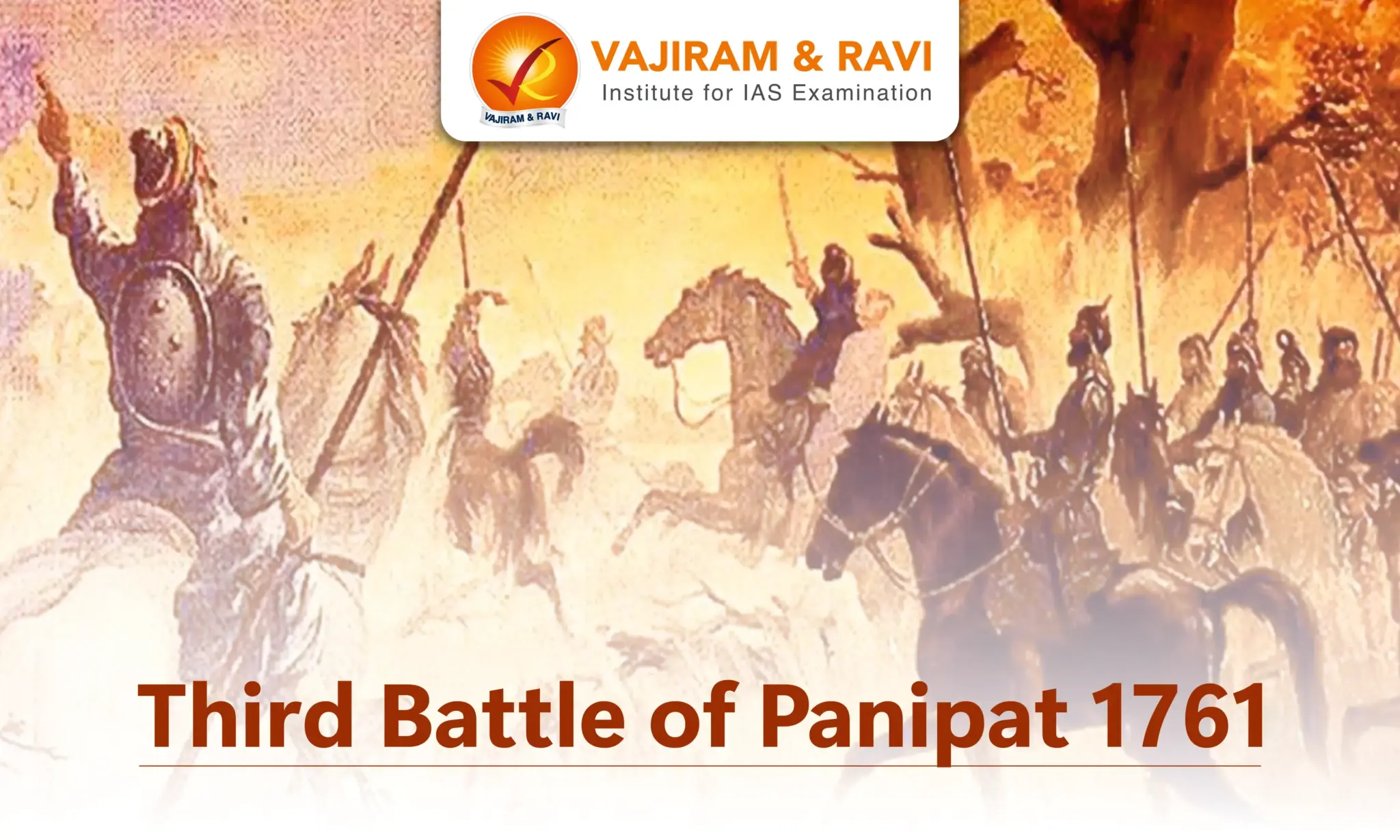
The Third Battle of Panipat was fought on 14 January 1761 at Panipat, present-day Haryana. It was fought between the Maratha army led by Sadashiv Rao Bhau and the Afghan-led coalition commanded by Ahmad Shah Abdali, also known as Ahmad Shah Durrani. This coalition included two Indian Muslim allies: the Rohilla Afghans of the Doab and Shuja-ud-Daula, the Nawab of Oudh.
The Third Battle of Panipat is regarded as one of the largest battles of the 18th century and is known for having one of the highest numbers of deaths in a single day. In summary, the scale of the Third Battle of Panipat and the massive loss of life highlighted the intense struggle for power in India and left a lasting mark on the region's history.
Third Battle of Panipat Background
The Third Battle of Panipat was shaped by rapid Maratha expansion into Northern India and repeated Afghan invasions, which destabilised the region and created intense political and religious rivalries.
Rise and Expansion of Maratha Empire
The rise of the Maratha Empire was linked to the decline of Mughal authority after Mughal Emperor Aurangzeb. Under Peshwa Baji Rao I, the Marathas expanded beyond the Deccan into Malwa, Gujarat, Bundelkhand, and parts of North India.
- Under Peshwa Baji Rao's leadership, the Marathas secured dominance over regions such as Gujarat, Malwa, and Rajputana.
- In 1737, Baji Rao won an important battle against the Mughals near Delhi, allowing the Marathas to take over a large area south of Agra.
- His son, Balaji Baji Rao (commonly known as Nana Saheb), continued this expansion by invading Punjab in 1758.
- By 1758, they had effectively taken over Delhi, captured Lahore, and removed Timur Shah Durrani, son of Ahmad Shah Abdali.
- At their peak, the Maratha Empire stretched from the Indus River in the north to the Kaveri River in the south.
Invasion by Ahmed Shah Abdali
Nadir Shah, the Persian emperor, invaded India in 1738-39, capturing Lahore and defeating the Mughal army at Karnal on February 13, 1739. After he died in 1747, Ahmad Shah Abdali (or Ahmad Shah Durrani) stepped into power. He made several incursions into India between 1748 and 1767.
- In 1757, Abdali captured Delhi and left an Afghan caretaker for the Mughal emperor.
- Before leaving, he recognised Alamgir II as the Mughal emperor and appointed Najib-ud-Daula, the Rohilla chief, as Mir Bakshi, making him his representative in Delhi.
Third Battle of Panipat Timeline
The Third Battle of Panipat was fought between the Marathas and Afghan forces of the Durrani Empire. The following timeline explains the major events leading to the battle:
|
Year / Date |
Major Event |
|
1759 |
Abdali invaded India again to challenge Maratha influence in Punjab and Delhi. |
|
August 1760 |
Maratha forces captured Delhi. |
|
October 1760 |
Marathas captured Kunjpura, an important Afghan-held position. |
|
October 1760 |
Abdali crossed the Yamuna River and cut Maratha supply routes. |
|
October 1760–January 1761 |
The two sides remained positioned near Panipat; shortages severely affected the Maratha camp. |
|
14 January 1761 |
Third Battle of Panipat was fought; Abdali’s coalition defeated the Marathas. |


Third Battle of Panipat Causes
The causes of the Third Battle of Panipat were multifaceted, involving Maratha expansion in Northwest India, Afghan retaliation, and Ahmad Shah Abdali’s determination to regain lost territories.
- Maratha Expansion into North India: The Marathas had expanded rapidly beyond the Deccan and established considerable influence in Delhi, Punjab and other northern regions. This expansion threatened Afghan interests.
- Attack of Durrani: While the Marathas were striving to increase their control in the Northwest of India, Durrani attacked the Mughal capital and left with the treasures he sought. As a measure against the Afghan threat, Peshwa Balaji Bajirao sent Raghunathrao.
- Capture of Delhi & Punjab (1758): Raghunathrao drove Najib-ud-Daula out of Delhi, captured Punjab, and brought the northwest region, including Peshawar, under Maratha control.
- Expulsion of Timur Shah: The Marathas successfully removed Durrani's son, Timur Shah, and his court from India, completely taking Punjab from Afghan control.
- Retaliation & War (1759–1761): This direct conflict prompted Ahmad Shah Abdali to return in 1759 for revenge, culminating in his victory at the Third Battle of Panipat in 1761.
Third Battle of Panipat Course
The Maratha army was commanded by Sadashivrao Bhau, with Vishwasrao, the son of Peshwa Balaji Baji Rao, accompanying him. The Maratha forces reached the Panipat region and established a fortified camp. Ahmad Shah Abdali's forces surrounded the Maratha position and attempted to cut off their supplies.
- Prolonged Stalemate: The Marathas were trapped for months, facing food shortages, lack of supplies, exhaustion, and disrupted communication, while Abdali maintained the blockade.
- Maratha Attack (14 January 1761): The Marathas launched a desperate attack to break the blockade. Ibrahim Khan Gardi's infantry and artillery initially performed effectively and pushed back Abdali's forces.
- Turning Point & Defeat: The death of Vishwasrao, followed by Sadashivrao Bhau's death, shattered Maratha morale and coordination. Abdali counterattacked, eventually overwhelming the Maratha army.
Third Battle of Panipat Outcome
The Third Battle of Panipat crushed Maratha power in northern India, killed key leaders like Sadashivrao Bhau, and caused over 100,000 casualties. Ahmad Shah Abdali won the war but returned to Afghanistan, leaving a political vacuum that helped the British East India Company rise to power.
- Reasons Behind the Maratha Loss: Durrani's forces had a larger and better-equipped army compared to the Marathas, whose lighter artillery struggled against the Afghans' heavy guns.
- Furthermore, conflicts among Maratha leaders and the lack of support from other local rulers left them alone and far from their capital in Pune.
- Ahmad Shah Abdali was regarded as one of the best generals, with a strong knowledge of effective methods for winning battles.
- Following the Third Battle of Panipat, Shah Alam II became the Mughal emperor of Delhi. However, Abdali did not establish permanent Afghan control over Delhi, and the political instability of North India continued.
- The Marathas gradually rebuilt their strength after the battle. Their later expansion brought them into direct conflict with the British East India Company, culminating in the Anglo-Maratha Wars (1775–1818) and ultimately the end of Maratha political supremacy in India.
Third Battle of Panipat Significance
The Third Battle of Panipat significantly affected the Maratha Empire, and its impacts influenced the course of 18th-century Indian history.
- Halt to Maratha Expansion: The devastating loss shattered the Maratha ambition of establishing a pan-Indian empire, causing severe military casualties and the loss of key leadership like Sadashivrao Bhau.
- While it halted immediate Maratha dominance, the empire eventually resurrected its Northern influence a decade later under Peshwa Madhavrao I and Mahadji Shinde.
- Rise of Regional Powers: The decline of the Marathas created opportunities for regional powers such as the Sikhs, Rajputs, and Jats to rise. This shift contributed to a greater political diversity in 18th-century India.
- Geopolitical Vacuum: Although victorious, Abdali withdrew due to mutinous troops, leaving a vast power vacuum in Northern India.
- Rise of the British: By neutralising the Marathas and failing to establish a lasting Afghan dynasty, the battle indirectly cleared the strategic path for the British East India Company to consolidate British Rule in India over Bengal and expand across the subcontinent.
Third Battle of Panipat PYQs
Q1: The Third Battle of Panipat was fought in 1761. Why were so many empire-shaking battles fought at Panipat? (UPSC Mains 2014)
Q2: What was the immediate reason for Ahmad Shah Abdali to invade India and fight the Third Battle of Panipat? (UPSC Prelims 2010)
(a) He wanted to avenge the expulsion by Marathas of his viceroy Timur Shah from Lahore.
(b) The frustrated governor of Jalandhar Adina Beg Khan invited him to invade Punjab.
(c) He wanted to punish the Mughal administration for nonpayment of the revenues of the Chahar Mahal (Gujarat, Aurangabad, Sialkot and Pasrur).
(d) He wanted to annex the fertile plains of Punjab up to the borders of Delhi in his kingdom.
Ans: (a)

 Last updated on Oct, 2026
→ UPSC 2027 Notification will be released on 13 January 2027 at upsconline.nic.in.
→ Check Nobel Prize 2026 Winners List here.
→ Download PIB PRiSM Monthly Magazine 2026 here.
→ Check UPSC Monthly Current Affairs Magazine The Recitals here.
→ Check out the latest UPSC Syllabus here.
→ Download UPSC Model Answers for Mains 2026
→ UPSC Mains Question Paper 2026 is out now for Essay & GS Paper 1, 2, 3 & 4.
→ UPSC Calendar 2027 has been released.
→ Enroll in Vajiram & Ravi’s UPSC Mains Test Series 2027 for structured answer writing practice, expert evaluation, and exam-oriented feedback.
→ Join Vajiram & Ravi’s UPSC Mentorship Program 2027 for personalized guidance, strategy planning, and one-to-one support from experienced mentors.
→ Go through the UPSC Mains Previous Year Papers to enhance your preparation.
→ UPSC has released UPSC Toppers List 2025 with the Civil Services final result on its official website.
→ Also check Best UPSC Coaching in India
Third Battle of Panipat FAQs
Q1. Who won The Third Battle of Panipat?+
Q2. When was the Third Battle of Panipat fought?+
Q3. Why is the Third Battle of Panipat important?+
Q4. Who fought the 3rd Battle of Panipat?+
Q5. Why did Marathas lose the 3rd Battle of Panipat?+
Tags: quest third battle of panipat upsc modern history notes