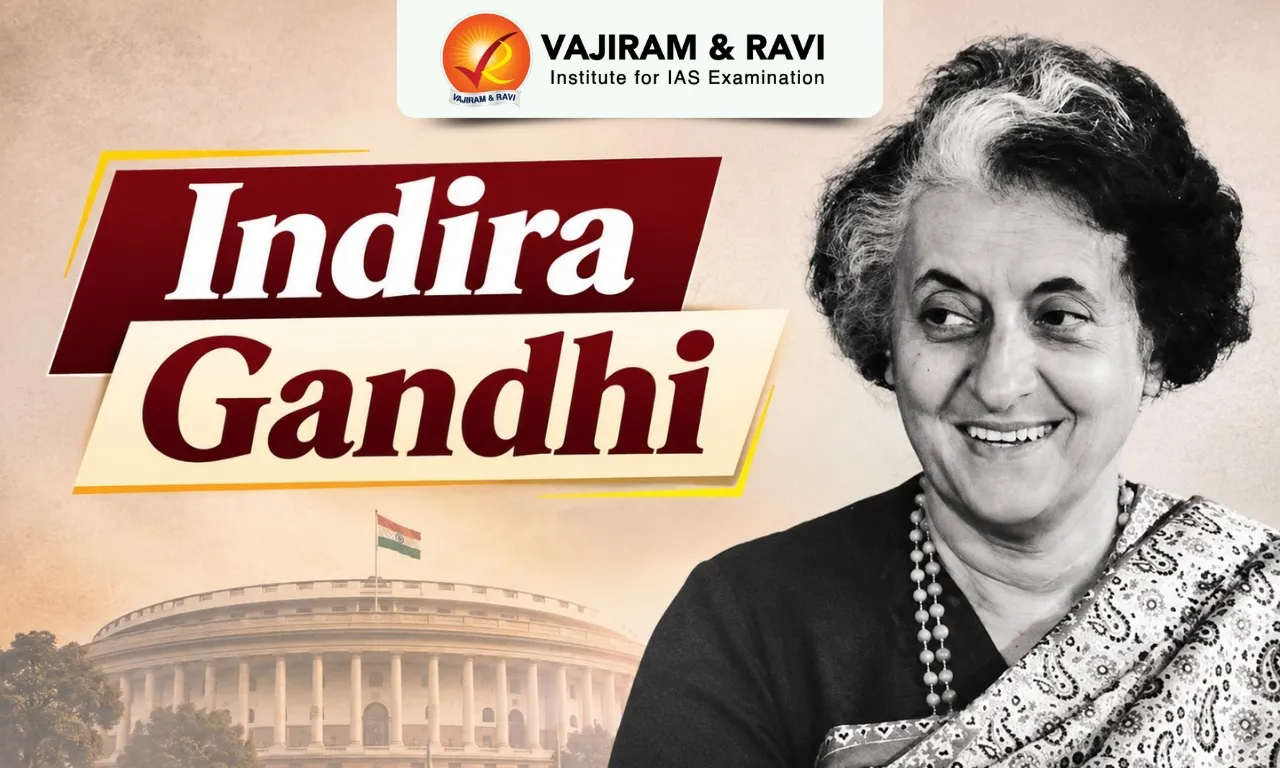
Indira Gandhi was India's first and, to date, only woman Prime Minister. She served from 1966 to 1977 and again from 1980 until her assassination in 1984. Known for her strong leadership and central role in Indian politics, she influenced India's economic policies, agricultural development, foreign relations and national security.
Her tenure witnessed major developments, including the nationalisation of 14 major commercial banks in 1969, the 1971 war that resulted in the creation of Bangladesh, and the expansion of agricultural production associated with the Green Revolution. However, her political career was also marked by significant controversies, particularly the National Emergency of 1975–1977 and Operation Blue Star in 1984.
Indira Gandhi Biography
Indira Gandhi was born on November 19, 1917, in Allahabad (Now Prayagraj), India, into a prominent political family. She was the daughter of Jawaharlal Nehru, a key figure in the Indian independence movement and the first Prime Minister of India. Her mother, Kamala Nehru, was an active participant in the struggle for independence.
Indira Gandhi Early Life
Indira Gandhi grew up in a politically active household closely associated with India’s freedom struggle. Her father was imprisoned several times during the independence movement, and she was exposed to nationalist politics from an early age.
- Education: She was educated at Visva-Bharati University and then studied at the International School of Geneva in Switzerland. Later, she enrolled at Oxford, where she studied history, economics, and political science.
- Personal Life: In 1942, Indira married Feroze Gandhi, a fellow Congress member and journalist, with whom she had two sons, Rajiv and Sanjay.
Indira Gandhi Books
Indira Gandhi's writings provide insights into her political views, personal experiences and leadership.
- Her notable works include The Years of Challenge: Selected Speeches and Writings, 1966–1969, The Years of Endeavour: Selected Speeches and Writings, 1969–1972, and My Truth.
- Important biographies include Pupul Jayakar's Indira Gandhi: A Biography and Katherine Frank's Indira Gandhi: A Personal and Political Biography.
Indira Gandhi Political Career
Indira Gandhi's political career developed gradually through her involvement in the Indian National Congress, her association with Jawaharlal Nehru and her participation in national political affairs. After India's independence in 1947, she assisted her father in various political and official responsibilities.
Indira Gandhi's Role in the Independence Movement
She participated in activities associated with the Indian independence movement during her childhood and youth. As a child, she formed Bal Charkha Sangh in 1930
- Vanar Sena: In 1930, she organised the Vanar Sena, a group of children who supported the Congress movement through activities such as distributing messages and assisting political volunteers.
- Participation in Freedom Struggle: During the Quit India Movement of 1942, she participated in nationalist activities and was arrested in September 1942. She was subsequently released in 1943.
Career in Indian National Congress
Indira Gandhi joined the Indian National Congress in 1938 and became a member of the working committee of the Congress Party in 1955. In 1959, she was chosen to be President of the Special Session of INC. After Jawaharlal Nehru's death in 1964, Lal Bahadur Shastri appointed her to the cabinet as the Minister of Communication and Broadcasting.
- 3rd Prime Minister: After Shastri’s death in January 1966, she defeated Morarji Desai in the Congress parliamentary leadership election and became the third Prime Minister and the first woman to hold the post.
- Congress Split: The Indian National Congress formally split in November 1969 due to a severe power struggle and ideological divide between Prime Minister Indira Gandhi and the party's old-guard leadership known as the Syndicate.
- Congress (I) / Indian National Congress (Indira): On January 2, 1978, Indira Gandhi and her followers split again to form a new party known as Congress (I) (the "I" standing for Indira).
- In 1981, the Election Commission of India recognised her faction as the "real" Indian National Congress, which eventually dropped the "I" designation.


Prime Minister Indira Gandhi
Indira Gandhi became Prime Minister on 24 January 1966 following the sudden death of Lal Bahadur Shastri. She became the first woman to hold the office in India. Her tenure included significant political, economic and international developments. Her government pursued policies aimed at strengthening the public sector, expanding agricultural production and increasing India's influence in international affairs.
First Term of Indira Gandhi
Her first term began in 1966 amid economic challenges, food shortages, and political uncertainty. She strengthened the Congress organisation, centralised decision-making, and projected a strong leadership image. Major developments during this period included the 1969 nationalisation of 14 major banks, the abolition of privy purses in 1971, the 1971 India–Pakistan War, and India’s first nuclear test at Pokhran in 1974.
Second Term of Indira Gandhi
Indira Gandhi returned to power in January 1980 after forming the Congress (I). Her second term focused on political stability, economic recovery, and managing regional security challenges. However, this period also faced serious challenges, including separatist violence in Punjab, which led to Operation Blue Star in June 1984.
Indira Gandhi Reforms and Contributions
The era of Indira Gandhi's Prime Ministership was a pivotal phase in Indian history, marked by significant events and transformative policies. This phase witnessed the birth of Bangladesh, the emergency, and the economic and social reforms introduced during her tenure.
Nationalisation of Banks
One of Indira Gandhi's most significant economic policies was the nationalisation of banks in 1969. In 1969, 14 major commercial banks were nationalised. This move aimed to control credit and increase access to financial resources for the rural poor.
- By nationalising the banks, she sought to align the banking sector with the needs of the Indian economy, enhancing financial inclusion and supporting the government's developmental agenda.
- In 1980, Gandhi nationalised six more banks, further consolidating government control over the banking sector.
Abolition of Privy Purse
The Privy Purse was a monetary allowance granted to the former rulers of princely states who had acceded to the Indian Union after independence. The Privy Purse was initially guaranteed under Article 291 of the Indian Constitution. In 1971, Indira Gandhi introduced the 26th Amendment to the Indian Constitution, which sought to abolish the Privy Purse.
Economic Reform
Gandhi's economic policies combined socialist ideas with practical solutions. She introduced the Green Revolution during the 1960s, which boosted agricultural productivity. She also nationalised industries like coal, steel, copper, and insurance. Her policies aimed for self-sufficiency and less reliance on foreign aid. While some sectors saw growth, these measures also increased government control over the economy.
Bangladesh Liberation War
Indira Gandhi played a pivotal role in the Bangladesh Liberation War, supporting the independence movement against Pakistan. The war between India and Pakistan in 1971 was triggered by political and economic discrimination against the Bengali-speaking population in East Pakistan (now Bangladesh).
- Root Causes and Escalation: The refusal to grant power to the Awami League, despite their electoral win, led to widespread unrest. In response, the Pakistani military launched Operation Searchlight, causing severe human rights abuses and mass displacement.
- India's Role and Intervention: India intervened on December 3, 1971, after Pakistan's airstrikes, supporting Bengali nationalists and coordinating military efforts with them. The Indian Army decisively defeated Pakistani forces by December 16, resulting in Bangladesh's independence.
- Impact: The war strained India-Pakistan relations and had a high human cost, leading to the Shimla Agreement in 1972, which aimed to resolve post-war issues peacefully.
Twenty Point Programme
The Twenty Point Programme, launched in 1975, aimed to reduce poverty and boost socio-economic development. It focused on areas like poverty relief, agriculture, housing, and social welfare. The programme was updated in 1982, 1986, and 2006 with new schemes. It aligned with the UN's Millennium Development Goals and India's National Common Minimum Programme, showing Indira Gandhi's dedication to fighting poverty and inequality.
Garibi Hatao
Indira Gandhi's opponents used the slogan "Indira Hatao" (Remove Indira), to which she responded with "Garibi Hatao" (Remove Poverty). This slogan became central to her campaign, which focused on reducing poverty, creating jobs, and boosting agriculture as part of the Fifth Five-Year Plan. The Indian National Congress led the programme, with funding from the central government, and it helped her connect with poor and disadvantaged communities.
Green Revolution
She played a decisive role in the Green Revolution by providing the political will and policy backing necessary for its success. As Prime Minister, she boldly authorised the import of high-yielding MX-500 wheat seeds, decentralised agricultural credit, and guaranteed price supports for farmers. Her decisive leadership turned India from a food-deficient nation into a self-sufficient agricultural power.
Strengthening India’s Global Presence
Indira Gandhi strengthened India’s strategic position through the 1971 war victory, the 1974 Pokhran nuclear test, and assertive diplomacy during the Cold War. She also oversaw the merger of Sikkim with India in 1974, further consolidating India’s territorial and political position in the region.
Nuclear Program Test
India conducted its first nuclear programme test, codenamed "Smiling Buddha," on May 18, 1974, in Pokhran, Rajasthan, under Prime Minister Indira Gandhi's leadership. This made India the first non-P5 nation to successfully conduct a nuclear test, establishing it as a nuclear power.
- This move was heavily criticised worldwide, and many sanctions were imposed on India. Despite international pressure, India refused to sign the Nuclear Non-Proliferation Treaty (NPT) due to concerns about its fairness.
- The test served as a deterrent for national security, showcased India’s technological prowess, and marked its self-reliance in defence.
Indira Gandhi's Controversies
This phase of Indira Gandhi's Prime Ministership was marked by the imposition of the Emergency and its far-reaching consequences. It included the nuclear programme, Operation Blue Star, and the tragic assassination.
The National Emergency
One of the most contentious periods in Indira Gandhi's tenure was the declaration of a national emergency from 1975 to 1977. Citing political instability and threats to national security, she suspended constitutional rights and imposed strict censorship.
- Contributing Factors: Key factors included economic strain from the Bangladesh crisis, the U.S. suspension of aid, soaring oil prices, and the Allahabad High Court verdict invalidating Indira's 1971 election for electoral malpractices.
- Unrest During Emergency: Widespread protests, spearheaded by opposition leaders like Jayaprakash Narayan, accused Indira’s government of authoritarianism, corruption, and mismanagement. Civil liberties were suspended, the media was censored, and political opponents were jailed. Additionally, controversial policies like the "Compulsory Sterilisation Program" aimed at controlling population growth caused widespread public anger.
- Outcome: The 1977 general elections, held after the Emergency, were seen as a referendum on Indira Gandhi's rule, resulting in her defeat. This period exposed vulnerabilities in India’s democracy, leading to key constitutional amendments such as the 42nd Amendment.
Operation Blue Star
Operation Blue Star was a military operation ordered by Indira Gandhi to remove Sikh militants, including leader Jarnail Singh Bhindranwale, from the Golden Temple in Amritsar. The operation resulted in significant casualties and damage to the sacred site, sparking widespread outrage among the Sikh community and leading to increased tensions. This incident ultimately contributed to her assassination on October 31, 1984, by her own bodyguards.
Centralisation of Power and Dismissal of State Governments
Indira Gandhi faced frequent accusations of centralising power within the Indian National Congress, marginalising regional leadership, and running the party in a top-down, personalised manner.
- Early in her political rise (such as during her tenure as Congress president in 1959), she was instrumental in dismissing India's first democratically elected communist state government in Kerala.
- Throughout her prime ministership, the federal centre frequently used constitutional provisions to dismiss rival state governments.
Indira Gandhi Awards and Achievements
Indira Gandhi received national and international recognition for her political leadership and role in shaping India's domestic and foreign policies.
- Bharat Ratna: She received the Bharat Ratna in 1971, India's highest civilian award. The recognition came during her premiership and followed the major political and strategic developments associated with the 1971 Bangladesh Liberation War.
- Other Awards: She was awarded the Mexican Academy Award for her role in the Bangladesh Liberation. She also received the FAO’s 2nd Annual Medal in 1973 and the Sahitya Vachaspati Nagari Pracharini Sabha honour in 1976.
- Additionally, she won the Mother’s Award (US) in 1953, Italy's Isabella d'Este Award for her diplomatic achievements, and Yale University's Howland Memorial Award.
- Indira Gandhi National Open University (IGNOU): The Indira Gandhi National Open University (IGNOU) was established by an Act of Parliament in 1985 and named in her honour. Headquartered in New Delhi, IGNOU is a major institution for open and distance learning in India.
- Indira Gandhi International Airport: Indira Gandhi International Airport is located in New Delhi and is one of India's principal international aviation hubs. Named after Indira Gandhi, the airport serves as a major gateway for domestic and international passengers.
- Indira Gandhi Memorial Museum: The Indira Gandhi Memorial Museum is located at 1 Safdarjung Road in New Delhi, in the former residence of Indira Gandhi. The residence was converted into a museum after her assassination in 1984.
- The museum preserves photographs, personal belongings and exhibits documenting her life, political career and the history of the Nehru-Gandhi family.
Indira Gandhi Death
Indira Gandhi was assassinated on 31 October 1984 in New Delhi by two of her Sikh bodyguards. The assassination was carried out in retaliation for Operation Blue Star. Her death led to large-scale violence against Sikhs in several parts of India. Her elder son, Rajiv Gandhi, succeeded her as Prime Minister.
Indira Gandhi UPSC PYQs
Q1: Critically examine the compulsions which prompted India to play a decisive role in the emergence of Bangladesh. (UPSC Mains 2013)

 Last updated on Nov, 2026
→ UPSC 2027 Notification will be released on 13 January 2027 at upsconline.nic.in.
→ Check Nobel Prize 2026 Winners List here.
→ Download PIB PRiSM Monthly Magazine 2026 here.
→ Check UPSC Monthly Current Affairs Magazine The Recitals here.
→ Check out the latest UPSC Syllabus here.
→ Download UPSC Model Answers for Mains 2026
→ UPSC Mains Question Paper 2026 is out now for Essay & GS Paper 1, 2, 3 & 4.
→ UPSC Calendar 2027 has been released.
→ Enroll in Vajiram & Ravi’s UPSC Mains Test Series 2027 for structured answer writing practice, expert evaluation, and exam-oriented feedback.
→ Join Vajiram & Ravi’s UPSC Mentorship Program 2027 for personalized guidance, strategy planning, and one-to-one support from experienced mentors.
→ Go through the UPSC Mains Previous Year Papers to enhance your preparation.
→ UPSC has released UPSC Toppers List 2025 with the Civil Services final result on its official website.
→ Also check Best UPSC Coaching in India
Indira Gandhi FAQs
Q1. When did Indira Gandhi die and why?+
Q2. Are Mahatma Gandhi and Indira Gandhi related?+
Q3. What happened to the people who assassinated Indira Gandhi?+
Q4. How many times was Indira Gandhi Prime Minister?+
Q5. Who was the first female Prime Minister of India?+
Tags: indira gandhi quest UPSC Post-Independence India Notes