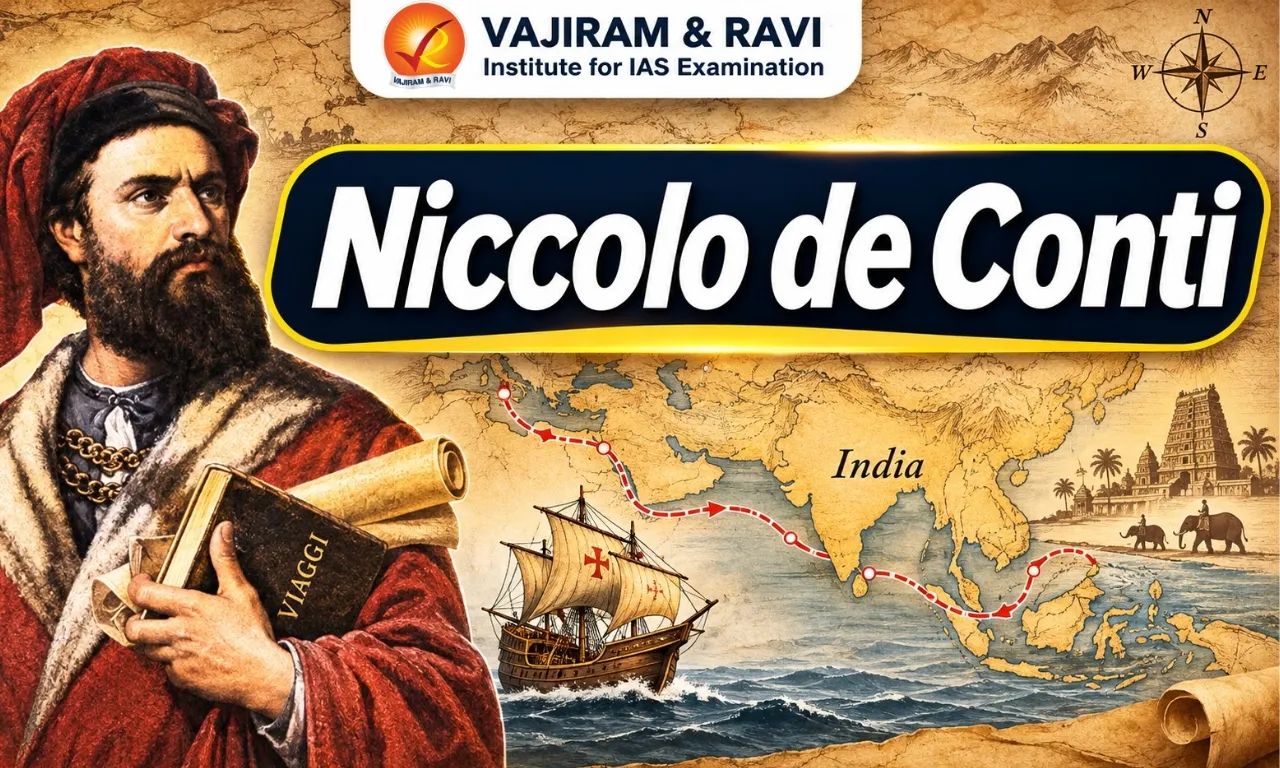
Niccolo de Conti was a Venetian merchant and Italian traveller who visited India during the 15th century. His account provides valuable information about Vijayanagara’s urban landscape, agriculture, irrigation, temples, festivals, social customs, and economic life.
Niccolò de Conti descriptions of Vijayanagara offer a foreign perspective on medieval Indian society, complementing indigenous literary, epigraphic and archaeological sources. His observations are particularly useful for understanding the empire’s urban development, prosperity, social life, religion and culture.
Nicolo De Conti About
Nicolo de Conti was among the famous foreign travellers who visited India. He was an Italian traveller and merchant from Venice who travelled extensively across Asia. His writings give useful information about Vijayanagara and medieval Indian society.
- Travels: Conti travelled extensively across Asia, visiting several regions of the Middle East, the Indian subcontinent and Southeast Asia. His observations are particularly important for understanding the condition of South India during the early 15th century.
- Travel account: His experiences were recorded by Poggio Bracciolini in Historia de Varietate Fortunae, commonly associated with the Nicolo De Conti book.
Nicolo De Conti Early Life and Travels
Niccolò de’ Conti was born around 1395 in the Venetian region of Italy. He belonged to a commercial environment in which maritime trade connected Mediterranean markets with the wider Asian trading world.
- Beginning of Travels: In 1419, Niccolò de’ Conti began a journey lasting nearly 25 years, exploring the Near East, India and Southeast Asia.
- Middle East and Persia: He travelled through Syria and Baghdad, learned Arabic and Persian, and established a trading company with local merchants in Persia.
- Visit to India: Using Persia as his base, Conti expanded his trading activities into India, travelled extensively across the Indian Ocean and married an Indian woman.
- Southeast Asian Travels: He visited Sumatra, the Malay Peninsula, Burma and Java, trading in spices, gold and precious stones.
- Return to Venice: After extensive commercial journeys, Conti travelled via the Red Sea and Suez, finally returning to Venice in 1444.
Nicolo De Conti Visit To India
Nicolo de Conti came during the early 15th century and visited India around 1420 CE, entering through Cambay (Khambhat) in Gujarat. He travelled through different parts of India and reached the Vijayanagara region.
- Cambay: He noted the availability of precious stones and referred to the practice of Sati. From Cambay, Conti travelled along the western coast of India. His wider journey connected coastal settlements with the interior of South India.
- Agriculture: At Pacamuria and Helly, he observed the cultivation and drying of ginger.
- Visit to Vijayanagara: He visited Vijayanagara, the capital of the Vijayanagara Empire, around 1420–1421 CE, during the period associated with Deva Raya II's rule. He referred to the city as Bizenegalia in his account.
- He described the city's extensive fortifications, large population, commercial activities, and religious festivals.
- Other Places: His travels also included Penugonda, Goa, Mylapore, Cochin and Calicut.
- Journey Beyond India: Conti's travels extended beyond the Indian subcontinent to Ceylon, present-day Sri Lanka, and several parts of Southeast Asia. His wider journey demonstrates the geographical reach of the commercial networks operating across the Indian Ocean.


Nicolo de Conti Observation of India
Niccolò de’ Conti provided valuable descriptions of India's urban centres, economic prosperity, maritime trade, religious practices and social customs. His observations, particularly on Vijayanagara, offer insights into the material and cultural life of the period.
- Urban Development and Fortifications: Conti described Vijayanagara (Bizenegalia) as an extensive city situated near steep mountains. He estimated its circumference at 60 miles and observed that massive walls extended across the mountains and enclosed valleys, indicating its extensive defensive system.
- Military Strength and Population: He estimated that approximately 90,000 men were fit to bear arms in Vijayanagara, reflecting the considerable military manpower associated with the capital.
- Wealth and Domestic Life: He described sumptuous houses, refined residences and valuable household goods. He also noted the presence of wealthy merchants and the use of tables, tablecloths and silver dishes among certain sections of society.
- He compared the wealth, lifestyle and governance of some Indian regions favourably with European standards.
- Trade and Maritime Technology: Conti described wealthy merchants, including one reportedly possessing 40 ships. He also noted large Indian vessels with 10–12 sails, water cisterns and multiple compartments, reflecting indigenous maritime knowledge and long-distance trading capabilities.
- Religious Festivals: He described religious processions in which idols were carried through cities, accompanied by women in decorated chariots singing hymns. He also recorded celebrations involving ritual bathing, new clothes, singing, dancing and feasting.
- Social Customs and Precious Stones: Conti recorded the practice of sati in Cambay (western India), rather than specifically in Vijayanagara. He also described Albenigaras, a mountain associated with a legend about diamonds being retrieved from inaccessible valleys with the help of eagles.
- Position of Brahmins: Conti also discusses Brahmins and their role in social and religious life. His findings reflect European travellers' repeating interest in India's scholarly and ritual specialists, while his interpretation was influenced by his own cultural and theological categories.
- Mahanavami Dibba and Royal Ceremonies: As per Conti, in the capital city of Vijaynagar, a platform was built in honour of Krishnadeva Raya, which was used for multiple royal ceremonies, including the Maha Navami festival and the spring festival.
Niccolo de Conti Account Significance
Niccolo de Conti observes the political, social, economic, and cultural life of the Vijayanagara Empire. His account provides a foreign perspective on the scale and prosperity of the empire.
- Urban development: His descriptions of fortifications and buildings provide insights into Vijayanagara's urban scale.
- Economic life: His observations on agriculture, irrigation and precious stones shed light on economic activities.
- Social customs: His account provides information about contemporary practices, including Sati.
- Religion and culture: His references to temples, educational institutions and festivals reveal the importance of religious and cultural traditions.
- Historical evidence: His account complements inscriptions, archaeological findings and indigenous literary sources in reconstructing medieval South Indian history.
Niccolo de Conti Limitations
Although Niccolo de’ Conti’s account is a valuable source for understanding 15th-century India, it has certain limitations:
- Oral Transmission: Conti did not write the surviving account himself; he narrated his experiences to Poggio Bracciolini, who recorded them in Latin. Thus, the account may reflect the narrator's interpretation.
- Translation and Textual Limitations: The account passed through subsequent translations and textual versions, making the exact wording and original expressions difficult to establish.
- Exaggerated Estimates: Figures such as Vijayanagara's 60-mile circumference and 90,000 men fit to bear arms may be approximate or exaggerated rather than precise records.
- Cultural Bias and Limited Perspective: His descriptions of Indian customs were influenced by his European background. As a merchant, he focused primarily on trade, wealth, maritime activities, and social customs, providing limited information about political and administrative institutions.

 Last updated on Nov, 2026
→ UPSC 2027 Notification will be released on 13 January 2027 at upsconline.nic.in.
→ Check Nobel Prize 2026 Winners List here.
→ Download PIB PRiSM Monthly Magazine 2026 here.
→ Check UPSC Monthly Current Affairs Magazine The Recitals here.
→ Check out the latest UPSC Syllabus here.
→ Download UPSC Model Answers for Mains 2026
→ UPSC Mains Question Paper 2026 is out now for Essay & GS Paper 1, 2, 3 & 4.
→ UPSC Calendar 2027 has been released.
→ Enroll in Vajiram & Ravi’s UPSC Mains Test Series 2027 for structured answer writing practice, expert evaluation, and exam-oriented feedback.
→ Join Vajiram & Ravi’s UPSC Mentorship Program 2027 for personalized guidance, strategy planning, and one-to-one support from experienced mentors.
→ Go through the UPSC Mains Previous Year Papers to enhance your preparation.
→ UPSC has released UPSC Toppers List 2025 with the Civil Services final result on its official website.
→ Also check Best UPSC Coaching in India
Niccolo de Conti FAQs
Q1. Which country was Niccolò de' Conti from?+
Q2. Who was the Italian traveller who first visited Vijayanagara?+
Q3. During the reign of whom did Niccolò Conti visit Vijayanagara?+
Q4. When did Nicolò Conti come to India?+
Q5. Why is Niccolo De Conti famous?+
Tags: niccolo de conti quest upsc ancient history notes