Planetary winds are large-scale winds that are part of the Earth's atmospheric circulation. They move across broad areas between different pressure zones and help spread heat and moisture around the globe. The direction of these winds is influenced by pressure differences caused by uneven heating from the Sun, as well as the rotation of the Earth and surface friction.
There are three main types of planetary winds: trade winds, westerlies, and polar easterlies. These are linked to the Hadley, Ferrel, and Polar cells in a simplified three-cell model of atmospheric circulation. These planetary winds affect various aspects of the environment, including global rainfall, ocean currents, deserts in the subtropics, mid-latitude weather, and the monsoon system in India.
Planetary Winds Meaning
Planetary winds are persistent, large-scale winds that are part of the global pressure belts. They generally blow in the same direction across wide areas throughout the year.
- The formation of these winds depends on three main factors:
- Unequal solar heating: Differences in the amount of solar energy received at different latitudes lead to temperature and pressure differences.
- Pressure-gradient force: Air moves from areas of high pressure to low pressure, creating wind.
- Coriolis force: The Earth's rotation causes moving air to be deflected to the right in the Northern Hemisphere and to the left in the Southern Hemisphere. This force is not present at the equator and is strongest at the poles.
- Surface friction affects wind speed and direction, and changes in heating during different seasons change pressure belts and alter wind patterns.
- The arrangement of continents and oceans also influences how planetary winds are distributed. As a result, their direction and strength change over time.
Planetary Winds and Factors Affecting Them
Planetary winds result from the combined effects of atmospheric heating, pressure differences and Earth's rotation. Their distribution is further modified by seasonal shifts, surface friction and the arrangement of land and water.
- Latitudinal temperature differences: Strong heating near the equator and lower solar energy at higher latitudes contribute to global atmospheric circulation.
- Earth's axial tilt also causes seasonal variations in solar heating.
- Global pressure belts: The equatorial low, subtropical highs, subpolar lows and polar highs establish the broad pressure gradient that drives the wind belts.
- Coriolis force: Earth's rotation changes wind direction, deflecting movement to the right in the Northern Hemisphere and to the left in the Southern Hemisphere. It is zero at the equator and maximum at the poles.
- Seasonal migration: Pressure belts shift with the ‘apparent north-south movement’ of the Sun, modifying planetary wind patterns.
- Distribution of continents and oceans: Land-sea heating contrasts and topography influence the continuity, strength and direction of prevailing winds.
- Surface friction: Friction with the Earth's surface reduces wind speed and modifies its direction, especially in the lower atmosphere.


Planetary Winds Classification and Cellular Model of Circulation
Planetary winds are classified into three principal wind belts in each hemisphere. The three-cell model explains their broad circulation between the equator and the poles. The model is idealised. Actual atmospheric circulation is modified by continents, oceans, seasons, jet streams and large-scale weather systems.
Tri-cellular model of atmospheric circulation
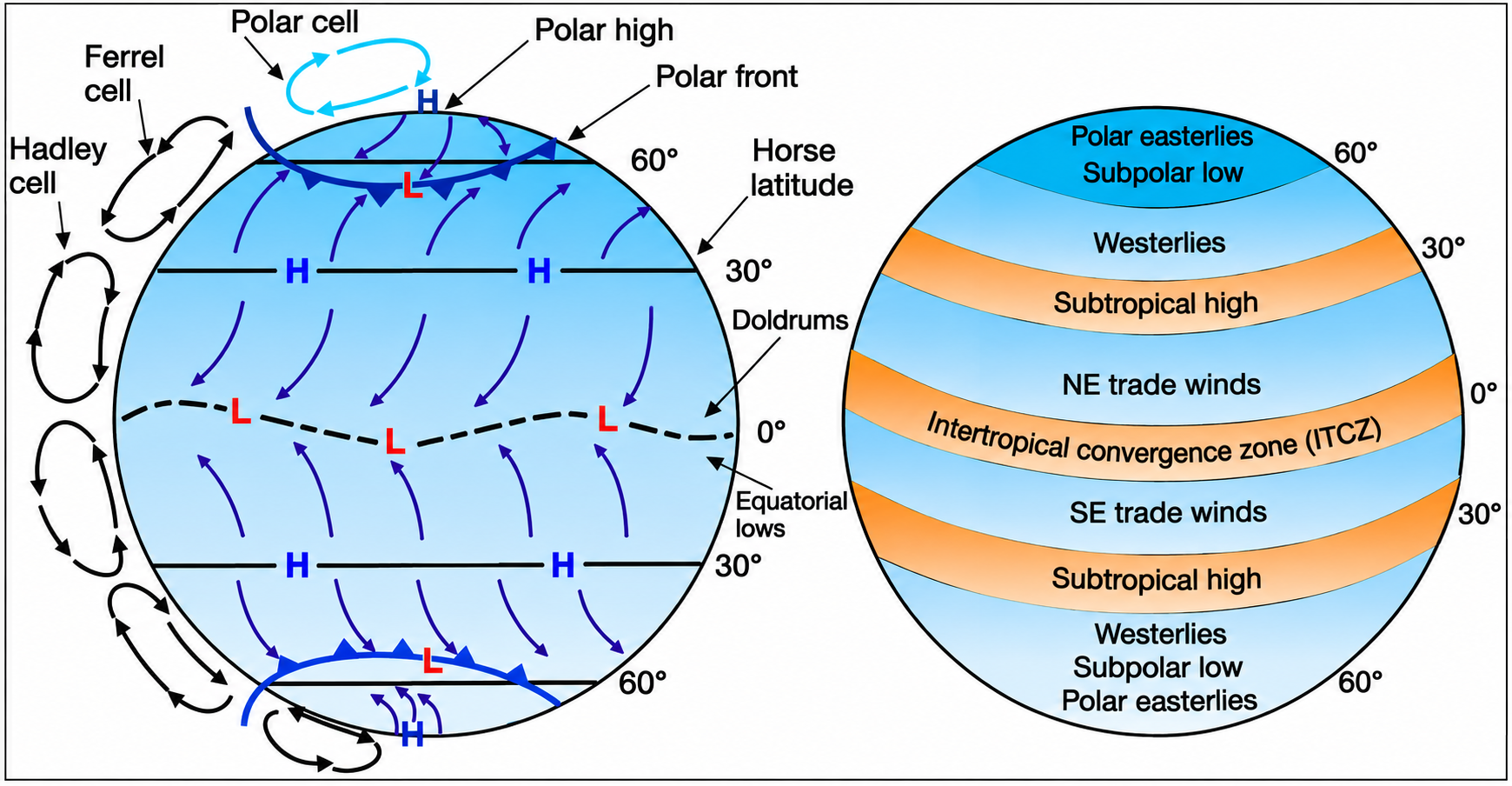
The three-cell model describes the idealised meridional circulation of air through the Hadley, Ferrel and Polar cells in each hemisphere.
- Hadley Cell (approx. 0°- 30°): Intense heating near the equator causes air to rise at the Inter-Tropical Convergence Zone (ITCZ). Upper-level air moves poleward, descends around 30° latitude and returns towards the equator as trade winds.
- Ferrel Cell (approx. 30°- 60°): The Ferrel Cell is an indirect circulation cell, driven largely by mid-latitude weather systems and interactions with the Hadley and Polar cells. At the surface, air generally moves poleward and is deflected eastward, producing the westerlies.
- Polar Cell (approx. 60°- 90°): Cold, dense air descends over the poles and moves towards subpolar low-pressure belts as polar easterlies. Air rises near the polar front and returns poleward at upper levels.
Planetary Winds and Three Principal Types
The global wind system is divided into three distinct latitudinal zones, each operating between specific high- and low-pressure belts.
Trade Winds (Tropical Easterlies)
Trade winds blow from subtropical high-pressure belts towards the equatorial low-pressure belt, broadly between 30° latitude and the equator.
- Trade winds blow as Northeast trade winds in the Northern Hemisphere and Southeast trade winds in the Southern Hemisphere.
- They are relatively persistent tropical winds that converge near the ITCZ.
- They transport moisture, support tropical rainfall and drive important tropical ocean currents.
Westerlies
Westerlies blow from subtropical high-pressure belts towards subpolar low-pressure belts, broadly between 30° and 60° latitude in each hemisphere.
- Westerlies generally blow from southwest to northeast in the Northern Hemisphere and northwest to southeast in the Southern Hemisphere.
- They influence mid-latitude weather systems and help steer extratropical cyclones.
- They are stronger and more continuous over the Southern Ocean because of its extensive, uninterrupted oceanic expanse.
- The strong Southern Hemisphere westerlies are associated with the Roaring Forties (between 40°- 50°S), Furious Fifties (between 50°- 60°S) and Shrieking Sixties or Screaming Sixties (between 60°- 70°S).
Polar Easterlies
Polar easterlies are winds that blow from the polar high-pressure areas toward the subpolar low-pressure zones. They generally occur between 90° and 60° latitude.
- Polar easterlies generally blow from northeast to southwest in the Northern Hemisphere and southeast to northwest in the Southern Hemisphere.
- They are generally cold and dry because they originate over polar regions.
- Their interaction with westerlies near the polar front contributes to frontal disturbances and the development of extratropical cyclones.
Planetary Winds Significance
Planetary winds redistribute heat and moisture across the Earth, shaping climatic conditions, rainfall patterns and ocean circulation. Their influence extends from regional weather systems to global atmospheric and oceanic interactions.
- Heat redistribution: Atmospheric circulation transfers energy from lower to higher latitudes, helping moderate temperature differences across the globe.
- Rainfall distribution: Convergence of trade winds near the ITCZ causes air to rise, supporting cloud formation and convective rainfall in tropical regions.
- Subtropical deserts: Descending air around 30° latitude creates relatively stable, dry conditions that favour the development of major subtropical deserts along western continental coasts. Cold ocean currents and continentality further favour aridity in several western coastal deserts.
- Ocean currents: Persistent planetary winds transfer momentum to ocean surfaces, driving surface currents and influencing coastal climates and marine ecosystems.
- Global weather systems: Westerlies and jet streams steer mid-latitude disturbances, influencing temperature, precipitation and storm tracks.
- Monsoon circulation: Seasonal shifts in pressure belts, along with land-sea heating contrasts and cross-equatorial flow, contribute to monsoon development.
- Climate variability: Changes in tropical trade winds and Walker circulation are associated with El Niño Southern Oscillation (ENSO), which can produce major variations in rainfall and temperature across regions.
- Maritime navigation: Persistent trade winds and Southern Hemisphere westerlies have historically influenced sailing routes and continue to affect ocean transport.
Planetary Winds Impact on Climate and India
Planetary winds affect regional climate through their interaction with pressure belts, seasonal heating and large-scale atmospheric disturbances. In India, their influence is particularly important for monsoon circulation and winter precipitation.
- South-West Monsoon: The seasonal northward shift of the ITCZ and the development of low pressure over the Indian subcontinent draw cross-equatorial winds from the Southern Hemisphere.
- The southeast trade winds cross the equator, undergo rightward deflection due to the Coriolis force and reach India as south-westerly monsoon winds.
- North-East Monsoon: During the retreating monsoon season, northeasterly winds prevail over much of India. After crossing the Bay of Bengal, they acquire moisture and bring significant rainfall to Tamil Nadu and parts of the southeastern coast.
- Western disturbances: These eastward-moving extra-tropical weather systems travel with the westerly circulation and are influenced by the subtropical westerly jet stream, bringing winter rainfall to northwestern India and snowfall to the western Himalayas.
- Agriculture and water resources: Variations in monsoon circulation affect crop sowing, irrigation requirements, reservoir levels and agricultural productivity.
- Regional climatic contrasts: Planetary circulation interacts with India's relief, ocean conditions and seasonal pressure systems to shape regional rainfall and temperature patterns.
- ENSO and monsoon variability: Changes in Pacific trade winds and ocean-atmosphere circulation during ENSO events can influence Indian monsoon rainfall. However, the relationship is not uniform and is also influenced by factors such as the Indian Ocean Dipole.
Planetary Winds PYQs
Q1. With reference to "Coriolis force”, which of the following statements is/are correct? (Prelims 2024)
- It increases with increase in wind velocity.
- It is maximum at the poles and is absent at the equator.
Select the answer using the code given below:
(a) 1 only
(b) 2 only
(c) Both 1 and 2
(d) Neither 1 nor 2
Ans: (c)
Q2. Consider the following statements: (Prelims 2015)
- The winds that blow between 30 degrees N and 60 degrees S latitudes throughout the year are known as westerlies.
- The moist air masses that cause winter rains in the North-Western region of India are part of westerlies.
Which of the statements given above is/are correct?
(a) 1 only
(b) 2 only
(c) Both 1 and 2
(d) Neither 1 nor 2
Ans: (b)
Q3. Westerlies in the southern hemisphere are stronger and persistent than in northern hemisphere. Why? (Prelims 2011)
- The Southern hemisphere has less landmass as compared to the Northern hemisphere.
- Coriolis force is higher in Southern hemisphere as compared to the Northern hemisphere
Which of the statements given above is/are correct?
(a) 1 only
(b) 2 only
(c) Both 1 and 2
(d) Neither 1 nor 2
Ans: (a)

 Last updated on Nov, 2026
→ UPSC 2027 Notification will be released on 13 January 2027 at upsconline.nic.in.
→ Check Nobel Prize 2026 Winners List here.
→ Download PIB PRiSM Monthly Magazine 2026 here.
→ Check UPSC Monthly Current Affairs Magazine The Recitals here.
→ Check out the latest UPSC Syllabus here.
→ Download UPSC Model Answers for Mains 2026
→ UPSC Mains Question Paper 2026 is out now for Essay & GS Paper 1, 2, 3 & 4.
→ UPSC Calendar 2027 has been released.
→ Enroll in Vajiram & Ravi’s UPSC Mains Test Series 2027 for structured answer writing practice, expert evaluation, and exam-oriented feedback.
→ Join Vajiram & Ravi’s UPSC Mentorship Program 2027 for personalized guidance, strategy planning, and one-to-one support from experienced mentors.
→ Go through the UPSC Mains Previous Year Papers to enhance your preparation.
→ UPSC has released UPSC Toppers List 2025 with the Civil Services final result on its official website.
→ Also check Best UPSC Coaching in India
Planetary Winds FAQs
Q1. What are planetary winds?+
Q2. What are the three types of planetary winds?+
Q3. What is the three-cell model of atmospheric circulation?+
Q4. Why are Southern Hemisphere westerlies stronger and more persistent?+
Q5. What is the role of planetary winds in the Indian monsoon?+
Tags: planetary winds quest UPSC Geography Notes