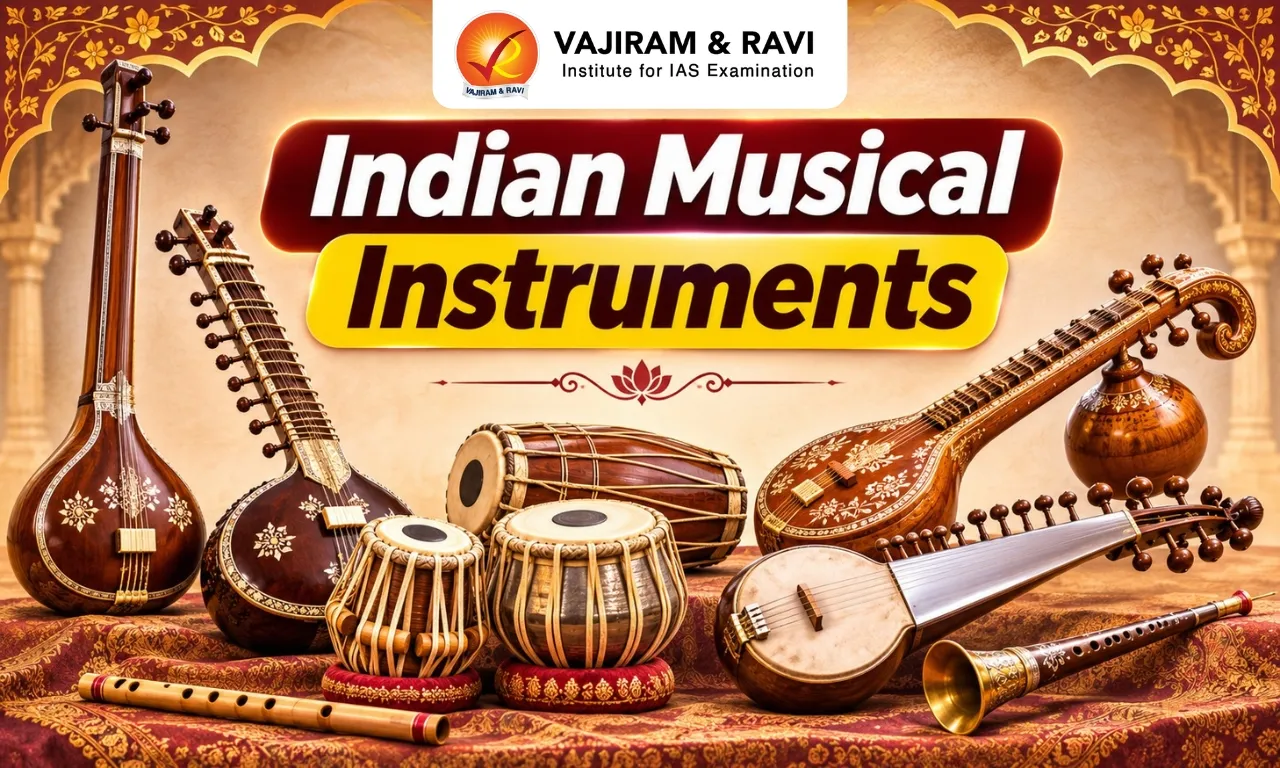
Indian Musical Instruments are the tangible and material representation of music, which is an auditory art. India possesses one of the world's oldest and most developed musical traditions. Indian musical instruments are also connected to gods, goddesses, and other semi-divine individuals of the Indian ethos, as they are interwoven with mythology and ancient texts like the Epics and Puranas.
The classical indian musical instruments classification, described in Bharata Muni’s Natya Shastra, divides instruments into four categories: Tata Vaadya, Sushira Vaadya, Avanaddha Vaadya, and Ghana Vaadya. This classification follows the sound-producing mechanism, rather than simply the instrument’s material, shape, or region of origin.
Indian Musical Instruments About
Indian Music Instruments include stringed instruments, wind instruments, membrane-covered drums, and self-sounding instruments. They are used independently in instrumental performances and collectively to accompany singing, dance, theatre, and community celebrations.
- Indian classical music has two major traditions: Hindustani classical music, predominantly practised in northern India, and Carnatic classical music, primarily associated with southern India.
- In addition, numerous folk and tribal musical traditions use distinctive indigenous instruments.
The earliest evidence of musical activity is found on the walls of cave paintings at Bhimbetka and in several parts of Madhya Pradesh.
- There is evidence of dancing and musical activity in the Harappan Civilisation's excavations, which took place much later.
- Karuvi, the Tamil term for an instrument, literally means "tool" and is used in Sangam literature from the second to sixth centuries A.D. This is extended to mean an instrument in the context of music.
- These instruments provide melody, rhythm, and accompaniment, reflecting India's rich musical and cultural diversity.
- They are traditionally classified into four major categories based on how sound is produced: Tata (stringed), Sushira (wind), Avanaddha (percussion with a membrane), and Ghana (solid percussion).
Indian Musical Instruments Evolution
The origin of Indian musical instruments can be traced to ancient human societies, where people used natural materials and simple objects to produce rhythmic sounds. Early instruments may have developed from everyday activities involving striking, blowing and stretching materials. Over time, these simple sound-producing objects evolved into more sophisticated instruments.
- Prehistoric Period: Cave paintings, including those at Bhimbetka, provide evidence of early human cultural and artistic activities. However, such paintings do not independently establish the precise forms of musical instruments used during that period.
- Indus Valley Civilization: Archaeological discoveries, including figurines and representations associated with dancing, suggest that music and performance were part of Harappan cultural life. The exact forms and uses of many early instruments remain subjects of interpretation.
- Vedic Period: During the Vedic period, music was closely connected with religious ceremonies and sacred chanting. Instruments such as the veena, flute, drums and conch are associated with ancient Indian musical and ritual traditions.
- Ancient Classical Period: The Natya Shastra systematised musical knowledge and classified instruments into four broad groups—Tata (string), Sushira (wind), Avanaddha (covered percussion) and Ghana (solid).
- Early Medieval Period: The development of raga-based music and changing performance practices encouraged modifications in instruments. Brihaddeshi marked an important stage by discussing murchhanas and raga, while Sangita Ratnakara later consolidated newer musical categories.
- Delhi Sultanate Interaction: From the 13th–14th centuries, interaction between Indian and Persian musical traditions introduced new influences in musical forms and instruments.
- Mughal Period: Patronage of the Mughal Empire further expanded Hindustani musical traditions. The 17th-century Persian work Tarjuma-i-Manakutuhala and Risala-i-Ragadarpana preserved information on contemporary Indian music and the development of ragas.
- Regional Courts: Raja Man Singh Tomar of Gwalior (1486–1516) patronised music and is associated with Manakutuhala; the Gwalior tradition also contributed to the development of Hindustani music.
- Colonial and Modern Period: Indian instruments continued to change through new performance settings, instrument-making techniques and interaction with Western instruments.
- The violin, for example, became integrated into Carnatic performance, while instruments such as the sitar, sarod and tabla became prominent in Hindustani music.
- Modern amplification and recording further changed their construction and performance practices.


Musical Instruments of India Classification
Traditional Indian musical instruments are classified into four main categories based on how they produce sound, a system first introduced by Bharata Muni in the ancient text the Natya Shastra. These are “Tatam, Avanadham, Sushiram, and Ghanam”.
- Tata Vadya or Chordophones (Stringed instruments).
- Sushira Vadya or Aerophones (Wind instruments).
- Avanaddha Vadya or Membranophones (Percussion instruments).
- Ghana Vadya or Idiophones (Solid instruments).
Tata Vaadya (Stringed Instruments)
Tata Vadya are string instruments in which sound is produced by the vibration of stretched strings. They form one of the four traditional categories of Indian musical instruments described in texts such as the Natya Shastra. Tata Vadya instruments are generally sub-categorised based on how the strings are played:
- Bowed: Instruments where a bow is drawn across the strings to make sound. For instance, violin, sarangi, etc.
- Plectral: Instruments in which a plectrum made of wire or a horn is used to pluck the strings. For instance, a sitar, a veena, etc.
- Struck: Strings are struck using small hammers, mallets, or a pair of wooden/metal sticks.• Examples: Santoor and Swarmandal.
Tata Vadya Musical Instruments Examples
Tata Vadya instruments serve as the melodic cornerstone of the Indian musical instrument lineage and are extensively utilised in classical, folk, and contemporary music.
- Sitar: A popular Indian string instrument, mainly used for solo performances and jugalbandi. Its name is derived from the Persian word Sehtar.
- Sarod: A fretless lute with a metal fingerboard, developed through adaptations of instruments such as Rabab, Sursringar and Veena.
- Santoor: A hammered string instrument traditionally associated with Kashmiri Sufi music. It is played using small wooden mallets.
- Sarangi: A bowed instrument with four main strings and several resonating strings, traditionally used in Hindustani classical music.
- Veena: One of India's oldest musical instruments, associated with Goddess Saraswati and used in both Hindustani and Carnatic music.
- Rudra Veena: An important instrument of Hindustani classical music, traditionally associated with Dhrupad performances.
- Carnatic Veena: A principal instrument of South Indian classical music, generally having four main playing strings and three drone strings.
- Violin: Introduced to India by Europeans in the 18th century, it became an important accompanying instrument in Carnatic music.
- Tanpura: A four- or five-stringed instrument that provides a continuous drone and reference pitch during musical performances.
- Dilruba and Esraj: Bowed string instruments used in classical, devotional and folk music; Dilruba is associated mainly with northern India and Esraj with eastern India.
Sushira Vaadya (Wind Instruments)
Within the Sushira Vaadya category, sound is generated by blowing air through a hollow tube. The note's pitch is set by regulating the airflow, while the melody is produced by using the fingers to open and close the instrument. Sushira Vadya (wind instruments) are broadly classified into flutes and reed instruments based on sound production.
Sushira Vadya Musical Instruments Examples
Flutes are known as Venu, Vamsi, Bansuri and Murali in the North and Pullankuzhal, Pillankarovi and Kolalu in the South. Reed instruments such as Shehnai and Nadaswaram produce sound through vibrating reeds when air is blown into them.
- Flute (Bansuri): Made of bamboo, it has a cylindrical tube-like body with a uniform bore and is closed at one end. It has several names, including Venu, Bansuri, Murali and Vansi.
- It is used as both a solo and accompanying instrument; it has been part of Indian musical traditions since the Vedic period.
- Shehnai: A quadruple-reed instrument with a wooden tube that narrows towards the blowing end and widens at the other end. It is played by blowing through a reed mouthpiece and is traditionally used during auspicious occasions, particularly weddings.
- Harmonium: A keyboard instrument that produces sound by pumping air through reeds tuned to different pitches. The Indian harmonium is hand-pumped using bellows, with one hand operating the bellows and the other playing the keyboard. It is widely used as an accompanying instrument for vocal performances.
Avanaddha Vaadya (Percussion Instruments)
Avanaddha Vadya are membranophones, or covered percussion instruments in which sound is produced by the vibration of a stretched membrane, usually fixed over a hollow body. They form one of the four traditional categories of Indian musical instruments. Avanaddha Vadya produces sound through a stretched membrane attached to a hollow body.
Avanaddha Vadya Instruments Examples
Examples include Mridangam, Pakhawaj, Khol, Khanjira and Chenda. The ancient Dundubhi is mentioned in Vedic literature. These instruments provide rhythm and Tala in classical, folk and devotional music.
- Bidi and Dama: Bidi is a small clay drum with a leather-covered face, played using thin sticks during processions and religious ceremonies. Dama is a wooden hand drum used by tribal communities in Tripura and Meghalaya.
- Burrakatha Dakki and Davandi: Burrakatha Dakki is a pitcher-shaped percussion instrument used by Burrakatha performers, while Davandi is a small, hourglass-shaped drum used during religious ceremonies and temple services.
- Anandalahari and Bom: Anandalahari is made of earthenware and wood, while Bom is made of softwood and leather. Both are traditional percussion instruments.
- Changu and Chenda: Changu is made of brass, parchment and wood. Chenda is a prominent percussion instrument associated with Kerala's temple rituals and traditional performances.
- Chyabrung and Damphu: Chyabrung is a traditional drum associated with the Garo community of Meghalaya, while Damphu is a frame drum used in traditional community performances.
- Damaru and Dhak: Damaru is a small, hourglass-shaped drum associated with Lord Shiva, while Dhak is a large barrel-shaped drum prominently played during Durga Puja celebrations in Bengal.
Ghana Vaadya
The earliest instruments invented by man are said to be the Ghana Vaadya. Once constructed, this variety of instruments does not need special tuning before playing. In early times, these instruments were an extension of the human body, such as sticks, clappers, rods, etc., and were also closely related to objects of utility in daily life, such as pots and pans, jhanj, falams, etc.
Ghana Vaadya Examples
They are principally rhythmic in function and are best suited as an accompaniment to folk and tribal music and dance.
- Manjira (Taal/Kartaal): A pair of small clash cymbals made of bronze, brass, copper or zinc. Held in both hands and struck together, they are commonly used to accompany devotional music such as Bhajans and Kirtans. Their pitch varies according to size, weight and material.
- Ghungroo: It consists of several small metallic bells tied together on a thick cloth. It is worn by dancers and used in classical dance, folk music and devotional performances to complement rhythm.
- Jal Tarang: A water-based percussion instrument consisting of porcelain bowls of different sizes filled with varying levels of water. The bowls are struck with light sticks to produce different musical notes.
- Ghatam: An earthenware pot made of clay mixed with metal, played by striking different parts of its surface. It is used as an accompanying instrument in Carnatic music concerts and is also known as Noot in Jammu and Kashmir.
Indian Music Instruments Name List
The following list highlights major Indian musical instruments used in India's classical, folk, and devotional music traditions.
| Category | Instruments |
|
Tata (Stringed) |
Sitar, Sarod, Veena, Santoor, Sarangi, Esraj, Tanpura, Rudra Veena, Chitraveena, Ektara |
|
Sushira (Wind) |
Bansuri, Shehnai, Nadaswaram, Pungi, Algoza, Shankh, Harmonium |
|
Avanaddha (Membrane Percussion) |
Tabla, Mridangam, Pakhawaj, Dhol, Dholak, Khol, Chenda, Tavil, Damru |
|
Ghana (Solid Percussion) |
Manjira, Kartal, Ghatam, Morsing, Jal Tarang, Chimta, Ghunghroo |
Indian Musical Instruments Significance
Indian musical instruments are an integral part of the country’s classical, folk, and devotional traditions, reflecting its cultural diversity and long musical heritage. Their distinct sounds, construction techniques, and regional variations have contributed to the evolution of Indian musical instruments.
- Cultural Heritage: Indian musical instruments such as the sitar, veena, tabla, and mridangam represent the distinctive traditions of Hindustani and Carnatic music and provide the melodic, rhythmic, and accompanying framework.
- Regional Identity: Folk instruments such as the algoza, ektara, and khartal preserve the musical traditions and cultural identities of different regions and communities.
- Religious Traditions: Instruments such as the conch, shehnai, and nadaswaram have important roles in temples, rituals, weddings, and other ceremonial practices.
- Craftsmanship: Traditional instrument-making sustains specialised knowledge involving woodworking, metalwork, string-making and acoustic design, linking music with India's handicraft traditions.
- Cultural Transmission: Instruments help transmit musical knowledge, techniques, and traditions across generations, particularly through guru–shishya and community-based learning.
- Global Cultural Outreach: Indian musical instruments have contributed to the international recognition of Indian music through concerts, cultural exchanges, and collaborations with global musicians.

 Last updated on Nov, 2026
→ UPSC 2027 Notification will be released on 13 January 2027 at upsconline.nic.in.
→ Check Nobel Prize 2026 Winners List here.
→ Download PIB PRiSM Monthly Magazine 2026 here.
→ Check UPSC Monthly Current Affairs Magazine The Recitals here.
→ Check out the latest UPSC Syllabus here.
→ Download UPSC Model Answers for Mains 2026
→ UPSC Mains Question Paper 2026 is out now for Essay & GS Paper 1, 2, 3 & 4.
→ UPSC Calendar 2027 has been released.
→ Enroll in Vajiram & Ravi’s UPSC Mains Test Series 2027 for structured answer writing practice, expert evaluation, and exam-oriented feedback.
→ Join Vajiram & Ravi’s UPSC Mentorship Program 2027 for personalized guidance, strategy planning, and one-to-one support from experienced mentors.
→ Go through the UPSC Mains Previous Year Papers to enhance your preparation.
→ UPSC has released UPSC Toppers List 2025 with the Civil Services final result on its official website.
→ Also check Best UPSC Coaching in India
Indian Musical Instruments FAQs
Q1. What are indian music instruments?+
Q2. What are the main instruments in Indian music?+
Q3. Who played all 27 instruments?+
Q4. What are 40 musical instruments from India?+
Q5. What are the top 10 musical instruments in India?+
Tags: indian musical instruments quest UPSC Art and Culture Notes