



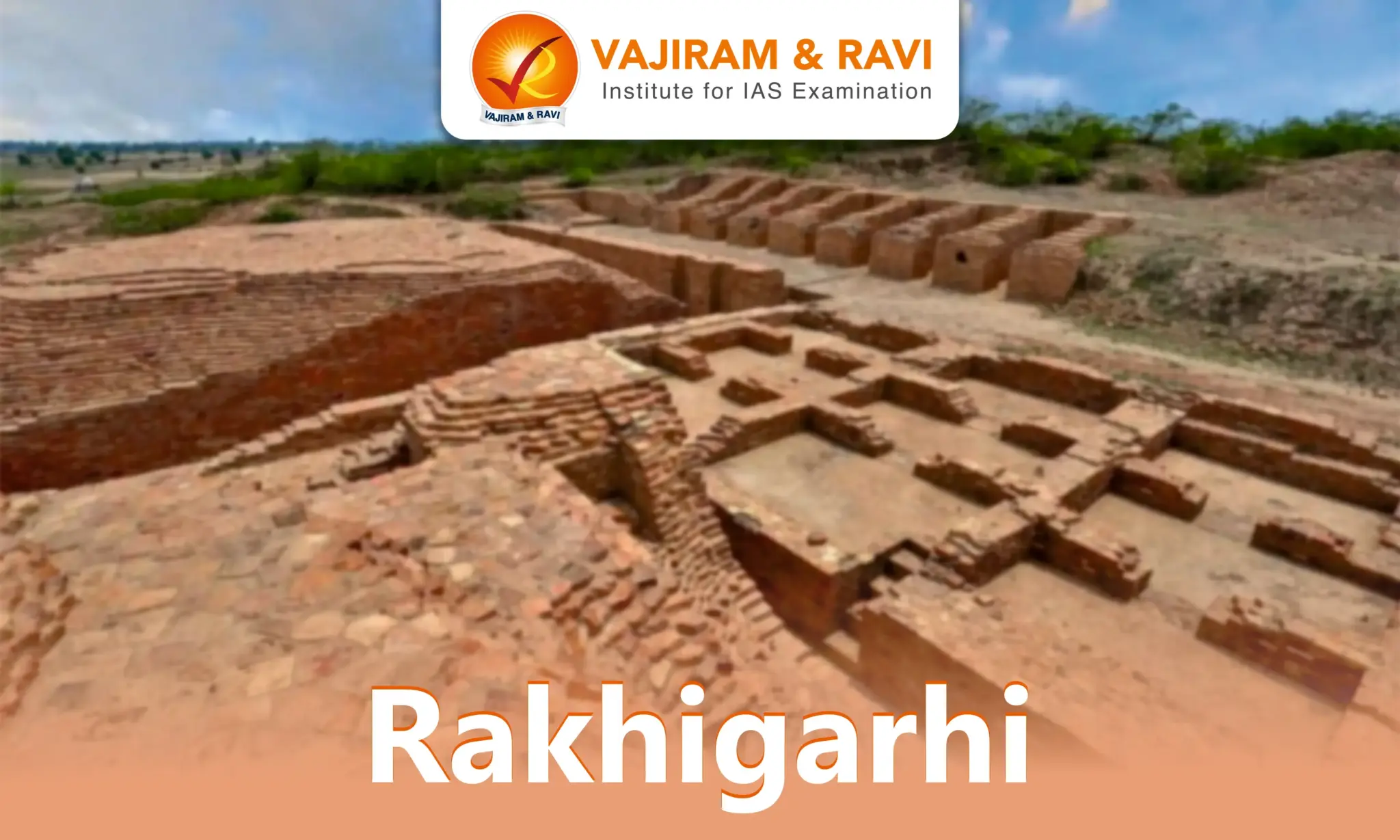
Rakhigarhi is an ancient site of the Indus Valley Civilization, located on the banks of the now-dried Sarasvati River in the Hisar district of Haryana. Rakhigarhi has emerged as an important site, providing valuable insight into the Pre-Harappan and Harappan cultures that thrived in the region.
Rakhigarh is one of the five largest known townships of the Harappan civilisation on the Indian subcontinent. The other four are Harappa, Mohenjodaro, and Ganweriwala in Pakistan and Dholavira in Gujarat, India.
About Rakhigarhi
Rakhigarhi, about 150 km northwest of Delhi, is a village and an archaeological site belonging to the Indus Valley Civilisation in the Hisar District of Haryana. The site, excavated by Amarendra Nath of the Archeological Survey of India, is located in the Ghaggar-Hakra River plain.
- It comprises two villages, Rakhi Shahpur and Rakhi Khas, which extend across nine mounds, of which two — mounds four and five — are thickly populated.
- It belonged to the Indus Valley Civilization's mature phase, which spanned 2600–1900 BCE. At Rakhigarhi, three layers representing the Early, Mature, and Late stages of the Indus Valley civilisation have been discovered.
Major Findings of Rakhigarhi
The Harappan civilisation site excavated by the Archaeological Survey of India revealed a large number of findings that provide further insight into the Indus Valley civilisation. These include skeletons, town planning, rituals and burials, and others.
- DNA analysis of Skeletal: While excavating the site, the Archaeological Survey of India found many skeletal remains. Subsequent DNA analysis revealed that the inhabitants of the Harappan civilisation had a distinct origin. This study negates the theory that the Harappan people have steppe pastoral or ancient Iranian farmer ancestry.
- Town Planning: Land townships were enclosed with mud and burnt brick homes, each having an efficient drainage system and proper sanitation. Excavations at Mound number 3 have revealed the existence of an aristocratic settlement with burnt brick walls alongside mud-brick walls.
- Lapidary: A large number of steatite beads, beads of semi-precious stones, shells, and objects made of agate and carnelian have been recovered. This discovery signifies that trading was a flourishing occupation. Various hunting tools, such as fish hooks, were also excavated at Rakhigarhi.
- Granary: The granary discovered at Rakhigarhi was made of mud bricks, and the floor was rammed earth plastered in mud. It was enclosed within seven rectangular or square chambers, with traces of lime and decomposed grains suggesting a granary, possibly public or privately owned by the elite at the Rakhigarhi site.
- Rituals and Burials: A ceremonial system was discovered when fire altars on mudflows were excavated, and traces of animal sacrifices were also located. The sacrificed animals' bodies were covered with mud walls and triangle fire altars.
- Two 5,000-year-old female skeletons were discovered at Mound No. 7, along with pots and artefacts, indicating funerary rituals.
- Pottery and Seals: A seal with an alligator symbol was discovered, with five Harappan letters on one side and a symbol on the other.
- The site also yielded various antiquities, such as blades, shell bracelets, stone beads, animal figurines, and copper artefacts.
- The redware ceramics collection included dishes-on-stands, vases, jars, bowls, beakers, perforated jars, goblets, and handles.





Significance of Rakhigarhi
The Rakhigarhi site provides valuable insights into the Indus Valley Civilization, revealing its distinct origins and advanced cultural practices. Notably, it will be home to the largest museum in the world devoted to Harappan culture, emphasising how important this culture is to comprehending ancient history.
- Largest museum of Harappan culture: Rakhigarhi is among the five iconic sites announced in the Union Budget 2020. The ASI, the state, and the central governments signed an MoU in 2022 to develop the Rakhigarhi Museum, which will be the world's largest museum dedicated to Harappan culture.
- The DNA analysis revealed that the inhabitants of the Harappan civilisation had a distinct origin. This study refutes the theory that the Harappans had Steppe pastoral or ancient Iranian farmer ancestry.
- Harappan sealings (impression of a seal on a surface) found at Rakhigarhi indicate that seals were used to mark objects belonging to specific people or communities.
- Excavation of a wide variety of tools indicates the presence of toy culture in the area. Jewellery, stamps, and weights were also found, which led to the idea that standardised weight systems were followed in the Rakhigarhi.
- In 2012, the watchdog Global Heritage Fund listed Rakhigarhi as one of Asia's ten most endangered heritage sites.
Rakhigarhi UPSC PYQs
Question 1: Which one of the following ancient towns is well-known for its elaborate system of water harvesting and management by building a series of dams and channelizing water into connected reservoirs? (UPSC Prelims 2021)
(a) Dholavira
(b) Kalibangan
(c) Rakhigarhi
(d) Ropar
Ans. (a)
| Other Related Posts | |
| Prehistoric Period | Indus Valley Civilization Sites |
| Chalcolithic Age | Rakhigarhi |
| Megalithic Culture | Lothal |
| Town Planning of Harappan Civilization | Kalibangan |

 Last updated on March, 2026
→ UPSC Final Result 2025 is now out.
→ UPSC has released UPSC Toppers List 2025 with the Civil Services final result on its official website.
→ Anuj Agnihotri secured AIR 1 in the UPSC Civil Services Examination 2025.
→ UPSC Marksheet 2025 is now out.
→ UPSC Notification 2026 & UPSC IFoS Notification 2026 is now out on the official website at upsconline.nic.in.
→ UPSC Calendar 2026 has been released.
→ Check out the latest UPSC Syllabus 2026 here.
→ UPSC Prelims 2026 will be conducted on 24th May, 2026 & UPSC Mains 2026 will be conducted on 21st August 2026.
→ The UPSC Selection Process is of 3 stages-Prelims, Mains and Interview.
→ Prepare effectively with Vajiram & Ravi’s UPSC Prelims Test Series 2026 featuring full-length mock tests, detailed solutions, and performance analysis.
→ Enroll in Vajiram & Ravi’s UPSC Mains Test Series 2026 for structured answer writing practice, expert evaluation, and exam-oriented feedback.
→ Join Vajiram & Ravi’s Best UPSC Mentorship Program for personalized guidance, strategy planning, and one-to-one support from experienced mentors.
→ Shakti Dubey secures AIR 1 in UPSC CSE Exam 2024.
→ Also check Best UPSC Coaching in India
Rakhigarhi FAQs
Q1. What is Rakhigarhi famous for?+
Q2. Is Rakhigarhi older than Harappa?+
Q3. What is the DNA of Rakhigarhi woman?+
Q4. Which river is Rakhigarhi in?+
Q5. Who excavated Rakhigarhi?+
Tags: quest rakhigarhi