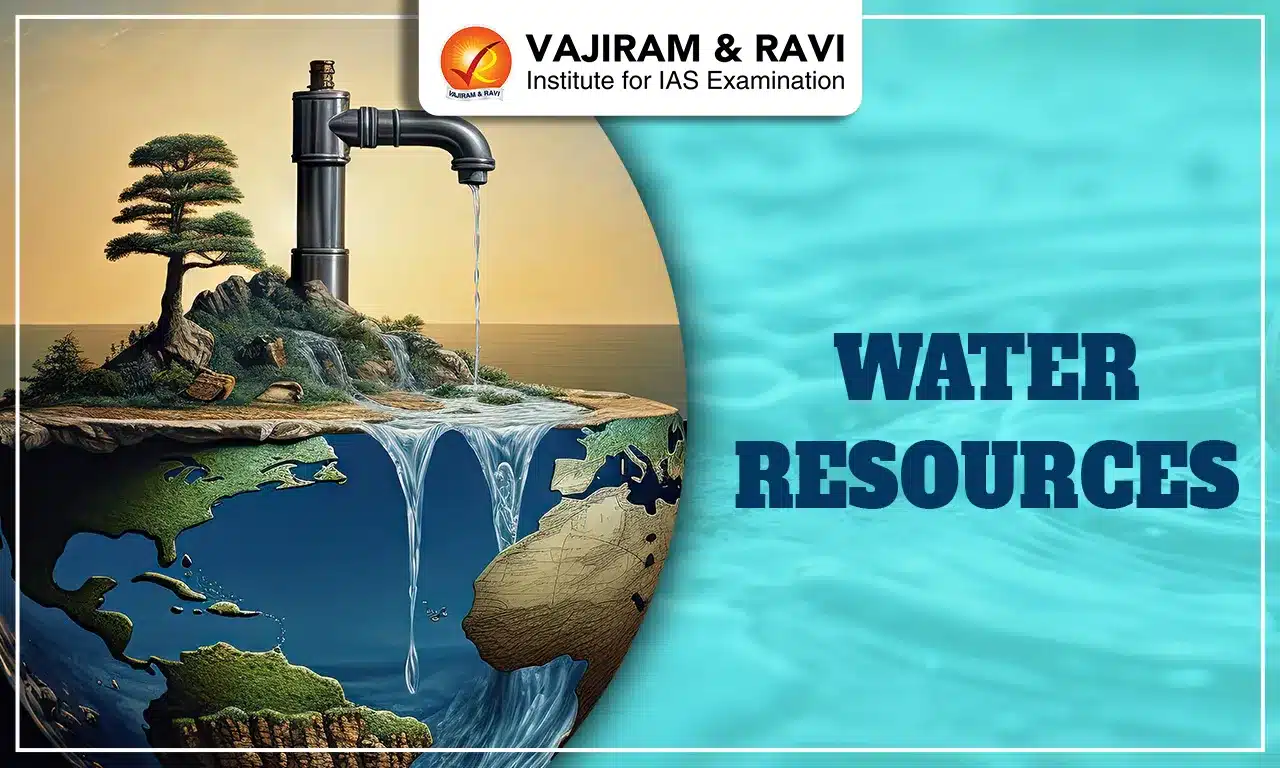
Water is a fundamental and cyclic natural resource, vital for life, agriculture, industry, and ecosystems. Despite its global abundance covering approximately 71 % of the earth’s surface, only a small fraction, about 3% constitutes freshwater suitable for human use. India, accounting for 2.45 % of the world’s land area and housing 16 % of the global population, has 4 % of the world’s water resources. Effective management of these resources is critical for sustaining livelihoods, food production, and economic growth in a rapidly developing country. In this article, we are going to cover water resources in India.
Water Resources in India
The total annual water availability in India from precipitation is estimated to be 4,000 cubic kilometers, with an average annual precipitation of 1,170 mm. Of this, the total availability from surface water and replenishable groundwater is approximately 1,869 cubic kilometers, but only about 60 % of this water is potentially utilizable for beneficial purposes. Consequently, India’s total utilizable water resources amount to 1,122 cubic kilometers per year, highlighting the gap between natural abundance and practical availability.
Water resources in India can be broadly classified into:
- Surface water resources
- Groundwater resources
Surface Water Resources in India
Surface water resources primarily include rivers, lakes, ponds, and tanks. India’s rivers, fed by the monsoon and Himalayan snowmelt, account for most of the country’s surface water. The mean annual flow in all river basins is estimated at 1,869 cubic kilometers, yet only approximately 690 cubic kilometers (37 %) can be effectively harnessed.
Challenges in Surface Water Utilization:
- Seasonal Concentration: Over 90 % of the annual flow of Himalayan rivers occurs during the four monsoon months, limiting capture potential.
- Storage Limitations: Suitable sites for reservoirs and dams are scarce, especially in hilly and flood-prone regions.
- Geographical Constraints: Surface water in many regions is unevenly distributed, with northern and northeastern states enjoying abundant flow, while western and southern regions experience deficits.
India has constructed nearly 5,000 major and medium dams, barrages, and reservoirs to store river water, support irrigation, generate hydropower, and replenish groundwater.
Groundwater Resources in India
The total replenishable groundwater resources of India are estimated at 432 cubic kilometers, with Ganga and Brahmaputra basins accounting for approximately 46 % of the total potential. Groundwater plays a critical role in Indian agriculture, providing water for over 50 % of irrigated areas, supported by about 20 million tube wells nationwide.
- High Utilization: States like Punjab, Haryana, Rajasthan, and Tamil Nadu exploit groundwater intensively for irrigation and industrial purposes.
- Low Utilization: States such as Chhattisgarh, Odisha, and Kerala use only a small proportion of their groundwater potential due to abundant surface water and lower irrigation demands.
- Overreliance on groundwater has led to aquifer depletion, declining water tables, and quality deterioration. To address this, the government emphasizes groundwater recharging through reservoirs, rainwater harvesting, and integrated water resource management.
Water Use and Sectoral Distribution
Agriculture dominates water usage in India, consuming 89 % of surface water and 92 % of groundwater. By contrast, the industrial sector accounts for only 2 % of surface water and 5 % of groundwater, while the domestic sector consumes 9 % of surface water.
This skewed distribution highlights the importance of efficient irrigation techniques and water-saving technologies to ensure sustainable allocation among sectors.
Factors Contributing to Water Quality Deterioration
Many anthropogenic and natural factors have led to water quality deterioration in India:
- Water Scarcity: Limited availability increases dependency on contaminated sources.
- Pathogenic Pollution: Presence of bacteria and viruses from untreated sewage and surface runoff.
- Chemical Leaching: Pesticides, fertilizers, and industrial effluents seep into groundwater.
- Oxygen Depletion & Eutrophication: Excess nutrients from fertilizers trigger algal blooms and reduce oxygen levels in water bodies.
- Salinity and Alkalinity: Improper irrigation and seawater intrusion increase soil and water salinity.
- Toxic Contaminants: Heavy metals like arsenic, lead, and mercury pose significant health risks.
The Central Ground Water Board (CGWB), under the Ministry of Jal Shakti, monitors and manages groundwater resources through scientific assessment, exploration, augmentation, and regulation. Established in 1970, CGWB serves as India’s apex agency for groundwater governance.
Types of Pollution Sources
- Point Source Pollution: Sources are identifiable, such as domestic sewage and industrial effluents.
- Non-Point Source Pollution: Sources are diffuse, including agricultural runoff, stormwater, rural waste, open defecation, and air deposition.
Other contaminants include heavy metals and biochemical oxygen demand (BOD) or chemical oxygen demand (COD), which impact aquatic ecosystems. Monsoon flooding further exacerbates pollution spread.
Global Water Scarcity
Water scarcity arises when freshwater availability is insufficient to meet demand. It manifests in:
- Unmet water needs for households, agriculture, or industry
- Economic competition for limited water resources
- Environmental degradation
- Groundwater depletion
Currently, one-third of the global population (2 billion people) faces severe water scarcity for at least one month per year.
Measuring Water Scarcity
The Falkenmark Indicator or Water Stress Index is widely used to assess water scarcity:
- Below 1,700 m³ per capita per year: Water stress
- Below 1,000 m³: Water scarcity
- Below 500 m³: Absolute water scarcity
India is currently water-stressed, with declining per capita availability due to population growth, overexploitation, and regional imbalances in distribution.
Water Scarcity in India
The causes and stress factors leading to water scarcity in India are:
- Population Growth: Rising demand from households and agriculture.
- Agricultural Dominance: Over 70 % of water resources are consumed by irrigation.
- Rapid Urbanization: High urban demand strains surface and groundwater.
- Climate Change: Altered monsoon patterns, melting glaciers, and temperature rises affect water availability.
- Aquifer Depletion: Excessive extraction for irrigation and domestic use lowers groundwater levels.
- Pollution: Discharge of untreated sewage, industrial waste, and agricultural runoff deteriorates water quality.
Projections indicate India’s population may reach 1.6 billion by 2050, further intensifying water stress.
Consequences of Water Scarcity
Water scarcity can lead to the following consequences for the human population:
- International Conflicts: Shared river basins with neighboring countries like Pakistan, Nepal, Bangladesh, and Myanmar may trigger disputes.
- Health Impacts: Limited access to clean water causes water-borne diseases and limits educational and economic opportunities.
- Food Shortages: Reduced water availability threatens agriculture, potentially leading to food insecurity and social unrest.
- Energy Shortages: Water-intensive thermoelectric plants and hydropower require adequate water for energy security.
- Economic Slowdown: Industrial production and urban growth are constrained by water shortages, affecting GDP growth and livelihoods.
Solutions for Water Scarcity
In order to tackle the problem of water scarcity, the following methods can be adopted:
- CO₂ Cleaning: Use of carbon dioxide in solid form as a cleaning agent reduces water consumption in industries.
- Realistic Pricing: Pricing water to reflect true costs encourages conservation and infrastructure maintenance.
- Education and Awareness: Behavioural changes in water usage are vital for sustainable consumption.
- Water Conservation Technologies: Including rainwater harvesting, drip irrigation, solar-powered purifiers, and wastewater recycling.
- Desalination Plants: Energy-efficient and solar-powered plants can augment freshwater supply in coastal regions.
- Improved Irrigation Practices: Use of drip or sprinkler systems to reduce water wastage.
- Community Governance: Localized management and participation ensure sustainable water use.
- Distribution Infrastructure: Repairing pipelines, reservoirs, and treatment plants to reduce losses and improve quality.
- Pollution Control: Establishment of STPs, water treatment facilities, and bioremediation techniques.
- Research & Development: Innovation in water conservation, wastewater treatment, and sustainable aquifer management.
Government Initiatives to Manage Water Scarcity
The Government of India has adopted the following schemes and initiatives to manage the problem of water scarcity:
- Jal Shakti Abhiyan: Focuses on water conservation in water-stressed districts, promoting citizen participation.
- Pradhan Mantri Krishi Sinchay Yojana (PMKSY): Aims at "Har Khet Ko Pani" and "More Crop per Drop", enhancing irrigation efficiency.
- National Water Mission: Promotes conservation, efficient use, and equitable distribution of water, targeting a 20 % improvement in water use efficiency.
- Atal Bhujal Yojana: Encourages sustainable groundwater management with community involvement.
- Jal Jeevan Mission (JJM): Ensures functional household tap connections (FHTC) for all rural households by 2024.
- National Rural Drinking Water Programme (NRDWP): Enhances rural water supply coverage and quality.
- Jal Kranti Abhiyan: Aims to transform water-scarce villages into water-surplus villages through integrated conservation and management.
Sustainable Approaches for Water Resource Augmentation
- Enhancing Water Availability: Protect ecosystems, increase green cover, manage riparian buffers, and implement diversified agriculture and recycling.
- Improving Water Quality: Enforce regulations, control pollution, establish treatment plants, and adopt bioremediation.
- Reducing Water-Related Risks: Implement integrated watershed management, flood control, climate-resilient agriculture, and sustainable livelihoods.
Mihir Shah Committee Recommendations
The committee recommended restructuring the Central Water Commission (CWC) and Central Ground Water Board (CGWB) into a National Water Commission (NWC) as India’s apex body for water policy, data management, and governance, enabling coordinated and strategic management of water resources at the national level.
Sustainable Management of Water Resources in Indian States
Water is an essential resource for human survival, agriculture, industry, and ecosystems. India, despite being endowed with abundant water resources, faces significant challenges in ensuring equitable distribution, sustainable utilization, and conservation. Various states in India have developed innovative programmes, traditional practices, and modern governance mechanisms to manage water resources sustainably. Understanding these strategies, along with challenges and solutions, is vital for ensuring water security for present and future generations.
Water Resources State-Level Water Management Initiatives
Different states have launched different schemes and initiatives to ensure water resources are available for all. These include:
Rajasthan: Mukhya Mantri Jal Swavlamban Abhiyan
Rajasthan, one of the driest states in India, launched the ‘Mukhya Mantri Jal Swavlamban Abhiyan’ to promote water conservation and harvesting activities in rural areas. The scheme focuses on:
- Construction and restoration of check dams, ponds, and traditional water bodies.
- Encouraging community participation in maintaining irrigation infrastructure.
- Ensuring sustainable groundwater recharge to combat water scarcity.
The programme has successfully mobilized local communities, particularly women, to actively participate in pre-monsoon desilting, water body cleaning, and maintenance activities
Maharashtra: Jalyukt Shivar Abhiyan
Maharashtra’s Jalyukt Shivar programme aims to make 5,000 villages free of water scarcity every year. Key features include:
- Restoration of minor irrigation structures, such as check dams and percolation tanks.
- Promotion of rainwater harvesting and soil moisture conservation techniques.
- Strengthening village-level water governance systems to manage irrigation and drinking water needs effectively.
The programme has also contributed to improved agricultural productivity by ensuring water availability during critical cropping seasons.
Telangana: Mission Kakatiya
The Telangana government initiated Mission Kakatiya with the objective of enhancing agriculture-based income for small and marginal farmers. The programme focuses on:
- Renovation and restoration of ancient tanks and minor irrigation structures.
- Promoting community-based irrigation management.
- Facilitating water availability for irrigation, livestock, and domestic use.
By restoring nearly 46,000 tanks, the mission has increased groundwater levels, reduced irrigation dependence on monsoon rainfall, and improved cropping intensity.
Distribution and Challenges of India’s Water Resources
India receives an average annual rainfall of about 1,170 mm, corresponding to 4,000 BCM (Billion Cubic Meters) of precipitation, including snowfall. However, water distribution is highly uneven:
- Water Surplus States: Uttar Pradesh, Himachal Pradesh, Assam, and northeastern states receive abundant rainfall.
- Water-Scarce States: Maharashtra (especially Vidarbha and Beed), Karnataka, Tamil Nadu, Rajasthan, and parts of Gujarat face recurring water stress.
Groundwater in northwestern India is now available at depths of nearly 100 meters, reflecting over-extraction and declining aquifer levels.
Institutional Mechanisms for Water Governance
The following mechanisms have been adopted for water governance:
Central Water Commission (CWC)
The CWC is India’s premier technical organization in the field of water resources. Its responsibilities include:
- Initiating and coordinating water resource schemes in consultation with state governments.
- Conservation and utilization of water for flood control, irrigation, drinking water supply, navigation, and hydropower development.
- Monitoring water infrastructure and advising on policy and management.
NITI Aayog Composite Water Management Index (CWMI)
To encourage efficient water use and management, NITI Aayog developed the Composite Water Management Index, which benchmarks state-level performance across key water indicators.
Key Focus Areas and Weights:
| Theme |
Weight (%) |
|
Source augmentation and restoration of water bodies
|
5
|
|
Source augmentation (Groundwater)
|
15
|
|
Major & medium irrigation – supply-side management
|
15
|
|
Watershed development – supply-side management
|
10
|
|
Participatory irrigation practices – demand-side
|
10
|
|
Sustainable on-farm water use practices – demand-side
|
10
|
|
Rural drinking water
|
10
|
|
Urban water supply and sanitation
|
10
|
|
Policy and governance
|
15
|
|
Total
|
100
|
The index evaluates states on water availability, consumption efficiency, equitable access, and governance, facilitating data-driven decision-making.
Interlinking of Rivers Project
The government has identified four priority links for detailed project reports under the Peninsular Component:
-
Ken-Betwa Link: Uttar Pradesh and Madhya Pradesh
-
Damanganga-Pinjal Link: Maharashtra and Gujarat
-
Par-Tapi-Narmada Link: Maharashtra and Gujarat
-
Godavari-Cauvery Link: Andhra Pradesh and Tamil Nadu
-
Arguments in Favor:
- Optimizes water utilization across regions.
- Addresses water stress and improves irrigation coverage.
- Enhances power generation and disaster management capabilities.
-
Arguments Against:
- Artificially alters river courses and affects dryland areas.
- May have negative environmental impacts, including shoreline erosion and disruption of monsoon patterns.
- Raises federal disputes over water sharing between states.
Dam Rehabilitation and Improvement Project
Started in 2010 with World Bank assistance, this project aims to:
- Rehabilitate dams and appurtenant structures.
- Strengthen institutional capacity and project management.
- Enhance flood control, irrigation, and water security.
- The project was scheduled for completion in 2020 and continues to support water storage and safety improvements nationwide.
Groundwater Management and Extraction Rules
India is the largest user of groundwater globally, accounting for 25% of global extraction:
- 90% is used for agriculture.
- 10% is used for drinking, domestic, and industrial purposes.
- Industrial use contributes only 5% of total groundwater extraction.
- The Central Ground Water Authority (CGWA), constituted in 1997 under the Environment Protection Act, 1986, regulates groundwater extraction and promotes sustainable management practices.
Challenges in Water Resources Governance
- Lack of credible water information and comprehensive data.
- Presence of multiple institutions with overlapping mandates.
- Unsustainable extraction and depletion of aquifers.
- Absence of an overarching National Water Policy in some regions.
- Suboptimal water infrastructure performance and deteriorating soil moisture.
- Increasing water footprint due to agriculture, industry, and urbanization.
The National Aquifer Mapping and Management Program (NAQUIM) by CGWB addresses these challenges by mapping aquifers, characterizing water-bearing formations, and developing Aquifer Management Plans for sustainable groundwater use.
Day Zero Instances in India
Day Zero refers to a situation when taps in a region run dry due to prolonged drought or excessive extraction. Global examples include:
- Cape Town, South Africa: Countdown due to a three-year drought.
- Sao Paulo, Brazil (2015): Water supply cut for 12 hours daily.
- Barcelona, Spain (2008): Water imported from France.
- In India, cities like Shimla (Himachal Pradesh), Udupi, and Mangaluru (Karnataka) are at risk of similar crises due to unsustainable water use and depletion of local sources.
Traditional Water Conservation Practices in India
India’s rich cultural heritage offers valuable lessons for water management:
- Building water structures: Stepwells (e.g., Rani Ki Vav, Patan), ponds, and tanks.
- Maintenance and cleaning of local water bodies.
- Cultural performances: Songs, dances, and rituals like Ganga Geet, Bhawai, Jal Yatras, and Jal Yagya celebrated water’s sacred value.
Tribal and Rural Practices
- Ziro Valley, Arunachal Pradesh: Community-managed irrigation canals.
- Spiti Valley: Khuls channel glacial water to villages with regulated distribution.
- Thar Desert, Rajasthan: Rituals like Lasipa and community desilting maintain water structures.
Traditional Conservation System
There are many traditional conservation systems for conserving water:
| System |
Location/Description |
Function |
|
Phad
|
Tapi basin, Maharashtra
|
Community-managed irrigation with check dams and canals.
|
|
Zing
|
Ladakh
|
Small tanks collecting glacier meltwater.
|
|
Kuhls
|
Himachal Pradesh
|
Channels carrying glacial water to fields.
|
|
Zabo/Ruza
|
Nagaland
|
Terraced hill structures for rainwater collection.
|
|
Jackwells
|
Great Nicobar
|
Bamboo tubes collecting leaf runoff into pits.
|
|
Pat System
|
Madhya Pradesh
|
Diverts hill stream water via bunds for irrigation.
|
|
Eri
|
Tamil Nadu
|
Tank system controlling floods, preventing soil erosion, recharging groundwater.
|
|
Johads
|
Rajasthan
|
Earthen check dams for groundwater recharge.
|
|
Panam Keni
|
Wayanad
|
Wooden cylinders capturing groundwater from springs.
|
|
Ahar Pynes
|
South Bihar
|
Reservoirs and artificial rivulets for irrigation.
|
|
Jhalara/Bawari
|
Rajasthan
|
Stepwells for storage and access to groundwater.
|
|
Taanka
|
Thar Desert
|
Cylindrical underground pits capturing rooftop rainwater.
|
|
Khadin
|
Jaisalmer
|
Long earthen embankments across hill slopes for runoff irrigation.
|
Kund
|
Western Rajasthan/Gujarat
|
Saucer-shaped catchments directing water to central wells.
|
These systems combine traditional engineering, community participation, and ecological knowledge, providing sustainable solutions for water management in diverse terrains.
Modern Integration with Traditional Practices
Modern initiatives like rainwater harvesting, check dams, and minor irrigation projects often integrate traditional knowledge systems, ensuring:
- Improved water availability and groundwater recharge.
- Reduced soil erosion and flooding.
- Increased community ownership and participation.
- Preservation of cultural heritage and biodiversity.
Water Resources FAQs
Q1: What is called water resources?
Ans: Water resources are sources of water, both surface and underground, that are useful for human consumption, agriculture, industry, and ecological purposes.
Q2: What are the five types of water resources?
Ans: The five types of water resources are surface water, groundwater, rainwater, atmospheric water, and artificial water resources.
Q3: What are the 10 natural resources of water?
Ans: The ten natural water resources include rivers, lakes, ponds, glaciers, springs, wetlands, groundwater, rainwater, snow, and estuaries.
Q4: What is Jal Shakti Abhiyan?
Ans: Jal Shakti Abhiyan is a nationwide campaign launched by the Indian government for water conservation, rainwater harvesting, and improving water use efficiency, especially in water-stressed districts.
Q5: What is Jal Kranti Abhiyan?
Ans: Jal Kranti Abhiyan is a government initiative aimed at transforming villages and cities through integrated water conservation and management practices to make water-scarce regions water-surplus.