
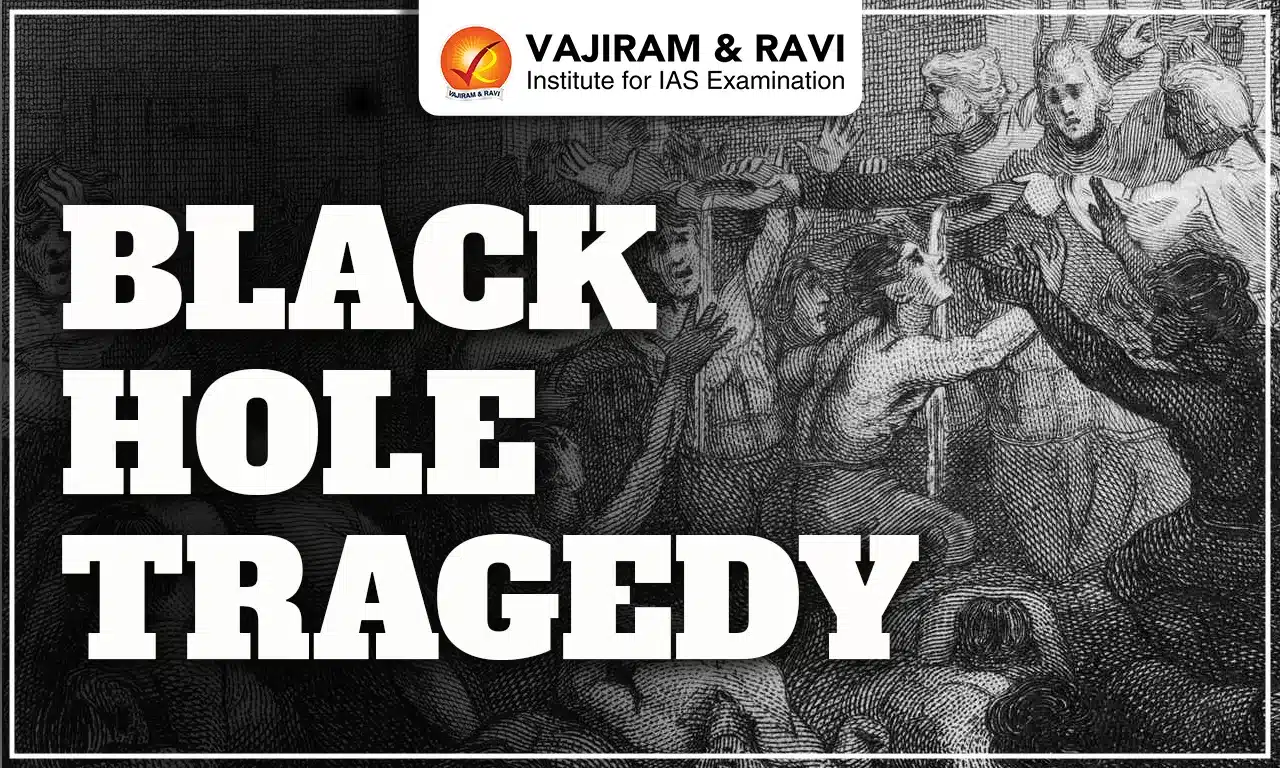
The Black Hole Tragedy is remembered as one of the most controversial and emotionally charged events of eighteenth-century India. It took place after the capture of Fort William in Calcutta on the night of 20 June 1756, when British prisoners were allegedly confined in a very small guardroom. The event became deeply influential because it shaped British attitudes, justified military retaliation, and played a major role in later political changes in Bengal.
Black Hole Tragedy
The Black Hole Tragedy refers to the reported confinement of British soldiers and civilians by the forces of Siraj ud-Daulah, the Nawab of Bengal, after the fall of Fort William. According to John Zephaniah Holwell, a British survivor, 146 prisoners were forced into a room measuring 18 × 14 feet, and only 23 survived by morning. Although many historians doubt the numbers, Holwell’s version became influential in British writings and was used to justify their later political actions.
Black Hole of Calcutta
The Black Hole of Calcutta refers to a confined prison room in the old Fort William complex, remembered for the tragic night when several captives reportedly died due to overcrowding. The chamber was originally built as a small guard cell and not intended to hold large groups. Over time, the incident became a symbol of colonial memory, shaping British interpretations of early conflict in Bengal and influencing later administrative and military decisions in the region. Later, Holwell built a Memorial to honor the victims who died in this incident.

Black Hole Tragedy Location
The Black Hole was originally a small guardroom inside the old Fort William, used by sentries and never designed to hold prisoners. After the incident, the old fort was demolished and replaced by the new Fort William, which still stands in the Maidan area of Kolkata. The exact location of the Black Hole cell is now identified in an alley between the General Post Office (GPO) and the adjacent northern building, situated in the north-west corner of B.B.D. Bagh. The memorial tablet once placed on that wall is currently kept in the Postal Museum nearby.
Black Hole Tragedy Historical Background
Understanding the Black Hole Tragedy requires studying the political and economic conditions of Bengal before 1756. The event did not occur suddenly but was the outcome of rising tensions between the Nawab of Bengal and the East India Company.
- Weakening Mughal Empire: After Aurangzeb’s death in 1707, Mughal authority declined, and provincial rulers gained more independence. Bengal became a rich but politically sensitive region.
- Rise of Siraj ud-Daulah: Siraj ud-Daulah became Nawab in April 1756. Young and determined, he aimed to control foreign trading companies and prevent them from expanding their political influence.
- British Fortification: The East India Company strengthened the fortifications of Fort William without seeking the Nawab’s permission. This act was viewed as a direct challenge to his authority.
- Political Refuge Issue: The Company provided shelter to Krishna Das, whose father was accused of misusing state revenue. This angered Siraj, who believed the British were interfering in Bengal’s internal matters.
- Capture of Fort William: Siraj ud-Daulah attacked Calcutta in June 1756. Most British soldiers fled to ships, leaving a small group inside the fort. These were the people taken prisoner, leading to the Black Hole Tragedy.
Black Hole Tragedy Reasons
The Black Hole Tragedy occurred due to a combination of administrative failures, military misjudgment, and chaotic prison management after the fall of Fort William. The primary reason was the sudden collapse of British leadership, which left captured individuals without proper oversight. Siraj ud-Daulah’s soldiers likely underestimated the number of prisoners and placed them in a small guardroom meant for only a few detainees. The overcrowding, intense heat, locked doors, and lack of ventilation created deadly conditions. Miscommunication among the Nawab’s troops and the absence of clear orders on handling prisoners further intensified the tragedy, resulting in high casualties overnight.
Black Hole Tragedy of Bengal
The Black Hole Tragedy took place on the night of 20 June 1756, after Siraj ud-Daulah captured Fort William in Calcutta. During the surrender, many British soldiers, civilians, and Anglo-Indian workers were taken prisoner. Because senior officers had fled, the remaining captives were gathered by the Nawab’s troops. They were pushed into a small guardroom measuring 18×14 feet, with only two barred windows. Throughout the night, prisoners struggled for air and water. Many collapsed due to suffocation, heat, and dehydration. By morning, only a small number survived. The incident became one of the most controversial events in colonial history.
Black Hole Tragedy Holwell’s Narrative
John Zephaniah Holwell’s report, although debated, became the standard British version. Holwell described the events after Fort William’s fall, explaining how prisoners were confined overnight in a tiny guardroom later called the “Black Hole.”
- Holwell met Siraj-ud-Daulah, who assured him no harm would occur, but prisoners were later locked in a 18 × 14 ft room.
- Jailers stripped the prisoners and confined them at 8 p.m.; by 6 a.m., only about 23 survived.
- Holwell claimed lower-rank Jemadars acted out of revenge, not on Siraj’s orders.
- Historians differ: Wolpert estimated 64 imprisoned, 21 survived; Prior noted 43 missing or dead from various causes.
- The room had two blocked windows, iron bars, and poor ventilation, worsened by fires in the fort.
- Prisoners offered guards bribes of 1,000-2,000 rupees to shift them, but no permission was granted.
- Crowding caused panic: people fought for air and water, many collapsing from heat, thirst, or trampling.
- By night’s end, bodies were removed and survivors revived; Siraj showed little reaction but was believed unaware of the confinement.
- Corpses were dumped into a ditch, while Holwell and a few others were later taken as prisoners to Murshidabad.
Siraj ud-Daulah’s Role in Black Hole Tragedy
Siraj ud-Daulah did not personally order the Black Hole confinement, according to most historians. His role was indirect and resulted from the battlefield situation after capturing Fort William. Siraj was angry at the British for illegal fortifications and giving shelter to political enemies. After the fort fell, his soldiers handled the prisoners without guidance or proper planning. Many scholars believe the tragedy occurred due to miscommunication and lack of supervision, not deliberate cruelty. Siraj was not present at the site that night. However, British writers portrayed him as responsible, helping justify the campaign that later removed him from power.
Black Hole Tragedy Casualties
According to Holwell’s detailed list, 123 people were reported dead from suffocation, excluding sixty-nine names he did not know, including Dutch and British soldiers, corporals, sergeants, militia members, whites, topazes, and Portuguese. The victims included senior Company officials, civilians, and military personnel. Holwell recorded the deaths of counsellors like E. Eyre and Wm. Baillie, service gentlemen such as Jenks, Revely, and Valicourt, military captains like Clayton and Buchanan, several lieutenants and ensigns, sergeants, and many sea captains. Only a small group survived, including Holwell himself, Ensign Walcott, Mrs. Carey, Captain Mills, Captain Dickson, and a few militia members.
Black Hole Tragedy Governor
During the Black Hole Tragedy, the acting Governor of Fort William was Roger Drake, whose weak leadership played a major role in the fall of Calcutta. When Siraj ud-Daulah advanced toward the fort in June 1756, Drake failed to organize proper defence arrangements or maintain discipline among the Company troops. As pressure increased, he abandoned the fort along with several senior officers, leaving the remaining soldiers and civilians without coordinated command. This vacuum of leadership contributed to confusion during the surrender, allowing the prisoners to be gathered by the Nawab’s forces and later confined in the room known as the “Black Hole.”
British Response to Black Hole Tragedy
The British response was swift and politically charged. The East India Company immediately blamed Siraj ud-Daulah for the tragedy and portrayed it as intentional cruelty. This helped mobilize military and financial support for an expedition to Bengal. Robert Clive led the counterattack, recapturing Calcutta in January 1757. The British rebuilt Fort William and strengthened defences. The tragedy also influenced public opinion in England, increasing support for aggressive imperial policy. Holwell’s narrative was printed widely, turning the event into a symbol of “Indian barbarity.” Ultimately, the response paved the way for the Battle of Plassey and British rule in Bengal.
Black Hole Tragedy Aftermath
The aftermath of the Black Hole Tragedy had long-lasting political consequences. When news reached British authorities in Madras and London, it created widespread anger and strengthened demands for strong retaliation against Siraj ud-Daulah. This led to Robert Clive’s return to Bengal with a military force. The event was used as a moral justification for British expansion. In 1757, Clive defeated Siraj ud-Daulah at the Battle of Plassey, establishing British dominance in Bengal. Holwell later built a Black Hole Monument in Calcutta, reinforcing the narrative. Over time, historians questioned the accuracy of the account, leading to major debates.
Black Hole Tragedy Debates
Many Historiographical Debates related to Black Hole Tragedy were carried out by several historians considering the following aspects:
- Holwell’s Narrative Questioned
- Holwell's numbers were likely exaggerated.
- The room may not have held as many people as he described.
- British failure in defending the fort was ignored in early narratives.
- Indian Sources Missing
- Contemporary Bengali sources do not describe the incident in the same way.
- This suggests that the tragedy gained importance mainly in British records.
- Colonial Propaganda
- Several scholars believe the event was used to justify expansion and portray the British as victims before Plassey.
- Archaeological Evidence
- The exact location of the “Black Hole” room is disputed, However the most accepted location is near the General Post Office.
- Historical maps show several guardrooms, but none perfectly match Holwell’s description.
Black Hole Tragedy Significance
The Black Hole Tragedy of Bengal has been crucial event of that time highlighting the emergence of various events as below:
- A Turning Point in British Rule: The Black Hole Tragedy became a major justification for British revenge and further military action in Bengal.
- Led to the Battle of Plassey (1757): The story helped Robert Clive gain support in England for a campaign against Siraj ud-Daulah.
- Political Propaganda: Holwell’s version was repeatedly used in speeches and writings to portray Indians as cruel and justify British dominance.
- Creation of a Memorial: A memorial was built by Holwell to honor those who died. It became a symbol of British suffering.
- Influence on Colonial Policy: The tragedy was used to defend the expansion of Company rule in Bengal after Plassey.
Black Hole Tragedy Impact
The Black Hole Tragedy had wide impacts on political decisions, military strategies, and historical memory in colonial India. Overall, the incident transformed from a local tragedy to a powerful tool of colonial expansion.
- Political: Strengthened British justification for war, leading to Plassey.
- Administrative: Increased British focus on fortification, discipline, and troop management.
- Economic: British control over Bengal’s revenue and trade after Plassey grew stronger.
- Psychological: Deepened racial mistrust between British rulers and Indians.
- Historical: Became a key narrative in colonial writings, often used to show alleged “Indian brutality.”
- Memorial: Holwell built a monument, later rebuilt by Curzon.
Black Hole Tragedy UPSC
The Black Hole Tragedy remains an important but heavily debated event in Indian history. While there is no doubt that prisoners were confined in a small cell after the fall of Fort William, the scale and details of the incident remain uncertain. The tragedy played a major role in shaping British perceptions, influencing political decisions, and contributing to the defeat of Siraj ud-Daulah at Plassey. Studying the Black Hole Tragedy highlights how historical narratives can be shaped by personal accounts, propaganda, and political motives.
Black Hole Tragedy FAQs
Q1: What was the Black Hole Tragedy?
Ans: It was the alleged confinement of British prisoners in a small guardroom after the fall of Fort William in 1756.
Q2: Who recorded the Black Hole Tragedy?
Ans: John Zephaniah Holwell, a British survivor, wrote the main account widely used in later British writings.
Q3: How many people died in the Black Hole Tragedy?
Ans: Holwell claimed 123 deaths, but modern historians believe the number was likely between 20 and 40.
Q4: What caused the Black Hole Tragedy?
Ans: It happened due to confusion after the capture of Fort William and the forced confinement of many prisoners in a tiny room.
Q5: The Black Hole Tragedy is related to which Battle?
Ans: The Black Hole Tragedy influenced British public opinion, justified military action in Bengal, and contributed to the ‘Battle of Plassey’.

