
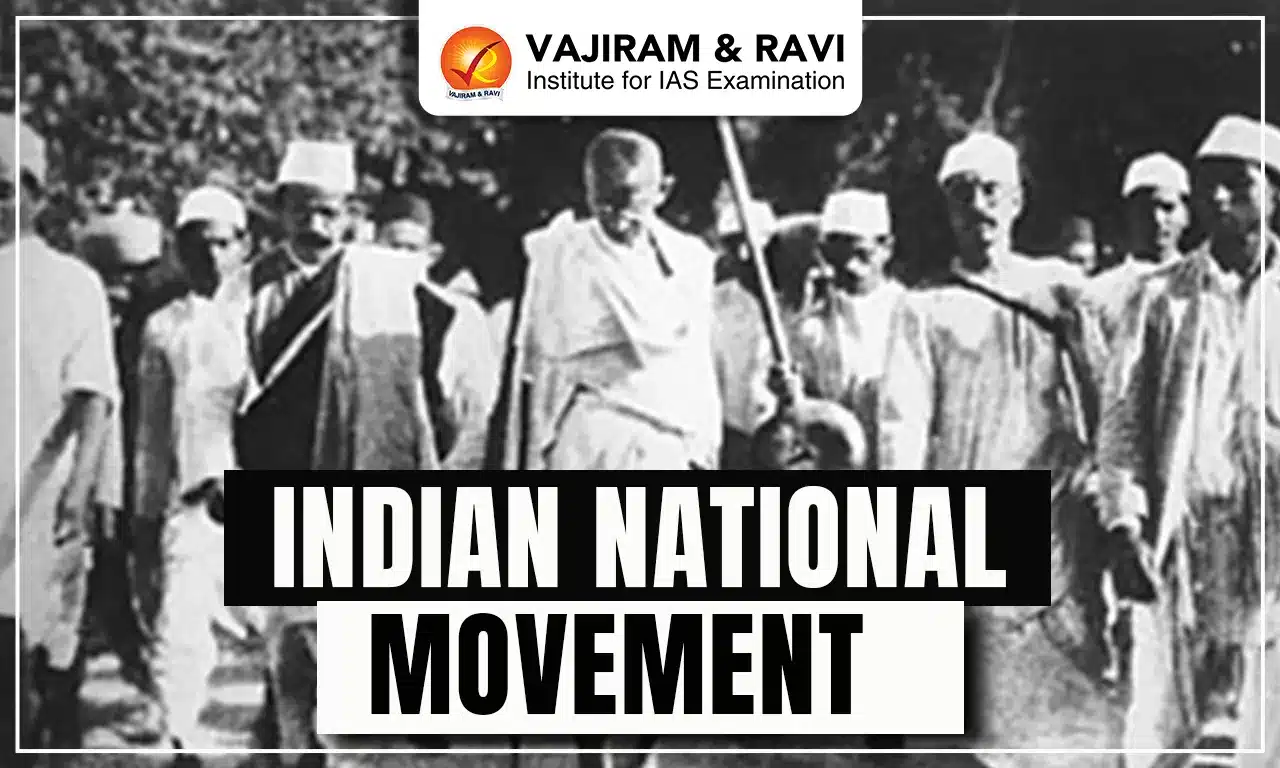
The Indian National Movement was a long struggle by Indians to gain independence from British colonial rule. Beginning in the late 19th century and culminating in 1947, it involved political, social, and economic efforts to challenge foreign dominance. Leaders like Mahatma Gandhi, Jawaharlal Nehru, Subhas Chandra Bose, Bal Gangadhar Tilak, and others played crucial roles. The movement combined constitutional reforms, mass mobilization, revolutionary activities, and civil disobedience, shaping modern India
Indian National Movement
The movement evolved in phases, reflecting the changing strategies of Indians against British rule. Early leaders emphasized moderate political reforms, while later generations adopted more radical approaches. Mass movements, including the Non-Cooperation Movement, Civil Disobedience Movement, and Quit India Movement, mobilized millions. It also integrated social reform, women’s participation, and youth activism, marking a nationwide awakening. Regional movements in Bengal, Punjab, Maharashtra, and the South complemented the national struggle for freedom.
Revolt of 1857
The 1857 Revolt, also called the First War of Indian Independence, marked the beginning of modern nationalist sentiment. Triggered by sepoy grievances, economic exploitation, and religious fears, it began in Meerut and spread to Delhi, Kanpur, Lucknow, and Jhansi. Key leaders included Mangal Pandey, Rani Lakshmibai, Nana Sahib, and Bahadur Shah Zafar. Though suppressed, it inspired future organized nationalist movements.
Indian National Movement Phases
The Historians have distributed the timeline of Indian National Movement into three major Phases:
- Moderate Phase (1885 - 1905)
- Extremist Phase (1905 - 1919)
- Gandhian Era (1919 - 1947)
Moderate Phase (1885-1905)
Focused on petitions, reforms, and dialogue with the British. Leaders like Dadabhai Naoroji emphasized economic critique (Drain Theory).
- Leaders: Dadabhai Naoroji, Gopal Krishna Gokhale, Pherozeshah Mehta, Surendranath Banerjee, W.C. Bonnerjee. Advocated constitutional reforms, petitions, and economic critique.
- Objective: Gain political rights through constitutional methods through “Dominion Status”, including participation in legislative councils, economic justice, and social reform.
Major Events & Movements:
| Events of Moderate Phase (1885-1905) | |
| Event / Movement | Year |
|
Formation of INC |
1885 |
|
Regional Associations |
1885-1900 |
|
Early Protests against Bengal Partition |
1905 |
- Important Locations: Bombay, Calcutta, Madras, Allahabad- hubs of political activity and education.
- Outcome: Laid the foundation for organized nationalism, political awareness, and petitioning the British for reform.
- Other Contemporary British Events:
- Indian Councils Act (1892) increased council participation but limited powers.
- Censorship laws to curb nationalist press.
- Regional Uprisings: Peasant agitations in Bengal and Madras, Santhal and Munda tribal revolts.
Extremist Phase (1905-1919)
Advocated direct action, boycott, and assertive nationalism.
- Leaders: Bal Gangadhar Tilak, Lala Lajpat Rai, Bipin Chandra Pal. Advocated direct action, boycotts, and assertive nationalism.
- Objective: Achieve “Swaraj” (self-rule) and assert Indian authority against British policies.
Major Movements & Events:
| Events of Extremist Phase (1905-1919) | |||
| Movement / Event | Year | Objective | Outcome |
|
Swadeshi Movement |
1905 |
Boycott British goods |
Strengthened nationalist sentiment |
|
Partition of Bengal Protests |
1905 |
Political and economic resistance |
Mass mobilization |
- Important Locations: Bengal (Calcutta), Maharashtra (Bombay), Punjab, United Provinces- major centres of agitation.
- Regional Uprisings: Localized protests against taxes and British policies in Bengal, Punjab, and Maharashtra.
Gandhian Era/ Mass Movements Phase (1919-1947)
Non-violent protests, civil disobedience, and Satyagraha led by Mahatma Gandhi mobilized millions.
- Leaders: Mahatma Gandhi, Jawaharlal Nehru, Subhas Chandra Bose, Sarojini Naidu, Kasturba Gandhi, Aruna Asaf Ali.
- Objective: Achieve Sampoorna Swaraj (complete independence) through non-violent resistance and mass mobilization.
Major Movements & Events:
| Events of Gandhian Era/ Mass Movements Phase (1919-1947) | ||||
| Movement | Year | Leaders | Method | Outcome |
|
Non-Cooperation |
1920-22 |
Gandhi |
Boycott institutions, resignations |
Suspended after Chauri Chaura |
|
Civil Disobedience |
1930-34 |
Gandhi |
Salt March, non-payment of taxes |
International attention |
|
Quit India |
1942 |
Gandhi, Nehru |
Mass protests, strikes |
Suppressed but united India |
- Important Locations: Champaran, Kheda, Dandi, Bombay, Delhi- centres of mass Satyagraha.
- Regional Uprisings: Champaran Satyagraha (1917), Kheda Satyagraha (1918), tribal and peasant revolts integrated into national struggle.
- Other Contemporary British Events: Rowlatt Act (1919), Jallianwala Bagh Massacre (1919), Simon Commission (1927).
Factors Responsible for National Uprising
The Indian National Movements were the results of the various events that occurred against Policies and Actions of the British. Few of the major causes are:
| Factors Responsible for National Uprising | |
| Factor | Details |
|
Political |
Exclusion from governance, British monopoly |
|
Economic |
Heavy taxation, drain of wealth, deindustrialization |
|
Social |
Famines, caste discrimination, low education |
|
Events |
Partition of Bengal (1905), World Wars I & II |
|
Repressive Policies |
Rowlatt Act, Jallianwala Bagh Massacre, Simon Commission |
Indian National Movement (1857-1947) Timeline
The chronological order of the key events and list of major Indian National Movements is tabulated below:
| Timeline of Indian National Movement (1857-1947) | ||||
| Year | Event / Movement | Leader(s) / Organisation | Location / Centre | Outcome / Significance |
|
1857 |
Mangal Pandey, Rani Lakshmibai, Nana Sahib, Bahadur Shah Zafar |
Meerut, Delhi, Jhansi, Kanpur |
First War of Indian Independence; inspired nationalist sentiment |
|
|
1885 |
Allan Octavian Hume, Dadabhai Naoroji, W.C. Bonnerjee |
Bombay |
Platform for political dialogue and reforms |
|
|
1885-1905 |
Moderate Phase activities |
Dadabhai Naoroji, Gopal Krishna Gokhale, Pherozeshah Mehta |
Bombay, Calcutta, Madras, Allahabad |
Constitutional petitions, economic critique (Drain Theory), foundation for nationalism |
|
1905 |
Lord Curzon, local leaders |
Bengal |
Triggered Swadeshi Movement; early mass protests |
|
|
1905-1919 |
Extremist Phase |
Bal Gangadhar Tilak, Bipin Chandra Pal, Lala Lajpat Rai |
Bengal, Maharashtra, Punjab |
Assertive nationalism, boycott of British goods, regional mobilization |
|
1917 |
Mahatma Gandhi |
Champaran, Bihar |
First major non-violent protest addressing rural grievances |
|
|
1918 |
Mahatma Gandhi |
Kheda, Gujarat |
Non-payment of revenue; success in obtaining concessions from British |
|
|
1919 |
Jallianwala Bagh Massacre |
British colonial authority |
Amritsar, Punjab |
Sparked nationwide outrage; led to Non-Cooperation Movement |
|
1920-22 |
Gandhi, C.R. Das |
Nationwide |
Boycott of British institutions; suspended after Chauri Chaura incident |
|
|
1930 |
Salt March / Civil Disobedience |
Dandi, Gujarat |
Protest against salt tax; widespread civil disobedience |
|
|
1935 |
Government of India Act |
British Parliament |
India-wide |
Provincial autonomy; partial self-rule; step toward independence |
|
1942 |
Gandhi, Nehru |
Nationwide |
Mass uprising demanding immediate independence; suppressed but politically significant |
|
|
1942 |
Formation of Indian National Army (INA) |
Subhas Chandra Bose |
Singapore (initially), Burma |
Armed resistance against British; mobilized Indian soldiers and expatriates |
|
1943 |
Provisional Government of Free India (Azad Hind) |
Subhas Chandra Bose |
Singapore |
Parallel government in exile; diplomatic recognition sought; symbol of sovereign India |
|
1944 |
INA campaigns: Imphal & Kohima |
Subhas Chandra Bose |
Assam-Nagaland border |
Pushed into India but eventually retreated; inspired nationalist sentiment |
|
1944 |
Arakan Campaign |
INA + Japanese forces |
Burma |
Coordinated offensive; strengthened INA’s strategic role |
|
1947 |
Indian Independence |
Indian National Congress |
India-wide |
End of British rule; establishment of a sovereign nation |
Kheda Satyagraha (1918)
In 1918, Gandhi led Kheda Satyagraha in Gujarat, supporting farmers facing crop failure and high taxes through non-violent protest.
Salt March/ Civil Disobedience Movement (1930)
Gandhi’s 1930 Salt March protested the salt tax, inspiring mass civil disobedience, boycotts, and nationwide anti-British mobilization.
Non-Cooperation Movement (1920)
Launched in 1920-22, Gandhi promoted boycotts of British institutions, resignations, and social unity, paused after Chauri Chaura violence.
Bardoli Satyagraha (1928)
In 1928, Sardar Vallabhbhai Patel led Bardoli Satyagraha, achieving concessions from the British against oppressive land taxes through non-violent methods.
Indigo Rebellion / Nil Bidroha (1859)
In 1859-60, Bengal peasants revolted against forced indigo cultivation, gaining temporary concessions and inspiring later nationalist and agrarian movements.
Quit India Movement (1942)
Launched in 1942 by Gandhi, the Quit India Movement demanded immediate British withdrawal, mass protests, strikes, and national unity.
Home Rule Movement (1916)
Led by Tilak and Annie Besant (1916), it aimed for self-governance within the British Empire, mobilizing people politically and socially.
Newspaper and Press Rebellion
The press played a vital role in mobilizing public opinion, spreading nationalist ideas, and documenting British injustices. Newspapers and journals became platforms for protest, awareness, and political critique. Press activism was often suppressed by the British, with censorship laws, fines, and imprisonment of editors, but it continued to strengthen nationalist consciousness across India
| Newspaper and Press Rebellion | |||
|
Newspaper / Journal |
Year |
Leader / Editor |
Significance |
|
Kesari |
1881 |
Advocated extremism and Swadeshi; inspired mass mobilization |
|
|
The Hindu |
1878 |
G. Subramania Iyer |
Constitutional criticism and political awareness |
|
Indian National Herald |
1938 |
Promoted Gandhian policies and Quit India Movement |
|
|
Bengalee |
1879 |
Supported early nationalist policies; anti-partition stance |
|
|
Amrita Bazar Patrika |
1868 |
Sisir Kumar Ghosh |
Highlighted colonial exploitation; mass influence |
Contribution of Women to the Indian National Movement
Women played a critical role in India’s struggle for freedom, participating in protests, leadership, and social reform campaigns. Key contributions include:
| Contribution of Women to the National Movement | ||
| Leader | Region | Contribution |
|
Sarojini Naidu |
Andhra / Maharashtra |
Led Civil Disobedience and Quit India campaigns; first woman president of INC |
|
Kasturba Gandhi |
Gujarat |
Participated in non-violent protests and Satyagraha |
|
Aruna Asaf Ali |
Delhi |
Hoisted Indian flag during Quit India Movement; underground activist |
|
Annie Besant |
All India |
Home Rule League; political awareness and reform |
|
Begum Rokeya |
Bengal |
Promoted women’s education; participated in social reform |
Tribal Uprisings
Tribal communities in India resisted British colonial policies that exploited their lands, resources, and autonomy. Tribal uprisings often preceded mainstream nationalist movements and highlighted local grievances against land revenue systems, forest laws, and forced labor.
| Tribal Uprisings | ||||
| Tribal Uprising | Year | Leader(s) | Region | Significance |
|
1855-56 |
Sidhu & Kanhu Murmu |
Bihar / West Bengal |
Revolt against zamindari exploitation and revenue demands |
|
|
1899-1900 |
Birsa Munda |
Jharkhand |
Resistance to British land revenue policies; assertion of tribal rights |
|
|
1831-32 |
Tribal Chiefs |
Chotanagpur |
Early tribal revolt against British revenue and administrative interference |
|
|
Paika Rebellion |
1817 |
Bakshi Jagabandhu |
Odisha |
Armed resistance against British land policies; precursor to nationalist movement |
|
Bhils & Gonds Revolts |
18th-19th Century |
Local Chiefs |
Central India / Madhya Pradesh |
Sustained resistance against revenue collection and forest exploitation |
Peasant Movements
Indian peasants led agrarian movements against excessive taxation, forced cultivation, and oppressive policies. They were crucial in linking local grievances to national awareness.
| Peasant Movements | |||||
| Movement | Year | Region | Leader(s) | Cause | Outcome |
|
Indigo Rebellion / Nil Bidroha |
1859-60 |
Bengal |
Local peasants |
Forced indigo cultivation for European planters |
Temporary concessions; British attempted reforms; inspired political activism |
|
1875 |
Maharashtra |
Peasants |
High debt, oppressive moneylenders |
Limited relief via colonial reforms |
|
|
Kheda Satyagraha |
1918 |
Gujarat |
Mahatma Gandhi |
Failure of crops; high taxes |
Successful non-payment of revenue; model for non-violent protest |
|
1928 |
Gujarat |
Sardar Vallabhbhai Patel |
Increased land revenue |
Government concession; strengthened civil disobedience strategies |
|
|
1946-51 |
Hyderabad State |
Communist leaders |
Zamindari exploitation, forced labour |
Integrated into larger post-independence land reforms |
|
|
Punjab Peasant Agitation |
Early 20th century |
Punjab |
Local leaders |
High taxes, colonial revenue policies |
Contributed to anti-British sentiment |
Formation of Indian National Army (INA)
Leader: Subhas Chandra Bose, 1942.
Objective: Overthrow British rule militarily and inspire Indian soldiers and expatriates to join the freedom struggle.
Structure of Azad Hind Government (Provisional Government of Free India, 1943):
| Structure of Azad Hind Government 1943 | ||
| Department | Head | Responsibility |
|
Defence |
Subhas Chandra Bose |
Led INA operations |
|
Foreign Affairs |
Abid Hasan |
Diplomacy, international recognition |
|
Interior |
Syed Mahmud |
Administration of territories |
|
Finance |
Lakshmi Swaminathan |
Funding INA and government operations |
Impact: Boosted morale, inspired Indian soldiers, pressured British administration, and influenced post-war independence.
Causes of Indian National Movements
Various factors responsible for the National Uprising and Indian National Movements involve roles of various section of society along with major activities and policies laid by the British Rulers as discussed below:
- Role of British Reforms and Acts
The British passed various reforms to manage Indian dissent. These reforms often fueled further nationalist demand for complete independence, as incremental concessions were deemed insufficient.
| Role of British Reforms and Acts in Indian National Movements | ||
| Act/ Reform | Year | Significance |
|
1892 |
Expanded legislative participation; limited powers |
|
|
1909 |
Introduced separate electorates for Muslims |
|
|
Montagu-Chelmsford Reforms |
1919 |
Dyarchy in provinces; partial self-government |
|
1935 |
Provincial autonomy; federal structure |
|
- Political Organizations in the Indian National Movement
Besides the Indian National Congress, regional and communal organizations influenced the movement:
- All India Muslim League (1906): Initially sought Muslim interests, later called for Pakistan.
- Hindu Mahasabha (1915): Promoted Hindu nationalist agenda.
- Ghadar Party (1913): Revolutionary activities abroad, especially in the US and Canada.
- Socialist and Labour groups: Focused on workers’ rights and peasant welfare.
- Role of Media and Literature
Newspapers, journals, and literature played a vital role in spreading nationalist ideas:
- The Indian Spectator, The Hindu, Kesari promoted political awareness.
- Writings of Bankim Chandra Chatterjee, Rabindranath Tagore, and revolutionary poetry inspired youth and common people.
- Print media helped unite diverse linguistic and cultural groups under common goals.
- Role of Youth in the Movement
Youth played a critical role, often participating in revolutionary activities and protests:
- Members of HSRA and Jugantar took part in armed resistance.
- Student movements in colleges across India engaged in boycotts and civil disobedience.
- Young leaders, including Bhagat Singh and Chandrashekhar Azad, became icons of courage and patriotism.
- Socio-Religious Movements
Social reform movements complemented political struggle:
- Brahmo Samaj (Raja Ram Mohan Roy)- eradication of Sati, widow remarriage.
- Arya Samaj (Dayananda Saraswati)- revivalist movement, education, anti-caste practices.
- Aligarh Movement (Sir Syed Ahmed Khan)- Muslim education, modern institutions.
- Prarthana Samaj- reform in Maharashtra.
- Secret Societies and Underground Activities
Secret revolutionary organizations worked alongside moderate and extremist movements:
- Anushilan Samiti- Bengal, revolutionary planning, training.
- Jugantar Party- Bengal, political assassinations.
- Ghadar Party- North America, Indian expatriates, armed struggle during WWI.
- Abhinav Bharat Society- Maharashtra, revolutionary activities.
- Split in INC and Revolutionary Rivalry
The INC split into Moderates and Extremists (1905-1919) due to differences in approach:
| Split of Indian National Congress | |||
| Faction | Leaders | Method | Objective |
|
Moderates |
Gokhale, Naoroji |
Dialogue, petitions |
Constitutional reforms |
|
Extremists |
Tilak, Lajpat Rai |
Boycotts, protests |
Assertive Swaraj |
Revolutionary leaders like Bhagat Singh, Surya Sen, Chandrasekhar Azad carried out targeted attacks on British officials, inspiring youth and public support.
- Role of Working Class
Urban industrial workers participated in strikes and labor protests:
- Bombay Textile Strike (1920s-1930s)
- Bengal jute mill strikes
- Formation of All India Trade Union Congress (AITUC, 1920)
- Highlighted link between industrial grievances and nationalist struggle
- Role of Capitalists
Indian business community supported nationalism through:
- Funding Swadeshi movement
- Establishing indigenous industries to reduce dependence on British goods
- Leaders: G.D. Birla, Jamnalal Bajaj, Ghanshyam Das Birla
- Communalism and Its Impact
- Communal divisions emerged in the late 19th and early 20th century.
- Muslim League (1906) advocated separate representation.
- Hindu Mahasabha formed in 1915.
- Impact: Led to political negotiations, partition debates, and influenced nationalist strategies
- Princely States and Their Struggle
During the Indian National Movement, princely states often participated in protests, strikes, and local uprisings to demand reforms and align with the broader struggle for independence.
| Struggle of Princely States | ||
| Princely State | Leader / Key Figure | Contribution / Significance |
|
Mysore |
Maharaja Krishna Raja Wadiyar IV |
Supported reforms; some administrative autonomy; allowed nationalist activities in education and society |
|
Travancore |
Local leaders, Diwan Sir C.P. Ramaswami Iyer |
Mobilization in civil protests; participated in Quit India Movement indirectly |
|
Hyderabad |
People & local activists |
Regional uprisings; demanded democratic reforms; resisted Nizam’s autocratic policies |
|
Rajasthan (Mewar, Jaipur, Jodhpur) |
Princes & commoners |
Organized regional protests; collaborated with INC and peasant movements |
|
Gwalior |
People & local leaders |
Participated in Quit India protests; provided shelter to nationalist leaders |
Indian National Movement Outcomes
The result of the Indian National Movement was eventually Freedom in 1947. Although various aspects of impacts created through these movements are discussed below:
- Political: End of British rule, foundation of democracy.
- Social: Women and marginalized groups participated in politics.
- Economic: Awareness of exploitation; promotion of indigenous industries.
- Cultural: Revival of Indian identity and national unity.
International: Inspired anti-colonial movements worldwide.
Indian National Movement FAQs
Q1: When did the Indian National Movement start?
Ans: The Indian National Movement began with the Revolt of 1857, marking India’s first large-scale struggle against British rule.
Q2: Who were the key leaders of the Indian National Movement?
Ans: Leaders like Mahatma Gandhi, Jawaharlal Nehru, Subhas Chandra Bose, Bal Gangadhar Tilak, and Sarojini Naidu played crucial roles.
Q3: What were the main phases of the Indian National Movement?
Ans: The movement had three phases: Moderate (1885-1905), Extremist (1905-1919), and Gandhian Era (1919-1947).
Q4: How did women contribute to the Indian National Movement?
Ans: Women leaders like Sarojini Naidu, Kasturba Gandhi, Aruna Asaf Ali, and Annie Besant actively participated in protests, Satyagraha, and leadership roles.
Q5: What was the role of the Indian National Army (INA)?
Ans: Formed by Subhas Chandra Bose in 1942, the INA inspired armed resistance against British rule and boosted nationalist morale.
