Purchasing Power Parity (PPP), Types, India’s Ranking

Purchasing Power Parity

Purchasing Power Parity (PPP) is an economic concept that compares currencies based on how many goods and services they can buy in different countries. It adjusts for cost-of-living differences, making international comparisons more accurate than market exchange rates. PPP shows the real value of money by measuring the price of a common basket of goods. 

It is widely used to compare GDP, living standards, and poverty levels across countries. India ranks as the third-largest economy in the world by Purchasing Power Parity (PPP), after China and the United States.

Types of Purchasing Power Parity

1. Absolute Purchasing Power Parity

Absolute PPP says that identical goods in two countries should cost the same when prices are converted using the exchange rate. It is based on the “law of one price” and compares the actual price levels directly.

Formula:

PPP Exchange Rate = Price in Country A / Price in Country B.

2. Relative Purchasing Power Parity

Relative PPP compares inflation rates between two countries and predicts how exchange rates adjust over time. It does not compare exact prices but focuses on changes in price levels.

Formula:

New Rate = Old Rate × (1 + Inflation in A) / (1 + Inflation in B).

3. National/ Aggregate PPP (Used for GDP Comparison)

This type of PPP compares the cost of a large basket of goods and services across countries to measure real GDP and living standards. It is used by international agencies for global GDP and poverty comparisons.

4. Implied PPP (Informal Method)

Implied PPP uses the price of a single standardized item like a burger, coffee, or commodity, to estimate currency undervaluation or overvaluation. It is not official, but it helps understand currency differences.

India’s GDP Ranking in PPP Terms

India is the 3rd largest economy in the world in PPP terms, ranking just after China and the United States. Many forecasts say India could become the 2nd largest economy by around 2038 if its growth continues at the same pace. PPP adjusts for cost of living, so it gives a clearer and more realistic picture of India’s actual economic strength than nominal GDP.

PPP in International Comparisons

Purchasing Power Parity (PPP) helps compare countries by adjusting for differences in prices and living costs, giving a clearer picture of real economic strength. It is used by the World Bank, IMF, and UN to compare GDP, poverty, and living standards fairly across nations.

PPP in International Comparisons
Rank Country GDP (PPP) in trillion USD (approx.)

1

China

$33.7 trillion

2

United States

$27.9 trillion

3

India

$14.7 trillion

4

Japan

$6.5 trillion

5

Germany

$5.8 trillion

Factors Affecting Purchasing Power Parity

  • Differences in inflation between countries change the purchasing power of currencies and cause PPP to deviate.
  • Interest rate changes attract or reduce foreign capital, which affects currency demand and breaks PPP.
  • Trade barriers like tariffs and quotas increase prices of imported goods and prevent equal pricing.
  • Transportation and shipping costs make the same goods costlier in some countries, affecting PPP.
  • Differences in product quality, brands, and consumer preferences create price gaps across nations.
  • Market imperfections such as subsidies, taxes, and monopoly control distort domestic prices.
  • Non-tradable goods and services like housing or local labour cannot be compared internationally, causing price differences.
  • Currency speculation and sudden capital flows change exchange rates quickly, moving away from PPP.
Other Related Posts
New Economic Policy 1991 Green GDP
Care Economy Securities and Exchange Board of India
National Income Foreign Portfolio Investment
Gross Domestic Product (GDP) Foreign Direct Investment
GDP Deflator

Purchasing Power Parity FAQs

Q1: What is Purchasing Power Parity (PPP)?

Ans: PPP is an economic concept that compares the value of currencies by checking how much goods and services they can buy in different countries.

Q2: Why is PPP important?

Ans: PPP helps compare the real living standards, economic productivity, and income levels of countries more accurately than market exchange rates.

Q3: How is PPP calculated?

Ans: PPP is calculated by comparing the price of a common basket of goods between two countries.

Q4: What is the difference between PPP and market exchange rate?

Ans: Market exchange rates change daily due to demand and supply of currencies, while PPP is based on long-term price levels and is more stable.

Q5: Which organisation publishes global PPP data?

Ans: The World Bank’s International Comparison Program (ICP) publishes global PPP data.
Code of Criminal Procedure (CrPC), Background, Features, Provisions

Code of Criminal Procedure

The Code of Criminal Procedure (CrPC), 1973, is the main law that explains how criminal cases should be handled in India. It tells the police, courts, and citizens what steps must be followed during investigation, arrest, bail, trial, and punishment. CrPC ensures that every person gets a fair process and justice is delivered in a systematic way. It is one of the most important laws that supports the entire criminal justice system.

Code of Criminal Procedure (CrPC) Historical Background

  • The origins of criminal procedure in India go back to the British era, when the first Criminal Procedure Code was introduced in 1861 after the 1857 revolt.
  • This was replaced by the Criminal Procedure Code of 1872, which brought more uniformity to criminal trials across British India.
  • Later, the Criminal Procedure Code of 1882 was introduced to address administrative issues and improve coordination between police and courts.
  • The Criminal Procedure Code of 1898 became the most stable and widely used law, governing criminal procedures for several decades.
  • This led to the drafting of a new law, and finally, the Criminal Procedure Code (CrPC), 1973 was enacted, replacing the 1898 Code.
  • The CrPC of 1973 came into force on 1 April 1974, standardizing arrest, investigation, trial, and appeal procedures across India.
  • Eventually, to modernize the system further, the Bharatiya Nagarik Suraksha Sanhita (BNSS), 2023 was introduced to replace CrPC.

Code of Criminal Procedure (CrPC) Objectives

  • To ensure fair, transparent, and speedy justice by providing a uniform procedure for handling criminal cases across the country.
  • To protect the rights of individuals, including both the accused and the victims, during investigation and trial.
  • To guide police, magistrates, and courts with clear rules for arrest, investigation, inquiry, bail, and trial.
  • To maintain public order and peace through defined powers for preventive actions and emergency measures.
  • To promote accountability and prevent misuse of power by setting legal safeguards and procedural checks at every stage of the criminal justice process.

Code of Criminal Procedure (CrPC) Features

  • Clear Classification of Offences: CrPC categorizes offences as cognizable/non-cognizable and bailable/non-bailable to decide how police and courts should act.
  • Detailed Procedure for Investigation and Trial: It lays down rules for FIR, arrest, evidence collection, charge framing, and different types of trials.
  • Rights of the Accused and Victims: Ensures fair treatment by providing rights like legal aid, protection from unlawful arrest, and victim compensation.
  • Defined Powers of Police and Magistrates: Specifies the roles, duties, and limits on authority to prevent misuse of power.
  • Appeals, Revisions, and Reviews: Offers a structured system for higher courts to correct errors and ensure justice through appellate mechanisms.

Types of Offences

Code of Criminal Procedure (CrPC) categorises offences to decide which authority handles them and what procedures must be followed. This classification helps ensure that serious crimes are treated differently from minor ones.

1. Cognizable and Non-Cognizable Offences

  • Cognizable: Police can arrest without a warrant; includes serious crimes like murder and rape.
  • Non-Cognizable: Police need a warrant; it includes minor offences like defamation.

2. Bailable and Non-Bailable Offences

  • Bailable: Bail is a right and must be granted.
  • Non-Bailable: Bail depends on the court’s approval.

3. Compoundable and Non-Compoundable Offences

  • Compoundable: Parties can settle or compromise.
  • Non-Compoundable: No compromise allowed due to the serious nature.

Code of Criminal Procedure (CrPC) Provisions

CrPC contains several important sections that govern how criminal cases progress. These provisions ensure fairness and prevent misuse of legal power. They include rules for lodging an FIR, conducting search and seizure, granting bail, and maintaining public order.

Code of Criminal Procedure (CrPC) Provisions
Category Section(s) Key Provisions

Arrest & Custody

Sections 41-60A

Police powers to arrest, rights of the arrested person, production before magistrate within 24 hours.

FIR & Investigation

Section 154

FIR registration for cognizable offences; police must start investigation after FIR.

Search & Seizure

Sections 93-105

Procedures for issuing warrants, conducting searches, and seizing evidence legally.

Bail Provisions

Sections 436-439

Rules for granting bail in bailable and non-bailable offences; court's power to impose conditions.

Anticipatory Bail

Section 438

Allows a person to seek bail in advance if they fear arrest in a non-bailable offence.

Classification of Trials

Sections 225-265

Defines different types of trials: Sessions Trial, Warrant Trial, Summons Trial, and Summary Trial.

Maintenance of Public Order

Sections 144-145

Authority to restrict activities for public safety; deals with disputes likely to cause violence.

Victim Compensation

Section 357

Court may order compensation to victims of crime for loss or injury.

Role of Magistrates

Sections 6-40

Defines the powers, functions, and hierarchy of magistrates in criminal matters.

Charge Framing

Sections 211-224

Rules for framing charges against the accused, amendments to charges, and communication of charges.

Recording Evidence

Sections 275-299

Procedures for recording witness statements and preserving evidence.

Judgment

Sections 353-371

Rules for delivering judgment, sentencing, and explaining decisions to the accused.

Appeals & Revisions

Sections 372-405

Provisions for filing appeals, revisions, and reviews before superior courts.

Maintenance Orders

Section 125

Provides monthly maintenance to wife, children, and parents who cannot support themselves.

Cognizable & Non-Cognizable Offences

First Schedule

Lists offences and clarifies which are cognizable, non-cognizable, bailable, or non-bailable.

Code of Criminal Procedure (CrPC) Limitations

  • Delay in Investigation and Trials: Many cases take years to complete due to slow procedures, lack of staff, and heavy workload on the police and courts.
  • Outdated Mechanisms: Several provisions of the CrPC do not match modern digital and forensic needs, making investigations less effective.
  • Misuse of Arrest Powers: Police sometimes misuse discretionary powers, leading to unnecessary or arbitrary arrests.
  • Weak Witness Protection: Witnesses often face threats or pressure, making them turn hostile and affecting the final judgment.
  • High Case Pendency: Courts are overloaded with lakhs of pending cases, leading to delays in justice.
  • Low Conviction Rates: Poor investigation quality, lack of coordination, and weak evidence collection lead to fewer convictions.
  • Limited Victim Support: Victim rights, compensation, and protection are not strong enough in many cases.
  • Inadequate Use of Technology: Lack of digital tools and slow adoption of modern systems affect efficiency.

Code of Criminal Procedure (CrPC) vs Bharatiya Nagarik Suraksha Sanhita (BNSS)

The CrPC, 1973 was India’s main criminal procedure law for several decades, but it gradually became outdated due to slow processes, limited use of technology, and weak victim protection. To modernize the system, the government introduced the Bharatiya Nagarik Suraksha Sanhita (BNSS), 2023, which focuses on digital procedures, forensic support, faster trials, and transparency.

Feature CrPC, 1973 BNSS, 2023

Total Sections

484 sections

531 sections

Overall Focus

Traditional and procedure-based

Digital, technology-driven, and victim-centric

FIR System

No mention of Zero FIR

Zero FIR explicitly recognized; e-FIR allowed in many cases

Digital Integration

Limited online procedures

E-records, digital case diaries, audio-video recording made compulsory

Forensic Support

Minimal use of forensics

Mandatory forensic investigation for offences punishable with 7+ years

Timeline for Investigation

No strict timelines

Time-bound investigation for serious offences; progress report required

Arrest Procedures

Conventional arrest rules

Added transparency using digital tracking, videography, and documentation

Trial Procedures

Physical court trials

Online, virtual hearings, and electronic evidence strongly supported

Victim Rights

Less emphasis

More victim-friendly: information rights, protection, compensation clarity

Bail Mechanism

Traditional rules

Simplified and structured bail provisions; safeguards against misuse

Public Order Sections

Sections like 144, 145 retained

Similar provisions but with clearer procedures and digital evidence support

Charge Sheet Submission

Mostly physical

Electronic charge sheet submission promoted

Search & Seizure

Traditional manual procedures

Mandatory audio-video recording for searches and raids

Maintenance Provisions

Section 125 included

Retained with clearer rules for dependents

Focus on Police Accountability

Basic safeguards

Strong monitoring through digital logs and mandatory documentation

Code of Criminal Procedure (CrPC) FAQs

Q1: What is the CrPC?

Ans: CrPC is the main law that guides how criminal cases are investigated, tried, and decided in India.

Q2: When was CrPC enacted?

Ans: It was enacted in 1973 and came into force in 1974.

Q3: What does CrPC deal with?

Ans: It covers investigations, arrests, FIRs, bail, court procedures, and appeals.

Q4: Has CrPC been replaced?

Ans: Yes, the Bharatiya Nagarik Suraksha Sanhita (BNSS), 2023 has replaced CrPC with updated and digital-friendly provisions.

Q5: Why is the CrPC important?

Ans: It ensures that every criminal case follows fair and uniform procedures, protecting the rights of both victims and accused persons.

UPSC Daily Quiz 9 December 2025

UPSC Daily Quiz

The Daily UPSC Quiz by Vajiram & Ravi is a thoughtfully curated initiative designed to support UPSC aspirants in strengthening their current affairs knowledge and core conceptual understanding. Aligned with the UPSC Syllabus 2025, this daily quiz serves as a revision resource, helping candidates assess their preparation, revise key topics, and stay updated with relevant issues. Whether you are preparing for Prelims or sharpening your revision for Mains, consistent practice with these Daily UPSC Quiz can significantly enhance accuracy, speed, and confidence in solving exam-level questions.

[WpProQuiz 41]

UPSC Daily Quiz FAQs

Q1: What is the Daily UPSC Quiz?

Ans: The Daily UPSC Quiz is a set of practice questions based on current affairs, static subjects, and PYQs that help aspirants enhance retention and test conceptual clarity regularly.

Q2: How is the Daily Quiz useful for UPSC preparation?

Ans: Daily quizzes support learning, help in revision, improve time management, and boost accuracy for both UPSC Prelims and Mains through consistent practice.

Q3: Are the quiz questions based on the UPSC syllabus?

Ans: Yes, all questions are aligned with the UPSC Syllabus 2025, covering key areas like Polity, Economy, Environment, History, Geography, and Current Affairs.

Q4: Are solutions and explanations provided with the quiz?

Ans: Yes, each quiz includes detailed explanations and source references to enhance conceptual understanding and enable self-assessment.

Q5: Is the Daily UPSC Quiz suitable for both Prelims and Mains?

Ans: Primarily focused on Prelims (MCQ format), but it also indirectly helps in Mains by strengthening subject knowledge and factual clarity.

Basel Norms in India, Objectives, Features, Impact on Indian Banks

Basel Norms in India

Basel Norms are international banking regulations introduced by the Basel Committee on Banking Supervision (BCBS) in Basel, Switzerland, to strengthen the global financial system.

It was first introduced in 1988; these norms provide a framework for capital adequacy, risk management, and banking supervision. Over time, Basel I, II, and III were developed to address evolving financial risks and prevent banking crises. 

Basel Committee on Banking Supervision

  • The Basel Committee on Banking Supervision was established in 1974 by the central bank governors of G10 countries in response to global banking disturbances.
  • Operates under the Bank for International Settlements (BIS), headquartered in Basel, Switzerland.
  • Acts as the primary global standard-setter for banking regulations, especially in areas like capital adequacy, risk management, and supervision.
  • Provides non-binding guidelines such as Basel I, II, and III, which member countries adapt based on their banking requirements.
  • Promotes cooperation and coordination among national banking regulators to strengthen global financial stability.

Also Read: Commercial Banks

Basel Norms in India Objectives

The main objectives of Basel Norms in India are:

  • Maintaining Capital Adequacy: Banks are required to maintain a minimum level of capital to cover risks arising from lending, investment, and operational activities.
  • Risk Management: Basel Norms encourage banks to adopt modern risk management practices, identifying, measuring, and mitigating risks effectively.
  • Financial Stability: By setting international standards, Basel Norms aim to prevent banking failures and reduce systemic risks in the financial system.
  • Transparency and Disclosure: Banks must provide clear information on capital adequacy, risk exposures, and asset quality to stakeholders, ensuring trust in the financial system.
  • Global Alignment: Facilitates harmonization of banking standards across countries, enabling Indian banks to compete internationally and attract foreign investment.

Basel Accords (Basel I, II, III)

The Basel Committee has introduced three major accords over time, each refining and strengthening banking regulations: 

Basel Accords (Basel I, II, III)
Basel Accord Features Capital Requirement / Calculation Method Focus Area

Basel I (1988)

Introduced Capital Adequacy Ratio (CAR) Classified assets into 5 risk categories 

Focused on credit risk

CAR = (Tier 1 Capital + Tier 2 Capital) ÷ Risk Weighted Assets (RWA) × 100 

Minimum CAR: 8%

Credit Risk

Basel II (2004)

Three-pillar approach: 

1. Minimum Capital Requirement 

2. Supervisory Review 3. Market Discipline Included credit, market, operational risks

Credit Risk: RWA based on standardized or internal ratings  Operational Risk: Using Basic Indicator, Standardized, or Advanced Measurement Approaches (AMA)

Market Risk: Using standardized or internal models

Credit, Market & Operational Risk

Basel III (2010 onwards)

Strengthened capital norms post-2008 crisis  Introduced CET1, leverage ratio, liquidity norms 

Counter-cyclical capital buffer

CET1 Ratio = Common Equity Tier 1 Capital ÷ RWA × 100 

Minimum CET1: 7% 

Leverage Ratio = Tier 1 Capital ÷ Total Exposure × 100 

Liquidity Coverage Ratio (LCR) = High-Quality Liquid Assets ÷ Net Cash Outflows (30 days) × 100

Capital Quality, Liquidity, Risk Coverage

  • Tier 1 Capital: Core capital including equity capital and disclosed reserves.
  • Tier 2 Capital: Supplementary capital like subordinated debt and hybrid instruments.
  • RWA (Risk Weighted Assets): Assets weighted according to credit, market, or operational risk.
  • LCR & NSFR (Basel III): Ensure banks can meet short-term and long-term liquidity requirements.

Implementation of Basel Norms in India

India has adopted Basel norms in a phased and structured manner to align domestic banks with international standards:

  • Basel I Implementation:
    • Introduced in 1992 by the RBI.
    • All Indian commercial banks were required to maintain CAR of 8%.
  1. Basel II Implementation:
    • Phased implementation started in 2007.
    • Banks were categorized into three groups:
      • Group 1: Large banks with significant international exposure.
      • Group 2: Mid-sized banks with moderate risk exposure.
      • Group 3: Small banks and regional banks.
    • RBI issued guidelines for credit risk, market risk, and operational risk management.
  2. Basel III Implementation:
    • Phased rollout started in 2013, with full implementation by March 2019.
    • Required banks to maintain higher capital buffers and meet liquidity requirements.
    • RBI monitors compliance through periodic reporting and stress testing.

Also Read: Inflation

Impact on Indian Banks and Financial Stability

  • Stronger Capital Base: Banks now maintain higher capital levels, improving their ability to absorb losses during economic stress.
  • Improved Risk Management: Adoption of advanced frameworks for credit, market, and operational risks has strengthened internal control systems.
  • Enhanced Transparency: Mandatory disclosures under Basel norms have increased accountability and improved stakeholder confidence.
  • Higher Financial Stability: A more resilient banking system reduces the possibility of cascading bank failures and systemic crises.
  • Better Global Compatibility: Indian banks now follow international standards, improving their credibility and enabling global integration.
  • Strengthened Supervisory Oversight: RBI’s monitoring, stress testing, and prudential regulations have become more effective.
  • Improved Asset Quality Focus: Banks have become more cautious in lending, leading to better assessment of borrower risk.

Basel Norms for Indian Banking Sector Significance

The significance of Basel Norms for India’s banking sector can be summarized as follows:

  • Protection of Depositors: Ensures banks have sufficient capital to safeguard depositors’ money.
  • Mitigation of Systemic Risk: Reduces the likelihood of banking crises and financial contagion.
  • Strengthening Prudential Regulation: Encourages disciplined lending, risk assessment, and transparency.
  • Promoting Sustainable Growth: A stable banking system fosters confidence and supports long-term economic development.
  • International Integration: Aligns Indian banks with global banking practices, improving credibility in the global market.
  • Encouraging Innovation: Risk-based regulation motivates banks to adopt modern risk management and technological solutions.

Basel Norms in India FAQs

Q1: What are Basel Norms?

Ans: Basel Norms are international banking regulations that set standards for capital adequacy, risk management, and financial stability, developed by the Basel Committee on Banking Supervision.

Q2: Why did India adopt Basel Norms?

Ans: India adopted Basel Norms to strengthen banks, ensure financial stability, manage risks, and align with global banking standards.

Q3: What is the Capital Adequacy Ratio (CAR)?

Ans: CAR is the ratio of a bank’s capital to its risk-weighted assets, ensuring banks have enough capital to cover potential losses.

Q4: What is the role of RBI in Basel Norms?

Ans: RBI issues guidelines, monitors compliance, conducts stress tests, and ensures banks meet capital and risk management standards.

Q5: How have Basel Norms impacted Indian banks?

Ans: They have strengthened banks’ capital base, improved risk management, increased transparency, and enhanced financial stability.

Copyright Act 1957, Provisions, Criteria, Exceptions, Duration

Copyright Act 1957

The Copyright Act 1957 is the central law governing copyright protection in India. It came into force on 21 January 1958 and remains the primary legislation defining the rights of authors, creators, and producers of literary, artistic, musical, dramatic, film and sound works. Copyright law in India has evolved from its colonial roots under British rule to a modern legal framework that aligns with major global treaties. The Act has been amended six times, the latest being the Copyright (Amendment) Act 2012, to keep pace with technological changes, digital content, and global standards. Today, copyright helps promote creativity while balancing the interests of authors and public access.

Copyright Act 1957

The Copyright Act 1957 was the first post-independence copyright law in India. It replaced the earlier Indian Copyright Act 1914 and aligned India’s legal system with international standards such as the Berne Convention 1886, Universal Copyright Convention 1951, Rome Convention 1961, and TRIPS Agreement. India later joined the WIPO Copyright Treaty (WCT) and WIPO Performances and Phonograms Treaty (WPPT) in 2013, strengthening digital copyright protection. Under this Act, copyright grants creators exclusive rights to reproduce, adapt, distribute, translate, and communicate their work to the public. The Act also defines ownership, assignment of rights, duration of protection, and exceptions under “fair dealing.”

Also Read: Indian Forest Act 1927

Copyright Act 1957 Provisions

The Copyright Act 1957 contains detailed provisions defining rights of authors, duration, assignments, ownership, remedies, and exceptions protecting creativity and public interest. Key Provisions of the act are:

  • Defines copyright as a bundle of rights including reproduction, communication, translation and adaptation.
  • Covers literary, musical, dramatic, artistic works, films and sound recordings.
  • Author is the first owner, except in employer-employee relationships.
  • Allows assignment of copyright only through written agreements under Section 19.
  • Assignment without specifying duration lasts five years; territory defaults to India.
  • Recognizes joint authorship when contributions cannot be distinguished.
  • Provides civil remedies, criminal action, and administrative remedies like customs detention.
  • Defines jurisdiction rules based on the place where cause of action arises (2015 Supreme Court ruling).

Copyright Act 1957 Historical Background

The evolution of copyright in India traces back to colonial legislation and later adapted to post-independence needs through the Copyright Act 1957.

  • Before 1958, India followed the Indian Copyright Act 1914, based on the British Imperial Copyright Act 1911.
  • The 1914 Act governed works created before 21 January 1958.
  • Under the 1914 Act, photographs enjoyed 50-year copyright from creation.
  • Copyright Act 1957 was India’s first independent copyright law.
  • The Act underwent six amendments: 1983, 1984, 1992, 1994, 1999, and 2012.
  • 2012 Amendment aligned Indian law with digital era requirements and rights of performers.
  • India became party to WCT & WPPT in 2013.
  • India is a member of major treaties like Berne, UCC, Rome, and TRIPS.

Also Read: Wetland (Conservation and Management) Rules 2010 & 2017

Copyright Act 1957 Criteria

The Copyright Act 1957 protects a wide range of intellectual and creative works, extending from texts and images to films, recordings and architectural creations. Types of work covered under the act are:

  • Literary works: books, articles, software, databases.
  • Dramatic works: scripts, choreography, recitation.
  • Musical works: compositions excluding lyrics.
  • Artistic works: paintings, drawings, sculptures, maps, photographs.
  • Cinematograph films: movies, videos, digital films.
  • Sound recordings: songs, audiobooks, albums, soundtracks.
  • Includes architecture and works of artistic craftsmanship.
  • Foreign works protected through International Copyright Order.
  • Duration cannot exceed protection in the country of origin.

Copyright Act 1957 Exceptions

The Copyright Act 1957 includes important exceptions to balance creators’ rights with public access, research needs, education, reporting and cultural documentation. Key Exceptions given under the Section 52 Fair Dealing are:

  • Fair dealing for private or personal use, including research.
  • Use for education, teaching, or instruction.
  • Use for criticism or review of a work.
  • Reporting current events, including public lectures.
  • Use of airport layouts or similar materials for public reporting.
  • Freedom of Panorama (Sections 52(s), 52(t), 52(u)):
    • Creating paintings, drawings or photographs of architecture permanently situated in public spaces.
    • Depicting public sculptures or works of craftsmanship.
    • Inclusion of such works in films if incidentally or permanently public.

Copyright Act 1957 Duration of Copyright

The duration of copyright varies under the Copyright Act 1957 depending on the type of work and ensures creators benefit from their creations over extended periods.

  • Literary, dramatic, musical, artistic works: lifetime of author + 60 years after year of death.
  • Anonymous/ pseudonymous works: 60 years from publication.
  • Cinematograph films: 60 years from publication.
  • Sound recordings: 60 years from publication.
  • Government works: 60 years from publication.
  • Public undertakings: 60 years from publication.
  • International agencies: 60 years from publication.
  • Photographs (post-1957 law): 60 years from publication.
  • For foreign works: duration cannot exceed that in country of origin.

Copyright Act 1957 Case Laws

Several landmark cases have shaped the interpretation of the Copyright Act 1957, strengthening understanding of ownership, fair dealing, jurisdiction and moral rights.

  • The Daily Calendar Supplying Bureau v. United Concern (1958, 1964): clarified freedom of panorama limits.
  • Academy of General Education v. B. Malini Mallya (2009): discussed the scope of fair dealing.
  • Civic Chandran v. Ammini Amma: transformative and critical use allowed.
  • Delhi University Rameshwari Photocopy Case (2016): photocopying for education allowed under fair dealing (later reopened).
  • Pine Labs Pvt. Ltd. v. Gemalto Terminals (2023): assignment without duration lasts five years.
  • Najma Heptulla v. Orient Longman: defined joint authorship.
  • Indian Performing Rights Society v. Sanjay Dalia (2015): jurisdiction based on place where cause of action arises; prevents harassment through distant filing.

Copyright Act 1957 FAQs

Q1: What is the Copyright Act 1957?

Ans: The Copyright Act 1957 is India’s main law that protects the rights of creators of books, music, films, art, software, and other original works.

Q2: What types of works are protected under the Copyright Act 1957?

Ans: It protects literary, musical, artistic, dramatic works, cinematograph films, sound recordings, computer programs, and architectural designs.

Q3: What is the duration of copyright under the Copyright Act 1957?

Ans: For literary, musical, artistic, and dramatic works, copyright lasts for the author’s lifetime plus 60 years after their death.

Q4: What is fair dealing under the Copyright Act 1957?

Ans: Fair dealing allows limited use of a copyrighted work for research, study, criticism, review, teaching, or reporting of current events.

Q5: Who is the first owner of copyright according to the Act?

Ans: The creator of the work is the first copyright owner, unless it is created under employment or a contract that states otherwise.

Article 13 of Indian Constitution, Interpretation, Significance

Article 13 of Indian Constitution

Article 13 comes under Part III of the Constitution of India. The article is a foundational pillar that helps protect the fundamental rights of citizens of India. It says that any existing or future laws that violate these rights should be considered void to the extent of the violation. This article helps establish the supremacy of the Constitution and also makes sure that no authority including the executive and executive can surpass the fundamental rights of individuals. In this article, we are going to cover Article 13 of the Constitution of India, its interpretation and its significance. 

Article 13 of the Constitution of India

The Constitution of India has stated the following about Article 13: 

Laws inconsistent with or in derogation of the fundamental rights

  • All laws in force in the territory of India immediately before the commencement of this Constitution, in so far as they are inconsistent with the provisions of this Part, shall, to the extent of such inconsistency, be void.
  • The State shall not make any law which takes away or abridges the rights conferred by this Part, and any law made in contravention of this clause shall, to the extent of the contravention, be void.
  • In this article:
    • (a) "Law" includes any Ordinance, order, bye-law, rule, regulation, notification, custom, or usage having in the territory of India the force of law;
    • (b) "Laws in force" includes laws passed or made by a Legislature or other competent authority in the territory of India before the commencement of this Constitution and not previously repealed, notwithstanding that any such law or any part thereof may not be then in operation either at all or in particular areas.
  • Nothing in this article shall apply to any amendment of this Constitution made under Article 368. 

Article 13 of Constitution of India Interpretation

Article 13 of Indian Constitution can be interpreted in the following manner

  • Article 13(1) says that any laws that are existing even before the Constitution was constituted, and are now in conflict with fundamental rights will now become invalid in case of any conflict. 
  • Article 13(2) of the Indian Constitution says that the state is not allowed to make laws that violate the fundamental rights of citizens of India. Such laws will be considered to be void in case of violation. 
  • Article 13(3) of the Indian Constitution particularly defines “Law”  in the form of legal instruments and customs. 
  • Article 13(4) of the Indian Constitution states that the constitutional amendments under Article 368 does not come under the provisions mentioned under Article 13.

Article 13 of the Indian Constitution Important Cases

Article 13 has always been in shaping India’s constitutional framework by ensuring that laws violating fundamental rights are struck down. Key Supreme Court judgments interpreting Article 13 include:

  • Kesavananda Bharati v. State of Kerala (1973): Establishing the Basic Structure Doctrine, limiting Parliament’s power to amend core constitutional principles, including fundamental rights.
  • I.C. Golaknath v. State of Punjab (1967): Ruled that Parliament cannot amend fundamental rights, treating amendments as “law” under Article 13.
  • Minerva Mills Ltd. v. Union of India (1980): Reaffirmed the Basic Structure Doctrine and held limited amending power as a basic feature.
  • L. Chandra Kumar v. Union of India (1997): Declared judicial review as a basic feature; tribunals cannot exclude High Court or Supreme Court jurisdiction.

Article 13 of the Indian Constitution Significance

Article 13 of the Constitution of India is important in the following manners: 

  • Make sure that the fundamental rights of citizens are protected by declaring any law that violates it void. 
  • Gives the power to the courts to review and nullify any unconstitutional laws.
  • Article 13(1) of the constitution can remove any pre-constitutional law that violates the fundamental rights. 
  • Article 13(2) of the Constitution of India makes sure that the state does not make any laws that violate the constitution in the future. 
  • Article 13(4) of the Const
  • Article 13 ensures all laws, whether past or present, must respect fundamental rights, and when read with Article 12 (defining "State"), it empowers citizens to hold the State accountable.
Also Check Related Post
Article 295 of Indian Constitution Article 194 of Indian Constitution
Article 39 of Indian Constitution Article 191 of Indian Constitution
Article 20 of Indian Constitution Article 16 of Indian Constitution
Article 67 of Indian Constitution Article 40 of Indian Constitution
Article 78 of Indian Constitution

Article 13 of Indian Constitution FAQs

Q1: What did Article 13 say?

Ans: Article 13 declares that any law violating fundamental rights shall be void and empowers courts to strike them down.

Q2: Is the word minority not defined in the Constitution of India?

Ans: Yes, the Constitution does not define "minority"; it leaves the term open to interpretation by the courts and legislature.

Q3: What is the main object of Article 13?

Ans: The main objective of Article 13 is to protect fundamental rights by invalidating laws that contravene them.

Q4: What is the Article 13 summary?

Ans: Article 13 ensures judicial review of laws, declaring pre- and post-Constitution laws void if they infringe fundamental rights.

Q5: What is the Article 13 agreement?

Ans: There is no "Article 13 agreement" in the Constitution; the term may refer to legal interpretations or applications of Article 13, but it is not an official constitutional clause.

Fundamental Duties of an Indian Citizen (Article 51A), Importance

Fundamental Duties of an Indian Citizen

Article 51(A) of the Indian Constitution includes the 11 Fundamental Duties, with the first 10 incorporated through the 42nd Constitutional Amendment Act in 1976 based on the recommendations of the Swaran Singh Committee. Later, the 86th Constitutional Amendment Act of 2002 introduced the 11th duty.

These duties, inspired by the Constitution of the USSR, depicted the moral responsibility among citizens, promoting patriotism and reinforcing the unity of the nation.

Fundamental Duties

Fundamental Duties, unlike Fundamental Rights, are non-justiciable, meaning they cannot be legally enforced. The inspiration for incorporating these duties into the Indian Constitution came from the Constitution of the former USSR. Based on the Swaran Singh Committee’s recommendations in 1976, 10 Fundamental Duties were introduced through the 42nd Constitutional Amendment Act. Later, the 86th Constitutional Amendment Act of 2002 added the 11th duty, making a total of 11 duties listed under Article 51A of the Indian Constitution.

List of Fundamental Duties of India

The Fundamental Duties were granted constitutional recognition through the 42nd Constitutional Amendment Act 1976. The complete List of Fundamental Duties of India  is as follows.

List of Fundamental Duties of India
Article Description

51A (a)

To abide by the Constitution and respect its ideals and institutions, the National Flag, and the National Anthem.

51A (b)

To cherish and follow the noble ideals which inspired our national struggle for freedom.

51A (c)

To uphold and protect the sovereignty, unity, and integrity of India.

51A (d)

To defend the country and render national service when called upon to do so.

51A (e)

To promote harmony and the spirit of common brotherhood amongst all the people of India transcending religious, linguistic, and regional or sectional diversities; to renounce practices derogatory to the dignity of women.

51A (f)

To value and preserve the rich heritage of our composite culture.

51A (g)

To protect and improve the natural environment, including forests, lakes, rivers, and wildlife, and to have compassion for living creatures.

51A (h)

To develop the scientific temper, humanism, and the spirit of inquiry and reform.

51A (i)

To safeguard public property and to abjure violence.

51A (j)

To strive towards excellence in all spheres of individual and collective activity so that the nation constantly rises to higher levels of endeavor and achievement.

51A (k)

If a parent or guardian provides opportunities for education to his child or, as the case may be, wards between the age of six and fourteen years. (86th Constitutional Amendment Act, 2002)

Fundamental Duties Importance

For a democracy like India, Fundamental Rights and Fundamental Duties must coexist. Fundamental Duties are often seen as an essential complement to Fundamental Rights, enforcing the responsibilities that come with constitutional freedoms. The significance of these Fundamental Duties are discussed in the following points:

  1. They encourage citizens to be more aware of their responsibilities toward society, fellow citizens, and the nation.
  2. They promote a sense of discipline, dedication, and commitment among the people.
  3. They serve as a safeguard against anti-national and anti-social activities.
  4. They assist judicial bodies in evaluating and upholding the constitutional validity of laws.

Fundamental Duties of India FAQs

Q1: What are the fundamental duties added by the 42nd Amendment?

Ans: The 42nd Amendment discusses required citizens "to promote harmony and the spirit of common brotherhood among all the people of India, transcending religious, linguistic and regional or sectional diversities."

Q2: What is 8th fundamental duty?

Ans: To develop the scientific temper, humanism and the spirit of inquiry and reform.

Q3: How many fundamental duties are there in the Constitution of India?

Ans: There are 11 fundamental duties in the Constitution of India.

Q4: How many articles are in the Indian Constitution in 2024?

Ans: The amended constitution has a preamble and 470 articles, which are grouped into 25 parts.

Q5: What is Article 51A G?

Ans: Article 51A (g) places a duty on the citizens of India to protect and improve the natural environment and have compassion for all living creatures.

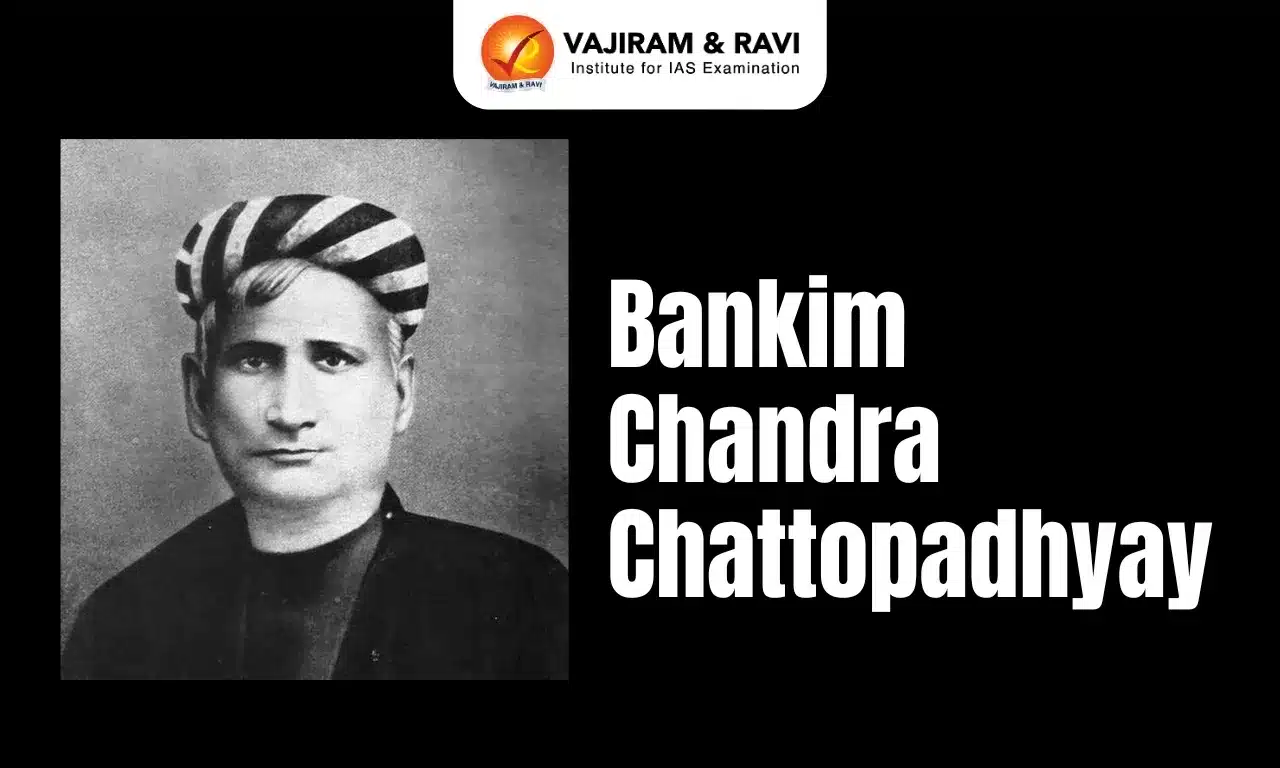
Bankim Chandra Chattopadhyay

Bankim Chandra Chattopadhyay

Bankim Chandra Chattopadhyay Latest News

The family of Bankim Chandra Chattopadhyay, the writer and composer of 'Vande Mataram', recently hailed the Prime Minister’s gesture to mark the 150 years of the country's national song.

About Bankim Chandra Chattopadhyay

  • Bankim Chandra Chattopadhyay, also known as Bankim Chandra Chatterjee, was one of the greatest novelists and poets of India. 
  • He is famous as the author of Vande Mataram, the national song of India.
  • He was born on June 27, 1838, in the village of Kantalpara in the 24 Paraganas District of Bengal.
  • Born into the family of a government official under the British rule of India, he was one of the first two graduates of the University of Calcutta and later obtained a degree in law.
  • He began his literary career as a writer of verse. He then turned to fiction. 
  • Durgeshnandini, his first Bengali romance, was published in 1865
  • His famous novels include Kapalkundala (1866), Mrinalini (1869), Vishbriksha (1873), Chandrasekhar (1877), Rajani (1877), Rajsimha (1881), and Devi Chaudhurani (1884). 
  • Bankim Chandra Chatterjee's most famous novel was Anand Math (1882). 
    • It was set in the background of the Sannyasi Rebellion in the late 18th century. 
    • Anand Math contained the song “Vande Mataram”, which was later adopted as the national song.
      • The patriotic song was written in Sanskrit.
      • In the year 1896, Gurudev Rabindranath Tagore sang this melodic poem for the first time at the Kolkata session of the Indian National Congress. 
      • It was officially adopted as the national song by the Constituent Assembly of India on 24th January 1950.
  • Bankim Chandra Chattopadhyay passed away on April 8, 1894.
  • As a distinguished novelist, poet, and essayist, his contributions significantly influenced the development of modern Bengali prose and the articulation of an emerging Indian nationalism.
  • He is often regarded as the “Sahitya Samrat” (Emperor of Literature) in Bengali literature.

Source: NDTV

Bankim Chandra Chattopadhyay FAQs

Q1: Who authored the national song of India, “Vande Mataram”?

Ans: Bankim Chandra Chattopadhyay

Q2: What was the first Bengali romance novel written by Bankim Chandra Chattopadhyay?

Ans: Durgeshnandini

Q3: Which novel by Bankim Chandra features the patriotic song “Vande Mataram”?

Ans: Anand Math (1882)

Q4: When was “Vande Mataram” adopted as the national song of India?

Ans: It was officially adopted as the national song by the Constituent Assembly of India on 24th January 1950.

Monroe Doctrine

Monroe Doctrine

Monroe Doctrine Latest News

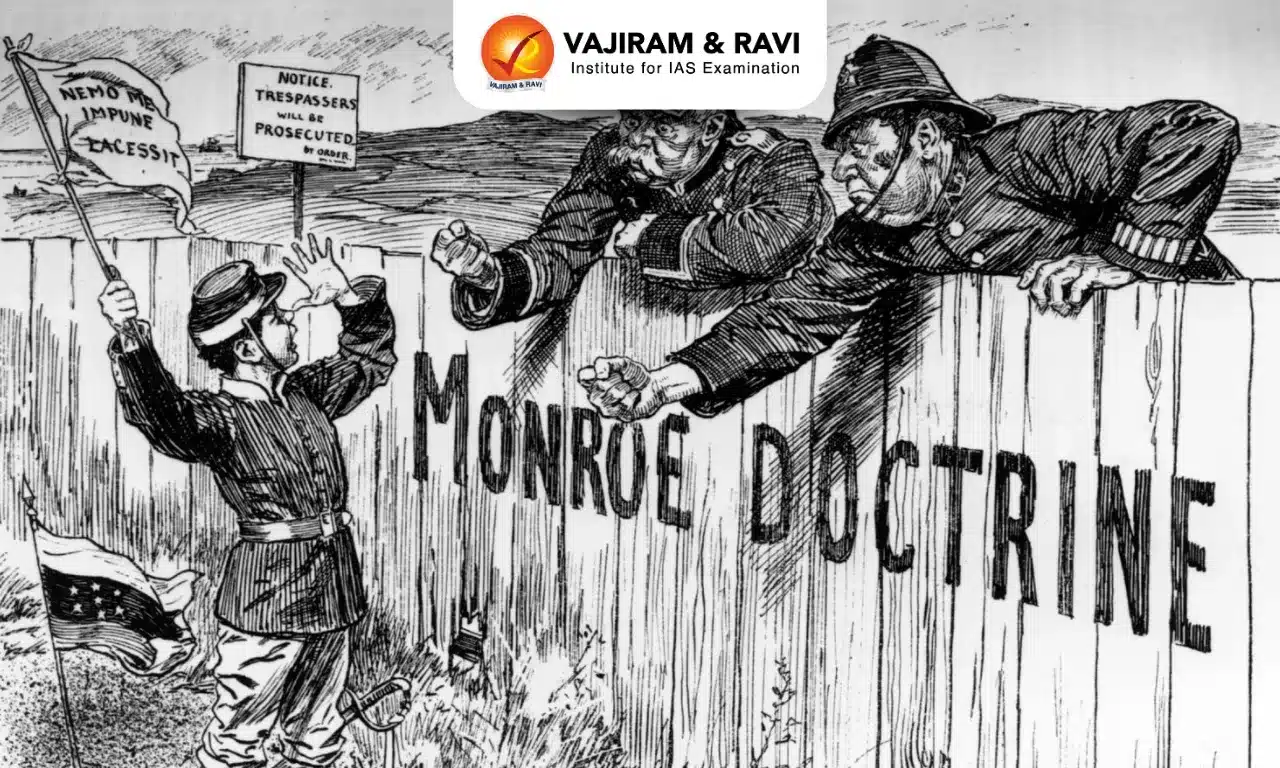
The US National Security Strategy, released recently, described Trump’s vision as one of “flexible realism” and argued that the U.S. should revive the 19th-century Monroe Doctrine, which declared the Western Hemisphere to be Washington’s zone of influence.

About Monroe Doctrine

  • The Monroe Doctrine, articulated by U.S. President James Monroe in 1823, is a significant U.S. foreign policy statement aimed at preventing European intervention in the Americas.
  • Primarily the work of Secretary of State John Quincy Adams, the Monroe Doctrine forbade European interference in the American hemisphere but also asserted U.S. neutrality in regard to future European conflicts.
  • The origins of the Monroe Doctrine stem from attempts by several European powers to reassert their influence in the Americas in the early 1820s. 
    • In North America, Russia had attempted to expand its influence in the Alaska territory, and in Central and South America, the U.S. government feared a Spanish colonial resurgence. 
    • Britain too was actively seeking a major role in the political and economic future of the Americas, and Adams feared a subservient role for the United States in an Anglo-American alliance.
  • The United States invoked the Monroe Doctrine to defend its increasingly imperialistic role in the Americas in the mid-19th century.
  • However, it was not until the Spanish-American War in 1898 that the United States declared war against a European power over its interference in the American hemisphere. 
  • The doctrine has had lasting impacts on U.S. relations with its southern neighbors, reflecting America's desire to assert its influence while advocating for independence and self-determination in the region.
  • The isolationist position of the Monroe Doctrine was also a cornerstone of U.S. foreign policy in the 19th century.
  • It took the two world wars of the 20th century to draw a hesitant America into its new role as a major global power.

Source: TP

Monroe Doctrine FAQs

Q1: What is the Monroe Doctrine?

Ans: It is a significant U.S. foreign policy statement aimed at preventing European intervention in the Americas.

Q2: The Monroe Doctrine was articulated in which year?

Ans: 1823

Q3: The Monroe Doctrine was announced by which U.S. President?

Ans: James Monroe

Q4: What does Monroe Doctrine primarily aims at?

Ans: It is aimed at preventing European intervention in the Americas.

Q5: What position did the Monroe Doctrine take regarding future European conflicts?

Ans: The U.S. would remain neutral.

UN Environment Assembly

UN Environment Assembly

UN Environment Assembly Latest News

Recently, the seventh UN Environment Assembly (UNEA-7) is taking place in Nairobi, Kenya.

About UN Environment Assembly

  • It is the world’s highest-level decision-making body on the environment.
  • Member Countries: It has the universal membership of all 193 UN Member States and the full involvement of major groups and stakeholders.
  • It gathers ministers of environment in Nairobi, Kenya every 2 years.
  • Background: UNEA was created in 2012, as an outcome of the UN Conference on Sustainable Development (Rio+20), held in Brazil.

Functions of UN Environment Assembly

  • It sets the global environmental agenda, provides overarching policy guidance, and defines policy responses to address emerging environmental challenges.
  • It undertakes policy review, dialogue and the exchange of experiences, sets the strategic guidance on the future direction of the UN Environment Programme (UNEP).
  • It fosters partnerships for achieving environmental goals and resource mobilization.
  • Organisational Structure: It consists of a President and 8 Vice Presidents (forming the UNEA Bureau)
  • Seventh UNEA session (2025) Theme: "Advancing sustainable solutions for a resilient planet"

Source: New Indian Express

UN Environment Assembly FAQs

Q1: Where is the UN Environment Assembly (UNEA) held?

Ans: Nairobi, Kenya

Q2: What is the theme of UNEA-7?

Ans: Advancing sustainable solutions for a resilient planet

Sudden Stratospheric Warming Event

Sudden Stratospheric Warming Event

Sudden Stratospheric Warming Event Latest News

Recently, a meteorologist warned of another Sudden Stratospheric Warming (SSW) event that could plunge temperatures below average across parts of the U.S. later this month.

About Sudden Stratospheric Warming Event

  • It refers to a rapid rise in stratospheric temperatures that weakens or distorts the polar vortex (a cold-air mass typically stabilized over the Arctic).

Occurrence of the Event

  • It begins with large-scale atmosphere waves (called Rossby waves) getting pushed higher into the atmosphere.
  • These waves can “break” (like waves in the ocean) on top of the polar vortex and weaken it. If waves are strong enough, the winds of the polar vortex can weaken so much that they can reverse from being westerly to easterly.
  • This leads to cold air descending and warming rapidly.
  • It can lead to a displacement or splitting of the polar vortex, so instead of cold air being locked above the polar region, it can push further south into the mid-latitudes.

What is the Polar Vortex?

  • It is a large area of low pressure and cold air surrounding both of the Earth’s poles. 
  • It extends from the tropopause (the dividing line between the stratosphere and troposphere) through the stratosphere and into the mesosphere (above 50 km).
  • It always exists near the poles, but weakens in summer and strengthens in winter.
  • Many times, during winter in the northern hemisphere, the polar vortex will expand, sending cold air southward with the jet stream.
  • Jet streams are relatively narrow bands of strong wind in the upper levels of the atmosphere, typically occurring around 30,000 feet (9,100 meters) in elevation.
  • This occurs fairly regularly during wintertime and is often associated with large outbreaks of Arctic air in the United States.
  • This is not confined to the United States. Portions of Europe and Asia also experience cold surges connected to the polar vortex.

 Source: Newsweek

Sudden Stratospheric Warming Event FAQs

Q1: What is Sudden Stratospheric Warming (SSW)?

Ans: A rapid warming of the stratosphere

Q2: What is the typical altitude range where SSW occurs?

Ans: 10-30 km

INS Gharial

INS Gharial

INS Gharial Latest News

The Indian Navy recently deployed INS Gharial and three other vessels as part of the ongoing Operation Sagar Bandhu for offering humanitarian assistance and relief to the cyclone-affected regions of Sri Lanka.

About INS Gharial

  • INS Gharial (L23) is a Magar-class amphibious warfare vessel of the Indian Navy.
  • It is the second indigenously built Landing Ship Tank (Large).
  • It was built by Hindustan Shipyard Limited and Garden Reach Shipbuilders and Engineers.
  • It is one of the largest ships of the Indian Navy.
  • It was commissioned on 14 Feb 1997 and is part of the Eastern Fleet under the Eastern Naval Command. 
  • It is capable of carrying two helicopters, one in the hangar and one on deck, 10 Vijayanta tanks in her underbelly, and four Landing Craft  Assault (LCA) slung aloft.
  • It is also armed with guns and rocket launchers, which are used to "soften up" a hostile beach before the tanks go in and the LCAs charge in with assault troops.

Source: TP

INS Gharial FAQs

Q1: What is INS Gharial?

Ans: It is a Magar-class amphibious warfare vessel of the Indian Navy.

Q2: When was INS Gharial commissioned into the Indian Navy?

Ans: It was commissioned on 14 Feb 1997.

Q3: INS Gharial is part of which fleet of the Indian Navy?

Ans: It is part of the Eastern Fleet under the Eastern Naval Command.

Article 39 of Indian Constitution, Interpretation, Importance

Article 39 of Indian Constitution

Article 39 comes under Part IV of the Constitution of India under the Directive Principles of State Policy. The article lays down the guidelines for the state to create policies for a just and equitable society. The goal is to provide social and economic justice to all the citizens of the country. Distribution of resources, economic equity and protection of workers and children all come under this article. In this article, we are going to cover all about Article 39 of the constitution. 

Article 39 of the Indian Constitution 

The Constitution of Indian states the following about Article 39: 

The state shall, in particular, direct its policy towards securing- 

  • that the citizens, men and women equally, have the right to an adequate means to livelihood
  • that the ownership and control of the material resources of the community are so distributed as best to sub serve the common good
  • that the operation of the economic system does not result in the concentration of wealth and means of production to the common detriment
  • that there is equal pay for equal work for both men and women
  • that the health and strength of workers, men and women, and the tender age of children are not abused and that citizens are not forced by economic necessity to enter avocations unsuited to their age or strength
  • that children are given opportunities and facilities to develop in a healthy manner and in conditions of freedom and dignity and that childhood and youth are protected against exploitation and against moral and material abandonment.

Article 39 of Indian Constitution Interpretation 

Article 39 of the Indian Constitution outlines important principles of policy that the State must try to follow. It includes six specific directives aimed at securing economic justice and equality. These are: 

  • Adequate Means of Livelihood (Article 39A): Article 39 emphasises that a state should make sure that all the citizens irrespective of their sex should have equal opportunity and access to sufficient means of livelihood. 
  • Distribution of Resources (Article 39b): The Article 39b of the Constitution of India, talks about the responsibility of the state to distribute resource and ownership of materials in a way that works for all and helps avoid the concentration of wealth. 
  • Article 39(c) emphasizes economic equity with a goal of aiming to prevent the concentration of wealth and means of production in a manner detrimental to the common good, thereby promoting social justice.
  • Article 39(d) tells the State to ensure equal pay for equal work for both men and women, reinforcing gender equality in employment.
  • Article 39(e) focuses on the protection of workers, stating that individuals—regardless of age or gender—should not be forced into employment that is harmful to their health or well-being.
  • Article 39(f) addresses child welfare, requiring the State to create conditions that ensure children grow up in a healthy and dignified environment, shielded from exploitation and neglect.
Also Check Related Articles
Article 295 of Indian Constitution Article 194 of Indian Constitution
Article 39 of Indian Constitution Article 191 of Indian Constitution
Article 20 of Indian Constitution Article 16 of Indian Constitution
Article 67 of Indian Constitution Article 40 of Indian Constitution
Article 78 of Indian Constitution

Article 39 of Indian Constitution FAQs

Q1: What is the Article 39 of the Constitution of India?

Ans: Article 39 directs the State to ensure economic justice and prevent wealth concentration by securing rights to adequate livelihood, equal pay, and child protection.

Q2: What is Article 39 of the UPSC?

Ans: For UPSC, Article 39 is part of the Directive Principles of State Policy (DPSP) and is crucial for understanding India's approach to socio-economic justice in governance.

Q3: What is Article 39b of the Constitution?

Ans: Article 39(b) ensures that the ownership and control of material resources are distributed to serve the common good.

Q4: Article 39 is of which part of the Constitution?

Ans: Article 39 is part of Part IV of the Constitution, which deals with the Directive Principles of State Policy.

Q5: What is the Article 40 of the Constitution?

Ans: Article 40 mandates the State to organize Village Panchayats and endow them with powers for self-governance.

Daily Editorial Analysis 9 December 2025

Daily Editorial Analysis

Democracy’s Paradox, The Chosen People of the State

Context

  • The question of what constitutes proof of citizenship lies at the centre of India’s democratic governance.
  • The Indian passport and electoral rolls are often viewed as indicators of belonging, yet neither document conclusively proves citizenship, as both can be forged.
  • This tension between evidence of status and the status of evidence frames the current debate around the Election Commission of India’s (ECI) Special Intensive Revision (SIR) of electoral rolls.
  • The controversy raises deeper questions about how states define and verify membership in a political community.

The Legal Dispute: Institutional Authority and Procedural Limits

  • Challenges to the ECI’s SIR rest on three key arguments. The ECI has no legal authority to determine citizenship, a power reserved for the Union Ministry of Home Affairs (MHA).
  • No law permits a nationwide, en masse SIR, and voter roll revisions are meant to be selective.
  • Finally, decisions on foreigner status belong to bodies constituted under the Foreigners Act, not the ECI.
  • The ECI argues that its constitutional duty to prepare accurate electoral rolls requires verifying an applicant’s citizenship, even if this does not amount to a formal citizenship determination.
  • The dispute unsettles a long-standing democratic presumption: that all residents are citizens unless proven otherwise.
  • With the burden shifting toward individuals, the nature of the state’s relationship to its people becomes central.

The Quest for a ‘Master Document’ and the Burden of Proof

  • India lacks a single document with the legal status of definitive proof of citizenship.
  • The Citizenship Act, 1955 and the Citizenship Rules, 2003 provide for a National Register of Citizens (NRC) and National Identity Cards, but these frameworks remain incomplete.
  • The National Population Register (NPR), which lists all residents, is intended to feed into the NRC, which includes only those who have proven their citizenship.
  • A critical principle governs this regime: when citizenship is questioned, the burden of proof rests on the individual, not the state.
  • Past exercises, such as the 2010 NPR and the 2008 Multipurpose National Identity Card pilot, reflect efforts to build comprehensive identification systems.
  • Political hesitation remains evident, particularly as the NRC disappeared from the 2024 election manifesto.
  • The interplay between policy ambition and political caution continues to shape India’s approach to documenting citizenship.

Evolving Conceptions of Indian Citizenship

  • India’s early citizenship framework leaned toward jus soli or birth-based citizenship.
  • Over time, elements of descent-based citizenship (jus sanguinis) grew stronger, introducing multiple caveats to citizenship by birth.
    • Those born before July 1, 1987 are citizens by birth without condition.
    • Between 1987 and 2004, one parent must be a citizen.
    • After December 3, 2004, one parent must be a citizen and the other must not be an illegal migrant.
  • The 2003 amendments introduced the category of illegal immigrant, excluding such persons and their children from birth-based citizenship.
  • The Citizenship (Amendment) Act, 2019 further altered the landscape by introducing a religion-based path to citizenship, marking a significant shift in the principles governing membership in the national community.

Who Determines Citizenship? The Administrative Paradox

  • A fundamental paradox sits at the heart of citizenship governance: while a democracy derives legitimacy from the people, the state controls the mechanisms that define who the people are.
  • In practice, citizenship determinations are made by frontline officials, clerks, constables, border agents, and local administrators, whose decisions shape political inclusion and exclusion.
  • Whether conducted under the ECI or the MHA, exercises such as SIR, NPR, or NRC rely on the same local bureaucracy.
  • Institutional location does not resolve the deeper contradiction, for the state retains authority to determine membership in the very polity that legitimises it.

Assam: A Case Study in Bureaucratised Citizenship

  • Assam offers the only example of a completed draft NRC, created under Section 6A following the Assam Accord.
  • The 2019 draft identified 19 lakh individuals as D-voters or doubtful citizens, based on their inability to establish lineage or residency beyond reasonable doubt.
  • Reliance on decades-old legacy documents placed immense burdens on individuals, and political reactions intensified when large numbers of excluded individuals were found to be Hindus.
  • Being marked a D-voter can result in loss of voting rights, proceedings before Foreigners Tribunals, and potential deportation.
  • Assam demonstrates the human and administrative complexity inherent in large-scale citizenship verification.

The Democratic Dilemma

  • Efforts to verify citizenship reveal a core democratic tension: a democracy presupposes that people create the state, yet the state decides who counts as the people.
  • With individuals bearing the burden of proof and the state exercising decisive authority, the balance between administrative control and democratic inclusion remains fragile.
  • Without resolving this paradox, initiatives such as SIR, NPR, or NRC will continue to shape anxieties over identity, belonging, and the meaning of citizenship in India.

Conclusion

  • India’s ongoing contestation over citizenship verification sits at the intersection of law, politics, and philosophy.
  • While administrative accuracy in electoral rolls is essential, the mechanisms used to determine citizenship must balance state interests with constitutional guarantees of fairness, transparency, and democratic inclusion.
  • The unresolved question remains: how can a democratic state verify its citizenry without undermining the very principle that the people precede and authorise the state?

Democracy’s Paradox, The Chosen People of the State FAQs

 Q1. Why is an Indian passport not considered conclusive proof of citizenship?
Ans. An Indian passport is not conclusive proof of citizenship because it can be obtained fraudulently.

Q2. What key principle governs citizenship verification in India?
Ans. The key principle is that the burden of proving citizenship lies on the individual.

Q3. Why does the Election Commission argue it can verify citizenship during SIR?
Ans. The Election Commission argues it can verify citizenship because it must ensure that only eligible citizens are included in electoral rolls.

Q4. What major shift occurred in India’s citizenship framework over time?
Ans. India’s citizenship framework shifted from a birth-based system toward one that increasingly emphasises ancestry and immigration status.

Q5. What consequence can individuals face when marked as “D-voters” in Assam?
Ans. Individuals marked as “D-voters” can lose voting rights and face proceedings before Foreigners Tribunals.

Source: The Hindu


The Real Story of the India-Russia summit

Context

  • The 23rd India–Russia Summit in New Delhi highlighted the complex geopolitical landscape India must navigate.
  • With the Ukraine war straining relations between India’s key partners—Russia on one side and the US and Europe on the other—New Delhi faces a particularly delicate diplomatic challenge.
  • Despite these opposing pressures, India has managed to maintain strategic autonomy, balancing ties with both camps.
  • Its calibrated approach has positioned it as a country showing the world how to operate amid deep global polarisation.

India–Russia Summit: Strategic Optics and Sensitive Timing

  • The warm, high-profile welcome extended to President Vladimir Putin carried deliberate diplomatic signalling.
  • For India, the message was one of confidence: reaffirming its long-standing partnership with Russia and removing ambiguity about the relationship at a time of global polarisation.
  • For Russia, it underscored India’s continued importance in its foreign policy calculus.
  • The timing of the summit was equally significant. With Russia holding a strong battlefield position, Ukraine facing potential defeat, and the U.S. largely disengaged, India’s vocal support for broader peace efforts aligns closely with Washington’s backing of the Trump-led initiative.
  • India and the U.S. are therefore converging on the peace process, even as Europe remains the main outlier.
  • India’s strategic challenge now lies in ensuring that this deepening Russia engagement does not erode the substantial diplomatic and economic gains it has made with European partners.

Key Pillars Strengthening India–Russia Relations

  • Programme 2030: Expanding Economic Cooperation

    • India and Russia adopted Programme 2030 to deepen strategic economic ties.
    • Key goals include:
      • Facilitating bilateral trade settlement in national currencies
      • Removing non-tariff barriers
      • Diversifying the trade basket
      • Boosting investments in non-energy sectors
    • Sectors like fertilizers, railways, pharmaceuticals, minerals, and critical raw materials are central to India’s growth, and Russia’s vast resources make it a natural partner.
    • Achieving $100 billion in trade by 2030 is considered feasible if these steps succeed.
  • Energy Security: The Core of the Partnership

    • India, as the world’s second-largest fossil fuel importer, sees affordable and reliable energy as a national security priority.
    • Russia’s unmatched energy reserves make it indispensable for India’s long-term energy future.
    • China has already secured dominant access to Russian resources, and U.S. companies are also seeking entry.
    • India risks losing strategic ground unless it strengthens its presence in Russia’s energy sector.
  • Emerging Strategic Sectors: Maritime, Arctic & Manpower Mobility

    • Maritime Connectivity - Chennai–Vladivostok Maritime Corridor; Northern Sea Route; Joint development in shipbuilding. These routes expand India’s access to Eurasian markets.
    • Arctic Cooperation - India welcomes Russia’s offer to train Indian seafarers for Arctic operations—an area of rising geopolitical and commercial significance.
    • Export of Indian Skilled Workers - A breakthrough labour mobility agreement will allow Indian skilled workers to fill shortages in Russia, especially in the Far East—driven by:
      • Russia’s demographic crisis
      • Loss of labour due to the Ukraine war
      • Declining Central Asian workforce
      • Russian unease over increased Chinese influence
      • Easier tourist visas complement this growing mobility framework.
    • Traditional Strengths: Defence, Space and Nuclear Collaboration
      • India–Russia ties have deep roots in:
        • Defence manufacturing and technology
        • Space cooperation
        • Nuclear energy projects
      • Russia remains a trusted technology supplier with fewer restrictions than Western partners.
      • Example:
        • BrahMos missile — a pillar of India’s strategic capability
        • S-400 system — crucial during Operation Sindoor
        • Increasing levels of localisation, technology transfer, and co-production
      • India will continue to rely on Russia to maintain legacy military platforms while pushing domestic indigenisation.

India–Russia Ties in Perspective: A Relationship Re-Engineered

  • The key outcome of the summit lies not in the announcements but in the strategic recalibration of the India–Russia partnership.
  • Both nations are consciously reshaping their ties to keep pace with global shifts, especially the evolving power dynamics between the U.S. and China — a factor that increasingly pulls India and Russia closer despite external pressures.
  • On Europe, India recognises that lasting peace in Ukraine will require direct engagement between Europe and Russia, not mediation through New Delhi.
  • India’s stance is rooted in historical lessons — knowing when to emulate examples of successful diplomacy and when to avoid past mistakes.
  • Ultimately, India sees itself as a trusted partner to both sides, capable of maintaining balanced relations even in a deeply polarised world.

The Real Story of the India-Russia summit FAQs

Q1. Why was the India–Russia summit strategically significant for both sides?

Ans. The summit reaffirmed India’s commitment to a long-standing partnership with Russia while signalling strategic clarity amid global polarisation, particularly the Ukraine conflict and shifting U.S.–Russia dynamics.

Q2. What is Programme 2030, and why is it important?

Ans. Programme 2030 outlines plans to expand economic cooperation, promote national currency trade, diversify sectors, and remove trade barriers to help achieve a $100-billion bilateral trade target by 2030.

Q3. Why is energy cooperation a central pillar of India–Russia relations?

Ans. India’s massive fossil fuel demand and Russia’s vast energy reserves create a strategic fit, making energy security a core driver of future bilateral engagement.

Q4. What new areas of collaboration are emerging between the two countries?

Ans. Key emerging areas include maritime connectivity, Arctic cooperation, shipbuilding, and labour mobility, with Russia seeking skilled Indian workers due to demographic shifts and labour shortages.

Q5. How does India aim to balance ties with Russia, the U.S., and Europe?

Ans. India seeks strategic autonomy, supporting peace efforts while avoiding actions that alienate Western partners, recognising that lasting peace requires direct Europe–Russia engagement.

Source: TH

Daily Editorial Analysis 9 December 2025 FAQs

Q1: What is editorial analysis?

Ans: Editorial analysis is the critical examination and interpretation of newspaper editorials to extract key insights, arguments, and perspectives relevant to UPSC preparation.

Q2: What is an editorial analyst?

Ans: An editorial analyst is someone who studies and breaks down editorials to highlight their relevance, structure, and usefulness for competitive exams like the UPSC.

Q3: What is an editorial for UPSC?

Ans: For UPSC, an editorial refers to opinion-based articles in reputed newspapers that provide analysis on current affairs, governance, policy, and socio-economic issues.

Q4: What are the sources of UPSC Editorial Analysis?

Ans: Key sources include editorials from The Hindu and Indian Express.

Q5: Can Editorial Analysis help in Mains Answer Writing?

Ans: Yes, editorial analysis enhances content quality, analytical depth, and structure in Mains answer writing.

Key Facts About Japan

Key Facts about Japan

Japan Latest News

Recently, a major earthquake rocked Japan's northern coast and also the country's meteorological agency recorded several tsunami waves.

About Japan

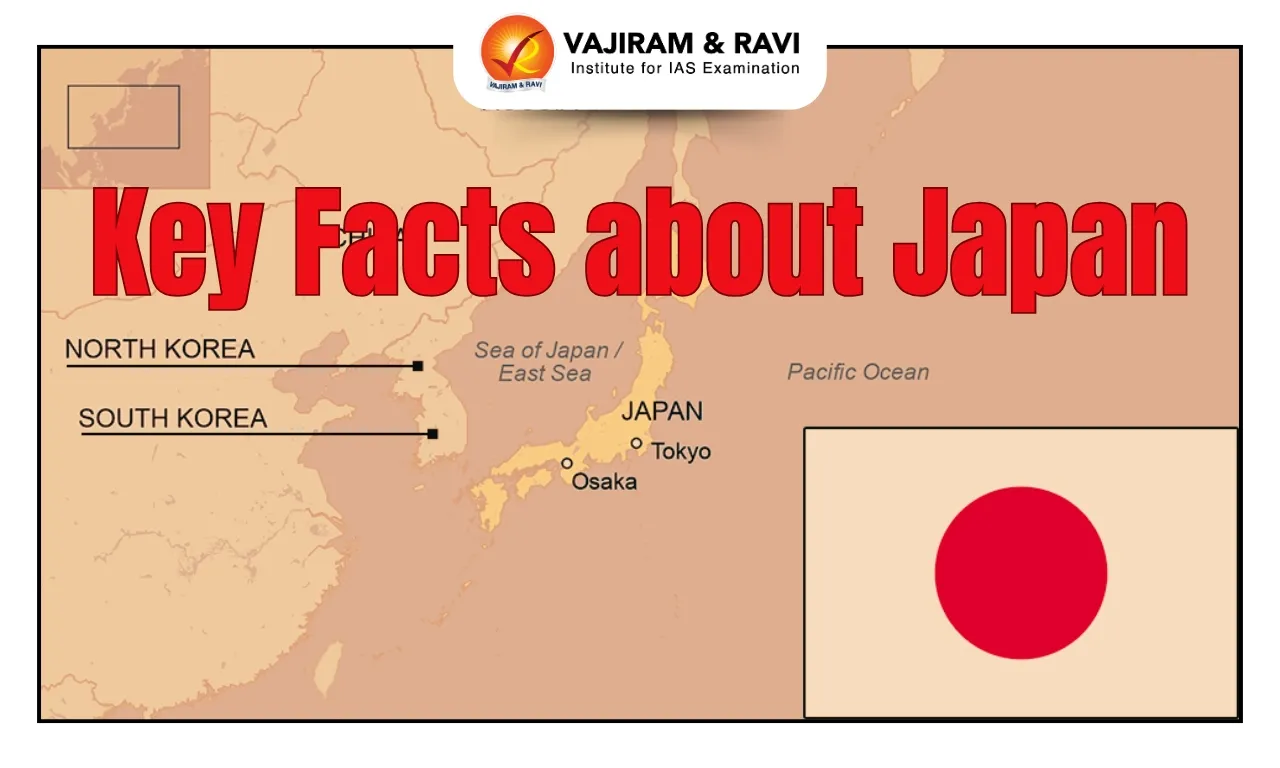
  • Location: It is an island nation in East Asia, situated in the Northwestern Pacific Ocean.
  • Maritime borders: It is bordered by the Pacific Ocean (East), Sea of Okhotsk (North), Sea of Japan (West East) and East China Sea (Southwest).
  • Political Structure: Parliamentary government under a constitutional monarchy.
  • Capital City: Tokyo, located in east-central Honshu.

Geographical Features of Japan

  • It comprises a chain of islands stretching ~1,500 miles in a northeast–southwest arc.
  • Main Islands (north to south): Hokkaido, Honshu, Shikoku, and Kyushu.
  • Terrain: Over 80% mountainous, with rugged terrain.
  • Volcanic activity: It is located on the Pacific Ring of Fire – a major zone of earthquakes and active volcanoes.
  • Highest peak: Mount Fuji (3,776 m), which is a stratovolcano.
  • Major mountain ranges: Japanese Alps.
  • Major rivers: Shinano River (longest), Tone River, Kiso River.
  • Climate: It ranges from subarctic in the north to humid subtropical in the south.
  • It is often disturbed by earthquakes, tsunamis, and volcanic eruptions due to tectonic activity.

Source: TH

Japan FAQs

Q1: What is the capital of Japan?

Ans: Tokyo

Q2: Which is the famous Japanese festival?

Ans: Cherry Blossom Festival

150 Years of Vande Mataram: History, Evolution, and National Significance Explained

Vande Mataram

Vande Mataram Latest News

  • Parliament held a special discussion to mark 150 years of Vande Mataram, a song deeply woven into India’s freedom movement yet continuously debated for its religious imagery and political interpretations. Prime Minister Narendra Modi opened the Lok Sabha debate on this.
  • The commemoration comes amid fresh political contention over the song’s origins, symbolism, and the decisions made by national leaders regarding its usage. 
  • Once a patriotic hymn in Bankimchandra Chattopadhyay’s novel, Vande Mataram evolved into a rallying cry for nationalism, though concerns over its later stanzas led the Congress in 1937 to officially adopt only the first two.
  • In the Constituent Assembly, the song was ultimately accorded “equal honour and status” with the National Anthem.

Origins of Vande Mataram

  • According to a historical account cited by the PIB, Bankimchandra Chattopadhyay composed Vande Mataram around 1875. 
  • The song gained prominence when his novel Anandamath was serialized in Bangadarshan magazine in 1881.
  • Sri Aurobindo wrote in Bande Mataram (1907) that the hymn captured the spirit of patriotic devotion.

Literary Context: Anandamath

  • Anandamath tells the story of the Santanas, ascetic warriors committed to liberating the motherland from oppression. 
  • Their loyalty is to Bharat Mata, represented as a personified motherland rather than a religious deity.

Symbolism of the Three Mothers

  • In the Santanas’ temple, three forms of the Mother are depicted:
    • The Mother That Was – powerful and magnificent
    • The Mother That Is – weakened and suffering
    • The Mother That Will Be – rejuvenated and triumphant
  • These images symbolised India’s past glory, present subjugation, and envisioned future resurgence.

From song to slogan: Birth of a nationalist cry

  • By the early 20th century, Vande Mataram transformed from a literary hymn into one of the most powerful rallying cries of India’s nationalist movement.

Central Role in the Swadeshi and Anti-Partition Movement

  • After Lord Curzon’s 1905 partition of Bengal, the song became the emotional and political heartbeat of mass resistance.
  • It energised:
    • Boycott campaigns
    • Protest marches
    • Newspapers and political groups adopting its name
  • A historic moment came in 1906 at Barisal, where over 10,000 Hindus and Muslims marched together shouting Vande Mataram, demonstrating its early inclusive appeal.
  • Key leaders who popularised it included:
    • Rabindranath Tagore
    • Bipin Chandra Pal
    • Sri Aurobindo, whose writings elevated the phrase into a spiritual and political call for self-rule.

Colonial Repression Against the Slogan

  • Worried by its ability to mobilise masses, the British authorities attempted to suppress it by:
    • Fining students
    • Conducting police lathi-charges
    • Banning public marches
    • Threatening expulsion from schools and colleges
  • Across Bengal and the Bombay Presidency, chanting Vande Mataram became an act of bold nationalist defiance.

Vande Mataram on the Global Stage

  • In 1907, Madam Bhikaji Cama unfurled the first Indian tricolour at Stuttgart, with Vande Mataram written across it — marking its symbolic arrival on the international platform.

The song and the Indian National Congress

  • The Indian National Congress not only appreciated Vande Mataram culturally but also adopted it formally in its national ceremonies.

1896: Tagore’s Iconic Rendition

  • At the Calcutta Congress session, Rabindranath Tagore sang Vande Mataram, giving the song national prominence and embedding it in the Congress’s cultural identity.

1905: Formal Adoption During the Swadeshi Movement

  • In Varanasi, the Congress formally adopted Vande Mataram for all-India events.
  • This came at the height of the anti-partition protests, when the song had already become the anthem of political awakening throughout the country.

1937: Congress Working Committee Removes Later Stanzas

  • By the 1930s, debates over the song’s Hindu goddess imagery became more pronounced.
  • To maintain a broad, inclusive national movement, the Congress Working Committee (CWC) decided in 1937 to use only the first two stanzas, which were considered free of sectarian symbolism.
  • Muslim leaders had objected to the later stanzas, arguing they evoked explicitly religious imagery inappropriate for a national movement meant to represent all communities.

Constituent Assembly’s Resolution: Equal Status for Vande Mataram (1950)

  • In 1950, the Constituent Assembly faced no conflict between Jana Gana Mana and Vande Mataram when deciding national symbols.
  • On January 24, 1950, Assembly President Dr. Rajendra Prasad formally declared:
    • Jana Gana Mana would be the National Anthem.
    • Vande Mataram, due to its historic significance in the freedom struggle, would receive equal honour and status.
  • The announcement was met with applause and no objections from any member.
  • This dual recognition balanced inclusivity with historical reverence—preserving national unity through the anthem while enshrining Vande Mataram as a pillar of India’s independence movement.

Source: ToI | IE | IT

Vande Mataram FAQs

Q1: What is the historical origin of Vande Mataram?

Ans: Bankimchandra Chattopadhyay composed Vande Mataram around 1875, later popularised through his novel Anandamath and embraced as a patriotic hymn during early nationalist movements.

Q2: How did Vande Mataram become a nationalist slogan?

Ans: During the Swadeshi movement after Bengal’s 1905 partition, it became a mass rallying cry, uniting communities in protest marches and inspiring millions across India.

Q3: Why did Congress adopt only the first two stanzas in 1937?

Ans: To maintain inclusivity, Congress restricted usage to two stanzas free of goddess imagery, addressing concerns from Muslim leaders over religious overtones.

Q4: What was the Constituent Assembly’s decision on Vande Mataram?

Ans: On January 24, 1950, the Assembly accorded Vande Mataram equal honour and status alongside the National Anthem, acknowledging its role in the freedom struggle.

Q5: Why does Vande Mataram remain debated today?

Ans: Its historical importance is undisputed, but debates continue regarding religious imagery in later stanzas and its suitability as an inclusive national symbol.

NTA Under Scrutiny: House Panel Flags Major Exam Lapses and Calls for Reform

NTA

NTA Latest News

  • A Parliamentary Standing Committee has sharply criticised the National Testing Agency (NTA), stating that it “has not inspired much confidence” and must urgently improve its functioning.
  • The panel highlighted repeated delays in exam results, especially CUET, and noted that despite collecting a surplus of ₹448 crore over six years, the NTA has not built adequate in-house capacity to conduct tests independently. 
  • The committee urged the agency to strengthen its systems, infrastructure, and accountability mechanisms to ensure reliable and timely examinations.

About National Testing Agency

  • The National Testing Agency (NTA) was established in 2017 as an autonomous, self-sustaining organisation under the Education Ministry (formerly HRD Ministry).
  • It is registered under the Societies Registration Act, 1860 and comes under the RTI Act.
  • Before its creation, UGC, CBSE, and central universities like DU and JNU conducted their own entrance exams.

Origins: When Was NTA First Envisioned

  • The idea for a national exam-conducting body dates back to the 1992 Programme of Action under NEP 1986.
  • In 2010, a committee of IIT directors recommended establishing such an agency through legislation, inspired by the Educational Testing Service (ETS), USA.
  • The government formally announced NTA in 2017, and the Cabinet approved its creation soon after.

Exams Conducted by NTA

  • NTA conducts India’s major entrance examinations, including:
    • Top Undergraduate Entrance Exams
      • JEE Main – Engineering admissions
      • NEET-UG – Medical admissions
      • CUET-UG – Admissions to undergraduate programmes in central universities
      • Over 50 lakh candidates appear for these three exams annually.
    • Other Major Exams
      • CUET-PG – Postgraduate admissions
      • UGC-NET – Eligibility for assistant professor, JRF, and PhD
      • CSIR UGC-NET – PhD admission in science disciplines
      • CMAT, Hotel Management JEE, GPATEntrance exams for DU, JNU, IIFT, ICAR, and others

House Panel Flags Serious Concerns Over NTA’s Functioning

  • The Parliamentary Standing Committee on Education has sharply criticised the National Testing Agency (NTA), stating that it has “not inspired much confidence” and must urgently improve its performance. 
  • The panel noted chronic delays, errors, and administrative lapses in major national examinations.

Repeated Delays and Exam Irregularities

  • The committee observed that NTA delayed CUET results for multiple years, disrupting university admissions and academic calendars.
  • Out of 14 exams conducted in 2024, at least five faced major issues:
    • UGC-NET, CSIR-NET, NEET-PG were postponed
    • NEET-UG faced paper leaks
    • CUET results were delayed
    • JEE Main 2025 had 12 incorrect questions withdrawn after answer key errors
  • The panel warned that such incidents erode students’ trust in the testing system.

NTA’s Financial Surplus Should Be Used for Capacity Building

  • NTA collected ₹3,512.98 crore in six years and spent ₹3,064.77 crore, leaving a surplus of ₹448 crore.
  • The committee recommended that this money be used to:
    • Build in-house capability to conduct exams independently
    • Strengthen regulatory oversight of outsourced vendors

Preference for Pen-and-Paper Exams

  • Citing CBSE and UPSC’s decades-long track record, the panel expressed support for pen-and-paper exams, noting they have been “leak-proof for several years” — implying computer-based testing may be more vulnerable.

Recommendation to Recognise Sonam Wangchuk’s Institute

  • The committee encouraged the UGC to evaluate Sonam Wangchuk’s Himalayan Institute of Alternatives, Ladakh, noting its innovative model and potential for replication across India.

Observation Regarding UGC

  • Draft UGC Regulations 2025 
    • Opposition fears they increase the Chancellor/Visitor’s control over Vice-Chancellor appointments.
    • Committee recommended detailed discussions with CABE (Central Advisory Board of Education) before finalising rules.
  • UGC Leadership Vacuum
    • The UGC Chairperson post has remained vacant since April 2025
    • Committee urges urgent appointment
  • UGC Equity Regulations 2025
    • Panel noted delays and recommended:
    • Inclusion of OBC harassment under caste-based discrimination
    • Addition of disability as a discrimination axis
    • Clear categorisation of discriminatory acts to avoid subjective interpretation

Source: IE | TH | ToI

NTA FAQs

Q1: Why did the House Committee criticise the NTA?

Ans: The committee cited repeated exam delays, paper leaks, answer key errors, and mismanagement, concluding that NTA has “not inspired much confidence” in recent years.

Q2: What financial recommendation did the panel make to NTA?

Ans: It urged the NTA to use its ₹448-crore surplus to build in-house testing capability and improve vendor oversight for more reliable exam administration.

Q3: Which major exams faced issues under NTA recently?

Ans: UGC-NET, CSIR-NET and NEET-PG were postponed, NEET-UG saw paper leaks, and CUET results were delayed; JEE Main had errors needing question withdrawal.

Q4: What reforms were suggested regarding UGC regulations?

Ans: The panel advised wider consultations via CABE, urgent appointment of a UGC Chairperson, and clearer anti-discrimination provisions including OBC and disability inclusion.

Q5: Why did the committee highlight pen-and-paper exams?

Ans: It argued that CBSE and UPSC paper-based exams have remained leak-proof for years, suggesting greater reliability compared to computer-based testing vulnerabilities.

Neurotechnology – Opportunities, Challenges and Global Context

Neurotechnology

Neurotechnology Latest News

  • A recent report discusses how neurotechnology, particularly Brain-Computer Interfaces (BCIs), is emerging as a frontier domain. 

Understanding Neurotechnology: A New Technological Frontier

  • Neurotechnology refers to the use of engineered tools that can record, monitor, or influence neural activity
  • The field sits at the convergence of neuroscience, Artificial Intelligence, engineering, and computing, and is rapidly redefining how humans interact with machines. 
  • At the core is the Brain-Computer Interface, a system that decodes neural signals and translates them into digital actions, enabling users to control prosthetics, wheelchairs, computers or even robotic limbs.
  • Neurotechnology is evolving across two broad areas:
    • Diagnostic and Neuroscience Research Tools
      • Devices that map brain activity to study neurological disorders, cognitive function, or behavioural patterns.
    • Therapeutic and Assistive Technologies
      • Systems enabling paralysed patients to move prosthetics, aiding stroke rehabilitation, and stimulating targeted brain circuits for conditions such as Parkinson’s disease, depression, or epilepsy.
  • Some experimental work globally has gone even further, such as lab experiments connecting the brains of mice to exchange simple information, underlining both the potential and the ethical complexity of the field.

Significance of Neurotechnology for India

  • India faces a growing neurological disease burden, with the share of non-communicable and injury-related neurological disorders rising between 1990 and 2019, and stroke emerging as the single largest contributor. 
  • Key reasons India needs neurotechnology
    • High disease burden: Millions live with paralysis, spinal cord injuries, Parkinson’s disease, or depression, conditions where BCIs and neural stimulation therapies could be transformative.
    • Mental health needs: Targeted stimulation could reduce long-term reliance on psychotropic medication.
    • Economic & innovation potential: Neurotechnology sits at the intersection of biotech, semiconductors, and AI, three sectors where India is actively expanding capabilities.
    • Strategic advantage: Early investments could position India as a global hub similar to how it scaled IT and pharmaceuticals.

India’s Emerging Strengths in Neurotechnology

  • Academic Contributions
    • IIT Kanpur recently unveiled a BCI-based robotic hand, aiding stroke rehabilitation.
    • The National Brain Research Centre (NBRC), Manesar, and the Brain Research Centre at IISc Bengaluru are serving as major neuroscience research nodes.
  • Industry and Start-up Landscape
    • The start-up Dognosis is using neurotechnology to study brain signals in trained dogs, hoping to apply scent-recognition neural patterns toward early human cancer detection, a novel application highlighted in the report.
  • These developments reflect a budding ecosystem that can be strengthened with policy, funding, and industry collaboration.

Global Developments and Their Implications for India

  • United States
    • The BRAIN Initiative, launched in 2013, is one of the strongest global programmes. 
    • Neuralink, in 2024, received FDA approval for human trials and has demonstrated early restoration of prosthetic-driven motor movement in paralysed individuals. 
  • China
    • The China Brain Project (2016-2030) focuses on cognition research, brain-inspired AI, and treating neurological disorders.
  • Europe & Latin America
    • The EU and Chile are pioneering neurorights legislation, recognising the potential risks of brain-data exploitation and autonomy loss.
  • For India, these trends underscore the need to develop both technological capacity and an ethical, regulatory architecture suited to its social and economic context.

Regulatory and Ethical Challenges for India

  • Without adequate regulation, neurotechnology could bring risks such as:
    • Privacy violations (brain data is the most intimate data known)
    • Manipulation of neural activity
    • Misuse for surveillance or military advantage
    • Inequitable access, worsening health disparities
  • The study stresses the importance of:
    • Public engagement to understand societal concerns
    • Tailored regulatory pathways depending on whether BCIs are diagnostic, therapeutic, or enhancement-oriented
    • Ethics frameworks ensuring user autonomy and data consent
    • A specialised regulatory pathway that evaluates BCIs on both technical safety and ethical dimensions is essential for responsible innovation.

Source: TH

Neurotechnology FAQs

Q1: What is neurotechnology?

Ans: Neurotechnology refers to tools that record, monitor, or influence brain activity to diagnose, treat, or augment human capabilities.

Q2: What is a Brain-Computer Interface (BCI)?

Ans: A BCI is a system that decodes brain signals into digital commands to control external devices.

Q3: Why is neurotechnology important for India?

Ans: India faces a high neurological disease burden, making BCIs crucial for rehabilitation and mental health solutions.

Q4: Which Indian institutes are leading neurotechnology research?

Ans: IIT Kanpur, NBRC Manesar, and IISc Bengaluru are major contributors.

Q5: What regulatory challenge does India face in this field?

Ans: India must create tailored, ethical regulatory pathways to govern BCIs and protect neural data.

India International Science Festival

India International Science Festival

India International Science Festival Latest News

The 11th edition of India International Science Festival is being held in Panchkula, Haryana. 

About India International Science Festival

  • It was launched in 2015.
  • IISF aims to bring together people and the scientific community both nationally and internationally to collaborate, interact, and experience the joy of doing science for the wellbeing of India and humanity, guided by the spirit of swadeshi.
  • Mission of IISF: Bridging traditional knowledge systems with modern scientific research thereby strengthening the link between India’s indigenous knowledge heritage and contemporary scientific inquiry.

Key Facts about India International Science Festival 2025

  • It is  organised by the Ministry of Earth Sciences (MoES) and coordinated by Indian Institute of Tropical Meteorology (IITM) Pune.
  • The theme of India International Science Festival (IISF) 2025:  “Vigyan Se Samruddhi: for Aatmanirbhar Bharat”.
  • The event will feature more than 150 technical and thematic sessions across science, technology and innovation.
  •  IISF 2025 will focus on five broad themes
    • Science, Technology and Ecology of North-West India and the Himalayan Region;
    • Science for Society and Education;
    • Atmanirbhar Bharat through Science and Technology;
    • Biotechnology and Bio-economy; and
    • Integration of Traditional Knowledge with Modern Science.

Source: PIB

India International Science Festival FAQs

Q1: What is the primary objective of the India International Science Festival (IISF)?

Ans: To celebrate science and technology

Q2: Where was the 11th India International Science Festival (IISF) 2025 held?

Ans: Panchkula

National Mission on Edible Oils

National Mission on Edible Oils

National Mission on Edible Oils Latest News

The National Mission on Edible Oils (NMEO) embodies India’s commitment to realizing the vision of Atmanirbhar Bharat by transforming the edible oil sector from an import-dependent to a self-reliant one. 

About National Mission on Edible Oils

  • It aims to strengthen the country’s oilseed ecosystem and achieve Atmanirbharta in edible oil production.
  • Targets of the mission
    • It targets to increase the area coverage from 29 million ha (2022-23) to 33 million ha, primary oilseed production from 39 million tonnes (2022-23) to 69.7 million tonnes, and yield from 1,353 kg/ha (2022-23) to 2,112 kg/ha by 2030-31.
    • This mission targets domestic edible oil production at 25.45 million tonnes by 2030-31.
    • The Mission also seeks to expand oilseed cultivation by an additional 40 lakh hectares by targeting rice and potato fallow lands.
  • It has two-pronged approach which is as follows

National Mission on Edible Oils-Oil Palm

  • It is focused on expanding oil palm cultivation and increasing domestic crude palm oil output.
  • It was approved in 2021, as a Centrally Sponsored Scheme, with the aim to enhance the edible oilseeds production and oils availability in the country by area expansion and increasing Crude Palm Oil (CPO) production.
  • It focuses on increasing production of seedlings by establishment of seed garden, and nurseries of oil palm in order to assure domestic availability of seedlings as per target fixed under NMEO-OP.
  • Targets: To bring 6.5 lakh hectares under oil palm cultivation by 2025–26 and increase crude palm oil production to 28 lakh tonnes by 2029–30.
  • Implementation: The Department of Agriculture & Farmers Welfare (DA&FW) serves as the nodal central authority.

National Mission on Edible Oils– Oilseeds

  • It is aimed at improving productivity, seed quality, processing, and market linkages for traditional oilseed crops.
  • Target:  To increase oilseed production from 39 to 69.7 million tonnes by 2030–31 through cluster-based interventions and improved seed systems.
  • It was approved in 2024, for a seven-year period, from 2024-25 to 2030-31.
  • Focus: Increasing production of key primary oilseed crops such as Rapeseed-Mustard, Groundnut, Soybean, Sunflower, Sesamum, Safflower, Niger, Linseed and Castor.
  • It also focuses on increasing collection and extraction efficiency from secondary sources like cottonseed, coconut, rice bran as well as Tree-Borne Oilseeds (TBOs).
  • Implementation: It will be implemented in all States/UTs with the funding pattern of 60:40 in case of general States, Delhi & Puducherry and 90:10 in case of North-Eastern States and hill States, and 100% funding for UTs and Central Agencies.

Source: PIB

National Mission on Edible Oils FAQs

Q1: What is the primary objective of the National Mission on Edible Oils (NMEO)?

Ans: To achieve self-sufficiency in edible oil production

Q2: What is the target for oilseed production under NMEO by 2030-31?

Ans: 69.7 million tonnes

C-130J Super Hercules

C-130J Super Hercules

C-130J Super Hercules Latest News

A new defence Maintenance, Repair, and Overhaul (MRO) facility to support the C-130J Super Hercules aircraft will be established in Bengaluru.

About C-130J Super Hercules

  • It is a four-engine turboprop military transport aircraft.
  • It was developed by Lockheed Martin, a US security and aerospace company.
  • It is the US Air Force’s principal tactical cargo and personnel transport aircraft.
  • It is the current variant of the C-130 Hercules and is the airlifter of choice for 26 operators in 22 nations.
  • The largest operators are the US Air Force, US Marine Corps, Australia, Canada, India, Italy, and the United Kingdom.
  • The Indian Air Force (IAF) currently operates 12 C-130J Super Hercules.

C-130J Super Hercules Features

  • The aircraft is capable of operating from rough, dirt strips and is the prime transport for airdropping troops and equipment into hostile areas. 
  • It has reduced crew requirements. A minimal crew of three men is required to operate this aircraft, including two pilots and one loadmaster.
  • It is powered by four Rolls-Royce AE 2100D3 turboprop engines.
  • It has digital avionics, including Head-Up Display (HUD) for each pilot. 
  • Range: 6,852 km (no payload)
  • Speed: 644 km/hr
  • Endurance: 20+ hours
  • It is capable of short takeoffs and landings from unprepared runways.
  • It has a payload capacity of 19 tons.
  • It can accommodate a wide variety of oversized cargo, including everything from utility helicopters and six-wheeled armored vehicles to standard palletized cargo and military personnel.
  • Equipped with an Infrared Detection Set, the aircraft can perform precision low-level flying, airdrops, and landing in blackout conditions.

Source: TH

C-130J Super Hercules FAQs

Q1: The C-130J Super Hercules is primarily what type of aircraft?

Ans: Military transport aircraft.

Q2: The C-130J Super Hercules was developed by which country?

Ans: United States

Q3: The C-130J Super Hercules is powered by which engines?

Ans: It is powered by four Rolls-Royce AE 2100D3 turboprop engines.

Q4: What is the C-130J Super Hercules?

Ans: 6,852 km (no payload)

Bluetongue Virus (BTV)

Bluetongue Virus

Bluetongue Virus Latest News

More suspected cases of bluetongue virus (BTV) have been recently detected in Northern Ireland.

About Bluetongue Virus

  • It is responsible for causing the severe haemorrhagic disease, bluetongue (BT).
    • It is an infectious, non-contagious, vector-borne disease.
    • It can infect domestic ruminants, including cattle, sheep, and goats, along with wild animals such as buffalo, deer, antelope, and camels
    • Of the domestic species, sheep are the most severely affected. 
  • BTV is present in all continents except Antarctica. 
  • Transmission:
    • BTV is predominantly spread between ruminants through the bites of infected Culicoides midges, tiny blood-feeding insects that can be found in large numbers on most farms. 
    • Some BTV strains can be transferred from a ruminant mother to her fetus during pregnancy.
  • Can the BTV Spread to Humans? 
    • No, BTV cannot infect people. 
    • There are no food safety issues, and meat and dairy products are safe to consume.
  • Clinical signs associated with bluetongue disease are usually only seen in sheep (and sometimes deer), and it can be fatal. Clinical Signs Include:
    • Fever (40°C to 42°C)
    • Swelling of the lips, tongue, and head
    • Nasal discharge
    • Lameness
    • Reddening around the coronary band (top of the hoof).
  • Some animals may show signs of a swollen, bluish-coloured tongue (hence the name ‘bluetongue’). 
    • This will not always be seen and should not be relied upon to diagnose bluetongue disease.
  • BT can result in high rates of morbidity and even mortality in flocks and herds and can affect production (e.g. milk yields) and trade.
  • Treatment:
    • There is no effective treatment for bluetongue. 
    • Vaccines are available for certain types of the disease and are used in Africa, Asia, and parts of Europe.

Source: BBC

Bluetongue Virus FAQs

Q1: Bluetongue Virus (BTV) causes which type of disease in animals?

Ans: Severe haemorrhagic disease.

Q2: Which domestic species is most severely affected by Bluetongue Virus?

Ans: Sheep

Q3: What is the primary vector responsible for transmitting Bluetongue Virus?

Ans: It is predominantly spread between ruminants through the bites of infected Culicoides midges, tiny blood-feeding insects

Q4: Can Bluetongue Virus infect humans?

Ans: No, humans cannot be infected.

Q5: What is the current treatment for Bluetongue Virus in animals?

Ans: There is no effective treatment for bluetongue but vaccines are available for certain types of the disease.

International Anti-Corruption Day 2025, Theme, Objectives, Laws in India

International Anti-Corruption Day 2025

International Anti-Corruption Day 2025 is observed on December 9 to raise awareness about the harmful effects of corruption. It aims to promote transparency, integrity, and accountability in governments and organizations. The day encourages citizens to participate in anti-corruption efforts and report unethical practices. It is celebrated worldwide through campaigns, seminars, and public initiatives.

The 11th session of the Conference of the States Parties to the UN Convention against Corruption (UN Anti-Corruption Conference) is scheduled to be held in Doha, Qatar, from 15 to 19 December 2025.

International Anti-Corruption Day 2025 Theme

The International Anti-Corruption Day 2025 Theme “Uniting with Youth Against Corruption: Shaping Tomorrow's Integrity” highlights the vital role of young people in building a transparent and accountable future. It encourages collective action, empowering youth to stand against corruption in all forms. 

International Anti-Corruption Day 2025 Objectives

The main objectives of International Anti-Corruption Day 2025 are:

  1. Raise Awareness: Educate the public about the negative impact of corruption on society and the economy.
  2. Promote Integrity: Encourage ethical behavior in governance, businesses, and communities.
  3. Strengthen Legal Frameworks: Support the implementation of anti-corruption laws and conventions.
  4. Foster Transparency: Enhance openness in decision-making and financial transactions.
  5. Encourage Citizen Engagement: Motivate individuals to report corruption and participate in anti-corruption initiatives.
  6. Support Global Cooperation: Facilitate international collaboration to tackle corruption across borders.

Anti-Corruption Laws in India

India has a strong legal framework to combat corruption and promote transparency in governance. These laws target corrupt practices by public officials, corporate fraud, and financial crimes. Anti-Corruption Laws in India include:

    • Defines corruption and prescribes penalties for offenses committed by public servants and individuals giving bribes.
    • Ensures accountability of government officials in public service.
  1. Bharatiya Nyaya Sanhita, 2023
    • Replaces the Indian Penal Code, 1860, and modernizes provisions related to corruption, bribery, and public misconduct.
    • Introduces reforms to simplify investigation and enforcement processes.
  2. Lokpal and Lokayuktas Act, 2013
    • Establishes anti-corruption ombudsmen at the central and state levels.
    • Addresses grievances related to corruption and ensures public accountability in governance.
  3. Whistle Blowers Protection Act, 2014
    • Promotes transparency by safeguarding individuals who report corrupt practices.
    • Encourages citizens and employees to expose misconduct without fear of retaliation.

Additional Legal Measures:

  • Prevention of Money Laundering Act, 2002 (PMLA): Targets money laundering and tracks illegal financial transactions.
  • Benami Transactions (Prohibition) Act, 1988: Prohibits property transactions under fictitious names to prevent tax evasion and corruption.
  • Black Money (Undisclosed Foreign Income and Assets) and Imposition of Tax Act, 2015: Addresses unaccounted money and penalizes individuals holding undisclosed assets.

Corruption Perceptions Index

The Corruption Perceptions Index (CPI) is published annually by Transparency International. It ranks countries based on perceived levels of public sector corruption on a scale of 0 (highly corrupt) to 100 (very clean).

In 2024, India ranked 96th out of 180 countries with a score of 38, showing a slight decline from its 2023 ranking of 93rd and a score of 39. The top position in 2024 was held by Denmark, recognized for its strong transparency and low corruption levels.

International Anti-Corruption Day 2025 FAQs

Q1: When is International Anti-Corruption Day celebrated?

Ans: It is celebrated every year on December 9.

Q2: Why is International Anti-Corruption Day important?

Ans: It raises awareness about corruption, promotes transparency, and encourages ethical practices in society.

Q3: How does India fight corruption?

Ans: India fights corruption through laws like the Prevention of Corruption Act, Lokpal Act, Whistle Blowers Act, and active vigilance commissions.

Q4: What is the Corruption Perceptions Index (CPI)?

Ans: CPI measures the perceived level of public sector corruption in countries globally and is published by Transparency International.

Q5: How can citizens contribute to fighting corruption?

Ans: Citizens can report corrupt practices, participate in awareness campaigns, demand transparency, and uphold ethical conduct in daily life.

Enquire Now