Small Scale & Cottage Industries, Role, Challenges, Government Initiatives

Small Scale & Cottage Industries

Small Scale and Cottage Industries occupy a crucial place in India’s economic structure, especially from the perspective of employment generation, inclusive growth, and balanced regional development. These industries are particularly important for UPSC as they are linked with Indian Economy, Rural Development, MSME policies, and Gandhian philosophy.

Role of Cottage Industries in Rural and Inclusive Development

  • Rural Employment Generation: Cottage industries form an integral part of the MSME sector, which provides employment to over 11 crore people, with nearly half of the enterprises located in rural areas, absorbing surplus labour and reducing rural unemployment.
  • Poverty Reduction and Income Diversification: These industries provide supplementary and alternative income to farming households, especially during the agricultural off-season, helping reduce rural poverty and income insecurity.
  • Women Empowerment: Women account for over one-fifth of the MSME workforce, with a higher concentration in cottage industries such as handloom, handicrafts, khadi, and food processing, enhancing financial independence and social status.
  • Balanced Regional Development: By promoting decentralised production in villages and backward regions, cottage industries help reduce regional disparities and curb distress-driven rural-to-urban migration.
  • Inclusion of Marginalised Communities: Cottage industries provide livelihood opportunities to SCs, STs, minorities, and tribal populations, integrating vulnerable groups into the mainstream economy and promoting inclusive growth.
  • Low Capital–High Employment Model: Requiring minimal capital investment and relying on family labour, cottage industries exhibit a high labour–capital ratio, making them suitable for India’s labour-surplus rural economy.
  • Sustainable and Cultural Development: Using local raw materials, traditional skills, and low-energy processes, cottage industries preserve India’s cultural heritage while supporting environmentally sustainable rural development.

Some of the Cottage Industries and their location

Cottage industries in India are closely linked to local resource availability, traditional skills, and regional socio-economic conditions, leading to their concentration in specific geographical areas.

Some of the Cottage Industries and their location
Cottage Industry Major Geographical Regions / Centres

Khadi Udyog

Central Plains of India, Gujarat, Madhya Pradesh

Oilseeds Processing Industry

Rajasthan, Western Madhya Pradesh, Gujarat, Maharashtra

Dairy Industry

Punjab, Haryana, Western Uttar Pradesh, Western Madhya Pradesh, Rajasthan, Gujarat, Maharashtra

Potteries, Plaster of Paris & China Clay Items

Southern Uttar Pradesh (Allahabad–Mughalsarai belt: Mirzapur, Churk, Chunar)

Woodcraft

Southern Karnataka, Uttarakhand, Himachal Pradesh, Jammu & Kashmir

Decorative Items (Animal Horns)

Northern & Central Karnataka (Belgaum district)

Leather Goods

Tamil Nadu, Karnataka, Maharashtra; small tanneries across India

Tribal Cottage Industries (baskets, mats, paper plates, umbrellas, bidis)

Chhattisgarh, Jharkhand, Odisha

Stone Sculpturing & Stone Cutting

Rajasthan

Precious Stone Cutting

Jaipur (Rajasthan), Gujarat

Coir Works

Kerala, Tamil Nadu

Painting Works

Pattachitra (Odisha), Madhubani (Bihar)

Sericulture & Silk Textiles

North-East India, Tamil Nadu, Karnataka, tribal regions

Wooden Textiles & Carpet Making

Jammu & Kashmir, Himachal Pradesh, Tibetan refugee camps; Bhadohi (Uttar Pradesh)

Glass Industry

Scattered nationwide; concentrated in Ferozabad and Naini (Prayagraj), Uttar Pradesh

Gem Cutting

Surat (Gujarat)

Pearl Industry

Surat, Mumbai

Brassware

Moradabad (Uttar Pradesh)

Nirmal Handicrafts

Andhra Pradesh

Ivory Carving

Thiruvananthapuram, Jaipur

Tendu Industry (Bidi Making)

Madhya Pradesh, Odisha, Maharashtra, Andhra Pradesh

Lac Industry (Medicine, Wax, Cosmetics)

Chota Nagpur Plateau region, Madhya Pradesh, Odisha, Chhattisgarh

Challenges Faced by Small Scale and Cottage Industries

Despite policy support, both SSIs and cottage industries face several structural challenges that hinder their growth.

Input Stage Challenges

  • Lack of timely, adequate, and low-cost credit
  • Limited access to formal banking and financial institutions
  • Infrastructural bottlenecks, especially irregular power supply
  • Difficulty in procurement of raw materials due to limited funds and policy bias towards large industries

Processing Stage Challenges

  • Dependence on traditional and obsolete technology, reducing productivity and competitiveness
  • Under-utilisation of capacity due to financial, technological, and skill constraints
  • Limited scope for expansion and modernisation

Output Stage Challenges

  • Absence of organised markets and weak marketing networks
  • Lack of branding, quality standardisation, and certification
  • Poor monitoring and facilitation by government agencies
  • High incidence of sickness and non-recovery of dues

Globalisation, liberalisation, and privatisation since 1990 have intensified competition from large-scale industries and imports. As a result, many artisans have abandoned traditional occupations, leading to the decline of knowledge-based cottage industries.

Government Initiatives and Reforms

  1. Khadi and Village Industries Commission (KVIC)
  • Statutory Status: KVIC is a statutory body established under the Khadi and Village Industries Commission Act, 1956 and has been operational since 1957.
  • Nodal Agency: It functions under the Ministry of Micro, Small and Medium Enterprises (MSME) and acts as the apex institution for khadi and village industries in India.
  • Core Objective: Promotion of employment generation, self-reliance, and sustainable rural development through cottage and village industries.
  • Functions:
    • Planning and promotion of khadi and village industries in rural areas
    • Skill development and training of artisans
    • Supply of raw materials through common facility centres
    • Financial assistance and subsidies
    • Marketing support through khadi outlets, exhibitions, and fairs
  • Socio-economic Role: KVIC supports Gandhian ideals of decentralised production, women empowerment, and use of eco-friendly, locally available resources.
  1. Credit-Related Schemes for Cottage Industries
  2. a) Pradhan Mantri Mudra Yojana (PMMY)
  • Launch Year: 2015
  • Objective: To provide collateral-free loans to micro and cottage enterprises engaged in manufacturing, trading, and service activities.
  • Loan Categories:
    • Shishu – small start-ups
    • Kishore – expanding enterprises
    • Tarun – well-established units
  • Significance for Cottage Industries: Enables artisans and household units to access institutional credit, reducing dependence on moneylenders.
  1. b) Priority Sector Lending (PSL)
  • Policy Mandate: RBI mandates banks to allocate a fixed portion of lending to priority sectors.
  • MSMEs as Priority Sector: Cottage and village industries fall under MSMEs, ensuring timely and affordable credit availability.
  • Sectors Covered:
    • Agriculture
    • MSMEs
    • Export Credit
    • Education
    • Housing
    • Social Infrastructure
    • Renewable Energy
  • Impact: Improves financial inclusion and sustains rural entrepreneurship.
  1. c) Stand-Up India Scheme
  • Launch Year: 2016
  • Target Groups: Scheduled Castes (SC), Scheduled Tribes (ST), and Women entrepreneurs.
  • Purpose: Promote greenfield enterprises in the non-farm sector, including cottage industries.
  • Economic Impact: Encourages social equity, inclusive growth, and diversification of rural livelihoods.
  1. Skill Development and Training Programmes
  2. a) Skill India Mission
  • Launch Year: 2015
  • Umbrella Programme: Covers multiple skill development schemes aimed at enhancing employability and productivity.
  • Focus Areas for Cottage Industries:
    • Upgradation of traditional skills
    • Introduction of modern tools and techniques
    • Market-oriented training
  • Outcome: Enhances income levels of artisans and ensures sustainability of traditional crafts.
  1. b) Management Development Programmes (MDPs)
  • Objective: Improve productivity and profitability of cottage and small-scale entrepreneurs.
  • Training Components:
    • Industrial and marketing management
    • Financial and inventory control
    • Human resource development
    • Information technology and e-commerce
  • Significance: Helps traditional artisans transition into entrepreneurial roles, improving decision-making and competitiveness.
  1. Marketing and Promotion Measures
  • Government-supported exhibitions, fairs, and emporiums help artisans reach wider markets.
  • Promotion of e-commerce platforms enables cottage industries to access national and global consumers.
  • Branding and quality certification initiatives improve product visibility and consumer trust.

Way Forward

To unlock the full potential of small-scale and cottage industries, a multi-dimensional strategy is required. 

  • Technology upgradation through affordable and appropriate modern tools
  • Strengthening rural credit systems via cooperatives and regional rural banks
  • Digital and e-commerce integration to expand market access beyond local boundaries
  • Branding, quality certification, and design support to enhance competitiveness
  • Frequent exhibitions, fairs, and market linkage programmes for artisans
  • Cluster-based development to achieve economies of scale without losing traditional character

Small Scale & Cottage Industries FAQs

Q1: What are Small Scale Industries (SSIs)?

Ans: Small Scale Industries are enterprises engaged in manufacturing, production, or services with limited investment and turnover.

Q2: What are Cottage Industries?

Ans: Cottage industries are household-based industries usually run with family labour, simple tools, and local raw materials.

Q3: How are Cottage Industries different from Small Scale Industries?

Ans: Cottage industries mainly use family labour and traditional methods with very low capital, whereas small scale industries employ hired labour, use modern or semi-modern technology, and have higher investment levels.

Q4: Why are Small Scale and Cottage Industries important for India?

Ans: They promote employment, reduce poverty, ensure balanced regional development, support large industries as ancillary units, and contribute to exports and inclusive growth.

Q5: Which body promotes Cottage and Village Industries in India?

Ans: The Khadi and Village Industries Commission (KVIC) is the statutory body responsible for planning, promotion, and development of khadi and village industries in rural areas.
UPSC Daily Quiz 22 December 2025

UPSC Daily Quiz

[WpProQuiz 52]

UPSC Daily Quiz FAQs

Q1: What is the Daily UPSC Quiz?

Ans: The Daily UPSC Quiz is a set of practice questions based on current affairs, static subjects, and PYQs that help aspirants enhance retention and test conceptual clarity regularly.

Q2: How is the Daily Quiz useful for UPSC preparation?

Ans: Daily quizzes support learning, help in revision, improve time management, and boost accuracy for both UPSC Prelims and Mains through consistent practice.

Q3: Are the quiz questions based on the UPSC syllabus?

Ans: Yes, all questions are aligned with the UPSC Syllabus 2025, covering key areas like Polity, Economy, Environment, History, Geography, and Current Affairs.

Q4: Are solutions and explanations provided with the quiz?

Ans: Yes, each quiz includes detailed explanations and source references to enhance conceptual understanding and enable self-assessment.

Q5: Is the Daily UPSC Quiz suitable for both Prelims and Mains?

Ans: Primarily focused on Prelims (MCQ format), but it also indirectly helps in Mains by strengthening subject knowledge and factual clarity.

Key Facts about Syria

Key Facts about Syria

Syria Latest News

Recently, the US military carried out a strike against the Islamic State group in Syria.

About Syria

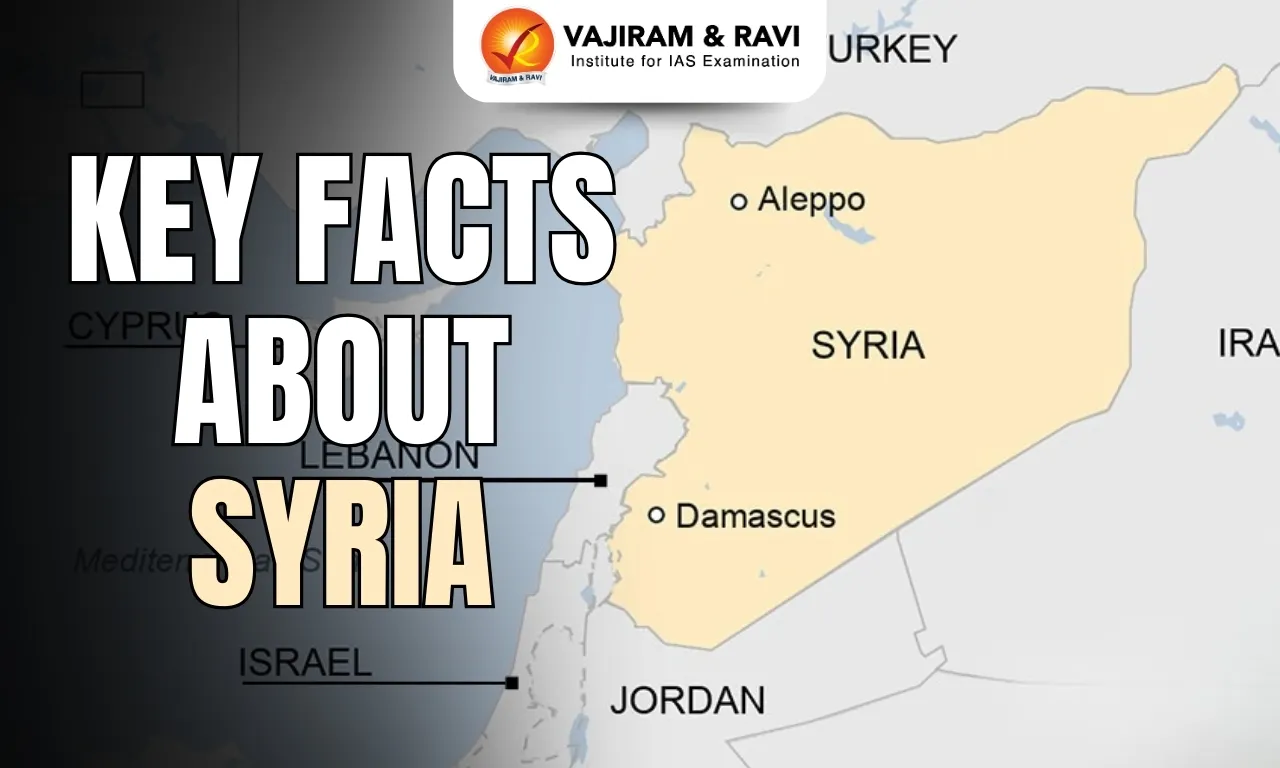
  • Location: It is located on the east coast of the Mediterranean Sea in southwestern Asia.
  • Bordering Countries: It is bordered by Turkey in the north, Lebanon in the west, Iraq in the east, Jordan in the south and Israel in the southwest.
  • Capital City: Damascus

Geographical Features of Syria

  • Syria's geography offers two major regions, a western and an eastern part.
    • The western region features narrow, fertile coastal plains along the eastern Mediterranean Sea.
    • The eastern part of the country is the realm of the Syrian Desert which is a mixture of dry steppe and true desert landscape.
  • Rivers: Euphrates River flows across Syria before entering Iraq.
  • Lakes: Lake al-Assad (a man-made reservoir,) created by a dam on the Euphrates River.
  • Desert: Southern and eastern Syria are part of the northern Syrian Desert.
  • Highest Point: Mt Hermon (2,814 m)

Source: News On Air

Syria FAQs

Q1: Which is the capital city of Syria?

Ans: Damascus

Q2: Which are the major ethnic groups of Syria?

Ans: Kurds, Arabs and Turkmens

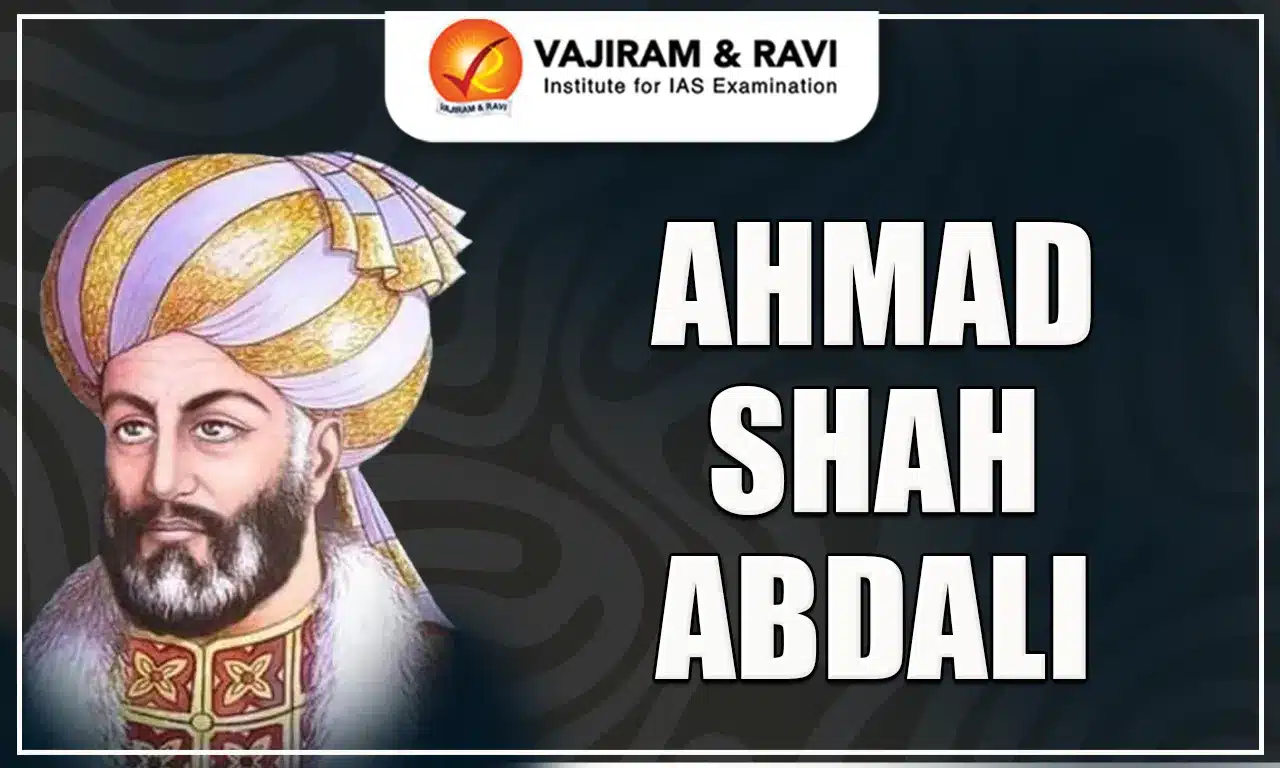
Ahmad Shah Abdali, Early Life, Durrani Empire, Indian Invasion

Ahmad Shah Abdali

Ahmad Shah Abdali has the other name Ahmad Shah Durrani who was the founder of Durrani Empire and elected as the successor of Nadir Shah after his death in 1747. Ahmad Shah Abdali invaded India 8 times during the tenure of 1748 and 1767. His campaigns were primarily driven by the aim of having quick wealth, rather than long-term control, he focused on raids and looting key cities.

Ahmad Shah Abdali Early Life

  • Ahmad Shah Abdali was born in 1722 in Multan, then part of the Mughal Empire (now in Pakistan). His father, Mohammad Zaman Khan, was the governor of Herat and head of the Abdali clan.
  • Abdali's paternal line came from the Sadozai tribe, while his mother belonged to the Alakozai tribe.
  • In 1729, Abdali soldiers led by Zulfiqar surrendered to Nader Shah Afshar, Persia’s rising power.
  • Soon after, they rebelled and briefly took control of Herat and Mashhad.
  • In 1730, Ahmad Shah defeated Ibrahim Khan, Nader Shah’s brother and a military commander.
  • Nader Shah began integrating Abdali fighters into his forces around 1729.
  • After the capture of Kandahar in 1738, Ahmad Shah and Zulfiqar were freed and given high positions.
  • Ahmad Shah served closely as a personal attendant (yaswal) to Nader Shah, later commanding the 4,000-strong Abdali Regiment.
  • The Abdali Regiment played an active role in Nader Shah’s 1738 invasion of the Mughal Empire.

Also Read: Nadir Shah

Durrani Empire

  • The Durrani Empire (also called the Sadozai Kingdom or Afghan Empire) was founded by Ahmad Shah Abdali in the 18th century.
  • It spanned regions of Central, South, and West Asia, including present-day Afghanistan, Pakistan, northeastern and southeastern Iran, eastern Turkmenistan, and parts of northern India.
  • At its peak, it was the most powerful Muslim empire after the Ottoman Empire during the late 1700s.
  • Ahmad Shah unified various Pashtun tribes with the support of Baloch allies to establish the empire.
  • The Durranis were from the Popalzai branch of the Pashtun Durrani (formerly Abdali) tribe, making them the second Pashtun rulers of Kandahar after the Hotaks.
  • Kashmir and parts of Punjab also came under Durrani control during Ahmad Shah’s reign.
  • The Barakzai dynasty succeeded the Durranis in the early 19th century.
  • Ahmad Shah Durrani’s leadership was key to the empire’s rise and influence in the region.

Ahmed Shah Abdali Indian Invasion

  • Ahmad Shah Durrani invaded India eight times between 1748 and 1767.
  • After Nadir Shah’s death, he became ruler of Afghanistan and began raiding neighboring regions for wealth.
  • He ambushed civilians during the Chota Ghalughara and Vada Ghalughara, but eventually retreated after encountering Sikh resistance near the Chenab.
  • After his retreat, the Sikhs rose in revolt and captured towns across Punjab. His repeated invasions destroyed the Mughal Empire and weakened the Marathas, especially with his victory at Panipat in 1761, which left a major power vacuum in North India.
  • Ahmed Shah Abdali Indian Invasion reflected his relentless ambition and strategic intent. Afghanistan’s poverty and lack of resources pushed Abdali to target India’s wealth.
  • He also aimed to assert political dominance over the Indian subcontinent.
  • In 1757, he captured Delhi, installed a caretaker, and recognized Alamgir II as emperor.
  • He appointed Najib-ud-Daula as Mir Bakhshi, his key agent in the Mughal court.
  • In 1758, Maratha leader Raghunath Rao captured Punjab and expelled Najib-ud-Daula.
  • Abdali returned in 1759 to retaliate and defeat the Marathas in the Third Battle of Panipat (1761).
  • His final invasion took place in 1767, after which he stopped interfering directly in Indian affairs.

Third Battle of Panipat

  • The Durrani Kingdom, also called the Sadozai Kingdom or the Afghan Empire, was a powerful empire that spanned parts of Central, South, and the Middle East Asia. 
  • It was founded by Ahmad Shah Abdali, who is credited with uniting the various Pashtun tribes under one rule.
  • At its peak, the empire covered present-day Afghanistan and Pakistan, along with parts of northeastern and southeastern Iran, eastern Turkmenistan, and northern India, including the Kashmir region. 
  • It was considered the most powerful Muslim empire of the late 18th century, after the Ottoman Empire.
  • Ahmad Shah established the empire with support from his Baloch allies and ruled as the head of the Durrani Popalzai clan, which had earlier been known as the Abdalis. 
  • His family became the second line of Pashtun rulers of Kandahar, following the Hotak dynasty.
  • After Ahmad Shah’s death, his descendants continued to rule until the early 19th century, when the Barakzai dynasty took over. 
  • Durrani's rise was largely due to Ahmad Shah’s military skill and leadership, which earned him a lasting legacy in the region’s history.

Ahmad Shah Abdali FAQs

Q1: Who was Ahmad Shah Abdali?

Ans: Ahmad Shah Abdali, also known as Ahmad Shah Durrani, was the founder of the Durrani Empire and an Afghan ruler who invaded India multiple times.

Q2: When did Ahmad Shah Abdali invade India?

Ans: He invaded India several times between 1747 and 1769, with his most famous campaign being the Third Battle of Panipat in 1761.

Q3: What was the Third Battle of Panipat?

Ans: Fought in 1761, it was a major battle between Ahmad Shah Abdali’s forces and the Marathas, resulting in a decisive victory for Abdali.

Q4: Why did Ahmad Shah Abdali invade India?

Ans: He sought to expand his empire, secure Afghan interests, and plunder India's wealth, especially after Nadir Shah’s successful 1739 invasion.

Q5: What impact did Abdali’s invasions have on India?

Ans: His repeated invasions weakened Indian powers, especially the Marathas, disrupted trade and governance, and hastened political instability in northern India.

Gallantry Awards in India, Full List, Eligibility, and Award Details

Gallantry Awards

The Ministry of Defence seeks recommendations twice annually from the Armed Forces and the Ministry of Home Affairs for Gallantry Awards in India. These honours are awarded to personnel who exhibit extraordinary bravery, courage, and commitment to duty, often at great personal risk. The recipients have showcased exceptional courage during a range of operations, including counter-terrorism and counter-insurgency efforts in Jammu & Kashmir and the North-East, anti-piracy missions, and critical fire-fighting operations.

Gallantry Awards in India

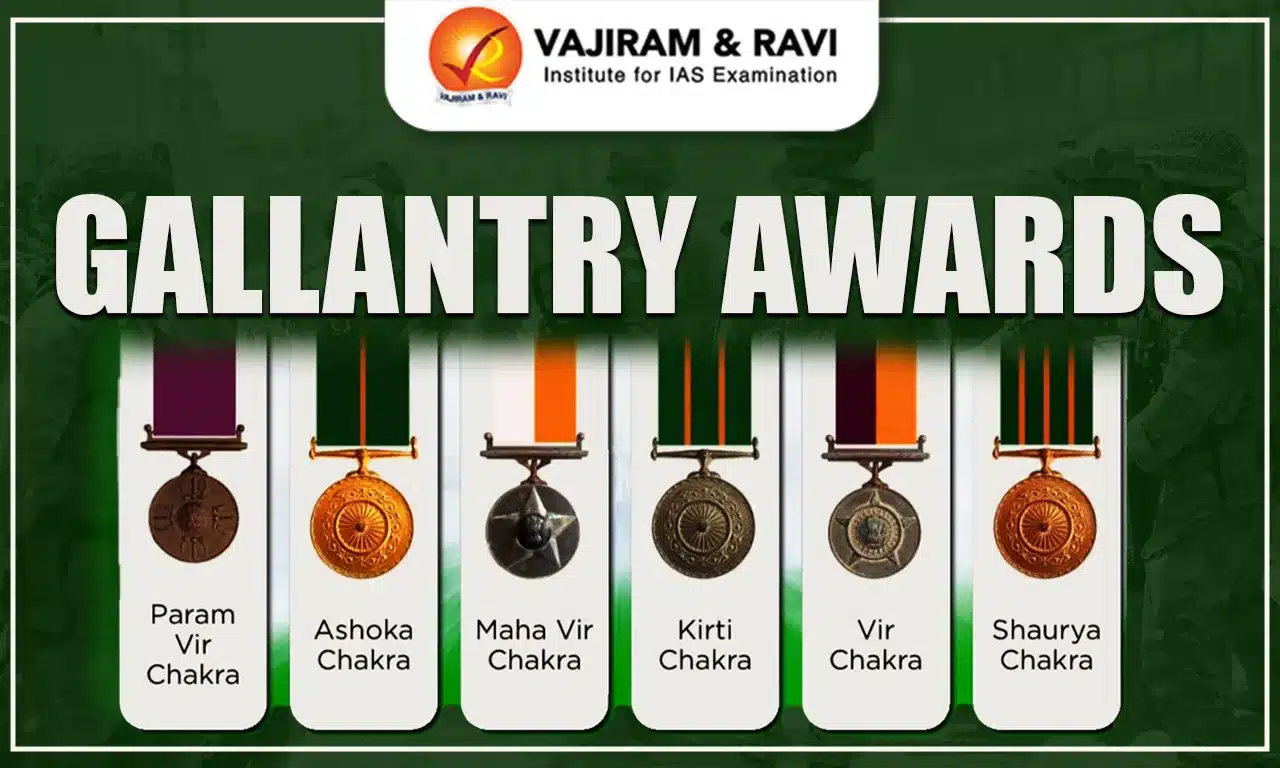
The Government of India instituted the Gallantry Awards to honour acts of bravery, courage, and sacrifice by members of the armed forces, other organised forces, and even civilians. These awards are announced twice a year on Republic Day and Independence Day. Soon after independence, on January 26, 1950, the government introduced the First Gallantry Awards in India, the Param Vir Chakra, Maha Vir Chakra, and Vir Chakra, with their effect dating back to August 15, 1947. In 1952, three additional awards were created, Ashoka Chakra Class I, Class II, and Class III also considered effective from the same date. These were later renamed in January 1967 as Ashoka Chakra, Kirti Chakra, and Shaurya Chakra, respectively.

Gallantry Awards in India

Category

Name of Gallantry Awards in India

Level

Awarded For

Wartime

Param Vir Chakra

Highest

Most conspicuous bravery or supreme sacrifice in the presence of the enemy.

Maha Vir Chakra

Second-highest

For acts of conspicuous gallantry in the presence of the enemy.

Vir Chakra

Third-highest

Acts of gallantry on battlefield

Peacetime

Ashoka Chakra

Highest

Bravery away from battlefield (e.g. terrorism, rescue ops)

Kirti Chakra

Second-highest

Courageous action in peacetime (e.g. counter-insurgency, internal ops)

Shaurya Chakra

Third-highest

Bravery during peacetime situations such as rescue or security operations

List of Gallantry Awards 2025

On May 22, 2025, during Phase-I of the Defence Investiture Ceremony held at Rashtrapati Bhawan in New Delhi, President Smt. Droupadi Murmu conferred six Kirti Chakras, including four posthumous honours and 33 Shaurya Chakras, of which seven were awarded posthumously. The recipients included personnel from the Armed Forces, Central Armed Police Forces, and State or Union Territory Police.

List of Gallantry Awards 2025

Name

Service/Unit

Award

Status

Major Malla Rama Gopal Naidu

The Maratha Light Infantry, 56 Rashtriya Rifles

Kirti Chakra

Living

Major Manjit

The Punjab Regiment, 22 Rashtriya Rifles

Kirti Chakra

Living

Rifleman Ravi Kumar

J&K Light Infantry, 63 Rashtriya Rifles

Kirti Chakra

Posthumous

Colonel Manpreet Singh, SM

Sikh Light Infantry, 19 Rashtriya Rifles

Kirti Chakra

Posthumous

Dy. SP Himayun Muzzammil Bhat

J&K Police

Kirti Chakra

Posthumous

Naik Dilwar Khan

Regiment of Artillery, 28 Rashtriya Rifles

Kirti Chakra

Posthumous

Maj. (Lt Col) Vijay Verma

Rajput Regiment, 44 Rashtriya Rifles

Shaurya Chakra

Living

Deputy Commandant Vikrant Kumar

CRPF

Shaurya Chakra

Living

Inspector/GD Jeffrey Hmingchullo

CRPF

Shaurya Chakra

Living

Wg Cdr Vernon Desmond Keane, VM

Indian Air Force (Pilot)

Shaurya Chakra

Living

Sqn Ldr Deepak Kumar

Indian Air Force (Pilot)

Shaurya Chakra

Living

SPO Abdul Latif

J&K Police

Shaurya Chakra

Living

Subedar Sanjeev Singh Jasrotia

5 J&K Rifles

Shaurya Chakra

Living

Colonel Pawan Singh

666 Army Aviation Squadron (R&O)

Shaurya Chakra

Living

Subedar P Pabin Singha

Artillery, 56 Rashtriya Rifles

Shaurya Chakra

Living

Major Sahil Randhawa

Artillery, 34 Rashtriya Rifles

Shaurya Chakra

Living

Maj. (Lt Col) CVS Nikhil

21 PARA (Special Forces)

Shaurya Chakra

Living

Major Tripatpreet Singh

Army Service Corps, 34 Rashtriya Rifles

Shaurya Chakra

Living

Lt Cdr Kapil Yadav

AEO, INS Visakhapatnam

Shaurya Chakra

Living

Deputy Commandant Lakhveer

CRPF

Shaurya Chakra

Living

Asst Commandant Rajesh Panchal

CRPF

Shaurya Chakra

Living

CT/GD Malkit Singh

CRPF

Shaurya Chakra

Living

Subedar Mohan Ram

20 JAT

Shaurya Chakra

Living

Commodore Sharad Sinsunwal

CO, INS Kolkata

Shaurya Chakra

Living

Flt Lt Aman Singh Hans

Indian Air Force (Pilot)

Shaurya Chakra

Living

Sergeant Dabhi Sanjay Hiffabhai

Indian Air Force

Shaurya Chakra

Living

Major Kunal

Army Service Corps, 1 Rashtriya Rifles

Shaurya Chakra

Living

Major Ashish Dahiya

Corps of Engineers, 50 Rashtriya Rifles

Shaurya Chakra

Living

Havildar Prakash Tamang

9 Gorkha Rifles, 32 Rashtriya Rifles

Shaurya Chakra

Living

Major Satender Dhankar

Armoured Corps, 4 Rashtriya Rifles

Shaurya Chakra

Living

Asst Commandant Eshenthung Kikon

4 Assam Rifles

Shaurya Chakra

Living

Subedar Vikas Tomar

1 PARA (Special Forces)

Shaurya Chakra

Living

Major Aashish Dhonchak, SM

Sikh Light Infantry, 19 Rashtriya Rifles

Shaurya Chakra

Posthumous

Sepoy Pardeep Singh

Sikh Light Infantry, 19 Rashtriya Rifles

Shaurya Chakra

Posthumous

Havildar Rohit Kumar

Dogra Regiment, HAWS

Shaurya Chakra

Posthumous

Shri Pawan Kumar, CT/GD

CRPF

Shaurya Chakra

Posthumous

Shri Devan C, CT/GD

CRPF

Shaurya Chakra

Posthumous

OEM GDE-1 Vijayan Kutty G

Border Roads Organisation (BRO)

Shaurya Chakra

Posthumous

Captain Deepak Singh

Corps of Signals, 48 Rashtriya Rifles

Shaurya Chakra

Posthumous

Gallantry Awards Types

Gallantry Awards in India are classified into two distinct categories based on the nature of the act of bravery. The first category includes awards for gallantry in the face of the enemy, which are given for acts of heroism during combat or military engagement. These include the Param Vir Chakra (PVC), Maha Vir Chakra (MVC), and Vir Chakra. The second category recognises bravery not necessarily in direct combat but in situations that demand exceptional courage, such as counter-insurgency, rescue, or peacetime operations. This category includes the Ashoka Chakra, Kirti Chakra, and Shaurya Chakra.

Gallantry Awards Types

Award

Medal Description

Ribbon

Bar System

Param Vir Chakra

Circular bronze medal (1 3/8 inch), embossed with four "Indra’s Vajra" and the State Emblem in the center. "PARAM VIR CHAKRA" inscribed on the reverse in Hindi & English, with two lotus flowers.

Plain purple

Bar added for each subsequent act of bravery. A miniature “Indra’s Vajra” is added to the riband for each bar when worn alone. Posthumous Bars allowed.

Mahavir Chakra

Silver circular medal (1 3/8 inch), five-pointed star touching the rim, State Emblem at center. "MAHA VIR CHAKRA" inscribed in Hindi & English on reverse, separated by two lotus flowers.

Half-white and half-orange

Bar attached to the riband for each additional qualifying act. Miniature Chakra on riband for each bar when worn alone. Posthumous Bars allowed.

Vir Chakra

Silver circular medal (1 3/8 inch), five-pointed star with a chakra and gilded State Emblem in the center. "VIR CHAKRA" inscribed on the reverse in Hindi & English, with two lotus blossoms.

Equal parts blue and orange

Bar added to riband for additional acts. Riband has a small duplicate of the Chakra for each bar. Bars may be awarded posthumously.

Ashoka Chakra

Gold-leaf circular medal (1 3/4 inch), Ashoka Chakra on the obverse encircled by lotus wreath. Inner rim has lotus leaves, flowers, and buds. Reverse has "ASHOK CHAKRA" in Hindi & English, separated by two lotus flowers.

Green ribbon with two halves separated by an orange line

Bar added to riband for each additional brave act. Miniature Chakra on riband for each bar. Bars may be awarded posthumously.

Kirti Chakra

Silver circular medal (1 3/8 inch), Ashoka Chakra on obverse with lotus wreath design. Reverse shows “KIRTI CHAKRA” in Hindi & English, separated by two lotus flowers.

Green ribbon split into 3 parts by 2 orange vertical lines

Bar added for repeated qualifying acts. Miniature Chakra on riband for each bar. Bars may be awarded posthumously.

Shaurya Chakra

Bronze circular medal (1 3/8 inch), Ashoka Chakra on obverse with lotus wreath design. Reverse shows “SHAURYA CHAKRA” in Hindi & English, separated by two lotus flowers.

Green ribbon divided into 4 equal parts by 3 orange lines

Bar added for each additional act of gallantry. Miniature Chakra on riband for each bar. Posthumous Bars allowed.

Gallantry Awards in India Eligibility Criteria

Gallantry Awards in India are divided into two main categories based on whether the act of bravery occurs in the presence of the enemy or in peacetime situations. The Param Vir Chakra, Maha Vir Chakra, and Vir Chakra are wartime Gallantry Awards in India, while the Ashoka Chakra, Kirti Chakra, and Shaurya Chakra are awarded for courageous actions during peacetime. The table below includes the Gallantry Awards in India Eligibility Criteria.

Gallantry Awards in India Eligibility Criteria

Award

Eligible Personnel

Awarded For

Presence of Enemy

Param Vir Chakra

Officers and personnel of the Armed Forces, Reserve Forces, Territorial Army, Militia, and related Nursing/Hospital services; Civilians serving with these forces.

Most conspicuous bravery, daring, or self-sacrifice of the highest order.

Yes

Maha Vir Chakra

Same as above.

Acts of conspicuous gallantry in the presence of the enemy.

Yes

Vir Chakra

Same as above.

Gallant acts in the presence of the enemy.

Yes

Ashoka Chakra

Armed Forces, Reserve Forces, Territorial Army, Central Para-Military Forces, Railway Protection Force, civilians, and nursing services personnel.

Most conspicuous courage, daring act, or self-sacrifice of the highest order in peacetime.

No

Kirti Chakra

Same as above.

Distinguished acts of bravery not involving direct engagement with the enemy.

No

Shaurya Chakra

Same as above.

Bravery and valour shown under circumstances not involving the enemy (e.g., during peacetime operations, rescues).

No

Gallantry Awards in India FAQs

Q1: What are Gallantry Awards in India?

Ans: Gallantry Awards are honors given for bravery, valor, and courage in the face of danger, especially in the armed forces.

Q2: Which is the highest Gallantry Award in India?

Ans: The Param Vir Chakra is India’s highest wartime gallantry award, awarded for the highest degree of bravery.

Q3: What are the main types of Gallantry Awards?

Ans: They are categorized into Wartime (Param Vir Chakra, Maha Vir Chakra, Vir Chakra) and Peacetime (Ashoka Chakra, Kirti Chakra, Shaurya Chakra).

Q4: When are Gallantry Awards announced?

Ans: They are announced twice a year—on Republic Day (26th January) and Independence Day (15th August).

Q5: Who presents Gallantry Awards in India?

Ans: The President of India presents Gallantry Awards during ceremonial functions at the Rashtrapati Bhavan.

Chillai-Kalan

Chillai-Kalan

Chillai-Kalan Latest News

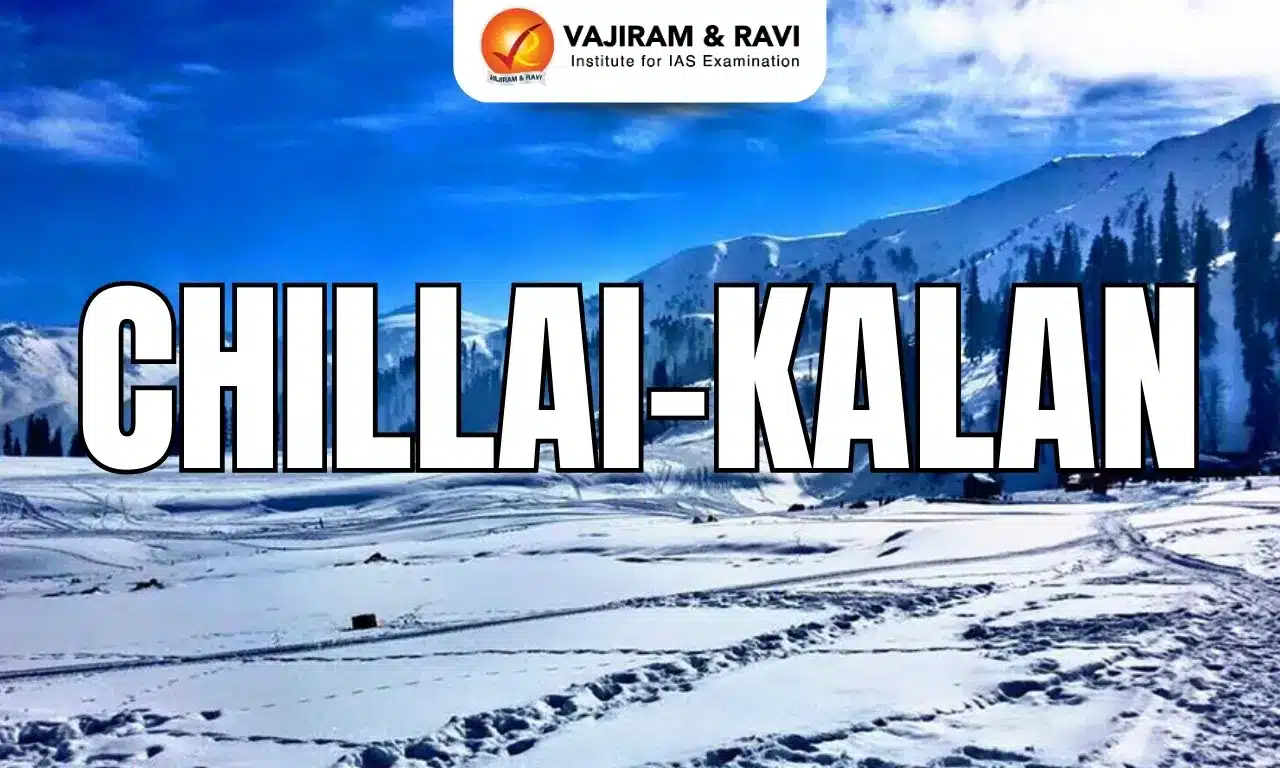
Recently, Kashmir braces for a spell of rain and snowfall and the region is also set to enter ‘Chillai Kalan’,

About Chillai-Kalan

  • It is the 40-day period of the harshest winter cold in Kashmir region.
    • Chillai Kalan is a Persian term which means “Major Cold”.
  • The Chillai Kalan (big cold) usually begins on December 21 and will end on January 30. 
  • During this time Kashmir Valley faces its harshest phase of the winter season, including widespread snowfall, sub-zero temperatures and intense cold waves.
    • Chillai Kalan is followed by ‘Chillai-Khurd’ (small cold)– a 20-day period of moderate winter from January 31 to February 19, and the 10-day ‘Chillai-Bacha’ (baby cold), towards the fag end of the winter season from February 20 to March 2.
  • Cultural Significance: According to Persian tradition, the night of 21st December is celebrated as Shab-e Yalda-“Night of Birth”, or Shab-e Chelleh. – “Night of Forty”. 
  • Impacts of Chillai Kalan
    • Traditionally, heavy snowfall during Chillai Kalan replenishes water reservoirs in the higher reaches, sustaining rivers, streams and lakes during the summer months. 

Source: TH

Chillai-Kalan FAQs

Q1: How long does Chillai-Kalan last?

Ans: 40 days

Q2: Chillai-Kalan is associated with which region?

Ans: Kashmir

Raccoon Roundworm

Raccoon Roundworm

Raccoon Roundworm Latest News

Recently, Europe is on alert after a new study revealed the raccoon roundworm, Baylisascaris procyonis, has firmly taken hold in wild raccoons across nine countries.

About Raccoon Roundworm

  • The raccoon roundworm (Baylisascaris procyonis) is the common large roundworm or ascarid found in the small intestinal tract of raccoons. 
  • It infects raccoons in parts of North America, Europe and Japan, and less commonly in South America.
  • The parasite is indigenous to North America and emerging in Europe and Asia after the introduction of North American raccoons for the commercial fur trade in the early 20th century.
  • It can cause severe disease in humans and other animals.
  • Primary Hosts of Raccoon Roundworm: Racoons (​Procyon lotor​), Wild and domestic canids

Transmission & Life Cycle of Raccoon Roundworm

  • Infection occurs through ingestion of infective eggs or infected paratenic hosts.
  • Eggs passed in racoon faeces are shed in the environment and take 2-4weeks to embryonate  and become infective.
  • Many mammals and birds can become paratenic hosts after consuming the eggs.
  • Once infective eggs are ingested, the eggs hatch and larvae penetrate the intestinal wall where they can migrate to various tissues (liver, lungs, eyes, and brain), and infect the host.
  • Treatment and Control: Raccoons can be successfully treated with several anthelmintics to kill the adult worms.

Source: India Today

Raccoon Roundworm FAQs

Q1: What is the scientific name of Raccoon Roundworm?

Ans: Baylis ascaris procyonis

Q2: What is the primary health risk of Raccoon Roundworm infection in humans?

Ans: Neurological damage

Functions of Parliament, Legislative, Financial and Other Functions

Functions of Parliament

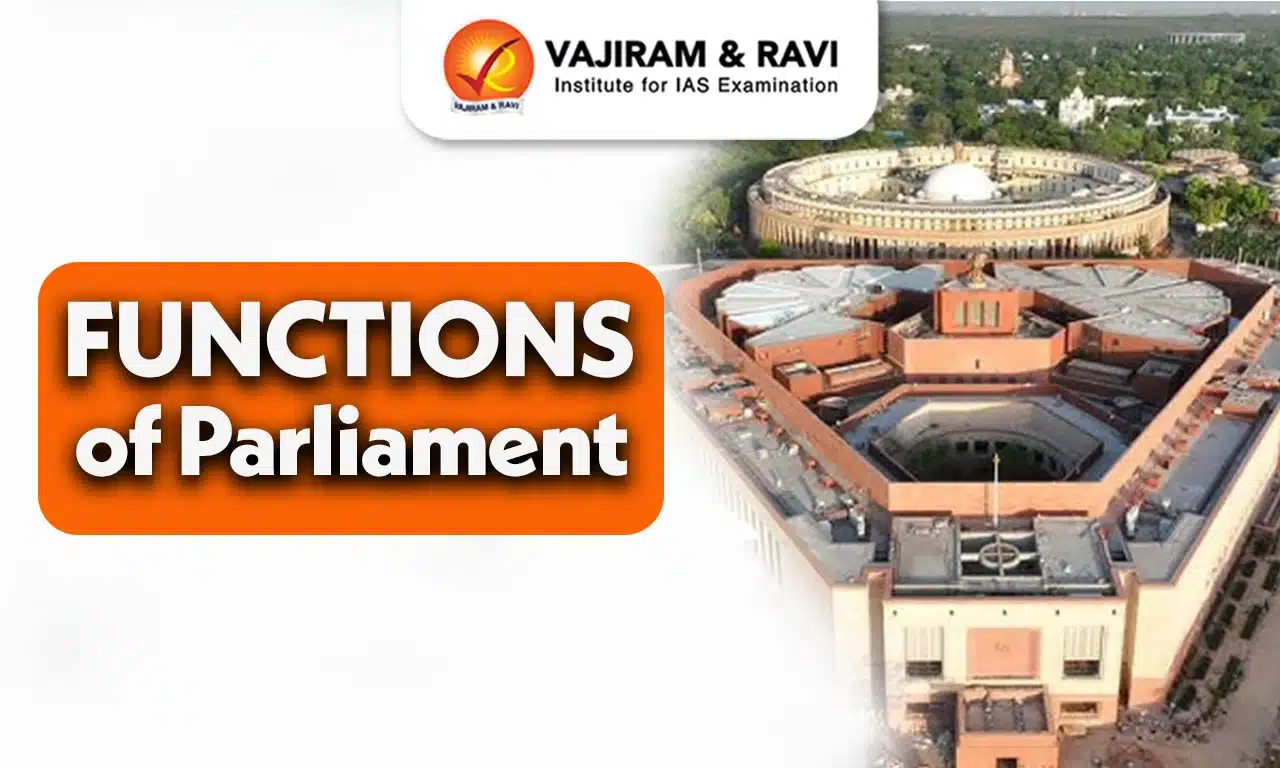
The Parliament is the primary law-making body of the Government of India, responsible for framing laws and overseeing governance. India has a bicameral legislature consisting of The President of India, Rajya Sabha (Council of States - the Upper House) and Lok Sabha (House of the People - the Lower House). It discusses, debates, and decides on key matters such as policies, laws, budget allocations, and governance issues affecting the country. While the Rajya Sabha represents the states and union territories, the Lok Sabha represents the citizens of India directly through elected members.

Parliament of India

The Parliament of India serves as the nation’s supreme legislative authority, holding the central role in law-making and governance. It follows the British Westminster model and functions as a bicameral legislature, meaning it consists of two separate houses, the Rajya Sabha (Council of States) and the Lok Sabha (House of the People).

In addition to these two houses, the President of India is considered an essential part of the Parliament, with the power to summon sessions, give assent to bills, and dissolve the Lok Sabha. Together, these three components work to draft, debate, and pass legislation, approve the national budget, and ensure accountability of the executive to the legislature. This structure allows for a representative and balanced system of governance across different regions and population groups in the country.

Functions of Parliament

The Parliament of India, as the apex legislative body, holds a pivotal role in the country’s political and administrative framework. The Constitution outlines a wide range of powers, responsibilities, and functions assigned to Parliament, shaping the way governance operates in India. Broadly, these Functions of Parliament can be grouped under several key categories.

  • Legislative Functions: Makes, amends, and repeals laws for the country.
  • Executive Functions: Holds the executive (Council of Ministers) accountable through questions, debates, motions, and discussions.
  • Financial Functions: Approves the Union Budget, authorizes taxation and public expenditure, and scrutinizes government spending.
  • Constituent Functions: Has the power to amend the Constitution under Article 368.
  • Judicial Functions: Can impeach the President, remove judges of the Supreme Court and High Courts, and punish members for breach of privilege.
  • Electoral Functions: Participates in the election of the President and Vice-President of India.
  • Other Functions: Discusses and debates national issues, raises matters of public concern, and shapes public policy.

Legislative Functions of Parliament

  • The Parliament legislates on all matters listed in the Union List and the Concurrent List.
  • In case of a conflict on matters in the Concurrent List, the union law prevails unless the state law had received prior Presidential assent. However, Parliament can amend or repeal such state law at any time.
  • Parliament can also legislate on matters in the State List under certain conditions:
    • During Emergency or President’s Rule (Article 356): Parliament can make laws on State List subjects if an emergency is in force or a state is under President’s Rule.
    • Under Article 249: If the Rajya Sabha passes a resolution with a two-thirds majority of members present and voting, stating it is necessary in the national interest, Parliament can legislate on State List items.
    • Under Article 253: Parliament can make laws on State subjects to implement international treaties, agreements, or conventions.
    • Under Article 252: If two or more state legislatures pass a resolution requesting a law on a State List subject, Parliament can make that law applicable only to those states. Other states can adopt it later.

Executive Functions (Control over the Executive) of Parliament

  • In the parliamentary system, the executive is accountable to the legislature, meaning the Parliament has multiple tools to control and supervise the government.
  • No-Confidence Motion: If the Parliament passes this motion, the Cabinet must resign. It’s a direct way to remove a government from power.
  • Question Hour: MPs can question ministers about government actions or failures. This keeps the executive transparent and accountable.
  • Adjournment Motion: Used only in the Lok Sabha, this motion halts normal proceedings to discuss a recent issue of urgent national importance.
  • Committee on Ministerial Assurances: This committee monitors whether ministers fulfill promises made on the floor of the House.
  • Censure Motion: Moved by the opposition in the Lok Sabha to criticize and disapprove of specific government policies. While it doesn’t force resignation, the government must prove it still has the House’s confidence.
  • Cut Motion: This allows MPs to oppose any demand for grants in the budget. It can lead to debates or reductions in government expenditure proposals.

Financial Function of Parliament

  • Financial Control: Parliament holds the power of the purse. The Executive cannot spend any money without its approval.
  • Union Budget: The annual budget, prepared by the Cabinet, must be passed by Parliament before any funds can be allocated or spent.
  • Taxation Authority: No new tax can be levied or collected without Parliament’s consent.
  • Parliamentary Committees: Two key standing committees, the Public Accounts Committee and the Estimates Committee monitor government spending and ensure accountability.

Amending Powers of Parliament

  • Power to Amend: Parliament holds the authority to amend the Constitution of India under Article 368.
  • Equal Role of Both Houses: Both the Lok Sabha and Rajya Sabha play an equal role in the amendment process.
  • Procedure: A constitutional amendment must be passed by a special majority in both Houses to become effective.

Electoral Functions of Parliament

  • Election of President and Vice President: Parliament participates in the election process for both posts.
  • Electoral College: The elected members of both Lok Sabha and Rajya Sabha are part of the electoral college that elects the President.
  • Removal of President: The President can be removed through impeachment, a resolution must be passed by the Rajya Sabha and agreed to by the Lok Sabha.

Also Read: Difference between Lok Sabha and Rajya Sabha

Judicial Functions of Parliament

  • Breach of Privilege: Parliament can take punitive action if any member breaches the privileges enjoyed by the House or its members.
  • Privilege Motion: A member may move a privilege motion if they believe another member or minister has misrepresented or withheld key facts.
  • Judicial Immunity: Legislative privileges are generally beyond the scope of judicial review in India.
  • Punitive Powers: Parliament has the authority to punish its own members for misconduct or breach of privilege.
  • Impeachment Powers: Parliament can initiate impeachment proceedings against the President, Vice President, judges of the Supreme Court and High Courts, and the Comptroller and Auditor-General.

Other Functions of Parliament

  • Deliberation on Key Issues: Parliament discusses matters of national and international importance, often bringing in multiple perspectives.
  • Role of Opposition: The opposition ensures alternate viewpoints are heard, keeping the ruling government accountable.
  • ‘Nation in Miniature’: Parliament reflects the diversity of the country, representing different regions, communities, and political opinions.
  • Debate Before Decisions: Before passing laws or resolutions, Parliament debates their implications, a key democratic function.
  • Alteration of State Boundaries: Parliament has the power to change the boundaries or status of states and Union Territories.

Organ of Information: Ministers are obligated to answer questions and provide information in the House when asked by members.

Functions of Parliament FAQs

Q1: What are the main functions of the Indian Parliament?

Ans: The Parliament makes laws, approves budgets, controls the executive, amends the Constitution, and represents the public’s interests.

Q2: What is the legislative function of Parliament?

Ans: Parliament formulates, debates, and passes laws for the country on subjects in the Union and Concurrent Lists.

Q3: How does Parliament control the executive?

Ans: Through questions, debates, motions, and committees, Parliament holds the government accountable for its actions and decisions.

Q4: What is the financial function of Parliament?

Ans: Parliament approves the Union Budget, authorizes expenditure, and ensures government spending aligns with national interests.

Q5: How does Parliament amend the Constitution?

Ans: Parliament can amend the Constitution by passing a bill with a special majority in both Houses, sometimes requiring state ratification.

Daily Editorial Analysis 22 December 2025

Daily Editorial Analysis

The Bulldozed Demolition of MGNREGA

Context

  • The Mahatma Gandhi National Rural Employment Guarantee Act (MGNREGA), enacted in 2005 during Prime Minister Dr. Manmohan Singh’s first tenure, marked a watershed in India’s welfare policy.
  • Rooted in Article 41 of the Constitution, which directs the State to secure the right to work, MGNREGA was designed as a rights-based legislation, not a discretionary scheme.
  • Shaped through extensive public consultations and passed unanimously by Parliament, it evolved into the world’s largest social security programme and one of the most rigorously studied.
  • Recent policy changes, however, represent a systematic dismantling of its legal, financial, and democratic foundations, threatening rural livelihoods and India’s constitutional ethos.

MGNREGA: A Rights-Based and Transformative Intervention

  • MGNREGA was conceived as a demand-driven guarantee of employment, obligating the State to provide work when demanded. This legal entitlement empowered rural households, particularly landless labourers, by enhancing bargaining power and raising agricultural wages.
  • Its decentralised framework, aligned with the 73rd Constitutional Amendment, entrusted Gram Sabhas with planning, implementation, and social audits, fostering transparency, accountability, and grassroots democracy.
  • Over two decades, MGNREGA reduced distress migration, strengthened wage security, and empowered panchayati raj institutions.
  • Its significance was most evident during the COVID-19 pandemic, when it served as a crucial lifeline alongside the National Food Security Act.
  • Persistently high demand for work continues to underline its indispensability for sustaining rural livelihoods.

Demolition of MGNREGA in Stages

  • Undermining the Legal Guarantee

    • The most damaging shift has been the elimination of the legal guarantee of work.
    • Employment is no longer an enforceable right but a bureaucratic provision controlled by the Union government.
    • The scheme’s coverage is now restricted to rural areas as notified at the Centre’s discretion, weakening its universal applicability.
    • Equally damaging is the replacement of uncapped, demand-based funding with pre-determined budgetary allocations.
    • This change caps employment days at the State level, subordinating people’s needs to central fiscal priorities and effectively nullifying the guarantee of work.
  • Financial Centralisation and the Burden on States

    • The revision of the cost-sharing ratio from 90:10 to 60:40 has transferred a significant financial burden to States.
    • Previously, strong central funding encouraged States to respond to demand without fiscal hesitation.
    • Under the new arrangement, any expenditure beyond the Union’s capped allocation must be borne entirely by States, many of which already face acute financial stress.
    • This discourages States from providing employment, hollowing out the scheme from within.
    • The removal of year-round employment, through the identification of 60 no-work days during peak agricultural seasons, further undermines labour security.
    • By weakening alternative employment options, these changes erode workers’ bargaining power and suppress wage growth, particularly troubling at a time when agricultural employment has risen for the first time since Independence.
  • From Decentralisation to Centralised Control

    • MGNREGA’s decentralised architecture was central to its success. Gram Sabhas played a pivotal role in identifying, planning, and executing works, embodying the constitutional vision of local self-governance.
    • This has now been replaced by a top-down framework under the PM GatiShakti National Master Plan, which prioritises Union-level objectives over local needs.
    • This shift represents centralisation with a vengeance, undermining federalism and democratic participation.
    • Claims of increasing guaranteed employment from 100 to 125 days ring hollow. Capped budgets, reduced State incentives, delayed payments, and technological barriers make such expansion implausible.
    • These changes are consistent with a decade-long strategy of weakening MGNREGA through stagnant allocations and administrative throttling.

MGNREGA and the Broader Assault on Rights

  • The dismantling of MGNREGA forms part of a broader rollback of India’s rights-based framework.
  • The weakening of the Right to Information, dilution of land acquisition and forest rights, erosion of the National Green Tribunal, undermining of the Right to Education, and attempts to deny farmers minimum support price protections reflect a consistent pattern.
  • Together, these measures signal a retreat from constitutional commitments to social justice, accountability, and democratic rights.
  • In this context, the erosion of the right to work is not merely administrative reform but a fundamental departure from the Constitution’s welfare vision, with severe implications for inequality and rural distress.

Conclusion

  • MGNREGA embodied Mahatma Gandhi’s vision of Sarvodaya, the welfare of all, and translated constitutional ideals into lived realities for millions.
  • Its effective dismantling constitutes a collective moral and constitutional failure, with profound human and economic consequences.
  • Defending MGNREGA is inseparable from defending India’s rights-based democracy, federalism, and social justice.
  • At stake is not merely a programme, but the constitutional promise of dignity, work, and welfare for all citizens.

The Bulldozed Demolition of MGNREGA FAQs

 Q1. What constitutional principle inspired MGNREGA?
Ans. MGNREGA was inspired by Article 41 of the Indian Constitution, which calls upon the State to secure the right to work.

Q2. How did MGNREGA empower rural workers?
Ans. MGNREGA empowered rural workers by guaranteeing employment and increasing their bargaining power, leading to higher rural wages.

Q3. What major change undermined the legal guarantee of MGNREGA?
Ans. The legal guarantee was undermined by replacing demand-based employment with capped, discretionary budget allocations.

Q4. How did the change in cost-sharing affect State governments?
Ans. The shift to a 60:40 cost-sharing ratio increased the financial burden on States and discouraged them from providing employment.

Q5. Why is the dismantling of MGNREGA seen as a constitutional failure?
Ans. The dismantling of MGNREGA is seen as a constitutional failure because it weakens the right to work and undermines India’s rights-based welfare framework.

Source: The Hindu


Unlocking the Potential of India-Africa Economic Ties

Context

  • India’s engagement with Africa has entered a renewed and strategically significant phase, shaped by global economic uncertainty and changing geopolitical realities.
  • Prime Minister Narendra Modi’s visits to African countries in 2025 underscore Africa’s growing importance in India’s foreign economic policy.
  • While India and Africa share long-standing cultural and political ties, their relationship is now increasingly driven by economics.
  • Amid restructuring global supply chains and the emergence of a multipolar world order, Africa has become central to India’s long-term economic aspirations.

The Global Context: Uncertainty in Traditional Markets

  • A key driver of India’s intensified focus on Africa is rising uncertainty in traditional Western markets.
  • In FY24, around 40% of India’s exports were directed to the United States and the European Union, exposing India to risks from economic slowdowns, protectionism, and policy volatility. Diversifying export destinations has therefore become imperative.
  • Africa, with its expanding population, growing consumer markets, and industrial potential, offers a viable alternative for reducing dependence on the West.

Current Trade Dynamics and Comparative Disadvantages

  • India is Africa’s fourth-largest trading partner, with bilateral trade nearing $100 billion, yet its presence remains limited compared to China.
  • China’s trade with Africa exceeds $200 billion, accounting for over 21% of Africa’s imports, with a strong concentration in high-value industrial goods such as machinery, electrical equipment, and semiconductors.
  • In contrast, India’s exports remain dominated by petroleum products, pharmaceuticals, rice, and textiles, reflecting a lower degree of industrial integration.
  • This imbalance highlights the need for India to move beyond traditional exports and strengthen its manufacturing and technology footprint.

A Five-Pillar Strategy for Deeper Engagement

  • Reducing Trade Barriers

    • The first pillar focuses on reducing trade barriers through preferential trade agreements and comprehensive economic partnerships, particularly with African regional economic communities.
    • Deeper engagement with the African Continental Free Trade Area (AfCFTA) can provide Indian exporters access to a more integrated continental market.
  • Value Added Manufacturing and Joint Ventures

    • The second pillar emphasises transitioning from low-value commodity exports to value-added manufacturing and joint ventures.
    • Establishing manufacturing units in Africa offers Indian firms dual advantages: preferential access to Western markets through favourable tariff regimes and direct participation in
    • Africa’s growing industrial base. Better utilisation of incentives offered by African governments remains critical to achieving this shift.
  • Scaling Up Trade Finance

    • The third pillar prioritises scaling up trade finance and Lines of Credit, especially to support micro, small, and medium enterprises (MSMEs).
    • African markets present greater entry opportunities for MSMEs than highly competitive Western economies.
    • However, limited access to finance, high perceived risk, and insufficient policy focus constrain their participation.
    • Measures such as local currency trade, joint insurance pools, and improved credit access could significantly enhance MSME engagement.
  • Infrastructure, Services, and Connectivity

    • The fourth pillar focuses on reducing freight and logistics costs through investments in port modernisation, hinterland connectivity, and India–Africa maritime corridors. Improved infrastructure is essential to making trade competitive and sustainable.
  • Digital Co-Operation and People to People Connect

    • The fifth pillar stresses the importance of services trade, digital connectivity, and people-to-people ties.
    • India’s strengths in information technology, healthcare, professional services, and skill development position it as a valuable partner for African economies.
    • Expanding services exports can generate high value and stimulate goods trade, though existing policy frameworks require substantial improvement to realise this potential.

Investment and the Role of the Public Sector

  • Sustained engagement with Africa also depends on stronger investment ties.
  • Currently, Indian investments are distorted by financial flows routed through Mauritius, often aimed at tax optimisation rather than productive investment.
  • Bureaucratic hurdles, political instability, and high financing costs further deter private firms.
  • In this context, Indian public sector units can play a catalytic role, particularly in mining, mineral exploration, infrastructure, renewable energy, and critical technologies, helping de-risk markets and attract private investment.

Conclusion

  • India’s engagement with Africa must move beyond transactional trade toward long-term, sustainable partnerships.
  • As global supply chains realign and economic power becomes more distributed, Africa will remain central to India’s global ambitions.
  • The moment is ripe for India to recalibrate its economic diplomacy, strengthen institutional mechanisms, and deepen its economic footprint across the continent.
  • Achieving this will require not only ambition but also effective execution, policy coherence, and sustained political commitment.

Unlocking the Potential of India-Africa Economic Ties FAQs

 Q1. Why has Africa become strategically important for India’s economic policy?
Ans. Africa has become strategically important because uncertainty in Western markets and shifting global supply chains make export diversification essential for India.

Q2. How does India’s trade presence in Africa compare with China’s?
Ans. India is Africa’s fourth-largest trading partner, but its trade volume and industrial exports remain significantly lower than China’s.

Q3. What is the objective of India’s five-pillar strategy toward Africa?
Ans. The objective of the five-pillar strategy is to double India–Africa trade by 2030 while deepening industrial, financial, and services engagement.

Q4. Why are MSMEs important in India–Africa trade relations?
Ans. MSMEs are important because African markets offer them easier entry opportunities compared to Western economies if adequate trade finance is provided.

Q5. What role should Indian public sector units play in Africa?
Ans. Indian public sector units should lead investments in sectors such as mining, infrastructure, renewable energy, and critical technologies to strengthen long-term partnerships.

 Source: The Hindu


IndiGo Meltdown and Regulatory Capture in Indian Aviation

Context

  • The Directorate General of Civil Aviation (DGCA) proposed new Flight Duty Time Limitations (FDTL) in January 2024 to ensure adequate rest for pilots and enhance passenger safety.
  • However, repeated delays, selective regulatory relaxations, and alleged political influence culminated in a massive operational crisis at IndiGo in December 2025, when over 1,000 flights were cancelled, stranding thousands of passengers.
  • The episode has raised serious concerns about regulatory capture (when regulators act in favour of the industry they regulate rather than the public), monopoly abuse, aviation safety, and governance failures in India’s civil aviation sector.

Background - FDTL and IndiGo’s Dominance

  • FDTL norms aim to prevent pilot fatigue, a globally recognised aviation safety risk.
  • IndiGo allegedly ignored DGCA notifications, failed to recruit or train pilots, and continued aggressive scheduling.
  • Pilot complaints were disregarded, and court cases were filed.
  • DGCA repeatedly postponed implementation, allegedly favouring IndiGo.
  • Final implementation was ordered only under court directions, effective July 1 and November 1 (in phased manner), nearly two years after proposal.

The IndiGo Meltdown

  • On December 5, over 1,000 IndiGo flights were cancelled. Thousands of passengers were stranded nationwide.
  • The crisis exposed operational fragility, poor workforce planning, and regulatory complacency.

Market Structure and Monopoly Concerns

  • Market capture: IndiGo controls about 65% of India’s aviation market. Tata Group airlines (Air India) hold less than 30% market share.
  • Passenger volume: It grew from 4 crore (2004) to 40 crore (2025), but airlines reduced from 8 to 2 major players.
  • Concerns: This reflects monopolisation and regulatory capture, where regulators protect private profit over public interest.

Political Economy Angle

  • Political donations: Rs 58 crore by InterGlobe Aviation via electoral bonds (mainly to the ruling party).
  • Alleged nexus: Between donations, regulatory leniency, and delayed safety compliance.
  • Control over the pilot training: Acquisition of Flight Simulation Technique Centre (FSTC) by Adani Group raised concerns about control over the pilot training ecosystem, especially given India’s need for 30,000 pilots in 15 years.

Global Comparison - Southwest Airlines Crisis (USA)

  • What happened: December 2022 winter storm triggered cancellations. Over 16,000 flights cancelled, 2 million passengers stranded.
  • Root causes: Outdated, inflexible rostering and IT systems. Ignored internal warnings from pilots’ union.
  • Regulatory response:
    • US Senate investigation - $140 million fine by US Department of Transportation (DOT), $600 million reimbursement to passengers.
    • The airline estimated total losses, both direct and indirect, to be nearly $1 billion.
    • Southwest re-evaluated its systems and committed to major resilience-focused upgrades.
  • Outcome: By early 2025, Southwest regained operational reliability.
  • Lesson for India: Strong, independent regulation ensures accountability and system resilience.

Key Issues Highlighted Amid Indigo Meltdown

  • Regulatory failure: Selective enforcement of safety norms. Weak accountability of DGCA leadership.
  • Monopoly abuse: Dominant market share enabling fare manipulation and safety compromises.
  • Passenger exploitation: Removal of fare cap led to exorbitant prices (e.g., after the Odisha train accident, airlines reportedly charged as much as Rs 1,00,000 for a Chennai-Bhubaneswar ticket). Fare cap reimposed only after crisis (December 5).
  • Governance deficit: Lack of an independent aviation regulator. Executive-controlled DGCA under Aircraft Act, 1934.

Way Forward

  • Immediate measures: Accountability of political and bureaucratic leadership. Independent DGCA inquiry with time-bound reporting. Financial penalties on IndiGo to fund passenger compensation.
  • Legal and regulatory actions:
    • The Competition Act: It empowers the government to impose penalties of up to 10% of the company’s average turnover over the last three years. It empowers the government to impose a structural remedy to break up a monopoly.
    • The Consumer Protection Act: Initiate suo motu action to impose penalties.
    • Redistribution of airport slots to promote competition.
  • Structural reforms:
    • Establish an autonomous Civil Aviation Authority (CAA) through an Act of Parliament (as proposed in 2012), on the lines of the US FAA.
    • Parliamentary oversight via a Joint Parliamentary Committee (JPC) to examine regulatory lapses and political funding nexus.
  • Fare regulation: Introduce price bands or permanent fare caps in monopolistic or emergency situations to protect consumers.

Conclusion

  • The IndiGo meltdown is not merely an operational failure but a systemic governance crisis rooted in regulatory capture, monopoly dominance, and weak institutional accountability.
  • Global experience shows that strong, independent regulators and stringent penalties are essential to safeguard passenger interest and aviation safety.
  • For India, restructuring aviation regulation and restoring public trust must become immediate policy priorities to ensure that rapid growth does not come at the cost of safety and equity.

Indigo Meltdown FAQs

Q1. How regulatory capture has manifested in India’s civil aviation sector?

Ans: It is evident in repeated postponement of FDTL safety norms, selective regulatory relaxations, etc.

Q2. How does the delay in implementing Flight Duty Time Limitations (FDTL) impact aviation safety?

Ans: It increases pilot fatigue, compromises flight safety, and violates international best practices on crew welfare.

Q3. How is the regulatory response to the IndiGo crisis in India compared with the Southwest Airlines crisis?

Ans: While US regulators ensured systemic reforms, Indian regulators showed regulatory forbearance and delayed accountability.

Q4. What are the implications of market concentration in the Indian aviation sector?

Ans: It enables fare manipulation, weakens service quality, reduces competition, and necessitates price regulation to protect consumers.

Q5. Why is there a need to replace the DGCA with an autonomous Civil Aviation Authority (CAA) in India?

Ans: It would ensure independent regulation, technical competence, and accountability, reducing political and corporate influence over aviation safety.

Source: IE

Daily Editorial Analysis 22 December 2025 FAQs

Q1: What is editorial analysis?

Ans: Editorial analysis is the critical examination and interpretation of newspaper editorials to extract key insights, arguments, and perspectives relevant to UPSC preparation.

Q2: What is an editorial analyst?

Ans: An editorial analyst is someone who studies and breaks down editorials to highlight their relevance, structure, and usefulness for competitive exams like the UPSC.

Q3: What is an editorial for UPSC?

Ans: For UPSC, an editorial refers to opinion-based articles in reputed newspapers that provide analysis on current affairs, governance, policy, and socio-economic issues.

Q4: What are the sources of UPSC Editorial Analysis?

Ans: Key sources include editorials from The Hindu and Indian Express.

Q5: Can Editorial Analysis help in Mains Answer Writing?

Ans: Yes, editorial analysis enhances content quality, analytical depth, and structure in Mains answer writing.

Data Exclusivity and Its Implications for India’s Generic Drug Industry

Data Exclusivity

Data Exclusivity Latest News

  • The Union government is exploring the introduction of data exclusivity in the pharmaceutical sector, raising concerns about delayed access to affordable generic medicines and the future of India’s generics-driven drug industry.

Understanding Data Exclusivity

  • When a pharmaceutical company develops a new drug, it must submit extensive clinical trial data to the drug regulator to prove the medicine’s safety and effectiveness. 
  • Traditionally, once a drug’s patent period ends, other manufacturers are allowed to produce generic versions using abbreviated approval processes based on bioequivalence studies.
  • Data exclusivity changes this system. It grants the innovator company exclusive rights over its clinical trial data for a fixed period. 
  • During this time, regulators are not allowed to rely on this data to approve generic versions, even if the patent has expired. 
  • As a result, generic manufacturers must either wait for the exclusivity period to end or conduct their own costly clinical trials.
  • This protection works alongside patents, but it is distinct from them. While patents protect the invention, data exclusivity protects the underlying test data.

India’s Pharmaceutical Model and the Role of Generics

  • India’s pharmaceutical sector is globally known for its generic drug manufacturing capacity. 
  • Nearly 90% of Indian pharmaceutical companies focus on generics rather than on developing new molecules. This model has ensured:
    • Affordable medicines for domestic patients
    • A strong export presence in developing countries
    • India’s reputation as the “pharmacy of the Global South”
  • Crucially, India’s drug laws currently do not provide data exclusivity, which allows generic companies to enter the market immediately after patent expiry.

Government’s Current Approach

  • According to the report, the government has recently held inter-ministerial and industry-level consultations involving the Commerce Ministry, the Department for Promotion of Industry and Internal Trade (DPIIT), the pharmaceuticals department, and the health ministry to examine how data exclusivity could be implemented.
  • The move is reportedly linked to trade negotiations, particularly with the European Free Trade Association (EFTA), and the expectation that stronger intellectual property protections could attract large-scale foreign investment.
  • However, the Health Ministry has officially stated that there is no proposal from its side to introduce data exclusivity, indicating divergence within the government.

Impact on Access to Affordable Medicines

  • Introducing data exclusivity could have serious consequences for public health and the affordability:
    • Delayed entry of generics even after patent expiry
    • Higher drug prices due to an extended market monopoly
    • Reduced availability of life-saving medicines for low-income populations
  • A key concern is that data exclusivity can protect even off-patent drugs, allowing innovator companies to retain exclusivity beyond the standard 20-year patent term. This can effectively extend monopolies without fresh innovation.

Implications for India’s Generic Industry

  • Experts argue that data exclusivity may weaken India’s generics-led growth model. 
  • Since most Indian firms do not invest in original drug discovery, requiring them to conduct full clinical trials would significantly raise costs and reduce competitiveness.
  • It could also undermine patent challenges and compulsory licensing, tools that India has used to balance innovation with public health needs. 
  • Past cases, such as court-approved generic production of expensive rare-disease drugs, may become harder if regulatory approval itself is blocked.

Role of the Drug Regulator

  • The Central Drugs Standard Control Organisation (CDSCO) has issued a notice suggesting that current regulations create an “uneven playing field” between original drug developers and generic manufacturers. 
  • Critics argue that this framing indirectly supports a data exclusivity-based regulatory approach, without openly stating so.
  • Public health activists have warned that such regulatory incentives could lead to:
    • Evergreening of patents
    • Unnecessary clinical trials
    • Delays in access to cheaper medicines
    • Expansion of monopolies over traditional or existing drugs

Way Forward

  • India currently has no international legal obligation to introduce data exclusivity. Any move in this direction must balance:
    • Innovation incentives
    • Trade and investment goals
    • Public health priorities
    • Constitutional commitments to affordable healthcare

Source: IE

Data Exclusivity FAQs

Q1: What is data exclusivity in pharmaceuticals?

Ans: It is a provision that prevents regulators from using an innovator’s clinical trial data to approve generic drugs for a fixed period.

Q2: How is data exclusivity different from patents?

Ans: Patents protect the invention, while data exclusivity protects the clinical trial data submitted for regulatory approval.

Q3: Why is data exclusivity controversial in India?

Ans: It can delay access to affordable generic medicines and weaken India’s generics-based pharmaceutical industry.

Q4: Does India have an international obligation to implement data exclusivity?

Ans: No, India is not legally bound under any trade agreement to introduce data exclusivity.

Q5: How could data exclusivity affect public health?

Ans: It may increase drug prices and delay the availability of life-saving medicines, especially for poorer populations.

Elephant–Train Collisions in India: Causes, Impact, and Prevention Measures

Elephant–Train Collisions

Elephant–Train Collisions Latest News

  • Recently, seven elephants were killed when the Delhi-bound Rajdhani Express hit a herd in Assam’s Hojai district. 
  • The impact derailed the locomotive and five coaches, but no passengers were injured.

Elephant Deaths on Railway Tracks: Scale and Causes

  • India is home to over half of the world’s Asian elephant population, and train collisions have emerged as a major human-caused threat to their survival. 
  • Railway accidents are among the leading anthropogenic causes of elephant deaths in the country.

Alarming Mortality Data

  • Between 2010 and 2020, at least 1,160 elephants died due to non-natural causes. 
  • Electrocution was the biggest killer (741 deaths), followed by train hits (186 deaths). 
  • Notably, electrocution is often linked to high-voltage overhead railway lines, indirectly tying rail infrastructure to multiple causes of death.

Impact of Linear Transport Infrastructure (LTI)

  • Railways, roads, and canals cutting through forests fragment elephant habitats. 
  • Such infrastructure can trap herds, restrict access to food and water, and increase stress, negatively affecting long-term health and survival.

Night-Time Collisions and Behavioural Factors

  • Studies show that most train–elephant collisions occur at night
  • Male elephants are disproportionately affected, as they cross tracks more frequently, especially during crop-harvest seasons when they engage in crop-raiding, increasing exposure to railway lines.

Preventing Elephant–Train Collisions: Why Crossings Matter

  • According to the Handbook to Mitigate the Impacts of Roads and Railways on Asian Elephants (2023) by the International Union for Conservation of Nature (IUCN), the most effective strategy is avoiding elephant habitats and migration corridors while planning infrastructure. 
  • Mitigation measures are not substitutes for careful route selection, but are necessary when avoidance is impractical.

Wildlife Crossing Structures: The Core Solution

  • Well-designed wildlife crossing structures, combined with fencing, can reduce wildlife mortality by up to 98%. 
  • These crossings form the backbone of effective mitigation strategies for roads and railways cutting through elephant landscapes.

Types of Crossings and Design Principles

  • Crossings can be underpasses (beneath bridges or flyovers) or overpasses (over tunnels or green bridges). 
  • The choice depends on terrain and animal behaviour. For elephants, openness is critical—they avoid confined spaces. 
  • The handbook recommends minimum heights of 6–7 metres, adjusted for crossing length, to ensure usage.

Placement Based on Elephant Movement

  • Where and how many crossings are built matters as much as design. 
  • Camera traps and GPS telemetry are used to map elephant movement and identify collision hotspots. 
  • These data guide the optimal placement of crossings.

Fencing as a Support Tool

  • Strategic fencing along high-risk stretches prevents elephants from straying onto tracks and gently channels them toward designated crossings, enhancing the effectiveness of the entire mitigation system.

Using Technology to Prevent Elephant–Train Collisions

  • Role of Early-Warning Systems - Alongside habitat avoidance and physical measures like crossings and fencing, technology-based early-warning systems are emerging as effective non-structural solutions to reduce elephant–train accidents by alerting train operators in advance.
  • Types of Sensor-Based Technologies - Early-warning systems can be locomotive-based or ground-based. Locomotive systems use Forward Looking Infrared (FLIR) cameras, capable of detecting obstructions up to 750 metres, even in poor visibility. 
    • Ground-based systems deploy cameras, acoustic, or seismic sensors at known elephant crossing points.
  • AI and Machine Learning as Game Changers - Earlier, these systems were limited by the massive data they generated and difficulties in distinguishing real threats from false alarms. 
    • Artificial intelligence and machine learning now allow faster, more accurate analysis, greatly improving reliability and response time.

Indian Railways’ Pilot Initiatives

  • Indian Railways has begun deploying AI-based early-warning systems, though adoption remains limited. 
  • In 2023, the Northeast Frontier Railway pioneered AI monitoring to protect elephants, followed by a similar rollout along the Kerala–Tamil Nadu border in 2024. 
  • Early results from these pilots have been encouraging, suggesting strong potential for wider implementation.

Source: IE | BBC

Elephant–Train Collisions FAQs

Q1: Why are elephant–train collisions common in India?

Ans: Elephant–train collisions in India occur due to railways cutting through elephant habitats, night-time movement, and increased crossings during crop-raiding seasons.

Q2: How serious is the elephant mortality caused by trains?

Ans: Between 2010 and 2020, at least 186 elephants died in train hits, making rail accidents one of the leading human-caused threats to Asian elephants.

Q3: How do railway lines affect elephant habitats?

Ans: Railways fragment habitats, trap herds, restrict access to food and water, and increase stress, indirectly harming elephant health and survival.

Q4: What role do wildlife crossings play in prevention?

Ans: Well-designed underpasses or overpasses, combined with fencing, can reduce elephant–train collisions by up to 98%, according to global conservation guidelines.

Q5: How can technology reduce elephant–train collisions?

Ans: AI-based early-warning systems using FLIR cameras and sensors help detect elephants in advance, allowing train operators to slow down and avoid collisions.

Securities Markets Code Bill 2025: One Law, One Market for India’s Capital Markets

Securities Markets Code Bill 2025

Securities Markets Code Bill 2025 Latest News

  • The Securities Markets Code (SMC), 2025, tabled in Parliament, proposes a sweeping overhaul of India’s securities regulation framework. It aims to strengthen investor protection, reduce compliance burdens, improve regulatory governance, and promote ease of doing business.
  • The Bill grants greater powers to Securities and Exchange Board of India (SEBI), decriminalises minor violations, and bolsters market infrastructure institutions. 
  • Crucially, it consolidates three existing laws—the Securities Contracts (Regulation) Act, 1956, the SEBI Act, 1992, and the Depositories Act, 1996—into a single, comprehensive code.

What the Securities Markets Code Bill, 2025 Replaces

  • The Securities Markets Code Bill, 2025 proposes to merge and replace three existing securities laws—the Securities Contracts (Regulation) Act, 1956 (SCRA), the SEBI Act, 1992, and the Depositories Act, 1996. 
  • These decades-old statutes contain overlapping and redundant provisions that no longer align with today’s technology-driven, complex markets. 
  • The consolidation—first announced in Budget 2021—aims to move toward a single, principle-based framework that reduces interpretative conflicts and improves legal certainty.
  • Stronger and More Representative Regulator - Under the Code, the board of Securities and Exchange Board of India will expand from 9 to 15 members, adding representatives from the Central Government, the Reserve Bank of India, and more whole-time members to strengthen governance and expertise.
  • Tighter Conflict-of-Interest Norms - While earlier laws required disclosure of pecuniary interests, the new Code broadens the scope to include family members’ interests, mandating disclosure and recusal to enhance transparency and integrity in decision-making.
  • Investor-Centric Additions - The Code formally incorporates an Investor Charter, which earlier had no explicit statutory backing. It also introduces a statutory Ombudsman as an independent grievance redressal authority, distinct from enforcement wings—addressing a long-standing gap in investor protection.

Key Provisions of the Securities Markets Code, 2025

  • Strengthening SEBI’s Governance
    • The Code empowers the government to remove SEBI Board members for conflicts of interest or convictions involving moral turpitude. 
    • It mandates disclosure of direct or indirect interests and expands the Board from 9 to 15 members, adding Central Government and RBI representation and more whole-time members.
  • Easier, Proportionate Compliance
    • Contraventions are reclassified into two buckets. 
    • Lesser violations (including fraudulent and unfair practices) are decriminalised and attract only civil penalties, while market abuse—serious misconduct harming market integrity—may invite both civil penalties and criminal action. 
    • This aims to reduce compliance burden while preserving deterrence.
  • Stronger Investor Protection
    • The Code requires Securities and Exchange Board of India to specify an Investor Charter, standardise grievance redressal across intermediaries and issuers, and appoint Ombudsperson(s) for time-bound resolution. 
    • It also opens public consultations to investors, improving transparency and participation.
  • Simplified Rules for Regulated Entities
    • A consolidated registration framework is proposed for intermediaries and pooled investment vehicles. 
    • Stock exchanges, clearing corporations, and depositories are brought under a single code, with SEBI allowed to delegate registration functions to MIIs and SROs to streamline oversight.
  • Better Inter-Regulatory Coordination
    • The Bill enables coordination among regulators to ease listing of other regulated instruments and improve interoperability among Market Infrastructure Institutions (MIIs), supporting smoother market operations, improved investment climate, and stronger market-making.

Aligning India’s Securities Law with Global Best Practices

  • The Securities Markets Code Bill, 2025 incorporates international best practices by strengthening regulatory governance, accountability, and transparency. 
  • It introduces regulatory impact assessments, ensures arm’s-length separation between investigation and adjudication, establishes an Ombudsperson for investor grievances, and enables inter-regulatory coordination. 
  • Experts note that by combining enhanced penalties, clearer adjudication, and greater regulatory flexibility for innovation, the consolidation of multiple laws into a single code marks a significant step toward a modern, globally aligned securities framework.

Source: IE | PRS

Securities Markets Code Bill 2025 FAQs

Q1: What is the Securities Markets Code Bill 2025?

Ans: The Securities Markets Code Bill 2025 is a comprehensive law that consolidates India’s securities regulations to improve investor protection, governance, and ease of doing business.

Q2: Which laws does the Securities Markets Code Bill replace?

Ans: The Bill replaces the SCRA 1956, SEBI Act 1992, and Depositories Act 1996, merging them into a single, principle-based regulatory framework.

Q3: How does the Securities Markets Code Bill strengthen SEBI?

Ans: It expands SEBI’s board, tightens conflict-of-interest rules, grants stronger enforcement powers, and allows delegation to market infrastructure institutions.

Q4: How does the Bill improve ease of compliance?

Ans: It decriminalises minor violations, introduces proportionate penalties, and distinguishes serious market abuse from procedural lapses, reducing compliance burden.

Q5: Why is the Securities Markets Code Bill 2025 important?

Ans: The Bill modernises regulation, enhances transparency, strengthens investor grievance redressal, and aligns India’s capital markets with global best practices.

Southern Ocean

Southern Ocean

Southern Ocean Latest News

Recently, scientists have found the Southern Ocean mitigates global surface warming by taking up a large portion of the carbon released by human activities.

About Southern Ocean

  • The Southern Ocean is also known as the Antarctic Ocean, is the fourth-largest ocean by surface area.
  • The International Hydrographic Organization describes the Southern Ocean as the World Ocean’s southernmost portion.
  • It is located on the lower end of the Pacific, Atlantic, and Indian Ocean, and includes the tributary seas around the Antarctic region. 
  • It is known for its strong winds, intense storms, dramatic seasonal changes and cold temperatures.
  • It is dominated by the Antarctic Circumpolar Current (ACC) which isthe longest, strongest, deepest-reaching current on earth. 
  • Formation: It was formed around 34 million years ago when Antarctica and South America drifted apart, creating the Drake Passage.
  • Biodiversity: Powerful currents, cold temperatures and nutrient and oxygen-rich waters make the Southern Ocean one of the most productive marine ecosystems on Earth.

Role of Southern Ocean

  • It plays an important role in the circulation of water around the globe.
  • It also plays a key role in regulating the earth’s climate through its currents, seasonal sea ice and by absorbing heat and carbon dioxide from the atmosphere.

Source: TH

Southern Ocean FAQs

Q1: What is a notable feature of the Southern Ocean?

Ans: Strongest winds and currents

Q2: Which ocean is also known as the Antarctic Ocean?

Ans: Southern Ocean

World Anti-Doping Agency

World Anti-Doping Agency

World Anti-Doping Agency Latest News

Recently, for the third consecutive year, India has topped the World Anti-Doping Agency’s (WADA) global list of offenders.

About World Anti-Doping Agency

  • It was established in 1999 as an international independent agency to lead a collaborative worldwide movement for doping-free sport.
  • Role: To develop, harmonize and coordinate anti-doping rules and policies across all sports and countries.
  • Its activities include scientific and social science research; education; intelligence & investigations; development of anti-doping capacity; and monitoring of compliance with the World Anti-Doping Program.
  • Headquarter: Montreal, Canada.

Governance Structure of World Anti-Doping Agency

  • Foundation Board (Board): It consists of 42-member and it is the agency’s highest policy-making body, is jointly composed of representatives of the Olympic Movement (the IOC, National Olympic Committees, International Sports Federations, and athletes) and representatives of governments from all five continents.
  • Executive Committee (ExCo): It consists of 16-member to which the Board delegates the management and running of the agency, including the performance of all its activities and the administration of its assets.

Source: IE

World Anti-Doping Agency FAQs

Q1: What is the primary objective of WADA?

Ans: To promote, coordinate, and monitor anti-doping efforts in sports

Q2: Where is WADA headquartered?

Ans: Montreal, Canada

Chhatrapati Sambhaji Maharaj, Biography, Role in Maratha Empire

Chhatrapati Sambhaji Maharaj Biography

Chhatrapati Sambhaji Maharaj was the son of Shivaji Maharaj who was the founder of Maratha Empire. He was a warrior known for his bravery and focused on Maratha heritage and swarajya. He was the descendant of the 96 Maratha Clans well known as 'Kshatriyas' or brave fighters. Sambhaji Maharaj, took the responsibility of safeguarding the Maratha Empire against the Mughal Empire in Delhi as well as carrying and promoting the ideologies of Shivaji Maharaj ahead to the future generation.

Chhatrapati Sambhaji Maharaj Early Life

Chhatrapati Sambhaji Maharaj was the son of Chhatrapati Shivaji Maharaj. His mother's name was Saibai who passed away in 1659 after that he was raised by his grandmother Jijabai. He was well-educated with several languages such as Sanskrit, marathi and hindi.

When Sambhaji was nine years old, he was sent to Raja Jai Singh I of Amber as a political hostage under the Treaty of Purandar (1665) between the Marathas and the Mughals. During his time with the Mughals, he was given the rank of Mansabdar. In 1666 with his father, Shivaji, managed to escape from Mughal captivity. 

Sambhaji Maharaj Role in Maratha Empire

After their escape from the Mughal Captivity, Sambhaji actively supported Shivaji Maharaj in military campaigns. Between 1666 and 1670, he assisted the Mughals against the Sultan of Bijapur before joining his father in expanding the Maratha Empire.

When Chhatrapati Shivaji passed away in April 1680, some court ministers attempted to crown his half-brother, Rajaram, as king. However, Sambhaji quickly took control of key forts like Raigad and Panhala, preventing the capture of these important forts. On 20 July 1680, he was crowned as the Chhatrapati of the Maratha Empire.

Chhatrapati Sambhaji Maharaj Important Events

  • Capture of Torna Fort (1645)

At the age of 16, Shivaji captured Torna Fort, marking his first major conquest and showcasing his courage and strategic skills. Encouraged by this success, he went on to capture forts like Raigad and Pratapgad. These victories caused panic in the Sultan of Bijapur mind, who imprisoned Shivaji’s father, Shahaji. In 1659, when Shivaji attempted another attack on Bijapur, the Sultan sent Afzal Khan to stop him. In 1662, the Sultan of Bijapur signed a peace treaty, recognizing Shivaji as an independent ruler.

  • Battle for Kondana Fort

Kondana Fort was controlled by Nilkanth Rao and later defended by Udaybhan Rathod under Mughal commander Jai Singh I. In a battle, Tanaji Malusare, one of Shivaji’s trusted commanders, led the Maratha forces to capture the fort. Though Tanaji lost his life in battle, the Marathas ultimately secured victory. In his honor, the fort was renamed Sinhagad (Lion’s Fort).

  • Shivaji’s Coronation (1674)

In 1674, Shivaji established himself as an independent ruler and was crowned as Chhatrapati at Raigad. His coronation ceremony symbolized the rise of regional powers challenging Mughal dominance. He was given the title "Haidava Dharmodharka" (Protector of Hindu Dharma) and gained the authority to collect land revenue and taxes, strengthening the newly formed Hindavi Swarajya.

  • Alliance with the Qutb Shahi Dynasty of Golconda

Shivaji allied with the rulers of Golconda, which helped him launch a successful military campaign in Bijapur Karnataka (1676–1679). Through this alliance, he expanded Maratha influence by capturing important forts like Gingee (Jingi), Vellore, and several strongholds in Karnataka.

The Battle of Wai

The Battle of Wai was a significant Maratha War with the Mughals during the late 17th century. It took place near the town of Wai in Maharashtra, a region strategically important for both sides. The Marathas successfully defeated the Mughal forces in the dense forests of Wai and Mahabaleshwar. The victory came at a great cost, as their commander-in-chief, Hambirrao Mohite, was killed. His loss was a major setback for the Marathas, impacting their military leadership.

The Battle of Wai Aftermath

After the Battle of Wai, Sambhaji faced the loss of his court member against the victory in Maratha War. In February 1689, he was captured at Sangameshwar along with 25 close advisors, including his trusted companion, Kavi Kalash.

He was taken to Bahadurgad in Ahmednagar, where Aurangzeb’s forces subjected him to severe humiliation and torture. Despite this, he refused to surrender or convert to Islam. On 11 March 1689, he was executed by beheading at Tulapur. His courage and sacrifice earned him the title “Dharmaveer”, meaning the Protector of Religion in Maratha history.

Chhatrapati Sambhaji Maharaj as a Scholar

Sambhaji Maharaj was not only a brave warrior but also a learned scholar. He was fluent in Marathi, Sanskrit, and Hindi. He authored the Sanskrit book Budhbhushanam, which covers politics and military strategies. He wrote Hindi publications such as Saatsatak, Nayikabhed, and Nakhshikha, depicting his deep knowledge of literature and leadership.

Chhatrapati Sambhaji Maharaj FAQs

Q1: What is Sambhaji Maharaj famous for?

Ans: Chhatrapati Sambhaji Maharaj is renowned for his bravery, military prowess, and unwavering defense of the Maratha Empire against the Mughal Empire, particularly under Aurangzeb, earning him the title of a "dharmaveer" (protector of dharma).

Q2: How did Shivaji's brother Sambhaji die?

Ans: Sambhaji Maharaj was captured by the Mughals in 1689, tortured, and executed by beheading at Tulapur on Aurangzeb’s orders for refusing to convert to Islam.

Q3: How was Sambhaji caught?

Ans: Sambhaji was captured in February 1689 at Sangameshwar after being betrayed by his own court members. Mughal forces, led by Muqarrab Khan, seized him and his advisors.

Q4: Who died first, Shivaji or Sambhaji?

Ans: Shivaji passed away first, on 3 April 1680, at Raigad Fort. His son, Sambhaji, was later captured and executed by the Mughals on 11 March 1689.

Q5: What was the biggest war of Sambhaji?

Ans: Sambhaji’s biggest war was the Maratha-Mughal War (1681–1689), where he fiercely resisted Aurangzeb’s massive invasion of the Deccan, defending Maratha territory until his capture in 1689.

Enquire Now