UPSC Daily Quiz 16 September 2025

UPSC Daily Quiz

The Daily UPSC Quiz by Vajiram & Ravi is a thoughtfully curated initiative designed to support UPSC aspirants in strengthening their current affairs knowledge and core conceptual understanding. Aligned with the UPSC Syllabus 2025, this daily quiz serves as a revision resource, helping candidates assess their preparation, revise key topics, and stay updated with relevant issues. Whether you are preparing for Prelims or sharpening your revision for Mains, consistent practice with these Daily UPSC Quiz can significantly enhance accuracy, speed, and confidence in solving exam-level questions.

[WpProQuiz 71]  

UPSC Daily Quiz FAQs

Q1: What is the Daily UPSC Quiz?

Ans: The Daily UPSC Quiz is a set of practice questions based on current affairs, static subjects, and PYQs that help aspirants enhance retention and test conceptual clarity regularly.

Q2: How is the Daily Quiz useful for UPSC preparation?

Ans: Daily quizzes support learning, help in revision, improve time management, and boost accuracy for both UPSC Prelims and Mains through consistent practice.

Q3: Are the quiz questions based on the UPSC syllabus?

Ans: Yes, all questions are aligned with the UPSC Syllabus 2025, covering key areas like Polity, Economy, Environment, History, Geography, and Current Affairs.

Q4: Are solutions and explanations provided with the quiz?

Ans: Yes, each quiz includes detailed explanations and source references to enhance conceptual understanding and enable self-assessment.

Q5: Is the Daily UPSC Quiz suitable for both Prelims and Mains?

Ans: Primarily focused on Prelims (MCQ format), but it also indirectly helps in Mains by strengthening subject knowledge and factual clarity.

Krishi Vigyan Kendra, Features, Objectives, Importance

Krishi Vigyan Kendra

Krishi Vigyan Kendras are important institutions connecting agricultural research with on-ground application. Through the use of innovation, region-specific technologies and capacity building initiatives and eco-friendly practices, Krishi Vigyan Kendras strengthen farmers, boost productivity and promote rural transformation, thereby securing sustainable food systems and driving agricultural progress across India. In this article, we are going to cover Krishi Vigyan Kendras, its features, objectives and importance. 

Krishi Vigyan Kendras

Krishi Vigyan Kendras are district-level agricultural extension centers established in 1974 under the Indian Council of Agricultural Research. Their primary goal is to serve as a bridge between agricultural research and the farming community, ensuring that scientific knowledge is translated into practical outcomes. KVKs are designed to introduce innovative technologies, enhance farm productivity, and promote sustainable practices tailored to local agro-climatic conditions. They focus on training, demonstrations, and advisory services covering multiple domains such as crop production, horticulture, livestock, fisheries, and agroforestry. Each KVK functions as a knowledge hub that supports farmers with real-time solutions on soil health, pest management, water conservation, and post-harvest management. With more than 700 centers spread across India, KVKs are important in achieving national food security and strengthening rural livelihoods.

Krishi Vigyan Kendra Features

The KVK model is unique in its farm-centric approach to technology dissemination. Each KVK acts as a Farm Science Centre, targeting the district’s specific agricultural challenges and opportunities. Krishi Vigyan Kendras have the following features: 

  • Through on-farm testing and frontline demonstrations, farmers are directly exposed to new crop varieties, innovative techniques, and improved farming tools, ensuring hands-on experience.
  • Capacity-building initiatives include training programs for farmers, rural youth, women, and extension workers, focusing on modern farming skills and entrepreneurship. 
  • KVKs also function as resource hubs, providing soil and water testing facilities, seed production units, and farm mechanization guidance. 
  • Their methods integrate crop cultivation, horticulture, fisheries, animal husbandry, and agroforestry, enabling a holistic model of rural development. 
  • By promoting organic farming, integrated pest management, and climate-resilient practices, KVKs also play a major role in environmental sustainability. 
  • Additionally, they provide entrepreneurship by supporting farmers in value addition, agri-marketing, and small-scale enterprises, thereby strengthening the rural economy.

Krishi Vigyan Kendra Objectives

The Krishi Vigyan Kendras aim to translate agricultural research into field-level solutions with a focus on technology transfer, skill development, and sustainable farming. Their objectives include:

  • Technology Assessment & Demonstration: Checking and refining agricultural technologies to suit diverse agro-climatic zones through field trials.
  • Skill Development: Conducting vocational training for farmers, women, and rural youth to enhance employment opportunities and modernize traditional practices.
  • On-Farm Testing (OFT): Addressing real-world farming problems by testing technologies under farmers’ conditions for better adaptability.
  • Frontline Demonstrations (FLD): Showcasing advanced crop varieties, livestock practices, and soil conservation methods to encourage adoption.
  • Knowledge Dissemination: Offering advisory services in soil health, pest and disease management, irrigation practices, and climate adaptation.
  • Promoting Sustainability: Encouraging eco-friendly practices, organic farming, and conservation of natural resources.
  • Diversification: Strengthening allied activities such as fisheries, dairy, horticulture, and agroforestry to increase rural income sources.

Krishi Vigyan Kendra Importance

The importance of Krishi Vigyan Kendras lies in their grassroots-level impact on agricultural growth and rural development. 

  • They are instrumental in bridging the research farmer gap, ensuring that innovations from agricultural universities and research institutes reach farmers effectively. 
  • By conducting need-based training programs, KVKs empower farmers with scientific knowledge, enabling them to adopt cost-effective, productive, and climate-resilient techniques. 
  • Their on-field demonstrations provide practical exposure, while advisory services offer real-time solutions to crop and livestock issues. 
  • KVKs also promote integrated farming systems and organic practices, ensuring both ecological balance and economic sustainability. 
  • By encouraging entrepreneurship and skill-based employment, KVKs enhance rural income and resilience. 
  • Their localized, participatory approach makes them vital for food security, poverty reduction, and rural empowerment in India.

Krishi Vigyan Kendra Challenges

Despite their contribution, KVKs face many structural and operational challenges. 

  • Resource constraints such as limited funds, outdated infrastructure, and inadequate equipment hinder efficiency. 
  • Many centers suffer from a shortage of trained professionals, especially in advanced areas like digital agriculture, precision farming, and climate adaptation. 
  • Outdated technology dissemination and weak research-extension linkages often leave farmers dependent on old practices. 
  • Awareness levels among small and marginal farmers remain low, reducing the outreach of KVK programs. In several regions, coordination gaps between KVKs, local administrations, and agricultural universities lead to duplication of efforts. 
  • Additionally, monitoring mechanisms are weak, with limited evaluation of the long-term impact of programs. 
  • Connectivity issues in remote areas further reduce access to KVK services. Addressing these problems through enhanced funding, skill enhancement, and stronger integration with digital platforms is essential for KVKs to realize their transformative potential.
Also Check Other Posts
Contract Farming National Horticulture Mission
Kharif and Rabi Crops Organic Farming

Krishi Vigyan Kendra FAQs

Q1: How many Krishi Vigyan Kendra are there?

Ans: There are more than 700 Krishi Vigyan Kendras functioning across India.

Q2: What is the Krishi Vigyan Kendras scheme?

Ans: It is an ICAR initiative launched in 1974 to provide district-level agricultural extension, training, and technology dissemination.

Q3: Which is the first Krishi Vigyan Kendra?

Ans: The first KVK was established in 1974 at Puducherry (then Pondicherry).

Q4: What is the concept of Krishi Vigyan Kendra?

Ans: The concept of KVK is to serve as a district-level Farm Science Centre to bridge the gap between agricultural research and farmers.

Q5: What are the roles and functions of KVK?

Ans: KVKs conduct on-farm testing, frontline demonstrations, farmer training, skill development, and advisory services to improve agriculture and rural livelihoods.

Blood Groups, Types, Components, Disease Links, Importance

Blood Groups

Blood Groups are classifications that determine the existence or absence of specific antigens located on the surface of red blood cells. These Blood Group categories are- A, B, AB and O when combined with the Rh factor, play an important role in medical science. The Blood Groups are the foundation for transfusion practices, organ transplantation and maternal fetal health, helping doctors prevent dangerous immune reactions and safeguard human lives during the times of medical emergencies and procedures. In this article, we are going to cover Blood Groups, their types and components.

Blood Groups

Blood Groups are important categories that depend on the presence of antigens on red blood cells and antibodies circulating in the plasma. The ABO system separates the blood into four primary categories. Type A contains A antigens, Type B consists of B antigens and Type AB contains both antigens and Type O contains none. Along with this, the Rh factor determines whether the blood is positive (Rh+) or negative (Rh-). For example, an individual can have A+, A-, B+ or O-. This categorisation helps in understanding blood compatibility and its success rate in transfusion and organ transplants. If incompatible blood is introduced, the immune system can launch a severe and often life-threatening reaction. A well-known example is that O− blood is universally accepted as a donor type, while AB+ is universally compatible as a recipient. Understanding these distinctions allows for safe, effective medical interventions.

Blood Groups Types

The ABO and Rh systems form the basis of modern transfusion medicine. The eight main blood types derived from these systems are: A+, A−, B+, B−, AB+, AB−, O+, and O−.

ABO Blood Group System

  • Type A
    • Antigen present: A
    • Antibody present: Anti-B
  • Type B
    • Antigen present: B
    • Antibody present: Anti-A
  • Type AB
    • Antigens present: Both A and B
    • Antibody present: None
    • Known as the universal recipient
  • Type O
    • Antigen present: None
    • Antibodies present: Both Anti-A and Anti-B
    • Known as the universal donor

Rh Factor

  • Rh Positive (Rh+): Indicates the presence of the D antigen on red blood cells.
  • Rh Negative (Rh−): Indicates the absence of the D antigen.

This combination of ABO and Rh factors provides the eight recognized blood types that guide clinical decisions in medicine.

Blood Groups Components

The blood groups  depend on specific molecules and immune markers present in red blood cells and plasma. 

Antigens

These are proteins or sugars available on the surface of red blood cells. Their composition decides an individual’s blood type.

  • A Antigen is present in Type A blood
  • B Antigen is present in Type B blood
  • Both A and B Antigens is found in Type AB blood
  • No Antigens is found in Type O blood
  • Rh Antigen (D) determines whether a blood group is positive or negative

Antibodies

Found in plasma, antibodies target foreign antigens to prevent harmful reactions.

  • Anti-A is found in Type B and O blood
  • Anti-B is found in Type A and O blood
  • No Antibodies is found in Type AB blood

Plasma

Plasma is the liquid portion of blood that carries antibodies, nutrients, waste products, and hormones. It supports immune activity and nutrient transport.

Red Blood Cells

Red Blood cells are specialized cells that carry oxygen and carbon dioxide. Their antigenic surface determines blood group identity. These elements interact to maintain compatibility and prevent transfusion-related complications.

Blood Groups Linked Diseases

Blood groups help in the understanding of certain diseases and health risks. These diseases include: 

Cardiovascular Diseases

Individuals with blood groups AB or B have a higher risk of heart-related conditions due to elevated clotting factors and inflammatory markers. By contrast, O group individuals are generally less vulnerable to coronary artery disease.

Thrombosis

Blood groups A, B, and AB carry a greater chance of developing venous thromboembolism, largely because of higher levels of clotting proteins such as Factor VIII.

Malaria

Interestingly, blood group O offers some resistance to severe malaria infections, whereas group A increases susceptibility, allowing parasites to adhere more easily to red blood cells.

Gastric and Peptic Ulcers

Group O individuals are at higher risk of Helicobacter pylori infections, often linked to stomach ulcers. On the other hand, group A is correlated with gastric cancer, showing a different disease connection.

Cancer Risks

Blood group A has been observed to carry a higher risk for cancers of the stomach and pancreas, owing to unique antigen-related mechanisms.

Autoimmune Disorders

Blood groups may affect the likelihood of developing autoimmune conditions. For example, AB group individuals show a slightly increased risk due to immune complexity.

Hemolytic Disease of the Newborn (HDN)

Occurs when an Rh− mother carries an Rh+ fetus, causing her immune system to attack fetal red blood cells. Modern medicine now prevents this with targeted injections.

By studying these links, doctors gain valuable insights for personalized healthcare and preventive medicine.

Blood Groups Recently Discovered

Medical science has uncovered many additional blood group systems beyond the normal ABO and Rh categories. These discoveries are important for patients requiring rare transfusions.

  • Langereis (Lan) System: Defined by the presence of the Lan antigen. Lan-negative individuals are extremely rare and require special blood donors.
  • Junior (Jr) System: Based on the Jr antigen. Jr-negative cases are mainly concentrated in specific ethnic communities.
  • Vel Blood Group: Identified by the Vel antigen. Vel-negative individuals are vulnerable to severe transfusion reactions due to the scarcity of compatible blood.
  • Er Blood Group: Recently discovered in 2022, linked to variations in the PIEZO1 protein. It includes five antigens — Er1, Er2, Er3, Er4, and Er5.
  • FORS Blood Group: Characterized by the Forssman antigen (FORS1). Rare and less globally distributed.

Blood Groups Significance

  • Blood groups form the foundation of modern medicine, governing transfusions, organ transplantation, and maternal-fetal health. 
  • While the ABO and Rh systems remain central, recent discoveries like Lan, Vel, and Er groups emphasize the growing complexity of immunohematology. 
  • Understanding these classifications is not only about safe transfusion practices but also about embracing the diversity of human biology. 
  • Enhance the safety of transfusions by identifying previously unknown incompatibilities.
  • Provide valuable insights into rare diseases and organ transplant compatibility.
  • Support the advancement of personalized medicine, where treatment is tailored to a patient’s specific blood phenotype.
  • Ongoing research may reveal even more systems, deepening our understanding of human genetic diversity.

Blood Groups FAQs

Q1: What is the new blood group?

Ans: The new blood group discovered is called Langereis (Lan) and Junior (Jr), in addition to the traditional ABO and Rh systems.

Q2: What are the 4 types of blood groups?

Ans: The four main blood groups are A, B, AB, and O.

Q3: What are the 7 blood types?

Ans: The seven blood types are A+, A−, B+, B−, AB+, AB−, and O+, with O− making it eight if fully counted.

Q4: What diseases can be determined by blood group?

Ans: Blood groups are linked to susceptibility to diseases like heart disease, malaria, gastric cancer, and COVID-19 severity.

Q5: What is a Rh Factor in Blood Group?

Ans: Rh factor is a protein on red blood cells that makes blood either positive (+) or negative (−).

International Environmental Organisations, List, Full Form, Significance

International Environmental Organisations

International Environmental Organisations are key players in global environmental governance. Their primary aim is to protect, conserve, and sustainably manage natural resources, while ensuring that economic development does not come at the cost of ecological balance. They coordinate international efforts, set environmental standards, provide guidance, and assist countries in implementing sustainable policies.

International Environmental Organisations

An International Environmental Organisations is an entity that arises from conservation or environmental movements and works to protect, monitor, and manage natural resources against human-induced degradation. These organisations can take various forms, charities, trusts, NGOs, governmental, or intergovernmental bodies and operate at global, national, regional, or local levels. Their work focuses on pressing environmental issues such as pollution, resource depletion, waste management, overpopulation, and climate change.

List of International Environmental Organisations

With growing environmental awareness, numerous International Environmental Organisations have been established to tackle global issues like pollution, deforestation, climate change, and wildlife conservation. These organisations coordinate efforts across countries, provide scientific assessments, and promote sustainable practices to protect natural resources.

List of International Environmental Organisations

Organisation

Full Form / Focus Area

Key Objectives

UNEP

United Nations Environment Programme

Coordinates global environmental activities and helps countries implement environmentally sound policies

UNDP

United Nations Development Programme

Works on sustainable development, poverty reduction, and integrating environmental concerns in development

GEF

Global Environment Facility

Provides funding to tackle global environmental issues like climate change, biodiversity loss, and pollution

IPCC

Intergovernmental Panel on Climate Change

Assesses scientific information related to climate change and its impacts

ITTO

International Tropical Timber Organisation

Promotes sustainable management and trade of tropical forests

UNFF

United Nations Forum on Forests

Facilitates sustainable forest management and international cooperation

IUCN

International Union for Conservation of Nature

Conserves nature, supports protected areas, and promotes sustainable use of natural resources

TFA

Tropical Forest Alliance

Public-private partnership to reduce deforestation linked to commodity supply chains

IWC

International Whaling Commission

Conserves whales and regulates whaling activities worldwide

WWF

World Wide Fund for Nature

Protects endangered species, forests, oceans, and freshwater ecosystems

WI

Wetlands International

Conserves and restores wetlands globally

BirdLife International

Protects birds, their habitats, and global biodiversity

CI

Conservation International

Protects nature for biodiversity and human well-being, focuses on forests, oceans, and climate

Also Read: Environmental Organisations in India

United Nations Environment Programme (UNEP)

The United Nations Environment Programme (UNEP) is the leading international authority on environmental issues, tasked with shaping the global environmental agenda and promoting sustainable development. It facilitates the effective implementation of the environmental dimension of the United Nations Sustainable Development Programme and serves as a global advocate for environmental protection.

  • Role: Sets global environmental priorities, supports sustainable development, and addresses environmental challenges at regional and global levels.
  • Headquarters: Nairobi, Kenya.
  • Leadership: Led by an Executive Director.
  • Significance: UNEP plays a critical role in coordinating international environmental efforts, providing policy guidance, and supporting countries in environmental governance.

United Nations Development Programme (UNDP)

The United Nations Development Programme (UNDP) is a global development network that connects countries with resources, knowledge, and expertise to help people improve their lives. It provides technical assistance, expert advice, training, and financial support, with a special focus on developing and least developed countries.

  • Role: Promotes investment, technical cooperation, and sustainable development; helps countries achieve the 2030 Agenda for Sustainable Development.
  • Funding: Entirely funded by voluntary contributions from member nations.
  • Scope: Operates in nearly 170 countries, coordinating the 40 UN funds, programmes, specialised agencies, and other bodies under the UN Sustainable Development Group (UNSDG).
  • Governance: Considered an executive board within the UN General Assembly; the UNDP Executive Board comprises representatives from 36 countries serving on a rotating basis.
  • Significance: Acts as a key facilitator for development projects, capacity-building, and policy guidance in partner countries.

Global Environment Facility (GEF)

The Global Environment Facility (GEF) is an international partnership and funding mechanism established to tackle global environmental challenges. It was founded in 1991 under the World Bank on the eve of the Rio Earth Summit (1992) and supports developing countries and economies in transition in implementing international environmental agreements.

    • Role: Provides strategic funding for projects addressing climate change, biodiversity, pollution, desertification, and other environmental issues. Acts as an innovator and catalyst for multi-stakeholder partnerships promoting clean energy, ecosystem preservation, food security, and greener cities.
    • Structure: Comprises 18 agencies, including UN bodies, multilateral development banks, national entities, and international NGOs. Works closely with civil society organisations (CSOs) and the private sector.
    • Scope: Engages 183 countries and supports projects under major environmental conventions.
    • Funding Mechanism: The GEF Trust Fund is available to developing countries and economies in transition to meet international environmental objectives.
  • Conventions Supported:
    • Minamata Convention on Mercury
    • Stockholm Convention on Persistent Organic Pollutants (POPs)
    • United Nations Convention on Biological Diversity (UNCBD)
    • United Nations Convention to Combat Desertification (UNCCD)
    • United Nations Framework Convention on Climate Change (UNFCCC)
  • Significance: Supports scientific, technical, and policy inputs to address pressing environmental challenges while promoting sustainable development.

Intergovernmental Panel on Climate Change (IPCC)

The IPCC is an international scientific body focused on assessing climate change and its impacts. It was established in 1988 by the United Nations Environment Programme (UNEP) and the World Meteorological Organisation (WMO) to provide policymakers with regular, objective scientific assessments.

  • Role: Evaluates the scientific basis of climate change, its impacts, future risks, and options for mitigation and adaptation.
  • Purpose: Provides a reliable foundation for governments to create climate-related policies and strategies.
  • Global Influence: IPCC reports guide international negotiations, including those under the United Nations Framework Convention on Climate Change (UNFCCC).
  • Significance: Ensures that climate policies are informed by up-to-date, peer-reviewed scientific evidence, bridging the gap between science and policy.

International Tropic Timber Organization (ITTO)

The ITTO is an intergovernmental international organisation established in 1986 under the United Nations framework, created in response to growing global concerns over tropical forests.

    • Purpose: Promotes the conservation and sustainable management, use, and trade of tropical forest resources.
    • Objectives: Supports sustainable development through tropical forest management, conservation, and a sustainable tropical timber trade.
    • Membership: 73 members divided into:
      • Producer countries: 35 members
      • Consumer countries: 38 members (including the EU)
  • Activities:
    • Develops internationally agreed policy documents for sustainable forest management.
    • Assists member countries in adapting and implementing these policies through field projects.
    • Funds pilot projects, human resource development, research, and development initiatives.
    • Collects, analyses, and shares data on tropical timber production and trade.
  • Impact: Facilitates forestry projects in producing countries, covering forest management, reforestation, industry development, and market promotion, benefiting both local communities and industrial stakeholders.

United Nations Forum on Forests (UNFF)

The United Nations Forum on Forests (UNFF) is an intergovernmental body established in October 2000 by the Economic and Social Council (ECOSOC) as a subsidiary body. It was created to strengthen political commitment and coordinated global action for the sustainable management of forests.

  • Objectives:
    • Promote the management, conservation, and sustainable development of all categories of forests and tree lands.
    • Strengthen long-term political and financial commitments based on the Rio Declaration, the Forest Principles, Agenda 21 (Chapter 11), and outcomes of the Intergovernmental Panel on Forests (IPF).
    • Enhance the role of forests in achieving internationally agreed development goals, including the Millennium Development Goals (MDGs) and Sustainable Development Goals (SDGs).
  • Membership: Has universal membership, including all UN Member States and specialized agencies.
  • Major Milestone: In 2017, the UNFF adopted the UN Strategic Plan for Forests 2017-2030, the first-ever comprehensive plan, at its Special Session.

International Union for Conservation of Nature (IUCN)

The International Union for Conservation of Nature (IUCN) is a leading international organisation focused on conserving nature and ensuring the sustainable use of natural resources. Established in 1948, it has grown into the world’s largest and most diverse environmental network.

  • Nature of Organisation: A unique membership Union comprising both governments and civil society organisations (CSOs).
  • Functions: 
    • Provides knowledge, tools, and guidance to governments, NGOs, and private entities to integrate nature conservation with economic development and human well-being.
    • Serves as the global authority on the status of biodiversity and the strategies needed to protect it.
  • Membership and Reach: Brings together 1,300 Member organisations from across the globe, making it the largest environmental network.
  • Role: Balances conservation priorities with development goals, ensuring that human progress does not come at the cost of ecological stability.

Tropical Forest Alliance (TFA)

The Tropical Forest Alliance (TFA), launched in 2012 at Rio+20, is a Public-Private Partnership (PPP) dedicated to tackling tropical deforestation linked to global commodity supply chains such as soy, palm oil, beef, and paper and pulp. It brings together governments, civil society, and private sector partners to take voluntary, collaborative actions to reduce deforestation and promote sustainable practices.

    • Hosted by: The World Economic Forum (WEF), under its Shaping the Future of Global Public Goods platform.
    • Funded by: Governments of the United Kingdom, Norway, and the Netherlands.
    • Secretariat: Operates within the World Economic Forum.
  • Aims and Objectives:
      • Mobilise and coordinate action across governments, civil society, and private entities to reduce tropical deforestation from agricultural commodities.
      • Promote sustainable rural development and create better growth opportunities in tropical forest countries.
      • Halve deforestation by 2020 and aim to end it by 2030.
  • Goals of TFA:
    • Improve planning and management of tropical forests, agricultural land use, and land tenure.
    • Share best practices in sustainable commodity production, ecosystem conservation, and agricultural intensification, including supporting smallholder farmers.
    • Encourage use of degraded lands, promote reforestation, and promote sustainable markets for commodities.
    • Enhance monitoring systems to track tropical deforestation and forest degradation, ensuring accountability and progress measurement.

International Whaling Commission (IWC)

The International Whaling Commission (IWC) is an intergovernmental organisation established to conserve whale populations and regulate whaling practices. It operates under the International Convention for the Regulation of Whaling (ICRW), signed in 1946, which makes it one of the earliest international environmental agreements.

    • Membership: Currently has 88 member governments across the world. All members are signatories to the ICRW.
  • Purpose and Legal Framework:
      • The preamble of the Convention emphasises the conservation of whale stocks to ensure the orderly development of the whaling industry.
      • The Convention includes a legally binding Schedule, which covers provisions such as catch limits.
      • The Schedule can be amended by the Commission, typically during its biennial meetings.
  • Key Functions:
      • Setting and reviewing catch limits to prevent over-exploitation.
      • Implementing a Strategic Plan for Whale Watching, ensuring this activity is developed responsibly and in line with global best practices.
      • Conducting research on cetacean populations (whales, dolphins, porpoises).
      • Developing and maintaining scientific databases and publishing the peer-reviewed Journal of Cetacean Research and Management.
  • Significance:
  • The IWC plays a dual role - protecting whale populations and regulating human activity connected to whaling and whale-related tourism. It remains a central body in global marine conservation.

Whale Research Programmes of International Whaling Commission

The International Whaling Commission (IWC) has conducted major long-term research initiatives to improve knowledge of whale populations and their ecosystems. Two significant programmes are:

  • IWC Southern Ocean Whale and Ecosystem Research Programme (IWC-SOWER)
      • Conducted annually between 1979 and 2009, running for over 30 years.
      • Focused on the Southern Ocean, providing extensive data on a wide range of cetacean species.
      • Helped in understanding whale distribution, abundance, migration patterns, and the broader marine ecosystem.
  • IWC Pacific Ocean Whale and Ecosystem Research Programme (IWC-POWER)
    • An ongoing international research initiative coordinated by the IWC.
    • Focuses on the North Pacific Ocean, particularly areas that have not been systematically surveyed for up to 40 years.
    • Designed as a long-term project expected to extend beyond a decade.
    • Aims to fill critical gaps in knowledge about whale populations and support conservation strategies.

World Wide Fund for Nature (WWF)

The World Wide Fund for Nature (WWF) is the world’s largest international non-profit conservation organisation, dedicated to protecting nature and conserving biodiversity. Founded in 1961, WWF operates across the globe and supports over 1,000 projects in partnership with governments, organisations, and communities. Its central aim is to stop the degradation of Earth’s natural environment and promote a future where humans live in harmony with nature.

  • Focal Domains of WWF:
    • Climate: Advocating climate action and reducing greenhouse gas emissions.
    • Food: Promoting sustainable food systems.
    • Forests: Protecting forest ecosystems and reducing deforestation.
    • Freshwater: Conserving rivers, lakes, and wetlands.
    • Oceans: Safeguarding marine ecosystems.
    • Wildlife: Conserving endangered species and their habitats.

Species Conservation: WWF focuses on protecting some of the most vulnerable and iconic species, including tigers, elephants, gorillas, giant pandas, sea turtles, polar bears, rhinos, and whales.

  • Major Campaigns and Reports:
    • Earth Hour: A global campaign encouraging individuals and communities to switch off lights for an hour to raise awareness about climate change.
    • Debt-for-Nature Swap: An initiative that allows developing countries to convert foreign debt into funding for environmental conservation.
    • Living Planet Report: Published biennially since 1998, it assesses the health of the planet and the impact of human activity on ecosystems.

Wetland International (WI)

Wetlands International is a global, non-profit environmental organisation dedicated to the sustainability and restoration of wetlands and their resources for both people and biodiversity. It works to protect these critical ecosystems that provide essential services such as water purification, flood regulation, carbon storage, and habitat for countless species.

The organisation is independent and is supported by governments, NGOs, and partners worldwide. Its presence is strongest in the developing world, where wetlands face the greatest threats from urbanisation, agriculture, and climate change.

Wetlands International operates through 20 regional, national, or project offices across all continents, with its headquarters located in Ede, the Netherlands.

Its mission is to combine science, advocacy, and field-level implementation to ensure wetlands are managed sustainably, benefiting both nature and people.

BirdLife International

BirdLife International is the world’s largest conservation partnership dedicated to the protection of birds, their habitats, and global biodiversity, while also promoting the sustainable use of natural resources. Originally known as the International Committee for Bird Preservation, it has evolved into a powerful global network that works with communities, governments, and organisations to safeguard ecosystems.

Its global headquarters is in the UK, supported by six regional offices across Asia, Africa, the Americas, Europe and Central Asia, the Middle East, and the Pacific.

BirdLife International is recognised as the official Red List authority for birds under the IUCN’s Red List of Threatened Species, making it a critical body for tracking and assessing the conservation status of bird populations worldwide.

The organisation also contributes to global awareness through publications such as World Birdwatch, a quarterly magazine featuring news, scientific insights, and conservation efforts related to birds and their habitats.

Important Bird and Biodiversity Areas (IBA)

One of BirdLife’s most significant contributions is the identification of Important Bird and Biodiversity Areas (IBAs). These are sites of global importance for the conservation of bird populations, identified using internationally agreed criteria.

Initially, IBAs were identified for terrestrial and freshwater ecosystems, but the methodology has since been extended to the marine realm.

In 2012, BirdLife published the first Marine IBA e-atlas, documenting over 3,000 IBAs in coastal waters, territorial seas, and even the high seas.

While being identified as an IBA highlights the ecological value of a site, legal protection is granted only if the site overlaps with existing protected areas.

To qualify as an IBA, a site must support endemic species or be crucial for the survival of species with restricted ranges.

Conservation International (CI)

Conservation International is a global non-profit environmental organisation focused on safeguarding rainforests and the biodiversity they support. Unlike many conservation groups, CI is largely science-driven, with teams of specialists in botany, ornithology, marine biology, and other related fields. Its core approach is to balance ecological protection with economic development, especially in developing nations, by empowering local communities, governments, and organisations with resources and technical support.

  • Nature: Non-profit, private international environmental organisation
  • Primary Focus: Protecting endangered rainforests, plants, and animals dependent on these ecosystems
  • Distinguishing Feature: Strong scientific base, staff includes experts in botany, ornithology, herpetology, marine biology, entomology, and zoology
  • Approach: Financial and technical support to local communities, NGOs, and governments in developing countries
  • Broad Themes of Work: Ecosystem-level focus, Linking economic and ecological interests,  Building scientific knowledge for conservation decisions, Enabling conservation at the local level

International Environmental Organisations FAQs

Q1: Is it UNEP or UNDP?

Ans: UNEP: United Nations Environment Programme, focuses on global environment. UNDP: United Nations Development Programme, focuses on poverty, governance, and sustainable development.

Q2: What is the world's largest environmental organization?

Ans: The United Nations Environment Programme (UNEP) is the largest global environmental body, coordinating international responses to climate change, biodiversity, and sustainability.

Q3: What are the top 10 major global environment issues?

Ans: Climate change, air pollution, deforestation, biodiversity loss, water scarcity, plastic pollution, soil degradation, ocean acidification, ozone depletion, and overpopulation-driven resource depletion.

Q4: What are the 5 organizations which are working for environment in India?

Ans: Centre for Science and Environment (CSE), The Energy and Resources Institute (TERI), Wildlife Trust of India (WTI), Greenpeace India, Ashoka Trust for Research in Ecology and the Environment (ATREE).

Q5: Is India a member of UNEP?

Ans: Yes. India is a member of UNEP and actively participates in global environmental governance, including hosting the 2018 World Environment Day.


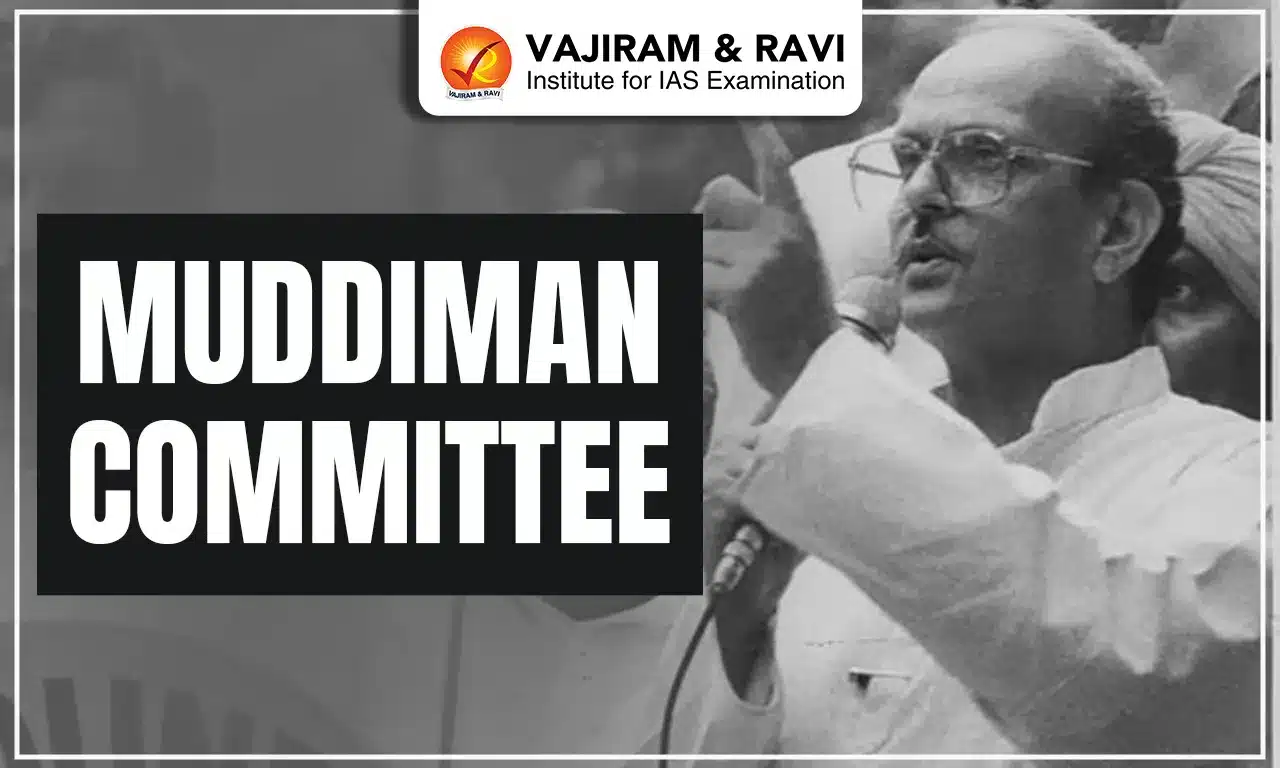
Muddiman Committee, Purpose, Recommendations, Significance

Muddiman Committee

The Muddiman Committee, also known as the Reforms Equiry Committee, was created in 1924 to check the functioning of the constitutional system introduced by the Government of India Act 1919. The act brought the system of dyarchy into effect in the provinces and divided the subjects into “reserved” and “transferred” categories. The committee became the center of political controversy, as Indians strongly criticized its inefficiency and lack of real power-sharing. Growing political unrest and dissatisfaction over the dyarchy system prompted the British government to set up this committee. The committee was chaired by Sir Alexander Muddiman, a senior British civil servant, and consisted of both official and non-official members. In this article, we are going to cover the Muddiman Committee, its purpose, recommendations and outcomes. 

Muddiman Committee Purpose

The Muddiman Committee was created with the goal of reviewing the constitutional reforms introduced by the 1919 Act, with special focus on dyarchy. Its aim was to analyse whether dyarchy had worked in practice, evaluate the criticisms raised by Indians and suggest changes for better governance. The purpose was to question whether the Indian political structure under British rule should remain static or whether it required a built-in mechanism for gradual progress towards self-governance. 

Muddiman Committee Reports Features

The Muddiman Committee submitted its finding in 1925 but the members were completely divided in their opinions. Due to this division, there were two separate reports created- the Majority Report and the Minority Report. 

1. Majority Report 

The report was prepared by the official members and supporters of British Rule. 

It said that the system of dyarchy had not been given a fair trail. 

  • According to them, the defects noticed were due to premature criticism rather than inherent flaws in the Act.
  • They suggested only minor adjustments in the working of the system instead of sweeping reforms.
  • The implication was that the British government should continue with dyarchy and avoid yielding greater political power to Indians.

2. Minority Report (Non-Official)

  • The Minority Report was drafted by non-official Indian members who strongly disagreed with the majority.
  • This report declared that the Government of India Act of 1919 had failed to deliver meaningful constitutional progress.
  • It argued that dyarchy was unworkable in practice and did not meet the aspirations of the Indian people.
  • It recommended that any future Constitution must be permanent in character and provide a mechanism for automatic advancement toward greater self-rule.
  • This report reflected the nationalist demand for a more responsible form of government.

Muddiman Committee Recommendations 

The Muddiman Committee didn't bring any revolutionary changes but it did introduce some important observations. These recommendations included: 

  • Criticism of Dyarchy: Both reports acknowledged the inherent difficulties in the working of dyarchy.
  • Small Adjustments Suggested: The majority sought minor modifications in the responsibilities assigned to non-official Indian ministers.
  • Need for Larger Reforms: The minority pushed for a recognition that the Government of India 1919 reforms had failed and that a permanent Constitution with progressive stages was essential.
  • Appointment of a Royal Commission: The committee recommended that a Royal Commission be appointed to conduct a deeper inquiry into the reforms and propose future changes.

Muddiman Committee Outcome and Government Response

The Secretary of State for India at the time, Lord Birkenhead, rejected the radical proposals of the minority report. Instead, he declared that the government would take action only in line with the majority report, thereby preserving the dyarchy system with limited reforms. However, the criticism of dyarchy continued to intensify in Indian political circles, and this ultimately paved the way for the appointment of the Simon Commission in 1927, which re-examined the working of the 1919 Act.

Muddiman Committee Significance

The Muddiman Committee had the following Significance: 

  • The Committee discussed the deep divisions between official British views and Indian nationalist aspirations.
  • It reinforced the perception among Indians that the British government was unwilling to introduce real reforms.
  • Although the recommendations did not immediately alter the constitutional setup, the minority report became an important document of nationalist critique of the dyarchy system.
  • Its work can be seen as a precursor to the Simon Commission, which took up the task of reviewing constitutional reforms.
Also Check Other Posts
Battle of Plassey Robert Clive
Battle of Buxar Anglo Mysore Wars
Dual Government in Bengal Tipu Sultan
Anglo Maratha Wars Maratha Empire
Third Battle of Panipat Chhatrapati Shivaji Maharaj
Battel of Bhima Koregaon Anglo Burmese War
Maharaja Ranjit Singh Anglo Nepal War

Muddiman Committee FAQs

Q1: What was the aim of the Muddiman Committee?

Ans: The aim of the Muddiman Committee was to examine the working of the Government of India Act, 1919, particularly the system of dyarchy.

Q2: Who were the Indian members of the Muddiman Committee?

Ans: The Indian members included Tej Bahadur Sapru, M.R. Jayakar, and N.N. Sircar.

Q3: Which committee recommended separation of accounts from audit?

Ans: The Lee Commission recommended the separation of accounts from audit in India.

Q4: Who created the Muddiman Committee?

Ans: The British Government appointed the Muddiman Committee in 1924 under Sir Alexander Muddiman.

Q5: What was the Government of India Act, 1919?

Ans: The Government of India Act, 1919, also known as the Montagu–Chelmsford Reforms, introduced dyarchy in provinces and expanded legislative councils with limited Indian participation.

Jain Tirthankaras, 24 Name List, Symbol, Birthplace, Colour

Jain Tirthankaras

In Jainism, Tirthankaras are referred as spiritual teachers who have attained liberation and guide others on the path to salvation. They are also called Jina, meaning “conquerors of all inclinations,” as they have overcome worldly desires and attachments.

There are 24 Jain Tirthankaras. The term “Tirthankara” is derived from Teertha (a sacred ford or pilgrimage place) and Samsara (the cycle of worldly existence). A Tirthankara is one who has transcended samsara and attained Kevala Jnana (perfect knowledge).

Jain Tirthankaras

A Jain Tirthankara is not a divine incarnation (Avatar). He is an ordinary soul born as a human who attains the status of Tirthankara through severe penance, inner serenity, and deep meditation. The position of a Tirthankara represents the highest, purest state of the soul, achieved through self-effort rather than divine intervention.

Unlike prophets or founders of religions, Tirthankaras were not creators of a new faith. Instead, they were omniscient teachers who appeared at different stages of human history. They achieved the ultimate spiritual goal of existence, liberation (moksha) and then guided others to walk the same path.

A Jain Tirthankara is described as one who helps others cross the ocean of samsara (worldly existence) to the safe shores of spiritual purity and freedom.

List of Jain Tirthankaras

Over thousands of years, 24 Jain Tirthankaras have been born to teach the path of Dharma (righteousness). Each Tirthankara is associated with a unique emblem or symbol, which makes them easily identifiable in Jain iconography.

These symbols serve as spiritual markers, reminding devotees of the Tirthankara’s teachings and virtues.

Jain Tirthankaras of the Present Cosmic Age

In the current cosmic age, Jainism recognizes 24 Tirthankaras, spiritual teachers who have attained Kevala Jnana (omniscience). The first Jain Tirthankara is Rishabhanatha, credited with establishing the foundations of Jain teachings. The 24th and last Tirthankara is Mahavira, who is the most widely known and whose teachings form the core of modern Jain practice.

Jain Tirthankaras of the Present Cosmic Age

Sl. No.

Tirthankara Name

Symbol

Birthplace

Colour

1

Rishabhanatha (Adinatha)

Bull

Ayodhya

Golden

2

Ajitanatha

Elephant

Ayodhya

Golden

3

Sambhavanatha

Horse

Shravasti

Golden

4

Abhinandananatha

Monkey

Samet Sikhar

Golden

5

Sumatinatha

Heron

Ayodhya

Golden

6

Padmaprabha

Padma

Samet Sikhar

Red

7

Suparshvanatha

Swastika

Samet Sikhar

Golden

8

Chandraprabha

Crescent Moon

Chandrapuri

White

9

Pushpadanta

Crocodile

Kakandi

White

10

Shitalanatha

Shrivatsa

Bhadrak Puri

Golden

11

Shreyanasanatha

Rhinoceros

Samet Sikhar

Golden

12

Vasupujya

Buffalo

Champapuri

Red

13

Vimalanatha

Boar

Kampilya

Golden

14

Anantanatha

Falcon

Ayodhya

Golden

15

Dharmanatha

Vajra

Ratnapuri

Golden

16

Shantinatha

Antelope or deer

Hastinapur

Golden

17

Kunthunatha

Goat

Hastinapur

Golden

18

Aranatha

Nandyavarta or fish

Hastinapur

Golden

19

Māllīnātha

Kalasha

Mithila

Blue

20

Munisuvrata

Tortoise

Kusagranagar

Black

21

Naminatha

Blue lotus

Mithila

Golden

22

Neminatha

Shankha

Dvaraka

Black

23

Parshvanatha

Snake

Kashi

Blue

24

Mahavira

Lion

Kshatriyakund

Golden

Jain Tirthankaras of the Next Cosmic Age

In Jain cosmology, the next cosmic age is known as the Utsarpiṇī (ascending half-cycle). During this half-cycle, it is believed that 24 Jain Tīrthaṅkaras will be born. The names of these Tīrthaṅkaras in the upcoming cosmic age are as follows:

Jain Tirthankaras of the Next Cosmic Age

Sl. No.

Tīrthankara

Previous Human Birth

1

Rishabhanatha

Nabhi Raja

2

Ajitanātha

Muni Suvrata

3

Sambhavanātha

King Jitāri

4

Abhinandananātha

King Samvaranaraja

5

Sumatinātha

King Megha

6

Padmaprabhā

King Vishvasena

7

Suparśvanātha

King Pratishtha Raja

8

Candraprabhā

King Mahasena

9

Pushpadanta

King Sugriva

10

Śītalanātha

King Dridharatha

11

Śreyāṃsanātha

King Shubhanasa

12

Vāsupūjya

King Vasupujya

13

Vimala

King Chandra

14

Anantanātha

King Dharanendra

15

Dharmanātha

King Bhojaka

16

Śāntinātha

King Nami

17

Kunthunātha

King Vijaya

18

Aranātha

King Taara

19

Mallinātha

King Siddhartha

20

Neminātha

King Samudravijaya

21

Pārśvanātha

King Ashvasena

22

Mahāvīra

King Siddhartha

23

Nandi Vardhana

King Yasas

24

Mahābala

King Rishabha

Jain Tirthankaras Significant

Jain Tirthankaras are spiritual teachers who have attained Kevala Jnana (omniscience) and guide others on the path to liberation. There are 24 Tirthankaras in the current cosmic age, each representing a symbol and inspiring followers with their teachings. Among them, five Tirthankaras, Rishabhdev, Parshvanath, Mahavira, Mallinath, and Neminatha are considered particularly significant for their contributions to Jain philosophy, ethics, and spiritual practice. The table below summarizes key details about these Tirthankaras.

Jain Tirthankaras Significant

Tirthankara

Order

Birthplace / Parents

Key Contributions & Facts

Emblem / Symbol

Nirvana Location

Rishabhdev (Adinatha)

1st

Ayodhya; King Nabhi & Queen Marudevi

First Tirthankara; inspired Jain ethics; sons Bharata & Bahubali; daughter Brahmi linked to Brahmi script

Bull

Mount Kailasa (Digambar) / Ashtapad (Shwetambar)

Parshvanath

23rd

Varanasi; King Ashvasena & Queen Vama

Became ascetic at 30; founded four Ganas; taught peaceful living; only Tirthankara depicted with naga hood

Snake

Sammet Sikhar (Parshvanatha)

Mahavira

24th

Born Vardhamana Mahavir; King Siddhartha & Queen Trishala

Left home at 30; attained Kaivalya at 42; taught five major vows; divided disciples into monks, nuns, laymen, laywomen; celebrated on Deepavali

Lion

Pavapuri

Mallinath

19th

Mithila

Only female Tirthankara; also called Malli

Not specified

Not specified

Neminatha

22nd

Cousin of Lord Krishna

Known as Nemi; depicted with dark complexion; taught spiritual liberation

Not specified

Not specified

Jain Tirthankaras Naam Karma

Jain Tirthankaras Naam Karma is a special type of karma that elevates a soul to the supreme status of a Tirthankara, a spiritual teacher and savior who has conquered saṃsara (the cycle of birth and death) and shown the path to liberation for others. Upon attaining complete self-realization, the Tirthankara achieves Kevala Gyana (omniscience).

The Tattvartha Sutra, an important Jain text, identifies sixteen key observances that cultivate the Tirthankara Naam Karma, guiding aspirants toward spiritual purity and ultimate liberation.

Jain Tirthankaras Naam Karma

Observance

Description

Purity of right faith

Maintaining correct understanding and faith in Jain principles.

Reverence

Showing deep respect for enlightened beings and spiritual practices.

Observance of vows and supplementary vows without transgressions

Strictly following ethical and spiritual vows without violations.

Ceaseless pursuit of knowledge

Constantly seeking spiritual and worldly understanding.

Perpetual fear of the cycle of existence

Awareness of the suffering inherent in birth, death, and rebirth.

Giving gifts (charity)

Selfless acts of generosity to aid others and reduce attachment.

Practising austerities according to one's capacity

Performing penances and self-discipline appropriate to personal ability.

Removal of obstacles that threaten the equanimity of ascetics

Ensuring ascetics can pursue spiritual practices unhindered.

Self-control

Mastering desires, impulses, and emotions.

Purity of conduct

Maintaining ethical and moral behavior in all actions.

Avoidance of injury to living beings

Practicing Ahimsa in thought, word, and deed.

Patience

Cultivating tolerance and endurance in all circumstances.

Truthfulness

Speaking and acting in accordance with truth.

Non-attachment

Avoiding emotional or material attachment to worldly possessions or relationships.

Celibacy

Observing chastity and controlling sexual desires.

Contemplation on the true nature of the self

Deep meditation on the soul’s essence to realize its pure state.

Also Check Other Posts
Jainism Mauryan Administration
Vardhaman Mahavira Ashoka
Jain Councils Post Mauryan Period
Sects of Jainism Indo-Greek Kingdom
Buddhism and Jainism Sangam Age
Mauryan Empire Kushan Empire

Jain Tirthankaras FAQs

Q1: Who are the 24 Jain Tirthankaras?

Ans: They are spiritual teachers who revived Jainism: Rishabhanatha, Ajitanatha, Sambhavanatha, Abhinandananatha, Sumatinatha… Mahavira being the 24th, guiding souls to liberation.

Q2: Who is the most famous Jain Tirthankar?

Ans: Lord Mahavira, the 24th Tirthankara, is the most famous, known for codifying Jain principles of non-violence, truth, and asceticism.

Q3: Who is the 21st Tirthankara of Jainism?

Ans: The 21st Tirthankara is Neminatha, revered for renouncing worldly life and promoting spiritual purity.

Q4: Who is the only female Jain Tirthankar?

Ans: There is no female Tirthankara in Jainism; all 24 Tirthankaras are male, though women can achieve Keval Gyan (liberation).

Q5: Why is Bahubali not a Tirthankara?

Ans: Bahubali attained spiritual liberation through meditation but did not found or revive Jain teachings, so he is a revered monk, not a Tirthankara.

Indian Universities Act 1904, Provisions, Recommendation, Outcome

Indian Universities Act 1904

In 1904, the British Viceroy, Lord Curzon, introduced the Indian Universities Act 1904 based on the recommendations of the Raleigh Commission. The Act tightened government control over Indian universities, reflecting Curzon’s broader aim of curbing the growing wave of nationalism in the country. Earlier, the Hunter Commission had suggested reforms for a stronger education system, but its proposals were never fully implemented. When Curzon became Governor-General, he took it upon himself to push reforms across various spheres of administration, and education became one of his main targets.

Indian Universities Act 1904 Background

The early twentieth century in India was marked by growing political unrest. The colonial government claimed that education under private management had deteriorated and that universities were turning into breeding grounds for political revolutionaries. Nationalists, while acknowledging a decline in quality, blamed the government for failing to tackle widespread illiteracy. 

In this context, the Raleigh Commission was set up in 1902 to examine the functioning of Indian universities and suggest reforms for their constitution and administration. Notably, the commission was restricted from reviewing primary or secondary education. Drawing on its recommendations, the British government introduced the Indian Universities Act in 1904.

Indian Universities Act 1904 Provisions

  • Reconstitution of Governing Bodies: University Senates were restructured and reduced in size (50-100 members). Each member had a six-year term.
  • Elected Fellows: Limited to 50 in Bombay, Calcutta, and Madras universities, and 15 in the other universities.
  • Government Control: Majority of fellows to be appointed by the government, increasing state influence in university administration.
  • Governor-General’s Authority: Empowered to fix the territorial limits of universities and regulate affiliation of colleges.
  • Control Over Universities: Universities and affiliated colleges were placed directly under government supervision.
  • Financial Grant: Annual grant of ₹5 lakh for five years introduced to promote higher education and research, marking the beginning of university grants in India

Indian Universities Act 1904 Recommendation

  • Stronger Government Control: The Act placed universities firmly under colonial supervision, reducing their autonomy.
  • Suppression of Nationalism: By limiting the role of Indians in university governance and tightening rules for private colleges, the Act sought to curb nationalist activities on campuses.
  • Improved Research & Funding: The five-year grant of ₹5 lakh did promote some improvements in higher education and research facilities, marking the start of state-sponsored university grants.
  • Criticism from Nationalists: National leaders and students viewed the Act as an attack on educational freedom and a deliberate attempt to stifle political awakening among youth.

Legacy: While it improved administrative efficiency and research, its controlling provisions created resentment and further fueled the nationalist movement.

Also Check Other Posts
Adi Shankaracharya Bhakti Movements in North India
Ramanujacharya Bhakti Movements in South India
Vallabhacharya Guru Nanak
Lingayats and Veerashaivas Basavanna

Indian Universities Act 1904 FAQs

Q1: Which act was passed in 1904?

Ans: The Indian Universities Act, 1904 was passed to improve higher education administration and strengthen government control over universities in British India.

Q2: What is the Indian Act 1904?

Ans: The Indian Universities Act, 1904, based on the recommendations of the Raleigh Commission (1902), aimed to regulate universities, promote quality education, and increase government supervision.

Q3: Who was the Viceroy of the Indian University Act 1904?

Ans: The Act was enacted under Lord Curzon, Viceroy of India from 1899 to 1905, known for his strong educational reforms and centralizing policies.

Q4: What is the Indian Education Policy 1904?

Ans: Lord Curzon’s education policy of 1904 focused on improving secondary and higher education, tightening university affiliation, encouraging research, and giving government greater say in management.

Q5: What are the features of 1904 Act?

Ans: Key features: stricter university affiliation rules, emphasis on research, creation of fellowships and scholarships, more government representation in university senates, and tighter curriculum control.

Social Audit, History, Component, Principles, Objectives

Social Audit

A Social Audit is the examination of official records to check whether reported government expenditures match the actual funds spent on the ground. It discloses details of both financial and non-financial resources used by public agencies for development projects. The process usually takes place through a public platform, ensuring people’s participation. Social Audits empower citizens to demand accountability and transparency from the government.

They give beneficiaries and communities the chance to review, question, and evaluate government schemes and initiatives. The process involves collaboration between the public and the government in planning, monitoring, and assessing schemes, programs, policies, or laws. Accessibility of information and its wide dissemination are crucial for the effectiveness of social audits.

Social Audit

A Social Audit evaluates an organization’s working procedures and codes of conduct. It examines the impact of the organization’s operations on society and welfare. The focus is on how far the organization meets its stated social objectives. It measures performance not just in economic terms but also in terms of accountability, ethics, and social responsibility.

Social Audit History

The Social Audit History traces back to the mid-20th century, when it first emerged as a theoretical tool to scrutinize government agencies. Its core purpose was to examine whether these institutions were truly meeting their stated social objectives.

By the 1970s, the idea began to move beyond the public sector and into corporate spaces. Companies started recognizing the need to evaluate their broader impact on society. What began as a practice adopted mainly by socially-conscious businesses gradually evolved into a global norm. Today, Social Audit is not just voluntary, it is, in many cases, mandated by law. This shift has been driven by growing concerns around corporate sustainability, social responsibility, and the rise of ethical consumerism.

Social Audit Components

A Social Audit looks at multiple dimensions of an organization’s functioning. Some of its core components include:

  • Ethical employment practices - ensuring fair wages, safe working conditions, and non-discriminatory policies.
  • Environmental responsibility - assessing how operations affect natural resources and whether sustainable practices are followed.
  • Community engagement and investment - measuring contributions toward local development, welfare initiatives, and inclusive growth.
  • Consumer protection - safeguarding customer interests through fair pricing, product safety, and grievance redressal mechanisms.
  • Transparency in operations - maintaining openness in financial dealings, decision-making, and accountability mechanisms.

Social Audit Principles

The Social Audit Principles act as a framework that ensures the process is meaningful and reliable. These include:

  • Participation - Active involvement of all stakeholders, including employees, beneficiaries, and community members, to capture diverse perspectives.
  • Ethics - Upholding integrity, fairness, and honesty throughout the audit process.
  • Transparency - Openly sharing organizational practices, social impacts, and responses to audit findings.
  • Comprehensiveness - Covering every significant aspect of an organization’s operations and their wider social consequences.
  • Comparability - Using consistent methods so results can be measured across time or benchmarked against other organizations.

Social Audit Objectives

The Social Audit Objectives explain why the process is carried out and what it aims to achieve. Key objectives include:

  • Assessing Social Impact - Measuring how an organization’s policies and activities affect the community, environment, and society at large.
  • Promoting Transparency - Ensuring clarity on how resources are used and how decisions translate into real social outcomes.
  • Encouraging Accountability - Holding organizations responsible for both their positive contributions and any adverse impacts.
  • Empowering Stakeholders - Giving employees, communities, and beneficiaries access to relevant information so they can make informed choices and voice concerns.
  • Increasing Improvement - Highlighting gaps and recommending changes that push organizations towards more ethical, sustainable, and socially beneficial practices.

Social Audit Conducting Process

  • Preparation of Calendar - The Social Audit Unit prepares an annual audit calendar and shares it with District Programme Coordinators (DPCs) for necessary arrangements.
  • Awareness - Workers and villagers are informed in advance about the Gram Sabha that will host the social audit.
  • Access to Records - The Program Officer (PO) provides the Social Audit Team with all required records from implementing agencies.
  • Verification - Resource persons and local stakeholders verify documents and physically inspect works undertaken.
  • Gram Sabha Discussion - A Gram Sabha is convened to present verification findings and allow villagers to raise questions or request further details.
  • Official Accountability - Officials responsible for program implementation must attend and respond to queries raised by Gram Sabha members.
  • Supervision - The DPC or an authorized representative oversees the Gram Sabha proceedings.
  • Review of Past Actions - Each meeting begins with the reading of the Action Taken Report from the previous social audit.
  • Documentation - All issues are recorded in writing, evidence is collected, and the Gram Sabha proceedings are video recorded and uploaded online.
  • Preparation of Report - The Social Audit Unit drafts the report in the local language and displays it on the Gram Panchayat notice board for at least seven days.
  • Listing of Issues - Reports contain grievances needing redressal and separate findings that require criminal investigation.
  • Follow-Up - Action Taken Reports on issues raised by the Gram Sabha are provided to both the Social Audit Unit and the individuals concerned.

Laws Related Social Audit

Meghalaya became the first state in India to pass a law dedicated to social audits with the enactment of the Meghalaya Community Participation and Public Services Social Audit Act, 2017. The Act institutionalized social audits as a tool for ensuring accountability in government programs and public services.

  • Social Audit Facilitator - The Act provides for the appointment of a facilitator who directly engages with the people and conducts the audit at the grassroots level.
  • Gram Sabha Involvement - Findings from the audit are first presented to the Gram Sabha, which gives its feedback and forwards the results to the auditors.
  • Social Audit Council (SAC) - A statutory body under the Act, the SAC monitors and evaluates government projects during their implementation.
  • Scope of Audit - The Act identifies specific projects, programs, and schemes that must undergo social audits to ensure transparency and citizen oversight.

Social Audit Importance

A Social Audit goes beyond financial accountability. It creates a platform for organizations to demonstrate how they address social, economic, and environmental concerns. Its importance can be understood in the following ways:

  • Building Trust with Stakeholders - By being transparent, organizations strengthen confidence among employees, customers, investors, and the community, fostering long-term relationships.
  • Facilitating Business Growth - Social audits help identify gaps in policies and practices. Addressing these issues not only improves efficiency but also supports sustainable business growth.
  • Upholding Corporate Social Responsibility (CSR) - Social audits ensure that organizations remain accountable for the impact of their actions, reinforcing their commitment to ethical practices and societal well-being.

Social Audit Benefits

The advantages of conducting a social audit can be broadly grouped into three categories:

  • Operational Benefits - Social Audits help identify inefficiencies, resource mismanagement, or gaps in implementation. This leads to better planning, improved delivery of services, and enhanced overall efficiency.
  • Strategic Benefits - By linking organizational goals with social and environmental responsibilities, social audits guide leadership in making informed, forward-looking decisions that balance growth with sustainability.
  • Reputational Benefits - Transparent reporting and positive social audit outcomes strengthen credibility. They build trust among stakeholders, consumers, and the community, giving the organization a stronger social license to operate.

Social Audit Limitations

Despite its many advantages, social audit also comes with certain limitations that cannot be overlooked:

  • Subjectivity: Measuring social impact is inherently subjective, and it’s difficult to capture it in a universally accepted, quantifiable way.
  • Lack of Standardization: Since there are no fixed global standards for social audits, the methods and results often vary, leading to inconsistencies.
  • Cost Intensive: For smaller organizations, social audits can be financially demanding because they require external experts, detailed research, and comprehensive reviews.
  • Time-Consuming: Conducting a thorough audit involves careful data collection, in-depth analysis, and detailed reporting, which takes considerable time.

Organizational Reluctance: Some companies hesitate to undertake social audits, worried that unfavorable findings might harm their public image.

Also Check Other Posts
Civil Society FCRA
India's Ranking in Different Indexes 1st ARC Report

Social Audit FAQs

Q1: What is the meaning of social audit?

Ans: A social audit evaluates government schemes by involving citizens, verifying records with ground realities, ensuring transparency, accountability, and measuring community impact beyond financial performance.

Q2: What is social audit in UPSC?

Ans: In UPSC, social audit refers to participatory review of government schemes, especially MGNREGA, ensuring transparency, citizen empowerment, reduced corruption, and accountability in public service delivery.

Q3: What is an example of a social audit?

Ans: A classic example is MGNREGA social audits in Andhra Pradesh and Rajasthan, where villagers publicly verify muster rolls, wage payments, and actual work done.

Q4: What are the five steps in a social audit?

Ans: Steps include planning the audit, collecting official records, verifying data with field evidence, conducting public hearings (Jan Sunwai), and reporting findings for corrective measures.

Q5: Who is the father of social audit?

Ans: T. N. Seshan promoted accountability, but Aruna Roy and MKSS are pioneers of India’s social audits, institutionalizing transparency in schemes like MGNREGA.

Red Fort

Red Fort

Red Fort Latest News

A ‘black crust’ is forming on the walls of the Red Fort due to high levels of air pollution, a recent study has found.

About Red Fort

  • The Red Fort, or Lal Qila, is a Mughal fort located in Delhi, India.
  • Formerly known as Quila-e-Mubarak, or the Blessed Fort, the Red Fort lies along the banks of the river Yamuna, whose waters fed the moats surrounding the fort. 
  • It was built as the palace fort of Shahjahanabad – the new capital of the fifth Mughal Emperor of India, Shah Jahan.
  • Shah Jahan constructed it in 1639. It was designed by architects Ustad Ahmad Lahauri and Ustad Hamid.
  • Named for its massive enclosing walls of red sandstone, it is adjacent to an older fort, the Salimgarh, built by Islam Shah Suri in 1546, with which it forms the Red Fort Complex.
  • The fort complex served as the residence of Mughal Emperors for nearly 200 years, until 1857.
  • The fort was designated a UNESCO World Heritage site in 2007.
  • From the fort each year on Independence Day (August 15), the Indian prime minister participates in a flag-raising ceremony and delivers a televised address to the country.

Red Fort Architecture

  • The Red Fort’s massive red sandstone walls, which stand 75 feet (23 metres) high, enclose a complex of palaces and entertainment halls, projecting balconies, baths and indoor canals, and geometrical gardens, as well as an ornate mosque.
  • The planning of the palace is based on Islamic prototypes, but each pavilion reveals architectural elements typical of Mughal buildings, reflecting a fusion of Persian, Timurid, and Hindu traditions.
  • The fort is octagonal, with the north-south axis longer than the east-west axis.
  • Among the most famous structures of the complex are the Hall of Public Audience (Diwan-i-ʿAm), which has 60 red sandstone pillars supporting a flat roof, and the Hall of Private Audience (Diwan-i-Khas), which is smaller and has a pavilion of white marble.
  • The marble, floral decorations, and double domes in the fort's buildings exemplify later Mughal architecture.
  • It has 2 principal gates–Lahore Drawaza and Delhi Darwaza along its western and southern sides, respectively.

Source: TH

Red Fort FAQs

Q1: Who built the Red Fort?

Ans: The Mughal Emperor Shah Jahan built the Red Fort in the mid-17th century.

Q2: What was the original name of the Red Fort?

Ans: Quila-e-Mubarak

Q3: Who were the principal architects of the Red Fort?

Ans: It was designed by architects Ustad Ahmad Lahauri and Ustad Hamid.

Q4: The Red Fort lies adjacent to which older fort built by Islam Shah Suri?

Ans: Salimgarh Fort

Exercise Pacific Reach 2025

Exercise Pacific Reach 2025

Exercise Pacific Reach 2025 Latest News

Indian Navy’s latest indigenously designed and constructed Diving Support Vessel (DSV) INS Nistar is participating in Exercise Pacific Reach 2025 in Singapore.        

About Exercise Pacific Reach 2025

  • It is a multinational conducted in Singapore.     
  • It is a biennial exercise which will witness participation of more than 40 nations.
  • The exercise is mainly conducted in two phases, including the harbour and sea phases.
  • Focus of the Exercise: The harbour phase will involve in-depth discussions on submarine rescue systems, Subject Matter Expert Exchanges (SMEE), a medical symposium and cross-deck visits between the participating nations.
  • The Sea phase of the exercise would witness INS Nistar and Submarine Rescue Unit (E) engaging in multiple intervention and rescue operations with participating assets in the South China Sea.

Key Facts about INS Nistar

  • It was commissioned on 18 Jul 2025.
  • It was developed by HSL, Visakhapatnam, under the Ministry of Defence’s ‘Aatmanirbhar Bharat’ initiative.
  • The ship with its Side Scan Sonar, Work & observation class ROVs and expansive deep sea diving systems will be carrying out the role of mothership (MoSHIP) for Deep Submergence Rescue Vehicle (DSRV).
  • Diving and Rescue Capabilities
    • Integrated Saturation Diving System (ISDS): Enables diver deployment at depths up to 300 meters, supporting underwater repairs, salvage, and rescue operations.
    • Remotely Operated Vehicles (ROVs): These can be deployed for underwater surveillance and recovery missions in deep waters.
    • Side Scan Sonar and Integrated Platform Management System (IPMS): Aid in locating submerged vessels or wreckage and managing onboard systems, respectively.
    • Submarine Rescue System: Especially crucial for submarine emergencies, allowing the timely and safe recovery of personnel from disabled submarines.

Source: News On AIR

Exercise Pacific Reach 2025 FAQs

Q1: Which country is hosting the Exercise Pacific Reach 2025?

Ans: Singapore

Q2: Which countries border the South China Sea?

Ans: Brunei, Indonesia, Malaysia, Myanmar, Laos, China, Philippines, Thailand, Vietnam, and Singapore.

Carlsberg Ridge

Carlsberg Ridge

Carlsberg Ridge Latest News

The government recently signed a contract with the International Seabed Authority to explore polymetallic sulphur nodules in the Carlsberg Ridge.

About Carlsberg Ridge

  • It is a mid-oceanic ridge (a divergent plate boundary) located in the Indian Ocean. 
  • The ridge extends from the triple junction of the African, Indian, and Australian tectonic plates (where it connects to the Mid-Indian Ridge) northwest to the Gulf of Aden. 
  • The ridge separates the Arabian Sea to the northeast from the Somali Basin to the southwest. 
  • It marks the boundary between the Somali Plate and the Indian Plate.
  • The mean depth of the Carlsberg Ridge is between some 6,000 and 12,000 feet (1,800 and 3,600 meters) below the sea surface, and it rises to a mean elevation of about 7,000 feet (2,100 meters) above the seafloor.
  • The ridge turns westward around the island of Socotra and eventually connects with the East African Rift System by way of the Gulf of Aden.
  • It is the most prominent mid-ocean ridge segment of the western Indian Ocean, which contains a number of earthquake epicenters.

Source: TH

Carlsberg Ridge FAQs

Q1: The Carlsberg Ridge is located in which ocean?

Ans: Indian Ocean

Q2: What plate boundary is the Carlsberg Ridge on?

Ans: The ridge extends from the triple junction of the African, Indian, and Australian tectonic plates.

Q3: Which two regions does the Carlsberg Ridge separate?

Ans: Arabian Sea and Somali Basin

Q4: What is the mean depth of the Carlsberg Ridge below the sea surface?

Ans: 6,000–12,000 feet

Red Coral Kukri Snake

Red Coral Kukri Snake

Red Coral Kukri Snake Latest News

Recently, a rare Red Coral Kukri Snake species, last reported in 1936, was recently found trapped in a net in a village field near Pilibhit Tiger Reserve.

About Red Coral Kukri Snake

  • It is identified as Oligodon kheriensis. 
  • It is one of the rarest non venomous snake species.
  • This nocturnal and fossorial snake is specialized with curved teeth like kukri (Nepalian Knife). Hence, they are called “Kukri”.
  • Appearance: Its whole body including the head is uniform bright coral-red without any patterns and the underside is yellowish or pinkish hence it is one of the most distinct snakes of its range.
  • Its head is short, not broader than the neck and bears an obtusely pointed snout.
  • Distribution: It is widely distributed in lowlands (below 1500ft) of Himalayan foothills from Uttrakhand, Nepal, northern parts of Uttar Pradesh, Bihar and West Bengal to Sikkim and western Assam.

Conservation Status of Red Coral Kukri Snake

  • IUCN: Least Concern (LC)
  • Wild Life Protection Act: Schedule –IV

Key Facts about Pilibhit Tiger Reserve

  • It is located in the state of Uttar Pradesh.
  • It lies along the India-Nepal border in the foothills of the Himalayas and is part of the Terai Arc Landscape.
  • Rivers: The river Gomti originates from the PTR, which is also the catchment of several others like Sharda, Chuka, and Mala Khannot.
  • Habitat: The habitat is characterized by dense sal forests and tall alluvial grasslands, savannahs, and impenetrable swamps, maintained by periodic flooding from rivers. 
  • The Sharda Sagar Dam, extending up to a length of 22 km, is on the boundary of the reserve.
  • It has a dry and hot climate, which brings a combination of dry teak forest and Vindhya Mountain soils.

Source: PTI

Red Coral Kukri Snake FAQs

Q1: Is Red coral kukri snake poisonous?

Ans: It is a nocturnal non venomous reptile.

Q2: What is the study of snakes called?

Ans: The study of snakes is called Herpetology.

Doctrine of Escheat

Doctrine of Escheat

Doctrine of Escheat Latest News

The Supreme Court recently held that a State Government cannot invoke the doctrine of escheat under Section 29 of the Hindu Succession Act once a Hindu male has executed a Will, which has been declared to be valid and has been granted probate by a Court.

About Doctrine of Escheat

  • It is a significant legal concept that ensures no property is left without ownership, reverting it to the state if the original owner dies without legal heirs or fails to make a will. 
  • This legal process addresses the handling of unclaimed assets, protecting societal interests and maintaining order within the legal framework.
  • The doctrine addresses two primary situations: 
    • when a person dies intestate (without a will) and without heirs, and 
    • when property remains unclaimed or abandoned for a specific period.
  • The underlying principle of escheat is that property must always have an identifiable owner, and in the absence of heirs, the government assumes ownership. 
  • In modern legal systems, escheat serves as a way to maintain orderly succession and prevent assets from being wasted or misused.

Historical Origins of Escheat

  • Escheat originates from the Old French word “eschete,” meaning “to fall to”.
  • The concept of escheat is rooted in the feudal system of medieval Europe, where land was held by tenants under a lord.
  • If the tenant died without an heir or was convicted of certain crimes like treason, the land would escheat, or revert, to the lord. 
  • This system allowed for continuous control of land, ensuring that property remained within the hierarchy of the feudal structure. 
  • Over time, this evolved to include the monarch or the state as the ultimate recipient of property without heirs.

Escheat in Modern Legal Systems

  • In modern legal systems, escheat ensures that unclaimed or ownerless property does not remain in limbo but is transferred to the state. 
  • The state assumes ownership of such property, either permanently or temporarily, until rightful claimants can be found. 
  • Escheat laws vary across jurisdictions, with some countries having well-defined processes for handling unclaimed assets.
  • In India, escheat is regulated primarily through Section 29 of the Hindu Succession Act, 1956, and Article 296 of the Constitution. 
    • These provisions outline the circumstances under which property escheats to the state, safeguarding against unclaimed or abandoned property.
    • However, the Supreme Court made it clear that the doctrine of escheat under Section 29 of the Hindu Succession Act, 1956, is a remedy of last resort; it comes into play only when a person dies intestate and without any legal heirs.
    • Where a valid will is executed and duly probated, the property must devolve strictly in line with the testator’s intent, leaving no room for the State to assert rights over the estate.

Source: LIVELAW

Doctrine of Escheat FAQs

Q1: What does the Doctrine of Escheat primarily deal with?

Ans: Reversion of property to the state when there are no heirs or will.

Q2: The term “escheat” originates from which language?

Ans: Escheat originates from the Old French word “eschete,” meaning “to fall to”.

Q3: In modern legal systems, what is the purpose of escheat?

Ans: To ensure property always has an identifiable owner

Q4: Is the doctrine of escheat regulated in India?

Ans: In India, escheat is regulated primarily through Section 29 of the Hindu Succession Act, 1956, and Article 296 of the Constitution.

Centre for Cellular and Molecular Biology (CCMB)

Centre for Cellular and Molecular Biology

Centre for Cellular and Molecular Biology Latest News

Scientists at CSIR-Centre for Cellular and Molecular Biology (CCMB) recently discovered how white blood cells can adapt their internal skeletons to combat pathogens.

About Centre for Cellular and Molecular Biology

  • It is India’s premier research organization in frontier areas of modern biology. 
  • The objectives of the Centre are to conduct high-quality basic research and training in frontier areas of modern biology, and promote centralized national facilities for new and modern techniques in the interdisciplinary areas of biology.
  • Located in Hyderabad, Telangana, CCMB is a constituent laboratory of the Council of Scientific and Industrial Research (CSIR), a renowned national organization under the Ministry of Science and Technology, Government of India.
  • Established in 1977, CCMB has emerged as a global leader in cellular and molecular research and is known for its contributions to understanding the molecular mechanisms that govern biological systems.
  • CCMB’s work spans various disciplines of biology, including genetics, biotechnology, bioinformatics, immunology, and molecular medicine. 
  • The institution is well-regarded for its cutting-edge research in molecular biology, genomics, proteomics, and cellular mechanisms.
  • The centre’s research is both fundamental and translational, focusing on problems that have wide-ranging implications for medicine, disease management, agricultural improvement, and environmental sustainability. 
  • CCMB has state-of-the-art facilities for research, including a high-throughput genomics facility and a bioinformatics centre.
  • The institute also offers training programs and workshops for students and researchers and collaborates with national and international institutions.
  • CCMB is a designated "Center of Excellence" by the Global Molecular and Cell Biology Network, UNESCO.

Source: NIE

Centre for Cellular and Molecular Biology FAQs

Q1: Where is the Centre for Cellular and Molecular Biology (CCMB) located?

Ans: Hyderabad, Telangana

Q2: Centre for Cellular and Molecular Biology (CCMB) is a constituent laboratory of which organization?

Ans: CCMB is a constituent laboratory of the Council of Scientific and Industrial Research (CSIR).

Q3: In which year was the Centre for Cellular and Molecular Biology (CCMB) established?

Ans: 1977

Persian and Greek Invasions in India, Impact, Key Details

Persian and Greek Invasions

The Persian and Greek Invasions into India became an important turning point in the history of the subcontinent. These foreign conquests started in the 6th century BCE and brought not only conflict but also long-lasting cultural, political and economic consequences. During the time of invasion, the northwestern frontiers of India lacked strong central authority and were divided into small principalities such as Gandhara and Kamboja, constantly at war with one another. The natural passes of the Hindukush mountains provide an easy entry into the fertile plains of India, making the region highly vulnerable to repeated invasions. The Persians were the first to march into this frontier, followed later by the Greeks under the leadership of Alexander the Great. In this article, we are going to cover the Persian and Greek Invasions in India.

Persian and Greek Invasion in India

The Persian and Greek invasions of India were far more than mere military encounters. While the Persians introduced administrative practices, new scripts, and artistic influences, the Greeks opened India to western cultural exchanges, trade, and art forms. Both invasions, though external, shaped India’s internal development, particularly in terms of political unity and cultural enrichment. Their legacies continued to influence Indian history, leading to the rise of the Mauryan Empire, which became the first great pan-Indian political power.

Also Read: Mahajanapadas

Persian Invasion of India

The Persian Invasion of India took place in the sixth century BCE, while Magadha was emerging as a powerful force in eastern India and the northwestern part of India remained fragmented. The rich resources and lack of a unified kingdom attracted foreign powers. The Achaemenid rulers of Persia, sensed the disunity and began their eastward campaigns laying the foundation of India-Persia contact. 

Cyrus the Great

Cyrus was the founder of Achaemenid Empire and the first to invade India around 535 BCE. His conquests extended as far as the Indus River and the tribes west of the Indus submitted to him and the Gandhara was incorporated into his empire. According to the Behistun Inscription, the conquered Indian Territory was brought under the Satrapy province of Gandhara, administered by a satrap, governor. Although his campaigns in India were limited, they marked the beginning of foreign incursions into the subcontinent. 

Darius I

Cyrus’s son Cambyses neglected India, but his successor and grandson, Darius I, expanded Persian influence further. In 516 BCE, Darius annexed Punjab, Sindh, and the region west of the Indus. These areas became part of the 20th satrapy of the Persian Empire, recognized as one of the most fertile and revenue gaining provinces. Surprisingly, the tribute collected from India amounted to 360 talents of gold, nearly one-third of Persia’s total revenue from Asia. Indians were recruited into the Persian army, and Darius even sent an expedition under Skylax to explore the Indus River, improving geographical knowledge and opening new trade routes.

Xerxes

Darius was succeeded by Xerxes, who also utilized Indian resources for his military campaigns. Indian army and infantry were sent to fight in Greece during his wars with the Greeks. However, the defeat of Xerxes led to a decline in Persia’s aggressive policy towards India, decreasing their ambitions in the region.

Persian Invasion Impact

Persian contact with India lasted for nearly two centuries and created significant changes:

  • Trade and Commerce: Indo-Iranian trade flourished, as seen in the circulation of Persian coins in northwestern India.
  • Script: The Kharoshthi script, written from right to left, was introduced by Iranian scribes and remained in use for centuries.
  • Art and Architecture: Mauryan art, especially Ashoka’s pillars and monuments, bore clear Iranian influence in their polished finish and stylistic features.
  • Administration: The idea of issuing royal edicts, along with certain administrative practices, can be traced to Persian traditions.
  • Link to Greek Invasion: Crucially, Persian campaigns introduced the Greeks to India’s wealth, laying the path for Alexander’s later invasion.

Also Read: Magadha Empire

Greek Invasion of India

By the fourth century BCE, the Persian Empire came into conflict with the Greeks. Alexander of Macedonia, succeeding his father Philip in 334 BCE, launched an ambitious campaign against Persia. After defeating Darius III in the famous Battle of Arbela, Alexander conquered Persia, Iraq, and much of Asia. Inspired by accounts of India’s immense wealth and driven by the belief that India marked the eastern edge of the known world, Alexander advanced towards the subcontinent. He entered India through Kabul and the Khyber Pass, benefiting from the disunity of Indian states.

Battle of Hydaspes

One of the most significant confrontations occurred with Porus, the ruler of Punjab. When Porus refused to submit, the two armies clashed in the Battle of Hydaspes (326 BCE) on the banks of the Jhelum River. Though Porus was defeated, Alexander was deeply impressed by his valor and reinstated him as a subordinate ruler. Alexander’s armies went eastward up to the River Beas. However, his soldiers were tired by years of continuous warfare and doubtful of facing the powerful kingdoms further east, mutinied and refused to proceed. Reluctantly, Alexander turned back.

Retreat and Administration

During his retreat, Alexander reorganized his Indian territories by dividing them among three governors. He restored autonomy to rulers who accepted his authority. Unfortunately, Alexander fell ill during his journey back and died at Babylon in 323 BCE, leaving behind no clear successor.

Greek Invasion Impact

The Greek invasion also had huge consequences on the Indian Subcontinent: 

  • Cultural Exchange: Direct contact was established between India and Greece, paving the way for cultural fusion.
  • Trade Routes: Four new routes by land and sea were opened, improving connectivity between India and the Mediterranean world.
  • Settlements: Several Greek communities settled in northwestern India, continuing even under Mauryan rule.
  • Historical Records: Greek historians accompanying Alexander documented Indian society, economy, and polity, providing invaluable accounts.
  • Artistic Influence: The Gandhara School of Art, blending Indian themes with Greco-Roman techniques, emerged as a legacy of this cultural synthesis.
  • Political Unity: The disunity witnessed by Alexander highlighted the need for political consolidation. This indirectly set the stage for Chandragupta Maurya to unify northern India under the Mauryan Empire. Tradition also suggests that Chandragupta learned from Alexander’s military tactics, which aided his success against the Nandas.

Persian and Greek Invasions FAQs

Q1: Who invaded India first, Persian or Greek?

Ans: The Persians invaded India first under Darius I in the 6th century BCE.

Q2: How did the Persians invade Greece?

Ans: The Persians invaded Greece through large-scale military campaigns led by Darius I and later Xerxes via land and sea routes.

Q3: How did the Greeks invade India?

Ans: The Greeks, under Alexander the Great, invaded India in 326 BCE after crossing the Hindu Kush mountains.

Q4: Who fought the Battle of Hydaspes?

Ans: The Battle of Hydaspes (326 BCE) was fought between Alexander the Great and King Porus on the banks of the River Jhelum.

Q5: Who was Darius I?

Ans: Darius I, also known as Darius the Great, was the Persian king of the Achaemenid dynasty who expanded the empire into India.

Polypropylene

Polypropylene

Polypropylene Latest News

Recently, the Prime Minister of India laid the foundation stone for a polypropylene (PP) plant at Numaligarh Refinery Limited (NRL) at Golaghat in Assam.

About Polypropylene

  • It is a thermoplastic polymer produced by the addition polymerization of propylene.
  • It is a synthetic resin built up by the polymerization of propylene.
  • It is one of the important families of polyolefin resins.
  • Polypropylene is molded or extruded into many plastic products in which toughness, flexibility, light weight, and heat resistance are required.

Properties of Polypropylene

  • It is highly resistant to chemical corrosion, making it an excellent choice for packaging of cleaning products and bleaches.
  •  It is a commodity plastic with low density and high heat resistance. 
  • Flammability: PP is a highly flammable material.
  • Density: PP is one of the lightest polymers among all commodity plastics.

Application of Polypropylene

  • It is widely used in polymer materials in the plastic manufacturing industry to produce various end products, especially plastic packaging.
  • Polypropylene has high insulation properties too, making it safe to use for plastic casing in electrical goods and cables. 
  • It offers impressive chemical and biological-resistant properties and makes polypropylene an obvious choice for the medical industry.

Source: PIB

Polypropylene FAQs

Q1: What is a Polymer?

Ans: It is a substance composed of molecules with a large molecular mass of repeating structural units or monomers connected by covalent chemical bonds.

Q2: What is propylene used for?

Ans: It is used mainly in the preparation of alkylates for gasoline and in the production of polypropylene, acrylonitrile, propylene oxide.

Eustoma

Eustoma

Eustoma Latest News

Recently, the National Botanical Research Institute (NBRI), a research arm of the Council of Scientific and Industrial Research (CSIR), has achieved a breakthrough by cultivating Eustoma flower in Odisha.      

About Eustoma

  • It is commonly known as Lisianthus or Prairie Gentian or Texas Bluebell.
  • It is a perennial herbaceous ornamental species that is used as a cut flower and is among the top ten popular cut flowers globally.
  • The plant originates from the grasslands of North America.
  • Features: It is admired for its wide colour range, long vase life and suitability for cut flowers and potted plants.       
  • Because of its enormous rose‐like blossoms, long stems and extended vase life, its sales have increased dramatically in recent years, earning it the title of ‘next rose’. 
  • Habitat: It typically grows in grasslands and disturbed areas, thriving in warm climates.
  • Soil Required: Well drain, moisture-retentive soil and garden compost or well-rotted manure.
  • It is native to Mexico, southern USA, Caribbean, and northern South America.
  • It has a great cosmopolitan demand mainly for its large and attractive flowers, long and hard stem, wide range of colors.

Source: TH

Eustoma FAQs

Q1: Where is CSIR's headquarters located?

Ans: New Delhi

Q2: What are herbaceous ornamental plants?

Ans: Herbaceous ornamentals are plants that have flexible stems and die back to the ground each year.

Lake Natron

Lake Natron

Lake Natron Latest News

Recently, Tanzania's government halted a planned large-scale soda ash mining project at Lake Natron.        

About Lake Natron

  • Location: It is a salt lake located on the border between Tanzania and Kenya.
  • It is part of the eastern branch of the Great Rift Valley.
  • It has a unique composition of warm waters and salt, caustic soda, and magnesite deposits that provide ideal conditions for flamingos to thrive.
  • It was designated as a Ramsar Site of International Importance in 2001.
  • Primarily, the lake is fed by the Ewaso Ng’iro River, which originates from the central region of Kenya.
  • One of the most striking features of this Lake is its striking red coloration. The primary reason for its hue lies in its extreme alkalinity.
  • It is the only reliable breeding ground for Lesser Flamingos in Africa, supporting up to 75 per cent of the world’s population. 
  • Lesser flamingos feed on Lake Natron with Shompole volcano (situated on the border of Kenya and Tanzania) in the distance at the northern end of the lake.
  • Threats: Several factors, including agriculture, pollution, and climate change, are threatening the beauty of this unique ecosystem.

Source: DTE

Lake Natron FAQs

Q1: Is Lake Natron a Ramsar site?

Ans: Lake Natron was designated as a Ramsar Site.

Q2: Which river drains into Lake Natron?

Ans: Southern Ewaso Ng'iro

Daily Editorial Analysis 16 September 2025

Daily Editorial Analysis

Unlocking Innovation with India’s Procurement Reforms

Context

  • Procurement is often seen as a dry administrative function, designed primarily to enforce transparency and contain costs.
  • Yet, for research and development (R&D), procurement is far more than a compliance mechanism; it is a decisive factor in determining whether scientific ideas can be translated into breakthroughs.
  • Policies that prioritise rigid control over flexibility frequently stifle innovation, while those that balance accountability with creativity can act as powerful accelerators of technological progress.
  • India’s recent reforms to its General Financial Rules (GFR), which ease restrictions on R&D procurement, offer an opportunity to reposition procurement as a driver of scientific ambition rather than an obstacle to it.

The Dual Nature of Procurement

  • The tension between cost efficiency and innovation in procurement is not new.
  • While anti-fraud frameworks safeguard public funds, they can unintentionally suffocate research by valuing procedural compliance over scientific need.
  • This was evident in India’s pre-reform system, where researchers were compelled to purchase equipment through the Government e-Marketplace (GeM), even when the platform lacked the specialised instruments necessary for cutting-edge work.
  • Scientists often had to endure long exemption processes, and the portal frequently delivered substandard materials that compromised research outcomes.
  • Yet procurement, if reimagined, can serve as an innovation catalyst.
  • Studies show that public procurement, when targeted, stimulates private R&D investment and drives patent activity, creating a self-reinforcing cycle of technological advancement.
  • Brazil’s experience, however, illustrates the danger of generic procurement rules: unless explicitly designed with innovation in mind, such frameworks rarely yield transformative results.

India’s Reforms: Incremental but Significant

  • In June 2025, the Government of India introduced reforms that directly addressed many of these bottlenecks.
  • By allowing institutional heads to bypass GeM for specialised equipment and raising direct purchase thresholds from ₹1 lakh to ₹2 lakh, the changes acknowledge that one-size-fits-all procurement is incompatible with the bespoke needs of research.
  • Delegating authority for global tenders up to ₹200 crore to vice-chancellors and directors further reduces bureaucratic delays, a chronic grievance flagged by policymakers and scientists alike.
  • These reforms embody the principles of catalytic procurement, where flexibility enables public institutions to act as early adopters of advanced technologies.


Global Lessons in Market-Shaping Procurement

  • India’s reforms can be better understood in the context of global procurement evolution.
  • Germany’s High-Tech Strategy, for example, institutionalises innovation-oriented procurement through KOINNO, a dedicated agency that curates supplier databases and fosters cross-sector collaboration.
  • The United States’ Small Business Innovation Research (SBIR) program similarly leverages procurement contracts to derisk early-stage technologies while sustaining competition among vendors.
  • South Korea’s pre-commercial procurement model even pays premium prices for prototypes that meet ambitious technological goals.
  • These approaches demonstrate what economist Mariana Mazzucato terms mission-oriented procurement: the deliberate use of state purchasing power to shape technological markets.

The Debate on Privatisation and the Way Forward

  • The Debate on Privatisation

    • The discussion around procurement often leads to calls for privatising national laboratories, arguing that corporate-style agility could bypass bureaucratic hurdles.
    • However, this debate risks becoming a false binary.
    • The S. experience with Sandia National Laboratories demonstrates that hybrid models are possible: while management shifted to a private company, government oversight remained intact, resulting in a surge of patents and industry partnerships.
    • India’s Council of Scientific and Industrial Research (CSIR) could benefit from such a hybrid approach, particularly in high-cost and strategic domains like quantum computing.
    • But this requires robust accountability frameworks and a clear alignment with national innovation roadmaps.
    • Privatisation alone, without performance-linked funding or competitive incentives, risks creating inefficiencies rather than solving them.
  • The Way Forward: Toward a New Procurement Paradigm

    • India’s current reforms are necessary but insufficient. Four systemic interventions could drive deeper change.
    • First, tenders must be outcome-weighted, evaluating bids not just on cost but also on innovation potential and scalability, as seen in Finland.
    • Second, elite institutions should be granted sandbox exemptions, freeing them from rigid procurement rules if they meet externally audited innovation targets.
    • Third, India should harness AI-augmented sourcing, using tools from the INDIAai ecosystem to predict delays and scan global markets in real time.
    • Finally, co-procurement alliances, similar to the European Union’s Joint Procurement Agreement, could pool demand across Indian laboratories for expensive equipment, achieving economies of scale.

Conclusion

  • Procurement is not a peripheral bureaucratic function; it is a central research variable.
  • India’s GeM reforms mark an important shift toward recognising this reality, but they remain a cautious first step rather than a paradigm shift.
  • By adopting global best practices in mission-oriented procurement, leveraging AI-driven tools, and experimenting with hybrid governance models, India can transform procurement into a catalyst for discovery.

Unlocking Innovation with India’s Procurement Reforms FAQs

Q1. Why do traditional procurement policies often hinder research and development?
Ans. Traditional procurement policies hinder research and development because they prioritise cost control and compliance over the specialised needs of scientific work.

Q2. What key reforms did India introduce in June 2025?
Ans. India’s reforms allowed institutional heads to bypass the GeM portal for specialised equipment, raised direct purchase limits to ₹2 lakh, and delegated authority for global tenders up to ₹200 crore.

Q3. How have countries like Germany and the United States used procurement to promote innovation?
Ans. Germany uses its High-Tech Strategy to promote innovation through mission-oriented procurement, while the U.S. supports startups via its Small Business Innovation Research program. 

Q4. What is meant by “cognitive procurement”?
Ans. Cognitive procurement refers to the use of advanced technologies like artificial intelligence to analyse supplier ecosystems, predict delays, and speed up sourcing decisions.

Q5. What additional measures could strengthen India’s procurement system for R&D?
Ans. India could adopt outcome-weighted tenders, sandbox exemptions for elite institutions, AI-augmented sourcing, and co-procurement alliances to make procurement more innovation-friendly.

Source: The Hindu


India's Economic Ambitions Need Better Gender Data

Context:

  • India’s economic future depends on women’s inclusion. Today, women contribute only 18% to GDP, and nearly 196 million employable women remain outside the workforce.
  • Despite labour force participation rising to 41.7%, only 18% of women are in formal jobs.
  • Without making women’s opportunities visible, measurable, and actionable in every governance department, India risks losing trillions and falling short of its $30 trillion goal by 2047.
  • This article highlights how India’s $30 trillion economic ambition depends on women’s inclusion, the role of the Women’s Economic Empowerment (WEE) Index, and the urgent need for gender-disaggregated data and budgeting to drive systemic reforms and inclusive growth.

Women’s Economic Empowerment Index: A Gender Lens for Policy

  • Uttar Pradesh has introduced India’s first Women’s Economic Empowerment (WEE) Index.
    • It is a district-level tool that tracks women’s participation across five areas — jobs, education and skills, entrepreneurship, livelihood and mobility, and safety and infrastructure.
  • Its real value lies in embedding a gender lens into governance, making gaps visible that usually remain hidden in broad health, economic, or infrastructure data.
  • For example, insights from the transport sector revealed the low presence of women bus staff, prompting reforms in recruitment and infrastructure like women’s restrooms.
  • The index also uncovers structural barriers — while women form over half of skilling programme enrolments, very few transition to entrepreneurship or secure credit.
  • By highlighting these bottlenecks, the WEE Index moves the debate beyond participation numbers to systemic reforms, offering a model for inclusive policymaking.

Making Gender Data and Budgeting Universal

  • To close India’s gender gap, gender-disaggregated data must be integrated into every department — from MSMEs to housing — and local governments must be trained to use it for action plans.
  • Beyond basic counts, data should track women’s retention, leadership, re-entry, and job quality, especially after school and higher education where dropout rates are high.
  • Equally vital is reimagining gender budgeting. Instead of limiting it to welfare schemes, every rupee spent across sectors like education, energy, and infrastructure should be viewed through a gender lens.
  • Simply put, effective budgeting is impossible without measuring women’s inclusion.

Scaling the WEE Index for Inclusive Growth

  • Uttar Pradesh’s WEE Index offers a replicable model for other States like Andhra Pradesh, Maharashtra, Odisha, and Telangana, which aim for trillion-dollar economies.
  • By turning gender data into district-level action plans, States can align budgets, infrastructure, and programmes to close gender gaps.
  • India’s response must shift from intent to systemic change — embedding a gender lens in governance at every level.
  • The WEE Index is only the beginning, making the invisible visible and charting a path to bring women from the margins to the centre of India’s growth story.

Conclusion

  • Closing gender gaps through better data, gender budgeting, and scalable frameworks like the WEE Index is essential to unlock India’s true economic potential by 2047.

India's Economic Ambitions Need Better Gender Data FAQs

Q1. Why is women’s inclusion critical for India’s $30 trillion economic goal?

Ans. Women currently contribute only 18% to GDP, and without inclusive opportunities, India risks losing trillions and falling short of its 2047 economic target.

Q2. What is the Women’s Economic Empowerment (WEE) Index?

Ans. Launched in Uttar Pradesh, it is India’s first district-level tool tracking women’s participation across employment, education, entrepreneurship, mobility, and safety to guide policymaking.

Q3. How did the WEE Index influence the transport sector in Uttar Pradesh?

Ans. Data revealed very few women as bus staff, leading to new recruitment strategies and improved infrastructure like women’s restrooms in bus terminals.

Q4. Why is gender-disaggregated data essential across departments?

Ans. It exposes hidden gaps in retention, leadership, and employment quality, enabling local governments to create targeted gender action plans beyond surface-level statistics.

Q5. How can the WEE Index be scaled across India?

Ans. States with trillion-dollar economic goals can replicate the Index, turning data into district-level action plans for budgets, infrastructure, and systemic gender reforms.

Source: TH

Daily Editorial Analysis 16 September 2025 FAQs

Q1: What is editorial analysis?

Ans: Editorial analysis is the critical examination and interpretation of newspaper editorials to extract key insights, arguments, and perspectives relevant to UPSC preparation.

Q2: What is an editorial analyst?

Ans: An editorial analyst is someone who studies and breaks down editorials to highlight their relevance, structure, and usefulness for competitive exams like the UPSC.

Q3: What is an editorial for UPSC?

Ans: For UPSC, an editorial refers to opinion-based articles in reputed newspapers that provide analysis on current affairs, governance, policy, and socio-economic issues.

Q4: What are the sources of UPSC Editorial Analysis?

Ans: Key sources include editorials from The Hindu and Indian Express.

Q5: Can Editorial Analysis help in Mains Answer Writing?

Ans: Yes, editorial analysis enhances content quality, analytical depth, and structure in Mains answer writing.

SC on Anticipatory Bail in Caste Crime Cases

Anticipatory bail in SCST Act

Anticipatory Bail in SC/ST Act Latest News

  • The Supreme Court set aside a Bombay High Court order granting anticipatory bail in a caste crime case (Kiran vs Rajkumar Jivaraj Jain). 
  • The Bench led by CJI B. R. Gavai ruled that Section 18 of the SC/ST (Prevention of Atrocities) Act, 1989, bars anticipatory bail when a prima facie case exists. The case arose from caste-based assault, abuse, and intimidation connected to an electoral dispute.

SC/ST (Prevention of Atrocities) Act 1989

  • The Scheduled Castes and Scheduled Tribes (Prevention of Atrocities) Act, 1989 was enacted to protect members of SC and ST communities from caste-based discrimination, violence, and exploitation. 
  • It criminalises a wide range of atrocities such as caste-based abuse, social and economic boycotts, land grabbing, sexual violence, and denial of access to public spaces. 
  • The Act provides for special courts to ensure speedy trials, stringent punishments to deter offenders, and protective measures such as victim and witness protection, relief, and rehabilitation.
  • A key feature is Section 18, which bars anticipatory bail for offences under the Act, recognising the risk of intimidation and retaliation against victims. 
  • Over time, amendments have further strengthened provisions by adding new offences, enhancing victim compensation, and placing greater accountability on public officials to prevent neglect of duties.

Background of the Case

  • In November 2024, a Scheduled Caste member, filed an FIR alleging that few persons attacked him and his family, abused using caste slurs, for refusing to vote as directed during Assembly elections. 
  • While the Additional Sessions Judge at Paranda denied anticipatory bail citing casteist intent and corroboration.
  • The Bombay High Court (Aurangabad Bench) overturned this, calling the case politically motivated and inconsistent, and granted bail — leading to an appeal before the Supreme Court.

Why Anticipatory Bail is Barred under the SC/ST Act

  • The Supreme Court reaffirmed that Section 18 of the SC/ST (Prevention of Atrocities) Act, 1989, expressly bars anticipatory bail under Section 438 CrPC (now Section 482 BNSS). 
  • This safeguard was introduced by Parliament to protect victims from intimidation and ensure fair prosecution
  • Relying on precedents like Ram Krishna Balothia (1995), Vilas Pawar (2012), and Prathvi Raj Chauhan (2020), the Court held that atrocities under this Act form a separate class linked to systemic caste discrimination, and the bar is constitutionally valid under Articles 14 and 21. 
  • Courts, it clarified, must not conduct a “mini-trial” at the bail stage, but only assess if a prima facie case exists. 
  • In this case, caste slurs, public assault, and an electoral motive placed the offence firmly within the Act’s ambit, ruling out anticipatory bail.

Key Observations of the Supreme Court

  • The Bench clarified that insults and assaults occurring outside a complainant’s home, visible to others, qualify as acts “within public view” under Section 3(1)(r) of the SC/ST Act. 
  • It further held that targeting the complainant for his voting choice attracted Section 3(1)(o), which penalises coercion or retaliation in electoral matters against SC/ST members. 
  • Independent witness statements, weapon recovery, and medical evidence reinforced the prosecution’s case, making the High Court’s dismissal of the FIR unsustainable. 
  • The Court also cautioned High Courts against evaluating evidence at the pre-arrest bail stage. 
  • Ultimately, it cancelled the anticipatory bail, terming the High Court’s order a “manifest error and jurisdictional illegality.”

The Way Forward

  • The Supreme Court’s ruling affirms that the SC/ST Act is a substantive safeguard for the dignity and security of vulnerable communities, not a mere formality. 
  • The strict bar on anticipatory bail is constitutionally valid as it prevents intimidation and retaliation against Dalit and tribal complainants
  • Courts must uphold the legislative intent of Section 18 by applying the prima facie test strictly on FIRs, without engaging in evidence analysis or dismissing allegations as exaggerated. 
  • The judgment also highlights that electoral retaliation against SC/ST voters undermines both democratic participation and social justice. By reinforcing accountability, it ensures the rule of law protects the most marginalised.

Source: TH | ML

Anticipatory Bail in SC/ST Act FAQs

Q1: Why did the SC cancel anticipatory bail in the caste crime case?

Ans: The SC ruled Section 18 of the SC/ST Act bars anticipatory bail when a prima facie case exists, ensuring protection for victims.

Q2: What does Section 18 of the SC/ST Act state?

Ans: Section 18 explicitly excludes anticipatory bail under Section 438 CrPC, aimed at preventing intimidation and retaliation against Dalit and tribal victims.

Q3: Which precedents did the Court rely on?

Ans: The SC cited Ram Krishna Balothia (1995), Vilas Pawar (2012), and Prathvi Raj Chauhan (2020) to affirm the constitutional validity of Section 18.

Q4: What key observation did the SC make in this case?

Ans: The SC held that public assaults and caste slurs count as offences “within public view,” reinforcing that the case fell squarely under the SC/ST Act.

Q5: What broader message did the SC ruling convey?

Ans: The judgment reaffirmed that the SC/ST Act is a substantive safeguard, strengthening accountability and protecting marginalised communities against caste-based retaliation.

Why India Avoids US Corn Imports

India US Corn Trade

India US Corn Trade Latest News

  • US Commerce Secretary Howard Lutnick criticised India’s trade practices, singling out its refusal to import American corn. 
  • He argued that India maintains high tariffs while enjoying access to the US market, making the trade relationship “one way.” 
  • Lutnick said India, despite its 1.4 billion population, does not buy even minimal US corn, calling it unfair and contrary to the US vision of “fair and reciprocal trade.”

Why India Limits US Corn Imports

  • In 2024–25, India imported 0.97 million tonnes of corn, mainly from Myanmar (0.53 mt) and Ukraine (0.39 mt), while imports from the US were negligible at just 1,100 tonnes. 
  • Two key factors explain this: 
    • India caps duty at 15% for up to 0.5 mt of imports, but any quantity beyond that faces a steep 50% tariff; and 
    • it bans genetically modified (GMO) corn, which dominates US production. 
  • Also, India is the fifth-largest corn producer and largely self-sufficient, with production dominated by small farmers needing protection from corporate imports.
  • These restrictions frustrate the US, the world’s largest corn producer and exporter.
    • US produced 377.63 mt and exported 71.70 mt in 2024–25 for uses ranging from livestock feed to ethanol production.

US Corn Export Push Amid China’s Retreat

  • For 2025–26, US corn production and exports are projected at record highs of 427.1 mt and 75 mt, with most output from Midwestern states like Iowa, Illinois, and Nebraska. 
  • The urgency to find new markets is driven by collapsing Chinese demand. 
  • In 2022, China was the top buyer, purchasing $5.21 billion worth of US corn out of $18.57 billion in total exports. 
  • By 2024, exports dropped to $13.70 billion, with China slashing imports to $331 million, far behind Mexico ($5.51 billion), Japan ($2.73 billion), and Colombia ($1.52 billion). 
  • Between January–July 2025, amid escalating trade tensions, China imported only $2.4 million worth of US corn. 
  • This steep decline explains the Trump administration’s aggressive push, reflected in Commerce Secretary Howard Lutnick’s criticism of India’s trade restrictions.

India’s Rising Corn Demand and US Trade Hurdles

  • India’s growing population, higher per capita GDP, and rising consumption of milk, eggs, fish, and meat are expected to sharply increase corn demand. 
  • The US Department of Agriculture projects India’s corn consumption to rise from 34.7 mt in 2022–23 to 98 mt in 2040 and 200.2 mt in 2050 under rapid income growth, requiring imports of 46 mt and 134 mt, respectively. 
    • Even with moderate growth, consumption could reach 93 mt by 2050, with 26 mt of imports. 
  • The US, the world’s cheapest corn producer, is keen to tap this market, but 94% of its corn area is under genetically modified (GM) varieties, which India neither imports nor allows farmers to plant. 
  • While a NITI Aayog proposal once suggested importing GM maize solely for ethanol production, it was withdrawn. 

Current Outlook

  • Despite US pressure, India remains firm on protecting its farmers and food policies by rejecting GM corn and maintaining tariffs.
  • With assembly elections in Bihar, India’s third-largest maize producer (after Karnataka and Madhya Pradesh), the government is even less likely to relax tariffs or permit GM corn imports. 
  • Price differences add another layer: US corn costs under ₹15/kg versus India’s wholesale price of ₹22–23/kg and MSP of ₹24/kg for 2025–26.
  • Hence, given domestic sensitivities, India is unlikely to concede, though the US continues to lobby aggressively.


Source: IE | IT | FP

India US Corn Trade FAQs

Q1: Why does India not import corn from the US?

Ans: India restricts imports with high tariffs and bans genetically modified (GM) corn, which dominates US production, to protect domestic farmers.

Q2: From where does India import most of its corn?

Ans: In 2024–25, India imported mainly from Myanmar (0.53 mt) and Ukraine (0.39 mt), with negligible imports from the US.

Q3: Why is the US keen to export corn to India?

Ans: China, once the largest buyer, has cut imports amid trade wars, pushing the US to find new markets like India for its record surpluses.

Q4: How much corn is India projected to consume by 2050?

Ans: Under rapid income growth, India’s corn demand could reach 200.2 mt by 2050, requiring up to 134 mt of imports.

Q5: Why is India unlikely to relax corn import rules soon?

Ans: With elections in Bihar, a key maize-producing state, and farmer protection concerns, India is unlikely to cut tariffs or allow GM imports.

India Secures ISA Licence to Explore Polymetallic Sulphides

Polymetallic Sulphides

Polymetallic Sulphides Latest News

  • India has secured a first-of-its-kind International Seabed Authority licence to explore polymetallic sulphides in the Carlsberg Ridge of the Indian Ocean.

Introduction

  • India has taken a major step in its pursuit of critical minerals by securing a first-of-its-kind exploration licence from the International Seabed Authority (ISA). 
  • The licence grants India rights to explore polymetallic sulphides in the Carlsberg Ridge, a geologically significant zone in the northwest Indian Ocean. 
  • With growing global competition for rare minerals needed for clean energy technologies, the development is a milestone in India’s deep-sea mining ambitions.

India’s New Exploration Rights

  • The agreement, signed in September 2025 with the Jamaica-based ISA, permits India to explore polymetallic sulphur nodules spread across 3,00,000 sq. km in the Carlsberg Ridge. 
  • These nodules are rich in manganese, cobalt, nickel, and copper, minerals critical for batteries, renewable energy infrastructure, and high-tech manufacturing.
  • This marks the first licence globally for such exploration in the Carlsberg Ridge, making India a pioneer in accessing this untapped mineral wealth.

Previous Exploration Efforts

  • India’s engagement with seabed exploration is not new. It had earlier secured exploratory rights in the Central Indian Ocean Basin (2002) for polymetallic nodules and later in 2016 for polymetallic sulphides along the Indian Ocean Ridge. 
  • These contracts, valid until 2027 and 2031 respectively, laid the groundwork for India’s technological and institutional capabilities in deep-sea mining.
  • Over the years, multiple surveys have been commissioned, but large-scale exploitation remains constrained due to environmental concerns and the high cost of deep-sea operations.

Strategic Importance

  • The significance of these exploration rights extends beyond mineral acquisition. 
  • With the increasing demand for critical minerals to support electric mobility, renewable energy storage, and advanced electronics, having secured rights ensures India’s strategic leverage in global supply chains.
  • Geopolitical competition adds urgency. Reports of Chinese vessels scouring the region partly prompted India’s 2024 application to the ISA. 
  • Exploration rights are often as much about preventing rival claims as they are about extraction. In this sense, India’s licence serves both economic and national security goals.

Legal and Environmental Dimensions

  • According to the United Nations Convention on the Law of the Sea (UNCLOS), countries can claim continental shelf rights up to 350 nautical miles (and in some regions, like the Bay of Bengal, up to 500 nautical miles). 
  • Beyond this, resource-rich “high seas” territories come under the ISA’s jurisdiction.
  • While India’s exploration rights open vast opportunities, deep-sea mining remains controversial. 
  • Scientists caution that disturbing seabed ecosystems could trigger irreversible biodiversity loss. 
  • Internationally, debates continue on creating robust safeguards before commercial exploitation begins. India, while pursuing its strategic interests, will have to balance exploration with its environmental commitments.

Global Context and Future Outlook

  • Currently, 19 countries hold some form of seabed exploration rights under ISA agreements. 
  • However, India’s Carlsberg Ridge licence is unique due to its scale and strategic location, forming the boundary between the Indian and Arabian tectonic plates.
  • Looking ahead, India is likely to invest in building indigenous capabilities in subsea technology, robotics, and environmental impact assessment. 
  • As the global clean energy transition accelerates, securing reliable supplies of cobalt, nickel, and copper will be vital for India’s manufacturing competitiveness and energy security.

Source: TH

Polymetallic Sulphides FAQs

Q1: What exploration licence has India recently secured?

Ans: India has secured an ISA licence to explore polymetallic sulphides in the Carlsberg Ridge of the Indian Ocean.

Q2: Why is the Carlsberg Ridge significant?

Ans: It is a 3,00,000 sq. km stretch in the northwest Indian Ocean rich in critical minerals like cobalt, nickel, manganese, and copper.

Q3: How does this licence strengthen India’s position?

Ans: It enhances India’s access to critical minerals, prevents rival claims, and boosts strategic security in the Indian Ocean.

Q4: What earlier exploration rights has India obtained?

Ans: India secured ISA contracts in 2002 for polymetallic nodules in the Central Indian Ocean Basin and in 2016 for polymetallic sulphides.

Q5: What are the challenges of deep-sea mining?

Ans: High operational costs and environmental risks, including potential seabed ecosystem damage, are key challenges.

Supreme Court’s Interim Stay on Waqf (Amendment) Act 2025

Waqf (Amendment) Act 2025

Waqf (Amendment) Act 2025 Latest News 

  • The Supreme Court of India passed an interim order staying select provisions of the Waqf (Amendment) Act 2025, while refusing to impose a blanket stay on the entire law
  • The Waqf (Amendment) Act 2025 (passed in April 2025) had introduced sweeping changes in the management of Waqf properties, leading to widespread constitutional challenges.

Background - Challenge to the Act

  • Petitioners: Political leaders and organisations (including AIMIM MP Asaduddin Owaisi, TMC MP Mahua Moitra, RJD MP Manoj Kumar Jha, YSR Congress, and CPI). Around 65 petitions consolidated before the Supreme Court.
  • Grounds of challenge: Violation of Article 26 (right to manage religious affairs) of the Constitution and alleged infringement of the autonomy of the Muslim community in managing Waqf properties.
  • Test of constitutionality
    • Generally, no law is stayed in its entirety because the Constitution’s Article 13(2) clearly says that only the provisions that contravene fundamental rights are void. 
    • The bench did exactly this in the interim order and stayed a few provisions of the Act.

Supreme Court’s Interim Relief

  • Powers of District Collectors (Section 3C):
    • Provision stayed: District Collectors’ powers to declare a Waqf property as government property during inquiry.
    • Reason: Prima facie arbitrary and contrary to the principle of separation of powers.
  • Interim safeguard:
    • Property to retain Waqf status during inquiry.
    • Waqfs not to be dispossessed.
    • No third-party rights to be created until final decision by a Waqf Tribunal.
  • Inclusion of non-muslims in Waqf Boards:
    • The new law allowed for a non-Muslim majority in Waqf boards and the Central Waqf Council.
    • Direction issued by SC to avoid ambiguity:
      • Central Waqf Council, which has 22 members, shall not consist of more than four non-Muslim members. 
      • State Waqf Boards, with 11 members, shall not have more than three non-Muslim members.
    • Rationale: To prevent violation of a community's right to religious self-management.
  • Five-year rule for practising Islam:
    • Provision stayed: Requirement that only a Muslim practising Islam for at least 5 years could create a Waqf.
    • Condition: Stay will continue until the government frames rules specifying mechanisms to determine religious practice.

Provisions not Stayed

  • Abolition of “Waqf by Use”:
    • Background: This long-standing principle meant that land used for Muslim religious or charitable purposes for a long time could be deemed to be a Waqf even if it was not formally registered as such. 
    • Petitioners’ argument: They had strongly opposed the omission of the concept of “Waqf by use”.
    • Government stance: The government had argued that this concept was being misused to encroach upon government lands.
    • Court’s view: The court did not find a prima facie case to stay the prospective abolition of this concept.
  • Applicability of the Limitation Act:
    • Earlier law (1995 Act): It had specifically excluded the application of the Limitation Act, which allowed Waqfs to act against encroachments on their properties without any time limit.
    • Amendment (2025 Act): The 2025 law removed this exemption, meaning legal claims against encroachment must be made within a specific period.
    • Court’s observation: This corrects earlier discrimination; provision not stayed.

Significance of the Interim Order

  • Balances community rights with government’s regulatory powers.
  • Prevents arbitrary dispossession of Waqf properties while ensuring disputes are adjudicated by Waqf Tribunals.
  • Provides clarity on non-Muslim participation limits in Waqf bodies.

Broader Concerns

  • Property rights vs. religious law
    • The court upheld the exclusion of non-Muslims from creating Waqf, despite historical precedents. 
    • For example, in Motishah v. Abdul Gaffar (1956), the Nagpur HC upheld the right of non-Muslims to create a waqf.
    • Critics argue it infringes property rights and limits philanthropy for secular causes (schools, hospitals, roads).
  • Secular state dilemma: Allowing officials to judge “good Muslims” vs “bad Muslims” challenges India’s secular and liberal democratic framework.
  • Comparative lens: Hindu, Sikh, Buddhist and Jain endowment laws have their own limitations, raising parity questions.
  • Missed opportunity: The Act could have been a step toward Uniform Civil Code (UCC) covering all religious endowments.

Conclusion

  • The matter remains sub judice, with the stay operative until final adjudication of constitutional validity.
  • The case will test the balance between religious freedoms under Article 26, secular state oversight, and property rights.
  • A final ruling will have significant implications for the governance of Waqf properties, minority rights, and the principle of separation of powers in India’s constitutional framework.

Source: IE | IE

Waqf (Amendment) Act 2025 FAQs

Q1: Why did the Supreme Court stay certain provisions of the Waqf (Amendment) Act 2025?

Ans: Because the provisions granting wide powers to district collectors and restricting Waqf creation were found prima facie arbitrary and violative of Article 26 rights.

Q2: How did the SC balance community rights and state powers in its interim order?

Ans: It protected Waqf properties from arbitrary dispossession while allowing inquiries, limiting non-Muslim participation in Waqf bodies, etc.

Q3: What constitutional right did the petitioners invoke against the Waqf (Amendment) Act 2025?

Ans: They invoked Article 26 of the Constitution, which guarantees religious denominations the right to manage their own affairs in matters of religion.

Q4: Why did the SC not stay the abolition of ‘Waqf by use’?

Ans: Because the Court accepted the government’s argument that the concept was being misused to encroach upon public land.

Q5: What is the significance of applying the Limitation Act to Waqf property disputes?

Ans: It introduces a fixed timeframe for legal claims against encroachments, ensuring parity and reducing indefinite litigation.

World Ozone Day 2025, History, Theme, Importance, Facts

World Ozone Day 2025

World Ozone Day 2025 is marked every year on 16 September to raise awareness about protecting the ozone layer, which serves as Earth’s natural shield against harmful ultraviolet (UV) rays. The day also highlights the success of the Montreal Protocol, an international treaty that united nations to tackle the problem of ozone depletion. For students, teachers, and communities alike, this occasion is a reminder of how collective action can protect the environment. Learning about the ozone layer’s role and taking steps to safeguard it is essential for ensuring a healthier planet for future generations.

World Ozone Day 2025

World Ozone Day, formally called the International Day for the Preservation of the Ozone Layer, is observed every year on 16 September. The United Nations declared this observance in 1994 to honor the signing of the Montreal Protocol in 1987, a landmark agreement where countries came together to phase out substances responsible for damaging the ozone layer.

The Ozone Layer, located in the Earth’s stratosphere, plays a crucial role by filtering out most of the Sun’s harmful ultraviolet (UV) radiation. Protecting it is vital, as excessive UV exposure can endanger human health, disrupt ecosystems, and threaten agricultural productivity. This day serves as a reminder of both the progress achieved through global cooperation and the responsibility to continue safeguarding this natural shield for future generations.

World Ozone Day 2025 History

The Ozone Layer was first identified in 1913 by French scientists Charles Fabry and Henri Buisson, who noticed that certain ultraviolet rays from the Sun were being absorbed in the atmosphere. Decades later, in the 1980s, the discovery of a massive “ozone hole” over Antarctica revealed just how fragile this protective shield had become, underscoring the urgent need for action.

This urgency led to the signing of the Montreal Protocol on 16 September 1987, widely regarded as one of the most successful international environmental agreements. Its primary objective was to eliminate ozone-depleting chemicals such as chlorofluorocarbons (CFCs), which were widely used in aerosols, refrigeration, and air-conditioning systems. The treaty has been ratified by all 197 UN member nations, a rare achievement in global cooperation.

The depletion of the Ozone Layer has slowed significantly, and scientific projections suggest that, with sustained global effort, the ozone could return to pre-1980 levels by the middle of this century. The Montreal Protocol stands as proof that coordinated international action can tackle even the most pressing environmental challenges.

World Ozone Day 2025 Theme

Every year, World Ozone Day is observed with a specific theme that draws attention to present challenges and achievements in protecting the Ozone Layer. The World Ozone Day 2025 Theme is “Ozone for Life”. It emphasizes the enduring role of the Ozone Layer as Earth’s natural shield against harmful ultraviolet radiation and reinforces the need to preserve it for future generations. At the same time, the theme celebrates the success of the Montreal Protocol, reminding the world how international cooperation can deliver lasting environmental progress.

World Ozone Day 2025 Theme

Year

Theme

2023

Montreal Protocol: Fixing the Ozone Layer and Reducing Climate Change

2024

Ozone For Life: 35 Years of Ozone Layer Protection

2025

Ozone for Life

World Ozone Day 2025 Importance

The Ozone Layer, made up of molecules of ozone (O₃), is found in the lower stratosphere, roughly 10 to 30 kilometers above the Earth’s surface. Its primary function is to absorb the Sun’s most harmful ultraviolet radiation, particularly UV-B and UV-C rays, which pose serious risks to life on Earth.

Without this natural shield, the consequences would be severe. Cases of skin cancer, cataracts, and other health problems linked to UV exposure would rise sharply. Plant growth and marine life, especially plankton, the foundation of aquatic food chains would face heavy disruption. Such damage would cascade through ecosystems, threatening biodiversity and long-term ecological balance. Ozone depletion also has wider impacts, including disturbances in weather systems and shifts in the global climate.

World Ozone Day Facts

  • The ozone layer was first discovered in 1913.
  • Its depletion was recognized as a global crisis only in the late 20th century.
  • The Montreal Protocol, signed in 1987, is regarded as the world’s most successful environmental treaty.
  • Phasing out ozone-depleting substances also helps slow climate change.
  • These chemicals not only damage ozone but also trap heat in the atmosphere.
  • Protecting the ozone layer requires global cooperation.
  • Every nation’s actions, or lack of them, directly affect its recovery.

World Ozone Day 2025 FAQs

Q1: What is the theme of Ozone Day 2025?

Ans: The theme for World Ozone Day 2025 is “From Science to Global Action.”

Q2: Why is 16 September celebrated as Ozone Day?

Ans: Because on 16 September 1987, the Montreal Protocol on Substances that Deplete the Ozone Layer was signed.

Q3: What is the theme of the World Ozone Day?

Ans: For 2025, the theme is “From Science to Global Action.”

Q4: Why is Ozone Day celebrated in India?

Ans: It spreads awareness in India about ozone layer protection, Montreal Protocol obligations, harmful UV impacts, and India’s role in phasing out ozone-depleting substances.

Q5: What is the theme of Climate Change Day 2025?

Ans: There’s no confirmed universal “Climate Change Day 2025” theme by the UN as of now.

Nankana Sahib

Nankana Sahib

Nankana Sahib Latest News

Political parties and Sikh bodies recently urged the Centre to reconsider its decision asking State governments not to process applications for pilgrimage to Nankana Sahib in Pakistan on the occasion of the birth anniversary of Guru Nanak Dev.

About Nankana Sahib

  • It is a city located in the Punjab province of Pakistan, which is historically significant to the Sikh community.
  • It is the birthplace of Guru Nanak, the founder of the Sikh religion.
  • Formerly known as Rai-Bhoi-Di Talwandi, Rai Bhullar Bhatti (grandson of Talwandi founder Rai Bhoi) renamed it Nankana Sahib in honor of Guru Nanak Sahib’s birth. 
  • Guru Nanak Dev Ji spent his early years in Nankana Sahib, and from here began his divine calling and spiritual journey.
  • It is where Gurdwara Janam Asthan (also called Nankana Sahib Gurdwara) is located.
    • The shrine is built over the site where Guru Nanak was believed to be born in 1469.
    • It was constructed by Maharaja Ranjit Singh after he visited Nankana Sahib in 1818-19 while returning from the Battle of Multan.
  • Besides Gurdwara Janam Asthan, Nankana Sahib has several important shrines, including Gurdwara Patti Sahib, Gurdwara Bal Leela, Gurdwara Mal Ji Sahib, Gurdwara Kiara Sahib, and Gurdwara Tambu Sahib—all dedicated to stages in the life of the first Guru.
  • There is also a Gurdwara in memory of Guru Arjan (5th Guru) and Guru Hargobind (6th Guru). Guru Hargobind is believed to have paid homage to the town in 1621-22.

Source: TH

Nankana Sahib FAQs

Q1: Where is Nankana Sahib located?

Ans: It is a city located in the Punjab province of Pakistan.

Q2: What is the significance of Nankana Sahib?

Ans: It is the birthplace of Guru Nanak, the founder of the Sikh religion.

Q3: What is the old name of Nankana Sahib?

Ans: Rai-Bhoi-Di Talwand

Q4: Who constructed the Gurdwara Janam Asthan at Nankana Sahib?

Ans: Maharaja Ranjit Singh

Enquire Now