Madiga Community, Population, Features, Sub Categorization

Madiga Community

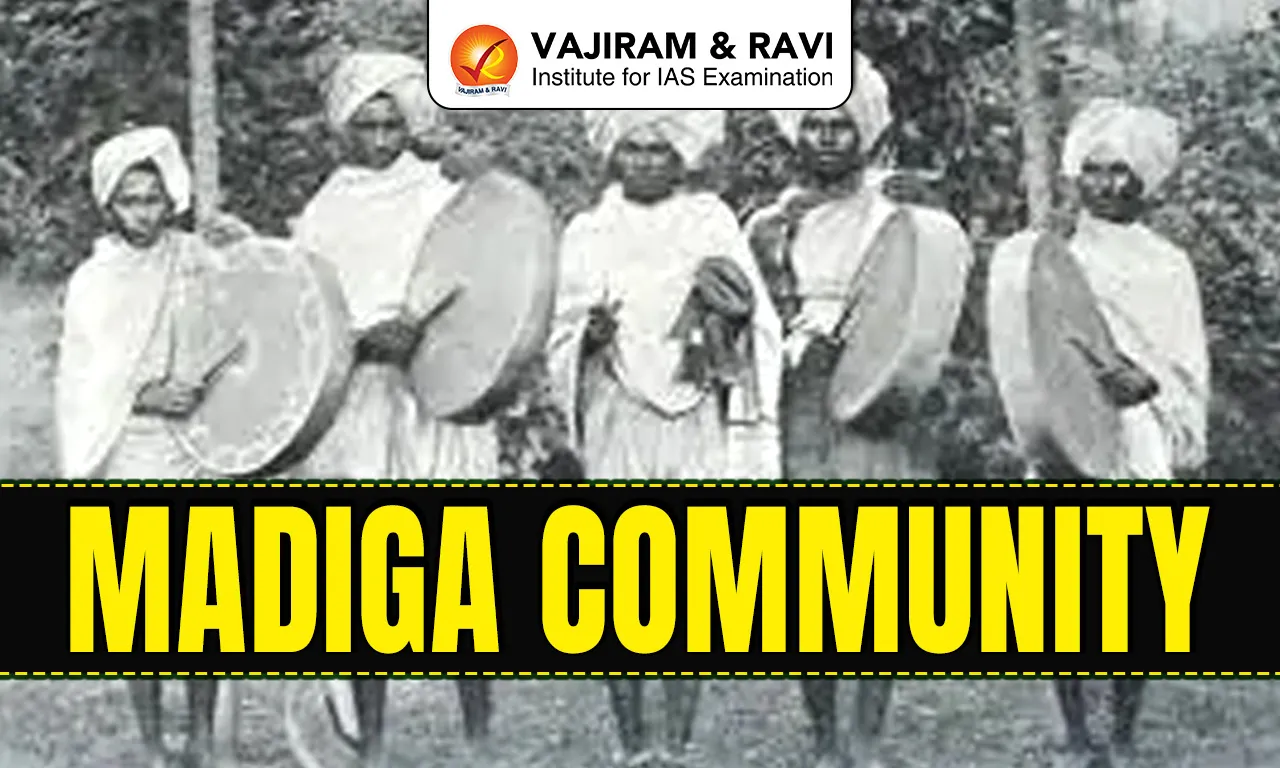
Madiga is a Telugu Scheduled Caste community mainly concentrated in Telangana, Andhra Pradesh, and Karnataka. They largely work as agricultural labourers. In Telangana, they form nearly 50% of the total Scheduled Caste population and play an important socio-political role.

Madiga Community Features

The Madiga community has a large demographic presence and a long history of social exclusion, leading to strong movements demanding equitable reservation benefits and internal sub-categorization within Scheduled Castes.

  • Population Share: As per Census 2011, Madigas numbered 6,702,609 in undivided Andhra Pradesh, forming 48.27% of the SC population. Telangana alone has over 3.2 million Madigas, while Andhra Pradesh has about 3.46 million.
  • Traditional Occupation: Madigas were historically engaged in tanning leather, making footwear, belts, bags, and crafting the traditional Dappu drum. Many also worked as village service providers under the vetti system, often receiving minimal wages or inam land.
  • Sub-Categorization Demand: Claiming dominance of the Mala community in accessing reservation benefits, Madigas demanded equitable distribution. In December 2023, Prime Minister Narendra Modi initiated a high-level committee, chaired by the Cabinet Secretary, to examine internal classification within SCs.
  • Judicial Development: On August 1, 2024, the Supreme Court, led by Chief Justice D.Y. Chandrachud, allowed states to sub-classify SCs for fair quota distribution, overturning the 2004 E.V. Chinnaiah judgment and strengthening Madiga demands.

Madiga Community FAQs

Q1: What is the Madiga Community?

Ans: Madiga is a Telugu Scheduled Caste community mainly found in Telangana, Andhra Pradesh, and Karnataka, historically linked with leatherwork and agricultural labour.

Q2: What percentage of SC population do Madigas form in Telangana?

Ans: Madigas constitute nearly 50% of the Scheduled Caste population in Telangana, making them one of the largest SC communities in the state.

Q3: Why do Madigas demand sub-categorization within SCs?

Ans: They argue that reservation benefits have largely gone to relatively dominant SC groups like the Mala community, leading to unequal access to education and government jobs.

Q4: What was the 2024 Supreme Court ruling on SC sub-classification of Madiga Community?

Ans: On August 1, 2024, the Supreme Court allowed states to sub-classify Scheduled Castes for fair distribution of reservation benefits, overturning the 2004 E.V. Chinnaiah judgment.

Q5: What committee was formed to examine Madiga Community demands?

Ans: In December 2023, the Union government formed a high-level committee of secretaries, chaired by the Cabinet Secretary, to study equitable distribution of SC benefits.

Solar Charkha Mission, Background, Objective, Features, Launch Date

Solar Charkha Mission

The Solar Charkha Mission is an enterprise-driven scheme launched in June 2018 by the Ministry of Micro, Small and Medium Enterprises (MSME). The mission aims to generate sustainable rural employment by promoting solar powered charkhas in cluster mode. 

Solar Charkha Mission Background 

Solar Charkha Mission is inspired from the success of the pilot Solar Charkha project started in 2016 at Khanwa village in Nawada district of Bihar. The pilot project introduced solar-powered charkhas to rural artisans and benefitted around 1,180 spinners and weavers, showing that solar-powered charkhas could increase productivity, reduce electricity costs, and create sustainable employment in villages.

The Government of India decided to scale up the model at the national level and approved the establishment of 50 Solar Charkha Clusters across different states with a total budget of ₹550 crore

Solar Charkha Cluster

A Solar Charkha Cluster is a group of villages organized under the Solar Charkha Mission where spinners, weavers, stitchers, and other artisans work together using solar-powered charkhas and looms.

Each cluster typically includes 200 to 2,000 beneficiaries within a defined geographical area and is supported with common infrastructure, training, and financial assistance. Each spinner will be given two charkhas of 10 spindles each.

Solar Charkha Mission Aims and Objectives 

The aims and objectives of Mission Solar Charkha are:

  • To ensure inclusive growth by generation of employment, especially for women and youth and sustainable development through solar charkha clusters in rural areas.
  • To boost the rural economy and help in arresting migration from rural to urban areas.
  • To leverage low-cost, innovative technologies and processes for substance.

Solar Charkha Mission Features 

  • Solar Charkha Mission is a Central Sector Scheme.
  • It was launched by the Ministry of Micro, Small and Medium Enterprises (MSME) in 2018.
  • The scheme is implemented through the Khadi and Village Industries Commission (KVIC).
  • The scheme aims to create nearly one lakh direct employment opportunities, especially for women and youth in rural areas, by promoting solar-powered spinning and weaving under cluster-based village industries.

It is an enterprise-driven scheme - no direct subsidy is given to individual artisans. Instead, the government provides a subsidy of up to ₹9.60 crore per cluster to the implementing or promoting agency for purchasing solar charkhas, looms, and related infrastructure.

Solar Charkha Mission FAQs

Q1: Solar Charkha Mission was launched in which year?

Ans: Solar Charkha Mission was launched in 2018.

Q2: Solar Charkha Mission is implemented by which organization?

Ans: Solar Charkha Mission is implemented by Khadi and Village Industries Commission (KVIC).

Q3: Solar Charkha Mission is a scheme of which ministry?

Ans: Ministry of Micro, Small and Medium Enterprises (MSME).

Q4: Solar Charkha Mission is which type of scheme?

Ans: Solar Charkha Mission is a Central Sector Scheme.

Q5: What is the main objective of the Solar Charkha Mission?

Ans: The main objective of Solar Charkha Mission is to generate sustainable rural employment through solar-powered spinning and weaving clusters.

Green Tax, Objectives, Legal Provisions, Green Tax vs Carbon Tax

Green Tax

India is facing an acute air pollution crisis, especially in urban and industrial regions. Vehicular emissions are one of the major contributors to deteriorating air quality, leading to serious public health consequences and environmental degradation. 

In this context, the concept of Green Tax has gained prominence as a regulatory and economic instrument to discourage the use of older, polluting vehicles and promote cleaner alternatives.

What is Green Tax?

Green Tax is an environmental tax imposed on older and polluting vehicles to reduce vehicular emissions and improve air quality. It is a fiscal instrument designed to internalize the environmental cost of pollution.

The Ministry of Road Transport and Highways (MoRTH) has proposed that:

  • Transport vehicles older than 8 years will be charged Green Tax at the time of renewal of their fitness certificate.
  • The tax will range between 10% to 25% of the road tax.
  • Personal vehicles will be charged Green Tax after 15 years at the time of renewal of registration.
  • In highly polluted cities, Green Tax may go up to 50% of the road tax.
  • Public transport vehicles such as city buses will be charged comparatively lower Green Tax.
  • Differential taxation will apply based on:
    • Fuel type (petrol/diesel)
    • Type of vehicle
    • Pollution level of the city

Green Tax in India Objectives

  • Reduce Vehicular Pollution: Discourage the use of old and highly polluting vehicles to lower emissions of CO, NOx, and particulate matter.
  • Protect Public Health: Minimize respiratory and cardiovascular diseases caused by prolonged exposure to polluted air.
  • Implement Polluter Pays Principle: Ensure that owners of pollution-causing vehicles bear the environmental cost of their actions.
  • Promote Clean Mobility: Encourage adoption of electric, hybrid, and alternative fuel vehicles through differential taxation.
  • Support Climate Commitments: Contribute to reduction of greenhouse gas emissions in line with India’s climate goals.
  • Generate Dedicated Funds for Pollution Control: Create a separate revenue stream to finance air quality improvement and sustainable transport initiatives.

Green Tax Legal Provisions

Green Tax in India is supported by constitutional mandates, statutory provisions, and environmental principles that empower the State to regulate pollution and protect public health.

  • Article 21 of the Constitution: The Right to Life has been judicially interpreted by the Supreme Court to include the right to a clean and healthy environment, forming the constitutional basis for pollution control measures like Green Tax.
  • Article 48A (Directive Principles of State Policy): Directs the State to protect and improve the environment and safeguard forests and wildlife, providing policy backing for environmental taxation.
  • Article 51A(g) (Fundamental Duties): Imposes a duty on citizens to protect and improve the natural environment, reinforcing shared responsibility in environmental protection.
  • Motor Vehicles Act, 1988: Provides the legal framework for vehicle registration, renewal, and fitness certification, under which Green Tax is levied on old vehicles during renewal.
  • Air (Prevention and Control of Pollution) Act, 1981: Empowers authorities to prevent and control air pollution, supporting measures targeting vehicular emissions.
  • Environment (Protection) Act, 1986: Grants broad powers to the Central Government to take necessary steps for environmental protection, including regulatory and fiscal measures.
  • Polluter Pays Principle (Judicial Doctrine): Recognized by Indian courts as part of environmental law, mandating that polluters compensate for environmental damage, forming the conceptual foundation of Green Tax.
  • Federal Structure and State Powers: Since road tax and vehicle registration fall under State jurisdiction, individual states determine the rate and implementation details of Green Tax within the broader central guidelines.

Green Tax vs Carbon Tax

Green Tax and Carbon Tax are environmental fiscal instruments designed to reduce pollution, but they differ in scope, structure, and implementation. The difference between Green Tax and Carbo Tax is given below:

Green Tax vs Carbon Tax

Basis of Comparison

Green Tax

Carbon Tax

Definition

Environmental tax imposed on old and polluting vehicles.

Tax imposed on carbon emissions from fossil fuels.

Scope

Sector-specific (primarily transport sector).

Economy-wide (power, industry, transport, manufacturing, etc.).

Objective

Reduce local air pollution and vehicular emissions.

Reduce greenhouse gas (GHG) emissions to combat climate change.

Basis of Levy

Age of vehicle, fuel type, pollution level, and city category.

Quantity of CO₂ or carbon content in fuel consumed.

Level of Implementation

Generally implemented by State Governments during registration/fitness renewal.

Usually imposed by Central/National Governments.

Environmental Focus

Local air quality improvement (PM, NOx, CO reduction).

Global warming mitigation and emission reduction targets.

Revenue Use

Dedicated funds for pollution control and environmental measures.

May be used for climate programs, renewable energy, or general revenue.

Example in India

Tax on transport vehicles older than 8 years and personal vehicles after 15 years.

India does not have a formal carbon tax but imposes a coal cess (carbon-related pricing mechanism).


Green Tax Criticism

While Green Tax aims to reduce pollution and promote sustainable mobility, it has been criticized for its economic impact and implementation challenges

  • Additional Financial Burden – Imposes extra cost on vehicle owners, especially middle- and lower-income groups who own older vehicles.
  • Impact on Public Transport Fares – Transport operators may pass the tax burden to passengers, increasing travel costs.
  • Inflationary Pressure – Higher transportation and logistics costs can raise prices of essential goods and services.
  • Existing High Fuel Taxes – Critics argue that petrol and diesel are already heavily taxed, making Green Tax an additional burden.
  • Limited Effect Without Enforcement – Weak vehicle fitness checks and poor monitoring may reduce its effectiveness.
  • Equity Concerns – Disproportionately affects those who cannot afford to replace old vehicles with new, cleaner models.

Way Forward

  • Make Clean Vehicles Affordable – Reduce taxes and give incentives on electric and hybrid vehicles so people can easily shift to cleaner options.
  • Improve Fitness Testing – Ensure strict and transparent vehicle emission checks so old polluting vehicles cannot run without control.
  • Use Tax Money Properly – Spend Green Tax funds only on pollution control, public transport, and clean energy projects.
  • Promote Public Transport – Improve buses, metros, and shared transport to reduce the number of private vehicles on roads.
  • Encourage Vehicle Scrapping – Provide benefits to people who scrap old vehicles and buy new low-emission vehicles.
  • Create Public Awareness – Educate people about pollution and motivate them to use cleaner transport options.

Green Tax FAQs

Q1: What is the purpose of Green Tax?

Ans: Green Tax aims to reduce vehicular pollution by discouraging the use of older vehicles and promoting cleaner alternatives.

Q2: Who has to pay Green Tax?

Ans: Transport vehicles older than 8 years and personal vehicles older than 15 years are required to pay Green Tax at renewal.

Q3: Are electric vehicles subject to Green Tax?

Ans: No. Electric vehicles and strong hybrids are exempted.

Q4: How much is the Green Tax?

Ans: It ranges from 10% to 25% of road tax and may go up to 50% in highly polluted cities.

Q5: Is Green Tax linked to climate change?

Ans: Yes. While primarily targeting local pollution, it indirectly supports climate action by reducing carbon emissions from the transport sector.

Cyclone Nivar, Naming, Impact, Tropical Cyclones in India

Cyclone Nivar

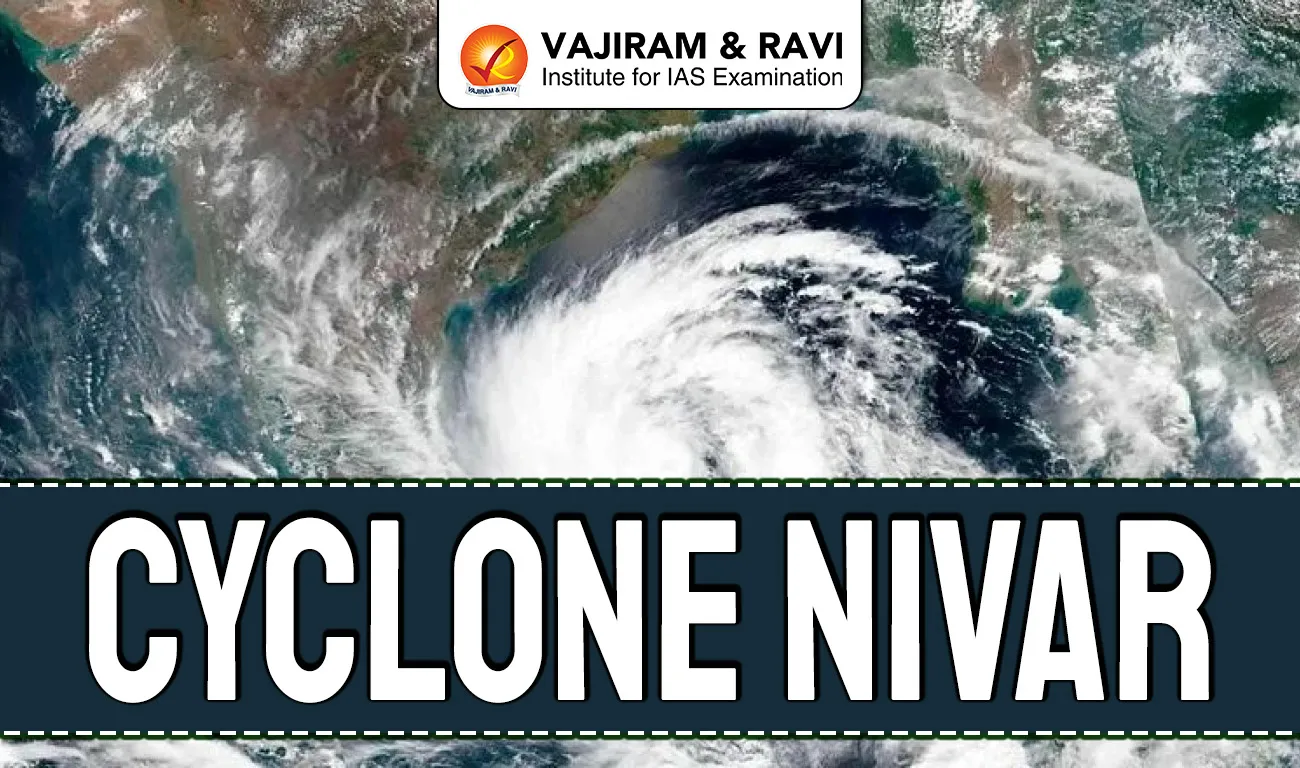
Cyclone Nivar is a severe tropical cyclone which formed in the Bay of Bengal and struck the southeast coast of India in November 2020. 

Cyclone Nivar Naming

The cyclone was named Cyclone Nivar based on the guidelines of the World Meteorological Organisation (WMO). Nivara has been selected from the list of names given by Iran.

  • According to WMO guidelines, countries in every region are supposed to give names for cyclones.
  • The North Indian Ocean Region covers tropical cyclones formed over Bay of Bengal and Arabian Sea.
  • The 13 members, which come under the region, are Bangladesh, India, Maldives, Myanmar, Oman, Pakistan, Sri Lanka, Thailand, Iran, Qatar, Saudi Arabia, the UAE and Yemen.

Cyclone Nivar Impact

Cyclone Nivar struck Puducherry, a district in Tamil Nadu, with a population of 1.6 million people. The cyclone can lead to a huge loss of life and property, especially in low-lying areas. It particularly affected Chennai in Tamil Nadu and Andhra Pradesh further up the coast.  

About Tropical Cyclones

A tropical cyclone is a rapidly rotating storm that begins over tropical oceans, and they can vary in speed, size, and intensity. It is characterized by strong winds, heavy rainfall, thunderstorms, and storm surges

Conditions for Formation

Tropical cyclone formation require following conditions: 

  • Warm Sea Surface Temperature: Requires ocean temperatures greater than 27°C. 
  • Higher Coriolis Force: Tropical cyclones do not originate between 5°N and 5°S latitudes because the Coriolis force is absent or too weak there.
    • Example:Tropical cyclones do not originate at the equator because the Coriolis force, essential for the rotational deflection of winds, is absent or too weak
  • Latent Heat of Condensation: This is the primary source of energy or the "driving engine" for tropical cyclones. They originate only on oceans and seas with abundant moist heat
  • Associated with ITCZ: They develop when the Intertropical Convergence Zone (ITCZ) is away from the equator, where there is a convergence of several warm air masses and sufficient heating of water.
  • Upper-Air High Pressure / Divergence: There must be an anti- cyclonic condition or high pressure in the upper atmosphere. This divergence in the upper atmosphere allows the air to be continuously thrown upwards, creating a vacuum that pulls in more air and intensifies the low-pressure center. If there's no divergence, cold air would accumulate and descend, preventing cyclone development.
  • Absence of Cold Ocean Currents: Tropical cyclones do not originate in regions with cold ocean currents because heat is required. 
    • Example: Tropical cyclones absent on the western coasts of continents like South America, Africa, and Australia.

Structure of a Tropical Cyclone

A tropical cyclone has a well-defined structure. At the center lies the eye, which is a calm and clear area with very low pressure. Surrounding the eye is the eyewall, which contains the most intense winds and heaviest rainfall. Beyond the eyewall are spiral-shaped rainbands that extend outward and produce thunderstorms and heavy showers. The entire system rotates counterclockwise in the Northern Hemisphere and clockwise in the Southern Hemisphere due to the Coriolis effect.

Tropical Cyclones in India

India is highly vulnerable to tropical cyclones because of its long coastline of over 7,500 km. The Bay of Bengal is more prone to severe cyclones compared to the Arabian Sea due to warmer waters and favorable atmospheric conditions. States such as Odisha, West Bengal, Andhra Pradesh, and Tamil Nadu are particularly vulnerable to cyclone impacts. 

Reasons for Higher Frequency in Bay of Bengal

The Bay of Bengal experiences a 35% greater frequency of cyclones compared to the Arabian Sea.

  • Warmer Waters: The Bay of Bengal is generally warmer, a key condition for cyclone formation.
  • Enclosed Nature: It is more enclosed, being surrounded by land on three sides. This allows the adjacent land to transfer excess heat to the water, contributing to higher temperatures.
  • Weaker Vertical Wind Shear: The Bay of Bengal generally has less vertical wind shear (upward and downward motion of wind), which is a favourable condition for tropical cyclones. Cyclones require a consistent upward movement of wind.
  • Remnants of Typhoons: The Bay of Bengal's connection to the Pacific Ocean means that remnants of typhoons, after crossing the South China Sea, can enter and intensify in the Bay of Bengal

Tropical Cyclones Regional Names

Tropical cyclones are known by different names in different parts of the world. In the Atlantic Ocean and Eastern Pacific, they are called Hurricanes. In the Western Pacific, they are known as Typhoons. In the Indian Ocean and South Pacific region, they are referred to as Cyclones.

Cyclone Nivar FAQs

Q1: When and where did Cyclone Nivar make landfall?

Ans: It struck the southeast coast of India between 26-28 November 2020, mainly affecting Puducherry and Tamil Nadu.

Q2: Which areas were most affected by Cyclone Nivar?

Ans: Puducherry, Chennai (Tamil Nadu), and parts of Andhra Pradesh.

Q3: Which country suggested the name “Nivar”?

Ans: The name Nivar was suggested by Iran as part of the WMO cyclone-naming list.

Q4: What is the minimum sea surface temperature required for tropical cyclone formation?

Ans: About 27°C or higher is the minimum sea surface temperature required for tropical cyclone formation.

Q5: Why do tropical cyclones not form near the equator?

Ans: Because the Coriolis force is too weak between about 5°N and 5°S, preventing rotation.

Maharaja Surajmal (1707-1763), Early Life, Achievements, Legacy

Maharaja Surajmal

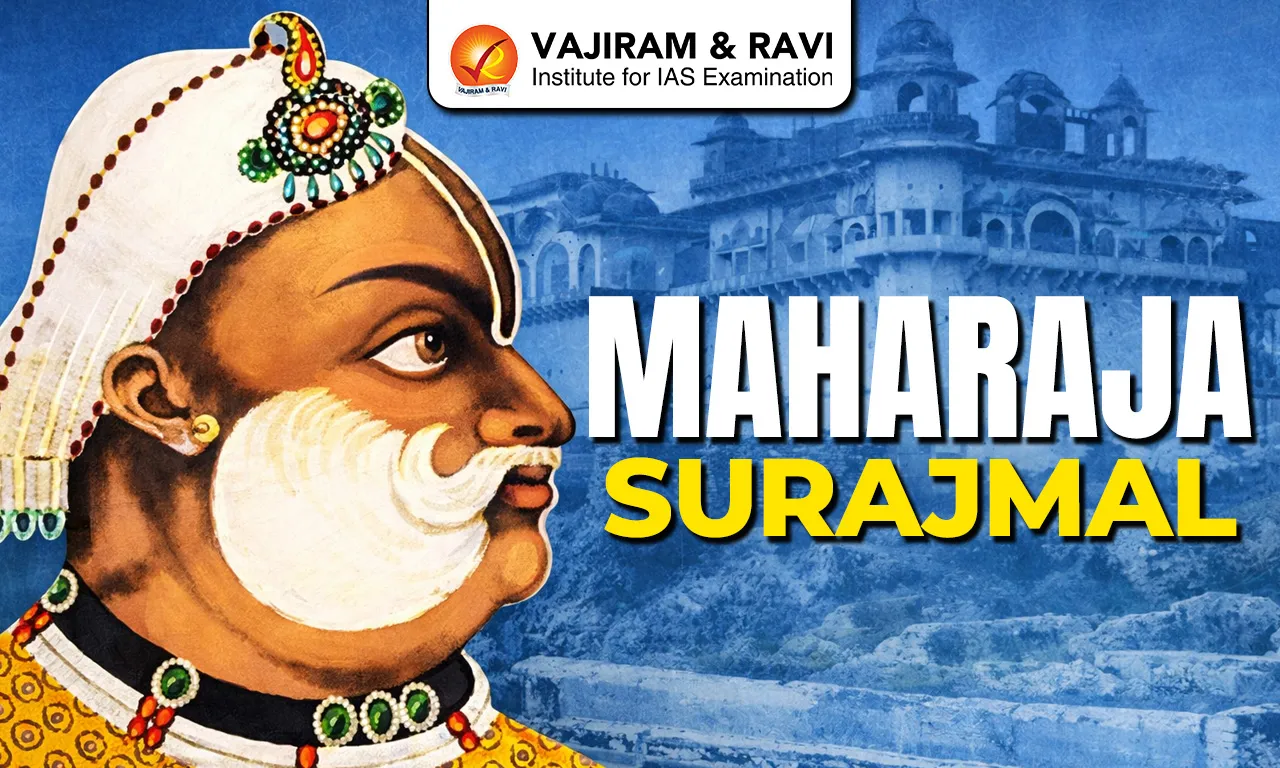
Maharaja Surajmal (1707-1763) was the most prominent ruler of the Bharatpur kingdom in Rajasthan during the 18th century. The Hindu Jat Kingdom reached its zenith under Maharaja Suraj Mal. He is known as the “Plato of the Jats” for his wisdom, diplomacy, and statesmanship.

Maharaja Surajmal Early Life

  • Maharaja Surajmal was born in 1707 in the erstwhile kingdom of Bharatpur.
  • He belonged to the  Sinsinwar Jat dynasty. 
  • He was the son of Badan Singh, founder of Bharatpur State (Jat Kingdom of Rajasthan).

Maharaja Suraj Legacy

  • Maharaja Surajmal expanded and strengthened Bharatpur into a powerful kingdom. Under his leadership, the kingdom extended over present-day Rajasthan, Haryana, western Uttar Pradesh, and parts of Delhi, making it a significant regional power. 
  • Maharaja Suraj Mal captured strategically important towns such as Agra, Mathura, and Aligarh. The strategic expansion of his kingdom made the Jat state a dominant force in North India during the 18th century, a period marked by the decline of the Mughal Empire and the rise of regional powers.
  • Suraj Mal was widely respected for his strategic intelligence, earning him the title “Plato of the Jats”. He successfully repelled repeated attacks from the Mughals, Marathas, and Afghan invaders. 
  • Maharaja Surajmal rebuilt and fortified Lohagarh Fort (Iron Fort) at Bharatpur, enhancing its defensive features and making it a virtually impregnable stronghold of Bharatpur.
  • He had a good relationship with Jai Singh of Jaipur. 
  • Surajmal was a secular ruler who believed in the unity of humanity above religion. He employed people based on merit, respected cultural monuments of other faiths, and envisioned a unified India.
  • He implemented an efficient revenue system that ensured regular income for the state, while land reforms strengthened agricultural productivity and stability. 
  • His policies encouraged trade and commerce.
  • Beyond administration and military conquests, Maharaja Suraj Mal was a patron of arts, architecture, and culture. He built palaces, forts, and public structures which enhanced the cultural identity of Bharatpur. The Lohagarh Fort is a prime example.
  • Suraj Mal also encouraged artisans, craftsmen, and scholars.
  • Maharaja Suraj Mal passed away in 1763.

Maharaja Surajmal FAQs

Q1: Who was Maharaja Surajmal?

Ans: Maharaja Surajmal was the most prominent ruler of the Bharatpur kingdom in Rajasthan. He expanded the Jat kingdom into a powerful state.

Q2: Who was the founder of Bharatpur state?

Ans: Badan Singh, Surajmal’s father, founded Bharatpur state.

Q3: Why is Maharaja Surajmal called the “Plato of the Jats”?

Ans: Maharaja Surajmal is called Plato of Jats for his wisdom, diplomacy, and strategic intelligence.

Q4: What were Maharaja Surajmal’s major military achievements?

Ans: He captured strategically important towns such as Agra, Mathura, and Aligarh. He successfully defended Bharatpur against repeated attacks by the Mughals, Marathas, and Afghan invaders and strengthened the Lohagarh Fort, making it virtually impregnable.

Q5: What were his contributions as an administrator?

Ans: Surajmal implemented an efficient revenue system, introduced land reforms to boost agricultural productivity, and promoted trade and commerce. He also employed people based on merit and respected cultural monuments of other faiths.

Indo-Pak War 1971, Background, Causes, Outcome, Significance

Indo-Pak War 1971

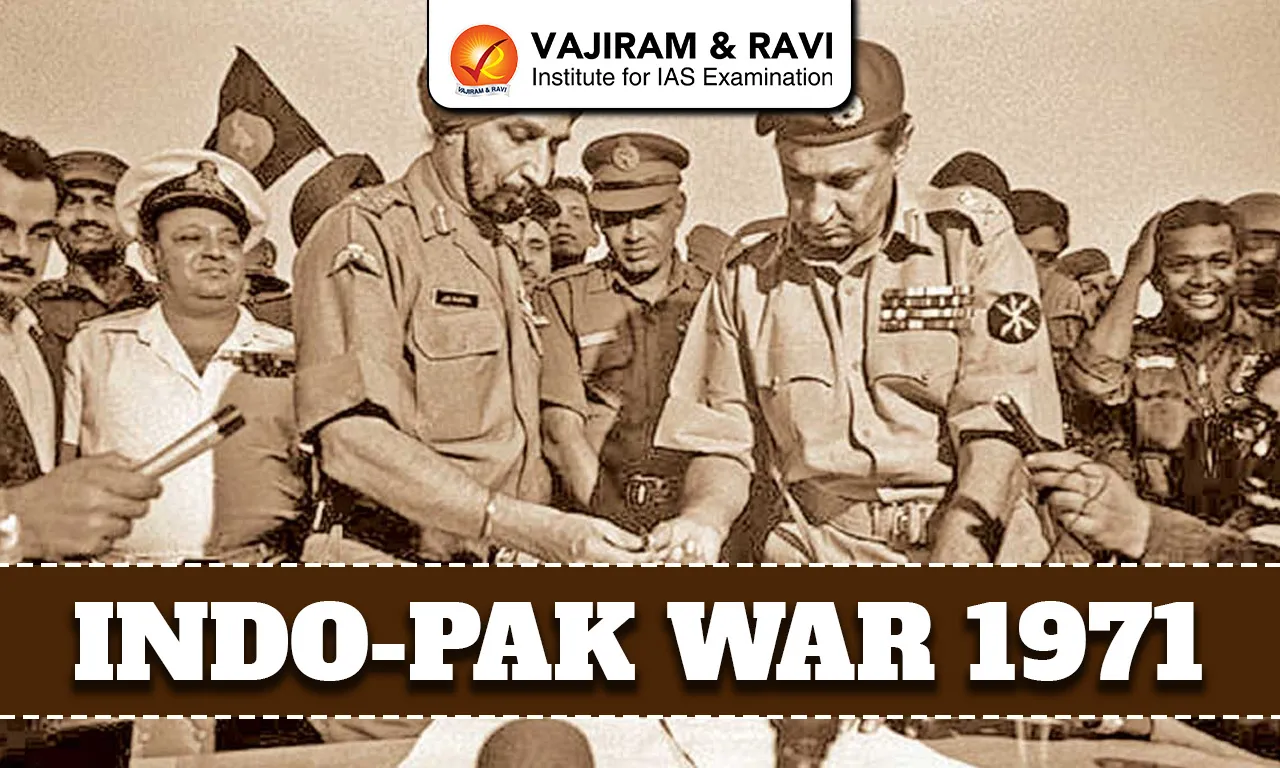
The Indo-Pak War 1971 was the third major conflict between India and Pakistan after independence, but unlike the wars of 1947-48 and 1965, it was not primarily about Kashmir. It was rooted in the political, economic and cultural crisis within Pakistan itself, which culminated in the creation of Bangladesh. The war ended in a decisive Indian victory and the surrender of Pakistani forces in East Pakistan on 16 December 1971.

Indo-Pak War Background

The background of the Indo-Pak War 1971 is rooted in the historical, political, economic, and cultural disparities between East and West Pakistan. When Pakistan was created in 1947, it consisted of two geographically and culturally distinct regions separated by over 1,600 km of Indian territory. West Pakistan dominated the political and military institutions, while East Pakistan, despite having a larger population, was systematically marginalized.

Economically, East Pakistan contributed nearly 50% of Pakistan’s export earnings, primarily through jute, tea, and textiles, yet received far less investment in infrastructure and industrial development. Culturally and linguistically, the Bengali-speaking population faced attempts at assimilation, including the imposition of Urdu as the state language, which fueled longstanding resentment.

Politically, the 1970 general elections saw the Awami League, led by Sheikh Mujibur Rahman, win a clear majority, but West Pakistan’s ruling elite refused to transfer power, leading to mass protests. The situation escalated when the Pakistani army launched Operation Searchlight in March 1971, a brutal crackdown on Dhaka and other cities, resulting in widespread killings, displacement, and a refugee crisis that spilled into India. 

These political, economic, and humanitarian pressures created a volatile environment that ultimately triggered India’s intervention and the war that led to the liberation of Bangladesh.

Read about: India Pakistan Relations

India’s Response

India’s response to the escalating crisis in East Pakistan was shaped by humanitarian concerns, strategic interests, and geopolitical calculations. As millions of refugees (over 10 million) fled into India, primarily to West Bengal, Assam, and Tripura, the country faced severe economic, social, and logistical pressures. Initially, India pursued diplomatic channels, urging Pakistan to grant political autonomy to East Pakistan and supporting negotiations mediated by the United States and other nations. 

When diplomacy failed and reports of widespread atrocities by the Pakistani military intensified, India began providing training, arms, and logistical support to the Mukti Bahini, the Bengali liberation forces fighting for independence. 

This support included guerrilla training, intelligence, and coordinated operations to weaken the Pakistani military. By early December 1971, India launched a full-scale military intervention, combining land, air, and naval operations, swiftly achieving strategic victories in East Pakistan.

About Mukti Bahini

  • The Mukti Bahini, or “Freedom Fighters,” was the main guerrilla force that led the Bengali liberation struggle in 1971 against the Pakistani military in East Pakistan.
  • It consisted of defected Bengali soldiers from the Pakistan Army, students, civilians, and political activists, united by the goal of achieving Bangladesh’s independence. 
  • The Mukti Bahini carried out guerrilla warfare, sabotage operations, and intelligence gathering, targeting Pakistani military installations, supply routes, and communication lines to weaken enemy control. 
  • They also mobilized the local population, fostering resistance and maintaining morale during the conflict.

India played a critical role in supporting the Mukti Bahini, providing weapons, training, and logistical assistance, which significantly enhanced their operational effectiveness.

International Response

The war drew global attention and became intertwined with Cold War politics:

United States:

  • President Richard Nixon and Secretary of State Henry Kissinger supported Pakistan to maintain influence in South Asia and counter Soviet expansion.
  • The US deployed the USS Enterprise as a show of support, though no direct combat occurred.

Soviet Union:

  • India signed the Treaty of Friendship and Cooperation with the USSR on September 9, 1971, securing political, military, and diplomatic support.
  • The Soviet Union vetoed UN resolutions that sought to pressure India to stop its intervention.

China:

  • Expressed political backing for Pakistan, warning India against military intervention, but avoided direct involvement due to geographical distance and strategic considerations.

United Nations:

  • The UN called for ceasefire and dialogue, but global power politics limited its effectiveness.

Other Countries:

  • Many non-aligned nations observed cautiously, with countries like the UK and France taking neutral stances, focusing on humanitarian concerns.

Consequences and Significance for India

The 1971 Indo-Pak War had far-reaching consequences and strategic importance for India:

  • Creation of Bangladesh: The war ended with the surrender of Pakistan’s Eastern Command on 16 December 1971, leading to the independence of Bangladesh.
  • Boost to Indian military prestige: India’s military demonstrated operational efficiency and strategic planning, gaining international recognition.
  • Humanitarian impact: India alleviated the refugee crisis by supporting the liberation movement.
  • Geopolitical shift in South Asia: India emerged as a dominant regional power, while Pakistan suffered a major territorial and psychological setback.
  • Strengthened Indo-Soviet ties: The war solidified India’s strategic relationship with the Soviet Union, influencing Cold War dynamics in the region.

Domestic morale and political gains: The victory enhanced national pride and reinforced confidence in India’s defense capabilities.

Indo-Pak War FAQs

Q1: What was the main cause of the Indo-Pak War of 1971?

Ans: The war was primarily caused by political, economic, and cultural disparities between East and West Pakistan, the denial of power to Sheikh Mujibur Rahman after the 1970 elections, and the Pakistani military’s brutal crackdown (Operation Searchlight) on East Pakistan, which triggered mass protests and a refugee crisis in India.

Q2: Who were the Mukti Bahini?

Ans: The Mukti Bahini were the Bengali guerrilla freedom fighters who resisted Pakistani forces in East Pakistan. They included defected Pakistani soldiers, students, civilians, and political activists, and were supported by India with training, arms, and logistical assistance.

Q3: How did India respond to the 1971 crisis?

Ans: India initially provided humanitarian aid to refugees, pursued diplomatic negotiations with Pakistan, and later supported the Mukti Bahini. In December 1971, India launched a full-scale military intervention, combining land, air, and naval operations, which led to the surrender of Pakistani forces in East Pakistan.

Q4: What was the role of international powers during the war?

Ans: The US and China supported Pakistan, while the Soviet Union backed India, signing the Treaty of Friendship and Cooperation. The United Nations called for a ceasefire, but global power politics limited its influence.

Q5: What were the outcomes and significance of the 1971 war for India?

Ans: The war resulted in the creation of Bangladesh, enhanced India’s military reputation, shifted the geopolitical balance in South Asia, strengthened Indo-Soviet ties, alleviated the refugee crisis, and boosted domestic morale and national pride.

Bhadar River, Origin, Tributaries, Reservoirs, Dam, Features

Bhadar River

The Bhadar River is one of the major seasonal rivers of the Saurashtra peninsula in Gujarat, western India. It originates in the Rajkot district at an elevation of 261 metres above mean sea level and flows for about 198 kilometres before emptying into the Arabian Sea near Porbandar district. It is a vital seasonal river system of western India, combining geomorphological importance, irrigation utility, reservoir infrastructure and environmental governance dimensions within Gujarat’s Saurashtra region.

Bhadar River Features

The Bhadar River shows seasonal flow, major tributary network, reservoir regulation and environmental importance in Saurashtra region. The key features of the river has been listed below:

  • Origin: The river rises near Vaddi or Aniali village, about 26 km northwest of Jasdan in Rajkot district, at 261 metres elevation. The source lies close to the Hingolgadh hill region in central Saurashtra, marking the beginning of its southward journey.
  • Course: Initially flowing south towards Jasdan, the river turns south-west near Jetpur and finally flows west to meet the Arabian Sea at Naviobandar near Porbandar. Its total length is approximately 198 km across hilly and plain terrain.
  • Drainage Area: The basin covers 7,094 sq km, of which around 706 sq km is hilly and the remaining area consists of plains. It drains nearly one-seventh of Saurashtra, making it one of the peninsula’s principal river systems.
  • Tributaries: The river has nine major tributaries longer than 25 km. Right bank tributaries include Gandali, Chapparwadi, Phopal, Utawali, Moj and Venu. Left bank tributaries are Vasavadi, Surwa and Galolio, with a more extensive right bank drainage system.
  • Rainfall: The basin receives an average annual rainfall of about 625 mm. 
  • Climate: Winter temperatures range between 4°C and 15°C, while May records peak summer temperatures between 40°C and 45°C, reflecting semi arid climatic conditions.
  • Hydrological Nature: The Bhadar is primarily monsoon fed. Most discharge occurs during intense southwest monsoon rainfall. Flow reduces sharply after September, showing typical seasonal characteristics of western Indian peninsular rivers.
  • Reservoirs: Two major reservoirs regulate the river. Bhadar I has a storage capacity of 238 million cubic metres, while downstream Bhadar II holds about 49 million cubic metres. In total, 12 reservoirs and weirs exist within the catchment.
  • Bhadar Dam: Located in Rajkot district, Bhadar Dam is the second largest in Saurashtra after Shetrunji Dam. Constructed in 1965, it plays a crucial role in irrigation, regional water supply and seasonal flood moderation.
  • Vegetation: The river basin supports semi arid vegetation with dry deciduous species such as teak (Tectona grandis) and tendu (Diospyros melanoxylon), along with riparian growth near reservoirs and seasonal wetlands during monsoon months.
  • Flora: Aquatic and wetland plants found in the basin include Hydrilla verticillata, Vallisneria spiralis, lotus (Nymphaea spp.), water hyacinth (Ipomoea aquatica) and halophytic species like Suaeda nudiflora near estuarine stretches.
  • Fauna: The river and its reservoirs support fish species such as Labeo rohita (rohu), Labeo calbasu (calbasu), Wallago attu, Channa spp. (murrel) and Cyprinus carpio (common carp), along with seasonal wetland bird species.
  • Flood Events: In 2015, intense short duration rainfall triggered flash floods, damaging 29 floodgates of Bhadar Dam. The Dam Safety Organisation of the Central Water Commission recommended replacement to strengthen flood management capacity.
  • Flash Flood: Flash floods in this basin occur within six hours of heavy rainfall. Sudden water surges, blocked drainage channels and encroachments worsen flooding impacts in downstream plains and reservoir areas.
  • Monitoring Infrastructure: There is one key gauge discharge and sediment monitoring station near Ganod in the plains of Rajkot district, close to the river’s mouth, used for discharge and sediment load assessment.
  • Environmental Oversight: The National Green Tribunal, established under the NGT Act 2010, directed the Gujarat Pollution Control Board to submit action reports on pollution abatement near Ahmedabad stretch.
  • Administrative Coordinates: The basin is entirely located within Gujarat and spans districts such as Rajkot and Porbandar. Its geographical positioning enhances its importance in western coastal drainage and Arabian Sea outflow systems.
  • Regional Importance: As a major river of Kathiawar peninsula, the Bhadar supports irrigation, agriculture and rural settlements across semi arid Saurashtra, where dependable surface water resources are limited.

Also Read: Tigris River

Bhadar River FAQs

Q1: Where does the Bhadar River originate?

Ans: The Bhadar River originates near Vaddi or Aniali village in Rajkot district, Gujarat, at an elevation of about 261 metres above mean sea level in the Saurashtra peninsula.

Q2: What is the catchment area of the Bhadar River basin?

Ans: The Bhadar River basin covers about 7,094 square kilometres, draining nearly one-seventh of the total geographical area of the Saurashtra region.

Q3: Which major dams are built on the Bhadar River?

Ans: Two key reservoirs, Bhadar I with a capacity of 238 million cubic metres and Bhadar II with 49 million cubic metres capacity, regulate the river’s seasonal flow.

Q4: Into which sea does the Bhadar River drain?

Ans: The Bhadar River finally empties into the Arabian Sea at Naviobandar near Porbandar district after flowing westward across the Saurashtra peninsula of Gujarat.

Q5: How many major tributaries does the Bhadar River have?

Ans: The river has nine major tributaries longer than 25 km, including Gandali, Chapparwadi, Phopal, Utawali, Moj, Venu on the right bank and Vasavadi, Surwa and Galolio on the left bank.

Important Terms in Ancient Indian History and their Meaning

Important Terms in Ancient Indian History

Ancient Indian History is not just a sequence of dynasties and dates; it is a rich vocabulary of political, administrative, economic and religious terminologies that UPSC consistently tests. Given this consistent trend, a strong command over important terms in Ancient Indian History is essential for scoring high in UPSC Prelims and enriching analytical answers in Mains. 

This article provides a comprehensive compilation of Important terms in Ancient Indian History frequently asked in UPSC.

Important Terms in Ancient Indian History
Important Terms in Ancient History  Meaning of Important Terms in Ancient History

Gojit 

Winner of Cows

Gavisthi

War for Cows 

Govikartana 

Forest Chief 

Gavyuti 

Measure of distance 

Godhuli

Measure of time 

Duhitri

Daughter 

Sangrihitri 

Treasurer 

Vrihi 

Rice

Godhuma 

Wheat

Spasa

Spy

Panis 

Traders

Varthaka

Merchant class 

Bhagadugha 

Tax Collector 

Palgala 

Messenger 

Akshvapa 

Accountant 

Niyoga 

Special type of widow marriage 

Aranyakas

Vedic texts composed by hermits 

Rajan 

king

Gramini

Head of Village 

Kula 

Clan 

Amatya

Minister 

Sannidhata

Treasurer and keeper of stores

Samharta

Chief Revenue Collector

Rajuka 

Responsible for surveying and assessing land 

Sitadhyaksha

Superintendent of Agriculture 

Navadhyaksha 

Superintendent of Ports 

Samshadhyaksha 

Supervisor of Markets 

Sulkadhyaksha 

Toll Collector 

Pautavadhyaksha

Superintendent of weight and measures 

Pradesika

Police officers 

Gopa 

Accountant 

Guddhapurushas 

Spies 

Yuktas 

Subordinate revenue officer 

Dharmasthiyas 

Civil Courts 

Kantakshodhanas 

Criminal Courts 

Srenis 

Guild 

Prashasti 

Prison Head

Padadhyaksha 

Superintendent of the infantry (foot soldiers) in the Mauryan military administration.

Rupadarshaka 

Inspector of coins 

Karamkaras

Wage Labour

Pranaya 

Emergency tax

Bali

Tax paid by villages, farmers, or subordinate rulers to the state, in cash or kind, to support the empire.

Agranomoi

Officials collecting land tax and managing land‑related matters such as land measurement, agricultural oversight, and rural administration. 

Sugata 

The well gone or one who has attained Nirvana. Buddha is called Sugata.

Tathagata 

The one who has realized the ultimate truth. Buddha is called Tathagata.

Arhat 

Victor / One who has attained Nirvana 

Bodhisattva 

A compassionate being who works for the enlightenment of all before attaining final Nirvana.

Parivrajaka 

A wandering monk or ascetic who renounces worldly life in search of spiritual truth.

Upasika

Lay follower of Buddhism 

Thirthankar 

Jain spiritual teacher who shows the path to liberation from worldly suffering. 

Aparigraha 

Non-possession / Non-attachment

Asteya 

Non-stealing

Sallekhan 

Ritual fasting unto death in Jain tradition 

Kevalya 

Complete spiritual liberation (in Jainism)

Nigrantha 

Free from all bonds 

Shravaka 

Lay follower of Jainism 

Bhaga 

Share of agricultural produce paid as land revenue (usually 1/6th)

Hiranya 

Tax paid in cash instead of produce

Sulka 

Customs duty or toll on trade and goods

Saulkika

Collector of customs and tolls 

Halivakara

Tax levied on ploughs or agricultural land

Klipta 

Fixed or assessed tax on land or produce

Bhukti 

Provinces 

Pradesha / Adhisthana

Districts 

Kutumbis and Mahattaras 

Village level officers 

Kumaramatya

High-ranking royal officer; often held important administrative or military posts.

Mahadandanayaka

Chief judicial or military officer; sometimes head of the army or justice system

Dandanayaka

Officer responsible for law and order or military duties

Mahasenapati

Commander-in-chief of the army.

Ayuktaka

Subordinate administrative officer at the district or local level

Vishayapati

Head of a Vishaya (district); main district administrator

Uparika

Provincial governor; in charge of a Bhukti (province).

Mahabaladhikrita

High military officer, often in charge of troops.

Dandapasika

Police or law-enforcement officer.

Dronvapa 

A measure of land area in the Gupta period; the amount of land that could be sown with one drona of seeds.

Kulyavapa 

A larger land measurement unit; the area of land that could be sown with one kulya of seeds.

Ayuktaka

A royal executive officer in the Gupta administration responsible for implementing orders and managing revenue at the local level.

Mahapratihara 

Chief of palace guards 

Pratihara

A royal official who served as a doorkeeper or chamberlain in the Gupta court, controlling access to the king.

Dutaka

Executor and notifier of land grant 

Brahmadeya 

Religious grants to brahmans during Guptas 

Devdana or Devagrahara 

Grants to institutions such as temples and monasteries 

Akshapataladhikrita

Keeper of royal records

Nagarasreshthin

Chairman of city corporations in towns 

Sarthvah

Represents trading community 

Mahasandhivigrahika 

Minister responsible for war, peace and foreign relations 

Dutakas

Spies 

Nishka 

Gold coin

Rupaka 

Silver coin 

Kakini, Kasharpan 

Copper coins

Khil

Infertile land 

Aprabata

Forested land 

Bedakbhog 

Irrigation tax 

Udakabhag 

Water Tax 

Uparnik

Tax from border areas 

Charasana

Grazing tax 

Chat 

Security tax

Bhatta

Police tax 

Bhog 

King's share of produce 

Prataya

Toll tax 

Sangam 

An assembly of poets, scholars and literary figures

Kizhar 

A respected elder or headman of a village, usually a wealthy landowner belonging to the Velalar (agricultural) community.

Velir 

Regional chieftains ruling hilly and forest areas

Vendar

The crowned kings who ruled the fertile river valleys and core agricultural regions (Marudam land) of Tamilakam, especially the major dynasties — Chera, Chola, and Pandya.

Amaichar

Minister 

Senathipathi

Army chief 

Anthanar

Priest 

Thuthar 

Messenger or envoy, sent to convey royal messages or conduct diplomacy.

Otrar 

Spy

Karai 

Land tax

Ulgu 

Customs 

Irai 

Tax or tribute paid to the king.

Variyar

Tax Collector 

Vellalar

Agriculturists 

Vanigar

Traders 

Kadaisiyar / Adimai 

Labourers 

Aniars 

Hunters 

Malvar 

Thieves 

Ur

Village 

Nadu 

Group of villages 

Panam 

Coin / money 

Pon 

Gold coin 

Pattinam 

Port Town 

Important Terms in Ancient Indian History FAQs

Q1: Who was Rajan?

Ans: King or ruler in ancient India.

Q2: What was Rajuka or Ayuktaka?

Ans: Rajuka was a Land surveyor and assessor and Ayuktaka was a Local administrative officer.

Q3: What is Bhaga, Hiranya, and Bali?

Ans: Bhaga: Share of produce paid as tax, Hiranya: Cash tax, Bali: Tax from villages or farmers.

Q4: What are Dronvapa and Kulyavapa?

Ans: They are land measurement units. Dronvapa means land sown with one drona of seed and Kulyavapa means land sown with one kulya of seed.

Q5: What is Brahmadeya?

Ans: Religious grants given to Brahmins.

Dornier 228 Aircraft

Dornier 228 Aircraft

Dornier 228 Aircraft Latest News

Recently, the Defence Ministry has signed a contract with Hindustan Aeronautics Limited (HAL), Transport Aircraft Division, Kanpur, for the acquisition of eight Dornier 228 Aircraft.

About Dornier 228 Aircraft

  • It is a highly versatile multi-purpose light transport aircraft.
  • It has been developed specifically to meet the manifold requirements of utility and commuter transport, third level services and air-taxi operations, coast guard duties and maritime surveillance.
  • Manufacturing: In 1983, Hindustan Aeronautics (HAL) bought a production licence and two years later commenced aircraft manufacture in India.

Features of Dornier 228 Aircraft

  • It is powered by a pair of Garrett TPE331 turboprop engines and has a supercritical wing that generates large amounts of lift at slow speeds.
  • It is a twin-turboprop aircraft known for its reliable performance and short takeoff and landing (STOL) capabilities. 
  • The STOL capabilities allows it to operate from unprepared, unpaved, and grass surfaces and specialize in hot and high environments.
  • It has the unique design of the TNT wing, capable of generating large amounts of lift at slow speeds.
  • The Dornier 228 is typically promoted for its versatility, low operational costs, and high levels of dispatch reliability.

Source: ET

Dornier 228 Aircraft FAQs

Q1: What type of aircraft is the Dornier 228?

Ans: Multi-purpose light transport aircraft

Q2: Who manufactures the Dornier 228 in India?

Ans: Hindustan Aeronautics Limited

Khudai Khidmatgar Movement, Political Role, Achievements

Khudai Khidmatgar Movement

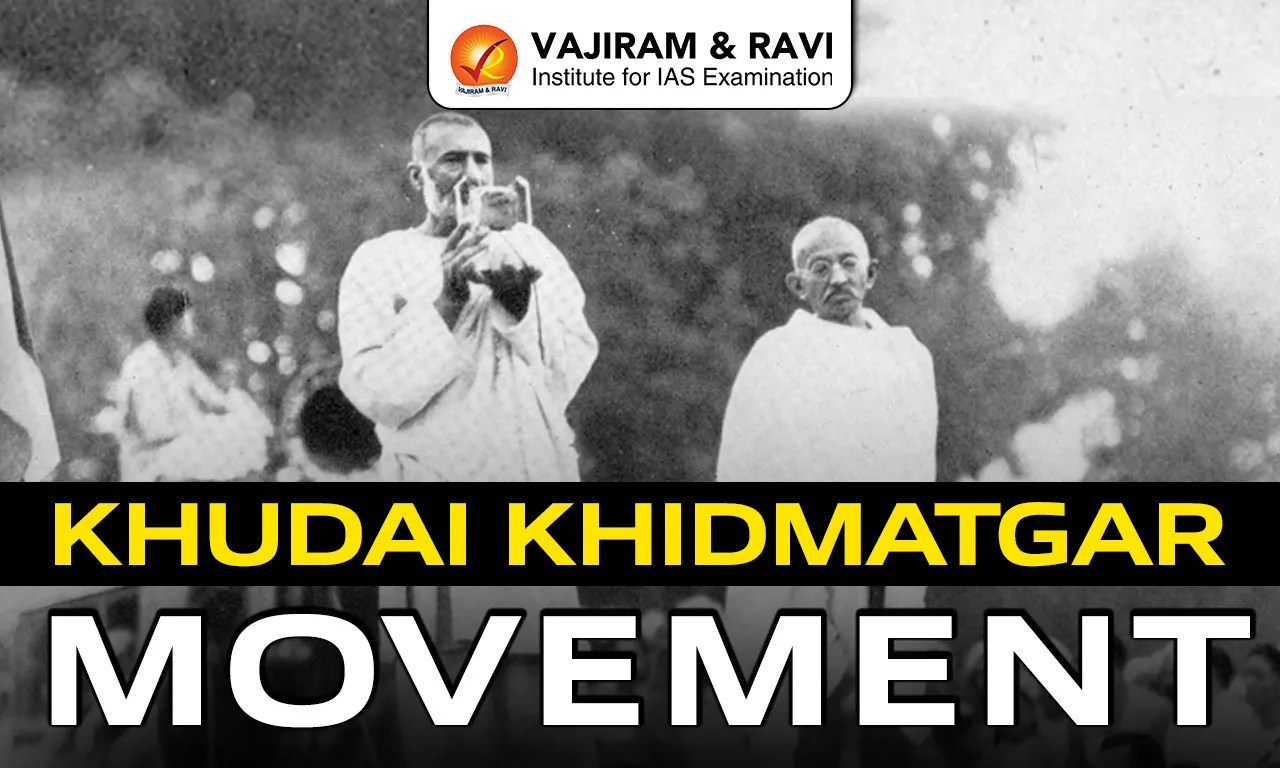
Khudai Khidmatgar, meaning “Servants of God,” was a mainly Pashtun movement that used nonviolent methods to oppose British rule in colonial India. It was based in the North-West Frontier Province, which is now part of Khyber Pakhtunkhwa, Pakistan.

Also called the Red Shirts or Surkh Posh, it started as a social reform group called Anjuman-e-Islah-e Afghania, focused on education and ending traditional blood feuds among Pashtuns.

Khudai Khidmatgar Movement Political Role

The Khudai Khidmatgar Movement was led by Abdul Ghaffar Khan, popularly known as Bacha Khan, Badshah Khan, or the Frontier Gandhi. Initially, it focused on social reforms, but as the British targeted its members, it became more political. By 1929, many leaders were exiled, and numerous members arrested.

The movement tried to get support from the All-India Muslim League and the Indian National Congress. After being rejected by the Muslim League, the Khudai Khidmatgars formally joined the Congress and played an important role in India’s fight for independence.

Khudai Khidmatgar Movement Achievements and Elections

Due to public pressure, the British released Bacha Khan and eased restrictions on the movement.

  • Under the Government of India Act 1935, men were allowed to vote in the NWFP.
  • In the 1937 elections, the Khudai Khidmatgars, allied with the Congress, won. Bacha Khan’s brother, Khan Abdul Jabbar Khan (Dr. Khan Sahib), became Chief Minister.
  • They also won the 1946 elections, with Dr. Khan Sahib re-elected.

The Khudai Khidmatgars opposed the partition of India, siding with Congress and the All India Azad Muslim Conference. When Congress accepted partition without consulting them, Bacha Khan said, “You have thrown us to the wolves.”

Khudai Khidmatgar Movement Post-Partition Struggles

After India and Pakistan were partitioned, the Khudai Khidmatgars faced severe backlash in Pakistan:

  • Their government was dismissed, and the movement banned.
  • Many members were killed in the Babrra massacre on 12 August 1948.

In 2011, the movement was revived in Delhi by Faisal Khan, focusing on communal harmony and disaster relief, with around 5,000 members.

Abdul Ghaffar Khan (Bacha Khan)

  • Born in 1890, Bacha Khan was a follower of Mahatma Gandhi and a leader of the Pashtuns.
  • He joined politics in 1919, protesting the Rowlatt Acts that allowed imprisonment without trial.
  • In 1920, he joined the Khilafat Movement, and in 1921, became president of a district Khilafat committee.
  • In 1929, he founded the Red Shirt movement (Khudai Khidmatgar).
  • In 1987, he became the first non-Indian awarded the Bharat Ratna, India’s highest civilian honor.

Other notable non-Indians who received the Bharat Ratna include Nelson Mandela (1990), and Mother Teresa (1980), who was the first naturalized citizen to receive it.

Khudai Khidmatgar Movement FAQs

Q1: What was the Khudai Khidmatgar Movement?

Ans: The Khudai Khidmatgar, meaning “Servants of God,” was a nonviolent Pashtun movement that opposed British rule in India.

Q2: Who founded the Khudai Khidmatgar?

Ans: It was founded by Abdul Ghaffar Khan, also known as Bacha Khan or the Frontier Gandhi, in 1929.

Q3: Why were they called the Red Shirts?

Ans: Members wore red uniforms, so they were popularly called Red Shirts or Surkh Posh.

Q4: Which political party did Khudai Khidmatgar join?

Ans: After being rejected by the All-India Muslim League, the Khudai Khidmatgars joined the Indian National Congress and actively participated in the independence movement.

Q5: How did the Khudai Khidmatgar react to India’s partition?

Ans: They opposed partition and boycotted the 1947 NWFP referendum, as it did not include options for independence or joining Afghanistan.

Phoenicia

Phoenicia

Phoenicia Latest News

Archaeologists excavating near ruins on the island of Sardinia discovered an Iron Age scarab amulet that originated from ancient Phoenicia.

About Phoenicia

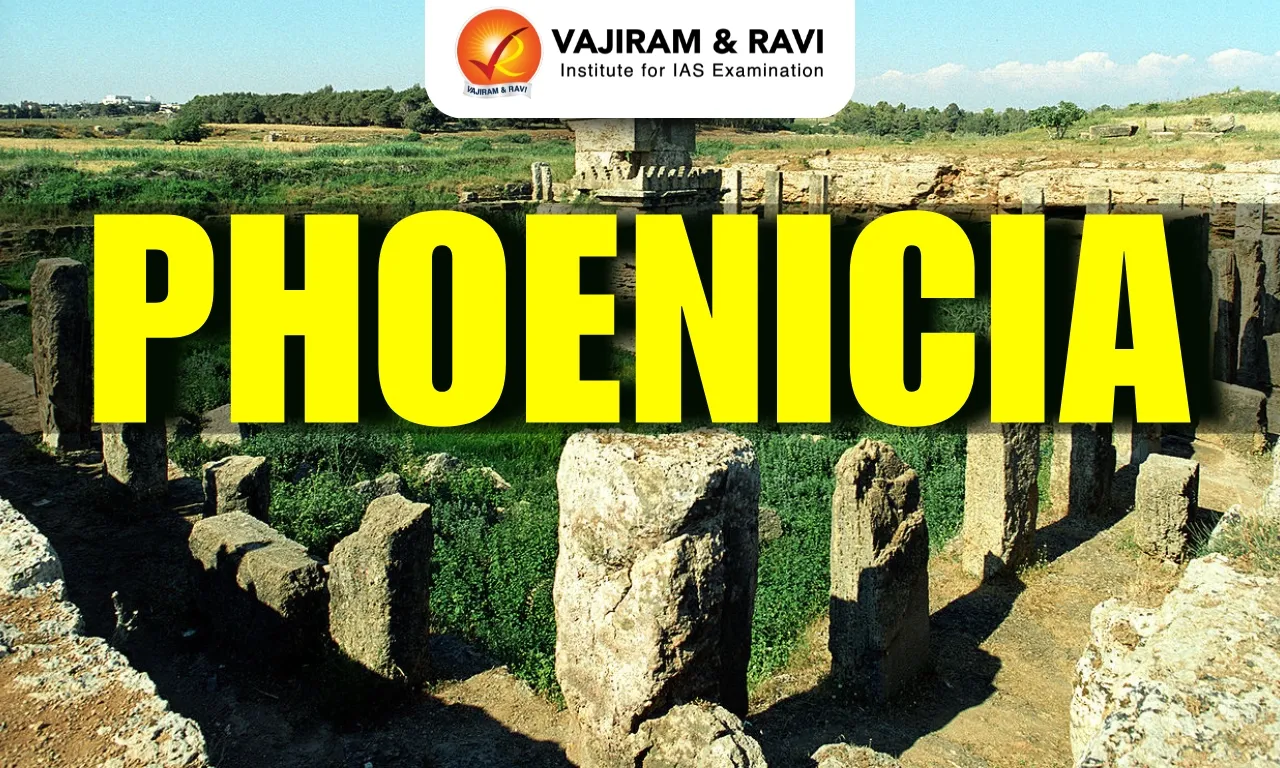
  • Phoenicia was an ancient region at the eastern end of the Mediterranean Sea. 
  • It covered the land where the country of Lebanon is today. 
  • The people who lived there were called Phoenicians. They traded with many other peoples and set up many colonies.
  • The Phoenicians lived on the seacoast and made their living from the sea. They were skilled shipbuilders and navigators. 
  • Their trade routes reached as far as Spain and the British Isles. 
  • The Phoenicians traded wood, linen, dyes, and wine
  • They also carved wood and ivory and worked with metals and glass
  • The art of glassblowing was probably invented in Phoenicia.
  • The Phoenicians spoke a language that was similar to Hebrew. They had their own form of writing and an alphabet of 22 letters. 
  • The Phoenician alphabet was the source of the Greek alphabet and of the Latin alphabet, which most people use today.
  • Historians think that the Phoenicians arrived in Phoenicia in about 3000 BCE. They probably came from the region of the Persian Gulf, to the southeast. 
  • They built the cities of Sidon, Tyre, and Berot (modern Beirut). 
  • The Phoenicians set up colonies all around the Mediterranean. Carthage, in North Africa, was a very successful colony. Eventually Carthage became a power in its own right.
  • Decline:
    • Over the centuries a number of foreign powers controlled all or parts of Phoenicia. They included Egypt, Assyria, Babylonia, and Persia. 
    • The Macedonians, led by Alexander the Great, conquered Phoenicia in 332 BCE. 
    • In 64 BCE Phoenicia became a part of the Roman Empire.

Source: PM

Phoenicia FAQs

Q1: What was Phoenicia?

Ans: Phoenicia was an ancient region at the eastern end of the Mediterranean Sea.

Q2: In which crafts were the Phoenicians skilled?

Ans: They carved wood and ivory and worked with metals and glass.

Q3: What important invention is believed to have originated in Phoenicia?

Ans: The art of glassblowing was probably invented in Phoenicia.

Q4: What was the Phoenician language similar to?

Ans: It was similar to Hebrew.

Q5: Which major cities were built by the Phoenicians?

Ans: They built the cities of Sidon, Tyre, and Beirut (ancient Berot).

Chunar Fort, Location, Architecture, History, Recent Development

Chunar Fort

Chunar Fort is also known as Chandrakanta Chunargarh and Charanadri. It stands in Mirzapur district of Uttar Pradesh. It is built on an isolated spur of the Vindhya Range 85 meters above sea level and overlooks a strategic bend of the Ganges near the Kaimur Hills. It is traditionally believed to be established by Maharaja Vikramaditya of Ujjain in the 11th century. Its occupation is traced back to 56 BC. Over centuries, it passed through the hands of Sher Shah Suri, the Mughals, the Nawabs of Awadh, Kashi rulers and finally the British until 1947.

Chunar Fort Features

The major highlighting features of the Chunar Fort has been listed below:

  • Strategic Location: Built on a steep rocky bluff projecting into the Ganges, the fort commands river navigation for 50 to 60 ton boats. The hill rises sharply 32 meters from the river and further to 85 meters, making direct assault difficult and allowing artillery batteries to dominate the river channel.
  • Political Control Struggles: Sher Shah Suri secured it in 1532 through strategic alliances. Humayun besieged it for four months. Akbar captured it in 1575 and built the west gate in 1586. It later shifted between Nawab of Awadh, Kashi Naresh and British control until Independence in 1947.
  • Architecture: Spread roughly 690 meters north to south with ramparts extending 1,690 meters, the fort used local sandstone from Mauryan era quarries. It contains a citadel with cannon placements, a 15 foot diameter deep well, underground dungeons and tiered defensive walls with 10 to 20 foot high towers.
  • Religious Associations: Linked to King Bali and the name Charanadri, it is associated with Vikramaditya and Bharthari. Sonwa Mandap, built in 1538 with 28 pillars, includes a deep 61 meter well connected to the Ganges, reinforcing its sacred and cultural dimension.
  • Colonial Background: It functioned as an artillery depot, prison and refuge during 1857. Rani Jind Kaur was imprisoned here in 1849 before escaping to Kathmandu. 
  • Recent Development: Today, it is being developed as a ₹150 crore PPP based 100 room heritage hotel to boost river tourism and regional economy.

Also Read: Amagarh Fort

Chunar Fort FAQs

Q1: Where is Chunar Fort located?

Ans: Chunar Fort is located in Mirzapur district of Uttar Pradesh, about 34 km from Mirzapur and 23 km southwest of Varanasi, on the bank of the Ganges River.

Q2: Who captured Chunar Fort in 1532?

Ans: Sher Shah Suri took control of Chunar Fort in 1532 and strengthened his political position in North India from this strategic base.

Q3: Why was Chunar Fort strategically important?

Ans: The fort overlooks a key bend of the Ganges River and controlled river navigation and major land routes toward eastern India.

Q4: Which Mughal emperor built the west gate of the fort?

Ans: Emperor Akbar captured the fort in 1575 and constructed the west gate in 1586, as marked by an inscription.

Q5: What is the present development plan for Chunar Fort?

Ans: The Uttar Pradesh government plans to convert it into a ₹150 crore heritage hotel under a Public Private Partnership model to promote tourism.

Wheat

Wheat

Wheat Latest News

Recently, the government allowed export of 25 lakh tonnes of wheat, along with an additional 5 lakh tonnes of wheat products after 4 years.

About Wheat

  • Wheat is the second most important staple food crop in India after rice.
  • It is a temperate crop that thrives in cool and dry climates.
  • It is primarily grown as a Rabi crop, meaning it is sown in the winter season and harvested in spring.
  • Required climatic conditions for wheat cultivation
    • Temperature: A cool temperature (10°C to 15°C) during sowing and 21°C to 26°C during ripening ensures optimum growth and grain quality.
    • Rainfall: Wheat requires 50-75 cm of well-distributed rainfall.
    • Excessive rain or humidity during the ripening period can harm the crop, while drizzles brought by Western Disturbances in northwestern India during winter significantly improve yields.
    • Sunlight: Bright sunshine during ripening improves grain formation and quality.
    • Frost: Frost or hailstorms during the flowering stage can damage the crop severely.
    • Soil: It grows well in a clay loam or loam texture soil.
  • Major Wheat Producing Countries: China, India, Russia and the United States.
  • Major Wheat Producing States: Punjab, Haryana, Uttar Pradesh, and Bihar.

Source: IE

Wheat FAQs

Q1: Which season is wheat typically grown in India?

Ans: Rabi

Q2: What is the scientific name of wheat?

Ans: Triticum aestivum

Key Facts about Barbados

Key Facts about Barbados

Barbados Latest News

Recently, the Prime Minister of India congratulated Barbados Mia Amor Mottley on securing a historic third consecutive electoral victory.

About Barbados

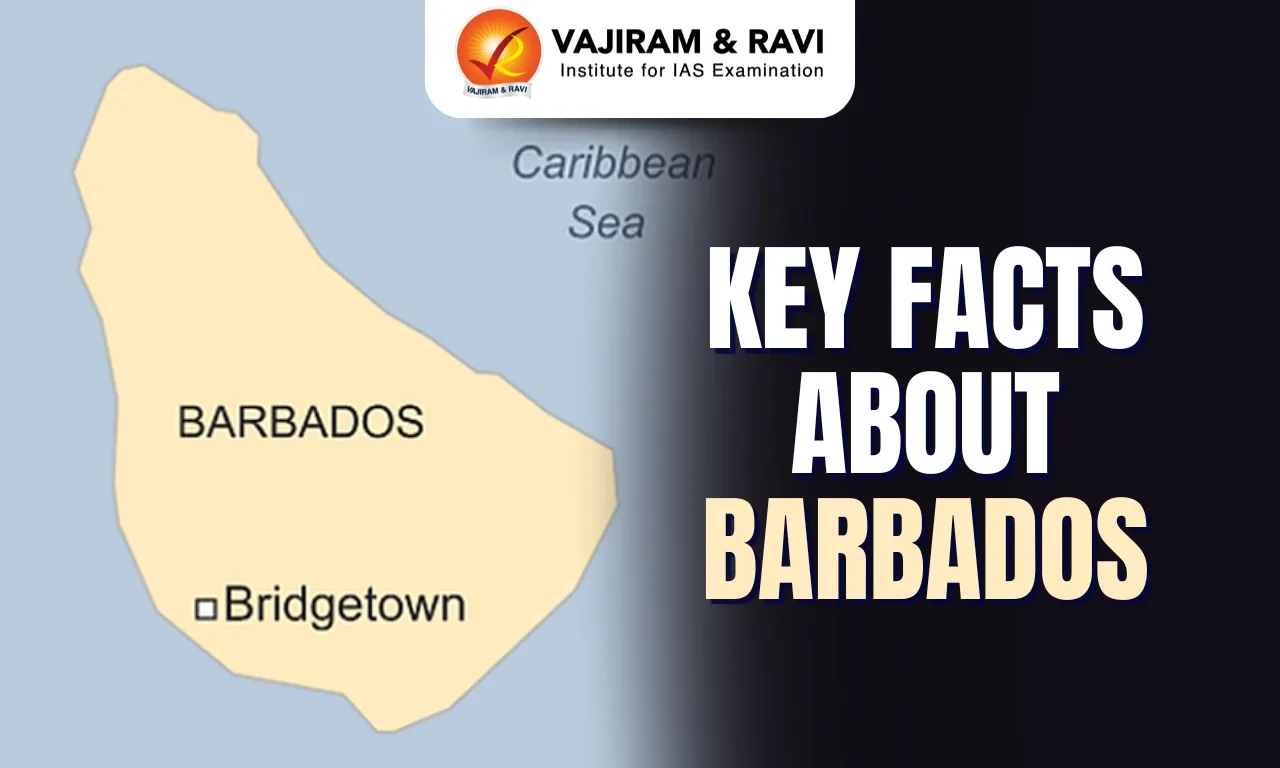
  • Location: It is an island country located in the south eastern Caribbean region of North America.
  • It lies to the east of St. Lucia, St. Vincent and the Grenadines; to the southeast of Martinique; to the northeast of Trinidad and Tobago.
  • It is the easternmost island in the Caribbean.
  • Water Bodies: Barbados is surrounded by the Atlantic Ocean.
  • It is part of the Caribbean Community (CARICOM) which was established in 1973.
  • Capital City: Bridgetown
  • Independence: Barbados became independent on November 30, 1966.

Geographical Features of Barbados

  • Terrain: The terrain of Barbados is gentle sloping, terraced plains separated by rolling hills.
  • Climate: Its climate is classified as a tropical monsoon. It experiences both the wet and dry seasons.
  • Highest Point: The highest point on the island is Mount Hillaby which measures 340 meters above sea level.
  • Natural Resources: Barbados's chief natural resources are petroleum, fish, and natural gas. 

Source: DD News

Barbados FAQs

Q1: Where is Barbados located?

Ans: Caribbean Sea

Q2: What is the capital of Barbados?

Ans: Bridgetown

Tetrataenium Paikadae

Tetrataenium Paikadae

Tetrataenium Paikadae Latest News

A team of researchers recently discovered a new plant species named Tetrataenium paikadae in the high-altitude grasslands of Idukki district of the Western Ghats.

About Tetrataenium Paikadae

  • It is a new plant species.
  • It was discovered in the high-altitude grasslands of the Western Ghats in the Idukki district, Kerala.
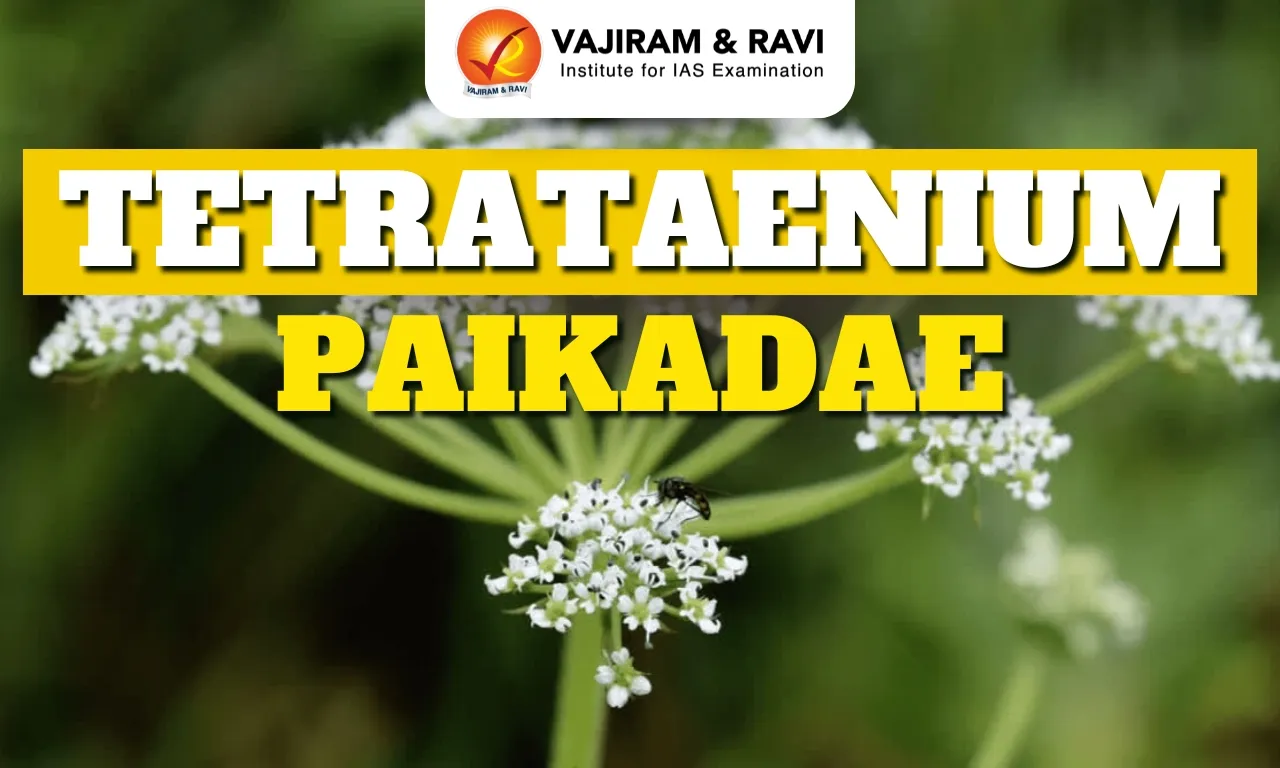
  • It was identified inside Eravikulam National Park and belongs to the Apiaceae family, which includes commonly known plants such as carrot and coriander.
  • The newly discovered species thrives in moist, marshy grasslands at elevations ranging between 1,000 and 2,500 metres above sea level. 
  • The plant grows to a height of 30 to 80 centimetres, and it has densely stiff-haired stems, ovate leaves, and clusters of small white flowers.
  • It typically flowers between July and September, while fruiting occurs from October to November. 
  • Researchers distinguished Tetrataenium paikadae from closely related species based on the number and structural arrangement of oil tubes present in its fruits.

Source: ETVB

Tetrataenium Paikadae FAQs

Q1: What is Tetrataenium paikadae?

Ans: It is a newly discovered plant species.

Q2: Where was Tetrataenium paikadae discovered?

Ans: It was discovered in the high-altitude grasslands of the Western Ghats in the Idukki district of Kerala.

Q3: To which plant family does Tetrataenium paikadae belong?

Ans: It belongs to the Apiaceae family.

Q4: In what type of habitat does Tetrataenium paikadae thrive?

Ans: It thrives in moist, marshy grasslands.

Chennakeshava Temple

Chennakeshava Temple

Chennakeshava Temple Latest News

The Prime Minister’s new office complex, Seva Teerth has been built in the Indian architectural tradition inspired by the features of the 12th-century Chennakeshava Temple.

About Chennakeshava Temple

  • The Chennakeshava Temple, also referred to as the Keshava, or Vijayanarayana Temple of Belur, is a 12th-century temple in Karnataka.
  • It is a Hindu temple dedicated to Lord Vishnu. 
  • It was commissioned by King Vishnuvardhana in 1117 CE (after a major military victory in 1116 CE over the Cholas in the great battle of Talakkad), on the banks of the Yagachi River in Belur, also known as Velapura. 
  • The temple was built over three generations and took 103 years to complete.
  • The temple is listed as a UNESCO World Heritage Site.

Chennakeshava Temple Architecture

  • It is a stunning example of Hoysala architecture.
  • The Hoysalas used soft soapstone for their structures, as they were found suitable for intricate carvings. 
  • Enclosed by a Prakara with a Gopura built in the Vijayanagar style, the temple stands on a platform, or Jagati, and looks like a huge casket.
  • The outer walls of the temple are adorned with intricate carvings, which depict various gods, goddesses, and mythical creatures.
  • There are more than 80 Madanika sculptures in the temple, dancing, hunting, standing under canopies of trees, and so on. 
  • One of the unique features of the Chennakeshava Temple is the stepped well, which is located in the temple complex.

Source: TI

Chennakeshava Temple FAQs

Q1: What is the Chennakeshava Temple also known as?

Ans: It is also known as the Keshava Temple or Vijayanarayana Temple of Belur.

Q2: Where is the Chennakeshava Temple located?

Ans: It is located in Belur (also known as Velapura) in Karnataka.

Q3: In which century was the Chennakeshava Temple built?

Ans: It was built in the 12th century.

Q4: Who commissioned the Chennakeshava Temple?

Ans: It was commissioned by King Vishnuvardhana.

Q5: In which year was the temple commissioned?

Ans: It was commissioned in 1117 CE.

Combined Maritime Forces

Combined Maritime Forces

Combined Maritime Forces Latest News

Recently, the Indian Navy has assumed command of Combined Task Force (CTF) 154, a key multinational training task force under the Combined Maritime Forces (CMF).

About Combined Maritime Forces

  • It is a multinational maritime partnership that upholds the International Rules Based Order (IRBO) by countering illicit non-state actors on the high seas.
  • It promotes security, stability and prosperity across approximately 3.2 million square miles of international waters, which encompass some of the world’s most important shipping lanes.
  • Mandate: Its main focus areas are counter-narcotics, counter-smuggling, suppressing piracy, encouraging regional cooperation, and engaging with regional and other partners to strengthen relevant capabilities and improve overall security and stability, and promote a safe maritime environment free from illicit non-state actors.
  • CMF has five Combined Task Forces
    • CTF 150 (Maritime Security Operations outside the Arabian Gulf)
    • CTF 151 (Counter-Piracy)
    • CTF 152 (Maritime Security Operations inside the Arabian Gulf)
    • CTF 153 (Red Sea Maritime Security)
    • CTF 154 (Maritime Security Training)
  • Member Countries: It comprises 47 nations including India.
  • The 47 nations that comprise CMF are not bound by either a fixed political or military mandate. 

Source: PIB

Combined Maritime Forces FAQs

Q1: What is the primary objective of the Combined Maritime Forces (CMF)?

Ans: To counter maritime threats and ensure security

Q2: Where is the headquarters of the Combined Maritime Forces located?

Ans: Bahrain

Lead Bank Scheme (LBS)

Lead Bank Scheme (LBS)

Lead Bank Scheme (LBS) Latest News

The Reserve Bank of India (RBI) recently issued the draft circular on the revised guidelines for the Lead Bank Scheme (LBS) for public comments.

About Lead Bank Scheme (LBS)

  • On the recommendations of the Nariman committee, the LBS was introduced by the Reserve Bank of India in December 1969.
  • Aim: Coordinating the activities of banks and other developmental agencies in order to achieve the objective of enhancing the flow of bank finance to the priority sector and other sectors and to promote banks' role in the overall development of the rural sector
  • For coordinating the activities in the district, a particular bank is assigned ‘Lead Bank’ responsibility of the district. 
  • The Lead Bank is expected to assume a leadership role for coordinating the efforts of the credit institutions and the Government. 
  • For the preparation of District Credit Plans and monitoring their implementation, a Lead bank Officer (LBO), now designated as Lead District Manager was appointed in 1979.

Source: TH

Lead Bank Scheme (LBS) FAQs

Q1: On whose recommendation was the Lead Bank Scheme introduced?

Ans: It was introduced on the recommendations of the Nariman Committee.

Q2: In which year was the Lead Bank Scheme introduced?

Ans: It was introduced in December 1969.

Q3: What is the main objective of the Lead Bank Scheme?

Ans: Its main objective is to enhance the flow of bank finance to the priority sector and promote the development of the rural sector.

Q4: What role does the Lead Bank play in a district?

Ans: The Lead Bank assumes a leadership role in coordinating the efforts of credit institutions and the Government.

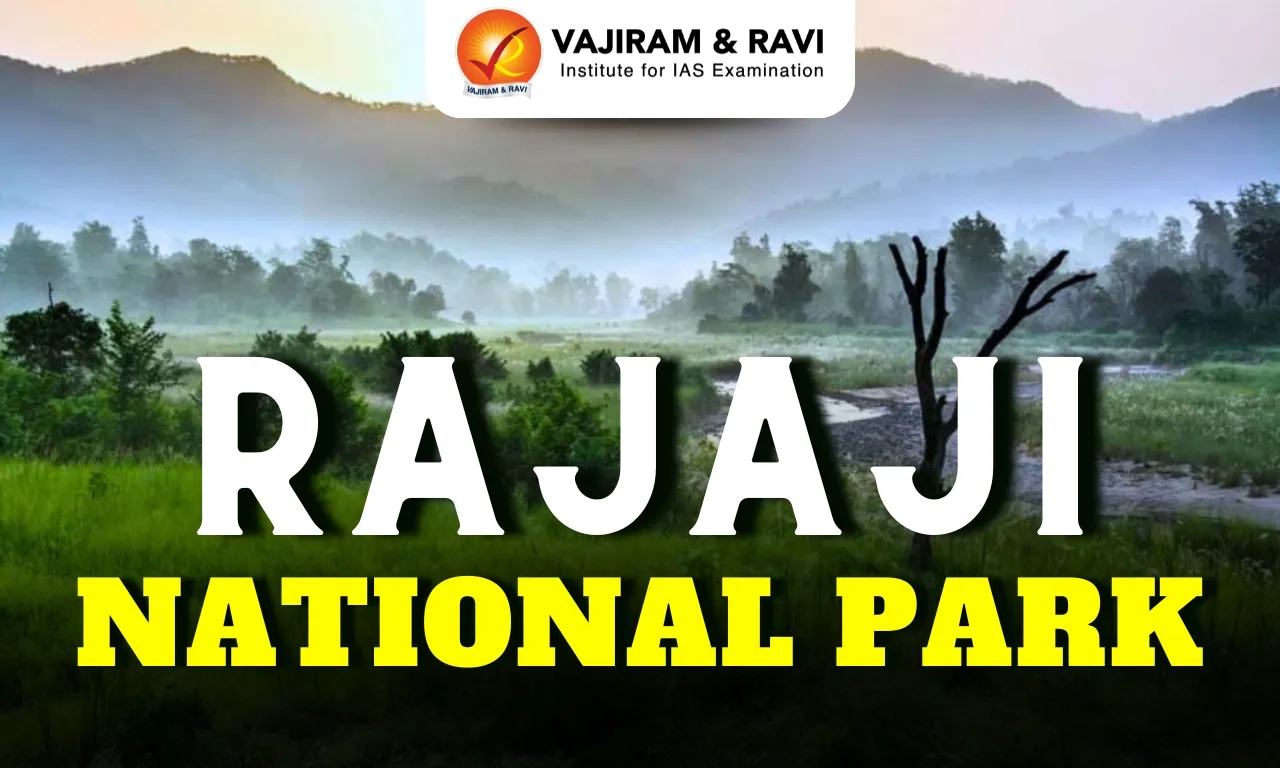
Rajaji Tiger Reserve

Rajaji Tiger Reserve

Rajaji National Park Latest News

The Supreme Court gave the nod for construction of a road cutting through Rajaji National Park on the condition that no commercial vehicles shall ply on it.

About Rajaji National Park

  • Location: It is located in the state of Uttarakhand.
  • It was established by merging three wildlife sanctuaries- Rajaji, Motichur and Chilla. 
  • It is named after C. Rajagopalachari, a prominent freedom fighter, fondly known as “Rajaji”. 
  • It is nestled between the Shivalik ranges and the Indo-Gangetic plains.
  • Rivers: River Ganga bifurcates the Park into two parts.
  • Vegetation: Forests of Rajaji include the Moist Shivalik Sal Forest, Moist Mixed Deciduous Forest, Northern Dry Mixed Deciduous and Khair-Sissoo forests in the Southern Slopes,
  • Flora: Sal tree, Anogeissus latilolia, Albizzia procera, A. lebbek, Boehmeria rugulosa, Lannea coromandelica, Terminalia bellerica, Mallotus philippensis, Wendlandia heynii, Bombax ceiba, etc.
  • Fauna: It is home to Asian Elephant, Tiger, leopard, Himalayan Black bear, sloth bear, Civet, Marten, Jackal, Hyena etc.

Source: HT

Rajaji National Park FAQs

Q1: Where is Rajaji National Park located?

Ans: Uttarakhand

Q2: Which river flows through Rajaji National Park?

Ans: Ganga River

New Consumer Price Index – Changes and Implications

New Consumer Price Index

Consumer Price Index Latest News

  • The Ministry of Statistics and Programme Implementation (MoSPI) has released a new India Consumer Price Index (CPI) series with 2024 as the base year, reporting retail inflation at 2.75% in January. 

Understanding the Consumer Price Index in India

  • The Consumer Price Index (CPI) is the primary measure of retail inflation in India. 
  • It tracks changes in the prices of goods and services consumed by households and is used by the Reserve Bank of India (RBI) to frame monetary policy under the inflation-targeting framework.
  • CPI reflects the cost of living and directly affects interest rates, wages, pensions, and government welfare schemes. 
  • It is based on a “basket” of goods and services that represents typical household consumption patterns.
  • Since consumption habits change over time due to income growth, technological shifts, and urbanisation, the CPI basket must be periodically revised. 
  • Without such revisions, the index may misrepresent actual inflation trends.

Key Features of the New CPI Series

  • Updated Base Year
    • The base year has been revised to 2024. A base year acts as a reference point against which price changes are measured. 
    • Updating it ensures that inflation calculations reflect contemporary consumption patterns rather than outdated ones.
  • Revised Consumption Basket
    • The new CPI includes goods and services that households currently consume and excludes obsolete items. 
    • For example, older items such as CDs and DVDs have been replaced with modern electronics such as headphones, earphones, and Bluetooth devices. 
    • This reflects the digital transformation of Indian households and makes inflation measurement more realistic.
  • Retail Inflation in January
    • According to the new CPI series, retail inflation stood at 2.75% in January. 
    • However, direct comparison with previous months under the old CPI series is statistically inappropriate due to differences in basket composition and methodology.

The Apples-to-Oranges Problem

  • One major issue raised by analysts is the comparability of inflation rates under the old and new series.
  • Under the old CPI, December inflation was recorded at 1.33%. Comparing that figure directly with January’s 2.75% under the new series would be misleading because:
    • Some goods have been added or removed.
    • Weightages assigned to categories have changed.
    • Data sources and price collection methods have been revised.
  • This is similar to comparing two different baskets of goods; the underlying components differ, so inflation outcomes may vary even if price trends remain stable.

The Back-Series Debate

  • To address comparability concerns, MoSPI has released a “back-series” of headline index numbers going back to 2013. 
  • However, experts caution that this back-series is largely mechanical. It applies linking factors to adjust old data, but does not reconstruct the old basket using new consumption patterns.
  • For example, December 2025 inflation under the new series would be 1.17%, compared to 1.33% under the old series. 
  • Over 2025, the average inflation rate remains broadly similar at around 2.2% under both series. 
  • Yet, economists argue that a more detailed back-series requires deeper methodological work, especially given changes in:
    • Item inclusion and exclusion
    • Market coverage
    • Data collection processes

Changes in the Weight of Food, Gold and Silver

  • Reduced Weight of Food
    • Food items now carry a lower weight in the CPI basket compared to the previous series. 
    • This reflects rising incomes and diversification of household expenditure towards services and non-food items.
    • A lower food weight could potentially reduce volatility in headline inflation, as food prices are typically more sensitive to monsoon conditions and supply shocks.
  • Revised Weight of Gold and Silver
    • In the old CPI, gold had a weight of 1.08% and silver 0.11%. 
    • In the new CPI, gold/diamond/platinum jewellery together account for 0.62%, while silver jewellery accounts for 0.31%. 
    • Although their combined weight remains important, gold’s individual weight has reduced.
    • Interestingly, global gold and silver prices saw sharp increases — gold inflation at 69% and silver at 97% during December 2025. 
  • If these were excluded, CPI inflation in December 2025 would have been just 0.26% instead of 1.33%. 
  • This shows how commodity price shocks can significantly influence headline inflation.

Implications for Monetary Policy

  • The new CPI series has several policy implications:
    • Improved Accuracy - It better reflects actual household spending patterns.
    • Reduced Food Volatility - Lower food weight may stabilise headline inflation.
    • Core Inflation Insight - With changed weights, underlying (core) inflation trends may appear softer.
    • Better Policy Calibration - RBI decisions on repo rates can be more aligned with real consumption dynamics.
  • However, transitional confusion and data interpretation challenges may persist until a detailed back-series is prepared.

Source: IE

Consumer Price Index FAQs

Q1: What is the base year of the new CPI series?

Ans: The new CPI series uses 2024 as its base year.

Q2: What was retail inflation in January under the new CPI?

Ans: Retail inflation stood at 2.75% in January.

Q3: Why cannot the new CPI be directly compared with the old series?

Ans: Because the consumption basket, weights, and methodology have changed.

Q4: How has the weight of gold changed in the new CPI?

Ans: Gold/diamond/platinum jewellery now accounts for 0.62% compared to 1.08% for gold earlier.

Q5: How did gold and silver prices affect inflation in December 2025?

Ans: Excluding gold and silver, inflation would have been 0.26% instead of 1.33%.

Daily Editorial Analysis 14 February 2026

Daily-Editorial-Analysis

India Tested, From U.S. Sanctions to One-Sided Trade Deal

Context

  • The proposed India–United States Bilateral Trade Agreement has sparked intense political and public debate.
  • Although the agreement itself has not yet been finalised, discussions surrounding it have already revealed important questions about India’s economic policy and foreign relations.
  • The Indian government’s primary objective is understandable: to ease the burden of high U.S. tariffs and to strengthen economic growth through expanded trade access.
  • The emerging framework suggests that the agreement may extend beyond commercial cooperation and enter the realm of foreign policy alignment.

The Nature of the Negotiation Process

  • Unilateral Announcements

    • A striking feature of the negotiations is the imbalance in communication. Nearly all major details about the agreement have been revealed by the United States rather than India.
    • The first indication of progress came from a public statement by the U.S. President, followed by executive orders and official documents released in Washington.
    • India’s responses, in contrast, were limited and delayed.
    • This sequence creates the perception that India is reacting to developments rather than shaping them.
    • When a joint statement appears first from one party, it raises a fundamental question: Is the agreement being negotiated between equals, or is one side dictating the terms?
  • Implications of Asymmetry

    • The communication pattern suggests a power imbalance. Instead of a mutual negotiation, the process resembles a situation in which India must adjust its policies to obtain tariff relief.
    • Such a precedent is significant because it may influence the nature of future agreements between the two countries, not only in trade but also in strategic and defence cooperation.

The Energy Security Question

  • Importance of Russian Oil

    • India has relied significantly on discounted Russian oil to ensure affordable energy for its population and industry.
    • At one point, Russia accounted for approximately 40% of India’s oil imports.
  • Recent Changes

    • Recent data indicate a decline in Russian oil purchases despite increasing discounts.
    • The reduction appears inconsistent with earlier policy statements prioritising affordable energy for Indian consumers.
    • The change suggests that political pressure, rather than economic logic, may be shaping energy policy.
  • Economic vs Political Choice

    • If India abandons cheaper energy sources due to external pressure, it may compromise domestic economic interests.
    • This situation raises a critical question: Should trade benefits justify altering independent energy decisions?

Diplomatic Consequences

  • Relations with Russia and Iran

    • Reducing engagement with Russia and Iran risks damaging India’s credibility as a reliable economic partner.
    • Countries that once considered India a stable and independent collaborator may reassess their trust.
  • Impact on the Global South

    • India has historically positioned itself as a leader among developing nations, often resisting unilateral sanctions not authorised by international institutions.
    • Compliance with external demands may weaken this image and reduce India’s diplomatic influence.
  • Relations with Other Trade Partners

    • Preferential treatment toward the United States could also cause friction with other economic partners, including the European Union and recently negotiated trade partners.
    • This may complicate India’s broader trade strategy.

Strategic and Geopolitical Implications

  • Regional Balance of Power

    • Curtailing projects such as the Chabahar port and reducing engagement with Iran could unintentionally strengthen China’s regional influence.
    • The agreement, therefore, has implications beyond economics and affects regional geopolitics.
  • Future Agreements

    • If tariff relief requires political alignment, future cooperation in defence, security partnerships, counter-terrorism, and Indo-Pacific strategies may also involve similar conditions.
    • The precedent could fundamentally reshape the India-U.S. partnership.

Strategic Autonomy and Historical Context

  • India’s Foreign Policy Tradition

    • Since independence, India has followed a policy of strategic autonomy, maintaining relations with multiple powers without formally aligning with any single bloc.
    • This approach allows flexibility in diplomacy and protects sovereign decision-making.
  • Comparison with RCEP Withdrawal

    • In 2019, India withdrew from the Regional Comprehensive Economic Partnership due to concerns about economic dependence and policy constraints.
    • Accepting stronger conditions in the present agreement would appear inconsistent with that earlier decision.
  • Risk to Multi-Alignment

    • The proposed trade agreement may narrow India’s foreign policy options rather than expand them.
    • Instead of multi-alignment in a multipolar world, India could appear increasingly tied to one major power.

Conclusion

  • The India-U.S. Bilateral Trade Agreement offers clear economic benefits, particularly relief from punitive tariffs and greater market access.
  • The manner of negotiation, the linkage of trade with foreign policy, and the potential impact on energy security and diplomatic relationships suggest that the agreement is far more than a commercial arrangement.
  • If economic gains come at the expense of independent decision-making, India risks compromising its long-standing principles of strategic autonomy and diplomatic balance.

India Tested, From U.S. Sanctions to One-Sided Trade Deal FAQs

Q1. What is the main concern raised about the India–U.S. trade agreement?
Ans. The main concern is that the agreement may compromise India’s strategic autonomy and independent foreign policy.

Q2. Why does the negotiation process appear unequal?
Ans. The process appears unequal because most announcements and details about the agreement have been released by the United States before India.

Q3. How is the trade deal connected to foreign policy issues?
Ans. The trade deal is linked to foreign policy because the United States expects India to reduce Russian oil imports and limit trade with Iran.

Q4. What impact could the agreement have on India’s global relationships?
Ans. The agreement could weaken India’s credibility with partners such as Russia, Iran, and developing nations.

Q5. Why is strategic autonomy important for India?
Ans. Strategic autonomy is important because it allows India to maintain independent decision-making and balanced relations with multiple countries.

Source: The Hindu


The Labour Codes Redefine Wages, Empower the Worker

Context

  • India’s new labour codes represent a major step toward strengthening financial inclusion and social security for workers.
  • By consolidating fragmented labour laws, they aim to modernise labour governance and embed income protection, long-term safeguards, and social security into employment.
  • Despite opposition and strike calls from some trade unions, the reforms seek to address historic exclusions and integrate millions of workers into formal financial and welfare systems, ensuring more equitable sharing of economic growth.
  • This article highlights how India’s labour codes redefine wages, expand social security, and embed financial inclusion within employment.

Reforming the Wage Definition: Expanding Social Security

  • Mandatory 50% Wage Threshold

    • A key reform under the labour codes is the revised definition of “wage.”
    • Employers must now ensure that wages (basic pay, dearness allowance, and retaining allowance) form at least 50% of total remuneration.
    • Earlier, many establishments kept this share as low as 30–35% to reduce social security contributions.
    • The new threshold increases contributions to Provident Fund (PF), pension, and gratuity, strengthening long-term financial security for workers.
  • Gratuity for Fixed-Term Employees

    • Fixed-term employees are now eligible for gratuity after one year of service, reflecting modern labour market realities.
    • Previously, such workers often exited without terminal financial benefits despite productive contributions.
    • Extending gratuity coverage converts short-term employment into a tool for asset creation and income stability.
  • Enhancing Financial Inclusion

    • PF, pension, and gratuity now function not merely as retirement benefits but as instruments of financial inclusion.
    • They enable workers to accumulate savings, manage life-cycle risks, and cushion income shocks during job transitions.
  • Corporate Cost vs Worker Security

    • The reforms increase financial liabilities for large corporations with sizeable workforces and fixed-term employment.
    • However, these higher outflows directly translate into improved worker income security, stronger purchasing power, and broader social security coverage.
  • Broader Economic Impact

    • Enhanced social security benefits contribute to:
      • Increased household consumption
      • Higher savings
      • Reduced vulnerability
    • The reform thus promotes fairer value distribution between capital and labour, reinforcing dignity and long-term stability in employment relations.

Macroeconomic Impact: Labour Codes and Inclusive Growth

  • Expanding Social Security Coverage

    • The labour codes extend financial inclusion beyond organised workers to gig, platform, and unorganised workers.
    • For the first time, these groups are formally recognised under labour law, enabling access to insurance, provident fund mechanisms, and welfare schemes.
    • Portability of benefits across States and jobs is particularly crucial for migrant and informal workers historically excluded from stable financial systems.
  • Strengthening Income Security

    • The Code on Wages introduces a universal wage definition, mandates statutory minimum wages, limits arbitrary deductions, and ensures timely payments.
    • These provisions stabilise incomes and enhance workers’ participation in the formal economy.
  • Boost to Consumption and Savings

    • Redistribution of income toward workers increases purchasing power, encouraging higher consumption and improved savings behaviour.
    • Unlike shareholder income, worker income largely circulates within the domestic economy, supporting demand-led growth.
  • Inclusive and Shock-Resilient Growth

    • By expanding social security and income protection, the labour codes reduce economic vulnerability and strengthen financial stability.
    • They serve as instruments of inclusive growth, reinforcing social cohesion and resilience against economic shocks.

Labour Law Reform: Modernisation Amid Opposition

  • Outdated and Fragmented Legacy Framework

    • India’s earlier labour laws had become fragmented and outdated, ill-suited to a rapidly evolving labour market.
    • Consolidating them into four labour codes simplifies compliance, enhances transparency, and creates a more predictable regulatory environment for both workers and employers.
  • Opposition and Implementation Concerns

    • While trade unions have raised concerns and called strikes, blanket opposition often overlooks the pro-worker provisions embedded in the codes.
    • Legitimate implementation challenges exist, but resistance driven by rhetoric risks obscuring tangible welfare gains.
  • Structural Shift Toward Financial Inclusion

    • The labour codes represent more than regulatory restructuring.
    • By extending gratuity, broadening social security coverage, and closing legal exclusions, they promote financial inclusion and gradually redistribute economic value toward labour.
  • Aligning Growth with Social Justice

    • By strengthening income security and financial dignity, the reforms aim to align economic growth with social justice.
    • Their long-term success will depend on effective implementation that ensures every worker benefits from India’s growth trajectory.

The Labour Codes Redefine Wages, Empower the Worker FAQs

Q1. How does the revised wage definition improve worker security?

Ans. The 50% wage threshold increases PF, pension, and gratuity contributions, ensuring higher long-term savings and stronger social security accumulation for workers.

Q2. Why is gratuity for fixed-term employees significant?

Ans. Granting gratuity after one year converts short-term employment into asset creation, addressing historic exclusions and improving income stability for contract workers.

Q3. How do labour codes promote financial inclusion?

Ans. They extend social security to gig, platform, and unorganised workers, ensure portability of benefits, and stabilise incomes through universal wage protections.

Q4. What is the macroeconomic impact of these reforms?

Ans. Higher worker income boosts consumption, savings, and domestic demand, contributing to inclusive, shock-resilient growth rather than wealth concentration.

Q5. Why were earlier labour laws considered outdated?

Ans. Fragmented and complex regulations hindered transparency and coverage, making consolidation into four codes necessary for modern labour markets and predictable governance.

Source: TH

Daily Editorial Analysis 14 February 2026 FAQs

Q1: What is editorial analysis?

Ans: Editorial analysis is the critical examination and interpretation of newspaper editorials to extract key insights, arguments, and perspectives relevant to UPSC preparation.

Q2: What is an editorial analyst?

Ans: An editorial analyst is someone who studies and breaks down editorials to highlight their relevance, structure, and usefulness for competitive exams like the UPSC.

Q3: What is an editorial for UPSC?

Ans: For UPSC, an editorial refers to opinion-based articles in reputed newspapers that provide analysis on current affairs, governance, policy, and socio-economic issues.

Q4: What are the sources of UPSC Editorial Analysis?

Ans: Key sources include editorials from The Hindu and Indian Express.

Q5: Can Editorial Analysis help in Mains Answer Writing?

Ans: Yes, editorial analysis enhances content quality, analytical depth, and structure in Mains answer writing.

Gender Stereotype Handbook Revisited: Supreme Court Signals Shift in Judicial Training

Gender Stereotype Handbook

Gender Stereotype Handbook Latest News

  • The Supreme Court has signalled a shift in its approach to gender sensitivity by moving beyond the 2023 Handbook on Combating Gender Stereotypes, issued under former CJI D Y Chandrachud. 
  • Current Chief Justice Surya Kant described the handbook as overly academic and stressed the need for more practical, ground-level judicial training.
  • The observations arose during a suo motu hearing of an Allahabad High Court ruling that had controversially termed certain acts—such as grabbing a victim’s breasts and loosening her pyjama string—as mere “preparation” rather than an “attempt” to rape. 
  • The Supreme Court had earlier stayed the judgment and, later, formally set it aside. 
  • The bench directed the trial court to proceed with attempt-to-rape charges, underscoring the judiciary’s commitment to a more sensitive and legally sound interpretation in sexual assault cases.

Shift from Handbook to Institutional Training

  • During the hearing, the Supreme Court questioned the practical utility of the 2023 Handbook on Combating Gender Stereotypes. 
  • The bench observed that the handbook relied on “forensic meanings” — technical or clinical interpretations — which may not reflect survivors’ lived realities or common social understanding.
  • CJI Surya Kant described the document as “too Harvard-oriented,” suggesting it was overly theoretical and disconnected from India’s ground realities.
  • The Court noted that merely issuing a handbook to guide High Court judges “serves no purpose” if it does not translate into meaningful change. 
  • Instead of relying on advisory texts, the bench emphasised the need for structured institutional reform.

Role of the National Judicial Academy

  • The Court directed the National Judicial Academy (NJA), Bhopal, to constitute a committee of domain experts, academics, and lawyers to draft practical training guidelines
  • These will become part of the NJA’s curriculum for High Court judges.
  • Once finalised, judges will undergo batch-wise training focused on handling sexual assault cases with sensitivity and legal clarity.
  • Senior advocates have been engaged to assist in refining the new guidelines, ensuring they balance legal precision with survivor-centric sensitivity.

Inside the 2023 Gender Stereotypes Handbook

  • Released in August 2023, the 35-page Handbook on Combating Gender Stereotypes aimed to eliminate patriarchal language and biased reasoning from judicial decisions.
  • In his foreword, then CJI D.Y. Chandrachud emphasised that language shapes justice, warning that stereotypes distort the law’s application to women.

Reforming Courtroom Language

  • A major section of the handbook provided a glossary identifying “Incorrect” (stereotype-promoting) terms and suggesting “Preferred” alternatives.
  • Examples of Suggested Changes
    • “Adulteress” → “Woman who has engaged in sexual relations outside marriage”
    • “Eve teasing” → “Street sexual harassment”
    • “Child prostitute” → “Child who has been trafficked”
    • “Housewife” → “Homemaker”
    • Avoiding terms like “fallen woman” or “woman of easy virtue”
    • On “survivor” vs “victim,” it stated that both are valid but the individual’s preference should be respected.

Challenging Judicial Reasoning Patterns

  • Beyond vocabulary, the handbook sought to dismantle stereotypes in judicial thinking, particularly in sexual offence cases.
  • Inherent Characteristics - It rejected assumptions such as:
    • Women are overly emotional or illogical
    • All women want children
    • Young women cannot take major life decisions
  • The handbook clarified that gender does not determine rationality or autonomy.
  • Gender Roles - It challenged beliefs that:
    • Working women are negligent mothers
    • Women must be submissive
  • It reaffirmed constitutional guarantees of equality and dignity.

Approach to Sexual Violence Cases

  • The handbook addressed evidentiary misconceptions in rape trials:
    • Clothing, alcohol consumption, or lifestyle do not imply consent.
    • Lack of physical resistance does not equal consent.
    • Absence of injuries does not invalidate testimony.

Judicial Precedents Cited

  • The handbook grounded its guidance in Supreme Court rulings, including:
    • State of Punjab v. Gurmit Singh (1996) — Survivor testimony is inherently credible.
    • State of Jharkhand v. Shailendra Kumar Rai (2022) — Banned the “two-finger test”.

Source: IE | ToI

Gender Stereotype Handbook FAQs

Q1: Why is the Supreme Court revisiting the gender stereotype handbook?

Ans: The Court believes the gender stereotype handbook is overly theoretical and seeks practical judicial training to ensure sensitivity in sexual assault cases.

Q2: What was the purpose of the gender stereotype handbook?

Ans: The gender stereotype handbook aimed to eliminate patriarchal language and biased reasoning in court judgments, especially in sexual offence trials.

Q3: What shift has the Court proposed instead of relying solely on the handbook?

Ans: The Court directed the National Judicial Academy to design structured training modules to institutionalise gender-sensitive judicial practices beyond the gender stereotype handbook.

Q4: What controversial case triggered this review?

Ans: The review followed criticism of an Allahabad High Court ruling that termed certain acts as “preparation” rather than “attempt” to rape.

Q5: How does the shift affect judicial reform?

Ans: The move strengthens institutional training, making gender sensitivity a structured learning process rather than relying exclusively on the gender stereotype handbook.

India–Bangladesh Relations After BNP Victory: Key Challenges and Opportunities

India–Bangladesh Relations

India–Bangladesh Relations Latest News

  • The Bangladesh Nationalist Party (BNP), led by Tarique Rahman, secured a decisive victory in the recent elections, emerging on course for a two-thirds majority in the 300-member Parliament. 
  • The polls, the first since Sheikh Hasina’s ouster in August 2024, also saw a significant rise in seats for the Jamaat-e-Islami.
  • Prime Minister Narendra Modi congratulated Rahman on his “decisive victory.” 
  • The outcome marks a turning point for India–Bangladesh relations, which have faced uncertainty since Hasina’s removal, and will shape the trajectory of bilateral ties in the coming years.

India and the BNP: A Complex Political Legacy

  • India’s engagement with the Bangladesh Nationalist Party (BNP) dates back to its founding in 1978 by General Ziaur Rahman. 
  • After his assassination, Khaleda Zia led the party for decades, shaping its ideology. 
  • Tarique Rahman assumed leadership after her death and returned to Bangladesh following 17 years in self-exile.

Strained Ties During 2001–2006

  • Relations between India and Bangladesh were tense during the BNP-Jamaat coalition government (2001–2006). 
  • India raised concerns over insurgent and terror groups operating from Bangladeshi soil, allegedly with protection from Jamaat leaders, posing security challenges for India’s Northeast.
  • When Sheikh Hasina returned to power in 2008, her government launched a crackdown on insurgent groups, strengthening counter-terror cooperation with India. 
  • While New Delhi welcomed the improved security environment, Hasina also used anti-terror measures to target political opponents, including BNP and Jamaat leaders.

Post-Hasina Political Realignment

  • Following Hasina’s removal amid protests in 2024, the political landscape shifted rapidly. 
  • With the Awami League barred from contesting and Hasina in India, the BNP and Jamaat-e-Islami have emerged as dominant forces in Bangladesh’s current political environment.

India’s Diplomatic Pivot After BNP’s Victory

  • PM Modi quickly congratulated Tarique Rahman on his victory, even before official results were declared. 
  • The prompt message signalled India’s readiness to engage constructively with the incoming BNP government.
  • India had earlier extended diplomatic outreach after Khaleda Zia’s death, with EAM S. Jaishankar visiting Dhaka in December to convey condolences—helping stabilise bilateral ties.

Conciliatory Tone from BNP

  • During the campaign and after his return from exile, Rahman avoided anti-India rhetoric and adopted an inclusive tone, emphasising safety and unity across religious communities. 
  • This moderation has been positively received in both Delhi and Dhaka.
  • The BNP’s manifesto outlines a foreign policy centred on “Bangladesh Before All” and stresses equality and self-dignity in external relations—phrased as “Friend Yes, Master No,” an indirect assertion of balanced ties with India.
  • The BNP manifesto also emphasises non-interference in internal matters—interpreted as a signal of zero tolerance for anti-India activities within Bangladesh, while also safeguarding its sovereignty.

Jamaat’s Position and Regional Focus

  • Jamaat-e-Islami has similarly adopted conciliatory language, advocating peaceful and cooperative relations with neighbouring countries, including India. 
  • Notably, neither party’s manifesto mentions Pakistan, despite recent diplomatic engagement during the interim government.
  • However, both BNP and Jamaat stress strengthening ties with the “Muslim world,” signalling a broader strategic orientation alongside regional diplomacy.

Key Challenges for India in the Post-Hasina Era

  • The Hasina Extradition Question - Sheikh Hasina’s continued presence in India is politically sensitive. The BNP leadership may face pressure, especially from Jamaat, to seek her extradition and prevent politically provocative statements from Indian soil.
  • Preserving Economic Interdependence - Bangladesh is India’s largest trading partner in South Asia, with strong ties in textiles, energy, and other sectors. Sustaining stable trade relations is vital for economic and political stability on both sides.
  • Preventing Security Deterioration - India remains concerned about any resurgence of anti-India insurgent or extremist activity reminiscent of earlier BNP tenures. Maintaining security cooperation is a priority, with communication channels open even with Jamaat leaders.
  • Connectivity and Development Projects - Delhi seeks continuity in infrastructure and connectivity projects linking Northeast India to Bangladesh. However, anti-India sentiment in Bangladesh requires sensitive handling of these initiatives.
  • Strengthening People-to-People Ties - Bangladeshis frequently travel to India for healthcare and tourism. Expanding long-term and multiple-entry visa systems and improving service infrastructure can deepen goodwill.
  • Managing Migration Sensitively - Economic migration from Bangladesh remains politically charged in several Indian states. The issue requires cooperative, non-confrontational management to avoid bilateral strain.
  • Preventing Extremist and Anti-Minority Trends - India is wary of any extremist or anti-minority shift in Bangladesh. Ultimately, safeguarding pluralism depends on domestic leadership in Bangladesh, beyond external statements of concern.
  • Avoiding Strategic Realignment - Strong bilateral cooperation can help prevent Bangladesh from drifting towards Pakistan or China, preserving regional stability.

Source: IE | TH | MC

India–Bangladesh Relations FAQs

Q1: Why is BNP’s victory significant for India–Bangladesh relations?

Ans: BNP’s victory marks a shift from the Hasina era, requiring recalibration of India–Bangladesh relations amid security concerns, extradition sensitivities, and evolving geopolitical alignments in South Asia.

Q2: How did India–Bangladesh relations differ under Hasina and BNP?

Ans: Under Hasina, India–Bangladesh relations strengthened through counter-terror cooperation, while earlier BNP tenures saw tensions over insurgent groups allegedly operating from Bangladeshi territory.

Q3: What economic factors influence India–Bangladesh relations?

Ans: Bangladesh is India’s largest trading partner in South Asia, making trade, connectivity, textiles, and energy cooperation central pillars of stable India–Bangladesh relations.

Q4: Why is Hasina’s presence in India politically sensitive?

Ans: Hasina’s presence could create diplomatic friction, as BNP may face domestic pressure to seek extradition, complicating India–Bangladesh relations in the post-election environment.
Q5: How can India prevent strategic realignment in Bangladesh?

Ans: Sustained engagement, economic cooperation, security collaboration, and respectful diplomacy can help stabilise India–Bangladesh relations and prevent drift towards Pakistan or China.

Industrial Relations Code (Amendment) Bill 2026 – Ensuring Legal Continuity Amid Political Contestation

Industrial Relations Code (Amendment) Bill 2026

Industrial Relations Code (Amendment) Bill 2026 Latest News

  • Recently, the Lok Sabha passed the Industrial Relations Code (Amendment) Bill 2026, aimed at preventing potential legal confusion regarding the repeal of older labour laws replaced by the Industrial Relations Code, 2020
  • The amendment seeks to reinforce legal certainty around the repeal and continuity provisions embedded in the Code.
  • The debate once again brought the larger issue of labour reforms vs. labour rights to the forefront — a recurring theme in contemporary Indian polity and governance.

Background

  • The Industrial Relations Code, 2020 is one of the four Labour Codes enacted to consolidate and rationalise India’s labour laws.
  • It subsumed three major legislations:
    • The Trade Unions Act, 1926 (dealt with trade union recognition)
    • The Industrial Employment (Standing Orders) Act, 1946 (conditions of employment)
    • The Industrial Disputes Act, 1947 (industrial dispute resolution)
  • The objective was to streamline labour regulations under a unified framework and promote ease of doing business (EoDB) while protecting worker rights.

Why the Amendment?

  • Issue of repeal and legal clarity:
    • Section 104 of the 2020 Code already provides for repeal of the above Acts. However, concerns emerged that there could be future legal challenges claiming that repeal power was improperly delegated to the executive.
    • Confusion may arise over whether repeal occurred automatically or via government notification.
  • The 2026 amendment:
    • It clarifies that repeal occurred by operation of Section 104 itself.
    • Reinforces savings provisions ensuring continuity of actions taken under old laws.
    • Prevents “future unwarranted complications.”
  • In essence: This is a legal housekeeping exercise, but one with constitutional implications relating to delegated legislation and legislative competence.

Government’s Position

  • The Union Labour Minister defended the amendment and the broader labour codes as reforms for labour welfare.
  • Key claims: These
    • Guarantee of minimum wages
    • Mandatory issuance of appointment letters
    • Uniform wages irrespective of gender (equal pay for equal work)
    • Greater transparency and formalisation of labour relations
    • Commitment to balancing worker welfare and industrial growth
  • The government framed the reform as a historic structural change aimed at protecting labourers while enhancing economic efficiency.

Opposition’s Criticism

  • Opposition parties raised sharp concerns calling reforms as anti-labour.
  • Major objections:
    • The Code allegedly enables “ease of firing” without “ease of hiring.”
    • This results in weakening of job security, potential increase in working hours, favouring corporates over workers.
    • Retrospective amendment reflects complete failure of government, as this repealing of the old Act should have been done before the new law was passed.
  • The Opposition also linked labour unrest and strike calls to dissatisfaction with the government’s approach.

Challenges and Way Forward

  • Trust deficit: Persistent suspicion among trade unions and opposition parties. Structured dialogue with trade unions.
  • Implementation gap: Ensuring uniform enforcement across states. Transparent rule-making at state level.
  • Balancing act: Promoting investment while protecting labour rights. Clear communication on safeguards against arbitrary termination. Strengthening labour inspection and compliance systems.
  • Judicial scrutiny: Possibility of constitutional challenges. Judiciary must balance labour rights and EoDB.
  • Industrial unrest: Strikes and labour mobilisation. Periodic review mechanisms to assess impact on employment and industrial relations. A reform of this scale must be both economically rational and socially sensitive.

Conclusion

  • The Industrial Relations Code (Amendment) Bill 2026 may appear technical, but it underscores a larger debate: How should India modernise its labour regime in a fast-changing economy?
  • The amendment primarily seeks to eliminate legal ambiguity regarding repeal of older labour laws. 
  • However, the political contestation around it reveals deeper anxieties about worker protections, job security, and the balance between capital and labour.
  • For a country aspiring to become a global manufacturing hub, labour reform is inevitable. 
  • The real test lies not in legislative consolidation alone, but in ensuring that reform translates into industrial harmony, social justice, and inclusive growth.

Source: TH | ToI

Industrial Relations Code (Amendment) Bill 2026 FAQs

Q1: What is the need for the Industrial Relations Code (Amendment) Bill 2026?

Ans: The amendment is introduced to ensure legal certainty against possible future judicial challenges.

Q2: How the Industrial Relations Code, 2020 seeks to balance ease of doing business with labour welfare?

Ans: The Code consolidates labour laws to streamline industrial relations while mandating minimum wages, etc.

Q3: Why has the Industrial Relations Code faced criticism from trade unions and opposition parties?

Ans: Critics argue that the Code prioritises “ease of firing” over job security.

Q4: What is the significance of savings clauses in legislative reforms such as the Industrial Relations Code?

Ans: Savings clauses ensure continuity of rights, liabilities, and actions taken under repealed laws.

Q5: What are the broader economic and social implications of labour code reforms in India?

Ans: They aim to formalise employment and attract investment, but their success depends on maintaining industrial harmony.

Bhadra Tiger Reserve

Bhadra Tiger Reserve

Bhadra Tiger Reserve Latest News

A black panther and a leopard were recently spotted drinking water side by side, creating a rare and unforgettable moment in the wild.

About Bhadra Tiger Reserve

  • It is located in the Western Ghats of Karnataka, spreading over the Chikmagalur and Shimoga districts.
  • It boasts of a substantial tiger population, and as such, the sanctuary was declared the 25th Project Tiger reserve of India in 1998.
  • The reserve is unique, as it is nestled within several hill ranges. The habitat has a good population of elephants and is also an Elephant Reserve.
  • The reserve is shaped in the form of a saucer, having mostly undulating terrain with valleys and steep hillocks. 
  • It is well drained by the river Bhadra and its tributaries.
  • Vegetation: It has dry-deciduous, moist-deciduous, shola, and semi-evergreen patches.
  • Flora: Teak, Rosewood, Mathi, Honne, Nandi and many medicinal plants, etc. 
  • Fauna
    • Tiger, Leopard, Leopard cat, Dholes, Indian Civet, ungulates like Gaur, Sambar, and Barking Deer are common. 
    • Birdlife in the reserve is abundant, and around 250 species of avifauna have been identified.

Source: NDTV

Bhadra Tiger Reserve FAQs

Q1: Where is Bhadra Tiger Reserve located?

Ans: It is located in the Western Ghats of Karnataka, spread over the Chikmagalur and Shimoga districts.

Q2: Which river drains the Bhadra Tiger Reserve?

Ans: It is well drained by the Bhadra River and its tributaries.

Q3: What types of vegetation are found in Bhadra Tiger Reserve?

Ans: Dry-deciduous, moist-deciduous, shola, and semi-evergreen patches are found here.

14 Feb Black Day in India, Pulwama Attack 2019

14 Feb Black Day in India

February 14, 2026, marks the 7th anniversary of the Pulwama Attack, in which 40 CRPF jawans lost their lives while on duty. The incident took place in 2019 when a suicide bomber targeted a convoy of 78 vehicles transporting over 2,500 soldiers along the Jammu-Srinagar National Highway.

The devastating attack resulted in the loss of 40 jawans and left more than 35 others injured, making it one of the deadliest terror strikes in history. This day serves as a solemn reminder of the ultimate sacrifice made by our brave soldiers.

14 February Black Day Background

  • Kashmir has long been a disputed territory, with both India and Pakistan claiming ownership. 
  • Since the late 1980s, terrorism in the region has intensified, with Pakistan's backing playing a significant role.
  • Since 1989, around 70,000 people including terrorists, civilians, and security forces have lost their lives due to the conflict.
  • On February 14, 2019, at approximately 3:15 PM, a convoy of CRPF personnel was enroute from Jammu to Srinagar. The convoy comprised 78 vehicles carrying nearly 2,500 soldiers. Due to a two-day highway closure, a larger group of personnel was traveling together. 
  • As the convoy reached the Avantipora area of Pulwama, a suicide bomber rammed a vehicle laden with an improvised explosive device (IED) into one of the CRPF buses. 
  • The massive explosion claimed the lives of 40 soldiers on the spot. The attacker, Adil Ahmad Dar, a local resident of Pulwama, was also killed in the blast.
  • Jaish-e-Mohammed (JeM), a Pakistan-based terrorist organization, took responsibility for the attack and released a video featuring Adil Ahmad Dar, in which he confessed to planning the suicide bombing. 
  • India accused Pakistan of being complicit in the attack, while Pakistan condemned the incident and denied any involvement. 
  • However, JeM's chief, Masood Azhar, was known to operate from Pakistan. This attack led to heightened tensions between the two nations, ultimately triggering the India-Pakistan military confrontation of 2019

14 Feb Black Day Conspiracy

The attack was planned and executed by Pakistan-based terrorist organizations which was was associated with Jaish-e-Mohammed (JeM) and the suicide bomber was Adil Ahmad Dar, who had already been monitored by security agencies. However, he was radicalized and trained by the group before carrying out the attack. Investigations focused on how such a large cache of explosives was acquired and how the attack was executed.

Prior to the incident, Indian intelligence agencies had issued at least 11 alerts about a potential terrorist strike. Just two days before the attack, Jaish-e-Mohammed had released a video showcasing a suicide bombing in Afghanistan, warning of a similar attack in Kashmir.

Black Day 14 February Investigation

Following the attack, the National Investigation Agency (NIA) assembled a 12-member team to conduct a thorough investigation. Initial findings indicated that approximately 300 kilograms of explosives, including 80 kilograms of RDX, were used in the blast. The NIA later confirmed that Adil Ahmad Dar was the suicide bomber responsible for the attack.

In August 2020, the NIA filed a charge sheet against 19 accused terrorists. By August 2021, security forces had neutralized seven key conspirators, while seven others were apprehended.

14 Feb Black Day Consequences

  • In response to the attack, India revoked Pakistan’s Most Favored Nation (MFN) trade status and imposed a 200% import duty on Pakistani goods.
  • The Financial Action Task Force (FATF) continued to keep Pakistan on its "grey list," issuing strict warnings over its links to terrorist organizations.
  • Widespread protests, candlelight marches, and anti-Pakistan demonstrations took place across the country, reflecting the nation's collective outrage.
  • The Indian film and television industry imposed a ban on Pakistani artists, restricting their participation in projects within India.

Pulwama Attack India’s Response

The attack led to nationwide outrage, with the Indian government promising a positive response. On February 26, 2019, the Indian Air Force (IAF) launched the Balakot Airstrike, striking Jaish-e-Mohammed’s training camps in Pakistan’s Khyber Pakhtunkhwa province.

Beyond military action, India also pursued diplomatic measures to isolate Pakistan on the global stage. Efforts were made to ensure Pakistan remained on the FATF "grey list," while India sought international backing for its counter-terrorism initiatives.

Balakot Airstrike

On February 26, 2019, Indian Air Force Mirage-2000 fighter jets crossed the Line of Control (LoC) and targeted a terrorist training camp in Balakot, Pakistan. India asserted that the airstrike neutralized 300–350 terrorists, while Pakistan denied any casualties.

14 Feb Black Day in India FAQs

Q1: Why is February 14 a black day?

Ans: On February 14, 2019, the country suffered one of the most fatal attacks in its events - the Pulwama Terror Attack.

Q2: What happened on 14th Feb in India?

Ans: Pulwama attack of February 14, 2019, remains one of the darkest days in India's history.

Q3: Which day is today black day?

Ans: 14 February is the black day today.

Q4: Which day is known as black?

Ans: February 14, 2026, marks the seventh anniversary of the tragic Pulwama Attack, in which 40 CRPF personnel lost their lives while on duty.

Q5: What does "black day" mean in India?

Ans: February 14, 2019, is remembered as one of the darkest days in India's history.

Enquire Now