Korean War, Background, Causes, Consequences, Significance

Korean War

The Korean War (1950-1953) was an armed conflict on the Korean Peninsula fought between North Korea (Democratic People's Republic of Korea) and South Korea (Republic of Korea) and their allies. North Korea was supported by China and the Soviet Union, while South Korea was supported by the United Nations Command (UNC) led by the United States. The conflict was one of the first major proxy wars of the Cold War.

Korean War Background

At the end of World War II, Korea, which had been under Japanese occupation since 1910, was liberated. However, instead of becoming unified, it was divided along the 38th parallel. The northern part came under Soviet influence and the southern part came under American influence.

Two separate governments were formed in 1948 - North Korea, officially the Democratic People’s Republic of Korea, led by Kim Il-sung and South Korea, officially the Republic of Korea, led by Syngman Rhee.

Both governments claimed to be the legitimate authority over the entire Korean Peninsula. The division, which was initially meant to be temporary, soon became permanent due to Cold War tensions between the United States and the Soviet Union.

Korean War Causes 

Causes of the Korean War were as follows:

  • Forced Division of Korea: The Korean War was primarily caused by the forced division of Korea after World War II, when the United States and the Soviet Union split the peninsula at the 38th Parallel without consulting the Korean people. The division was supposed to be temporary, but it gradually became permanent. Over time, the North and South developed different political systems and ideologies, which created deep tensions between them.
  • Ideological Conflict: By 1948, two separate governments emerged. In the North, Kim Il Sung established a communist state and in the South, Syngman Rhee led an anti-communist government. Both leaders believed they were the rightful ruler of the entire peninsula. Reunification was their shared goal but each wanted it under their own ideology. This made conflict almost inevitable.
  • Cold War Rivalry: The Korean Peninsula became a strategic battleground in the emerging Cold War. The United States feared the spread of communism after China became communist in 1949. The Soviet Union, on the other hand, wanted to expand its influence in Asia.
  • Failure of Unification: Attempts were made to create a united Korea through joint US-Soviet discussions and later through United Nations-supervised elections. However, disagreements between the superpowers prevented any settlement. The Soviet Union rejected UN elections in the North, which led to the formal division into two states.
  • Military Imbalance and Overconfidence: North Korea was heavily armed and trained with Soviet support, including tanks and aircraft. South Korea had limited military strength, as the United States had reduced its support and withdrawn troops in 1949. This imbalance gave North Korea confidence that it could win quickly.
  • Support from Soviet Union and China: Kim Il Sung received approval from Stalin and assurance of support from China if the United States intervened. This external backing encouraged North Korea to launch the invasion in June 1950, believing the war would be short and successful.
  • Immediate Trigger: On 25 June 1950, North Korean forces crossed the 38th Parallel and invaded South Korea in a planned military attack. The matter was taken to the United Nations Security Council, where the Soviet Union was absent due to its boycott. In its absence, the Security Council passed resolutions condemning North Korea and called for military assistance to South Korea. This marked the beginning of full-scale international involvement in the Korean War.

In 1953, an armistice agreement was signed, creating the Demilitarized Zone (DMZ) between North and South Korea. However, no formal peace treaty was signed.

Korean War Consequences

  • Permanent Division of Korea: The war solidified the division of the Korean Peninsula. Even today, North and South Korea remain technically at war.
  • Militarization of the Cold War: The Korean War transformed the Cold War from a political and diplomatic rivalry into an armed global confrontation. The United States increased defense spending and strengthened military alliances like NATO.
  • Rise of China as a Military Power: China’s intervention demonstrated its willingness to challenge the United States militarily in Asia, establishing it as a major regional power.
  • Strengthening of US Containment Policy: The war reinforced the American policy of containment, which later influenced US involvement in Vietnam and other regions.
  • Human and Economic Costs: Millions of Korean civilians and soldiers died. Infrastructure in both North and South Korea was severely damaged. Families were permanently divided across the DMZ.

Korean War Significance

The Korean War holds lasting significance for several reasons:

  • First, it was the first major armed conflict of the Cold War and set the pattern for future proxy wars.
  • Second, it demonstrated the role of the United Nations in collective security, although in practice the war was largely US-led.
  • Third, it led to the continued militarization of East Asia. The presence of US troops in South Korea continues even today.
  • Fourth, the unresolved nature of the conflict has contributed to ongoing tensions, especially with North Korea’s nuclear ambitions in recent decades.

Conclusion

The Korean War was more than a conflict between two neighbouring states; it became the first major military clash of the Cold War. It permanently divided the Korean peninsula and deepened mistrust between communist and capitalist blocs. Since the war ended only with an armistice and not a peace treaty, tensions continue even today. In this sense, the Korean War remains a lasting reminder of the unresolved legacy of the Cold War.

Korean War FAQs

Q1: When and between whom was the Korean War fought?

Ans: The Korean War was fought from 1950 to 1953 between North Korea (Democratic People’s Republic of Korea) and South Korea (Republic of Korea). North Korea was supported by China and the Soviet Union, while South Korea was backed by the United Nations Command led by the United States.

Q2: Why did the Korean War begin?

Ans: The war began mainly due to the forced division of Korea after World War II, ideological conflict between communism and capitalism, and Cold War rivalry. The immediate cause was North Korea’s invasion of South Korea on 25 June 1950.

Q3: What role did the United Nations play in the war?

Ans: The United Nations authorized military assistance to South Korea through the United Nations Command. Although it was a UN mission, most troops and leadership came from the United States.

Q4: How did the Korean War end?

Ans: The war ended in 1953 with an armistice agreement, not a peace treaty. A Demilitarized Zone (DMZ) was created between North and South Korea, and technically, the two countries are still at war.

Q5: Why is the Korean War important today?

Ans: The Korean War was the first major armed conflict of the Cold War and set the pattern for future proxy wars. It permanently divided Korea and continues to affect global politics, especially due to North Korea’s nuclear program and tensions in East Asia.

Part 10 of Indian Constitution, Objectives, Articles, Schedules

Part 10 of Indian Constitution

Part 10 of Indian Constitution deals with the administration of Scheduled Areas and Tribal Areas in India. It reflects the deep concern of the Constituent Assembly for protecting the rights, culture, and land of tribal communities, while also integrating them into the broader constitutional framework of the country.

Part 10 of Indian Constitution Objectives

Part 10 of Indian Constitution aims to:

  • Protect tribal land from alienation.
  • Preserve tribal culture and customs.
  • Ensure self-governance.
  • Promote socio-economic development.
  • Balance integration with autonomy.
  • It reflects the constitutional philosophy of protective discrimination and asymmetrical federalism.

Articles related to Part 10 of Indian Constitution

  • Article 244 (1): The provisions of the Fifth Schedule shall apply to the administration and control of the Scheduled Areas and Scheduled Tribes in any State other than the States of Assam, Meghalaya, Tripura, and Mizoram.
  • Article 244 (2): The provisions of the Sixth Schedule shall apply to the administration of the tribal areas in the States of Assam, Meghalaya, Tripura, and Mizoram.
  • Article 244A: It empowers the Parliament of India to create an autonomous state within Assam by reorganizing certain tribal areas. It also allows for the establishment of a local legislature, Council of Ministers, or both for the autonomous state.

What is the Fifth Schedule of the Indian Constitution?

The 5th Schedule of the Indian Constitution deals with the administration and control of Scheduled Areas and Scheduled Tribes in states other than the Northeast. It provides special provisions to protect the interests, land rights, and culture of tribal communities.

  • Applies to Scheduled Areas: The 5th Schedule applies to areas declared as Scheduled Areas by the President of India. These are regions with a significant tribal population that require special protection and governance mechanisms.
  • Role of the Governor: The Governor has special powers regarding Scheduled Areas. He/she can make regulations for peace and good governance, including restricting the transfer of tribal land and regulating money-lending activities.
  • Tribal Advisory Council (TAC): Each state having Scheduled Areas must establish a Tribal Advisory Council. It consists mainly of Scheduled Tribe MLAs to advise on welfare and advancement of tribal communities.
  • Presidential Powers: The President can declare, increase, decrease, or alter the boundaries of Scheduled Areas. Thus, the final authority regarding Scheduled Areas rests with the Union Government.
  • Protection of Land and Resources: The Schedule safeguards tribal land from being transferred to non-tribals and aims to prevent exploitation by moneylenders and private entities.
  • Application of Laws: The Governor can direct that any Act of Parliament or State Legislature may not apply to a Scheduled Area or may apply with modifications. This ensures flexibility in governance suited to tribal needs.
  • States included in the Fifth Schedule are: Andhra Pradesh, Chhattisgarh, Gujarat, Himachal Pradesh, Madhya Pradesh, Maharashtra, Odisha, Rajasthan, Jharkhand, and Telangana.

What is the Sixth Schedule of the Indian Constitution?

The Sixth Schedule of the Indian Constitution provides special provisions for the administration of tribal areas in certain northeastern states of India. 

It grants autonomy to tribal communities through Autonomous District Councils (ADCs), allowing them to govern themselves in matters of land, customs, and local administration.

  • Autonomous District Councils (ADCs): Each tribal area has an Autonomous District Council with legislative, executive, and judicial powers over specified subjects.
  • Legislative Powers: ADCs can make laws on land, forests (other than reserved forests), shifting cultivation, village administration, inheritance, marriage, and social customs.
  • Judicial Powers: District Councils can establish village courts to handle cases involving tribal laws and customs.
  • Financial Powers: ADCs can levy and collect certain taxes such as land revenue, tolls, and taxes on professions, animals, vehicles, and markets.
  • Governor’s Role: The Governor of the concerned state has special powers regarding approval of laws made by the councils and can modify or annul them.
  • Protection of Tribal Identity: The Schedule ensures preservation of tribal traditions, language, and customary practices through constitutional safeguards.

Article 244 A of Indian Constitution 

  • Parliament can create an autonomous state in Assam using certain tribal areas from the Sixth Schedule.
  • It can set up a Legislature, a Council of Ministers, or both for the autonomous state.
  • The autonomous state can make laws on subjects from the State List or Concurrent List.
  • It is given executive powers to manage administration and governance.
  • Taxes collected by Assam that come from the autonomous state can be assigned to the autonomous state.
  • References to “State” in the Constitution include the autonomous state where applicable.
  • Changes to laws about law-making or executive powers require a two-thirds majority in both Houses of Parliament.
  • Laws made under Article 244A do not count as constitutional amendments under Article 368.

Part 10 of Indian Constitution FAQs

Q1: What is Part 10 of Indian Constitution about?

Ans: Part 10 of Indian Constitution deals with the administration of Scheduled Areas and Tribal Areas in India to protect tribal rights, culture, and land, while allowing self-governance and integration into the country.

Q2: What is the Fifth Schedule?

Ans: The Fifth Schedule applies to Scheduled Areas in states other than the Northeast. It provides special provisions for tribal welfare, land protection, self-governance, and flexibility in applying laws.

Q3: What is the Sixth Schedule?

Ans: The Sixth Schedule applies to tribal areas in Assam, Meghalaya, Tripura, and Mizoram. It provides Autonomous District Councils (ADCs) with legislative, executive, judicial, and financial powers to ensure tribal self-governance.

Q4: What powers does the Governor have in Scheduled Areas?

Ans: The Governor can make regulations for peace and good governance, restrict transfer of tribal land, regulate money-lending, and modify or exempt laws passed by Parliament or the State Legislature.

Q5: What is Article 244A?

Ans: Article 244A allows Parliament to create an autonomous state in Assam using certain tribal areas. It can establish a Legislature, Council of Ministers, or both, give law-making and executive powers, assign taxes, and does not count as a constitutional amendment.

Seven Years War, Causes, Prelude, Course, Impact

Seven Years War

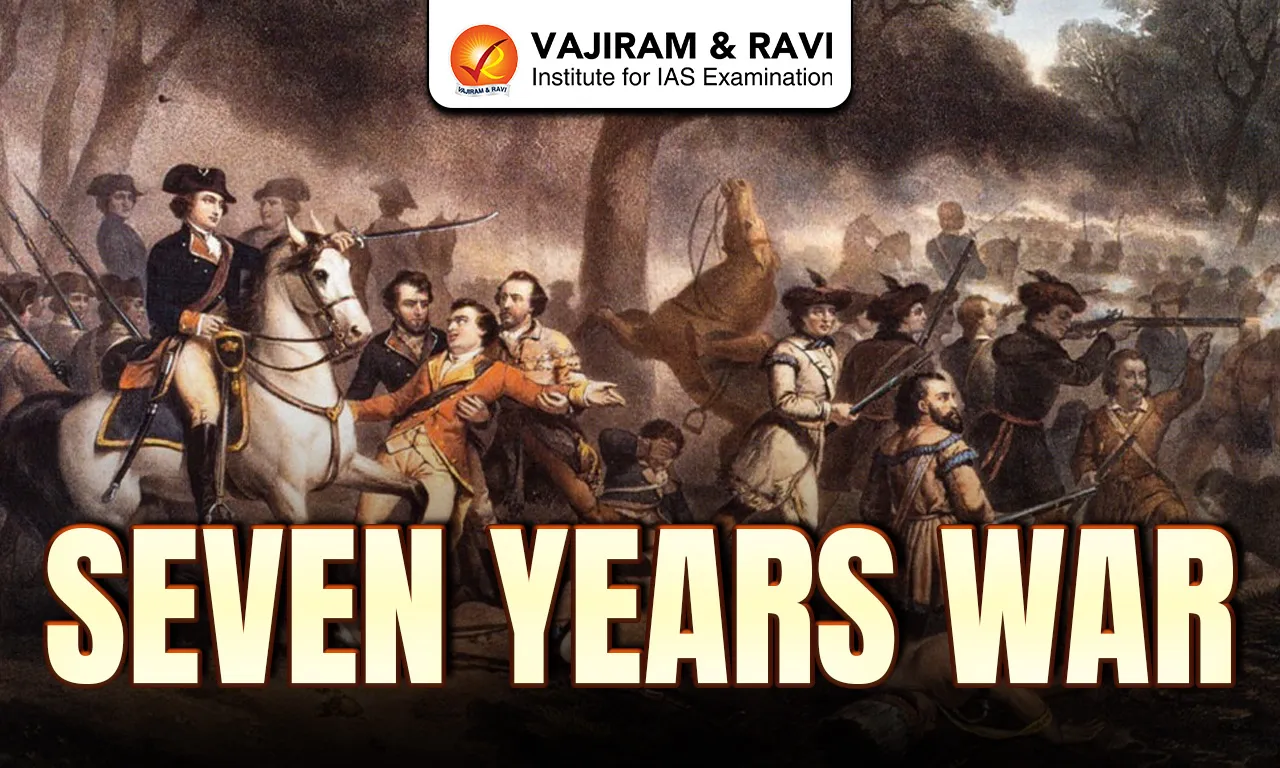
The Seven Years War (1756-1763) was a major conflict fought between powerful European countries like Britain, France, Austria, Prussia and Spain. It took place in Europe, North America, Asia and other regions, making it one of the first wars fought on a global scale. The war changed the balance of power in the world and influenced future events such as the American and French Revolutions.

Seven Years War Causes

  • Colonial Rivalry Between Britain and France
    • Britain and France were both trying to expand their overseas empires. In North America and India, they competed for new lands, resources and influence. This rivalry often led to clashes between the two powers.
  • Race for Global Trade
    • Both countries wanted to control important trade routes and valuable goods like fur, spices and sugar. This struggle to dominate global trade made tensions worse.
  • European Alliances and Rivalries
    • In Europe, countries formed two major alliances. Britain joined with Prussia, while France allied with Austria and Russia. These alliances meant that a local conflict could quickly grow into a large European war.
  • Territorial Conflicts
  • In North America, Britain and France fought over the Ohio River Valley, which was important for expansion. In India, the British and French East India Companies competed for control of regions like Bengal and the Carnatic.

Seven Years War Prelude and Diplomatic Revolution

Before the Seven Years War, the European powers changed their alliances in what is called the Diplomatic Revolution.

  • Old Alliances Shattered
    • Previously, France and Austria were enemies, while Britain and Prussia were on opposite sides. But by the 1750s, Austria wanted to take back Silesia from Prussia and needed a strong ally. France, seeing Britain as its main rival, agreed to join Austria. Meanwhile, Britain allied with Prussia to protect its interests in Europe and overseas.
  • European Rivalries
    • The changes in alliances were also about protecting territories and family interests. King George II of Britain wanted to safeguard Hanover in Germany, while Maria Theresa of Austria wanted to regain lost lands. France wanted to challenge Britain’s growing power but didn’t want to waste too much effort in Central Europe.
  • Secret Diplomacy
    • France used secret diplomacy to try to gain personal advantages in Europe. Austria, Russia and Britain also made defensive agreements to protect themselves and prepare for any attack.
  • Rising Tensions in Colonies
    • Even before open war in Europe, Britain and France were already fighting in North America and India. Their East India Companies and colonists clashed over land and trade. These colonial fights added fuel to the fire.

Seven Years War: Major Battles and Course of the War

  • North America - French and Indian War
    • In North America, the war between Britain and France is called the French and Indian War.
    • Key Battles:
      • Battle of Fort Duquesne (1758): British forces gained control over strategic forts.
      • Battle of Quebec (1759): British victory gave them control over Canada and marked the decline of French power in North America.
  • 2. Europe - Prussia vs Austria
    • Frederick the Great of Prussia defended his small kingdom against Austria, France, Russia, and Sweden.
    • Russian withdrawal in 1762 (after Empress Elizabeth’s death) saved Prussia.
  • 3. India - Battle of Plassey (1757)

Seven Years War Impact

  • Britain Becomes a Global Superpower
    • Britain’s victories in Canada, India and the Caribbean made it the strongest colonial and naval power in the world.
    • Its empire expanded rapidly, giving it control over trade and overseas territories.
  • Losses for France and Spain
    • France lost Canada, Florida and most of its Indian territories. The war was expensive and caused a financial crisis, which later contributed to the French Revolution.
    • Spain, allied with France, lost Florida but gained Louisiana. The war still caused long-term economic damage.
  • Rise of American Discontent
    • Britain’s huge war debt led it to tax the American colonies with measures like the Stamp Act and Tea Act.
    • These taxes created resentment and eventually led to the American Revolution in 1776.
  • British Control in India
    • The war helped the British East India Company defeat the French in India.
    • It marked the start of British colonial rule in India, which lasted until 1947.
  • Shift in European Power
    • Prussia became a major European power.
    • Austria, France and Russia lost influence.
    • The new balance of power created tensions that later led to the Napoleonic Wars.
  • Military Lessons and Changes
    • The war showed the importance of professional armies, strategy and alliances.
    • European nations learned how global wars could affect colonies, trade and politics at home.
  • Economic and Global Trade Impact
    • Britain gained control over key trade routes and resources, strengthening its economy.
    • The decline of French and Spanish influence opened new opportunities for Britain in Asia, Africa and the Americas.

Seven Years War Long Term Impacts

  • Rise of Britain and Prussia
    • Britain became the world’s leading naval and colonial power, gaining Canada, India and Caribbean islands.
    • Prussia emerged stronger in Europe, changing the balance of power.
  • Weakening of France and Spain
    • France lost territories in North America and India and faced severe economic problems, which later contributed to the French Revolution.
    • Spain lost Florida but gained Louisiana; overall, both countries’ global influence declined.
  • Impact on India
    • British victory over the French and local rulers like the Nawab of Bengal marked the start of British supremacy in India, setting the stage for nearly 200 years of colonial rule.
  • Spark for Revolutions
    • Britain’s war debts led to heavy taxation of the American colonies, causing resentment and the American Revolution.
    • France’s financial crisis, worsened by the war, helped trigger the French Revolution.
  • Changes in Global Warfare and Trade
    • Nations realized wars were global, requiring strong armies, navies and control of colonies.
    • Britain gained control of key trade routes and resources, reshaping world trade.
  • Modernization of Governments
    • European monarchies reformed taxes, reduced feudal privileges and strengthened central governments, paving the way for modern administration and democratic ideas.

Seven Years War FAQs

Q1: What was the Seven Years’ War?

Ans: A global war (1756-1763) involving Britain, France, Austria, Prussia and Spain, fought in Europe, North America, India and the Caribbean.

Q2: What were the main causes of the Seven Years’ War?

Ans: The war was caused by colonial rivalry, trade competition, territorial disputes, shifting alliances in Europe and conflicts between British and French colonists and East India Companies.

Q3: What were the key battles of the Seven Years’ War?

Ans: Major battles included Fort Duquesne and Quebec in North America, Plassey in India and Rossbach, Leuthen, Zorndorf and Torgau in Europe.

Q4: How did the war affect Britain?

Ans: Britain emerged as a global superpower, expanded its empire, controlled trade routes and its colonial gains set the stage for the American Revolution due to war debts.

Q5: What was the impact of the war on India?

Ans: The British defeated the French and local rulers like the Nawab of Bengal, establishing control over eastern India and starting nearly 200 years of colonial rule.

Part 4A of Indian Constitution, Article 51A, Amendments

Part 4A of Indian Constitution

Part 4A of Indian Constitution deals with Fundamental Duties of citizens. It was not included in the original Constitution of 1950. This Part was added by the 42nd Constitutional Amendment Act, 1976 during the Emergency period. It contains only one Article, Article 51A. The idea was influenced by the Constitution of the former USSR and recommendations of the Swaran Singh Committee. Initially, ten duties were listed. Later, the 86th Amendment Act, 2002 added one more duty, making a total of eleven Fundamental Duties.

Article 51A of Part 4A of Indian Constitution

Article 51A of Part 4A of Indian Constitution lists eleven non-justiciable duties that every Indian citizen must follow. These Fundamental Duties require citizens to respect the Constitution, National Flag and National Anthem, protect sovereignty and unity, promote harmony, preserve cultural heritage, safeguard the environment, develop scientific temper, protect public property, avoid violence, and strive for excellence. These duties are moral obligations and cannot be directly enforced by courts.

Amendments related to Part 4A of Indian Constitution

Important constitutional amendments shaped the structure and content of Part 4A of Indian Constitution. These amendments include:

  • 42nd Constitutional Amendment Act, 1976: This amendment inserted Part 4A and Article 51A into the Constitution. It introduced ten Fundamental Duties based on the Swaran Singh Committee’s recommendation, promoting civic responsibility and national discipline among citizens.
  • 86th Constitutional Amendment Act, 2002: This amendment added clause (k) to Article 51A. It made it a duty of parents or guardians to provide educational opportunities to children aged six to fourteen years.

Case Laws related to Part 4A of Indian Constitution

The Supreme Court has used Article 51A of Part 4A of Indian Constitution to interpret laws and promote constitutional values several time as highlighted below:

  • M.C. Mehta v. Union of India (1988): The Court relied on Article 51A(g) to strengthen environmental protection. It emphasized citizens’ responsibility to protect forests, rivers, wildlife and improve environmental conditions.
  • AIIMS Students Union v. AIIMS (2001): The Court observed that although Fundamental Duties are non-justiciable, they are important in constitutional interpretation and help balance Fundamental Rights with civic responsibilities.

Part 4A of Indian Constitution FAQs

Q1: When was Part IVA added to the Indian Constitution?

Ans: Part 4A of Indian Constitution was inserted by the Constitution (Forty-second Amendment) Act, 1976 during the Emergency period (1975-77).

Q2: Which Article deals with Fundamental Duties?

Ans: Article 51A is the only article under Part 4A of Indian Constitution and it lists the Fundamental Duties of citizens.

Q3: Are Fundamental Duties enforceable by courts?

Ans: No, Fundamental Duties are non-justiciable. They cannot be directly enforced by courts but help in interpreting laws.

Q4: How many Fundamental Duties were originally included?

Ans: Originally, there were 10 duties added in 1976. Later, one more duty was added in 2002.

Q5: Which Amendment added the 11th Fundamental Duty?

Ans: The 86th Constitutional Amendment Act, 2002 added clause (k), making education for children aged 6 to 14 years a duty of parents or guardians.

Difference Between Government and Governance, Meaning, Features

Difference Between Government and Governance

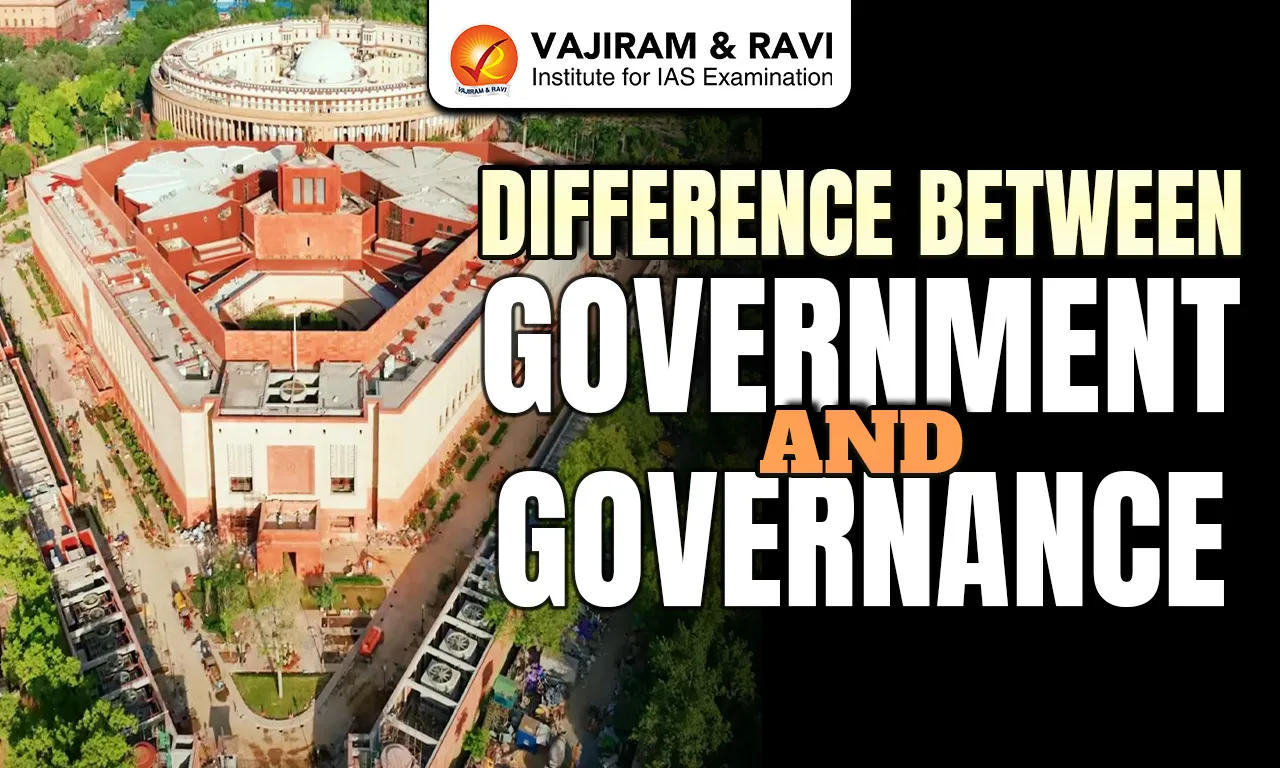
Government and Governance are related but different. Government is the system of leaders, institutions, and officials who make and enforce laws. Governance is about how decisions are actually made and carried out, involving not just the government, but also people, organizations, and communities working together. This article explains the Difference Between Government and Governance.

Difference Between Government and Governance

Government refers to the formal institutions and officials that run a country, while governance is a broader concept involving multiple actors, including private and international bodies, working together to make and implement decisions. The table below explains Difference Between Government and Governance.

Difference Between Government and Governance
Aspect Government Governance

Geographical Scope

The government works within defined territorial borders. It functions at national and sub-national levels like central, state, and local governments.

Governance goes beyond just borders. It operates at local, national, regional, global and even transnational levels, involving multiple actors across countries.

Functional Scope

The government handles key issues through a single, unified public agency. Most decisions are centralized within official institutions.

Governance involves multiple specialized agencies and organizations, including independent bodies, private associations and civil society groups, which coordinate together to manage different issues.

Distribution of Resources

Resources like taxes, funds, and other policy tools are controlled centrally by the government and used directly for implementing policies.

Resources are shared among various public and private actors. Private groups and organizations can influence decision-making by contributing resources or expertise.

Interests

The government assumes that diverse social, political, and economic interests can be balanced within the nation-state. Individual preferences are expected to align with public interest.

Governance emphasizes individualism and market needs. Citizens are seen more as consumers with different demands, which are often met through private services rather than a single public system.

Norms

Focuses on national sovereignty, command-and-control structures, and redistribution of resources to meet societal needs.

Focuses on limiting centralized control, promoting self-management, and allowing market mechanisms to guide social and economic interactions.

Decision-Making & Implementation

Decisions are hierarchical. Authority flows from the top, and national public agencies implement policies in a centralized manner.

Decision-making is spread horizontally. Authority is shared among many actors at different levels, including state agencies, international organizations and private groups, working together to implement policies.

Government

Government means the official system through which a country is ruled. It includes the main institutions of the state and the people who hold power in them. Through the government, a country makes decisions, creates laws, and maintains order.

  • Main Features of Government
    • Government has certain clear features:
    • It has legal authority, which comes from the Constitution and laws.
    • It works through proper institutions like the legislature, executive and judiciary.
    • It is made up of elected leaders and appointed officials who act on behalf of the state.
    • It has sovereign power, meaning only the government can make and enforce laws within its territory.
    • In India, the government includes bodies like Parliament, the Prime Minister and Council of Ministers, central ministries, state governments and local authorities. All of them together form the official structure of the state.
  • Functions of Government
    • The government performs several important duties:
    • It makes laws and policies for the country.
    • It implements these policies through administrative machinery.
    • It maintains law and order.
    • It provides public services such as education, health, and infrastructure.
    • It protects the country from internal and external threats.

For example, the Union Government makes laws in Parliament, implements schemes through ministries and ensures security through armed forces and police. These activities show how the government mainly works through authority and formal institutions.

Governance

Governance is different from government. It is not just about official institutions, but about how decisions are made and how they are carried out. It includes the methods, processes, and people involved in running public affairs.

  • Main Features of Governance
    • Governance goes beyond the formal structure of government and involves many participants:
    • It includes many actors, such as the government, private companies, civil society groups and ordinary citizens.
    • It focuses more on the process of decision-making and implementation rather than just authority.
    • It works through cooperation and networks, where different groups interact and depend on each other.
    • It is guided by values like transparency, accountability, and participation.
    • In India, governance can be seen in practices like public-private partnerships, citizen consultations, social audits and platforms where people participate in shaping policies and monitoring their implementation.
  • Principles of Good Governance
    • Good governance is based on certain important principles:
    • Accountability - those in power must answer for their actions.
    • Transparency - decisions and processes should be open and clear.
    • Responsiveness - authorities should respond to public needs quickly and properly.
    • Equity and inclusiveness - everyone should get fair treatment and an opportunity to participate.
    • Effectiveness and efficiency - policies should achieve results without wasting resources.
    • Rule of law - laws should be applied equally to all.
    • Participation - people should have a voice in decision-making.

For example, the Right to Information Act, 2005 promotes transparency by giving citizens access to government information. Similarly, institutions like the Gram Sabha allow people at the village level to directly participate in decision-making.

Difference Between Government and Governance FAQs

Q1: What is Government?

Ans: Government is the formal system of institutions and officials that make laws, enforce them, and run the country.

Q2: What is Governance?

Ans: Governance refers to the process through which decisions are made and implemented, involving government as well as private bodies, civil society, and citizens.

Q3: Who are the key actors involved in the process of governance?

Ans: Governance involves multiple actors such as government agencies, private sector, NGOs, international organizations, and citizens.

Q4: How is Government different from Governance?

Ans: Government is a structure or institution, while governance is the process and method of managing public affairs.

Q5: What are the principles of Good Governance?

Ans: Good governance is based on accountability, transparency, rule of law, participation, responsiveness, equity and efficiency.

Shetrunji Dam, Location, Importance, Storage Capacity

Shetrunji Dam

Shetrunji Dam is an important medium irrigation project located in the western state of Gujarat. It lies in the semi-arid region of Saurashtra, which frequently faces water scarcity. It plays a crucial role in irrigation, drinking water supply, and regional agricultural development.

Shetrunji Dam

  • Shetrunji Dam is built on the Shetrunji River.
  • It is located in the Bhavnagar district of the Saurashtra region in Gujarat, India.
  • It has a designed gross storage capacity of 308.68 million cubic metre (mcm), the largest in Saurashtra region.
  • It is the largest reservoir in the Saurashtra region of Gujarat.

Also Read: Dams in India

About Shetrunji River

  • The Shetrunji River is an important river system of the Saurashtra region in Gujarat.
  • It originates from the Chachai Hills in the Gir Forest area of Junagadh district, at a height of around 380 metres above mean sea level.
  • From its source, the river flows generally eastward before finally draining into the Gulf of Cambay (Gulf of Khambhat).
  • The river stretches for approximately 182 kilometres from its origin to its mouth.
  • It covers a drainage basin of about 5,514 square kilometres, supporting agriculture and settlements in the region.
  • Important tributaries that join it include Safara, Shel, Khari, Talaji, Stali, Thebu, Gagadia, Rajwal, and Kharo.
  • The river is seasonal in nature, meaning it does not flow throughout the year. Its water flow largely depends on the south-west monsoon rainfall.

Shetrunji Dam FAQs

Q1: Where is Shetrunji Dam located?

Ans: Shetrunji Dam is located in Bhavnagar district of the Saurashtra region, Gujarat, and is built on the Shetrunji River.

Q2: Why is Shetrunji Dam important for Saurashtra?

Ans: It provides irrigation water, drinking water supply, and supports agricultural development in the semi-arid Saurashtra region, which frequently faces water scarcity.

Q3: What is the storage capacity of Shetrunji Dam?

Ans: It has a gross storage capacity of 308.68 million cubic metres (MCM), making it the largest reservoir in the Saurashtra region.

Q4: Where does the Shetrunji River originate and where does it end?

Ans: The river originates from the Chachai Hills in Gir Forest (Junagadh district) at about 380 m above mean sea level and flows eastward into the Gulf of Cambay.

Q5: Is the Shetrunji River perennial?

Ans: No. It is a seasonal (non-perennial) river and depends mainly on south-west monsoon rainfall for its flow.

Vietnam War, Background, Causes, Consequences, Significance

Vietnam War

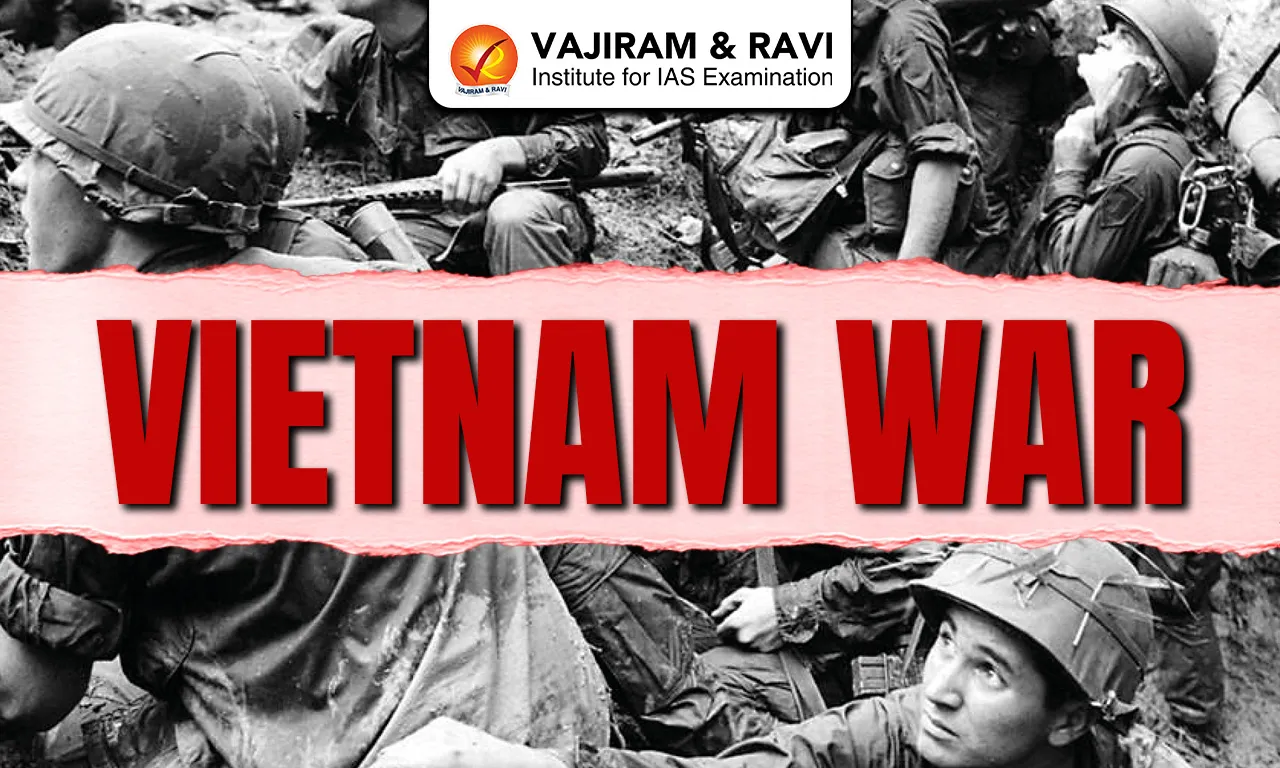
The Vietnam War (1955-1975) was one of the most significant conflicts of the 20th century. It was fought between North Vietnam, supported by communist allies, and South Vietnam, backed primarily by the United States and other anti-communist countries. More than just a civil war, it became a major episode of the Cold War, reflecting the global ideological struggle between communism and capitalism.

The war ended with the reunification of Vietnam under communist rule in 1975, but its political, social, and strategic consequences reshaped not only Southeast Asia but also global power politics.

Vietnam War Background

The roots of the Vietnam War can be traced to the colonial period. Vietnam was part of French Indochina under the control of France. During World War II, the region was occupied by Japan. After Japan’s defeat, nationalist leader Ho Chi Minh declared Vietnam’s independence in 1945.

However, France attempted to reassert control, leading to the First Indochina War (1946-1954). The French were defeated at the Battle of Dien Bien Phu in 1954. The subsequent Geneva Accords (1954) temporarily divided Vietnam at the 17th parallel: North Vietnam under Ho Chi Minh (communist government) and South Vietnam under a non-communist regime supported by the United States. The division was meant to be temporary, with nationwide elections planned in 1956. However, these elections were never held due to Cold War tensions. This temporary division gradually turned into a full-scale war.

Vietnam War Causes

The Vietnam War was caused by a combination of political, ideological, and strategic factors.

  • Cold War Rivalry: The primary cause was the Cold War rivalry between the United States and the Soviet Union. North Vietnam was supported by the communist bloc, particularly the Soviet Union and China, while South Vietnam was supported by the United States. The war thus became a proxy conflict.
  • Domino Theory: The United States believed in the "Domino Theory," which suggested that if one country in Southeast Asia fell to communism, others like Laos, Cambodia, and Thailand would follow. This fear led the US to increase its military involvement to prevent the spread of communism.
  • Failure of Geneva Accords: The refusal to conduct the promised nationwide elections deepened political divisions. The South Vietnamese government, backed by the US, feared that Ho Chi Minh would win the elections due to his popularity.
  • Rise of Viet Cong: In South Vietnam, communist insurgents known as the Viet Cong began guerrilla warfare against the South Vietnamese government. They received support from North Vietnam, which aimed to reunify the country under communist rule.
  • Gulf of Tonkin Incident (1964): In August 1964, the United States claimed that North Vietnam attacked its naval ships in the Gulf of Tonkin. After this, the US Congress passed the Gulf of Tonkin Resolution, giving President Lyndon B. Johnson the power to use military force in Vietnam without officially declaring war. This incident led to large-scale US military involvement in the Vietnam War.

Vietnam War Consequences

The Vietnam War had deep and long-lasting consequences.

  • Human and Economic Loss: The war caused massive casualties. Millions of Vietnamese civilians and soldiers were killed. The United States lost over 58,000 soldiers. The war also caused widespread destruction of infrastructure and agriculture in Vietnam.
  • Psychological and Social Impact: The war deeply affected American society. It led to large anti-war protests, questioning government policies and media narratives. It also created a “Vietnam Syndrome,” making the US cautious about future military interventions.
  • Reunification of Vietnam: In 1975, North Vietnamese forces captured Saigon, marking the end of the war. Vietnam was reunified under communist rule as the Socialist Republic of Vietnam.
  • Impact on Neighbouring Countries: The conflict spread instability in Cambodia and Laos. In Cambodia, it indirectly facilitated the rise of the Khmer Rouge regime, leading to genocide.
  • Shift in US Foreign Policy: The war led to a more cautious American foreign policy. The US shifted its focus from direct military intervention to diplomacy. It promoted détente which means relaxation of tension with the Soviet Union through arms control talks and improved relations. At the same time, it normalised relations with China to maintain strategic balance during the Cold War.

Vietnam War Significance

The Vietnam War holds great significance in international relations and strategic studies.

  • First, it demonstrated the limits of military power. Despite superior technology and resources, the United States could not defeat a determined nationalist and guerrilla force.
  • Second, it showed the importance of public opinion in democratic countries. Media coverage and anti-war protests influenced political decisions.
  • Third, it changed the nature of warfare. Guerrilla tactics, asymmetric warfare, and ideological mobilization became central themes in modern conflicts.
  • Fourth, it weakened US global prestige temporarily and strengthened communist influence in Southeast Asia, although the long-term global balance eventually shifted.

Vietnam War FAQs

Q1: What was the Vietnam War?

Ans: The Vietnam War (1955–1975) was a conflict between communist North Vietnam and US-backed South Vietnam, which became a major Cold War confrontation.

Q2: Why did the United States enter the war?

Ans: The US intervened to stop the spread of communism in Southeast Asia, based on the Domino Theory.

Q3: What was the Gulf of Tonkin Incident?

Ans: It was a 1964 incident involving alleged attacks on US ships, after which the US expanded its military involvement in Vietnam.

Q4: How did the Vietnam War end?

Ans: In 1975, North Vietnamese forces captured Saigon, leading to the reunification of Vietnam under communist rule.

Q5: Why is the Vietnam War significant?

Ans: It showed the limits of military power, influenced US foreign policy, and became a key example of Cold War proxy conflicts.

UPSC Daily Quiz 20 February 2026

[WpProQuiz 97]

UPSC Daily Quiz FAQs

Q1: What is the Daily UPSC Quiz?

Ans: The Daily UPSC Quiz is a set of practice questions based on current affairs, static subjects, and PYQs that help aspirants enhance retention and test conceptual clarity regularly.

Q2: How is the Daily Quiz useful for UPSC preparation?

Ans: Daily quizzes support learning, help in revision, improve time management, and boost accuracy for both UPSC Prelims and Mains through consistent practice.

Q3: Are the quiz questions based on the UPSC syllabus?

Ans: Yes, all questions are aligned with the UPSC Syllabus 2025, covering key areas like Polity, Economy, Environment, History, Geography, and Current Affairs.

Q4: Are solutions and explanations provided with the quiz?

Ans: Yes, each quiz includes detailed explanations and source references to enhance conceptual understanding and enable self-assessment.

Q5: Is the Daily UPSC Quiz suitable for both Prelims and Mains?

Ans: Primarily focused on Prelims (MCQ format), but it also indirectly helps in Mains by strengthening subject knowledge and factual clarity.

Part 11 of Indian Constitution, Article 245 to 263, Amendments

Part 11 of Indian Constitution

The Parts of the Constitution of India collectively define powers, duties and relationships among different organs of government. Part 11 of Indian Constitution is one such important division. It explains how authority is shared between the Union and the States. It covers Articles 245 to 263 and establishes rules for legislative and administrative coordination while ensuring that India functions under a cooperative federal structure.

Part 11 of Indian Constitution

Part XI of the Indian Constitution is titled as “Relations between the Union and the States.” It deals with how legislative and administrative powers are distributed between the central government and state governments. This Part defines the extent of law making authority, division of subjects and executive responsibilities. It also provides mechanisms for resolving disputes and promoting coordination. Part 11 of Indian Constitution plays a central role in shaping India’s quasi federal system, where both levels of government function within defined constitutional limits.

Chapters under Part 11 of Indian Constitution

Part 11 of Indian Constitution is divided into two chapters covering legislative and administrative relations in detail. The chapters include:

  • Chapter I- Legislative Relations: This chapter covers Articles 245 to 255. It explains the territorial extent of laws, division of subjects between Union and States, special powers of Parliament in national interest or emergencies and resolution of conflicts between Union and State laws.
  • Chapter II- Administrative Relations: This chapter includes Articles 256 to 263. It focuses on executive obligations, Union control in specific situations, delegation of powers, water dispute adjudication and establishment of an Inter-State Council for coordination.

Articles under Part 11 of Indian Constitution

Articles 245 to 263 of the Part 11 of Indian Constitution explain legislative authority, administrative duties and cooperation between Union and States.

  • Article 245- Extent of Laws: Parliament can make laws for the whole or any part of India, while State Legislatures can legislate for their respective territories. Parliament may also enact laws with extra territorial operation if linked to India.
  • Article 246- Subject Matter of Laws: Legislative subjects are divided into Union List, State List and Concurrent List. Parliament has exclusive power over Union List, States over State List and both share authority over Concurrent List subjects.
  • Article 246A- Goods and Services Tax: Provides a special arrangement for GST. Both Union and States have concurrent powers for taxation under GST, while Parliament has exclusive authority over inter-State GST matters.
  • Article 247- Additional Courts: Empowers Parliament to establish additional courts for better administration of laws made by it, strengthening the implementation of central legislation.
  • Article 248- Residuary Powers: Grants Parliament exclusive power to legislate on matters not listed in any of the three Lists, ensuring no subject remains outside legislative control.
  • Article 249- National Interest Legislation: Allows Parliament to legislate on State List matters if the Rajya Sabha passes a resolution by a two-thirds majority declaring it necessary in national interest.
  • Article 250- During Emergency: Authorizes Parliament to make laws on State List subjects when a Proclamation of Emergency is in operation, enhancing central authority temporarily.
  • Article 251- Inconsistency under Articles 249 and 250: Provides that Union laws made under these provisions will prevail over inconsistent State laws during the period of their operation.
  • Article 252- Legislation by Consent: Parliament may legislate for two or more States if they consent. Other States can later adopt such legislation, ensuring cooperative federal action.
  • Article 253- International Agreements: Empowers Parliament to make laws to implement international treaties and agreements, even on matters in the State List.
  • Article 254- Repugnancy: In case of conflict between Union and State laws on Concurrent List subjects, Union law prevails unless the State law has received Presidential assent.
  • Article 255- Procedural Requirements: Clarifies that recommendations or previous sanctions required for legislation are procedural matters and do not invalidate laws merely for procedural irregularities.
  • Article 256- Obligation of States: States must exercise executive power in compliance with laws made by Parliament and ensure effective implementation of Union laws.
  • Article 257- Union’s Control: Allows the Union to issue directions to States in certain cases to ensure compliance with laws and policies.
  • Article 257A- Repealed Provision: Earlier permitted deployment of Union armed forces in States for assistance. This provision was later repealed to restore federal balance.
  • Article 258- Delegation by Union: Enables the Union to confer powers or functions on States with consent, promoting administrative cooperation.
  • Article 258A- Delegation by States: Allows States to entrust their functions to the Union with consent, facilitating administrative flexibility.
  • Article 259- Repealed Provision: Earlier dealt with certain administrative arrangements but is no longer in force.
  • Article 260- Jurisdiction Outside India: Permits the Union to exercise jurisdiction in territories outside India with consent, broadening administrative reach.
  • Article 261- Public Acts and Records: Ensures that public acts, records and judicial proceedings of one State are recognized and respected by other States.
  • Article 262- Water Disputes: Authorizes Parliament to provide for adjudication of disputes relating to inter-State rivers and allows exclusion of court jurisdiction in such matters.
  • Article 263- Inter-State Council: Empowers the President to establish an Inter-State Council to inquire into disputes and promote coordination between States.

Amendments related to Part 11 of Indian Constitution

Several amendments have reshaped legislative and administrative balance under Part 11 of Indian Constitution as given below:

  • 3rd Constitutional Amendment Act, 1954: Amended Article 246 and the Seventh Schedule to expand Parliament’s authority over trade and commerce in essential commodities, strengthening Union legislative control.
  • 7th Constitutional Amendment Act, 1956: Modified Articles 245 to 255 and reorganized States. It clarified legislative jurisdiction and empowered Parliament to legislate for newly formed Union Territories.
  • 40th Constitutional Amendment Act, 1976: Strengthened Parliament’s taxation authority through changes in the Union List, indirectly influencing legislative balance under Part XI.
  • 42nd Constitutional Amendment Act, 1976: Amended Article 246 and inserted Article 257A. It shifted five subjects including education and forests to the Concurrent List, increasing central influence.
  • 44th Constitutional Amendment Act, 1978: Repealed Article 257A to reduce excessive centralization and restore greater administrative autonomy to States.
  • 101st Constitutional Amendment Act, 2016: Inserted Article 246A and amended Article 248 to introduce the Goods and Services Tax, creating concurrent taxing powers and redefining fiscal federal relations.

Case Laws related to Part 11 of Indian Constitution

Judicial decisions have clarified legislative competence and federal balance under Part 11 of Indian Constitution as highlighted below:

  • Hoechst Pharmaceuticals Ltd. v. State of Bihar (1983): Clarified repugnancy under Article 254 and ruled that Union law prevails over conflicting State law unless Presidential assent is granted.
  • R.M.D.C. v. Union of India (1957): Applied the doctrine of pith and substance to determine legislative competence when subjects overlapped between Union and State Lists.
  • Union of India v. H.S. Dhillon (1972): Confirmed Parliament’s exclusive authority over residuary subjects under Article 248, reinforcing central legislative supremacy.
  • State of West Bengal v. Union of India (1963): Supreme Court upheld Parliament’s supremacy in legislative matters and confirmed that Union law prevails over State law in Concurrent List conflicts.

S.R. Bommai v. Union of India (1994): Recognized federalism as part of the basic structure and limited misuse of central power, emphasizing constitutional balance in administrative relations.

Part 11 of Indian Constitution FAQs

Q1: What is Part 11 of Indian Constitution about?

Ans: Part XI explains the legislative and administrative relations between the Union and the States. It defines how powers are distributed and coordinated to maintain India’s cooperative federal structure.

Q2: How are legislative subjects divided under Part 11 of Indian Constitution?

Ans: Article 246 divides subjects into the Union List, State List and Concurrent List. Parliament legislates on Union matters, States on State matters and both on Concurrent subjects.

Q3: What are residuary powers under Part 11 of Indian Constitution?

Ans: Under Article 248, residuary powers belong exclusively to Parliament. It can legislate on subjects not mentioned in any of the three constitutional lists.

Q4: Can Parliament legislate on State List subjects?

Ans: Yes, under Articles 249 and 250, Parliament may legislate on State List matters in national interest or during a proclaimed Emergency.

Q5: What is the purpose of Article 263?

Ans: Article 263 allows the President to establish an Inter-State Council to resolve disputes and promote coordination and cooperation among States and the Union.

Spanish Civil War, Background, Leader, Winner, Course, Aftermath

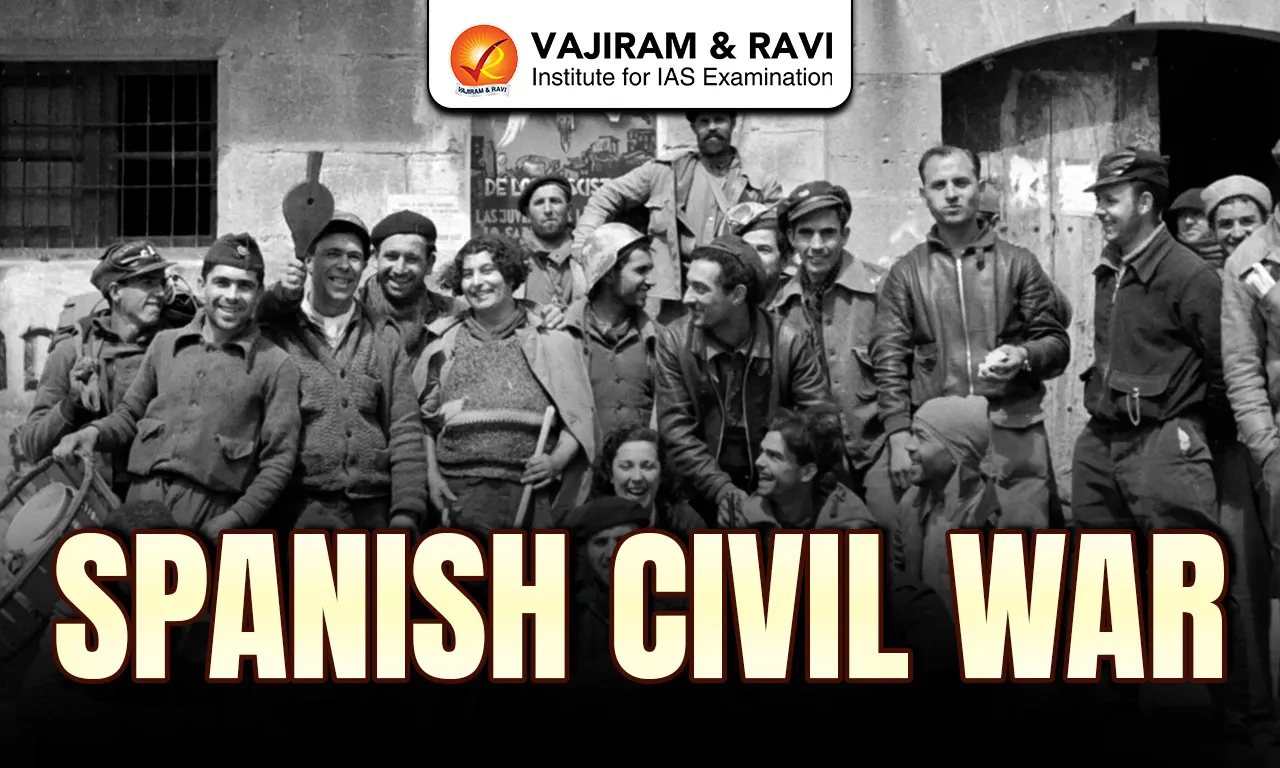
Spanish Civil War

The Spanish Civil War (1936-1939) was fought between the elected Republican government and the Nationalists led by General Franco. It began due to political and ideological divisions in Spain.

Spanish Civil War Background

  • The Spanish Civil War was a major conflict in Spain that started in 1936. It was mainly caused by deep political, social and economic divisions in Spanish society.
  • On one side were the Nationalists, who included most of the army, wealthy landowners, the Catholic Church and conservative groups. They wanted a strong central government and opposed major social changes.
  • On the other side were the Republicans, who included urban workers, farmers, leftist political parties, socialists, anarchists and many members of the educated middle class. They wanted reforms, more equality and protection of workers’ rights.
  • Spain had faced years of political instability before 1936, including conflicts between monarchists, conservatives, liberals, socialists and communists. A major crisis in 1934, when miners in Asturias rebelled, showed the growing tension between the left and right.
  • The February 1936 elections brought the Popular Front, a coalition of leftist parties, to power. This alarmed the conservatives and military leaders, who feared that Spain was moving toward socialism or communism. This fear led to a military uprising on July 17, 1936, which triggered the civil war.

Course of the Spanish Civil War

  • The military revolt was led by conservative officers, including General Francisco Franco, and became known as the Nationalists. The uprising was successful in some parts of Spain, including Spanish Morocco, the Canary Islands and northern Spain, but failed in other regions. The areas under the Republicans resisted the Nationalists, leading to a full-scale civil war.
  • Both sides sought help from other countries:
    • Nationalists received military support from Nazi Germany and Fascist Italy, including troops, tanks and aircraft.
    • Republicans received help from the Soviet Union, the International Brigades (volunteers from Europe and the US) and initially support from France.
  • The war was extremely violent, with widespread killings, bombings and repression on both sides. Nationalists under Franco practiced systematic terror, while Republicans also carried out executions during the early stages of the war.
  • Key events during the war:
    • In late 1936, the Nationalists tried to capture Madrid but were initially held off.
    • By 1937, the Nationalists gained control of northern provinces, including the Basque Country and Asturias.
    • In 1938, they split the Republican-held territory by reaching the Mediterranean, isolating Republican areas.
    • By early 1939, the Republican forces were weakened, many soldiers and civilians fled into France and the Republican government went into exile.
  • The war also had an international significance. For Germany and Italy, it was a testing ground for new weapons and military tactics. For artists, writers and intellectuals around the world, it became a symbol of the fight between freedom and tyranny. Famous works inspired by the war include Hemingway’s For Whom the Bell Tolls, Orwell’s Homage to Catalonia and Picasso’s painting Guernica.

Results of the War

  • The Nationalists, led by Franco, won the war in 1939. Franco established a dictatorship in Spain that lasted until 1975.
  • The war caused massive human losses due to battles, executions, bombings, starvation and disease.
  • Politically, the war showed the danger of extreme ideological divisions and became a prelude to World War II, as it involved fascism, communism and international involvement. Spain under Franco remained neutral in World War II but became a symbol of the rise of authoritarianism in Europe.
  • The war also left a lasting cultural impact, inspiring novels, memoirs, paintings and photography that depicted the tragedy and human suffering caused by civil conflict.

Spanish Civil War FAQs

Q1: What was the Spanish Civil War?

Ans: It was a conflict in Spain (1936-1939) between the elected Republican government and the Nationalists led by General Franco.

Q2: What caused the Spanish Civil War?

Ans: Deep political, social and economic divisions in Spain, including conflict between conservatives (Nationalists) and leftists (Republicans), triggered the war.

Q3: Who were the main groups involved?

Ans: Nationalists: Army, landowners, the Catholic Church, conservatives. Republicans: Urban workers, farmers, socialists, anarchists, educated middle class.

Q4: What was the result of the war?

Ans: Franco’s Nationalists won in 1939, establishing a dictatorship in Spain that lasted until 1975.

Q5: What was the significance of the Spanish Civil War?

Ans: It showed the dangers of ideological divisions, acted as a prelude to World War II, involved international powers, and left a lasting cultural impact on literature, art and history.

Naga Movement, History, Phases, About Naga Community

Naga Movement

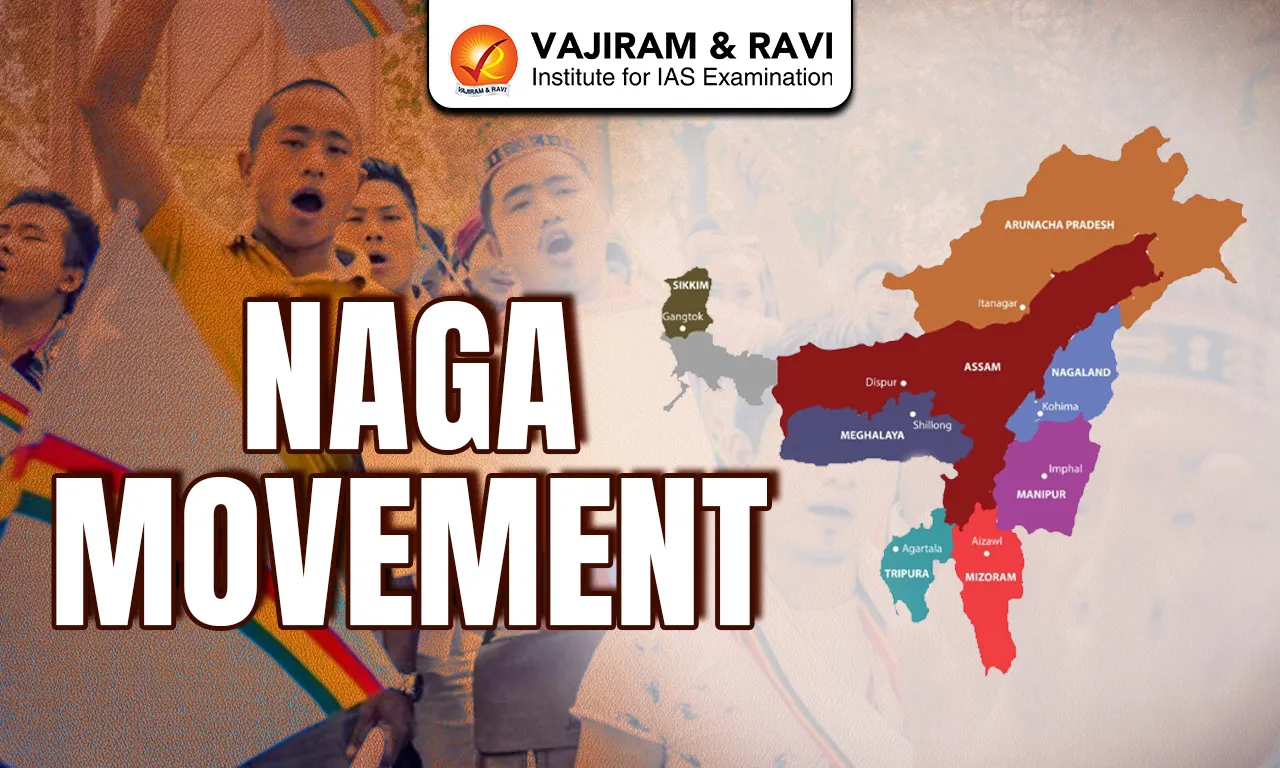
The Naga Movement is a political movement in Northeast India where Naga groups demanded more autonomy and protection of their identity after independence. Over the years, it became an important internal security and peace issue and the government has tried to resolve it through talks and agreements.

About Nagas

  • The Nagas are a tribal community mainly living in the hilly and mountainous areas of Northeast India and parts of Myanmar. Their total population is around 2.5 million, with most living in Nagaland and others in Manipur and Arunachal Pradesh. 
  • They are divided into several major tribes and each tribe has its own name, culture and language. The Nagas are considered an indigenous group of the region and it is generally believed that they belong to the Indo-Mongoloid group who migrated to this area many centuries ago.

Naga Movement History

The history of the Naga Movement can be understood in different phases over time. It began before independence and later developed into an armed struggle after 1947. The main events and developments of the movement are discussed below.

Pre-Independence Phase of the Naga Movement

  • The British took control of Assam in 1826, and later, in 1881, the Naga Hills also became part of British India.
  • In 1918, Naga leaders formed the Naga Club to unite different Naga tribes and protect their interests. In 1929, the Club submitted a memorandum to the Simon Commission, requesting that Naga areas should not be merged with the rest of India and should be allowed to remain separate.
  • In 1946, the Naga Club developed into the Naga National Council (NNC), which aimed at the social and political progress of the Nagas. After the return of Angami Zapu Phizo in 1947, the demand for complete independence became stronger.
  • On 14 August 1947, under Phizo’s leadership, the NNC declared Nagaland as an independent state. In 1951, it conducted a referendum claiming support for a sovereign Nagaland.
  • Earlier, in June 1947, Assam Governor Sir Akbar Hydari had signed the Nine-Point Agreement with moderate Naga leaders, offering some autonomy. However, Phizo rejected this agreement as he wanted full independence.

Post-Independence Phase & Peace Process

  • After independence, the Naga National Council (NNC) started an armed movement in the 1950s demanding sovereignty. In 1952, A.Z. Phizo formed the underground Naga Federal Government (NFG) and its armed wing, the Naga Federal Army (NFA).
  • To control the insurgency, the Government of India sent the Army and enacted the Armed Forces (Special Powers) Act (AFSPA) in 1958.
  • In 1960, a 16-Point Agreement was signed with moderate Naga leaders, which led to the creation of the state of Nagaland in 1963. However, violence continued. A Peace Mission was started in 1964, but talks failed by 1967.
  • Shillong Accord (1975)
    • In 1975, the Shillong Accord was signed between the Government of India and a section of NNC leaders. They agreed to give up violence and accept the Indian Constitution.
    • However, this agreement was strongly opposed by leaders like Thuingaleng Muivah and Isak Swu. In 1980, they formed the National Socialist Council of Nagaland (NSCN).
    • Later, in 1988, the NSCN split into:
      • NSCN (IM) led by Isak and Muivah
      • NSCN (K) led by Khaplang
    • Over time, the NNC became weaker, and NSCN (IM) emerged as the main Naga insurgent group.
  • Demand for Greater Nagaland
    • Under the leadership of NSCN (IM), many Naga groups demanded the creation of a larger Naga homeland, often called Greater Nagalim.
    • One idea was to form a completely independent country that would include present-day Nagaland and all Naga-inhabited areas of Manipur and even parts of Myanmar.
    • Another demand was to bring together all Naga-inhabited districts of Manipur and merge them with Nagaland, but within the framework of the Indian Constitution.
    • This demand has been a major issue in peace talks because it involves changing state boundaries in the Northeast.

Naga Peace Accord (2015)

The Naga Peace Accord, also called the Framework Agreement, was signed on 3 August 2015 between the Government of India and the NSCN (IM). Its main aim was to end the long-running Naga insurgency and find a peaceful solution to the Naga issue.

  • Background & Outcomes: Since 1997, the NSCN (IM) had been in ceasefire and peace talks with the Government of India. After many years of discussions, both sides signed the Framework Agreement in 2015 and the key outcomes are:
    • The full details of the agreement were not made public, but some broad ideas were discussed:
    • More powers could be given to Nagaland under Article 371(A) of the Constitution.
    • NSCN (IM) cadres could be adjusted into a new security force.
    • More autonomy could be given to Naga areas in Manipur.
    • However, there would be no change in state boundaries (no physical integration of all Naga areas).
    • The agreement was only a basic framework. A final detailed settlement is still pending.
  • Major Issues in the Peace Talks
    1. Issue of Sovereignty
      • The agreement mentions “sharing sovereign power.”
      • NSCN (IM) says this means Nagas should retain some form of sovereignty.
      • The Government of India does not accept separate sovereignty.
    2. Separate Flag and Constitution
      • NSCN (IM) demands a separate Naga flag and constitution (Yezabo).
      • The Centre has not agreed to this demand.
    3. Vague Language of the Agreement
      • The wording of the Framework Agreement is unclear, leading to different interpretations by both sides.
    4. Role of Other Naga Groups (NNPGs)
      • Smaller Naga groups were also included in talks.
      • This created tension, as NSCN (IM) considers itself the main representative of Naga interests.
    5. Trust Issues
      • Differences arose between NSCN (IM) and the government’s interlocutor (R.N. Ravi), leading to a trust deficit.

Naga Movement FAQs

Q1: What is the Naga Movement?

Ans: It is a political and armed movement in Northeast India where some Naga groups demanded independence or greater autonomy after 1947.

Q2: Who are the Nagas?

Ans: The Nagas are a tribal community living mainly in Nagaland, Manipur, Arunachal Pradesh and parts of Myanmar, with different tribes, languages and cultures.

Q3: What was the Shillong Accord (1975)?

Ans: It was an agreement where a section of NNC leaders agreed to give up violence and accept the Indian Constitution.

Q4: What is Greater Nagalim?

Ans: It is the demand to unite all Naga-inhabited areas under one administration.

Q5: What is the Naga Peace Accord (2015)?

Ans: It is the Framework Agreement signed between the Government of India and NSCN (IM) to find a peaceful solution, though final settlement is still pending.

Difference Between Producer and Consumer, Meaning, Trophic Level

Difference Between Producer and Consumer

Understanding the Difference Between Producer and Consumer is fundamental in environmental studies and ecology. These two components form the base of every ecosystem, drive the food chain, and maintain ecological balance.

What is a Producer in Ecology?

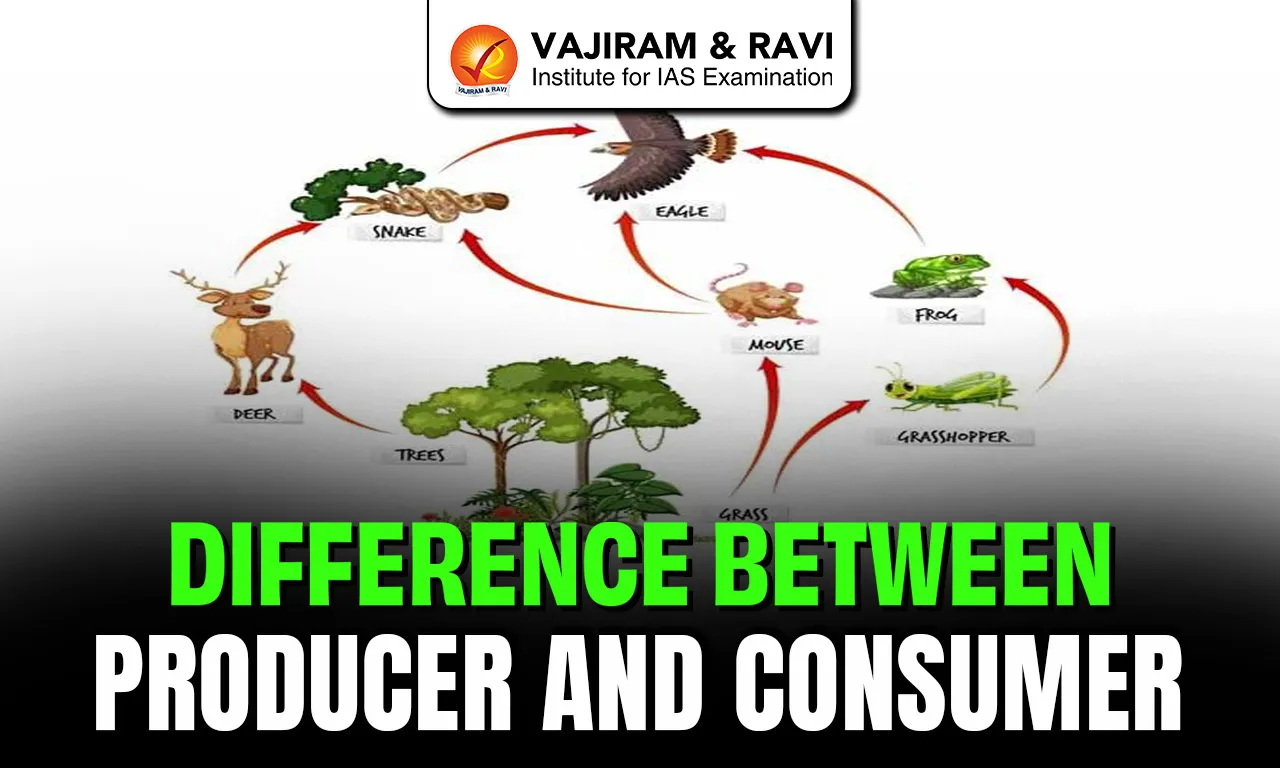
A producer in ecology is an organism that prepares its own food using sunlight, water, and carbon dioxide. Producers are also called autotrophs because they do not depend on other organisms for nutrition. They form the first trophic level and act as the primary source of energy in every ecosystem.

    • Self-Food Production: Producers manufacture their own food through photosynthesis or chemical processes.
    • Base of Food Chain: They occupy the first trophic level and support all higher trophic levels.
    • Energy Conversion: Convert solar energy into chemical energy stored in food (glucose).
    • Oxygen Production: Release oxygen as a by-product of photosynthesis, essential for life.
  • Types of Producers:
    • Photoautotrophs – Use sunlight (e.g., green plants, algae).
    • Chemoautotrophs – Use chemical energy (e.g., certain bacteria).
  • Examples: Grass, trees, phytoplankton, algae, cyanobacteria.
  • Ecological Importance: Maintain atmospheric balance and regulate carbon dioxide levels.
  • Foundation of Ecosystems: Without producers, consumers and other life forms cannot survive.

Also Read: Difference between Sympathy and Empathy

What is a Consumer in Ecology?

A consumer in ecology is an organism that cannot make its own food and depends on other organisms for nutrition. Consumers are known as heterotrophs because they rely directly or indirectly on producers for energy. They occupy the second and higher trophic levels in a food chain and help in the transfer of energy within an ecosystem.

    • Dependence on Other Organisms: Consumers obtain food by eating plants (producers) or other animals.
    • Cannot Perform Photosynthesis: Unlike producers, they lack the ability to prepare their own food.
    • Higher Trophic Levels: They occupy the second, third, or higher trophic levels in ecological pyramids.
    • Energy Transfer Role: Help in transferring energy from one trophic level to another.
    • Population Control: Maintain balance by regulating plant and animal populations.
  • Types of Consumers:
    • Primary Consumers (Herbivores): Eat plants (e.g., deer, goat).
    • Secondary Consumers: Eat herbivores (e.g., frog, small fish).
    • Tertiary Consumers: Eat secondary consumers (e.g., snake).
    • Quaternary Consumers (Top Predators): Highest-level carnivores (e.g., lion, eagle).
    • Omnivores: Eat both plants and animals (e.g., humans).
  • Examples: Humans, tiger, cow, fish, birds, lion.

Difference Between Producer and Consumer

The difference between producer and consumer is based on how they obtain energy and their position in the ecosystem. Producers prepare their own food and form the base of the food chain, while consumers depend on producers or other organisms for survival.

Difference Between Producer and Consumer

Basis of Comparison

Producer

Consumer

Meaning

Organisms that make their own food

Organisms that obtain food from other organisms

Also Called

Autotrophs

Heterotrophs

Mode of Nutrition

Autotrophic mode of nutrition

Heterotrophic mode of nutrition

Ability to Prepare Food

Can prepare their own food

Cannot prepare their own food

Process Involved

Photosynthesis or chemosynthesis

Ingestion and digestion

Energy Source

Sunlight or chemical energy

Producers or other consumers

Position in Food Chain

Base of the food chain

Above producers in food chain

Trophic Level

First trophic level

Second, third, or higher trophic levels

Dependency

Independent for food

Dependent on producers directly or indirectly

Chlorophyll Presence

Usually present (in green plants)

Absent

Oxygen Production

Release oxygen (most producers)

Do not produce oxygen

Role in Ecosystem

Convert solar energy into chemical energy

Transfer energy between trophic levels

Impact on Population

Support life of all organisms

Regulate population of plants and animals

Biomass Pyramid

Largest biomass at base

Biomass decreases at higher levels

Examples

Grass, trees, algae, phytoplankton

Humans, lion, deer, tiger, fish

Ecological Importance

Foundation of ecosystem stability

Maintain ecological balance and biodiversity

Also Read: Difference between Natural Farming and Organic Farming

Role of Producers and Consumers in the Ecosystem

Producers and consumers play a vital role in maintaining ecological balance and ensuring the smooth flow of energy in an ecosystem.

  1. Energy Production and Transfer – Producers convert solar energy into chemical energy, and consumers transfer this energy across trophic levels.
  2. Foundation of Food Chain – Producers form the base of the food chain, while consumers occupy higher trophic levels.
  3. Maintenance of Ecological Balance – Consumers control plant and animal populations, preventing overgrowth or extinction.
  4. Oxygen and Carbon Cycle Regulation – Producers release oxygen and absorb carbon dioxide, maintaining atmospheric balance.
  5. Support Biodiversity – The interaction between producers and consumers sustains diverse life forms in an ecosystem.
  6. Stability of Ecosystem – Together, they ensure proper energy flow, nutrient cycling, and long-term sustainability of the environment.

Difference Between Producer and Consumer FAQs

Q1: What is the main difference between producer and consumer?

Ans: The main difference between producer and consumer is that producers make their own food, whereas consumers depend on other organisms for food.

Q2: What are producers also called?

Ans: Producers are also called autotrophs because they prepare their own food using sunlight or chemical energy.

Q3: What are consumers also called?

Ans: Consumers are known as heterotrophs since they rely on plants or other animals for nutrition.

Q4: Which trophic level do producers occupy?

Ans: Producers occupy the first trophic level in a food chain or ecological pyramid.

Q5: Which trophic levels do consumers occupy?

Ans: Consumers occupy the second, third, or higher trophic levels, depending on their position in the food chain.

Farm Subsidies in India, Types, Importance, Issues

Farm Subsidies in India

Farm subsidies have become one of the most important pillars of India’s agricultural policy. In a country where agriculture supports nearly half of the population, farm subsidies act as a safety net for millions of small and marginal farmers. At present, farm subsidies account for roughly 2% of India’s GDP and contribute about 21% of farmers’ income, showing how deeply the system depends on farm subsidies for income stability and production support.

Over time, India has developed a wide network of farm subsidies to reduce input costs, provide income support, and protect farmers from price and climate risks. These farm subsidies can broadly be classified into direct subsidies and indirect subsidies.

Types of Farm Subsidies in India

Farm Subsidies in India are classified into direct and indirect subsidies. Direct subsidies include benefits like income support schemes and cash transfers to farmers, while indirect subsidies cover support through reduced input costs such as fertilizers, electricity, irrigation, credit, and Minimum Support Price (MSP) mechanisms.

Direct Farm Subsidies

Direct farm subsidies are those where the benefit reaches farmers in the form of cash support, price assurance, insurance, or investment incentives.

  • PM-KISAN provides ₹6,000 per year to land-owning farmers as direct income support. This is one of the largest direct farm subsidies in the world in terms of coverage.
  • Minimum Support Price (MSP) ensures remunerative prices for 22 crops. Through procurement, MSP functions as a major form of price-based farm subsidies.
  • Pradhan Mantri Kisan Urja Suraksha evam Utthaan Mahabhiyaan (PM-KUSUM) offers farm subsidies for solar pump installation, helping farmers reduce electricity and diesel expenses.
  • Pradhan Mantri Krishi Sinchayee Yojana (PMKSY) provides farm subsidies for drip and sprinkler systems to improve water efficiency.
  • Pradhan Mantri Fasal Bima Yojana (PMFBY) offers heavily subsidised crop insurance to protect farmers from climate-related losses.
  • Kisan Credit Card (KCC) provides interest subvention, making farm loans cheaper and acting as a credit-linked farm subsidy.
  • Agriculture Infrastructure Fund offers subsidised financing for cold chains, warehouses, and post-harvest facilities.
  • Farm loan waivers are periodic farm subsidies aimed at relieving farmers from severe indebtedness.

Indirect Farm Subsidies

Indirect farm subsidies lower the cost of agricultural inputs and services.

  • Fertiliser subsidies, including urea subsidy and Nutrient-Based Subsidy for P&K fertilisers.
  • Electricity subsidies through free or low-cost power for irrigation.
  • Water subsidies via low irrigation charges.
  • Seed subsidies to promote high-quality seed production.
  • Export subsidies such as transport assistance for certain crops.

These indirect farm subsidies play a crucial role in lowering the cost of cultivation, especially for small farmers.

Why Farm Subsidies Are Necessary?

  • Support for Small and Marginal Farmers: More than 85% of farmers in India operate small or marginal holdings. Farm subsidies help them survive in a sector marked by price volatility and uncertain rainfall.
  • Reduction in Input Costs: Farm subsidies on fertilisers, seeds, electricity, and irrigation significantly reduce the cost of cultivation, making farming viable for low-income households.
  • Food Security and Productivity: Farm subsidies such as MSP, irrigation support, and crop insurance encourage production and help maintain stable food supplies.
  • Prevention of Distress Sales: Through MSP and procurement, farm subsidies protect farmers from sudden price crashes during bumper harvests.
  • Encouragement of Long-Term Investment: Investment-linked farm subsidies like the Agriculture Infrastructure Fund and PM-KUSUM promote capital formation in agriculture.
  • Climate Risk Protection: Insurance-based farm subsidies under PMFBY help farmers cope with losses caused by floods, droughts, or pests.

Issues with the Current Farm Subsidy System

  • High Fiscal Burden: Farm subsidies together account for around 2% of GDP, placing pressure on public finances and limiting spending on long-term agricultural investments.
  • Exclusionary Nature: Despite large spending on farm subsidies, benefits are uneven, Only about 6% of farmers benefit from MSP procurement, according to the Shanta Kumar Committee, PM-KISAN excludes tenant farmers and sharecroppers, Loan waiver-based farm subsidies often miss farmers who rely on informal credit.
  • Market Distortions: Certain farm subsidies distort incentives.
    • Loan waivers weaken credit discipline and increase NPAs.
    • MSP-led procurement encourages overproduction of certain crops.
    • Electricity-based farm subsidies create financial stress for DISCOMs.
  • Environmental Damage: Some farm subsidies unintentionally promote unsustainable practices.
    • Urea-heavy fertiliser subsidies lead to nutrient imbalance.
    • Free electricity encourages excessive groundwater extraction.
    • Water-intensive crops are grown in unsuitable regions due to distorted incentives.
  • Neglect of Structural Issues: Large farm subsidies often address short-term income concerns but fail to solve deeper structural problems such as poor irrigation, weak markets, and low agricultural research.

Need for Rationalisation of Farm Subsidies

Currently, government spending on farm subsidies is higher than spending on gross capital formation in agriculture. This indicates that the system focuses more on consumption support rather than productivity enhancement. A strategic shift is needed:

  • Gradual rationalisation of inefficient farm subsidies.
  • Reallocation of savings toward irrigation, storage, mechanisation, and research.
  • Greater focus on income support and investment-based farm subsidies.

WTO Concerns Over Farm Subsidies

India’s farm subsidies have also faced scrutiny at the World Trade Organization. Key Issues include: 

  • MSP and public stockholding programmes are considered trade-distorting if they exceed 10% of production value based on outdated price benchmarks.
  • Sugarcane pricing and export-related farm subsidies were challenged for exceeding limits.
  • Fisheries farm subsidies have been linked to overcapacity and overfishing.
  • India has also faced criticism for delays in notifying subsidy data.

Some of these concerns are temporarily addressed through the Peace Clause, which protects food security programmes from legal challenges. India argues that farm subsidies are essential for feeding a large population and supporting vulnerable farmers, and therefore seeks a permanent solution at the WTO.

Way Forward 

  • Shift from input-heavy farm subsidies to direct income support.
  • Extend benefits to tenant farmers and sharecroppers.
  • Promote water-efficient and nutrient-balanced practices.
  • Increase investment in irrigation, R&D, and rural infrastructure.
  • Strengthen digital land records for better targeting of farm subsidies.
  • Continue negotiations at the WTO for policy flexibility.

Farm subsidies remain essential for sustaining farmer incomes and ensuring national food security. However, the current structure of farm subsidies is fiscally expensive, uneven in coverage, and sometimes environmentally harmful. A gradual transition toward smarter, targeted, and investment-oriented farm subsidies can create a more productive, equitable, and sustainable agricultural sector in the long run.

Farm Subsidies in India FAQs

Q1: What are farm subsidies?

Ans: Farm subsidies are financial or policy support provided by the government to farmers to reduce input costs, stabilise incomes, and ensure food security.

Q2: Why are farm subsidies important in India?

Ans: Farm subsidies support small and marginal farmers, lower cultivation costs, prevent distress sales, and help maintain stable food production.

Q3: What is the difference between direct and indirect farm subsidies?

Ans: Direct farm subsidies provide benefits directly to farmers through cash transfers, price support, or insurance, while indirect farm subsidies reduce the cost of inputs like fertilisers, electricity, water, and seeds.

Q4: What are the major issues with farm subsidies in India?

Ans: Major issues include high fiscal burden, unequal distribution of benefits, market distortions, environmental damage, and limited focus on long-term agricultural investment.

Q5: Why are India’s farm subsidies questioned at the World Trade Organization?

Ans: Some of India’s farm subsidies, such as Minimum Support Price and export subsidies, are considered trade-distorting under global rules, leading to disputes and the need for a permanent solution at the World Trade Organization.

Part 7 of Indian Constitution, Article 238, Repealed, Amendment

Part 7 of Indian Constitution

The Constitution of India is the supreme legal document that governs the country. It is divided into several Parts, each dealing with specific subjects such as the Union, States, Judiciary and Administration. Originally, the Constitution contained different classifications of States under the First Schedule. Part 7 of Indian Constitution was one such Part, specially created to deal with the States placed in Part B of the First Schedule. Although it is no longer in force today, Part VII played an important historical role in shaping India’s early federal structure after the Constitution came into effect in 1950.

Part 7 of Indian Constitution

Part 7 of Indian Constitution was titled as “The States in Part B of the First Schedule.” It contained only one Article, i.e. Article 238. This Part was included to regulate the governance of Part B States, which were mainly former Princely States integrated into India after independence. Article 238 extended the provisions of Part 6 of the Constitution (which dealt with State Governments) to these Part B States with specific modifications and omissions. However, this entire Part was omitted by the Constitution (Seventh Amendment) Act 1956, with effect from 1 November 1956, after the reorganisation of States.

Article 238 of Part 7 of Indian Constitution

Article 238 of the Part 7 of Indian Constitution applied Part 6 provisions to Part B States with several modifications and special administrative arrangements.

  • It provided that the provisions of Part VI, which governed States, would also apply to the States listed in Part B of the First Schedule, but with specific changes and exceptions suited to their unique background.
  • Under Article 238, wherever the word “Governor” appeared in Part VI, it was replaced by “Rajpramukh,” except in one specific reference in Article 232. This reflected the administrative position of former princely rulers.
  • Articles 155, 156 and 157 were omitted in their application to Part B States. This showed that the appointment and conditions of Governors under Part VI did not apply in the same way to Rajpramukhs.
  • Changes were made in Articles 158 and 202, including provisions regarding allowances, residence and expenditure of the Rajpramukh. For example, allowances were to be determined by the President by general or special order.
  • Article 164 was modified to require that in the State of Madhya Bharat there would be a Minister in charge of tribal welfare, who could also handle welfare of Scheduled Castes and backward classes.
  • In Article 168, it was provided that every Part B State would have a Legislature consisting of the Rajpramukh. Mysore had two Houses, while other Part B States had only one House.
  • Article 221 was substituted to provide that salaries of High Court Judges in Part B States would be determined by the President after consultation with the Rajpramukh, with safeguards against disadvantage after appointment.
  • Article 238 was not part of the Draft Constitution of 1948. It was introduced later as Draft Article 211A in October 1949 and adopted with minor amendments.
  • However, it was later repealed through the Constitution (Seventh Amendment) Act, 1956.

Amendments related to Part 7 of Indian Constitution

Part 7 of Indian Constitution and Article 238 were omitted by the Constitution (Seventh Amendment) Act, 1956. The major features of the amendment are:

  • Section 29 and the Schedule of the Constitution (Seventh Amendment) Act, 1956 deleted Part VII entirely. This change came into effect on 1 November 1956 after the reorganisation of States.
  • The Seventh Amendment removed the earlier classification of States into Part A, Part B, Part C and Part D categories. Part B States ceased to exist as a separate constitutional class.
  • The 7th Amendment followed the States Reorganisation Act, 1956, which restructured Indian States. After this change, the earlier distinction between Part A and Part B States became unnecessary.
  • After the repeal of Article 238, Part VI applied only to States. Union Territories were placed under Part VIII, specifically Articles 239 to 241, creating a distinct administrative framework.
  • With the deletion of Article 238, the constitutional position of Rajpramukh ended. A uniform system of governance was established across all States under the same constitutional provisions.

Case Laws related to Part 7 of Indian Constitution

Few Landmark Case Laws related to the Part 7 of the Indian Constitution and the Article 238 include:

  • T.M. Kanniyan v. I.T.O. (AIR 1968 SC 637): The Supreme Court held that Union Territories are governed by the President under Article 239 and are not covered by Part VI. This reflected the post-repeal position after Article 238 was removed.
  • New Delhi Municipal Council v. State of Punjab (1997) 7 SCC 339: The Court observed that Union Territories do not enjoy the same constitutional status as States. This judgment reinforced that Part VI applies only to States, not to Union Territories.
  • G.V. Ramanaiah v. Superintendent of Central Jail (1974) 3 SCC 531: The Court clarified that Union Territories cannot claim privileges available to States unless expressly provided. This interpretation reflected the legal consequences after Article 238 ceased to operate.
  • State of Rajasthan v. Union of India (1977): Although not directly about Article 238, this case discussed Union-State relations and presidential powers, reflecting the broader constitutional changes after the Seventh Amendment streamlined state classifications.
  • Berubari Union Case (1960): This case interpreted territorial changes under the First Schedule and emphasized constitutional procedures for cession of territory, reflecting the restructuring environment following the Seventh Amendment and omission of Part VII.

Part 7 of Indian Constitution FAQs

Q1: What was Part 7 of Indian Constitution?

Ans: Part VII dealt with States listed in Part B of the First Schedule, mainly former princely States. It contained Article 238, which applied Part 6 provisions to them with specific modifications.

Q2: What was the purpose of Article 238 under Part 7 of Indian Constitution?

Ans: Article 238 extended the provisions of Part VI relating to State Governments to Part B States, with adaptations such as replacing the Governor with Rajpramukh and modifying administrative provisions.

Q3: Why was Part 7 of Indian Constitution and Article 238 omitted from the Constitution?

Ans: Part 7 of Indian Constitution and Article 238 was omitted by the Constitution (Seventh Amendment) Act, 1956 after States were reorganized. The classification of Part A, B, C and D States was abolished.

Q4: Who was the Rajpramukh under Article 238?

Ans: Rajpramukh was the constitutional head of Part B States, usually a former princely ruler. Under Article 238, references to “Governor” in Part VI were replaced with “Rajpramukh.”

Q5: What was the impact of the Seventh Amendment on Part 7 of Indian Constitution?

Ans: The Constitution (Seventh Amendment) Act, 1956 deleted Part VII and Article 238, creating a uniform system for all States and ending the separate constitutional status of Part B States.

Part 9 of Indian Constitution, Article 243 to 243 O, Amendment

Part 9 of Indian Constitution

The Constitution of India is divided into several Parts which collectively define the structure of government, powers of institutions and rights of citizens. Part 9 of Indian Constitution focuses on rural local self government. It gives constitutional status to Panchayati Raj Institutions (PRI) and strengthens democracy at the grassroots level. Through this Part, rural governance was formally structured under clear constitutional provisions.

Part 9 of Indian Constitution

Part IX of the Indian Constitution deals with The Panchayatsand provides a constitutional framework for rural local self government. It was inserted by the Constitution (Seventy-third Amendment) Act, 1992. The earlier it had been removed by the Constitution (Seventh Amendment) Act, 1956. The present Part 9 of Indian Constitution covers Articles 243 to 243 O. It represents a major step toward democratic decentralization and participatory governance.

Articles under Part 9 of Indian Constitution

Part 9 of Indian Constitution contains Articles 243 to 243 O, defining structure, powers, finance, elections and safeguards of Panchayats as highlighted below:

  • Article 243- Definitions: This Article explains important terms such as District, Gram Sabha, Intermediate Level, Panchayat, Panchayat Area, Population and Village. These definitions provide clarity for uniform interpretation across all States.
  • Article 243 A- Gram Sabha: It empowers the Gram Sabha to perform functions at the village level as provided by State law. The Gram Sabha consists of registered voters within the Panchayat area.
  • Article 243 B- Constitution of Panchayats: This Article mandates the establishment of Panchayats at village, intermediate and district levels. The structure is determined by the State Legislature.
  • Article 243 C- Composition of Panchayats: It describes the composition at different levels. Village members are directly elected, while intermediate and district bodies may include directly elected, indirectly elected, or nominated members.
  • Article 243 D- Reservation of Seats: It provides reservation for Scheduled Castes and Scheduled Tribes in proportion to their population. At least one-third of total seats, including reserved seats, are for women.
  • Article 243 E- Duration of Panchayats: Panchayats have a five year term from their first meeting. They can be dissolved earlier, but fresh elections must follow constitutional requirements.
  • Article 243 F- Disqualifications: This Article sets minimum age at 21 years and allows State Legislatures to prescribe additional disqualifications for Panchayat membership.
  • Article 243 G- Powers and Responsibilities: Panchayats are empowered to prepare plans for economic development and social justice. They function in matters listed in the Eleventh Schedule.
  • Article 243 H- Financial Powers: Panchayats may levy taxes, duties, tolls and fees as authorized by State law. They can also receive grants-in-aid from the State’s Consolidated Fund.
  • Article 243 I- Finance Commission: A State Finance Commission must be constituted every five years to review Panchayat finances and recommend distribution of revenue.
  • Article 243 J- Audit of Accounts: State Legislatures may provide for maintenance and audit of Panchayat accounts to ensure financial transparency and accountability.
  • Article 243 K- Elections: It establishes a State Election Commission to supervise, direct and control Panchayat elections, ensuring free and fair democratic processes.
  • Article 243 L- Application to Union Territories: The President may apply Part IX provisions to Union Territories with necessary modifications.
  • Article 243 M- Exclusion of Certain Areas: Certain areas such as Fifth Schedule and Sixth Schedule tribal regions may be excluded from the application of this Part.
  • Article 243 N- Continuance of Existing Laws: Laws and Panchayats existing before the 73rd Amendment continue until amended, repealed, or until their term expires.
  • Article 243 O- Bar to Court Interference: Courts cannot question delimitation or seat allotment. Panchayat elections can only be challenged through election petitions under State law.

Amendments related to Part 9 of Indian Constitution

Part 9 of Indian Constitution was shaped mainly through the 73rd Amendment. The major features of the Constitution (Seventy-third Amendment) Act, 1992 are:

  • This amendment inserted Part IX and Articles 243 to 243 O. It gave constitutional recognition to Panchayati Raj Institutions and added the Eleventh Schedule listing 29 subjects.
  • The amendment required a Gram Panchayat at village level, Panchayat Samiti at intermediate level and Zila Parishad at district level, strengthening grassroots participation.
  • It ensured representation of Scheduled Castes, Scheduled Tribes and women, including one-third seats reserved for women in all Panchayats.
  • It mandated State Finance Commissions every five years to review financial positions and recommend revenue sharing for effective decentralization.
  • The amendment created independent State Election Commissions responsible for timely and fair Panchayat elections within the five year constitutional term.

Case Laws related to Part 9 of Indian Constitution

Courts have clarified democratic functioning and limits under the provisions of Part 9 of Indian Constitution:

  • Sudhakar v. State Election Commission, Maharashtra (2015): The Bombay High Court upheld minimum educational qualifications for Panchayat candidates as constitutionally valid.
  • Kishansing Tomar v. Municipal Corporation of Ahmedabad (2006): The Supreme Court held that State Election Commissions must conduct elections before the expiry of the five year term without delay.
  • Rajendra Singh Rana v. Swami Prasad Maurya (2007): The judgment clarified that the Tenth Schedule does not automatically apply to Panchayats unless State laws provide anti defection measures.
  • Bhanumati v. State of Uttar Pradesh (2010): It upheld the State’s power to restructure or abolish Panchayats in public interest, provided such action follows democratic principles.
  • Javed v. State of Haryana (2003): The Supreme Court upheld disqualification of candidates having more than two children, stating such provisions promote public welfare.
  • State of U.P. v. Pradhan Sangh Kshettra Samiti (1995): The Court ruled that courts cannot interfere in ongoing Panchayat elections and disputes must be resolved only through election petitions.
  • K.K. Krishnan v. State of Tamil Nadu (2005): The Madras High Court emphasized transfer of 29 subjects listed in the Eleventh Schedule to Panchayats for true decentralization.

Part 9 of Indian Constitution FAQs

Q1: What is Part 9 of the Indian Constitution about?

Ans: Part 9 deals with Panchayats and rural local self government. It provides a constitutional framework for the establishment, powers and functioning of Panchayati Raj Institutions.

Q2: Which amendment introduced Part 9 into the Constitution?

Ans: Part 9 was inserted by the Constitution (73rd Amendment) Act, 1992, which gave constitutional status to Panchayats.

Q3: Which Articles are included under Part 9?

Ans: Part 9 includes Articles 243 to 243 O, covering definitions, composition, elections, powers, finance and other provisions related to Panchayats.

Q4: What is the duration of a Panchayat under Part 9?

Ans: A Panchayat has a five year term from the date of its first meeting, as provided under Article 243E.

Q5: Who conducts Panchayat elections in India?

Ans: The State Election Commission supervises, directs and controls Panchayat elections to ensure free and fair elections.

India’s Drone Ecosystem, Socio-Economic Impact, Reforms, Challenges

India’s Drone Ecosystem

Over the past two decades, drone technology has moved from a specialised military tool to a widely used platform for governance and development across the world. India, too, has begun to harness its potential in a systematic manner. 

In India, drones are used for land and property surveys, precision agriculture, infrastructure inspection, disaster management, railway and highway monitoring, and defence applications etc

As of February 2026, India has over 38,500 registered drones, nearly 40,000 certified remote pilots, and 244 approved training organisations, reflecting the expanding scale of India’s drone ecosystem.

India’s Drone Ecosystem Reforms

The transformation in India’s Drone Ecosystem is the result of deliberate policy reforms, simplified regulations, targeted financial incentives, and capacity-building initiatives. Key Reforms include: 

Liberalised Drone Rules

  • The Drone Rules, 2021, and their amendments in 2022 and 2023, have significantly liberalized the sector. 
  • Regulatory procedures were simplified, with forms reduced from 25 to 5 and approvals from 72 to just 4. 
  • Civilian drones weighing up to 500 kg can now operate across 90% of Indian airspace declared as Green Zones. 
  • Traditional pilot licenses have been replaced with DGCA-issued Remote Pilot Certificates, and government-issued IDs suffice for drone registration and operation.

Manufacturing Support

Tax Incentive 

  • GST on drones was reduced to 5%, replacing earlier higher tax slabs. This move has reduced costs for commercial users and training institutions, encouraging wider adoption.

Digital Platforms

  • Digital platforms like Digital Sky and eGCA have enabled single-window registration, pilot certification, airspace approvals, and flight planning, making compliance efficient and transparent.
  • By February 2026, India had registered 38,575 drones and issued 39,890 Remote Pilot Certificates, while 244 DGCA-approved training organizations were operational nationwide, strengthening the pool of trained personnel.

Capacity Building 

  • Capacity-building programs such as SwaYaan and the National Innovation Challenge for Drone Application and Research (NIDAR) have promoted skill development, research, and start-up incubation. 
  • Platforms like Bharat Drone Shakti and the Bharat Drone Mahotsav provide visibility to innovations and foster collaboration between industry, start-ups, and research institutions.

Drone Applications in India

Drone technology has become a key enabler of efficient and responsive public service delivery in India. It has been integrated into flagship government schemes such as Survey of Villages and Mapping with Improvised Technology in Village Areas (SVAMITVA) and Pradhan Mantri Fasal Bima Yojana (PMFBY). 

Agriculture and Farmer Empowerment

Namo Drone Didi Scheme 

  • The government launched the Namo Drone Didi Scheme in November 2023.
  • It provides drones to women-led Self Help Groups (SHGs) to promote modern and efficient farming practices. 
  • The scheme aims to increase crop productivity, reduce input costs, and create sustainable livelihood opportunities for women. 
  • Since its inception, over 1,094 drones have been distributed, with more than 500 allocated under this initiative alone. 

Land Mapping and Property Surveys

SVAMITVA Scheme

  • The government launched the SVAMITVA Scheme (Survey of Villages and Mapping with Improvised Technology in Village Areas) in April 2020.
  • SVAMITVA Scheme is a Central Sector Scheme launched by the Ministry of Panchayati Raj.
  • It uses drone technology to map rural residential land, providing official "Record of Rights" and property cards to homeowners to enable financial loans, reduce disputes, and improve rural planning.
  • By December 2025, surveys had been completed in approximately 3.28 lakh villages, and 2.76 crore property cards had been issued across 1.82 lakh villages in 31 states and Union Territories. The scheme has brought legal clarity, reduced disputes, and enhanced financial inclusion in rural areas.

Infrastructure Monitoring

  • The National Highways Authority of India (NHAI) requires monthly drone recordings for highway projects. These recordings allow for precise monitoring of project progress, digital reporting, and permanent records for dispute resolution. 
  • Similarly, Indian Railways deploy drones to inspect tracks, bridges, and yards, especially in hard-to-reach areas. 
  • The Railway Protection Force (RPF) uses drones for real-time surveillance, crowd management, and anti-trespass operations, improving both security and operational efficiency.

Disaster Management and Emergency Response

Drones are playing a crucial role in disaster preparedness and response.

  • The North East Centre for Technology Application and Reach (NECTAR) has developed specialised drones capable of carrying heavy payloads and providing live visuals during floods and landslides.
  • Drones enable faster damage assessment, better coordination of rescue teams and improved situational awareness. This enhances resilience in disaster-prone regions.

Defence and National Security

  • Drones are increasingly used by the Indian armed forces for border surveillance, intelligence gathering, and precision strikes. 
  • During Operation SINDOOR, drones and loitering munitions were employed to neutralize enemy targets safely and accurately. 
  •  By integrating with radar systems, air defense networks, and command centers, drones enhance India’s ability to protect critical infrastructure and respond swiftly to security threats.

Socio-Economic Impact of India’s Drone Ecosystem

The expansion of drone applications across sectors is creating visible socio-economic changes. India’s drone ecosystem is not only improving efficiency in governance but also generating new livelihoods, empowering communities, and strengthening public service delivery.

Economic Impacts

  • India’s drone ecosystem is creating new employment avenues for remote pilots, technicians, maintenance staff, and data analysts.
  • It is encouraging the growth of start-ups and MSMEs in manufacturing, software, mapping, and drone services.
  • The rise of Drone-as-a-Service models is lowering operational costs for farmers, infrastructure firms, and government departments.
  • Precision agriculture through drones is helping farmers reduce input costs, improve crop health monitoring, and increase productivity.

Social Impacts

  • Women-led initiatives such as SHG-based drone services are providing new income opportunities and enhancing financial independence.
  • Drone-based land surveys are improving property ownership clarity in rural areas, reducing disputes and enabling easier access to bank credit.
  • During floods, landslides, and other disasters, drones are enabling quicker assessment and more effective rescue operations, helping save lives.
  • The spread of drone training programmes is opening up modern technical career paths for youth, especially in semi-urban and rural regions.

Governance Impacts

  • Drone-based monitoring of highways, railways, and urban infrastructure is improving transparency and reducing delays and cost overruns.
  • Real-time aerial data is enabling more accurate, evidence-based decision-making by government agencies.
  • Drones are strengthening the monitoring of public schemes in agriculture, land management, and disaster response.
  • Overall, India’s drone ecosystem is helping shift governance towards faster, more transparent, and technology-driven service delivery.

Challenges in India’s Drone Ecosystem

Despite rapid growth, India’s drone ecosystem still faces a few key challenges that need timely attention.

  • Dependence on imports: Many critical components like sensors, chips, and batteries are still sourced from abroad, making the sector vulnerable to supply disruptions.
  • Limited indigenous R&D: Advanced technologies such as autonomous systems and high-end defence drones still rely heavily on foreign know-how.
  • Training quality concerns: While training centres are increasing, maintaining uniform standards of pilot training and certification remains a challenge.
  • Cybersecurity and data risks: Drones collect sensitive aerial data, raising concerns about privacy, hacking, and data protection.
  • Urban airspace integration: Growing drone use in cities requires robust traffic management systems to ensure safety and avoid congestion.

Addressing these issues will be essential for the sustainable and secure growth of India’s drone ecosystem.

Way Forward

To unlock the full potential of India’s drone ecosystem, the focus should now shift from early adoption to long-term capacity building and global competitiveness.

  • Strengthen domestic manufacturing: Build local supply chains for key components to reduce import dependence and support self-reliance.
  • Promote R&D and innovation: Invest in AI-enabled, autonomous, and high-end drone technologies through industry–academia collaboration.
  • Expand skill development: Increase training institutes and integrate drone skills into vocational and technical education.
  • Develop urban airspace systems: Establish drone traffic management frameworks to ensure safety, privacy, and efficient operations in cities.
  • Encourage exports: Support export-oriented manufacturing to position India as a global hub for affordable and reliable drones.

A coordinated push in manufacturing, innovation, skills, and regulation will help India’s drone ecosystem grow into a globally competitive and future-ready sector.

India’s Drone Ecosystem FAQs

Q1: What reforms have accelerated drone adoption in India?

Ans: The Drone Rules, 2021 simplified procedures, reduced approvals, expanded Green Zone airspace, and introduced DGCA-issued Remote Pilot Certificates.

Q2: How are drones improving agriculture in India?

Ans: Through schemes like Namo Drone Didi, drones are used for crop spraying, monitoring crop health, and precision farming. This reduces input costs, increases productivity, and creates income opportunities for women-led Self Help Groups.

Q3: What is the significance of drones in land governance?

Ans: Under the SVAMITVA Scheme, drones map rural residential land and issue property cards (Record of Rights), reducing land disputes, improving transparency, and enabling access to institutional credit.

Q4: What is the main objective of the Namo Drone Didi Scheme?

Ans: The scheme aims to promote precision agriculture, reduce input costs, increase crop productivity, and create sustainable livelihood opportunities for rural women.

Q5: What are the key challenges facing India’s drone ecosystem?

Ans: Major challenges include dependence on imported components, cybersecurity and data privacy concerns, uneven training standards, limited advanced R&D, and the need for urban drone traffic management systems.

Part 8 of Indian Constitution, Article 239 to 242, Amendments

Part 8 of Indian Constitution

The Constitution of India organizes the structure of government and distribution of powers. It is divided into different Parts which collectively explain the Union, States, judiciary, rights and administrative systems. Part 8 of Indian Constitution focuses on Union Territories. It contains Articles 239 to 242 and explains how these territories are governed. Unlike States, Union Territories are administered directly by the Union government, though some enjoy limited legislative powers.

Part 8 of Indian Constitution

Part 8 of Indian Constitution is titled as The Union Territories.” It lays down the framework for governing Union Territories and clarifies their constitutional position. These territories are regions of strategic or historical importance and are administered by the President through appointed administrators. At present, India has 8 Union Territories: Delhi, Andaman and Nicobar Islands, Chandigarh, Dadra and Nagar Haveli and Daman and Diu, Jammu and Kashmir, Ladakh, Lakshadweep, and Puducherry. This Part also provides special provisions for the National Capital Territory of Delhi and Puducherry.

Articles under Part 8 of Indian Constitution

Part 8 of Indian Constitution contains Articles 239 to 242 which explain administration, legislative powers, regulations and judicial arrangements for Union Territories.

  • Article 239- Administration of Union Territories: The President administers every Union Territory through an appointed administrator. In some cases, the Governor of a neighboring State may act as administrator independently of the State’s Council of Ministers.
  • Article 239A- Creation of Legislature or Council of Ministers: Parliament may create a Legislative body or Council of Ministers, or both, for Puducherry. Such law is not treated as a constitutional amendment under Article 368.
  • Article 239AA- Special Provisions for Delhi: Inserted by the 69th Constitutional Amendment Act, 1991, it renamed Delhi as National Capital Territory. It provides a Legislative Assembly and Council of Ministers headed by a Chief Minister.
  • Article 239AB- Failure of Constitutional Machinery: If governance in Delhi cannot function under Article 239AA, the President may suspend its operation partially or fully to restore proper administration.
  • Article 239B- Ordinance Making Power: The administrator may promulgate Ordinances during recess of the Legislature of Puducherry, after obtaining instructions from the President, subject to legislative approval within six weeks.
  • Article 240- President’s Regulatory Power: The President may issue regulations for peace and good governance in Andaman and Nicobar Islands, Lakshadweep, Dadra and Nagar Haveli and Daman and Diu, and Puducherry.
  • Article 241- High Courts for Union Territories: Parliament may establish High Courts for Union Territories. Existing High Courts continue jurisdiction after the Constitution (Seventh Amendment) Act, 1956, unless modified by Parliament.
  • Article 242- Coorg (Repealed): Article 242 earlier related to Coorg but has been repealed and is no longer in operation under the Constitution.

Amendments related to Part 8 of Indian Constitution

Several constitutional amendments have shaped governance and structure of Union Territories under the provisions of Part 8 of Indian Constitution.

  • 69th Constitutional Amendment Act 1991: This amendment inserted Article 239AA and 239AB. It granted Delhi special status as National Capital Territory with a Legislative Assembly and Council of Ministers.
  • Constitution (Seventh Amendment) Act 1956: It ensured continuation of High Court jurisdiction over Union Territories and aligned judicial arrangements after reorganization of States and territories.
  • Jammu and Kashmir Reorganisation Act 2019: This Act created two Union Territories, Jammu and Kashmir with legislature and Ladakh without legislature, strengthening the administrative framework under Part VIII.

Case Laws related to Part 8 of Indian Constitution

Judicial decisions have clarified distribution of powers and constitutional balance in Union Territory governance under Part 8 of Indian Constitution.

  • Government of NCT of Delhi v. Union of India (2018): The Supreme Court clarified that the Lieutenant Governor must act on aid and advice of the elected Delhi government except in matters of land, police, and public order.
  • NDMC v. State of Punjab (1997): The Court held that Union Territories are centrally administered and lack the legislative autonomy of States unless specifically granted, reinforcing the unitary nature of Part VIII.

Part 8 of Indian Constitution FAQs

Q1: What is Part 8 of Indian Constitution about?

Ans: Part VIII deals with Union Territories. It explains their administration by the President through administrators and provides special legislative arrangements for certain territories like Delhi and Puducherry.

Q2: How are Union Territories governed under Article 239?

Ans: Under Article 239, Union Territories are administered by the President through an appointed administrator. In some cases, a State Governor may act as administrator independently of the State government.

Q3: What special status does Article 239AA provide to Delhi?

Ans: Article 239AA grants Delhi the status of National Capital Territory with a Legislative Assembly and Council of Ministers, though subjects like police, public order, and land remain under Union control.

Q4: Can Parliament create a legislature for a Union Territory?

Ans: Yes, under Article 239A, Parliament may create a Legislative Assembly or Council of Ministers for Union Territories like Puducherry through an ordinary law, not requiring a constitutional amendment.

Q5: What happens if constitutional machinery fails in Delhi?

Ans: Under Article 239AB, the President may suspend the operation of Article 239AA if governance in Delhi fails, ensuring proper administration under direct Union control.

Nandhaur Wildlife Sanctuary

Nandhaur Wildlife Sanctuary

Nandhaur Wildlife Sanctuary Latest News

Recently, the Uttarakhand Forest Department has officially documented the presence of smooth-coated otters in the Nandhaur Wildlife Sanctuary for the first time.

About Nandhaur Wildlife Sanctuary

  • Location: It is located in the state of Uttarakhand.
  • It is situated in Terai Arc Landscape, it forms part of Shivalik Elephant Reserve.
  • It connects Corbett and Rajaji landscape in the west with Pilibhit-Dudwa along with Terai area of Nepal in the East.
  • Rivers: It is flanked by River Gola in the west and River Sharda in the east and intersected by River Nandhaur
    • The Nandhaur River flows east to west in the northern area and then turns south to cut  the  landscape  into  two  before  disappearing  in  the  Tarai  area.
  • Vegetation: It mainly consists of Tropical Moist Deciduous Forest, Mixed Deciduous Forests, Riverine Forests.
  • Flora: It has over 100 tree species, including the majestic shisham, versatile bamboo, timeless teak, and the evergreen chir pine.
  • Fauna: Asian elephants, leopards and sloth bears, Tigers, Asiatic black bear and Sloth Bear. etc.

Source: NIE

Nandhaur Wildlife Sanctuary FAQs

Q1: Where is Nandhaur Wildlife Sanctuary located?

Ans: Uttarakhand

Q2: Which river flows through Nandhaur Wildlife Sanctuary?

Ans: Nandhaur River

Vibrant Villages Programme–II

Vibrant Villages Programme–II

Vibrant Villages Programme–II Latest News

The Union Home Minister will launch the Vibrant Villages Programme-II in the Cachar district of Assam.

About Vibrant Villages Programme–II

  • It is a Central Sector Scheme (100% Centre funding).
  • It is designed to ensure comprehensive and sustainable development of border villages through a saturation-based and convergence-driven approach.
  • Objective: To create better living conditions and adequate livelihood opportunities to ensure prosperous and safe borders, control trans-border crime and assimilate the border population with the nation.
  • States Covered: It is implemented in the States/UTs of Arunachal Pradesh, Assam, Bihar, Gujarat, J&K. Ladakh, Manipur, Meghalaya, Mizoram, Nagaland, Punjab, Rajasthan, Sikkim, Tripura, Uttarakhand, Uttar Pradesh and West Bengal.
    • It excludes the Northern border already covered under VVP-I.
  • Financial Outlay: It has a total outlay of Rs 6,839 crore to be implemented till the FY 2028-29.
  • Key Features of Vibrant Villages Programme-II
    • It shall provide funds for infrastructure development within the village or a cluster of villages like education infrastructure like SMART classes, development of tourism circuits.
    • It focuses on value chain development through cooperatives, SHGs, etc to create diverse & sustainable livelihood opportunities in the border areas.
    • It emphasizes enhancing vibrancy in these villages by organizing activities including fairs & festivals, awareness camps, celebration of National days.

Source: PIB

Vibrant Villages Programme–II FAQs

Q1: What is the main objective of Vibrant Villages Programme-II?

Ans: To improve livelihood opportunities in border villages

Q2: What is the total outlay for Vibrant Villages Programme-II?

Ans: ₹6,839 crore

Indian Sandalwood

Indian Sandalwood

Indian Sandalwood Latest News

According to a recent report by the sandalwood development committee (SDC) set up by the Union Government, globally, the estimated annual demand for sandalwood stands at 5,000 to 6,000 tonnes. 

About Indian Sandalwood

  • Santalum album L. (Santalaceae) commonly known as Indian Sandalwood is one of the oldest and precious sources of natural fragrance.
  • It is known by the name "Chandan" and "Srigandha" in India.
  • Required Climatic Conditions for Indian Sandalwood
    • Soil: Sandalwood grows better in slight alkaline condition soil PH Range between 6.7. to 7.5.
    • Climate: It thrives in hot and humid climates.
    • The ideal temperature for the growth of Sandalwood is between 12 degrees Celsius to 35 degrees Celsius.
    • It requires good drainage and does not stand water logged ground.
  • It is a long-duration crop, taking nearly 20 years to develop quality heartwood, which is the primary source of sandalwood oil. 
  • It freely produces seed and natural regeneration occurs both via seedlings and through root suckers after trees have been uprooted and the stump removed from the ground.
  • Uses: Sandalwood and its essential oils have very high commercial values because of its use in aromatherapy, soap industry, perfumery, cosmetics, and pharmaceuticals.
  • Major Sandalwood Growing States: Sandalwood is mostly grown in states of Karnataka, Andhra Pradesh, Gujarat, Bihar, Telangana, Madhya Pradesh, Maharashtra, and Tamil Nadu in India. 
  • Reasons for decline in sandalwood production: Illegal logging and smuggling, Habitat loss due to deforestation, Slow growth and long maturation cycle, Pests and diseases.

Source: TH

Indian Sandalwood FAQs

Q1: Which of the following is a major use of Indian Sandalwood?

Ans: Perfumery and cosmetics

Q2: How long does it take for Indian Sandalwood to develop quality heartwood?

Ans: 20 years

Spinosaurus mirabilis

Spinosaurus mirabilis

Spinosaurus mirabilis Latest News

A new meat-eating dinosaur species, Spinosaurus mirabilis, was recently discovered in the Sahara Desert.

About Spinosaurus mirabilis

  • It is a new meat-eating dinosaur, belonging to ‘Spinosaurus’ species.
  • The dinosaur’s fossils were uncovered in the remote fossil area of Jengueb in Niger, deep in the central Sahara.
  • It existed nearly 95 million years ago.
  • It likely lived in a forested inland habitat dissected by rivers.
  • With this new finding, mirabilis becomes the second known species of Spinosaurus. 
  • The remains of first known species – Spinosaurus aegyptiacus – were discovered in 1915 from fossils excavated in Egypt

Spinosaurus mirabilis Features

  • The most striking feature of S. mirabilis is a massive, scimitar-shaped cranial crest, unlike anything previously documented in the group.
  • Based on the crest’s surface texture and interior vascular canals, the experts believe the crest was sheathed in keratin. 
  • They reckon that this display feature was brightly colored in life, curving toward the sky as a blade-shaped beacon.
  • Other findings from the skull and leg bones show that S. mirabilis was a formidable, semiaquatic hunter. 
  • Its interlocking conical teeth and long legs would have allowed the dinosaur to hunt on land, as well as to wade through the shallows and pluck creatures out of the water.

Source: MINT

Spinosaurus mirabilis FAQs

Q1: What is Spinosaurus mirabilis?

Ans: It is a newly identified meat-eating dinosaur belonging to the genus Spinosaurus.

Q2: Where were the fossils of Spinosaurus mirabilis discovered?

Ans: In the Jengueb fossil area of Niger in the central Sahara.

Q3: When did Spinosaurus mirabilis live?

Ans: About 95 million years ago.

Q4: What is the most distinctive feature of Spinosaurus mirabilis?

Ans: A massive, scimitar-shaped cranial crest.

CJ-1000 Missile

CJ-1000 Missile

CJ-1000 Missile Latest News

China recently showcased the CJ-1000, a land-based scramjet-powered hypersonic missile, during a military parade in Beijing.

About CJ-1000 Missile

  • It is a road-mobile hypersonic cruise missile developed by China.
  • It is the world’s first and so far only operational land-based scramjet-powered hypersonic missile.
  • CJ-1000 is mounted on a highly mobile 10-wheel diesel-electric hybrid transporter-erector-launcher.
  • It is estimated to have a range of at least 2,500 km.
  • Scramjet-powered missiles represent a more advanced but technically demanding path than hypersonic glide vehicles, such as China’s DF-17 and Russia’s Avangard. 

Why Are Scramjet Missiles More Dangerous Than Glide Vehicles?

  • Scramjet missiles have a cruise altitude of 20 km to 30 km, which is much lower than that of glide vehicles. Glide vehicles typically fly at an altitude of approximately 60 km to 80 km. 
  • For enemy air defence radar systems, the lower a missile flies, the more difficult it is to detect and respond to. 
  • Furthermore, the scramjet engine operates throughout the cruise and terminal phases, providing greater manoeuvrability and accuracy against targets. 
  • Glide vehicles, in contrast, rely largely on inertia during the final approach.

Source: WION

CJ-1000 Missile FAQs

Q1: What is the CJ-1000 missile?

Ans: A road-mobile hypersonic cruise missile developed by China.

Q2: What type of propulsion system does the CJ-1000 use?

Ans: A scramjet engine.

Q3: Is the CJ-1000 a land-based or sea-based missile?

Ans: It is a land-based missile.

Q4: What makes the CJ-1000 unique among hypersonic weapons?

Ans: It is the world’s first operational land-based scramjet-powered hypersonic missile.

National Commission for Scheduled Tribes

National Commission for Scheduled Tribes

National Commission for Scheduled Tribes Latest News

Recently, the 23rd Foundation Day of the National Commission for Scheduled Tribes (NCST) was celebrated in New Delhi.

About National Commission for Scheduled Tribes

  • It is a constitutional body established by amending Article 338 and inserting a new Article 338A.
  • Historical Evolution
    • The NCST’s establishment is rooted in the Constitution (89th Amendment) Act, 2003.
    • Prior to this amendment, the National Commission for Scheduled Castes and Scheduled Tribes was a combined entity.
    • The separation into two distinct Commissions-NCSC and NCST-occurred on 19 February 2004.
  • Headquarters: New Delhi
  • Composition of National Commission for Scheduled Tribes
    • Chairperson: Holds the rank of a Union Cabinet Minister.
    • Vice-Chairperson: Holds the rank of a Minister of State. 
    • Members: Their ranks are equivalent to that of a Secretary to the Government of India.
    • The terms of office for these positions are three years from the date of assuming charge.

Functions of National Commission for Scheduled Tribes

  • To monitor safeguards provided for STs under the Constitution or under other laws;
  • To inquire into specific complaints relating to Rights & Safeguards of STs;
  • To advise in the Planning Process relating to Socio-economic development of STs;
  • To submit report to the President annually and other times on welfare Measures required related to Socio-economic development of STs;
  • To discharge such other functions in relation to STs as the President may by rule specify

Source: PIB

National Commission for Scheduled Tribes FAQs

Q1: What is the rank of NCST Chairperson?

Ans: Union Cabinet Minister

Q2: What is the term of office for NCST members?

Ans: 3 years

Strait of Gibraltar

Strait of Gibraltar

Strait of Gibraltar Latest News

The nuclear-powered USS Gerald R. Ford lit up tracking systems while sailing hard toward the Strait of Gibraltar, a move that defense watchers say “doesn’t usually happen”.

About Strait of Gibraltar

  • It is the body of water separating Europe from Africa and connecting the Atlantic Ocean to the west with the Mediterranean Sea in the east.
  • It is located at the southern tip of the Iberian Peninsula. 
  • Bordering Countries: It is bordered by Spain and the British Overseas Territory of Gibraltar in the north and by the African country of Morocco and the Spanish enclave of Ceuta in the south.
  • It is about 58 km long and has a width of about 13 km at its narrowest point between Morocco’s Point Cires and Spain’s Point Marroquí. 
  • The western end of the strait located between Spain’s Cape Trafalgar and Morocco’s Cape Spartel has a width of about 43 km. 
  • The strait’s eastern end, located between the Rock of Gibraltar in the north and Mount Hacho or Jebel Moussa in the south, has a width of about 23 km. 
    • These two land features in the strait’s eastern extremity are known as the Pillars of Heracles. 
  • The Strait of Gibraltar’s depth ranges from 300 to 900 m, and it forms a significant gap between the high plateau of Spain and the Atlas Mountains of Northern Africa. 
  • Formation: Geological studies have revealed that the Strait was formed due to the northward movement of the African Plate towards the European Plate.
  • It is the only natural link between the Atlantic Ocean and the Mediterranean Sea and is one of the busiest waterways in the world. Approximately 300 ships cross the Strait every day.
  • Until the opening of the Suez Canal in 1869, the Strait of Gibraltar was the only means of oceanic access to and from the Mediterranean Sea.
  • An important port located on the Strait of Gibraltar is the Moroccan port of Tanger-Med, near Tangier.
  • Water Flow and Currents:
    • Water flows in and out of the Strait constantly. 
    • The Atlantic Ocean has cooler, less salty water. The Mediterranean Sea has warmer, saltier water. This difference creates strong currents
    • Water from the Atlantic flows into the Mediterranean near the surface. 
    • Deeper down, saltier water from the Mediterranean flows back into the Atlantic
    • This constant exchange helps keep the Mediterranean Sea healthy.

Source: IDR

Strait of Gibraltar FAQs

Q1: Where is the Strait of Gibraltar located?

Ans: Between Europe and Africa at the southern tip of the Iberian Peninsula.

Q2: Which two major water bodies does the Strait of Gibraltar connect?

Ans: The Atlantic Ocean and the Mediterranean Sea.

Q3: How was the Strait of Gibraltar formed?

Ans: By the northward movement of the African Plate toward the European Plate.

Q4: How does water circulate through the Strait of Gibraltar?

Ans: Surface water from the Atlantic flows into the Mediterranean, while deeper, saltier Mediterranean water flows back into the Atlantic.

Public Trust Doctrine

Public Trust Doctrine

Public Trust Doctrine Latest News

The Supreme Court recently held that the doctrine of public trust is not confined only to natural waterbodies such as rivers, lakes, and wetlands but also extends to man-made or artificially created waterbodies that serve ecological or environmental purposes.

About Public Trust Doctrine

  • It is a legal principle establishing that certain natural and cultural resources are preserved for public use. 
  • Rooted in Roman law and developed through English common law, this doctrine encompasses various public assets such as tidal waters, lakes, rivers, wetlands, and ecosystems. 
  • It rests on the principle that certain resources have such great importance to the people as a whole that it would be wholly unjustified to make them a subject of private ownership.
  • The public is considered the owner of the resources, and the government protects and maintains these resources for the public's use.
  • The doctrine enjoins upon the government to safeguard the resources for the enjoyment of the final public instead of to allow their use for personal possession or industrial functions.
  • Three types of restrictions on governmental authority are often thought to be imposed by the public trust: 
    • the property subject to the trust must not only be used for a public purpose, but it must be held available for use by the general public; 
    • the property may not be sold, even for a fair cash equivalent;
    • the property must be maintained for particular types of uses.

Source: LAWB

Public Trust Doctrine FAQs

Q1: What is the Public Trust Doctrine?

Ans: A legal principle that the government holds certain natural resources in trust for the benefit of the public.

Q2: On what basic principle is the Public Trust Doctrine based?

Ans: That certain natural resources are too important for private ownership and must be preserved for public use.

Q3: What type of resources are covered under the Public Trust Doctrine?

Ans: Natural resources such as tidal waters, lakes, rivers, wetlands, and ecosystems.

Q4: What role does the government play under the Public Trust Doctrine?

Ans: It acts as a trustee and custodian of natural resources.

Q5: What is the main objective of the Public Trust Doctrine?

Ans: To protect and preserve natural resources for public use and benefit.

Self Help Groups, Meaning, Objectives, Role, Important Features

Self Help Groups

Self Help Groups are small organisations that are community based where members pool their resources together for mutual economic support with a focus on savings and credit activities. The group plays an important role in marginalising communities, providing financial assistance and promoting sustainable livelihoods. In this article, we are going to cover all about Self Help Groups, their meaning, role and contribution in socio-economic development. 

Self Help Groups (SHGs)

  • Self Help Groups are groups of people who come together to pool their resources and work for a mutual economic benefit. 
  • Self-help Groups have managed to treat a transformative movement in India as well as other developing countries. These groups work on the principles of mutual aid, self-reliance and collective empowerment. 
  • The groups focus on mobilizing people, take charge of their economic, social and personal growth.  

Self Help Group Meaning 

  • A Self-Help Group (SHG) is a small, informal group of individuals from similar socio-economic backgrounds who voluntarily unite to pursue shared goals.
  • They contribute regular savings, pool their resources, and utilize the collective fund to address personal needs or initiate income-generating ventures.

Self-Help Groups (SHGs) Objectives

Self- Help Groups have the following Objectives: 

  • Access to credit and promotion of entrepreneurship 
  • Build confidence among marginalised groups, with a special focus on women to foster a sense of community. 
  • Connect unbanked populations with proper official financial institutions. 
  • Improve skills, awareness and decision-making capabilities. 
  • Improve the standard of living of poor households through sustainable livelihoods.

Self-Help Groups (SHGs) Features

Following are the features of Self-Help Groups- 

  • Group Size: SHGs usually consist of 10–20 members, a manageable number that supports effective communication, coordination, and a strong sense of responsibility among members.
  • Homogeneity: Members typically come from similar socio-economic backgrounds, fostering trust, mutual understanding, and collaboration in addressing shared challenges.
  • Savings and Credit: Members regularly save to build a common fund, which is used to provide low-interest loans for personal or income-generating needs, promoting financial self-reliance and internal resource circulation.
  • Collective Decision-Making: SHGs follow a democratic approach where decisions are made collectively, ensuring equal participation and shared ownership of group initiatives.
  • Training and Capacity Building: Members undergo training in financial literacy, entrepreneurship, and skill development, empowering them to manage finances and run small businesses effectively.
  • Bank Linkages: Through initiatives like NABARD’s SHG-Bank Linkage Programme, SHGs connect with formal banks, gaining access to credit and enhancing the group’s financial stability and community impact.

Emergence and Origin of SHGs in India

The Self Help Group (SHG) movement in India emerged as a grassroots response to rural poverty, lack of institutional credit, and women’s economic exclusion. It evolved through voluntary collective action, later supported by banks and government-led livelihood missions.

  • Early Collective Efforts (1950s): The Textile Labour Association (TLA), Ahmedabad formed a women’s wing in 1954 to provide skill training like sewing and knitting to women from mill worker families, laying the foundation for organized self-help initiatives.
  • Formation of SEWA (1972): A major milestone was the establishment of Self-Employed Women's Association by Ela Bhatt.
    SEWA organized poor self-employed women such as weavers, hawkers, and artisans in the unorganized sector to improve income security and bargaining power.
  • Rise of NGO-led SHGs (1980s): During the 1980s, several NGOs promoted small savings and credit groups to address rural indebtedness and exploitative moneylender practices.
  • NABARD’s SHG-Bank Linkage Programme (1992): National Bank for Agriculture and Rural Development launched the SHG-Bank Linkage Programme (SBLP), integrating informal groups with the formal banking system. This became the world’s largest microfinance initiative.
  • RBI Policy Support (1993): The Reserve Bank of India permitted SHGs to open savings bank accounts, formally recognizing them within the banking framework.
  • Government-Led Livelihood Missions (1999 onwards): The Government of India launched Swarn Jayanti Gram Swarozgar Yojana in 1999 to promote self-employment through SHGs.
    This later evolved into National Rural Livelihoods Mission (2011), strengthening SHGs across rural India.
  • Expansion and Institutionalization (2000s–Present): SHGs expanded rapidly under NRLM and state-level initiatives like Kudumbashree in Kerala, becoming key instruments of financial inclusion and women empowerment.

Role of SHGs in Socio-Economic Development

  • Women Empowerment: SHGs empower women by promoting financial independence, boosting confidence, and involving them in decision-making, which enhances leadership skills and rights awareness.
  • Poverty Alleviation: By providing access to microcredit for income-generating activities, SHGs help uplift families from poverty.
  • Financial Inclusion: SHGs bring marginalized populations into the formal banking system by facilitating savings and credit access.
  • Skill Development & Employment: Members receive training in trades like tailoring, handicrafts, and farming, enabling self-employment and job creation.
  • Social Cohesion: SHGs strengthen community bonds and collectively tackle social issues such as domestic violence, child marriage, and illiteracy.
  • Disaster Management: SHGs enhance community resilience by mobilizing resources and support during emergencies like natural disasters or pandemics.

Self Help Group (SHGs) Advantages

Self Help Groups (SHGs) have become one of the most effective grassroots development models in India. The advantages of SHgs in India are:

  • Financial Inclusion – Provide collateral-free loans to poor households who lack access to formal banking; supported through initiatives like National Bank for Agriculture and Rural Development.
  • Regular Savings Habit – Encourage small but consistent savings, building a common corpus for internal lending.
  • Reduced Dependence on Moneylenders – Protect members from exploitative high-interest informal credit systems.
  • Women Empowerment – Enhance decision-making power, leadership skills, and economic independence of women.
  • Income Generation – Promote micro-enterprises such as dairy, tailoring, handicrafts, and food processing.
  • Poverty Alleviation – Strengthen household income stability and reduce vulnerability to economic shocks.
  • Social Awareness – Spread awareness about health, sanitation, education, and legal rights during group meetings.
  • Elimination of Social Evils – Act collectively against dowry, alcoholism, and child marriage.
  • Improved Access to Government Schemes – Facilitate better implementation of schemes under National Rural Livelihoods Mission.
  • Financial Literacy – Improve banking knowledge, bookkeeping skills, and repayment discipline.

Self Help Groups (SHGs) Challenges

The major challenges associated with Self Help Groups (SHGs) are:

  • Limited Outreach to the Poorest – SHGs sometimes fail to include the ultra-poor and most marginalized families, limiting their poverty alleviation impact.
  • Patriarchal Social Structure – Deep-rooted gender bias and social restrictions prevent many women from actively participating in SHGs.
  • Inadequate Banking Infrastructure – With limited rural bank branches compared to the large number of villages, access to formal credit linkage remains uneven despite support from National Bank for Agriculture and Rural Development.
  • Irregular Meetings and Poor Participation – Some groups suffer from low attendance and weak group cohesion, affecting decision-making and sustainability.
  • Weak Financial Management – Lack of proper bookkeeping skills and transparency can lead to mismanagement of funds.
  • Overdependence on External Agencies – Excessive reliance on NGOs or government officials reduces self-sustainability and autonomy of SHGs.
  • Loan Default Risk – Peer pressure ensures repayment, but income instability can lead to delayed or defaulted payments.
  • Limited Skill Development – Inadequate training restricts members from expanding into profitable and competitive enterprises.
  • Market Linkage Problems – SHG products often face poor marketing support and limited access to wider markets, reducing profitability.
  • Regional Imbalance – SHG movement is stronger in southern states, while credit-deficient regions like parts of central and northeastern India lag behind.

Way Forward

  • Expand Outreach to Credit-Deficient Regions – Strengthen SHG penetration in underserved states such as Madhya Pradesh, Rajasthan, and North-Eastern states to ensure balanced regional development and financial inclusion.
  • Strengthen Financial Infrastructure – Enhance rural banking networks and promote digital banking with support from National Bank for Agriculture and Rural Development to improve timely credit flow and transparency.
  • Capacity Building and Skill Development – Provide regular training in entrepreneurship, bookkeeping, digital literacy, and marketing skills to improve sustainability and income generation.
  • Improved Market Linkages – Develop better branding, packaging, e-commerce access, and supply chain networks so SHG products can compete in wider markets.
  • Robust Monitoring and Evaluation Mechanism – Establish dedicated state and district-level SHG monitoring cells for performance tracking, transparency, and quality control.
  • Urban and Peri-Urban Expansion – Extend SHG models beyond rural areas under schemes like National Rural Livelihoods Mission to include the urban poor and migrant populations for inclusive growth.

Self Help Groups FAQs

Q1: What are the 5 principles of SHG?

Ans: Mutual trust, active participation, group decision-making, peer pressure, and collective responsibility.

Q2: What is a self-help support group?

Ans: It is a small, voluntary group of people with shared interests or problems who support each other emotionally and practically.

Q3: What is the function of SHG?

Ans: To promote savings, provide credit, support income-generating activities, and empower members socially and economically.

Q4: How to register a self-help group?

Ans: An SHG can be registered under the Societies Registration Act, Trust Act, or as a cooperative society, through the local authorities or NGOs.

Q5: What are the objectives of a SHG?

Ans: To foster financial inclusion, self-reliance, skill development, and collective problem-solving among marginalized groups.

India’s Vision for Artificial Intelligence – Global Good and Inclusive Growth

Artificial Intelligence

Artificial Intelligence Latest News

  • Prime Minister Narendra Modi articulated India’s Artificial Intelligence Vision at the AI Impact Summit 2026, emphasising AI as a global common good and announcing the New Delhi Frontier AI Impact Commitments.

India’s Approach to Artificial Intelligence

  • At the AI Impact Summit held in New Delhi, the Prime Minister stated that India does not view Artificial Intelligence (AI) with fear, but sees “fortune and the future” in it. 
  • Addressing global technology leaders and policymakers, he argued that AI represents a transformative moment in human history and must be shaped responsibly.
  • India’s approach differs from that of some countries and corporations that treat AI as a strategic and confidential asset. 
  • Instead, India has proposed that AI should be developed as a “global common good” benefitting humanity only when it is shared openly.
  • The Prime Minister emphasised that open-source development and collaborative innovation would allow millions of young innovators worldwide to make AI systems safer and more effective.

The MANAV Framework

  • Central to India’s Artificial Intelligence Vision is the “MANAV” framework, an acronym representing key governance principles:
    • Moral and Ethical Systems: AI must be grounded in ethical guidelines.
    • Accountable Governance: Transparent rules and strong oversight mechanisms are necessary.
    • National Sovereignty: Data ownership must remain with those who generate it.
    • Accessible and Inclusive: AI should not become a monopoly but act as a multiplier for society.
    • Valid and Legitimate: AI applications must be lawful, verifiable, and trustworthy.
  • This framework reflects India’s attempt to balance innovation with regulation, ensuring AI remains human-centric rather than machine-centric.

AI as a Tool for Inclusion and Global South Leadership

  • India positioned itself as a voice for the Global South in AI governance. The Prime Minister underlined that AI must be democratised and used for inclusion and empowerment, especially in developing countries.
  • The summit also saw the signing of the New Delhi Frontier AI Impact Commitments, a voluntary framework adopted by major global and Indian AI companies, including Google, OpenAI, Meta, Microsoft, Anthropic, and Indian firms.
  • These commitments focus on:
    • Evaluating AI systems for real-world contexts.
    • Strengthening multilingual and cross-cultural AI capabilities.
    • Enhancing analysis of AI’s impact on jobs, skills, and economic transformation.
  • Companies pledged to publish statistical insights from anonymised and aggregated usage data by the next summit. This is aimed at supporting evidence-based policymaking.

Multilingual AI and Digital Public Infrastructure

  • A notable development was the live-streaming of the Prime Minister’s speech in seven Indian languages using AI-powered translation tools. 
  • This reflects India’s push to leverage digital public infrastructure such as BHASHINI for language inclusion.
  • The emphasis on multilingual AI is critical for India, given its linguistic diversity. It also aligns with the broader goal of making AI accessible beyond English-dominant ecosystems.

AI Governance, Deepfakes and Authenticity Standards

  • The Prime Minister raised concerns about deepfakes and fabricated content destabilising open societies. Drawing an analogy with food nutrition labels, he suggested that digital content should carry authenticity labels to help users distinguish between real and AI-generated material.
  • The need for watermarking and source verification standards was highlighted as part of responsible AI governance. This aligns with global debates on regulating generative AI and combating misinformation.

Economic Transformation and Skilling

  • AI was described as a catalyst for higher-value and creative roles, fostering innovation and entrepreneurship. 
  • However, the Prime Minister emphasised the importance of skilling, reskilling, and upskilling to manage workforce transitions.
  • India is simultaneously building a resilient ecosystem that includes semiconductor manufacturing, quantum computing, secure data centres, and a robust IT backbone.
  • According to the Prime Minister, any AI model that succeeds in India’s diverse and large-scale environment can be deployed globally.
  • This positions India as a potential hub for affordable, scalable, and secure AI solutions.

Strategic Context and Global Debate

  • The summit took place amid global competition over AI dominance. 
  • While some countries advocate building AI systems within closed national stacks, India has emphasised openness and collaboration.
  • India’s Artificial Intelligence Vision thus seeks to balance:
    • Technological sovereignty,
    • Ethical governance,
    • Economic growth, and
    • Global cooperation.

Source: TH | IE

Artificial Intelligence FAQs

Q1: What is the core idea behind India’s Artificial Intelligence Vision?

Ans: India views AI as a global common good that must be ethical, inclusive, and shared for global benefit.

Q2: What does the MANAV framework stand for?

Ans: MANAV represents Moral systems, Accountable governance, National sovereignty, Accessible AI, and Valid uses.

Q3: What are the New Delhi Frontier AI Impact Commitments?

Ans: They are voluntary commitments by AI companies to ensure inclusive, multilingual, and responsible AI development.

Q4: Why is multilingual AI important for India?

Ans: It ensures inclusion across India’s linguistic diversity and supports democratisation of AI access.

Q5: How does India link AI with economic transformation?

Ans: India sees AI as creating higher-value jobs and innovation opportunities while emphasising skilling and digital infrastructure.

Difference Between Weather and Climate, Characteristics, Significance, Challenges

Weather and Climate

Weather and Climate are closely related but distinct concepts. Weather describes short-term atmospheric conditions in a specific location, while Climate refers to long-term patterns and averages of weather over extended periods. Understanding the Difference Between Weather and Climate essential for analyzing environmental changes and preparing for phenomena like climate change.

Difference Between Weather and Climate

Weather and Climate are two fundamental aspects of Earth’s atmospheric system that influence life on our planet in different ways. Weather refers to the short-term, day-to-day variations in atmospheric conditions, including temperature, humidity, precipitation, wind speed, and air pressure, observed at a specific location. It is highly dynamic, capable of changing within hours or days, and is influenced by local and global factors such as pressure systems, ocean currents, topography, and seasonal shifts.

Climate, on the other hand, represents the long-term average of weather patterns in a particular region, typically calculated over a period of 30 years or more. It provides insights into broader trends and patterns, such as seasonal variations, rainfall distribution, and long-term changes in temperature. Unlike weather, which affects daily human activities like commuting or planning events, climate shapes ecosystems, agricultural practices, urban planning, and human settlements over decades.

Difference Between Weather and Climate

Understanding the Difference Between Weather and Climate is essential to grasp how Earth's atmospheric system functions. While weather refers to short-term atmospheric conditions at a specific location, climate describes long-term patterns and averages over large regions. Both play a crucial role in shaping ecosystems, agriculture, and human activities, but they operate on different timescales and scales of influence.

Difference Between Weather and Climate
Feature Weather Climate

Definition

Day-to-day variations in atmospheric conditions like temperature, humidity, wind, and precipitation.

Long-term average of weather conditions in a region, typically over 30 years or more.

Time Scale

Short-term, hours, days, or weeks.

Long-term, decades to centuries.

Spatial Scope

Local or specific to a small area.

Regional, national, or global.

Predictability

Limited to short durations; forecasts are less reliable beyond a week or so.

Relatively stable; trends and patterns can be predicted over long periods.

Influencing Factors

Immediate atmospheric conditions, local topography, water bodies, and seasonal shifts.

Latitude, altitude, ocean currents, long-term circulation patterns, and human-induced changes.

Impact

Directly affects daily activities, travel, and short-term planning.

Influences agriculture, ecosystems, biodiversity, and human settlements over the long term.

Elements Measured

Temperature, humidity, wind speed, cloud cover, precipitation, and atmospheric pressure.

Long-term averages of temperature, precipitation, wind, and sunshine.

Weather and Climate Significance

Weather and Climate shape almost every aspect of life on Earth. While weather refers to short-term atmospheric conditions, climate represents long-term patterns. Both have significant effects on society, economy, and the natural world. Their impact can be seen across the following areas:

  • Agriculture and Food Production: Weather determines daily crop growth, harvesting schedules, and irrigation needs, while climate sets the broader conditions that decide which crops can thrive in a particular region.
  • Human Health and Safety: Extreme weather events such as heatwaves, storms, or cold spells can threaten health and damage infrastructure. Climate, on the other hand, shapes long-term health risks, including the spread of diseases or heat-related illnesses.
  • Economic Activities: Weather influences day-to-day operations in aviation, construction, shipping, and tourism. Climate plays a role in long-term economic planning, investment decisions, and resource management.
  • Ecosystems and Biodiversity: Climate regulates the overall stability of ecosystems, while short-term weather fluctuations affect migration patterns, breeding cycles, and plant growth.
  • Energy Resources: Renewable energy sources such as solar, wind, and hydropower are directly dependent on weather conditions and long-term climate trends.
  • Disaster Preparedness: Weather forecasting supports immediate disaster management, while climate studies guide long-term resilience planning and infrastructure design.
  • Global Sustainability: Climate change drives global issues like sea-level rise and changing rainfall patterns, shaping sustainability initiatives and international policy responses.

Weather and Climate Challenges

Weather and Climate are deeply interconnected with human society and the environment. However, rapid global changes and human activities have intensified their challenges, creating risks that cut across ecological, social, and economic systems. Major challenges include:

  • Climate Change: Global warming, driven by greenhouse gas emissions, is shifting long-term climate patterns and increasing the frequency of extreme weather events.
  • Extreme Weather Events: Hurricanes, droughts, floods, and heatwaves are becoming more intense and unpredictable, making disaster preparedness and response increasingly difficult.
  • Urbanization: Expanding cities create heat islands, disrupt local weather systems, and heighten vulnerabilities to climate-related risks.
  • Deforestation and Land Use Changes: Human-driven activities such as deforestation and unsustainable agriculture disturb ecosystems, weakening natural climate regulation.
  • Resource Scarcity: Changing weather and climate patterns affect water supply, food production, and energy security, often sparking conflicts and economic stress.
  • Data Collection and Forecasting Limitations: Despite technological advances, gaps in data and the complexity of atmospheric systems limit accurate forecasting and climate modeling.
  • Rising Sea Levels: Melting polar ice and thermal expansion of oceans threaten coastal regions, displacing populations and disrupting ecosystems.
  • Public Awareness and Policy Gaps: Limited public understanding and weak policy implementation slow down effective climate action and adaptation strategies.
  • Economic Impacts: Extreme weather and climate variability cause heavy financial losses in agriculture, infrastructure, and insurance, burdening national economies.

Global Inequities: Developing nations bear disproportionate risks, lacking adequate resources and resilience to face climate challenges, deepening global inequality.

Also Check Other Posts
Coastal Regulation Zone Global Plastic Treaty
Nitrogen Cycle Carbon Cycle

Difference Between Weather and Climate FAQs

Q1: What is different between weather and climate?

Ans: Weather is the short-term atmospheric condition of a place, while climate is the long-term average pattern of weather, usually over 30 years.

Q2: What are the 4 types of weather?

Ans: The four main types of weather are sunny, rainy, windy, and snowy, though variations like cloudy or stormy also exist.

Q3: What is weather and climate class 7?

Ans: Weather is the daily state of the atmosphere, and climate refers to the average weather condition of a region over many years.

Q4: What are the 4 examples of climate?

Ans: Examples of climate include tropical, desert (arid), temperate, and polar regions.

Q5: What are the 5 points of weather and climate?

Ans: Weather is short-term, climate is long-term, Both affect human life, Determined by temperature, rainfall, humidity, Climate varies regionally, Weather changes quickly.

Mount Kanlaon

Mount Kanlaon

Mount Kanlaon Latest News

Mount Kanlaon, a highly active volcano in the Philippines, erupted recently, releasing significant ash and smoke over Negros Island, prompting safety warnings.

About Mount Kanlaon

  • Mount Kanlaon, also called Kanlaon Volcano, is a stratovolcano located on the island of Negros, Philippines. 
  • It is the tallest mountain on Negros Island and in the Visayas region, standing about 2,465 meters (8,087 feet) above sea level. 
  • It is one of the active volcanoes in the Philippines and part of the Pacific Ring of Fire.
  • The volcano comprises a number of pyroclastic cones and craters.
  • The summit contains a broad, elongated caldera with a crater lake, with a smaller but more active crater to the south.
  • The base of Kanlaon covers an area of 30 km x 14 km. 
  • It is underlain by tropical volcanic materials composed of sheeted lava flows, lahar deposits, airfall tephra, and apron pyroclastic materials.
  • It is biologically diverse; and home to a number of species of flora and fauna.
  • The slopes are also headwater catchments of major river systems on the entire Negros Island.
  • Volcanic Activity:
    • It has erupted more than 30 times since 1819. 
    • Most of its eruptions are phreatic, which means they are caused by steam and produce small to medium amounts of ash. 
    • This ash usually falls around the volcano.

Source: TN

Mount Kanlaon FAQs

Q1: Where is Mount Kanlaon located?

Ans: On Negros Island in the Philippines.

Q2: What type of volcano is Mount Kanlaon?

Ans: A stratovolcano.

Q3: Mount Kanlaon is part of which major tectonic belt?

Ans: The Pacific Ring of Fire.

Q4: Is Mount Kanlaon an active volcano?

Ans: Yes, it is an active volcano.

Graphics Processing Unit Explained: How GPU Power AI and Modern Computing

GPU

GPU Latest News

  • In 1999, Nvidia introduced the GeForce 256 as the world’s first GPU, designed primarily to enhance video game graphics and performance. 
  • Over the past 25 years, GPUs have evolved far beyond gaming, becoming essential components of the digital economy and powering core technologies such as artificial intelligence and large-scale computing.

GPU: Understanding the Basics

  • A Graphics Processing Unit (GPU) is a specialised processor designed to perform many simple calculations simultaneously. 
  • Unlike a Central Processing Unit (CPU), which handles fewer but more complex tasks quickly and efficiently, a GPU excels at parallel processing—handling large volumes of repetitive computations at once.

Why GPUs Are Ideal for Graphics

  • Rendering images on a screen requires updating millions of pixels multiple times per second. 
  • For example, a 1920×1080 display has over 2 million pixels per frame, and at 60 frames per second, more than 120 million pixel updates are required every second. 
  • Each pixel’s colour depends on lighting, texture, shadows, and object properties. 
  • Since the same calculations are repeated across pixels, GPUs are better suited than CPUs for this kind of workload.

Parallel Processing Made Simple

  • A GPU can be imagined as a large team of workers, each handling a small portion of a task simultaneously. 
  • While each GPU core is less powerful than a CPU core, the GPU contains hundreds or thousands of such cores. 
  • This allows it to process large, repetitive workloads far more quickly than a CPU working alone.

How a GPU Works: The Rendering Process Explained

  • When a video game displays a scene, it sends the GPU objects built from triangles. 
  • The GPU processes them through a four-step rendering pipeline to produce the final image.
  • Vertex Processing - The GPU calculates where each triangle should appear on the screen. Using mathematical operations with matrices, it rotates, moves, and adjusts objects according to the camera’s perspective.
  • Rasterisation - Once positioned, the GPU determines which screen pixels each triangle covers. This step converts geometric shapes into pixel-level data ready for colouring.
  • Fragment (Pixel) Shading - For each pixel fragment, the GPU calculates the final colour. It applies textures, lighting, shadows, reflections, and other visual effects using small programs called shaders.
  • Frame Buffer Output - The computed pixel colours are written to memory known as the frame buffer. The display system then reads this buffer to render the final image on the screen.

Parallel Processing and Memory Design

  • GPUs execute shader programs simultaneously across many vertices and pixels. 
  • To handle massive data flows—such as 3D models and textures—they use dedicated high-bandwidth memory called VRAM (video RAM). 
  • Smaller, faster caches and shared memory structures help prevent bottlenecks.
  • Because GPUs excel at repeating similar calculations across large datasets, they are widely used beyond graphics in machine learning, image processing, and scientific simulations.

Where Is the GPU Located

  • The GPU as a Silicon Chip - A GPU is built on a silicon die — a flat piece of semiconductor material measured in square millimetres. Like a CPU, it is a physical chip mounted inside a computing device.
  • Dedicated Graphics Card Setup - In systems with a separate graphics card, the GPU die sits beneath a metal heat sink at the centre of the card. It is surrounded by VRAM chips and connects to the motherboard through a high-speed interface.
  • Integrated Graphics in Modern Devices - In laptops and smartphones, the GPU is often integrated with the CPU on the same die. This design is common in modern systems-on-a-chip (SoCs), which combine multiple components that were previously separate into a single package.

GPUs Vs CPUs

  • GPUs are not fundamentally smaller than CPUs. Both use similar silicon transistors and advanced fabrication nodes (e.g., 3–5 nm). 
  • The difference lies in microarchitecture — how transistors are organised and used.
  • CPUs dedicate more die area to complex control logic, cache, and decision-making features. 
  • GPUs allocate more space to repeated compute units and wide data paths, enabling parallel processing.

How Much Energy Do GPUs Consume

  • Energy During Training - In a scenario using four Nvidia A100 GPUs (250 W each) for 12 hours of neural network training, total energy consumption would be about 12 kWh, as the GPUs run near full capacity.
  • Energy During Inference - Once deployed, if one GPU handles predictions, energy use drops to roughly 2 kWh for inference.
  • Total System Consumption - Including additional server components (CPU, RAM, storage, cooling), total daily power use can reach around 6 kWh when running continuously, accounting for 30–60% overhead.
  • Real-World Comparison - This is comparable to running an air conditioner for 4–6 hours, a water heater for 3 hours, or 60 LED bulbs for 10 hours daily.

Source: TH

GPU FAQs

Q1: What is a GPU?

Ans: A Graphics Processing Unit (GPU) is a specialised processor designed for parallel computing, handling many simple calculations simultaneously, making it ideal for graphics, AI, and simulations.

Q2: How does a Graphics Processing Unit (GPU) differ from a CPU?

Ans: A Graphics Processing Unit (GPU) focuses on parallel tasks with many cores, while a CPU handles fewer complex instructions with advanced control logic and decision-making capabilities.

Q3: How does a Graphics Processing Unit (GPU) render images?

Ans: A Graphics Processing Unit (GPU) uses a rendering pipeline—vertex processing, rasterisation, shading, and frame buffering—to transform 3D objects into coloured pixels displayed on screen.

Q4: Where is a Graphics Processing Unit (GPU) located in devices?

Ans: A Graphics Processing Unit (GPU) may sit on a dedicated graphics card with VRAM or be integrated with the CPU on a single system-on-chip in laptops and smartphones.

Q5: How much energy does a Graphics Processing Unit (GPU) consume?

Ans: A Graphics Processing Unit (GPU) can consume significant power during training workloads—around 12 kWh in intensive tasks—plus additional system overhead, depending on usage and configuration.

Salem Sago

Salem Sago

Salem Sago Latest News

Recently, the Agricultural and Processed Food Products Export Development Authority (APEDA) facilitated the export of 0.5 MT of GI-tagged Salem Sago from Salem, Tamil Nadu to Canada. 

About Salem Sago

  • It is locally known as Javvarisi in Tamil Nadu, is a starch-based food product extracted from tapioca roots.
  • Sago is derived from raw tapiocas.
  • It is in the form of small hard globules or pearls and is pearl white in colour.
  • It is manufactured from the wet starch powder crushed from tapioca roots.
  • The wet starch powder is used for producing sago and the dry powder has been used as a raw material for industrial purposes.
  • In 2023 Salem Sago secured a Geographical Indication (GI) tag.
  • Uses: Sago is used in various industries, including food, paper, construction, textile, cosmetic, pharmaceutical, mining, and alcohol, among others.

Key Facts about Tapioca

  • It is a major horticulture crop cultivated in Tamil Nadu.
  • Required Climatic Conditions for Tapioca
    • Soil: Any well drained soil preferably red lateritic loamy soil.
    • Climate: It thrives best in tropical, warm humid climate
    • Rainfall: Well distributed rainfall of over 100 cm per annum.
    • This crop can be cultivated upto an elevation of 1000 m.

Source: PIB

Salem Sago FAQs

Q1: What is Salem Sago?

Ans: A tapioca-based product

Q2: Where is Salem Sago primarily produced?

Ans: Tamil Nadu

Gold ETF Inflows Surge: How India’s Precious Metal Craze Is Straining the Economy

Gold ETF

Gold ETF Latest News

  • Indian households are diversifying their savings, with investments in mutual funds and equities rising sharply — from 7% of financial assets in 2022–23 to 15% in 2024–25 — while bank deposits declined slightly. However, the long-standing preference for gold remains strong. 
  • Gold imports surged to $12.07 billion in January, nearly tripling from December. 
  • A growing channel for this investment is gold exchange-traded funds (ETFs), reflecting the increasing financialisation and formalisation of household savings, even as it adds to gold import pressures.

Gold ETFs: From Niche Product to Investment Wave

  • Gold ETFs function like mutual funds that invest in gold. They offer advantages over physical gold—no concerns about purity, storage, or security, and the flexibility to invest in small amounts. 
  • The fund handles gold purchases based on investor inflows.

Record Inflows in January

  • What began modestly in 2007 surged dramatically in January. According to the World Gold Council, Indian gold ETFs purchased a record 15.52 tonnes of gold in January—nearly equal to the previous three months combined.
  • Data from AMFI show net gold ETF inflows more than doubled to an all-time high of ₹24,040 crore, even as equity mutual fund inflows fell 14% to ₹24,029 crore. 
  • For the first time, gold ETFs attracted more investment than equity funds.
  • Gold ETF inflows accounted for 22% of total gold imports (₹1.1 lakh crore) in January. The share was even higher for silver—52% of silver imports were linked to ETF inflows.

Speculation and Economic Concerns

  • Analysts suggest the surge may reflect large-scale speculation in precious metals. 
  • While it may represent a shift from physical gold demand, concerns remain that heavy investment in gold—financial or physical—effectively amounts to capital moving out of the domestic economy.

Gold Rush Redux: Lessons from the Past

  • After the 2008 global financial crisis, high inflation, a weakening rupee, and slow growth drove Indian households toward gold. 
  • Imports surged, forcing the government and RBI to curb free imports and introduce measures to discourage physical gold purchases.

Sovereign Gold Bonds: A Policy Experiment

  • Launched in 2015, Sovereign Gold Bonds (SGBs) offered returns linked to gold prices plus 2.5% annual interest. 
  • Indians invested in bonds equivalent to 147 tonnes of gold worth ₹72,274 crore, reducing the need for physical imports.
  • Rising gold prices made the scheme costly, with annual payouts nearing ₹18,000 crore. The government discontinued SGBs in early 2024 due to mounting fiscal pressure.

Renewed Concerns Over Gold Investments

  • Although inflation is currently moderate, geopolitical tensions, policy uncertainty, and uneven global stock market gains have renewed interest in gold as a safe haven.
  • A January spike in gold ETF-driven imports pushed India’s goods trade deficit close to $35 billion, highlighting macroeconomic risks.
  • Given rising precious metal demand, a redesigned Sovereign Gold Bond scheme—possibly extended to silver and other metals—may help manage imports while offering households structured investment alternatives.

Source: IE

Gold ETF FAQs

Q1: Why are Gold ETF inflows rising sharply in India?

Ans: Gold ETF inflows surged as investors shifted from equity funds to gold amid rising prices, global uncertainty, and safe-haven demand, making Gold ETF inflows a key driver of imports.

Q2: How do Gold ETF inflows affect India’s trade deficit?

Ans: Gold ETF inflows require funds to purchase physical gold, increasing imports. In January, Gold ETF inflows accounted for 22% of total gold imports, widening the goods trade deficit.

Q3: What makes Gold ETF inflows attractive to households?

Ans: Gold ETF inflows offer exposure to gold prices without storage risks, purity concerns, or security issues, making them more convenient than buying physical gold.

Q4: How did Sovereign Gold Bonds impact Gold ETF inflows?

Ans: Sovereign Gold Bonds reduced physical imports by offering interest plus price exposure, but after discontinuation in 2024, Gold ETF inflows gained stronger momentum.

Q5: Why do analysts see risks in rising Gold ETF inflows?

Ans: Analysts warn that heavy Gold ETF inflows may reflect speculation or declining confidence in financial systems, effectively diverting domestic capital into non-productive assets.

Daily Editorial Analysis 20 February 2026

Daily-Editorial-Analysis

Tehran Re-enters the Global Geopolitical Spotlight

Context

  • The dispute over Iran’s nuclear programme reflects the intersection of security concerns, regional rivalries, and great-power politics.
  • What appears as a technical debate over atomic capability is in fact a broader contest over influence, deterrence, and political legitimacy in West Asia.
  • Over time, U.S. policy has moved in a cycle, negotiation, withdrawal, coercion, and a renewed return to diplomacy.
  • The issue demonstrates that even adversarial relationships cannot be managed solely through force; they ultimately return to political bargaining.
  • The core challenge remains balancing non-proliferation, deterrence, and stability without igniting a wider conflict.

The Origins: Diplomacy and the JCPOA

  • In 2015, the Joint Comprehensive Plan of Action (JCPOA) emerged from negotiations between Iran and the P5+1, the United States, United Kingdom, France, Russia, China, and Germany.
  • Western governments suspected Iran of pursuing nuclear weapons, while Tehran insisted its programme served civilian nuclear energy.
  • The agreement-imposed inspections, restrictions on enrichment, and monitoring mechanisms designed as verification measures rather than trust-based commitments.
  • Iran sought relief from economic sanctions, while the international community aimed to prevent a nuclear arms race.
  • The deal represented pragmatic diplomacy: neither side achieved full objectives, but both reduced immediate risks.
  • It embodied a broader principle of arms control, managing capability instead of eliminating knowledge.
  • The agreement temporarily stabilised the region and reopened economic engagement with Iran.

The Trump Administration: Withdrawal and Coercive Strategy

  • In 2018, President Donald Trump withdrew the United States from the JCPOA, arguing it failed to protect American interests.
  • This move strained relations with European allies and disrupted the coordinated international approach.
  • A policy of maximum pressure followed, combining sanctions and later military strikes on Iranian nuclear and air-defence facilities in 2025, conducted with support from Israel.
  • Despite the coercive strategy, negotiations re-emerged. The shift revealed a central reality: military action can damage infrastructure but cannot erase technological capability or geopolitical influence. Even after escalation, diplomacy became necessary again.
  • The situation illustrated the limits of force and the persistence of diplomatic engagement as an unavoidable tool of international politics.

Israel’s Security Perspective

  • For Israel, Iran’s nuclear development is viewed as an existential danger.
  • Prime Minister Benjamin Netanyahu consistently advocated preventing Iran from reaching a nuclear threshold.
  • Israeli intelligence assessments heavily influenced U.S. decision-making, reinforcing fears that Iran was moving toward weaponization.
  • Israel prioritises prevention above containment, seeking permanent restrictions rather than temporary arrangements.
  • The difference between Israeli urgency and American strategic calculation highlights how alliances shape superpower policies.
  • While Washington balances global commitments, Israel focuses on immediate national survival, making the issue central to its national security doctrine.

Regional Actors: The Gulf States and the Fear of War

  • The Gulf states share rivalry with Iran yet strongly oppose escalation. Their economies depend on trade routes, energy exports, and investor confidence.
  • A regional war would disrupt oil markets, maritime shipping, and infrastructure across the Persian Gulf. Stability, even with a rival Iran, is preferable to open conflict.
  • Iran has warned it retains retaliatory capability, including potential attacks on S. military bases in the region.
  • The threat of wider confrontation raises fears of a prolonged crisis. Uncertainty surrounding leadership decisions intensifies anxiety, as unpredictability increases the risk of miscalculation. The priority for regional actors is de-escalation rather than victory.

India’s Strategic Interests and Domestic Politics Inside Iran

  • India’s Strategic Interests

    • For India, Iran is more than an energy supplier. Tehran once ranked among India’s major sources of crude oil, linking the issue directly to energy security.
    • The Chabahar Port project provides access to Afghanistan and Central Asia without dependence on Pakistan, making Iran vital for regional connectivity and trade.
    • Iran’s relations with Pakistan, its pragmatic engagement with the Taliban, and its role in Central Asian politics affect India’s broader strategic environment.
    • Sanctions disrupted trade and weakened cooperation, making diplomatic resolution essential. A negotiated settlement supports both economic engagement and geopolitical balance.
  • Domestic Politics Inside Iran

    • Internal dynamics within Iran strongly influence external negotiations. Persistent protests, economic pressure, and factional rivalry shape policymaking.
    • External attacks tend to strengthen conservative factions and promote nationalism, weakening reform-oriented moderates who favour engagement.
    • Military pressure therefore produces unintended consequences: instead of compliance, it consolidates domestic unity.
    • Political legitimacy becomes tied to resistance, complicating compromise.
    • Negotiations succeed only when internal political conditions allow leadership to justify cooperation without appearing weak.

Conclusion

  • The Iran nuclear issue demonstrates a recurring pattern in international relations: confrontation ultimately returns to negotiation.
  • Diplomatic agreements such as the JCPOA may be imperfect, but they reduce immediate risk more effectively than prolonged conflict.
  • For regional powers, the stakes involve survival and economic continuity. For global actors, they involve credibility and strategic balance.
  • For India, they concern trade routes, energy, and geopolitical access and the broader lesson is clear: sustainable security requires persistent diplomacy, because the alternatives, escalation, retaliation, and regional war, carry unpredictable and far greater costs.

Tehran Re-enters the Global Geopolitical Spotlight FAQs

Q1. What was the main objective of the JCPOA?
Ans. The main objective of the JCPOA was to restrict and monitor Iran’s nuclear programme to prevent the development of nuclear weapons while allowing civilian nuclear activity.

Q2. Why did the United States withdraw from the JCPOA in 2018?
Ans. The United States withdrew because the Trump administration believed the agreement did not adequately protect American strategic interests.

Q3. Why do Gulf states oppose military escalation with Iran?
Ans. Gulf states oppose escalation because a regional war would disrupt oil markets, trade routes, and economic stability.

Q4. Why is Iran important for India?
Ans. Iran is important for India due to energy security, access to Central Asia through the Chabahar Port, and its influence in regional geopolitics.

Q5. How do domestic politics in Iran affect negotiations?
Ans. Domestic politics affect negotiations because external pressure strengthens conservative factions and makes compromise more difficult.

Source: The Hindu


Transitioning to Green Steel

Context

  • India’s path to achieving net-zero emissions by 2070 will significantly depend on scaling up the production and consumption of green steel, given that the steel sector is one of the country’s largest industrial sources of emissions.
  • Recognising this, the Ministry of Steel formed 14 task forces comprising industry leaders and technical experts to chart decarbonisation pathways and develop a roadmap for accelerating low-carbon steel production.
  • However, a major challenge identified was the “green premium” — the higher upfront cost of producing green steel.
  • Manufacturers face financial constraints in transitioning to cleaner technologies.
  • To address this, the roadmap emphasises the need for targeted fiscal support in the initial years, including GST rationalisation and time-bound incentives, to ease the burden on producers and facilitate the shift toward sustainable steel production.

Green Steel Premium: A Manageable Cost for Strategic Gains

  • Limited Impact on Public Infrastructure Costs

    • Although green steel carries a premium, its overall impact on infrastructure budgets is modest.
    • Steel makes up about 18% of large public projects. Even with a 30% premium and exclusive public-sector use, overall project costs would rise by roughly 5.5%.
    • If only 20% adoption occurs, the increase in public works budgets such as highways would be around 1.1%.
  • Strategic and Economic Rationale

    • The incremental cost is viewed as manageable, particularly as a safeguard for national economic security.
    • India faces pressure from the EU’s Carbon Border Adjustment Mechanism and heavy reliance on imported coking coal, exposing the economy to price volatility.
    • Green steel can help avoid carbon tariffs and reduce vulnerability to fossil fuel shocks.
  • Lessons from Global Models

    • International examples offer guidance. Japan’s Green Purchasing framework combines procurement mandates with fiscal incentives to support industry transition.
    • California’s Buy Clean model uses strict carbon benchmarks and verified disclosures to ensure traceability and accountability.
  • India’s Green Steel Framework

    • India has introduced a Green Steel Taxonomy featuring a 3-, 4-, and 5-star rating system based on emission intensity, providing transparency through a carbon “nutrition label.”
    • The Ministry has initiated steps to embed green steel procurement mandates, but final approval is pending due to concerns over costs and verification mechanisms.

Bridging the Trust Gap in Green Steel Procurement

  • Strengthening Verification and Transparency

    • A key barrier to green steel adoption is the lack of reliable verification.
    • Procurement officers currently cannot easily distinguish certified green steel from conventional products.
    • Integrating Green Star ratings into the existing Made in India QR code system, alongside Quality Council of India accreditation, can enable instant carbon credential verification.
  • Reforming Procurement Frameworks

    • Procurement policies should move beyond the lowest-cost principle and adopt a broader “value for money” approach that factors in sustainability and national economic interests.
    • The Schedule of Rates must formally recognise certified low-carbon steel as a standard quality parameter, reducing administrative risk for officers. Capacity building and coordination with States are also essential.
  • Aligning Incentives with Demand

    • Production Linked Incentives and green hydrogen missions should be aligned with public procurement.
    • If the government subsidises green steel production, it must also act as an anchor buyer to ensure market stability and harmonise private and public incentives.
  • Phased Standards and Pilot Implementation

    • While a 3-star benchmark offers an entry point, policy should gradually shift toward 4- and 5-star standards post-2030 to encourage deeper decarbonisation.
    • Launching pilot projects through large public buyers like Indian Railways can create a practical testing ground.
    • Coordinated action among the Ministries of Steel, Finance, and Environment will be crucial to link climate goals with procurement and fiscal policy.

Transitioning to Green Steel FAQs

Q1. Why is green steel important for India’s net-zero goal?

Ans. Green steel is crucial because the steel sector is a major industrial emitter. Decarbonising it significantly advances India’s pathway toward achieving net-zero emissions by 2070.

Q2. What is the “green premium” in steel production?

Ans. The green premium refers to the higher upfront cost of producing low-carbon steel compared to conventional steel, posing financial challenges for manufacturers during the transition phase.

Q3. How much would green steel raise public infrastructure costs?

Ans. Even with a 30% green premium and full public adoption, overall infrastructure costs rise about 5.5%. Partial adoption at 20% increases budgets by roughly 1.1%.

Q4. How can procurement reforms support green steel adoption?

Ans. Procurement policies should move beyond lowest cost, recognise carbon intensity as a quality parameter, embed Green Star verification, and align incentives with sustainability goals.

Q5. What role can public procurement play in scaling green steel?

Ans. Public procurement can act as an anchor demand driver. Pilot projects and phased standards can create market confidence and encourage industry investment in higher-grade low-carbon production.

Source: TH


India’s Execution Deficit in the Age of AI

Context

  • The recent Artificial Intelligence (AI) Summit in Delhi, held shortly after the Union Budget 2026, has sparked a wider debate about India’s developmental trajectory.
  • India’s policy ambition remains bold — ranging from AI leadership to semiconductor manufacturing and data-centre expansion.
  • However, the summit exposed a persistent structural weakness: the gap between announcement and implementation.

The Budget 2026 - Ambition Without Retrospection

  • Detailed review avoided: Finance Minister (Nirmala Sitharaman) presented her ninth consecutive Union Budget, notable for its restrained rhetoric. However, the speech avoided a detailed review of past flagship programmes.
  • Key observations:
    • Multiple new initiatives announced.
    • Long-term commitments, for example, 25-year tax holiday for semiconductor manufacturing, incentives for data centres and cloud infrastructure, and long-term skill development programmes.
    • Fiscal consolidation path maintained.
  • Structural limitation of Budgets:
    • With GST institutionalised, customs duties aligned with trade agreements, and limited room for major direct tax reforms, annual budgets now signal direction rather than drive transformation.
    • Wealth tax and agricultural taxation remain politically sensitive.
    • Only about 30 million individuals pay income tax out of roughly 90 million in the tax net.
    • However, meaningful gains now depend on administrative reform, not fiscal announcements.

The AI Summit

  • Symbolism vs reality: The AI Summit was intended to project India as a global AI leader. However, operational lapses — long queues, overcrowding, and notably, cash-only counters at a digital summit — symbolised deeper administrative weaknesses.
  • The irony: A summit celebrating digital infrastructure, UPI ecosystem, and AI innovation was undermined by basic logistical failures.
  • This reflects a recurring governance pattern: Strong policy vision, weak last-mile execution.

The Broader Economic Pattern

  • Manufacturing stagnation:

    • Manufacturing share remains around 16–17% of GDP for nearly two decades.
    • This is despite lower labour costs than competitors (including China), Production-linked incentives, infrastructure expansion, etc.
    • This is because of execution bottlenecks like project delays, regulatory hurdles, land and compliance issues.
  • Fiscal incentives vs governance quality:

    • Tax holidays and incentives (e.g., semiconductor mission, data centres) cannot substitute for predictable regulation, administrative efficiency, judicial speed, logistics and supply chain management, and trust-based taxation.
    • The Laffer Curve (logic popularised by Ronald Reagan) highlights that lower compliance costs and trust-based taxation may improve collections more sustainably than coercion.

Lessons from Reform History

  • The 1991 moment:

    • The landmark reforms of 1991 occurred during a balance-of-payments crisis when foreign exchange reserves covered only days of imports.
    • Unlike that crisis-driven transformation, contemporary reforms operate without existential urgency.
  • Reform thinkers and incrementalism:

    • Several prominent economists have warned against excessive bureaucratic activism without necessity, advocated credible incremental reforms, and emphasised calibrated gradualism suited to India’s political economy.
    • Common insight: Implementation determines success more than policy design.

The Core Governance Challenge

  • After 35 years of economic liberalisation, India’s development constraint is no longer primarily policy design.
  • It is the execution deficit, like,
    • Weak last-mile delivery.
    • Institutional capacity constraints.
    • Compliance burden.
    • Adversarial tax administration.
    • Regulatory unpredictability.
  • Even digital filing systems alone cannot build trust.

Institutional Reform

  • Creating an “Implementation Commission”: Focused not on designing schemes but on ensuring delivery.
  • Main idea: Though paradoxical — creating bureaucracy to reduce bureaucratic inefficiency — the idea underscores the urgency of -
    • Outcome-based monitoring.
    • Inter-ministerial coordination.
    • Process simplification.
    • Administrative accountability.
    • Governance innovation.

Other Challenges and Way Forward

  • Policy overproduction: Too many schemes, insufficient review. Shift from scheme-centric to delivery-centric governance. Evaluate old schemes before launching new ones. Institutionalise sunset clauses and outcome audits.
  • Trust deficit in tax administration: Trust-based taxation, resulting in lower compliance costs, stable regulatory regime, and predictable dispute resolution.
  • Event management vs institutional strength: Civil service reforms - Specialised technical cadres for AI, semiconductor, and digital sectors. Project management capabilities.

Conclusion

  • The AI Summit and Budget 2026 together highlight a critical truth: India does not lack ambition, it lacks consistent execution.
  • Incremental reform can indeed produce transformative change — but only if implementation itself becomes the central reform agenda.
  • India’s next developmental leap will begin when delivery replaces declaration as the metric of success. Ultimately, the question is not what India announces — but what it implements.

India’s Execution Deficit FAQs

Q1. Why does India continue to face structural constraints in achieving transformative economic growth?

Ans. This is because of weak administrative capacity and last-mile implementation rather than in policy design or fiscal intent.

Q2. How did the AI Summit in Delhi symbolically highlight governance challenges in India’s development trajectory?

Ans. The summit exposed the gap between digital ambition and ground-level administrative efficiency.

Q3. Why are fiscal incentives such as tax holidays insufficient for ensuring success in sectors like semiconductors and AI?

Ans. Without predictable regulation, efficient logistics, fiscal incentives alone cannot deliver structural transformation.

Q4. What distinguishes incremental reform from crisis-driven reform in India?

Ans. Unlike crisis-driven reforms of 1991, contemporary reforms rely on gradual, credibility-based implementation.

Q5. What institutional reform is required to bridge the gap between policy intention and outcomes?

Ans. Prioritising implementation-focused institutional innovation, possibly through a dedicated mechanism like an Implementation Commission.

Source: IE

Daily Editorial Analysis 20 February 2026 FAQs

Q1: What is editorial analysis?

Ans: Editorial analysis is the critical examination and interpretation of newspaper editorials to extract key insights, arguments, and perspectives relevant to UPSC preparation.

Q2: What is an editorial analyst?

Ans: An editorial analyst is someone who studies and breaks down editorials to highlight their relevance, structure, and usefulness for competitive exams like the UPSC.

Q3: What is an editorial for UPSC?

Ans: For UPSC, an editorial refers to opinion-based articles in reputed newspapers that provide analysis on current affairs, governance, policy, and socio-economic issues.

Q4: What are the sources of UPSC Editorial Analysis?

Ans: Key sources include editorials from The Hindu and Indian Express.

Q5: Can Editorial Analysis help in Mains Answer Writing?

Ans: Yes, editorial analysis enhances content quality, analytical depth, and structure in Mains answer writing.

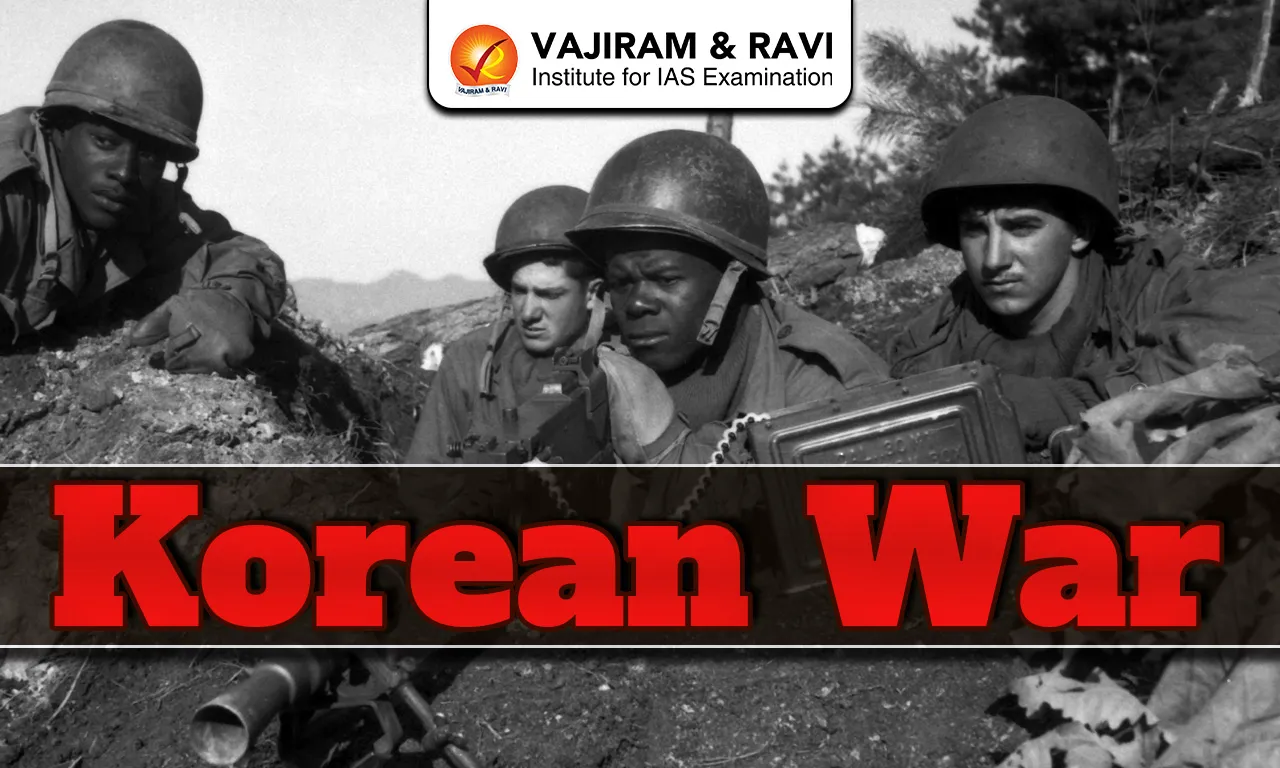
Enquire Now