Bahujan Samaj Movement, History, Leaders and Dalit Empowerment

Bahujan Samaj Movement

Bahujan Samaj Movement is an important social and political movement in India that focuses on social justice, equality, dignity and political representation for marginalized communities. The movement sought to unite Scheduled Castes, Scheduled Tribes, OBCs and other disadvantaged groups and give them a stronger voice in society and democratic politics. Inspired by the ideas of social reformers such as Dr. B.R. Ambedkar and Jyotirao Phule, the movement gradually developed into an organised political force under Kanshi Ram. 

Bahujan Samaj Movement History and Background

  • The Bahujan Samaj Movement emerged as a social and political movement aimed at bringing greater equality, dignity and representation to communities that had faced social and economic discrimination for a long time.
  • The term “Bahujan” means the majority of people. The movement uses this idea to bring together Scheduled Castes (SCs), Scheduled Tribes (STs), Other Backward Classes (OBCs) and other socially and religiously marginalized communities.
  • The movement developed from the long-standing struggle against caste-based discrimination, social inequality and exclusion. 
  • It sought to make the concerns of marginalised communities a stronger part of public and political life.
  • Kanshi Ram played a major role in turning the idea of Bahujan unity into an organised social and political movement. 
  • Before entering electoral politics, he worked to build awareness and organisation among educated members of backward and marginalised communities.
  • In 1973, Kanshi Ram helped establish BAMCEF (All India Backward and Minority Communities Employees Federation) to organise educated employees from disadvantaged communities and spread social awareness.
  • He later founded DS4 (Dalit Shoshit Samaj Sangharsh Samiti), which helped create greater political awareness among Dalits, youth, students and other oppressed sections.
  • On 14 April 1984, Kanshi Ram founded the Bahujan Samaj Party (BSP) on the birth anniversary of Dr. B.R. Ambedkar. The party provided a political platform for the Bahujan movement and its demand for greater representation.

Bahujan Samaj Movement Key Leaders and Ideology

  • Kanshi Ram is regarded as the main organiser of the modern Bahujan movement. He believed that social change required not only awareness but also political power and representation.
  • The movement was strongly influenced by the ideas of Dr. B.R. Ambedkar, particularly his emphasis on social equality, dignity, education, political representation and justice for oppressed communities.
  • The Bahujan ideology also draws inspiration from Jyotirao Phule, Chhatrapati Shahuji Maharaj and Gautama Buddha, whose teachings and movements are associated with equality, social reform and opposition to social discrimination.
  • A central idea of the movement is to unite different disadvantaged communities under a broader Bahujan identity, rather than treating caste-based discrimination as an issue affecting only one community.
  • The movement sought to challenge caste hierarchy and social domination and promote a society based on equality, self-respect and social justice.
  • Kanshi Ram also believed that political participation was essential for bringing lasting reforms. Therefore, the movement gradually moved from social mobilisation to organised electoral politics through the BSP.

Bahujan Samaj Movement and Dalit Empowerment

  • Dalit empowerment has remained an important part of the Bahujan movement. It emerged from the demand for freedom from caste-based discrimination and for equal access to social, economic and political opportunities.
  • After independence, many Dalits continued to experience social exclusion and lack of adequate representation. 
  • The Bahujan movement gave greater importance to their demand for dignity, equality and political participation.
  • Education played an important role in this process. The growth of an educated Dalit population helped spread ideas of justice, equality and rights, while writers and intellectuals also raised awareness about caste discrimination.
  • The movement encouraged Dalits and other marginalised communities to become more politically aware and participate actively in leadership, elections and democratic institutions.
  • Organisations such as BAMCEF and DS4 helped build social and political consciousness before and alongside the growth of the BSP. 
  • BAMCEF focused on organising educated members of disadvantaged communities, while DS4 worked to mobilise wider sections of society.
  • The movement also had a wider cultural impact. Meetings, literature and other forms of cultural expression were used to highlight the history, experiences and identity of Bahujan communities.
  • Under Mayawati, the Bahujan political movement achieved major electoral success in Uttar Pradesh, where it played an important role in forming governments and strengthening the political representation of marginalised communities.

Bahujan Samaj Movement Role and Significance in Indian Politics

  • The Bahujan Samaj Movement brought questions of caste, social justice, political representation and equality more prominently into Indian electoral politics.
  • One of its major contributions was to encourage marginalised communities to view their numerical strength as a source of political influence and participate more actively in the democratic process.
  • The movement expanded the political discussion beyond a narrow focus on Dalits by bringing SCs, STs, OBCs and other marginalized communities into a broader political framework.
  • The Bahujan Samaj Party became the main political expression of this movement and established itself as an important force, particularly in Uttar Pradesh.
  • The movement also encouraged greater participation of women, youth and students in political activities and leadership, helping create a wider base for social and political mobilisation.
  • Its significance goes beyond electoral politics because it also contributed to a stronger sense of self-respect, identity and social awareness among historically marginalised sections.
  • The Bahujan Samaj Movement represents an important phase in India's social justice and democratic politics, where social mobilisation was used to seek greater political power, representation and equality.

Bahujan Samaj Movement FAQs

Q1: What is the Bahujan Samaj Movement?

Ans: The Bahujan Samaj Movement is a social and political movement that focuses on equality, social justice, dignity and political representation for marginalized communities in India.

Q2: What does Bahujan mean?

Ans: Bahujan means the majority of people. In the context of the movement, it refers broadly to SCs, STs, OBCs and other socially and religiously marginalized communities.

Q3: Who founded the Bahujan Samaj Movement?

Ans: Kanshi Ram played the leading role in organising the modern Bahujan Samaj Movement. He worked to unite marginalised communities and strengthen their social and political representation.

Q4: When was the Bahujan Samaj Party founded?

Ans: The Bahujan Samaj Party (BSP) was founded by Kanshi Ram on 14 April 1984, the birth anniversary of Dr. B.R. Ambedkar.

Q5: What are the main ideas of the Bahujan Samaj Movement?

Ans: The movement focuses on social equality, self-respect, social justice, political representation and empowerment of historically marginalised communities.

Dahi Handi Festival 2026, Date, Significance, UNESCO Recognition

Dahi Handi Festival

Dahi Handi Festival 2026 is a traditional socio-cultural celebration associated with Krishna Janmashtami. It is especially prominent in Maharashtra, with Mumbai, Thane and Pune being major centres. The festival combines cultural tradition with teamwork and competitive human pyramid formation. Maharashtra has also announced formal efforts to seek a UNESCO Intangible Cultural Heritage tag for the traditional festival.

What is Dahi Handi Festival?

Dahi Handi Festival involves Govindas forming multi tier human pyramids to break an earthen pot containing curd, butter, milk, fruits and other items. The origin of the Dahi Handi Utsav tradition is linked to the childhood stories of Krishna in Gokul and Vrindavan, where Krishna and his cowherd companions reportedly formed human pyramids to reach curd and butter pots hung high by village women.

Dahi Handi Festival 2026

In 2026, Dahi Handi Festival will be observed as part of Krishna Janmashtami celebrations. 

  • Date in 2026: Dahi Handi Festival 2026 will be celebrated on 5 September 2026, as the traditional event associated with Shree Krishna Janmashtami.
  • Economic scale: Dahi Handi events have increasingly attracted sponsorship and prize money. Historical event prizes have ranged from ₹1 lakh to ₹12 lakh.
  • Record achievement: In 2012, Jai Jawan Govinda Pathak from Jogeshwari formed a 9 tier pyramid measuring 43.79 feet (13.35 m) at Thane.
  • UNESCO recognition: Maharashtra has announced formal efforts to obtain UNESCO Intangible Cultural Heritage recognition for the Dahi Handi Utsav and Ganeshotsav, highlighting the festival's traditional and socio-cultural importance.
  • Cultural significance: The festival represents teamwork, coordination, determination, balance and collective effort through the formation of human pyramids.

Also Read: Fairs and Festivals of India 2026

Dahi Handi Festival Rituals and Celebrations

The key highlights of the celebrations and rituals of the Dahi Handi Festival 2026 are:

  • Human pyramids: Govinda Pathaks generally form pyramids of up to nine tiers. Participants train for weeks, with stronger members forming lower layers and lighter participants reaching the top.
  • Handi ritual: The suspended clay pot traditionally contains curd, butter, milk, fruits and water. The top participant breaks it, causing its contents to spill over the pyramid and surrounding crowd.
  • Govinda Pathaks: The participating groups are known as Govinda Pathaks or mandals. They practise collectively before the festival to improve coordination and pyramid formation.
  • Public celebration: Dahi Handi events feature large gatherings, music, dancing and cheering. Spectators traditionally chant “Ala re ala, Govinda ala” during the pyramid attempts.
  • Maharashtra celebrations: Maharashtra is the main centre of Dahi Handi celebrations, with major events held in Mumbai, Thane, Pune and the Konkan region.
  • Other Indian regions: The tradition is also observed in Gujarat and Goa, while related forms are celebrated in other parts of India during Krishna Janmashtami.
  • Gopalakala: In parts of western India, Dahi Handi is known as Gopalakala. The name is associated with the traditional celebration connected with Krishna Janmashtami.
  • Utlotsavam: In Andhra Pradesh and Telangana, the corresponding tradition is called Utlotsavam. It involves attempts to reach a suspended object using coordinated physical effort.

Also Read: Festivals of Maharashtra 2026

Dahi Handi Festival FAQs

Q1: What is Dahi Handi Festival?

Ans: Dahi Handi is a traditional festival associated with Krishna Janmashtami in which Govindas form human pyramids to break a suspended earthen pot.

Q2: When will be Dahi Handi Festival 2026 celebrated?

Ans: Dahi Handi Festival 2026 will be celebrated on 5 September 2026 as part of the Krishna Janmashtami celebrations.

Q3: Why is Dahi Handi celebrated?

Ans: Dahi Handi commemorates the childhood stories of Krishna and his companions forming human pyramids to reach curd and butter kept in hanging pots.

Q4: Where is Dahi Handi mainly celebrated?

Ans: Dahi Handi is celebrated mainly in Maharashtra, especially Mumbai, Thane, Pune and the Konkan region, along with Gujarat and Goa.

Q5: What is Dahi Handi called in Andhra Pradesh and Telangana?

Ans: In Andhra Pradesh and Telangana, the related traditional celebration is known as Utlotsavam.

Bachpan Bachao Andolan (BBA), Launch, Kailash Satyarthi, Status

Bachpan Bachao Andolan

Bachpan Bachao Andolan (BBA) is India’s largest child rights movement working against child labour, bonded labour, trafficking and exploitation. It combines rescue, rehabilitation, education, legal action and community mobilisation. Over four decades, BBA has protected and rehabilitated more than 1,10,000 children and strengthened advocacy for child friendly laws and policies.

What is Bachpan Bachao Andolan (BBA)

Bachpan Bachao Andolan, meaning Save Childhood Movement, was started by Kailash Satyarthi in 1980. Its work is managed through the registered society Association for Voluntary Action (AVA). The movement seeks to identify, liberate, rehabilitate and educate children in servitude through prevention, direct intervention, legal action and mass mobilisation.

Bachpan Bachao Andolan Objectives

Bachpan Bachao Andolan (BBA) works to create a child friendly society where children are protected from exploitation, abuse, trafficking and forced labour and receive education, dignity and freedom.

  • Primary Objective: To eliminate child labour, bonded labour, trafficking and exploitation by rescuing affected children and ensuring their rehabilitation, education, dignity and freedom.
  • Vision: BBA seeks a child friendly world where every child is free from exploitation and abuse and can access free and quality education.
  • Mission: Its mission covers identifying, releasing, rehabilitating and educating children in servitude through prevention, intervention, coalition building, mobilisation and legal action.
  • Core Values: Justice, Courage, Compassion, Integrity and Freedom guide BBA’s approach towards child protection, rehabilitation, legal advocacy and social mobilisation.
  • Strategy: BBA follows prevention, protection and rehabilitation through community participation, legal enforcement, rescue operations, education and support for affected children.
  • Efforts: The Bal Mitra Gram model promotes child labour free villages where children attend school and participate through Bal Panchayats recognised by Gram Panchayats.

Bachpan Bachao Andolan Features

Bachpan Bachao Andolan combines grassroots rescue operations with public campaigns, legal intervention and policy advocacy to address child labour and trafficking.

  • Child rescue: BBA has rescued more than 88,000 children according to one organisational record, while its broader record reports over 1,10,000 children protected and rehabilitated.
  • Rehabilitation centres: Mukti Ashram near Delhi provides immediate shelter, medical care, food, counselling and recreation, while Bal Ashram in Rajasthan supports longer term education and vocational training.
  • Legal advocacy: BBA has pursued cases before the Supreme Court and High Courts involving missing children, child labour, trafficking, education and enforcement against establishments employing children.
  • Global March: In 1998, BBA led the Global March Against Child Labour across 103 countries, helping build international momentum for ILO Convention No. 182.
  • Education campaign: In 2001, BBA led a nationwide campaign involving more than 180 Members of Parliament and a 15,000 km march demanding education as a fundamental right.
  • Child trafficking campaign: Mukti Caravan covered 158 villages across Uttar Pradesh, Bihar, Delhi and Rajasthan, conducting 750 street plays and forming 70 Public Vigilance Committees.
  • Baal Panchayat: BBA organises Baal Panchayat activities on 12 June, observed as the World Day Against Child Labour, to encourage children’s participation in protection efforts.
  • Policy contribution: BBA’s advocacy supported stronger child protection measures, including the Child Labour Act, Right to Education framework and action against trafficking and exploitative employment.

Who is Kailash Satyarthi?

Kailash Satyarthi is an Indian child rights activist who founded BBA and received the 2014 Nobel Peace Prize jointly with Malala Yousafzai.

  • Satyarthi left his electrical engineering career and began working against child slavery, bonded labour and exploitation through organised child rights activism.
  • His sustained advocacy contributed to support for the Child Labour Act in 1986 and its subsequent amendment in 2016.
  • His work with the Global March Against Child Labour helped generate international support for ILO Convention No. 182 on the worst forms of child labour.
  • In 2014, Kailash Satyarthi received the Nobel Peace Prize jointly with Malala Yousafzai for their contribution to children’s education and rights.

Status of Children in India 2026

India has made progress in poverty reduction, schooling and institutional healthcare, but children still face serious nutritional, educational, social and climate related vulnerabilities.

  • Child population: Children constitute roughly 32% of India’s demographic in 2026.
  • School enrolment: UDISE+ recorded 24.72 crore students from pre primary to higher secondary levels, supported by approximately 1.02 crore teachers.
  • Out of school children: Around 46 million children are estimated to remain outside school, with substantial concentration across selected states and disadvantaged communities.

  • Adolescents: India has the world’s largest adolescent population at 253 million, with every fifth person aged between 10 and 19 years.
  • Nutrition: More than half of India’s children have been reported as malnourished, while adolescent girls face particularly high risks of undernutrition.
  • Obesity: The World Health Organization and World Obesity Atlas 2026 place India second globally for children with high BMI, with over 41 million overweight or obese children and adolescents.
  • Climate vulnerability: A UNICEF report released on 16 June 2026 estimates that 411.62 million children face at least two climate or disaster hazards.
  • Multiple hazards: More than 234 million children face at least three climate hazards, while drought and extreme heat affect over 158.8 million children together.

Challenges Faced by Children in India:

  • Child protection: The Right to Education Act and Protection of Children from Sexual Offences Act remain important legal frameworks for safeguarding children.
  • Child budget: The Union Budget allocated ₹1,32,296.85 crore for child welfare and development schemes, reflecting continued public investment in children.
  • Digital concerns: Increasing digital, gaming and social media dependence among young people has raised concerns about behavioural health and responsible technology use.
  • Persistent challenges: Rural children, urban poor families, Scheduled Castes, tribal communities and other disadvantaged groups continue facing poverty, malnutrition, child marriage, poor attendance and inadequate sanitation.
  • Child marriage: India ranks fourth among eight South Asian countries for child marriage prevalence, after Bangladesh, Nepal and Afghanistan, with adolescent girls particularly vulnerable.

Way Forward:

  • Stronger social protection, quality education, effective legal enforcement, rehabilitation, disaster preparedness and child centred climate adaptation remain essential for securing children’s rights.
  • The Kailash Satyarthi Children’s Foundation and organisations such as BBA continue supporting child protection, awareness, rehabilitation and policy advocacy against exploitation.

Bachpan Bachao Andolan FAQs

Q1: What is Bachpan Bachao Andolan?

Ans: Bachpan Bachao Andolan is a child rights movement working against child labour, bonded labour, trafficking and exploitation.

Q2: Who started Bachpan Bachao Andolan?

Ans: Bachpan Bachao Andolan was started by Kailash Satyarthi in 1980 to protect children from exploitation and promote their education and rehabilitation.

Q3: What is the main objective of Bachpan Bachao Andolan?

Ans: Its main objective is to identify, rescue, rehabilitate and educate children in servitude and create a child friendly society.

Q4: When was Bachpan Bachao Andolan founded?

Ans: Bachpan Bachao Andolan was founded in 1980 by Kailash Satyarthi as a movement against child labour and child exploitation.

Q5: Who is Kailash Satyarthi?

Ans: Kailash Satyarthi is a child rights activist who founded Bachpan Bachao Andolan and received the 2014 Nobel Peace Prize jointly with Malala Yousafzai.

UPSC Daily Quiz 3 September 2026

UPSC Daily Quiz

[WpProQuiz 246]

UPSC Daily Quiz FAQs

Q1: What is the Daily UPSC Quiz?

Ans: The Daily UPSC Quiz is a set of practice questions based on current affairs, static subjects, and PYQs that help aspirants enhance retention and test conceptual clarity regularly.

Q2: How is the Daily Quiz useful for UPSC preparation?

Ans: Daily quizzes support learning, help in revision, improve time management, and boost accuracy for both UPSC Prelims and Mains through consistent practice.

Q3: Are the quiz questions based on the UPSC syllabus?

Ans: Yes, all questions are aligned with the UPSC Syllabus 2025, covering key areas like Polity, Economy, Environment, History, Geography, and Current Affairs.

Q4: Are solutions and explanations provided with the quiz?

Ans: Yes, each quiz includes detailed explanations and source references to enhance conceptual understanding and enable self-assessment.

Q5: Is the Daily UPSC Quiz suitable for both Prelims and Mains?

Ans: Primarily focused on Prelims (MCQ format), but it also indirectly helps in Mains by strengthening subject knowledge and factual clarity.

Ajanta Caves, History, Architecture, Paintings, Significance

Ajanta Caves

The Ajanta Caves are a group of ancient Buddhist rock-cut caves in Maharashtra. They are known for their architecture, sculptures, paintings and inscriptions, which provide valuable information about the religious, social and cultural life of ancient India.

About Ajanta Caves

The Ajanta Caves are a group of ancient Buddhist rock-cut caves in Maharashtra, carved into a basalt cliff along the Waghora River.

  • They are located in the Sahyadri hills of the Deccan Plateau, near Lenapur village in Soyagaon taluka of Maharashtra.
  • The caves form a horseshoe-shaped escarpment about 75 metres high along the left bank of the Waghora River.
  • The site was close to an ancient trade route connecting the ports of western India with cities in the Deccan and therefore served as a resting place for merchants and travellers.

Ajanta Caves History and Patronage

The Ajanta Caves were not built by a single ruler or during a single period. They developed over several centuries in two main phases.

  • The first phase took place under the Satavahanas, around the 2nd to 1st centuries BCE.
  • The second phase took place under the Vakatakas, especially during the reign of King Harishena, in the 5th and 6th centuries CE.
  • Cave 1 is associated with the patronage of Harishena, while Cave 16 was donated by his minister Varahadeva.
  • Cave 17 was donated by Upendragupta, a Vakataka feudatory who ruled the Risika region.
  • The caves served as viharas, where Buddhist monks lived, studied and meditated, and chaityagrihas, which were used for worship and congregation.
  • The caves also served as a monsoon retreat for monks, who had to stop travelling during the rainy season.
  • Merchants and pilgrims using the nearby trade route are also believed to have used the caves as resting places.

Ajanta Caves Architecture

The Ajanta Caves are an example of rock-cut architecture, where the structures were carved directly into the basalt cliff rather than built separately.

  • Craftsmen used chisels and hammers to remove the rock and create halls, cells, pillars and sculptures.
  • The architecture also imitates wooden structures, with stone beams, rafters and roof ribs carved to resemble wooden forms.
  • The complex has 30 caves, including five chaityagrihas and the remaining viharas.
  • The five chaityagrihas are Caves 9, 10, 19, 26 and 29. They have a vaulted ceiling, apsidal end and rows of pillars, with a stupa at the centre of the apse as the main object of worship.
  • Their facades have a distinctive horseshoe-shaped chaitya window.
  • The viharas served as monasteries and generally have a central hall surrounded by cells for monks, along with a shrine containing an image of the Buddha.
  • Caves 5, 24 and 29 were left unfinished, giving an idea of how the caves were gradually carved out of the rock.

Ajanta Caves Sculptures

The caves contain extensive rock-cut sculptures along with their architectural features.

  • They include large images of the Buddha and Bodhisattvas such as Padmapani and Vajrapani.
  • Figures of celestial nymphs are also found in the caves.
  • Pillars, doorways, door frames and facades are richly decorated with sculptures.

Ajanta Caves Paintings

The Ajanta Caves paintings are known for their Buddhist themes and detailed portrayal of contemporary life.

  • The paintings mainly depict Jataka tales, describing the previous births of the Buddha, along with scenes from the life of the historical Buddha.
  • They also show clothing, jewellery, hairstyles, court life, musical instruments and social customs of the period.
  • Cave 1 is famous for the painting of Bodhisattva Padmapani, while Caves 16 and 17 contain some of the finest surviving paintings.
  • The walls were prepared with mud plaster, followed by finer plaster and a layer of lime or kaolin to create a smooth surface.
  • Artists used pigments such as red and yellow ochre, terra verte, lime, kaolin, gypsum, lamp black and lapis lazuli.
  • Lapis lazuli was not locally available and is believed to have been brought from Afghanistan, indicating long-distance trade links.
  • Glue, probably of animal origin, was used as a binding material.
  • Since the paintings were made on dry plaster, they are technically tempera paintings and not true frescoes.

Ajanta Caves as a Historical Record

The Ajanta Caves provide valuable evidence about ancient India through their paintings, sculptures and inscriptions.

  • Religion: They show the development of Buddhism from early traditions to the later Mahayana phase.
  • Political history: Inscriptions provide information about the Vakataka rulers, ministers and feudatories.
  • Social life: Paintings show clothing, jewellery, hairstyles, court life and social customs.
  • Trade: The use of lapis lazuli from Afghanistan points to long-distance trade links.
  • Epigraphy: Inscriptions mentioning donors and patrons help reconstruct the history and chronology of the caves.
  • Art and culture: The caves preserve important examples of ancient Indian painting, sculpture and architecture.

Ajanta Caves UNESCO World Heritage Status

The Ajanta Caves were inscribed as a UNESCO World Heritage Site in 1983 under Criteria (i), (ii), (iii) and (vi).

  • Criterion (i): Ajanta represents a unique artistic achievement.
  • Criterion (ii): Its artistic style influenced art in India and beyond, including Java.
  • Criterion (iii): The caves provide important evidence of the development of Indian art and the role of Buddhism during the Satavahana and Vakataka periods.
  • Criterion (vi): Ajanta is directly associated with the history of Buddhism.

Ajanta Caves Decline and Rediscovery

After the decline of royal patronage, the Ajanta Caves were abandoned and gradually covered by forest. They were rediscovered in 1819 by British officer John Smith during a hunting expedition. Today, the Archaeological Survey of India (ASI) manages the site, which is protected under the Ancient Monuments and Archaeological Sites and Remains Act, 1958 and Rules, 1959. The law also regulates activities in the 100-metre prohibited and 200-metre regulated zones around the protected monument.

Ajanta Caves FAQs

Q1: Where are the Ajanta Caves located?

Ans: The Ajanta Caves are located in the Sahyadri hills of the Deccan Plateau, near Lenapur village in Soyagaon taluka of Maharashtra, along the Waghora River.

Q2: Who built the Ajanta Caves?

Ans: The Ajanta Caves were developed in two main phases. The first phase was associated with the Satavahanas, while the second phase took place under the Vakatakas, especially during the reign of King Harishena.

Q3: What are the Ajanta Caves famous for?

Ans: The Ajanta Caves are famous for their Buddhist rock-cut architecture, sculptures and paintings, especially the paintings depicting Jataka tales, the life of the Buddha and contemporary social life.

Q4: How many caves are there at Ajanta?

Ans: The Ajanta complex has 30 caves, including five chaityagrihas - Caves 9, 10, 19, 26 and 29 and the remaining viharas.

Q5: What is special about the paintings of the Ajanta Caves?

Ans: The paintings depict Jataka tales, scenes from the Buddha’s life, and details of contemporary society. They were made on dry plaster using the tempera technique, so they are technically not true frescoes.

Java Trench, Location, Formation, Depth, Earthquake Zone

Java Trench

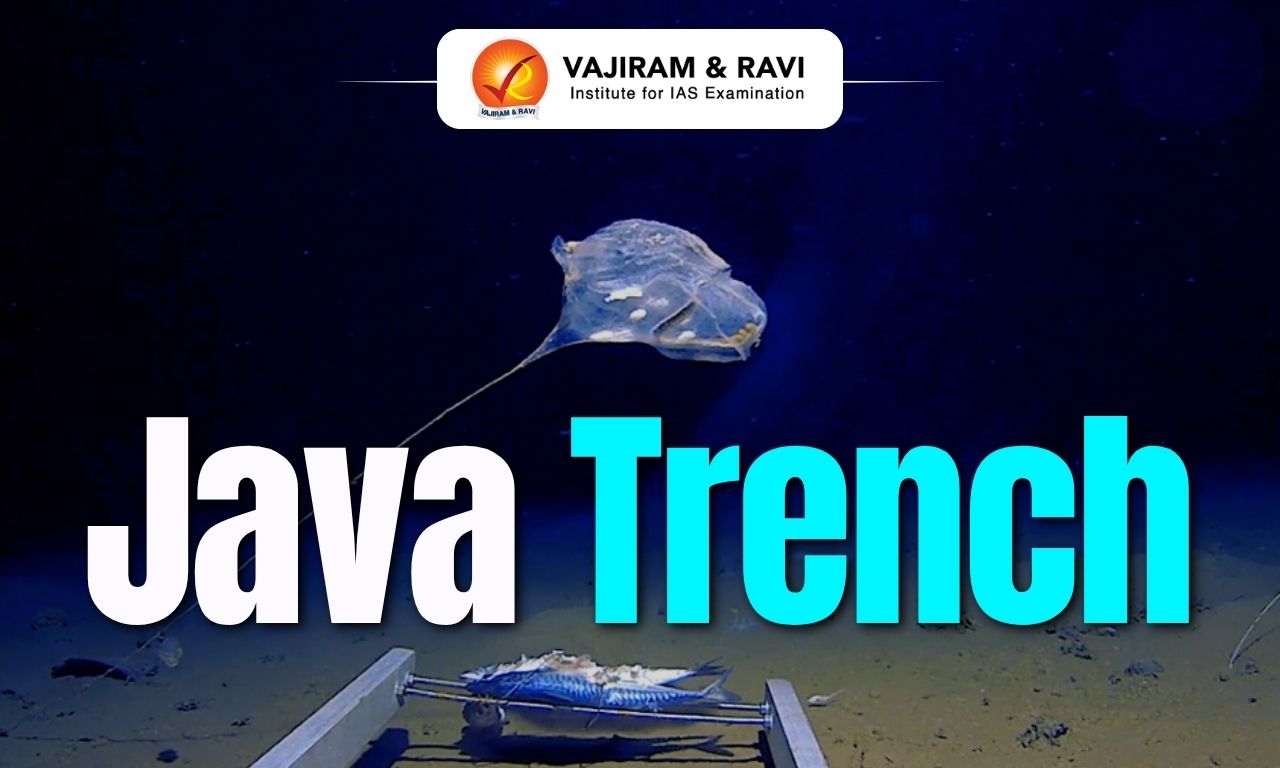
The Java Trench, also known as the Sunda Trench, is a major submarine trench in the eastern Indian Ocean, located south of the Indonesian islands of Sumatra and Java. It lies along an active tectonic zone associated with the Sunda Volcanic Arc, frequent earthquakes and tsunami risk, making it important for understanding ocean-floor relief, plate tectonics and natural hazards.

About Java Trench

The Java Trench is a deep-sea trench formed along an active subduction zone, where the Australian Plate moves beneath the Sunda Plate.

  • Location: It lies south of the Indonesian islands of Sumatra, Java and the Lesser Sunda Islands, along the southern margin of the Indonesian island arc.
  • Formation: The Java Trench lies at a convergent plate boundary, where the relatively dense Australian Plate moves northward and subducts beneath the Sunda Plate. As the oceanic lithosphere bends downward and sinks into the mantle, it creates the long, narrow depression of the Java Trench.
  • Depth: It reaches a depth of roughly 7.2 km. A depth of around 7,290 metres is commonly cited in conventional geographical sources, while modern surveys have recorded approximately 7,187 metres. 
  • Volcanic Activity: Fluids released from the subducting plate trigger partial melting in the overlying mantle, generating magma that rises towards the surface and contributes to the Sunda Volcanic Arc, which includes volcanoes such as Mount Merapi.
  • Earthquake-Prone Zone: Friction can cause parts of the subduction interface to become locked, allowing tectonic stress to accumulate and eventually release through powerful megathrust earthquakes.
  • Tsunami Risk: The Java Trench is prone to tsunamis because large earthquakes along the subduction zone can suddenly move the seafloor and displace seawater. The 2006 Java earthquake (magnitude 7.7) triggered a destructive tsunami along the southern coast of Java.
  • Hadal Environment: Parts of the trench extend below 6,000 metres, placing them within the hadal zone, characterised by extremely high pressure, darkness, low temperatures and specialised deep-sea organisms.

Java Trench FAQs

Q1: Where is the Java Trench located?

Ans: The Java Trench is located in the eastern Indian Ocean, south of the Indonesian islands of Sumatra, Java and the Lesser Sunda Islands.

Q2: What is the Java Trench also known as?

Ans: The Java Trench is also known as the Sunda Trench

Q3: Which plates are involved in the formation of the Java Trench?

Ans: The Australian Plate and the Sunda Plate are involved in the formation of the Java Trench. The Australian Plate subducts beneath the Sunda Plate, forming the Java Trench along a convergent plate boundary.

Q4: What is the depth of the Java Trench?

Ans: The Java Trench reaches a depth of approximately 7.2 km (about 7,200 metres).

Q5: What are the major hazards associated with the Java Trench?

Ans: The active subduction zone makes the region prone to megathrust earthquakes, volcanic activity and tsunamis.

Assisted Reproductive Technology (Regulation) Act, 2021

Assisted Reproductive Technology (Regulation) Act 2021

The Assisted Reproductive Technology (Regulation) Act, 2021 provides a statutory framework for regulating assisted reproductive technology(ART) services in India. It brings ART clinics and banks, gamete donors, patients, embryos and ART-born children within a common regulatory system, while seeking to ensure the safe, ethical and transparent use of reproductive technologies.

About the Assisted Reproductive Technology (Regulation) Act, 2021

The Assisted Reproductive Technology (Regulation) Act, 2021 is a central law enacted to regulate Assisted Reproductive Technology (ART) clinics and ART banks in India. 

  • It was enacted on 18 December 2021 and came into force on 25 January 2022. 
  • Main objective: The Act seeks to ensure the safe and ethical use of ART, prevent its misuse and protect the interests of patients, donors and children born through ART.

What is Assisted Reproductive Technology?

The Act defines Assisted Reproductive Technology as techniques that attempt to achieve pregnancy by handling sperm or oocytes outside the human body and subsequently transferring the gamete or embryo into the reproductive system of a woman. In-vitro fertilisation (IVF) is a common example, in which an egg is fertilised with sperm in a laboratory and the resulting embryo is transferred to the uterus.

Assisted Reproductive Technology (Regulation) Act, 2021 Need

The need for the Assisted Reproductive Technology (Regulation) Act, 2021 arose from the rapid expansion of ART services and the absence of a comprehensive statutory framework to regulate clinics, donors, gametes and embryos.

  • Regulatory gap: ART services lacked a dedicated law covering their complete functioning.
  • Lack of uniform standards: Clinics needed common standards for infrastructure, equipment, medical personnel and procedures.
  • Unregulated ART banks: Collection, storage and supply of sperm and oocytes required statutory oversight.
  • Donor protection: Oocyte donors required safeguards against unsafe procedures and exploitation.
  • Misuse prevention: Sex selection and unauthorised use or trade of gametes and embryos needed clear legal restrictions.
  • Effective monitoring: Registration, inspections and a National Registry were needed to track and regulate ART services.

Assisted Reproductive Technology (Regulation) Act, 2021 Key Provisions 

The Assisted Reproductive Technology (Regulation) Act, 2021 regulates the entire ART ecosystem, from the registration of clinics and eligibility of patients to the use of donated gametes, protection of embryos, genetic testing and penalties for violations.

Regulatory framework

  • Creates the National Assisted Reproductive Technology and Surrogacy Board as the apex body to set standards and regulate ART services across the country.
  • Provides for State Boards to implement these standards and oversee ART services at the state level.
  • Empowers appropriate authorities to register ART clinics and banks, conduct inspections and take action against violations.

Eligibility for ART services

  • ART services are available to women above 21 and below 50 years and men above 21 and below 55 years.
  • A married couple seeking ART must generally be certified as infertile, including cases where they have been unable to conceive after one year of unprotected intercourse or where a medical condition prevents conception.
  • A single woman can also access ART services, subject to the conditions laid down under the law.

Registration of ART clinics and banks

  • Every ART clinic and ART bank must be registered before providing services, ensuring that only facilities meeting prescribed standards can operate.
  • Registration depends on requirements relating to infrastructure, equipment, qualified medical personnel, laboratory facilities and other standards.
  • Registration remains valid for five years and can be renewed as prescribed, while serious violations can lead to suspension or cancellation.

National Registry

  • Establishes a National Registry of Assisted Reproductive Technology and Surrogacy to maintain information about registered clinics, ART banks, services and treatment outcomes.
  • The Registry helps authorities track the functioning of ART facilities and provides reliable data for monitoring, regulation and policymaking.

Donor regulation

  • Gamete donors must undergo prescribed medical and genetic screening before their gametes can be used, reducing the risk of transmitting diseases to the child.
  • Semen donors must be between 21 and 55 years, while oocyte donors must be between 23 and 35 years.
  • An oocyte donor must be ever-married and have at least one living child who is at least three years old.
  • Gametes obtained from a single donor cannot be supplied to more than one commissioning party, preventing their repeated use across different families.

Protection of oocyte donors

  • Recognising the physical risks involved in oocyte retrieval, the Act provides for insurance coverage for 12 months against complications arising from the donation.
  • An oocyte donor can donate only once in her lifetime.
  • The number of oocytes retrieved from a donor is limited to seven.

Protection of patients

  • ART procedures require written informed consent, ensuring that patients understand the treatment before proceeding.
  • Patients must be informed about the procedure, chances of success, risks, side effects and costs involved.
  • Clinics and banks must maintain the confidentiality of patient and donor information, except where disclosure is permitted by law.

Record keeping

  • ART clinics and banks must maintain records relating to patients, donors, gametes, embryos, procedures and treatment outcomes.
  • Records relating to gamete donation must be maintained for at least 10 years before being transferred to the National Registry.
  • Such records allow regulators to monitor treatment practices and investigate complaints or violations.

Regulation of embryos

  • The Act regulates the creation, storage and transfer of embryos during ART procedures.
  • It places limits on the number of oocytes or embryos that can be transferred during a treatment cycle.
  • It prohibits practices such as mixing semen from two individuals and splitting embryos for the purpose of twinning.

Genetic testing of embryos

  • Pre-implantation genetic testing is permitted to identify known, pre-existing, heritable or genetic diseases. This prevents genetic testing from being used simply to select preferred characteristics in a child.
  • Genetic testing may also be undertaken where necessary to diagnose, prevent or treat a sex-linked genetic disorder or disease.

Prohibition of sex selection

  • The Act prohibits the use of ART procedures to determine or select the sex of a child. This prohibition works alongside the Pre-Conception and Pre-Natal Diagnostic Techniques (Prohibition of Sex Selection) Act, 1994, providing an additional legal safeguard against sex selection.
  • The limited exception applies where genetic testing is medically necessary for a sex-linked disorder or disease.

Regulation of gametes and embryos

  • Prohibits the sale and unauthorised transfer or use of human gametes, zygotes and embryos.
  • Regulates the transfer of gametes and embryos outside India to prevent their misuse and commercial exploitation.
  • These provisions seek to ensure that reproductive material is handled for legitimate medical purposes rather than treated as a commercial commodity.

Research involving gametes and embryos

  • Places restrictions on the use of human gametes and embryos for research. Their transfer outside India for research purposes is prohibited.
  • Permitted research must comply with the prescribed scientific, legal and ethical safeguards.

Rights of ART-born children

  • A child born through ART is legally recognised as the biological child of the commissioning couple.
  • The child enjoys the same legal rights and privileges as a child born naturally to the couple.
  • A gamete donor does not acquire parental rights over the child merely because their genetic material was used.

Grievance redressal

  • ART clinics and banks must establish a grievance redressal mechanism for patients and donors. This provides an institutional avenue for addressing complaints regarding treatment, services or other violations.
  • It also strengthens accountability of ART service providers.

Inspection and enforcement

  • Appropriate authorities can inspect ART clinics and banks, examine records and investigate suspected violations. They can take action against facilities that fail to comply with the Act, including suspension or cancellation of registration. This gives the regulatory framework an enforcement mechanism rather than making it dependent only on voluntary compliance.

Penalties

  • Sex-selective ART can attract imprisonment of 5–10 years, or a fine of ₹10–25 lakh, or both.
  • Other specified offences can attract a fine of ₹5–10 lakh for the first contravention.
  • A subsequent contravention can attract 3–8 years of imprisonment and a fine of ₹10–20 lakh.

Cognisance of offences

  • Courts can take cognisance of offences under the Act only on a complaint made by the National Board, State Board or an officer authorised by them.
  • Offences are triable by a Metropolitan Magistrate, Judicial Magistrate First Class or a higher court, as prescribed under the Act.

Assisted Reproductive Technology (Regulation) Act, 2021 Significance 

  • Ends the regulatory vacuum: Brings ART clinics and banks under a dedicated statutory framework instead of leaving the sector largely dependent on guidelines and professional standards.
  • Standardises ART services: Mandatory registration and prescribed standards for infrastructure, equipment and medical personnel create a common regulatory baseline for ART facilities.
  • Controls the donor system: Medical screening of donors, restrictions on oocyte donation and limits on the use of a donor's gametes reduce the scope for unsafe or unregulated donor practices.
  • Strengthens patient protection: Mandatory counselling, informed decision-making, disclosure of costs and risks, and grievance mechanisms give patients greater protection during ART treatment.
  • Prevents misuse of genetic technology: By permitting genetic testing only for specified medical purposes and prohibiting sex selection, the Act draws a clear line between legitimate medical use and reproductive misuse.
  • Creates traceability through the National Registry: A central database of ART clinics, banks, procedures and outcomes can help regulators monitor the sector and develop evidence-based policies. 
  • Protects confidentiality: The Act places a statutory duty on clinics and banks to protect information relating to patients, commissioning couples and donors, subject to limited exceptions.
  • Recognises the rights of ART-born children: It gives children born through ART the same legal status and rights as naturally conceived children, while denying parental rights to gamete donors.
  • Creates enforceable accountability: Inspection powers, grievance mechanisms and penalties make violations by ART clinics and banks subject to legal consequences rather than merely professional regulation.

Assisted Reproductive Technology (Regulation) Act, 2021 Concerns

Despite creating a much-needed regulatory framework, the Act has raised concerns regarding access to ART, availability of donors, privacy, affordability and practical implementation.

  • Affordability remains unaddressed: The Act regulates ART services but does not regulate their prices, leaving procedures such as IVF expensive for many couples.
  • Risk of gamete shortage: Limiting an oocyte donor to one donation and restricting a donor’s gametes to one commissioning party may reduce donor availability and increase treatment costs.
  • Exclusion from ART access: Eligibility restrictions may limit access for some unmarried couples, unmarried men and LGBTQ+ persons, raising concerns about equality and reproductive autonomy.
  • Privacy concerns: The National Registry involves sensitive information about patients, donors, procedures and outcomes, raising concerns about reproductive data protection.
  • Burden on smaller clinics: Registration and infrastructure requirements may be difficult for smaller ART centres to meet, particularly outside major cities.
  • Risk of informal markets: Limited donor availability combined with restrictions on commercial transactions could encourage unregulated donor arrangements.
  • Donor livelihood concerns: Restrictions on compensation for gamete donation may discourage donors or push some donation practices outside the formal regulatory system.
  • Implementation gap: The effectiveness of the Act depends on the capacity of regulatory authorities to register, inspect and monitor ART clinics and banks effectively.

Assisted Reproductive Technology (Regulation) Act, 2021 FAQs

Q1: What is the Assisted Reproductive Technology (Regulation) Act, 2021?

Ans: The Assisted Reproductive Technology (Regulation) Act, 2021 is a law that regulates ART clinics and banks and seeks to ensure the safe, ethical and transparent use of assisted reproductive technology in India.

Q2: What is Assisted Reproductive Technology?

Ans: Assisted Reproductive Technology (ART) refers to medical techniques in which sperm or oocytes are handled outside the human body to help achieve pregnancy, with the gamete or resulting embryo subsequently transferred into a woman’s reproductive system.

Q3: When did the Assisted Reproductive Technology (Regulation) Act, 2021 come into force?

Ans: The Assisted Reproductive Technology (Regulation) Act, 2021 came into force on 25 January 2022.

Q4: What is the main objective of the Assisted Reproductive Technology (Regulation) Act, 2021?

Ans: The Assisted Reproductive Technology (Regulation) Act, 2021 aims to regulate ART services, prevent their misuse and protect the interests of patients, donors and children born through ART.

Q5: What are the age limits under the Assisted Reproductive Technology (Regulation) Act, 2021?

Ans: Under the Assisted Reproductive Technology (Regulation) Act, 2021, ART services can generally be provided to women above 21 and below 50 years and men above 21 and below 55 years.

Purse Seine Fishing

Purse Seine Fishing

Purse Seine Fishing Latest News

The Supreme Court recently observed the Union and State Governments must abide by the principle of cooperative federalism to ensure effective implementation of the regulatory framework governing purse seine fishing in India's EEZ and territorial waters.

About Purse Seine Fishing

  • Purse seines are used in the open ocean to target dense schools of single-species pelagic (midwater) fish species of various sizes. 
    • Pelagic fish are those that swim in the water column of the open ocean, up to approximately 600 feet deep. 
  • A purse seine is a huge wall of netting that is set in a circle around a school of fish. 
  • Once the fish school is encircled, the net is closed underneath the school by hauling the purse line at the bottom of the net, which is called “pursing”. 
  • As the volume of the net becomes smaller, the fish become more concentrated, and the catch is harvested by either hauling the net aboard or bringing it alongside the vessel. 
  • A purse seine net can be more than 2000 metres in length and reach around 200 metres in depth. 
  • The size can vary depending on the vessel they are deployed from, the size of the mesh, and the target species.
  • Advantages:
    • Purse-seine fishing in open water is generally considered to be an efficient form of fishing.
    • It has no contact with the seabed and can have low levels of bycatch (accidental catch of unwanted species). 
    • It can also be used to catch fish congregating around fish aggregating devices.
  • Why is it banned in some states?
    • In some States, it is linked to concerns about the decreasing stock of small, pelagic shoaling fish such as sardines, mackerel, anchovies, and trevally on the western coasts.
    • Because this fishing method uses a wide net to draw in not only the targeted fish but also at-risk varieties, including turtles.
    • Fishing is a State subject, and the management plan for marine fisheries in territorial waters is the job of the states (Under the Seventh Schedule of the Indian Constitution).
    • Currently, bans on purse seine fishing are implemented in the territorial waters of Tamil Nadu, Kerala, Puducherry, Odisha, Dadra and Nagar Haveli and Daman and Diu, and the Andaman and Nicobar Islands up to 12 nautical miles.

News: LL

Purse Seine Fishing FAQs

Q1: What is purse seine fishing?

Ans: It is a fishing method in which a large wall of netting is set in a circle around a school of fish and then closed underneath by hauling a purse line.

Q2: What type of fish are primarily targeted by purse seine fishing?

Ans: Dense schools of pelagic fish.

Q3: What is meant by “pursing” in purse seine fishing?

Ans: Closing the bottom of the net beneath the fish school by hauling the purse line.

Q4: Why is purse-seine fishing considered an efficient fishing method in open water?

Ans: Because it can encircle and harvest large, dense schools of fish efficiently.

Q5: Does purse seine fishing normally involve contact with the seabed?

Ans: No, open-water purse seine fishing has no contact with the seabe

Polychaete worms

Polychaete worms

Polychaete worms Latest News

In recent years, the booming shrimp aquaculture industry has driven large-scale harvesting of wild polychaete worms. 

About Polychaete worms

  • Polychaete worms are a diverse group of marine annelids. 
  • They are also known as bristle worms.
  • These are among the most diverse groups of marine invertebrates on Earth.
  • Polychaeta means “having much hair”, and refers to the bristles on the fleshy, leg-like protrusions on their body.
  • Habitat: They occur in almost all marine habitats, from estuaries, mangroves, sandy shores, coral reefs, and seagrass beds to the continental shelf and deeper waters.

Characteristics of Polychaete worms

  • They have parapodia (small leg-like structures) for crawling, swimming and burrowing.
  • Each segment has a pair of parapodia with chaetae (bristles).
  • Their bodies consist of a circular layer of muscle around a coelom (fluid-filled space).
  • Many have tentacles for feeding or feather-like branchial radioles for feeding and breathing.
  • Reproduction: Some reproduce sexually, others asexually. Some species are hermaphrodites, which means they have both male and female reproductive organs.
  • They have high ecological adaptability and sensitivity to environmental stresses also make polychaetes great bioindicators of ecological health.
  • Ecological role: They are detritivores (that consume detritus to obtain nutrients) and play a major role in the breakdown of organic matter, oxygen transport, and its redistribution.

Source: IM

Polychaete worms FAQs

Q1: What are Polychaete worms?

Ans: They are are a diverse group of marine annelids. 

Q2: What are the ecological role of Polychaete worms?

Ans: They play a major role in the breakdown of organic matter, oxygen transport, and its redistribution.

Khagantak-243

Khagantak-243

Khagantak-243 Latest News

Recently, the Indian Air Force conducted a successful drop trial of the indigenously designed and developed Long Range Glide Bomb (LRGB), Khagantak-243. 

About Khagantak-243

  • It is a 300-kg-class airborne long-range stand-off precision-guided glide bomb.
  • Developed By: It is jointly developed by Bharat Electronics Limited (BEL) and JSR Dynamics.
  • Features of Khagantak-243
    • It is designed to be launched from a fighter aircraft and glide towards its target after release.
    • Unlike conventional free-fall bombs, glide bombs allow aircraft to engage targets from a stand-off distance without having to fly directly over them.
    • Range: It can cover a range of 144 km to 180 km when released from an altitude of 12 km at Mach 0.8. 
    • The bomb features a cylindrical body, swivel-type mid-body glide wings and five aft control surfaces that help it navigate towards its target.
  • Significance: Long-range glide bombs are designed to enable combat aircraft to engage targets from stand-off distances, allowing platforms to strike enemy targets while remaining outside the reach of certain air defence systems.

Source: TH

Khagantak-243 FAQs

Q1: It is a 300-kg-class airborne long-range stand-off precision-guided glide bomb.

Ans: Who has developed Khagantak-243?

Uparkot Fort

Uparkot Fort

Uparkot Fort Latest News

During the festival season, Junagadh’s Uparkot Fort has remained closed to visitors for the third consecutive day after a leopard was spotted inside the historic premises.

About Uparkot Fort

  • It is an ancient fort located in the city of Junagadh in Gujarat. 
  • It is strategically perched at the foothills of Girnar Hill.

Uparkot Fort History

  • This ancient fort is believed to have been built in 319 BC by the Mauryan emperor Chandragupta, though it has been extended many times.  
  • It has been inhabited continuously for over 2,000 years. 
  • The fort was known previously as the Revath Nagri. 
  • It’s been besieged 16 times, and legend has it that the fort once withstood a 12-year siege. 

Uparkot Fort Architecture

  • The fort covers an area of around 70 acres and is surrounded by a wall that is over 20 meters high in some places. 
  • The Indo-Gothic-designed fort has three entries that give way to an ancient Torana. This is a pedestal of sorts, used for auspicious Jain, Hindu, and Buddhist ceremonies. 
  • One of the most famous attractions of Uparkot Fort is the Buddhist caves, which were carved out of the rock by Buddhist monks around the 2nd century BCE. 
  • These caves are adorned with beautiful carvings and inscriptions and are considered to be some of the oldest surviving Buddhist caves in India. 
  • There is also an ancient mosque, a 15th-century Jama Masjid, which also houses the tomb of Nuri Shah in proximity.
  • The fort also encloses a couple of temples and even two stepwells called Adi Chadi, or the Adi Kavi Wav, and the Navghan Kuvo. 
  • A huge cannon of more than fifteen feet is located on the grounds. This is said to have been made in Egypt in 1531.  
  • Uparkot Fort also has a square lake in its premises, called the Nawabi Lake.
  • Besides, this vast fort also houses a moat that is at least 300 feet deep. 

News: BE

Uparkot Fort FAQs

Q1: Where is Uparkot Fort located?

Ans: In Junagadh city, Gujarat.

Q2: At the foothills of which hill is Uparkot Fort located?

Ans: Girnar Hill.

Q3: Who is traditionally credited with building Uparkot Fort?

Ans: This ancient fort is believed to have been built in 319 BC by the Mauryan emperor Chandragupta.

Q4: What are the famous Buddhist caves of Uparkot Fort?

Ans: They are rock-cut caves carved by Buddhist monks, dating to around the 2nd century BCE.

Pacific Islands Forum

Pacific Islands Forum

Pacific Islands Forum Latest News

Recently, the Indian Air Force conducted a successful drop trial of the indigenously designed and developed Long Range Glide Bomb (LRGB), Khagantak-243. 

About Pacific Islands Forum

  • It was established in 1971.
  • It is the region's top political and economic organisation, with 18 members across the Pacific Ocean.
  • Vision: To create a resilient Pacific region of peace, harmony, security, social inclusion and prosperity, that ensures all Pacific peoples can lead free, healthy and productive lives.
  • Members: Australia, Cook Islands, Federated States of Micronesia, Fiji, French Polynesia, Kiribati, Naoero, New Caledonia, New Zealand, Niue, Palau, Papua New Guinea, Republic of Marshall Islands, Samoa, Solomon Islands, Tonga, Tuvalu, and Vanuatu.
  • Headquarters: Suva, Fiji
  • Annual Meetings: The annual Forum meetings are chaired by the Head of Government of the Host Country, who remains as the Forum Chair until the next meeting. 
  • Key areas of focus of PIF: It includes regional security, economic development, climate change, ocean governance, and strengthening regionalism under the 2050 Strategy for the Blue Pacific Continent.

Source: DD News

Pacific Islands Forum FAQs

Q1: What is Pacific Islands Forum?

Ans: It is the region's top political and economic organisation, with 18 members across the Pacific Ocean.

Q2: Where is the headquarters of the Pacific Islands Forum?

Ans: Suva, Fiji

Ponnaniyar Dam

Ponnaniyar Dam

Ponnaniyar Dam Latest News

A long-pending demand of farmers to divert surplus Cauvery water from Mayanur barrage to the Ponnaniyar dam in Manapparai is likely to fructify soon.

About Ponnaniyar Dam

  • It is located in the Kadavur hill region of Karur district, Tamil Nadu, near Pooncholai village.  
  • Built between the Perumalmalai and Semmalai mountains in 1976, the Ponnaniyar dam has its downstream in the Trichy district.
  • The dam is built across the Ponnaniyar River, which is a tributary of the Kaveri River.
  • The dam is a concrete gravity dam with a height of 59 meters and a length of 310 meters. 
  • The catchment area is spread over 33.60 sq miles. The dam has a storage capacity of 120 million cubic feet (mcft). 
  • Its principal purpose is irrigation. The reservoir is important for agricultural lands in the surrounding region. 
  • The dam's water also supplies the nearby towns and villages, ensuring a regular supply of drinking water for the people. 
  • Dense forests, home to various wildlife, such as elephants, gaurs, sloth bears, sambar deer, and several species of birds and reptiles, surround the dam. 

News: NIE

Ponnaniyar Dam FAQs

Q1: Where is the Ponnaniyar Dam located?

Ans: In the Kadavur hill region of Karur district, Tamil Nadu, near Pooncholai village.

Q2: Between which two mountains is the Ponnaniyar Dam located?

Ans: Between the Perumalmalai and Semmalai mountains.

Q3: Across which river is the Ponnaniyar Dam built?

Ans: The Ponnaniyar River.

Q4: The Ponnaniyar River is a tributary of which major river?

Ans: The Kaveri River.

Districts as Export Hubs Initiative

Districts as Export Hubs (DEH) Initiative

Districts as Export Hubs Initiative Latest News

The Districts as Export Hubs initiative marks a shift in India's export strategy from concentrating growth in a few industrial centres to unlocking the potential of every district.

About Districts as Export Hubs Initiative

  • It is aimed at identifying products and services with global potential and connecting local producers with international markets.
  • It is an initiative of the Directorate General of Foreign Trade, Department of Commerce.
  • Under this initiative, the export promotion activities are being decentralised to make the districts active stakeholders in boosting export growth of the identified products and services from the districts.

Institutional Architecture for Districts as Export Hubs Initiative

  • DEH runs on a layered system of coordination between the Centre, States and districts.
  • The Department of Commerce provides overall policy direction, while the DGFT anchors implementation, facilitates stakeholder coordination and monitors progress.
    • At the State level, State Export Promotion Committees (SEPCs) guide implementation and ensure convergence across departments.
    • At the district level, District Export Promotion Committees (DEPCs), identify export opportunities, resolve local challenges and coordinate with industry, exporters and other stakeholders.
    • A key responsibility of the DEPCs is preparing District Export Action Plans (DEAPs). These plans map products and services with export potential, assess infrastructure and logistics, identify export bottlenecks.
  • Coverage: The initiative has identified export potential in 734 districts across the country, spanning critical sectors like agriculture, toys, and GI products.
  • Focused phase: From 1 June 2026, the initiative adopted a phased, outcome-oriented approach covering districts across 27 States and Union Territories, supported by 24 DGFT regional authorities and 11 partner agencies.

 Source: PIB

Districts as Export Hubs Initiative FAQ's

Q1: What is the aim of Districts as Export Hubs Initiative?

Ans: It is aimed at identifying products and services with global potential and connecting local producers with international markets.

Q2: Which department initiated the Districts as Export Hubs Initiative?

Ans: It is an initiative of the Directorate General of Foreign Trade, Department of Commerce.

Fulvous Whistling Duck

Fulvous Whistling Duck

Fulvous Whistling Duck Latest News

A flock of more than 30 Fulvous whistling ducks, a species rarely recorded in Kerala, has been recently spotted at the Venjali wetlands in Malappuram district.

About Fulvous Whistling Duck

  • The Fulvous whistling duck, also known as the fulvous tree duck, is a large, goose-like bird characterized by its long legs and neck. 
  • Scientific Name: Dendrocygna bicolor 

Fulvous Whistling Duck Habitat and Distribution

  • It is one of the most widely distributed species of waterfowl in the world, occurring mostly in tropical and subtropical regions but also in temperate areas of the Americas, Africa, and Asia. 
  • In India, the bird is more commonly found in the wetlands of Assam and other northeastern States. 
  • It prefers shallow wetlands with plenty of tall grass and other vegetation. 
  • It can be found in freshwater lakes, seasonal freshwater pools, slow-flowing streams, marshy areas, swamps in open flat terrain, flooded grasslands, and very frequently in areas of wet rice cultivation.  

Fulvous Whistling Duck Features

  • These ducks measure 45 to 55 cm in length and weigh 500 to 1,000 grams. 
  • The male ducks are slightly larger than the females. 
  • They have reddish brown plumage. 
  • The upper tail-coverts are whitish. They have whitish stripes on the flanks.
  •  A distinctive crescent white band across the black tail can be seen during flight. 
  • The legs are long with a bluish-grey tinge. 
  • The bill is grey in color.  
  • These ducks are notable for their distinctive squealing sounds when taking off and their loud, shrill whistles during flight. 

Fulvous Whistling Duck Conservation Status

It is classified as 'Least Concern' under the IUCN Red List. 

News: TH

Fulvous Whistling Duck FAQs

Q1: What is the scientific name of the Fulvous Whistling Duck?

Ans: Dendrocygna bicolor

Q2: In which regions of the world is the Fulvous Whistling Duck mainly found?

Ans: Tropical and subtropical regions, as well as some temperate areas of the Americas, Africa, and Asia.

Q3: What type of habitat does the Fulvous Whistling Duck prefer?

Ans: Shallow wetlands with abundant tall grass and other vegetation.

Q4: What is the predominant plumage colour of the Fulvous Whistling Duck?

Ans: Reddish brown.

Q5: What is the IUCN Red List status of the Fulvous Whistling Duck?

Ans: Least Concern.

Cold Allodynia

Cold Allodynia

Cold Allodynia Latest News

A team of researchers have identified the “brain circuit” that involves the sensations associated with a certain side effect of chemotherapy known as “cold allodynia”. 

About Cold Allodynia

  • It is a nerve-related pain condition where even mild cold triggers intense burning or freezing sensations.
  • It is a condition in which the sufferer may feel pain or distress from even a regular level of cold temperatures.
  • Symptoms: It includes sharp, burning pain, tingling, and pins-and-needles sensations.

Causes of Cold Allodynia 

  • Diabetes: It can injure peripheral nerves, leading to diabetic neuropathy, which may include cold allodynia.
  • Chemotherapy: Certain cancer treatments affect nerve function and can cause painful cold sensitivity. Especially when oxaliplatin, a commonly used chemotherapy drug that contains platinum.
  • Infections: Viral infections (e.g., shingles) can inflame nerves, sometimes causing persistent neuropathic pain.
  • Autoimmune Diseases: Conditions like lupus or rheumatoid arthritis can target the nervous system.
  • Nutritional Deficiencies: Lack of B vitamins, particularly B12, can impair nerve health.

Treatments for Cold Allodynia 

  • Medicines: Pregabalin, gabapentin, or duloxetine target nerve pain pathways.
  • Topical treatments: Lidocaine or capsaicin creams can desensitize skin receptors and Nonsteroidal anti-inflammatory drugs (NSAIDs) are also used.
  • Lifestyle Changes: Keep feet warm, wear insulated socks and shoes. Use heated flooring pads or warm water soaks (avoid extremes of temperature).
  • Alternative Therapies: Transcutaneous electrical nerve stimulation (TENS) delivers mild electrical currents to block pain pathways.

Source: IE

Cold Allodynia FAQs

Q1: What is Cold Allodynia?

Ans: It is a nerve-related pain condition where even mild cold triggers intense burning or freezing sensations.

Q2: What are the symptoms of Cold Allodynia?

Ans: It includes sharp, burning pain, tingling, and pins-and-needles sensations.

SCO Summit 2026 Bishkek, Theme, Agenda, Indian Participation

SCO Summit 2026 Bishkek

The SCO Summit 2026 Bishkek is the 26th meeting of the Council of Heads of State of the Shanghai Cooperation Organisation. It is being held in Bishkek, Kyrgyzstan, from 31 August to 1 September 2026. The summit marks the 25th anniversary of the SCO and focuses on sustainable peace, development and prosperity. Prime Minister Narendra Modi is representing India at the summit.

What is SCO Summit 2026 in Bishkek?

The SCO Summit 2026 Bishkek is hosted by Kyrgyzstan during its 2025-2026 rotating chairmanship. The summit brings together leaders of the SCO's 10 member countries to discuss regional security, counter terrorism, trade, connectivity, energy, digital cooperation and sustainable development. The meeting also provides a platform for bilateral discussions among participating leaders.

SCO Summit 2026 Theme

The official theme of the SCO Summit 2026 Bishkek is “25 Years of the SCO: Together Towards Sustainable Peace, Development and Prosperity.” The theme reflects the organisation's 25 year journey and its focus on regional stability, economic development, connectivity, environmental cooperation and practical multilateral engagement. Kyrgyzstan adopted the theme for its SCO chairmanship for 2025-2026.

SCO Summit 2026 Bishkek Features

The SCO Summit 2026 Bishkek marks an important stage in the SCO's institutional development and brings together its member states, partner countries and international organisations.

  • Date and Venue: The summit is being held from 31 August to 1 September 2026 in Bishkek, the capital of Kyrgyzstan. Yrys Ordo is the venue for the 26th SCO Summit.
  • Host and Chair: Kyrgyzstan is hosting the summit during its 2025-2026 rotating chairmanship. Kyrgyz President Sadyr Japarov is chairing the meeting of SCO heads of state.
  • 25th Anniversary of SCO: The summit coincides with the 25th anniversary of the SCO. The organisation was formally established on 15 June 2001 in Shanghai after developing from the Shanghai Five framework.
  • Member States: The SCO has 10 members: India, China, Russia, Pakistan, Kazakhstan, Kyrgyzstan, Tajikistan, Uzbekistan, Iran and Belarus. India and Pakistan became full members in 2017, Iran joined in 2023 and Belarus joined in 2024.
  • Participants: The member state leaders include Narendra Modi, Xi Jinping, Vladimir Putin, Masoud Pezeshkian, Alexander Lukashenko, Kassym-Jomart Tokayev, Shehbaz Sharif, Emomali Rahmon, Shavkat Mirziyoyev and Sadyr Japarov.
  • SCO Plus: The expanded format includes leaders and representatives from partner countries and international organisations. 
  • Preparatory Meetings: Kyrgyzstan conducted several preparatory meetings during its chairmanship. 
  • Major Documents: Preparatory discussions included the draft Bishkek Declaration marking the SCO's 25th anniversary. The foreign ministers approved the draft as a basis for consideration at the leaders' summit.
  • World Nomad Games: The sixth World Nomad Games opened in Bishkek on 31 August 2026. Prime Minister Narendra Modi attended the opening ceremony with leaders of SCO member countries.

Also Read:- 18th BRICS Summit 2026

SCO Summit 2026 Agenda

The agenda of SCO Summit 2026 Bishkek combines traditional security concerns with economic, technological, environmental and connectivity priorities relevant to the wider Eurasian region.

  • Regional Security: Security remains a central SCO priority. Member states are expected to strengthen cooperation against terrorism, separatism and extremism and address emerging security challenges.
  • Counter Terrorism: India continues to oppose double standards in combating terrorism. The SCO framework emphasises collective action against terrorism in all its forms and manifestations.
  • Organised Crime: Cooperation against transnational organised crime is an important agenda area. The proposed International Centre for Combating Organised Crime is intended to strengthen institutional cooperation among member states.
  • Cyber Threats: The SCO agenda also covers cybercrime, cyber attacks and the misuse of digital technologies. Digital cooperation is increasingly linked with regional security and economic development.
  • Transport Connectivity: Improving transport links across Eurasia is a major economic priority. The China-Kyrgyzstan-Uzbekistan railway is expected to strengthen regional connectivity and facilitate movement of goods.
  • Trade Cooperation: SCO members seek to expand intra SCO trade, improve transit potential, facilitate investment and develop stronger economic partnerships across member countries.
  • Energy Security: Energy cooperation is an important component of the summit. Discussions include strengthening energy security and exploring cooperation through initiatives such as the proposed SCO Energy Consortium.
  • Sustainable Development: Environmental protection, climate change response and sustainable development remain major priorities. SCO cooperation also covers green energy, biodiversity, water resources and environmentally responsible development.
  • Development Finance: The SCO has continued discussions on stronger financial mechanisms for regional projects. Proposals relating to an SCO Development Bank are part of the wider economic cooperation agenda.
  • Humanitarian Cooperation: Cultural, educational and humanitarian exchanges are also part of the SCO's broader cooperation framework. These areas support people to people relations among member countries.

SCO Summit 2026 Indian Participation

India's participation in the SCO Summit 2026 Bishkek focuses on security, connectivity, economic opportunity, youth and regional cooperation, with Prime Minister Narendra Modi representing the country at the leaders' meeting.

  • Prime Minister's Address: Prime Minister Narendra Modi is addressing the 26th SCO Summit. His intervention highlights India's priorities concerning security, connectivity and opportunity.
  • Security Priority: India has consistently stressed that terrorism, separatism and extremism must be addressed without double standards. Modi called for collective opposition to terrorism in all its forms.
  • Security, Connectivity, Opportunity: Modi described the three major pillars of India's SCO approach as “Security, Connectivity and Opportunity.” The formulation links regional stability with economic integration and opportunities for people.
  • Youth and Startups: India advocates creating new opportunities for young people across SCO countries. It also supports stronger startup ecosystems by using youth energy, innovation and entrepreneurship for regional development.
  • India-Russia Meeting: On the sidelines of the summit, PM Modi met Russian President Vladimir Putin. Their discussions covered bilateral relations, the Russia-Ukraine war and major regional developments.
  • Other Bilateral Meetings: During his Kyrgyzstan visit, Modi also held meetings with leaders of Russia, Iran, the Kyrgyz Republic and Armenia. The discussions covered bilateral relations and issues of mutual interest.
  • Peace and Diplomacy: Modi stressed the need to move away from prolonged conflicts towards peaceful solutions. He described peace as the message shared by the traditions associated with Gandhi and Buddha.
  • Governance Message: At the summit, Modi highlighted “Reform, Perform, Transform” as a key governance mantra. He linked reforms and effective implementation with transformative development.

What is Shanghai Cooperation Organisation (SCO)?

The Shanghai Cooperation Organisation (SCO) is a regional organisation centred on security, economic cooperation, connectivity and regional stability, with 10 member states representing more than 3.4 billion people.

  • Origin: The SCO originated as the Shanghai Five in 1996. China, Russia, Kazakhstan, Kyrgyzstan and Tajikistan formed the grouping to address regional security and border related concerns.
  • Establishment: The Shanghai Cooperation Organisation was formally established on 15 June 2001 in Shanghai, China. Uzbekistan joined the founding framework when the organisation was created.
  • Membership Expansion: India and Pakistan became full members in 2017. Iran joined in 2023. Belarus became the tenth member in 2024.
  • Core Objectives: Its major objectives include combating terrorism, separatism and extremism, strengthening regional security, promoting economic cooperation and advancing sustainable development.
  • Permanent Bodies: The SCO Secretariat is located in Beijing. The Regional Anti Terrorist Structure, known as RATS, is located in Tashkent.
  • Shanghai Spirit: The organisation follows the principle of the “Shanghai Spirit.” It emphasises mutual trust, respect for sovereignty, non interference and mutually beneficial cooperation.
  • Official Languages: Russian and Chinese are the official languages of the SCO. The organisation operates through consensus among its member states.

SCO Summit 2026 Bishkek Significance

The SCO Summit 2026 Bishkek is significant because it combines the organisation's 25th anniversary with an expanding agenda covering security, connectivity, trade, energy and sustainable development.

  • Eurasian Cooperation: The summit provides a platform for major Eurasian countries to coordinate on regional security, economic cooperation, transport routes and emerging challenges.
  • Central Asian Connectivity: Kyrgyzstan's hosting role highlights Central Asia's importance within the SCO. Transport corridors and railway projects can improve trade links between Central Asia and wider Eurasian markets.
  • Security Cooperation: Terrorism, separatism, extremism, organised crime and cyber threats remain important common concerns. Greater institutional cooperation can strengthen the region's collective security response.
  • Economic Integration: Expanding intra SCO trade, improving transit infrastructure and facilitating investment can increase economic interdependence among member states.
  • Energy and Environment: Cooperation on energy security, green development, climate change, water resources and environmental protection can support long term regional stability.
  • India's Regional Role: India's emphasis on security, connectivity and opportunity gives the summit a wider development oriented dimension. Its position also stresses sovereignty and territorial integrity in connectivity projects.
  • Future Direction: The Bishkek meeting represents a transition towards the next phase of SCO cooperation. The organisation is seeking stronger practical implementation while maintaining consensus, national interests and mutual respect.

SCO Summit 2026 Bishkek FAQs

Q1: Where is the SCO Summit 2026 being held?

Ans: The SCO Summit 2026 is being held in Bishkek, Kyrgyzstan, from 31 August to 1 September 2026.

Q2: What is the theme of SCO Summit 2026 Bishkek?

Ans: The theme of the SCO Summit 2026 Bishkek is “25 Years of the SCO: Together Towards Sustainable Peace, Development and Prosperity.”

Q3: Who is representing India at the SCO Summit 2026 in Bishkek?

Ans: Prime Minister Narendra Modi is representing India at the 26th SCO Summit in Bishkek, Kyrgyzstan.

Q4: How many members does the SCO have in the 2026 Bishkek Summit?

Ans: The Shanghai Cooperation Organisation has 10 member countries in 2026 Bishkek Summit, including India, China, Russia, Pakistan, Iran and Belarus.

Q5: Why is the SCO Summit 2026 Bishkek important?

Ans: The SCO Summit 2026 Bishkek marks the 25th anniversary of the SCO and focuses on regional security, counter terrorism, connectivity, trade, energy and sustainable development.

Sepsis

Sepsis

Sepsis Latest News

A global study recently finds that antimicrobial resistance in children is rising, undermining life-saving antibiotics for infections like sepsis and pneumonia.

About Sepsis

  • Sepsis is a life-threatening condition that happens when the body’s immune system has an extreme response to an infection, causing organ dysfunction.
  • The body’s reaction causes damage to its own tissues and organs, and it can lead to shock, multiple organ failure, and sometimes death.

Sepsis Cause

  • Sepsis happens when an infection you already have triggers a chain reaction throughout your body.
  • Sepsis is usually caused by bacterial infections but may be the result of other infections such as viruses, parasites, or fungi.
  • The infections are often in the lungs, stomach, kidneys, or bladder. 
  • It's possible for sepsis to begin with a small cut that gets infected or with an infection that develops after surgery. 
  • Sometimes, sepsis can occur in people who didn't even know that they had an infection. 
  • It can affect anyone, but people who are older, very young, pregnant, or have other health problems are at higher risk.

Sepsis Symptoms

  • Sepsis can cause one or more of these symptoms:
    • Rapid breathing and heart rate
    • Shortness of breath
    • Confusion or disorientation
    • Extreme pain or discomfort
    • Fever, shivering, or feeling very cold
    • Clammy or sweaty skin
  • Severe cases of sepsis can lead to septic shock, where your blood pressure drops to a dangerous level and multiple organs can fail.

Sepsis Treatment

  • It is very important to get treatment right away. Treatment usually includes:
    • Antibiotics.
    • Maintaining blood flow to organs. This may involve getting oxygen and intravenous (IV) fluids.
    • Treating the source of the infection.
    • If needed, medicines to increase blood pressure.
  • In serious cases, you might need kidney dialysis or a breathing tube. 
  • Some people need surgery to remove tissue damaged by the infection.

News: DTE

Sepsis FAQs

Q1: What is sepsis?

Ans: Sepsis is a life-threatening condition caused by the body's extreme immune response to an infection, resulting in organ dysfunction.

Q2: What causes sepsis?

Ans: Sepsis occurs when an existing infection triggers a chain reaction throughout the body, causing tissue and organ damage.

Q3: How does sepsis damage the body?

Ans: The body's extreme immune response can cause damage to its own tissues and organs, resulting in organ dysfunction.

Q4: What is septic shock?

Ans: Septic shock is a severe form of sepsis in which blood pressure falls to a dangerously low level and multiple organs may fail.

National Nutrition Week 2026, Aim, Theme, Importance

National Nutrition Week

National Nutrition Week is an annual awareness initiative that promotes understanding of nutrition and encourages healthier dietary practices among people.

National Nutrition Week 2026

National Nutrition Week is observed from 1 to 7 September every year in India. It aims to create awareness about the importance of nutrition, healthy diets, and appropriate dietary practices 

  • It was first observed in India in 1982 under the initiative of the Food and Nutrition Board.
  • The Week focuses on balanced diets, dietary diversity, micronutrients, maternal and child nutrition and healthy eating practices.
  • Anganwadi centres, schools, healthcare institutions and community organisations conduct nutrition education and awareness activities during the Week.
  • It seeks to promote behavioural change and community participation while complementing India's wider efforts to improve nutrition outcomes.

National Nutrition Week 2026 Theme

No official theme for National Nutrition Week 2026 has been confirmed by the Government of India. National Nutrition Week is observed annually from September 1 to 7 in India to promote awareness about balanced diets, healthy eating habits and the importance of proper nutrition.

Other Nutrition Awareness Initiatives in India

National Nutrition Week is part of a wider set of campaigns that seek to build public awareness and community participation around nutrition.

  • Rashtriya Poshan Maah is observed during September to generate awareness and encourage community action on nutrition under the broader POSHAN framework.
  • Poshan Pakhwada is a fortnight-long campaign focused on nutrition awareness, behavioural change and community mobilisation.
  • POSHAN Abhiyaan uses a Jan Andolan approach to make nutrition a collective responsibility and promote sustained behavioural change.
  • Eat Right India promotes safe, healthy and sustainable food choices through awareness, education and food-system interventions.
  • Anaemia Mukt Bharat focuses specifically on preventing and controlling anaemia through screening, iron-folic acid supplementation, treatment and behaviour-change communication.

Why Is National Nutrition Week 2026 Important for India?

National Nutrition Week 2026 is important because India’s nutrition challenge is large, persistent and changing, requiring sustained public awareness along with government action.

  • Child undernutrition remains a concern, although stunting among children under five declined from 35.5% in NFHS-5 to 29.3% in NFHS-6 (2023–24).
  • Progress remains uneven, with underweight at 31.8% and wasting at around 19%, despite a decline in severe wasting from 7.7% to 5.2%.
  • Anaemia continues to require attention, with NFHS-5 reporting anaemia among 57% of women aged 15-49 years and 67% of children aged 6-59 months.
  • India faces a double burden of malnutrition, where undernutrition and micronutrient deficiencies coexist with overweight, obesity and diet-related diseases.

These nutrition challenges have wider consequences, as poor nutrition during pregnancy and childhood can affect growth, cognitive development, learning and future productivity. This makes nutrition awareness important alongside government schemes, particularly for promoting dietary diversity, balanced diets, appropriate infant feeding and healthier food choices. National Nutrition Week therefore provides an important platform to keep nutrition on the public agenda and translate awareness into healthier dietary practices at the household and community levels

National Nutrition Week FAQs

Q1: When is National Nutrition Week observed in India?

Ans: National Nutrition Week is observed from 1 to 7 September every year in India.

Q2: When was National Nutrition Week first observed in India?

Ans: National Nutrition Week was first observed in India in 1982 under the initiative of the Food and Nutrition Board.

Q3: What is the main purpose of National Nutrition Week?

Ans: It aims to create awareness about nutrition, balanced diets, dietary diversity and healthy eating practices and encourage behavioural change.

Q4: What are the other major nutrition initiatives in India?

Ans: Major initiatives include Rashtriya Poshan Maah, Poshan Pakhwada, POSHAN Abhiyaan, Eat Right India and Anaemia Mukt Bharat.

Q5: Why is National Nutrition Week important for India?

Ans: National Nutrition Week draws attention to India's continuing challenges of undernutrition, anaemia and micronutrient deficiencies, while also highlighting the growing problem of overweight, obesity and diet-related diseases.

Atacama Desert, Location, Temperature, Map, Latest News 2026

Atacama Desert

The Atacama Desert is a hyper-arid desert in northern Chile along the Pacific coast of South America. It lies between the Andes and Pacific Ocean and extends for about 1,600 km. It is widely known as the Driest Desert in the World outside polar regions. Its extreme dryness, mineral wealth, salt flats, volcanoes, clear skies and unique biodiversity make it geographically and economically important.

Why is Atacama Desert in News 2026?

The Atacama Desert is in the news in 2026 for two unusual environmental developments. In August 2026, successive winter storms produced rare and widespread snowfall in the Atacama Desert from the Andes almost to the Pacific coast which temporarily covered its normally arid landscape.

Earlier in April 2026, light pollution was reported as a threat to the region's exceptionally dark skies.

Why does Snow Occur in the Atacama Desert?

Several possible reasons established by the experts for the rare Snowfall at Atacama Desert include:

  • Cutoff low: A low pressure system became separated from the main jet stream and generated widespread winter precipitation over northern Chile.
  • Large atmospheric trough: The late August 2026 system developed from an unusually large trough extending from southern South America into the subtropics, supporting the exceptional weather event.
  • Coastal moisture: Moisture from the Pacific reached the region and combined with cold conditions to produce rain and snow across areas that normally receive almost no precipitation.
  • El Niño influence: Strengthening El Niño weakened the subtropical Pacific high and shifted Southern Hemisphere storm tracks equatorward, creating a wetter winter background.
  • Widespread snowfall: Snow extended from the Andes across the hyper arid core and nearly reached the Pacific coast south of Antofagasta, making the 2026 event unusually extensive.
  • Heavy rainfall: Taltal received nearly 40 mm of rain in three days, around 10 times its annual mean. Such precipitation events occur only a few times, if any, per decade.

Atacama Desert

The Atacama Desert is Famous For extreme dryness, mineral deposits, salt flats, volcanoes, astronomical observatories, Mars like landscapes and exceptional night skies. Its geography, mountain barriers and cold ocean current create exceptionally dry conditions. The key highlights related to the desert are:

  • Location: The Atacama Desert is located in northern Chile along the Pacific coast and extends northward toward the Peru border.. It lies between the Andes Mountains to the east and the Pacific Ocean to the west.
  • Continent: The Atacama Desert is located in South America. It forms part of the continent’s dry Pacific fringe and extends across the northern third of Chile.
  • Extent: The desert stretches for about 1,600 km along the northern third of Chile. Its commonly described narrow coastal strip extends for nearly 1,000 km.
  • Neighbouring regions: It borders Peru to the north and lies near Argentina and Bolivia to the east. The Chilean Matorral occurs towards the south.
  • Mountain setting: The Andes lie to the east and the Chilean Coast Range lies towards the Pacific. These mountains block major moisture bearing air masses.
  • Rainfall: Atacama Desert Rainfall averages around 15 mm annually. Some locations receive only 1 to 3 mm, while certain weather stations have never recorded rain.
  • Temperature: Atacama Desert Temperature remains comparatively mild throughout the year. The average temperature is about 63°F or 18°C.
  • Volcanoes: The region contains about 12 volcanoes. Numerous volcanic cones occur in the western Andes, with some exceeding 4,900 metres.
  • Topography: The landscape includes salt pans, alluvial fans, dunes, coastal cliffs, elevated depressions and high volcanic terrain. The Atacama Plateau reaches about 4,000 metres.
  • Night sky: Atacama Desert at Night offers exceptionally clear astronomical conditions. The region has more than 200 cloudless nights annually and very little artificial light.
  • Human Settlement: Chinchorro Communities inhabited the region from about 7000 BCE. The oldest artificially mummified human remains have been discovered in the desert.

Atacama Desert Significance

The Atacama Desert combines major mineral resources, scientific facilities, historical sites and renewable energy potential within an exceptionally arid landscape.

  • Mineral wealth: The region contains copper, gold, silver, iron, boron, lithium, sodium nitrate and potassium salts. Copper mining remains a major economic activity.
  • Sodium nitrate: The desert has the world's largest natural supply of sodium nitrate. It historically supported fertilizer and explosive production and drove major mining activity.
  • Astronomy: Extremely dry air, high elevation, minimal cloud cover and low light pollution make the region one of Earth's leading locations for astronomical observation.
  • Major observatories: The region hosts ALMA, the Very Large Telescope and La Silla Observatory. Cerro Armazones is the site of the future Extremely Large Telescope.
  • Scientific research: Mars like soils and extreme aridity have made the desert a testing ground for planetary instruments and research on environments with very limited biological activity.
  • Energy potential: Since 2024, Grenergy has been developing the Oasis de Atacama storage project, combining about 2 GW of solar capacity with 11 GWh of storage.

Atacama Desert Biodiversity and Environment

Despite extreme aridity, the Atacama Desert contains specially adapted plants and animals, while fog, rare rainfall and salt flats create important ecological niches.

  • Flora: More than 500 plant species have been recorded within the desert. Thyme, llareta, saltgrass, cacti, succulents and other drought adapted plants occur in suitable areas.
  • Desert flowering: The Atacama Desert can experience the Desierto Florido Phenomenon after sufficient precipitation. This flowering event is generally observed between September and November.
  • Fauna: Species include Andean flamingos, Humboldt penguins, Chilean flamingos, vicuñas, guanacos, viscachas, lizards, beetles and Darwin's leaf eared mouse.
  • Fog ecosystem: Coastal fog, locally called camanchaca, can provide enough moisture for algae, lichens, cacti and seasonal vegetation in otherwise extremely dry areas.
  • Environmental pressure: Used clothing dumped in parts of the desert has created pollution concerns. Estimates indicate around 39,000 tonnes of illegally dumped used clothing arrive annually.
  • Extreme weather: Rare heavy rainfall has caused destructive mudflows and floods. Major events occurred in 1991 and 2015, while the August 2026 storms again caused flooding and mudflows.
  • Dark skies: The exceptionally low light pollution of the Atacama Desert supports world class astronomy. However, increasing artificial light is now threatening this important environmental and scientific asset.

Atacama Desert FAQs

Q1: Which is the world’s highest active volcano located in Atacama region?

Ans: Ojos del Salado is the highest active volcano of the world which is located in Atacama Region

Q2: Why is the Atacama Desert in News in 2026?

Ans: The Atacama Desert made news in 2026 after rare, widespread snowfall in August covered areas from the Andes to near the Pacific coast.

Q3: Atacama Desert in which country?

Ans: The Atacama Desert is located in northern Chile, along the Pacific coast of South America.

Q4: Why did it snow in the Atacama Desert in August 2026?

Ans: Cutoff low pressure systems, abundant coastal moisture and strengthening El Niño conditions produced unusually widespread rain and snow across northern Chile.

Q5: Why is the Atacama Desert called the driest desert in the world?

Ans: The Atacama is known as the Driest Desert in the World because some areas receive only 1-3 mm of rainfall annually, while some locations have recorded no rain.

UNEP Sets Out Overshoot Pathway as Global Warming Limit Breach Becomes Inevitable

Global Warming Limit

Global Warming Limit Latest News

  • The United Nations Environment Programme has, for the first time, set out a detailed "overshoot, peak, and decline" pathway, warning that a breach of the 1.5°C global warming limit is now unavoidable.

Background: The 1.5°C Goal

  • The Paris Agreement of 2015 set the central goal of limiting the rise in average global temperatures to 1.5°C above pre-industrial levels, with a broader ceiling of well below 2°C.
  • The 1.5°C figure was not arbitrary. Scientific assessments have repeatedly shown that beyond this threshold, the risks of severe heatwaves, coral reef collapse, ice sheet destabilisation and food system disruption rise sharply.
  • The diplomatic groundwork for accepting that this limit may be breached was laid at COP30, held in 2025 in Belém, Brazil. 
  • The consensus decision there, described as the "Global Mutirão" or collective effort, became the first COP text to concede that a temporary overshoot of 1.5°C was likely, given how rapidly the remaining carbon budget was being consumed.

The UNEP Report

  • The report, titled Limiting Overshoot, states that global warming will cross 1.5°C "in the next few years".
  • Its projections are sobering. Even in a scenario where every country delivers on its national climate plan and net-zero target, peak warming would reach 1.8°C. 
  • Based on current policies, the world is heading towards a rise of about 2.6°C by 2100, within a range of 1.9°C to 3.6°C.

What the Pathway Involves

  • The pathway projects a trajectory in which the world overshoots the 1.5°C target, then seeks to:
    • Hold peak temperatures after the overshoot as low as possible
    • Bring warming back down below 1.5°C by 2100
  • This represents a significant shift in framing. Climate policy has until now been organised around avoiding the breach. The new approach accepts the breach as a given and focuses on minimising its magnitude and duration.
  • The UN Secretary-General, commenting on the report, noted that recent scorching heat, raging wildfires and deadly floods are a warning of what lies ahead, and that the overshoot must be made "as small and short as possible."

The Compounding Costs of Overshoot

  • The report warns that time spent above 1.5°C carries compounding costs rather than merely temporary discomfort. Specific consequences identified include:
    • Faster sea-level rise
    • Coral reef collapse
    • Glacier loss exceeding a quarter of global mass by 2100
    • Declines of up to 14% in global food production by 2050 without effective adaptation
    • Rising odds of irreversible tipping points
  • The tipping points flagged are the West Antarctic and Greenland ice sheets, the Atlantic Meridional Overturning Circulation, and the Amazon. Crossing these thresholds would trigger changes that no adaptation initiative could undo.

Delay Becomes Progressively Costlier

  • One of the report's most important findings concerns the asymmetry between emitting and removing carbon.
  • Every five years of continued high emissions adds roughly 0.1°C to peak warming.
  • Reversing that same 0.1°C afterwards, however, means pulling about 220 billion tonnes of carbon dioxide back out of the atmosphere, over and above whatever is still being emitted at the time.
  • In other words, it becomes progressively harder to roll back the effects of each tonne of carbon released. Delay does not simply postpone action; it multiplies the effort required later.

The New Emphasis on Methane

  • In a first for the UN, the report places significant stress on methane.
  • Methane contributes about 0.5°C of warming. Because it is a short-lived but highly potent greenhouse gas, cutting methane emissions is described as the most effective way to slow warming in the near term.
  • This matters for the overshoot strategy specifically. Reducing carbon dioxide is essential for long-term temperature stabilisation, but methane reduction can lower the peak, which is precisely what the overshoot pathway seeks to minimise.

The Role of Carbon Removal

  • The report makes clear that emission cuts alone will no longer suffice.
  • Bringing temperatures back below 1.5°C after an overshoot requires actively removing carbon from the atmosphere. 
  • As noted by COP30 leadership, this means a steep scaling up of nature-based removals, particularly large reforestation programmes.
  • This creates a substantial practical challenge. Carbon removal at the scale implied- hundreds of billions of tonnes- has never been attempted, and nature-based methods require vast land areas, long timeframes and sustained protection against reversal through fire, drought or land-use change.

Implications for Global Climate Policy

  • The report signals three shifts in how climate action is likely to be discussed.
  • First, the focus moves from avoidance to damage limitation. The question is no longer whether 1.5°C will be crossed but by how much and for how long.
  • Second, near-term measures gain priority. With peak warming as the key variable, actions that deliver quick temperature benefits, especially methane cuts, become more valuable relative to slower long-term measures.
  • Third, carbon removal moves from the margins to the centre of climate strategy, raising difficult questions about land use, cost, verification and equity.

Source: TH

Global Warming Limit FAQs

Q1: What is the 1.5°C limit?

Ans: It is the Paris Agreement's central goal of limiting the rise in average global temperatures to 1.5°C above pre-industrial levels.

Q2: What does the overshoot, peak and decline pathway propose?

Ans: It accepts that the 1.5°C limit will be breached, and seeks to keep peak warming as low as possible before bringing temperatures back below the limit by 2100.

Q3: What warming level do current policies point towards?

Ans: Current policies point to a rise of about 2.6°C by 2100, within a range of 1.9°C to 3.6°C.

Q4: How much carbon removal is needed to reverse 0.1°C of warming?

Ans: About 220 billion tonnes of carbon dioxide, over and above whatever is still being emitted.

Q5: Why does the report emphasise methane?

Ans: Methane contributes about 0.5°C of warming, and cutting it is described as the most effective way to slow warming in the near term.

IST Rules 2026: How One Nation, One Time Makes Indian Standard Time Legal

IST Rules 2026

IST Rules 2026 Latest News

  • India has followed Indian Standard Time (IST) for decades, but time itself had no legal status until now. 
  • The new Legal Metrology (Indian Standard Time) Rules, 2026 make IST the legally enforceable time reference for official and commercial use, requiring systems across sectors to synchronise to time traceable to IST.

Why the Rules Were Needed

  • Think about it this way: your phone shows one time, a bank's server might show a slightly different time, and a TV channel's studio clock might show yet another. These small differences — a few seconds here, a minute there — usually don't matter in daily life. 
  • But they can matter a lot in banking, courts, cybersecurity, or emergencies.
  • Until now, there was no law requiring anyone to follow IST exactly. The government could check if a shop's weighing scale was accurate, but there was no similar check for time. 
  • The new rule fixes this gap by legally requiring important systems to be synced with IST.
  • CSIR-National Physical Laboratory (NPL) is India's National Metrology Institute, mandated to maintain the country's scientific standards, including maintaining and disseminating IST — in fact, IST is a registered trademark of CSIR-NPL. 
    • The new rule simply gives this existing system legal teeth.
  • The larger goal is captured in the phrase "One Nation, One Time": a single common time reference for the entire country. 

What Does "Synced with IST" Actually Mean?

  • Every device — your computer, a bank's server, a mobile tower — gets its time from somewhere. 
  • Often, that "somewhere" is a foreign server, or indirectly through GPS (which is American-owned). 
  • This is why a phone using one source might show a slightly different time than a device using another.
  • The goal now is simple: everyone should get their time from a source that is officially traceable back to India's own IST reference, maintained by NPL.
  • There are different ways to do this, depending on how precise one needs to be:
    • The internet method (NTP - Network Time Protocol) — the easiest and most common option, good enough for most everyday uses, accurate to about a thousandth of a second.
    • A more precise network method (PTP - Precision Time Protocol) — used within offices or data centres, accurate to a millionth of a second.
    • Satellite links — used for very demanding needs like space missions, accurate to a billionth of a second or better.
    • NavIC — India's own satellite navigation system, which can also supply IST-linked time.
  • To help spread this reference reliably, five regional labs (known as Regional Reference Standards Laboratories) across India — plus ISRO — already maintain their own copies of the time, all traced back to NPL's master clock.

What Will Businesses Need to Do?

  • In simple terms, an organisation must be able to show that its computers or systems are pulling time from an approved, IST-linked source — not from some random foreign server. 
  • This isn't just about the number displayed on a screen; the actual internal clock needs to be properly synced.
  • There are no exemptions right now. However, places like hotels or ISRO's launch centres, which sometimes display other time zones for convenience, can continue to do so — as long as IST is also shown and used as the real reference underneath.
  • The Legal Metrology Department (the same body that checks weighing scales and fuel pumps) will enforce this rule, with technical help from NPL.

What Does This Mean for an Ordinary Person?

  • For ordinary citizens, there's no immediate requirement to change anything — compliance will largely happen automatically through service providers. 
  • However, accurate, traceable time can matter significantly when investigators or courts need to reconstruct events, such as in fraud investigations.

Why Not Just Keep Using GPS?

  • Most people currently obtain time indirectly through GPS, which is owned and controlled by the United States — and can be degraded or denied at will. 
  • During the Kargil War, India was denied access to GPS information it had sought, which became the genesis of India developing its own navigation system.
  • This led ISRO to build the Indian Regional Navigation Satellite System (IRNSS), now known as NavIC, providing independent regional satellite-navigation coverage. 
  • Since time is critical to navigation, NavIC satellites carry atomic clocks, and its ground stations are traceable to IST — giving India an alternative, sovereign source of accurate time.
  • NPL has also developed indigenous primary frequency standards and is working on advanced atomic clocks, upgrading its timing infrastructure.
  • This is to ensure India has an independent, resilient time source — one that can keep critical services running even if international traceability links fail.

Conclusion

  • The IST Rules, 2026 transform India's time reference from a scientific convention into a legally enforceable standard, ensuring uniform synchronisation across sectors for better accountability, cybersecurity and infrastructure resilience. 
  • Combined with indigenous capabilities like NavIC and NPL's atomic clocks, this move strengthens India's technological self-reliance and reduces vulnerability to disruptions in foreign systems like GPS.

Source: IE | TH

IST Rules 2026 FAQ

Q1: What are the IST Rules 2026?

Ans: The IST Rules 2026 legally establish Indian Standard Time as the enforceable reference for official and commercial systems across India.

Q2: Why were the IST Rules 2026 introduced?

Ans: The IST Rules 2026 address inconsistencies in timekeeping that could affect banking, courts, cybersecurity, investigations, emergencies and other critical services.

Q3: How will businesses comply with the IST Rules 2026?

Ans: Under the IST Rules 2026, businesses must synchronise internal systems with approved time sources traceable to India's official IST reference.

Q4: Why do the IST Rules 2026 reduce dependence on GPS?

Ans: The IST Rules 2026 promote an Indian, sovereign time reference through NPL and NavIC, reducing reliance on foreign systems such as GPS.

Q5: What do the IST Rules 2026 mean for ordinary citizens?

Ans: For citizens, the IST Rules 2026 require no immediate action because service providers will largely handle compliance and ensure accurate, traceable time.

FCRA Amendment Bill 2026: Constitutional Faultlines and Executive Control

FCRA Amendment Bill 2026

FCRA Amendment Bill 2026 Latest News

  • The Foreign Contribution (Regulation) Amendment Bill, 2026 introduces a statutory framework for a "Designated Authority" to oversee foreign contributions and assets when an organisation's FCRA certificate is cancelled, surrendered, or ceases to exist. 
  • While the State has a legitimate interest in regulating foreign funding, the Bill raises deeper constitutional questions about the extent of executive intervention in civil society institutions.

The Core Issue: Regulation vs Control

  • The debate is not between civil society and national security.
  • The real question: where does the State cross the line from regulating foreign contributions to exercising undue executive control over the institutions receiving them.

What the Bill Introduces

  • A 'Designated Authority' appointed by the Central government to oversee vesting, supervision, management and disposal of foreign contributions and assets.
  • Applies when an organisation's FCRA certificate is cancelled, surrendered, or ceases to exist (including due to non-renewal).
  • Foreign contributions and assets created from them may provisionally vest in this Authority.
  • Framed officially as an accountability mechanism to prevent diversion or abuse of such properties.

Expansion Beyond Existing Law

  • The existing FCRA already empowers scrutiny of foreign funding — registrations can be withdrawn, cancelled for non-compliance, and penalties imposed for misappropriation.
  • Existing law already contains a provision for vesting assets created from foreign funds upon cancellation.
  • What's new: a detailed statutory framework covering provisional vesting, possession, management, restoration, and ultimately permanent vesting and disposal.
  • The Designated Authority may, where deemed necessary in public interest, take possession of assets AND undertake management of the organisation's activities itself.

Why Ownership vs Management Distinction Matters

  • Even if the legal distinction between ownership and custody is important, it may not have much practical significance. 
  • For an institution whose success depends on continuity in management, control is often more important than ownership. 
  • The ownership of an institution may remain unchanged on paper, but if control over its management changes, its relationship with the government can change significantly.
  • A hospital, school or laboratory cannot function effectively simply because it owns property or resources. 
  • What matters is its independence to manage and use those resources for its charitable purposes.

The Constitutional Test: Proportionality

  • The Supreme Court has repeatedly held that even for legitimate state objectives, the means adopted must: 
    • Bear a reasonable connection to the objective
    • Maintain a balance between public purpose and the burden imposed on rights
  • Given the Bill's consequences — provisional vesting and potential management takeover — the safeguards must be commensurately robust.

Safeguards Provided — And Their Adequacy

  • The Bill allows for restoration of assets if registration is obtained, renewed, or restored within a prescribed period.
  • Provides mechanisms for revision and judicial appeal.
  • Open constitutional question: whether these safeguards are sufficiently clear, timely and effective.

The Broader Regulatory Context

  • Over the past decade, thousands of FCRA registrations have ceased — for reasons ranging from non-renewal to alleged violations.
  • Previously, the consequence was largely loss of eligibility to receive foreign funds.
  • Under the new framework, this could extend to provisional management and, if registration isn't restored in time, permanent vesting and disposal of assets.

Conclusion

  • The FCRA Amendment Bill does not question the State's legitimate authority to regulate foreign contributions, but it significantly expands the consequences of losing FCRA registration — potentially extending State control from asset possession to institutional management. 
  • Ensuring the Bill's safeguards meet the constitutional standard of proportionality is essential to prevent regulatory overreach into civil society's institutional autonomy.

Source: TH

FCRA Amendment Bill 2026 FAQs

Q1: What is the FCRA Amendment Bill 2026?

Ans: The FCRA Amendment Bill 2026 creates a statutory framework for a Designated Authority to oversee foreign-funded assets when FCRA registration ends.

Q2: What does the FCRA Amendment Bill 2026 change?

Ans: The FCRA Amendment Bill 2026 expands existing provisions by enabling provisional vesting, possession, management, restoration, permanent vesting and disposal.

Q3: Why is the FCRA Amendment Bill 2026 constitutionally significant?

Ans: The FCRA Amendment Bill 2026 raises concerns about executive control over civil society institutions and whether State intervention satisfies proportionality requirements.

Q4: What is the Designated Authority under the FCRA Amendment Bill 2026?

Ans: Under the FCRA Amendment Bill 2026, the Central government-appointed Designated Authority may oversee, manage and dispose of specified foreign-funded assets.

Q5: What safeguards does the FCRA Amendment Bill 2026 provide?

Ans: The FCRA Amendment Bill 2026 provides restoration mechanisms, revision procedures and judicial appeals, though their clarity and effectiveness remain constitutionally debated.

Important Days in 2026, National and International Days List

Important Days in 2026

Important Days in 2026, Month-wise List helps candidates track national and international observances throughout the year in an organised manner. These days cover important themes such as health, environment, education, science, culture, and national pride. Remembering the date along with its significance improves general awareness and exam performance.

The detailed article on Special Days in 2026 in India along with a month-wise list have been mentioned below.

Important Days in 2026

Important Days in 2026 include nationally and internationally recognised dates observed to promote awareness about health, environment, human rights, culture, science, and historical events. Throughout the year, these days commemorate significant milestones such as independence movements, social reforms, humanitarian efforts, and global cooperation initiatives.

Month Wise Important Days in 2026 in India

The detailed list of Important Days Month Wise 2026 has been provided below along with the significance and dates for each:

List of Important Days in January 2026

Important Days in January 2026 mark the beginning of the year with significant national and international observances such as Republic Day, National Youth Day, and Army Day. These days highlight themes of patriotism, youth empowerment, cultural heritage, and social awareness.

Important Days in January 2026
Date Important Day Significance

1 January

English New Year

Marks the beginning of the Gregorian calendar year

1-31 January

National Road Safety Month

Spreads awareness on traffic safety and accident prevention

4 January

World Braille Day

Highlights importance of Braille for visually impaired

4 January

Holi

Festival symbolising victory of good over evil

5 January

National Birds Day

Promotes bird conservation and biodiversity

6 January

World War Orphans Day

Focuses on children orphaned due to wars

9 January

Pravasi Bharatiya Divas

Celebrates contribution of Indian diaspora

10 January

World Hindi Day

Promotes Hindi language globally

11 January

Lal Bahadur Shastri Death Anniversary

Remembers India’s second Prime Minister

12 January

National Youth Day

Birth anniversary of Swami Vivekananda

13 January

Lohri

Harvest festival of North India

14 January

Makar Sankranti

Marks sun’s transition into Capricorn

15 January

Army Day

Establishment of Indian Army leadership

23 January

Netaji Subhas Chandra Bose Jayanti

Honors freedom fighter Subhas Chandra Bose

25 January

India Tourism Day

Promotes tourism in India

25 January

National Voters Day

Encourages democratic participation

26 January

Republic Day

Adoption of Indian Constitution

28 January

Lala Lajpat Rai Jayanti

Birth anniversary of Punjab Kesari

28 January

Data Protection Day

Awareness on data privacy

28 January

K.M. Cariappa Day

Honors India’s first Field Marshal

30 January

Martyrs’ Day

Death anniversary of Mahatma Gandhi

30 January

World Leprosy Day

Awareness for leprosy eradication

31 January

International Zebra Day

Conservation of zebra species

Check Complete List of Important Days in January 2026

List of Important Days in February 2026

Important Days in February 2026 focus on health, science, language, and social justice, with key observances like World Cancer Day, National Science Day, and International Mother Language Day.

Important Days in February 2026
Date Important Day Significance

1 February

Indian Coast Guard Day

Formation of Indian Coast Guard

2 February

World Wetlands Day

Conservation of wetlands

4 February

World Cancer Day

Awareness on cancer prevention

13 February

World Radio Day

Importance of radio communication

20 February

World Social Justice Day

Promotes equality and fairness

21 February

Mother Language Day

Protects linguistic diversity

24 February

Central Excise Day

Formation of Excise Department

28 February

National Science Day

Discovery of Raman Effect

Check Complete List of Important Days in February 2026

List of Important Days in March 2026

March 2026 emphasises equality, happiness, and environmental protection through observances such as International Women’s Day, World Water Day, and World Wildlife Day. It promotes social justice, sustainability, and global well-being.

Important Days in March 2026
Date Important Day Significance

1 March

Zero Discrimination Day

Promotes equality

3 March

World Wildlife Day

Wildlife conservation

8 March

International Women’s Day

Women empowerment

14 March

Pi Day

Mathematical awareness

15 March

Consumer Rights Day

Protects consumer interests

20 March

Happiness Day

Global well-being

21 March

World Forestry Day

Forest conservation

22 March

World Water Day

Sustainable water management

23 March

Shaheed Diwas

Martyrdom of Bhagat Singh

24 March

World Tuberculosis (TB) Day

Tuberculosis awareness

Check Complete List of Important Days in March 2026

List of Important Days in April 2026

Important Days in April 2026 underlines public welfare, democracy, and cultural heritage. The table have been shared below.

Important Days in April 2026
Date Important Day Important Day

1 April

Odisha Foundation Day

Marks the formation of Odisha as a separate state in 1936

1 April

April Fools’ Day

A day associated with humor, jokes, and light-hearted pranks

1 April

Prevention of Blindness Week

Promotes eye care awareness and prevention of avoidable blindness

2 April

World Autism Awareness Day

Spreads awareness about autism spectrum disorder and social inclusion

5 April

National Maritime Day

Commemorates India’s maritime history and shipping sector

7 April

World Health Day

Raises awareness on global public health issues under WHO

10 April

World Homoeopathy Day

Birth anniversary of Dr. Samuel Hahnemann, founder of homoeopathy

11 April

National Safe Motherhood Day

Focuses on maternal health and reducing maternal mortality

13 April

Vaisakhi / Baisakhi / Vishu

Harvest festivals celebrated in different parts of India

13 April

Jallianwala Bagh Massacre

Remembers the 1919 massacre during India’s freedom struggle

14 April

Dr. B.R. Ambedkar Jayanti

Birth anniversary of the chief architect of the Indian Constitution

15 April

Bengali New Year / Bihu

Celebrates New Year and harvest season in eastern India

17 April

World Haemophilia Day

Raises awareness about haemophilia and bleeding disorders

18 April

World Heritage Day

Promotes protection of cultural and natural heritage sites

21 April

National Civil Service Day

Recognises the role of civil servants in governance

22 April

World Earth Day

Encourages environmental protection and climate action

23 April

World Book and Copyright Day

Promotes reading, publishing, and intellectual property rights

24 April

National Panchayati Raj Day

Marks constitutional status of local self-governance in India

25 April

World Malaria Day

Focuses on prevention and eradication of malaria

26 April

World Intellectual Property Day

Highlights importance of innovation and IP rights

30 April

World Veterinary Day

Recognises contributions of veterinarians to animal health

Check Complete List of Important Days in April 2026

List of Important Days in May 2026

Important Days in May 2026 focuses on workers’ rights, family values, and global health through days like International Labour Day, International Day of Families, and World No Tobacco Day.

Important Days in May 2026
Date Important Day Significance

1 May

International Labour Day / May Day

Celebrates workers’ rights and labour movements worldwide

1 May

Maharashtra Day

Marks the formation of Maharashtra state in 1960

2 May

World Asthma Day

Raises awareness about asthma management and care

3 May

World Press Freedom Day

Promotes freedom of expression and press independence

4 May

Coal Miners Day

Recognises the contribution of coal miners

7 May

World Athletics Day

Encourages youth participation in sports and fitness

8 May

World Red Cross Day

Marks the birth of Henry Dunant and humanitarian work

8 May

World Thalassaemia Day

Raises awareness about thalassaemia prevention and care

7 May

Rabindranath Tagore Jayanti

Birth anniversary of Nobel laureate Rabindranath Tagore

11 May

National Technology Day

Commemorates India’s technological achievements

12 May

International Nurses Day

Birth anniversary of Florence Nightingale

17 May

National Endangered Species Day

Promotes conservation of endangered species

18 May

Armed Forces Day

Honours the armed forces and their service

18 May

World AIDS Vaccine Day

Encourages research towards HIV vaccines

18 May

International Museum Day

Highlights role of museums in cultural preservation

21 May

National Anti-Terrorism Day

Observed in memory of Rajiv Gandhi

22 May

International Day for Biological Diversity

Promotes biodiversity conservation

31 May

World No Tobacco Day

Raises awareness about harmful effects of tobacco

Check Complete List of Important Days in May 2026

List of Important Days in June 2026

Important Days in June 2026 centre on environmental protection, yoga, and humanitarian issues, including World Environment Day and International Yoga Day.

Important Days in June 2026
Date Important Day Significance

1 June

World Milk Day

Highlights the importance of milk and dairy for nutrition

2 June

Telangana Formation Day

Marks formation of Telangana state in 2014

4 June

International Day of Innocent Children Victims of Aggression

Protects children affected by war and violence

5 June

World Environment Day

Encourages environmental protection and climate action

7 June

World Food Safety Day

Raises awareness of safe food handling and hygiene

8 June

World Oceans Day

Promotes conservation of oceans and marine resources

12 June

World Day Against Child Labour

Focuses on ending child labour worldwide

16 June

Martyrdom of Guru Arjan Dev

Commemorates the 5th Sikh Guru’s martyrdom

17 June

World Day to Combat Desertification and Drought

Promotes sustainable land management

19 June

World Sickle Cell Awareness Day

Awareness about sickle cell disease

19 June

World Sauntering Day

Promotes slow walking for health and relaxation

20 June

World Refugee Day

Recognises the rights and plight of refugees

21 June

World Hydrography Day

Highlights the importance of mapping seas and waterways

21 June

International Yoga Day

Promotes physical and mental well-being through yoga

23 June

International Olympic Day

Celebrates Olympic values and sports participation

23 June

United Nations Public Service Day

Recognises contributions of public servants

23 June

International Widow’s Day

Raises awareness of challenges faced by widows

26 June

International Day against Drug Abuse

Focuses on prevention of drug abuse worldwide

29 June

National Statistics Day

Recognises importance of statistics for development

30 June

World Asteroid Day

Promotes awareness of asteroid impact risks

Check Complete List of Important Days in June 2026

List of Important Days in July 2026

Important Days in July 2026 highlights population awareness, youth skills, and national pride with observances such as World Population Day and Kargil Vijay Diwas. It encourages responsibility, innovation, and patriotism.

Important Days in July 2026
Date Important Day Significance

1 July

National Doctor’s Day

Honours doctors for their contributions to healthcare

1 July

Canada Day

Celebrates Canada’s national day and independence

1 July

Chartered Accountants Day (India)

Recognises the role of CAs in India’s economy

4 July

Independence Day (USA)

Commemorates US independence from British rule in 1776

7 July

Jagannath Puri Rath Yatra

Annual Hindu chariot festival in Puri, Odisha

11 July

World Population Day

Focuses on global population awareness and challenges

12 July

Malala Day

Celebrates education advocacy and women’s rights inspired by Malala Yousafzai

15 July

World Youth Skills Day

Highlights importance of skill development for youth

17 July

World Day for International Justice

Promotes accountability and international justice mechanisms

18 July

International Nelson Mandela Day

Honors Mandela’s legacy of peace, equality, and social justice

22 July

Chandrayaan 2 Launch Anniversary

Marks India’s second lunar mission launch

26 July

Kargil Vijay Diwas

Commemorates India’s victory in Kargil War (1999)

28 July

World Nature Conservation Day

Promotes biodiversity and natural habitat protection

28 July

World Hepatitis Day

Raises awareness about hepatitis prevention and treatment

29 July

Guru Purnima

Pays tribute to spiritual and academic teachers

29 July

International Tiger Day

Promotes tiger conservation and wildlife protection

Check Complete List of Important Days in July 2026

List of Important Days in August 2026

Important Days in August 2026 commemorate freedom, humanitarian values, and peace, led by Independence Day, Quit India Movement Day, and World Humanitarian Day. The month reflects sacrifice, unity, and national pride.

Date Important Day Significance

6 August

Hiroshima Day

Remembers the atomic bombing of Hiroshima in 1945

7 August

National Handloom Day

Promotes India’s handloom sector and traditional weaving

8 August

Quit India Movement Day

Commemorates India’s Quit India Movement 1942 struggle for independence

9 August

Nagasaki Day

Remembers atomic bombing of Nagasaki in 1945

12 August

International Youth Day

Highlights youth empowerment and social engagement

12 August

World Elephant Day

Promotes conservation of elephants and their habitats

13 August

World Organ Donation Day

Encourages organ donation to save lives

14 August

Youm-e-Azadi (Pakistan Independence Day)

Commemorates Pakistan’s independence from British India in 1947

15 August

National Mourning Day (Bangladesh)

Observes the assassination of Sheikh Mujibur Rahman in 1975

15 August

Independence Day (India)

Marks India’s independence from British rule in 1947

19 August

World Humanitarian Day

Honors aid workers and promotes humanitarian causes

20 August

Sadbhavna Diwas

Promotes national harmony and peace in India

20 August

Indian Akshay Urja Day

Highlights renewable energy initiatives in India

29 August

National Sports Day

Marks birth anniversary of hockey legend Major Dhyan Chand

List of Important Days in September 2026

Important Days in September 2026 focus on education, democracy, and peace through International Literacy Day and International Day of Peace.

Important Days in September 2026
Date Important Day Significance

1 September

National Nutrition Week

Promotes awareness about balanced diet and nutrition

5 September

Teachers’ Day (India)

Honors teachers on Dr. S. Radhakrishnan’s birth anniversary

8 September

International Literacy Day

Promotes global literacy and education

11 September

National Forest Martyrs Day

Honors forest personnel who sacrificed their lives

14 September

Hindi Diwas

Celebrates Hindi as India’s official language

15 September

Engineer’s Day (India)

Marks birth anniversary of M. Visvesvaraya

15 September

International Day of Democracy

Promotes democratic values and governance

16 September

World Ozone Day

Raises awareness on ozone layer protection

18 September

World Bamboo Day

Promotes sustainable use of bamboo resources

21 September

International Day of Peace (UN)

Promotes global peace and non-violence

22 September

World Rhino Day

Promotes conservation of rhinoceros species

24 September

Antyodaya Diwas

Honors Pandit Deendayal Upadhyaya’s birth anniversary

25 September

World Pharmacists Day

Recognizes role of pharmacists in healthcare and Pharmaceutical Sector of India

26 September

World Environmental Health Day

Highlights link between environment and public health

28 September

World Rabies Day

Raises awareness to eliminate rabies

30 September

International Translation Day

Honors translators and language professionals

List of Important Days in October 2026

Important Days in October 2026 highlight non-violence, mental health, and social equality, with key observances like Gandhi Jayanti and World Mental Health Day.

Important Days in October 2026
Date Important Day Significance

1 October

International Day of the Older Persons

Promotes dignity, rights, and well-being of senior citizens

2 October

Gandhi Jayanti

Marks birth anniversary of Mahatma Gandhi

2 October

International Day of Non-Violence

Promotes non-violence inspired by Gandhian philosophy

8 October

Indian Air Force Day

Commemorates establishment of Indian Air Force in 1932

9 October

World Postal Day

Highlights role of postal services in communication

10 October

World Mental Health Day

Raises awareness about mental health issues

12 October

Dussehra

Celebrates victory of good over evil

13 October

International Day for Disaster Risk Reduction

Promotes disaster preparedness and resilience

16 October

World Anaesthesia Day

Commemorates first public demonstration of anaesthesia

17 October

International Day for the Eradication of Poverty

Highlights need to end poverty globally

20 October

World Statistics Day

Promotes importance of statistics in development

24 October

United Nations Day

Marks establishment of the United Nations in 1945

31 October

Rashtriya Ekta Diwas (National Unity Day)

Marks birth anniversary of Sardar Vallabhbhai Patel

List of Important Days in November 2026

Important Days in November 2026 emphasise children’s welfare, science, and social tolerance through Children’s Day and World Science Day. It reflects compassion, education, and equality.

Important Days in November 2026
Date Important Day Significance

1 November

Rajyotsava Day (Karnataka Formation Day)

Celebrates formation of Karnataka state in 1956

5 November

World Tsunami Awareness Day

Raises awareness about tsunami risks and preparedness

7 November

National Cancer Awareness Day

Promotes early detection and cancer prevention

9 November

Legal Services Day

Raises awareness about legal aid and justice

11 November

National Education Day

Celebrates birth anniversary of Maulana Abul Kalam Azad

12 November

World Pneumonia Day

Raises awareness on pneumonia prevention

14 November

Children’s Day (India)

Celebrates childhood on Jawaharlal Nehru’s birth anniversary

16 November

International Day for Tolerance

Promotes mutual understanding and harmony

17 November

National Epilepsy Day

Raises awareness about epilepsy

19 November

World Toilet Day

Promotes sanitation and hygiene

24 November

Guru Nanak Jayanti

Celebrates birth of Guru Nanak Dev Ji

25 November

International Day for Elimination of Violence against Women

Raises awareness to end gender-based violence and Women Empowerment

26 November

Constitution Day of India

Commemorates adoption of Indian Constitution

List of Important Days in December 2026

Important Days in December 2026 focus on human rights, national pride, and social responsibility, marked by World AIDS Day, Vijay Diwas, and Human Rights Day.

Important Days in December 2026
Date Important Day Significance

1 December

World AIDS Day

Raises awareness about HIV/AIDS prevention and treatment

2 December

National Pollution Control Day

Commemorates the Bhopal Gas Tragedy and promotes pollution control

4 December

Indian Navy Day

Marks Operation Trident and honours the Indian Navy

5 December

World Soil Day

Highlights importance of soil health for ecosystems

7 December

Armed Forces Flag Day

Supports welfare of Indian armed forces personnel

9 December

International Anti-Corruption Day

Raises awareness against corruption globally

10 December

Human Rights Day

Marks adoption of the Universal Declaration of Human Rights

14 December

National Energy Conservation Day

Promotes energy efficiency and conservation in India

16 December

Vijay Diwas

Celebrates India’s victory in the 1971 Indo-Pak war

18 December

Minorities Rights Day (India)

Protects constitutional rights of minorities

19 December

Goa’s Liberation Day

Marks Goa’s liberation from Portuguese rule in 1961

22 December

National Mathematics Day

Birth anniversary of Srinivasa Ramanujan

23 December

Kisan Diwas

Birth anniversary of Chaudhary Charan Singh

24 December

National Consumer Rights Day

Promotes awareness of consumer rights

25 December

Christmas Day

Celebrates birth of Jesus Christ

25 December

National Good Governance Day

Birth anniversary of Atal Bihari Vajpayee


Related Post
Important Days in January 2026 Important Days in 2026
Important Days in February 2026 Important Days in March 2026
Important Days in April 2026 Important Days in May 2026
Important Days in June 2026 Important Days in July 2026
Important Days in August 2026

Important Days in 2026 FAQs

Q1: What are the major National Important Days in 2026 in India?

Ans: Republic Day, Independence Day, National Youth Day, Army Day, Constitution Day, National Sports Day, and National Technology Day are highly significant special days in India.

Q2: What are the special days in 2026 internationally observed?

Ans: The list includes World Health Day, World Environment Day, International Yoga Day, Human Rights Day, World Water Day, and Literacy Day.

Q3: What are the important days in August 2026 in India?

Ans: Key days include Independence Day (15 August), Quit India Movement Day (8 August), Hiroshima Day (6 August), and National Sports Day (29 August).

Q4: Which Important Days in 2026 are related to the environment?

Ans: World Wetlands Day, World Forestry Day, Earth Day, World Environment Day, World Oceans Day, and World Ozone Day promote environmental conservation.

Q5: Why should students remember Important Days of 2026?

Ans: Remembering Important Days of 2026 helps students score better in competitive exams and stay aware of national and global issues.

Daily Editorial Analysis 3 September 2026

Daily-Editorial-Analysis

India’s GDP Debate - Why Like-for-Like Comparisons Matter

Context

  • India’s real GDP growth of 7.8% in Q1 FY2026-27 (April–June 2026) has triggered a debate over the reliability of the latest national accounts data.
  • Critics have questioned the sharp revision in the previous year’s Q1 nominal GDP and the methodology used to calculate real growth.
  • The Ministry of Statistics and Programme Implementation (MoSPI), however, has defended the estimates, arguing that the controversy largely arises from comparing GDP numbers belonging to different statistical series.
  • The debate is important because GDP estimates influence fiscal policy, monetary policy, investor confidence and assessment of India’s economic performance.

The Base-Year Controversy

  • Under the earlier GDP series with 2011-12 as the base year, Q1 FY2025-26 nominal GDP was estimated at about ₹86.1 lakh crore.
  • Under the new series with 2022-23 as the base year, the corresponding figure has been revised to around ₹80 lakh crore.
  • Q1 FY2026-27 nominal GDP under the new series stands at about ₹88.3 lakh crore.
  • Critics have compared ₹88.3 lakh crore with the old ₹86.1 lakh crore figure and arrived at nominal growth of only 2.6%.
  • This is methodologically inappropriate because the two figures belong to different GDP series. A valid comparison must use figures from the same series and methodology.
  • Comparing ₹88.3 lakh crore with the revised ₹80 lakh crore gives nominal growth of roughly 9.7%, much closer to the officially reported real growth after accounting for the GDP deflator.
  • Thus, the 2.6% figure is not the official real growth rate nor a like-for-like nominal comparison; it combines the current-year estimate from the new series with the previous-year estimate from the old series.

Why Were Previous Estimates Revised?

  • GDP revisions are a normal feature of national accounting, which occur because of -
    • Base-year revisions to reflect structural changes in the economy.
    • Incorporation of improved data sources.
    • Changes in statistical methodologies.
    • Updating of production and price indicators.
    • Availability of more comprehensive information.
  • The latest National Accounts Statistics also incorporated revised historical quarterly estimates to ensure consistency with updated CPI, IIP, WPI and PPI series.
  • Base-year revision does not necessarily increase the measured size of an economy. In the present case, the revised methodology actually reduced the estimate of Q1 FY2025-26 nominal GDP.

Double Deflation - A Major Methodological Change

  • One of the most significant changes in the new GDP series is the wider adoption of double deflation. GVA is calculated as: Value of Output − Intermediate Consumption = GVA.
  • To calculate real GVA, output and inputs need to be adjusted for their respective price movements.
  • Since input and output prices can change at different rates, applying a single deflator can distort the estimate.
  • The earlier system used double deflation mainly for agriculture and mining and quarrying, while other sectors often relied on common price indices.
  • The new GDP series applies double deflation more comprehensively and incorporates the Producer Price Index (PPI).
  • MoSPI states that the number of deflators used has increased from around 180 to more than 300. This is intended to improve the accuracy of real/volume estimates and bring Indian national accounting closer to international practices.

Evidence Supporting the 7.8% Growth

  • The 7.8% GDP growth rate is supported by several high-frequency indicators.
  • For example, real GVA (8.2%), GST collections till August (₹10.42 lakh crore, up 11%), domestic passenger vehicle sales (+25.6%), IIP (+6.2%), exports till July (+17%), and net FDI in Q1 FY2026-27 ($7.8 billion, compared with $4.75 billion a year earlier).
  • These indicators suggest that the economy was expanding substantially faster than the 2.6% nominal-growth interpretation would imply.

Quarterly GDP and Future Revisions

  • Quarterly GDP estimates are prepared through a benchmark-indicator approach, using hundreds of high-frequency indicators such as crop production, cement production, steel consumption and commercial vehicle sales.
  • Annual GDP estimates, by contrast, increasingly rely on actual and more comprehensive data. Therefore, quarterly estimates are subject to subsequent revisions.
  • MoSPI has stressed that revisions do not follow a permanent upward trend. Recent annual growth rates have undergone only modest revisions, supporting the broad robustness of the estimates.
  • The Q1 FY2026-27 estimate itself will continue to undergo revisions before becoming more firmly established, highlighting the need to distinguish between provisional and final GDP estimates.

Way Forward

  • The controversy highlights the need for greater statistical literacy and transparency, rather than selective use of GDP numbers.
  • For meaningful economic analysis -
    • GDP figures must be compared using the same base year and methodology.
    • Nominal GDP, real GDP and GVA should not be conflated.
    • The impact of deflators and double deflation must be understood.
    • Revisions should be viewed as a normal part of national accounting.
    • GDP should be assessed alongside employment, consumption, investment, productivity and sectoral indicators.

Conclusion

  • The GDP controversy illustrates that statistical comparability is as important as the headline number itself. A comparison across different GDP series can generate misleading conclusions.
  • At the same time, the controversy underscores the importance of transparent methodologies, accessible data and independent scrutiny.
  • Rather than treating revisions as evidence of manipulation, they should be assessed in the context of changing economic structures, improved datasets and methodological refinement.

India’s GDP Debate FAQs

Q1. Why is comparing GDP figures from different statistical series methodologically inappropriate?

Ans. Such comparison mixes different base years and methodologies, producing a non-comparable growth rate.

Q2. What is the significance of the 2022-23 base-year revision in India’s GDP estimates?

Ans. It incorporates updated economic structures, improved data sources, revised price indices and better methodologies.

Q3. What is ‘double deflation’ and why is it important for measuring real GVA?

Ans. Double deflation separately adjusts output and intermediate-input prices, capturing their differing price movements.

Q4. How does the benchmark-indicator approach help in estimating quarterly GDP?

Ans. It estimates quarterly economic activity using hundreds of high-frequency indicators such as crop production, IIP, etc.

Q5. What does the GDP controversy reveal about the challenges of economic policymaking in India?

Ans. It highlights the need for statistical transparency, methodological consistency, data literacy, etc.

Source: IE

Daily Editorial Analysis 2026 FAQs

Q1: What is editorial analysis?

Ans: Editorial analysis is the critical examination and interpretation of newspaper editorials to extract key insights, arguments, and perspectives relevant to UPSC preparation.

Q2: What is an editorial analyst?

Ans: An editorial analyst is someone who studies and breaks down editorials to highlight their relevance, structure, and usefulness for competitive exams like the UPSC.

Q3: What is an editorial for UPSC?

Ans: For UPSC, an editorial refers to opinion-based articles in reputed newspapers that provide analysis on current affairs, governance, policy, and socio-economic issues.

Q4: What are the sources of UPSC Editorial Analysis?

Ans: Key sources include editorials from The Hindu and Indian Express.

Q5: Can Editorial Analysis help in Mains Answer Writing?

Ans: Yes, editorial analysis enhances content quality, analytical depth, and structure in Mains answer writing.

Ramsar Sites in India 2026, State Wise List, Total 101 Sites, Latest Map

ramsar sites in india

India is home to 101 Ramsar Sites across states and union territories, each recognized for its ecological, hydrological, and biodiversity significance. The largest Ramsar site is the Sundarban Wetland in West Bengal (4,230 km²), while the smallest sites include Renuka Lake in Himachal Pradesh and Vembannur Wetland Complex in Tamil Nadu (both under 1 km²). The oldest Ramsar sites, Chilika Lake in Odisha and Keoladeo Ghana National Park in Rajasthan, were designated in 1981, reflecting India’s long-standing commitment to wetland conservation.

What is a Ramsar Site?

A Ramsar Site is a wetland recognized under the Ramsar Convention (1971) for its international importance in conserving biodiversity and sustaining ecological balance. These wetlands provide critical habitats for migratory birds, endangered species, and unique flora and fauna. They help in groundwater recharge, flood control, and climate regulation, while supporting local livelihoods like fishing and agriculture. India currently has 101 Ramsar Sites spread across 28 states and union territories, highlighting the country’s rich wetland diversity.

Total Ramsar Sites in India 2026

As of August 2026, with the addition of Glaw Lake of Arunachal Pradesh in the list of Ramsar Conventions, there are a total 101 Ramsar Sites in India. The 101st Ramsar Site was designated in August 03rd, 2026.

Ramsar Sites in India StateWise List 2026

India has 101 Ramsar sites spread across 28 states and union territories, each recognized for its ecological, hydrological, and biodiversity significance. These wetlands range from large brackish lagoons to small freshwater lakes, supporting unique flora, fauna, and migratory birds.

Ramsar Sites in India State wise List 2026

S.No

Ramsar Site

State/UT

Designated Year

Area (km²)

1

Kolleru Lake

Andhra Pradesh

2002

901

2

Deepor Beel

Assam

2002

40

3

Kanwar (Kabar) Taal

Bihar

2020

26.2

4

Nagi Bird Sanctuary

Bihar

2023

2

5

Nakti Bird Sanctuary

Bihar

2023

3.3

6

Nanda Lake

Goa

2022

0.42

7

Khijadia WLS

Gujarat

2021

6

8

Nalsarovar BS

Gujarat

2012

123

9

Thol Lake

Gujarat

2021

6.99

10

Wadhvana WetlandN

Gujarat

2021

10.38

11

Bhindawas WLS

Haryana

2021

4.11

12

Sultanpur NP

Haryana

2021

142.5

13

Chandra Taal

Himachal Pradesh

2005

0.49

14

Pong Dam Lake

Himachal Pradesh

2002

156.62

15

Renuka Lake

Himachal Pradesh

2005

0.2

16

Ranganathituu BS

Karnataka

2022

5.18

17

Magadi Kere Conservation Reserve

Karnataka

2024

0.5

18

Ankasamudra Bird Conservation Reserve

Karnataka

2024

0.98

19

Aghanashini Estuary

Karnataka

2024

4.8

20

Ashtamudi Wetland

Kerala

2002

614

21

Sasthamkotta Lake

Kerala

2002

3.73

22

Vembanad-Kol Wetland

Kerala

1905

1,512.5

23

Bhoj Wetland

Madhya Pradesh

2002

32

24

Sakhya Sagar

Madhya Pradesh

2022

2.48

25

Sirpur Wetland

Madhya Pradesh

2022

1.61

26

Yashwant Sagar

Madhya Pradesh

2022

8.22

27

Tawa Reservoir

Madhya Pradesh

2024

200

28

Lonar Lake

Maharashtra

2020

4.27

29

Nandur Madhameshwar

Maharashtra

2019

14

30

Thane Creek

Maharashtra

2022

65.21

31

Loktak Lake

Manipur

1990

266

32

Pala Wetland

Mizoram

2021

18.5

33

Ansupa Lake

Odisha

2021

2.31

34

Bhitarkanika Mangroves

Odisha

2002

650

35

Chilika Lake

Odisha

1981

1,165

36

Hirakud Reservoir

Odisha

2021

654

37

Satkosia Gorge

Odisha

2021

981.97

38

Tampara Lake

Odisha

2021

3

39

Beas CnR

Punjab

2019

64

40

Harike Wetland

Punjab

1990

41

41

Kanjli Wetland

Punjab

2002

1.83

42

Keshopur-Miani CmR

Punjab

2019

34

43

Nangal WLS

Punjab

2019

1

44

Ropar Wetland

Punjab

2002

13.65

45

Keoladeo National Park

Rajasthan

1981

28.73

46

Sambhar Lake

Rajasthan

1990

240

47

Chitrangudi BS

Tamil Nadu

2021

2.6

48

Gulf of Mannar Marine BR

Tamil Nadu

2022

526.72

49

Kanjirankulam BS

Tamil Nadu

2022

0.96

50

Karikili BS

Tamil Nadu

2022

0.584

51

Koonthankulam BS

Tamil Nadu

2021

0.72

52

Pallikaranai Marsh Reserve Forest

Tamil Nadu

2022

12.475

53

Pichavaram Mangrove

Tamil Nadu

2022

14.786

54

Point Calimere WLS & BS

Tamil Nadu

2002

389

55

Suchindram Theroor Wetland Complex

Tamil Nadu

2022

0.94

56

Udhayamarthandapuram BS

Tamil Nadu

2022

0.44

57

Vaduvur BS

Tamil Nadu

2022

1.12

58

Vedanthangal BS

Tamil Nadu

2022

0.4

59

Vellode BS

Tamil Nadu

2022

0.77

60

Vembannur Wetland Complex

Tamil Nadu

2022

0.2

61

Karaivetti Bird Sanctuary

Tamil Nadu

2024

4.5

62

Longwood Shola Reserve Forest

Tamil Nadu

2024

1.16

63

Nanjarayan Bird Sanctuary

Tamil Nadu

2024

1.3

64

Kazhuveli Bird Sanctuary

Tamil Nadu

2024

1,513

65

Rudrasagar Lake

Tripura

2005

2.4

66

Hokera Wetland

UT of Jammu & Kashmir

2005

13.75

67

Hygam Wetland CnR

UT of Jammu & Kashmir

2022

8.02

68

Shallbugh Wetland CnR

UT of Jammu & Kashmir

2022

16.75

69

Surinsar-Mansar Lakes

UT of Jammu & Kashmir

2005

3.5

70

Wular Lake

UT of Jammu & Kashmir

1990

189

71

Tso Kar

UT of Ladakh

2020

95.77

72

Tsomoriri

UT of Ladakh

2002

120

73

Bakhira WLS

Uttar Pradesh

2021

28.94

74

Haiderpur Wetland

Uttar Pradesh

2021

69

75

Nawabganj BS

Uttar Pradesh

2019

2

76

Parvati Arga BS

Uttar Pradesh

2019

7

77

Saman BS

Uttar Pradesh

2019

5

78

Samaspur BS

Uttar Pradesh

2019

8

79

Sandi BS

Uttar Pradesh

2019

3

80

Sarsai Nawar Jheel

Uttar Pradesh

2019

2

81

Sur Sarovar (Keetham Lake)

Uttar Pradesh

2020

4.31

82

Upper Ganga River (Brijghat to Narora)

Uttar Pradesh

2005

265.9

83

Asan Barrage

Uttarakhand

2020

4.44

84

East Kolkata Wetlands

West Bengal

2002

125

85

Sundarban Wetland

West Bengal

2019

4,230

86

Sakkarakottai Bird Sanctuary

Tamil Nadu

2025

–

87

Therthangal Bird Sanctuary

Tamil Nadu

2025

–

88

Khecheopalri Wetland

Sikkim

2025

–

89

Udhwa Lake

Jharkhand

2025

–

90

Khichan (Phalodi)

Rajasthan

2025

–

91

Menar (Udaipur)

Rajasthan

2025

–

92

Gokul Jalashay

Bihar

2025

–

93

Udaipur Jheel

Bihar

2025

–

94

Gogabeel Lake

Bihar

2025

-

95

Siliserh Lake

Rajasthan

2025

-

96

Kopra Jalashay

Chhattisgarh

2025

-

97

Patna Bird Sanctuary

Uttar Pradesh

2026

-

98

Chhari-Dhand

Kutch (Gujarat)

2026

-

99

Shekha Jheel Bird Sanctuary

Uttar Pradesh

2026

-

100

Jai Prakash Narayan Bird Sanctuary

Uttar Pradesh

2026

-

101

Glaw Lake

Arunachal Pradesh

2026

-

Recently Added Ramsar Sites in India 2025-2026

In 2025 and 2026, India added 15 new Ramsar Sites, reflecting its ongoing commitment to wetland conservation and biodiversity protection. These sites span several states and union territories, including Tamil Nadu, Uttar Pradesh, Chhattisgarh, Sikkim, Jharkhand, Rajasthan, and Bihar.

Newly Added Ramsar Sites in India

S.No

Ramsar Site

State/UT

Designated Year

1

Sakkarakottai Bird Sanctuary

Tamil Nadu

2025

2

Therthangal Bird Sanctuary

Tamil Nadu

2025

3

Khecheopalri Wetland

Sikkim

2025

4

Udhwa Lake

Jharkhand

2025

5

Khichan (Phalodi)

Rajasthan

2025

6

Menar (Udaipur)

Rajasthan

2025

7

Gokul Jalashay

Bihar

2025

8

Udaipur Jheel

Bihar

2025

9

Gogabeel Lake

Bihar

2025

10

Siliserh Lake

Rajasthan

2025

11

Kopra Jalashay

Chhattisgarh

2025

12

Patna Bird Sanctuary

Uttar Pradesh

2026

13

Chhari-Dhand

Kutch (Gujarat)

2026

14

Shekha Jheel Bird Sanctuary

Uttar Pradesh

2026

15

Jai Prakash Narayan Bird Sanctuary

Uttar Pradesh

2026

16

Glaw Lake

Arunachal Pradesh

2026

[youtube url="https://www.youtube.com/watch?v=SSE0fdf60s4" width="560" height="315"]

Major Ramsar Sites in India 2026

This table provides a comprehensive list of all 101 Ramsar Sites in India, including their state/UT and a brief description highlighting ecological, cultural, and conservation importance. It serves as a handy reference for understanding India’s wetlands and their significance for biodiversity, migratory birds, and local livelihoods.

Ramsar Sites in India Description

S.No

Ramsar Site

State/UT

Description

1

Kolleru Lake

Andhra Pradesh

Nutrient-rich freshwater lake between Godavari and Krishna basins, supports fisheries and agriculture; endangered Spot-Billed Pelican.

2

Deepor Beel

Assam

Permanent freshwater lake near Guwahati; habitat for Grey Pelican, Lesser & Greater Adjutant Storks, Baer’s Pochard.

3

Kanwar Taal

Bihar

Oxbow lake in Indo-Gangetic plain; hosts critically endangered vultures and waterbirds like Baer’s Pochard.

4

Nagi Bird Sanctuary

Bihar

Created from damming Nagi River; wintering site for Baer’s Pochard and steppe eagle; large bar-headed goose congregation.

5

Nakti Bird Sanctuary

Bihar

Man-made wetland from Nakti Dam; habitat for red-crested pochard and vulnerable catfish.

6

Gokul Jalashay

Bihar

Oxbow lake on Ganga’s southern edge; supports 50+ bird species; local communities depend on it for fishing and agriculture.

7

Udaipur Jheel

Bihar

Oxbow lake in Udaipur WLS; home to 280 plant species and migratory birds including vulnerable common pochard.

8

Nanda Lake

Goa

Freshwater marsh near Zuari River; supports aquatic biodiversity despite small size (0.42 km²).

9

Khijadia WLS

Gujarat

Freshwater wetland in Jamnagar; endangered Pallas’s Fish-Eagle, Indian Skimmer, and Bdellium-Tree.

10

Nalsarovar BS

Gujarat

Largest natural freshwater lake in Thar Desert; supports endangered Indian Wild Ass and Sociable Lapwing.

11

Thol Lake

Gujarat

Human-made reservoir; supports Blackbucks and endangered birds like White-Rumped Vulture.

12

Wadhvana Wetland

Gujarat

Semi-arid man-made wetland; habitat for Pallas’s Fish-Eagle, Sarus Crane, Common Pochard.

13

Bhindawas WLS

Haryana

Human-made freshwater wetland; hosts Egyptian Vultures and Pallas’s Fish-Eagle.

14

Sultanpur NP

Haryana

Near Delhi; IBA wetland supporting Sociable Lapwing, Egyptian Vultures, Saker Falcon, Black-Bellied Tern.

15

Chandra Taal

Himachal Pradesh

High-altitude lake; habitat for Snow Leopard, Himalayan Ibex, Blue Sheep; threatened by overgrazing.

16

Pong Dam Lake

Himachal Pradesh

Reservoir on Beas River; lies on Trans-Himalayan Flyway for migratory waterfowl.

17

Renuka Lake

Himachal Pradesh

Freshwater wetland with karst formations; named after sage Parshuram’s mother.

18

Udhwa Lake

Jharkhand

Oxbow wetland; supports Oriental White-Backed Vulture, Pallas’s Fish Eagle, Lesser Adjutant.

19

Aghanashini Estuary

Karnataka

Free-flowing river estuary; mangroves support fish, prawns, and bird diversity; important nutrient cycling.

20

Ankasamudra Bird CnR

Karnataka

Near Hampi; 175 bird species including 11 IUCN-listed species; nesting and breeding site.

21

Magadi Kere CnR

Karnataka

Saline wetland attracting migratory waterfowl; hosts bar-headed goose, Grey & Purple Herons.

22

Ranganathituu BS

Karnataka

Part of Kaveri River; habitat for Mugger Crocodile, Smooth-Coated Otter, Painted Stork, Grey Pelican.

23

Ashtamudi Wetland

Kerala

Backwater ecosystem; second-largest estuary in Kerala; supports fisheries and National Waterway 3.

24

Sasthamkotta Lake

Kerala

Largest freshwater lake in Kerala; exceptionally pure water supporting diverse aquatic life.

25

Vembanad-Kol Wetland

Kerala

Largest brackish lake in Kerala; supports paddy cultivation and migratory birds; second-largest Ramsar site in India.

26

Bhoj Wetland

Madhya Pradesh

Two human-made lakes in Bhopal; habitat for Sarus Crane.

27

Sakhya Sagar

Madhya Pradesh

Reservoir near Madhav National Park; hosts Mugger, Smooth-Coated Otter, Hump-Backed Mahseer.

28

Sirpur Wetland

Madhya Pradesh

Human-made wetland in Indore; supports Common Pochard, Egyptian Vulture, Indian River Tern.

29

Tawa Reservoir

Madhya Pradesh

Within Satpura Tiger Reserve; fish spawning ground and habitat for Indian giant squirrel.

30

Yashwant Sagar

Madhya Pradesh

IBA wetland in Indore region; important for migratory and resident birds.

31

Lonar Lake

Maharashtra

Meteorite crater lake; hypersaline and alkaline, hosts haloarchaea producing pink pigment.

32

Nandur Madhameshwar

Maharashtra

Created by Godavari-Kadwa confluence; hosts leopards and endangered bird species.

33

Thane Creek

Maharashtra

Large brackish water creek; fringed by mangroves; supports flamingos and diverse avifauna.

34

Loktak Lake

Manipur

Largest freshwater lake in northeast India; features floating phumdis and Keibul Lamjao, the only floating national park.

35

Pala Wetland

Mizoram

Natural lake in Indo-Burma hotspot; supports Sambar Deer, Barking Deer, Hoolock Gibbon.

36

Ansupa Lake

Odisha

Freshwater oxbow of Mahanadi River; largest freshwater lake in Odisha; endangered birds and fish.

37

Bhitarkanika Mangroves

Odisha

Part of Bhitarkanika WLS; supports Olive Ridley Turtles, Saltwater Crocodiles.

38

Chilika Lake

Odisha

India’s first Ramsar site (1981); brackish water lagoon; home to Irrawaddy dolphins; major migratory bird hub.

39

Hirakud Reservoir

Odisha

Large earthen dam; moderates floods in Mahanadi delta.

40

Satkosia Gorge

Odisha

Mosaic of rivers and forests; home to tigers and endangered turtles.

41

Tampara Lake

Odisha

Formed during 1766 battle; now connected to Rushikulya River for flood control.

42

Beas CnR

Punjab

189 km stretch of Beas River; hosts Indus River dolphin and reintroduced Gharial.

43

Harike Wetland

Punjab

Shallow reservoir at Beas-Sutlej confluence; important for migratory birds.

44

Kanjli Wetland

Punjab

Associated with Guru Nanak; freshwater wetland supporting local biodiversity.

45

Keshopur-Miani CmR

Punjab

Mosaic of marshes and ponds; supports Common Pochard, Spotted Pond Turtle.

46

Nangal WLS

Punjab

Bhakra-Nangal reservoir; historically significant; endangered Indian Pangolin and Leopard.

47

Ropar Wetland

Punjab

Formed by Sutlej River barrage; supports Smooth Indian Otter, Hog Deer, Sambar.

48

Keoladeo NP

Rajasthan

Complex of seasonal marshes; invasive grasses threaten Siberian Crane; on Montreux Record in 1990.

49

Sambhar Lake

Rajasthan

India’s largest inland saltwater lake; wintering site for flamingos.

50

Khichan Wetland

Rajasthan

Thar Desert wetland; wintering site for migratory demoiselle cranes.

51

Menar Wetland Complex

Rajasthan

Monsoon-fed freshwater ponds; supports vultures, waterbirds, and local flora.

52

Khecheopalri Wetland

Sikkim

Sacred lake in Demazong valley; revered by Hindus and Buddhists; near Kanchenjunga.

53

Chitrangudi BS

Tamil Nadu

IBA adjacent to Kanjirankulam; supports Grey Pelican, Painted Stork, Little Egret.

54

Gulf of Mannar Marine BR

Tamil Nadu

First marine biosphere reserve in South Asia; Dugong, Hawksbill Turtle, Humpback Dolphin.

55

Kanjirankulam BS

Tamil Nadu

Affected by invasive Prosopis trees; hosts Painted Stork, Oriental Darter.

56

Karaivetti BS

Tamil Nadu

Irrigation tank; freshwater feeding ground for migratory birds like Bar-headed Goose.

57

Karikili BS

Tamil Nadu

Near Kanchipuram; supports Oriental Darter, Spot-Billed Pelican.

58

Kazhuveli BS

Tamil Nadu

Brackish lake; important migratory bird path and spawning ground for fish.

59

Koonthankulam BS

Tamil Nadu

Human-made wetland; IBA maintained by local community.

60

Longwood Shola RF

Tamil Nadu

Urban shola forest in Nilgiris; retains water, regulates microclimate.

61

Nanjarayan BS

Tamil Nadu

Historical freshwater lake; nesting habitats for waterbirds and flapshell turtles.

62

Pallikaranai Marsh RF

Tamil Nadu

Coastal marsh; buffers Chennai floodwaters.

63

Pichavaram Mangrove

Tamil Nadu

Large mangrove forest; spiritual value; supports endangered birds and Olive Ridley Turtle.

64

Point Calimere WLS & BS

Tamil Nadu

Last remnants of dry evergreen forests; hosts Spoon-Billed Sandpiper and Grey Pelican.

65

Suchindram Theroor Wetland Complex

Tamil Nadu

IBA; inland perennial man-made tank on Central Asian flyway.

66

Udhayamarthandapuram BS

Tamil Nadu

Stores monsoon floodwaters; maintains dry-season water flow.

67

Vaduvur BS

Tamil Nadu

Large human-made tank; shelter for migratory birds.

68

Vedanthangal BS

Tamil Nadu

Freshwater wetland; protected by locals; guano enriches agriculture.

69

Vellode BS

Tamil Nadu

Supports Indian River Tern, Oriental Darter, Painted Stork.

70

Vembannur Wetland Complex

Tamil Nadu

Human-made inland tank; habitat for Spot-Billed Pelican and Spotted Greenshank.

71

Karaivetti BS

Tamil Nadu

Freshwater lake; attracts migratory waterbirds.

72

Rudrasagar Lake

Tripura

Reservoir fed by perennial streams; habitat for Three-Striped Roof Turtle.

73

Hokera Wetland

UT of JK

Natural wetland near Srinagar; hosts White-Eyed Pochard.

74

Hygam Wetland CnR

UT of JK

Downstream of Wular Lake; threatened by siltation.

75

Shallbugh Wetland CnR

UT of JK

Prevents flooding; supports Steppe Eagle, Pallas’s Fish-Eagle.

76

Surinsar-Mansar Lakes

UT of JK

Composite freshwater lake; semi-arid Punjab plains; linked to Mahabharata mythology.

77

Wular Lake

UT of JK

Largest freshwater lake in India; fed by Jhelum; supports rich biodiversity.

78

Tso Kar

UT of Ladakh

High-altitude hypersaline and freshwater lakes; breeding site for Black-Necked Cranes.

79

Tsomoriri

UT of Ladakh

Freshwater-brackish lake; only breeding site in India for Black-Necked Cranes and Bar-Headed Geese.

80

Bakhira WLS

Uttar Pradesh

Freshwater marsh near Gorakhpur; hosts Egyptian Vultures, Greater Spotted Eagle.

81

Haiderpur Wetland

Uttar Pradesh

Formed by Madhya Ganga Barrage; supports Gharial, Golden Mahseer, Hog Deer.

82

Nawabganj BS

Uttar Pradesh

Shallow marsh near Lucknow; renamed Chandra Shekhar Azad BS; Egyptian Vulture and Pallas’s Fish Eagle.

83

Parvati Arga BS

Uttar Pradesh

Freshwater oxbow lakes; home to Red-Headed Vulture, Indian Vulture.

84

Saman BS

Uttar Pradesh

Seasonal oxbow lake on Ganges floodplain; Sarus Crane, Greater Spotted Eagle.

85

Samaspur BS

Uttar Pradesh

Perennial lowland marsh; Egyptian Vulture, Pallas’s Fish Eagle.

86

Sandi BS

Uttar Pradesh

Freshwater wetland; supports Sarus Crane.

87

Sarsai Nawar Jheel

Uttar Pradesh

Marsh; name from Sarus Crane; pilgrimage site nearby.

88

Sur Sarovar (Keetham Lake)

Uttar Pradesh

Created for Agra water supply; supports Greater Spotted Eagle.

89

Upper Ganga River

Uttar Pradesh

Stretch from Brijghat to Narora; endangered Ganges River Dolphin and Gharial.

90

Asan Barrage

Uttarakhand

Formed by damming Asan River; supports Red-Headed Vulture, White-Rumped Vulture, Baer’s Pochard.

91

East Kolkata Wetlands

West Bengal

Multiple-use wetland; feeds world’s largest wastewater-fed aquaculture.

92

Sundarban Wetland

West Bengal

Largest Ramsar site in India; mangrove forest; Northern River Terrapin, Irrawaddy Dolphin.

93

Newly Added Sites (2025 and 2026)

Multiple States

Includes Sakkarakottai BS, Therthangal BS (TN), Khecheopalri Wetland (Sikkim), Udhwa Lake (Jharkhand), Khichan (Rajasthan), Menar (Rajasthan), Gokul Jalashay, Udaipur Jheel (Bihar), Gogabeel Lake (Bihar), Siliserh Lake (Rajasthan), and Kopra Jalashay (Chhattisgarh), Patna Bird Sanctuary (Uttar Pradesh), Chhari-Dhand (Gujarat), Shekha Jheel Bird Sanctuary (Uttar Pradesh), Jai Prakash Narayan Bird Sanctuary (Uttar Pradesh), and Glaw Lake (Arunachal Pradesh).

Largest Ramsar Sites in India 2026

The Sundarban Wetland, Kazhuveli Bird Sanctuary, and Vembanad-Kol Wetland are among India’s largest Ramsar sites, spanning over 1,500 km² each. These wetlands play a crucial role in biodiversity conservation, supporting diverse flora, fauna, and migratory birds.

Largest Ramsar Sites in India

Rank

Ramsar Site

State

Area (km²)

1

Sundarban Wetland

West Bengal

4,230

2

Kazhuveli Bird Sanctuary

Tamil Nadu

1,513

3

Vembanad-Kol Wetland

Kerala

1,512.5

4

Chilika Lake

Odisha

1,165

5

Satkosia Gorge

Odisha

981.97

6

Kolleru Lake

Andhra Pradesh

901

Smallest Ramsar Sites in India 2026

Renuka Lake, Vembannur Wetland Complex, and Vedanthangal Bird Sanctuary are India’s smallest Ramsar sites, each under 1 km² in area. Despite their size, these sites are ecologically significant, providing critical habitats for endangered species and local communities.

Smallest Ramsar Sites in India

Rank

Ramsar Site

State

Area (km²)

1

Renuka Lake

Himachal Pradesh

0.2

2

Vembannur Wetland Complex

Tamil Nadu

0.2

3

Vedanthangal BS

Tamil Nadu

0.4

4

Nanda Lake

Goa

0.42

5

Udhayamarthandapuram BS

Tamil Nadu

0.44

Oldest Ramsar Sites in India 2026

Chilika Lake and Keoladeo Ghana National Park were the first Indian wetlands recognized under the Ramsar Convention in 1981. They are internationally renowned for their rich biodiversity, especially migratory waterbirds, and long-standing conservation importance.

Oldest Ramsar Sites in India

Rank

Ramsar Site

Year of Designation

1

Chilika Lake

1981

2

Keoladeo Ghana NP

1981

Importance of Ramsar Sites in India

Ramsar sites are wetlands of international importance that support biodiversity, regulate water cycles, and sustain livelihoods of local communities. They play a vital role in flood control, groundwater recharge, and climate regulation. 

  • Provide habitat for migratory and endangered species.
  • Support fisheries, agriculture, and tourism-based livelihoods.
  • Act as natural water purifiers and carbon sinks.
  • Help in flood mitigation and groundwater replenishment.
  • Contribute to climate regulation and ecosystem services.

Montreux Record in India

The Montreux Record is a register of Ramsar sites facing ecological changes due to human activities or natural factors. Inclusion highlights wetlands requiring priority conservation and restoration efforts. There are only 2 Ramsar Sites in India in the Montreux Record.

Indian Ramsar Sites on the Montreux Record

Ramsar Site

State

Reason for Inclusion

Year Listed

Keoladeo Ghana National Park

Rajasthan

Water shortage and unbalanced grazing

1990

Loktak Lake

Manipur

This lake is affected by factors such as human-induced changes and pollution

1993

Also Check Other Posts
Biosphere Reserves in India National Parks in India
Waterfalls in India Highest Peak in India
Ramsar Sites in India Wildlife Sanctuaries in India
Dams in India Tiger Reserves in India
Mountain Passes in India Longest Bridge in India


Ramsar Sites in India FAQs

Q1: What is a Ramsar Site?

Ans: A Ramsar Site is a wetland designated as being of international importance under the Ramsar Convention (1971) for its biodiversity, ecological, and hydrological value.

Q2: How many Total Ramsar Sites are there in India 2026?

Ans: As of August 2026, India has 101 Ramsar Sites spread across 28 states and union territories.

Q3: Which is the largest Ramsar Site in India 2026?

Ans: The Sundarban Wetland in West Bengal is the largest Ramsar Site in India, covering 4,230 km².

Q4: Which is the smallest Ramsar Site in India 2026?

Ans: The Renuka Lake (Himachal Pradesh) and Vembannur Wetland Complex (Tamil Nadu) are the smallest Ramsar Sites, each under 1 km².

Q5: Which are the oldest Ramsar Sites in India 2026?

Ans: Chilika Lake (Odisha) and Keoladeo Ghana National Park (Rajasthan), both designated in 1981, are the oldest Ramsar Sites.

Enquire Now