Dakhla Oasis

Dakhla Oasis

Dakhla Oasis Latest News

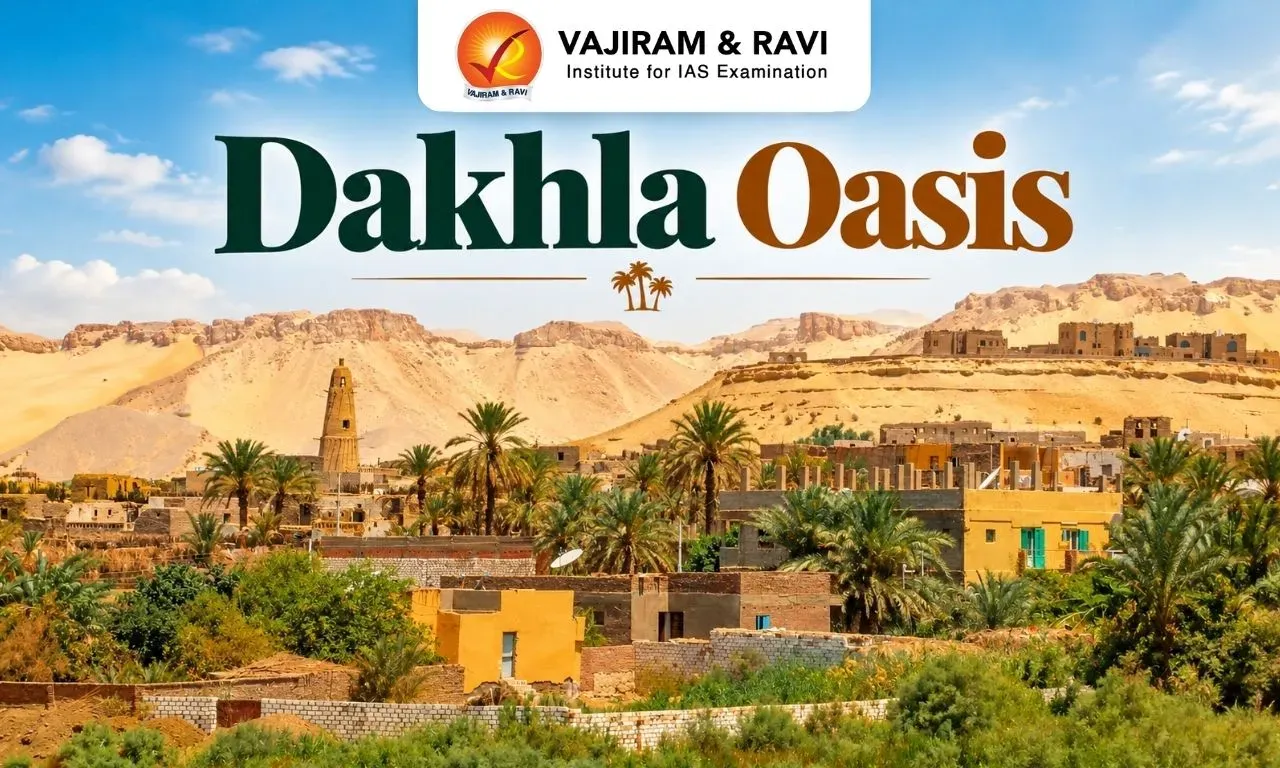
A rare pyramid-shaped tomb dating to the Roman period has been recently uncovered at Bir Al-Shaghala in Egypt’s Dakhla Oasis.

About Dakhla Oasis

  • It is a desert oasis located west of the Nile River, between Cairo and Luxor in Egypt.
  • It is part of the Western Desert, which covers two-thirds of the land area of the country.
  • It covers an area of about 2,000 sq.km and is known for its rich history and stunning landscapes.
  • Nomadic hunter-gatherers first settled in Dakhla Oasis around 12,000 years ago.  
  • It has long been a crossroads between different parts of North Africa. 
    • Ancient routes passing through the region connected communities travelling between Egypt, the Sahara, and Libya, leaving behind evidence of repeated human activity.
  • Among the most valuable remains are thousands of petroglyphs carved into exposed rock surfaces. 
    • Some depict animals that once lived in a wetter Sahara, while others show people, hunting scenes, and symbols connected to different periods of settlement.
  • It was only connected to the outside world by a road built in the 80s, the so-called Great Desert Loop. 
  • The soil's exceptional fertility makes Dakhla famous. Local farmers grow dates, olives, and other crops that are the foundations of the region's agriculture. 
  • The oasis also features therapeutic hot springs like Bir Tarfawi and Bir Al-Gebel. 
  • Dakhla Oasis is home to several important sites, including Mut, Al-Qasr village, and the Dakhla Oasis Heritage Museum.

What is an Oasis?

  • An oasis is an area made fertile by a source of freshwater in an otherwise dry and arid region. 
  • Oases (more than one oasis) are irrigated by natural springs or other underground water sources. 
  • They vary in size from a cluster of date palms around a well or a spring to a city and its irrigated cropland. 
  • Dates, cotton, olives, figs, citrus fruits, wheat, and corn (maize) are common oasis crops. 
  • Underground water sources called aquifers supply most oases. 
  • In some cases, a natural spring brings the underground water to the surface.  At other oases, manmade wells tap the aquifer.

News: TOI

Dakhla Oasis FAQs

Q1: In which country is Dakhla Oasis located?

Ans: Dakhla Oasis is located in Egypt.

Q2: Why has Dakhla Oasis historically been important?

Ans: It has long been a crossroads between different parts of North Africa.

Q3: What are petroglyphs found in Dakhla Oasis?

Ans: They are carvings made on exposed rock surfaces, depicting animals, people, hunting scenes and symbols from different periods.

Q4: Why is Dakhla Oasis famous for agriculture?

Ans: It is famous for agriculture because of its exceptionally fertile soil.

Q5: Which important settlements and sites are located in Dakhla Oasis?

Ans: Important sites include Mut, Al-Qasr village and the Dakhla Oasis Heritage Museum.

Arteries

Arteries

Arteries Latest News

Pain in your legs when you walk can be a warning sign that the arteries carrying blood to your legs are becoming blocked, a condition called peripheral artery disease (PAD). 

About Arteries

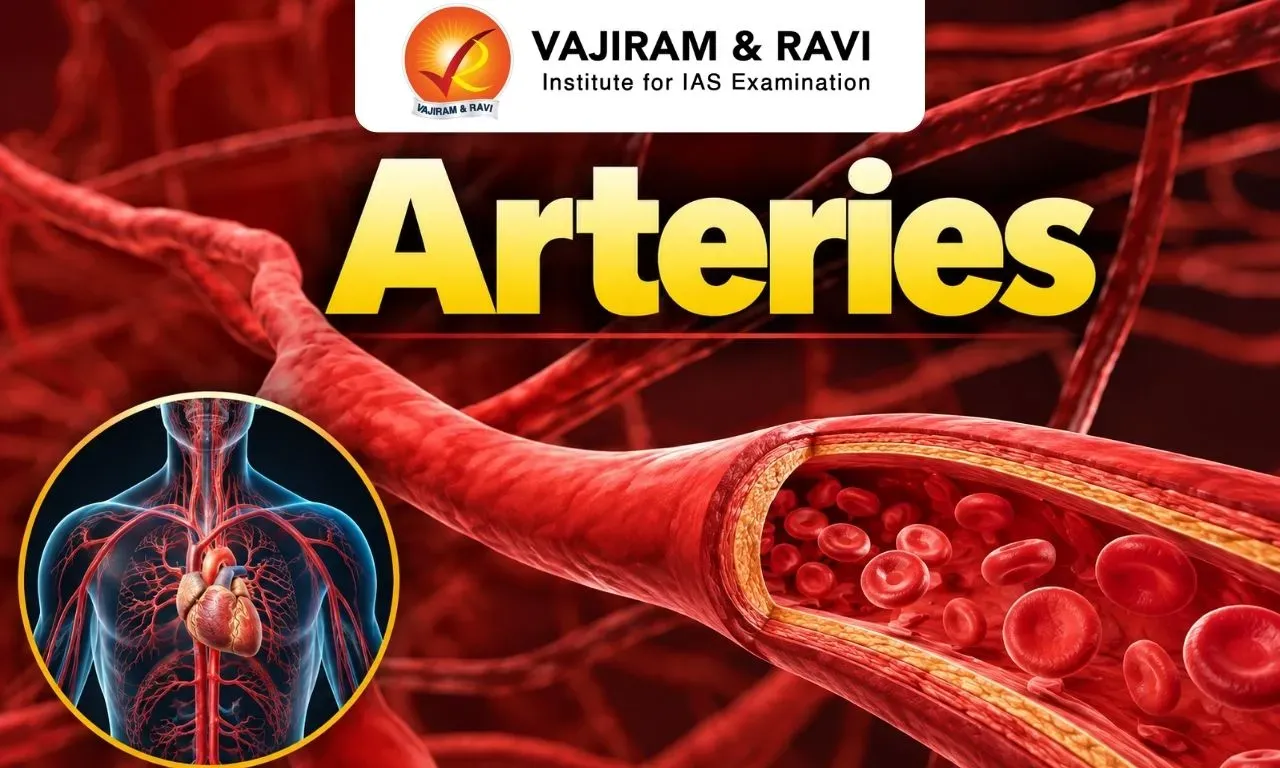
  • Arteries are the blood vessels that bring oxygen-rich blood from your heart to all of your body’s cells. 
  • Arteries make up a major part of the circulatory system, with the veins and heart being the other main components. 
  • They play a crucial role in distributing oxygen, nutrients, and hormones throughout your body.
  • Your heart pumps oxygen-rich blood into the biggest artery in your body — your aorta. 
  • This branches off into parts that feed smaller and smaller arteries, eventually reaching your entire body. 
  • Arteries keep your body alive and healthy by delivering what your cells and tissues need. 
  • Roughly 10% of your body’s blood is in your arteries at any point in time.
  • Your arteries have three layers:
    • Tunica intima, or inner layer: Has tissue with elastic fiber.
    • Tunica media, or middle layer: This is mostly smooth muscle that lets your arteries get tighter or more open as needed.
    • Tunica externa, or outer layer: Interacts with other tissues, including nerves that send commands to pull in or expand.
  • The two types of arteries are:
    • Elastic: Have more elastic tissue than muscular arteries and are located close to your heart. Examples: Aorta and pulmonary artery.
    • Muscular: Have more smooth muscle than elastic arteries. Examples: Femoral, radial, and brachial arteries.
  • Specific arteries provide blood to organs or certain parts of your body, such as:
    • Coronary arteries: Heart.
    • Carotid arteries: Brain, head, face and neck.
    • Vertebral arteries: Brain and spine.
    • Iliac arteries: Pelvis.
    • Femoral artery: Legs.
    • Subclavian arteries: Head, neck, and arms.
    • Celiac and mesenteric arteries: Digestive system.
  • Conditions that can harm your arteries include:
    • Atherosclerosis, a condition in which plaque builds up inside your arteries.
      • Over time, plaque hardens and causes your arteries to narrow. 
      • That limits the flow of oxygen-rich blood to your body.
    • Aneurysm (a stretch or bulge in an artery that can break open).
    • Blood clot.
    • Coronary artery disease (atherosclerosis in your coronary arteries).
    • Carotid artery disease (atherosclerosis in your carotid artery).
    • High blood pressure.
    • High cholesterol.
    • Peripheral artery disease (PAD): A common condition in which narrowed arteries reduce blood flow to the arms or legs. 
    • Vasculitis.

How are Arteries Different from Veins?

  • Arteries:
    • Take oxygen-rich blood away from your heart and distribute it to your whole body.
    • Have strong, muscular walls that can handle the high pressure of blood your heart pumps out with each heartbeat.
    • Don’t need valves because the force of the blood coming from your heart ensures the blood only goes in one direction.
  • Veins:
    • Bring blood back to your heart after your body’s cells and tissues have taken the oxygen out of it. This is known as oxygen-poor blood or deoxygenated blood.
    • Have thinner walls because the pressure inside them isn’t as high as it is in arteries.
    • Have valves inside them to keep blood from moving in the wrong direction.

News: MED

Arteries FAQs

Q1: What are arteries?

Ans: Arteries are blood vessels that carry oxygen-rich blood from the heart to the body's cells.

Q2: Which blood vessel is the largest artery in the human body?

Ans: The aorta is the largest artery in the human body.

Q3: What are the three layers of an artery?

Ans: The three layers are tunica intima, tunica media and tunica externa.

Q4: What is atherosclerosis?

Ans: Atherosclerosis is a condition in which plaque builds up inside the arteries, causing them to narrow over time.

Modhera Sun Temple

Modhera Sun Temple

Modhera Sun Temple Latest News

Prime Minister recently highlighted the thousand-year history of Gujar Modhera Sun Temple, recalling its destruction during invasions and its subsequent reconstruction, while also highlighting the village's transformation into India's first 24x7 s village.

About Modhera Sun Temple

  • It is a Hindu temple dedicated to the solar deity Surya located at Modhera village of the Mehsana district, Gujarat. 
  • It is situated on the bank of the river Pushpavati. 
  • It was built after 1026-27 CE during the reign of King Bhima I of the Chaulukya dynasty.  
  • No worship is offered now and is a protected monument maintained by the Archaeological Survey of India (ASI). 
  • It entered the list of UNESCO World Heritage Sites in the year 2014. 

Modhera Sun Temple Architecture

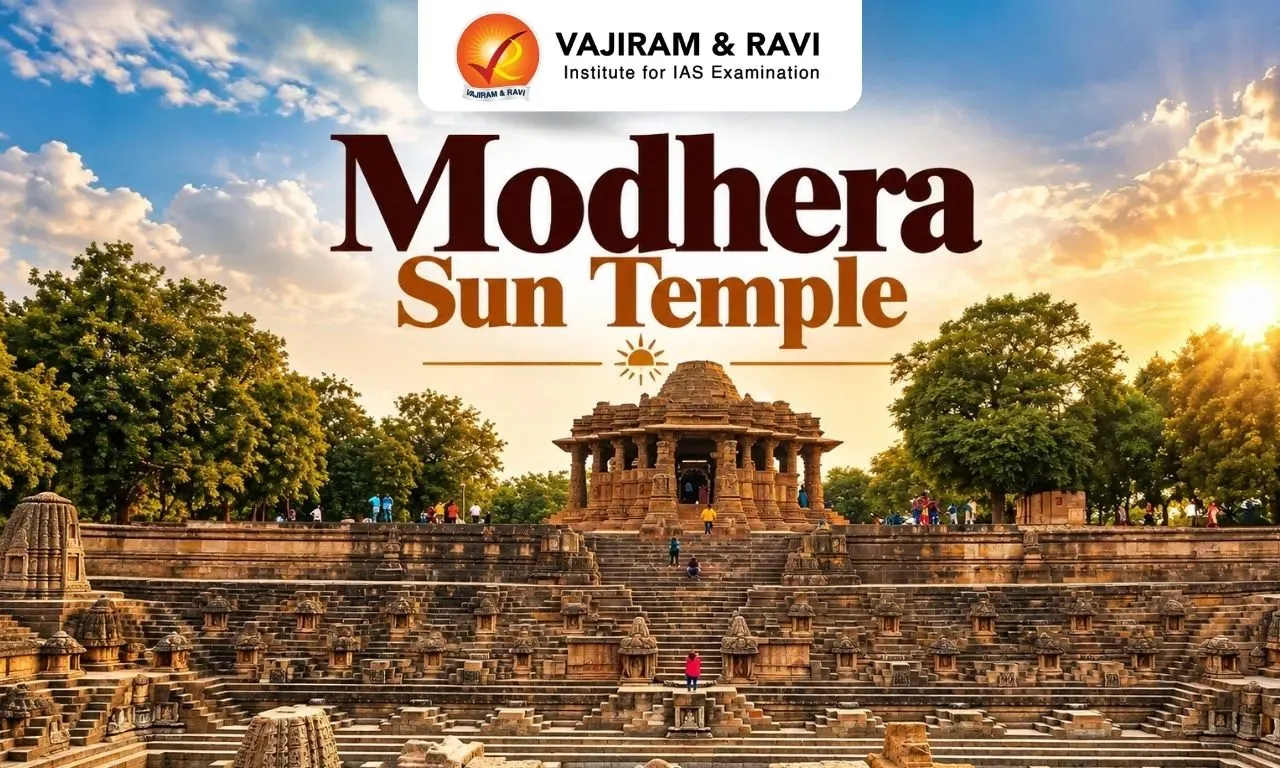
  • The temple complex is built in Maru-Gurjara style (Chaulukya style).  
  • The temple complex has three components: Gudhamandapa, the shrine hall; Sabhamandapa, the assembly hall; and Kunda, the reservoir. 
  • Each part is aligned along an east-west axis, reinforcing the temple’s connection to the sun’s movement. 
  • The halls have intricately carved exterior and pillars. 
  • Sabha Mandap standing on 52 pillars, depicting the 52 weeks in a year. The intricate carvings on the pillars depict scenes from ancient Indian epics Ramayana, Mahabharata and scenes from the life of Lord Krishna.  
  • The reservoir has steps to reach the bottom and numerous small shrines. 
  • On equinoxes, with the perfect planning and precision of the architecture, sun rays enter the main sanctum. 
  • In those days light was used to further reflect to other idols from the correctly placed diamond on the head of Sun God.
  • The exterior walls are engraved with beautiful intricate carvings.

News: ET

Modhera Sun Temple FAQs

Q1: Where is the Modhera Sun Temple located?

Ans: It is located in Modhera village of Mehsana district, Gujarat.

Q2: On the bank of which river is the Modhera Sun Temple located?

Ans: It is situated on the bank of the Pushpavati River.

Q3: During whose reign was the Modhera Sun Temple built?

Ans: It was built during the reign of King Bhima I of the Chaulukya dynasty.

Q4: Which architectural style is represented by the Modhera Sun Temple?

Ans: It is built in the Maru-Gurjara style, also known as the Chaulukya style.

Polylactic Acid

Polylactic Acid

Polylactic Acid Latest News

Recently, the Union minister for Science and Technology launched the commercial use of bio-based biodegradable plastic based on Polylactic Acid (PLA). 

About Polylactic Acid

  • It is a biodegradable, thermoplastic polymer derived from renewable resources such as corn starch or sugarcane.
  • It is synthesized through the fermentation of glucose to produce lactic acid, which is then polymerized.
  • Applications: PLA is known for its eco-compatibility and versatility, finding applications in areas like food packaging, medical sutures, and 3D printing.
  • Advantages of Polylactic Acid
    • Reduces Carbon Footprint: Its bio-based origin ensures a reduced carbon footprint and aligns with global sustainability goals.
    • Dual Benefit: PLA’s ability to integrate agricultural waste into the value chain can create dual benefits first with farmers gaining additional income streams, and second is industries achieving a sustainable supply of raw materials.
    • Resource utilization: Integrating PLA production within existing agro-industrial frameworks—such as co-locating bioplastic plants with sugar mills—can optimize resource utilization while reducing waste.

Source: News On Air

Polylactic Acid FAQs

Q1: What is Polylactic Acid?

Ans: It is a biodegradable, thermoplastic polymer derived from renewable resources such as corn starch or sugarcane.

Q2: What are the applications of Polylactic Acid?

Ans: It has applications in areas like food packaging, medical sutures, and 3D printing.

Tetrataenium manipurense

Tetrataenium manipurense

Tetrataenium manipurense Latest News

A team of botanists from Manipur University and Mizoram University has officially identified a local culinary herb recently and named it Tetrataenium manipurense after the state of Manipur.

About Tetrataenium manipurense

  • It is a new plant species from Manipur.
  • Locally known as 'Singjang-kumol' or 'Manshang-nakuppi', the species has been named Tetrataenium manipurense after the state of Manipur. 
  • It is a local culinary herb in Manipur.
  • Despite its long-standing popularity in traditional Manipuri cuisine, the plant previously lacked official recognition in global scientific records. 
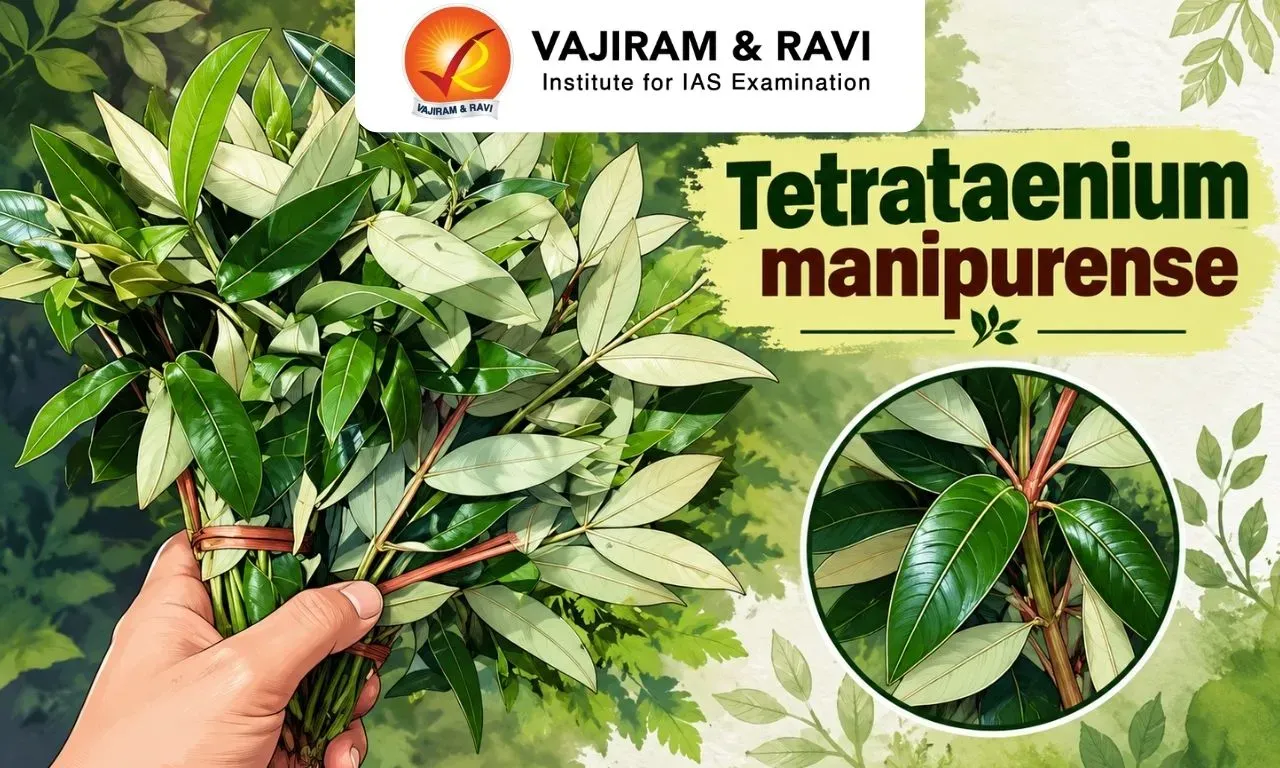
  • It has long, slender, grass-like green leaflets and an exceptionally long cylindrical rootstock that can reach up to 40 centimetres. 
  • The plant also produces stalks measuring 10–20 centimetres that bear small, oblong-oval fruits. 
  • For generations, communities have harvested its aerial shoots, flowers, and basal leaves to season traditional dishes.
  • Local markets in Manipur have been trading this wild aromatic vegetable for generations, where it is typically sold in bundles of fresh green sprigs. 
  • It is provisionally categorised as Least Concern (LC) under the IUCN Red List criteria.

News: NEN

Tetrataenium manipurense FAQs

Q1: What is Tetrataenium manipurense?

Ans: It is a new plant species from Manipur.

Q2: What are the local names of Tetrataenium manipurense in Manipur?

Ans: It is locally known as 'Singjang-kumol' or 'Manshang-nakuppi'.

Q3: What is the culinary significance of Tetrataenium manipurense?

Ans: It is a local culinary herb used in traditional Manipuri cuisine.

Q4: What do the leaves of Tetrataenium manipurense look like?

Ans: It has long, slender, grass-like green leaflets.

Q5: What is the provisional IUCN Red List category of Tetrataenium manipurense?

Ans: It is provisionally categorised as Least Concern (LC) under the IUCN Red List criteria.

Musk Deer

Musk Deer

Musk Deer Latest News

Recently, the Assam Police recovered six musk deer pods from two Arunachal Pradesh-based men during an operation near Guwahati. 

About Musk Deer

  • Musk deer (Moschidae) are small deer-like animals that belong to the family Moschidae.
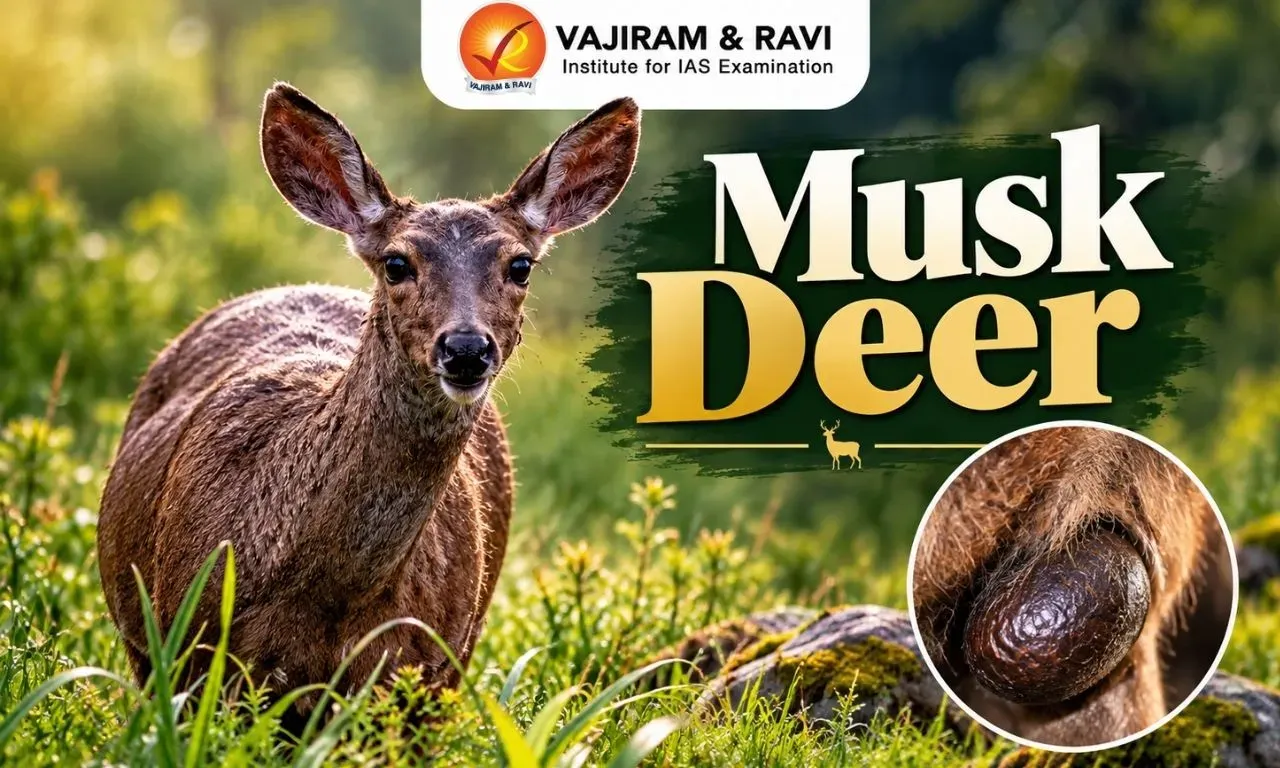
  • Appearance: Its coat is dark brown, mottled with paler, greyer hair underneath. It has whitish markings on its chin and ears.
  • Habitat: They typically inhabit forests and brushlands at intermediate elevations and rocky slopes at altitudes between 2,600 and 3,000 meters.
  • Distribution: They live in highland areas in central and northeastern Asia, particularly in western China, Myanmar and the Himalayas.

Characteristics of Musk Deer

  • They are shy, usually feeding at night, and tend to live alone, occasionally in pairs but never in herds.
  • Musk deer lack antlers.
  • The animal has well-developed side toes that give it a sure-footedness and allow it to scamper around rocks in the snow and even climb trees.
  • Diet:  Their diet includes both browse and graze, and they also consume some mosses and lichens
  • A musk deer pod is a specialised scent gland found in the abdomen of a male musk deer.
  • It produces a strong-smelling, reddish-brown secretion used in traditional perfumes and medicines.
  • A musk gland in males produces a strong scent used for communication/territorial marking.

Conservation Status of Musk Deer

Source: TH

Musk Deer FAQs

Q1: Where do we find Musk Deer?

Ans: They live in highland areas in central and northeastern Asia, particularly in western China, Myanmar and the Himalayas.

Q2: What is the IUCN status of Musk Deer ?

Ans: Endangered

Livestock Insurance Portal

Livestock Insurance Portal

Livestock Insurance Portal Latest News

The Department of Animal Husbandry and Dairying will launch the Livestock Insurance Portal in New Delhi. 

About Livestock Insurance Portal

  • It will provide a single, integrated digital platform for livestock insurance.
  • It is aimed at making livestock insurance services more transparent, efficient, accessible and technology-driven.
  • It will strengthen risk protection for livestock farmers and support the sustainability of their livelihoods.
  • It is an initiative of the Ministry of Fisheries, Animal Husbandry and Dairying.
  • Features
    • It enables streamlined policy issuance, claim processing, monitoring and reporting, in case of animals insured under the Livestock Insurance Scheme of the Department of Animal Husbandry & Dairying.
    •  The Portal will also be available in 11 regional languages apart from Hindi and English, enabling livestock farmers to access information and services in languages familiar to them.
    • It will also facilitate better coordination, real-time monitoring and data-driven management of livestock insurance programmes, contributing to improved service delivery across the country.

Source: PIB

Livestock Insurance Portal FAQ's

Q1: What is Livestock Insurance Portal?

Ans: It will provide a single, integrated digital platform for livestock insurance.

Q2: Livestock Insurance Portal is an initiative of which ministry?

Ans: Ministry of Fisheries, Animal Husbandry and Dairying.

Begonia rajvikramanii

Begonia rajvikramanii

Begonia rajvikramanii Latest News

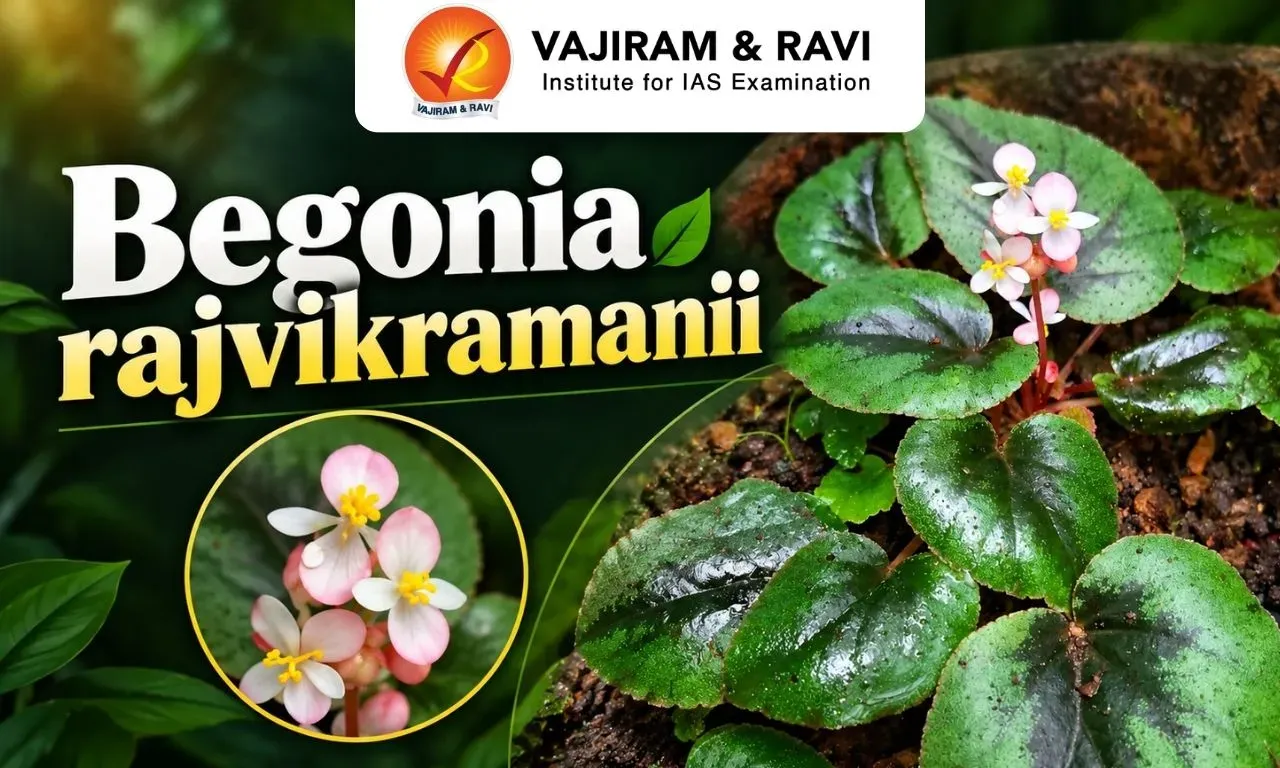
Researchers recently identified a new species of the genus Begonia from the Western Ghats region in Keralam’s Kollam district and named it Begonia rajvikramanii.

About Begonia rajvikramanii

  • It is a new species of perennial flowering plant.
  • It belongs to the genus Begonia in the family Begoniaceae.
    • The genus Begonia is one of the largest flowering plant genera, with 2,200 accepted species, mainly distributed across the tropical and subtropical regions of Africa, Asia, and America.  
  • Begonia rajvikramanii was discovered from the Western Ghats region in Keralam’s Kollam district. 
  • It grows in wet habitats, particularly on rocky cliffs and road-cut walls, at elevations of approximately 200 metres-350 metres 
  • Flowering and fruiting of Begonia rajvikramanii occurs between August and April. 
  • The observed population of this species comprises approximately 200 mature individuals, occupying an area of less than 5 sq.km.
  • It has been assessed as ‘Data Deficient’ (DD), pending comprehensive assessment in the future.

News: TH

Begonia rajvikramanii FAQs

Q1: What is Begonia rajvikramanii?

Ans: It is a newly discovered species of perennial flowering plant.

Q2: Where was Begonia rajvikramanii discovered?

Ans: It was discovered in the Western Ghats region of Kollam district, Keralam.

Q3: What type of habitat does Begonia rajvikramanii prefer?

Ans: It grows in wet habitats, particularly on rocky cliffs and road-cut walls.

Q4: What is the IUCN conservation status of Begonia rajvikramanii?

Ans: It has been assessed as Data Deficient (DD).

Pradhan Mantri Awas Yojana (Gramin)

Pradhan Mantri Awas Yojana

About Pradhan Mantri Awas Yojana

  • Pradhan Mantri Awas Yojana (PMAY) is a credit-linked subsidy scheme initiated to provide affordable housing to low and moderate-income residents across the country.
  • The newly formed government has approved the proposal to provide 3 crore additional rural and urban houses under PMAY.
  • The scheme has two components: PMAY-U for the urban poor and PMAY-G and PMAY-R for the rural poor.

PMAY-U (Urban)

  • Objective: To provide housing for all in urban areas.
  • Beneficiaries: Economically Weaker Section (EWS), Low-Income Group (LIG), and Middle-Income Group (MIG).
  • Subsidy Schemes:
    • Credit Linked Subsidy Scheme: Offers interest subsidy on home loans for EWS, LIG, and MIG categories.
    • In-Situ Slum Redevelopment: Utilizes land as a resource to provide houses to eligible slum dwellers.
    • Affordable Housing in Partnership: Promotes partnerships with public and private sectors to provide affordable housing.
    • Beneficiary-Led Construction: Provides financial assistance to individuals to construct or enhance their own houses.

PMAY-G (Gramin)

  • Objective: To provide a pucca house with basic amenities to all rural families who are homeless or living in kutcha or dilapidated houses.
  • Beneficiaries: Identified using the Socio-Economic and Caste Census (SECC) 2011.
  • Features:
    • Financial Assistance: Rs. 1.2 lakh in plain areas and Rs. 1.3 lakh in hilly, difficult, and Integrated Action Plan (IAP) areas.
    • Construction: Houses are to be constructed by beneficiaries with technical assistance from the government.
    • Convergence with other schemes: Encourages convergence with other schemes like Swachh Bharat Mission (SBM) for toilet construction, and MGNREGA for wage employment.

Source: PIB

Pradhan Mantri Awas Yojana FAQs

Q1: What is a Center Sector Scheme?

Ans: Central Sector Schemes are those that are implemented by a central agency and 100% funded by the centre on subjects within the union list.

Cyclone Arnab 2026, Location, Naming, Tracker, Latest Updates

Cyclone Arnab

Cyclone Arnab 2026 refers to the weather system over the Bay of Bengal that has attracted attention as the next possible cyclone name. However, the system remains a deep depression and is not classified as a cyclonic storm. It is moving towards the north Andhra Pradesh-South Odisha coast, with landfall expected near Kalingapatnam between Visakhapatnam and Gopalpur.

Cyclone Arnab Latest Updates

According to the latest IMD Tropical Weather Outlook issued on September 25, 2026, the system has moved north-northwestwards and weakened from a deep depression into a depression over south interior Odisha and adjoining south Chhattisgarh. At 05:30 AM on September 25, it was located close to Nuapada in Odisha and about 120 km southeast of Raipur in Chhattisgarh.
The system is very likely to continue moving north-northwestwards and maintain depression intensity for the next 12 hours. It is then expected to weaken into a well-marked low-pressure area during the following 12 hours.

Cyclone Arnab 2026

The Cyclone Arnab 2026 system is located over the westcentral and adjoining northwest Bay of Bengal and is being monitored continuously by IMD.

  • Cyclone Classification: The India Meteorological Department has indicated that the system is unlikely to intensify into a cyclone before landfall. Therefore, it is expected to retain deep depression status.
  • Name Arnab: The name Arnab means ocean in Bengali. The name was contributed by Bangladesh for the regional tropical cyclone naming system.
  • Formation Background: The system developed over the Bay of Bengal and intensified from a depression into a deep depression before approaching the north Andhra Pradesh-South Odisha coast.
  • Monitoring System: The system is under continuous observation by the Doppler Weather Radar at Visakhapatnam. Radar monitoring is tracking its movement and structure near the coast.
  • Wind Conditions: Strong winds are expected along the affected coastal areas. The Bay of Bengal Deep Depression 2026 may produce gusty winds along with heavy rainfall during its approach and landfall.

Cyclone Arnab Impacts

The main concern from the Cyclone Arnab system is heavy rainfall, strong winds, rough seas, flooding and localised landslide risks across affected areas.

  • Odisha Impact: Odisha remains among the worst-affected regions. Heavy to very heavy rainfall is expected in several areas, with extremely heavy rainfall possible at isolated places.
  • Red Alert Areas: Koraput, Gajapati and Ganjam faced warnings for heavy to very heavy rainfall and isolated extremely heavy rainfall on September 24.
  • Further Rainfall: Kalahandi, Nabarangpur, Koraput and Malkangiri are expected to receive heavy rainfall during September 24-25.
  • Andhra Pradesh: Coastal Andhra Pradesh is also experiencing the system's effects. Squally weather and strong winds are expected along and off the south Odisha-north Andhra Pradesh coasts.
  • West Bengal: Parts of West Bengal are expected to receive heavy to very heavy rainfall. Darjeeling and Kalimpong were also under landslide warnings.
  • Flood Risk: Heavy rainfall can increase water levels in rivers, water bodies and dams. Low lying areas may face waterlogging and local flooding during intense rainfall.
  • Landslide Risk: Odisha authorities identified 140 landslide prone areas in Gajapati. Rain related risks were also reported from Ganjam, Malkangiri, Koraput, Rayagada and Nabarangpur.
  • Sea Conditions: Very rough seas are expected over the westcentral and northwest Bay of Bengal until the evening of September 24. Coastal waters may gradually improve afterwards.
  • Local Damage: Heavy rain has already resulted in reports of trees being uprooted, houses being damaged, rainwater entering homes and muddy water flowing down hills.

Cyclone Arnab 2026 Management

Preparedness of Cyclone Arnab 2026 focuses on evacuation, shelter management, emergency services, weather monitoring, essential supplies and protection of vulnerable communities.

  • Evacuation: About 8,000 people were moved to safer locations in Odisha. Pregnant women and elderly persons were among those shifted to cyclone centres and temporary relief camps.
  • Emergency Services: Essential supplies, equipment, health services and emergency teams were kept ready. Disaster mitigation teams were placed on high alert for rapid response.
  • Shelter Preparedness: Cyclone and flood shelters were kept ready in vulnerable districts. Temporary relief camps were also arranged for evacuated residents.
  • Vulnerable Areas: Authorities restricted access to identified landslide prone locations. Continuous monitoring was carried out in areas considered vulnerable to landslides and mudslides.
  • Water Monitoring: Officials monitored water levels in rivers, water bodies and dams to identify possible flood risks during periods of intense rainfall.
  • Public Safety: People were advised to stay indoors during strong winds. They should avoid windows, damaged structures, trees, large hoardings, floodwater and exposed electrical equipment.
  • Emergency Kit: Residents should keep drinking water, food, medicines, first aid supplies, torches, batteries, candles, matches and power banks ready for at least two to three days.
  • Evacuation Rules: People in coastal, low lying and flood prone areas should immediately follow evacuation orders. They should move to designated shelters or safer higher ground.

Cyclone Arnab Tracker

The Cyclone Arnab 2026 is being tracked by the latest monitoring systems of the India Meteorological Department Doppler Weather Radar. It’s latest updates are shared to the authorities to improve and monitor preparations to reduce the impacts of the storm.

  • Current Bay of Bengal Deep Depression 2026 Status: According to the IMD update of September 25, 2026, the system has weakened from a deep depression into a depression over south interior Odisha and adjoining Chhattisgarh.
  • Landfall Location: The system crossed between Visakhapatnam and Gopalpur, close to Kalingapatnam, after moving west-northwestwards towards the coast.
  • Post-Landfall Movement: The system is now moving north-northwestwards after landfall. IMD expects it to maintain depression intensity for the next 12 hours and then weaken into a well-marked low-pressure area during the subsequent 12 hours.
  • Wind Forecast: At 05:30 AM on September 25, the depression had maximum sustained surface winds of 45-55 kmph, gusting to 65 kmph. IMD forecasts winds of 35-45 kmph, gusting to 55 kmph, by 05:30 PM on September 25, followed by further weakening.
  • Preparedness: Odisha placed collectors of 11 districts on high alert. Cyclone and flood shelters were kept ready, while at least 5,000 people were moved to safer locations.
  • Post-Landfall Monitoring: Authorities continue to monitor the system as it moves inland across Odisha and adjoining Chhattisgarh. IMD expects associated extreme weather over east, east-central and subsequently adjoining northern plains during the next 3-4 days.
  • Current Location: As of September 25, the depression was located near 20.5°N and 82.5°E, close to Nuapada in Odisha.
  • Expected Weakening: The system is likely to weaken further because of its movement over land. IMD forecasts that it will become a well-marked low-pressure area by September 26, 2026.

Cyclone Arnab 2026 FAQs

Q1: What is Cyclone Arnab 2026?

Ans: Cyclone Arnab 2026 refers to the deep depression over the Bay of Bengal approaching the north Andhra Pradesh-South Odisha coast.

Q2: Where is Cyclone Arnab now?

Ans: As of 25 September 2026, The depression is currently over south interior Odisha and adjoining Chhattisgarh, near 20.5°N and 82.5°E, close to Nuapada in Odisha

Q3: Did Cyclone Arnab make landfall?

Ans: The system crossed the Andhra Pradesh-Odisha coast near Kalingapatnam during the early hours of September 24, 2026, as a deep depression.

Q4: What is the latest status of Cyclone Arnab 2026?

Ans: As of 25 September 2026, The system is moving north-northwestwards and is expected to maintain depression intensity for the next 12 hours before weakening into a well-marked low-pressure area.

Q5: Who named Cyclone Arnab?

Ans: The name Arnab, meaning ocean in Bengali, was contributed by Bangladesh.

Travel & Tourism Development Index

Travel & Tourism Development Index

Travel & Tourism Development Index Latest News

The latest  2026 Travel & Tourism Development Index by the World Economic Forum suggests that travel and tourism conditions have strengthened across the world.

About Travel & Tourism Development Index (TTDI)

  • It is published biennially by the World Economic Forum (WEF). 
  • It has evolved from the Travel & Tourism Competitiveness Index (TTCI), published biennially from 2007 to 2019 by the WEF. 
  • Relaunched in 2022 in its current form, it reflects a broader focus on sustainable and resilient development, beyond competitiveness alone. 
  • TTDI 2026 Highlights:
    • It was published by WEF in collaboration with Zurich Insurance Group.
    • It ranked 110 economies on the factors and conditions that support the development of travel and tourism.
    • Being high on the TTDI does not necessarily mean a country receives the most tourists. 
    • The index is designed to measure how well economies are positioned to support sustainable and resilient tourism development. 
    • Japan moved up two places to take the top spot in the 2026 ranking. It was followed by the US, Spain, Australia, and France. And, Germany, the UK, China, Switzerland, and Italy comprised the top 10.
    • India Rankings:
      • India is ranked 31st, moving up from 39th place in 2024, helped by its low travel costs, cultural resources, and natural attractions.
      • India also ranks among the top 10 economies for the number of World Heritage cultural sites, along with China and Mexico.
      • The report also pointed to some challenges for India. Workforce skills, environmental sustainability, and tourism infrastructure remain areas that need improvement.
    • Tourism conditions improve worldwide:
      • Tourism conditions improved across most economies between 2024 and 2026. 
      • International tourist arrivals reached 1.5 billion in 2025, with arrivals 4.4% higher than pre-pandemic levels.
      • 101 of the 110 economies covered by the index improved their scores during the period. 
      • The average score rose 2.1%, the fastest growth since 2019.
      • China, India, Indonesia, Malaysia, Thailand, Viet Nam, the Philippines, Türkiye, Mexico, and Brazil, the 10 largest non-high-income travel and tourism economies account for more than 28% of global direct travel and tourism GDP, with their share projected to rise to 35% by 2035.

News: TP

Travel & Tourism Development Index FAQs

Q1: Who publishes the Travel & Tourism Development Index (TTDI)?

Ans: The World Economic Forum (WEF) publishes the TTDI.

Q2: What was the top-ranked country in the Travel & Tourism Development Index (TTDI) 2026?

Ans: Japan was ranked first.

Q3: What was India's rank in the Travel & Tourism Development Index (TTDI) 2026?

Ans: India was ranked 31st.

Q4: Which factors helped India improve its Travel & Tourism Development Index (TTDI) ranking in 2026?

Ans: India's low travel costs, cultural resources and natural attractions helped improve its ranking.

Kaladi

Kaladi

Kaladi Latest News

The Union Minister of State in PMO recently stated that the “Kaladi”, the GI-tagged traditional dairy product of the Udhampur district of Jammu and Kashmir, has reached the commercial threshold for local and global consumption.

About Kaladi

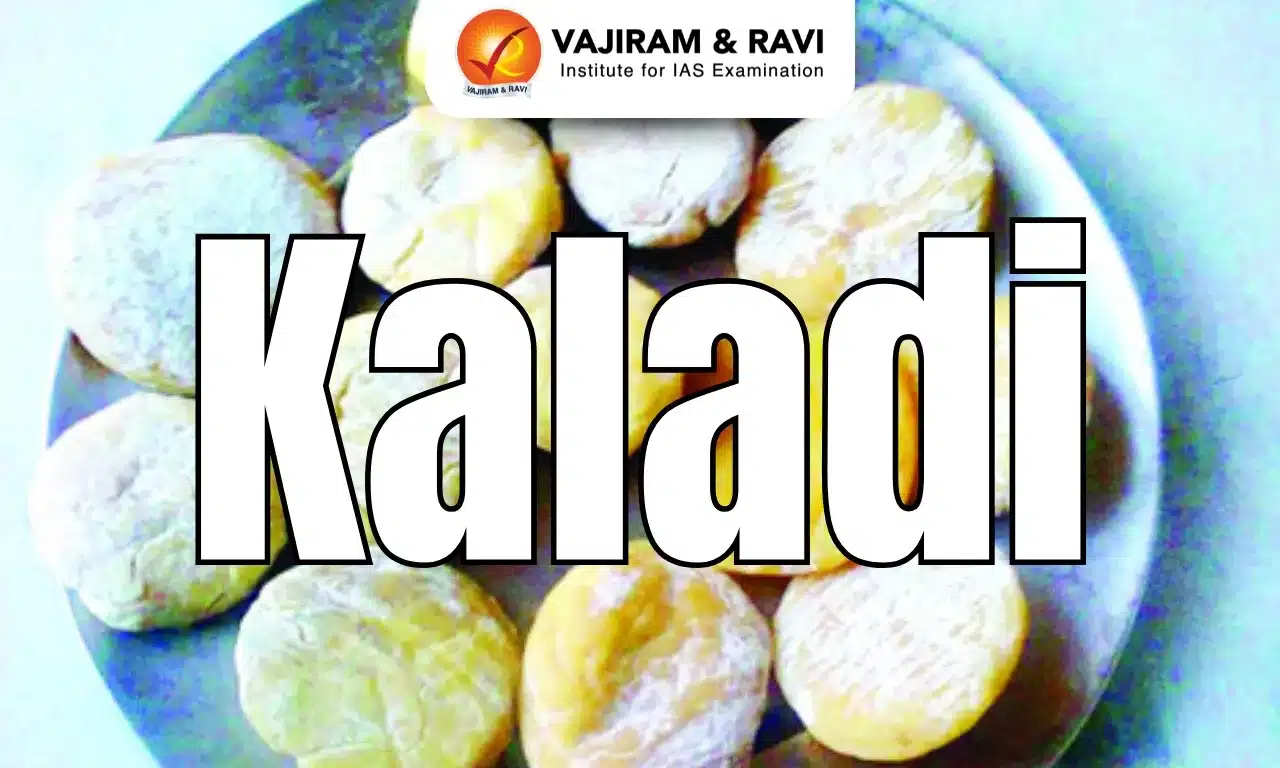
  • Known as Kalari cheese or the “mozzarella of the Himalayas”, it is a traditional dairy product originated from the Ramnagar area, Udhampur district of Jammu & Kashmir.
  • The local delicacy is traditionally made by Gujjar shepherds in the mountains of Kashmir. 
  • It is a traditionally ripened cheese made from cow’s or goat’s milk. 
  • Kalari was developed to preserve excess milk during the summer months, when the heat would make it difficult to store fresh milk. 
  • Preparation:
    • Traditionally handmade, the milk is churned with a wooden spoon, after which sour whey—a byproduct of cheesemaking—is added to the warm milk to curdle it. 
    • The milk solids are separated from the whey liquid and hand-pressed into small discs.
    • These discs are then sun-dried for several days to dry the outer layer, while the interior remains soft and moist. 
  • It has a mild flavor and a dense, stretchy texture.  
  • It develops a golden, crispy crust when pan‑seared while staying gooey inside.  
  • To maintain freshness, Kalari is kept frozen in sealed packets. 
  • It received the Geographical Indication (GI) tag in 2023.

News: GK

Kaladi FAQs

Q1: What is Kaladi?

Ans: Kaladi, also known as Kalari cheese, is a traditional dairy product from Jammu & Kashmir.

Q2: Which community traditionally makes Kaladi?

Ans: Gujjar shepherds traditionally make Kaladi in the mountains of Kashmir.

Q3: Why was Kaladi traditionally developed?

Ans: It was developed to preserve excess milk during the summer months, when storing fresh milk was difficult.

Q4: What happens to the texture of Kaladi during sun-drying?

Ans: The outer layer becomes dry, while the interior remains soft and moist.

Q5: How is Kaladi stored to maintain its freshness?

Ans: Kaladi is kept frozen in sealed packets to maintain freshness.

Asian Games 2026 Day 10, India Medal Tally, Schedule, Highlights

Asian Games 2026 Day 10

Asian Games 2026 Day 10 is taking place on 28 September 2026 in Aichi-Nagoya, Japan. Indian athletes are competing across sports such as athletics, shooting, boxing, archery, squash, cricket, volleyball and kurash.

India entered Day 10 with 37 medals, including 4 gold, 16 silver and 17 bronze medals. Several medal events and important knockout matches are scheduled throughout the day.

Asian Games 2026 Day 10 Highlights

Day 10 features several important events for India, with athletes competing for medals as well as places in the later rounds of their respective competitions.

  • Pincky Balhara won a bronze medal in women's 78kg kurash.
  • Lovlina Borgohain assured a medal in women's 75kg boxing by reaching the semifinals.
  • Esha Singh qualified for the women's 25m pistol final.
  • Manu Bhaker finished 11th in the women's 25m pistol qualification.
  • India's men's cricket team advanced to the semifinals after its quarterfinal against Afghanistan was abandoned due to rain.
  • India's men's squash team defeated China 3-0.
  • India's women's squash team also defeated China.
  • India's men's volleyball team defeated Hong Kong, China 3-0 and reached the quarterfinals.
  • Indian compound archers progressed to the later rounds of their individual events.

Asian Games 2026 India Medal Tally

India had 37 medals at the beginning of Day 10.

Asian Games 2026 India Medal Tally

Medal

Number

Gold

4

Silver

16

Bronze

17

Total

37

The Indian contingent has won medals across several disciplines, with athletics and shooting among the major contributors.

India's Gold Medals

India's gold medals before Day 10 came from cricket, kabaddi and shooting.

  • Women's Cricket Team – T20 cricket
  • Women's Kabaddi Team – Kabaddi
  • Men's Kabaddi Team – Kabaddi
  • Kamaljeet and Suruchi Singh – 10m air pistol mixed team

Pincky Balhara Wins Bronze in Kurash

Pincky Balhara won the bronze medal in the women's 78kg kurash event. Kurash is a traditional grappling sport originating in Central Asia and is part of the Asian Games programme.

Balhara defeated South Korea's Garam Lim 3-0 in the quarterfinal before losing to Mo Sumin 0-5 in the semifinal.

Pincky Balhara's Performance

  • Sport: Kurash
  • Event: Women's 78kg
  • Medal: Bronze
  • Quarterfinal: Defeated Garam Lim, 3-0
  • Semifinal: Lost to Mo Sumin, 0-5
  • Previous Asian Games medal: Bronze at the 2018 Asian Games

Lovlina Borgohain Assures Boxing Medal

Lovlina Borgohain progressed to the semifinals of the women's 75kg boxing event after defeating South Korea's Suyeon Seong 5-0 in the quarterfinal.

Reaching the semifinal guarantees a medal in boxing, where losing semifinalists receive bronze medals.

Lovlina Borgohain

  • Sport: Boxing
  • Category: Women's 75kg
  • Quarterfinal opponent: Suyeon Seong
  • Result: 5-0 victory
  • Stage reached: Semifinal
  • Medal status: Assured

Shooting Esha Singh Reaches 25m Pistol Final

India had three representatives in the women's 25m pistol qualification. Esha Singh successfully progressed to the individual final, while Manu Bhaker missed out.

Esha scored 580 points with 22 inner tens, finishing among the qualifiers for the final.

Women's 25m Pistol Qualification

Shooter

Score

Result

Esha Singh

580

Qualified for final

Manu Bhaker

579

Finished 11th

Rahi Sarnobat

-

Finished 30th

The Indian team finished fifth in the women's 25m pistol team event.

Manu Bhaker's Performance

Manu Bhaker finished 11th in the women's 25m pistol qualification and therefore did not make the individual final.

She scored 579 points with 18 inner tens.

Her series scores in the rapid stage were:

  • First series: 97
  • Second series: 96
  • Third series: 99

Cricket India Reaches Semifinal

India's men's cricket team progressed to the semifinals of the Asian Games 2026 after its quarterfinal against Afghanistan was abandoned because of rain.

The result means India moves into the last four without a completed quarterfinal match.

India's Men's Cricket Campaign

  • Stage: Quarterfinal
  • Opponent: Afghanistan
  • Result: Match abandoned due to rain
  • Outcome: India advanced to semifinal
  • Next stage: Semifinal

India's men's team is aiming to add another cricket medal after the Indian women's cricket team won gold earlier in the tournament.

Athletics at Asian Games 2026

Athletics is one of India's largest medal-producing sports at the Asian Games. Indian athletes have already won several medals in track and field events.

Day 10 features multiple athletics finals, providing India with further medal opportunities.

Major Indian Athletes in Action

  • Avinash Sable – Men's 3000m steeplechase
  • Murali Sreeshankar – Men's long jump
  • Gulveer Singh – Men's 1500m
  • Rohit Yadav – Men's javelin throw
  • Yashvir Singh – Men's javelin throw
  • Parul Chaudhary – Women's 5000m
  • Vithya Ramraj – Women's 400m hurdles
  • Anu Raghavan – Women's 400m hurdles
  • Seema Yadav – Women's discus throw
  • Sanya Yadav – Women's discus throw

Avinash Sable in 3000m Steeplechase

Avinash Sable is competing in the men's 3000m steeplechase final.

Sable is one of India's leading long-distance runners and has previously won the Asian Games title in this event.

Key Points

  • Event: 3000m steeplechase
  • Athlete: Avinash Sable
  • Category: Men's
  • Stage: Final
  • Previous Asian Games achievement: Gold medal

Murali Sreeshankar in Long Jump

Murali Sreeshankar is competing in the men's long jump final.

He qualified for the final with a jump of 7.84 metres. His strong performances in international competitions have made him one of India's prominent long-jump athletes.

Key Points

  • Event: Men's long jump
  • Athlete: Murali Sreeshankar
  • Qualification mark: 7.84 metres
  • Stage: Final

Squash India Defeats China

India produced strong performances in the squash team competition.

The Indian men's team defeated China 3-0, with Indian players winning their respective matches.

Men's Squash Results

  • Suraj Chand defeated Du Shaoqian
  • Veer Chotrani defeated Li Haizhen
  • Velavan Senthilkumar defeated Zhou Penglin
  • Overall result: India 3-0 China

India's women's squash team also recorded a victory over China.

Volleyball India Reaches Quarterfinals

India defeated Hong Kong, China 3-0 in the men's volleyball Pool C match.

India won all three sets:

  • 25-22
  • 25-19
  • 25-21

The result helped India secure a place in the quarterfinals.

India's Volleyball Campaign

  • Competition: Men's volleyball
  • Pool: C
  • Opponent: Hong Kong, China
  • Result: India won 3-0
  • Outcome: Quarterfinal qualification

Archery Indian Compound Archers Progress

Indian archers continued their campaign in the compound individual events.

In the men's event, Ganesh Mani Ratnam Thirumuru defeated fellow Indian Sahil Jadhav 149-148 in the Round of 16.

In the women's compound event, Indian archers also progressed.

Indian Compound Archery Results

  • Ganesh Mani Ratnam Thirumuru defeated Sahil Jadhav, 149-148
  • Chikitha Taniparthi defeated Dorji Dolma, 149-140
  • Jyothi Surekha Vennam defeated Adel Zhexenbinova, 148-145

These results took the Indian archers into the next stages of the competition.

Sepaktakraw

India's women's doubles team faced Japan in the sepaktakraw competition. Japan defeated India in three sets after India managed to level the match in the second set.

Result

Japan 15-11, 9-15, 15-13 India

India therefore missed out on a victory in the match.

India's Athletics Medals So Far

Athletics has been one of the important medal contributors for India at the 2026 Asian Games.

India's athletics medals before Day 10 included:

Athlete

Event

Medal

Ancy Sojan

Women's long jump

Silver

Sarvesh Kushare

Men's high jump

Silver

Gulveer Singh

Men's 10,000m

Silver

Sawan Barwal

Men's marathon

Silver

Tajinderpal Singh Toor

Men's shot put

Silver

Tejaswin Shankar

Men's decathlon

Bronze

Parul Chaudhary

Women's 3000m steeplechase

Bronze

Harita Bhadra

Women's 200m

Bronze

Manpreet Kaur

Women's shot put

Bronze

Baranica Elangovan

Women's pole vault

Bronze

Prachi

Women's 400m

Bronze

Seema Kumari

Women's 10,000m

Bronze

Asian Games 2026 Day 10 Schedule Major Events for India

The major events involving Indian athletes on Day 10 include:

  • Women's discus throw
  • Women's 400m hurdles
  • Men's 400m hurdles
  • Men's 3000m steeplechase
  • Men's long jump
  • Men's 1500m
  • Men's javelin throw
  • Women's 5000m
  • Women's 4x100m relay
  • Women's 25m pistol final
  • Boxing semifinals
  • Squash team events
  • Cricket semifinal qualification
  • Compound archery
Related Articles
Asian Games 2026 Asian Games 2026 India Schedule
Asian Games 2026 Medal Tally Asian Games 2026 Sports List
Asian Games 2026 Indian Cricket Team India's medals at Asian Games 2026
Asian Games 2026 Day 3 Asian Games 2026 Day 4
Asian Games 2026 Day 5 Asian Games 2026 Day 6
Asian Games 2026 Day 7 Asian Games 2026 Day 8

Asian Games 2026 Day 10 FAQs

Q1: How many medals did India have before Day 10?

Ans: India had 37 medals, comprising 4 gold, 16 silver and 17 bronze medals before the Day 10 events.

Q2: Who won India's bronze medal in kurash?

Ans: Pincky Balhara won the bronze medal in the women's 78kg kurash event.

Q3: Did Lovlina Borgohain qualify for the semifinal?

Ans: Yes. Lovlina Borgohain defeated Suyeon Seong 5-0 in the women's 75kg quarterfinal and secured a medal by reaching the semifinal.

Q4: Did Manu Bhaker reach the 25m pistol final?

Ans: No. Manu Bhaker finished 11th in qualification. Esha Singh qualified for the final.

Q5: Did India reach the men's cricket semifinal?

Ans: Yes. India advanced to the semifinal after its quarterfinal against Afghanistan was abandoned due to rain.

New Mobile Recharge Rules, Telecom Consumer Protection (13th Amendment) Regulations 2026

New Mobile Recharge Rules

New Mobile Recharge Rules 2026 introduced by the Telecom Regulatory Authority of India (TRAI) focus on increasing consumer choice for voice and SMS services. The Telecom Consumer Protection (Thirteenth Amendment) Regulations 2026 require suitable Special Tariff Vouchers (STVs) without bundled data. The rules particularly address consumers who need basic mobile services, including low income users, rural consumers and feature phone users.

TRAI New Mobile Recharge Rules 2026

TRAI released the Telecom Consumer Protection (13th Amendment) Regulations 2026 on 21 September 2026. The amendment follows a consultation process that received 1,132 stakeholder responses and an Open House Discussion on 15 June 2026.

13th Telecom Consumer Protection Amendment Background

The Telecom Consumer Protection (Thirteenth Amendment) Regulations 2026 followed concerns that existing Voice and SMS only STVs were concentrated around longer validity periods and did not provide sufficient affordable shorter duration choices.

  • Twelfth Amendment 2024: TRAI's Telecom Consumer Protection (Twelfth Amendment) Regulations, 2024 required at least one Voice and SMS only STV with validity not exceeding 365 days.
  • Limited implementation: Telecom service providers introduced one or two Voice and SMS only STVs, but these commonly had 80/84 day or 336/365 day validity.
  • Consumer concerns: Low income consumers, rural users and feature phone users sought shorter validity options because longer vouchers require higher upfront payments.
  • Data bundle issue: Consumers needing only calls and SMS had fewer choices than users buying plans containing Voice, SMS and data across multiple validity periods.
  • Draft amendment: TRAI issued the draft Telecom Consumer Protection (Thirteenth Amendment) Regulations on 7 April 2026. Stakeholders initially received time until 28 April for comments, later extended to 5 May.
  • Stakeholder consultation: TRAI received 1,132 responses from telecom service providers, associations, consumer advocacy groups and other stakeholders. An Open House Discussion was held on 15 June 2026.
  • Final regulation: After examining stakeholder responses and conducting its own analysis, TRAI finalised the amendment and released it in September 2026.

Telecom Consumer Protection (13th  Amendment) Regulations 2026

The Telecom Consumer Protection (13th  Amendment) Regulations 2026 changes the framework for Special Tariff Vouchers and expands shorter duration voice and SMS only recharge choices for telecom consumers.

  • Voice and SMS only STVs: Telecom service providers must offer Special Tariff Vouchers exclusively for Voice and SMS with appropriate tariff reductions.
  • Validity up to 30 days: A Voice and SMS only STV must be available for every validity period of 30 days or less offered for Voice, SMS and data, with or without value added services.
  • Monthly renewal option: Operators must provide an STV renewable on the same date every month. If that date is unavailable in a month, renewal must occur on the last day of that month.
  • Longer validity STV: At least one Voice and SMS only STV must have validity longer than the shorter options and correspond to a longer validity offered for bundled Voice, SMS and data services.
  • Appropriate tariff reduction: Voice and SMS only STVs must carry an appropriate reduction in tariff because consumers are not receiving bundled data services.
  • Commencement: The Telecom Consumer Protection (Thirteenth Amendment) Regulations 2026 will come into force 30 days after publication in the Official Gazette.
  • Regulatory authority: TRAI issued the amendment under Section 36 read with sub clauses (i) and (v) of Section 11(1)(b) of the Telecom Regulatory Authority of India Act 1997.

New Mobile Recharge Rules 2026 Challenges

The New Mobile Recharge Rules 2026 framework addresses consumer choice concerns, but implementation and pricing will determine how effectively the intended benefits reach users.

  • Operator implementation: Telecom service providers must create corresponding Voice and SMS only STVs across specified validity periods instead of offering only limited longer duration choices.
  • Tariff reduction: Appropriate tariff reduction must be reflected in the plans because data services are excluded. The actual consumer benefit will depend on the tariffs introduced by operators.
  • Consumer awareness: Users need clear information about available Voice and SMS only options to compare them with bundled recharge plans.
  • Existing validity structure: The amendment does not require operators to convert every 28 day recharge into a 30 day plan. Its primary focus remains on Voice and SMS only STV availability.

New Mobile Recharge Rules 2026 Significance

The New Mobile Recharge Rules 2026 seek to make prepaid recharge choices more flexible by linking Voice and SMS only options with the validity periods already offered through bundled plans.

  • Affordable shorter choices: Low income consumers can get shorter duration options instead of making relatively larger one time payments for quarterly or yearly validity.
  • Non data users: Consumers who primarily need calling and SMS services can select plans without paying for mobile data they do not require.
  • Monthly convenience: A monthly renewal option can align recharge dates with the same calendar date, subject to the last day rule.
  • Consumer choice: The amendment strengthens the availability of different recharge options and addresses the limited choices faced by consumers who do not require data.

Telecom Regulatory Authority of India (TRAI)

The Telecom Regulatory Authority of India (TRAI) is India's statutory telecom regulator. It was established on 20 February 1997 under the Telecom Regulatory Authority of India Act, 1997.

  • Legal framework: TRAI functions under the Telecom Regulatory Authority of India Act 1997. The Telecom Consumer Protection (Thirteenth Amendment) Regulations, 2026 were issued under Section 36 and relevant provisions of Section 11.
  • Headquarters: The headquarters of the Telecom Regulatory Authority of India is located in New Delhi.
  • Objective: TRAI aims to create and nurture conditions for telecommunications growth while promoting a fair, transparent policy environment and fair competition.
  • Composition: TRAI consists of a Chairperson, two whole time members and two part time members. The Government of India appoints these members.
  • Tenure: The Chairperson and other members hold office for three years or until reaching 65 years of age, whichever is earlier.
  • Chairperson: The Chairperson exercises general superintendence and presides over TRAI meetings. The Central Government may appoint a member as Vice Chairperson.
  • Removal: A member may be removed for insolvency, conviction involving moral turpitude, physical or mental incapacity, or abuse of position prejudicial to public interest.

Functions of TRAI

  • Recommendations: TRAI recommends matters such as introduction of new service providers, licence revocation for non compliance, competition measures, operational efficiency and technological improvements.
  • Service standards: TRAI ensures compliance with licence conditions, technical compatibility, effective interconnection and prescribed quality of service standards.
  • Tariff regulation: TRAI regulates telecom services, including fixation and revision of tariffs that were earlier vested with the Central Government.
  • Consumer service oversight: TRAI conducts periodic surveys of telecom services and officially notifies applicable domestic and international telecom service rates under the 1997 Act.
  • Non binding recommendations: TRAI's recommendations are not binding on the Central Government. If rejected or requiring modification, they can be referred back to TRAI for reconsideration.

Powers of TRAI

  • Information powers: TRAI can require service providers to furnish written information or explanations concerning their affairs.
  • Inquiry powers: TRAI can appoint one or more persons to conduct inquiries into the affairs of a service provider.
  • Inspection powers: TRAI can direct its officers or employees to inspect books of accounts and other documents of service providers.
  • Directions: TRAI can issue directions to telecom service providers when necessary for their proper functioning.

New Mobile Recharge Rules 2026 FAQs

Q1: What are the New Mobile Recharge Rules 2026?

Ans: The New Mobile Recharge Rules 2026 require telecom operators to offer more Voice and SMS only Special Tariff Vouchers with shorter, monthly and longer validity options.

Q2: What is the Telecom Consumer Protection Thirteenth Amendment Regulations 2026?

Ans: It is a TRAI regulation requiring suitable Voice and SMS only STVs for corresponding validity periods of bundled Voice, SMS and data vouchers.

Q3: Who will benefit from the New Mobile Recharge Rules 2026?

Ans: Low income consumers, rural users, feature phone users and people who mainly need calling and SMS services can benefit from greater recharge choice.

Q4: Will mobile recharge plans become 30 days under the new TRAI rules?

Ans: No. The rules do not require all existing 28 day plans to become 30 day plans. They focus on expanding Voice and SMS only recharge options and monthly renewal choices.

Q5: When will the New Mobile Recharge Rules 2026 come into effect?

Ans: The Telecom Consumer Protection (Thirteenth Amendment) Regulations 2026 will come into force 30 days after their publication in the Official Gazette.

India’s New GDP Series – Five Additional Methodological Changes

New GDP Series

New GDP Series Latest News

  • The Ministry of Statistics and Programme Implementation (MoSPI) has introduced a new GDP series with 2022-23 as the base year, replacing the earlier 2011-12 series. 
  • While changes such as double deflation, improved informal-sector estimates and the use of new price indices have received considerable attention, several other methodological changes have also been introduced.
  • According to MoSPI, five additional changes aim to improve the accuracy, coverage and reliability of India’s national income estimates.

Improved Classification of Manufacturing and Services

  • Earlier methodology (2011-12 series): 
    • Enterprises engaged in multiple activities were classified according to their major activity. 
    • Their entire Gross Value Added (GVA) was assigned to the sector contributing the largest share of turnover.
  • New methodology (2022-23 series): An enterprise’s GVA is distributed between manufacturing and services according to the respective contributions of these activities.
  • Data source: 
    • MoSPI uses information from the Ministry of Corporate Affairs' annual MGT-7 and MGT-7A forms, which companies submit to disclose their financial and operational details.
    • These forms require companies to report business activities contributing at least 10% of their turnover, along with their respective shares.
  • Significance: This activity-based classification provides a more accurate picture of sectoral GVA, particularly for enterprises engaged in both manufacturing and services.

Inclusion of Government-Provided Housing Services

  • Earlier GDP series:
    • It did not adequately account for the housing services provided to government employees living in government-owned accommodation.
    • While House Rent Allowance (HRA) is included in government employees' salaries, the imputed value of housing services provided to employees was not separately accounted for.
  • New methodology: The new series estimates the value of these housing services using the cost of constructing the houses, after accounting for repairs, maintenance and annual consumption of fixed capital.
  • Significance: This improves the measurement of government-provided housing services and ensures more comprehensive coverage of economic activity.

Revision of the Useful Life of Fixed Assets

  • The new GDP series has revised the estimated average useful life of several assets to calculate their annual consumption of fixed capital (depreciation).
  • For instance, the average useful life of dwellings is now assumed to be 60-75 years, down from 70-80 years in the old series.
  • MoSPI periodically reviews the useful life of assets, considering technological changes, obsolescence, operating conditions, maintenance practices and regulatory requirements.
  • Significance: Revised asset-life estimates improve the measurement of depreciation and, consequently, the estimation of GVA and other national accounts aggregates.

Improved Estimation of Household Savings

  • Household savings, an important component of national accounts, comprise financial assets, physical assets and valuables such as gold and silver. The new GDP series introduces two major changes.
  • Financial savings: 
    • Data on shares, debentures, hybrid instruments and mutual funds are now sourced from the Securities and Exchange Board of India (SEBI), replacing the earlier reliance on the Reserve Bank of India (RBI). 
    • This enables the inclusion of newer investment instruments, including Real Estate Investment Trusts (REITs), Infrastructure Investment Trusts (InvITs) and Alternative Investment Funds (AIFs).
  • Savings in valuables: The estimated nominal household savings in gold and silver ornaments for 2022-23 increased to ₹1.65 lakh crore, compared to ₹64,504 crore in the previous series.
  • Significance: 
    • The revised methodology improves the coverage of financial instruments and provides a more comprehensive estimate of household savings.
    • The (above) estimates are based on the 2019 All India Debt and Investment Survey (AIDIS). MoSPI initiated a fresh AIDIS in July 2026, which is scheduled to conclude in June 2027.

Inclusion of Rooftop Solar Electricity

  • The new GDP series includes electricity generated by households through rooftop solar panels for their own consumption. The estimation methodology varies across years.
  • For example,
    • 2022-23 and 2023-24: Estimates are based on the respective Household Consumption Expenditure Surveys and the Ministry of Health's population projections.
    • 2024-25 onwards: 
      • Estimates use the growth in installed rooftop solar capacity, as reported by the Ministry of New and Renewable Energy (MNRE), along with the applicable per-unit electricity price.
      • This electricity is included in the electricity, gas, water supply and other utility services sector.
  • Significance: The inclusion of household-generated electricity improves the coverage of economic activity, particularly self-consumed renewable energy that may not be fully reflected in conventional electricity sales data.

Conclusion

  • The five additional changes in the 2022-23 GDP series extend beyond the revision of the base year. 
  • They improve the classification of economic activities, measurement of government services, estimation of depreciation, coverage of household savings and accounting for decentralised renewable energy.
  • Together, these methodological improvements aim to make India's national accounts more comprehensive and representative of structural changes in the economy.

Source: IE

New GDP Series

Q1: How does the new GDP series improve the measurement of manufacturing and services?

Ans: By allocating GVA according to individual business activities rather than the major activity of an enterprise.

Q2: Why has the new GDP series revised the useful life of fixed assets?

Ans: To improve depreciation estimates by accounting for technological changes, obsolescence, maintenance practices, etc.

Q3: How does the new GDP series improve the estimation of household savings?

Ans: By incorporating SEBI data on diverse financial instruments and updated survey data on household investments.

Q4: Why is the inclusion of government-provided housing services important in GDP estimation?

Ans: It ensures better valuation of such services and improves the comprehensiveness of national income estimates.

Q5: How does the inclusion of rooftop solar electricity improve India's GDP estimation?

Ans: It improves the measurement of economic activity and the contribution of renewable energy.

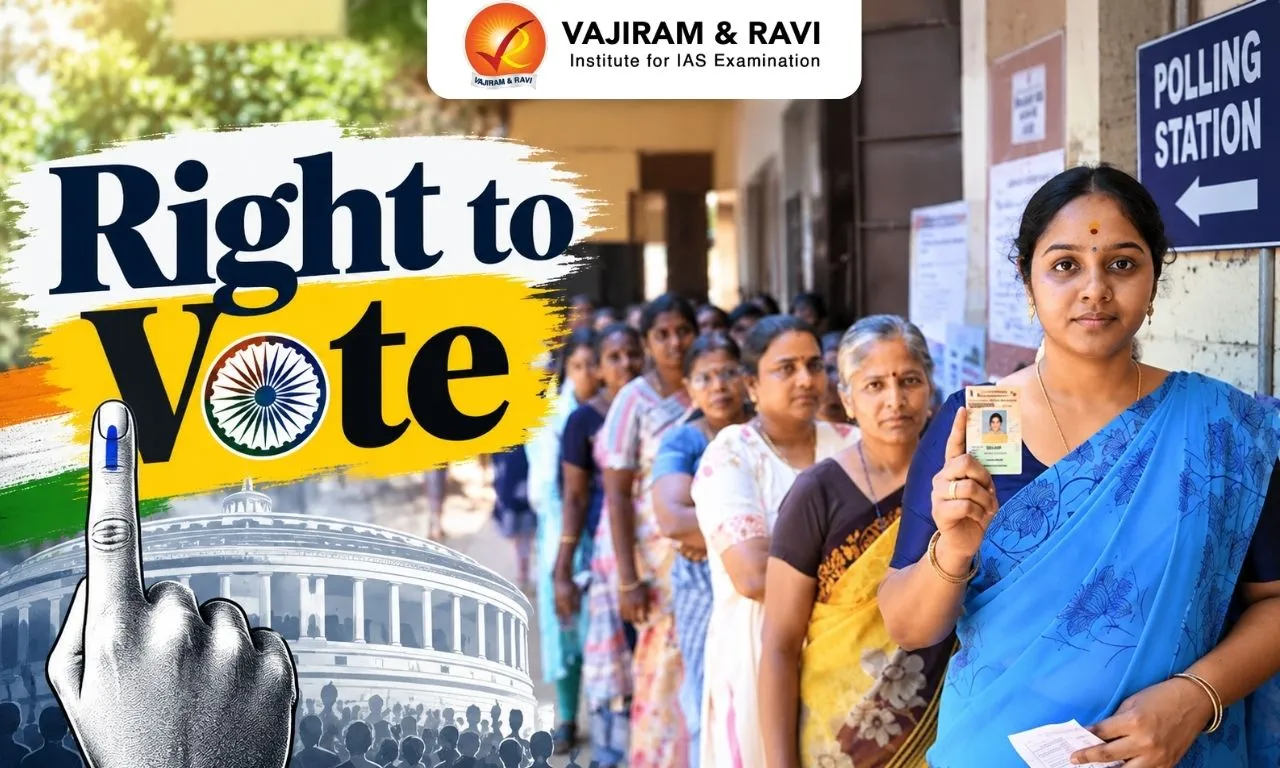
Right to Vote in India – Constitutional and Legal Status

Right to Vote in India

Right to Vote Latest News

  • Recent concerns over electoral roll management and the functioning of ECI have renewed discussion on the legal status and protection of the right to vote in India.

Universal Adult Suffrage in India

  • India adopted universal adult suffrage from the beginning of the Republic, granting adult citizens the right to participate in elections without restrictions based on gender, caste, religion, education or property.
  • In the United States, although the 15th and 19th Amendments extended voting rights to African Americans in 1870 and women in 1920, systemic barriers such as poll taxes and literacy tests continued to disenfranchise many for decades. 
  • India chose immediate, universal inclusion, ensuring democratic equality from the outset and bypassing the prolonged struggles seen elsewhere. 
  • Article 326 granted every adult citizen the right to vote regardless of gender, caste, religion, education or property.
  • This was operationalised through two laws, the Representation of the People Act, 1950, governing preparation and revision of electoral rolls, and the 1951 Act, regulating election conduct, candidature and electoral offences.
  • The first general election presented a major administrative challenge, with around 173 million voters, many of whom were illiterate. 
  • The Election Commission, under the first Chief Election Commissioner Sukumar Sen, introduced election symbols to make participation accessible to voters.

What Is the Legal Status of the Right to Vote?

  • The distinction between a fundamental right, constitutional right and statutory right is important because each category carries different levels of legal protection.
  • The Constituent Assembly considered whether voting should form part of the Fundamental Rights chapter. However, the proposal was not adopted.
  • In Kuldip Nayar v. Union of India (2006), a five-judge Constitution Bench of the Supreme Court held that the “right to elect” is a statutory right, deriving from Section 62 of the Representation of the People Act, 1951, rather than a fundamental or constitutional right.
  • A two-judge Bench in Rajbala v. State of Haryana (2015) referred to the right to vote as a constitutional right. However, the larger Constitution Bench ruling in Kuldip Nayar remains the controlling position.
  • In Anoop Baranwal v. Union of India (2023), the Supreme Court did not revisit the issue, noting the existing position established by Kuldip Nayar. Justice Ajay Rastogi, in his dissent, argued that the right to vote could be viewed as an expression of Article 19(1)(a) and connected with Article 21.
  • Thus, under the position discussed in the source, the right to elect continues to be treated as a statutory right, although its democratic significance has been recognised by the judiciary.

Why Are Electoral Rolls Important?

  • The right to participate in elections depends in practice on an accurate electoral roll.
  • The Representation of the People Act, 1950 provides the statutory framework for preparation and revision of electoral rolls. 
  • Section 19 provides that a citizen who is at least 18 years old, ordinarily resident in a constituency and not otherwise disqualified is entitled to registration.
  • Under Section 21, the Election Commission is empowered to direct the preparation and revision of electoral rolls. Errors such as:
    • omission of eligible voters, 
    • inclusion of ineligible persons, 
    • duplicate entries, and 
    • incorrect voter details 
    • can affect electoral integrity and the principle of “one person, one vote.”
  • The challenge becomes more complex when electoral administration increasingly depends on digital systems.

The Case for Greater Protection

  • The debate over making voting a fundamental right centres on the level of constitutional protection that should accompany the franchise.
  • Supporters of greater constitutional protection argue that voting is closely connected with democratic participation and that restrictions affecting the franchise should receive stronger judicial scrutiny.
  • At the same time, the existing legal framework gives Parliament the authority to regulate electoral participation through legislation, while the Election Commission exercises constitutional powers under Article 324 relating to the superintendence, direction and control of elections.
  • The issue therefore involves balancing electoral integrity, administrative regulation and individual participation.

Conclusion

  • India's system combines universal adult suffrage under Article 326 with statutory regulation through the Representation of the People Acts and constitutional supervision by the Election Commission. 
  • The continuing debate over the legal status of the right to vote highlights a broader constitutional question: how should electoral administration protect both the accuracy of electoral rolls and the individual's ability to participate in the democratic process?

Source: TH

Right to Vote FAQs

Q1: Is the right to vote a fundamental right in India?

Ans: No, the Supreme Court's larger Bench in Kuldip Nayar v. Union of India treats the right to elect as a statutory right.

Q2: Which Article provides for adult suffrage?

Ans: Article 326 provides for elections to the Lok Sabha and State Legislative Assemblies on the basis of adult suffrage.

Q3: Which law governs electoral rolls?

Ans: The Representation of the People Act, 1950 provides the principal statutory framework for preparation and revision of electoral rolls.

Q4: What is the role of Article 324?

Ans: Article 324 vests the Election Commission with superintendence, direction and control over elections.

Q5: Why are accurate electoral rolls important?

Ans: Accurate electoral rolls help ensure that eligible citizens can participate while preventing duplication, ineligible inclusion and other forms of electoral irregularity.

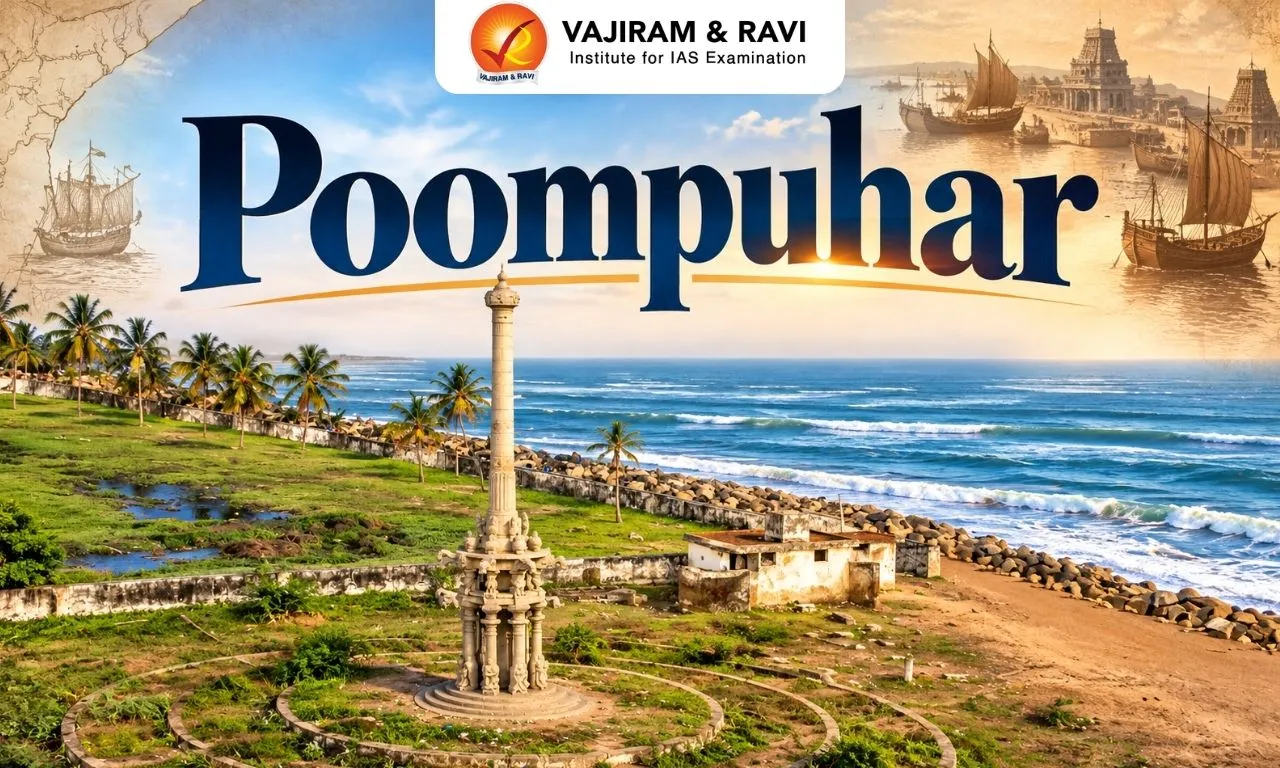
Poompuhar: Underwater Excavations Reveal Tamil Links to West Asia

Poompuhar

Poompuhar Latest News

  • Fresh underwater excavations off Poompuhar, the ancient Chola port city in Tamil Nadu, have found new evidence of its maritime connections. 
  • The 18-day exploration was carried out by the Tamil Nadu State Department of Archaeology (TNSDA) with the Indian Maritime University.
  • Key findings include: A fragment of a West Asian torpedo jar; Four terracotta ring wells; More than 250 ceramic fragments. Much of the ancient settlement is believed to lie beneath the sea today.

About Poompuhar

  • Poompuhar, also called Kaveripoompattinam, lies in present-day Mayiladuthurai district. 
  • It sits at the mouth of the 800-km-long Cauvery river, where the river empties into the Bay of Bengal. 
  • It is believed to have been the capital of the early Cholas and features prominently in Sangam and post-Sangam literature.
  • A 2011 archaeology report says the city existed from the 5th–4th century BCE, based on the carbon dating of a wooden log recovered there.
  • The city is said to have had three major divisions:
    • Maruvurppakkam — along the seashore.
    • Pattinappakkam — to the west.
    • Nalangadi — between the two.

A Busy Trading Port

  • The port was thronged during the Chola period. Exports were stamped with a tiger symbol, the Chola customs seal, marking their origin.
  • Merchants from across India and Southeast Asia came seeking markets.
  • Imports included articles from the Ganges region, food products from Ceylon, and spices from Java.
  • Earlier research supports this picture:
    • The 1996 paper notes that ships from Tamralipti (West Bengal) and Palur (Odisha) visited Poompuhar. From there, sea-going vessels sailed to Southeast Asia, Arabia and Rome.
    • Sreelata Menon's In Search of Lost Cities (2025) describes ships from Rome, Egypt, China and Arabia docking round the clock, with cargo, including horses, stamped with the tiger seal.

Significance of the Torpedo Jar

  • The recovered fragment is of fine ceramic, with an estimated diameter of 30–35 cm. 
  • Torpedo jars were historically used to carry liquid cargo such as wine and olive oil across ocean routes. This is proof of Poompuhar's links with West Asia and the Mediterranean world.
  • The discovery is not entirely new, but it adds to evidence already gathered by earlier studies.

Other Structures and Objects

  • Earlier offshore work found:
    • Brick structures, terracotta ring wells, storage jars and clay patches of the Sangam period.
    • Remains that experts believe are of a public building, wharf and reservoir.
    • Megalithic pottery and associated ware, showing that ancient habitation extended beyond the present shoreline.
  • Why The Ring Wells Matter - Ring wells were built on dry land to reach freshwater. Finding them on the seabed may point to a buried palaeochannel, meaning an ancient riverbed later submerged by coastal erosion and rising sea levels.

The Lost City: How Poompuhar Went Under

  • Natural Explanations - Catastrophic floods are believed to have hit the coast around the 4th or 5th century CE, swallowing large parts of the city.
    • Studies also suggest a major tsunami around the 3rd century CE may have contributed to its submergence.
  • Legend - According to analysts, the port's king, grieving his son's death, failed to celebrate Indra Vizha, a festival honouring Indra (Vendhan) as ruler of rain, thunder and lightning. Enraged, the goddess of Poompuhar made the sea swallow the city.
  • Scholarly View - Scholars differ. Either the entire city was submerged and rebuilt after the sea receded, or only part of it was engulfed. 

Conclusion

  • Poompuhar shows that Tamil coastal trade was global long before the modern era. Ships from Rome, Arabia and Southeast Asia met here, and a single jar fragment now confirms that link once more. 
  • Much of the city still lies underwater, so the seabed remains one of India's richest unread archives of maritime history.

Source: IE | ToI

Poompuhar FAQs

Q1: What did recent underwater excavations at Poompuhar discover?

Ans: Underwater excavations at Poompuhar discovered a West Asian torpedo jar fragment, four terracotta ring wells and more than 250 ceramic fragments.

Q2: Why is Poompuhar important in Tamil history?

Ans: Poompuhar was an early Chola capital and major maritime port, prominently mentioned in Sangam literature and connected with extensive overseas trade.

Q3: What does the torpedo jar reveal about Poompuhar's trade?

Ans: The torpedo jar fragment strengthens evidence that Poompuhar maintained maritime connections with West Asia and the Mediterranean through ancient ocean trade routes.

Q4: Why are the ring wells found underwater at Poompuhar significant?

Ans: Ring wells on the seabed may indicate an ancient palaeochannel, suggesting freshwater systems and inhabited areas were later submerged by coastal changes.

Q5: Why is much of Poompuhar believed to be underwater today?

Ans: Poompuhar's submergence may have resulted from coastal floods, a possible ancient tsunami, erosion and rising sea levels, although scholars differ on the extent.

IRDAI Insurance Reforms: New Rules for Insurance Distribution

IRDAI Insurance Reforms

IRDAI Insurance Reforms Latest News

  • Recently, India's insurance regulator, the Insurance Regulatory and Development Authority of India (IRDAI), issued a consultation paper titled "Recalibrating Economics of Insurance Distribution." 
  • It covers distribution, structure, expenses and commissions. The aim is to improve consumer protection, reduce mis-selling and counter dark patterns. Comments are invited by October 25.

Market Reaction

  • Analysts say that the reforms are good news for households but will eat into the profit margins of distributors.
  • As a result, insurance shares did fall sharply recently. 
    • PB Fintech (parent of Policybazaar): fell 36% on September 24, then 3% more on next day.
    • TurtleMint: slumped 20% on both days.
    • Many banks also ended lower.

Key Proposals

  • Commission Caps - In life insurance, first-year commission would be capped at: 20% of premium for distributors; 25% for agents.
    • This is less than half of current commissions. The regulator had scrapped such caps in 2023.
  • Lower Expense of Management (EoM) - EoM is the cost an insurer charges against premiums, including administrative and distribution costs such as agent commissions. 
    • IRDAI proposes reducing it, over five years, to: 12.5% of gross direct premium for life insurers; 20% for general insurers.
    • Limits are also set for 2028–29. According to CareEdge Ratings, 20 of 22 life insurers and 28 of 31 general insurers currently exceed the proposed limits.

Why IRDAI Is Acting

  • IRDAI says sales are led by commissions, not by price and quality.
    • General insurance: premiums via brokers rose 37% between 2022–23 and 2024–25, but commissions rose 173%.
    • Life insurance: premiums via corporate agents rose 28%, but commissions surged 125%.
  • So, distributors' income has grown 4–5 times faster than premiums. 
  • The paper says heavy dependence on commission-led distribution and opaque pricing has weakened competition and pushed value away from customers.

The Larger Backdrop

  • FDI in insurance was raised to 100% in December last year, and notified in May 2026.
  • India is the world's 10th largest insurance market, yet insurance penetration was only 3.7% in 2024–25.
  • Insurance penetration means total premium (life and non-life) divided by GDP.

Who Is Hit Hardest?

  • Online Aggregators - Policybazaar and TurtleMint face high customer acquisition costs and rely heavily on upfront commissions. They lack a network of agents like LIC, so caps hurt them most.
  • Banks - Banks are key distributors because of cross-selling and deep networks.
    • Analysts note that banks with multiple tie-ups and heavy incentive-led payouts will suffer more than those with single partnerships.
    • Insurance distribution income for banks rose to 5.1% of profit before tax in 2025–26, from 3.5% in 2022–23.
    • Banks with insurance subsidiaries (HDFC Bank, ICICI Bank, SBI, Kotak Mahindra Bank) are relatively insulated, as they keep part of the savings through higher insurer margins.

Criticisms and Gaps

  • Persistency is Not Addressed - Persistency means policyholders continuing to pay premiums. Experts say writing a new policy still pays a distributor several times more than retaining an old one. 
    • They suggest:
      • Deferring part of first-year commission.
      • Vesting it against 13th- and 25th-month persistency.
      • Clawing it back on early lapse.
      • Flattening the gap between first-year and renewal commission.
  • Aggregators Perform Best on Persistency - IRDAI's data shows 71% of online-sold policies are active after five years, against 43% for those sold by corporate agents such as banks. Yet aggregators are hit hardest.
  • Penetration Risk - Caps may discourage insurers from selling low-ticket, low-margin policies, which drive penetration in non-tier-1 cities and among lower-income groups.
  • Smaller Insurers - Critics argue that the framework should recognise the structural cost differences of smaller insurers, so distribution stays competitive and inclusive.

Conclusion

  • IRDAI's proposals target a real problem: sellers earning more than buyers gain. Yet capping commissions alone does not fix lapsing policies, and it could squeeze the low-ticket products that widen coverage. 
  • The final rules must protect consumers without pushing insurance away from the people who still lack it.

Source: IE | RT

IRDAI insurance reforms FAQs

Q1: What are the main IRDAI insurance reforms proposed in the consultation paper?

Ans: The IRDAI insurance reforms propose commission caps, lower expense-of-management limits and measures aimed at improving consumer protection and reducing mis-selling.

Q2: Why did insurance stocks fall after the IRDAI proposals?

Ans: Insurance stocks fell because analysts expect lower commission income and tighter distribution economics to reduce profit margins for distributors and some insurers.

Q3: What commission caps are proposed under the IRDAI insurance reforms?

Ans: Under the proposed IRDAI insurance reforms, first-year life insurance commission would be capped at 20% for distributors and 25% for agents.

Q4: Why is IRDAI concerned about commission-led insurance distribution?

Ans: IRDAI says distributor income has grown substantially faster than premiums, potentially encouraging commission-driven sales rather than competition based on price and product quality.

Q5: Could the IRDAI insurance reforms affect insurance penetration?

Ans: The IRDAI insurance reforms could discourage sales of low-ticket policies if tighter commissions reduce incentives for products serving lower-income and non-tier-1 customers.

Daily Editorial Analysis 28 September 2026

Daily-Editorial-Analysis

Form 26 and the Statutory Mandate

Context

  • The Supreme Court’s dismissal of Congress leader Meenakshi Natarajan’s challenge to the rejection of her Rajya Sabha nomination from Madhya Pradesh raises important questions concerning electoral transparency, candidate rights and judicial review.
  • The controversy centres on the alleged non-disclosure of a pending criminal complaint and the legal scope of Form 26 under the Representation of the People Act, 1951 (ROPA).
  • It also raises questions about the limits of Returning Officers’ powers and the constitutional bar on judicial intervention during elections.

Evolution of Criminal Disclosure Requirements

  • The requirement to disclose candidates’ criminal antecedents originated in the Supreme Court’s landmark Union of India v. Association for Democratic Reforms (2002).
  • The Court recognised the voter’s right to information and held that disclosure enables an informed electoral choice.
  • Parliament subsequently inserted Section 33-A into ROPA, while the Election Commission prescribed Form 26 for candidate affidavits.
  • The objective was to improve transparency without creating additional qualifications for contesting elections.
  • However, a significant divergence emerged in 2018. Section 33-A requires disclosure of cases involving offences punishable with imprisonment of two years or more where charges have been framed.
  • The amended Form 26, by contrast, requires disclosure of all pending criminal cases, regardless of whether charges have been framed.

The Problem of Delegated Legislation

  • Rule 4A of the Conduct of Election Rules, 1961, requires candidates to submit Form 26 with their nomination papers.
  • Since the rule primarily provides the procedural mechanism for implementing Section 33-A, a constitutional question arises when the prescribed form appears to impose broader substantive obligations than the parent statute.
  • The key issue is whether delegated legislation can enlarge a statutory obligation created by Parliament.
  • Procedural rules may prescribe how information is supplied, but their authority to determine what must be disclosed cannot automatically exceed the limits of the enabling statute.
  • At the same time, broader disclosure can promote electoral accountability and informed voting.
  • The challenge is to reconcile transparency with statutory authority, legal certainty and proportionality.

Electoral Integrity versus Candidate Rights

  • Criminal disclosure requirements serve a legitimate democratic purpose by giving voters relevant information about candidates.
  • However, candidates are also entitled to fair treatment under established law.
  • A pending criminal complaint is not equivalent to a charge framed by a court or a conviction. Treating every allegation as sufficient grounds for rejection could undermine the presumption of innocence and potentially expose candidates to politically motivated complaints.
  • Electoral transparency must therefore be balanced with procedural fairness and clear statutory thresholds.
  • The law should distinguish between a complaint, investigation, criminal case, framing of charges and conviction.

Constitutional Remedies and Article 329(b)

  • The second major issue concerns judicial intervention during elections. Article 329(b) restricts judicial interference in electoral matters and generally requires disputes to be raised through an election petition.
  • In P. Ponnuswami v. Returning Officer (1952), the Supreme Court established that courts should ordinarily avoid interrupting an ongoing electoral process.
  • The principle seeks to preserve electoral continuity and certainty.
  • However, difficulties arise where a Returning Officer is alleged to have acted without jurisdiction or with manifest arbitrariness.
  • A rigid application of Article 329(b) could potentially deny immediate judicial scrutiny even where an administrative decision is fundamentally defective.
  • The central constitutional challenge is therefore to reconcile judicial restraint with constitutional accountability.

The Need to Reconsider the Legal Framework

  • The controversy points to the need for greater clarity in two areas.
  • First, the relationship between Section 33-A and Form 26 should be expressly clarified so that candidates and Returning Officers know precisely which criminal matters require disclosure.
  • Second, the Supreme Court may need to clarify the boundaries of Article 329(b).
  • The objective should not be to permit routine judicial intervention but to determine whether narrowly defined exceptions exist for cases involving patent illegality or lack of jurisdiction.

The Way Forward

  • Harmonise Form 26 with ROPA to remove conflicting disclosure requirements.
  • Clearly distinguish between complaints, criminal cases, framed charges and convictions.
  • Establish uniform guidelines for Returning Officers dealing with alleged non-disclosure.
  • Provide candidates a meaningful opportunity to clarify disputed information.
  • Preserve the election-petition mechanism as the principal electoral remedy.
  • Consider narrowly defined judicial review for manifest jurisdictional errors without disrupting elections.
  • Ensure public access to candidate information while protecting the presumption of innocence.

Conclusion

  • The Natarajan case raises issues extending beyond an individual nomination.
  • It demonstrates the need to balance electoral transparency, candidate rights, delegated legislation, judicial restraint and constitutional accountability.
  • Democratic elections require informed voters, but transparency must operate within clearly established law.
  • Similarly, protecting electoral continuity should not eliminate safeguards against exceptional illegality.

Form 26 and the Statutory Mandate FAQs

Q1. What is the purpose of Form 26?
Ans. Form 26 requires election candidates to disclose specified personal and criminal information.

Q2. What does Section 33-A of ROPA require?
Ans. Section 33-A requires disclosure of certain criminal cases in which charges have been framed.

Q3. What is the main issue concerning Form 26?
Ans. The main issue is whether Form 26 can impose broader disclosure requirements than Section 33-A.

Q4. What does Article 329(b) provide?
Ans. Article 329(b) generally restricts judicial intervention in electoral matters once the election process has commenced.

Q5. What is the key lesson from the Natarajan case?
Ans. The case demonstrates the need to balance electoral transparency with candidate rights and constitutional accountability.

Source: The Hindu


Kashmir as India’s Gateway to Eurasian Opportunity

Context

  • India’s large young population can become a powerful engine of economic growth only when young citizens receive quality education, relevant skills, productive employment and meaningful opportunities.
  • A youthful population alone does not guarantee a demographic dividend; without opportunities, it can generate frustration and social disillusionment.
  • This challenge is particularly significant in Jammu and Kashmir and Ladakh, where demographic potential intersects with conflict, geographical isolation and strategic sensitivities.
  • Sustainable development requires combining economic opportunity, connectivity, entrepreneurship and regional integration with security considerations.

The Demographic Opportunity and Aspiration-Reality Gap

  • India’s demographic advantage contrasts with China’s ageing population.
  • India possesses a vast pool of young people entering the workforce, creating an opportunity for rapid economic growth if sufficient productive employment is generated.
  • The smartphone revolution has dramatically expanded young people's expectations.
  • Even those in remote areas can observe global educational, professional and lifestyle opportunities instantly. This has widened the aspiration-reality gap.
  • Higher education has expanded, but a degree no longer guarantees employment or economic independence.
  • Unemployment, recruitment delays, examination irregularities and paper leaks can therefore intensify frustration.
  • The challenge is to build an economy capable of absorbing young people’s aspirations and talents.

Kashmir’s Youth: From Security Lens to Opportunity Lens

  • Young people in Jammu and Kashmir share fundamental aspirations with youth elsewhere: dignity, employment, economic independence and a secure future.
  • However, decades of conflict and political uncertainty have imposed additional constraints.
  • A predominantly security-oriented perception can prevent Kashmiri youth from being recognised as human capital and strategic assets.
  • Jammu and Kashmir possesses considerable hydroelectric potential, mineral resources and tourism opportunities, while its geographical location itself represents an underutilised economic asset.

Kashmir’s Historic Role as a Crossroads

  • Historically, Kashmir was a crossroads connecting South Asia, Central Asia and Tibet, rather than an isolated frontier.
  • Caravan routes facilitated the movement of goods, people, ideas, culture and skills.
  • The influence of Mir Sayyid Ali Hamadani (Shah-i-Hamadan) and Persian and Central Asian craftsmen illustrates how connectivity contributed to Kashmir’s renowned handicraft traditions.
  • The larger lesson is that connectivity creates economic ecosystems.
  • Modern policy can draw upon this historical experience by transforming suitable traditional routes into modern, regulated economic corridors, subject to contemporary diplomatic and security conditions.

From Security Barriers to Connectivity Opportunities

  • Connectivity involving Pakistan, China and Central Asia is necessarily sensitive.
  • Reopening traditional routes therefore requires a phased diplomatic and infrastructure strategy rather than immediate unrestricted access.
  • With Pakistan, India could explore confidence-building measures and trade connectivity when political and security conditions permit.
  • With China, practical dialogue on trans-Himalayan connectivity could be pursued where economic interests and security concerns can be reconciled.
  • A gradual strategy could begin with pilot corridors, selected according to security, diplomatic feasibility and economic potential.
  • Successful initiatives could subsequently be expanded. Properly regulated connectivity could complement security objectives by encouraging economic interdependence and stability.

Jammu and Kashmir as India’s Northern Economic Gateway

  • Greater connectivity with Central Asia could enable Jammu and Kashmir and Ladakh to function as northern economic gateways for India.
  • Improved access could connect Indian businesses with Central Asian markets while attracting investment, tourism and commerce.
  • A functioning land corridor could generate opportunities in:
    • Transport and logistics
    • Warehousing and supply chains
    • Tourism and hospitality
    • Agriculture and horticulture
    • Manufacturing and handicrafts
    • Finance, technology and services
  • Unlike connectivity concentrated around airports or individual urban centres, land corridors can distribute economic activity across wider geographical areas.

A Road to Opportunity for the Young

  • The ultimate purpose of connectivity should be employment and human development, rather than infrastructure alone.
  • Construction can generate immediate jobs, while functioning corridors can create sustained demand for logistics, services, manufacturing and entrepreneurship.
  • For Kashmir’s youth, expanded connectivity could transform aspirations into tangible opportunities and provide alternatives to dependence on limited public-sector employment.
  • It could also strengthen participation in national and international markets.
  • India’s demographic dividend is time-sensitive. The country cannot assume that its youthful population will remain an advantage indefinitely.
  • Demographic potential must therefore be converted into productive human capital while the opportunity remains.

Conclusion

  • India’s demographic future and Jammu and Kashmir’s economic future are closely connected to opportunity creation.
  • Education without employment, connectivity without economic activity and security without inclusion cannot fully address the aspirations of a young population.
  • India’s demographic advantage will yield lasting benefits only when young citizens across the country can move from education and aspiration towards employment, enterprise and dignity.

Kashmir as India’s Gateway to Eurasian Opportunity FAQs

Q1. What is India’s key demographic challenge?
Ans. India must convert its large young population into productive human capital through education, skills and employment.

Q2. What has the smartphone revolution created among Indian youth?
Ans. The smartphone revolution has widened the aspiration-reality gap among Indian youth.

Q3. Why is Kashmir’s geographical location strategically important?
Ans. Kashmir’s location can make it a potential gateway between India, Central Asia and Eurasia.

Q4. How can connectivity benefit Jammu and Kashmir?
Ans. Connectivity can generate opportunities in trade, logistics, tourism, manufacturing and services.

Q5. What is essential for converting India’s demographic advantage into a dividend?
Ans. India must create productive employment and meaningful economic opportunities for its young population.

Source: The Hindu

Daily Editorial Analysis 2026 FAQs

Q1: What is editorial analysis?

Ans: Editorial analysis is the critical examination and interpretation of newspaper editorials to extract key insights, arguments, and perspectives relevant to UPSC preparation.

Q2: What is an editorial analyst?

Ans: An editorial analyst is someone who studies and breaks down editorials to highlight their relevance, structure, and usefulness for competitive exams like the UPSC.

Q3: What is an editorial for UPSC?

Ans: For UPSC, an editorial refers to opinion-based articles in reputed newspapers that provide analysis on current affairs, governance, policy, and socio-economic issues.

Q4: What are the sources of UPSC Editorial Analysis?

Ans: Key sources include editorials from The Hindu and Indian Express.

Q5: Can Editorial Analysis help in Mains Answer Writing?

Ans: Yes, editorial analysis enhances content quality, analytical depth, and structure in Mains answer writing.

Asian Games 2026 Medal Tally, Country-Wise Medals and Rankings

Asian Games 2026 Medal Tally

Asian Games 2026 Medal Tally is updated as athletes from across Asia compete for medals at the 20th Asian Games in Aichi-Nagoya, Japan. The Asian Games 2026 are being held from 19 September to 4 October 2026. The event features 43 sports, 71 disciplines and 469 medal events.

China, Japan, South Korea and other Asian countries are competing across multiple sports. The medal table ranks countries based primarily on the number of gold medals, followed by silver and bronze medals. 

India has won 37 medals at the Asian Games 2026, including 4 gold medal, 16 silver medals and 17 bronze medals. Indian athletes have earned these medals across events such as shooting and mixed martial arts.

Asian Games 2026 Medal Tally

The following is the Asian Games 2026 medal tally based on the latest figures provided as of 28th September 2026.

Rank Country Gold Silver Bronze Total
1 China 123 51 39 214
2 Japan 39 64 60 163
3 South Korea 21 24 41 86
4 Uzbekistan 10 17 11 38
5 Kazakhstan 9 10 22 41
6 Thailand 9 7 10 26
7 Bahrain 8 2 3 13
8 Iran 7 14 8 29
9 North Korea 6 5 4 15
10 Malaysia 6 2 9 17
11 Hong Kong, China 5 12 16 33
12 India 4 16 17 37
13 Chinese Taipei 3 7 19 29
14 Indonesia 2 5 17 24
15 Singapore 2 5 3 10
16 Philippines 2 2 9 13
17 Qatar 2 2 1 5
18 Tajikistan 2 2 1 5
19 Kuwait 2 1 2 5
20 Macao, China 1 4 1 6
21 Vietnam 1 1 16 18
22 Jordan 1 1 1 3
23 Myanmar 1 1 1 3
24 Saudi Arabia 0 2 5 7
25 Kyrgyzstan 0 1 3 4
26 Afghanistan 0 1 2 3
27 Iraq 0 1 2 3
28 Lebanon 0 1 1 2
29 Oman 0 1 1 2
30 Sri Lanka 0 1 0 1
31 United Arab Emirates 0 1 0 1
32 Turkmenistan 0 1 0 1
33 Cambodia 0 0 4 4
34 Pakistan 0 0 4 4
35 Nepal 0 0 2 2
36 Bangladesh 0 0 1 1
37 Brunei Darussalam 0 0 1 1
38 Mongolia 0 0 1 1
39 Syria 0 0 1 1

Note: The medal tally changes throughout the Asian Games as more events are completed. The table above reflects the figures provided for this update and should be treated as a live/ongoing tally rather than the final medal standings.

India in Asian Games 2026 Medal Tally

India has recorded 37 medals in the provided Asian Games 2026 medal tally, including 4 gold medal, 16 silver medals and 17 bronze medals.

India in Asian Games 2026 Medal Tally

Medal

Number

Gold

4

Silver

16

Bronze

17

Total

37

Indian Medallists at Asian Games 2026

India delivered a strong performance at the Asian Games 2026, winning 37 medals, 4 Gold, 16 Silver and 17 Bronze across sports including shooting, athletics, kabaddi, cricket, squash, weightlifting, badminton, rowing, wushu and table tennis.

No. Medal Winner(s) Sport Event Medal
1 Indian Women’s Cricket Team Cricket Women’s T20 Gold
2 Suruchi Singh & Kamaljeet Shooting 10m Air Pistol Mixed Team Gold
3 Indian Women’s Kabaddi Team Kabaddi Women’s Final Gold
4 Indian Men’s Kabaddi Team Kabaddi Men’s Final Gold
5 Niraj Kumar, Aishwary Pratap Singh Tomar & Rudrankksh Patil Shooting Men’s 50m Rifle 3P Team Silver
6 Mirabai Chanu Weightlifting Women’s 49kg Silver
7 Elavenil Valarivan, Sonam Maskar & Vidarsa Vinod Shooting Women’s 10m Air Rifle Team Silver
8 Elavenil Valarivan Shooting Women’s 10m Air Rifle Silver
9 Rudrankksh Patil, Parth Mane & Himanshu Dhillon Shooting Men’s 10m Air Rifle Team Silver
10 Himanshu Dhillon Shooting Men’s 10m Air Rifle Silver
11 Naorem Roshibina Devi Wushu Women’s Sanda 60kg Silver
12 Vishal T.K., M.R. Poovamma, Manu T.S. & Vithya Ramraj Athletics Mixed 4×400m Relay Silver
13 Gulveer Singh Athletics Men’s 10,000m Silver
14 Sawan Barwal Athletics Men’s Marathon Silver
15 Ashi Chouksey, Tilottama Sen & Vidarsa Kochalumkal Shooting Women’s 50m Rifle 3P Team Silver
16 Tajinderpal Singh Toor Athletics Men’s Shot Put Silver
17 Ancy Sojan Athletics Women’s Long Jump Silver
18 Sarvesh Kushare Athletics Men’s High Jump Silver
19 Abhay Singh Squash Men’s Singles Silver
20 Anahat Singh Squash Women’s Singles Silver
21 Rudrankksh Patil Shooting Men’s 10m Air Rifle Bronze
22 Suchika Tariyal MMA Women’s Traditional MMA -60kg Bronze
23 Raiza Dhillon, Maheshwari Chauhan & Parinaaz Dhaliwal Shooting Women’s Skeet Team Bronze
24 Anantjeet Singh Naruka, Mairaj Ahmad Khan & Bhavtegh Singh Gill Shooting Men’s Skeet Team Bronze
25 Jay Meena Soft Tennis Men’s Singles Bronze
26 Indian Men’s Badminton Team Badminton Men’s Team Bronze
27 Satnam Singh & Salman Khan Rowing Men’s Double Sculls Bronze
28 Anantjeet Singh Naruka & Parinaaz Dhaliwal Shooting Mixed Team Skeet Bronze
29 Seema Kumari Athletics Women’s 10,000m Bronze
30 Manush Shah & Diya Chitale Table Tennis Mixed Doubles Bronze
31 Manpreet Kaur Athletics Women’s Shot Put Bronze
32 Baranica Elangovan Athletics Women’s Pole Vault Bronze
33 Prachi Choudhary Athletics Women’s 400m Bronze
34 Harita Bhadra Athletics Women’s 200m Bronze
35 Tejaswin Shankar Athletics Men’s Decathlon Bronze
36 Parul Chaudhary Athletics Women’s 3000m Steeplechase Bronze
37 Joshna Chinappa & Velavan Senthilkumar Squash Mixed Doubles Bronze

India at Asian Games 2026 Day-Wise Medal Updates

India has won 37 medals at the Asian Games 2026 in Aichi-Nagoya, comprising 4 Gold, 16 Silver and 17 Bronze medals as of 28 September. India’s medal campaign has seen strong contributions from shooting, athletics, kabaddi, cricket, squash, weightlifting, wushu, rowing, badminton and table tennis.

28 September Update

India entered 28 September with 37 medals, 4 Gold, 16 Silver and 17 Bronze. The day features medal opportunities in athletics, shooting, boxing, squash and hockey, along with India's men's cricket quarter-final against Afghanistan. Key Indian athletes in action include Manu Bhaker, Avinash Sable and Lovlina Borgohain.

  • Athletics: Avinash Sable begins his campaign in the men's 3000m steeplechase as he looks to defend his Asian Games title.
  • Shooting: Manu Bhaker competes in the women's 25m pistol event after India's strong showing in shooting earlier in the Games.
  • Boxing: Lovlina Borgohain and other Indian boxers continue their campaigns across different weight categories.
  • Cricket: India's men's cricket team takes on Afghanistan in the quarter-final.
  • Hockey: The Indian women's hockey team continues its campaign after topping its group with five wins from five matches.
  • Medal tally: No new Indian medal had been added at the time of this update; India's latest confirmed tally remained 37 medals.

27 September Update – Seven More Medals

India added seven medals on 27 September, taking its overall tally to 37 medals. Athletics contributed five medals, while India won two silver medals in squash.

  • Ancy Sojan – Silver (Athletics): Won silver in the women's long jump.
  • Sarvesh Kushare – Silver (Athletics): Won silver in the men's high jump, clearing 2.25m.
  • Anahat Singh – Silver (Squash): Won silver in the women's singles after losing the final to Malaysia's Sivasangari Subramaniam.
  • Abhay Singh – Silver (Squash): Won silver in the men's singles after losing the final to Malaysia's Ng Eain Yow.
  • Tejaswin Shankar – Bronze (Athletics): Secured bronze in the men's decathlon with 7,934 points.
  • Harita Bhadra – Bronze (Athletics): Won bronze in the women's 200m.
  • Parul Chaudhary – Bronze (Athletics): Secured bronze in the women's 3000m steeplechase.

26 September Update – India Wins Double Kabaddi Gold

India enjoyed a highly successful day on 26 September, winning seven medals, including two gold medals in kabaddi. The men's and women's teams both defeated Iran in their respective finals, completing India's historic kabaddi double.

  • Men's Kabaddi Gold: India defeated Iran 40–34 in the final to successfully defend its Asian Games title.
  • Women's Kabaddi Gold: India defeated Iran 37–34 to win the women's kabaddi title and successfully defend its crown.
  • Sawan Barwal – Silver (Athletics): Won silver in the men's marathon, setting a national record and becoming India's first Asian Games marathon medallist since 1982.
  • Tajinderpal Singh Toor – Silver (Athletics): Secured silver in the men's shot put.
  • Ashi Chouksey, Tilottama Sen & Vidarsa Kochalumkal – Silver (Shooting): Won silver in the women's 50m rifle 3 positions team event.
  • Prachi Chaudhary – Bronze (Athletics): Won bronze in the women's 400m.
  • Joshna Chinappa & Velavan Senthilkumar – Bronze (Squash): Secured bronze in mixed doubles.

Following the day's results, India had 4 Gold, 12 Silver and 14 Bronze medals, taking its tally to 30 medals at the end of 26 September.

25 September Update

India added two medals on 25 September, including a gold medal in shooting. Kamaljeet and Suruchi Singh won the 10m Air Pistol Mixed Team event, securing India's second gold medal of the Games and India's first shooting gold.

India also won a silver medal in the Men's 50m Rifle 3 Positions Team event, with Aishwary Pratap Singh Tomar, Rudrankksh Patil and Niraj Kumar finishing second.

Athlete/Team Sport Event Medal
Kamaljeet & Suruchi Singh Shooting 10m Air Pistol Mixed Team Gold
Aishwary Pratap Singh Tomar, Rudrankksh Patil & Niraj Kumar Shooting Men's 50m Rifle 3 Positions Team Silver

Following these results, India's medal tally stands at 2 Gold, 8 Silver and 9 Bronze, 19 medals in total.

24 September Update Wushu Silver and Rowing Bronze

  • Roshibina Devi – Silver (Wushu): Won silver in the women's 60kg sanda category after losing the final to China's Zhang Xiaoyu. This is her third consecutive Asian Games medal, following bronze in 2018 and silver in 2023.
  • Satnam Singh and Salman Khan – Bronze (Rowing): Won bronze in the men's double sculls, clocking 6:13.25. It is India's first Asian Games medal in the men's double sculls.
  • Anantjeet Singh Naruka and Parinaaz Dhaliwal: Qualified for the mixed skeet team final, keeping India in contention for another shooting medal.
  • Balraj Panwar: Finished fourth in the men's single sculls after staying in medal contention for much of the race.

23 September Update India's Five-Medal Day

  • Mirabai Chanu – Silver (Weightlifting): Won silver in the women's 49kg category, ending India's 28-year wait for an Asian Games weightlifting medal since Karnam Malleswari's bronze in 1998.
  • Women's skeet team – Bronze (Shooting): Parinaaz Dhaliwal, Raiza Dhillon and Maheshwari Chauhan won bronze.
  • Men's skeet team – Bronze (Shooting): Anantjeet Singh Naruka, Bhavtegh Singh Gill and Mairaj Ahmad Khan secured bronze.
  • Jay Meena – Bronze (Soft Tennis): Won India's first-ever Asian Games medal in soft tennis in the men's singles.
  • Men's badminton team – Bronze: India secured bronze after reaching the semi-finals.
  • Women's hockey: India defeated Thailand 20-1, with Deepika Sehrawat scoring nine goals.
  • Women's kabaddi: The defending champions defeated Iran 37-23 to record their second consecutive group-stage win.

22 September Update India Wins First Gold

  • Women's cricket team – Gold: India defeated Sri Lanka by 147 runs in the final to retain the Asian Games women's cricket title.
  • Record total: India scored 216/3, the highest team total in Asian Games cricket, with Smriti Mandhana scoring 79, Shafali Verma 48 and Richa Ghosh remaining unbeaten on 49.
  • Shooting: Elavenil Valarivan and Parth Mane finished fourth in the 10m air rifle mixed team event.
  • Swimming: India's men's 4x100m medley relay team qualified for the final with the seventh-fastest time.
  • Karate: Chetan Bhatt missed a bronze medal in the men's 84kg kumite event.

Which Country is Leading the Asian Games 2026 Medal Tally?

China is at the top of the Asian Games 2026 medal tally with 105 gold medals and a total of 169 medals.

Japan is next with 30 gold medals, followed by South Korea with 13 gold medals and Kazakhstan with 8 gold medals.

The Asian Games medal table is generally arranged according to gold medals first, followed by silver and bronze medals. Therefore, the total number of medals alone does not determine the position of a country in the table.

Also Read:- Asian Games 2026 Indian Cricket Team

Asian Games 2026 Host Country

Japan is the host country of the 20th Asian Games. The event is officially called the Aichi-Nagoya 2026 Asian Games.

The Games are being organised in Aichi Prefecture and Nagoya, with competitions taking place across multiple venues. The official event programme includes 43 sports and 71 disciplines.

The Asian Games are being held from 19 September 2026 to 4 October 2026. The Opening Ceremony took place on 19 September 2026, while the Closing Ceremony is scheduled for 4 October 2026.

Also Read:- India's medals at Asian Games 2026

How is the Asian Games Medal Tally Calculated?

The Asian Games medal tally records the number of gold, silver and bronze medals won by each participating country or region.

The ranking generally follows this order:

  1. Number of gold medals
  2. Number of silver medals
  3. Number of bronze medals

For example, a country with 5 gold medals is placed above a country with 4 gold medals even if the second country has a higher overall medal count.

The Total column is calculated by adding: Gold + Silver + Bronze = Total Medals

Asian Games 2026 Key facts for UPSC Prelims

20th Asian Games, hosted by Aichi Prefecture and Nagoya, Japan, are being held from 19 September to 4 October 2026, featuring 43 sports, 71 disciplines and 469 medal events under the Olympic Council of Asia (OCA).

Parameter Details
Edition 20th Asian Games (XX Asian Games)
Host Aichi Prefecture and Nagoya, Japan
Dates 19 September – 4 October 2026
Sports / Disciplines / Events 43 / 71 / 469
Governing Body Olympic Council of Asia (OCA), headquartered in Kuwait City
Debut Sport Mixed Martial Arts (MMA)
India’s Firsts in 2026 First MMA medal – Suchika Tariyal; first soft tennis medal – Jay Meena; first wushu medals at three consecutive Games – Roshibina Devi
First Asian Games New Delhi, India – 1951
India at Hangzhou 2023 106 medals (28 Gold, 38 Silver, 40 Bronze) – 4th position; India’s first 100+ medal haul
Next Editions Doha 2030 and Riyadh 2034

Asian Games 2026 Medal Tally FAQs

Q1: What is the Asian Games 2026 Medal Tally?

Ans: The Asian Games 2026 Medal Tally is the country-wise record of gold, silver and bronze medals won at the Aichi-Nagoya 2026 Asian Games.

Q2: Which country is leading the Asian Games 2026 Medal Tally?

Ans: China is leading the medal tally with 123 gold medals and 214 total medals.

Q3: How many medals has India won in Asian Games 2026?

Ans: According to the provided update, India has won 37 medals, including 4 gold, 16 silver and 17 bronze medals.

Q4: How many gold medals has India won in Asian Games 2026?

Ans: India has won 4 gold medals in the provided medal tally.

Q5: When are the Asian Games 2026 being held?

Ans: Asian Games 2026 are being held from 19 September to 4 October 2026 in Aichi-Nagoya, Japan.

India’s First LNG Train, Features, Benefits, Significance, Latest News

India’s First LNG Train

India’s first LNG-powered train was flagged off from Sabarmati Railway Station in Ahmedabad, Gujarat, on September 27, 2026, marking the introduction of liquefied natural gas (LNG) as an alternative fuel in Indian Railways. The train uses a diesel-LNG dual-fuel system, allowing LNG to partially replace conventional diesel.

Why in News?

India’s first LNG-powered train was flagged off from Sabarmati, Gujarat, by Union Home and Cooperation Minister Amit Shah and Gujarat Chief Minister Bhupendra Patel. The initiative is aimed at reducing diesel consumption, fuel costs and emissions in railway operations while promoting alternative fuels.

How Does the LNG-Diesel Dual-Fuel System Work?

The technology does not completely eliminate diesel use. Instead, LNG is used alongside diesel in the converted engine.

The system allows LNG to replace around 40% of diesel consumption. This can reduce the quantity of diesel required while retaining the operational capability of the existing diesel engine.

Benefits of India’s LNG Train

India’s LNG train can help reduce diesel consumption, fuel costs and emissions while promoting the use of alternative fuels in railway transportation.

  • Reduced Diesel Consumption: The dual-fuel system allows LNG to replace a significant portion of diesel, reducing dependence on conventional diesel fuel.
  • Lower Fuel Costs: Greater use of LNG can reduce operational fuel expenditure where LNG is economically competitive with diesel.
  • Lower Emissions: LNG combustion generally produces lower levels of particulate matter, sulphur oxides and nitrogen oxides than conventional diesel combustion.
  • Energy Diversification: It promotes the use of natural gas as an alternative transport fuel, diversifying the railway sector’s energy mix.
  • Better Air Quality: Lower emissions of particulate pollutants can help reduce local air pollution, particularly around railway operations.
  • Dual-Fuel Flexibility: The train can operate using both LNG and diesel, allowing continued operation when LNG availability is limited.
  • Use of Existing Technology: Converting suitable diesel-powered systems to dual-fuel technology can allow partial utilisation of existing railway infrastructure.
  • Transition Fuel: LNG can serve as an intermediate fuel option while India continues its broader transition towards electrification and cleaner energy sources.

Significance for Indian Railways

The LNG train is part of the broader effort to promote energy efficiency, cleaner transportation and alternative fuel technologies in the railway sector.

Indian Railways has already been pursuing electrification and renewable energy as major pathways for reducing fossil-fuel dependence. LNG can serve as an additional transition technology, particularly for railway operations where complete electrification may take time.

However, LNG is still a fossil fuel, so its use should be viewed as a transition or alternative-fuel measure rather than a zero-carbon solution.

LNG and India’s Energy Transition

LNG can act as a transition fuel in India’s energy transition by reducing dependence on more carbon-intensive fuels while the country expands renewable energy and electrification to achieve its net-zero emissions target by 2070.

  • Net-Zero Target: India has committed to achieving net-zero carbon emissions by 2070.
  • 2030 Emission Target: India aims to reduce the emissions intensity of its GDP by 45% from 2005 levels by 2030.
  • Non-Fossil Energy Capacity: India has set a target of achieving 50% of its installed electricity generation capacity from non-fossil fuel sources by 2030.
  • Energy Diversification: LNG can diversify India’s energy mix by providing an alternative to coal and petroleum-based fuels.
  • Lower Local Pollution: LNG generally produces lower particulate matter, sulphur oxides and nitrogen oxides than conventional diesel and coal-based fuels.
  • Transport Sector: LNG can be used as an alternative fuel in railways, heavy-duty road transport and shipping.
  • Industrial Transition: Natural gas can help industries gradually shift away from more carbon-intensive fuels.
  • Renewable Energy Support: Gas-based power can provide flexibility when solar and wind generation fluctuates.
  • Methane Challenge: Methane leakage during extraction, processing and transportation remains an important climate concern.
  • Fossil-Fuel Limitation: LNG is still a fossil fuel, so its use must be balanced with rapid expansion of renewable energy and electrification.

About Liquefied Natural Gas (LNG)

Liquefied Natural Gas (LNG) is natural gas, composed mainly of methane, that is cooled to around −162°C to convert it into a liquid, reducing its volume and making it easier to store and transport over long distances.

  • Main Component: It primarily consists of methane (CH₄), with small quantities of other hydrocarbons.
  • Formation: Natural gas is purified and then cooled to approximately −162°C, causing it to change from a gas into a liquid.
  • Volume Reduction: LNG occupies about 1/600th of the volume of natural gas in its gaseous state, making transportation more efficient.
  • Storage: It is stored in specially designed cryogenic tanks that maintain extremely low temperatures.
  • Transportation: LNG can be transported through specialised LNG carriers, trucks and rail-based systems.
  • Regasification: Before use as conventional natural gas, LNG is warmed and converted back into its gaseous form at regasification terminals.
  • Energy Use: LNG is used in power generation, industries, transport and city gas distribution.
  • Lower Air Pollutants: Compared with coal and some petroleum fuels, LNG generally produces lower levels of particulate matter and sulphur oxides during combustion.
  • Fossil Fuel: LNG is not a renewable source of energy because it is derived from natural gas.
  • Methane Concern: Methane leakage during extraction, liquefaction, transportation and regasification is an important environmental concern.

India’s First LNG Train FAQs

Q1: What is India’s first LNG train?

Ans: India’s first LNG train is a diesel-LNG dual-fuel DEMU that can operate using both liquefied natural gas and diesel. 

Q2: Who flagged off India’s first LNG-powered train?

Ans: Union Home and Cooperation Minister Amit Shah flagged off the train from Sabarmati. 

Q3: What is the fuel system used in the LNG train?

Ans: The train uses a dual-fuel system, allowing its engine to run on both LNG and diesel depending on fuel availability. 

Q4: How much diesel can the LNG train replace?

Ans: The technology is designed to replace around 40% of diesel consumption with LNG. 

Q5: How many power cars were converted for the project?

Ans: Two 1,400 HP Driving Power Cars (DPCs) at the Sabarmati Integrated Coaching Depot were converted to the LNG-diesel dual-fuel system. 

Asian Games 2026, Medal Tally, Participating Countries, Host Country

Asian Games 2026, officially known as the 20th Asian Games Aichi-Nagoya 2026, are being held in Japan from 19 September to 4 October 2026. Aichi Prefecture and Nagoya are hosting the continental multi-sport event, which brings together athletes from across Asia.

The Games feature 43 sports, 71 disciplines and 469 medal events. The official programme also includes newer sports such as teqball, padel, sport climbing, skateboarding, surfing, esports and mixed martial arts (MMA).

Asian Games 2026 Overview

The key highlights related to the Asian Games 2026 have been tabulated below...

Asian Games 2026 Overview

Particulars

Details

Event

20th Asian Games

Official Name

Aichi-Nagoya 2026

Host Country

Japan

Host Region

Aichi Prefecture and Nagoya

Dates

19 September – 4 October 2026

Total Indian Delegation

768

New and Emerging Sports at Asian Games 2026

Asian Games 2026 feature several new and emerging sports, reflecting the changing interests of athletes and younger audiences. These sports add more variety to the Games and give athletes from newer sporting disciplines an international platform.

  • Teqball: A football-based sport played on a curved table, making its Asian Games debut in 2026.
  • Mixed Martial Arts (MMA): Included in the Games for the first time, with competitions across different weight categories.
  • Padel: A racket sport combining elements of tennis and squash, included in men's and women's competitions.
  • Surfing: Features shortboard events for men and women.
  • Skateboarding: Includes different disciplines that test balance, speed and technical skills.
  • Sport Climbing: Includes speed, bouldering and lead events.
  • Esports: Continues to provide a competitive platform for digital sports and gaming.

Also Read:- India to Host Commonwealth Games 2030

Asian Games 2026 Participating Countries

Asian Games 2026 feature participation from 45 countries and regions across Asia. The participating delegations represent South Asia, Southeast Asia, East Asia, Central Asia and West Asia.

No. Country/Region No. Country/Region No. Country/Region
1 Afghanistan 16 Kazakhstan 31 Philippines
2 Bahrain 17 Kuwait 32 Qatar
3 Bangladesh 18 Kyrgyzstan 33 Korea
4 Bhutan 19 Lao PDR 34 Saudi Arabia
5 Brunei 20 Lebanon 35 Singapore
6 Cambodia 21 Macao, China 36 Sri Lanka
7 Chinese Taipei 22 Malaysia 37 Syria
8 DPR Korea 23 Maldives 38 Tajikistan
9 Hong Kong, China 24 Mongolia 39 Thailand
10 India 25 Myanmar 40 Timor-Leste
11 Indonesia 26 Nepal 41 Turkmenistan
12 Iraq 27 Oman 42 United Arab Emirates
13 IR Iran 28 Pakistan 43 Uzbekistan
14 Japan 29 Palestine 44 Vietnam
15 Jordan 30 China 45 Yemen

Asian Games 2026 Host Country

Japan is hosting the 20th Asian Games 2026 in Aichi-Nagoya, marking the third time the country has hosted the Asian Games. The event is being held from 19 September to 4 October 2026 across multiple venues in Aichi Prefecture and Nagoya. Japan previously hosted the Asian Games in Tokyo in 1958 and Hiroshima in 1994. The Games feature athletes from across Asia competing in a wide range of sports and disciplines.

Also Read:- India's medals at Asian Games 2026

India at Asian Games 2026

India is participating in the 20th Asian Games in Aichi-Nagoya with 503 athletes across 36 disciplines. The contingent includes 269 men and 234 women, supported by coaches, officials and other staff. India enters the Games after winning a record 107 medals at Hangzhou 2023, including 28 gold, 38 silver and 41 bronze medals.

India delivered a strong performance at the Asian Games 2026, winning 37 medals, 4 Gold, 16 Silver and 17 Bronze across sports including shooting, athletics, kabaddi, cricket, squash, weightlifting, badminton, rowing, wushu and table tennis.

No. Medal Winner(s) Sport Event Medal
1 Indian Women’s Cricket Team Cricket Women’s T20 Gold
2 Suruchi Singh & Kamaljeet Shooting 10m Air Pistol Mixed Team Gold
3 Indian Women’s Kabaddi Team Kabaddi Women’s Final Gold
4 Indian Men’s Kabaddi Team Kabaddi Men’s Final Gold
5 Niraj Kumar, Aishwary Pratap Singh Tomar & Rudrankksh Patil Shooting Men’s 50m Rifle 3P Team Silver
6 Mirabai Chanu Weightlifting Women’s 49kg Silver
7 Elavenil Valarivan, Sonam Maskar & Vidarsa Vinod Shooting Women’s 10m Air Rifle Team Silver
8 Elavenil Valarivan Shooting Women’s 10m Air Rifle Silver
9 Rudrankksh Patil, Parth Mane & Himanshu Dhillon Shooting Men’s 10m Air Rifle Team Silver
10 Himanshu Dhillon Shooting Men’s 10m Air Rifle Silver
11 Naorem Roshibina Devi Wushu Women’s Sanda 60kg Silver
12 Vishal T.K., M.R. Poovamma, Manu T.S. & Vithya Ramraj Athletics Mixed 4×400m Relay Silver
13 Gulveer Singh Athletics Men’s 10,000m Silver
14 Sawan Barwal Athletics Men’s Marathon Silver
15 Ashi Chouksey, Tilottama Sen & Vidarsa Kochalumkal Shooting Women’s 50m Rifle 3P Team Silver
16 Tajinderpal Singh Toor Athletics Men’s Shot Put Silver
17 Ancy Sojan Athletics Women’s Long Jump Silver
18 Sarvesh Kushare Athletics Men’s High Jump Silver
19 Abhay Singh Squash Men’s Singles Silver
20 Anahat Singh Squash Women’s Singles Silver
21 Rudrankksh Patil Shooting Men’s 10m Air Rifle Bronze
22 Suchika Tariyal MMA Women’s Traditional MMA -60kg Bronze
23 Raiza Dhillon, Maheshwari Chauhan & Parinaaz Dhaliwal Shooting Women’s Skeet Team Bronze
24 Anantjeet Singh Naruka, Mairaj Ahmad Khan & Bhavtegh Singh Gill Shooting Men’s Skeet Team Bronze
25 Jay Meena Soft Tennis Men’s Singles Bronze
26 Indian Men’s Badminton Team Badminton Men’s Team Bronze
27 Satnam Singh & Salman Khan Rowing Men’s Double Sculls Bronze
28 Anantjeet Singh Naruka & Parinaaz Dhaliwal Shooting Mixed Team Skeet Bronze
29 Seema Kumari Athletics Women’s 10,000m Bronze
30 Manush Shah & Diya Chitale Table Tennis Mixed Doubles Bronze
31 Manpreet Kaur Athletics Women’s Shot Put Bronze
32 Baranica Elangovan Athletics Women’s Pole Vault Bronze
33 Prachi Choudhary Athletics Women’s 400m Bronze
34 Harita Bhadra Athletics Women’s 200m Bronze
35 Tejaswin Shankar Athletics Men’s Decathlon Bronze
36 Parul Chaudhary Athletics Women’s 3000m Steeplechase Bronze
37 Joshna Chinappa & Velavan Senthilkumar Squash Mixed Doubles Bronze

Medal Tally at Asian Games 2026

As of 28 September 2026, China leads the Asian Games 2026 medal table with 214 medals, while India is ranked 12th with 37 medals, including 4 gold, 16 silver and 17 bronze.

Rank Country Gold Silver Bronze Total
1 China 123 51 39 214
2 Japan 39 64 60 163
3 South Korea 21 24 41 86
4 Uzbekistan 10 17 11 38
5 Kazakhstan 9 10 22 41
6 Thailand 9 7 10 26
7 Bahrain 8 2 3 13
8 Iran 7 14 8 29
9 North Korea 6 5 4 15
10 Malaysia 6 2 9 17
11 Hong Kong, China 5 12 16 33
12 India 4 16 17 37
13 Chinese Taipei 3 7 19 29
14 Indonesia 2 5 17 24
15 Singapore 2 5 3 10
16 Philippines 2 2 9 13
17 Qatar 2 2 1 5
18 Tajikistan 2 2 1 5
19 Kuwait 2 1 2 5
20 Macao, China 1 4 1 6
21 Vietnam 1 1 16 18
22 Jordan 1 1 1 3
23 Myanmar 1 1 1 3
24 Saudi Arabia 0 2 5 7
25 Kyrgyzstan 0 1 3 4
26 Afghanistan 0 1 2 3
27 Iraq 0 1 2 3
28 Lebanon 0 1 1 2
29 Oman 0 1 1 2
30 Sri Lanka 0 1 0 1
31 United Arab Emirates 0 1 0 1
32 Turkmenistan 0 1 0 1
33 Cambodia 0 0 4 4
34 Pakistan 0 0 4 4
35 Nepal 0 0 2 2
36 Bangladesh 0 0 1 1
37 Brunei Darussalam 0 0 1 1
38 Mongolia 0 0 1 1
39 Syria 0 0 1 1

About Asian Games

Asian Games, also known as the Asiad, are a major multi-sport event held every four years for athletes from across Asia. The Games have evolved significantly since their beginning in 1951.

  • Early Origins: The idea of an Asian multi-sport event was influenced by the Far Eastern Championship Games (1913) and the West Asian Games (1934).
  • 1948 Initiative: During the 1948 London Olympics, Asian representatives discussed creating a larger sporting event for Asian countries. Indian IOC representative Guru Dutt Sondhi played an important role in promoting the idea.
  • Asian Games Federation: The Asian Games Federation (AGF) was established in 1949 in New Delhi to organise and govern the new continental sporting event.
  • First Asian Games: The first Asian Games were held in New Delhi in March 1951, with 489 athletes from 11 countries competing in 6 sports and 57 events.
  • Expansion: The Games gradually expanded to more countries and sports, with editions held in Manila (1954), Tokyo (1958), Jakarta (1962), Bangkok (1966 and 1970) and other Asian cities.
  • Formation of OCA: In 1981, the Olympic Council of Asia (OCA) was created to replace the Asian Games Federation. It later became the main governing body for the Asian Games.
  • Modern Asian Games: The Games continued to grow, with recent editions held in Guangzhou (2010), Incheon (2014), Jakarta-Palembang (2018) and Hangzhou (2023).

Asian Games 2026 FAQs

Q1: When are the Asian Games 2026 being held?

Ans: Asian Games 2026 are being held from 19 September to 4 October 2026 in Aichi-Nagoya, Japan.

Q2: Where are the Asian Games 2026 being held?

Ans: The Games are being hosted by Aichi Prefecture and Nagoya in Japan, with competitions taking place across multiple venues.

Q3: How many sports are there in Asian Games 2026?

Ans: The official Aichi-Nagoya programme features 43 sports, 71 disciplines and 469 medal events.

Q4: How many athletes are representing India?

Ans: India has sent 503 athletes, comprising 269 men and 234 women, across 36 disciplines.

Q5: How many members are there in India's Asian Games contingent?

Ans: India's total approved contingent consists of 768 members, including 503 athletes and accompanying support staff and officials.

Asian Games 2026 Indian Cricket Team, Squad, Schedule, Format and Players

Asian Games 2026 Indian Cricket Team

The Asian Games 2026 Indian Cricket Team will compete in Nagoya, Japan, with India defending the gold medals won in both men’s and women’s cricket at the 2022 Asian Games in Hangzhou. The women’s cricket competition is being held from September 17 to 22, while the men’s tournament will run from September 24 to October 3. Both competitions will be played in the T20 format. 

India Women Win Gold Medal at Asian Games 2026

India won the women’s cricket gold medal at the Asian Games 2026 after defeating Sri Lanka by 147 runs in the final at the Korogi Sports Park in Nisshin, Japan, on September 22.

India posted 216/3 in 20 overs, the highest team total in women’s cricket at the Asian Games. Sri Lanka were then bowled out for 69 in 15.4 overs, giving India a comprehensive 147-run victory.

The 147-run margin is India Women’s biggest victory in T20 Internationals, surpassing their previous record of a 144-run win over Malaysia in 2018.

The victory gave India its second consecutive women’s cricket gold medal at the Asian Games, following the team’s triumph over Sri Lanka in the final at the 2022 Hangzhou Games. Sri Lanka won the silver medal, while Pakistan secured bronze after defeating Bangladesh in the third-place play-off.

With this victory, India also became only the second team after Pakistan to successfully defend the women’s cricket gold medal at the Asian Games.

What are the Asian Games?

The Asian Games are a continental multi-sport event held every four years, bringing together athletes from across Asia. The 20th Asian Games, Aichi-Nagoya 2026, are being held in Japan from September 19 to October 4, with competitions taking place across Nagoya and other venues in Aichi Prefecture.

Also Read:- India's medals at Asian Games 2026

Cricket at the Asian Games

Cricket made its Asian Games debut at Guangzhou 2010. It was also included at Incheon 2014, absent from Jakarta 2018, and returned at Hangzhou 2022. The 2026 edition will therefore mark the fourth appearance of cricket in the last five Asian Games. 

Asian Games 2026 Cricket Venue

The cricket competition is being played at the Nisshin Cricket Ground in Korogi Sports Park, located in Nisshin on the outskirts of Nagoya. The venue is hosting both the men’s and women’s competitions.

Format and Qualification

The men’s and women’s tournaments follow different competition structures, with the men’s event beginning with a preliminary group stage and the women’s event starting at the quarter-final stage. 

Men's Competition

The men’s tournament features 10 teams. Six teams begin in the preliminary round, divided into two groups of three.

Group A

  • Afghanistan
  • Japan
  • Nepal

Group B

  • Hong Kong, China
  • Malaysia
  • Oman

The top two teams from each group will qualify for the quarter-finals. India, Pakistan, Sri Lanka and Bangladesh have direct entry into the quarter-finals based on their seeding.

ICC Full Members received automatic qualification, along with hosts Japan. Hong Kong, China, Malaysia, Nepal and Oman secured the remaining places through the qualification process.

Also Read:- Asian Games 2026 Medal Tally

Women's Competition

The women’s tournament features eight teams and begins directly with the quarter-finals. The winners progress to the semi-finals, followed by the bronze-medal and gold-medal matches. 

The participating teams are India, Japan, Bangladesh, China, Sri Lanka, Malaysia, Pakistan and Thailand.

Asian Games 2026 Cricket Schedule

The Asian Games 2026 cricket schedule covers the women’s competition from September 17 to 22 and the men’s tournament from September 24 to October 3. )

Women's Cricket Schedule

Date

Match

September 17

Bangladesh vs China

September 17

Pakistan vs Thailand

September 18

Sri Lanka vs Malaysia

September 18

India vs Japan

September 20

Semi-finals

September 22

Bronze-medal match

September 22

Gold-medal match

The quarter-final between India and Japan was played on September 18, with India winning by eight wickets. India then defeated Bangladesh by 114 runs in the semi-final on September 20 to reach the gold-medal match against Sri Lanka. 

Men's Cricket Schedule

The men’s preliminary round will be played from September 24 to 26, followed by the quarter-finals, semi-finals and medal matches. 

Date

Match

September 24

Afghanistan vs Japan

September 24

Hong Kong, China vs Malaysia

September 25

Hong Kong, China vs Oman

September 25

Afghanistan vs Nepal

September 26

Japan vs Nepal

September 26

Malaysia vs Oman

September 28

Pakistan vs Group B runner-up

September 28

India vs Group A runner-up

September 29

Sri Lanka vs Group A winner

September 29

Bangladesh vs Group B winner

October 1

Semi-finals

October 3

Bronze-medal and Gold-medal matches

Asian Games 2026 Indian Cricket Team

India Men's Squad

The final Asian Games 2026 Indian Cricket Team men's squad comprises 14 players:

Shreyas Iyer (Captain), Abhishek Sharma, Sanju Samson (WK), Ishan Kishan (WK), Shivam Dube, Tilak Varma (Vice-Captain), Axar Patel, Washington Sundar, Ravi Bishnoi, Jasprit Bumrah, Arshdeep Singh, Vaibhav Sooryavanshi, Yash Thakur and Vipraj Nigam.

BCCI initially named Harshit Rana and Varun Chakaravarthy in the squad. Harshit Rana was later replaced by Yash Thakur after a rectus femoris strain, while Vipraj Nigam replaced Varun Chakaravarthy after the latter was ruled out with a side strain. Nitish Kumar Reddy was also withdrawn from the Asian Games squad. 

India Women's Squad

The Asian Games 2026 Indian Cricket Team women's squad is:

Harmanpreet Kaur (Captain), Smriti Mandhana, Shafali Verma, Pratika Rawal, Deepti Sharma, Richa Ghosh, G. Kamalini, Bharti Fulmali, Sree Charani, Renuka Singh, Kranti Gaud, Arundhati Reddy, Shreyanka Patil, Radha Yadav and Nandni Sharma.

Jemimah Rodrigues was ruled out of the Asian Games because of a high-grade right hamstring tear. Pratika Rawal was named as her replacement. 

Asian Games 2026 Indian Cricket Team FAQs

Q1: When will the Asian Games 2026 cricket tournament be held?

Ans: The women’s cricket competition will be held from September 17 to 22, 2026, while the men’s competition will take place from September 24 to October 3, 2026. Both tournaments will be played in the T20 format.

Q2: Where will the Asian Games 2026 cricket matches be played?

Ans: All cricket matches at the Asian Games 2026 will be played at the Nisshin Cricket Ground in Korogi Sports Park, located in Nisshin near Nagoya, Japan.

Q3: When was cricket first played at the Asian Games?

Ans: Cricket made its Asian Games debut at the 2010 Asian Games in Guangzhou, China.

Q4: What is the format of cricket at the Asian Games 2026?

Ans: Both the men’s and women’s competitions will be played in the Twenty20 (T20) format. The women’s tournament begins with the quarter-finals, while the men’s tournament has a preliminary round followed by the quarter-finals.

Q5: Who are the defending champions in Asian Games cricket?

Ans: India are the defending champions in both men’s and women’s cricket. The Indian men’s and women’s teams won gold at the 2022 Asian Games in Hangzhou, where cricket returned to the Games after being absent from the 2018 edition.

Bhagat Singh Birth Anniversary 2026, Date, History, Life & Legacy

Bhagat Singh Birth Anniversary 2026

Bhagat Singh Birth Anniversary 2026 will be observed on 28 September 2026. It will mark the 119th birth anniversary of Bhagat Singh, one of the most influential revolutionaries of India's freedom struggle. Known for his courage, patriotism, revolutionary ideas, and commitment to India's independence, Bhagat Singh continues to inspire generations.

Bhagat Singh Biography

Bhagat Singh was a prominent Indian revolutionary and freedom fighter who played an important role in the struggle against British colonial rule. He is remembered for his courage, revolutionary ideas, political writings, and supreme sacrifice at a young age.

  • Born: 28 September 1907
  • Birthplace: Banga, Lyallpur district, Punjab Province, British India (now in Pakistan)
  • Parents: Sardar Kishan Singh and Vidyavati
  • Known For: Revolutionary activities against British rule
  • Organisation: Hindustan Socialist Republican Association (HSRA)
  • Major Associates: Chandrashekhar Azad, Sukhdev Thapar, Shivaram Rajguru, and Batukeshwar Dutt
  • Major Activities: Central Legislative Assembly bombing (1929) and participation in revolutionary activities against British rule
  • Political Ideas: Supported socialism, equality, secularism, and social justice
  • Famous Slogan: "Inquilab Zindabad"
  • Important Writing: "Why I Am an Atheist"
  • Executed On: 23 March 1931
  • Age at Execution: 23 years
  • Legacy: Became a lasting symbol of courage, patriotism, sacrifice, and revolutionary nationalism in India.

Early Life and Education of Bhagat Singh

Bhagat Singh was born on 28 September 1907 into a family deeply associated with India's freedom movement, and his early experiences, education, and exposure to nationalist ideas strongly shaped his revolutionary outlook.

  • Family Background: Belonged to a patriotic Sikh family involved in the freedom struggle.
  • Father: His father, Kishan Singh, was associated with nationalist activities.
  • Influence of Uncles: His uncles Ajit Singh and Swaran Singh also influenced his early nationalist thinking.
  • Jallianwala Bagh: The Jallianwala Bagh massacre of 1919 deeply affected young Bhagat Singh.
  • Early Schooling: Studied at Dayanand Anglo-Vedic School, Lahore.
  • National College: Later joined National College, Lahore, founded by Lala Lajpat Rai.
  • Academic Interests: Developed a strong interest in history, politics, economics, and revolutionary literature.
  • Reading Habit: Read extensively about Indian nationalism, socialism, revolution, and international political movements.
  • Political Awareness: His education and reading helped develop his ideas about freedom, social equality, and resistance to colonial rule.

Bhagat Singh’s Role in India’s Freedom Struggle

Bhagat Singh played a significant role in India’s revolutionary freedom movement and became a powerful symbol of resistance against British colonial rule. Through his revolutionary activities, political writings, hunger strike, and sacrifice, he inspired many young Indians to participate in the struggle for independence.

  • Revolutionary Movement: Joined revolutionary organisations and worked with young nationalists to challenge British colonial rule.
  • Hindustan Republican Association: Became associated with the Hindustan Republican Association (HRA) and later played an important role in its transformation into the Hindustan Socialist Republican Association (HSRA).
  • Influence of Lala Lajpat Rai’s Death: After Lala Lajpat Rai died following injuries sustained during a police lathi charge while protesting the Simon Commission, Bhagat Singh and his associates sought to avenge his death.
  • Saunders Assassination: In December 1928, Bhagat Singh and Shivaram Rajguru shot John Saunders, a British police officer in Lahore, in a case of mistaken identity.
  • Central Legislative Assembly Bombing: On 8 April 1929, Bhagat Singh and Batukeshwar Dutt threw bombs in the Central Legislative Assembly in Delhi to protest against repressive colonial legislation.
  • Purpose of the Bombing: The bombs were intended to make a political statement rather than cause mass casualties. Bhagat Singh and Dutt deliberately stayed at the scene and surrendered.
  • Hunger Strike: During imprisonment, Bhagat Singh participated in a hunger strike demanding better treatment and equal facilities for Indian political prisoners.
  • Use of the Courtroom: He and his fellow revolutionaries used their trial as a platform to communicate their political ideas and oppose British rule.
  • Political Ideas: Bhagat Singh increasingly advocated socialism, equality, secularism, and freedom from economic exploitation.
  • Inspiration for Youth: His courage, writings, and willingness to sacrifice his life made him a major inspiration for Indian youth during the freedom struggle.
  • Supreme Sacrifice: Bhagat Singh was executed along with Sukhdev Thapar and Shivaram Rajguru on 23 March 1931 in Lahore Jail.

Bhagat Singh Birth Anniversary 2026 Significance

Bhagat Singh Birth Anniversary 2026 will be observed on 28 September 2026, marking his 119th birth anniversary. The day is significant for remembering his contribution to India's freedom struggle, revolutionary movement, and political thought.

  • Remembering a Revolutionary: It honours Bhagat Singh's role in challenging British colonial rule and his commitment to India's independence.
  • Symbol of Sacrifice: His execution at the age of 23 represents the courage and sacrifice of young revolutionaries who fought for freedom.
  • Inspiration for Youth: His life continues to inspire young people through his fearlessness, patriotism, discipline, and commitment to his ideals.
  • Revolutionary Ideas: His writings and political activities reflected ideas of socialism, equality, secularism, and social justice.
  • Role in the Freedom Movement: The occasion highlights his association with the Hindustan Socialist Republican Association (HSRA) and major revolutionary activities.
  • Political Awareness: Bhagat Singh believed that freedom required political consciousness and social transformation, making his ideas relevant beyond the struggle against colonial rule.
  • Legacy of Inquilab: His association with the slogan "Inquilab Zindabad" continues to represent the spirit of revolutionary change and resistance.
  • National Heritage: His birth anniversary provides an opportunity to remember the contributions of young freedom fighters and their role in India's independence movement.

Bhagat Singh Birth Anniversary 2026 FAQs

Q1: When is Bhagat Singh Birth Anniversary 2026?

Ans: Bhagat Singh Birth Anniversary 2026 will be observed on 28 September 2026. It will mark his 119th birth anniversary.

Q2: When and where was Bhagat Singh born?

Ans: Bhagat Singh was born on 28 September 1907 in Banga village, Lyallpur district, Punjab Province, British India, now in Pakistan.

Q3: Why is Bhagat Singh famous?

Ans: Bhagat Singh is remembered for his role in the revolutionary freedom movement, opposition to British rule, political writings, and supreme sacrifice for India's independence.

Q4: What was Bhagat Singh's role in the freedom struggle?

Ans: He participated in revolutionary activities against British rule and was associated with the Hindustan Socialist Republican Association (HSRA). His activities and writings inspired many young Indians.

Q5: What was the Hindustan Socialist Republican Association?

Ans: The HSRA was a revolutionary organisation that sought to end British colonial rule and establish an independent India based on socialist principles and economic equality.

Enquire Now