Bio-Medical Waste Management, Meaning, Concerns, Rules

Biomedical Waste Management

According to AIIMS Delhi, “Bio-medical waste" means any waste, which is generated during the diagnosis, treatment or immunization of human beings or animals or research activities pertaining thereto or in the production or testing of biological or in health camps.

The World Health Organisation (WHO) defines Bio-medical waste as waste generated by health care activities, ranging from used needles and syringes to soiled dressings, body parts, diagnostic samples, blood, chemicals, pharmaceuticals, medical devices and radioactive materials. This article shares insights on Bio-Medical Waste Management in India.

Bio-Medical Waste

Bio-Medical waste is biologically and chemically hazardous waste, containing biological and microbiological contaminants. Poor management of bio-medical waste exposes health care workers, waste handlers and the community to infections, toxic effects and injuries, and risks that pollute the environment.

Bio-Medical Waste Management in India 

India’s expanding healthcare system generates a large quantity of biomedical waste (BMW) every day from hospitals, clinics, laboratories, vaccination camps, and home healthcare services. As of 2020, India generated approximately 774 tons of biomedical waste per day. 

Bio-Medical Waste Management in India is regulated primarily under the Bio-Medical Waste Management Rules, 2016, notified under the Environment (Protection) Act, 1986, replacing the earlier 1998 Rules

Bio-Medical Waste Management Rules 2016 

Bio-Medical Waste Management Rules 2016 are the primary rules to deal with bio-medical waste in India. 

These rules apply to everyone who generates, collects, receives, stores, transports, treats, disposes, or handles bio-medical waste in any form. This includes hospitals, nursing homes, clinics, dispensaries, veterinary institutions, animal houses, pathological laboratories, and blood banks.

The 2016 rules moved away from simple disposal toward a more rigorous monitoring system, emphasizing the "polluter pays" principle.

Salient features of Bio-Medical Waste Management Rules 2016 are as follows: 

  • Expanded Scope: The scope of the rules has been expanded to include vaccination camps, blood donation camps, surgical camps or any other healthcare activity.
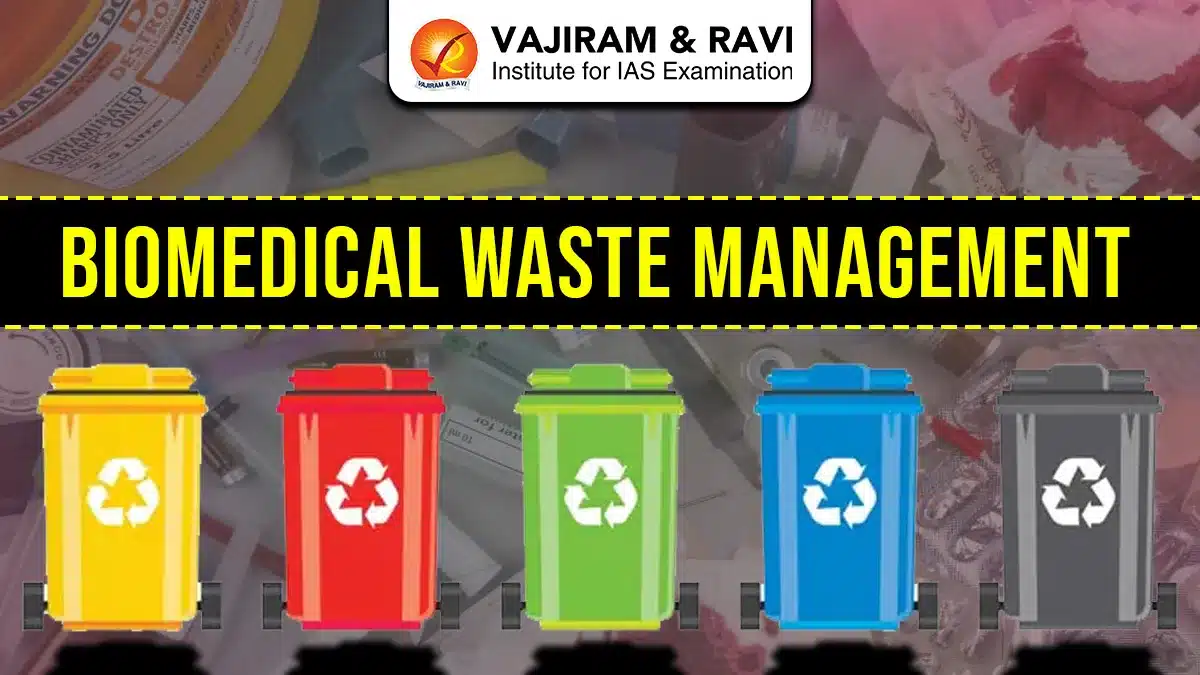
  • Simplified Categorization: To make segregation easier for healthcare workers, the waste categories were reduced from ten to four color-coded categories:
    • Yellow: For infectious waste, anatomical waste, soiled waste, and chemical waste.
    • Red: For contaminated waste (recyclable) like tubing, bottles, and syringes.
    • White: For waste sharps (needles, scalpels).
    • Blue: For glassware and metallic body implants.
  • Pre-treatment of Waste: Laboratory waste, microbiological waste, and blood bags must be pre-treated through disinfection or sterilization on-site (as per WHO or NACO guidelines) before being sent for final disposal.
  • Phasing out Chlorinated Plastics: To prevent the release of toxic dioxins and furans during incineration, the rules mandated the phase-out of chlorinated plastic bags, gloves, and blood bags.
  • Barcoding and GPS: Establish a Bar-Code System for bags or containers containing bio-medical waste for disposal
  • Strict Emission Norms: The rules tightened the standards for incinerators, reducing the permissible limit for particulate matter and increasing the residence time in the secondary chamber to ensure complete combustion.
  • Occupational Safety: Healthcare facilities must provide regular training and immunize all health workers (specifically against Hepatitis B and Tetanus) who handle bio-medical waste.
  • Operator Responsibility: Common Bio-medical Waste Treatment Facility (CBMWTF) operators are now more accountable for the timely collection of waste from even small clinics.

Bio-Medical Waste rules 2016 doesn’t apply to the following types of wastes as they are covered under different acts enumerated below : 

  • Radioactive wastes, 
  • Municipal Solid Wastes,
  • Hazardous chemicals,
  • Lead acid batteries, 
  • Hazardous wastes, 
  • E-Waste, 
  • Hazardous microorganisms, genetically engineered microorganisms and cells

Challenges in Bio-Medical Waste Management in India

Despite a robust legal framework, bio-medical waste management in India faces several challenges. 

  • Improper segregation at source, especially in small clinics and rural health centres. 
  • Limited coverage and capacity of Common Bio-Medical Waste Treatment Facilities (CBWTFs) lead to unsafe disposal in remote areas. 
  • Inadequate training and awareness among healthcare workers and waste handlers increases occupational risks.
  • Weak monitoring, poor data reporting, and non-compliance by private healthcare facilities.
  • The surge in waste during health emergencies like COVID-19 has also exposed infrastructural and logistical gaps.

Way Forward

  • Ensure strict segregation at source through regular audits and penalties.
  • Expand CBWTF coverage in rural and underserved areas.
  • Strengthen training, safety gear, and immunisation of healthcare workers.
  • Use digital tools like bar-coding, GPS tracking, and real-time reporting.
  • Integrate BMW management into health emergency and disaster planning.

Bio-Medical Waste Management FAQs

Q1: What is Bio-medical waste?

Ans: Bio-medical waste is waste generated during diagnosis, treatment, immunisation, or research related to humans or animals Why is bio-medical waste management necessary?To prevent infections, injuries, toxic exposure, and environmental pollution from hazardous healthcare waste.

Q2: Which law governs bio-medical waste in India?

Ans: Bio-Medical Waste Management Rules, 2016 under the Environment (Protection) Act, 1986.

Q3: Who is covered under BMWM Rules, 2016?

Ans: All healthcare waste generators, including hospitals, clinics, labs, blood banks, veterinary institutions, and health camps.

Q4: Which waste is not covered under BMWM Rules, 2016?

Ans: Bio-Medical Waste rules 2016 doesn’t apply to Radioactive wastes, Municipal Solid Wastes,Hazardous chemicals,Lead acid batteries, Hazardous wastes, E-Waste, Hazardous microorganisms, genetically engineered microorganisms and cells

Q5: What are the key features of BMWM Rules, 2016?

Ans: Four-colour segregation, pre-treatment of infectious waste, bar-coding, strict emission norms, and worker safety measures.

Subhadra Yojana, Objectives, Features, Eligibility Criteria

Subhadra Yojana

The Subhadra Yojana is a welfare initiative launched by the State Government of Odisha to provide direct financial support to women from economically weaker sections. The scheme is designed to empower women financially through regular cash transfers, promote digital literacy, and ensure economic independence. The scheme is named after Goddess Subhadra, the sister of Lord Jagannath, the scheme carries cultural significance and resonates emotionally with the people of Odisha, reflecting the state’s rich heritage and devotion.

Subhadra Yojana Objectives

The Subhadra Yojana aims to assist financially the women residing permanently in the state of Odisha. The major objectives of this scheme has been listed below:

  • Financial Empowerment: To provide women with direct cash support, enabling them to manage household and personal finances independently.
  • Economic Inclusion: To ensure that women from economically weaker sections gain access to government benefits without intermediaries.
    Promotion of Digital Literacy: To encourage the use of digital banking and transactions through incentives.
  • Cultural Relevance: To align the scheme with Odisha’s traditions and heritage by naming it after Goddess Subhadra.
  • Wider Coverage: To benefit over one crore women across the state by 2028-29.

Subhadra Yojana Features

The major features of the Subhadra Yojana has been listed below:

  • Annual Financial Assistance: Women receive 10,000 annually in two equal installments of ₹5,000 each. Payments are made on: Rakhi Purnima (August) and International Women’s Day (March 8)
  • Direct Benefit Transfer (DBT): Cash is transferred directly to Aadhaar linked bank accounts, ensuring transparency and eliminating intermediaries.
  • e-KYC Requirement: All beneficiaries undergo e-KYC to maintain accountability and reduce leakages.
  • Subhadra Debit Card: Women are issued a debit card to withdraw cash and make digital transactions conveniently.
  • Digital Transaction Incentive: ₹500 is awarded to the top 100 beneficiaries in each gram panchayat or urban local body for maximum digital transactions.
  • Implementation Period: The scheme runs over five years (2024-25 to 2028-29) to cover a wide base of beneficiaries.

Subhadra Yojana Eligibility Criteria

The Candidates must fulfill the below listed requirements so as to be eligible for the Subhadra Yojana Scheme. The major requirements as laid by the Government of Odisha has been given below:

  • Gender: Only women are eligible.
  • Age: Women between 21 and 60 years.
  • Income: Targeted at economically weaker sections; government employees, income tax payees, and those receiving ₹1,500 or more per month from other government schemes are excluded.
  • Residency: Must be a resident of Odisha.
  • Documentation: Aadhaar-based e-KYC and bank account details are required for enrollment.

Subhadra Yojana Impacts

Subhadra Yojana plays a crucial role in women empowerment by providing financial independence, promoting digital literacy, and encouraging economic participation. Key impacts include:

  • Economic Independence: Regular cash transfers allow women to manage personal and household finances confidently.
  • Digital Literacy: Incentives for digital transactions encourage women to adopt modern banking and financial practices.
  • Social Security: Direct cash support reduces dependency on family members and enhances women’s decision-making power.
  • Entrepreneurial Opportunities: Financial assistance can help women invest in small businesses or self-employment ventures.
  • Community Development: Empowered women contribute to the socio-economic progress of their families and communities.

Women Empowerment Government Initiatives

The Union Government has launched several schemes to complement state-level initiatives like Subhadra Yojana. This Yojana aligns perfectly with these initiatives, creating a comprehensive ecosystem for women’s socio-economic development. The other initiatives that promote Women Empowerment are:

  • Beti Bachao Beti Padhao (BBBP): Promotes girl child education and addresses declining child sex ratio.
  • Pradhan Mantri Matru Vandana Yojana (PMMVY): Provides ₹5,000 financial assistance in three installments for first live birth to improve maternal health.
  • National Nutrition Mission (POSHAN Abhiyaan): Enhances nutrition for pregnant women, lactating mothers, and children under six.
  • Ujjwala Yojana (PMUY): Provides LPG connections to women from BPL households for better health and reduced firewood dependency.
  • Sukanya Samriddhi Yojana (SSY): Encourages savings for girl children’s education and marriage.
  • One Stop Centre Scheme (OSC): Offers medical, legal, psychological support, and temporary shelter for women facing violence.
  • Swadhar Greh Scheme: Provides shelter and rehabilitation for widows, domestic violence victims, and trafficking survivors.
  • Nirbhaya Fund: Ensures women’s safety in public spaces, transportation, and sets up fast-track courts.
  • Support the Training and Employment Program for Women (STEP): Provides skill training for self-employment and financial independence.
  • Pradhan Mantri Mahila Shakti Kendra: Promotes grassroots  level women empowerment, digital literacy, and access to government schemes.
  • Mahtari Vandana YojanaIt is a similar initiative by Chhattisgarh government which provides ₹1000 monthly financial aid to eligible women who is above the age of 21 years.
Related Articles
Mahtari Vandana Yojana Atal Pension Yojana
PM Matsya Sampada Yojana Pradhan Mantri Jeevan Jyoti Bima Yojana
Pradhan Mantri Suraksha Bima Yojana Rashtriya Krishi Vikas Yojana
Deendayal Antyodaya Yojana Pradhan Mantri Kaushal Vikas Yojana
Ladla Bhai Yojana Pradhan Mantri Mudra Yojana


Subhadra Yojana FAQs

Q1: What is Subhadra Yojana?

Ans: A welfare scheme by the Odisha government providing direct financial support to women from economically weaker sections.

Q2: Who can apply for Subhadra Yojana?

Ans: Women aged 21-60 years, excluding government employees, income tax payees, and those receiving ₹1,500+ from other schemes.

Q3: How much financial assistance is provided?

Ans: ₹10,000 annually, disbursed in two installments of ₹5,000 each via Direct Benefit Transfer.

Q4:  When are the payments made?

Ans: On Rakhi Purnima (August) and International Women’s Day (March 8).

Q5: What is the Subhadra Debit Card?

Ans: A debit card issued to beneficiaries for cash withdrawal and digital transactions.

Important Days in February 2026, National and International Days List

Important Days in February 2026

February is an important month that focuses on health, science, language, social justice and cultural awareness. The Important Days in February 2026 include many national and international observances that highlight critical global and Indian issues, even though it is the shortest month of the year. In India, February is also the last month of winter and is marked by festivals, cultural events and historical commemorations that make it significant.

Important Days in February 2026

Important Days in February 2026 include several national, international, cultural and awareness days. These days are observed to educate people about health issues, scientific achievements, social equality, environmental protection and historical personalities. Major Festivals that fall in the month of February include: Mahashivaratri, Ramadan and other regional festive events.

List of Important Days in February 2026

The list of Important Days in February 2026 has been tabulated below:

Important Days in February 2026
Date Event Significance

1 February

Union Budget (India)

Since 2017, the Government of India releases Union Budget on this day each year

1 February

Indian Coast Guard Day

Marks the foundation day (Feb 1, 1977) of the Indian Coast Guard and its role in maritime security.

1 February

Guru Ravidas Jayanti

Celebrates the birth of saint and social reformer Guru Ravidas.

1-7 February

International Development Week

Highlights global development efforts and career opportunities in development sectors.

2 February

World Wetlands Day

Raises awareness about the importance of wetlands and environmental conservation.

2 February

Rheumatoid Arthritis Awareness Day

Spreads awareness about Rheumatoid Arthritis and its impact on health.

4 February

World Cancer Day

Promotes awareness, prevention and control of cancer worldwide.

4 February

Independence Day of Sri Lanka

Celebrates Sri Lanka’s independence from British rule in 1948.

6 February

International Day of Zero Tolerance for Female Genital Mutilation

Educates about the harmful effects of female genital mutilation.

9 February

Baba Amte’s Death Anniversary

Remembers the social reformer known for work with leprosy patients.

9 February (Second Monday of the Month)

International Epilepsy Day

Raises awareness about epilepsy and the need for better treatment, observed on second Monday of February

10 February

National Deworming Day

Government initiative to protect children from parasitic worm infections, celebrated biannually on Feb 10 and Aug 10.

10 February

World Pulses Day

Highlights the nutritional and environmental benefits of pulses.

10 February

Safer Internet Day

Encourages safer and responsible use of the internet, especially for children. Observed on Second Tuesday of the Month

11 February

World Day of the Sick

Observed to pray and care for people suffering from illness.

11 February

International Day of Women and Girls in Science

Promotes gender equality in science and technology fields.

12 February

Darwin Day

Commemorates the birth of Charles Darwin and his contribution to science.

12 February

Abraham Lincoln’s Birthday

Honors the former US President known for ending slavery.

12 February

National Productivity Day

Promotes productivity awareness in India.

13 February

World Radio Day

Highlights the importance of radio as a mass communication medium.

13 February

Sarojini Naidu Birth Anniversary

Celebrates the birth of the Nightingale of India and freedom fighter.

14 February

Black Day

Commemorates the sacrifice of Indian Soldiers in the Pulwama Attack of 2019

14 February

World Congenital Heart Defect Awareness Day

Raises awareness about congenital heart defects.

15 February

Mahashivratri

Major Hindu festival dedicated to Lord Shiva.

18-27 February

Taj Mahotsav

Cultural festival showcasing India’s heritage at Agra.

17 February

Ramadan Begins

Marks the beginning of the holy fasting month for Muslims.

19 February

World Anthropology Day

Promotes awareness about anthropology and human societies. Observed on Third Thursday of the Month

20 February

Arunachal Pradesh Foundation Day

Celebrates the formation of Arunachal Pradesh.

20 February

Mizoram Foundation Day

Marks Mizoram becoming a full fledged Indian state.

20 February

World Day of Social Justice

Promotes equality, employment and social inclusion.

21 February

International Mother Language Day

Encourages linguistic diversity and multilingual education.

22 February

World Thinking Day

Observed by Girl Guides and Girl Scouts worldwide. This year marks the 100th Anniversary of the day.

23 February

World Peace and Understanding Day

Promotes peace and international understanding.

24 February

Central Excise Day

Encourages efficient functioning of the excise department in India.

26 February

Veer Savarkar’s Death Anniversary

This day remembers freedom fighter Vinayak Damodar Savarkar.

27 February

World NGO Day

Recognizes the contribution of non-governmental organizations.

28 February

National Science Day (India)

Marks the discovery of the Raman Effect by C.V. Raman.

28 February

Rare Disease Day

Raises awareness about rare diseases and affected individuals. Observed on the last day of February.

Major Important Days in February 2026 Explained

The significance and background of the days celebrated in the month of February has been detailed below:

February 1: Union Budget and Indian Coast Guard Day

February 1 is important in India as the Union Budget is presented on this day. It outlines government policies, expenditure and development plans. The same day is also celebrated as Indian Coast Guard Day, honoring the force that protects India’s maritime boundaries.

February 4: World Cancer Day

World Cancer Day is observed to spread awareness about cancer prevention, early detection and treatment. It encourages global efforts to reduce cancer related deaths.

February 6: Zero Tolerance for Female Genital Mutilation

This international observance highlights the harmful effects of female genital mutilation and promotes human rights and women’s health.

February 10: National Deworming Day and World Pulses Day

National Deworming Day focuses on improving child health in India, while World Pulses Day promotes pulses as a sustainable and nutritious food source.

February 11: Women and Girls in Science

This day recognizes the achievements of women in science and encourages equal participation in scientific research and education.

February 12: Darwin Day

Darwin Day celebrates the birth of Charles Darwin and his contribution to evolutionary science through the theory of natural selection.

February 13: Sarojini Naidu Birth Anniversary

Sarojini Naidu was a freedom fighter, poet and the first woman Governor of an Indian state. Her birth anniversary honors her contribution to India’s freedom struggle.

February 15: Mahashivratri

Mahashivratri is a major Hindu festival dedicated to Lord Shiva. Devotees observe fasting and night long prayers.

February 20: State Foundation Days and Social Justice

Arunachal Pradesh and Mizoram celebrate their foundation days on February 20. The same day is also observed as World Day of Social Justice, promoting equality and inclusion.

February 28: National Science Day

National Science Day commemorates the discovery of the Raman Effect by C.V. Raman in 1928 and promotes scientific thinking among students and citizens.

Important Days in February 2026 FAQs

Q1: Why is February important for awareness campaigns?

Ans: February includes many health, science and social justice observances that focus on public awareness.

Q2: Which is the most important national day in February in India?

Ans: National Science Day on February 28 is one of the most important national observances.

Q3: Why is February 21 celebrated as International Mother Language Day?

Ans: It promotes linguistic diversity and the protection of mother languages worldwide.

Q4: What is the significance of World Cancer Day?

Ans: World Cancer Day spreads awareness about cancer prevention and treatment.

Q5: Which cultural festival is celebrated in February in Agra?

Ans: Taj Mahotsav is celebrated in February to showcase India’s cultural heritage.

Critical Minerals, About, Application, Availability, Importance

Critical Minerals

Why in the news?

As part of the continuous Structural reforms in the mining sector undertaken by Government of India to align with the  vision of Aatmanirbhar Bharat and Viksit Bharat 2047, the Government has recently notified Coking Coal as Critical and Strategic mineral under the Mines and Minerals (Development and Regulation) Act, 1975 (MMDR Act).

About Critical Minerals

Critical Minerals are the set of minerals which are crucial for national security and  latest modern technologies and economic development but due to their lack of availability, geographical concentration, extraction or processing difficulties leads to supply chain disruptions.

Why are they called Critical Minerals?

  • The criticality level of minerals are determined by their economic importance and their risk of supply chain disruptions. 
  • The economic importance depends on the factor of how relevant it is to produce new advanced technologies, while the supply chain vulnerabilities refer to likelihood of shortage due to their geographical scarcity and extraction difficulties.
  • The major reason for the mineral supply chain disruptions is that they are present in minimum concentration as by-products of the ‘major’ minerals. 
  • The other reason for their criticality is the market concentration in the downward processing stage.
  • For instance about 40% of global smelting and refining of Cobalt, Lithium, REE and Copper is concentrated in China.

Coking Coal Inclusion Significance

  • India accounts for about 37.37 billion tonnes of coking coal, majorly found in Jharkhand, with minor reserves in Madhya Pradesh, West Bengal, and Chhattisgarh
  • However, despite this India saw coking coal imports rising from 51.20 million tonnes in 2020–21 to 57.58 million tonnes in 2024–25
  • At present, around 95% of the steel industry’s coking coal requirement is fulfilled through imports, creating a heavy drain on foreign exchange.
  • Now, classifying coking coal as a critical mineral is expected to increase approvals, upgrade ease of doing business, and boost up exploration and mining, including deep-seated deposits
  • Exemptions from public consultation and the use of degraded forest land for compensatory afforestation are also likely to attract greater private sector participation.

Use of Coking Coal

  • Essential for steel making: Coking coal is a crucial raw material which is used to produce coke, which is essential for steel production.
  • Supports infrastructure growth: Steel which is made using coking coal is crucial for buildings, railways, roads, and defence equipment.
  • Economic importance: Reducing dependence on imports can save foreign exchange and strengthen India’s economy.
  • Strategic significance: A steady supply of coking coal is crucial for industrial security and self-reliance.
  • Employment and investment: Increase in domestic mining can create jobs and can also attract private investment.

Critical Minerals Application

  • Energy: They are indispensable for clean energy technologies like solar panels, wind turbines, advanced batteries for energy storage and transportation.

Example: Lithium and Cobalt are used in Lithium ion batteries which are the backbone of Electric vehicles (Evs)

  • Modern technologies: Critical minerals are the foundation on which modern technologies are built. Most of the modern digital devices depend on critical minerals for their manufacturing.

Example: the manufacturing of semiconductors, LEDs and modern micro high speed chips.

  • Defence and strategic technologies: They are used in advanced military equipment to increase precision, to support R&D and other aerospace weaponry.

Example: the use of Titanium in submarines and fighter jets.

  • Medical devices: Critical minerals play a vital role in the diagnostics, advanced medical equipment and implants.

Example: Use in MRI and medical imaging systems.

  • Space Technologies: Critical minerals are essential for space missions and nuclear energy infrastructure.

Example: Use of Beryllium in the satellites and space exploration telescope.

Critical Minerals List

The Government of India in 2023 has notified a list of 30 Critical Minerals, which are crucial for India’s economic development, which is as follows:

Critical Minerals List
S.No. Critical Minerals Application
  1.  

Antimony

Flame retardants, Lead-acid batteries, Lead alloys, Plastics (catalysts and stabilisers), Glass and ceramics

2.

Beryllium

Automotive components: Transport and Defence Manufacturing of Machinery., Electronic and telecommunications equipments

3.

Bismuth

Chemicals, Pharmaceuticals, Casting of Iron

4.

Cadmium

Batteries, Pigments, Coatings

5.

Cobalt

Electric Vehicle, Batteries, corrosion resistant alloys, aerospace applications, Pigments and Dyes

6.

Copper

Electrical and electronics products, Electrical Wiring, Solar Panel, Automotive industry

7.

Gallium

Semiconductors, Integrated Circuits, LEDs

8.

Germanium

Optical fibres, satellites, solar cells

9.

Graphite

Batteries, Lubricants, fuel cells for EVs, Electric Vehicle

10.

Hafnium

Superalloy, Catalyst precursor, Semiconductors, Oxide for Optical, Nuclear reactors

11.

Indium

Electronics (Laptops, LED Monitors/TVs, Smartphones), and semiconductors

12. 

Lithium

Electric Vehicle, Batteries, glassware, ceramics, fuel manufacturing, Lubricant

13.

Molybdenum 

Steel alloys, Pigment and Dyes, Catalyst, Electrical and Electronic

14. 

Niobium

Construction, transportation

15. 

Nickel

Stainless steel, solar panels, batteries, aerospace, defence applications and Electric Vehicle

16.

PGE

Auto catalyst, Jewellery, medicine, electronic equipment used by military

17.

Phosphorus 

Mineral fertilizer

18.

Potash 

Chemical Fertilizers, Water softener

19.

Rare earth element (REE)

Permanent magnets for electricity generators and motors, catalyst, polishing, Batteries, Electronics, Defence technologies, wind energy sector, aviation, and Space

20.

Rhenium 

Super-alloys, aerospace and machinery uses, Catalysts in petroleum industry

21.

Selenium 

Electrolytic, Manganese, Glass, pigments

22.

Silicon

Semiconductors, electronics, and transport equipment, Paints, Aluminum alloys

23.

Strontium

Alloys of aluminium, Pigments and Fillers, Glass, Magnets, Pyrotechnic applications

24.

Tantalum 

Capacitors, Superalloys, Carbides, Medical technology

25.

Tellurium

Solar power, thermoelectric devices, Rubber vulcanising

26.

Tin

Aerospace, construction, home decor, electronics, jewellery and telecommunications

27.

Titanium

Aerospace and defence applications, chemicals and petrochemicals, Pigments, Polymers

28.

Tungsten

Mill and cutting tools, Mining and construction tools, Catalysts and pigments, Aeronautics and energy uses, tungsten carbide

29.

Vanadium

Alloys, batteries 

30.

Zircon

High value chemical manufacturing and electronics sector

Critical Minerals Vs. Rare Earth Elements (REE)

Critical Minerals are a broad class of minerals, which are crucial for the economy and clean energy of a country with a high supply chain vulnerability. Their classification is determined by their strategic importance, economic availability and supply chain risks. 

Rare Earth Elements (REE) are a subset of specific 17 chemically similar elements in the periodic table. They are a part of Critical minerals if deemed strategic importance. They are primarily used in high-performance magnets, electronics and defence, EVs and wind turbines.

Critical Mineral Global Overview

The report by the International Energy Agency provides an outlook for the key energy minerals and rare earth elements.

Critical Mineral Global Overview
S.No. Critical Mineral Top 3 (Mining Countries) Top 3 (Refining Countries)
  1.  

Copper 

  1. Chile
  2. Peru
  3. DRC
  1. China
  2. Chile 
  3. DRC
  1.  

Lithium

  1. China
  2. Australia
  3. Chile
  1. China
  2. Chile
  3. Australia

3.

Nickel

  1. Indonesia
  2. Philippines
  3. Russia
  1. Indonesia
  2. China
  3. Russia

4.

Cobalt

  1. Democratic Republic of Congo
  2. Indonesia
  3. Russia
  1. China
  2. Finland
  3. Indonesia

5.

Graphite

  1. China
  2. Japan
  3. Madagascar
  1. China
  2. Japan
  3. Indonesia

6.

REE

  1. China
  2. Australia
  3. Myanmar
  1. China
  2. U.S.A
  3. Malaysia

Critical Mineral Five Pillars Value Chain

For the success of the Critical Minerals in India, there is a need to develop capacity at each stage starting from exploration to recycling.

For the success of the Critical Minerals in India, there is a need to develop capacity at each stage starting from exploration to recycling.

1. Geoscience and Upstream Exploration

  • Diverse geological regions of India have been thoroughly mapped by the Geological Survey of India (GSI) to recognize mineral-rich areas known as Obvious Geological Potential (OGP) zones
  • These respective zones hold important minerals such as gold, rare earth elements, nickel, and cobalt. Exploration of minerals is mainly undertaken by MECL and State mining departments. 
  • Earlier, exploration was mainly focused on bulk minerals like coal and iron ore. 
  • However, with rising demand for critical minerals the focus has shifted towards deep-seated resources. Reforms such as the MMDR Amendment Act, 2021 and further support from NMET have enabled accelerated participation by the private sector in mineral exploration.

2. Upstream Mining and Extraction

  • Mining is the process of separating minerals from the earth through both surface or underground methods, depending on the characteristics of the deposit. These operations often use heavy machinery for drilling, blasting, excavation, and transporting minerals for further processing.

3. Midstream – Processing, Refining and Metallurgy

  • Although India has strengthened mineral exploration and manufacturing, intermediate processing and refining still need much attention. 
  • Developing advanced, environmentally friendly refining technologies is crucial for building a strong critical minerals ecosystem. 
  • Even though India has capable research institutions, most of the work remains at the laboratory level. 
  • Increase in funding and pilot-scale support are essential to commercialize innovations and process minerals efficiently from primary sources as well as waste such as used batteries and mine tailings.

4. Downstream - Component Manufacturing & Advanced Technology Production

  • Processed critical minerals are used in EV motors, wind turbines, and other advanced products.
  • Permanent magnets from rare earth metals are key for electric vehicles and renewable energy.
  • India’s Aatmanirbhar Bharat and Make in India programs promote domestic manufacturing and exports.
  • The PLI (Production-Linked Incentive) scheme boosts global competitiveness in 13 sectors; 7 key sectors using critical minerals:
    • Large-scale electronics (MeitY)
    • Electronic/technology products (MeitY)
    • Telecom & networking products (DoT)
    • White goods like ACs & LEDs (DPIIT)
    • High-efficiency solar PV modules (MNRE)
    • Automobiles & auto components (DHI)
    • Advanced Chemistry Cell batteries (DHI)

5. Material Recovery & Recycling

  • Recycling majorly reduces dependence on the primary minerals and assists sustainable development.
  • Lithium-ion batteries and other such tech products can be recycled to recover valuable minerals.
  • Currently, only steel, lead, copper, and aluminium have significant recycling rates; others have  minimal.
  • By 2040, recycling is expected to play a major role globally.
  • Strong recycling policies and infrastructure are needed to recover minerals from end-of-life products, industrial waste, and post-consumer goods.

Critical Minerals Initiatives taken by the Government 

The Government of India has launched several initiatives, such as the National Critical Minerals Mission, overseas mineral asset acquisition, exploration reforms, and recycling policies to ensure secure, sustainable, and diversified access to critical minerals essential for economic growth and energy transition.

Early Policy Recognition (2011)

  • The Planning Commission (now NITI Aayog) highlighted the need for assured mineral availability for India’s industrial growth.
  • Focus was placed on systematic exploration, efficient management, recycling, overseas acquisition, and R&D for substitutes.
  • A list of 12 strategic minerals was identified, including lithium, cobalt, tin, tungsten, rare earths, and others.

Ministry of Mines Initiative

  • In 2011, the Ministry of Mines formed a Steering Committee to assess Rare Earth Elements (REEs) and energy-critical minerals.
  • The 2012 roadmap emphasized strengthening the entire mineral supply chain—from exploration to manufacturing.

Research on Mineral Criticality

  • A CEEW study (2016), supported by DST, highlighted weak research on mineral security in India.
  • It developed a criticality index for 49 non-fuel minerals and identified 13 minerals as highly critical by 2030, including rare earths, graphite, germanium, and niobium.

Focus on Rare Earth Elements (2017–2020)

  • GSI and AMD submitted reports on India’s potential REE deposits and strategies to enhance REE exploration.
  • India Exim Bank also stressed the importance of securing REEs for economic and strategic needs.

CSEP Studies on Critical Minerals

  • CSEP adopted the EU methodology to identify critical minerals for India.
  • Studies (2021–2023) assessed the criticality of 11, 23, and 43 non-fuel minerals based on economic importance and supply risk.
  • These studies also projected mineral demand for manufacturing and green technologies.

Critical Minerals in India: Conclusions & Recommendations

  • India adopted a three-stage assessment involving global benchmarking, inter-ministerial consultations, and empirical analysis to identify critical minerals. The study reviewed strategies of major economies and shortlisted 69 globally critical minerals, incorporating domestic research inputs. Sectoral consultations ensured alignment with national priorities. 
  • An EU-style framework based on economic importance and supply risk was proposed, highlighting the need for robust indicators such as import reliance and substitutability. Based on this process, 30 minerals, including two fertilizer minerals, were identified as most critical for India.
  • To address supply vulnerabilities, the report recommends establishing a Centre of Excellence for Critical Minerals under the Ministry of Mines. The Centre should focus on advanced exploration, R&D, policy coordination, international collaboration (including KABIL), and periodic updating of the critical minerals list. This would help build a domestic value chain and reduce import dependence in strategic sectors.

UPSC CSE Prelims PYQs

  1. Consider the following statements: [2025]
  2. India has joined the Minerals Security Partnership as a member.
  3. India is a resource-rich country in all the 30 critical minerals that it has identified.

III. The Parliament in 2023 has amended the Mines and Minerals (Development and Regulation) Act, 1957 empowering the Central Government to exclusively auction mining lease and composite licenses for certain critical minerals.

Which of the statements given above are correct?

  1. I and II only
  2. II and III only
  3. I and III only
  4. I, II and III

Critical Minerals FAQs

Q1: What are critical minerals?

Ans: Critical minerals are the set of minerals crucial for national security and latest modern technologies and economic development but due to their lack of availability, geographical concentration, extraction or processing difficulties leads to supply chain disruptions.

Q2: Why was Coking Coal declared as Critical Mineral?

Ans: Despite having large reserves, India imports nearly 95% of its coking coal for steel production, leading to high foreign exchange loss.

Q3: What are the major applications of critical minerals?

Ans: Some of the major applications of critical minerals are Renewable energy (solar panels, wind turbines), Electric vehicles and batteries, Semiconductors and electronics etc.

Q4: How are critical minerals different from Rare Earth Elements (REEs)?

Ans: Critical minerals are a broad category based on economic importance and supply chain risk. REEs are a subset of 17 specific elements, mainly used in magnets, electronics, EVs, defence, etc

Q5: Why are critical minerals called “critical”?

Ans: They are called critical due to high economic importance for advanced technologies and high supply chain risk.

Exercise Agni Pariksha

Exercise Agni Pariksha

Exercise Agni Pariksha Latest News

The Indian Army and Indo-Tibetan Border Police recently conducted Agni Pariksha in Arunachal Pradesh to enhance joint combat capabilities.

About Exercise Agni Pariksha

  • It is a joint training exercise involving personnel from the Indian Army and the Indo-Tibetan Border Police (ITBP).
  • Location: Arunachal Pradesh
  • This first-of-its-kind initiative aimed to enhance inter-force combat synergy and operational integration. 
  • It witnessed spearhead gunners of Spear Corps, along with personnel from artillery regiment, infantry battalions, and the ITBP, participating in a unique collaborative firepower training initiative validated through live artillery firing.
  • The primary objective of the exercise was to familiarise non-artillery personnel with artillery procedures, coordination mechanisms, and the execution of firing missions, thereby improving their understanding of firepower integration in dynamic combat scenarios.
  • During the training, participating infantry and ITBP personnel were systematically trained to independently undertake multiple artillery firing drills under the close supervision and guidance of experienced Spearhead Gunners.

Source: HANS

Exercise Agni Pariksha FAQs

Q1: What is Exercise Agni Pariksha?

Ans: It is a joint training exercise involving personnel from the Indian Army and the Indo-Tibetan Border Police (ITBP).

Q2: Where was Exercise Agni Pariksha conducted?

Ans: It was conducted in Arunachal Pradesh.

Q3: What was the primary objective of Exercise Agni Pariksha?

Ans: To familiarise non-artillery personnel with artillery procedures, coordination mechanisms, and firing mission execution.

Zapotec Civilization

Zapotec Civilization

Zapotec Civilization Latest News

Archaeologists in Mexico recently discovered a 1,400-year-old tomb from the Zapotec culture that features well-preserved details, including a sculpture of a wide-eyed owl with a man in its beak, multicolored murals and calendrical carvings.

About Zapotec Civilization

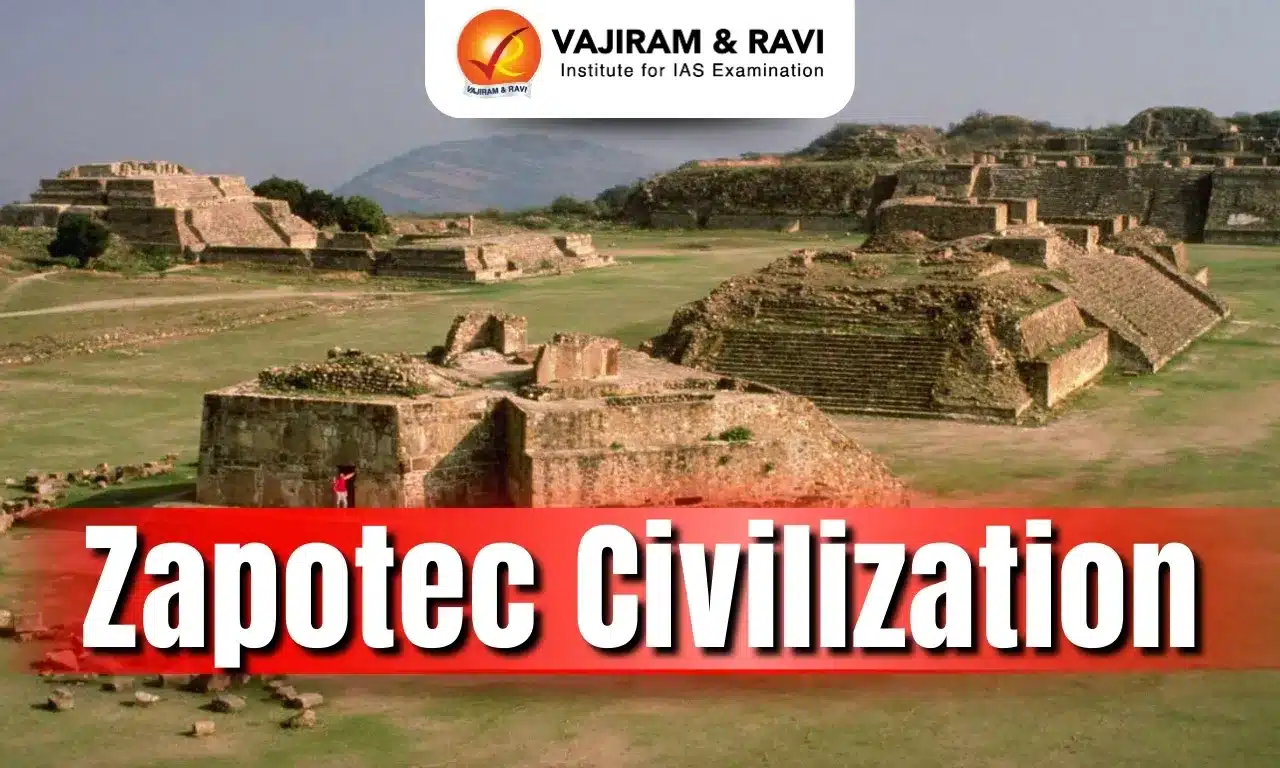
  • The Zapotec civilization thrived in the Valley of Oaxaca, Mexico, characterized by its high elevation and reliance on irrigation from the Atoyac River and its tributaries. 
  • Emerging from hunter-gatherer societies, the Zapotecs transitioned to agriculture, developing skills in weaving, pottery, and stone masonry.
  • By the Classic period (200 BCE-100 CE), they established a highly centralized state, with Monte Albán as their capital, featuring impressive public architecture and a distinct social hierarchy separating nobles from commoners. 
  • This society was marked by a professional priesthood and a state religion, where rituals included human sacrifice and complex ceremonies. 
  • The Zapotecs also innovated in calendar systems and writing, contributing to Mesoamerican culture. 
  • The Zapotec state was one of the earliest examples of centralized government in Mesoamerica. 
  • It was also one of the first to experience the drawbacks of urban living, particularly the need to conquer others in order to obtain sufficient food to sustain an urban civilization. 
  • The civilization's art and architecture reflect a deep intertwining of religion and political power, influencing subsequent cultures like the Mixtec and Aztec civilizations.
  • Decline
    • Decline around 900 CE shifted the capital to Mitla and later Zaachila. 
    • Conflicts with the Aztecs in the 15th century and submission to Spanish rule in 1521 highlight their resilience amid conquests.
    • Today, their descendants preserve languages and traditions, making the Zapotec legacy a living part of Oaxaca’s cultural tapestry.

Source: LS

Zapotec Civilization FAQs

Q1: Where did the Zapotec civilization thrive?

Ans: The Zapotec civilization thrived in the Valley of Oaxaca in Mexico.

Q2: What was the capital of the Zapotec state?

Ans: Monte Albán was the capital.

Q3: What were the major features of Monte Albán?

Ans: It featured impressive public architecture and a distinct social hierarchy

Q4: How was Zapotec society socially structured?

Ans: Society was divided into nobles and commoners.

Q5: What type of religious system existed among the Zapotecs?

Ans: They had a state religion led by a professional priesthood.

Cytoplasm

Cytoplasm

Cytoplasm Latest News

Early development across vertebrates and insects critically relies on robustly reorganizing the cytoplasm of fertilized eggs into individualized cells.

About Cytoplasm

  • Cytoplasm is a thick solution that fills each cell and is enclosed by the cell membrane. 
  • It is mainly composed of water, salts, and proteins. 
  • In eukaryotic cells (i.e., cells having a nucleus), the cytoplasm includes all of the material inside the cell but outside the nucleus, which contains its own watery substance called nucleoplasm. 
  • All of the organelles in eukaryotic cells are located in the cytoplasm. The cytoplasm helps to keep them in place.
    • Among such organelles are the mitochondria, which are the sites of energy production through ATP (adenosine triphosphate) synthesis
    • the endoplasmic reticulum, the site of lipid and protein synthesis; 
    • the Golgi apparatus, the site where proteins are modified, packaged, and sorted in preparation for transport to their cellular destinations; 
    • lysosomes and peroxisomes, sacs of digestive enzymes that carry out the intracellular digestion of macromolecules such as lipids and proteins; 
  • The portion of the cytoplasm surrounding organelles is called cytosol, which is the liquid part of the cytoplasm. 
    • It is composed of about 80 percent water and also contains dissolved salts, fatty acids, sugars, amino acids, and proteins such as enzymes
    • These dissolved substances are needed to keep the cell alive and carry out metabolic processes.
  • Cytoplasm is also the site of most metabolic activities in the cell, and it allows materials to pass easily throughout the cell.
  • Although cytoplasm may appear to have no form or structure, it is actually highly organized. 
    • A framework of protein scaffolds called the cytoskeleton provides the cytoplasm and the cell with their structure.
  • Though prokaryotic cells do not have organelles (they do have ribosomes), they still have cytoplasm.

Source: NT

Cytoplasm FAQs

Q1: What is cytoplasm?

Ans: Cytoplasm is a thick solution that fills each cell and is enclosed by the cell membrane.

Q2: What are the main components of cytoplasm?

Ans: Cytoplasm is mainly composed of water, salts, and proteins.

Q3: What is the watery substance inside the nucleus called?

Ans: It is called nucleoplasm.

Q4: Where are the organelles of eukaryotic cells located?

Ans: All organelles are located in the cytoplasm.

Q5: What is cytosol?

Ans: Cytosol is the liquid part of the cytoplasm surrounding the organelles.

Diplocentrum Papillosum

Diplocentrum Papillosum

Diplocentrum Papillosum Latest News

A new orchid species named Diplocentrum papillosum has been recently discovered in Kanthalloor, Marayoor, in the Idukki district, Kerala.

About Diplocentrum Papillosum

  • It is a new species of orchid.
  • It was discovered in the Idukki district, Kerala.
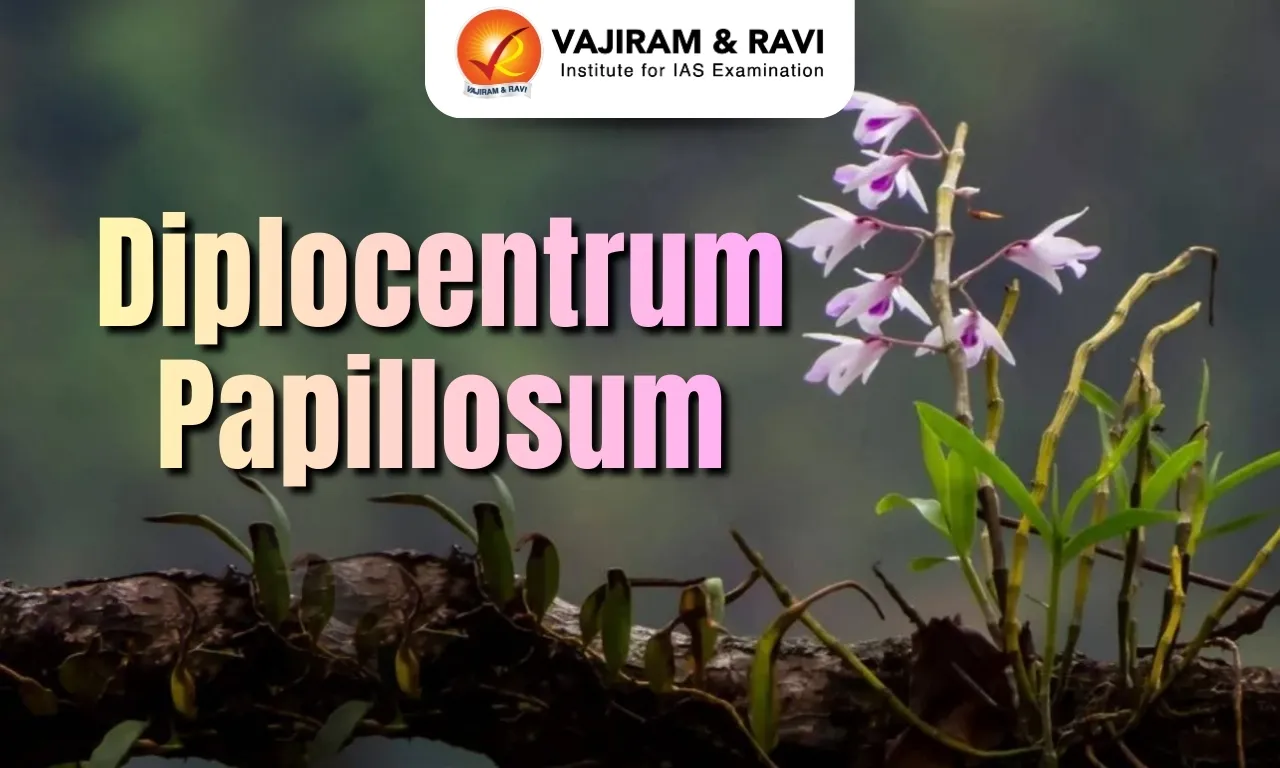
  • Belonging to the Diplocentrum genus, which is found only in the southern ranges of the Western Ghats, the plant has been scientifically named Diplocentrum papillosum, distinguished by the unique characteristics of its flowers.
  • This orchid thrives on rocks and tree branches, with strong roots that help it withstand powerful winds.
  • The specific epithet ‘papillosum’ refers to the papillose character of the flower, which is unique to the Diplocentrum species. 
  • Its unbranched flower clusters, pink and white blooms, and distinctively shaped petals set it apart from other species in the genus.
  • The flowers are both fragrant and visually striking.

Source: ONM

Diplocentrum Papillosum FAQs

Q1: What is Diplocentrum papillosum?

Ans: It is a newly discovered species of orchid.

Q2: Where was Diplocentrum papillosum discovered?

Ans: It was discovered in the Idukki district of Kerala.

Q3: Where is the Diplocentrum genus naturally found?

Ans: It is found only in the southern ranges of the Western Ghats.

Q4: What habitat does Diplocentrum papillosum thrive in?

Ans: It thrives on rocks and tree branches.

Q5: What floral characteristics distinguish Diplocentrum papillosum from other species?

Ans: Its unbranched flower clusters, pink and white blooms, and distinctively shaped petals set it apart.

Union Budget 2026, Date, History, Constitutional Provisions, Stages

Union Budget 2026-27

The Union Budget 2026 is India’s annual financial statement presented by the Central Government that lays down plans for revenue and expenditure for the next financial year from 1 April 2026 to 31 March 2027. It is the most important financial instrument of the government, reflecting priority sectors, economic strategy, taxation policy, social welfare, and fiscal discipline.

The budget determines how India mobilises resources, spends on defence, health, education, infrastructure, and social sectors, and balances growth with fiscal prudence.

What is Union Budget of India?

The Union Budget of India is the annual financial statement of the Government of India, which presents a detailed account of the estimated revenues and expenditures of the Central Government for a particular financial year, running from 1st April to 31st March.

The Union Budget is presented every year by the Union Finance Minister in the Lok Sabha, usually on 1st February, and it requires approval from Parliament before implementation.

Union Budget 2026 Date

Union Budget 2026 will be presented by Finance Minister Nirmala Sitharaman on 1st Februaury, 2026 (Sunday). The upcoming Union Budget 2026 presented by Finance Minister Nirmala Sitharaman is expected to prioritise tax relief, infrastructure expansion, and overall economic growth, even as India navigates global tariff disputes and regional diplomatic challenges. Aligned with the Viksit Bharat@2047 vision, the budget seeks to balance fiscal discipline with strategic investments that promise strong long-term economic returns.

Union Budget History

India’s budgetary tradition began during the colonial era and has grown into a vital instrument guiding the country’s economic and social policies. From the first budget in 1860 to modern times, it reflects India’s evolving fiscal priorities and development goals.

  • Colonial Era Beginnings: The first budget in India was presented on 7th April 1860 by James Wilson, the first Finance Member of the Viceroy’s Council.
  • Purpose in Early Times: Initially, the budget mainly focused on revenue collection and expenditure for administration under British rule.
  • First Post-Independence Budget: After India gained independence, the first budget was presented on 26th November 1947 by R. K. Shanmukham Chetty, setting the foundation for India’s sovereign fiscal policy.
  • Evolution Over Time: The Union Budget transformed from a simple statement of revenue and expenditure to a comprehensive economic policy instrument.
  • Policy and Social Impact: Today, the budget influences economic growth, social welfare, taxation, infrastructure development, and national priorities.
  • Annual Significance: The budget is presented every year, on 1st February, marking the beginning of discussions on economic strategies for the upcoming fiscal year.
  • Modern Innovations: Over decades, the budget has incorporated reforms like digital reporting, gender budgeting, environmental considerations, and sector-specific allocations.
  • Public Engagement: With growing transparency, the budget now engages citizens, experts, and industries through detailed presentations, press releases, and live sessions.

Union Budget Constitutional Provisions

The Union Budget of India is prepared, presented, and implemented strictly according to the constitutional framework laid down in the Indian Constitution. These provisions ensure financial accountability, legislative control, and transparency in the use of public money.

Note: The term ‘budget’ is nowhere mentioned in the Constitution of India.

Union Budget Constitutional Provisions
Article Provision Explanation

Article 112

Annual Financial Statement

Mandates the presentation of the Union Budget showing estimated receipts and expenditures of the Government of India for the financial year.

Article 113

Voting on Demands for Grants

Requires Lok Sabha approval for all expenditure demands of ministries; Rajya Sabha has no voting power.

Article 114

Appropriation Bill

Authorizes withdrawal of money from the Consolidated Fund of India after demands are passed.

Article 110

Finance Bill (Money Bill)

Contains tax proposals; can be introduced only in Lok Sabha and cannot be rejected by Rajya Sabha.

Article 117

Financial Bills

Deals with bills involving expenditure from the Consolidated Fund other than Money Bills.

Article 266

Consolidated Fund of India

All revenues, loans, and repayments go into this fund; money can be withdrawn only with parliamentary approval.

Article 267

Contingency Fund of India

Used to meet unforeseen expenditure, placed at the disposal of the President.

Article 109

Role of Rajya Sabha

Rajya Sabha can only discuss the Budget and must return Money Bills within 14 days.

Article 111

Presidential Assent

Budget becomes law only after President gives assent to Appropriation and Finance Bills.

Article 116

Vote on Account

Allows government to meet expenses temporarily if Budget is not passed in time.

Stages of Budget Session in Indian Parliament

The Budget Session of the Indian Parliament is a special session conducted to discuss, scrutinize, and approve the Union Budget for the upcoming financial year. The stages of Budget Session 2026-27 have been discussed below.

  1. Presentation of the Budget: The Union Budget is presented in the Lok Sabha on 1st February every year by the Finance Minister of India. During the presentation, the Finance Minister delivers the budget speech. After the speech, the budget is formally laid before both Houses of Parliament.
  2. General Discussion: Members of the Lok Sabha discuss the budget as a whole or on any principle involved in it. However, no cut motions can be moved, and the budget is not submitted to a vote at this stage. The Finance Minister has the right to reply at the end of the discussion, clarifying policies and addressing members’ concerns.
  3. Scrutiny by Departmental Committees: Each departmental standing committee conducts an in-depth examination of the Demands for Grants of its respective ministry. This process lasts three to four weeks, during which the House remains in recess. At the end of this period, the committees submit their reports to Parliament, suggesting reductions, modifications, or reallocations if necessary.
  4. Voting on Demands for Grants: The Lok Sabha votes on the individual demands for grants of each ministry. Only Lok Sabha members can vote on these demands. Expenditure charged on the Consolidated Fund of India is excluded and does not require voting.
  5. Passing of Appropriation Bill: No money can be withdrawn from the Consolidated Fund of India except through an Appropriation Bill. This bill authorises the government to withdraw funds and meet its approved expenditures for the financial year.
  6. Passing of Finance Bill: The Finance Bill is introduced to give legal effect to the financial proposals of the government, including taxation and revenue measures, for the upcoming year. It is presented as a Money Bill under Article 110 and requires Lok Sabha approval followed by Presidential assent to become the Finance Act.

Documents Presented in Parliament Along with the Union Budget

When the Union Budget is presented in Parliament, it is accompanied by several mandatory documents that provide detailed information on government finances, allocations, and fiscal policies. These documents ensure transparency, accountability, and detailed scrutiny of government expenditure and revenue.

Budget Documents:

  • Annual Financial Statement (AFS): The primary budget document detailing the estimated receipts and expenditures of the Government of India, prepared under Article 112 of the Constitution.
  • Demands for Grants (DGs): Ministry-wise requests for funds for specific services and schemes, which must be voted upon by the Lok Sabha.
  • Finance Bill: Introduces new taxes or amendments to existing tax laws to implement the government’s revenue proposals.
  • Appropriation Bill: Authorizes the withdrawal of funds from the Consolidated Fund of India to meet expenditure approved through the budget.

FRBM Act Mandated Statements (Fiscal Responsibility and Budget Management)

  • Macro-Economic Framework Statement (MEFS): Evaluates economic growth prospects, fiscal balance, and external sector position for the upcoming year.
  • Fiscal Policy Strategy Statement (FPSS): Outlines the government’s fiscal policies and priorities for the financial year.
  • Medium-Term Fiscal Policy Statement (MTFPS): Presents medium-term fiscal targets and strategies to ensure sustainable public finances over the next 3 years.
Other Related Posts
National Income UPSC Economy Notes 2026
Inflation Monetary Policy in India
Sectors of Indian Economy Balance of Payments
Economic Growth and Development Indirect Tax
Fiscal Policy in India Financial Market
Reserve Bank of India MSME
Poverty and Developmental Issues Green GDP

Union Budget 2026 FAQs

Q1: What is the Union Budget 2026-27?

Ans: The Union Budget 2026-27 is the annual financial statement of the Government of India for the fiscal year 1st April 2026 to 31st March 2027.

Q2: Who presents the Union Budget 2026-27?

Ans: The Finance Minister of India, currently Nirmala Sitharaman, presents the budget in the Lok Sabha.

Q3: When is the Union Budget 2026-27 presented?

Ans: It is scheduled to be presented on 1st February 2026, keeping the tradition of presenting the budget before the start of the new financial year.

Q4: Under which Article of the Constitution is the Union Budget presented?

Ans: The budget is presented under Article 112 (Annual Financial Statement) of the Indian Constitution.

Q5: What are Demands for Grants?

Ans: Demands for Grants (DGs) are ministry-wise requests for funds for specific services or schemes. The Lok Sabha votes on them to authorise spending; the Rajya Sabha can only discuss them.

Punjabi Folk Orchestra

Punjabi Folk Orchestra

Punjabi Folk Orchestra Latest News

The rich musical and spiritual heritage of Punjab will be presented at Bharat Parv 2026 at the historic Red Fort with captivating performances by the Punjabi Folk Orchestra and Qalandri Dhamal.

About Punjabi Folk Orchestra

  • It is a unique ensemble developed using a wide range of traditional Punjabi folk instruments such as Dhol, Dholki, Taal-Koze, Tansari, Flute, Nagara, Chimta, Sap, Kara, and Vanjli.
  • It brings together rhythmic, melodic, and percussive folk instruments into a single, structured musical presentation.
  • These folk melodies have been thoughtfully composed and arranged for orchestral performance, preserving their authentic folk essence while presenting them in a collective and harmonious form.
  • Performance: The orchestra is performed by a group of twelve students, each playing a specific instrumental role.
    • Their performance highlights teamwork, coordination, and a deep understanding of Punjabi folk music traditions.

What is Qalandri Dhamal?

  • It is a traditional Sufi folk dance of Sindh and Punjab.
  • Qalandri Dhamal is a devotional dance expressing love and surrender to God and Sufi saints, most notably associated with the shrine of Lal Shahbaz Qalandar in Sehwan Sharif.

Source: PIB

Punjabi Folk Orchestra FAQs

Q1: What is the Punjabi Folk Orchestra?

Ans: It is a unique musical ensemble developed using a wide range of traditional Punjabi folk instruments.

Q2: Which types of instruments are used in the Punjabi Folk Orchestra?

Ans: It uses rhythmic, melodic, and percussive folk instruments such as Dhol, Dholki, Taal-Koze, Tansari, Flute, Nagara, Chimta, Sap, Kara, Vanjli, and others.

Q3: What makes the Punjabi Folk Orchestra distinct from solo folk performances?

Ans: It brings multiple traditional folk instruments together into a single, structured orchestral presentation.

Q4: What is Qalandri Dhamal?

Ans: It is a traditional Sufi folk dance of Sindh and Punjab.

Kabir Das, Early Life, Teachings, Bhakti Movement, Literary Works

Kabir Das

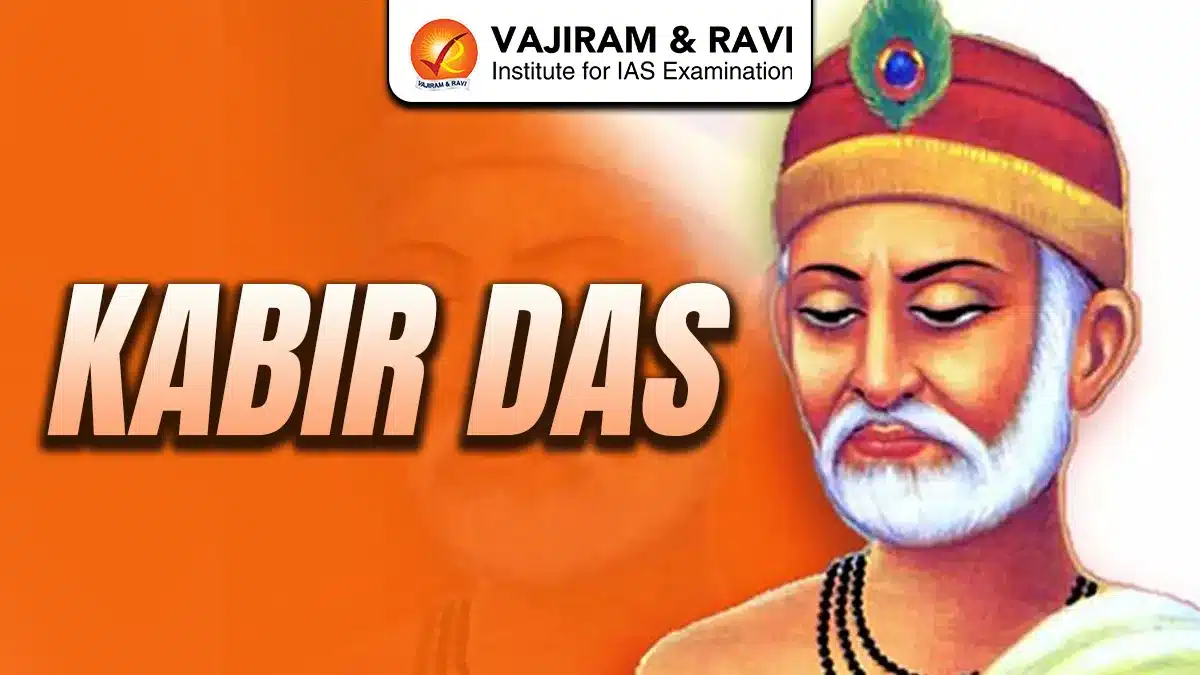
Kabir Das was a mystic poet and a popular Bhakti saint of medieval India. He is regarded as one of the most influential figures of the Bhakti movement, which sought to bring religion closer to the common people through devotion, ethical living, and social reform. 

Kabir Das Early Life and Background 

While the exact details of Kabir’s birth remain unclear, he is believed to have lived between 1440 and 1518. He was born in the city of Varanasi, Uttar Pradesh, with some stories suggesting he was born to a Brahmin mother but raised by a Muslim weaver.

Though he didn’t receive any formal education but from an early age, he was deeply drawn to spiritual inquiry. In his quest for spiritual enquiry, he became a disciple of Saint Ramananda, a prominent Hindu Bhakti saint of medieval India. 

Kabir and the Bhakti Movement

The Bhakti movement was a religious and cultural movement in India that emphasized personal devotion over caste, rituals, and orthodoxy. It promoted equality, religious harmony, and devotion as the path to salvation. It began in the 7th century in South India and began to spread across north India in the 14th and the 15th centuries. 

One school within the Bhakti movement was the Nirguni tradition and Kabir Das was a prominent member of it. In this tradition, God was understood to be a universal and formless being.

Kabir Das Teachings 

Kabir Das' teachings were secular and universal and therefore he was respected across different religious traditions. Sikhs regard him as a precursor to Guru Nanak, Muslims associate him with Sufi lineages, and Hindus venerate him as a Nirguna saint.

His teachings are as follows: 

  • Monotheism: There is only one God (Nirguna), who is formless and resides within the heart of every living being.
  • Rejection of Rituals: Kabir rejected formal worship, idolatry, scriptural knowledge and emphasised on personal spiritual experience as the true path to knowledge. 
  • Social Equality: He opposed the caste system and other forms of discrimination. For Kabir, the divine (Brahman) and truth (Satya) exist in all living beings (jiva), and therefore humans must transcend the divisions of “me” and “you”. 
  • Simple living: He believed in simple living as a householder and rejected severe asceticism.

Kabir Das preached his teachings in simple vernacular language like Awadhi, Bhojpuri, and Braj, making his ideas accessible to common people.

After his death, his teachings were carried forward by his followers, who formed the Kabir Panth, a community that believes in devotion to a formless God, rejecting idol worship and caste distinctions. Two major centres emerged -Kabir Chaura at Banaras, established by his disciple Surat Gopal, and Dham Khera in Chhattisgarh, founded by Dharamdas. 

Kabir Das was a mystic poet and a popular Bhakti saint of medieval India. He is regarded as one of the most influential figures of the Bhakti movement, which sought to bring religion closer to the common people through devotion, ethical living, and social reform. 

Kabir Das Early Life and Background 

While the exact details of Kabir’s birth remain unclear, he is believed to have lived between 1440 and 1518. He was born in the city of Varanasi, Uttar Pradesh, with some stories suggesting he was born to a Brahmin mother but raised by a Muslim weaver.

Though he didn’t receive any formal education but from an early age, he was deeply drawn to spiritual inquiry. In his quest for spiritual enquiry, he became a disciple of Saint Ramananda, a prominent Hindu Bhakti saint of medieval India. 

Kabir and the Bhakti Movement

The Bhakti movement was a religious and cultural movement in India that emphasized personal devotion over caste, rituals, and orthodoxy. It promoted equality, religious harmony, and devotion as the path to salvation. It began in the 7th century in South India and began to spread across north India in the 14th and the 15th centuries. 

One school within the Bhakti movement was the Nirguni tradition and Kabir Das was a prominent member of it. In this tradition, God was understood to be a universal and formless being.

Kabir Das Teachings 

Kabir Das' teachings were secular and universal and therefore he was respected across different religious traditions. Sikhs regard him as a precursor to Guru Nanak, Muslims associate him with Sufi lineages, and Hindus venerate him as a Nirguna saint.

His teachings are as follows: 

  • Monotheism: There is only one God (Nirguna), who is formless and resides within the heart of every living being.
  • Rejection of Rituals: Kabir rejected formal worship, idolatry, scriptural knowledge and emphasised on personal spiritual experience as the true path to knowledge. 
  • Social Equality: He opposed the caste system and other forms of discrimination. For Kabir, the divine (Brahman) and truth (Satya) exist in all living beings (jiva), and therefore humans must transcend the divisions of “me” and “you”. 
  • Simple living: He believed in simple living as a householder and rejected severe asceticism.

Kabir Das preached his teachings in simple vernacular language like Awadhi, Bhojpuri, and Braj, making his ideas accessible to common people.

After his death, his teachings were carried forward by his followers, who formed the Kabir Panth, a community that believes in devotion to a formless God, rejecting idol worship and caste distinctions. Two major centres emerged -Kabir Chaura at Banaras, established by his disciple Surat Gopal, and Dham Khera in Chhattisgarh, founded by Dharamdas. 

Kabir Das Literary Works 

Kabir Das writings were not composed as formal books but were orally transmitted and later compiled by his followers in works such as the Bijak, Kabir Granthavali, and Anurag Sagar. A large amount of Kabir’s works were compiled by the fifth Sikh Guru, Guru Arjan Dev, and placed in the Sikh scripture, Guru Granth Sahib.

Sant Kabir Das used everyday metaphors, sharp satire, and paradoxes to criticise caste discrimination, ritualism, and religious hypocrisy in both Hinduism and Islam. 

His dohas, also known as shabad or sakhi, played a major role in the growth of vernacular literature.

He employed a unique literary technique called ulatbansi (upside-down language) to convey deeper spiritual meanings. 

Relevance of Kabir Das Teachings in Today’s World

Kabir’s ideas are highly relevant in contemporary society 

  • His rejection of caste is relevant in addressing social inequality
  • Message of religious unity counters communalism and extremism
  • Emphasis on inner ethics supports moral governance and integrity
  • Simplicity and humanism align with constitutional values
  • Encourages critical thinking against blind traditions

In an age of polarization, Kabir’s teachings promote tolerance, harmony, and shared humanity.

Kabir Das writings were not composed as formal books but were orally transmitted and later compiled by his followers in works such as the Bijak, Kabir Granthavali, and Anurag Sagar. A large amount of Kabir’s works were compiled by the fifth Sikh Guru, Guru Arjan Dev, and placed in the Sikh scripture, Guru Granth Sahib.

Sant Kabir Das used everyday metaphors, sharp satire, and paradoxes to criticise caste discrimination, ritualism, and religious hypocrisy in both Hinduism and Islam. 

His dohas, also known as shabad or sakhi, played a major role in the growth of vernacular literature.

He employed a unique literary technique called ulatbansi (upside-down language) to convey deeper spiritual meanings. 

Relevance of Kabir Das Teachings in Today’s World

Kabir’s ideas are highly relevant in contemporary society 

  • His rejection of caste is relevant in addressing social inequality
  • Message of religious unity counters communalism and extremism
  • Emphasis on inner ethics supports moral governance and integrity
  • Simplicity and humanism align with constitutional values
  • Encourages critical thinking against blind traditions

In an age of polarization, Kabir’s teachings promote tolerance, harmony, and shared humanity.

Kabir Das FAQs

Q1: Who was Kabir Das?

Ans: Kabir Das was a 15th-century mystic poet and Bhakti saint from Varanasi, known for his devotional poetry, social reform, and emphasis on a formless God.

Q2: Whose disciple was Kabir Das?

Ans: Sant Kabir Das was a disciple of Saint Ramananda, a prominent Bhakti saint of medieval India, from whom he learned devotion to a formless God and spiritual inquiry.

Q3: What were the core teachings of Kabir Das?

Ans: He taught monotheism, rejected rituals and idol worship, promoted social equality, simple living, and stressed personal spiritual experience over dogma.

Q4: Which literary works preserve Kabir’s teachings?

Ans: His teachings were compiled orally by followers into texts like the Bijak, Kabir Granthavali, Anurag Sagar, and included in the Guru Granth Sahib of Sikhism.

Q5: How did Kabir influence the Bhakti movement?

Ans: As a member of the Nirguna tradition, Kabir emphasized devotion to a formless God, criticized caste and ritualism, and inspired religious harmony and vernacular literature.

Paathara Practice

Paathara Practice

Paathara Practice Latest News

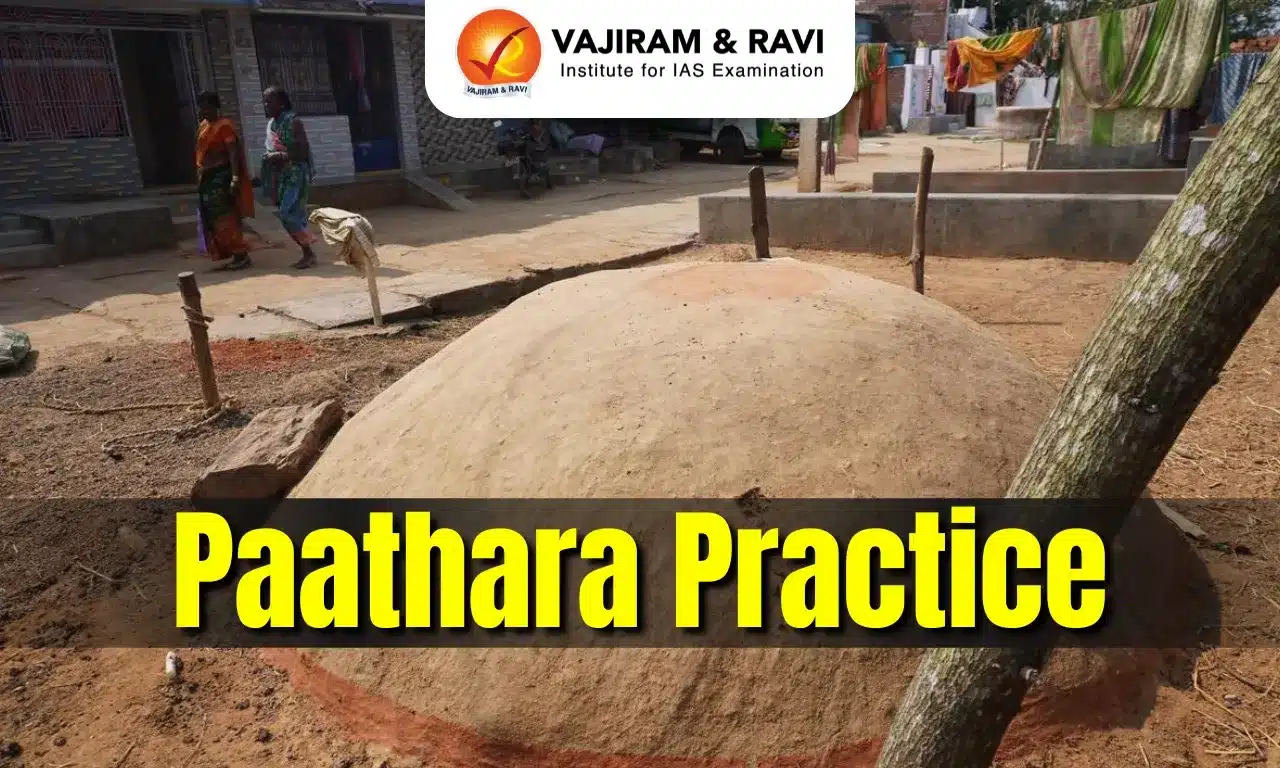
Recently, it is observed that the ancient grain storage tradition named Paathara practice or Khoni is fading fast in Srikakulam district.

About Paathara Practice

  • It is an ancestral practice of underground grain storage pits.
  • It is a storage pit in which freshly harvested grains, mostly paddy, are stored.
  • It is observed by farmers along the banks of the Mahendratanaya River in the Uddanam region of Srikakulam district, near the Andhra Pradesh–Odisha border.
  • This tradition thrived in the inland, hilly terrain, where underground grain storage was effective.
  • Decline: Lack of space and awareness, as well as changes in rural architecture—have contributed to its decline.

Key Features of Paathara Practice

  • Structure: The pit is dug in a rectangular shape, plastered with straw and clay, and sealed with a layer of cow dung on top.
  • The Paathara was built in front of thatched houses and was an integral part of rural architecture, symbolising a thriving joint family system.
  • Every paddy-growing family stores enough grain for its annual needs.
  • Advantage: The Paath­ara pro­tects grain from rodents, con­tam­in­a­tion, and theft.

Source: TH

Paathara Practice FAQs

Q1: What is the Paathara practice?

Ans: It is an ancestral practice of storing freshly harvested grains in underground storage pits.

Q2: Which crops are mainly stored using the Paathara practice

Ans: Mostly paddy is stored in Paathara pits.

Q3: Where is the Paathara practice traditionally observed?

Ans: It is observed by farmers along the banks of the Mahendratanaya River in the Uddanam region of Srikakulam district near the Andhra Pradesh–Odisha border.

Q4: Why was the Paathara practice suitable for the region?

Ans: It was effective in the inland, hilly terrain where underground grain storage worked well.

Q5: What is the structure of a Paathara pit?

Ans: It is a rectangular pit plastered with straw and clay and sealed with a layer of cow dung on top.

Living Root Bridge

Living Root Bridge

Living Root Bridges Latest News

Recently, India submitted Meghalaya’s living root bridges to UNESCO for World Heritage status.

About Living Root Bridges

  • The living root bridges are locally known as Jingkieng Jri or Lyu Chrai.
  • These are nestled across the lush southern slopes of the Khasi and Jaintia Hills in Meghalaya.
  • These are masterpieces of bioengineering created by indigenous communities.
  • These are grown by indigenous Khasi and Jaintia tribes over a time period of 15 to 30 years.
  • These bridges range in span from 15 feet to 250 feet, and last for several centuries.

Construction of Living Root Bridges

  • The bridges are grown by methods of tree-shaping using the aerial roots of Ficus Elastica (Rubber fig tree/Indian rubber tree).
  • The underlying growth process involves recurring inosculation (joining by twining) of Ficus aerial root fibres over a gorge or river.
  • The process begins with placing of young pliable aerial roots in hollowed Areca catechu trunks.
  • These provide essential nutrition and protection from the weather, and also perform as root guidance systems.
  • This assemblage is structurally supported by a bamboo scaffold, which spans the river and performs as a temporary river crossing for the local community.
  • Over time, as the aerial roots increase in strength and thickness, the Areca catechu trunks are no longer required.

Source: News On Air

Living Root Bridges FAQs

Q1: What are living root bridges locally known as?

Ans: They are locally known as Jingkieng Jri or Lyu Chrai.

Q2: Where are living root bridges found in India?

Ans: They are found on the southern slopes of the Khasi and Jaintia Hills in Meghalaya.

Q3: Which communities create living root bridges?

Ans: They are created by indigenous Khasi and Jaintia tribes.

Q4: Why are living root bridges considered masterpieces of bioengineering?

Ans: Because they are grown from living tree roots using traditional knowledge over several decades.

Q5: How long does it take to grow a living root bridge?

Ans: It takes about 15 to 30 years to grow a living root bridge.

Hanle Dark Sky Reserve

Hanle Dark Sky Reserve

Hanle Dark Sky Reserve Latest News

Recently, a rare blood-red auroral activity was captured by the all-sky camera at the Indian Astronomical Observatory in Ladakh's Hanle Dark Sky Reserve.

About  Hanle Dark Sky Reserve

  • Location: It is located at 4,500 metres altitude, in the remote Changthang region of Ladakh.
  • It is part of the Changthang Wildlife Sanctuary, offering Bortle-1 dark skies (the darkest category).
  • It was notified in December 2022 by the Government of Ladakh.
  • It is India’s first International Dark Sky Reserve, centred around the Indian Astronomical Observatory (IAO) at Hanle.
  • It is managed by the Indian Institute of Astrophysics (IIA) under the Department of Science and Technology (DST), Ministry of Science & Technology
  • The reserve aims to curb light pollution and promote astro-tourism benefiting local communities.
  • The reserve is a science-driven socio-economic development project, built on two pillars:
    • Curtailing light pollution in the region
    • Promoting astro-tourism for local livelihood generation
  • The UT Ladakh administration supports the project by funding astro-tourism initiatives and light management plans.
  • Significance of Hanle: Hanle’s pristine dark skies and transparent atmosphere allow observing and photographing faint celestial objects that are often impossible from other locations in India.

Source: ET

Hanle Dark Sky Reserve FAQs

Q1: Where is the Hanle Dark Sky Reserve located?

Ans: It is located at an altitude of about 4,500 metres in the remote Changthang region of Ladakh.

Q2: Which wildlife sanctuary does the Hanle Dark Sky Reserve form a part of?

Ans: It is part of the Changthang Wildlife Sanctuary.

Q3: Why is Hanle Dark Sky Reserve significant at the national level?

Ans: It is India’s first International Dark Sky Reserve.

Q4: Around which major astronomical facility is the reserve centred?

Ans: It is centred around the Indian Astronomical Observatory (IAO) at Hanle.

Q5: Which institution manages the Hanle Dark Sky Reserve?

Ans: It is managed by the Indian Institute of Astrophysics (IIA).

Daily Editorial Analysis 31 January 2026

Daily Editorial Analysis

Green Steel Can Shape India’s Climate Goals Trajectory

Context

  • India stands at a pivotal moment where economic expansion and climate responsibility must advance together.
  • The commitment to submit a more ambitious Nationally Determined Contribution (NDC) places pressure on the country to move beyond incremental change towards economy-wide
  • Among all sectors, steel emerges as the most consequential. Its transformation will shape India’s ability to meet climate goals while sustaining development, competitiveness, and global leadership in sustainable

The Centrality of Steel to India’s Growth and Emissions Challenge

  • Steel underpins India’s development ambitions, enabling infrastructure, urbanisation, and industrial growth.
  • To unlock its full economic potential, steel production would need to more than triple from roughly 125 million tonnes annually to over 400 million tonnes by mid-century.
  • This scale of expansion is unprecedented and poses a serious climate challenge. The steel sector currently contributes around 12% of national carbon emissions, primarily due to dependence on coal-based blast furnaces.
  • India faces a dual imperative common to emerging economies: maintaining rapid growth while aligning with long-term climate targets.
  • The central risk lies in locking in high-carbon infrastructure through present-day investments. Steel assets are long-lived, and continued reliance on conventional technologies could embed emissions for decades.
  • Such lock-in would undermine climate commitments and weaken India’s long-term economic attractiveness in a world rapidly transitioning towards low-carbon production.

Global Signals and Competitive Pressures

  • Global trends reinforce the urgency of transition. Major steel-producing economies are actively reducing emissions.
  • China is expanding scrap-based secondary steelmaking and investing in green hydrogen to curb coal dependence.
  • The European Union has advanced decarbonisation for decades and introduced the Carbon Border Adjustment Mechanism (CBAM), which penalises carbon-intensive imports.
  • These developments signal that access to premium global markets will increasingly depend on demonstrable low-carbon production.
  • Countries that fail to adapt face border charges, reputational risks, and declining export competitiveness.
  • Conversely, early movers in green steel will secure a durable advantage. Delay, therefore, is no longer a neutral option but a strategic liability for India.

Industry Action: Progress and Its Limits

  • India’s steel industry has begun responding. Leading producers are piloting low-emission technologies and diversifying energy sources.
  • Initiatives include hydrogen injection trials, expanded renewable energy procurement, modernisation of facilities, and exploration of carbon capture.
  • These efforts reflect growing leadership commitment and recognition of the climate challenge.
  • However, pilot projects alone are insufficient. The sector must move swiftly towards demonstration plants and full-scale deployment of near-zero-emission technologies.
  • Continued investment in business-as-usual blast furnace capacity risks diluting progress.
  • Small and medium producers also need to adapt by adopting best available technologies and raw materials to improve carbon efficiency, ensuring that the transition remains equitable across the sector.

Policy Framework: Momentum Without Sufficient Incentives

  • Policy direction has improved, but implementation gaps remain.
  • The Greening Steel Roadmap outlines a practical transition pathway, while the Green Steel Taxonomy positions India as a global first-mover in defining low-carbon steel.
  • Supporting initiatives such as the National Green Hydrogen Mission, expanded renewables, and emissions intensity targets under the Carbon Credit Trading Scheme indicate momentum.
  • Yet, strong incentives to decisively shift investments away from coal-based technologies are still lacking.
  • Without them, India risks continuing to add outdated infrastructure while others accelerate ahead.
  • Key barriers include high hydrogen costs, limited industry-dedicated renewables, an underdeveloped scrap market, constrained natural gas availability, financing challenges, and workforce skill gaps.
  • These challenges are significant but solvable, as demonstrated by India’s rapid renewable energy expansion over the past decade.

The Way Forward: Towards a Market-Aligned Transition

  • Long-term investment requires clear and credible policy signals.
  • Setting stringent short-, medium-, and long-term emission targets would allow firms to plan capital allocation with confidence.
  • Early rollout of carbon pricing is essential to internalise emissions costs and distribute them across the value chain.
  • Experience from Europe shows that near-zero steel technologies become viable only when carbon prices reach $90–$100 per tonne of CO₂.
  • Additional measures include widespread adoption of the Green Steel Taxonomy, public procurement to create domestic demand, robust certification and labelling systems, and the creation of shared infrastructure hubs for energy, hydrogen, gas, and carbon transport.
  • Given that low-carbon steelmaking has 30–50% higher capital intensity, targeted fiscal support—especially for smaller producers, is critical for a just transition.

Conclusion

  • Green steel is no longer optional. It is central to India’s climate ambitions, industrial competitiveness, and global leadership.
  • Having demonstrated capability in renewables and climate diplomacy, India now faces its next decisive test.
  • By aligning bold corporate action with a coherent, market-oriented policy framework, the country can decarbonise steel, protect economic growth, and shape global standards for low-carbon

Green Steel Can Shape India’s Climate Goals Trajectory FAQs

Q1. Why is the steel sector central to India’s climate strategy?
Ans. The steel sector is central because it underpins economic growth while contributing significantly to national carbon emissions.

Q2. What risk does continued investment in coal-based steelmaking pose?
Ans. Continued investment risks locking India into long-term high-carbon infrastructure that undermines climate and economic goals.

Q3. How are global policies influencing India’s steel transition?
Ans. Global measures like the EU’s CBAM are pushing India to adopt low-carbon steel to remain competitive in export markets.

Q4. Why are pilot projects in green steel insufficient?
Ans. Pilot projects are insufficient because large-scale deployment is needed to achieve meaningful emissions reductions.

Q5. What role does government policy play in enabling green steel?
Ans. Government policy provides long-term targets, carbon pricing, and infrastructure support that enable investment in low-carbon steel.

Source: The Hindu


The 27th Amendment, Pakistan’s Democratic Dilemma

Context

  • The passage of Pakistan’s 27th Constitutional Amendment (PCA) marks a significant turning point in the country’s constitutional evolution.
  • Introduced under the pretext of reorganising aspects of military command, the amendment fundamentally alters the structure of constitutional governance.
  • By transferring original jurisdiction over constitutional interpretation, fundamental rights, and federal–provincial disputes from the Supreme Court to a newly created Federal Constitutional Court (FCC), the PCA reshapes the balance of institutional authority.
  • This change raises serious concerns about judicial independence, executive dominance, and the long-term stability of constitutional checks and balances.

The Marginalisation of the Supreme Court of Pakistan

  • The Supreme Court of Pakistan has historically served as the principal guardian of the Constitution, particularly through its original jurisdiction.
  • This authority enabled it to adjudicate landmark political cases, including the Panama Papers and Memogate controversies, placing the Court at the centre of constitutional accountability.
  • The PCA removes this pivotal role, fragmenting constitutional adjudication and weakening the Court’s position as the final arbiter of constitutional meaning.
  • This reallocation of authority is not merely procedural. It risks institutional marginalisation, especially in a political system where executive influence has frequently tested judicial autonomy.
  • By sidelining the apex court from the most consequential constitutional questions, the amendment undermines coherence in constitutional interpretation and diminishes the Court’s ability to function as an effective check on power.

Judicial Independence and the Rule of Law

  • At the heart of constitutional governance lies the rule of law, articulated most famously by A.V. Dicey.
  • This doctrine rests on the absence of arbitrary power, equality before the law, and the central role of independent courts as protectors of rights.
  • Courts, within this framework, are not passive institutions but active guardians that restrain authority and preserve liberty.
  • The PCA unsettles this equilibrium. While specialised constitutional courts are not inherently problematic, their legitimacy depends on demonstrable independence.
  • The FCC’s creation, coupled with the scope for executive influence over its composition and functioning, raises the risk that judicial review may become an extension of political power.
  • This concern is particularly stark given that the 18th Amendment had sought to insulate the judiciary by strengthening the Judicial Commission of Pakistan and reducing executive interference. The PCA appears to dilute these safeguards.

Historical Warnings and Constitutional Lessons

  • The tension between executive authority and judicial autonomy has deep historical roots.
  • In early 17th-century England, King James I claimed the right to personally adjudicate disputes, a claim firmly rejected by Sir Edward Coke, the Chief Justice.
  • Coke’s insistence that the monarch was subject to the law established a foundational constitutional principle: judicial authority must remain separate from executive will.
  • This episode underscores that constitutional governance relies not on the goodwill of rulers but on institutional insulation from power.
  • Courts operating under political pressure cannot serve as neutral arbiters.
  • The PCA echoes this historical struggle by relocating constitutional interpretation to a forum potentially vulnerable to political preferences, thereby weakening the structural foundations of judicial neutrality.

Regional Context and Implications for India

  • The PCA must be understood within a broader South Asian context marked by political instability, security pressures, and institutional strain.
  • In such environments, governments are often tempted to prioritise control over constitutional restraint.
  • For countries in the Global South, where democratic institutions remain fragile, constitutional design choices carry lasting consequences.
  • For India, developments in Pakistan are instructive rather than comparative. As the region’s largest constitutional democracy, India has a vested interest in the health of constitutional norms across its neighbourhood.
  • The erosion of judicial independence or the normalisation of executive dominance elsewhere in South Asia offers a cautionary lesson.
  • History demonstrates that democratic decline is often incremental, achieved through formally valid legal changes rather than abrupt ruptures.
  • The experience of inter-war Europe illustrates this danger vividly. Democratic systems were hollowed out through constitutional amendments enacted in the name of stability and necessity.
  • Power was consolidated legally, even as institutional checks were steadily dismantled.
  • The PCA reflects a similar pattern, preserving constitutional form while weakening constitutional substance.

Conclusion

  • Pakistan’s 27th Amendment represents more than an administrative restructuring; it signals a shift in constitutional philosophy.
  • By diminishing the role of the Supreme Court and empowering a potentially executive-influenced FCC, the amendment risks transforming the Constitution from a shield against power into an instrument of governance.
  • For India and the wider region, the lesson is clear: constitutional democracy depends not merely on written texts but on sustained respect for judicial independence, institutional boundaries, and constitutional restraint.
  • The choices republics make today will determine whether this century is defined by democratic renewal or by the quiet erosion of constitutional spirit.

The 27th Amendment, Pakistan’s Democratic Dilemma FAQs

Q1. What is the central constitutional change introduced by Pakistan’s 27th Amendment?
Ans. It transfers original constitutional jurisdiction from the Supreme Court to a newly created Federal Constitutional Court.

Q2. Why is the marginalisation of the Supreme Court significant?
Ans. It weakens the Court’s role as the final guardian of the Constitution and reduces effective checks on executive power.

Q3. How does the amendment affect the rule of law?
Ans. It risks undermining the rule of law by diluting judicial independence and enabling executive influence over constitutional interpretation.

Q4. What historical example illustrates the importance of judicial independence?
Ans. Sir Edward Coke’s resistance to King James I established that courts must remain independent of executive authority.

Q5. Why does the PCA matter for India?
Ans. It offers a cautionary lesson on how constitutional democracies can be weakened through legally valid but institutionally corrosive reforms.

Source: The Hindu


India’s Manufacturing Revival in a Reconfigured Global Economy


Context:

  • Amid growing geopolitical uncertainties and the reconfiguration of global production networks, India’s manufacturing sector has regained momentum.
  • As supply chains diversify away from single-country dependence and industrial policy regains global prominence, India’s manufacturing revival provides a strong base for the next phase of industrialisation.
  • The Economic Survey underscores that sustaining this momentum hinges on improving competitiveness and deeper integration into Global Value Chains (GVCs).


Manufacturing Revival - From Capacity Creation to Capability Building:

  • India’s manufacturing policy has progressively focused on:
    • Lowering entry barriers through targeted incentives
    • Infrastructure investments
    • Ease of Doing Business (EoDB) reforms
  • These measures have boosted investor confidence and capacity creation.
  • However, the next challenge is to shift from mere capacity expansion to capability building, supported by stronger industrial ecosystems.


Strategic Industrialisation and Technology Leadership:

  • Countries commanding critical technologies, complex manufacturing processes, and trusted production capabilities enjoy greater global bargaining power.
  • India’s next phase of industrialisation must:
    • Prioritise strategic and technology-intensive sectors
    • Scale up traditional manufacturing
    • Allow higher experimentation and tolerance for firm-level failures
  • This approach is essential to move up the value chain and ensure strategic indispensability.


Moving up the Value Chain - Sectoral Success Stories:

  • India’s manufacturing profile is increasingly technology- and export-oriented. For example,
    • Electronics manufacturing: Production expanded almost 6 times, and exports grew nearly 8 times over the last 11 years.
    • Pharmaceuticals: India’s pharma production is among the world’s largest by volume. India supplies over 50% of global vaccine demand, and it is the major producer of generic medicines.
  • To replicate such success across sectors, India needs:
    • Higher private sector participation
    • Stronger R&D-led innovation
    • Deeper industry–academia linkages
    • Faster technology absorption
    • Robust skilling ecosystems


Spatial Reorganisation - Rethinking Industrial Clusters:

  • As capabilities deepen, spatial concentration of industry gains importance.
  • As existing clusters are often small and fragmented, limiting productivity gains, focus must shift from creating clusters to building large, integrated industrial ecosystems.
  • Tier-2 and Tier-3 cities are emerging as anchors due to:
    • Affordable land and real estate
    • Lower wage and operating costs
    • Large labour pools
    • Improved infrastructure and liveability


Infrastructure and Logistics - The Competitiveness Backbone:

  • India has made notable progress. For example,
    • Logistics costs declined to around97% of GDP (FY 2023–24) — close to global benchmarks.
    • Improved port efficiency, with several ports in the Top 100 of the World Bank’s Container Port Performance Index 2024.
  • Key initiatives: PM Gati Shakti, National Logistics Policy, and Accelerated highway construction.
  • Suggestions: Rebalance freight movement by increasing share of railways and coastal shipping. Promote multimodal logistics integration to unlock further efficiency gains.


Quality Control Orders (QCOs) - Raising Standards, Not Costs:

  • QCOs can strengthen competitiveness in strategic and safety-critical sectors.
  • By aligning with international standards, they encourage capability upgradation, and global market credibility.
  • Success depends on phased implementation, adequate testing infrastructure, and continuous industry consultation.


MSMEs - Backbone of Manufacturing Growth:

  • MSMEs contribute significantly to employment, output, and exports.
  • Recent gains are greater formalisation, improved access to finance, and stronger supply-chain integration.
  • Key challenges are persistent credit gaps, and limited technology adoption.
  • Solutions include deeper MSME integration into strategic value chains, strengthening skilling, technology access, and quality infrastructure.


Governance and EoDB - The Factory-Floor Reality:

  • While regulatory reforms have improved formal EoDB metrics, firms value speed, predictability, and consistency.
  • Persistent bottlenecks include land acquisition delays, utilities and regulatory approvals, and weak dispute resolution mechanisms.
  • With manufacturing becoming spatially concentrated, state and local governments play a decisive role through stable regulatory regimes, effective single-window systems, and time-bound approvals.


Challenges and Way Forward:

  • Fragmented industrial clusters and scale constraints. Deepen GVC integration; build large, integrated industrial ecosystems in Tier-2/3 cities.
  • Limited R&D intensity and weak innovation ecosystems. Prioritise technology-intensive and strategic sectors.
  • MSME credit and technology gaps. Strengthen MSME participation in strategic value chains by filling credit and tech gaps.
  • Overdependence on road transport for freight. Promote multimodal logistics and freight rebalancing.
  • Regulatory delays and implementation inconsistencies. Ensure predictable, time-bound regulatory governance.


Conclusion:

  • India’s next manufacturing leap will be defined not just by the scale of production, but by technological depth, strategic relevance, and global competitiveness.
  • The proposed National Manufacturing Mission offers a platform to align reforms, infrastructure, skilling, and innovation under a coherent industrial strategy.
  • Ultimately, India’s success will rest on building globally competitive firms embedded in strategically indispensable sectors—positioning manufacturing as a durable engine of growth and resilience.


India’s Manufacturing Revival FAQs

Q1. How does the reconfiguration of global value chains create an opportunity for India’s manufacturing sector?

Ans. Global supply chain diversification amid geopolitical uncertainties allows India to integrate deeper into Global Value Chains.


Q2. Why is India’s manufacturing strategy shifting from capacity creation to capability building?

Ans. Because sustainable industrial growth now depends on technological depth, R&D intensity, skilled manpower, etc.


Q3. What is the role of Tier-2 and Tier-3 cities in India’s next phase of industrialisation?

Ans. They offer cost advantages, large labour pools, improved infrastructure, and better liveability.


Q4. How can logistics reforms enhance India’s manufacturing competitiveness?

Ans. By reducing logistics costs through multimodal integration, greater use of railways and waterways.


Q5. What is the significance of MSMEs in strengthening India’s manufacturing-led growth model?

Ans. MSMEs are critical for employment, exports, and value-chain depth, and requires improved credit access, skilling, and technology adoption.

Source: IE

Daily Editorial Analysis 31 January 2026 FAQs

Q1: What is editorial analysis?

Ans: Editorial analysis is the critical examination and interpretation of newspaper editorials to extract key insights, arguments, and perspectives relevant to UPSC preparation.

Q2: What is an editorial analyst?

Ans: An editorial analyst is someone who studies and breaks down editorials to highlight their relevance, structure, and usefulness for competitive exams like the UPSC.

Q3: What is an editorial for UPSC?

Ans: For UPSC, an editorial refers to opinion-based articles in reputed newspapers that provide analysis on current affairs, governance, policy, and socio-economic issues.

Q4: What are the sources of UPSC Editorial Analysis?

Ans: Key sources include editorials from The Hindu and Indian Express.

Q5: Can Editorial Analysis help in Mains Answer Writing?

Ans: Yes, editorial analysis enhances content quality, analytical depth, and structure in Mains answer writing.

Coking Coal

Coking Coal

Coking Coal Latest News

Recently, the Government of India has notified Coking Coal as a Critical and Strategic Mineral under the Mines and Minerals (Development and Regulation) Act, 1957 (MMDR Act). 

About Coking Coal

  • It is a naturally occurring sedimentary rock found within the earth’s crust.
  • It is also known as Metallurgical coal.
  • Characteristics: It is a type of coal that softens and swells when heated, forming lightweight, porous coke particles, and is characterized by a free swelling index of 1 or greater.
  • It typically contains more carbon, less ash, and less moisture than thermal coal, which is used for electricity generation.
  • Coke is the main product of the high-temperature carbonisation of coking coal. 
  • Coking coal is divided into 3 sub-categories namely, 
    • Primary Coking Coal (Low ash , low Volatile, High Coking property) 
    • Medium Coking Coal (low ash, medium volatile, low caking index)
    • Blendable/ Semi/Weak Coking Coal (low ash, high volatile, very low caking index).
  • Major Producers: The largest producers of coking coal were China, Australia, Russia, USA and Canada.
    • India has an estimated 37.37 billion tonnes of coking coal resources, largely located in Jharkhand, with additional reserves in Madhya Pradesh, West Bengal and Chhattisgarh.

Uses of Coking Coal

  • It is essential for metallurgical processes, as it exhibits caking properties that allow it to fuse into a solid mass during heating.
  • It is an essential ingredient in the production of steel, making it one of the most widely used building materials on earth.

Source: ET

Coking Coal FAQs

Q1: What is coking coal?

Ans: It is a naturally occurring sedimentary rock found within the Earth’s crust and is also known as metallurgical coal.

Q2: Why is coking coal called metallurgical coal?

Ans: Because it is essential for metallurgical processes, especially in steel production.

Q3: What happens to coking coal when it is heated?

Ans: It softens and swells, forming lightweight, porous coke particles.

Q4: How does coking coal differ from thermal coal?

Ans: Coking coal has higher carbon content and lower ash and moisture than thermal coal, which is mainly used for electricity generation.

Q5: What is coke?

Ans: Coke is the main product obtained from the high-temperature carbonisation of coking coal.

East China Sea

East China Sea

East China Sea Latest News

China’s coast guard patrolled Japan-administered islands ‍in the East China Sea almost daily last year, it said recently.

About East China Sea

  • It is a marginal sea of the Western Pacific Ocean, located in East Asia.
  • It extends northeastward from the South China Sea, to which it is connected by the shallow Taiwan Strait between Taiwan and mainland China. 
  • The Korea Strait connects it to the Sea of Japan. 
  • To the north, the East China Sea opens up into the Yellow Sea.
  • To the east, you'll find Kyūshū and the Ryukyu Islands of Japan. 
  • The East China Sea and the South China Sea together form the China Sea.
  • In China, people often call it the East Sea.
  • The countries which border the sea include South Korea, Japan, the Republic of China (Taiwan), and the People’s Republic of China.
  • It has an area of about 750,000 sq.km. and is largely shallow; almost three-fourths of the sea is less than 650 feet (200 metres).
  • Rivers: The Yellow River (Huanghe) and the Yangtze River (Changjiang) discharge into the East China Sea.
  • Weather in the region is dominated by the monsoon winds.
  • The region is influenced by the Tsushima and Kuroshio Currents as well as by a strong upwelling area northeast of Taiwan.
  • Islands: The sea contains several islands, with the most significant being the Ryukyu Islands, which are part of Japan, and the Senkaku/Diaoyu Islands.
    • China, Taiwan, and Japan all claim sovereignty over the Senkaku islands, which are under Japanese administration.
  • It has a huge presence of submerged reefs in the northern region, such as Yajiao Rock, Hupijiao Rock, and Socotra Rock.
  • Approximately 35% of global petroleum and petroleum product shipments traveled through the East China Sea in 2023.

Source: TH

East China Sea FAQs

Q1: Where is the East China Sea located?

Ans: It is a marginal sea of the Western Pacific Ocean located in East Asia.

Q2: Which strait connects the East China Sea with the South China Sea?

Ans: The Taiwan Strait connects the East China Sea with the South China Sea.

Q3: Which strait links the East China Sea to the Sea of Japan?

Ans: The Korea Strait connects the East China Sea to the Sea of Japan.

Q4: Which countries border the East China Sea?

Ans: South Korea, Japan, Taiwan, and China.

Q5: Which major rivers discharge into the East China Sea?

Ans: The Yellow River and the Yangtze River.

Budget 2026: Three Big Macro Challenges for India

Budget 2026

Budget 2026 Latest News

  • The Union Budget for 2026–27, to be presented by Nirmala Sitharaman, will outline three core aspects
    • the government’s expectations for economic growth and planned spending across schemes and departments; 
    • projected revenues from tax and non-tax sources; and 
    • the level of borrowing required to bridge the gap between income and expenditure, known as the fiscal deficit.
  • While the Budget formally marks a fresh financial year, it is rarely a blank-slate exercise. 
  • In practice, fiscal realities and policy commitments from previous years significantly limit the scope for major shifts, leaving only constrained room for fundamental change.

Why a New Budget Has Limited Room for Change

  • A Union Budget is constrained by committed expenditures and policy continuity. 
  • Salaries, pensions, and many subsidies cannot be easily altered year to year, nor can tax rates be frequently changed. 
  • Crucially, the Finance Minister’s choices are shaped by the state of government finances in the ongoing year. 
  • Shocks or stresses—such as exports hit by US tariffs—often carry over, setting priorities for the next Budget. 
  • As a result, reviewing the year just ended offers key clues to what the Budget can realistically address.

What Current-Year Data Signals: Three Key Macro Concerns

  • Current-year economic data point to several issues, but at the macroeconomic level, three broad concerns stand out as especially relevant for the upcoming Budget.

1. Weak Nominal GDP Growth: A Key Budget Worry

  • While India’s real GDP growth often makes headlines, it is nominal GDP—the total value of goods and services at current prices—that matters most for Budget-making. 
  • Nominal GDP is the base on which tax revenues, spending plans, and borrowing needs are calculated.

The Budget Arithmetic Problem

  • If nominal GDP grows slower than expected, government revenues fall short. 
  • For example, lower-than-anticipated nominal growth means less tax collection, forcing the government to either:
    • Borrow more, which can crowd out private borrowers and push up interest rates, or
    • Cut spending, potentially reducing funds for R&D, infrastructure, or welfare.

A Sustained Slowdown

  • India’s nominal GDP growth has been decelerating for years. For the current year, it is expected to grow by just 8%, markedly lower than the levels seen over the past two decades. 
  • This is below the 10.1% growth assumed in last year’s Budget and reflects a recent secular slowdown.

Implications for Budget 2026

  • The First Advance Estimates now peg nominal GDP growth at 8%, tightening fiscal space. 
  • The foremost challenge for the Finance Minister is to devise a strategy to lift nominal GDP growth in the coming year to stabilise revenues and avoid difficult trade-offs between borrowing and spending.

2. Weak Tax Buoyancy: Revenues Falling Short of Expectations

  • Tax buoyancy measures how tax revenues respond to economic growth. 
  • A buoyancy of 1 means tax collections rise in line with GDP. If GDP grows 10%, taxes grow 10%. Budgets often assume buoyancy above 1 to fund spending.
  • If nominal GDP grows less than expected and tax buoyancy is lower, revenue shortfalls multiply
  • For instance, slower GDP growth combined with a buoyancy of 0.5 can slash expected additional revenues sharply.

What’s Happening This Year

  • Actual tax collections are lagging Budget assumptions across categories. 
  • Year-to-date growth in taxes trails the government’s targets—and is even below the weak nominal GDP growth rate (around 8%).
  • Data show that while the Budget assumed tax buoyancy of 1.1, the actual buoyancy is closer to 0.6. 
  • In other words, tax revenues are growing at barely half the pace anticipated relative to GDP.

Implications for the Budget

  • Weak tax buoyancy tightens fiscal space. 
  • With revenues underperforming, the government faces tougher choices between higher borrowing and spending restraint, complicating Budget 2026 planning.

3. Weak Private Corporate Investment: A Persistent Growth Challenge

  • A central policy objective of the government has been to expand the role of the private sector under the idea of “Minimum Government”. 
  • Since 2019, this has translated into sharp corporate tax cuts, higher public capital expenditure, and targeted incentives like the Production Linked Incentive (PLI) scheme to lower costs and crowd in private investment.
  • When investment did not respond as expected, the government shifted focus to boosting demand—raising income tax exemptions and cutting GST rates—to improve sales prospects and create a stronger business case for private investment.

Investment Still Below Pre-Pandemic Levels

  • Despite these measures and strong headline GDP growth, data show that private corporate investment remains below pre-pandemic (2019) levels. 
  • Firms are hesitant to invest widely, largely because sales growth has not been strong enough to justify fresh capacity creation.
  • Adding to concerns, foreign investors have also reduced exposure to India in recent periods
  • This has put pressure on the rupee, creating economic and political challenges for Nirmala Sitharaman.

The Budget Dilemma

  • The key question for the upcoming Budget is how to revive private investment—what additional incentives or reforms can restore confidence, lift demand, and persuade both domestic and global investors to commit capital more decisively.

Source: IE | HT

Budget 2026 FAQs

Q1: Why is Budget 2026 not a blank-slate exercise?

Ans: Budget 2026 is constrained by committed spending, fixed tax structures, and ongoing fiscal realities, leaving limited scope for sharp policy shifts despite the start of a new financial year.

Q2: Why does nominal GDP matter more for Budget 2026?

Ans: For Budget 2026, nominal GDP determines tax revenues, spending capacity, and borrowing needs; slower nominal growth directly reduces fiscal space even if real GDP growth appears strong.

Q3: How does weak tax buoyancy affect Budget 2026?

Ans: Weak tax buoyancy means tax collections grow slower than GDP, worsening revenue shortfalls in Budget 2026 and forcing tougher choices between higher borrowing and spending cuts.

Q4: Why is private investment a concern for Budget 2026?

Ans: Despite tax cuts, capex push, and PLI schemes, private corporate investment remains below pre-pandemic levels, limiting growth momentum and complicating Budget 2026 objectives.

Q5: What is the key dilemma facing Budget 2026?

Ans: The central dilemma in Budget 2026 is how to revive growth amid weak revenues, slowing nominal GDP, low tax buoyancy, and hesitant domestic and foreign private investors.

Economic Survey Raises Potential Growth to 7%

Economic Survey Raises Potential Growth to 7%

Potential Growth Latest News

  • The latest Economic Survey, led by V Anantha Nageswaran, has reassessed India’s long-term economic prospects and raised the country’s potential growth rate from 6.5% to 7%. 
  • This reassessment comes amid an active debate on India’s current GDP growth trajectory and reflects the Survey’s view of improved structural and medium-term growth capacity of the economy.

What Is Potential Economic Growth and Why It Matters

  • A country’s potential growth rate differs from its annual GDP growth. 
  • While GDP growth measures how fast the economy expands in a given year, potential growth shows the pace at which it can grow without causing high inflation
  • If growth exceeds this level, demand outstrips supply and prices rise; if it falls below, resources remain underused. 
  • Therefore, to achieve sustainably higher growth, governments must focus on raising the economy’s potential growth rate, not just boosting short-term demand.

What Determines a Country’s Potential Growth Rate

  • Capital Stock - Potential growth depends on the size and quality of physical assets—such as roads, bridges, ports, factories, and machinery—that support production and expansion in the economy.
  • Labour Input - This includes not just the number of workers, but also their skills, productivity, and capacity, which directly influence how much an economy can produce.
  • Total Factor Productivity (TFP) - TFP reflects how efficiently labour and capital are used together. Higher efficiency allows faster growth without inflationary pressure.

India’s Declining Potential Growth: The Trend

  • Research by the Reserve Bank of India shows that India’s potential growth rate has declined over time:
    • 2003–2008: around 8%, India’s highest growth phase
    • 2009–2015: fell to 7%
    • Around the Covid-19 period: declined further to 6.5%, as acknowledged by the Chief Economic Adviser.
  • This decline underscores the need for sustained reforms to rebuild long-term growth capacity.

Why the Economic Survey Sees Higher Potential Growth

  • Reforms Lifting Medium-Term Growth - The Chief Economic Adviser notes that the cumulative impact of recent policy reforms has raised India’s medium-term potential growth to around 7%, reversing earlier declines.
  • Manufacturing and Supply-Side Push - Key reforms over the past three years—PLI schemes, FDI liberalisation, and logistics improvements—have strengthened manufacturing capacity and boosted the economy’s ability to expand supply.
  • Labour Market Improvements - Measures such as labour law consolidation, lower regulatory compliance, and state-level reforms, along with investments in education, skilling, and apprenticeships, have reduced labour market frictions and improved employability.
  • Conditions for Sustained Gains - The Survey stresses that credible increases in potential growth require persistent reforms and macroeconomic stability—conditions it says India currently meets.
  • The Caveat: External Risks - Despite domestic strengths, the Survey cautions that geopolitical conflicts and global disruptions could still constrain India’s ability to fully realise its growth potential.

Source: IE

Potential Growth FAQs

Q1: What does potential growth mean in the Economic Survey?

Ans: Potential growth refers to the maximum sustainable growth rate an economy can achieve without triggering high inflation, unlike annual GDP growth which fluctuates year to year.

Q2: Why did India’s potential growth decline earlier?

Ans: India’s potential growth fell from 8% to 6.5% over two decades due to weaker productivity gains, slowing investment, labour market frictions, and efficiency losses highlighted by RBI research.

Q3: Why has potential growth been raised to 7% now?

Ans: The Economic Survey says cumulative reforms over recent years have strengthened supply capacity, lifting India’s medium-term potential growth closer to 7%.

Q4: Which reforms contributed to higher potential growth?

Ans: Manufacturing-focused reforms like PLI schemes, FDI liberalisation, logistics improvements, and labour law consolidation have boosted India’s productive capacity and potential growth.

Q5: What risks could limit India’s potential growth?

Ans: Despite domestic reforms and stability, geopolitical conflicts, global disruptions, and external shocks could prevent India from fully realising its higher potential growth.

Jal Jeevan Mission – Coverage Versus Functionality in Water Supply

Jal Jeevan Mission

Jal Jeevan Mission Latest News

  • A 2024 government-commissioned survey revealed that while nearly 98% of rural households have tap connections under the Jal Jeevan Mission, only about three-fourths receive a reliable and safe water supply. 

Overview of Jal Jeevan Mission

  • The Jal Jeevan Mission (JJM), launched in 2019, is a flagship programme of the Government of India aimed at providing Functional Household Tap Connections (FHTCs) to all rural households. 
  • The scheme seeks to ensure 55 litres of potable water per person per day on a regular basis, with an emphasis on water quality, sustainability of sources, and community participation.
  • Unlike earlier water supply programmes that focused primarily on infrastructure creation, JJM adopts a service delivery approach, where functionality, water quality, and regularity are central performance indicators. 
  • The mission is implemented in partnership with States, with funding shared between the Centre and States.

Current Status of Rural Tap Water Coverage

  • According to official data, the Jal Jeevan Mission has expanded tap water coverage at an unprecedented scale. 
  • From less than 20% rural coverage in 2019, India has reached close to universal household tap connectivity by 2024-25.
  • States such as Goa, Gujarat, Andhra Pradesh, and several Union Territories report over 97% tap availability. 
  • As of early 2026, more than 2.7 lakh villages have been certified as “Har Ghar Jal” villages, indicating that all households and public institutions in these villages have tap connections.
  • However, coverage certification is largely based on infrastructure availability and does not always reflect actual water delivery or quality.

Functionality and Water Quality Concerns

  • The core objective of the Jal Jeevan Mission is not merely tap installation but a functional and safe water supply
  • The recent Functionality Assessment of Household Tap Connections highlights significant gaps in this regard.
  • Only 83% of surveyed households reported receiving water through taps at least once in the previous seven days. 
  • Even fewer households consistently received the prescribed 55 litres per capita per day, with just 80% meeting the quantity norm.
  • Water quality emerged as a critical concern. Tests for E. coli, faecal coliform, and pH levels showed that only 76% of households received water meeting basic safety standards. When availability, regularity, and quality were assessed together, only three-fourths of households were found to be benefiting from the scheme as intended. 

Regional Variations in Performance

  • The survey revealed sharp inter-State variations. While coastal and better-performing States recorded high functionality, States such as Bihar, Uttar Pradesh, Nagaland, and Sikkim lagged behind on water availability and quantity benchmarks.
  • For instance, Bihar reported water flow in only about 61% of households, while Sikkim showed particularly low compliance with per capita water supply norms. 
  • These disparities underline differences in source sustainability, groundwater availability, terrain, and institutional capacity at the State and district levels.

Financial and Implementation Challenges

  • The Jal Jeevan Mission is among the most resource-intensive welfare programmes undertaken by India. 
  • Since 2019, over Rs. 3.6 lakh crore has been spent on rural water infrastructure. 
  • However, recent budgetary trends indicate underutilisation of allocated funds, with actual expenditure falling significantly short of provisions in some years.
  • The original target of achieving 100% functional coverage by 2024 has now been extended to 2028, acknowledging the complexity of last-mile delivery, operation and maintenance, and source sustainability challenges. 
  • Estimates suggest that the remaining uncovered and non-functional households may require nearly Rs. 4 lakh crore in additional investment.

Institutional and Monitoring Framework

  • To address implementation gaps, the Jal Jeevan Mission relies on multiple monitoring tools, including third-party surveys, village-level water committees, and real-time dashboards. 
  • The functionality assessment survey conducted in 2024 covered over 2.3 lakh households across certified Har Ghar Jal villages, offering a more nuanced picture beyond official coverage figures.
  • However, the Ministry has cautioned that results are not directly comparable with earlier assessments due to changes in methodology and survey scope.

Way Forward for Sustainable Rural Water Supply

  • Ensuring the long-term success of the Jal Jeevan Mission requires a shift from infrastructure expansion to system sustainability. 
  • Key priorities include strengthening local operation and maintenance mechanisms, improving water source recharge, enhancing water quality surveillance, and empowering Panchayats and user committees.
  • Greater emphasis on climate-resilient water planning, especially in water-stressed regions, and integration of JJM with sanitation, groundwater management, and health programmes will be essential to translate tap coverage into real welfare gains.

Source: TH

Jal Jeevan Mission FAQs

Q1: What is the primary objective of the Jal Jeevan Mission?

Ans: To provide functional household tap connections with safe drinking water to all rural households.

Q2: What percentage of rural households currently have tap connections?

Ans: About 98% of rural households have tap connections under the scheme.

Q3: How many households receive water meeting quality standards?

Ans: Only around 76% receive water that meets basic quality parameters.

Q4: What is the prescribed water supply norm under JJM?

Ans: 55 litres of potable water per person per day.

Q5: By when has the Jal Jeevan Mission target been extended?

Ans: The target for full functional coverage has been extended to 2028.

Economic Survey 2025-26 Out, Key Highlights, Features, PDF Download

Economic Survey 2026 Out

The Economic Survey 2026 is one of the most important official documents released by the Government of India every year. It acts as a comprehensive report card of the Indian economy and provides a clear picture of economic performance, challenges, opportunities, and future policy directions. It is released just before the Union Budget, the Economic Survey plays a crucial role in shaping fiscal decisions and long-term economic planning.

What is the Economic Survey?

The Economic Survey is an annual document prepared by the Department of Economic Affairs, Ministry of Finance, under the supervision of the Chief Economic Adviser (CEA) of India. It presents a detailed analysis of the Indian economy’s performance during the previous financial year.

Features of the Economic Survey

  • Economic Survey 2026 provides a comprehensive analysis of India’s economic performance, including growth, inflation, employment, and fiscal trends.
  • It evaluates sector-wise performance such as agriculture, industry, services, and infrastructure.
  • It is released every year before the Union Budget to provide an economic background for policy formulation.
  • The document is data-driven and analytical in nature, based on official statistics and economic indicators.
  • It reviews government policies and reforms while suggesting future economic strategies.
  • The Economic Survey serves as an important reference for policymakers and researchers.

Economic Survey 2026 History

The Economic Survey was first presented in 1950–51 as a part of the Union Budget documents to provide an overview of India’s economic performance. However, in 1964, it was separated from the Budget and began to be presented as an independent document. This change was introduced to ensure a more detailed and objective review of economic developments before the presentation of the Union Budget. The separation allowed policymakers and Parliament to analyze economic trends, challenges, and opportunities in advance, thereby enabling better-informed fiscal decisions. 

In line with this tradition, the Economic Survey 2026 has been released on 29th January 2026, before the Union Budget 2026-27, which will be presented on 1st February 2026.

Economic Survey 2025-26 PDF Download

The Economic Survey 2025-26 PDF is officially released by the Government of India for public access. It provides a detailed review of the country’s economic performance, sector-wise analysis, and policy recommendations. This year, the Economic Survey 2026 has been released on 29th January 2026, ahead of the Union Budget. The PDF can be downloaded from the official government portals for reference by students, researchers, and policymakers.

Download Economic Survey 2025-26 PDF

Economic Survey 2026 Key Highlights

The Economic Survey 2026 highlights India’s continued macroeconomic resilience, with FY26 real GDP growth estimated at 7.4%, low inflation, improved fiscal consolidation, and a strong banking and external sector despite global uncertainties. It underscores structural transformation driven by robust services growth, manufacturing revival, infrastructure expansion, digital and financial inclusion, poverty reduction, and a long-term vision of strategic resilience and strategic indispensability under the Viksit Bharat 2047 framework.

1. Overall State of the Economy

  • India remained the fastest-growing major economy for the fourth consecutive year, despite global headwinds such as geopolitical tensions, trade fragmentation and financial instability.
  • As per First Advance Estimates, real GDP growth for FY26 is projected at 7.4%, while GVA growth is estimated at 7.3%, indicating broad-based economic expansion.
  • Potential growth rate of the Indian economy is assessed at around 7%, with FY27 real GDP growth projected between 6.8–7.2%.

2. Consumption and Investment

  • Private Final Consumption Expenditure (PFCE) grew by 7% in FY26, reaching 61.5% of GDP, the highest level since 2012, reflecting strong domestic demand.
  • Rural consumption improved due to a good agricultural performance, while urban demand was supported by stable employment and tax rationalisation.
  • Gross Fixed Capital Formation (GFCF) rose by 7.8%, remaining steady at 30% of GDP, driven by sustained public capital expenditure and revival of private investment.

3. Fiscal Developments

  • Centre’s revenue receipts increased to 9.2% of GDP in FY25, up from the pre-pandemic average of about 8.5%, reflecting improved tax buoyancy.
  • The direct tax base expanded, with income tax return filers increasing from 6.9 crore in FY22 to 9.2 crore in FY25, indicating better compliance and formalisation.
  • Gross GST collections during April–December 2025 stood at ₹17.4 lakh crore, registering a 6.7% year-on-year growth.
  • Effective capital expenditure of the Centre rose to about 4% of GDP in FY25, reinforcing growth through infrastructure creation.
  • India reduced its general government debt-to-GDP ratio by 7.1 percentage points since 2020, while maintaining high public investment.

4. Monetary Management and Banking Sector

  • The banking system showed strong resilience, with Gross NPAs declining to 2.2% in September 2025, a multi-decadal low.
  • Net NPAs declined further to 0.5%, reflecting improved asset quality and stronger balance sheets.
  • Credit growth of scheduled commercial banks accelerated to 14.5% (YoY) by December 2025, supporting economic activity.

5. Financial Inclusion and Capital Markets

  • Under PM Jan Dhan Yojana, 55.02 crore bank accounts were opened by March 2025, with 36.63 crore accounts in rural and semi-urban areas.
  • The number of unique investors crossed 12 crore in September 2025, with nearly 25% being women, highlighting widening financial participation.
  • Mutual fund penetration expanded beyond metros, with a growing share of investors from non-tier I and II cities.
  • GIFT City is emerging as an international financial hub, helping channel global capital into India.

6. External Sector Performance

  • India’s share in global merchandise exports nearly doubled from 1% in 2005 to 1.8% in 2024, while services export share rose from 2% to 4.3%.
  • Total exports reached a record USD 825.3 billion in FY25, driven mainly by services exports.
  • Services exports touched an all-time high of USD 387.6 billion, growing by 13.6%.
  • India remained the largest recipient of remittances globally, with inflows of USD 135.4 billion in FY25, approximately 3.5% of GDP.
  • Foreign exchange reserves rose to USD 701.4 billion (January 2026), providing import cover of about 11 months and covering 94% of external debt.

7. Inflation Trends

  • India recorded the lowest average CPI inflation (1.7%) for April–December 2025 since the beginning of the CPI series.
  • The sharp decline in inflation was mainly due to moderation in food and fuel prices, strengthening household purchasing power.

8. Agriculture and Allied Sectors

  • Foodgrain production reached 3,577.3 LMT in AY 2024–25, an increase of 254.3 LMT over the previous year.
  • Horticulture, contributing about one-third of agricultural GVA, produced 362.08 MT, surpassing foodgrain outp ut.
  • Livestock and fisheries sectors showed strong long-term growth with fish production increasing by more than 140 per cent during 2014-2024, compared to the increase from 2004-14, reflecting diversification of rural incomes.
  • Under PM-KISAN, more than ₹4.09 lakh crore has been transferred to farmers, strengthening income support.
  • e-NAM enhanced price discovery by integrating farmers, traders and FPOs across States.

9. Services Sector

  • Services accounted for 53.6% of GDP and 56.4% of GVA, the highest ever, reflecting India’s shift towards a service-led economy.
  • India emerged as the 7th largest services exporter globally, driven by IT, business services and digitally delivered services.
  • The services sector attracted over 80% of total FDI inflows during FY23–FY25.

10. Industry and Manufacturing

  • Industry GVA (in real terms) grew by 7% in H1 FY26, despite global slowdown pressures.
  • Manufacturing GVA accelerated to 7.72% in Q1 and 9.13% in Q2 FY26, indicating structural recovery.
  • PLI schemes across 14 sectors attracted over ₹2 lakh crore in investment, generated ₹18.7 lakh crore in output, and created 12.6 lakh jobs.
  • The India Semiconductor Mission advanced domestic manufacturing with ₹1.6 lakh crore investment across 10 projects.

11. Infrastructure and Connectivity

  • Central government capital expenditure increased over four times since FY18, reaching ₹11.21 lakh crore in FY26 (BE).
  • High-speed highway corridors expanded nearly ten-fold to 5,364 km.
  • Railway network expanded with near-total electrification (99.1%).
  • India became the 3rd largest domestic aviation market, with airports increasing from 74 (2014) to 164 (2025).
  • Power sector reforms led to DISCOMs recording a positive PAT of ₹2,701 crore in FY25 for the first time.

12. Social Sector: Education, Health and Employment

  • School enrolment improved with GERs exceeding 90% at primary and upper primary levels.
  • Expansion of premier institutions: 23 IITs, 21 IIMs and 20 AIIMS, including overseas IIT campuses.
  • India achieved faster reduction in maternal and child mortality than global averages since 1990.
  • Employment (15 years & above) stood at 56.2 crore persons in Q2 FY26, with new job creation supported by manufacturing and services.
  • e-Shram portal registered over 31 crore unorganised workers, with women forming 54%.

13. Poverty Reduction and Rural Development

  • Multidimensional Poverty Index (MPI) declined sharply from 55.3% (2005–06) to 11.28% (2022–23) as per NITI Aayog.
  • Social Services Expenditure increased to 7.9% of GDP in FY26 (BE).
  • SVAMITVA scheme improved rural asset ownership through drone-based property mapping.

14. Strategic Vision: From Swadeshi to Strategic Indispensability

  • The Survey advocates “Disciplined Swadeshi” through a three-tier framework focusing on strategic urgency, feasibility and cost-effectiveness.
  • Emphasises reducing input costs, strengthening advanced manufacturing, and integrating India into global value chains.
  • The long-term goal is to make India strategically indispensable in the global economic system.

Why is the Economic Survey 2026 Released Before the Union Budget?

The Economic Survey 2026 is released before the Union Budget to provide a detailed review of India’s economic performance and trends. It helps policymakers and Parliament understand the current economic situation and challenges. The Survey acts as a guide for budget formulation and prioritizing government spending. Releasing it beforehand ensures informed decision-making and transparency in fiscal planning.

Difference Between Union Budget and Economic Survey

The Economic Survey is an analytical document that reviews India’s economic performance and provides policy insights, while the Union Budget is a financial statement outlining government revenue, expenditure, and fiscal priorities. The Survey is presented before the Budget to guide policy decisions. Together, they provide a complete picture of India’s economic strategy and planning

Difference Between Union Budget and Economic Survey
Aspect Economic Survey Union Budget

Nature

Analytical document assessing the economy

Financial and legal statement of government’s revenue and expenditure

Purpose

Review past economic performance and provide policy recommendations

Allocate resources, announce taxes, and set fiscal priorities

Content

GDP trends, inflation, employment, sector-wise performance, and policy suggestions

Tax proposals, government spending, fiscal deficit, and schemes

Timing

Released before the Budget

Released after the Economic Survey

Binding Nature

Non-binding, advisory in nature

Legally binding financial plan for the fiscal year

Prepared by

Chief Economic Adviser and Ministry of Finance

Finance Minister with Ministry of Finance support

Focus

Economic trends, challenges, and future outlook

Financial planning, allocation of resources, and fiscal management

Usefulness

Helps policymakers, researchers, and analysts understand economic conditions

Directly affects citizens, businesses, and government programs

Political Nature

Objective and neutral

Policy-oriented and may include government priorities

Frequency

Annually

Annually

Economic Survey 2026 FAQs

Q1: What is the Economic Survey 2026?

Ans: The Economic Survey 2026 is an annual report that reviews India’s economic performance over the past year, highlights trends and challenges, and offers analytical insights before the Union Budget.

Q2: Who prepares the Economic Survey?

Ans: It is prepared by the Ministry of Finance under the guidance of the Chief Economic Adviser (CEA).

Q3: When is the Economic Survey 2026 released?

Ans: The Economic Survey 2026 has been released on 29th January 2026, ahead of the Union Budget.

Q4: Why is the Economic Survey released before the Union Budget?

Ans: It is released because it provides a detailed economic review and context that helps policymakers and Parliament make informed budgetary decisions.

Q5: What does the Economic Survey include?

Ans: It includes economic data, macroeconomic trends, sector‑wise analysis, policy insights, projections, and recommendations for future growth.

Enquire Now