Bulletin of the Atomic Scientists (BAS)

Bulletin of the Atomic Scientists (BAS)

Bulletin of the Atomic Scientists Latest News

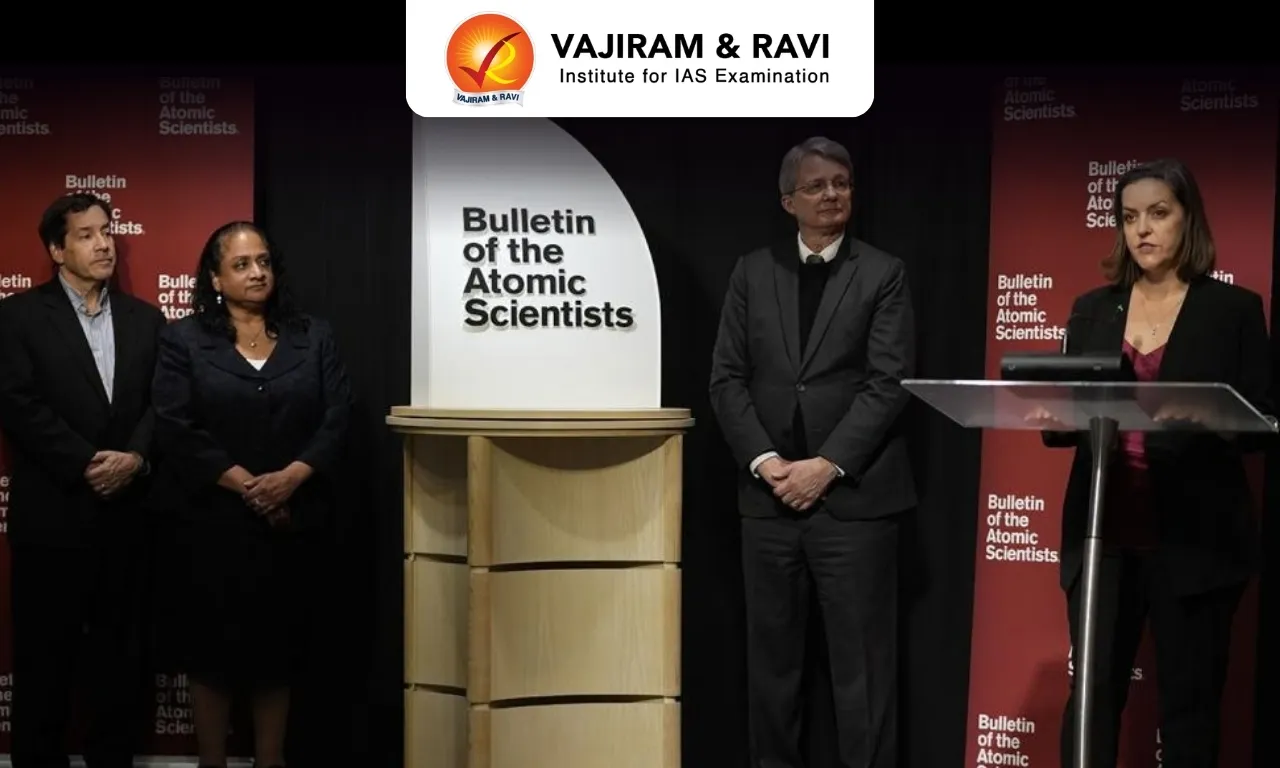
A new assessment published by the regarded Bulletin of the Atomic Scientists (BAS) says India continues to modernise and expand the systems that can deliver nuclear weapons, even as New Delhi maintains its long standing doctrine of no first use.

About Bulletin of the Atomic Scientists 

  • It is an independent, nonprofit organization that sought to warn the public about the danger of nuclear weapons. 
  • The Bulletin was founded by a group called the Atomic Scientists of Chicago in September 1945 at the University of Chicago. 
  • Its founding members and sponsors were scientists who had contributed to the development of the first atomic bombs as part of the Manhattan Project, including physicists Albert Einstein, J. Robert Oppenheimer, and Eugene Rabinowitch. 
  • The Bulletin focuses on three main areas: nuclear risk, climate change, and disruptive technologies.  
  • It pursues its goals through media products, starting in 1945 as a mimeographed newsletter, then a magazine, and now as an online publication. 
  • Today, the Bulletin’s website, premium magazine, videos, iconic Doomsday Clock, and regular events help advance actionable ideas to reduce existential threats. 

Key Facts about Doomsday Clock

  • To convey the particular peril posed by nuclear weapons, the BAS devised the Doomsday Clock in 1947.  
  • It is a symbolic clock adopted by atomic scientists to show how close human beings are considered to be to a global catastrophe, with midnight standing for annihilation, or “doomsday.”.
  • It is recognized as a universal symbol of threats to humanity from a variety of sources: nuclear and other weapons of mass destruction, climate change, and disruptive technologies. 
  • The Doomsday Clock appeared on the Bulletin’s first cover when it transitioned from a newsletter to a magazine. 
  • Its original setting was seven minutes to midnight.  Since its invention in 1947, the clock has been reset 27 times. 
  • In January 2026 the clock was set to 85 seconds before midnight, the closest it has ever been to doomsday.

News: NDTV

Bulletin of the Atomic Scientists FAQs

Q1: What is the Bulletin of the Atomic Scientists (BAS)?

Ans: It is an independent, nonprofit organization that seeks to warn the public about the dangers of nuclear weapons and other existential threats.

Q2: When was the Bulletin of the Atomic Scientists founded?

Ans: September 1945.

Q3: Where was the Bulletin of the Atomic Scientists founded?

Ans: At the University of Chicago.

Q4: Who were among the founding members and sponsors of the Bulletin of the Atomic Scientists?

Ans: Scientists involved in the development of the first atomic bombs under the Manhattan Project, including Albert Einstein, J. Robert Oppenheimer and Eugene Rabinowitch.

Q5: Which organization publishes the Doomsday Clock?

Ans: Bulletin of the Atomic Scientists.

Sal Heartwood Borer

Sal Heartwood Borer

Sal Heartwood Borer Latest News

The Sal trees in Dindori forests of Madhya Pradesh are witnessing a major infestation of the sal heartwood borer this year, compelling the government and local communities to undertake a mega exercise to tackle the pest.

About Sal Heartwood Borer

  • It is a beetle of the order- Coleoptera, family-Cerambycydae. 
    • Hoplocerambyx spinicornis, commonly known as the sal heartwood borer, is a destructive pest first recorded as a threat to the trees in 1897.
  • Appearance: It looks dark brown in color and is about the size of a human finger.
  • It is the most devastating insect pest responsible for catastrophic damage of sal forests of the country.
  • It causes extensive damage to sal trees both in standing as well as freshly felled timbers.
  • The attack of the borer is considered epidemic when the sal trees affected are more than 1% of the total number of trees.

Key Facts about Sal Tree

  • Sal, or Shorea robusta, is among the dominant tree species of central India’s dry deciduous forests.
  • Distribution: It is found naturally in Uttarakhand, Terai region of Uttar Pradesh, Jharkhand, Odisha, Madhya Pradesh, Chhattisgarh and West Bengal.
  • Required Climatic Conditions for Sal Tree
    • Temperature: It can tolerate temperatures as high as 40-45°Celcius in summers and as low as 5°Celcius in winters.
    • Soil: It can be grown in the plains, provided there is light loamy soil with good drainage and the area receives approximately 1000 mm – 3000 mm of annual rainfall.
    • Climate: It requires a warm and humid climate and can thrive at altitudes up to 1500 metres above the sea level.

Uses of Sal Tree

  • Sal timber has historically been prized for construction and for railway sleepers because of its strength and resistance to decay.
  • Sal seed pressed for oil and used in cooking and in the soap and confectionery industries;
  • Sal leaves, stitched into plates and bowls sold across local markets; and resin tapped from the trunk, used as dhoop in religious offerings.

Source: IE

Sal Heartwood Borer FAQs

Q1: What is Sal Heartwood Borer?

Ans: It is a beetle of the order- Coleoptera, family-Cerambycydae. 

Q2: What is the scientific name of Sal Heartwood Borer?

Ans: Hoplocerambyx spinicornis

E100 Fuel in India, Ethanol Blending, Flex Fuel Vehicles, Benefits

E100 Fuel in India

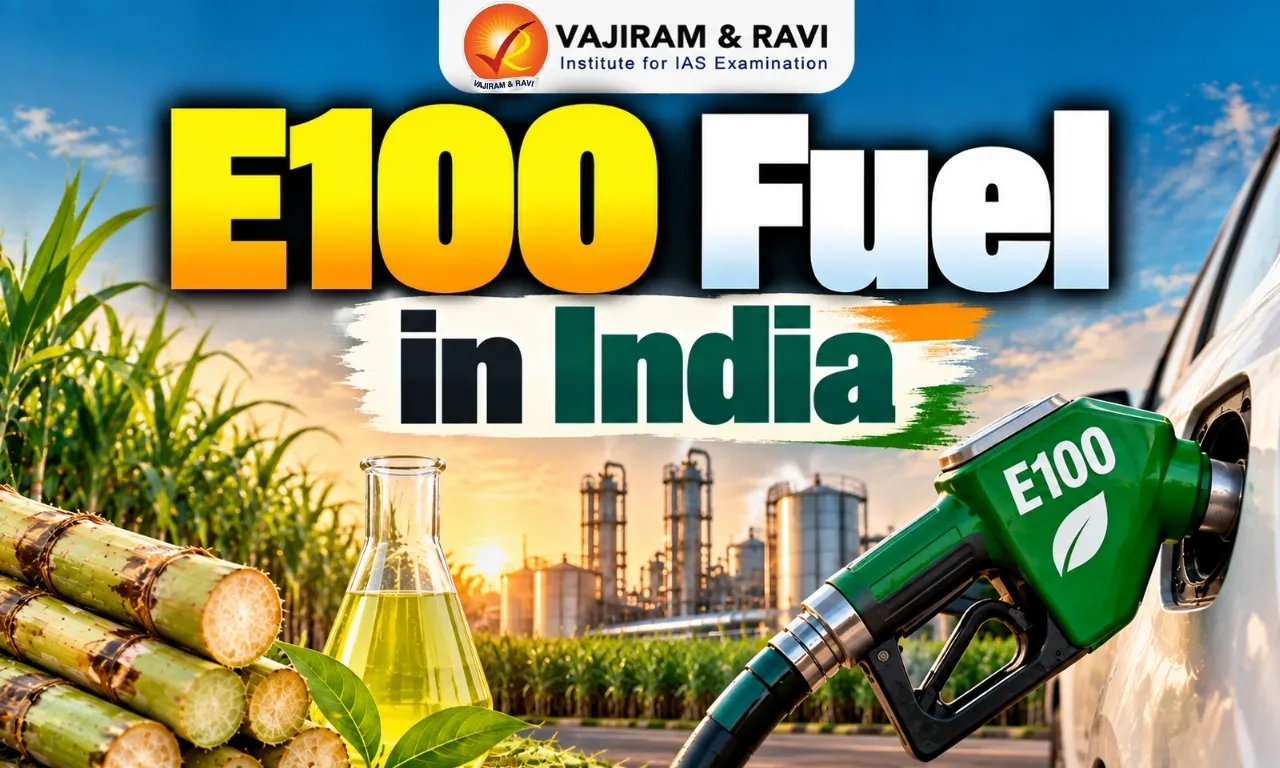
E100 Fuel in India represents the next stage of the country’s ethanol blending strategy after achieving the E20 target in 2025. The Union Minister for Road Transport and Highways has advocated moving towards 100% ethanol blending to improve energy self reliance and reduce exposure to global oil supply shocks. The policy focus now includes flex fuel vehicles, domestic ethanol production, agricultural feedstock, fuel infrastructure and cleaner mobility.

E100 Fuel in India

E100 Fuel in India refers to the use of almost pure ethanol as a transport fuel instead of conventional petrol. India has already expanded ethanol production capacity from under 2 billion litres in 2014 to nearly 20 billion litres. This exceeds the nearly 11 billion litres required for E20. The transition towards E100 therefore depends increasingly on compatible vehicles, fuel availability, infrastructure and sustainable feedstock.

What is E100 Fuel?

E100 is an ethanol based fuel designed for compatible flex fuel engines and represents a move towards higher ethanol use in transport.

  • Fuel Composition: The Ethanol 100 launched in India comprises 93-93.5% ethanol, 5% petrol and 1.5% co-solvent or binder.
  • Ethanol Source: Indian ethanol is mainly produced from sugarcane molasses, with increasing use of maize, surplus rice, damaged foodgrains and agricultural residues.
  • Fuel Types: E10 contains 10% ethanol, E20 contains 20%, E85 commonly contains 85%, while E100 refers to almost pure ethanol, i.e. almost 100% Ethanol Blending.
  • Vehicle Requirement: E100 requires flex fuel vehicles because conventional petrol engines are generally not designed for very high ethanol concentrations.
  • Safety Feature: The Ethanol 100 formulation addresses fire related safety concerns by ensuring that the flame remains visible during combustion.

Flex Fuel Vehicles

Flex fuel vehicles allow engines to operate with petrol, ethanol or different ethanol and petrol blends through specially adapted fuel systems.

  • Flexible Operation: FFVs can use petrol, E20, E85 and higher ethanol blends depending on vehicle design, fuel availability and manufacturer approval.
  • Engine Technology: These vehicles use modified engines, adaptive electronic control systems, suitable fuel injectors, sensors and corrosion resistant components for higher ethanol blends.
  • Indian Development: India’s first flex fuel passenger vehicle was launched in June 2026, while a 100% ethanol capable Toyota Innova was proposed for launch in October 2026.
  • Economic Importance: Higher FFV adoption can create additional ethanol demand while supporting domestic agriculture, agro processing and alternative transport fuel production.
  • Two Wheeler Potential: More than 60% of India’s petrol consumption comes from two wheelers, making this segment important for a broader ethanol strategy.

Ethanol Blending in India

India’s Ethanol Blending Programme (EBP) has rapidly expanded domestic production, reduced crude oil dependence and created a larger agricultural market for ethanol feedstocks.

  • EBP Programme: The Ethanol Blended Petrol Programme operates under the National Biofuel Policy 2018 and is driven by the Ministry of Petroleum and Natural Gas.
  • Blending Target: India achieved 10% ethanol blending in June 2022 and reached the 20% target in 2025, five years before the original 2030 deadline.
  • Recent Blending: Ethanol blending reached 12.06% in 2022-23, 14.60% in 2023-24 and 17.98% up to 28 February 2025.
  • Current Petrol Standard: From April 2026, petrol sold across India must contain 20% ethanol and meet a minimum Research Octane Number of 95.
  • Production Growth: Ethanol production capacity increased from under 2 billion litres in 2014 to nearly 20 billion litres, creating capacity for higher blending levels.
  • Policy Support: Ethanol Interest Subvention Schemes, Long Term Offtake Agreements, administered pricing, GST reduction from 18% to 5% and movement related legal reforms supported the sector.

E100 Fuel in India Benefits

E100 Fuel in India can support energy security, agricultural income, domestic fuel production and cleaner mobility when supported by sustainable feedstock and infrastructure.

  • Energy Security: India imports nearly 89% of its crude oil. Greater ethanol use can reduce exposure to international oil prices and global supply disruptions.
  • Foreign Exchange Savings: Ethanol replacing imported crude oil has helped India save well over Rs 1.4 lakh crore in foreign exchange since 2014.
  • Farmer Income: Ethanol procurement until 2025 generated Rs 1.18 lakh crore for farmers and Rs 1.96 lakh crore for distilleries.
  • Agricultural Value: Ethanol creates an additional market for sugarcane, maize, surplus rice, damaged foodgrains and agricultural residues, strengthening agro processing activities.
  • Emission Reduction: E20 blending has produced an estimated net reduction of approximately 832 lakh metric tonnes of CO2 emissions.
  • Waste to Wealth: Grain based ethanol produces DDGS, which can be used as nutritious cattle feed and supports better utilisation of agricultural resources.
  • Rural Employment: New agro processing and distillery activities have supported employment opportunities in states including Uttar Pradesh, Maharashtra and Bihar.
  • Energy Diversification: E100 can become part of a wider alternative fuel strategy involving ethanol, electricity, hydrogen and other domestic energy sources.

Also Read: Sugar Industry in India

E100 Fuel in India Challenges

Scaling E100 Fuel in India involves challenges related to vehicle efficiency, food security, water use, taxation, fuel infrastructure, production costs and consumer adoption.

  • Lower Mileage: Ethanol provides around 45-55% less energy per litre than petrol, which can reduce kilometres per litre and increase consumer concerns about running costs.
  • Vehicle Compatibility: Higher ethanol blends can affect conventional engines and require modified fuel systems, corrosion resistant materials, suitable sensors and calibrated engine control systems.
  • Food Security: Greater use of maize and foodgrain stocks for ethanol can create concerns about food prices, nutritional security and availability during poor agricultural years.
  • Water Requirement: Sugarcane based ethanol has a high water footprint, with approximately 2,800-3,000 litres of water estimated for producing one litre of ethanol.
  • Infrastructure: E85 and E100 require suitable storage, transportation and dispensing arrangements, including specialised equipment at fuel stations.
  • Taxation Issue: Ethanol attracts 5% GST, while petrol remains outside GST and is subject to Central Excise and State VAT, limiting uniform fuel tax treatment.
  • Production Economics: Ethanol production costs can remain comparable to or higher than petrol, making sustained policy support important for wider adoption.
  • Feedstock Risk: Excessive dependence on sugarcane and food crops can create regional ecological pressure, making 2G and 3G ethanol important for diversification.

E100 Fuel in India Current Status

E100 Fuel in India is moving from policy discussion towards vehicle and infrastructure development, with current efforts focused on higher blends and flex fuel technology.

  • Government Push: Road Transport and Highways Minister Nitin Gadkari has advocated 100% ethanol blending to strengthen energy self reliance and reduce petroleum import dependence.
  • Import Dependence: Gadkari stated that India currently imports petroleum worth about ₹22 lakh crore, highlighting the economic significance of alternative domestic fuels.
  • Ethanol Pricing: E100 has been priced at Rs 94.72 per litre in Delhi, Rs 104.21 in Maharashtra and Rs 100.75 in Chennai.
  • FFV Roadmap: A new white paper by IIT Delhi and the All India Distillers’ Association presents a 10 point roadmap for E85 and E100 readiness.
  • Infrastructure Focus: The roadmap covers vehicle technology, fuel availability, retail infrastructure, pricing, financing, consumer adoption, feedstock sustainability and long term market development.
  • Cost per Kilometre: The roadmap proposes comparing ethanol fuels through cost per kilometre rather than only price per litre because ethanol contains less energy per litre.
  • Brazil Association: Brazil provides an important international association for flex fuel adoption, having developed E100 capability, dual fuel pumps and commercial flex fuel vehicles over several decades.
  • Future Direction: India’s E100 strategy is increasingly linked with higher ethanol blends, FFVs, agricultural residues, sustainable feedstock and diversified clean transport options. Its future Events, policy Assembly and industry developments will depend on infrastructure, affordability and vehicle readiness.

E100 Fuel in India FAQs

Q1: What is E100 Fuel in India?

Ans: E100 is an ethanol based fuel containing almost pure ethanol. It is intended for compatible flex fuel vehicles.

Q2: Is E100 fuel available in India?

Ans: E100 fuel has been introduced in India, but its wider availability depends on compatible vehicles, fuel infrastructure and retail expansion.

Q3: Can normal petrol cars use E100 fuel?

Ans: No. E100 requires compatible flex fuel vehicles because conventional petrol engines are generally not designed for very high ethanol blends.

Q4: What are the benefits of E100 Fuel in India?

Ans: E100 can reduce crude oil dependence, support domestic ethanol production, increase agricultural demand and contribute to lower transport emissions.

Q5: What are the main challenges of E100 Fuel in India?

Ans: Key challenges include lower mileage, vehicle compatibility, fuel infrastructure, production costs, water use and food versus fuel concerns.

Tuvalu Island

Tuvalu

Tuvalu Latest News

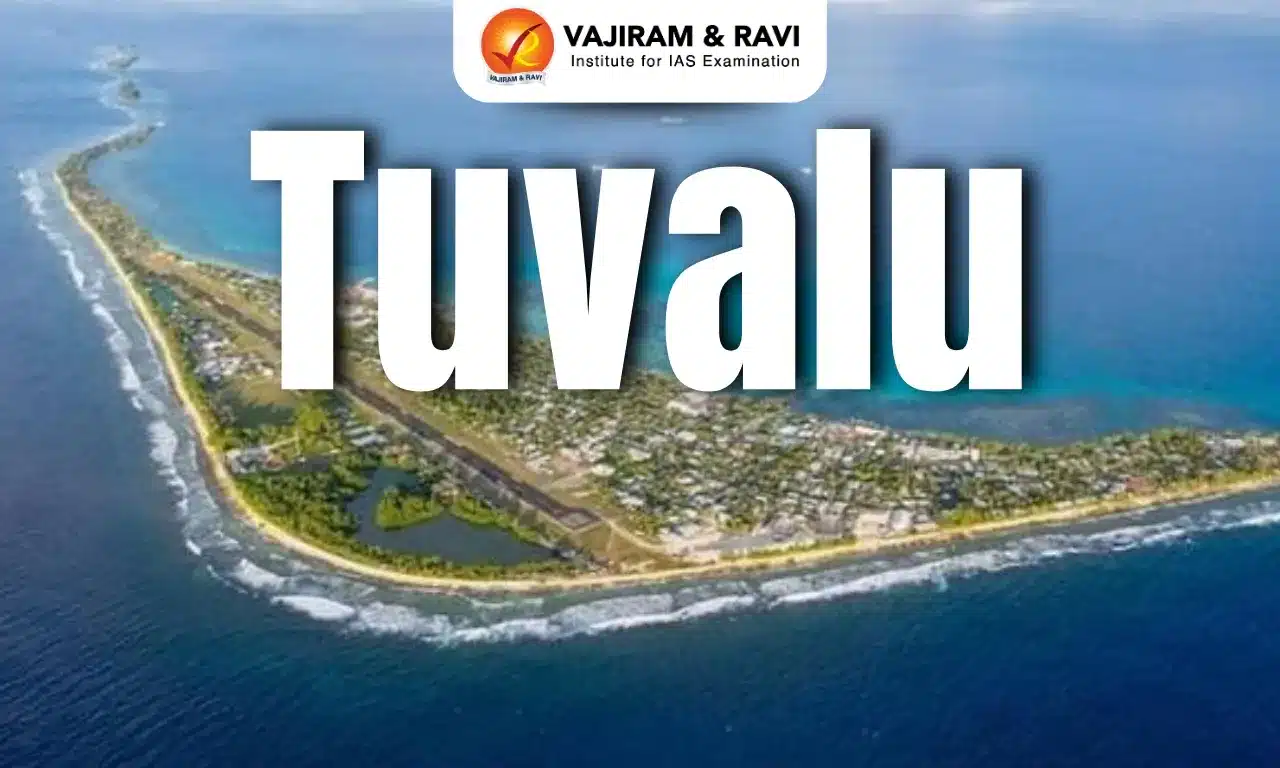
Scientists fear the entire Tuvalu archipelago could be unliveable by the end of the century as it is impacted by climate change.

About Tuvalu

  • Location: It was formerly known as the Ellice Islands, is a Polynesian island country in the west-central Pacific Ocean. 
  • It is the 4th smallest country in the world with 26 sq.km. of land.
  • It sits about halfway between Australia and Hawaii. 
  • Neighboring Countries: Its neighbours include Kiribati, to the north, and Fiji, to the south. 
  • It comprises nine islands (four reef islands and five coral atolls). 
  • Nanumanga, Niutao, and Niulakita are the three main islands that make up Tuvalu. 
  • Capital: The Funafuti atoll is the capital of Tuvalu and is also the most populous among all the 9 atolls.
  • Climate: There are no rivers. Tuvalu’s climate is hot and rainy.
  • Economy: A small quantity of copra is produced for export, the sale of stamps accounts for modest earnings, and fees are collected from foreign fishing fleets, but the country depends heavily on foreign aid.

Source: PIB

Tuvalu FAQs

Q1: Where is Tuvalu located?

Ans: Pacific Ocean

Q2: Which are the main islands of Tuvalu?

Ans: Nanumanga, Niutao, and Niulakita are the three main islands that make up Tuvalu.

Petroglyphs

Petroglyphs

Petroglyphs Latest News

A team of archaeologists recently discovered petroglyphs engraved on a granite rock near the recently restored umbrella stone site at Peralam-Kozhummal in Kannur district, Kerala.

About Petroglyphs

  • Petroglyphs (also known as rock engravings) are symbolic images sculpted or engraved on the surface of rocks by removing material from its surface layer with instruments of superior hardness.
  • The word ‘’petroglyph’’ is derived from two Greek words, ‘’petros’’ meaning “stone,” and ‘’glyphein’’ meaning “to carve.“
  • The techniques used to create these images include pecking, incising, abrading, sculpting, polishing, drilling, and scratching. 
  • These processes remove part of the rock and therefore are different from images simply painted or drawn on rock, which are called petrographs.
  • Because petroglyphs are carved into rock, they tend to last longer than petrographs. 
  • Petroglyphs took two primary forms, as images either appear as scratches or deeper visible indentations on rock. 
  • Petroglyphs are typically associated with prehistoric populations. These carvings often depict animals, people, geometric shapes, and symbolic images that offer insights into the social and religious lives of ancient peoples. 
  • They can be found on every continent throughout the world, except Antarctica.
    • However, they are especially concentrated in Africa, South America, North America (mainly in the southwestern United States), Siberia, Australia, and Europe (Scandinavia, Spanish Galicia, Ireland, and Italy).
  • Example of Petroglyph Site in India: Edakkal Caves in Wayanad, Kerala.
    • Significance:
    • They are among the earliest forms of art to have existed and are therefore considered the foundation of art. 
    • Ancient peoples also used petroglyphs as a form of communication or writing. 
    • For example, some petroglyphs clearly indicated the borders between tribal lands, and others were astronomical markers and maps. 
    • Additionally, some petroglyphs served as musical instruments and were known as “rock gongs.”.

News:TH

Petroglyphs FAQ's

Q1: What are petroglyphs?

Ans: Petroglyphs are symbolic images carved or engraved on rock surfaces by removing material from the rock.

Q2: What techniques are used to create petroglyphs?

Ans: Pecking, incising, abrading, sculpting, polishing, drilling and scratching.

Q3: How are petroglyphs different from petrographs?

Ans: Petroglyphs are carved or engraved by removing rock material, whereas petrographs are images painted or drawn on rock surfaces.

Q4: In which regions are petroglyphs particularly concentrated?

Ans: Africa, South America, North America, Siberia, Australia and Europe.

Methane Emissions, Sources, Climate Impact, Global Efforts

methane emissions

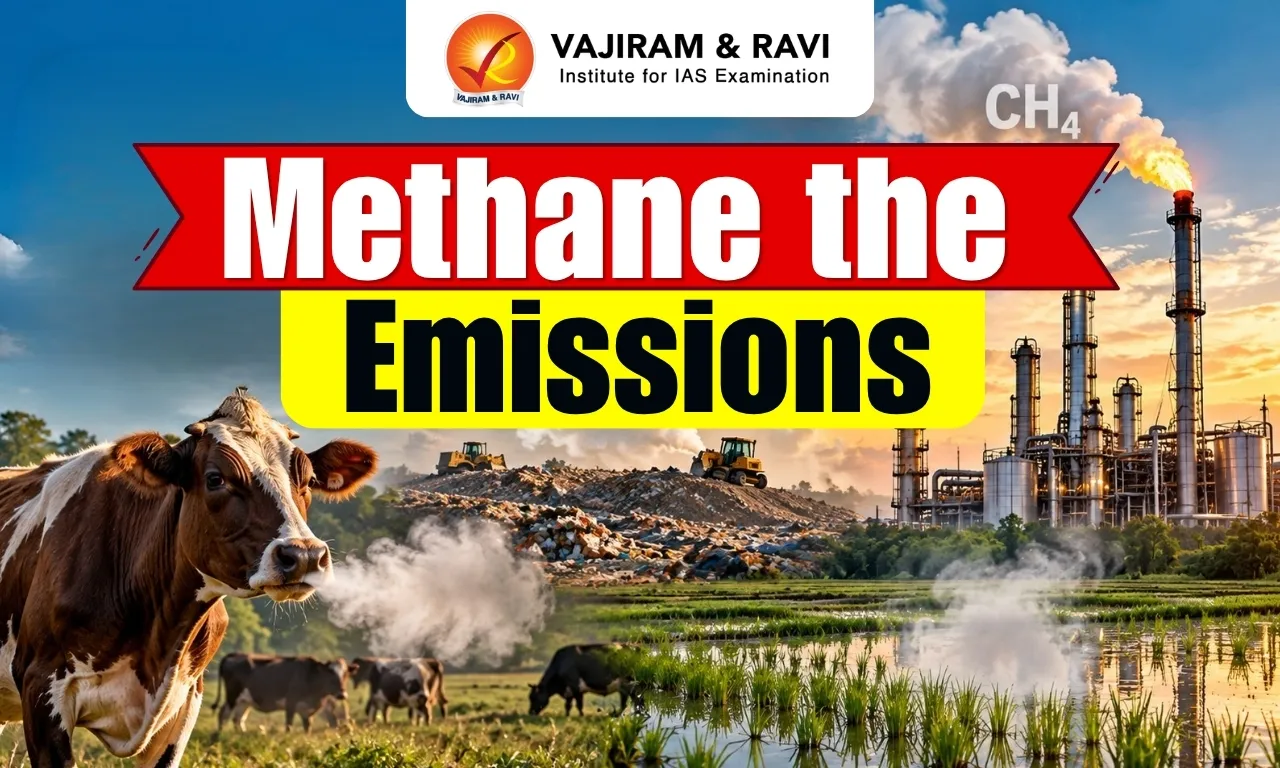
Methane Emissions are a major contributor to climate change because methane (CH₄) is a short-lived but highly potent greenhouse gas. According to the International Energy Agency (IEA), methane is responsible for around 30% of the rise in global temperatures since the Industrial Revolution. Over a 20-year period, methane has more than 80 times the warming potential of carbon dioxide (CO₂).

Unlike CO₂, which can remain in the atmosphere for centuries, methane has an atmospheric lifetime of roughly 12 years. This means that reducing methane emissions can slow the rate of global warming relatively quickly while also improving air quality.

Major Sources of Methane Emissions

Global methane emissions are estimated at around 610 million tonnes annually, with human activities contributing nearly two-thirds of the total. Among anthropogenic sources, agriculture, energy and waste are the major contributors.

  • Agriculture: Accounts for around 42% of human-caused methane emissions, mainly from livestock digestion, manure management and rice cultivation.
  • Fossil Fuels: The energy sector contributes around 38% of anthropogenic methane emissions, primarily through leaks, venting and flaring during oil, natural gas and coal production.
  • Waste: Responsible for about 20% of human-caused methane emissions, mainly from landfills, open dumps and wastewater treatment.
  • Wetlands: Wetlands are the largest natural source of methane, as microorganisms produce methane while decomposing organic matter in oxygen-free conditions.
  • Coal Mining: Coal mining releases methane trapped in underground coal seams, both during active mining and from abandoned mines.
  • Oil and Gas Infrastructure: Methane escapes from oil and gas wells, pipelines, processing facilities, storage systems and other equipment, making leak detection and repair an important mitigation measure.

Methane Emissions in India

India is a major source of methane emissions, with agriculture and livestock accounting for a large share because of the country's extensive livestock population and rice cultivation. The energy and waste sectors also contribute significantly to methane emissions.

  • Livestock: Enteric fermentation in cattle and buffalo is a major source of methane.
  • Rice cultivation: Flooded paddy fields create oxygen-free conditions that promote methane production.
  • Manure: Decomposition of livestock manure releases methane.
  • Coal mining: Methane is released during coal extraction and from abandoned coal mines.
  • Waste: Landfills, open dumping and wastewater treatment contribute to methane emissions.
  • Agricultural residues: Poor management and burning of crop residues can contribute to methane and other air pollutants.

How Can Methane Emissions Be Reduced?

Methane emissions can be reduced through better agricultural practices, improved waste management, stronger monitoring and methane-control technologies. Since methane has a relatively short atmospheric lifetime, rapid reductions can help slow near-term warming.

  • Improve livestock management: Better animal nutrition, health and breeding practices can reduce methane from enteric fermentation.
  • Improve rice cultivation: Alternate wetting and drying and other water-management practices can reduce methane from flooded rice fields.
  • Manage manure: Anaerobic digesters can capture methane from animal waste and convert it into biogas.
  • Control fossil-fuel leaks: Regular leak detection and repair can reduce methane emissions from oil and gas infrastructure.
  • Reduce venting and flaring: Capturing methane instead of releasing or burning it can reduce emissions and recover usable energy.
  • Improve waste management: Composting organic waste, improving landfill management and capturing landfill gas can reduce methane.
  • Strengthen monitoring: Satellites, sensors and direct measurements can help identify major methane-emitting sites and improve enforcement.
  • Reduce crop-residue burning: Better residue management can help reduce methane and other pollutants associated with open burning.

Global Methane Tracker

The Global Methane Tracker, published by the International Energy Agency, provides country and regional estimates of methane emissions and information on methane-abatement opportunities.

The latest tracker includes estimates for energy-related methane emissions and examines the potential for reducing emissions from coal, oil and gas operations. Its database was updated in May 2026.

The use of satellites, direct measurements and other monitoring technologies has also improved the ability to identify major methane-emitting facilities and regions.

Global Methane Pledge

The Global Methane Pledge is an international initiative aimed at accelerating reductions in methane emissions. Its focus is particularly important because methane reductions can produce relatively rapid climate benefits.

The Climate and Clean Air Coalition estimates that implementing available methane-reduction measures could substantially reduce human-caused methane emissions this decade.

European Union Methane Regulation

The European Union Methane Regulation is designed to reduce methane emissions associated with the fossil-fuel supply chain. It includes requirements related to monitoring, reporting and verification of methane emissions and measures addressing leaks and venting.

However, the implementation timeline has become a subject of debate in 2026. In September 2026, the European Commission indicated that it planned to propose postponing the entry into force of the methane regulation following pressure from several governments and concerns related to energy supplies.

The European Commission's proposed approach and any eventual delay remain part of the EU's ongoing policy process.

Methane Emissions FAQs

Q1: What is methane?

Ans: Methane is a greenhouse gas with the chemical formula CH₄. It is the primary component of natural gas and is released through both natural processes and human activities.

Q2: Why is methane more harmful than carbon dioxide?

Ans: Methane has a much higher warming potential than CO₂ over shorter time periods. Over 20 years, its global warming potential is more than 80 times that of CO₂.

Q3: What is the largest source of human-caused methane emissions?

Ans: Agriculture is the largest source, accounting for around 42% of anthropogenic methane emissions in the latest Global Methane Status Report. Livestock and rice cultivation are major contributors.

Q4: What are the major sources of methane in agriculture?

Ans: The major sources are livestock digestion, manure management and rice cultivation. Agricultural residue management can also contribute.

Q5: How can methane emissions be reduced?

Ans: Methane can be reduced through better livestock and rice-management practices, improved manure and waste management, methane leak detection, reduced venting and flaring, landfill-gas capture and improved wastewater treatment.

CAPF Cadre vs IPS Deputation – The Battle Over Senior Command Positions

CAPF Cadre vs IPS Deputation

CAPF Cadre vs IPS Deputation Latest News

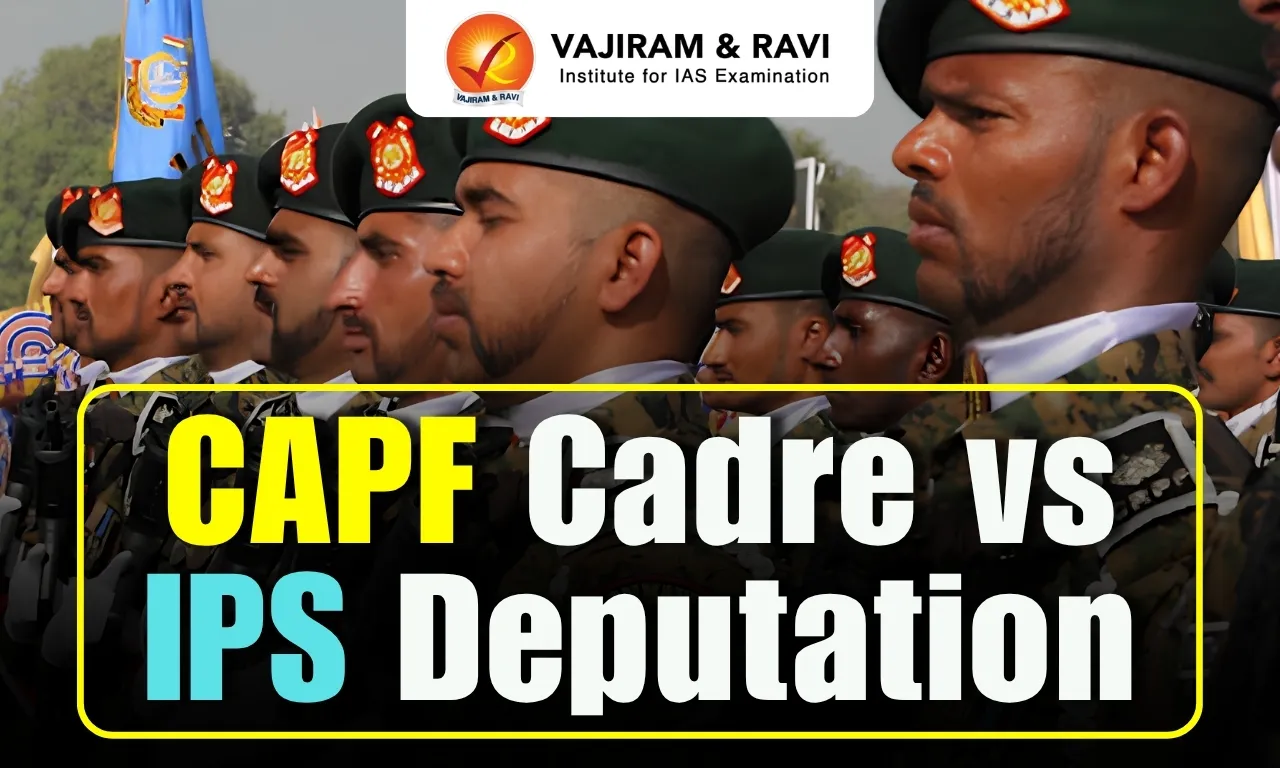
  • A recent controversy in the Supreme Court over the listing of contempt petitions has revived a long-running institutional dispute over senior command positions in the Central Armed Police Forces (CAPFs). 
  • The core issue is whether these posts should primarily go to officers who have built their careers within the CAPFs or continue to be occupied by IPS officers on deputation.
  • The dispute involves career stagnation, Organised Group A Service (OGAS) status, Non-Functional Financial Upgradation (NFFU), cadre management and the constitutional relationship between judicial directions and legislative action.

The Recent Controversy

  • The SC was hearing contempt petitions alleging non-compliance with its (May 23, 2025) judgment on CAPF cadre progression and IPS deputation.
  • The Centre was expected to explain why 46 IPS officers were brought into CAPFs despite the Court directing a progressive reduction in IPS deputation. 
  • The Centre had requested that the contempt proceedings be heard alongside a separate challenge to the new CAPF law, since the government's defence in both matters overlapped.
  • CAPF officers objected, arguing that non-compliance with an earlier judicial judgment was a distinct issue from the subsequent constitutional challenge to legislation.

The Underlying Dispute

  • Senior posts through deputation:
    • The five CAPFs involved are CRPF, BSF, CISF, ITBP, and SSB. Each has its own Group A executive cadre, generally recruited as Assistant Commandants and capable of rising to senior command positions.
    • However, senior posts have traditionally been shared with officers brought in through deputation, particularly from the IPS. 
    • Before the new law, recruitment rules provided for 20% of DIG and 50% of IG posts to be filled through deputation.
  • The problem of stagnation:
    • CAPF cadre officers argue that reserving senior posts for deputation creates a structural promotional bottleneck. 
    • As the number of posts decreases at higher levels, deputation further restricts opportunities for officers who have spent their entire careers within the forces.
    • This became the basis for their demand for NFFU, under which an officer unable to secure promotion because of limited vacancies can receive the financial benefits of a higher grade.
  • OGAS status and NFFU:
    • The Delhi High Court ruled in favour of CAPF officers in 2015, and the SC upheld the decision in 2019. 
    • Subsequently, the Union Cabinet granted Organised Group A Service (OGAS) status and NFFU benefits to Group A executive cadre officers.
    • However, CAPF officers contend that NFFU has not completely resolved stagnation because existing Recruitment Rules continue to link financial progression to actual promotion and prescribed service in each rank.
    • Thus, an officer may receive the pay of a higher grade without actually occupying the corresponding post, while the qualifying service for the next financial upgradation may not begin until substantive promotion takes place.

The 2025 SC Judgment

  • It held that CAPFs must be treated as OGAS not merely for NFFU but for broader cadre-related purposes.
  • It directed - 
    • Cadre review of the CAPFs, review of existing service and recruitment rules, consideration of the concerns of CAPF cadres, and 
    • Progressive reduction of deputation posts up to the Senior Administrative Grade (DIG and IG) within an outer limit of two years.
  • The Centre's review petition was subsequently dismissed in October 2025.

Why Does the Government Support IPS Deputation?

  • The MHA argued that CAPFs have distinctive operational and security responsibilities and cannot be treated exactly like ordinary civilian Group A services.
  • It also maintained that IPS officers provide an institutional link between Central and State police establishments, particularly when CAPFs are deployed in states.
  • The SC did not abolish IPS deputation. Instead, it attempted to balance the government's operational concerns with the career progression of CAPF cadre officers.
  • A notable paradox is that the Centre itself has faced difficulties in filling IPS-deputation posts because states have sometimes been reluctant to release IPS officers for central deputation.

Changes Brought by the New CAPF Act

  • The new law:
    • The government subsequently introduced the Central Armed Police Forces (General Administration) Bill (in March 2026). After being passed by both Houses, it became law.
    • The Act establishes an umbrella framework for Group A officers of the five CAPFs and empowers the Centre to frame rules concerning recruitment, promotion, deputation, and service conditions.
    • Significantly, the Act provides that rules made under it can operate notwithstanding inconsistent judgments, decrees or orders of courts, while the rules will prevail over inconsistent existing rules or government orders.
  • Senior posts reserved for deputation: The legislation retains a substantial deputation component -
    • 50% of IG posts through deputation.
    • At least 67% of Additional DG posts through deputation.
    • All Special DG and DG posts through deputation.
  • For and against arguments:
    • The government argues that this is necessary for operational requirements and Centre-State coordination.
    • Opposition MPs, however, argued that the legislation could undermine the effect of the SC's 2025 judgment and perpetuate career disadvantages for CAPF cadre officers. 
    • They sought reference to a Select Committee and later walked out during the legislation's passage.

The Larger Constitutional Question

  • The controversy now involves two interconnected proceedings -
    • Contempt petitions — whether the Centre complied with the SC's 2025 directions.
    • Challenge to the 2026 CAPF Act — whether the new statutory framework, including its deputation provisions and its treatment of judicial orders, is constitutionally valid.
  • The dispute therefore extends beyond service conditions. It raises important questions concerning -
    • Judicial review, separation of powers, 
    • Legislative competence, 
    • Statutory override of judicial directions, 
    • Cadre management and administrative efficiency.

Source: IE

CAPF Cadre vs IPS Deputation FAQs

Q1: What is the core issue in the CAPF cadre-versus-IPS deputation dispute?

Ans: The dispute concerns career progression and access to senior command posts.

Q2: How has Organised Group A Service (OGAS) status benefited CAPF officers?

Ans: OGAS status strengthened the cadre-based career structure of CAPFs and enabled benefits such as NFFU.

Q3: Why has NFFU failed to completely resolve stagnation in CAPFs?

Ans: Because existing service rules often link financial progression to actual promotion and prescribed service in each rank.

Q4: What was the significance of the SC’s May 2025 judgment on CAPF cadre management?

Ans: The Court directed cadre and service-rule reviews and ordered the progressive reduction of deputation posts up to DIG and IG levels.

Q5: What constitutional issues arise from the new CAPF Act?

Ans: The Act raises questions concerning separation of powers, judicial review and legislative-executive authority.

Desert National Park

Desert National Park (DNP)

Desert National Park Latest News

In a major milestone for the conservation of the critically endangered Great Indian Bustard (GIB), the Union Environment Minister released two captive-bred male GIBs into the wild at Sam in the Desert National Park, Jaisalmer, Rajasthan.

About Desert National Park

  • Location: It is located in the Thar Desert near the town of Jaisalmer, in Rajasthan.
  • It is one of the largest national parks in the country, covering an area of over 3160 sq. km.
  • Topography: The substantial part of the park is on a landscape, which comprises a lakebed of extinct salt lakes and thorny scrub and a considerable area consists of sand dunes. 
  • Climate: The area falls in the extreme hot and arid region of the very low rainfall zone (<100mm) of the country.
  • One of the most interesting features of this park is the presence of fossils from the Jurassic Period.
  • Vegetation
    • The vegetation of a major part of the arid region of the Thar falls under the thorn forest type.
    • The vegetation is quite sparse with open grassland, thorny bushes, plantations and dunes as the broad habitat types.
  • Lakes: There are three main lakes in this Park- Rajbaugh Lake, Malik Talao Lake and Padam Talao.
  • Flora: The rich flora of the park consists of dhok, ronj, salai and palm trees. The vegetation is sparce, and patches of sewan grass and aak shrub can be seen.
    • Khejri (Prosopis cineraria) is commonly found, which is revered and protected by the local communities, especially the ‘Bishnois’.
  • Fauna: Blackbuck, Chinkara, Desert fox, Bengal Fox, Indian Wolf, Desert Cat, Hare etc. Reptiles are also found in abundance and they include spiny –tailed lizard, monitor lizard, saw scaled-viper, Russel viper , Karit.
  • The Great Indian Bustard is one magnificent bird found in relatively fair numbers.

Source: PIB

Desert National Park FAQs

Q1: Where is Desert National Park located?

Ans: It is located in Rajasthan

Q2: Which lakes are found in Desert National Park?

Ans: Rajbaugh Lake, Malik Talao Lake and Padam Talao.

Green Energy Corridor Phase 3: ₹1.86 Lakh Crore Renewable Push

Green Energy Corridor

Green Energy Corridor Latest News

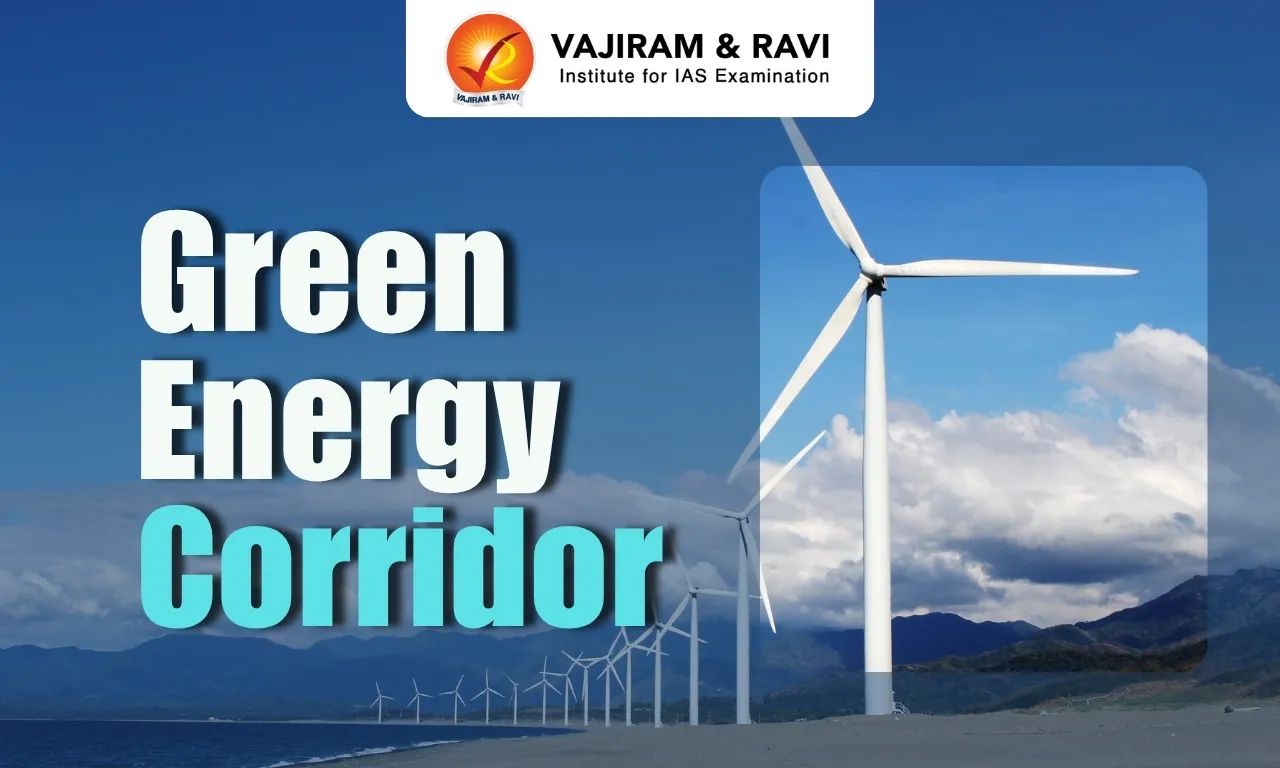
  • The Centre approved the third phase of the Green Energy Corridor (GEC), with an outlay of ₹1.86 lakh crore, aimed at facilitating the evacuation of up to 135 gigawatts (GW) of renewable energy (RE). 
    • Evacuation refers to transferring electricity generated from renewable sources to the places where it is actually consumed.
  • This comes as India's rapidly expanding RE capacity poses a growing challenge: ensuring electricity generated from renewables can actually be evacuated and absorbed by the grid when and where needed.

What Is the Green Energy Corridor (GEC)?

  • The GEC is a flagship government programme to build dedicated transmission infrastructure integrating large-scale renewable energy — solar and wind — into the national power grid.
  • What's New in Phase 3: For the first time, GEC includes a dedicated battery energy storage component, with provisions for deploying 50 gigawatt-hours (GWh) of Battery Energy Storage Systems (BESS).

Understanding Storage:

  • Energy storage systems store excess renewable electricity during high-generation periods and discharge it when demand rises but generation remains low.
  • They convert electricity into a storable form when available, then convert it back to electricity when needed.
  • A GWh measures total energy produced, consumed, or stored over a period.

Why This Matters: The Evacuation Problem

  • Transmission bottlenecks and grid congestion — particularly during periods of high solar generation in the daytime — are causing renewable power to be curtailed or restricted from being evacuated. 
  • This problem is worsening because renewable capacity is expanding faster than the transmission infrastructure needed to carry it.

How the ₹1.86 Lakh Crore Is Allocated

  • Intra-State Transmission Systems (InSTS) - Over ₹1.36 lakh crore
  • 50 GWh of BESS - ₹50,000 crore
  • Central Financial Support (CFS) - ₹54,082 crore
    • The CFS is meant to offset intra-state transmission charges and keep power costs lower for end users.

Implementation Models:

  • Greenfield projects (entirely new) under InSTS: Tariff-Based Competitive Bidding (TBCB) — private transmission companies compete to develop and operate a project at a competitively determined tariff.
  • Brownfield upgrades and network-strengthening: Cost-Plus Basis (CPB) — project cost plus an approved return is recovered through the regulated tariff.
  • Who implements it: State transmission utilities serve as overall implementing agencies, while transmission service providers participate in the TBCB process under a build-own-operate-maintain model. 
  • The scheme targets completion by FY33.

The Scale of India's Future Needs And Significance of GEC-III

  • India is expected to add around 400 GW of RE capacity between 2030 and 2035–36.
  • This would require about 160 GW of additional InSTS infrastructure.
  • GEC-III is expected to support 135 GW of this infrastructure creation at the state level.
  • Decentralisation Goal: The scheme would also help decentralise RE capacity, which has so far been concentrated largely in five states. 
    • Proposals have already been received from at least 13 states, expanding GEC's geographical footprint — GEC-I covered eight states, GEC-II covered seven states.
  • Boosting Private Capital: Greenfield projects — traditionally developed by states via CPB using budgetary resources or loans — will now be opened to TBCB. 
    • Experts draw a parallel with inter-state transmission (ISTS), where transmission service providers bring in capital upfront and recover it over a 35-year period. 
    • The same model will now apply at the state level, aiming to maximise private capital inflow and competition.

The Challenges So Far

  • Persistent delays. MNRE is implementing GEC in two phases (GEC-I and GEC-II) to augment transmission lines and transformation capacity. Both have faced consistent delays:
    • GEC-I: Now expected to complete by March 2027.
    • GEC-II: All projects expected to complete by 2028.
  • A steering committee at the Cabinet Secretary level will monitor GEC-II and GEC-III progress twice a year.
  • Transmission constraints are a major barrier to evacuating RE power. In FY26, around 6,900 GWh of clean electricity faced restrictions due to a mismatch between rapid RE deployment and the pace of transmission infrastructure commissioning.

Why Battery Storage Is So Significant

  • Large volumes of renewable energy have had to be curtailed — meaning grid operators ask RE plants to reduce or temporarily stop generation to maintain grid stability — particularly during daytime peak solar generation, when supply can exceed the grid's absorption capacity. 
  • This happens mainly due to a lack of energy storage capacity.
  • The Storage Gap: Deployment of energy storage systems has not kept pace with rapid RE capacity addition, raising concerns about whether the grid can efficiently absorb rising renewable power shares.
  • Current Installed Capacity:
    • BESS: ~2.9 GW
    • Pumped Hydro Storage (PHS): ~7.2 GW
  • Future Targets (Central Electricity Authority plan, by 2035–36):
    • Total storage capacity: 174 GW / 888 GWh
    • BESS: 80 GW / 321 GWh
    • PHS: 94 GW / 567 GWh

Conclusion

  • Generating clean power is only half the challenge — moving and storing it is the other half, and India has been lagging on both. 
  • GEC-III's dual focus on transmission and, for the first time, battery storage, signals recognition that curtailment, not generation capacity, is the real bottleneck. 
  • Whether India meets its 2035–36 storage targets will determine if this renewable energy boom translates into reliable power, or continues to be wasted at the point of generation.

Source: IE | ToI

Green Energy Corridor FAQs

Q1: What is Green Energy Corridor Phase 3?

Ans: Green Energy Corridor Phase 3 is a transmission initiative designed to integrate large-scale renewable energy into India's national electricity grid efficiently.

Q2: What is the financial outlay for Green Energy Corridor Phase 3?

Ans: Green Energy Corridor Phase 3 has an outlay of ₹1.86 lakh crore and aims to facilitate evacuation of up to 135 GW renewable energy.

Q3: Why is battery storage important for Green Energy Corridor Phase 3?

Ans: Green Energy Corridor Phase 3 includes 50 GWh battery storage to store surplus renewable electricity and release it when demand rises or generation falls.

Q4: How will Green Energy Corridor Phase 3 attract private investment?

Ans: Green Energy Corridor Phase 3 will use tariff-based competitive bidding for new transmission projects, encouraging private companies to invest and operate infrastructure.

Q5: What is the major challenge facing the Green Energy Corridor programme?

Ans: The Green Energy Corridor faces persistent transmission delays, with renewable electricity being curtailed because grid infrastructure and storage have not expanded rapidly enough.

Visa Does Not Guarantee Entry Into India: Delhi HC Ruling

Visa

Visa Latest News

  • The Delhi High Court has held that possession of a valid visa does not give a foreign national an inherent or legally enforceable right to enter India. 
  • The court dismissed a petition filed by a Turkmenistan citizen who was stopped at Indira Gandhi International Airport, New Delhi, despite holding a valid business visa.

What Happened

  • The petitioner arrived in India in March on the same flight as her husband, who held a visa of the same category and was permitted entry. She, however, had to return to Turkmenistan the same day.
  • She approached the court seeking:
    • A written order explaining why she had been denied entry.
    • Permission to enter India with her business visa.

The Petitioner's Arguments

  • She based her challenge on two grounds:
    • No Reasons Given: Authorities denied her entry without providing any explanation.
    • Discrimination (Articles 14 and 21): Her husband, travelling with her on a visa of the same category, was allowed in while she was turned away — amounting, she argued, to discriminatory treatment violating the right to equality and the right to life and personal liberty.

The Centre's Position

  • The government countered that a foreign national does not acquire an indefeasible right to enter India merely because a valid visa has been issued.
  • Grant of a visa and permission to enter India are two distinct matters.
  • Entry remains subject to immigration law and the discretion of competent authorities.
  • Why she was stopped: The authorities stated that "adverse inputs" had been received concerning the petitioner, and the decision was taken in the interest of national security and public order. 

What the Court Ruled

  • The court's central holding: there is no inherent or legally enforceable right of a foreign national to seek entry into India.

Key Reasoning

  • Issuance of a visa, refusal of entry, and immigration clearance are sovereign functions of the State, involving considerations like national security, foreign policy, and administrative discretion.
  • The court drew a crucial distinction between satisfying the requirements for obtaining a visa and actually being admitted into the country — these are not the same thing.
  • The statutory framework, therefore, does not treat the possession of a visa as creating an absolute and unconditional right of admission into India.

On the Article 14 Discrimination Argument

  • The court rejected this too. The mere fact that her husband was allowed entry did not establish that the two were similarly situated in all respects — since the "adverse inputs" specifically concerned the petitioner, not her husband. 
  • Without a basis to show infringement of a legally enforceable right, there was no ground to issue a writ under Article 226. The petition was dismissed.

The Legal Framework: Immigration and Foreigners Act, 2025

  • This is the key legislation now governing foreigners in India.
  • Section 3: Requires a foreigner seeking entry into India to possess a valid passport/travel document and a valid visa.
  • However, no foreigner shall be allowed entry or stay if found inadmissible on grounds including threats to: 
    • National security
    • Sovereignty and integrity of India
    • Relations with a foreign State
    • Public health, or other grounds.
  • Section 7 (along with Section 3 of the now-repealed Foreigners Act, 1946) authorises the Central government to make provisions prohibiting, regulating, or restricting the entry, departure, or continued presence of foreigners in India.
  • At the Point of Entry: An Immigration Officer examining a foreigner's passport, travel document and visa is empowered to require any information necessary and appropriate — reinforcing that a visa alone does not guarantee admission.

Supreme Court Precedents the Judgment Relied On

  • Hans Muller of Nurenburg v. Superintendent, Presidency Jail (1955) - The Supreme Court held that the Foreigners Act, 1946 gave the Central government broad discretion in relation to foreigners, including the power to expel them.
  • Louis De Raedt v. Union of India (1991) - The Supreme Court held that a foreigner's fundamental rights are confined to Article 21's protection of life and personal liberty. The right to reside and settle in India under Article 19(1)(e) is available only to citizens, not foreigners.

Conclusion

  • The ruling draws a firm line between a visa as a travel document and entry as a State prerogative — the former is procedural; the latter remains discretionary. 
  • Even a facially identical visa, held alongside a spouse who was let in, offered no automatic claim once security considerations entered the picture. 
  • For foreign nationals, this judgment is a reminder that immigration clearance, unlike visa issuance, is where sovereign discretion has the final word.

Source: TH | ET

Visa FAQs

Q1: Does a valid visa guarantee entry into India?

Ans: No, a valid visa does not guarantee entry into India because admission remains subject to immigration clearance and sovereign discretion.

Q2: Why did the Delhi High Court reject the petitioner's entry claim?

Ans: The Delhi High Court held that possessing a visa creates no legally enforceable right to enter India when security concerns arise.

Q3: How does Indian law distinguish visa issuance from entry?

Ans: Visa issuance confirms eligibility to seek entry, whereas actual admission requires immigration clearance and remains subject to statutory restrictions and government discretion.

Q4: What does the Immigration and Foreigners Act, 2025 provide?

Ans: The Act requires foreigners to possess valid travel documents and visas but permits denial of entry on national security and other specified grounds.

Q5: What Supreme Court precedents supported the Delhi High Court's decision?

Ans: The judgment relied on precedents recognising broad governmental discretion over foreigners and limiting their fundamental rights primarily to Article 21 protections.

Ramappa Temple

Ramappa Temple

Ramappa Temple Latest News

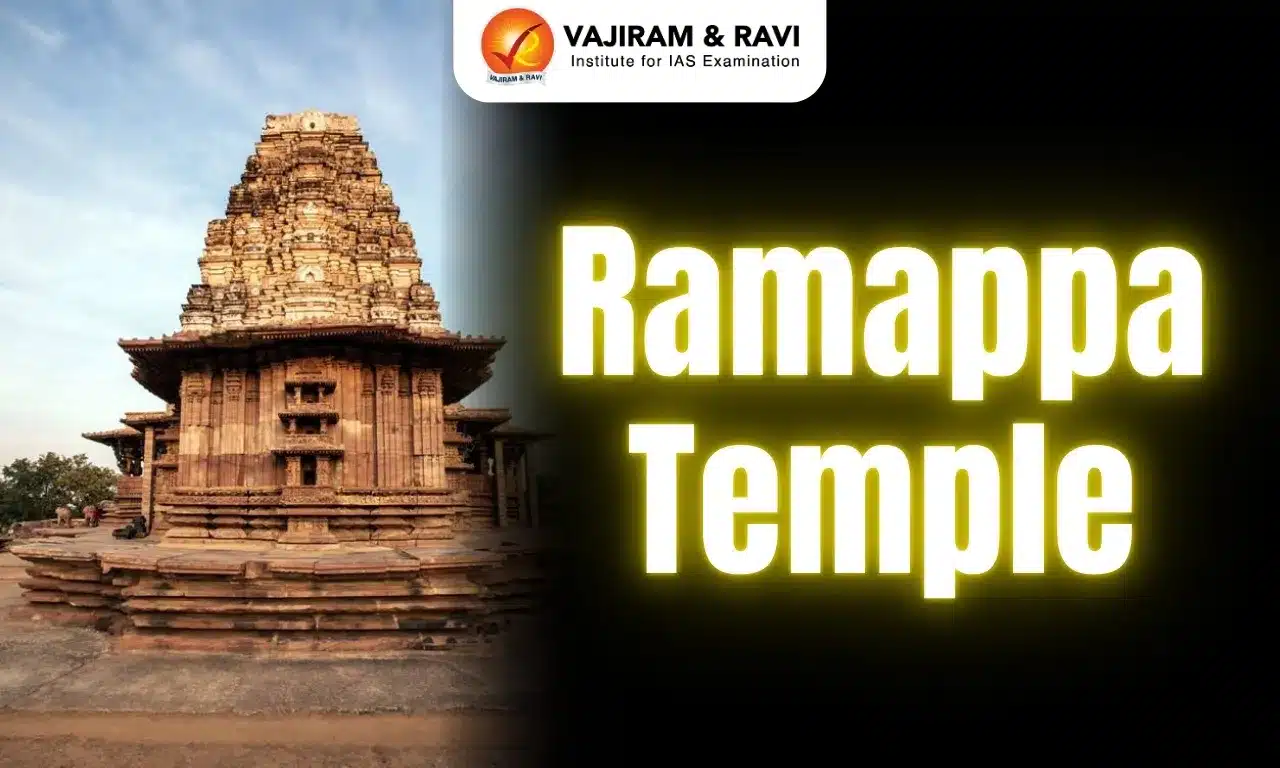
Recently, the Kakatiya Heritage Trust has expressed concern over a proposed open-cast mining project by Singareni, alleging that it could pose a threat to the UNESCO World Heritage-listed Ramappa Temple and Ramappa Lake.

About Ramappa Temple

  • Location: It is located in the state of Telangana.
  • It was constructed in 1213 AD during the reign of the Kakatiya Empire by RecharlaRudra, a general of Kakatiya king Ganapati Deva.
  • It is also known as the Rudreswara Temple and its presiding deity here is RamalingeswaraSwamy.
  • The temple got its name Ramappa because of its chief sculptor Ramappa.
  • Ramappa Temple is probably the only temple in India that is named after the architect.
  • In 2021, the temple was inscribed as a UNESCO World Heritage Site as “Kakatiya Rudreshwara (Ramappa) Temple, Telangana”.

Architectural Features of Ramappa Temple

  • It features decorated beams and pillars of carved granite and dolerite with a distinctive and pyramidal Vimana (horizontally stepped tower) made of lightweight porous bricks.
    • The temple stands on a 6 feet high star-shaped platform with walls, pillars and ceilings adorned with intricate carvings.
  • Earthquake-proof: Made out of clay mixed with acacia wood, chaff and myrobalan fruit (a family of amla), the bricks used in building the gopuram of the temple are light enough to float on water.
  • Using this technique has made the temple light, meaning, in case of a natural event like an earthquake, the probability of it collapsing would be very low.
  • Sandbox technique: The temple construction was done using the sandbox technique. This is a technique where the foundation pit is filled with a mixture of sand-lime, jaggery and black myrobalan fruit.
  • This mix acts as a cushion in case of earthquakes. 

Source: TH

Ramappa Temple FAQs

Q1: Where is Ramappa Temple located?

Ans: Telangana

Q2: When was Ramappa Temple constructed?

Ans: It was constructed in 1213 AD during the reign of the Kakatiya Empire by RecharlaRudra, a general of Kakatiya king Ganapati Deva.

G7 Group

G7

G7 Group Latest News

Recently, the Group of Seven (G7) countries agreed to release 100 million barrels of diesel and crude oil from emergency reserves. 

About G7 Group

  • It is an informal grouping of seven of the world’s advanced economies.
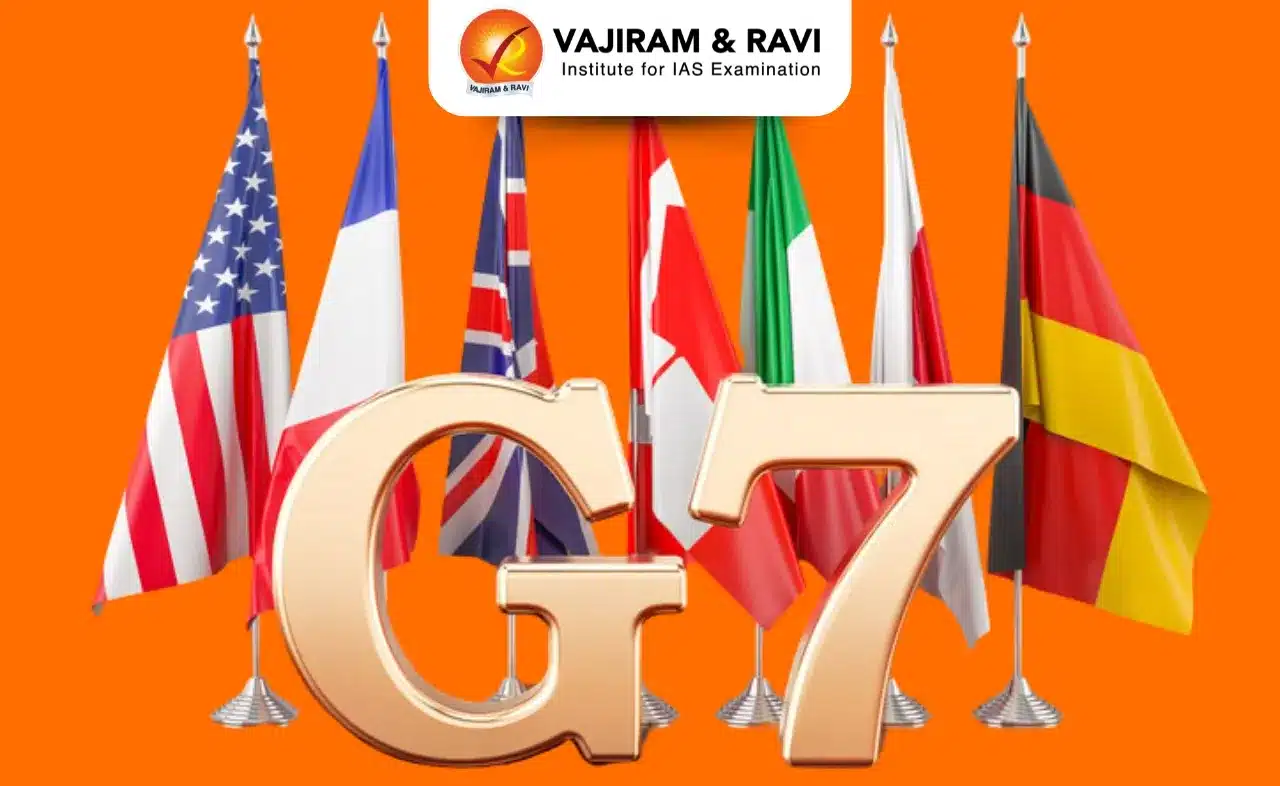
  • Members: Canada, France, Germany, Italy, Japan, the United Kingdom, and the United States.
  • Evolution
    • It was founded in 1975 in response to the oil crisis. 
    • Russia was a member from 1998, the group temporarily became the G8.
    • In 2014, the group returned to the G7 format. 
  • The G7 originally dealt exclusively with issues related to the development of the global economy. 
  • Major Focus Area: It now covers the entire spectrum of global issues, such as foreign and security policy, trade, climate, and development.
  • Governance
    • There is no firmly established secretariat, procedural guidelines, or administrative structures. 
    • Presidency: Its presidency rotates each calendar year among the member states. The EU does not hold the rotating presidency of the G7.
    • The changing agenda and thematic priorities of the G7 are determined by the respective presidency. 
    • Decisions are usually taken by consensus.

Source: Reuters

G7 Group FAQs

Q1: What are the members of G7 Group?

Ans: Canada, France, Germany, Italy, Japan, the United Kingdom, and the United States.

Q2: Which are the major topics G7 Group discuses?

Ans: It now covers the entire spectrum of global issues, such as foreign and security policy, trade, climate, and development.

Asian Games 2026, Medal Tally, Participating Countries, Host Country

Asian Games 2026, officially known as the 20th Asian Games Aichi-Nagoya 2026, are being held in Japan from 19 September to 4 October 2026. Aichi Prefecture and Nagoya are hosting the continental multi-sport event, which brings together athletes from across Asia.

The Games feature 43 sports, 71 disciplines and 469 medal events. The official programme also includes newer sports such as teqball, padel, sport climbing, skateboarding, surfing, esports and mixed martial arts (MMA).

Asian Games 2026 Overview

The key highlights related to the Asian Games 2026 have been tabulated below...

Asian Games 2026 Overview

Particulars

Details

Event

20th Asian Games

Official Name

Aichi-Nagoya 2026

Host Country

Japan

Host Region

Aichi Prefecture and Nagoya

Dates

19 September – 4 October 2026

Total Indian Delegation

768

New and Emerging Sports at Asian Games 2026

Asian Games 2026 feature several new and emerging sports, reflecting the changing interests of athletes and younger audiences. These sports add more variety to the Games and give athletes from newer sporting disciplines an international platform.

  • Teqball: A football-based sport played on a curved table, making its Asian Games debut in 2026.
  • Mixed Martial Arts (MMA): Included in the Games for the first time, with competitions across different weight categories.
  • Padel: A racket sport combining elements of tennis and squash, included in men's and women's competitions.
  • Surfing: Features shortboard events for men and women.
  • Skateboarding: Includes different disciplines that test balance, speed and technical skills.
  • Sport Climbing: Includes speed, bouldering and lead events.
  • Esports: Continues to provide a competitive platform for digital sports and gaming.

Also Read:- India to Host Commonwealth Games 2030

Asian Games 2026 Participating Countries

Asian Games 2026 feature participation from 45 countries and regions across Asia. The participating delegations represent South Asia, Southeast Asia, East Asia, Central Asia and West Asia.

No. Country/Region No. Country/Region No. Country/Region
1 Afghanistan 16 Kazakhstan 31 Philippines
2 Bahrain 17 Kuwait 32 Qatar
3 Bangladesh 18 Kyrgyzstan 33 Korea
4 Bhutan 19 Lao PDR 34 Saudi Arabia
5 Brunei 20 Lebanon 35 Singapore
6 Cambodia 21 Macao, China 36 Sri Lanka
7 Chinese Taipei 22 Malaysia 37 Syria
8 DPR Korea 23 Maldives 38 Tajikistan
9 Hong Kong, China 24 Mongolia 39 Thailand
10 India 25 Myanmar 40 Timor-Leste
11 Indonesia 26 Nepal 41 Turkmenistan
12 Iraq 27 Oman 42 United Arab Emirates
13 IR Iran 28 Pakistan 43 Uzbekistan
14 Japan 29 Palestine 44 Vietnam
15 Jordan 30 China 45 Yemen

Asian Games 2026 Host Country

Japan is hosting the 20th Asian Games 2026 in Aichi-Nagoya, marking the third time the country has hosted the Asian Games. The event is being held from 19 September to 4 October 2026 across multiple venues in Aichi Prefecture and Nagoya. Japan previously hosted the Asian Games in Tokyo in 1958 and Hiroshima in 1994. The Games feature athletes from across Asia competing in a wide range of sports and disciplines.

Also Read:- India's medals at Asian Games 2026

India at Asian Games 2026

India is participating in the 20th Asian Games in Aichi-Nagoya with 503 athletes across 36 disciplines. The contingent includes 269 men and 234 women, supported by coaches, officials and other staff. India enters the Games after winning a record 107 medals at Hangzhou 2023, including 28 gold, 38 silver and 41 bronze medals.

India delivered a strong performance at the Asian Games 2026, winning 85 medals, 21 Gold, 27 Silver and 37 Bronze across sports including shooting, athletics, kabaddi, cricket, squash, weightlifting, badminton, rowing, wushu and table tennis.

No. Athlete Sport Event Medal
1 Elavenil Valarivan, Sonam Maskar, Vidarsa Vinod Shooting Women's 10m air rifle team Silver
2 Elavenil Valarivan Shooting Women's 10m air rifle Silver
3 Rudrankksh Patil, Parth Mane, Himanshu Dhillon Shooting Men's 10m air rifle team Silver
4 Himanshu Dhillon Shooting Men's 10m air rifle Silver
5 Rudrankksh Patil Shooting Men's 10m air rifle Bronze
6 Suchika Tariyal Mixed martial arts Women's traditional -60kg Bronze
7 Team India Cricket Women's event Gold
8 Parinaaz Dhaliwal, Raiza Dhillon, Maheshwari Chauhan Shooting Women's skeet team Bronze
9 Anantjeet Singh Naruka, Bhavtegh Singh Gill, Mairaj Ahmad Khan Shooting Men's skeet team Bronze
10 Jay Meena Soft tennis Men's singles Bronze
11 Mirabai Chanu Weightlifting Women's 49kg Silver
12 Team India Badminton Men's team Bronze
13 Satnam Singh, Salman Khan Rowing Men's double sculls Bronze
14 Roshibina Devi Wushu Women's 60kg sanda Silver
15 Anantjeet Singh Naruka, Parinaaz Dhaliwal Shooting Mixed skeet team Bronze
16 Seema Kumari Athletics Women's 10,000m Bronze
17 Manu TS, Poovamma MR, Vishal Thennarasu, Vithya Ramraj Athletics Mixed 4×400m relay Silver
18 Aishwary Pratap Singh Tomar, Rudranksh Patil, Niraj Kumar Shooting Men's 50m rifle 3P team Silver
19 Kamaljeet, Suruchi Singh Shooting Mixed team 10m air pistol Gold
20 Diya Chitale, Manush Shah Table tennis Mixed doubles Bronze
21 Manpreet Kaur Athletics Shot put Bronze
22 Gulveer Singh Athletics Men's 10,000m Silver
23 Baranica Elangovan Athletics Women's pole vault Bronze
24 Sawan Berwal Athletics Men's marathon Silver
25 Vidarsa Vinod, Ashi Chouksey, Tilottama Sen Shooting Women's 50m rifle 3P team Silver
26 Joshna Chinappa, Velavan Senthilkumar Squash Mixed doubles Bronze
27 Team India Kabaddi Women's event Gold
28 Team India Kabaddi Men's event Gold
29 Tajinderpal Singh Toor Athletics Shot put Silver
30 Prachi Choudhary Athletics Women's 400m Bronze
31 Abhay Singh Squash Men's singles Silver
32 Anahat Singh Squash Women's singles Silver
33 Haritha Bhadra Athletics Women's 200m Bronze
34 Ancy Sojan Athletics Women's long jump Silver
35 Tejaswin Shankar Athletics Decathlon Bronze
36 Parul Chaudhary Athletics Women's 3000m steeplechase Bronze
37 Sarvesh Kushare Athletics Men's high jump Silver
38 Pincky Balhara Kurash Women's -78kg Bronze
39 Esha Singh Shooting Women's 25m pistol Silver
40 Vithya Ramraj Athletics Women's 400m hurdles Bronze
41 Gulveer Singh Athletics Men's 1500m Silver
42 Parul Chaudhary Athletics Women's 5000m Bronze
43 Murali Sreeshankar Athletics Men's long jump Silver
44 Yash Vir Singh Athletics Men's javelin throw Silver
45 Rohit Yadav Athletics Men's javelin throw Bronze
46 Neeru Dhanda, Manisha Keer, Aashima Ahlawat Shooting Women's trap team Silver
47 Neeru Dhanda Shooting Women's trap Gold
48 Narender Berwal Boxing Men's +90kg Bronze
49 Gulveer Singh Athletics Men's 5000m Bronze
50 Gurindervir Singh, Sneha SS, Animesh Kujur, Harita Bhadra Athletics Mixed 4×100m team relay Bronze
51 Pooja Singh Athletics Women's high jump Bronze
52 Kiran Pahal, Poovamma MR, Prachi Choudhary, Vithya Ramraj Athletics Women's 4×400m relay Gold
53 Dharmveer Choudhary, Manu TS, Jay Kumar, Vishal TK Athletics Men's 4×400m relay Bronze
54 Jyothi Surekha Vennam, Prithika Pradeep, Chikitha Taniparthi Archery Women's compound team Gold
55 Chikitha Taniparthi, Sahil Jadhav Archery Mixed compound team Gold
56 Priya Ghanghas Boxing Women's 60kg Bronze
57 Kynan Chenai, Neeru Dhanda Shooting Mixed trap Gold
58 Kapil Pokhariya Boxing Men's 90kg Bronze
59 Sahil Jadhav, Ganesh Mani Ratnam Thirumuru, Kushal Dalal Archery Men's compound team Gold
60 Sunil Kumar Wrestling Greco-Roman 87kg Bronze
61 Anahat Singh, Joshana Chinappa, Tanvi Khanna, Shameena Riaz Squash Women's team Bronze
62 Prince Kurisinkal Noble, Manu Francis Sailing Men's skiff Silver
63 Ganesh Mani Ratnam Thirumuru Archery Men's compound individual Bronze
64 Nitesh Kumar Wrestling Greco-Roman 97kg Silver
65 Abhay Singh, Veer Chotrani, Velavan Senthilkumar, Suraj Kumar Chand Squash Men's team Bronze
66 Harshita Tomar, Shital Verma Sailing Women's skiff Bronze
67 Ankita Bhakat, Kumkum Mohod, Kirti Sharma Archery Women's team recurve Gold
68 Kumkum Mohod, Dhiraj Bommadevara Archery Mixed team recurve Silver
69 Nethra Kumanan Sailing Women's dinghy Bronze
70 Lovlina Borgohain Boxing Women's 75kg Gold
71 Dhiraj Bommadevara, Neeraj Chauhan, Yashdeep Bhoge Archery Men's team Silver
72 Team India Sepaktakraw Men's quadrant Bronze
73 Parveen Hooda Boxing Women's 65kg Gold
74 Ankush Panghal Boxing Men's 80kg Gold
75 Sujeet Kalkal Wrestling Men's 65kg Gold
76 Team India Hockey Women's event Gold
77 Kumkum Mohod Archery Women's individual recurve Gold
78 Pranavi Urs Golf Women's individual Gold
79 Pranavi Urs, Aditi Ashok, Diksha Dagar Golf Women's team Silver
80 Neeraj Chauhan Archery Men's individual recurve Bronze
81 Team India Cricket Men's event Gold
82 Aman Sehrawat Wrestling Men's 57kg Gold
83 Deepak Punia Wrestling Men's 97kg Bronze
84 Antim Panghal Wrestling Women's 53kg Silver
85 Team India Hockey Men's event Gold

Medal Tally at Asian Games 2026

As of 04 October 2026, China leads the Asian Games 2026 medal table with 341 medals, while India is ranked 4th with 85 medals, including 21 gold, 27 silver and 37 bronze.

Country Gold Silver Bronze Total
China 169 89 83 341
Japan 83 95 91 269
South Korea 39 43 68 150
India 21 27 37 85
Uzbekistan 21 25 24 70
Iran 19 18 15 52
Thailand 18 13 21 52
Kazakhstan 12 24 48 84
Hong Kong, China 11 19 24 54
Bahrain 11 5 6 22
Malaysia 9 7 16 32
North Korea 7 13 9 29
United Arab Emirates 7 5 1 13
Qatar 6 6 6 18
Chinese Taipei 5 17 33 55
Indonesia 5 11 23 39
Philippines 4 9 16 29
Saudi Arabia 4 3 10 17
Kuwait 4 1 4 9
Vietnam 3 3 19 25
Singapore 2 9 7 18
Tajikistan 2 5 9 16
Jordan 2 3 6 11
Myanmar 2 1 2 5
Macao, China 1 4 1 6
Kyrgyzstan 1 3 10 14
Mongolia 1 1 13 15
Sri Lanka 1 1 1 3
Pakistan 0 2 8 10
Iraq 0 2 3 5
Turkmenistan 0 2 0 2
Afghanistan 0 1 2 3
Lebanon 0 1 2 3
Oman 0 1 1 2
Cambodia 0 0 4 4
Nepal 0 0 2 2
Bangladesh 0 0 1 1
Brunei Darussalam 0 0 1 1
Laos 0 0 1 1
Syria 0 0 1 1

About Asian Games

Asian Games, also known as the Asiad, are a major multi-sport event held every four years for athletes from across Asia. The Games have evolved significantly since their beginning in 1951.

  • Early Origins: The idea of an Asian multi-sport event was influenced by the Far Eastern Championship Games (1913) and the West Asian Games (1934).
  • 1948 Initiative: During the 1948 London Olympics, Asian representatives discussed creating a larger sporting event for Asian countries. Indian IOC representative Guru Dutt Sondhi played an important role in promoting the idea.
  • Asian Games Federation: The Asian Games Federation (AGF) was established in 1949 in New Delhi to organise and govern the new continental sporting event.
  • First Asian Games: The first Asian Games were held in New Delhi in March 1951, with 489 athletes from 11 countries competing in 6 sports and 57 events.
  • Expansion: The Games gradually expanded to more countries and sports, with editions held in Manila (1954), Tokyo (1958), Jakarta (1962), Bangkok (1966 and 1970) and other Asian cities.
  • Formation of OCA: In 1981, the Olympic Council of Asia (OCA) was created to replace the Asian Games Federation. It later became the main governing body for the Asian Games.
  • Modern Asian Games: The Games continued to grow, with recent editions held in Guangzhou (2010), Incheon (2014), Jakarta-Palembang (2018) and Hangzhou (2023).

Asian Games 2026 FAQs

Q1: When are the Asian Games 2026 being held?

Ans: Asian Games 2026 are being held from 19 September to 4 October 2026 in Aichi-Nagoya, Japan.

Q2: Where are the Asian Games 2026 being held?

Ans: The Games are being hosted by Aichi Prefecture and Nagoya in Japan, with competitions taking place across multiple venues.

Q3: How many sports are there in Asian Games 2026?

Ans: The official Aichi-Nagoya programme features 43 sports, 71 disciplines and 469 medal events.

Q4: How many athletes are representing India?

Ans: India has sent 503 athletes, comprising 269 men and 234 women, across 36 disciplines.

Q5: How many members are there in India's Asian Games contingent?

Ans: India's total approved contingent consists of 768 members, including 503 athletes and accompanying support staff and officials.

Asian Games 2026 Medal Tally, Country-Wise Medals and Rankings

Asian Games 2026 Medal Tally

Asian Games 2026 Medal Tally is updated as athletes from across Asia compete for medals at the 20th Asian Games in Aichi-Nagoya, Japan. The Asian Games 2026 are being held from 19 September to 4 October 2026. The event features 43 sports, 71 disciplines and 469 medal events.

China, Japan, South Korea and other Asian countries are competing across multiple sports. The medal table ranks countries based primarily on the number of gold medals, followed by silver and bronze medals. 

India has won 85 medals at the Asian Games 2026, including 21 gold medal, 27 silver medals and 37 bronze medals. Indian athletes have earned these medals across events such as shooting and mixed martial arts.

Asian Games 2026 Medal Tally

The following is the Asian Games 2026 medal tally based on the latest figures as concluded on 4th October, 2026.

Country Gold Silver Bronze Total
China 169 89 83 341
Japan 83 95 91 269
South Korea 39 43 68 150
India 21 27 37 85
Uzbekistan 21 25 24 70
Iran 19 18 15 52
Thailand 18 13 21 52
Kazakhstan 12 24 48 84
Hong Kong, China 11 19 24 54
Bahrain 11 5 6 22
Malaysia 9 7 16 32
North Korea 7 13 9 29
United Arab Emirates 7 5 1 13
Qatar 6 6 6 18
Chinese Taipei 5 17 33 55
Indonesia 5 11 23 39
Philippines 4 9 16 29
Saudi Arabia 4 3 10 17
Kuwait 4 1 4 9
Vietnam 3 3 19 25
Singapore 2 9 7 18
Tajikistan 2 5 9 16
Jordan 2 3 6 11
Myanmar 2 1 2 5
Macao, China 1 4 1 6
Kyrgyzstan 1 3 10 14
Mongolia 1 1 13 15
Sri Lanka 1 1 1 3
Pakistan 0 2 8 10
Iraq 0 2 3 5
Turkmenistan 0 2 0 2
Afghanistan 0 1 2 3
Lebanon 0 1 2 3
Oman 0 1 1 2
Cambodia 0 0 4 4
Nepal 0 0 2 2
Bangladesh 0 0 1 1
Brunei Darussalam 0 0 1 1
Laos 0 0 1 1
Syria 0 0 1 1

Note: The medal tally changes throughout the Asian Games as more events are completed. The table above reflects the figures provided for this update and should be treated as a live/ongoing tally rather than the final medal standings.

India in Asian Games 2026 Medal Tally

India has recorded 85 medals in the provided Asian Games 2026 medal tally, including 21 gold medal, 27 silver medals and 37 bronze medals.

India in Asian Games 2026 Medal Tally

Medal

Number

Gold

21

Silver

27

Bronze

37

Total

85

Indian Medalists at Asian Games 2026

India delivered a strong performance at the Asian Games 2026, winning 85 medals, 21 Gold, 27 Silver and 37 Bronze across sports including shooting, athletics, kabaddi, cricket, squash, weightlifting, badminton, rowing, wushu and table tennis.

No. Athlete Sport Event Medal
1 Elavenil Valarivan, Sonam Maskar, Vidarsa Vinod Shooting Women's 10m air rifle team Silver
2 Elavenil Valarivan Shooting Women's 10m air rifle Silver
3 Rudrankksh Patil, Parth Mane, Himanshu Dhillon Shooting Men's 10m air rifle team Silver
4 Himanshu Dhillon Shooting Men's 10m air rifle Silver
5 Rudrankksh Patil Shooting Men's 10m air rifle Bronze
6 Suchika Tariyal Mixed martial arts Women's traditional -60kg Bronze
7 Team India Cricket Women's event Gold
8 Parinaaz Dhaliwal, Raiza Dhillon, Maheshwari Chauhan Shooting Women's skeet team Bronze
9 Anantjeet Singh Naruka, Bhavtegh Singh Gill, Mairaj Ahmad Khan Shooting Men's skeet team Bronze
10 Jay Meena Soft tennis Men's singles Bronze
11 Mirabai Chanu Weightlifting Women's 49kg Silver
12 Team India Badminton Men's team Bronze
13 Satnam Singh, Salman Khan Rowing Men's double sculls Bronze
14 Roshibina Devi Wushu Women's 60kg sanda Silver
15 Anantjeet Singh Naruka, Parinaaz Dhaliwal Shooting Mixed skeet team Bronze
16 Seema Kumari Athletics Women's 10,000m Bronze
17 Manu TS, Poovamma MR, Vishal Thennarasu, Vithya Ramraj Athletics Mixed 4×400m relay Silver
18 Aishwary Pratap Singh Tomar, Rudranksh Patil, Niraj Kumar Shooting Men's 50m rifle 3P team Silver
19 Kamaljeet, Suruchi Singh Shooting Mixed team 10m air pistol Gold
20 Diya Chitale, Manush Shah Table tennis Mixed doubles Bronze
21 Manpreet Kaur Athletics Shot put Bronze
22 Gulveer Singh Athletics Men's 10,000m Silver
23 Baranica Elangovan Athletics Women's pole vault Bronze
24 Sawan Berwal Athletics Men's marathon Silver
25 Vidarsa Vinod, Ashi Chouksey, Tilottama Sen Shooting Women's 50m rifle 3P team Silver
26 Joshna Chinappa, Velavan Senthilkumar Squash Mixed doubles Bronze
27 Team India Kabaddi Women's event Gold
28 Team India Kabaddi Men's event Gold
29 Tajinderpal Singh Toor Athletics Shot put Silver
30 Prachi Choudhary Athletics Women's 400m Bronze
31 Abhay Singh Squash Men's singles Silver
32 Anahat Singh Squash Women's singles Silver
33 Haritha Bhadra Athletics Women's 200m Bronze
34 Ancy Sojan Athletics Women's long jump Silver
35 Tejaswin Shankar Athletics Decathlon Bronze
36 Parul Chaudhary Athletics Women's 3000m steeplechase Bronze
37 Sarvesh Kushare Athletics Men's high jump Silver
38 Pincky Balhara Kurash Women's -78kg Bronze
39 Esha Singh Shooting Women's 25m pistol Silver
40 Vithya Ramraj Athletics Women's 400m hurdles Bronze
41 Gulveer Singh Athletics Men's 1500m Silver
42 Parul Chaudhary Athletics Women's 5000m Bronze
43 Murali Sreeshankar Athletics Men's long jump Silver
44 Yash Vir Singh Athletics Men's javelin throw Silver
45 Rohit Yadav Athletics Men's javelin throw Bronze
46 Neeru Dhanda, Manisha Keer, Aashima Ahlawat Shooting Women's trap team Silver
47 Neeru Dhanda Shooting Women's trap Gold
48 Narender Berwal Boxing Men's +90kg Bronze
49 Gulveer Singh Athletics Men's 5000m Bronze
50 Gurindervir Singh, Sneha SS, Animesh Kujur, Harita Bhadra Athletics Mixed 4×100m team relay Bronze
51 Pooja Singh Athletics Women's high jump Bronze
52 Kiran Pahal, Poovamma MR, Prachi Choudhary, Vithya Ramraj Athletics Women's 4×400m relay Gold
53 Dharmveer Choudhary, Manu TS, Jay Kumar, Vishal TK Athletics Men's 4×400m relay Bronze
54 Jyothi Surekha Vennam, Prithika Pradeep, Chikitha Taniparthi Archery Women's compound team Gold
55 Chikitha Taniparthi, Sahil Jadhav Archery Mixed compound team Gold
56 Priya Ghanghas Boxing Women's 60kg Bronze
57 Kynan Chenai, Neeru Dhanda Shooting Mixed trap Gold
58 Kapil Pokhariya Boxing Men's 90kg Bronze
59 Sahil Jadhav, Ganesh Mani Ratnam Thirumuru, Kushal Dalal Archery Men's compound team Gold
60 Sunil Kumar Wrestling Greco-Roman 87kg Bronze
61 Anahat Singh, Joshana Chinappa, Tanvi Khanna, Shameena Riaz Squash Women's team Bronze
62 Prince Kurisinkal Noble, Manu Francis Sailing Men's skiff Silver
63 Ganesh Mani Ratnam Thirumuru Archery Men's compound individual Bronze
64 Nitesh Kumar Wrestling Greco-Roman 97kg Silver
65 Abhay Singh, Veer Chotrani, Velavan Senthilkumar, Suraj Kumar Chand Squash Men's team Bronze
66 Harshita Tomar, Shital Verma Sailing Women's skiff Bronze
67 Ankita Bhakat, Kumkum Mohod, Kirti Sharma Archery Women's team recurve Gold
68 Kumkum Mohod, Dhiraj Bommadevara Archery Mixed team recurve Silver
69 Nethra Kumanan Sailing Women's dinghy Bronze
70 Lovlina Borgohain Boxing Women's 75kg Gold
71 Dhiraj Bommadevara, Neeraj Chauhan, Yashdeep Bhoge Archery Men's team Silver
72 Team India Sepaktakraw Men's quadrant Bronze
73 Parveen Hooda Boxing Women's 65kg Gold
74 Ankush Panghal Boxing Men's 80kg Gold
75 Sujeet Kalkal Wrestling Men's 65kg Gold
76 Team India Hockey Women's event Gold
77 Kumkum Mohod Archery Women's individual recurve Gold
78 Pranavi Urs Golf Women's individual Gold
79 Pranavi Urs, Aditi Ashok, Diksha Dagar Golf Women's team Silver
80 Neeraj Chauhan Archery Men's individual recurve Bronze
81 Team India Cricket Men's event Gold
82 Aman Sehrawat Wrestling Men's 57kg Gold
83 Deepak Punia Wrestling Men's 97kg Bronze
84 Antim Panghal Wrestling Women's 53kg Silver
85 Team India Hockey Men's event Gold
India at Asian Games 2026 Day-Wise Medal Updates

India has won 85 medals at the Asian Games 2026 in Aichi-Nagoya, comprising 21 Gold, 27 Silver and 37 Bronze medals as of 4th October, 2026. India’s medal campaign has seen strong contributions from shooting, athletics, kabaddi, cricket, squash, weightlifting, wushu, rowing, badminton and table tennis.

4 October Update

India added further medals on 4 October, taking its final Asian Games 2026 tally to 85 medals, 21 Gold, 27 Silver and 37 Bronze.

  • Indian men’s cricket team won the Gold medal in the men’s T20 cricket event.
  • Indian men’s hockey team won the Gold medal in the men’s hockey event.
  • Aman Sehrawat won Gold in the men’s 57kg wrestling event.
  • Antim Panghal won Silver in the women’s 53kg wrestling event.
  • Deepak Punia won Bronze in the men’s 97kg wrestling event.
  • India’s final medal tally reached 85 medals, including 21 Gold, 27 Silver and 37 Bronze.

3 October Update

India added medals in archery and golf on 3 October, taking its tally to 79 medals, 18 Gold, 26 Silver and 35 Bronze at that stage.

  • Kumkum Mohod won Gold in the women’s individual recurve archery event.
  • Pranavi Urs won Gold in the women’s individual golf event with a score of 15-under par.
  • Pranavi Urs, Aditi Ashok and Diksha Dagar won Silver in the women’s team golf event.
  • India also competed in the men’s T20 cricket gold-medal match against Pakistan.
  • India faced Malaysia in the men’s hockey gold-medal match on the same day.

2 October Update

India enjoyed one of its most successful days at the Asian Games 2026 on 2 October, winning 11 medals — five Gold, two Silver and four Bronze. The day's medals came from archery, boxing, wrestling, hockey, sailing and sepaktakraw.

  • Ankita Bhakat, Kumkum Mohod and Kirti Sharma won gold in the women’s recurve team event.
  • Lovlina Borgohain won gold in women’s 75kg boxing.
  • Parveen Hooda secured gold in women’s 65kg boxing.
  • Ankush Panghal won gold in men’s 80kg boxing.
  • Sujeet Kalkal won gold in men’s 65kg freestyle wrestling after a dramatic comeback in the final.
  • India’s women’s hockey team defeated China 1–0 to win gold, ending a 44-year wait for an Asian Games women’s hockey title.
  • Kumkum Mohod and Dhiraj Bommadevara won silver in the mixed recurve team event.
  • Yashdeep Bhoge, Neeraj Chauhan and Dhiraj Bommadevara secured silver in the men’s recurve team event.
  • Nethra Kumanan won bronze in the women’s dinghy sailing event.
  • Harshita Tomar and Shital Verma secured bronze in the women’s skiff event following China’s disqualification.
  • India won bronze in the men’s quadrant sepaktakraw event after losing to Japan.

1 October Update

India added seven medals on 1 October 2026, taking its overall tally to 65 medals — 10 Gold, 23 Silver and 32 Bronze. The medals came from wrestling, sailing, squash and archery.

  • Nitesh Siwach won the silver medal in the men’s Greco-Roman 97kg wrestling event after losing the final to Japan’s Yuri Nakazato.
  • Manu Francis and Prince Kurisinkal Noble secured silver in the men’s skiff (49er) sailing event.
  • Harshita Tomar and Shital Verma won bronze in the women’s skiff sailing event after a retrospective change in the standings.
  • India’s women’s squash team won bronze after losing its semifinal to Hong Kong, China.
  • India’s men’s squash team also secured bronze after its semifinal defeat to Malaysia.
  • T. Ganesh Mani Ratnam Thirumuru won bronze in the men’s compound individual archery event.
  • India also secured a bronze medal in the men’s quadrant sepaktakraw event, with the team losing to Japan in the semifinal.

30 September Update

India enjoyed its best medal-winning day so far at the Asian Games 2026 on 30 September, with the compound archery contingent completing a clean sweep of all three team gold medals. Indian shooters also added a gold in the mixed trap team event, while boxing and wrestling contributed bronze medals.

  • Jyothi Surekha Vennam, Chikitha Taniparthi and Prithika Pradeep won gold in the women's compound team event, defeating China 238–234. Their score equalled the world record for the event.
  • Chikitha Taniparthi and Sahil Jadhav won gold in the mixed compound team event, defeating South Korea in a dramatic shoot-off. Their victory also secured an LA 2028 Olympic quota place.
  • Sahil Jadhav, Kushal Dalal and Thirumuru Ganesh Maniratnam won gold in the men's compound team event, completing India's sweep of all three compound archery team titles.
  • Neeru Dhanda and Kynan Chenai won gold in the mixed team trap shooting event, giving India another gold medal on the day.
  • Priya Ghanghas won bronze in women's 60kg boxing after losing her semifinal to China's Yang Chengyu by a 1–4 decision.
  • Kapil Pokhariya secured bronze in men's 90kg boxing after losing his semifinal to Uzbekistan's Turabek Khabibullaev.
  • Sunil Kumar won bronze in men's 87kg Greco-Roman wrestling. His medal was notable as it made him the first Indian to win two Greco-Roman medals at the Asian Games.
  • India's women's hockey team reached the final after defeating South Korea 2–0, while both the men's and women's squash teams reached the semifinals and assured themselves of at least bronze medals.

29 September Update

India had a highly productive 29 September, winning eight medals, including two gold, one silver and five bronze medals. The day's medals took India's tally to 47 medals, 5 Gold, 21 Silver and 21 Bronze.

  • Neeru Dhanda, Manisha Keer and Aashima Ahlawat won the silver medal in the women's trap team event in shooting.
  • Neeru Dhanda then won the gold medal in the women's individual trap event.
  • Dhanda became the first Indian woman to win Asian Games gold in the women's individual trap event.
  • India also added medals in athletics, shooting and other events during the day, taking the total to 47 medals by the end of the day's reported tally.

28 September Update

India entered 28 September with 37 medals, 4 Gold, 16 Silver and 17 Bronze. The day features medal opportunities in athletics, shooting, boxing, squash and hockey, along with India's men's cricket quarter-final against Afghanistan. Key Indian athletes in action include Manu Bhaker, Avinash Sable and Lovlina Borgohain.

  • Athletics: Avinash Sable begins his campaign in the men's 3000m steeplechase as he looks to defend his Asian Games title.
  • Shooting: Manu Bhaker competes in the women's 25m pistol event after India's strong showing in shooting earlier in the Games.
  • Boxing: Lovlina Borgohain and other Indian boxers continue their campaigns across different weight categories.
  • Cricket: India's men's cricket team takes on Afghanistan in the quarter-final.
  • Hockey: The Indian women's hockey team continues its campaign after topping its group with five wins from five matches.
  • Medal tally: No new Indian medal had been added at the time of this update; India's latest confirmed tally remained 37 medals.

27 September Update – Seven More Medals

India added seven medals on 27 September, taking its overall tally to 37 medals. Athletics contributed five medals, while India won two silver medals in squash.

  • Ancy Sojan – Silver (Athletics): Won silver in the women's long jump.
  • Sarvesh Kushare – Silver (Athletics): Won silver in the men's high jump, clearing 2.25m.
  • Anahat Singh – Silver (Squash): Won silver in the women's singles after losing the final to Malaysia's Sivasangari Subramaniam.
  • Abhay Singh – Silver (Squash): Won silver in the men's singles after losing the final to Malaysia's Ng Eain Yow.
  • Tejaswin Shankar – Bronze (Athletics): Secured bronze in the men's decathlon with 7,934 points.
  • Harita Bhadra – Bronze (Athletics): Won bronze in the women's 200m.
  • Parul Chaudhary – Bronze (Athletics): Secured bronze in the women's 3000m steeplechase.

26 September Update – India Wins Double Kabaddi Gold

India enjoyed a highly successful day on 26 September, winning seven medals, including two gold medals in kabaddi. The men's and women's teams both defeated Iran in their respective finals, completing India's historic kabaddi double.

  • Men's Kabaddi Gold: India defeated Iran 40–34 in the final to successfully defend its Asian Games title.
  • Women's Kabaddi Gold: India defeated Iran 37–34 to win the women's kabaddi title and successfully defend its crown.
  • Sawan Barwal – Silver (Athletics): Won silver in the men's marathon, setting a national record and becoming India's first Asian Games marathon medallist since 1982.
  • Tajinderpal Singh Toor – Silver (Athletics): Secured silver in the men's shot put.
  • Ashi Chouksey, Tilottama Sen & Vidarsa Kochalumkal – Silver (Shooting): Won silver in the women's 50m rifle 3 positions team event.
  • Prachi Chaudhary – Bronze (Athletics): Won bronze in the women's 400m.
  • Joshna Chinappa & Velavan Senthilkumar – Bronze (Squash): Secured bronze in mixed doubles.

Following the day's results, India had 4 Gold, 12 Silver and 14 Bronze medals, taking its tally to 30 medals at the end of 26 September.

25 September Update

India added two medals on 25 September, including a gold medal in shooting. Kamaljeet and Suruchi Singh won the 10m Air Pistol Mixed Team event, securing India's second gold medal of the Games and India's first shooting gold.

India also won a silver medal in the Men's 50m Rifle 3 Positions Team event, with Aishwary Pratap Singh Tomar, Rudrankksh Patil and Niraj Kumar finishing second.

Athlete/Team Sport Event Medal
Kamaljeet & Suruchi Singh Shooting 10m Air Pistol Mixed Team Gold
Aishwary Pratap Singh Tomar, Rudrankksh Patil & Niraj Kumar Shooting Men's 50m Rifle 3 Positions Team Silver

Following these results, India's medal tally stands at 2 Gold, 8 Silver and 9 Bronze, 19 medals in total.

24 September Update Wushu Silver and Rowing Bronze

  • Roshibina Devi – Silver (Wushu): Won silver in the women's 60kg sanda category after losing the final to China's Zhang Xiaoyu. This is her third consecutive Asian Games medal, following bronze in 2018 and silver in 2023.
  • Satnam Singh and Salman Khan – Bronze (Rowing): Won bronze in the men's double sculls, clocking 6:13.25. It is India's first Asian Games medal in the men's double sculls.
  • Anantjeet Singh Naruka and Parinaaz Dhaliwal: Qualified for the mixed skeet team final, keeping India in contention for another shooting medal.
  • Balraj Panwar: Finished fourth in the men's single sculls after staying in medal contention for much of the race.

23 September Update India's Five-Medal Day

  • Mirabai Chanu – Silver (Weightlifting): Won silver in the women's 49kg category, ending India's 28-year wait for an Asian Games weightlifting medal since Karnam Malleswari's bronze in 1998.
  • Women's skeet team – Bronze (Shooting): Parinaaz Dhaliwal, Raiza Dhillon and Maheshwari Chauhan won bronze.
  • Men's skeet team – Bronze (Shooting): Anantjeet Singh Naruka, Bhavtegh Singh Gill and Mairaj Ahmad Khan secured bronze.
  • Jay Meena – Bronze (Soft Tennis): Won India's first-ever Asian Games medal in soft tennis in the men's singles.
  • Men's badminton team – Bronze: India secured bronze after reaching the semi-finals.
  • Women's hockey: India defeated Thailand 20-1, with Deepika Sehrawat scoring nine goals.
  • Women's kabaddi: The defending champions defeated Iran 37-23 to record their second consecutive group-stage win.

22 September Update India Wins First Gold

  • Women's cricket team – Gold: India defeated Sri Lanka by 147 runs in the final to retain the Asian Games women's cricket title.
  • Record total: India scored 216/3, the highest team total in Asian Games cricket, with Smriti Mandhana scoring 79, Shafali Verma 48 and Richa Ghosh remaining unbeaten on 49.
  • Shooting: Elavenil Valarivan and Parth Mane finished fourth in the 10m air rifle mixed team event.
  • Swimming: India's men's 4x100m medley relay team qualified for the final with the seventh-fastest time.
  • Karate: Chetan Bhatt missed a bronze medal in the men's 84kg kumite event.

Also Read:- Asian Games 2026 Indian Cricket Team

Asian Games 2026 Host Country

Japan is the host country of the 20th Asian Games. The event is officially called the Aichi-Nagoya 2026 Asian Games.

The Games are being organised in Aichi Prefecture and Nagoya, with competitions taking place across multiple venues. The official event programme includes 43 sports and 71 disciplines.

The Asian Games are being held from 19 September 2026 to 4 October 2026. The Opening Ceremony took place on 19 September 2026, while the Closing Ceremony is scheduled for 4 October 2026.

Also Read:- India's medals at Asian Games 2026

How is the Asian Games Medal Tally Calculated?

The Asian Games medal tally records the number of gold, silver and bronze medals won by each participating country or region.

The ranking generally follows this order:

  1. Number of gold medals
  2. Number of silver medals
  3. Number of bronze medals

For example, a country with 5 gold medals is placed above a country with 4 gold medals even if the second country has a higher overall medal count.

The Total column is calculated by adding: Gold + Silver + Bronze = Total Medals

Asian Games 2026 Key facts for UPSC Prelims

20th Asian Games, hosted by Aichi Prefecture and Nagoya, Japan, are being held from 19 September to 4 October 2026, featuring 43 sports, 71 disciplines and 469 medal events under the Olympic Council of Asia (OCA).

Parameter Details
Edition 20th Asian Games (XX Asian Games)
Host Aichi Prefecture and Nagoya, Japan
Dates 19 September – 4 October 2026
Sports / Disciplines / Events 43 / 71 / 469
Governing Body Olympic Council of Asia (OCA), headquartered in Kuwait City
Debut Sport Mixed Martial Arts (MMA)
India’s Firsts in 2026 First MMA medal – Suchika Tariyal; first soft tennis medal – Jay Meena; first wushu medals at three consecutive Games – Roshibina Devi
First Asian Games New Delhi, India – 1951
India at Hangzhou 2023 106 medals (28 Gold, 38 Silver, 40 Bronze) – 4th position; India’s first 100+ medal haul
Next Editions Doha 2030 and Riyadh 2034

Asian Games 2026 Medal Tally FAQs

Q1: What is the Asian Games 2026 Medal Tally?

Ans: The Asian Games 2026 Medal Tally is the country-wise record of gold, silver and bronze medals won at the Aichi-Nagoya 2026 Asian Games.

Q2: Which country is leading the Asian Games 2026 Medal Tally?

Ans: China is leading the medal tally with 169 gold medals and 341 total medals.

Q3: How many medals has India won in Asian Games 2026?

Ans: According to the provided update, India has won 85 medals, including 21 gold, 27 silver and 37 bronze medals.

Q4: How many gold medals has India won in Asian Games 2026?

Ans: India has won 21 gold medals in the provided medal tally.

Q5: When are the Asian Games 2026 being held?

Ans: Asian Games 2026 are being held from 19 September to 4 October 2026 in Aichi-Nagoya, Japan.

Daily Editorial Analysis 5 October 2026

Daily-Editorial-Analysis

The ECI’s Constitutional Mandate is Under Strain

Context

  • The Election Commission of India (ECI) is a constitutional institution entrusted with conducting free, fair and impartial elections.
  • Its credibility depends on independence from the executive, adherence to law and public confidence.
  • Recent controversy surrounding the Special Intensive Revision (SIR) of electoral rolls has raised questions about voter exclusion, legal authority, institutional decision-making and accountability.
  • These concerns are significant because the integrity of electoral rolls directly affects the democratic right to vote.

Constitutional Vision of an Independent Election Commission

  • Protection from Executive Control
    • The Constituent Assembly recognised that electoral machinery must remain outside executive control.
    • B.R. Ambedkar strongly supported an independent central election authority to prevent political interference.
    • The Draft Constitution initially proposed decentralised election machinery.
    • However, concerns over provincial election officials deleting voters perceived as opponents of ruling parties led to the adoption of a centralised Election Commission.
  • Warnings from the Constitution-Makers
    • Members of the Constituent Assembly anticipated the possibility of political influence over the ECI.
    • Shibban Lal Saxena warned that a government could appoint a politically loyal Chief Election Commissioner and suggested parliamentary approval for such appointments.
    • These debates demonstrate that the Constitution-makers understood that control over electoral machinery could potentially undermine democracy itself.
    • Institutional independence was therefore designed as a safeguard against partisan manipulation.

Legal Questions Surrounding Special Intensive Revision

  • Statutory Framework
    • Section 21 of the Representation of the People Act, 1950 provides for the preparation and revision of electoral rolls.
    • Section 21(2) permits regular revisions, while Rule 25 of the Registration of Electors Rules, 1960 recognises intensive and summary revisions.
    • Section 21(3) separately provides for special revision, subject to recorded reasons and applicable circumstances.
  • The SIR Controversy
    • The central legal question is that the expression Special Intensive Revision does not appear expressly in the statutory framework.
    • Intensive revision and special revision are recognised as separate categories.
    • Although Article 324 provides the ECI with broad powers concerning elections, those powers must operate within the Constitution and legislation enacted by Parliament.
    • Constitutional authority cannot ordinarily be treated as permission to disregard statutory requirements.
    • Therefore, the legality of SIR depends on whether its procedures and implementation remain consistent with the existing electoral law and principles of due process.

Voter Exclusion and Democratic Rights

  • Concerns over Large-Scale Deletions
    • Reports cited in the controversy indicate that approximately 13 crore voters have been removed from electoral rolls through SIR operations.
    • If eligible voters are wrongly excluded, the consequences extend beyond administrative error because electoral registration determines access to the ballot.
    • Article 326 guarantees universal adult suffrage, subject to constitutionally and legally recognised disqualifications.
    • Electoral-roll revision should therefore primarily ensure accurate inclusion while removing only those who are legally ineligible.
  • Need for Due Process
    • Large-scale revisions require strong safeguards, including prior notice, verification, opportunities to submit documents, correction mechanisms and accessible appeals.
    • Citizens should not lose their voting rights merely because of procedural difficulties or inadequate documentation.
    • The principle of electoral integrity requires a balance between removing ineligible entries and preventing the disenfranchisement of legitimate voters.

Institutional Decision-Making and Accountability

  • Concerns over Unilateralism
    • Reports that Election Commissioners were not adequately consulted on major decisions have raised questions about collective decision-making within the ECI.
    • As a constitutional institution, the Commission's credibility depends not only on its formal independence but also on transparent and procedurally sound internal functioning.
    • Decisions affecting millions of voters should follow established institutional processes.
  • Safeguards and Accountability
    • The Chief Election Commissioner enjoys substantial constitutional protection and can be removed only through a prescribed parliamentary process on grounds of proved misbehaviour or incapacity.
    • The 2023 law governing Election Commissioners also provides statutory protection concerning official acts.
    • Such safeguards are intended to protect independence from political retaliation.

Reforms Needed to Restore Public Confidence

  • Strengthening Electoral Transparency
    • The ECI should provide clear explanations for voter deletions and publish transparent procedures governing electoral-roll revisions.
  • Protecting Voter Rights
    • Every eligible citizen should have adequate opportunities to verify registration, challenge wrongful deletion and restore their name through simple and accessible procedures.
  • Improving Institutional Functioning
    • Important decisions should involve collective consultation among Election Commissioners.
    • Greater transparency in appointments and institutional procedures could further strengthen public confidence.
  • Balancing Independence with Accountability
    • The ECI must remain protected from political interference while remaining subject to the Constitution, statutory law and appropriate accountability mechanisms.

Conclusion

  • The credibility of Indian democracy depends on both free elections and inclusive electoral participation.
  • The Election Commission was created to protect the electoral process from political influence, making its independence essential.
  • Ultimately, a trustworthy electoral system requires an independent, impartial and accountable ECI, robust safeguards against wrongful voter exclusion and strict adherence to constitutional and statutory principles.
  • Protecting these foundations is essential for sustaining public confidence in Indian democracy.

The ECI’s Constitutional Mandate is Under Strain FAQs

Q1. What is the primary role of the ECI?
Ans. The ECI conducts free, fair and impartial elections in India.

Q2. Why was a centralised ECI established?
Ans. A centralised ECI was established to prevent political interference in electoral administration.

Q3. What is the main legal concern regarding SIR?
Ans. The main concern is that “Special Intensive Revision” is not expressly provided for in electoral law.

Q4. Why can voter deletions be problematic?
Ans. Wrongful voter deletions can undermine universal adult suffrage and disenfranchise eligible citizens.

Q5. How can public confidence in the ECI be strengthened?
Ans. Public confidence can be strengthened through transparency, legal compliance, due process and institutional accountability.

Source: The Hindu


How Regulation Stifles HEIs

Context:

  • The Viksit Bharat Shiksha Adhishthan (VBSA) Bill, 2025, currently under legislative review, seeks to overhaul the regulatory system governing higher education in India.
  • Experts argue that before the Bill becomes yet another overarching regulatory apparatus, one question deserves serious scrutiny: will regulation itself become a threat to the very quality it claims to protect?

The Familiar Reformist Logic

  • The VBSA follows a recognisable pattern. Its stated goals rest on the same general pillars seen in earlier reforms:
    • Ensuring quality
    • Ensuring accountability
    • Maintaining minimum standards
    • Preventing malpractice
  • However, analysts argue that the problem is not regulation itself, but the nature of "governmentality" — the dominant logic through which institutional life gets organised under such regimes.

When External Supervision Replaces Internal Integrity

  • The core thesis: when external oversight substitutes for internal institutional integrity, Higher Educational Institutions (HEIs) stop asking what is morally and intrinsically right, and instead ask only what minimum requirements must be maintained on paper.
  • Regulations built on force and fear ignores the moral base of society.
  • This applies directly to Indian higher education: institutions that meet every prescribed norm, maintain impeccable files, and score high on the accreditation ladder can still have classrooms where intellectual engagement lies dormant.

The Pathology: Optimising for the Regulator, Not the Classroom

  • Fear generated by regulators produces a specific institutional pathology — HEIs optimise their academic activity for the regulator, not for teaching and knowledge construction.
  • What This Looks Like in Practice:
    • Teachers stop asking what makes a class worthwhile or engaging.
    • Instead, they focus on documenting evidence to satisfy inspections during annual self-assessment reports.
    • University authorities become less interested in how faculty cultivate intellectual engagement among students.
    • They become more interested in maximising institutional scores on rankings and accreditation.
  • The result is an ecosystem that nurtures a "paper blizzard" or "evidence blizzard" — an overwhelming volume of digital documentation that substitutes for actual educational substance.

Evidence Over Learning: The Regulatory Architecture

  • Key regulatory bodies shaping this ecosystem include:
    • University Grants Commission (UGC)
    • All India Council for Technical Education (AICTE)
    • National Assessment and Accreditation Council (NAAC)
    • National Council for Teacher Education (NCTE)
  • A Structural Problem: The regulations, orders, circulars and guidelines produced by these bodies often contain internal incongruences, which then require clarifications — producing, in turn, yet more irregularities.
  • Example Cited: The UGC's 2018 Regulation requires teachers to account for a 40-hour working week, while only mandating physical presence on campus for five hours a day.
    • This formulation risks converting intellectual engagement into an arithmetic exercise — reducing teaching to hours logged rather than learning achieved.
  • An "assembly line" model of work, combined with panoptic surveillance through regulatory architecture, creates a trust deficit that threatens quality teaching.
  • This pushes HEIs and teachers toward "risk aversion" — where innovation is stifled, and conventional mediocrity becomes the safest available option.

The Counter-Evidence: Institutions Outside the Regulatory Net

  • Analysts highlight existing counter-evidence already present within India's own education system.
  • The IISc, IITs, IIMs, NITs, and IISERs operate outside the standard regulatory architecture that governs all other HEIs in India.
  • These institutions:
    • Are not bound to follow standardised regulatory formulas.
    • Design and update curricula at their own pace.
    • Follow a different recruitment process.
    • Enjoy greater freedom in directing resources based on their own institutional strategy.
  • If intensive regulatory mechanisms were truly the engine of quality, India's most tightly regulated universities should have been outperforming these relatively unregulated institutions.
  • Since this is demonstrably not the case, critics conclude that regulatory logic has fundamentally misguided the national understanding of "quality higher education."
  • The Risk Ahead: If these currently less-regulated institutions are also brought under the VBSA's regulatory ambit, the critics warn, "another casualty is awaiting us."

The Real Test for the VBSA

  • The challenge to policymakers is precise: the real test of the VBSA is to avoid reducing quality improvement to the updating of inspection portals, and instead ask whether the new architecture can make India's HEIs bolder hubs of teaching and inquiry.

Conclusion

  • The argument here is not anti-regulationbut anti-compliance-theatre: when institutions spend more energy proving quality on paper than creating it in classrooms, regulation defeats its own purpose.
  • The IITs and IISc stand as living evidence that autonomy, not surveillance, may be the real foundation of excellence.
  • As the VBSA moves through legislative review, the question isn't how tightly to regulate — it's whether regulation can be redesigned to trust institutions rather than police them.

How Regulation Stifles HEIs FAQs

Q1. What is the central concern regarding regulation of HEIs?

Ans: The concern is that excessive external regulation may make HEIs prioritise compliance and documentation instead of teaching, intellectual engagement and knowledge creation. 5. How Regulation Stifles HEIs

Q2. How can regulation affect teaching in HEIs?

Ans: Regulation can encourage teachers to focus on documenting evidence for inspections rather than improving classroom engagement and meaningful learning experiences. 5. How Regulation Stifles HEIs

Q3. What is meant by the “paper blizzard” in higher education?

Ans: The “paper blizzard” refers to excessive digital documentation generated for regulatory compliance, which can substitute paperwork for genuine educational substance. 5. How Regulation Stifles HEIs

Q4. Which Indian institutions are cited as examples of greater regulatory autonomy?

Ans: IISc, IITs, IIMs, NITs and IISERs are cited as institutions enjoying greater autonomy in curricula, recruitment and resource allocation. 5. How Regulation Stifles HEIs

Q5. What should be the real test of the VBSA Bill?

Ans: The VBSA should be assessed by whether it makes HEIs stronger centres of teaching and inquiry rather than merely improving regulatory inspection and compliance systems.

Source: TH


Next-Gen GST - Simplifying Compliance, Expanding Markets and Strengthening India’s Growth

Context

  • The Goods and Services Tax (GST), introduced in 2017, created a common national framework for indirect taxation and sought to replace a fragmented system of multiple indirect taxes.
  • After nearly nine years of implementation, Next-Gen GST seeks to take the reform forward through two broad objectives: rationalising tax rates and simplifying
  • The rate changes under the reform came into effect on 22 September 2025, while further process reforms are proposed before the GST Council.
  • The broader objective is to provide taxpayer relief, greater certainty for businesses, stronger compliance and sustainable public revenues, contributing to the vision of a Viksit Bharat.

Evidence of Economic Expansion

  • The reform period has been accompanied by strong growth in reported economic activity.
  • For example,
    • The value of reported taxable supplies increased by 25.8% between October 2025 and July 2026 compared with the corresponding period a year earlier.
    • Gross GST collections during April–September 2026 reached ₹12.46 lakh crore, registering 11.6% year-on-year growth.
    • Collections recorded double-digit annual growth every month from June to September, with the four-month period registering nearly 15% growth.
    • Net GST collections, after refunds, increased by 10.4% during the first half of 2026–27.
    • Taxable supplies expanded across all 11 sector groups and major States, indicating broad-based rather than narrowly concentrated growth.
  • Thus, taxpayer relief and revenue mobilisation need not be mutually exclusive if tax reforms stimulate formal economic activity and compliance.

Consumer Demand and MSME Opportunities

  • A key indicator has been the 26.7% rise in reported Business-to-Consumer (B2C) sales during the post-reform comparison period.
  • Lower or rationalised tax rates can translate into lower prices, thereby increasing household purchasing power, consumption and savings.
  • Higher consumption, in turn, strengthens demand for goods and services produced by businesses, creating a virtuous cycle involving consumers, retailers, suppliers and producers.
  • For Micro, Small and Medium Enterprises (MSMEs), GST's common national framework can expand their potential market beyond their immediate geographical locations.
  • Enterprises in Tier-2 and Tier-3 cities can access wider markets while continuing to generate local investment and employment.
  • Expansion into smaller towns can also strengthen local supplier and distribution networks.
  • GST therefore has significance beyond taxation - it can facilitate market integration, formalisation and geographically broader enterprise growth.

Widening Tax Base and Compliance

  • GST participation has expanded significantly, for example,
    • GST registrations across Central and State jurisdictions reached around 1.71 crore by August 2026, nearly 15% higher than a year earlier.
    • GSTR-3B returns filed by their due dates for the April–July 2026 tax periods increased by 12.6%.
  • However, rising registration and filing numbers also increase the responsibility of tax administration.
  • Businesses require reliable digital services, clear guidance, timely grievance redressal and predictable procedures.

Input Tax Credit and Refunds

  • The effective functioning of Input Tax Credit (ITC) remains central to GST's design.
  • Post-reform data indicates that the share of tax liability discharged through credits increased, while accumulated credit declined relative to taxable supplies.
  • Efficient ITC reduces the tax cascading effect and can improve the working-capital position of businesses, particularly smaller firms.
  • Faster and more predictable refunds can improve liquidity and enable firms to plan production, procurement and investment with greater certainty.
  • For example, around ₹1.80 lakh crore was refunded during April–September 2026.

Strengthening Cooperative Federalism

  • GST is fundamentally a product of cooperative federalism, with the Centre and States jointly participating through the GST Council.
  • For instance, States have contributed their priorities and implementation experience to the reform process.
  • Their revenue position has also strengthened, with aggregate SGST receipts, including their share of IGST settlements, growing by about 16% during April–September 2026.
  • This creates a mutually reinforcing cycle: consumer relief → higher demand → enterprise growth → higher tax revenues → greater public investment in infrastructure and services.

The Road Ahead

  • The next stage of GST reform must focus not merely on tax rates but on the taxpayer experience.
  • Proposed reforms before the GST Council on 7 October address registration procedures, return filing, refunds, dispute resolution, and improved flow of Input Tax Credit.
  • For smaller enterprises in particular, reducing the time and cost of compliance is crucial.
  • Administrative simplicity can allow entrepreneurs to redirect scarce resources from paperwork towards production, innovation, employment and expansion.

Conclusion:

  • GST represents a major structural reform aimed at One Nation, One Indirect Tax, market integration, formalisation and improved tax compliance.
  • Its next phase highlights the shift from merely creating a common tax architecture to improving its efficiency, predictability and ease of doing business.

Next-Gen GST FAQs

Q1. How does Next-Gen GST seek to balance taxpayer relief with revenue mobilisation?

Ans. By rationalising tax rates, simplifying compliance and expanding the formal tax base.

Q2. What is the role of GST in promoting the growth of MSMEs?

Ans. GST’s common national market enables MSMEs to access customers beyond local boundaries.

Q3. Why are Input Tax Credit and timely refunds critical for improving the business environment under GST?

Ans. It reduces tax cascading and working-capital pressures, while predictable refunds improve liquidity.

Q4. How does GST exemplify cooperative federalism in India?

Ans. It enables the Centre and States to jointly decide tax policies, reconcile diverse fiscal interests and implement reforms.

Q5. What should be the priorities for the next phase of GST reforms?

Ans. The focus should shift towards simpler registration and returns, faster refunds, efficient ITC flow, quicker dispute resolution, etc.

Source: IE

Daily Editorial Analysis 2026 FAQs

Q1: What is editorial analysis?

Ans: Editorial analysis is the critical examination and interpretation of newspaper editorials to extract key insights, arguments, and perspectives relevant to UPSC preparation.

Q2: What is an editorial analyst?

Ans: An editorial analyst is someone who studies and breaks down editorials to highlight their relevance, structure, and usefulness for competitive exams like the UPSC.

Q3: What is an editorial for UPSC?

Ans: For UPSC, an editorial refers to opinion-based articles in reputed newspapers that provide analysis on current affairs, governance, policy, and socio-economic issues.

Q4: What are the sources of UPSC Editorial Analysis?

Ans: Key sources include editorials from The Hindu and Indian Express.

Q5: Can Editorial Analysis help in Mains Answer Writing?

Ans: Yes, editorial analysis enhances content quality, analytical depth, and structure in Mains answer writing.

Enquire Now