UPSC Daily Quiz 17 October 2026

UPSC Daily Quiz

[WpProQuiz 281]

UPSC Daily Quiz FAQs

Q1: What is the Daily UPSC Quiz?

Ans: The Daily UPSC Quiz is a set of practice questions based on current affairs, static subjects, and PYQs that help aspirants enhance retention and test conceptual clarity regularly.

Q2: How is the Daily Quiz useful for UPSC preparation?

Ans: Daily quizzes support learning, help in revision, improve time management, and boost accuracy for both UPSC Prelims and Mains through consistent practice.

Q3: Are the quiz questions based on the UPSC syllabus?

Ans: Yes, all questions are aligned with the UPSC Syllabus 2025, covering key areas like Polity, Economy, Environment, History, Geography, and Current Affairs.

Q4: Are solutions and explanations provided with the quiz?

Ans: Yes, each quiz includes detailed explanations and source references to enhance conceptual understanding and enable self-assessment.

Q5: Is the Daily UPSC Quiz suitable for both Prelims and Mains?

Ans: Primarily focused on Prelims (MCQ format), but it also indirectly helps in Mains by strengthening subject knowledge and factual clarity.

birth-anniversary-of-subrahmanyan-chandrasekhar-2026, Education

Birth Anniversary of Subrahmanyan Chandrasekhar 2026

The birth anniversary of Subrahmanyan Chandrasekhar is observed on 19 October every year. Born in 1910, he was an Indian-born American astrophysicist known for his pioneering research on the structure and evolution of stars. His work on the maximum mass of white dwarf stars led to the formulation of the Chandrasekhar Limit, which helped scientists understand the final stages of stellar evolution. He received the 1983 Nobel Prize in Physics for his theoretical studies of physical processes important to the structure and evolution of stars. In 2026, his 116th birth anniversary will be observed on 19 October.

Subrahmanyan Chandrasekhar Early Life and Education 

Subrahmanyan Chandrasekhar was born on 19 October 1910 in Lahore, then part of British India and now in Pakistan.

  • He studied physics at Presidency College in Madras and later pursued higher studies at the University of Cambridge in the United Kingdom.
  • He earned his PhD in 1933 and subsequently held a fellowship at Trinity College, Cambridge.
  • In the late 1930s, he joined the University of Chicago, where he continued his research and teaching until his death on 21 August 1995.
  • He was the nephew of C. V. Raman, who received the Nobel Prize in Physics in 1930.

Subrahmanyan Chandrasekhar Major Contributions 

Subrahmanyan Chandrasekhar made important contributions to the study of stars, black holes and other objects in space. His research helped scientists understand how stars behave, change over time and eventually reach the end of their lives.

  • Stellar structure and evolution: He studied how stars work, how they change over time and what happens to them as they grow older.
  • White dwarf stars: He calculated the maximum mass a white dwarf star can have while remaining stable.
  • Black holes: He used mathematical methods to improve scientific understanding of black holes and their physical properties.
  • Radiative transfer: He studied how energy travels through the outer layers of stars in the form of radiation.
  • Hydrodynamic stability: He examined how fluids and electrically conducting fluids behave and remain stable, helping scientists understand processes inside stars and other astronomical objects.

What Is the Chandrasekhar Limit?

The Chandrasekhar Limit is the maximum mass a white dwarf star can have while remaining stable. It is approximately 1.4 times the mass of the Sun. Chandrasekhar calculated this limit by studying how gravity affects matter under the extremely high densities found inside stars.

To understand the importance of this limit, it is useful to know what happens when a star grows old.

  • How stars produce energy: Stars generate energy through nuclear fusion, a process in which hydrogen combines to form helium.
  • Formation of a white dwarf: When a star like the Sun uses up most of its nuclear fuel, it expands and sheds its outer layers. Its remaining core can become a white dwarf, a small but extremely dense star.
  • Why the mass limit matters: A white dwarf remains stable because the behaviour of electrons inside it creates pressure that resists gravity. If its mass exceeds the Chandrasekhar Limit, this pressure is no longer sufficient to support it.
  • What happens next: The star may collapse further. Depending on its mass and physical conditions, this process can lead to a supernova, a neutron star or, in some cases, a black hole.

Chandrasekhar's work helped scientists understand why some stars remain as white dwarfs while others undergo further collapse. It established an important theoretical foundation for studying the final stages of stellar evolution.

Awards and Recognition of Subrahmanyan Chandrasekhar

Subrahmanyan Chandrasekhar received several prestigious awards in recognition of his contributions to astrophysics and our understanding of stars and other celestial objects.

  • Nobel Prize in Physics (1983): He shared the prize with William A. Fowler for theoretical studies of physical processes important to the structure and evolution of stars.
  • Gold Medal of the Royal Astronomical Society (1953): Awarded in recognition of his contributions to astronomy.
  • Royal Medal (1962): Awarded by the Royal Society for his scientific work.
  • Copley Medal (1984): One of the Royal Society's highest honours, recognising his scientific contributions.

Important Books by Subrahmanyan Chandrasekhar

Subrahmanyan Chandrasekhar also authored several influential books on astrophysics and mathematical physics.

  • An Introduction to the Study of Stellar Structure (1939)
  • Principles of Stellar Dynamics (1942)
  • Radiative Transfer (1950)
  • Hydrodynamic and Hydromagnetic Stability (1961)
  • The Mathematical Theory of Black Holes (1983)
  • Truth and Beauty: Aesthetics and Motivations in Science (1987)
  • Newton’s Principia for the Common Reader (1995)

Birth Anniversary of Subrahmanyan Chandrasekhar 2026 FAQs

Q1: When is the birth anniversary of Subrahmanyan Chandrasekhar observed?

Ans: The birth anniversary of Subrahmanyan Chandrasekhar is observed on 19 October. He was born in 1910, and his 116th birth anniversary falls in 2026.

Q2: What is Subrahmanyan Chandrasekhar famous for?

Ans: He is known for his pioneering contributions to astrophysics, particularly his research on stellar structure, stellar evolution and the Chandrasekhar Limit.

Q3: What is the Chandrasekhar Limit?

Ans: The Chandrasekhar Limit is the maximum mass of a stable white dwarf star, approximately 1.4 times the mass of the Sun.

Q4: When did Subrahmanyan Chandrasekhar receive the Nobel Prize in Physics?

Ans: He received the Nobel Prize in Physics in 1983, jointly with William A. Fowler, for theoretical studies of physical processes important to the structure and evolution of stars.

Q5: Who was C. V. Raman in relation to Subrahmanyan Chandrasekhar?

Ans: C. V. Raman was Subrahmanyan Chandrasekhar’s uncle. Raman received the Nobel Prize in Physics in 1930 for his discovery of the Raman effect.

Sikhna Jwhwlao National Park, Location, Wildlife, Significance

Sikhna Jwhwlao National Park

Sikhna Jwhwlao National Park is a protected area in Assam known for its rich biodiversity, diverse forests and important wildlife habitats. Located along the Indo-Bhutan border, it covers 316.29 square kilometres across Kokrajhar and Chirang districts. The park was officially notified in March 2025, adding to Assam's network of protected areas.

The national park is named after Sikhna Jwhwlao, a legendary Bodo freedom fighter who fought against British colonial forces. Its forests, rivers and wildlife habitats play an important role in biodiversity conservation and maintaining ecological connectivity in western Assam.

Origin of the Name

The national park is named after Sikhna Jwhwlao, also known as Jaolia Dewan, a legendary Bodo freedom fighter.

He is associated with resistance against British colonial forces during the Duar War of 1864-1866, a conflict connected with British expansion and Bhutan in the Duars region.

Naming the park after Sikhna Jwhwlao recognises his historical legacy and the cultural identity of the Bodo community. It also connects wildlife conservation with the preservation of regional history.

Wildlife of Sikhna Jwhwlao National Park

Sikhna Jwhwlao National Park supports rich wildlife diversity, including endangered mammals, birds, insects and other species. Its diverse forest habitats provide food, shelter and breeding grounds for many animals.

  • Golden Langur: An endangered primate found in parts of western Assam and neighbouring Bhutan.
  • Royal Bengal Tiger: A major predator that helps maintain ecological balance by regulating prey populations.
  • Asian Elephant: A large herbivore that depends on extensive forest habitats and wildlife corridors.
  • Great One-horned Rhinoceros: An important species of northeastern India that depends on suitable grassland and wetland habitats.
  • Butterflies: The region is reported to support more than 460 butterfly species, with Ultapani recognised as an important butterfly habitat.

Rivers and Water Bodies Associated with Park

Rivers and water bodies are important components of Sikhna Jwhwlao National Park. They provide water for wildlife, support vegetation and help maintain habitats for different species.

The important rivers associated with the park are:

  • Saralbhanga River: An important river associated with the western side of the park's landscape.
  • Samukha River: Part of the river network associated with the region.
  • Champabati River: An important river in the wider landscape of western Assam.
  • Bhur River: One of the rivers associated with the park's surrounding area.
  • Laopani River: A river associated with the park's geographical landscape.
  • Dholpani River: Another important river in the surrounding region.

Mashbhandar Lake is also associated with the park's water resources.

Rivers and lakes help maintain soil moisture, support vegetation and provide water for wildlife. Riverbank forests also help reduce soil erosion and support the movement of nutrients through natural ecosystems.

Ecological Significance of Sikhna Jwhwlao National Park

Sikhna Jwhwlao National Park plays an important role in conserving Assam’s biodiversity and protecting natural forest ecosystems. Its location along the Indo-Bhutan border also supports wildlife connectivity across the region.

  • Wildlife Corridor: Helps maintain ecological connectivity between Manas and Raimona National Parks.
  • Biodiversity Conservation: Provides habitats for wildlife such as the Golden Langur, Royal Bengal Tiger and Asian Elephant.
  • Forest Protection: Conserves diverse forest types, including moist sal, evergreen and riparian forests.
  • Water Resource Conservation: Rivers and Mashbhandar Lake support wildlife and surrounding ecosystems.
  • Butterfly Diversity: The Ultapani area is known for its rich butterfly diversity, with over 460 species reported in the region.
  • Cross-border Conservation: Its location near Bhutan highlights the importance of protecting connected forest habitats across international boundaries.

Major Conservation Challenges

Like other protected forest landscapes, Sikhna Jwhwlao National Park may face several conservation challenges that require effective management and regular monitoring.

  • Habitat Fragmentation: Roads, settlements and development activities can divide forests into smaller patches.
  • Human-Wildlife Conflict: Elephants and other animals may enter agricultural fields or settlements when natural habitats or movement routes are disturbed.
  • Poaching: Illegal hunting and wildlife trade can threaten vulnerable animal populations.
  • Forest Degradation: Unsustainable extraction of forest resources can reduce habitat quality.
  • Climate Change: Changes in temperature, rainfall and water availability can affect vegetation and wildlife habitats.
  • Cross-border Conservation: Protecting connected forest landscapes may require cooperation between authorities in India and Bhutan.

Legal Framework for National Park Protection

The Wild Life (Protection) Act, 1972 provides the legal framework for declaring and managing national parks in India.

Section 35 of the Act deals with the declaration of national parks. The legal process includes provisions concerning land, existing rights and restrictions applicable to protected areas.

Importance of Sikhna Jwhwlao National Park for Assam

The establishment of Sikhna Jwhwlao National Park strengthens Assam's protected-area network and highlights the ecological importance of the Bodoland region.

Its major contributions include:

  • Biodiversity Conservation: Protecting habitats that support diverse plants, butterflies, birds and mammals.
  • Wildlife Connectivity: Supporting a wider forest landscape associated with Manas and Raimona National Parks.
  • Environmental Protection: Helping conserve forests, river systems and natural habitats.
  • Cultural Recognition: Honouring Sikhna Jwhwlao and the historical heritage of the Bodo community.
  • Ecological Security: Supporting long-term conservation and the maintenance of natural ecosystems.

Sikhna Jwhwlao National Park FAQs

Q1: Where is Sikhna Jwhwlao National Park located?

Ans: Sikhna Jwhwlao National Park is located in the Kokrajhar and Chirang districts of Assam, along the Indo-Bhutan border.

Q2: Why is Sikhna Jwhwlao National Park named after Sikhna Jwhwlao?

Ans: It is named after Sikhna Jwhwlao, also known as Jaolia Dewan, a legendary Bodo freedom fighter associated with resistance against British colonial forces during the Duar War of 1864-1866.

Q3: Which animals are found in Sikhna Jwhwlao National Park?

Ans: Important wildlife species associated with the park include the Golden Langur, Royal Bengal Tiger, Asian Elephant and Great One-horned Rhinoceros.

Q4: How many forest types are found in the park?

Ans: The park is reported to contain 12 distinct forest types, including moist sal, evergreen and riparian forests.

Q5: Which rivers are associated with Sikhna Jwhwlao National Park?

Ans: The important rivers are Saralbhanga, Samukha, Champabati, Bhur, Laopani and Dholpani. Mashbhandar Lake is also associated with the area.

Election Commission of India (ECI), Structure, Framework, Composition

Election Commission of India

Why in News?

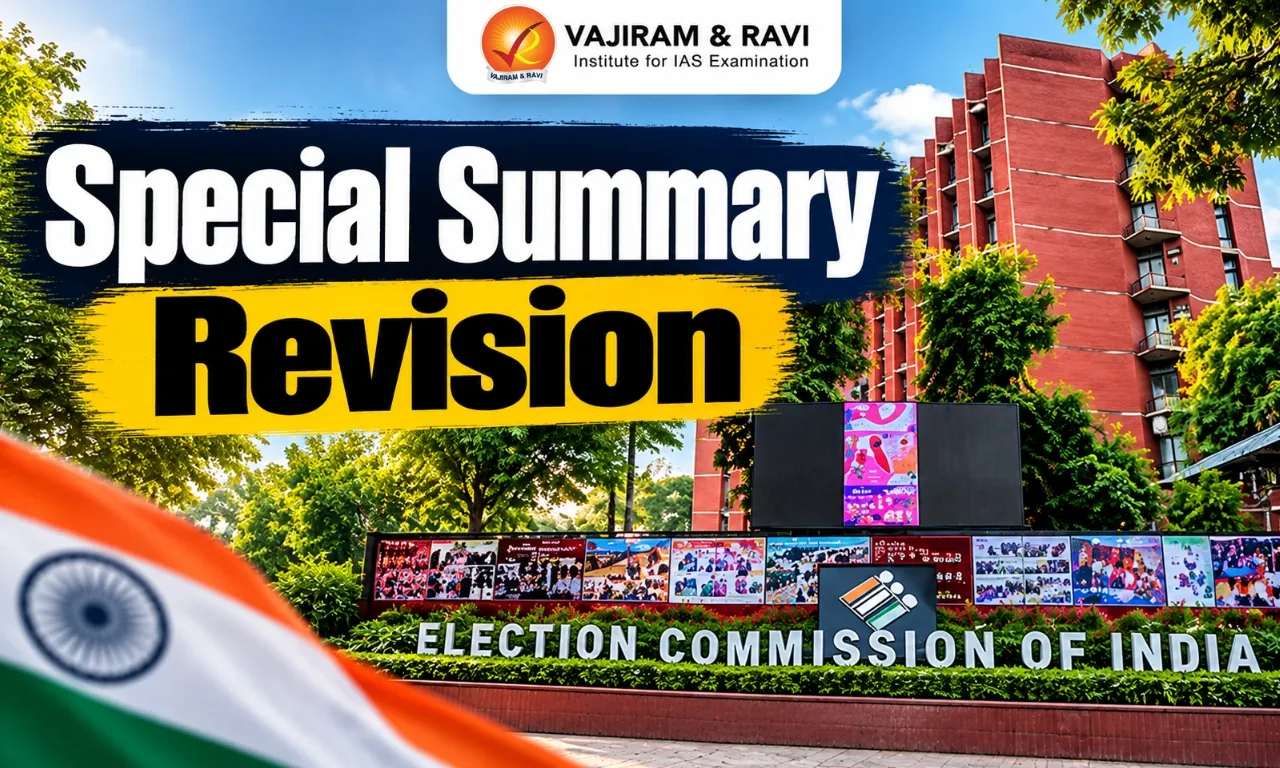
Election Commission of India (ECI) is in the news amid protests and Supreme Court scrutiny over the deletion of voters' names during the Special Intensive Revision (SIR) of electoral rolls. Meanwhile, the ECI has announced a Special Summary Revision (SSR) across 17 States and Union Territories to update voter lists and ensure the inclusion of eligible voters.

Election Commission of India

The Election Commission of India derives its powers and responsibilities from Article 324 of the Indian Constitution. It is a constitutional body, independent of government influence, tasked with supervising the entire electoral process. Initially a single-member body, it became a multi-member Commission in 1993, consisting of the Chief Election Commissioner (CEC) and two Election Commissioners. The ECI manages over 97 crore registered voters (as per 2024 data) and conducts elections in more than 10 lakh polling stations nationwide.

Election Commission of India Structure

The Election Commission of India (ECI) is a constitutional body established under Article 324 of the Indian Constitution. It is a multi-member commission responsible for supervising elections to Parliament, State Legislatures, and the offices of the President and Vice President. Originally, it had only one Chief Election Commissioner (CEC), but since October 1993, it became a three-member body. The Commission operates as a collegiate body, ensuring collective decision-making. It has a permanent secretariat at Nirvachan Sadan, New Delhi, and functions independently of government control. Its structure ensures autonomy, impartiality, and accountability in the electoral process as mandated by the Constitution.

Election Commission of India Composition

The ECI comprises the Chief Election Commissioner (CEC) and two Election Commissioners (ECs), as provided under Article 324(2) of the Constitution. The President of India determines the number of Commissioners from time to time. All three members enjoy equal powers, salaries, and status, and decisions are taken collectively through majority vote. The Chief Election Commissioner acts as the head of the institution, ensuring smooth coordination. The administrative staff is drawn from central and state government services. This composition aims to maintain checks and balances within the Commission, upholding transparency and non-partisanship in the conduct of elections.

As of 2026 the members of Election Commission of India are:

  • Chief Election Commissioner (CEC): Shri Gyanesh Kumar
  • Election Commissioners: Dr. Sukhbir Singh Sandhu and Dr. Vivek Joshi

Chief Election Commissioner (CEC)

The Chief Election Commissioner is the head of the Election Commission of India and ensures the independence and integrity of the electoral process.

  • The CEC is appointed by the President of India under Article 324(2) of the Constitution.
  • The CEC’s role is crucial in enforcing the Model Code of Conduct (MCC), supervising voter rolls, and ensuring impartial conduct of elections.
  • The Supreme Court in T.N. Seshan vs Union of India (1995) upheld that all Election Commissioners are equal in power and status, ensuring collective functioning.
  • The CEC is considered the guardian of India’s electoral democracy, accountable only to Parliament and the Constitution.

Election Commissioners Appointment

The Chief Election Commissioner and other Election Commissioners are appointed by the President of India under Article 324(2). Though the Constitution does not specify a detailed procedure, the appointment is made on the advice of the Council of Ministers. However, several legal experts and the Supreme Court (in March 2023) have recommended a collegium system involving the Prime Minister, Leader of Opposition, and Chief Justice of India to ensure transparency until Parliament enacts law. Their appointment order is issued by the President, and their terms, conditions, and service benefits are defined under the Election Commission (Conditions of Service) Rules 1992.

Election Commissioners Tenure

Under the Election Commission (Conditions of Service of Election Commissioners and Transaction of Business) Act 1991, each Election Commissioner, including the CEC, holds office for six years or until attaining the age of 65 years, whichever is earlier. This fixed tenure provides functional independence and stability. Their salaries and allowances are equivalent to those of Judges of the Supreme Court, ensuring parity with other high constitutional offices. Article 324(5) protects their tenure by stating that their service cannot be varied to their disadvantage after appointment. Such constitutional safeguards ensure autonomy and prevent arbitrary interference by the executive branch.

Election Commissioners Resignation and Removal

Election Commissioners may resign from office by submitting a written resignation to the President of India. However, the Chief Election Commissioner (CEC) enjoys stronger constitutional protection. Under Article 324(5), the CEC can be removed only in the same manner and on the same grounds as a Judge of the Supreme Court, that is, by a special majority of both Houses of Parliament on proven misbehavior or incapacity. Other Election Commissioners can be removed only on the recommendation of the CEC. This system ensures the Commission’s independence, preventing misuse of executive power and preserving the institution’s credibility and neutrality in elections.

Election Commission of India Powers

The Commission enjoys wide-ranging powers to ensure the integrity, neutrality, and transparency of the electoral process across India.Key Powers:

  • Administrative Powers: Control over election schedules, polling arrangements, and the deployment of polling staff.
  • Advisory Powers: Advises the President and Governors on matters related to disqualification of members.
  • Quasi-Judicial Powers: Decides disputes regarding political party recognition and symbols under the Election Symbols (Reservation and Allotment) Order, 1968.
  • Regulatory Powers: Enforces the Model Code of Conduct (MCC) and monitors election expenditure.
  • Disciplinary Powers: Can direct transfers or suspension of officials for election-related misconduct.

Election Commission of India Functions

The ECI performs multiple functions to ensure free, fair, and periodic elections in accordance with democratic principles. Major Functions:

  • Conduct of Elections: Supervises, directs, and controls elections to Parliament, State Legislatures, and high offices.
  • Delimitation: The Election Commission of India (ECI) does not directly have delimitation powers; instead, it oversees the process, which is conducted by a separate, temporary Delimitation Commission established by the Central Government.
  • Electoral Rolls: Prepares, revises, and updates voter lists through continuous revision and SIR (Special Intensive Revision).
  • Registration of Political Parties: Recognizes parties and allots election symbols.
  • Voter Education: Promotes awareness under the Systematic Voters’ Education and Electoral Participation (SVEEP) program.
  • Monitoring Expenditure: Ensures transparency through election expenditure audits and monitoring teams.

Election Commission of India Constitutional Provisions

The Election Commission of India is established under Article 324 of the Constitution to ensure free and fair elections in India. Key Constitutional Provisions:

  • Article 324(1): Grants the ECI the power to conduct elections to Parliament, State Legislatures, and the offices of President and Vice-President.
  • Article 324(2): Empowers the President to appoint the Chief Election Commissioner and other Election Commissioners.
  • Article 324(5): Provides protection to the tenure and service conditions of the CEC, ensuring independence.
  • These provisions ensure the ECI acts as an autonomous constitutional authority, not subordinate to any executive or legislature.

Election Commission of India Legal Safeguards

The legal framework guarantees the Commission’s independence and shields it from executive or political influence during elections. Major Legal Provisions:

  • Article 324(5): Protects the CEC’s tenure and prevents arbitrary removal.
  • Election Commission (Conditions of Service of Election Commissioners and Transaction of Business) Act, 1991: Defines tenure, salaries, and conditions of service.
  • Representation of the People Acts (1950 & 1951): Provide detailed election procedures, voter eligibility, and dispute resolution.
  • Indian Penal Code & Conduct of Election Rules, 1961: Penalize malpractices like bribery, booth capturing, and false nominations.
  • These legal safeguards collectively ensure institutional autonomy and operational transparency.

Election Commission of India Government Policies

To strengthen electoral integrity, several policy measures and reforms have been introduced by the government in consultation with the ECI. Key Policies and Their Impact:

  • Electoral Bond Scheme (2018): Introduced to improve transparency in political funding, though under judicial scrutiny.
  • One Nation, One Election (Proposal): Aims to synchronize national and state elections, reducing expenditure and administrative burden.
  • Voter ID-Aadhaar Linking Drive (Proposal): Ensures cleaner voter rolls by removing duplicate entries.
  • Remote Voting Prototype (Proposal): Designed to allow migrant workers to vote from other locations.
  • Awareness Campaigns (SVEEP): Promotes voter education and participation, increasing turnout rates to over 67% in 2019 Lok Sabha polls.

Election Commission of India Independence

The independence of the Election Commission is fundamental to Indian democracy. The Constitution grants it autonomy, but its accountability mechanisms ensure transparency.

Accountability Measures:

  • Judicial review of Commission decisions.
  • Parliamentary oversight through questions and debates.
  • Media transparency and publication of detailed election reports.

Measures Ensuring Independence:

  • Fixed Tenure: CEC and ECs hold office for six years or till the age of 65.
  • Security of Tenure: CEC can be removed only by parliamentary impeachment similar to a Supreme Court judge.
  • Equal Status: All commissioners enjoy equal decision-making power.
  • Financial Autonomy: ECI’s budget is charged on the Consolidated Fund of India, ensuring executive non-interference.
  • Neutrality in Appointments: Recent Supreme Court directives advocate a collegium-based selection process for transparency.

Election Commission of India Case Laws

Several judicial decisions have strengthened the constitutional position and functioning of the ECI:

  • S. Subramaniam Balaji v. State of Tamil Nadu (2013): Directed the ECI to enforce the Model Code of Conduct more stringently.
  • Union of India v. Association for Democratic Reforms (2002): Mandated disclosure of candidates’ criminal, educational, and financial backgrounds.
  • PUCL v. Union of India (2003): Recognized the Right to Vote as part of the freedom of expression under Article 19(1)(a).
  • A.C. Jose v. Sivan Pillai (1984): Affirmed that the ECI has plenary powers under Article 324 to ensure free elections.
  • ADR vs. Election Commission (2024): The Supreme Court emphasized transparency in voter list revisions under SIR, ensuring uniform procedures across states.

Election Commission of India Challenges

Despite its achievements, the ECI faces several operational and institutional challenges:

  • Political Pressure and Allegations of Bias: Increasing accusations of partisanship affect its credibility.
  • Voter Exclusion: Issues in electoral roll verification, especially during Special Intensive Revisions (SIR), lead to disenfranchisement.
  • Election Expenditure: Unchecked campaign spending and unaccounted political donations undermine transparency.
  • Fake News and Electoral Manipulation: Social media misinformation impacts voter behavior.
  • Digital Divide: Limited accessibility of digital services in rural areas hinders full participation.

Way Forward:

  • Establish a collegium system for appointment of Election Commissioners.
  • Provide statutory backing for the Model Code of Conduct.
  • Expand voter education programs in marginalized communities.
  • Enhance cyber resilience through AI-based monitoring.
  • Strengthen coordination with social media platforms to curb misinformation.

Election Commission of India Technology Integration

The ECI has significantly integrated technology into election management, ensuring faster, more secure, and transparent processes. Key Digital Initiatives:

  • EVMs and VVPATs: Ensure tamper-proof voting and verifiable paper trails.
  • cVIGIL App: Allows citizens to report Model Code violations in real time.
  • ERONet and NVSP Portal: Facilitate online voter registration and roll management.
  • Suvidha and Samadhan Portals: Streamline candidate permissions and grievance redressal.
  • Garuda App: Enables Booth Level Officers (BLOs) to conduct door-to-door verification digitally.

Election Commission of India Significance

The Election Commission acts as the foundation of India’s democracy, ensuring the people’s mandate is exercised freely, fairly, and periodically.

  • Democratic Legitimacy: Upholds citizens’ right to vote under Article 326, maintaining public confidence in electoral outcomes.
  • Institutional Stability: Ensures smooth transitions of power without conflict, protecting the essence of parliamentary democracy.
  • Inclusivity: Implements initiatives like SVEEP and Accessible Elections Project to include marginalized groups, PwDs, and senior citizens.
  • Technological Reforms: Adoption of EVMs, VVPAT, and digital voter roll systems enhances transparency and reduces human error.
  • Global Recognition: India’s ECI is often cited as a model for electoral management by international organizations like the UNDP and International IDEA.

Election Commission of India Recent Developments

The Election Commission of India (ECI) has announced Phase 2 of its nationwide “Special Intensive Revision” (SIR) of electoral rolls, covering 12 states and Union Territories from November 4, 2025.

  • The exercise will affect around 51 crore electors, aiming for a final roll publication on February 7, 2026.
  • States involved include major poll-bound regions such as Tamil Nadu, Kerala, West Bengal and Puducherry. 
  • The ECI clarified that Aadhaar card and 13 other documents may be used for identity proof, though concerns over potential disenfranchisement have been raised by opposition parties. 
  • The revision follows the earlier SIR pilot in Bihar, where the ECI reported zero appeals or complaints relating to deletions. 
  • Some states have questioned the timeline and scope of the exercise, arguing that it should not proceed in a short span of 2-3 months given migration and administrative challenges.

Election Commission of India FAQs

Q1: What is the Election Commission of India?

Ans: It is a constitutional body established under Article 324 to supervise elections in India.

Q2: Who appoints the Chief Election Commissioner?

Ans: The President of India appoints the Chief Election Commissioner and other Election Commissioners.

Q3: What is the tenure of Election Commissioners?

Ans: They hold office for six years or until the age of 65, whichever is earlier.

Q4: What are the major powers of the Election Commission of India?

Ans: The ECI conducts elections, enforces the Model Code, and regulates political parties and expenditure.

Q5: How does the Election Commission of India ensure free and fair elections?

Ans: Through technology use, strict monitoring, legal powers, and transparent processes under constitutional safeguards.

Why Bond Yields Are Rising in All Major Countries Except China

Rising Bond Yields

Global government bond yields have been rising as inflation concerns push investors to demand higher returns on their investments. China is an exception, with its government bond yields falling amid low inflation, weak domestic consumption and limited investment opportunities. This divergence highlights differences in economic conditions across major economies.

What Are Government Bond Yields?

Government bonds are debt instruments through which governments borrow money from investors. A bond yield is the return an investor earns on a bond relative to its price.

Bond prices and yields generally move in opposite directions: 

  • When bond prices fall, yields rise. For example, suppose a government bond pays ₹100 annually. If its market price falls from ₹1,000 to ₹800, the annual payment remains ₹100, but the return relative to the purchase price rises from 10% to 12.5%.
  • When bond prices rise, yields fall. If the same bond's market price increases from ₹1,000 to ₹1,250, the annual payment remains ₹100, but the return relative to the purchase price falls from 10% to 8%.

Government bond yields also influence borrowing costs across the economy. Rising yields can make it more expensive for governments and other borrowers to raise funds.

Why Are Bond Yields Rising Globally?

Government bond yields are rising in major economies as inflation increases and investors demand higher returns to compensate for the erosion of their money’s purchasing power.

The main reasons include:

  • Rising inflation: Higher prices reduce the purchasing power of future bond payments, prompting investors to demand higher yields.
  • Higher interest rates: Central banks may raise policy interest rates to contain inflation, putting upward pressure on bond yields.
  • Higher borrowing costs: As yields rise, governments face greater costs when issuing new debt or refinancing existing debt.

The scale of this shift is significant. The yield on US 10-year government bonds increased by 125 basis points after the US-Iran war began at the end of February 2026. One basis point equals 0.01 percentage point.

Why Are Bond Yields Falling in China?

Unlike other major economies, China has experienced very low inflation, alongside periods of deflation. This reduces pressure on its central bank to raise interest rates and encourages investors to seek returns from government bonds.

Three factors help explain China’s falling bond yields.

  • Low inflation: China’s consumer inflation rate was 0% in 2025, compared with 0.2% in both 2023 and 2024. Inflation was expected to rise only to around 1% in 2026, according to the report.
  • Moderating economic growth: China’s growth has slowed from the double-digit rates recorded in earlier decades. Weaker demand limits upward pressure on prices.
  • Weak domestic consumption and limited investment options: China relies heavily on exports, while household consumption remains relatively weak. The property market downturn and restrictions on investing abroad have also limited attractive investment avenues.

As a result, a large share of domestic savings flows into government bonds. Increased demand raises bond prices and pushes yields down.

What Does the Divergence in Bond Yields Indicate?

The difference between rising global bond yields and falling Chinese bond yields reflects contrasting economic conditions.

  • For major economies: Higher yields increase government borrowing costs and may raise borrowing costs for businesses and households, potentially slowing economic growth.
  • For China: Lower yields reduce government borrowing costs, but they also reflect weak inflationary pressure and limited demand for investment.
  • For global markets: Diverging yields reflect differences in inflation, economic growth, monetary policy and investor demand across countries.

Falling bond yields are therefore not necessarily a sign of economic strength. In China’s case, they may indicate subdued domestic demand and a shortage of attractive investment opportunities.

Why Bond Yields are rising in all major countries except China FAQs

Q1: What are bond yields?

Ans: Bond yields represent the return an investor earns on a bond relative to its market price. Governments issue bonds to borrow money from investors.

Q2: What is the relationship between bond prices and yields?

Ans: Bond prices and yields generally move in opposite directions. When a bond’s price falls, its yield rises; when its price rises, its yield falls. This happens because the fixed payment on an existing bond remains unchanged while its market price changes.

Q3: Why are bond yields rising globally?

Ans: Rising inflation reduces the purchasing power of future bond payments, prompting investors to demand higher returns. Expectations of higher interest rates to control inflation also put upward pressure on bond yields.

Q4: Why are bond yields falling in China?

Ans: China’s low inflation, weak domestic consumption and limited investment opportunities have encouraged investors to buy government bonds. Higher demand raises bond prices and lowers yields.

Q5: How do rising bond yields affect the economy?

Ans: Rising bond yields increase government borrowing costs and can make borrowing more expensive for businesses and households. This may reduce investment and consumption, potentially slowing economic growth.

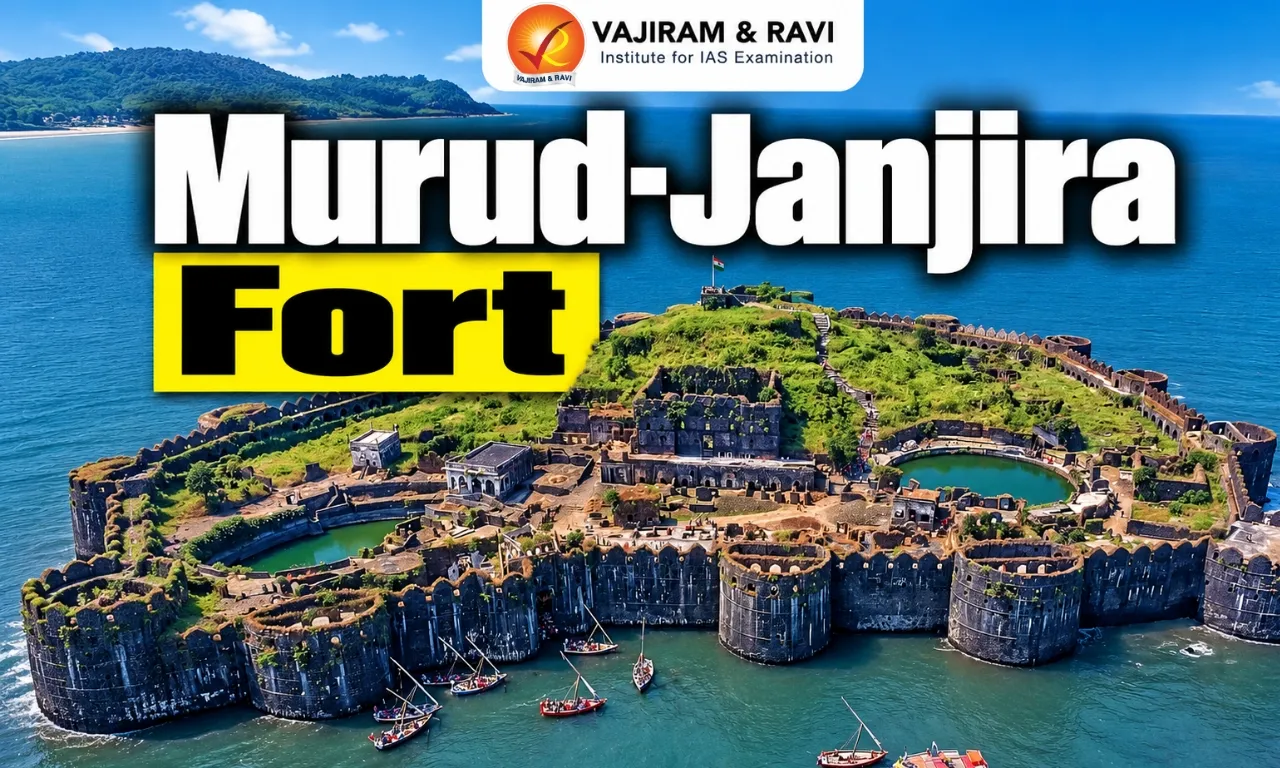
Murud-Janjira Fort

Murud-Janjira Fort

Murud-Janjira Fort Latest News

Months after being closed during the monsoon for safety and cleaning work, the historic Murud Janjira Fort in Maharashtra's Raigad district has finally reopened to visitors recently.

About Murud-Janjira Fort

  • It is an island fort located on an island off the coastal village of Murud, in the Raigad district of Maharashtra. 
  • It is surrounded by the Arabian Sea on all sides and is one of the strongest marine forts of India.  

Murud-Janjira Fort History

  • The history of Murud Janjira Fort dates back to the 15th century, when the Siddi rulers established a powerful naval base along Maharashtra's western coast.
  • The Siddis were the rulers of Murud-Janjira. They were people of African origin who had come to India many centuries ago. 
  • The name "Janjira" is believed to have originated from the Arabic word "Jazeera," meaning island.
  • Initially constructed as a small wooden fort by local fishermen, it was later rebuilt into a massive stone fortress under the Siddis. 
  • The fort’s strategic location on the bustling maritime trade route connecting Broach, Daman, Diu, and Mangalore made it a vital hub for commerce and military operations. 
  • Over the centuries, Siddi alignment with Mughals provoked conflict with local kings, including Shivaji and his son Sambhaji, who attempted to scale the walls and tunnel to it, respectively. 
  • However, no outsider (including British, French, and Portuguese colonists) ever made it past the fort’s 12 m-high granite walls, which, when seen during high tide, seem to rise straight from the sea. 
  • Despite numerous attempts, its defenses remained unbreached, earning it the moniker “Unconquerable Janjira.” 

Murud-Janjira Fort Architecture

  • The structure is built on a rock outcrop and has 26 massive bastions and high protective walls.
  • The fort was made by a mixture of lead, sand, and gul. 
  • The main gate of the fort facing Rajapuri on the shore is a huge structure. There is a small gate towards the open sea to escape from the enemies. 
  • Once it stood firm and robust in defence with 572 roaring cannons, only a few of the large cannons remain in place today, and the largest of them is known as the Kalaal Bangdi. 
  • Earlier the fort was a full-fledged living place with all the necessary facilities like palaces, quarters for officers, a mosque, two small 18 m natural freshwater lakes, etc. 
  • There is also a deep well with cold and sweet water, a wonder of nature in the midst of the sea.  

News: MD

Murud-Janjira Fort FAQs

Q1: Where is Murud-Janjira Fort located?

Ans: Murud-Janjira Fort is located on an island off the coastal village of Murud in Maharashtra’s Raigad district.

Q2: Who were the traditional rulers of Murud-Janjira Fort?

Ans: The Siddi rulers were the traditional rulers of Murud-Janjira Fort.

Q3: Why was Murud-Janjira Fort strategically important?

Ans: Its location along a busy maritime trade route made it important for commerce and military operations.

Q4: Which Maratha rulers attempted to capture Murud-Janjira Fort?

Ans: Chhatrapati Shivaji Maharaj and his son Sambhaji attempted to capture the fort.

Right to Protest in India, Article 19, Permission, Restrictions

Right to Protest in India

The Right to Protest in India is a vital democratic principle that allows citizens to peacefully express opinions, oppose government decisions and seek policy changes. It is derived from Article 19 of the Constitution through the freedoms of speech, peaceful assembly and association. However, this right is subject to reasonable restrictions to protect public order, national security and the rights of other citizens, ensuring a balance between democratic dissent and public interest.

Why is the Right to Protest in News?

The Right to Protest in India is in focus following the proposed Cockroach Janta Party (CJP) march from Jantar Mantar to Parliament in New Delhi on July 20. The Delhi Police stated that the organisation had neither obtained permission to continue its protest at Jantar Mantar nor applied for approval for the planned march. The CJP has been protesting since June 20, demanding the removal of Union Education Minister Dharmendra Pradhan over educational reforms. The incident has renewed discussions on whether peaceful protests require prior police permission, the limits of constitutional freedoms and the legal framework governing public demonstrations in India.

Right to Protest Under the Indian Constitution

The Constitution does not explicitly mention the phrase “Right to Protest”. Instead, this right is derived primarily from the following Fundamental Rights.

  • Article 19(1)(a): Guarantees freedom of speech and expression, allowing citizens to express their opinions and dissent.
  • Article 19(1)(b): Guarantees the right to assemble peacefully and without arms.
  • Article 19(1)(c): Guarantees the right to form associations and unions, enabling collective action.

These provisions allow citizens to organise peaceful demonstrations, rallies, marches and public meetings to express their concerns and demand government action.

Is the Right to Protest a Fundamental Right?

The Right to Protest is protected by the Fundamental Rights guaranteed under Article 19 of the Constitution. However, it is not an absolute right.

Citizens can express dissent and assemble peacefully, but protests must comply with constitutional restrictions and lawful regulations. The government may regulate the time, place and manner of demonstrations to maintain public order and protect the rights of other citizens.

The state must also ensure that restrictions are reasonable and proportionate rather than arbitrary.

Restrictions on Right to Protest in India

The Constitution permits reasonable restrictions to ensure protests remain peaceful and do not adversely affect public safety or constitutional values.

  • Article 19(2) restrictions: Freedom of speech may be restricted in the interests of sovereignty and integrity of India, State security, friendly relations with foreign States, public order, decency, morality, contempt of court, defamation and incitement to an offence.
  • Public Assembly Restrictions: Peaceful assemblies may also be regulated when necessary to maintain public order, prevent violence and safeguard the rights and freedoms of other citizens.
  • Violence Prohibited: Constitutional protection extends only to peaceful protests. Violence, destruction of public property, or unlawful activities fall outside constitutional protection.
  • Fundamental Duty under Article 51A: Every citizen has a constitutional duty to safeguard public property and renounce violence during public demonstrations and collective movements.
  • Police Permission: Authorities may refuse permission if a proposed protest is likely to threaten public order, national security, decency, morality, or other constitutional grounds recognised under Article 19.
  • Section 163 of Bharatiya Nagarik Suraksha Sanhita: Authorities may impose prohibitory orders and even revoke permission for ongoing protests when necessary to maintain law and order. This provision replaced the earlier Section 144 of the Code of Criminal Procedure 1973.
  • Reasoned Decision Required: If permission is denied or withdrawn, the police or District Magistrate should communicate specific reasons, including the nature of the perceived threat and public safety concerns.

Supreme Court Judgments on the Right to Protest

The Supreme Court has clarified that peaceful protest is constitutionally protected but remains subject to reasonable restrictions and the rights of others.

  • Himat Lal K. Shah v. Commissioner of Police (1973): The Supreme Court held that public meetings on streets are protected by constitutional freedoms, and authorities may regulate them but cannot impose arbitrary restrictions.
  • In Re: Ramlila Maidan Incident (2012): The Supreme Court examined police action against a gathering at Ramlila Maidan, Delhi, and held that restrictions on fundamental rights must be reasonable, non-arbitrary and proportionate to the objective sought to be achieved.
  • Mazdoor Kisan Shakti Sangathan v. Union of India (2018): The Supreme Court recognised peaceful protest as a Fundamental Right under Articles 19(1)(a) and 19(1)(b). In the context of demonstrations at Jantar Mantar and Central Delhi, it called for regulated protests that balance demonstrators’ rights with residents’ interests.
  • Amit Sahni v. Commissioner of Police (2020): In the context of the Shaheen Bagh blockade, the Supreme Court held that public ways and spaces cannot be occupied indefinitely in a manner that obstructs the movement of other citizens.
  • Kisan Mahapanchayat v. Union of India (2021): The Supreme Court considered whether the right to protest is absolute and the relationship between ongoing protests and pending court proceedings. The case should not be cited solely as a blanket ruling against road blockades without checking the specific order being referenced.

Process of Legal Protest in India

Organising a lawful protest requires compliance with local laws, police permissions and administrative procedures that vary across States.

  • State specific procedures: Since law and order is a State subject, every State may prescribe its own rules governing public protests, rallies, demonstrations and assemblies.
  • No Objection Certificate (NOC): Organisers generally need an NOC from the local police station. Where multiple police jurisdictions are involved, approval is usually granted by the Commissionerate or Deputy Commissioner of Police (DCP).
  • Application details: The application should include organisers' names, addresses, contact details, purpose of protest, expected participants, venue, duration and proposed rally route wherever applicable.
  • Equipment declaration: Organisers must mention arrangements for loudspeakers, tents, pandals, public address systems and other equipment proposed for use during the event.
  • Supporting documents: Applications are generally accompanied by identity proof, residence proof, photographs and any additional documents required by the concerned police authority.
  • Crowd management plan: Police may seek details regarding drinking water, sanitation facilities, crowd control measures, emergency arrangements, coordination with officials, or affidavits from organisers before granting permission.
  • Permission not automatic: Authorities evaluate applications by considering public order, local conditions, security concerns and the rights of nearby residents before granting or refusing approval.

Examples of Peaceful Protests in India

Several peaceful movements have significantly influenced public policy, environmental protection, governance reforms and social justice in India.

  • Chipko Movement (1973): Villagers, particularly women, peacefully embraced trees to oppose deforestation, making the movement a landmark example of Gandhian environmental conservation through non violent resistance.
  • Narmada Bachao Andolan (1985): Farmers, Adivasis, environmentalists and human rights activists united against large dam projects on the Narmada River, influencing debates on rehabilitation, displacement and sustainable development.
  • Jan Lokpal Movement (2011): Anna Hazare's hunger strike at Jantar Mantar generated nationwide public support for stronger anti corruption institutions and accelerated discussions on the Lokpal legislation.
  • Nirbhaya Movement (2012): Nationwide peaceful protests after the Delhi gang rape led to important legal reforms on crimes against women and the establishment of the Nirbhaya Fund for women's safety.
  • Farmers' Protest (2020): Year long peaceful demonstrations against the three farm laws ultimately resulted in the repeal of the legislation and the formation of a committee to examine Minimum Support Price (MSP) related issues.

Right to Protest in India 2026 FAQs

Q1: What is the Right to Protest in India?

Ans: The Right to Protest in India is a constitutional right derived from Article 19, allowing citizens to peacefully express opinions and assemble without arms, subject to reasonable restrictions.

Q2: Can the Right to Protest be Restricted in India?

Ans: Yes. Under Article 19(2), peaceful protests may be restricted to protect sovereignty and integrity, State security, public order, decency, morality and other constitutional interests.

Q3: Can we Protest without permission in India?

Ans: Peaceful protest is a constitutional right, but most public protests, rallies and demonstrations require prior permission from the local police or competent authority under applicable State rules.

Q4: Do we need permission to Protest in India?

Ans: Yes. Generally, organisers must obtain police permission or a No Objection Certificate (NOC) before holding a public protest, especially if it involves roads, public spaces, loudspeakers, or large gatherings.

Q5: Is the Right to Protest a Fundamental Right in India?

Ans: The Right to Protest is not expressly listed as a separate Fundamental Right. It is derived from Articles 19(1)(a), 19(1)(b) and 19(1)(c), which guarantee freedom of speech, peaceful assembly and association, subject to reasonable restrictions.

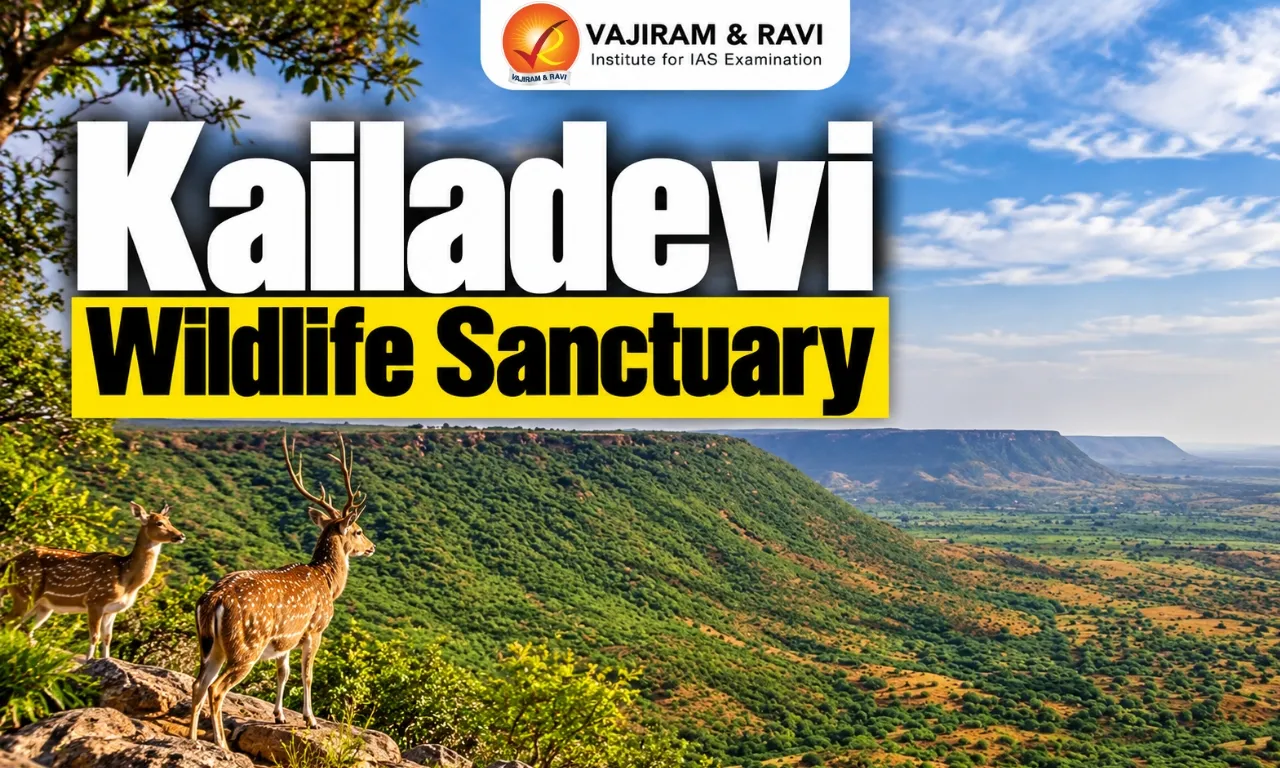
Kailadevi Wildlife Sanctuary

Kailadevi Wildlife Sanctuary

Kailadevi Wildlife Sanctuary Latest News

A new study by WWF-India, in collaboration with the Rajasthan Forest Department, highlights Kailadevi Wildlife Sanctuary as a key stronghold for wildlife conservation and tiger recovery in Rajasthan. 

About Kailadevi Wildlife Sanctuary

  • It is located in the Karauli district of Rajasthan. 
  • It spans about 674 sq.km. and was established in 1983.  
  • It serves as a northern extension and buffer zone of the Ranthambore Tiger Reserve, acting as a wildlife corridor connecting Ranthambore to the Chambal region. 
  • It is geographically characterized by rugged hills, deep gorges (locally referred to as khos), and dry deciduous forests, with the Banas River on its western edge and the Chambal River to the southeast. 
  • The sanctuary is also culturally significant due to the Kaila Devi Temple within its boundary, attracting many pilgrims.  
  • It has become a popular reference among environmentalists and conservationists for the community-initiated forest protection committees (referred to as kulhadi bandh panchayats) that are operational in the area. 
    • These forest protection committees prevent the carrying of axes into the forests, a symbol of protecting the forests.  
  • Flora: The forest vegetation mainly comprises species like dhok, khair, and tendu trees.  
  • Fauna: Its rich wildlife includes Bengal tigers, leopards, sloth bears, Indian grey wolves, striped hyenas, jackals, nilgai, chinkara, sambar, chital, and over 200 species of birds such as kingfishers and peafowl. 

News: WWF

Kailadevi Wildlife Sanctuary FAQs

Q1: In which state is Kailadevi Wildlife Sanctuary located?

Ans: Kailadevi Wildlife Sanctuary is located in Rajasthan.

Q2: Kailadevi Wildlife Sanctuary serves as a northern extension and buffer zone of which tiger reserve?

Ans: It serves as a northern extension and buffer zone of Ranthambore Tiger Reserve.

Q3: Which geographical features characterize Kailadevi Wildlife Sanctuary?

Ans: It is characterized by rugged hills, deep gorges and dry deciduous forests.

Q4: Which river flows along the western edge of Kailadevi Wildlife Sanctuary?

Ans: The Banas River flows along its western edge.

Q5: Which river lies to the southeast of Kailadevi Wildlife Sanctuary?

Ans: The Chambal River lies to its southeast.

Glacial Lake Outburst Flood Warning System

Glacial Lake Outburst Flood Warning System

Glacial Lake Outburst Flood Warning System Latest News

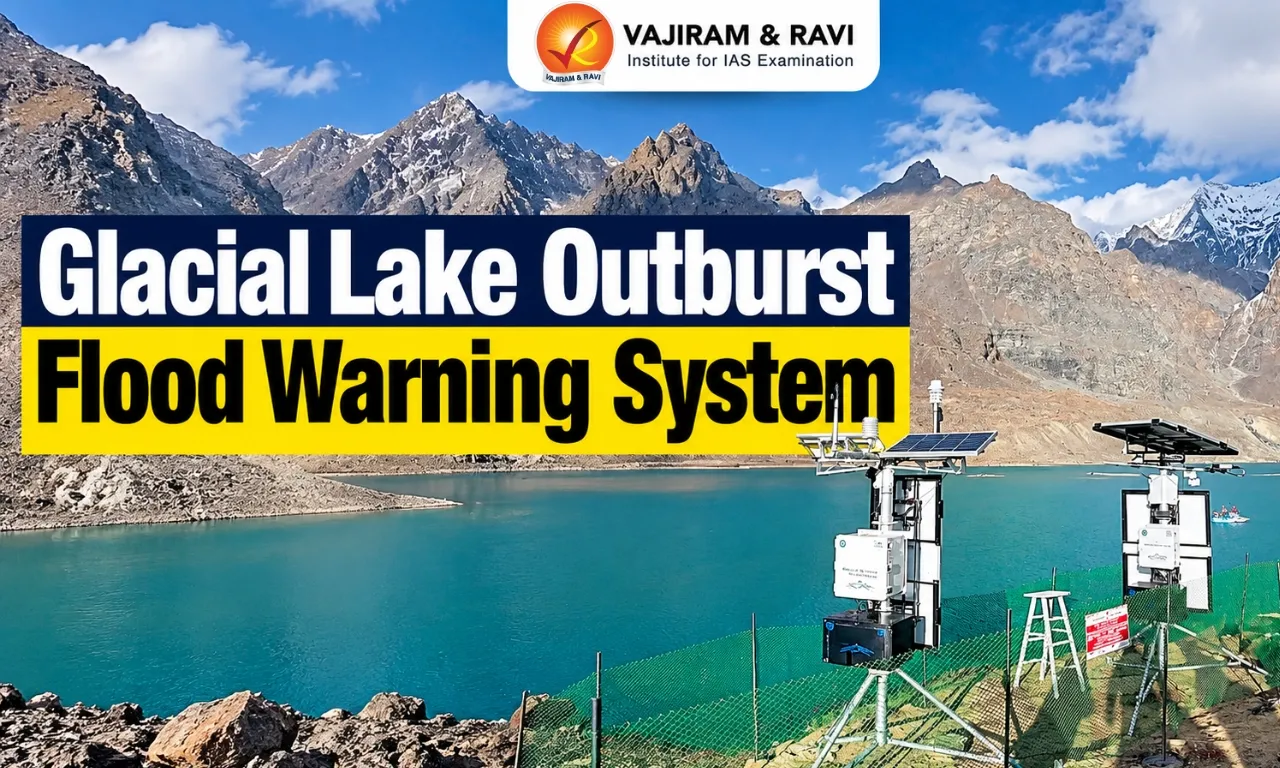
Recently, the country's first Glacial Lake Outburst Flood (GLOF) early warning system has been installed at Ghepan Ghat glacial lake in Himachal Pradesh's Lahaul and Spiti district.

About Glacial Lake Outburst Flood Warning System

  • It is installed at Ghepan Ghat glacial lake in Himachal Pradesh.
  • It is developed by the Centre for Development of Advanced Computing (C-DAC) under a pilot project funded by the National Disaster Management Authority (NDMA).
  • Components: It comprises a floating buoy deployed in the water, an automatic weather station on the shore and a glacier vision unit equipped with two cameras.

Working of Glacial Lake Outburst Flood Warning System

  • The floating buoy continuously monitors changes in the water and transmits data at intervals of 10 minutes under normal conditions.
  • In an emergency, the system is designed to begin transmitting information within 30 seconds, enabling authorities to detect sudden changes in the lake.
  • The automatic weather station records 14 environmental parameters, while the two-camera glacier vision unit continuously monitors changes in the lake and its surroundings.
  • All three systems are interconnected through a supercomputer-based analytical platform.
  • It will provide disaster management authorities with crucial data for timely risk assessment and preparedness against potential hazards.

Significance of Glacial Lake Outburst Flood Warning System

  • The installation marks a significant milestone in monitoring glacial lakes and assessing potential flood threats in the ecologically sensitive Himalayan region.
  • The initiative will also help raise public awareness about flood-prone areas and support disaster management planning.

Source: NIE

Spot-bellied Eagle-Owl

Spot-Bellied Eagle-Owl

Spot-bellied Eagle-Owl Latest News

In a major ornithological milestone, spot-bellied eagle-owl, a rare and elusive species, has been documented for the first time in Kozhikode, Kerala.

About Spot-bellied Eagle-Owl

  • The spot-bellied eagle-owl, also known as the forest eagle-owl, is a large bird of prey with a formidable appearance.
  • Scientific Name: Ketupa nipalensis.
  • It is closely related to the barred eagle-owl, which looks similar. However, these two owls live in different areas. 

Spot-bellied Eagle-Owl Habitat and Distribution

  • It is a forest-inhabiting species found in the Indian Subcontinent and Southeast Asia.  
  • In India, these spot-bellied eagle-owl species are distributed in the states of Tamil Nadu, Kerala, Goa, Karnataka, Maharashtra, Uttarakhand, Sikkim, Assam, Arunachal Pradesh, Nagaland, Meghalaya, Manipur, Tripura, and Mizoram. 
  • It can be found in a variety of habitats, including tropical and subtropical forests, woodlands, and savannas.

Spot-bellied Eagle-Owl Features

  • It is a very large owl. It can be from 50 to 65 cm long. This makes it one of the longest owls in the world. 
  • It also has very long wings. Its wingspan can reach up to 1.7 meters.
  • The most distinguishing feature is its striking colouration. The upper parts of its body are a rich chocolate brown, speckled with white spots.
  • The feathers on its wings and tail are barred with alternating shades of brown and white, creating a stunning pattern that helps it blend in with its surroundings.
  • The underside of the owl is where it gets its name; its belly and breast are a light cream colour, covered in bold black spots.
  • The nostrils are round. The beak is curved and yellowish. 
  • The owl has long ear tufts on its head. These tufts can be 63 to 76 mm long.  
  • Like most eagle owls, its legs and feet are covered in feathers.  But the tips of its toes are bare. 
  • It is primarily nocturnal.
  • It is a solitary bird that is territorial and maintains a home range.
  • It is famous for its strange, human-like calls.

Spot-bellied Eagle-Owl Conservation Status

It is classified as 'Least Concern' under the IUCN Red List.

News: NIE

Spot-bellied Eagle-Owl FAQs

Q1: What is the scientific name of the spot-bellied eagle-owl?

Ans: Its scientific name is Ketupa nipalensis.

Q2: Which type of bird is the spot-bellied eagle-owl?

Ans: It is a large bird of prey.

Q3: In which regions of the world is the spot-bellied eagle-owl found?

Ans: It is found in the Indian Subcontinent and Southeast Asia.

Q4: What is the colour of the upper body of the spot-bellied eagle-owl?

Ans: Its upper body is rich chocolate brown, speckled with white spots.

Q5: What is the IUCN Red List conservation status of the spot-bellied eagle-owl?

Ans: It is classified as Least Concern (LC).

New Centipede Species

New Centipede Species

New Centipede Species Latest News

Recently, researchers discovered three new centipede species from South India and named them as Rhysida quadrispinosa, Rhysida coorgensis and Rhysida neyyarensis. 

About Rhysida quadrispinosa

  • It got its name from the Latin-derived term quadrispinosa.
  • It has four ventrolateral spines on its ultimate leg prefemur.
  • It features 18 antennal articles, unique body segment margination starting from tergites 7–11, and a distinct arrangement of spines on its ultimate legs.

About Rhysida coorgensis

  • It is named after Coorg in Karnataka, where researchers first collected the specimen. 
  • It has a specific paramedian suture starting points on its back plates and unique coxopleural spine configurations

About Rhysida neyyarensis

  • It is named after the Neyyar Wildlife Sanctuary in Kerala, where it was discovered.
  • It is distinguished by its specific pattern of tarsal and tibial spurs, possessing two tarsal spurs on legs 1 through 19, alongside its own distinct spinal formula on the ultimate legs.

Key Facts about Centipede

  • These are long, many-legged invertebrates.
  • Centipedes are not insects. They are arthropods in the myriapod group and belong to the class Chilopoda.
  • Habitat: They live in damp, sheltered places such as leaf litter, soil, under bark, beneath rocks and inside rotting logs.
  • Appearance: They have segmented bodies, antennae, breathing holes called spiracles and one pair of legs on each body segment.
  • Diet: Centipedes are predators. Their first pair of legs has changed into venom claws, called forcipules, which help them catch and hold prey.

Source: RM

New Centipede Species FAQs

Q1: What is Rhysida quadrispinosa?

Ans: It is a new centipede species.

Q2: What is unique about Rhysida quadrispinosa?

Ans: It has four ventrolateral spines on its ultimate leg prefemur.

Badrinath Temple, Location, History, Significance, Architecture

Badrinath Temple

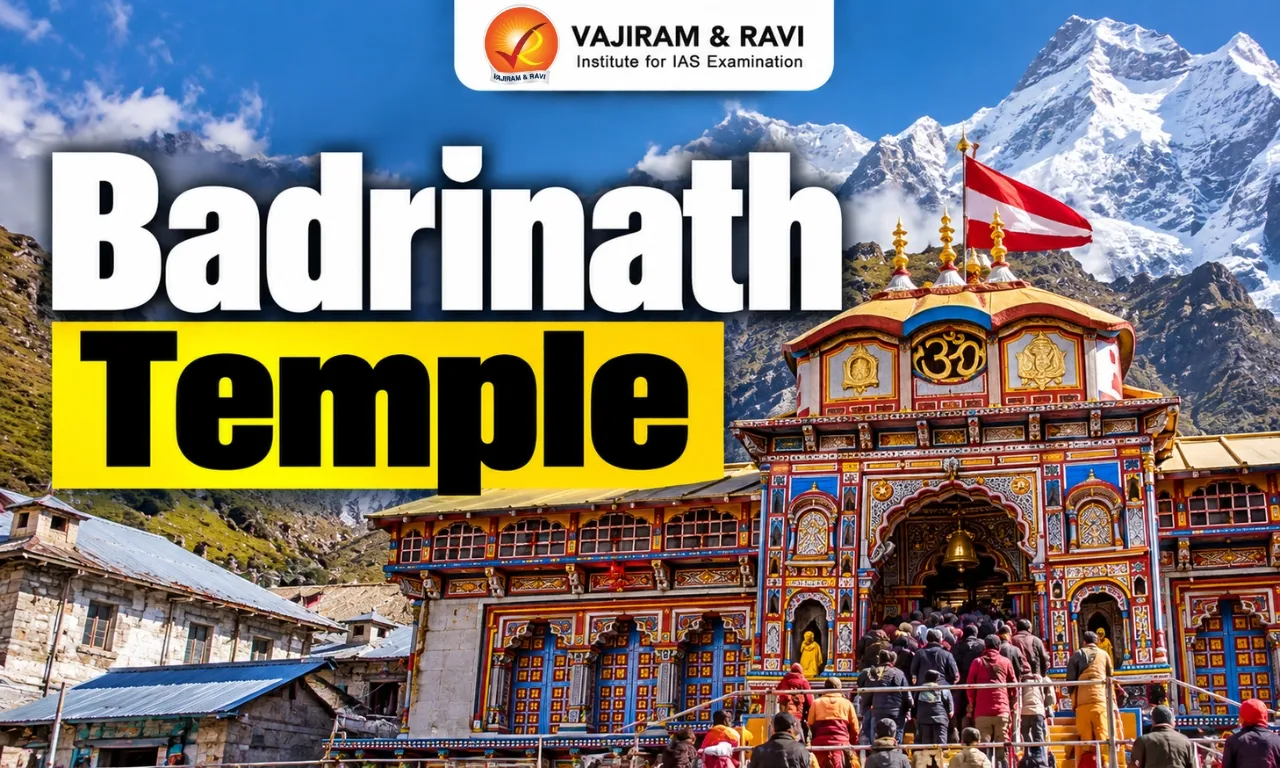
Badrinath Temple is an important Hindu pilgrimage site located in the Chamoli district of Uttarakhand. Dedicated to Lord Vishnu, the temple lies in the Garhwal Himalayas along the banks of the Alaknanda River. It is one of the four sacred sites of the Char Dham Yatra in Uttarakhand and holds great religious, cultural and historical importance.

The temple is also significant for understanding India's religious traditions, Himalayan geography, pilgrimage tourism and cultural heritage.

History and Mythological Significance of Badrinath Temple

The Badrinath Temple is an ancient Hindu shrine dedicated to Lord Vishnu, located in the Chamoli district of Uttarakhand. It is one of the four sacred sites of the Char Dham pilgrimage in Uttarakhand and one of the 108 Divya Desams, which are sacred Vishnu temples revered in the Sri Vaishnava tradition.

Mythological Origins

  • Lord Vishnu’s Penance: According to Hindu religious traditions, Lord Vishnu performed deep meditation at this site, making it an important centre of spiritual practice.
  • Legend of the Badri Tree: According to popular belief, Goddess Lakshmi took the form of a berry tree (Badri) to protect Lord Vishnu from the harsh Himalayan weather while he meditated. This legend is associated with the names Badrikashram and Badrinath.
  • Connection with the Mahabharata: Local traditions associate the region with the Pandavas and their final journey towards the Himalayas, as described in the Mahabharata.

Historical Development

  • Ancient Origins: Badrinath is mentioned in Hindu religious literature, including the Vishnu Purana and Skanda Purana. These references highlight its longstanding religious importance.
  • Role of Adi Shankaracharya: According to tradition, the philosopher and religious reformer Adi Shankaracharya revived the shrine's importance during the 8th–9th century CE. He is believed to have recovered the black stone idol of Lord Badrinarayan from the Alaknanda River and established it for worship.
  • Renovation and Reconstruction: Over the centuries, the temple underwent several repairs due to harsh climatic conditions and natural disasters. The Garhwal rulers and the royal family of Jaipur are associated with its restoration and development.
  • Modern Administration: Today, the temple is managed by the Shri Badarinath Kedarnath Temple Committee (BKTC) under the applicable state legislation, which oversees temple administration and religious activities.

Religious and Cultural Significance

  • Worship of Lord Vishnu: The temple is dedicated to Lord Vishnu, who is regarded as the preserver of the universe in Hinduism.
  • Char Dham Yatra: Badrinath is one of the four pilgrimage sites in Uttarakhand, along with Yamunotri, Gangotri and Kedarnath.
  • Larger Char Dham circuit: It is also one of the four sacred destinations in India's wider Char Dham pilgrimage, along with Dwarka, Puri and Rameswaram.
  • Religious traditions: The temple is associated with Hindu beliefs, pilgrimage practices and traditions connected with the Himalayan region.
  • Cultural heritage: It represents the close relationship between religion, local communities and the natural environment in the Himalayas.

Architecture and Important Features

Badrinath Temple is known for its colourful entrance, traditional architectural features and location amid the Himalayan mountains.

  • Main shrine: The inner sanctum houses the image of Lord Badrinarayan, a form of Lord Vishnu.
  • Garbhagriha: The innermost chamber where the principal deity is worshipped.
  • Mandapa: The hall used by devotees for religious activities and worship.
  • Temple entrance: The entrance is decorated with colourful architectural elements.
  • Tapt Kund: A natural hot spring near the temple where pilgrims traditionally bathe before worship.
  • Alaknanda River: The river flows near the temple and forms part of the Ganga river system.
  • Neelkanth Peak: This prominent Himalayan peak adds to the natural and religious importance of the region.

Char Dham Yatra of Uttarakhand

The Char Dham Yatra is a major Hindu pilgrimage covering four sacred sites in Uttarakhand.

Pilgrimage site

Presiding deity or religious association

Yamunotri

Goddess Yamuna

Gangotri

Goddess Ganga

Kedarnath

Lord Shiva

Badrinath

Lord Vishnu

The pilgrimage is generally undertaken during the warmer months because heavy snowfall and severe winter conditions make access to these Himalayan sites difficult.

Geographical Significance

Badrinath Temple is situated in the Himalayan region, where high mountains, river valleys and changing weather conditions influence human activities.

  • Alaknanda River: The river is an important headstream of the Ganga and contributes to the drainage system of the Himalayas.
  • Mountain environment: The region has steep slopes, high elevations and cold winters.
  • Natural hazards: Landslides, heavy rainfall, snowfall and road blockages can affect pilgrimage and transport.
  • Tourism and livelihoods: Pilgrimage supports hotels, transport services, local businesses and other tourism-related activities.
  • Environmental concerns: Increasing tourist pressure and infrastructure development require sustainable waste management and protection of the fragile Himalayan ecosystem.

Badrinath Temple FAQs

Q1: Where is Badrinath Temple located?

Ans: Badrinath Temple is located in the Chamoli district of Uttarakhand in the Garhwal Himalayas.

Q2: Which deity is worshipped at Badrinath Temple?

Ans: Lord Vishnu is worshipped in the form of Lord Badrinarayan.

Q3: Who revived the religious importance of Badrinath Temple?

Ans: According to tradition, Adi Shankaracharya revived its religious importance during the 8th century CE.

Q4: Which river flows near Badrinath Temple?

Ans: The Alaknanda River flows near the temple and is an important headstream of the Ganga.

Q5: What are the four sites of Uttarakhand's Char Dham Yatra?

Ans: Yamunotri, Gangotri, Kedarnath and Badrinath are the four sites.

National Security Guard

National Security Guard

National Security Guard Latest News

The Prime Minister recently extended greetings to personnel of the National Security Guard (NSG) on its Raising Day, lauding their courage, precision, and unwavering commitment to duty.

About National Security Guard

  • It is India’s premier counter-terror force, specially trained and equipped to respond to serious acts of terrorism and other exceptional security situations.  
  • The NSG members are also known as Black Cats because of the black drill cotton coveralls and balaclavas, or helmets, they wear.
  • Establishment: 
    • It was raised in 1984, following Operation Blue Star and the assassination of Indira Gandhi.
    • It was established under the National Security Guard Act of 1986. 
    • The Act places it under the administrative control of the Union Ministry of Home Affairs (MHA), which exercises operational tasking.  
    • The NSG was modelled on the pattern of the Special Air Service of the UK and GSG-9 of Germany.  
  • The NSG’s specific goals include:
    • Neutralization of terrorist threats
    • Handling hijacking situations in the air and on land.
    • Bomb disposal (search, detection, and neutralisation of IEDs).
    • PBI (Post Blast Investigation)
    • Hostage Rescue
    • VIP Security
  • Motto: Sarvatra Sarvottama Suraksa.
  • Headquarters: New Delhi.
  • Director General (DG): 
    • The head of the NSG, designated as Director General (DG), is selected by the Home Ministry.
    • All the selected DGs have been officers from the Indian Police Service (IPS).
  • It is designed to be employed as a specialised counter-terrorism force “only in exceptional situations,” not to take over “functions of the State Police Forces or other paramilitary forces.”
  • The teams of NSG work on a basic philosophy of swift and speedy strike and immediate withdrawal from the theatre of action.
  • NSG deployments are usually not made public, with most of its operations remaining classified. 
  • Structurally, the NSG is a two-tier composite force. 
    • The Special Action Group (SAG) is the offensive assault component, manned entirely by personnel on deputation from the Indian Army, and constitutes roughly half the force. 
    • The Special Ranger Group (SRG) is drawn on deputation from the Central Armed Police Forces (CRPF, BSF, ITBP, CISF) and the state police, and performs perimeter, support, VIP protection, and logistics roles.  
  • This dual sourcing is a deliberate design feature: it keeps the cutting-edge assault capability under Army-trained discipline while retaining a police-culture interface for civilian-environment operations.  
  • The force also fields specialised wings for bomb disposal, electronic countermeasures, and explosive detection and runs the National Bomb Data Centre (NBDC). 
    • The NBDC collects, collates, analyses, and evaluates all terrorist bombing activities and disseminates relevant information to concerned law enforcement agencies.

News: DDN

National Security Guard FAQs

Q1: What is the National Security Guard (NSG)?

Ans: The NSG is India’s premier counter-terrorism force, specially trained and equipped to respond to serious acts of terrorism and exceptional security situations.

Q2: Why are NSG personnel known as “Black Cats”?

Ans: They are known as Black Cats because of the black drill cotton coveralls and balaclavas or helmets they wear.

Q3: Which events led to the raising of the National Security Guard (NSG)?

Ans: Operation Blue Star and the assassination of former Prime Minister Indira Gandhi preceded the raising of the NSG.

Q4: Under which Union Ministry does the National Security Guard (NSG) function?

Ans: The NSG functions under the administrative control of the Union Ministry of Home Affairs (MHA).

Q5: Which types of operations are handled by the National Security Guard (NSG)?

Ans: The NSG handles counter-terrorism operations, hijacking situations, bomb disposal, post-blast investigations, hostage rescue and VIP security.

Alauddin Khilji (129-1316 AD), Expeditions History, Reforms, Death

Alauddin Khilji

Alauddin Khilji (1296-1316 AD) was one of the most powerful rulers of the Delhi Sultanate. He belonged to the Khalji Dynasty and ruled for 20 years. His original name was Ali Gurshasp. He is remembered for expanding his empire, defeating Mongol attacks, and introducing strong administrative and market reforms. He came to power by killing his uncle and father-in-law, Jalal-ud-din Firoz Khilji. After becoming Sultan, he removed all possible rivals to secure his throne.

Who was Alauddin Khilji?

Alauddin Khilji was a ruler of the Khalji Dynasty under the Delhi Sultanate.

  • He was the nephew and son-in-law of Jalal-ud-din Firoz Khilji.
  • Before becoming Sultan, he served as the Governor of Kara and Awadh.
    In 1296 AD, he attacked Devagiri and collected huge wealth.
  • Using this wealth, he killed Jalaluddin Khilji and became Sultan in 1296 AD.
  • After taking the throne, he removed rivals to secure his power.
  • He adopted grand titles like Sikander-e-Sani (Second Alexander).
  • His main aim was to expand the empire and strengthen administration.
  • He ruled from 1296 to 1316 AD and became one of the most powerful rulers of the Delhi Sultanate.

Alauddin Khilji Wife and Family

Malika-i-Jahan was one of Alauddin Khilji's wives. She was the daughter of Jalal-ud-din Firoz Khilji, the founder of the Khalji Dynasty, making her Alauddin's cousin as well as his wife.

Alauddin Khilji also married Mahru, the sister of Alp Khan, a prominent noble associated with his court. Medieval historical accounts provide limited information about his family life compared with their descriptions of his military campaigns and administration.

The relationship between Alauddin and Jalaluddin is historically significant because Alauddin was both his nephew and son-in-law before seizing the throne.

Major Expeditions of Alauddin Khilji

  • Alauddin Khilji adopted an aggressive imperial policy to expand the territory of the Delhi Sultanate.
  • His campaigns covered Rajasthan, Gujarat, Central India, and the Deccan region.
  • Most southern expeditions were led by his trusted general Malik Kafur.
  • His victories brought enormous wealth, strengthened administration, and enhanced military power.

1. Gujarat Expedition (1299 AD)

  • Alauddin sent his generals Ulugh Khan and Nusrat Khan to conquer Gujarat, which was ruled by Rai Karan Baghela.
  • The Gujarat army was defeated, and large quantities of gold, silver, and precious items were looted.
  • Kamla Devi, the queen of Gujarat, was captured and brought to Delhi.
  • During this campaign, Malik Kafur was captured and later became Alauddin’s most trusted commander.
  • The conquest helped control important trade ports and increased state revenue.

2. Ranthambore Expedition (1301 AD)

  • The target was Rajput ruler Hamir Dev of Ranthambore, who had given shelter to Alauddin’s enemies.
  • The initial campaign faced resistance, and Nusrat Khan was killed.
  • Alauddin personally led the final assault and captured the fort after a long siege.
  • Rajput women committed Jauhar to avoid capture.
  • Ranthambore was annexed, strengthening Sultanate control in Rajasthan.

3. Chittor Expedition (1303 AD)

  • Chittor was ruled by Rana Ratan Singh of Mewar.
  • The siege lasted nearly seven months due to strong Rajput resistance.
  • After defeat, Rajput women performed Jauhar.
  • Alauddin captured the fort and renamed it Khizrabad after his son Khizr Khan.
  • The victory secured Delhi’s dominance in Rajasthan.

4. Malwa Expedition (1305 AD)

  • Alauddin’s forces attacked the Malwa region in Central India.
  • Important cities such as Ujjain, Mandu, and Dhar were captured.
  • The region was placed under Sultanate administration.
  • This conquest increased political influence in Central India.

5. Devagiri Campaigns (1307–1313 AD)

  • Devagiri was ruled by Ramchandra Deva of the Yadava dynasty.
  • Malik Kafur led the campaign and defeated Ramchandra.
  • Ramchandra accepted Delhi’s authority and agreed to pay tribute.
  • After his death, his son Shankar Deva revolted but was defeated and killed.
  • This brought the Deccan region firmly under Delhi’s control.

6. Warangal (Telangana) Expedition (1309–1310 AD)

  • Malik Kafur attacked Warangal ruled by Pratap Rudra Deva of the Kakatiya dynasty.
  • After resistance, the ruler agreed to pay heavy tribute and accept Delhi’s supremacy.
  • Large amounts of wealth, including diamonds and precious stones, were brought to Delhi.
  • This campaign increased the economic strength of the Sultanate.

7. Dwarasamudra and Madurai Expeditions (1310–1311 AD)

  • Malik Kafur attacked the Hoysala kingdom of Dwarasamudra.
  • The Hoysala ruler accepted Sultanate authority and paid tribute.
  • The army then marched towards Madurai in South India.
  • Southern rulers agreed to pay annual tribute without direct annexation.
  • These campaigns extended Delhi’s influence to far South India.

8. Mongol Invasions (1297–1306 AD)

  • During his reign, several Mongol invasions threatened North India.
  • Alauddin strengthened his army and border defenses.
  • In 1306 AD, Mongols were decisively defeated near the Ravi River.
  • After this victory, Mongol attacks significantly declined.
  • His military reforms ensured long-term security of the northern frontiers.

Major Reforms Under Alauddin Khilji

Alauddin Khilji introduced strict and practical reforms to strengthen the administration and prevent rebellions in the Delhi Sultanate. His reforms mainly focused on administration, market control, military organization, and revenue system to maintain a strong central authority.

1. Administrative Reforms

Alauddin aimed to centralize power and reduce the influence of nobles and religious leaders.

  • Confiscated jagirs (land grants) from nobles to weaken their financial power.
  • Cancelled pensions, waqf (religious endowments), and inam lands.
  • Banned social gatherings, feasts, and matrimonial alliances among nobles to prevent conspiracies.
  • Established a strong spy (intelligence) system to monitor nobles and officials.
  • Prohibited consumption and sale of alcohol and intoxicants in Delhi.
  • Kept religion separate from politics and did not allow Ulema to interfere in administration.

2. Market Reforms

To maintain a large army with low salaries, Alauddin introduced a strict price control system.

  • Fixed prices of essential goods like wheat, rice, sugar, cloth, and horses.
  • Established special markets in Delhi for different commodities.
  • Appointed an officer called Shahana-i-Mandi to supervise markets.
  • Created a department to check hoarding and black marketing.
  • Imposed strict punishments on traders who violated price rules.
  • Maintained government storehouses to control grain supply during famine.

3. Military Reforms

Alauddin strengthened the army to defend against Mongol invasions and expand the empire.

  • Maintained a large standing army directly under the Sultan.
  • Introduced the Dagh system (branding of horses) to prevent fraud.
  • Maintained detailed descriptive rolls (Chehra system) of soldiers.
  • Paid soldiers in cash salary instead of land grants.
  • Strengthened border defenses against Mongols.
  • Appointed Ariz-i-Mumalik as head of the military department.

4. Revenue Reforms

Revenue reforms increased state income and reduced the power of local landlords.

  • Established a separate revenue department called Diwan-i-Mustakhraj.
  • Measured agricultural land to assess tax scientifically.
  • Collected land revenue directly from peasants.
  • Increased land tax up to 50% of the produce in fertile areas.
  • Imposed Jaziya tax on non-Muslims.
  • Reduced the privileges of local chiefs and intermediaries.

Achievements of Alauddin Khilji

Alauddin Khilji's achievements extended beyond military conquest. His reign strengthened the Delhi Sultanate's central administration and increased its influence over large parts of the Indian subcontinent.

  • Territorial expansion: Extended Sultanate influence across Gujarat, Rajasthan, central India and the Deccan.
  • Defence against Mongols: Repelled repeated Mongol attacks and strengthened the north-western frontier.
  • Market regulation: Developed an extensive price-control system to support the maintenance of a large army.
  • Military organisation: Strengthened the army through horse branding, descriptive rolls and centralised supervision.
  • Revenue administration: Increased state control over agricultural revenue and local intermediaries.
  • Architectural contributions: Commissioned important structures in Delhi, including Alai Darwaza, and developed Siri as a fortified city.

His reign is therefore an important subject in medieval Indian history, particularly for understanding state centralisation, military organisation and economic administration under the Delhi Sultanate.

Architecture Under Alauddin Khilji

Alauddin Khilji contributed to the development of Indo-Islamic architecture through construction and expansion projects in Delhi.

  • Alai Darwaza: Built in 1311 AD, this gateway forms part of the Qutb complex and is known for its arches, dome and decorative stonework.
  • Siri Fort: Alauddin developed Siri as a fortified city to strengthen Delhi's defences, particularly against Mongol attacks.
  • Alai Minar: Alauddin began constructing this tower near the Qutb Minar, but the project remained unfinished.
  • Hauz-i-Alai: Also known as Hauz Khas, this reservoir is traditionally associated with Alauddin's efforts to provide water to the inhabitants of Siri.

These structures reflect the architectural ambitions of the Khalji period and the expansion of Delhi as a political and military centre.

Alauddin Khilji Death Reason

Alauddin Khilji died in January 1316 CE in Delhi, after ruling the Delhi Sultanate from 1296 to 1316. The exact cause of his death is not conclusively established in historical records. Some historical accounts suggest that he suffered from a serious illness during the final years of his reign.

His final years were marked by political instability, court intrigues and the growing influence of Malik Kafur, his trusted military commander. After Alauddin Khilji's death, Malik Kafur briefly exercised power on behalf of Alauddin's young son, Shihabuddin Umar. However, Malik Kafur was soon killed, and a succession struggle followed.

Who Succeeded Alauddin Khilji?

After Alauddin Khilji's death in 1316 AD, his young son Shihabuddin Umar was placed on the throne under Malik Kafur's influence. Following Malik Kafur's death, Qutbuddin Mubarak Shah emerged as ruler.

The Khalji Dynasty continued until 1320 AD. After the fall of Khusrau Khan, Ghazi Malik ascended the throne as Ghiyasuddin Tughlaq and established the Tughlaq Dynasty.

Why Did the Khalji Dynasty Decline?

The decline of the Khalji Dynasty resulted from a combination of political instability and struggles for power.

  • Succession disputes: Rival claims to the throne weakened the ruling family.
  • Court intrigues: Conflicts among nobles and military commanders undermined political stability.
  • Dependence on a powerful ruler: The administration relied heavily on the Sultan's authority and strict control.
  • Weak successors: Later rulers struggled to maintain the political dominance achieved during Alauddin's reign.
  • End of the dynasty: Ghiyasuddin Tughlaq's accession in 1320 AD marked the establishment of a new ruling dynasty.


Alauddin Khilji FAQs

Q1: Who was Alauddin Khilji?

Ans: Alauddin Khilji was a powerful ruler of the Khalji Dynasty who ruled the Delhi Sultanate from 1296 to 1316 AD.

Q2: What was the original name of Alauddin Khilji?

Ans: His original name was Ali Gurshasp.

Q3: How did Alauddin Khilji become Sultan?

Ans: He became Sultan in 1296 AD after killing his uncle and father-in-law, Jalal-ud-din Firoz Khilji.

Q4: Why is Alauddin Khilji famous?

Ans: He is famous for his military conquests, price control system, military reforms, and for successfully defending India against Mongol invasions.

Q5: What were Alauddin Khilji’s major reforms?

Ans: His major reforms included administrative reforms, market (price control) reforms, military restructuring, and revenue reforms.

Benin

Benin

Benin Latest News

Recently, India and Benin have held high-level talks in Porto-Novo to strengthen bilateral cooperation across defence, health, agriculture, and economic sectors. 

About Benin

  • Benin is a country in West Africa.
  • Bordering Countries: It borders Niger to the northeast, Nigeria to the east, Togo to the west, and Burkina Faso to the northeast.
  • Maritime Boundary: To the south, it has a small stretch of coastline on the Bight of Benin which is part of the Gulf of Guinea in the Atlantic Ocean.
  • Capital City: Porto-Novo

Geographical Features of Benin

  • Climate: It has a hot, humid tropical climate.
  • Plateau: Its main plateau is La Terre de Barre Plateau. 
  • Mountain: Atakora Mountains located northwest of Benin, which is a branch of the Togo Mountains.
  • Highest Point: Benin's highest point is Mt. Sokbaro, which rises 658 m. 
  • Major Rivers: The Niger and Ouémé are the country's major rivers. 
  • Natural Resources: Benin is very rich with key minerals including Limestone, Marble, and Gold.

Source: News On Air

Benin FAQs

Q1: What is the capital city of Benin?

Ans: Porto-Novo

Q2: La Terre de Barre Plateau is located in which country?

Ans: It is located in Benin.

Palmyra Palm Tree

Palmyra Palm Tree

Palmyra Palm Tree Latest News

India has exported a consignment of 1.755 tonnes of organic 'Palmyra' jaggery powder derived from Palmyra (a variety of palm tree) blossom nectar from Erode district of Tamil Nadu to Varna, Bulgaria. 

About Palmyra Palm Tree

  • It is commonly named as sugar palm, or toddy palm or fan palm.
  • It is a native of tropical Africa but cultivated and naturalized throughout India.
  • In India, it is planted as a windbreak on the plains.
  • Required Climatic Conditions
    • Soil: It exhibits adaptability to a wide range of soil types, including arid and wastelands. They thrive particularly well in sandy soil, red soil, black soil, and river alluvium.
    • Rainfall: These palms are also suited for semi-arid regions with an annual rainfall of less than 750 mm.
    • They can grow at altitudes from sea level up to 800 meters.
    • Palmyra is mainly propagated through seeds and there is no vegetative method available for its propagation.

Benefits of Palmyra Palm Tree

  • The chief product of the palmyra is the sweet sap (toddy) obtained by tapping the tip of the inflorescence.
  • The toddy ferments naturally within a few hours after sunrise and is locally popular as a beverage.
  • Palmyra palm jaggery (gur) is much more nutritious than crude cane sugar.
  • Traditionally, the Indian ‘Nadar’ community are the people who make their living from this tree using its wood, fruits, sap, stems, petioles and leaves to process a variety of food products, beverages, furniture, building materials, and handicrafts.

Source: PIB

Palmyra Palm Tree FAQs

Q1: Where do we find Palmyra Palm Tree?

Ans: It is a native of tropical Africa but cultivated and naturalized throughout India.

Q2: Which type of soil is suitable for Palmyra Palm Tree?

Ans: It thrives particularly well in sandy soil, red soil, black soil, and river alluvium.

Sankoo as a New District, Notification, Background, Location

Sankoo as a New District

Sankoo has become the Eighth District of Ladakh following its formal notification by the Union Territory administration on October 16, 2026. It is located in the Suru Valley of the Kargil region. The New Sankoo District aims to improve administrative accessibility, strengthen public service delivery and address the long standing demand of local residents. The decision marks an important development in Ladakh's administrative structure, bringing district level governance closer to people living in remote and geographically challenging areas.

Sankoo as a New District Latest News

The Ladakh Administration has formally notified Sankoo as a New District through Notification S.O. 284, issued by the Revenue Department on October 16, 2026. The notification follows the earlier Notification S.O. 180 dated April 27, 2026 and establishes Sankoo as the district headquarters. Lieutenant Governor Vinai Kumar Saxena announced the decision, describing it as the fulfilment of a long standing aspiration of local residents. The notification takes effect from its publication in the Official Gazette.

Background of Sankoo District Notification

The creation of Sankoo as a New District follows years of local demands for separate administrative status to improve governance and public access to essential services in remote parts of Ladakh.

  • Demand for district status: Local residents demanded a separate district to address administrative difficulties and improve access to services, with around 3,000 people gathering in Sankoo in February 2020.
  • Formation of Ladakh UT: On October 31, 2019, Ladakh became a separate Union Territory under the Jammu and Kashmir Reorganisation Act 2019, with Leh and Kargil as its two districts.
  • Announcement of five districts: In August 2024, the Centre announced five new districts- Zanskar, Drass, Sham, Nubra and Changthang. Sankoo was excluded, leading to protests and demands for reconsideration.
  • Continued public mobilisation: During 2024-25, the United Movement for Sankoo District Status submitted memoranda to the Union Government and organised public mobilisation, including a protest march in February 2025.
  • Notification of new districts: On April 27, 2026, the five previously announced districts were formally notified, increasing Ladakh's total to seven districts.
  • Final notification of Sankoo: On October 16, 2026, the administration issued Notification S.O. 284, officially establishing Sankoo as Ladakh's eighth district.
  • Total districts in Ladakh: Ladakh now has eight districts: Leh, Kargil, Sham, Nubra, Changthang, Zanskar, Drass and Sankoo.

Sankoo District

Sankoo District lies in the Suru Valley of the Kargil region and brings together four tehsils under a separate district administration.

  • Location: Sankoo is situated in the Suru Valley, approximately 40-42 kilometres south of Kargil town, within the Union Territory of Ladakh.
  • District headquarters: Sankoo town serves as the headquarters of the newly created district, providing a central location for district level administrative functions.
  • Population: The Sankoo Village has a reported population of approximately 40,548 people, highlighting the administrative needs of its residents.
    • Legal basis: The Revenue Department issued Notification S.O. 284 under Section 5 of the Jammu and Kashmir Land Revenue Act 1996, as applicable to Ladakh.
  • Territorial reorganisation: The jurisdiction of Kargil district has been modified to exclude the tehsils and revenue villages incorporated into Sankoo District.
  • Geographical features: The region is shaped by the Suru River valley, with settlements including Sangra, Stakpa, Umba, Lankarchay, Thasgam, Barso, Farona and Nagma Kousar.

Sankoo District Significance

The creation of Sankoo District is significant for decentralised governance, improved public service delivery and more balanced regional development across the Kargil region.

  • Improved administrative efficiency: A separate district can bring administrative offices closer to residents, reduce dependence on Kargil headquarters and make routine official procedures more accessible.
  • Better public service delivery: District level administration can improve access to revenue, health, education and welfare services, particularly for residents of remote villages.
  • Decentralised governance: The New Sankoo District strengthens local administrative access by bringing decision making and government services closer to the people they serve.
  • Regional development: Separate district status may encourage the development of administrative infrastructure, public facilities and economic activity within Sankoo and its surrounding settlements.
  • Addressing public aspirations: The decision responds to a long standing demand supported by memoranda, public representation and peaceful mobilisation, highlighting the role of local participation in administrative decisions.
  • Support for remote villages: Villages located far from Kargil headquarters face additional difficulties during harsh winters. A closer administrative centre can help reduce these geographical barriers.
  • Balanced regional growth: The district's creation may help address perceptions of regional exclusion and support more balanced administrative development across the Kargil region.

Sankoo as a New District Notification Challenges

The major challenges associated with the implementation and administration of the new Sankoo District may include:

  • Implementation challenges: Effective functioning will require adequate staffing, administrative buildings, police facilities, healthcare and education infrastructure, reliable connectivity and sufficient financial resources.
  • Fiscal and staffing requirements: Establishing new offices and filling posts in a remote, high altitude region may increase administrative expenditure and create recruitment challenges.
  • Future administrative demands: The decision may encourage other areas, including Shakar-Chiktan, to renew demands for separate district status, requiring careful consideration of administrative capacity and regional needs.

Sankoo as a New District FAQs

Q1: When was Sankoo declared a new district?

Ans: Sankoo was formally notified as a new district of Ladakh on October 16, 2026, through Notification S.O. 284 issued by the Revenue Department of the Union Territory administration.

Q2: Why has Sankoo been made a separate district?

Ans: Sankoo has been granted district status to improve administrative accessibility, facilitate public service delivery and address the long standing demand of residents for a separate administrative unit.

Q3: What is the headquarters of Sankoo District?

Ans: Sankoo town is the headquarters of the new district. It is located in the Suru Valley, approximately 40-42 kilometres south of Kargil town in Ladakh.

Q4: How many districts are there in Ladakh after the creation of Sankoo?

Ans: Ladakh has eight districts following the creation of Sankoo: Leh, Kargil, Sham, Nubra, Changthang, Zanskar, Drass and Sankoo.

Q5: Under which law was Sankoo District officially notified?

Ans: Sankoo District was notified under Section 5 of the Jammu and Kashmir Land Revenue Act, 1996, as applicable to the Union Territory of Ladakh, through Notification S.O. 284 dated October 16, 2026.

Ustad Bismillah Khan Yuva Puraskar

Ustad Bismillah Khan Yuva Puraskar

Ustad Bismillah Khan Yuva Puraskar Latest News

Union Minister of Culture and Tourism, Government of India will confer the Ustad Bismillah Khan Yuva Puraskar for the years 2024 and 2025 to 106 young artists in New Delhi. 

About Ustad Bismillah Khan Yuva Puraskar

  • It was instituted by the Sangeet Natak Akademi in 2006.
  • Eligibility
    • It recognizes young artists up to the age of 40.
    • Puraskar would not be given posthumously.
    • A person who has received the Puraskar once will not be eligible for the same Puraskar under any other field / category.
  • The Yuva Puraskar may be given in the following five Fields of activity:
    • Music
    • Dance
    • Theatre
    • Other Traditional / Folk/ Tribal/ Dance/ Music/ Theatre and Puppetry
    • Contribution / Scholarship in Performing Arts
  • It carries a purse of Rs. 25,000/- (Rupees twenty-five thousand only) besides a Tamrapatra and an Angavastram.

Key Facts about Ustad Bismillah Khan

  • Ustad Bismillah Khan was born on 21 March 1916 in Dumraon, Bihar, into a family with a long tradition of serving as court musicians.
  • He is a legendary shehnai player.
  • He was awarded the Bharat Ratna in 2001, India’s highest civilian honour, recognising his exceptional contribution to music.
  • He received the Padma Shri in 1961, Padma Bhushan in 1968 and Padma Vibhushan in 1980 for his contribution to Indian music.

Source: PIB

Ustad Bismillah Khan Yuva Puraskar FAQs

Q1: Which organisation instituted Ustad Bismillah Khan Yuva Puraskar?

Ans: It was instituted by the Sangeet Natak Akademi in 2006.

Q2: Who is Ustad Bismillah Khan?

Ans: He is a legendary shehnai player.

Deglobalisation, Meaning, Causes, Impact, Opportunities, Challenges

Deglobalisation

Deglobalisation is the process where countries begin to reduce their reliance on global trade and international connections. Instead of increasing integration, nations focus more on their own economy and domestic priorities. In simple terms, it refers to a slowdown or reversal of globalization.

About Deglobalisation

  • Deglobalisation refers to the shift towards a less interconnected world where countries reduce dependence on global systems and focus more on domestic priorities and self-reliance. It involves a decline in international trade, investment, and cooperation, with greater emphasis on strengthening internal economic capacity.
  • Governments adopt protective measures such as higher tariffs, trade restrictions, and stricter regulations to safeguard local industries, while also promoting domestic manufacturing and building resilient local supply chains.
  • There is increased control over borders and a more selective approach to the movement of goods, services, capital, and people, reflecting a cautious engagement with the global economy.
  • The process is driven by factors like economic instability, geopolitical tensions, pandemics, and national security concerns, pushing countries to prioritise strategic autonomy in key sectors such as technology, energy, healthcare, and defence.

Also Read: Globalisation

Causes of Deglobalisation

  • Geopolitical tensions and conflicts: Increasing conflicts between countries create uncertainty in global relations. Wars, sanctions, and rivalries disrupt trade routes and reduce trust, making countries rely more on themselves rather than international partners.
  • Rise of protectionist policies: Governments are focusing on protecting their domestic industries by imposing tariffs, import restrictions, and promoting local manufacturing. This reduces the free flow of goods and services across borders.
  • Weakening of global institutions: International organisations like WTO, IMF, WHO, UNSC have struggled to effectively handle global issues like trade disputes, financial crises, and pandemics. This has reduced confidence in multilateral cooperation.
  • Disruptions in global supply chains: Events like the COVID-19 pandemic showed how dependent countries are on global supply networks. Shortages of essential goods encouraged nations to produce more within their own borders.
  • Economic nationalism: Many countries are adopting “self-reliance” strategies to protect jobs and industries. Policies are increasingly designed to benefit domestic economies rather than global markets.
  • Job losses and public dissatisfaction: In developed countries, industries shifted production to cheaper locations abroad, leading to job losses. This has created resentment among people and increased support for inward-looking policies.
  • Growing economic inequality: The gains from globalisation have not been equally distributed. A large share of wealth is concentrated among a small section of society, leading to criticism of global economic systems. The richest 1% of the population controls about 45% of global wealth, according to the Oxfam report (2024).
  • Political polarisation and nationalism: The rise of nationalist governments has encouraged policies that prioritise national interests over global cooperation, often reducing international engagement.
  • Technological and strategic decoupling: Countries are trying to reduce dependence on others in critical sectors like technology, energy, and defence. This has led to fragmentation in global systems.
  • Environmental and climate policies: New regulations like carbon taxes and sustainability standards sometimes act as trade barriers, making international trade more difficult.
  • Migration and refugee pressures: Large-scale migration has created social and economic challenges in many countries, leading to stricter immigration policies and reduced openness.
  • Security concerns: Increased global connections have raised fears related to terrorism, cyber threats, and border security, encouraging countries to adopt more controlled and inward-looking approaches.

Deglobalisation Impact on India

  • Economic impacts
    • Slower economic growth: When global trade reduces, India’s exports also decline. This affects key sectors like textiles, pharmaceuticals, gems & jewellery, and services, which depend heavily on foreign demand.
    • Reduced competition and higher prices: With fewer foreign goods in the market, competition decreases. This can lead to higher prices for consumers and fewer choices.
    • Employment challenges: Strict visa rules and protectionist policies in countries like the USA can reduce job opportunities for skilled Indians abroad. This also affects remittances sent back to India.
    • Increase in production costs: Industries may face higher costs as imports of raw materials, machinery, and technology become expensive or limited. This can reduce overall efficiency.
    • Pressure on exports: New trade barriers, tariffs, and policies like carbon taxes in developed countries can make Indian goods less competitive globally.
  • Social impacts
    • Impact on standard of living: Slower growth and higher prices can affect people’s income and purchasing power, especially for the poor and middle class.
    • Rising inequality risks: Job losses or fewer opportunities may widen the gap between rich and poor.
    • Migration issues: Tighter immigration policies abroad may limit opportunities for Indians seeking better jobs overseas.
  • Political impacts
    • Risk of instability: Rising prices, unemployment, and economic stress can create dissatisfaction among people, sometimes leading to protests or unrest.
    • Policy shifts: Governments may focus more on inward-looking policies, prioritising national interests over global cooperation.
  • Impact on technology and innovation
    • Slower technology transfer: Reduced global cooperation means less sharing of knowledge and innovation. Developing countries like India may find it harder to access advanced technologies.
    • Digital sector resilience: However, India’s IT and digital services sector remains relatively strong and can still grow even with reduced globalisation.
  • Environmental impacts
    • Weaker global cooperation: Tackling climate change requires global efforts. Deglobalisation can reduce coordination between countries, slowing environmental action.
    • Funding challenges: Less international support and funding can affect India’s environmental and sustainability projects.
    • Trade-related barriers: New environmental rules by developed countries can make exports difficult for Indian industries.
  • Impact on agriculture
    • Reduced export opportunities: Indian farmers may face difficulties in exporting their produce due to trade restrictions.
    • Income uncertainty: Lower exports and climate challenges together can reduce farmers’ incomes.
    • Need for local support: Greater focus may be needed on domestic markets and government support for farmers.
  • Impact on women and society
    • Fewer global opportunities: Reduced international cooperation may limit global movements and opportunities that support women’s empowerment.
    • Workforce impact: Sectors employing large numbers of women (like textiles and services) may be affected by declining exports.
  • Impact on security
    • Reduced global coordination: Less cooperation between countries can weaken intelligence sharing and joint action against global threats like terrorism.
    • Increased risks: Economic stress and political tensions can indirectly create security challenges.

Deglobalisation Opportunities for India

  • India as an alternative manufacturing hub: With many countries trying to reduce their dependence on China, India is emerging as a strong alternative. Nations like the US, Japan, and European countries are looking to diversify supply chains, and India can attract investment in sectors like pharmaceuticals, electronics, semiconductors, and energy.
  • Boost to self-reliance: Deglobalisation encourages India to strengthen its own economy through initiatives like domestic production and reduced import dependence. This helps build long-term economic stability and resilience.
  • Growth of local and community-based economies: There is a renewed focus on producing goods at the local level. This supports small businesses, promotes regional development, and helps preserve local skills and traditions.
  • Stronger position in global value chains: Instead of being just a participant, India has the opportunity to move up the value chain by focusing on higher-quality production, innovation, and strategic industries.
  • Balanced trade approach: While globalisation is slowing, India is maintaining strong ties with key regions and trade groups. This allows India to reduce over-dependence on any one country while still benefiting from international trade.
  • Greater economic independence: Deglobalisation allows India to make policies based on its own needs rather than external pressures. This strengthens decision-making and aligns economic growth with national priorities.
  • Utilising demographic advantage: India has a large and young workforce. With proper training and skill development, this population can drive growth and support industries within the country.
  • Reduction in brain drain: Stricter global migration rules may reduce the outflow of skilled professionals. This can help India retain talent and use it for domestic growth and innovation.
  • Rise of entrepreneurship and startups: A focus on domestic growth encourages innovation, startups, and small enterprises. This creates jobs and strengthens the internal economy.
  • Expansion of the digital and IT sector: India’s IT and service sector remains strong even in a less globalised world. Growth in digital services, startups, and technology can make India a global leader in innovation.
  • Resilient supply chains: India can build its own reliable supply systems, reducing risks from global disruptions and ensuring continuity in essential sectors.
  • Focus on inclusive growth: Deglobalisation provides an opportunity to create a more balanced economy where growth benefits a wider section of society, not just large corporations.
  • Regional cooperation opportunities: Even with reduced globalisation, India can strengthen regional partnerships and trade relations, ensuring steady economic engagement without overdependence.

Deglobalisation Challenges for India

  • Pressure on economic growth: Deglobalisation reduces trade openness, which can slow down India’s growth. Even though India is trying to strengthen its domestic supply chains, weak global linkages can limit export opportunities and overall economic expansion.
  • Declining export opportunities: Developed countries are increasingly following reshoring and friend-shoring, meaning they prefer to produce within their own countries or trade with trusted partners. This reduces demand for Indian exports and can affect industries dependent on global markets.
  • Risk to poverty reduction efforts: Slower growth, fewer exports, and limited job creation may reverse the progress India has made in reducing poverty over the years.
  • Rising energy costs: India depends heavily on imported energy resources like oil and gas. Global tensions, sanctions, and supply concentration can increase energy prices, making imports more expensive and affecting the economy.
  • Food security concerns: Many countries are restricting exports of essential food items to protect their own populations. This creates shortages and price rises globally, affecting India’s food imports and increasing inflation.
  • Decline in foreign investment (FDI): As global capital becomes more cautious and countries turn inward, India may face reduced foreign investment. This can slow infrastructure development, industrial growth, and job creation.
  • Financial sector challenges: Reduced global financial integration, declining cross-border banking, and capital flow restrictions can affect India’s financial stability. Existing issues like NPAs, banking stress, and financial frauds make this situation more challenging.
  • Higher cost of borrowing: With global uncertainties and reduced capital flows, interest rates may rise. This makes borrowing more expensive for businesses and the government, slowing investment and growth.
  • Weakness in advanced technologies: India still lags behind in areas like artificial intelligence, biotechnology, and quantum computing. Deglobalisation and technology restrictions by developed countries can limit access to advanced knowledge and slow innovation.
  • Technology protectionism: Developed nations are placing restrictions on technology transfer and investments in sensitive sectors. This can hinder India’s technological progress and reduce opportunities for collaboration.
  • Supply chain vulnerabilities: While India is trying to build local supply chains, it still depends on imports for many intermediate goods. Any disruption can increase costs and affect production.
  • Global competition for capital and resources: As countries compete more aggressively for investments, resources, and markets, India may find it harder to secure its share.
  • Inflationary pressures: Reduced imports, supply disruptions, and higher costs of goods (energy, food, raw materials) can lead to overall price rise in the economy.

Way Forward for India in the era of Deglobalisation

  • Adopt a balanced and gradual approach: India should avoid complete isolation and instead follow a middle path, strengthening domestic capacity while staying connected to key global partners. Any shift should be gradual and well-planned to prevent economic or geopolitical shocks.
  • Promote inclusive and equitable growth: The focus should move beyond just economic growth to improving quality of life. Policies must reduce income inequality, bridge the urban-rural divide, and ensure that development benefits all sections of society.
  • Strengthen local economy and MSMEs: Encouraging small businesses, local production, and community-level economies can generate employment and reduce over-dependence on global markets. At the same time, regulation should prevent excessive concentration of economic power.
  • Invest in agriculture and food security: Increased government support for agriculture through better infrastructure, technology, and funding is essential. Ensuring stable food supply through both domestic production and global linkages is equally important.
  • Enhance technology, innovation, and digital security: India must invest in R&D, emerging technologies, and digital infrastructure while maintaining global collaborations for knowledge sharing. Strong data protection and cybersecurity systems are also necessary.
  • Maintain strategic global and regional partnerships: Even in a deglobalising world, India should actively engage with key countries and regional groups to access markets, technology, and investment while managing diplomatic and security challenges.
  • Build resilient supply chains and economic systems: Developing strong domestic and regional supply chains will reduce vulnerability to global disruptions and improve long-term economic stability.

Deglobalisation FAQs

Q1: What is Deglobalisation?

Ans: Deglobalisation is the process where countries reduce their dependence on global trade and international connections, focusing more on domestic production, self-reliance, and national interests.

Q2: What are the main causes of Deglobalisation?

Ans: Major causes include geopolitical tensions, protectionist policies, supply chain disruptions, economic nationalism, inequality, and weakening global institutions.

Q3: How does Deglobalisation affect India’s economy?

Ans: It can slow economic growth, reduce exports, increase production costs, and limit job opportunities, especially in sectors dependent on global markets.

Q4: What are the opportunities of Deglobalisation for India?

Ans: Deglobalisation offers opportunities like boosting domestic manufacturing, attracting global investments, strengthening local supply chains, and promoting self-reliance.

Q5: What challenges does India face due to Deglobalisation?

Ans: India faces challenges such as reduced foreign investment, rising energy costs, supply chain vulnerabilities, technological gaps, and increased global competition for capital.

Pradhan Mantri Anusuchit Jaati Abhyuday Yojana

Pradhan Mantri Anusuchit Jaati Abhyuday Yojana

Pradhan Mantri Anusuchit Jaati Abhyuday Yojana Latest News

The Pradhan Mantri Anusuchit Jaati Abhyuday Yojana (PM-AJAY) has seen 18,093 villages declared Adarsh Grams as of September 8, 2026, reflecting efforts to improve infrastructure, basic services and quality of life in Scheduled Caste-majority villages.

About Pradhan Mantri Anusuchit Jaati Abhyuday Yojana

  • It is a comprehensive initiative by the Government of India, launched in FY 2021-22, aimed at the socio-economic upliftment of Scheduled Castes (SCs). 
  • It is a merger scheme of three erstwhile Centrally Sponsored Schemes, namely, Pradhan Mantri Adarsh Gram Yojana (PMAGY), Special Central Assistance to Scheduled Castes Sub Plan (SCA to SCSP), and Babu Jagjivan Ram Chhatrawas Yojana (BJRCY). 
  • Implemented by the Ministry of Social Justice & Empowerment, the scheme focuses on reducing poverty, enhancing educational opportunities, and improving infrastructure in SC-dominated areas. 
  • The objectives of the Scheme are to:
    • Reduce poverty of the SC communities by generating additional employment opportunities through skill development, income-generating schemes, and other initiatives.
    • Improve socio-economic developmental indicators by ensuring adequate infrastructure and requisite services in the SC-dominated villages.
    • Increase literacy and encourage enrollment of SCs in schools and higher educational institutions by providing adequate residential facilities in quality institutions, as well as residential schools where required, especially in the aspirational districts/SC-dominated blocks and elsewhere in India.
  • The scheme is 100% funded by the Central Government. However, the States/UTs are free to provide additional funds from their own resources if they so desire. 
  • The states are required to submit their Annual Action Plans (AAPs) through the PM-AJAY portal in order to receive funds from the central government. 
  • The planning process is decentralized, allowing for the creation and approval of projects at both state and district levels. 
  • Key Components:
    • Adarsh Gram Development: Transforming SC-majority villages into ‘Adarsh Grams’ (model villages) by filling critical gaps in infrastructure and services.​
    • Grants-in-Aid for Socio-Economic Projects: Providing financial assistance for district/state-level projects aimed at the socio-economic betterment of SCs. This includes:​
      • Creation of infrastructure in SC-dominated villages
      • Construction of hostels/residential schools
      • Comprehensive livelihood projects, including skill development and related infrastructure.​
      • Financial assistance towards loans taken by beneficiaries for asset acquisition/creation required for livelihood generation.​
    • Construction of Hostels: It includes building hostels in higher educational institutions ranked under the National Institutional Ranking Framework (NIRF) and funded by the Centre/State/UT Governments, schools funded by the Centre/State/UT Governments, and recommended by the Ministry of Education.​
    • Financial support for monitoring and evaluation of the Scheme implementation through the Administrative Head of the Scheme.
  • Eligibility Criteria:
    • The SC persons living below the poverty lines are eligible for getting benefits under the various income-generating schemes and skill development programmes.
    • In case of Infrastructure Development, the villages having 50% or more SC population are eligible for grants under the Scheme.

News: DD

Pradhan Mantri Anusuchit Jaati Abhyuday Yojana FAQs

Q1: What is PM-AJAY?

Ans: PM-AJAY is a Government of India initiative aimed at the socio-economic upliftment of Scheduled Castes (SCs).

Q2: Which Union Ministry implements PM-AJAY?

Ans: The Ministry of Social Justice and Empowerment implements the scheme.

Q3: What are the major objectives of PM-AJAY?

Ans: Its major objectives are poverty reduction, improvement of socio-economic indicators, expansion of educational opportunities and infrastructure development in SC-dominated areas.

Q4: What is the Adarsh Gram Development component of PM-AJAY?

Ans: It aims to transform SC-majority villages into model villages by filling critical infrastructure and service gaps.

Special Summary Revision: Key Differences Between SSR and SIR

Special Summary Revision

Special Summary Revision Latest News

  • Amid protests against the Special Intensive Revision (SIR) of electoral rolls, the Election Commission (EC) recently announced the schedule for the Special Summary Revision (SSR). 
  • The annual exercise, aimed at updating electoral rolls, was skipped in 2026. It will now be conducted in 17 states and Union Territories, including the five states scheduled to hold Assembly elections in early 2027.

What Is the Special Summary Revision?

  • Article 324 of the Constitution gives the EC authority to prepare electoral rolls for Parliament and Assembly elections.
  • The process is governed by the Representation of the People Act, 1950 and the Registration of Electors Rules, 1960.
  • Electoral rolls are prepared constituency-wise, with the Electoral Registration Officer (ERO) as the statutory authority.
  • Section 21(2) of the 1950 Act mandates roll revision: before every general election, and “in any year” if directed by the EC with reference to a “qualifying date.”

How SSR Normally Works

  • SSR is the routine annual update, adding newly eligible electors and removing those who have died or shifted residence.
  • Conducted before each Lok Sabha/Assembly election, and annually with January 1 as the qualifying date — meaning everyone turning 18 by January 1 becomes eligible for enrolment.
  • Why SSR 2026 Was Skipped: After announcing the decision to conduct the SIR in June 2025 (where rolls were prepared afresh, requiring all existing electors to re-establish eligibility), the EC did not conduct SSR 2026.

The EC’s New SSR Announcement: Key Details

  • SSR will be held with a qualifying date of January 1, 2027 in:
    • States/UTs where SIR has already been completed in 2025 and 2026.
    • Assam, where the EC had decided not to conduct SIR at all.
  • The 17 states/UTs covered: Andaman and Nicobar Islands, Assam, Bihar, Chhattisgarh, Goa, Gujarat, Kerala, Lakshadweep, Madhya Pradesh, Manipur, Puducherry, Punjab, Rajasthan, Tamil Nadu, Uttar Pradesh, Uttarakhand, and West Bengal.
  • For remaining states (where SIR is still ongoing), the EC will announce the SSR schedule later.

Timeline For the SSR Process

  • Rationalisation of polling stations: Completed by November 2, 2026.
  • Publication of draft rolls: November 12, 2026.
  • Claims and objections period: November 12 to December 11, 2026.
  • Disposal of claims/objections: By December 28, 2026.
  • Final electoral rolls published: January 4, 2027.
  • For voters: Those turning 18 or seeking to shift enrolment can use Form 6 (new voters) or Form 8 (shifting/correction) during the revision.

How SSR Differs from SIR: The Core Distinction

  • The EC broke from its annual SSR practice in 2025, opting instead for an intensive revision of rolls — the first of its kind in 20 years.
  • [my_image src="https://vajiramias.sgp1.cdn.digitaloceanspaces.com/wp/current-affairs/2026/10/17103921/SSR-Vs-SIR.jpg?v=1792213760" size="full" align="none" width="auto" height="330px" alt="" title="SSR Vs SIR"]
  • The Essential Contrast: SIR placed the burden of proof on every elector to re-establish eligibility from scratch; SSR assumes continuity — existing electors stay on the roll unless specifically flagged through a due process-bound deletion mechanism.

Conclusion

  • The EC’s return to the Special Summary Revision, even as the Special Intensive Revision continues drawing criticism, highlights a deliberate procedural recalibration: SSR trusts the existing roll as its starting point, while SIR demanded electors prove their place on it all over again. 
  • With Assembly elections approaching in several states by early 2027, the tight SSR timeline — draft to final rolls in under two months — will test whether this “lighter-touch” revision can balance administrative efficiency with the accuracy and fairness voters expect from India’s electoral machinery.

Source: IE

Special Summary Revision FAQs

Q1: What is the Special Summary Revision of electoral rolls?

Ans: Special Summary Revision is the Election Commission’s routine electoral roll update, adding newly eligible voters and removing deceased or shifted electors through established procedures.

Q2: How does the Special Summary Revision differ from SIR?

Ans: Special Summary Revision assumes existing voters remain enrolled unless due process supports deletion, whereas SIR requires electors to re-establish eligibility from scratch.

Q3: Which constitutional provision empowers the Election Commission to prepare electoral rolls?

Ans: Special Summary Revision operates under the Election Commission’s authority in Article 324, alongside the Representation of the People Act, 1950, and Registration of Electors Rules, 1960.

Q4: When will the final electoral rolls under the announced SSR schedule be published?

Ans: Special Summary Revision has a final electoral roll publication date of January 4, 2027, following draft publication and a period for claims and objections.

Q5: Which forms can voters use during the Special Summary Revision?

Ans: Special Summary Revision allows eligible first-time voters to use Form 6 for enrolment, while Form 8 can be used for shifting enrolment or correcting details.

Indian Railways Travel Insurance: Supreme Court Orders Counter-Ticket Coverage

Indian Railways Travel Insurance

Indian Railways Travel Insurance Latest News

  • In a significant move aimed at protecting passengers from marginalised sections of society, the Supreme Court ordered the Railway Board earlier this month to extend travel insurance to offline/counter tickets. 
  • Currently, this facility is optional and available only for online-booked tickets. The court directed implementation by October 27, 2026, warning of consequences for non-compliance.

Why the Order Came Now

  • The plea arose from the June 2023 Balasore train accident in Odisha, which killed 296 people, seeking a commission of inquiry into the crash.
  • As a result, the Apex Court set a firm deadline, warning sharply: “if the Court finds that there has been no substantial progress... the Court may have to consider whether the Railway Board, as presently constituted, is fit to be permitted to continue in office.”

Current State of Railway Insurance

  • Train passengers are entitled to compensation for accidents and untoward incidents as defined under the Railways Act, 1989 — separate from and in addition to the railways’ own compensation liability for passenger death/injury.
  • Existing Rule: Travel insurance is optional and offered only to e-ticket (online) passengers.
  • How it Works: Railways merely links passengers to insurance companies via its website; the claim and liability rest between the passenger and the insurer — not the railways.

Eligibility Restrictions

  • Scheme applies only to Indian citizens — foreign nationals are ineligible.
  • Covers only confirmed, partly confirmed, and RAC (Reservation Against Cancellation) tickets at the time of booking.
  • Waiting-listed passengers (who travel on counter-purchased tickets) are NOT covered.

Premium And Coverage

  • Premium: 45 paise per passenger (inclusive of taxes), as fixed in February 2024.
  • Covers: Death, permanent total disability, partial disability, hospitalisation expenses for injury, and transportation of mortal remains.
  • Sum insured: Ranges from ₹2 lakh to ₹10 lakh, depending on severity.

Why This Gap Matters: Who Gets Left Out

  • With rising digitisation, counter ticket bookings have declined sharply — over 87% of all reserved tickets are now booked online. 
  • However, those who still rely on offline/counter bookings are predominantly from the lowest socio-economic strata and remote areas — a reality the Supreme Court explicitly recognised.
    • The Court observed that it had “granted sufficient time to the authorities to devise a mechanism for extending such coverage to persons belonging to the lowest strata of society, who, in most cases, purchase their tickets at the railway reservation counters.”

Other Significant Exclusions From Current Insurance Coverage

  • Second class/general class passengers — who form the majority of train travellers — are not covered.
  • Even for reserved classes (SL, 1AC, 2AC, 3AC), insurance is unavailable for passenger trains and suburban trains.
  • Children under 5 years (ticketed without berth/seat) are not covered.
  • Children aged 5–11 years (ticket with or without berth) ARE covered.
  • Regardless of category, once insurance is opted for, the claim and liability remain strictly between the insured passenger and the insurance company — railways plays no role in settlement.

Conclusion

  • The Supreme Court’s order exposes an uncomfortable irony in Indian Railways’ digital transformation: as online ticketing becomes the default, the very passengers most likely to need financial protection — counter-ticket buyers, waitlisted travellers, and general-class passengers from the lowest socio-economic strata — have been left outside the insurance net. 
  • By setting a firm deadline and threatening institutional accountability, the Court has pushed railways toward a more inclusive safety framework, though the real test will be how quickly this gets implemented across India’s offline ticketing system.

Source: IE

Indian Railways Travel Insurance FAQs

Q1: What did the Supreme Court direct regarding railway travel insurance?

Ans: Indian Railways travel insurance must be extended to passengers buying tickets at railway counters, with the Supreme Court setting an implementation deadline of October 27, 2026.

Q2: Who is currently eligible for railway travel insurance?

Ans: Indian Railways travel insurance is optional for eligible Indian citizens booking online, covering confirmed, partly confirmed and RAC tickets, subject to the scheme’s conditions.

Q3: What does the existing railway travel insurance scheme cover?

Ans: Indian Railways travel insurance covers death, permanent total or partial disability, hospitalisation expenses for injuries and transportation of mortal remains, with coverage ranging from ₹2 lakh to ₹10 lakh.

Q4: Why are counter-ticket passengers particularly affected by the insurance gap?

Ans: Indian Railways travel insurance has excluded many offline-ticket buyers, who often belong to lower-income groups or remote areas and may have limited access to digital booking.

Q5: Does railway travel insurance replace compensation payable under the Railways Act?

Ans: Indian Railways travel insurance is separate from statutory compensation under the Railways Act, 1989; insurance claims are handled between passengers and insurers rather than the Railways.

India-China Trade Deficit – Causes, Challenges and Way Forward

India-China Trade Deficit

India-China Trade Deficit Latest News

  • India's trade deficit with China crossed $100 billion in 2026, prompting renewed concerns over restricted market access for Indian products, rising imports and structural imbalances in bilateral trade.

Trends in India-China Trade

: India-China Trade Deficit

  • India-China economic relations are characterised by substantial bilateral trade but an uneven balance between exports and imports.
  • Bilateral trade: Trade between the two countries reached $144.45 billion during January-September 2026, registering 25.4% growth.
  • India's exports: Indian exports to China rose by 40.7% to $19.26 billion during the first nine months of 2026.
  • India's imports: Imports from China increased by 23.3% to $125.19 billion over the same period.
  • Trade deficit: The deficit reached $105.93 billion and was on track to surpass the previous year's record of $116.12 billion.
  • Although exports have grown significantly, they remain much smaller than imports. 
  • The resulting imbalance reflects differences in the scale and composition of trade, as well as concerns about market access and dependence on Chinese supplies.

Structural Causes of the Trade Imbalance

  • Dependence on Chinese intermediate goods
    • Indian manufacturers import substantial quantities of intermediate goods from China for domestic production. These inputs support industrial activity but also expose Indian supply chains to external disruptions.
    • The continued import of finished products, particularly electronics and machinery, is another concern because it can limit opportunities for domestic manufacturing to capture greater value addition.
  • Non-tariff barriers and restricted market access
    • Finance Minister Nirmala Sitharaman has identified non-tariff barriers as a major obstacle to expanding Indian exports to China.
    • These barriers include regulatory requirements, such as phytosanitary measures, that govern the import of agricultural and other products. 
    • While such measures can serve legitimate health and safety objectives, concerns arise when procedures are applied in ways that restrict market access without adequate transparency or timely resolution.
    • India has highlighted export opportunities in generic medicines, bovine meat, vegetables and perishable products, but has raised concerns about limited access to the Chinese market.
  • Unequal trade composition
    • India imports large quantities of industrial inputs, electronics and machinery, while its exports to China are concentrated in a narrower range of products, including seafood, naphtha and printed circuit boards.
    • This difference in trade composition contributes to the persistent imbalance and highlights the need to diversify India's export basket.

Strategic and Supply Chain Concerns

  • The trade deficit is not merely a question of the value of imports and exports. It also has implications for India's industrial resilience and economic security.
    • Export controls: Chinese restrictions on exports in sectors such as fertilisers and rare earths create uncertainty for Indian industries that depend on these supplies.
    • Manufacturing vulnerability: Dependence on imported components and machinery can expose production to external price shocks and supply interruptions.
    • Limited value addition: Continued reliance on finished goods can constrain the development of domestic manufacturing capabilities.
    • External trade pressures: High import expenditure, including on crude oil and fertilisers, can increase the pressure on India's overall import bill.
  • These concerns underline the importance of reducing excessive dependence without disrupting access to inputs required by Indian businesses.

India's Diplomatic and Trade Policy Approach

  • India has continued to pursue dialogue with China to address market access concerns and structural trade imbalances.
  • During their meeting on the side-lines of the BRICS summit in September 2026, Prime Minister Narendra Modi and Chinese President Xi Jinping acknowledged the need to address trade imbalances, supply chain issues and the facilitation of meaningful and predictable market access.
  • India has also emphasised that dialogue, rather than the imposition of tariffs or countervailing duties, remains its preferred approach to addressing trade barriers.
  • At the same time, India is accelerating negotiations for bilateral trade agreements with other countries. These agreements can expand export markets, strengthen commercial relationships and reduce overdependence on individual trading partners.

Way Forward

  • Addressing the India-China trade deficit requires a combination of market access negotiations, domestic industrial development and export diversification.
  • Improve market access: Pursue transparent and time-bound resolution of regulatory barriers affecting Indian products in China.
  • Diversify exports: Expand opportunities in pharmaceuticals, agricultural products, processed foods, engineering goods and other competitive sectors.
  • Strengthen domestic manufacturing: Improve infrastructure, technology adoption, productivity and component manufacturing to reduce excessive dependence on imported finished goods.
  • Diversify supply chains: Develop alternative sources for critical inputs while maintaining reliable access to essential Chinese intermediates.
  • Accelerate trade agreements: Use bilateral and multilateral trade arrangements to expand India's export opportunities across global markets.
  • Promote value addition: Encourage domestic production of higher-value goods to improve export competitiveness and strengthen industrial capabilities.

Source: TOI | TH

India-China Trade Deficit FAQs

Q1: What is the India-China trade deficit?

Ans: It is the difference between India's imports from China and its exports to China when imports exceed exports.

Q2: What are non-tariff barriers?

Ans: Non-tariff barriers are regulatory or administrative measures other than customs tariffs that can restrict or complicate international trade.

Q3: Why is India concerned about imports from China?

Ans: India's concerns include the widening trade deficit, dependence on Chinese industrial inputs, imports of finished goods and restrictions affecting access to the Chinese market.

Q4: Which Indian products have export potential in China?

Ans: India has identified generic medicines, bovine meat, vegetables and perishable products as areas with significant export potential.

Q5: How can India reduce its trade imbalance with China?

Ans: India can improve market access, diversify exports, strengthen domestic manufacturing, develop alternative supply chains and expand trade relationships with other countries.

ISRO Completes Crew Module-Service Module Separation Tests for Gaganyaan Mission

Gaganyaan Separation Tests

Why in News?

The Indian Space Research Organisation (ISRO) has successfully completed a series of Crew Module (CM)-Service Module (SM) separation tests for the Gaganyaan mission. These tests aim to ensure the safe separation of the crew module from the service module before the spacecraft re-enters Earth's atmosphere. The first uncrewed Gaganyaan mission (G1) is targeted for launch in 2026.

What Is the Gaganyaan Mission?

  • Gaganyaan is India's human spaceflight mission developed by ISRO.
  • It aims to demonstrate India's capability to send humans into space and bring them safely back to Earth.
  • The spacecraft's Orbital Module consists of two main parts: the Crew Module and the Service Module.

What Are the Crew Module and Service Module?

The two modules perform different functions during the mission.

  1. Crew Module (CM)
  • It is the part of the spacecraft designed to carry astronauts.
  • It provides the necessary environment and protection for the crew during the mission.
  • It includes critical systems such as avionics, navigation systems, and thermal protection components.
  1. Service Module (SM)
  • It supports the crew module during the mission.
  • It provides essential services and connections required for the spacecraft's operation.
  • The two modules remain connected during launch and the on-orbit phase of the mission.

What Are CM-SM Separation Tests?

The Crew Module and Service Module are connected through a separation system and umbilical connections that carry electrical and fluid services between them.

Before the spacecraft begins re-entry into Earth's atmosphere, the Crew Module must separate from the Service Module. This process involves a sequence of carefully timed events using pyrotechnic devices and jettisoning systems.

ISRO conducted these tests to check whether the separation system can perform its intended function safely and reliably.

Key Highlights of the Separation Tests

  • Testing location: The test setup was established at the Vikram Sarabhai Space Centre (VSSC), Thiruvananthapuram, Kerala.
  • Simulated conditions: The tests recreated the overall Crew Module–Service Module assembly and the separation process.
  • Umbilical disconnection: The tests simulated the cutting and separation of multiple connections between the two modules.
  • Design validation: The tests helped validate the overall design and performance of the CM–SM separation system.
  • Shock survivability: They demonstrated the ability of several critical Crew Module subsystems to withstand the shocks associated with separation.

Systems Validated During the Tests

The tests also assessed the robustness of important systems inside the Crew Module, including:

  • Avionics systems used for spacecraft monitoring and control.
  • Inertial Navigation Systems used to determine the spacecraft's orientation and movement.
  • Thermal Protection System components in the aft and conical heat shields, which help protect the module from extreme heat during re-entry.
  • Crew Module Deployable Umbilical Shield, which protects the relevant area associated with the umbilical connections.
  • Pyrotechnic devices used in the Crew Module Uprighting System.
  • Components of the Thermal and Humidity Control System, which help maintain suitable environmental conditions inside the module.

Significance of the CM-SM Separation Tests

  • Astronaut safety: Reliable separation is essential before the Crew Module returns to Earth.
  • Mission reliability: The tests help confirm that the separation system is designed to operate as intended under simulated conditions.
  • Protection of critical systems: They demonstrate the shock survivability of important onboard equipment.
  • Preparation for the G1 mission: The results provide greater confidence in the separation system ahead of the first uncrewed Gaganyaan mission.
  • Progress towards human spaceflight: Successful validation of key spacecraft systems is an important step towards India's human spaceflight programme.

What Is the Vikram Sarabhai Space Centre (VSSC)?

  • VSSC is a major ISRO centre located in Thiruvananthapuram, Kerala.
  • It plays an important role in the development of launch vehicles and related space technologies.
  • It contributes to India's space programme through research, engineering, testing, and technology development.

Gaganyaan Separation Tests FAQs

Q1: What is the purpose of the CM–SM separation tests?

Ans: The tests validate the design and functioning of the system that separates the Crew Module from the Service Module before atmospheric re-entry.

Q2: Where were the Gaganyaan separation tests conducted?

Ans: The test setup was established at the Vikram Sarabhai Space Centre in Thiruvananthapuram, Kerala.

Q3: What are the two main components of the Gaganyaan Orbital Module?

Ans: The two components are the Crew Module (CM) and the Service Module (SM).

Q4: Why must the Crew Module separate from the Service Module?

Ans: The Crew Module must separate before re-entry so that it can return to Earth independently of the Service Module.

Q5: When is the first uncrewed Gaganyaan mission targeted for launch?

Ans: The first uncrewed Gaganyaan mission, known as G1, is targeted for launch in 2026.

List of Temples in India, State Wise Famous, Locations, History

Famous Temples in India

India is home to thousands of temples that reflect its rich history, religious traditions and architectural heritage. From the Himalayan shrines of Kedarnath and Badrinath to the magnificent temple complexes of Tamil Nadu and Odisha, these sacred places attract millions of devotees and tourists every year.

List of Famous Temples in India

The following table lists 20 famous temples in India and their locations.

Temple Name

Location

Kedarnath Temple

Rudraprayag, Uttarakhand

Khajuraho Temples

Chhatarpur, Madhya Pradesh

Siddhivinayak Temple

Mumbai, Maharashtra

Tirumala Venkateswara Temple

Tirumala, Andhra Pradesh

Kashi Vishwanath Temple

Varanasi, Uttar Pradesh

Mahabodhi Temple

Bodh Gaya, Bihar

Konark Sun Temple

Konark, Odisha

Jagannath Temple

Puri, Odisha

Sree Padmanabhaswamy Temple

Thiruvananthapuram, Kerala

Vaishno Devi Temple

Katra, Jammu and Kashmir

Amarnath Cave Shrine

Anantnag district, Jammu and Kashmir

Ramanathaswamy Temple

Rameswaram, Tamil Nadu

Brihadeeswara Temple

Thanjavur, Tamil Nadu

Meenakshi Amman Temple

Madurai, Tamil Nadu

Sri Ranganathaswamy Temple

Srirangam, Tiruchirappalli, Tamil Nadu

Somnath Temple

Prabhas Patan, Gujarat

Dwarkadhish Temple

Dwarka, Gujarat

Virupaksha Temple

Hampi, Karnataka

Badrinath Temple

Chamoli, Uttarakhand

Kamakhya Temple

Guwahati, Assam

Top 20 Famous Temples in India

India is home to many famous temples known for their religious importance, history, and architecture. Here are 20 famous temples in India and their significance.

1. Kedarnath Temple, Uttarakhand

Kedarnath Temple is one of the most famous Hindu temples in India, located in the Garhwal Himalayas of Uttarakhand.

  • Location: Rudraprayag district, near the Mandakini River, at an altitude of approximately 3,583 metres.
  • Presiding Deity: Lord Shiva, worshipped in the form of a Jyotirlinga.
  • Religious Significance: One of the twelve Jyotirlingas and one of the four temples in Uttarakhand's Char Dham pilgrimage circuit.
  • Key Feature: Its stone architecture and Himalayan setting make it an important destination for pilgrims and visitors.

2. Khajuraho Temples, Madhya Pradesh

The Khajuraho Group of Monuments is renowned for its intricate sculptures and outstanding examples of medieval Indian temple architecture.

  • Location: Chhatarpur district, Madhya Pradesh.
  • Historical Background: Most temples were constructed between the 10th and 11th centuries under the Chandela dynasty.
  • Religious Significance: The complex includes Hindu temples dedicated to deities such as Shiva and Vishnu, as well as Jain temples.
  • Key Feature: The temples feature detailed carvings depicting deities, celestial figures, everyday life and various aspects of human experience.
  • UNESCO Recognition: The Khajuraho Group of Monuments was designated a UNESCO World Heritage Site in 1986.

3. Siddhivinayak Temple, Maharashtra

Shree Siddhivinayak Temple in Mumbai is one of the most prominent temples dedicated to Lord Ganesha in western India.

  • Location: Prabhadevi, Mumbai, Maharashtra.
  • Established: The temple was founded in 1801.
  • Presiding Deity: Lord Ganesha, worshipped as the remover of obstacles and the deity of wisdom and prosperity.
  • Religious Significance: Devotees visit the temple before important personal and professional undertakings, seeking Ganesha's blessings.
  • Key Feature: The temple attracts large numbers of devotees, particularly on Tuesdays and during the festival of Ganesh Chaturthi.

4. Tirumala Venkateswara Temple, Andhra Pradesh

Tirumala Venkateswara Temple is one of India's most prominent Hindu pilgrimage centres and is widely known for its religious traditions and elaborate rituals.

  • Location: Tirumala hills, near Tirupati, Andhra Pradesh.
  • Presiding Deity: Lord Venkateswara, a form of Lord Vishnu.
  • Religious Significance: The temple is an important centre of Vaishnavism, a tradition centred on the worship of Lord Vishnu and his forms.
  • Architecture: The temple follows the Dravidian architectural tradition and features a richly decorated main shrine.
  • Key Feature: The tradition of offering hair as an act of devotion and the preparation of the famous Tirupati Laddu prasadam.

5. Kashi Vishwanath Temple, Uttar Pradesh

Kashi Vishwanath Temple is one of the most sacred Hindu temples in Varanasi and holds a central place in the worship of Lord Shiva.

  • Location: Varanasi, Uttar Pradesh, near the River Ganga.
  • Presiding Deity: Lord Shiva, worshipped as Vishwanath, meaning the Lord of the Universe.
  • Religious Significance: One of the twelve Jyotirlingas and a major pilgrimage destination for Shiva devotees.
  • Historical Background: The temple has undergone destruction and reconstruction at different points in history. The present main temple was built in the 18th century under the patronage of Ahilyabai Holkar.
  • Key Feature: Its golden domes and close association with Varanasi's sacred geography make it one of India's best-known temples.

6. Mahabodhi Temple, Bihar

The Mahabodhi Temple in Bodh Gaya is one of the most important Buddhist pilgrimage sites in the world.

  • Location: Bodh Gaya, Bihar.
  • Religious Significance: The site is associated with Gautama Buddha's attainment of enlightenment.
  • Historical Background: The original shrine is traditionally associated with Emperor Ashoka's patronage in the 3rd century BCE, while the surviving complex reflects later phases of construction and restoration.
  • Architecture: The temple is known for its pyramidal tower, carved stone features and sacred surroundings.
  • Key Feature: The nearby Bodhi Tree is traditionally associated with the Buddha's enlightenment.
  • UNESCO Recognition: The Mahabodhi Temple Complex was designated a UNESCO World Heritage Site in 2002.

7. Konark Sun Temple, Odisha

Konark Sun Temple is a historic monument famous for its distinctive chariot-shaped design and elaborate stone carvings.

  • Location: Konark, Puri district, Odisha.
  • Built By: King Narasimhadeva I of the Eastern Ganga dynasty in the 13th century.
  • Presiding Deity: Surya, the Hindu Sun God.
  • Architecture: The temple was designed as a monumental stone chariot, with carved wheels and horses representing the movement of the Sun God.
  • Key Feature: Its sculptures depict deities, musicians, dancers and aspects of medieval Indian life.
  • UNESCO Recognition: The Konark Sun Temple became a UNESCO World Heritage Site in 1984.

8. Jagannath Temple, Odisha

Jagannath Temple in Puri is one of the most important Hindu pilgrimage centres in eastern India and a major centre of Vaishnava traditions.

  • Location: Puri, Odisha.
  • Presiding Deities: Lord Jagannath, Lord Balabhadra and Goddess Subhadra.
  • Historical Background: The present temple structure is generally associated with the 12th century and the reign of King Anantavarman Chodaganga Deva.
  • Religious Significance: The temple is one of the four traditional Char Dham pilgrimage destinations.
  • Key Feature: The annual Rath Yatra involves the ceremonial procession of the three deities in large decorated chariots.
  • Temple Tradition: Mahaprasad prepared in the temple kitchen is an important part of its religious practices.

9. Sree Padmanabhaswamy Temple, Kerala

Sree Padmanabhaswamy Temple is a prominent religious landmark in Kerala, known for its distinctive architecture and the form in which Lord Vishnu is worshipped.

  • Location: Thiruvananthapuram, Kerala.
  • Presiding Deity: Lord Vishnu, reclining on the serpent Anantha.
  • Architecture: The temple combines elements of Kerala and Dravidian architectural styles, including a towering entrance structure and intricate stonework.
  • Religious Significance: It is an important centre of Vaishnava worship and has strong historical associations with the Travancore royal family.
  • Key Feature: The temple received widespread attention following the discovery of valuable objects in its underground vaults.

10. Vaishno Devi Temple, Jammu and Kashmir

The Vaishno Devi shrine is one of India's most visited pilgrimage destinations dedicated to the Divine Mother.

  • Location: Trikuta Hills, near Katra, Jammu and Kashmir.
  • Presiding Deity: Mata Vaishno Devi, worshipped as a manifestation of the Divine Mother.
  • Religious Significance: The shrine is associated with Shakti worship and attracts devotees from across India.
  • Pilgrimage: Devotees undertake a mountain journey to reach the cave shrine.
  • Key Feature: Inside the cave, the goddess is worshipped through three natural rock formations known as Pindis, representing the forms of Mahakali, Mahalakshmi and Mahasaraswati in the temple tradition.

11. Amarnath Cave Shrine, Jammu and Kashmir

The Amarnath Cave Shrine is a major Himalayan pilgrimage destination associated with Lord Shiva.

  • Location: The Himalayas in the Anantnag district of Jammu and Kashmir.
  • Presiding Deity: Lord Shiva.
  • Religious Significance: The cave is associated with the Hindu tradition of Shiva revealing the secret of immortality to Goddess Parvati.
  • Key Feature: A naturally formed ice stalagmite, commonly worshipped as the ice lingam, develops inside the cave under suitable climatic conditions.
  • Pilgrimage: The annual Amarnath Yatra is organised during the summer, subject to weather, security arrangements and official permissions.

12. Ramanathaswamy Temple, Tamil Nadu

Ramanathaswamy Temple is one of the most important Shiva temples in southern India and a major destination for Hindu pilgrims.

  • Location: Rameswaram island, Tamil Nadu.
  • Presiding Deity: Lord Shiva, worshipped as Ramanathaswamy.
  • Religious Significance: One of the twelve Jyotirlingas and one of the four traditional Char Dham pilgrimage destinations.
  • Historical Association: Hindu tradition connects Rameswaram with the Ramayana and the worship of Lord Shiva by Lord Rama.
  • Architecture: The temple is famous for its long pillared corridors, carved pillars and expansive temple complex.
  • Key Feature: Its sacred water tanks, known as theerthams, are associated with ritual bathing and pilgrimage practices.

13. Brihadeeswara Temple, Tamil Nadu

Brihadeeswara Temple, also known as the Big Temple, is a landmark of Chola architecture and one of India's most celebrated historic temples.

  • Location: Thanjavur, Tamil Nadu.
  • Built By: Chola king Rajaraja I in the early 11th century.
  • Presiding Deity: Lord Shiva.
  • Architecture: The temple is known for its massive vimana, stone construction and monumental scale.
  • Historical Significance: It reflects the political power, artistic achievements and temple-building traditions of the Chola dynasty.
  • UNESCO Recognition: It forms part of the Great Living Chola Temples, inscribed on the UNESCO World Heritage List in 1987.

14. Meenakshi Amman Temple, Tamil Nadu

Meenakshi Amman Temple is one of the most recognisable temple complexes in southern India, celebrated for its elaborate architecture and religious festivals.

  • Location: Madurai, Tamil Nadu.
  • Presiding Deities: Goddess Meenakshi, a form of Parvati, and Lord Sundareswarar, a form of Shiva.
  • Architecture: The complex features colourful gopurams, intricately carved sculptures, pillared halls and numerous shrines.
  • Religious Significance: The temple is central to Madurai's religious and cultural life.
  • Key Feature: The annual Meenakshi Thirukalyanam festival celebrates the divine marriage of Meenakshi and Sundareswarar and attracts large numbers of devotees.

15. Sri Ranganathaswamy Temple, Tamil Nadu

Sri Ranganathaswamy Temple at Srirangam is a major centre of Vaishnavism and one of the most important temples dedicated to Lord Vishnu.

  • Location: Srirangam, Tiruchirappalli, Tamil Nadu.
  • Presiding Deity: Lord Ranganatha, a reclining form of Lord Vishnu.
  • Religious Significance: The temple has a central place in the Sri Vaishnava tradition and is associated with the devotional hymns of the Alvars.
  • Architecture: Its extensive complex contains multiple enclosures, shrines, pillared halls and monumental gateway towers.
  • Historical Background: The temple developed over several centuries under different South Indian dynasties.
  • Key Feature: Its vast layout and numerous gateway towers make it a distinctive example of South Indian temple architecture.

16. Somnath Temple, Gujarat

Somnath Temple is one of the most important Shiva pilgrimage sites in India, with a long history of destruction and reconstruction.

  • Location: Prabhas Patan, near Veraval, Gujarat.
  • Presiding Deity: Lord Shiva.
  • Religious Significance: One of the twelve Jyotirlingas.
  • Historical Background: The temple has been rebuilt several times throughout history. The present structure was reconstructed after India's independence and inaugurated in 1951.
  • Architecture: The current temple follows the traditional Chaulukya style of temple architecture.
  • Key Feature: Its location on the Arabian Sea coast and its historical significance make it a prominent pilgrimage destination.

17. Dwarkadhish Temple, Gujarat

Dwarkadhish Temple, also known as Jagat Mandir, is an important Hindu pilgrimage site associated with Lord Krishna.

  • Location: Dwarka, Gujarat.
  • Presiding Deity: Lord Krishna, worshipped as Dwarkadhish, or the King of Dwarka.
  • Religious Significance: Dwarka is one of the four traditional Char Dham pilgrimage destinations.
  • Historical Association: Hindu traditions identify Dwarka with the kingdom of Lord Krishna.
  • Architecture: The temple is known for its towering spire, carved stone structure and traditional temple design.
  • Key Feature: It remains a major centre of Krishna worship, particularly during festivals such as Janmashtami.

18. Virupaksha Temple, Karnataka

Virupaksha Temple is a historic Hindu temple in Hampi that continues to function as an active place of worship.

  • Location: Hampi, Vijayanagara district, Karnataka.
  • Presiding Deity: Lord Shiva, worshipped as Virupaksha.
  • Historical Background: Although the temple's origins predate the Vijayanagara Empire, it received significant patronage during the empire's rule.
  • Architecture: Its prominent features include a towering entrance gateway, pillared halls and traditional South Indian temple structures.
  • Religious Significance: It is an important pilgrimage centre in the Hampi region.
  • UNESCO Recognition: The temple is situated within the UNESCO World Heritage Site of Hampi, which preserves the remains of the Vijayanagara capital.

19. Badrinath Temple, Uttarakhand

Badrinath Temple is a major Himalayan pilgrimage site dedicated to Lord Vishnu and an important destination in the Char Dham tradition.

  • Location: Chamoli district, Uttarakhand, along the Alaknanda River.
  • Presiding Deity: Lord Vishnu, worshipped as Badrinarayan.
  • Religious Significance: One of the four traditional Char Dham pilgrimage destinations and a key centre of Vaishnava worship.
  • Geographical Setting: The temple lies amid the Himalayan mountains and is generally accessible during the warmer months.
  • Key Feature: Its colourful façade and religious importance make it one of Uttarakhand's best-known pilgrimage sites.

20. Kamakhya Temple, Assam

Kamakhya Temple is one of the most important centres of goddess worship in India and a prominent pilgrimage destination in northeastern India.

  • Location: Nilachal Hill, Guwahati, Assam.
  • Presiding Deity: Goddess Kamakhya.
  • Religious Significance: One of the prominent Shakti Peethas and an important centre of Shaktism and Tantric traditions.
  • Distinctive Tradition: The main shrine is associated with a natural rock formation symbolising the goddess's creative power rather than a conventional anthropomorphic idol.
  • Key Feature: The annual Ambubachi Mela attracts devotees, ascetics and visitors from across India.
  • Architecture: The temple's distinctive structure combines elements of regional and broader Indian temple-building traditions.

Famous Temples in India by Region

India's temple architecture varies across regions, reflecting local building traditions, dynastic histories and religious practices.

Famous Temples in North India

North India is home to ancient pilgrimage centres, Himalayan shrines and temples associated with major Hindu traditions.

  • Kedarnath Temple, Uttarakhand: One of the twelve Jyotirlingas dedicated to Lord Shiva.
  • Badrinath Temple, Uttarakhand: An important pilgrimage destination dedicated to Lord Vishnu.
  • Kashi Vishwanath Temple, Uttar Pradesh: A major Shiva temple located in Varanasi.
  • Vaishno Devi Temple, Jammu and Kashmir: A prominent pilgrimage shrine dedicated to Mata Vaishno Devi.
  • Amarnath Cave Shrine, Jammu and Kashmir: Famous for its naturally formed ice lingam associated with Lord Shiva.

Famous Temples in South India

South India is particularly renowned for its large temple complexes, monumental gopurams, detailed stone carvings and long-standing religious traditions.

  • Meenakshi Amman Temple, Tamil Nadu: Famous for its colourful gateway towers and elaborate sculptures.
  • Brihadeeswara Temple, Tamil Nadu: A major example of Chola architecture and part of the Great Living Chola Temples.
  • Ramanathaswamy Temple, Tamil Nadu: Known for its long pillared corridors and sacred water tanks.
  • Sri Ranganathaswamy Temple, Tamil Nadu: One of the most important Vaishnava pilgrimage centres.
  • Tirumala Venkateswara Temple, Andhra Pradesh: A major pilgrimage destination dedicated to Lord Vishnu.
  • Sree Padmanabhaswamy Temple, Kerala: Renowned for its deity in the reclining form of Lord Vishnu.
  • Virupaksha Temple, Karnataka: A historic temple that continues to function as a place of worship.

Famous Temples in East India

Eastern India has a rich temple heritage shaped by regional dynasties, Hindu traditions and Buddhist history.

  • Jagannath Temple, Odisha: Famous for the annual Rath Yatra and its association with Lord Jagannath.
  • Konark Sun Temple, Odisha: A UNESCO World Heritage Site dedicated to Surya.
  • Mahabodhi Temple, Bihar: A major Buddhist pilgrimage site associated with Gautama Buddha's enlightenment.
  • Kamakhya Temple, Assam: An important Shakti Peetha and centre of Tantric traditions.

Famous Temples in West India

Western India features temples associated with major Hindu pilgrimage traditions and distinctive architectural styles.

  • Somnath Temple, Gujarat: One of the twelve Jyotirlingas dedicated to Lord Shiva.
  • Dwarkadhish Temple, Gujarat: A major pilgrimage centre associated with Lord Krishna.
  • Siddhivinayak Temple, Maharashtra: A prominent temple dedicated to Lord Ganesha.

Famous Temples in Central India

Central India preserves important examples of medieval temple architecture and sculpture.

Khajuraho Temples, Madhya Pradesh: Famous for their intricate carvings and architectural excellence, the temples are part of a UNESCO World Heritage Site.

UNESCO World Heritage Sites Associated with Famous Temples in India

Several important Indian temples and temple complexes are recognised by UNESCO for their outstanding cultural and historical value.

Temple or Monument

State

Historical and Architectural Significance

Khajuraho Group of Monuments

Madhya Pradesh

Known for medieval Hindu and Jain temple architecture and intricate sculptures.

Konark Sun Temple

Odisha

A 13th-century temple designed as a monumental stone chariot dedicated to Surya.

Great Living Chola Temples

Tamil Nadu

A group of major Chola-era temples, including Brihadeeswara Temple in Thanjavur.

Mahabodhi Temple Complex

Bihar

Associated with Gautama Buddha's enlightenment and an important centre of Buddhist pilgrimage.

Hampi

Karnataka

A historic landscape containing Virupaksha Temple and the remains of the Vijayanagara capital.

These sites demonstrate India's architectural achievements and the historical role of religious institutions in art, culture and society.

Famous Temples in India FAQs

Q1: Which are the most famous temples in India?

Ans: Some of the most famous temples in India include Kedarnath Temple, Kashi Vishwanath Temple, Tirumala Venkateswara Temple, Jagannath Temple, Somnath Temple, and Meenakshi Amman Temple.

Q2: Which are the four Char Dham pilgrimage sites in India?

Ans: The four traditional Char Dham pilgrimage sites are Badrinath in Uttarakhand, Dwarka in Gujarat, Jagannath Puri in Odisha, and Rameswaram in Tamil Nadu. They are associated with important Hindu pilgrimage traditions across India.

Q3: Which temples in India are associated with the 12 Jyotirlingas?

Ans: The Kedarnath Temple, Kashi Vishwanath Temple, Ramanathaswamy Temple, and Somnath Temple are among the 12 Jyotirlingas dedicated to Lord Shiva. These shrines hold great religious significance for Hindu devotees.

Q4: Which is the richest temple in India?

Ans: The Sree Padmanabhaswamy Temple in Thiruvananthapuram, Kerala, is widely known for its valuable treasure discovered in underground vaults.

Q5: Which temple in India is associated with Gautama Buddha's enlightenment?

Ans: The Mahabodhi Temple in Bodh Gaya, Bihar, is associated with Gautama Buddha's attainment of enlightenment and is one of the most important Buddhist pilgrimage sites.

Daily Editorial Analysis 17 October 2026

Daily-Editorial-Analysis

The Myth of ‘Unskilled’ Labour

Context

  • India’s labour market is marked by a persistent contradiction: millions of workers perform essential and demanding tasks, yet their contributions remain undervalued because they are classified as ‘unskilled’ labourers.
  • This classification affects their wages, job security, training, and workplace safety.
  • The distinction between skilled and unskilled work often reflects institutional and social hierarchies rather than the actual abilities required.
  • Addressing this inequality is essential to ensuring labour rights, social justice, and dignity of work.

Wage Inequality and Workplace Safety

  • According to the Safe in India Foundation, unskilled automotive workers earning below ₹8,000 monthly lost an average of 2.27 fingers per accident in 2024, compared with 1.54 fingers among skilled workers earning over ₹20,000.
  • Employers often assign unskilled workers to operate dangerous machinery without adequate training or protective measures.
  • Similarly, the International Institute of Migration and Development found that migrant workers classified as unskilled in Kerala’s construction and hospitality sectors experienced 40% more wage theft than skilled workers.
  • Contractors also withhold protective equipment and wages, exploiting workers’ limited access to legal remedies.
  • The unskilled label frequently justifies denying annual increments, health benefits, and safety training.

The State’s Role in Reinforcing Labour Hierarchies

  • Industrial protests in Noida and New Delhi in 2026 over stagnant wages prompted the Uttar Pradesh government to announce an interim monthly wage increase to ₹13,690 for unskilled workers and ₹16,868 for skilled workers.
  • Under the Code on Wages, governments consider skill levels, geographical location, arduousness, and hazardous working conditions when fixing minimum wages.
  • Agricultural wage schedules in high-cost urban centres prescribed daily rates of ₹528 for unskilled workers, ₹578 for semi-skilled workers, ₹627 for skilled workers, and ₹694 for highly skilled workers.
  • However, these classifications can overlook practical knowledge. Weeding and irrigation require identifying weeds, assessing soil conditions, handling tools carefully, and adapting to weather.
  • Therefore, official wage classifications may undervalue practical skills acquired through experience rather than formal training.

The Hidden Skills of ‘Unskilled’ Workers

  • The term unskilled misleadingly suggests that certain occupations require little knowledge or judgment.
  • Construction workers must handle materials accurately and use tools effectively.
  • Factory workers identify defects, maintain production standards, and troubleshoot operational problems.
  • Agricultural and sanitation workers also require specialised knowledge to perform tasks safely.
  • These responsibilities demand practical intelligence, technical competence, and accumulated experience.
  • Nevertheless, such abilities remain unrecognised when workers lack formal qualifications.
  • A fair labour market must recognise demonstrated competence and experiential learning alongside educational credentials.

A Stratified Labour Market: Caste, Class, Gender and Migration

  • India’s labour market is stratified by caste, class, gender, and migration status, which influence occupational opportunities and remuneration.
  • Historically marginalised communities are disproportionately associated with certain forms of manual and sanitation work, while women and migrant workers often face weaker bargaining power.
  • Informal employment further reinforces inequality. Municipal corporations may recruit sanitation workers through contractors, weakening accountability and reducing job security.
  • Consequently, occupational status does not necessarily reflect competence or productivity but is often shaped by social disadvantage and insecure employment arrangements.

The Self-Reinforcing Cycle of Precarious Employment

  • The classification of workers as unskilled creates a cycle of vulnerability.
  • Low wages restrict access to training and recognised qualifications, keeping workers in informal employment.
  • Employers, in turn, have fewer incentives to invest in training, safety, or career development.
  • Inadequate training and protective equipment increase workplace injuries, while wage theft and insecure contracts discourage workers from challenging exploitation.
  • Thus, low wages, poor safety, limited training, and insecure employment reinforce one another.
  • Reform must address these interconnected problems rather than merely expanding certification programmes.

The Way Forward

  • India needs competency-based skill recognition systems that assess practical experience alongside formal qualifications.
  • Minimum-wage policies should reflect actual job requirements and working conditions.
  • Employers must ensure mandatory safety training, protective equipment, timely wage payments, and social security.
  • Stronger inspections and accessible grievance mechanisms are particularly important for migrant and contract workers.
  • Affordable vocational education and recognition of prior learning can improve career mobility.
  • Labour reforms must also confront social discrimination and strengthen accountability in informal employment.

Conclusion

  • The classification of workers as unskilled conceals the knowledge and experience essential to India’s economy.
  • It perpetuates inequality by linking occupational labels to lower wages, inadequate protection, and limited opportunities.
  • India must recognise workers’ actual capabilities, ensure fair wages, strengthen workplace safety, and expand employment security.
  • Inclusive development requires every worker to receive fair compensation, meaningful protection, and the dignity their labour deserves.

The Myth of ‘Unskilled’ Labour FAQs

Q1. What is the main problem with classifying workers as unskilled?

The classification undervalues their practical skills and experience.

Q2. What did the Safe in India Foundation report reveal?

Ans. Unskilled automotive workers suffered more severe finger injuries than skilled workers.

Q3. How does the state reinforce labour inequality?

Ans. The state reinforces inequality through skill-based wage classifications that may overlook practical competence.

Q4. Which factors contribute to labour market stratification in India?

Ans. Caste, class, gender, and migration status contribute to labour market stratification.

Q5. How can India improve the conditions of unskilled workers?

Ans. India can improve their conditions through fair wages, safety measures, skill recognition, and employment security.

Source: The Hindu


Bilateral Investment Treaties (BITs) - Balancing Investor Protection with Policy Sovereignty

Context

  • Foreign investment inflows are an important indicator of economic attractiveness.
  • Bilateral Investment Treaties (BITs) seek to promote such investment by assuring foreign investors a predictable regulatory environment and protection against arbitrary state action.
  • However, excessive investor protections can constrain a State’s regulatory autonomy, taxation powers and policy space.
  • India’s experience with the Cairn and Vodafone disputes highlights how treaty protections may enable investors to challenge sovereign measures, even when such measures arise from legitimate public-policy objectives.

Investor Protection vs. Sovereign Regulatory Powers

  • BITs commonly provide protections such as -
    • Fair and Equitable Treatment (FET)
    • Protection against expropriation
    • Non-discrimination
    • Protection of investments
    • Investor-State Dispute Settlement (ISDS) through international arbitration
  • The concern is that broad standards such as FET may operate asymmetrically.
  • Foreign investors can obtain remedies unavailable to domestic investors, while States may have limited reciprocal protection for their tax base and regulatory interests.
  • India reviewed its earlier BIT framework in 2016 and subsequently adopted a new Model BIT that seeks to balance investment protection with the State’s right to regulate.

The Expropriation Question

  • Historical episodes such as the nationalisation of Mexico’s oil industry (1938), Cuban expropriations (1959) and post-World War II nationalisation in Europe explain why investors seek protection against arbitrary asset seizure.
  • Such safeguards remain relevant because energy and extractive industries account for a significant share of investor-State disputes.
  • However, a change in ownership or control of an asset cannot automatically be equated with legitimate public regulation.
  • Protection against expropriation must therefore be distinguished from restrictions on policy sovereignty.

Taxation and Forum Shopping:

  • What is the problem?

    • Governments have the sovereign power to impose and collect taxes.
    • However, some BITs allow foreign investors to take disputes to international arbitration if they believe a government’s action has unfairly harmed their investment.
    • If taxation disputes are covered by BITs, a foreign company may challenge a tax measure through international arbitration.
    • A domestic company facing the same tax measure generally has to use the domestic legal system.
  • Implications: This creates a potential two-tier system of justice (Foreign investor → BIT → International arbitration; Domestic investor → Domestic courts/tribunals).
  • What is “forum shopping”?

    • Forum shopping means choosing the legal forum that offers the most favourable route or outcome.
    • This is why some investors have used BITs instead of tax treaties, even when tax treaties provide mechanisms for resolving taxation disputes.
  • Why is India concerned?

    • India's position is that taxation is fundamentally a sovereign function.
    • Tax disputes should therefore generally be handled through domestic tax mechanisms or the Mutual Agreement Procedure (MAP) available under tax treaties.
    • The concern is also about equality: foreign investors should not receive a special dispute-resolution mechanism that is unavailable to domestic taxpayers.
  • Key takeaway

    • BITs should not allow foreign investors to bypass domestic tax mechanisms and challenge sovereign taxation decisions through international arbitration.

Alternative Dispute-Resolution Mechanisms

  • India’s approach is not unique. Brazil’s Cooperation and Investment Facilitation Agreements largely avoid ISDS and emphasise State-to-State dispute settlement, Joint committees, Institutional dialogue and dispute prevention.
  • For taxation disputes, India can strengthen the MAP under tax treaties, allowing the concerned States to resolve disputes through consultation rather than investor-initiated arbitration.
  • Excluding tax matters from BITs is therefore compatible with evolving international practice.

Exhaustion of Domestic Remedies

  • Another contentious issue is whether foreign investors should first exhaust domestic legal remedies before initiating international arbitration.
  • India’s recent treaties have attempted to strike a balance. For example, its investment treaty framework with the UAE requires exhaustion of local remedies for a specified period (not longer period) before arbitration.
  • However, creating an excessively fast-track system for foreign investors could undermine equality before law and delay justice for domestic investors.

Way Forward

India’s BIT policy should pursue a balanced investment regime based on -

  • Predictable and transparent regulations.
  • Protection against genuine discrimination and unlawful expropriation.
  • Explicit exclusion or careful treatment of taxation disputes.
  • Greater use of State-to-State mechanisms and MAP.
  • Reasonable exhaustion of domestic remedies.
  • Preservation of the right to regulate in public interest.
  • Avoidance of nationality-based preferential access to justice.

Conclusion

  • BITs can provide investor confidence, but their value should not be measured merely by the breadth of investor rights.
  • Investment protection must coexist with fiscal sovereignty, regulatory autonomy and equal access to justice.
  • The debate represents the larger challenge of reconciling globalisation and capital mobility with democratic regulatory sovereignty—a key issue in India’s evolving international economic policy.

Bilateral Investment Treaties (BITs) FAQs

Q1. How do BITs balance investor protection with a State’s regulatory sovereignty?

Ans. BITs provide protections such as Fair and Equitable Treatment, non-discrimination and protection against expropriation.

Q2. Why is taxation a contentious issue under ISDS?

Ans. Because BIT-based arbitration can give foreign investors remedies unavailable to domestic taxpayers.

Q3. What alternatives can India adopt to resolve investment and taxation disputes?

Ans. India can strengthen State-to-State dispute settlement, Mutual Agreement Procedure (MAP), joint committees, etc.

Q4. Why is the exhaustion of domestic remedies important before international investment arbitration?

Ans. It reinforces national judicial sovereignty, equality between domestic and foreign investors and institutional accountability.

Q5. Why must BITs protect investors without compromising the State’s right to regulate?

Ans. For combining regulatory certainty and protection against genuine expropriation with safeguards for fiscal sovereignty.

Source: IE

Daily Editorial Analysis 2026 FAQs

Q1: What is editorial analysis?

Ans: Editorial analysis is the critical examination and interpretation of newspaper editorials to extract key insights, arguments, and perspectives relevant to UPSC preparation.

Q2: What is an editorial analyst?

Ans: An editorial analyst is someone who studies and breaks down editorials to highlight their relevance, structure, and usefulness for competitive exams like the UPSC.

Q3: What is an editorial for UPSC?

Ans: For UPSC, an editorial refers to opinion-based articles in reputed newspapers that provide analysis on current affairs, governance, policy, and socio-economic issues.

Q4: What are the sources of UPSC Editorial Analysis?

Ans: Key sources include editorials from The Hindu and Indian Express.

Q5: Can Editorial Analysis help in Mains Answer Writing?

Ans: Yes, editorial analysis enhances content quality, analytical depth, and structure in Mains answer writing.

Enquire Now