Harshavardhana Dynasty (500-647 CE), Rulers, Administration, Art

Harshavardhana Dynasty

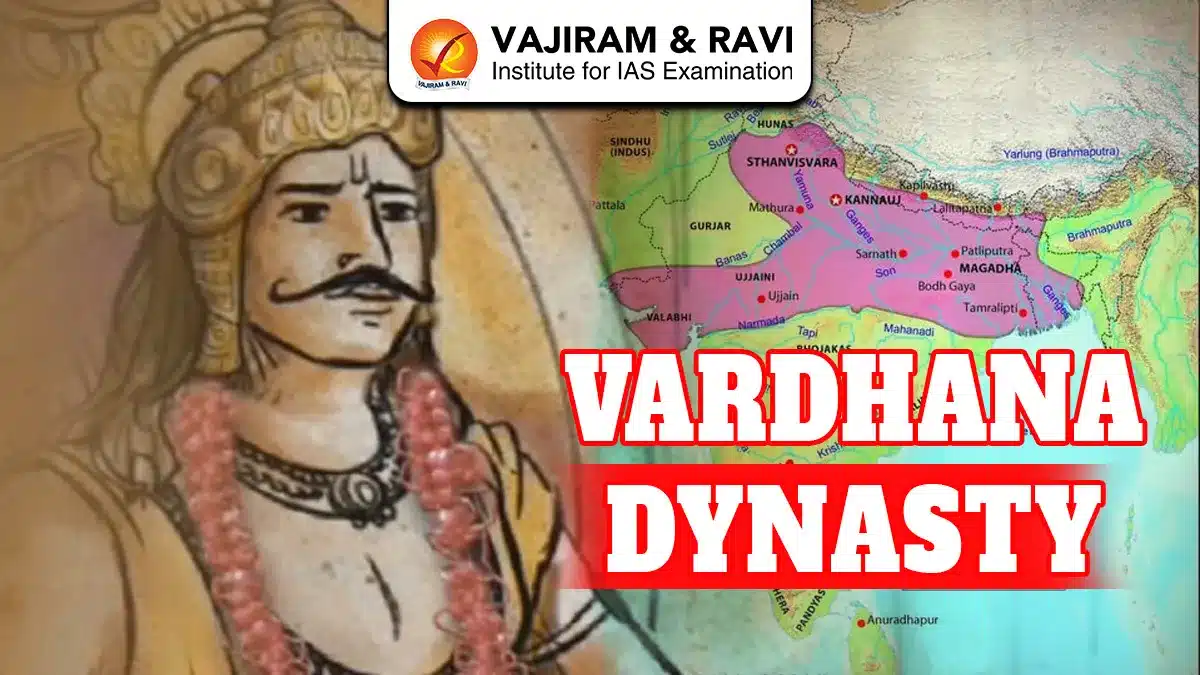
The Harshavardhana Dynasty emerged in North India after the decline of the Gupta Empire in the 6th century CE, a period marked by political fragmentation and the rise of regional powers. Former Gupta subordinates such as the Maukharis, Later Guptas, Gaudas, Maitrakas and Pushyabhutis asserted independence. Continuous warfare, weak central authority and the growing power of samantas defined this era. Amid this instability, the Pushyabhuti family of Thanesar gradually rose, laying the foundation for the Harshavardhana Dynasty that later unified much of northern India under a strong ruler.

Harshavardhana Dynasty

The Harshavardhana Dynasty is also known as the Pushyabhuti Dynasty or Vardhana Dynasty. It ruled northern India from the period around 500 to 647 CE, with its capital initially at Thanesar and later at Kannauj. The dynasty reached its greatest extent under Emperor Harshavardhana, whose empire stretched from Punjab to Bengal and from the Himalayas to the Narmada River. The dynasty is known for its political consolidation, religious tolerance and cultural patronage which played a crucial role in shaping early medieval Indian history.

Harshavardhana Dynasty Timeline

The historical period of the Harshavardhana Dynasty during the 6th - 7th centuries CE with origin, expansion and decline of empire is listed here:

  • c. 500 CE Foundation: Pushyabhuti established control over Thanesar, likely as a former Gupta subordinate asserting independence after imperial decline.
  • 500-580 CE Early Rulers: Naravardhana, Rajyavardhana I and Adityavardhana ruled as Maharajas, probably feudatories under Guptas, Hunas, or Maukharis.
  • 580-605 CE Prabhakaravardhana: Assumed title Maharajadhiraja, expanded territory, resisted Hunas and raised the dynasty to sovereign status.
  • 605-606 CE Rajyavardhana II: Avenged Maukhari alliance by defeating Malwa ruler but was treacherously killed by Gauda king Shashanka.
  • 606-647 CE Harshavardhana: Crowned emperor, unified northern India, ruled for 41 years from Kannauj, marking dynastic zenith.
  • 647 CE Decline: Harsha died without an heir, leading to fragmentation and the end of Pushyabhuti rule.

Harshavardhana Dynasty Sources

The sources of information for the Harshavardhana Dynasty include the following Literature, Inscriptions, etc. mentioned here:

  • Harshacharita: Sanskrit biography written by Banabhatta, Harshavardhana’s court poet, providing detailed information on his life, administration and military campaigns.
  • Si-Yu-Ki (Great Tang Records): Travel account of Chinese pilgrim Xuanzang describing political conditions, society, religion and economy during Harsha’s reign.
  • Aihole Inscription: Composed by Pulakesin II’s court poet Ravikirti, it mentions Harsha’s defeat on the Narmada, confirming historical events.
  • Banskhera Inscription: Land grant issued by Harshavardhana containing his genealogy, administrative titles and governance practices.
  • Madhuban Copper Plate Inscription: Provides details about land grants, officials and revenue system under Harsha’s rule.
  • Nalanda Seal: Archaeological source mentioning Harsha’s support to Nalanda University and Buddhist institutions.
  • Coins: Gold coins of Harshavardhana supply limited but useful information about economy and royal symbolism.
  • Literary Works by Harsha: Plays like Ratnavali, Nagananda and Priyadarshika reflect contemporary culture and religious ideas.
  • Other Contemporary Texts: References in Buddhist and Brahmanical literature help corroborate political and religious history.

Harshavardhana Dynasty Rulers

The Harshavardhana Dynasty included several rulers, but its true greatness emerged under Harshavardhana. The various Kings of Vardhana Dynasty are:

  • Pushyabhuti: He was the founder of the dynasty as mentioned in Harshacharita, credited with establishing the dynasty at Thanesar and initiating regional authority. The dynasty is often named after him as Pushyabhuti Dynasty.
  • Naravardhana: Early ruler who likely governed as a feudatory, maintaining dynastic continuity during post Gupta political uncertainty.
  • Rajyavardhana I: Continued consolidation of Thanesar region while remaining subordinate to stronger contemporaneous powers.
  • Adityavardhana: Strengthened alliances, married into Later Gupta family and expanded influence in north western regions.
  • Prabhakaravardhana: First independent monarch, defeated Hunas, allied with Maukharis and assumed imperial title Maharajadhiraja.
  • Rajyavardhana II: Defeated Malwa ruler Devagupta but was assassinated by Gauda king Shashanka through deceit.
  • Harshavardhana: United Thanesar and Kannauj, expanded empire, patronised Buddhism, literature and ruled as Sakalottarapathanatha. The Dynasty is often named after him as Harshavardhana Dynasty.

Harshavardhana Dynasty Administration

The administration under Harshavardhana Dynasty followed Gupta traditions but showed increasing feudal and decentralised features as highlighted below:

  • Central Authority: King held supreme legislative, executive and judicial powers, supported by Mantri Parishad of ministers and advisors.
  • Provincial Structure: Empire divided into Bhuktis, Visayas, Pathakas and Gramas, ensuring governance from provincial to village levels.
  • Officials: Kumaramatyas, Uparikas, Visayapatis and Gramikas handled civil administration at different levels.
  • Feudal Elements: Mahasamantas and Maharajas were hereditary local chiefs, indicating growing decentralisation.
  • Land Grants: Land granted to Brahmins and officials, reducing coin circulation and strengthening feudal relationships.
  • Law and Order: Weak enforcement noted by Hiuen Tsang; crimes punished harshly, though Buddhist influence softened penalties.

Harshavardhana Dynasty Economy

The economy under Harshavardhana Dynasty showed clear decline compared to the Gupta period:

  • Agriculture: Villages became self sufficient as reduced trade lowered market demand for surplus agricultural produce.
  • Trade and Commerce: Decline evident from fewer coins, weakening merchant guilds and shrinking trade centres.
  • Taxation System: Revenue derived from Bhaga land tax equal to one-sixth produce, Bali, Hiranya, customs and ferry taxes.
  • Coinage: Limited minting reflected land based revenue and grants replacing cash payments.
  • Revenue Division: Income divided into royal expenses, scholars, officials and religious endowments.
  • Craft Decline: Reduced trade weakened handicrafts, metalwork and urban manufacturing.
  • Charity System: Harsha donated wealth every five years, reinforcing the religious economy.
  • Agrarian Focus: Economy relied primarily on land revenue rather than commercial taxation.

Harshavardhana Dynasty Military

The military strength under Harshavardhana Dynasty supported territorial expansion but faced southern resistance. The key features of Military and Army during Vardhana are:

  • Army Composition: Included infantry, cavalry, elephants and camels, each with separate commanders.
  • Command Structure: Cavalry led by Brihadasvavaru; king personally supervised campaigns.
  • Northern Campaigns: Defeated Malwa ruler, subdued Gauda hostility and established dominance across North India.
  • Southern Limitation: Defeated by Chalukya ruler Pulakesin II at Narmada, fixing southern boundary permanently.
  • Diplomacy: Alliances with Bhaskaravarman of Kamarupa and Maitrakas of Valabhi strengthened imperial control.

Harshavardhana Dynasty Art and Culture

The art and culture of the Harshavardhana Dynasty continued the zenith of Gupta Empire. The major features of art are discussed here:

  • Architecture: No distinct style; followed Gupta patterns with religious stupas, monasteries and temples.
  • Sultanganj Buddha: Largest known copper Buddha statue, cast using lost wax technique, dating 500-700 CE.
  • Art Centres: Kannauj, Varanasi, Ujjain emerged as major cultural hubs.
  • Literature by Harsha: Authored Priyadarshika, Ratnavali and Nagananda, showcasing Sanskrit drama excellence.
  • Court Scholars: Banabhatta wrote Harshacharita and Kadambari; Mayurabhatta composed Suryashataka.
  • Education: Nalanda flourished under royal patronage, attracting scholars like Hiuen Tsang.

Harshavardhana Dynasty Society

The society under the rule of Harshavardhana Dynasty reflected rigid caste hierarchy with religious tolerance. The major characteristics of the society is highlighted here:

  • Varna System: Brahmins privileged through land grants; Kshatriyas ruled; Vaishyas traded; Shudras practiced agriculture.
  • Sub Castes: Numerous jatis existed, indicating social stratification intensifying during this period.
  • Women’s Status: Education existed among elites, but sati, dowry and ban on widow remarriage prevailed.
  • Untouchability: Practiced against executioners and scavengers, who lived outside villages.
  • Religion: Harsha followed tolerant policy, patronised Shaivism, Buddhism, Surya worship equally.
  • Buddhist Assemblies: Kannauj and Prayag assemblies promoted Mahayana Buddhism and royal charity.
  • Foreign Travellers: Xuanzang (Hiuen Tsang), a Chinese Buddhist monk who visited India during Harshavardhana’s reign and spent several years at his court. He came to study Buddhism, collect sacred texts and visit important Buddhist pilgrimage centres across India. His travel account Si-Yu-Ki (Great Tang Records on the Western Regions) is a major source for Harshavardhana’s period.

Harshavardhana Dynasty Decline

After the death of Harshavardhan, the Vardhana Dynasty declined rapidly. The major reason behind the fall of dynasty are considered as following:

  • No Heir: Harsha died in 647 CE without a successor, creating power vacuum.
  • Fragmentation: Feudatories like Bhaskaravarman annexed territories.
  • Kannauj’s Fate: Remained politically important, later ruled by Yashovarman.
  • End of Vardhana Rule: Ministerial takeover failed to maintain empire, ending Pushyabhuti dominance in 647 CE.

Harshavardhana Dynasty FAQs

Q1: Who founded the Harshavardhana Dynasty?

Ans: The Vardhana Dynasty was founded by Pushyabhuti in 500 CE as mentioned in the Harshacharita.

Q2: Who was the most powerful ruler of the Harshavardhana Dynasty?

Ans: Harshavardhana was the most powerful ruler who expanded the empire across northern India.

Q3: What was the capital of the Harshavardhana Dynasty?

Ans: Initially Thanesar was the Capital and later Kannauj served as the capital of the Pushyabhuti Dynasty.

Q4: Which sources provide information about the Harshavardhana Dynasty?

Ans: Harshacharita, Xuanzang’s Si-Yu-Ki, inscriptions, seals and coins are main sources.

Q5: What was the religion of Harshavardhana?

Ans: Harshavardhana followed Shaivism initially but later supported Mahayana Buddhism.

UPSC Daily Quiz 3 February 2026

UPSC Daily Quiz

[WpProQuiz 82]

UPSC Daily Quiz FAQs

Q1: What is the Daily UPSC Quiz?

Ans: The Daily UPSC Quiz is a set of practice questions based on current affairs, static subjects, and PYQs that help aspirants enhance retention and test conceptual clarity regularly.

Q2: How is the Daily Quiz useful for UPSC preparation?

Ans: Daily quizzes support learning, help in revision, improve time management, and boost accuracy for both UPSC Prelims and Mains through consistent practice.

Q3: Are the quiz questions based on the UPSC syllabus?

Ans: Yes, all questions are aligned with the UPSC Syllabus 2025, covering key areas like Polity, Economy, Environment, History, Geography, and Current Affairs.

Q4: Are solutions and explanations provided with the quiz?

Ans: Yes, each quiz includes detailed explanations and source references to enhance conceptual understanding and enable self-assessment.

Q5: Is the Daily UPSC Quiz suitable for both Prelims and Mains?

Ans: Primarily focused on Prelims (MCQ format), but it also indirectly helps in Mains by strengthening subject knowledge and factual clarity.

Bharathapuzha River, Origin, Geographical Features, Projects

Bharathapuzha River

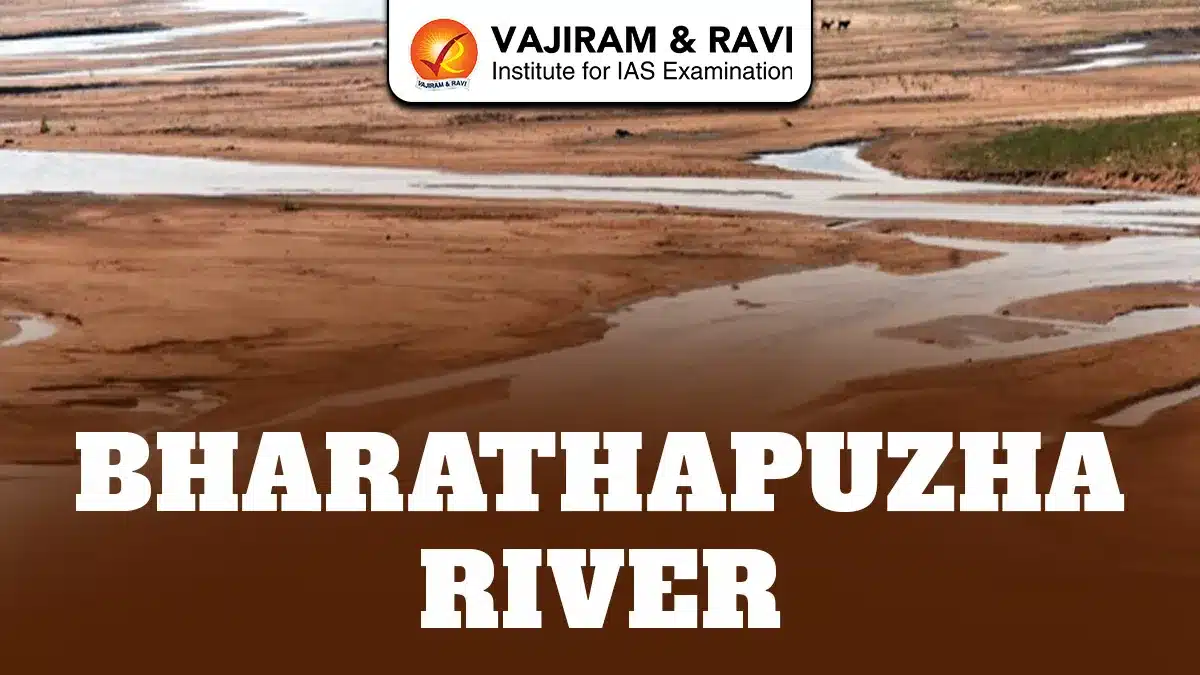
Bharathapuzha River is also known as Nila River, Ponnani River, Perar RIver and Kuttippuram River. It is the second longest river flowing through Kerala, with a total length of about 209 km. It is an important interstate river of Kerala and Tamil Nadu and flows through the Palakkad Gap, the widest break in the Western Ghats. The river supports agriculture, culture and daily life across Palakkad and Malappuram districts and parts of Thrissur, Coimbatore and Tiruppur. Its basin is spread over 6,186 sq km, making it the largest river basin in Kerala.

Bharathapuzha River Geographical Features

Bharathapuzha River originates from the Anamalai Hills in Tamil Nadu and flows westward through the Palakkad Gap before draining into the Arabian Sea at Ponnani.

  • Origin and Course: The river begins as small streams near Thirumoorthy Hills in the Anamalai range, flows northward initially, then turns west across Palakkad and Malappuram, finally meeting the Arabian Sea at the Ponnani estuary.
  • Length and Basin Area: With a length of 209 km, Bharathapuzha has a drainage basin of 6,186 sq km, of which around 4,400 sq km lies in Kerala and 1,786 sq km in Tamil Nadu.
  • Palakkad Gap Influence: The Palakkad Gap allows dry continental winds to enter Kerala, making the river basin comparatively drier, which directly reduces water availability despite the large basin size.
  • Tributaries: Important tributaries include Kannadipuzha, Kalpathipuzha, Gayathripuzha and Thuthapuzha, with Thuthapuzha significantly increasing river width and flow after joining near Pallippuram.
  • Rainfall and Climate Influence: The basin receives 2,000-2,800 mm rainfall in hilly areas and up to 3,000 mm near the coast, but high temperatures and rain shadow effects limit year round flow.

Bharathapuzha River Projects

Bharathapuzha River is one of the most heavily regulated rivers in Kerala, with multiple dams and irrigation projects built after independence.

  • Reservoirs: There are 11 reservoirs across the river system, including Malampuzha, Walayar, Mangalam, Pothundi, Meenkara, Chulliyar, Thirumoorthy, Aliyar, Upper Aliyar, Chitturpuzha regulator and Kanjirapuzha dam.
  • Malampuzha Dam: Malampuzha is the largest reservoir in the basin and plays a critical role in irrigating Palakkad district, supporting paddy cultivation in one of Kerala’s main food producing regions.
  • Irrigation Coverage: Existing irrigation projects support about 773 sq km of agricultural land, mainly for paddy, coconut and vegetable farming across Palakkad and Malappuram districts.
  • Ongoing Developments: Two additional irrigation projects under construction are expected to increase the irrigated area by around 542 sq km, strengthening water security in drought prone regions.
  • Thrithala Regulator-cum-Bridge: This project has a shutter height of 5 meters, improves drinking water storage, reduces travel distance between Thrissur and Kozhikode by 11 km and has revived summer fish populations.

Bharathapuzha River Threats

Bharathapuzha River faces severe environmental stress due to human activities, climatic changes and unsustainable resource use as highlighted below:

  • Reduced Summer Flow: Due to extensive dam construction and dry catchment areas, many stretches of the river almost dry up during summer months, affecting drinking water and agriculture.
  • Sand Mining Impact: Large scale sand mining over the past three decades removed ancient sand beds, destabilized riverbanks, lowered groundwater levels and altered the natural flow pattern of the river.
  • Vegetation Overgrowth: Loss of sand has allowed grasses and bushes to grow within the river channel, obstructing flow and increasing the risk of course alteration during monsoon floods.
  • Water Pollution: Untreated waste from hospitals, households and urban settlements has reduced water quality, making many stretches unsuitable for drinking and domestic use.
  • Climate Variability: Studies show declining annual rainfall and rising temperatures in the basin, further reducing water availability and intensifying seasonal drought conditions.

Bharathapuzha River Conservation Measures

Several conservation efforts and proposed measures aim to restore ecological balance and long term sustainability of the Bharathapuzha River:

  • Regulated Sand Mining: Experts recommend strict regulation instead of total bans, ensuring limited, monitored extraction and allocating a portion of sand mining revenue for river restoration activities.
  • Waste Management Controls: Enforcing strict waste treatment rules for hospitals, hotels and households is essential to prevent direct discharge of pollutants into the river system.
  • Riverbank Afforestation: Planting banyan, jackfruit, teak and mango trees along riverbanks can improve groundwater recharge, reduce erosion and enhance summer base flow.
  • Mangrove Development: Mangroves near estuarine stretches act as natural barriers against erosion, support fish breeding and stabilize riverbanks near the Ponnani mouth.
  • Community Initiatives: Groups like Bharathapuzha Samrakshana Samithi and Friends of Bharathapuzha, led by E. Sreedharan, work to raise awareness, promote conservation and protect the river from further degradation.

Bharathapuzha River FAQs

Q1: What is Bharathapuzha River also known as?

Ans: Bharathapuzha is also known as Nila, Ponnani River, Perar and Kuttippuram River in different regions and historical records.

Q2: What is the origin of the Bharathapuzha River?

Ans: It originates from the Anamalai Hills near Thirumoorthy in Tamil Nadu and flows westward into the Arabian Sea at Ponnani.

Q3: Why is Bharathapuzha River important to Kerala?

Ans: It is Kerala’s second longest river and supports irrigation, drinking water needs, agriculture, culture and livelihoods across multiple districts.

Q4: Which is the largest dam on Bharathapuzha River?

Ans: Malampuzha Dam is the largest reservoir built across the Bharathapuzha river system and is mainly used for irrigation.

Q5: What is the biggest threat to Bharathapuzha River?

Ans: Uncontrolled sand mining, reduced rainfall, pollution and heavy damming have severely reduced its water flow and ecological health.

Fundamental Rights of Indian Constitution, List & other Details

Fundamental Rights of Indian Constitution

Fundamental Rights are discussed in Articles 12 to 35 of the Indian Constitution, form the foundation of India's democratic structure. These Fundamental Rights ensure essential freedoms and protect individuals from arbitrary state action. There are six fundamental rights, including the Right to Life, Right to Dignity, and Right to Education, which safeguard the dignity and liberty of every citizen. Recognized as a crucial part of the Constitution, Part III of the Indian Constitution is often referred to as the "Magna Carta of India" due to its role in upholding justice, equality, and personal freedoms.

Fundamental Rights

The Fundamental Rights of Indian Constitution are applied to all individuals, ensuring equality and protection without discrimination. These rights were introduced to ensure equality, freedom, and protection for all individuals, regardless of background and preventing any misuse of power by the state. The Fundamental Rights ensures that the country is governed by laws, not by individuals, protecting citizens from arbitrary actions by the authorities.

Fundamental Rights of Indian Constitution

Initially, The Indian Constitution includes 7 Fundamental Rights. The Right to Property was originally a Fundamental Right, but was removed by the 44th Constitutional Amendment Act of 1978. It is now classified as a legal right under Article 300-A in Part XII of the Constitution.

  1. Right to Equality (Articles 14 to 18): Ensures equal treatment before the law and prohibits discrimination.
  2. Right to Freedom (Articles 19 to 22): Grants freedoms such as speech, expression, and movement while protecting individuals' rights in legal matters.
  3. Right Against Exploitation (Articles 23 to 24): Prohibits human trafficking, forced labor, and child labor.
  4. Right to Freedom of Religion (Articles 25 to 28): Guarantees the freedom to practice, profess, and propagate any religion.
  5. Cultural and Educational Rights (Articles 29 to 30): Protects the cultural and educational rights of minorities.
  6. Right to Constitutional Remedies (Articles 32 to 35): Empowers citizens to seek enforcement of Fundamental Rights through the Supreme Court and High Courts.

List of Fundamental Rights of Indian Constitution

The Fundamental Rights of India are discussed in Part III of the Constitution (Articles 12 to 35). These rights serve as essential safeguards, ensuring the protection of individuals from any unjust actions by the state.

List of Fundamental Rights of Indian Constitution
Fundamental Rights Articles

Right to equality 

(a) Article 14 - Equal protection of laws and Equality before law. 

(b) Article 15 - Prohibition of discrimination on grounds of religion, caste, sex, place of birth or race. 

(c) Article 16 - Equality of opportunity in terms of public employment. 

(d) Article 17 - Abolition of untouchability and prohibition of its practice. 

(e) Article 18 - Abolition of titles except military and academic. 

Right to freedom

(a) Article 19 - Protection of six rights regarding freedom of: 

(i) speech and expression, 

(ii) assembly, 

(iii) association, 

(iv) movement, 

(v) residence, and 

(vi) profession

(b) Article 20 - Protection in a conviction for offences. 

(c) Article 21 - Protection of life and personal liberty. 

(d)Article 21A -  Right to elementary education. 

(e) Article 22 -  Protection against arrest and detention in certain cases.

Right against exploitation 

(a) Article 23 - Prohibition of traffic in forced labour and human beings. 

(b) Article 24 - Prohibition of employment of children in Companies and factories, etc.

Right to freedom of religion 

(a) Article 25 - Freedom of conscience and free profession, practice and propagation of religion. 

(b) Article 26 - Freedom to manage religious affairs. 

(c) Article 27 - Freedom from payment of taxes for promotion of any religion or religious affairs.

(d) Article 28 - Freedom from attending religious instruction or worship in certain educational institutions 

Cultural and educational rights

(a) Article 29 - Protection of language, script and culture of minorities. 

(b) Article 30 - Rights of minorities to establish and administer educational institutions.

Right to constitutional remedies

(a) Article 32 - Right to move the Supreme Court for the enforcement of fundamental rights including the writs of 

  1. Habeas corpus,
  2. Mandamus,
  3. Prohibition,
  4. Certiorari,
  5. Quo Warranto

(b) Article 33 - Provides the Parliament with the authority to limit or abolish the fundamental rights of “Members of the Armed Forces, paramilitary forces, police forces, intelligence agencies, and analogous forces”.

(c) Article 34 - Provides for the restrictions on fundamental rights while martial law(military rule) is in force.

(d) Article 35 - Empowers the Parliament to make laws on Fundamental Rights.

Fundamental Rights in India

The Indian Constitution grants its citizens 6 Fundamental Rights, ensuring justice, equality, and freedom in various aspects of life. Below is a detailed breakdown of these rights:

Right to Equality (Articles 14–18)

Right to Equality guarantees that all individuals are treated equally under the law and enjoy equal protection. It prohibits discrimination based on religion, race, caste, sex, or place of birth. It ensures equal opportunities in public employment, abolishes untouchability, and prohibits the use of titles except for military and academic distinctions.

Right to Freedom (Articles 19–22)

Right to Freedom includes safeguards against arbitrary punishment and unlawful detention. The State is also responsible for providing free and compulsory education to children aged 6 to 14 years. These freedoms include freedom of speech and expressions, residence, movement, information, etc.

Right Against Exploitation (Articles 23–24)

Right Against Exploitation protects individuals from forced labor, human trafficking, and child labor. It strictly prohibits children under 14 years of age from working in hazardous industries, such as factories and mines.

Right to Freedom of Religion (Articles 25–28)

Every individual in India has the freedom to practice, profess, and propagate any religion of their choice. Religious groups also have the right to: Establish and manage religious institutions, Handle their religious affairs independently, Own and manage property for religious purposes and Be exempt from paying taxes specifically for religious promotion

Cultural and Educational Rights (Articles 29–30)

Cultural and Educational Rights safeguard the cultural, linguistic, and educational interests of minorities. They ensure: The right to preserve one’s language, culture, and heritage, Equal access to educational institutions without discrimination and te right of minorities to establish and administer their own educational institutions

Right to Constitutional Remedies (Articles 32–35)

Right to Constitutional Remedies is called the "Heart and Soul of the Constitution" as it empowers citizens to approach the courts if their fundamental rights are violated. Under this, the Supreme Court (Article 32) and High Courts (Article 226) can issue five types of writs to protect rights:

  1. Habeas Corpus – To prevent unlawful detention.
  2. Mandamus – To compel a public official to perform their duty.
  3. Prohibition – To stop lower courts from exceeding their jurisdiction.
  4. Certiorari – To quash an illegal order or decision of a lower court.
  5. Quo Warranto – To challenge a person’s authority in holding a public office.

Fundamental Rights Features

The major features of the fundamental rights as given in the Constitution of India are:

1. Rights Apply for Indian Citizens Only

Apart from Fundamental Rights, the Indian Constitution provides certain rights that are applicable only for Indian citizens and not for foreigners which includes the below mentioned rights. The rights that are only applicable for the citizens of India and not any alien are:

  • Article 15: Prohibition of discrimination on grounds of religion, race, caste, sex or place of birth 
  • Article 16: Equality of opportunity in matters of public employment 
  • Article 19: Protection of six rights regarding freedom of : speech and expression, assembly, association, movement, residence, and profession
  • Article 21: Protection of life and personal liberty
  • Article 30: Right of minorities to establish and administer educational institutions

2. Rights Apply for Everyone

The rights that apply to Indian Citizens as well as any foreigner aliens are listed below:

  • Article 14: Equality before the law and equal protection of laws 
  • Article 20: Protection in respect of conviction for offences 
  • Article 21: Protection of life and personal liberty 
  • Article 22: Protection against arrest and detention in certain cases 
  • Article 23: Prohibition of traffic in human beings and forced labour.
  • Article 24: Prohibition of employment of children in factories etc.
  • Article 25: Freedom of conscience and free profession, practice and propagation of religion 
  • Article 26: Freedom to manage religious affairs.
  • Article 27: Freedom from payment of taxes for promotion of any religion
  • Article 28: Freedom from attending religious instruction or worship in certain educational institutions)

Fundamental Rights of Indian Constitution FAQs

Q1: Are there 6 or 7 fundamental rights in India?

Ans: There are six fundamental rights that include right to equality, right to freedom, right against exploitation, right to freedom of religion, cultural and educational rights, and right to constitutional remedies.

Q2: What are the fundamental rights from article 14 to 32?

Ans: Right to equality (Article 14–18) Right to freedom (Article 19–22) Right against exploitation (Article 23–24) Right to freedom of religion (Article 25–28).

Q3: Who is called the father of fundamental rights?

Ans: Sardar Vallabhbhai Patel considered as the father of Fundamental rights in India.

Q4: What is the Article 14 to 18?

Ans: Right to Equality is the Article 14 to 18.

Q5: What is Article 51A G?

Ans: Article 51A (g) places a duty on the citizens of India to protect and improve the natural environment and have compassion for all living creatures.

Semi Presidential System, Origin, Features, Merits, Demerits

Semi Presidential System

The Semi Presidential System is a form of government in which executive power is shared between a directly elected President and a Prime Minister, who is responsible to the legislature. It combines elements of presidential democracy with parliamentary democracy.

Semi Presidential System Origin

The semi-presidential system was formally introduced in France in 1958 under the Fifth Republic. 

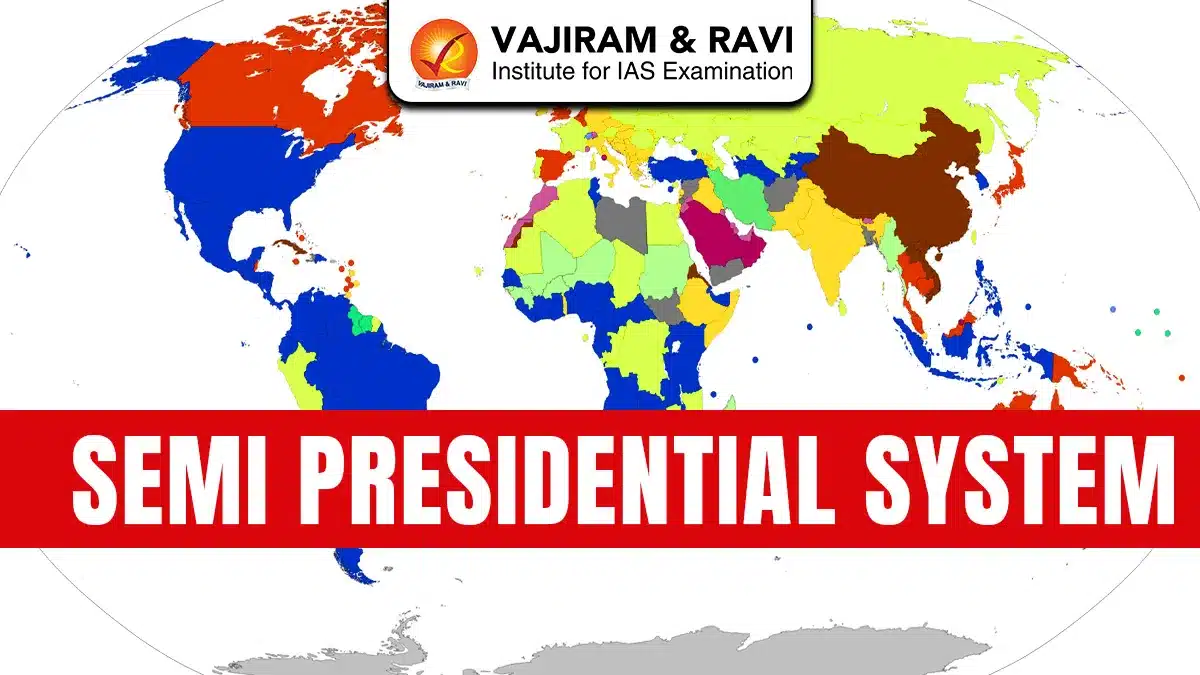
Currently, several countries in the world follow a semi-presidential system of government. Prominent examples include France, Sri Lanka, Ukraine, Portugal, Haiti, Azerbaijan, the Democratic Republic of the Congo, Mauritania, Namibia, Lithuania etc

Semi Presidential System Features

The features of Semi Presidential System include: 

  • Dual Executive: Executive Power is divided between the president and the prime minister. The President is the head of state while the Prime Minister is head of government. 
  • Directly Electled President: The President is directly elected by the people and enjoys independent democratic legitimacy.
  • Wide Presidential powers: The President possesses substantial constitutional powers, particularly in matters of defence, foreign policy, and emergencies.
  • Responsible Prime Minister: The Prime Minister and Council of Ministers are responsible to the legislature and can be removed by a vote of no-confidence.
  • Cohabitation: A situation, often in France, where the president and prime minister are from opposing political parties, which can lead to tense power-sharing or conflict.

Semi-Presidential System Merits 

  • Political Stability: The directly elected President provides political stability in case of removal of the prime minister. 
  • Prevent Concentration of Power: Sharing of executive authority between President and Prime Minister prevents concentration of power in a single office.
  • Accountable Government: Prime Minister and Council of Ministers remain responsible to the legislature, ensuring parliamentary accountability.
  • Efficient Decision-Making: The President can act decisively in emergencies, foreign policy, and defence matters.

Semi-Presidential System Demerits 

  • Ambiguity in Executive Authority: Overlapping powers of President and Prime Minister may lead to conflict and administrative confusion.
  • Risk of Authoritarianism: A dominant President may bypass parliamentary controls and concentrate power.
  • Policy Paralysis during Cohabitation: If the President and PM belong to rival parties, decision-making may be slowed or blocked.
  • Unclear Accountability: Public may be uncertain about whether the President or Prime Minister is responsible for governance failures.
  • Unsuitability for Weak Democracies: Requires strong institutions and political culture; weak states may experience instability and constitutional crises.

Different System of Government

Presidential, semi-presidential, and parliamentary systems represent three major systems of democratic governance. The differences between them are discussed below.

Basis Presidential system Semi Presidential system Parliamentary System

Nature of Executive 

Single Executive - executive power is concentrated in a single authority (President) 

Dual Executive - executive authority is shared between a directly elected President and a Prime minister. 

Dual executive - executive power is exercised by the Prime Minister and Council of Ministers while the Head of State performs a largely ceremonial role. 

Head of State & Head of Government 

The President acts as both Head of State and Head of Government . 

President is Head of State with real powers while Prime minister is Head of Government 

The President is the nominal Head of State whereas the Prime Minister is the real head of government. 

Election 

The President is directly elected 

President is directly elected while Prime Minister is appointed from the majority in legislature 

President is indirectly elected or hereditary while Prime Minister is chosen from among the members of the legislature

Executive Accountability 

Not accountable to the legislature 

President is not accountable to the legislature but Prime Minister is accountable to legislature 

The President is generally a nominal/ceremonial executive and is not directly accountable to the legislature, while the Prime Minister and Council of Ministers (the real executive) are directly accountable. The President acts on the advice of the council, and accountability to Parliament lies with the PM and CoM 

Tenure 

President enjoys a fixed tenure irrespective of legislative support

President has fixed tenure but Prime Minister’s tenure depends on parliamentary confidence 

Tenure of executive is not fixed and continues as long as it commands majority support. 

Removal 

The President can be removed only through impeachment 

The Prime Minister can be removed by non-confidence motion while the President can be removed only through impeachment 

The Prime Minister and council of ministers can be removed at any time through no-confidence motion. 

The President can be removed only through impeachment on grounds mentioned in constitution 

Examples 

United States of America, Brazil, Argentina etc 

France, Russia, Sri Lanka etc 

India, Britain, Australia, Canada etc 

Semi-Presidential System FAQs

Q1: What is a semi-presidential system of government?

Ans: A semi-presidential system of government is a form of democracy in which executive power is shared between a directly elected President and a Prime Minister who is responsible to the legislature.

Q2: Which countries currently follow a semi-presidential system?

Ans: Countries such as France, Portugal, Sri Lanka, Ukraine, Lithuania, and Timor-Leste follow a semi-presidential form of government.

Q3: How is the semi-presidential system different from the parliamentary system?

Ans: Unlike the parliamentary system, where the President or Monarch is only ceremonial, the semi-presidential system gives the President real and substantive powers alongside the Prime Minister.

Q4: How is the semi-presidential system different from the presidential system?

Ans: Unlike the presidential system, where the President alone exercises executive authority, the semi-presidential system divides executive power between the President and a Prime Minister who is accountable to Parliament.

Q5: What is meant by “cohabitation” in a semi-presidential system?

Ans: Cohabitation refers to a situation where the President and the Prime Minister belong to different political parties, leading to power-sharing and sometimes institutional conflict.

Appiko Movement, History, Background, Leaders, Objectives, Impact

Appiko Movement

Appiko means "to embrace" in Kannada, similar movement started in the Southern India in the similar way of the famous Chipko Movement in North India. In 1983, villagers from Salkani village in Uttara Kannada, Karnataka, hugged trees and refused to let them be felled. Leading this southern "hug the trees" movement was environmentalist Panduranga Hegde. Over the next months, their grassroots campaign protected crucial parts of the Western Ghats, reversed deforestation policies, and promoted a broader ecological awakening.

Appiko Movement

The Appiko Movement took place in 1983, when men, women, and children gathered to prevent loggers from cutting trees in the Kalase forest near Salkani in the state of Karnataka. It was a peaceful, culturally rooted protest. This movement succeeded in protecting tree felling through nonviolent, direct action and community resolve. The Movement was initiated by Panduranga Hegde, a local environmentalist trained in Delhi and inspired by the Chipko Movement. On 8 September 1983, hundreds from Sirsi Taluk marched 8 km into Kalase forest and began surrounding trees to stop the loggers from cutting them. The practice of hugging trees took on a uniquely Kannada life as Appiko Chaluvali. This movement was the response to the destruction of forests which reduced the forested area from 81% in 1950 to 25% in 1980.

Appiko Movement Historical Background

The Historical Timeline and Evolution of the Appiko Movement is detailed below:

  • 1950: the forests of Uttara Kannada covered over 81% of its land. Over the decades, this rich forest was cleared to make way for pulp and paper mills, plywood factories, and hydropower projects, industries that removed both trees and livelihoods.
  • 1980: less than 25% of original natural forests remained. Farmers suffered too: spice cultivation depended on leaf manure, dam projects displaced local communities, and bamboo were disappearing.
  • September 1980: People recognized the link between environmental degradation and poverty. Development has become similar to exploitation which resulted in villagers initiating a Chipko-style resistance, demanding a stop to green‑tree felling.
  • Till 1985: The movement gained a great achievement by plantation of about 1.2 million Saplings in the Sirsi Region.

Appiko Movement Leaders

The major leaders involved in the initiation and organization of the Appiko Movement were Panduranga Hegde and Sundarlal Bahuguna:

  • Panduranga Hegde: He was the movement leader and environmentalist whose leadership, research, and mobilizing skills brought clarity, discipline, and direction.
  • Sunderlal Bahuguna: He was a Chipko Movement veteran who visited Karnataka in 1979, supported Appiko's philosophy and helped it gain national momentum. His partnership with Hegde led to a 1989 ban on green felling in Western Ghats forests.

Appiko Movement Objectives

The major objectives and aim of the Appiko Movement were as highlighted below:

  • Built around the incentives to Ulisu, Belasu, Balasu ("Save, Grow, Use rationally")
  • Protecting existing forest cover
  • Promoting natural regeneration of indigenous species
  • Ensuring sustainable use of non-timber forest resources such as bamboo and medicinal plants.
  • Through cultural performances, educational slideshows, marches, street theatre in forests and villages.
  • Planting fast-yielding native saplings of the "Five F's": Fruit, Fodder, Fuelwood, Fertilizer (leaf litter), Fiber.

Appiko Movement Methods

The Appiko Movement involves a range of innovative, community driven methods and Strategies to protect forests and promote environmental awareness.  The following table highlights key Appiko Movement Methods and Strategies and their descriptions that was impactful and unique in India’s environmental history.

  • Tree-Hugging: Nonviolent resistance by forming human chains around trees marked for felling
  • Padayatras & Cultural Outreach: Awareness through village walks, street plays, folk performances, and festivals to connect with locals
  • Educational Campaigns: Use of slideshows and exhibits in forest interiors to explain ecological importance scientifically
  • Tree-Growing Schemes: Community-led afforestation, e.g., 1.2 million saplings planted in Sirsi (1984-85)
  • Policy Engagement: Hegde's collaboration with forest departments and DFID led to Karnataka’s green-felling ban in 1990.

Appiko Movement Impact

The results and achievements of the Appiko Movement as seen later years of 1990s are highlighted below:

  • Karnataka responded in 1990 with a ban on green‑tree cutting in its evergreen forests which was a win for Appiko.
  • The emphasis on traditional sapling planting fruitful, fodder-yielding, fiber-producing reconnected livelihoods with conservation.
  • Saving bamboo, medicinal species, and forest fruits secured jobs and incomes for local artisans and farmers.
  • Appiko sparked campaigns in Karnataka, Goa, Eastern Tamil Nadu, and also inspired similar movements elsewhere, reinforcing the power of decentralized people's movements.
  • It helped communities reclaim rights over forest resources, prompted forest policy reforms, and shaped national discourse on sustainable development.
Related Articles
Silent Valley Movement Chipko Movement
Bishnoi Movement Human Environment Interaction


Appiko Movement FAQs

Q1: How did Appiko differ from Chipko?

Ans: Chipko began in the Himalayas in 1973; Appiko followed in 1983 in Southern India. Though both used tree-hugging, Appiko added cultural outreach and community-based regeneration reflecting the Western Ghats context.

Q2: Who was Panduranga Hegde?

Ans: A chartered accountant-turned-activist, trained in Delhi and Gandhian philosophy. Hegde pioneered Appiko, collaborated with Bahuguna, and influenced forest conservation policy at multiple levels.

Q3: What does “Ulisu, Belasu, Balasu” mean?

Ans: A Kannada slogan meaning “Save, Grow, Use Rationally” that guided Appiko’s approach to forest conservation and livelihoods.

Q4: Why was bamboo significant?

Ans: Bamboo was a staple resource for local crafts, construction, and income. Its decline threatened local economies and cultural practices.

Q5: What was the long-term result of Appiko?

Ans: Beyond the 1990 felling ban, Appiko helped institutionalize community engagement in forestry and inspired policy and legal frameworks that granted villages a stake in forest management.

Residual Mountains, Formation, Characteristics, Examples in India

Residual Mountains

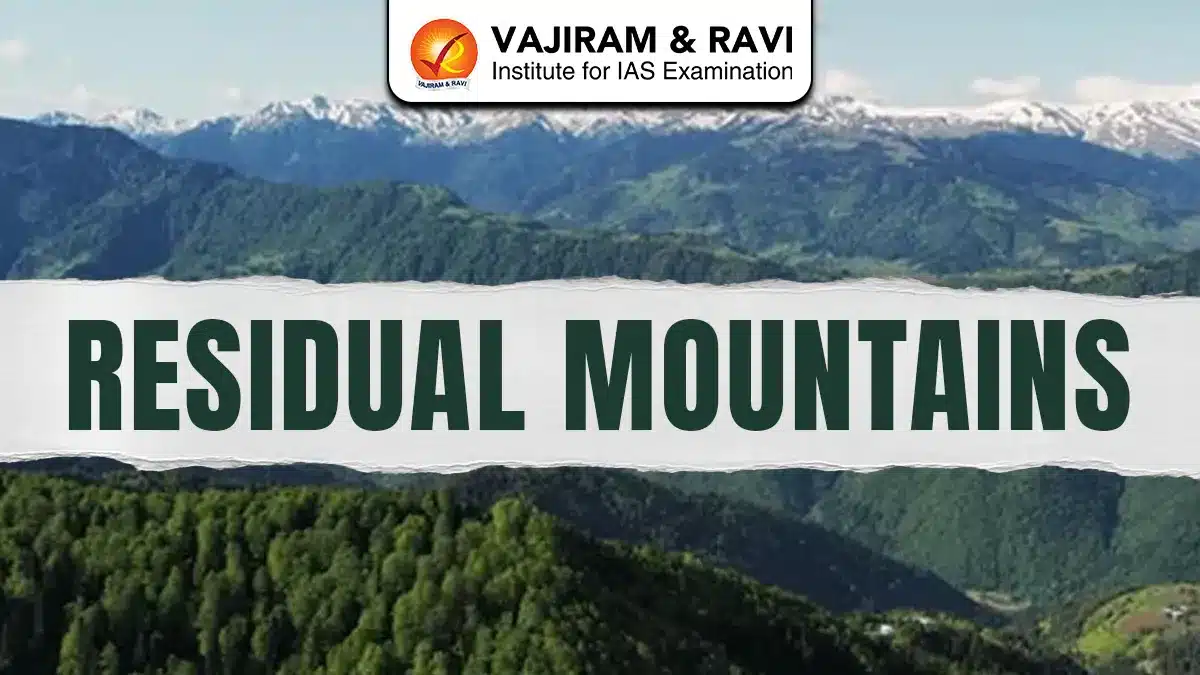
Residual mountains are ancient landforms formed by the continuous erosion of old mountain ranges or plateaus over millions of years. They are created when weathering and denudation remove softer rocks, leaving behind hard and resistant rock structures. These mountains usually have rounded peaks, lower heights, and appear as isolated hills or small ranges. Examples include the Aravalli Range in India and the Ural Mountains, Scottish Highlands, and Scandinavian Highlands in the world.

Residual Mountains Formation

Residual Mountains also known as Circum-erosional or Relict mountains are formed through the long-term process of erosion and denudation, where external natural forces gradually wear down ancient mountain ranges or plateaus. Over time, softer rocks are removed, leaving behind hard and resistant rock structures as residual mountains.

  • Origin from Ancient Mountain Ranges or Plateaus: Residual mountains were originally part of large fold mountains or elevated plateau regions formed by tectonic forces millions of years ago.
  • Weathering of Rocks: Physical, chemical, and biological weathering processes break down rocks into smaller particles, weakening the mountain structure.
  • Erosion by External Agents: Natural agents such as rivers, wind, glaciers, and rainfall remove weathered rock materials layer by layer, reducing the mountain’s height.
  • Denudation Process: Continuous removal of surface material through erosion, transportation, and deposition gradually reshapes mountains into smaller remnants.
  • River Dissection of Plateaus: Rivers cut deep valleys and separate plateau regions into hills and ridges, which later appear as residual mountains.
  • Survival of Hard Rocks: Hard and erosion-resistant rocks like granite and quartzite remain intact after softer rocks are removed, forming the core structure of residual mountains.
  • Gradual Reduction in Height and Size: Over long geological periods, erosion lowers the elevation and changes the rugged mountain terrain into smoother, rounded landforms.

Residual Mountains Characteristics

Residual mountains are ancient landforms formed after long periods of erosion and denudation that wear down older mountain ranges or plateaus. The key characteristics of the residual mountains are:

  • Ancient Geological Formation: Residual mountains are among the oldest mountain landforms on Earth. They represent the remaining parts of once massive mountain ranges that have been reduced in height due to continuous erosion over millions of years.
  • Rounded Peaks and Gentle Slopes: Due to prolonged weathering and erosion, residual mountains generally have smooth, rounded summits and less rugged terrain compared to young fold mountains like the Himalayas.
  • Lower Elevation: These mountains usually have moderate or low heights because erosion gradually removes upper rock layers, reducing their overall size and elevation.
  • Composed of Hard and Resistant Rocks: Residual mountains mainly consist of strong rocks such as granite, quartzite, and basalt, which resist erosion and remain standing after softer rocks are removed.
  • Isolated or Fragmented Appearance: Many residual mountains appear as scattered hills or small mountain ranges surrounded by plains or plateaus, giving them a distinct landscape presence.
  • Thin Soil Cover and Sparse Vegetation: Continuous erosion removes fertile topsoil, leaving rocky surfaces where vegetation is often limited.
  • Evidence of Long-Term Erosion Processes: Residual mountains serve as geological records showing the impact of weathering, river erosion, wind action, and glacial activity over long time periods.

Residual Mountains in India

India contains several prominent residual mountain ranges that provide evidence of ancient geological activity and erosion.

  1. Aravalli Range

The Aravalli Range is one of the oldest mountain systems in the world, stretching from Gujarat to Delhi. It represents the eroded remains of ancient fold mountains and contains important mineral deposits such as copper and zinc.

  1. Parasnath Hills (Jharkhand)

Parasnath Hill is the highest peak in Jharkhand and is considered a residual mountain formed through long-term erosion. It is also a significant religious site for Jain pilgrims.

  1. Nallamala Hills (Andhra Pradesh and Telangana)

These hills are part of the Eastern Ghats and are formed through plateau dissection by river erosion. They consist mainly of ancient sedimentary rocks.

  1. Mahendragiri Hills (Odisha)

Mahendragiri is a residual mountain within the Eastern Ghats and is known for its geological and religious importance.

  1. Javadi, Veliconda, and Palkonda Hills

These hill ranges in southern India are remnants of ancient plateau regions dissected by rivers and erosion processes.

Residual Mountains in the World

Residual Mountains are found across different continents, showcasing the universal impact of erosion on Earth’s surface.

  1. Ural Mountains (Russia)

The Ural Mountains are among the oldest mountain ranges and form a natural boundary between Europe and Asia. They are heavily eroded remnants of ancient fold mountains.

  1. Highlands of Scotland

The Scottish Highlands represent a classic example of residual mountains formed through long-term glacial and river erosion.

  1. Scandinavian Highlands

Located in Northern Europe, these highlands are remnants of ancient geological structures shaped by glaciation and erosion.

  1. Sierras de Europa (Spain)

This mountain range is formed from the erosion of older mountain systems and contains limestone formations shaped by weathering.

  1. Mesas and Buttes (United States)

Mesas and buttes are flat-topped elevated landforms created when plateau surfaces are eroded by rivers and wind, leaving isolated residual hills.

UPSC CSE PYQs

Question: Which of the following mountains is considered a residual mountain? [2018]

  1. A) Andes
  2. B) Ural Mountains
  3. C) Himalayas
  4. D) Alps

Answer: (B)

Residual Mountains FAQs

Q1: What are Residual Mountains?

Ans: Residual mountains are old landforms formed by the erosion and denudation of ancient mountain ranges or plateaus, leaving behind resistant rock structures.

Q2: Why are Residual Mountains called Relict Mountains?

Ans: They are called relict mountains because they are the remaining parts or remnants of previously existing high mountain systems.

Q3: How are Residual Mountains formed?

Ans: Residual mountains are formed when external forces like wind, rivers, glaciers, and rainfall gradually erode softer rock layers and leave behind harder rocks.

Q4: Name some examples of Residual Mountains in India.

Ans: Major examples include the Aravalli Range, Parasnath Hills, Nallamala Hills, Mahendragiri Hills, and Javadi Hills.

Q5: Which are the major Residual Mountains in the world?

Ans: Examples include the Ural Mountains in Russia, Scottish Highlands, Scandinavian Highlands, and Sierras de Europa in Spain.

Tamraparni River, Origin, Drainage, Features, History, Biodiversity

Tamraparni River

The Tamraparni River is also known as Thamirabarani River or Porunai River. It is a rare perennial river of southern India flowing entirely within Tamil Nadu. It originates from the Agastyarkoodam peak of the Pothigai hills in the Western Ghats at about 1,725 metres. The river travels nearly 128 kilometres before draining into the Gulf of Mannar. It flows initially northward and later turns eastward, passing through Tirunelveli and Thoothukudi districts. It is fed by both southwest and northeast monsoons. It sustains agriculture, biodiversity, settlements and cultural traditions, making it ecologically, historically and economically vital.

Tamraparni River Geographical Features

The Tamraparni River displays unique geographical characteristics influenced by the Western Ghats, monsoonal rainfall and an extensive tributary network:

    • Origin and Elevation: The river rises at Agastyarkoodam peak in the Pothigai hills at around 1,725 metres above sea level, ensuring continuous flow throughout the year due to heavy monsoonal rainfall in the Western Ghats region.
    • Length and Course Direction: From source to sea, the river covers about 128 kilometres, making it the shortest perennial river in Tamil Nadu, initially flowing northwards and later turning eastwards across plains.
    • Tributary System: Major tributaries include Servalar, Manimuthar, Gadananathi, Pachaiyar, Chittar, Ramanathi and Koraiyar, all originating from forested Western Ghats regions and strengthening perennial discharge.
    • Waterfalls and Reservoirs: The river forms Paanatheertham waterfalls of about 40 metres near Karaiyar reservoir and Kalyanatheertham and Agasthiar falls near Papanasam, highlighting sharp elevation drops.
    • Drainage Basin: Along with its tributaries, the river drains an area of nearly 4,400 square kilometres, with most catchment zones lying within the Western Ghats, making it flood prone during intense northeast monsoon rainfall.
    • Flood Characteristics: Major floods occurred in 1992, 2015 and December 2023, when discharge peaked around 4.5 lakh cubic feet per second, severely affecting Tirunelveli, Palayamkottai, Eral and Athur regions.

Tamraparni River Historical Background

The Tamraparni River has deep historical, literary and cultural significance, reflected in ancient texts, trade links and long standing human settlements as discussed below:

  • Ancient Names: Historically known as Tan Porunai, Tamira Porunai and Tamraparni, the name is derived from “Thamiram” meaning copper-red and “parani” meaning leaf, symbolising red foliage.
  • Sangam Literature: The river is celebrated in Sangam Era Tamil works like Purananuru, indicating its importance in early Tamil society, agriculture, trade routes and ritual practices.
  • Epics and Puranas: Sanskrit texts such as the Mahabharata, Ramayana and various Puranas describe Tamraparni as a sacred river where sages performed penance seeking spiritual liberation.
  • Pandyan Kingdom: During the Early Pandyan period, the river basin supported pearl fisheries, conch harvesting, agriculture and maritime trade linking southern India with Sri Lanka.
  • Sri Lankan Connection: The name Tamraparni influenced ancient names of Sri Lanka such as Tambapanni and Taprobane, reflecting migration, trade and cultural exchange across the Palk Strait.
  • Archaeological Evidence: A 2021 report by Beta Analytic Testing Laboratory suggested continuous human civilisation along the riverbanks for nearly 3,200 years, indicating early river based settlements.

Read about: Mechi River

Tamraparni River Projects

Several irrigation, hydropower and ecological restoration projects have shaped the Tamraparni River’s role in regional development and environmental management as highlighted below:

  • Papanasam Hydroelectric Project: The Papanasam lower reservoir supports hydroelectric generation, utilising steep gradients near the Western Ghats while regulating downstream water flow for irrigation.
  • Major Dams and Anicuts: Key structures include Karaiyar Dam, Manimuthar Dam, Gadananathi Dam and Ramanathi Dam, supporting irrigation across thousands of hectares in Tirunelveli district.
  • Irrigation Network: Seven major ancient anicuts like Kannadian, Ariyanayagipuram, Marudur and Suthamalli divert river water through channels irrigating over 20,000 hectares of wet and dry lands.
  • British Era Engineering: The Srivaikundam Anicut, completed in 1869, remains one of the most important hydraulic structures, distributing water through North and South Main Channels.
  • TamiraSES Project: The Tirunelveli district administration and ATREE launched the TamiraSES project to restore social-ecological systems from headwaters to estuary using hyper-local conservation strategies.
  • Water Management Challenges: Despite projects, issues like illegal sand mining, industrial effluent discharge, sewage inflow and encroachments threaten water quality and long term sustainability.

Tamraparni River Biodiversity

The Tamraparni River supports exceptional biodiversity due to perennial flow, forested catchments and connection with the Gulf of Mannar ecosystem. The major flora and fauna found in the River Ecosystem has been mentioned here:

  • Aquatic Biodiversity Richness: The river is considered among the most fish rich rivers globally, with estimates of nearly 669 fish species supported by year round freshwater availability.
  • Snakehead Fish Diversity: More than 17 species of native snakehead fishes, including Channa marulius, Channa striata and Channa diplogramma, dominate the river as top level predators.
  • Catfish and Invasive Species: Around 13 catfish species occur, while invasive African catfish, first recorded in 2009, pose ecological risks to native fish populations.
  • Eels and Carp Species: Nearly 90 eel species including Indian mottled eel (Anguilla bengalensis) and carp species like silver, grass and common carp form significant biomass.
  • Terrestrial and Riparian Fauna: The river basin supports Nilgiri marten, slender loris, lion tailed macaque, great hornbill, Sri Lankan Atlas moth and endemic amphibians.
  • Ecological Link to Gulf of Mannar: The river’s estuary near Punnaikayal nourishes mangroves, coastal fisheries and coral associated marine life, strengthening regional ecological connectivity.

Tamraparni River FAQs

Q1: Why is the Tamraparni River unique in Tamil Nadu?

Ans: It is the only perennial river in Tamil Nadu, flowing throughout the year due to Western Ghats catchment and dual monsoons.

Q2: Where does the Tamraparni River originate?

Ans: It originates from the Agastyarkoodam peak of the Pothigai hills in the Western Ghats at about 1,725 metres elevation.

Q3: Which districts does the Tamraparni River flow through?

Ans: The river flows through Tirunelveli and Thoothukudi districts before draining into the Gulf of Mannar.

Q4: Which sea does the Tamraparni River drain into?

Ans: The river drains into the Gulf of Mannar, part of the Bay of Bengal, near Punnaikayal in Thoothukudi district.

Q5: Why is the Tamraparni River ecologically important?

Ans: It supports rich biodiversity with hundreds of fish species, forest wildlife and sustains coastal ecosystems of the Gulf of Mannar.

Operation Gibraltar, Reasons, Strategy, Failure, Outcome

Operation Gibraltar

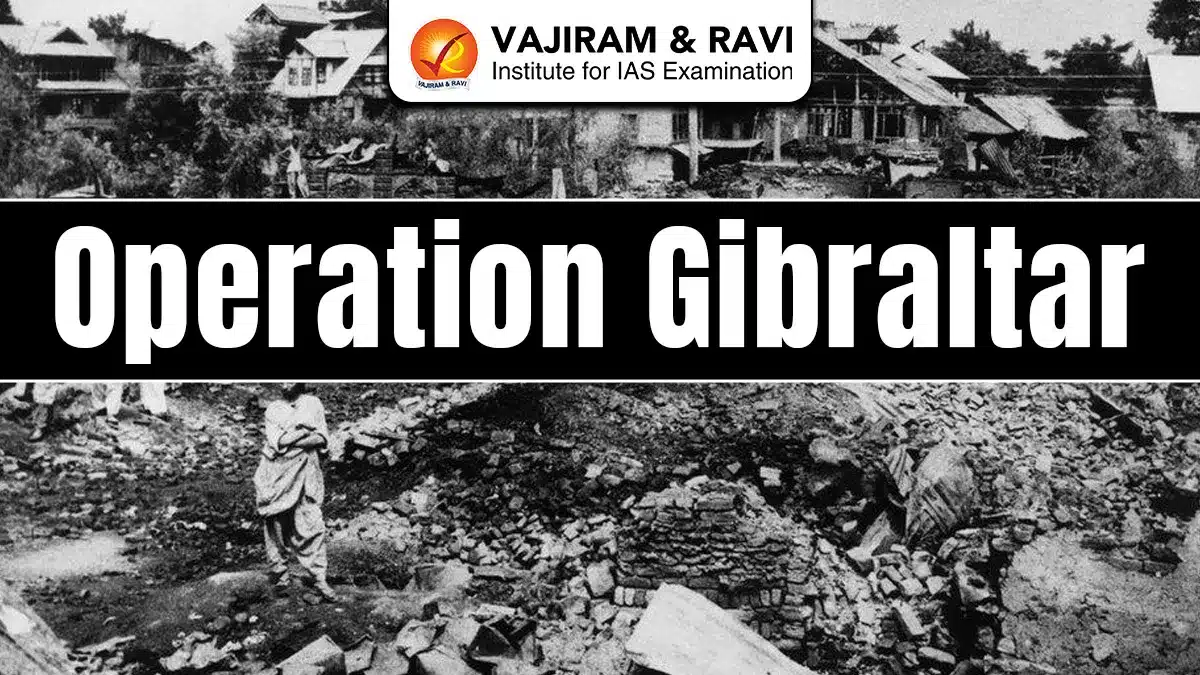
Operation Gibraltar was a covert military operation launched by Pakistan in 1965 to incite a mass rebellion among Kashmiri Muslims and weaken India’s control over the region.

The operation was named Operation Gibraltar to motivate its soldiers, by symbolising it with the Muslim conquest of Spain in 711 AD, when a small Muslim force crossed Gibraltar and successfully took control of large parts of Spain

Reasons for Operation Gibraltar 

  • Operation Gibraltar was based on Pakistan’s belief that India was militarily and politically weakened after the 1962 Sino-Indian War and would be unable to respond effectively to a limited infiltration.
  • Pakistan assumed that discontent among the Kashmiri population would translate into mass support for infiltrators, leading to a spontaneous rebellion against Indian administration.
  • A limited covert operation could internationalise the Kashmir issue without triggering a full-scale war.

Operation Gibraltar Strategy 

Under Operation Gibraltar, Pakistani soldiers infiltrated into Kashmir disguised as locals. The infiltrators were organised into groups with code names such as Salahuddin, Ghaznavi, Tariq, Babur and Khalid, each assigned to operate in specific regions of Kashmir. Their tasks included sabotage of bridges and communication networks, attacks on Indian military installations, spreading propaganda, and provoking unrest among the local population.

Operation Gibraltar Outcome 

  • Operation Gibraltar failed as local Kashmiris did not revolt and instead informed the Army and the police about the presence of Pakistani infiltrators.
  • Indian security forces detected the infiltration at an early stage, captured or eliminated a large number of infiltrators, and quickly regained control over affected areas. In response to the infiltration, India launched military counter-operations across the Line of Control, expanding the conflict beyond Kashmir.
  • Pakistan escalated the situation by launching Operation Grand Slam in the Akhnoor sector, which further intensified hostilities.
  • These developments resulted in the outbreak of the full-scale Indo-Pak War of 1965, involving large-scale conventional military engagement on both eastern and western fronts.

The war ended with a ceasefire mediated by the Soviet Union and formalised through the Tashkent Agreement in January 1966, restoring the pre-war territorial status quo.

Operation Gibraltar FAQs

Q1: What was Operation Gibraltar?

Ans: Operation Gibraltar was a secret military operation launched by Pakistan in 1965 to destabilise Indian control over Jammu and Kashmir by encouraging an internal revolt.

Q2: What was the main objective of the operation?

Ans: The primary objective was to infiltrate armed personnel into Kashmir, provoke popular unrest, and internationalise the Kashmir issue without triggering a full-scale war.

Q3: Why was it named Operation Gibraltar?

Ans: It was named after the 711 AD Muslim conquest of Gibraltar to symbolise the belief that a small, covert force could trigger a large-scale political and military change in Kashmir.

Q4: What was the outcome of Operation Gibraltar?

Ans: The operation failed as no mass uprising occurred, infiltrators were detected by Indian forces, and the situation escalated into the Indo-Pak War of 1965.

Q5: What is the Tashkent Agreement?

Ans: The Tashkent Agreement (1966) was a peace agreement signed by India and Pakistan after the 1965 war, under Soviet mediation, in which both sides agreed to withdraw troops and restore pre-war positions.

Durgadi Fort, About, History, Key Facts, Features, Disputes

Durgadi Fort

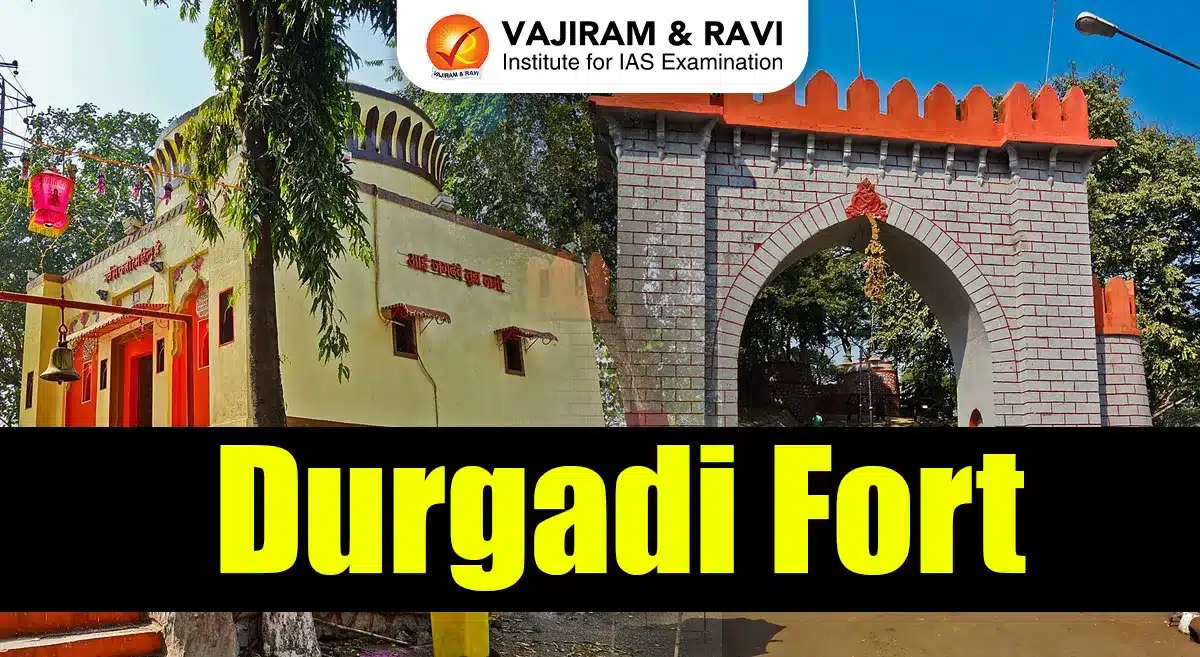
Durgadi Fort is a significant historic fort located in Kalyan region of Maharashtra, on the banks of the Ulhas River. It was built during the 16th century, under Adil Shah and later it was controlled by Chhatrapati Shivaji Maharaj. The fort played a crucial role in Medieval India trade and economic activities due to its strategic coastal location.

Durgadi Fort Facts

  • Durgadi Fort is located in the Kalyan region, Maharashtra on the bank of Ulhas river.
  • It was constructed in the 16th century by Adil Shah (Sultanate of Bijapur) and was later modified by Marathas.
  • The fort is spread over an area of 70 acres.
  • It was a mosque for the Eid Prayer for the Muslim community.
  • When the Marathas captured Kalyan they renamed the fort as Durgadi Killa (fort) and built a wooden temple dedicated to Durgadevi, near the already existing mosque.
  • In 1818 when the Britishers took control, the fort became less significant as a place of worship and by 1876 the idol of the goddess was also stolen.

Durgadi Fort Historical Background

  • Under Adil Shah Period
    • Durgadi Fort was constructed in the 16th century under Adil Shah, Sultanate of Bijapur.
    • The position of the fort was strategic as it was acting as trading point thus protecting Kalyan commercial and economic interests and was also used to protect Kalyan from the rivals.
    • The fort contributed to Adil Shah’s economy as it was used to collect revenues from the river-borne trade.
    • Its location made it a key defensive and administrative post in the northern Konkan region.
  • Under Maratha Period
    • Kalyan was captured by Maratha ruler Chhatrapati Shivaji Maharaj in 1760 as part of his expedition to capture Konkan region and its trading points.
    • They constructed a wooden temple, dedicated to Durgadevi (goddess Durga).
    • Under the Marathas, the fort became an important military outpost to keep an eye on the enemy's movement.
    • It supported their naval and commercial networks.
    • The fort also witnessed the conflict between the Marathas and the Britishers.
    • In 1818, after the third Anglo-Maratha war, the control of the fort was passed to the British after which it lost its significance.
  • Under British Rule
    • The fort lost its strategic and military significance under British rule.
    • The temple which was constructed during the marathas, lost its prominence and later  ceased to function.
    • In 1876, the idol of goddess Durgadevi was stolen, marking the decline of cultural and religious significance.
    • The Britishers paid more attention to the development of Bombay, thus reducing Kalyan’s strategic value.
    • Over time the fort became a historical monument.

Read about: Daulatabad Fort

Durgadi Fort Features

  • Durgadi Fort was built on an elevated ground on the bank of the Ulhas river and covering an area of 70 acres.
  • It includes a stone Idgah (prayer wall), mosque, and round stone-cut well.
  • Marathas build a wooden temple within the fort.
  • Surrounded by strong defensive walls suitable for land and river protection.
  • Simple and functional layout, focused on military needs rather than decoration.

Durgadi Fort Significance

  • Medieval Indian History: The fort gives a glimpse about the military strategies of the Medieval rulers, the fort's role in the regional defences and its impact on the military landscape.
  • Geographical Significance: It has served as a strategic trade port in the medieval period, as it was located on the bank of Ulhas River, contributing to economic growth and is essential to understand the military geography of medieval India.
  • Cultural Significance: The fort reflects the architectural contributions by Adil Shah and the temple reflects the cultural contributions by the Marathas. Thus, the fort has both a mosque and was later modified to include a temple. Its been a site of communal tensions, reflecting a complex balance between historical heritage and religious identity.

Durgadevi Fort Disputes

  • Communal Tensions (1960s):
    The dispute began in the mid-1960s, when some local Kokni Muslims declared the use of the long-standing fort for Eid prayers and claimed possession of the land. Hindu groups did not accept their claims and demanded equal worship rights.
  • State Intervention and Ownership Claim (1966):
    The Maharashtra government after realizing the communal seriousness, declared itself as the legal owner of the fort land and suggested transferring some part of it to the Kalyan Municipal Council for public use. Following protests, the order was withdrawn, and a status-quo arrangement was introduced.
  • Regulated Religious Use:
    The government refused to recognise both Hindu nor Muslim ownership claims. Muslims were allowed to offer Eid prayers twice a year at the eidgah walls and adjoining open ground, under the administrative supervision.
  • Escalation of Religious Claims (Late 1960s):
    In 1968, tensions intensified when some Hindu groups claimed that the structure was a Durga temple and began Navratri celebrations within the fort. This period marked a shift from administrative dispute to religious controversy.
  • Legal Battle (1970s Onwards):
    In 1974, the Maharashtra government again transferred the land to the Kalyan Municipal Corporation. This order was legally challenged by the Muslim trust in 1976, initiating a prolonged court dispute.
  • Politicisation of the Issue:
    Over the decades, the fort became a focal point for local political mobilisation, with religious rituals and symbolic acts used to assert their claims.
  • Judicial Verdict:
    After nearly five decades, a Kalyan Civil Court ruled in favor of the Maharashtra government’s ownership of the land, rejecting the Muslim trust’s claim on the grounds of limitation under the Limitation Act.

Current Status:
While the verdict confirmed state ownership, the Muslim side has decided to appeal, keeping the dispute legally and politically relevant.

Durgadi Fort FAQs

Q1: Where is Durgadi Fort located?

Ans: Durgadi Fort is located in Kalyan region of Maharashtra, on the bank of Ulhas river.

Q2: Who built the Durgadi Fort?

Ans: The Durgadi Fort was built by Adil Shah, the Sultanate of Bijapur in the 16th century.

Q3: When did Marathas capture Durgadi Fort?

Ans: The Marathas captured the Kalyan in 1760 , then the fort was also seized and a wooden temple was constructed.

Q4: What happened to the fort under British rule?

Ans: The fort was captured by British in 1818 after the third Anglo-Maratha war and the fort lost its significance.

Q5: Why was Durgadi Fort strategically significant?

Ans: The Durgadi Fort is located on the bank of Ulhas river, thus serving as a strategic focal point for trade, revenue collection and defense.

Mechi River, Origin, Geographical Features, Kosi-Mechi River Link Project

Mechi River

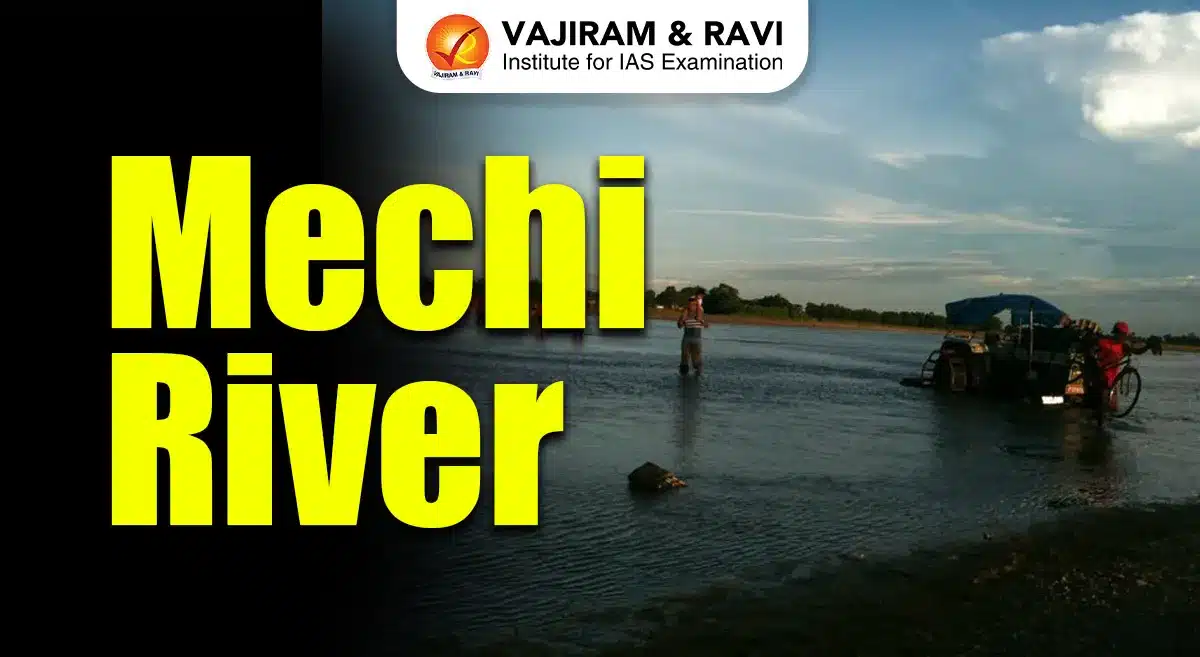
The Mechi River is a trans-boundary perennial river flowing through Nepal and India that forms an important part of the eastern Himalayan river system. It originates in the Mahabharat Range of Nepal and travels southwards. It briefly marks the India-Nepal international boundary before entering Bihar and finally joining the Mahananda River in Kishanganj district. As a tributary of the Mahananda, the Mechi plays a critical role in regional hydrology, agriculture and flood dynamics. It lies within the larger Mahananda River System, which drains high rainfall sub-Himalayan regions and frequently experiences monsoon induced flooding.

Read about: Kushiyara River

Mechi River Geographical Features

The Mechi River originates in the Mahabharat Lekh of Nepal and flows through varied terrain before merging with the Mahananda River in Bihar.

  • Source and Origin: The Mechi rises in the Mahabharat Range, an inner Himalayan belt in Nepal, making it a perennial river sustained by monsoon rainfall and hill catchments throughout the year.
  • Course and Flow Path: After originating, it flows through eastern Nepal and the Darjeeling district of West Bengal before joining the Mahananda River in the Kishanganj district of Bihar, India.
  • Trans-boundary Nature: The river flows through both Nepal and India, requiring bilateral coordination for embankments, flood control and water management, especially in border areas.
  • River System: Mechi is a tributary of the Mahananda River, which ultimately drains into the Ganga, connecting it to the larger Ganga-Brahmaputra-Meghna basin.
  • Catchment Area: The Mahananda river system, including Mechi, covers about 8,088 square kilometres in Nepal and 11,520 square kilometres in India, reflecting its extensive hydrological influence.
  • Interfluve Characteristics: The Mechi-Mahananda interfluve represents a transition zone between hills and plains, showing sharp elevation changes and diverse landforms.
  • Braided Channel Nature: Rivers emerging from the hills, including the Mechi, often develop braided channels due to heavy sediment load and variable discharge during monsoon months.
  • Alluvial Fan Formation: The Mechi contributes to well developed alluvial fans in the plains, depositing fertile sediments that support agriculture but also increase flood vulnerability.
  • Flood Prone Behaviour: During peak monsoon, high rainfall in sub-Himalayan regions causes the Mechi and Mahananda to swell, leading to waterlogging and inundation in low lying areas.
  • Embankment Infrastructure: Embankments exist along about 14 kilometres of the left bank in West Bengal, though they require remodelling to reduce flood risks in Naxalbari and nearby areas.
  • Border Sensitivity: Since the river marks an international boundary, embankment alignment must maintain equal top levels on both sides, as agreed by the Nepal-India Joint Standing Technical Committee.
  • Role in Local Livelihoods: Communities along the Mechi depend on its waters for irrigation and farming, but frequent flooding and erosion often damage crops and settlements.

Read about: Potomac River

Kosi-Mechi River Link Project

The Kosi-Mechi River Link Project aims to transfer surplus water from the Kosi River to the Mechi for irrigation and regional water management.

Background

  • The project is part of India’s National Perspective Plan for interlinking rivers, which was formulated in 1980 to enable inter basin water transfer.
  • It proposes linking the Kosi River, known as the “Sorrow of Bihar,” with the Mechi.
  • The project is overseen by the National Water Development Agency under the Union Ministry of Jal Shakti.

Objectives

  • The project aims to provide annual irrigation to about 4.74 lakh hectares, including nearly 2.99 lakh hectares in Bihar.
  • It is designed to support irrigation for about 2.15 lakh hectares in the Mahananda basin during the Kharif season.
  • The project plans to supply around 24 million cubic metres of water annually for domestic and industrial use.
  • Upon completion, an extra 5,247 cubic feet per second of water is expected to be released from the Kosi barrage.
  • Expected irrigation benefits will reach Araria, Purnea, Kishanganj and Katihar districts of Bihar.
  • Authorities state the project will also contribute to flood moderation, though experts consider the impact limited.
  • The project reflects ongoing efforts to manage eastern India’s complex water challenges through inter basin river linking.

Implementation

  • On 28 March 2025, the Cabinet Committee on Economic Affairs approved the Kosi-Mechi Intra-State Link Project under PMKSY-AIBP.
  • The plan includes a barrage across the Kosi near Chatra village, located 10-12 kilometres below the proposed Kosi High Dam.
  • The plan involves remodelling the Eastern Kosi Main Canal from 0 to 41.30 kilometres and extending it up to the Mechi at 117.50 kilometres.
  • Water will be transferred through the Kosi-Mechi link canal, with the Kankai River forming part of the broader interlinking structure.
  • The project is scheduled for completion by March 2029.
  • The total estimated cost is ₹6,282.32 crore, with a central share of ₹3,652.56 crore.

Criticism

  • Although promoted as a multi purpose project, it lacks a strong flood mitigation component for Bihar’s chronically flood affected districts.
  • Flood affected communities in Bihar have protested, arguing that irrigation benefits do not address annual flooding, erosion and displacement.
  • This release is minimal compared to the Kosi barrage capacity of nearly 9,00,000 cusecs, raising questions about flood control effectiveness.
  • Recurrent floods between embankments destroy homes and crops and locals fear the project will not significantly reduce these losses.

Mechi River FAQs

Q1: What is the Origin of the Mechi River?

Ans: The Mechi River originates in the Mahabharat Range of Nepal within the inner Himalayan region.

Q2: In which district does the Mechi River join the Mahananda River?

Ans: The Mechi River joins the Mahananda River in Kishanganj district of Bihar, India.

Q3: Why is the Kosi-Mechi Link criticised by flood affected communities?

Ans: Critics argue its low additional discharge capacity cannot significantly reduce recurring floods and erosion in Bihar.

Q4: Why is the Mechi River prone to flooding?

Ans: High monsoon rainfall, heavy sediment load, braided channels, and low-lying plains increase flooding risk along the Mechi.

Q5: What is the purpose of the Kosi-Mechi River Link Project?

Ans: The project aims to improve irrigation, water supply, and limited flood moderation by transferring water from the Kosi River.

Onake Obavva, Role in Mysore-Maratha Conflict, Significance

Onake Obavva

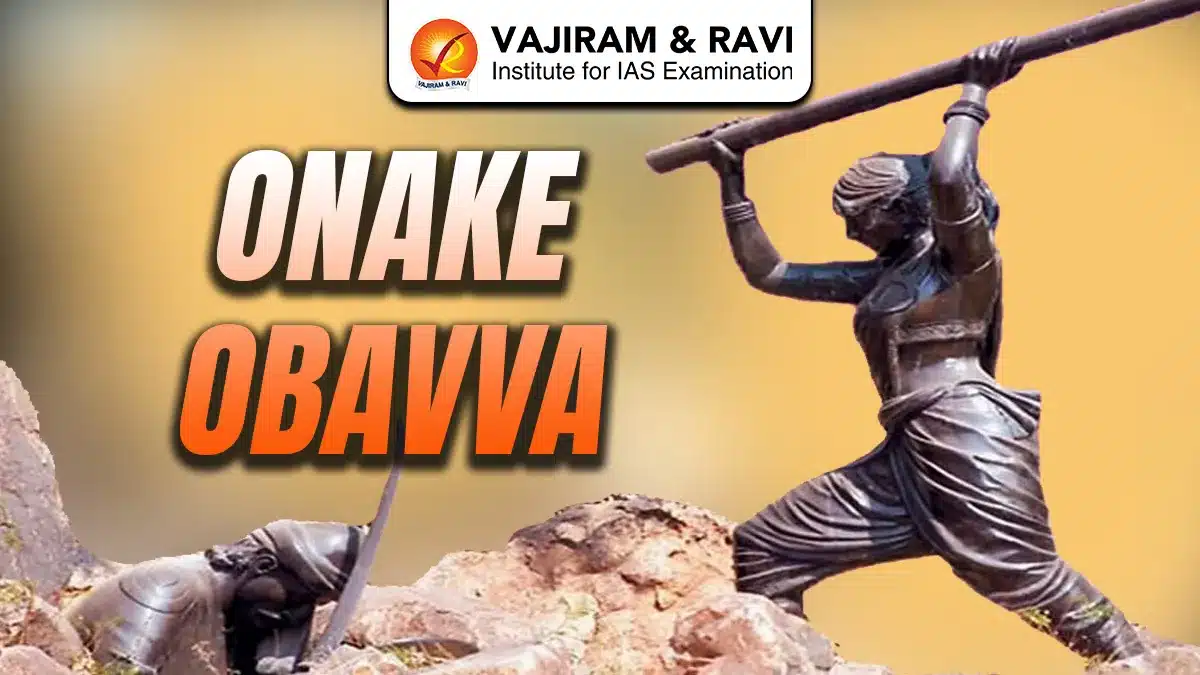
Onake Obavva was a courageous woman warrior from Karnataka who lived in the 18th century. She is remembered for her fearless act of bravery during an attack on Chitradurga Fort. Using a simple household tool called an “Onake” (a wooden pestle used for pounding grains), she fought enemy soldiers single-handedly and protected the fort.

Her story reflects the strength, intelligence, and courage of ordinary women who played an important role in Indian history. Onake Obavva has become a lasting symbol of Kannada pride and women’s bravery.

Onake Obavva and the Siege of Chitradurga Fort

  • Onake Obavva lived in the 18th century in present-day Karnataka.
  • During this period, Hyder Ali, the ruler of the Mysore Kingdom and father of Tipu Sultan, attacked Chitradurga Fort.
  • At that time, Chitradurga Fort was ruled by Madakari Nayaka.
  • Chitradurga Fort is locally known as Elusuttina Kote, meaning Fort of Seven Circles in Kannada.
  • The fort is located in Chitradurga district, about 200 km northwest of Bengaluru.
  • Onake Obavva was the wife of Kahale Mudda Hanuma, a soldier guarding the fort.
  • Enemy soldiers tried to secretly enter the fort during the siege.
  • Onake Obavva noticed the intruding soldiers and acted with great courage.
  • She used a wooden pestle called an Onake as a weapon.
  • Obavva fought the enemy single-handedly and stopped them from advancing.
  • Her bravery helped in defending the fort and delaying the enemy attack.
  • Her action became a historic example of women’s courage in Indian history.

Role of Onake Obavva in the Mysore-Maratha Conflict

  • The incident took place during a period of continuous conflicts involving the Mysore Kingdom and regional powers.
  • Chitradurga Fort was strategically important in these military struggles.
  • Onake Obavva prevented enemy soldiers from secretly entering the fort.
  • Her timely action stopped a surprise attack on the fort.
  • She strengthened the defense of Madakari Nayaka’s rule.
  • Her bravery delayed the enemy advance during the conflict.
  • Onake Obavva proved that common people could play a crucial role in warfare.

Onake Obavva Significance

  • Onake Obavva is remembered as a powerful symbol of courage and bravery in Indian history.
  • She represents the important role played by ordinary women in protecting their land and people.
  • Her story is a source of Kannada pride and cultural identity in Karnataka.
  • She stands alongside famous women warriors like Abbakka Rani, Keladi Chennamma, and Kittur Chennamma.
  • Onake Obavva highlights the idea that presence of mind and courage are as important as weapons in warfare.
  • Her legacy continues to inspire modern initiatives like Obavva Pade, a women police squad started in 2018.

She remains a role model for women empowerment and self-defense awareness.

Onake Obavva FAQs

Q1: Who was Onake Obavva?

Ans: Onake Obavva was a brave woman from Karnataka who defended Chitradurga Fort by killing enemy soldiers using an Onake, a wooden pestle.

Q2: Why is she called “Onake Obavva”?

Ans: She is called Onake Obavva because she used an Onake (wooden pounding stick) as a weapon to defeat the enemy.

Q3: Which fort is associated with Onake Obavva?

Ans: Onake Obavva is associated with Chitradurga Fort in Karnataka.

Q4: During which conflict did Onake Obavva play a role?

Ans: She played an important role during the Mysore–Maratha conflicts of the 18th century.

Q5: Why is Onake Obavva important in Indian history?

Ans: She is important because her bravery saved a major fort and highlighted the role of women and common people in defending the nation.

Critical Minerals, About, Application, Availability, Importance

Critical Minerals

Why in the news?

As part of the continuous Structural reforms in the mining sector undertaken by Government of India to align with the  vision of Aatmanirbhar Bharat and Viksit Bharat 2047, the Government has recently notified Coking Coal as Critical and Strategic mineral under the Mines and Minerals (Development and Regulation) Act, 1975 (MMDR Act).

About Critical Minerals

Critical Minerals are the set of minerals which are crucial for national security and  latest modern technologies and economic development but due to their lack of availability, geographical concentration, extraction or processing difficulties leads to supply chain disruptions.

Why are they called Critical Minerals?

  • The criticality level of minerals are determined by their economic importance and their risk of supply chain disruptions. 
  • The economic importance depends on the factor of how relevant it is to produce new advanced technologies, while the supply chain vulnerabilities refer to likelihood of shortage due to their geographical scarcity and extraction difficulties.
  • The major reason for the mineral supply chain disruptions is that they are present in minimum concentration as by-products of the ‘major’ minerals. 
  • The other reason for their criticality is the market concentration in the downward processing stage.
  • For instance about 40% of global smelting and refining of Cobalt, Lithium, REE and Copper is concentrated in China.

Coking Coal Inclusion Significance

  • India accounts for about 37.37 billion tonnes of coking coal, majorly found in Jharkhand, with minor reserves in Madhya Pradesh, West Bengal, and Chhattisgarh
  • However, despite this India saw coking coal imports rising from 51.20 million tonnes in 2020–21 to 57.58 million tonnes in 2024–25
  • At present, around 95% of the steel industry’s coking coal requirement is fulfilled through imports, creating a heavy drain on foreign exchange.
  • Now, classifying coking coal as a critical mineral is expected to increase approvals, upgrade ease of doing business, and boost up exploration and mining, including deep-seated deposits
  • Exemptions from public consultation and the use of degraded forest land for compensatory afforestation are also likely to attract greater private sector participation.

Use of Coking Coal

  • Essential for steel making: Coking coal is a crucial raw material which is used to produce coke, which is essential for steel production.
  • Supports infrastructure growth: Steel which is made using coking coal is crucial for buildings, railways, roads, and defence equipment.
  • Economic importance: Reducing dependence on imports can save foreign exchange and strengthen India’s economy.
  • Strategic significance: A steady supply of coking coal is crucial for industrial security and self-reliance.
  • Employment and investment: Increase in domestic mining can create jobs and can also attract private investment.

Critical Minerals Application

  • Energy: They are indispensable for clean energy technologies like solar panels, wind turbines, advanced batteries for energy storage and transportation.

Example: Lithium and Cobalt are used in Lithium ion batteries which are the backbone of Electric vehicles (Evs)

  • Modern technologies: Critical minerals are the foundation on which modern technologies are built. Most of the modern digital devices depend on critical minerals for their manufacturing.

Example: the manufacturing of semiconductors, LEDs and modern micro high speed chips.

  • Defence and strategic technologies: They are used in advanced military equipment to increase precision, to support R&D and other aerospace weaponry.

Example: the use of Titanium in submarines and fighter jets.

  • Medical devices: Critical minerals play a vital role in the diagnostics, advanced medical equipment and implants.

Example: Use in MRI and medical imaging systems.

  • Space Technologies: Critical minerals are essential for space missions and nuclear energy infrastructure.

Example: Use of Beryllium in the satellites and space exploration telescope.

Critical Minerals List

The Government of India in 2023 has notified a list of 30 Critical Minerals, which are crucial for India’s economic development, which is as follows:

Critical Minerals List
S.No. Critical Minerals Application
  1.  

Antimony

Flame retardants, Lead-acid batteries, Lead alloys, Plastics (catalysts and stabilisers), Glass and ceramics

2.

Beryllium

Automotive components: Transport and Defence Manufacturing of Machinery., Electronic and telecommunications equipments

3.

Bismuth

Chemicals, Pharmaceuticals, Casting of Iron

4.

Cadmium

Batteries, Pigments, Coatings

5.

Cobalt

Electric Vehicle, Batteries, corrosion resistant alloys, aerospace applications, Pigments and Dyes

6.

Copper

Electrical and electronics products, Electrical Wiring, Solar Panel, Automotive industry

7.

Gallium

Semiconductors, Integrated Circuits, LEDs

8.

Germanium

Optical fibres, satellites, solar cells

9.

Graphite

Batteries, Lubricants, fuel cells for EVs, Electric Vehicle

10.

Hafnium

Superalloy, Catalyst precursor, Semiconductors, Oxide for Optical, Nuclear reactors

11.

Indium

Electronics (Laptops, LED Monitors/TVs, Smartphones), and semiconductors

12. 

Lithium

Electric Vehicle, Batteries, glassware, ceramics, fuel manufacturing, Lubricant

13.

Molybdenum 

Steel alloys, Pigment and Dyes, Catalyst, Electrical and Electronic

14. 

Niobium

Construction, transportation

15. 

Nickel

Stainless steel, solar panels, batteries, aerospace, defence applications and Electric Vehicle

16.

PGE

Auto catalyst, Jewellery, medicine, electronic equipment used by military

17.

Phosphorus 

Mineral fertilizer

18.

Potash 

Chemical Fertilizers, Water softener

19.

Rare earth element (REE)

Permanent magnets for electricity generators and motors, catalyst, polishing, Batteries, Electronics, Defence technologies, wind energy sector, aviation, and Space

20.

Rhenium 

Super-alloys, aerospace and machinery uses, Catalysts in petroleum industry

21.

Selenium 

Electrolytic, Manganese, Glass, pigments

22.

Silicon

Semiconductors, electronics, and transport equipment, Paints, Aluminum alloys

23.

Strontium

Alloys of aluminium, Pigments and Fillers, Glass, Magnets, Pyrotechnic applications

24.

Tantalum 

Capacitors, Superalloys, Carbides, Medical technology

25.

Tellurium

Solar power, thermoelectric devices, Rubber vulcanising

26.

Tin

Aerospace, construction, home decor, electronics, jewellery and telecommunications

27.

Titanium

Aerospace and defence applications, chemicals and petrochemicals, Pigments, Polymers

28.

Tungsten

Mill and cutting tools, Mining and construction tools, Catalysts and pigments, Aeronautics and energy uses, tungsten carbide

29.

Vanadium

Alloys, batteries 

30.

Zircon

High value chemical manufacturing and electronics sector

Critical Minerals Vs. Rare Earth Elements (REE)

Critical Minerals are a broad class of minerals, which are crucial for the economy and clean energy of a country with a high supply chain vulnerability. Their classification is determined by their strategic importance, economic availability and supply chain risks. 

Rare Earth Elements (REE) are a subset of specific 17 chemically similar elements in the periodic table. They are a part of Critical minerals if deemed strategic importance. They are primarily used in high-performance magnets, electronics and defence, EVs and wind turbines.

Critical Mineral Global Overview

The report by the International Energy Agency provides an outlook for the key energy minerals and rare earth elements.

Critical Mineral Global Overview
S.No. Critical Mineral Top 3 (Mining Countries) Top 3 (Refining Countries)
  1.  

Copper 

  1. Chile
  2. Peru
  3. DRC
  1. China
  2. Chile 
  3. DRC
  1.  

Lithium

  1. China
  2. Australia
  3. Chile
  1. China
  2. Chile
  3. Australia

3.

Nickel

  1. Indonesia
  2. Philippines
  3. Russia
  1. Indonesia
  2. China
  3. Russia

4.

Cobalt

  1. Democratic Republic of Congo
  2. Indonesia
  3. Russia
  1. China
  2. Finland
  3. Indonesia

5.

Graphite

  1. China
  2. Japan
  3. Madagascar
  1. China
  2. Japan
  3. Indonesia

6.

REE

  1. China
  2. Australia
  3. Myanmar
  1. China
  2. U.S.A
  3. Malaysia

Critical Mineral Five Pillars Value Chain

For the success of the Critical Minerals in India, there is a need to develop capacity at each stage starting from exploration to recycling.

For the success of the Critical Minerals in India, there is a need to develop capacity at each stage starting from exploration to recycling.

1. Geoscience and Upstream Exploration

  • Diverse geological regions of India have been thoroughly mapped by the Geological Survey of India (GSI) to recognize mineral-rich areas known as Obvious Geological Potential (OGP) zones
  • These respective zones hold important minerals such as gold, rare earth elements, nickel, and cobalt. Exploration of minerals is mainly undertaken by MECL and State mining departments. 
  • Earlier, exploration was mainly focused on bulk minerals like coal and iron ore. 
  • However, with rising demand for critical minerals the focus has shifted towards deep-seated resources. Reforms such as the MMDR Amendment Act, 2021 and further support from NMET have enabled accelerated participation by the private sector in mineral exploration.

2. Upstream Mining and Extraction

  • Mining is the process of separating minerals from the earth through both surface or underground methods, depending on the characteristics of the deposit. These operations often use heavy machinery for drilling, blasting, excavation, and transporting minerals for further processing.

3. Midstream – Processing, Refining and Metallurgy

  • Although India has strengthened mineral exploration and manufacturing, intermediate processing and refining still need much attention. 
  • Developing advanced, environmentally friendly refining technologies is crucial for building a strong critical minerals ecosystem. 
  • Even though India has capable research institutions, most of the work remains at the laboratory level. 
  • Increase in funding and pilot-scale support are essential to commercialize innovations and process minerals efficiently from primary sources as well as waste such as used batteries and mine tailings.

4. Downstream - Component Manufacturing & Advanced Technology Production

  • Processed critical minerals are used in EV motors, wind turbines, and other advanced products.
  • Permanent magnets from rare earth metals are key for electric vehicles and renewable energy.
  • India’s Aatmanirbhar Bharat and Make in India programs promote domestic manufacturing and exports.
  • The PLI (Production-Linked Incentive) scheme boosts global competitiveness in 13 sectors; 7 key sectors using critical minerals:
    • Large-scale electronics (MeitY)
    • Electronic/technology products (MeitY)
    • Telecom & networking products (DoT)
    • White goods like ACs & LEDs (DPIIT)
    • High-efficiency solar PV modules (MNRE)
    • Automobiles & auto components (DHI)
    • Advanced Chemistry Cell batteries (DHI)

5. Material Recovery & Recycling

  • Recycling majorly reduces dependence on the primary minerals and assists sustainable development.
  • Lithium-ion batteries and other such tech products can be recycled to recover valuable minerals.
  • Currently, only steel, lead, copper, and aluminium have significant recycling rates; others have  minimal.
  • By 2040, recycling is expected to play a major role globally.
  • Strong recycling policies and infrastructure are needed to recover minerals from end-of-life products, industrial waste, and post-consumer goods.

Critical Minerals Initiatives taken by the Government 

The Government of India has launched several initiatives, such as the National Critical Minerals Mission, overseas mineral asset acquisition, exploration reforms, and recycling policies to ensure secure, sustainable, and diversified access to critical minerals essential for economic growth and energy transition.

Early Policy Recognition (2011)

  • The Planning Commission (now NITI Aayog) highlighted the need for assured mineral availability for India’s industrial growth.
  • Focus was placed on systematic exploration, efficient management, recycling, overseas acquisition, and R&D for substitutes.
  • A list of 12 strategic minerals was identified, including lithium, cobalt, tin, tungsten, rare earths, and others.

Ministry of Mines Initiative

  • In 2011, the Ministry of Mines formed a Steering Committee to assess Rare Earth Elements (REEs) and energy-critical minerals.
  • The 2012 roadmap emphasized strengthening the entire mineral supply chain from exploration to manufacturing.

Research on Mineral Criticality

  • A CEEW study (2016), supported by DST, highlighted weak research on mineral security in India.
  • It developed a criticality index for 49 non-fuel minerals and identified 13 minerals as highly critical by 2030, including rare earths, graphite, germanium, and niobium.

Focus on Rare Earth Elements (2017–2020)

  • GSI and AMD submitted reports on India’s potential REE deposits and strategies to enhance REE exploration.
  • India Exim Bank also stressed the importance of securing REEs for economic and strategic needs.

CSEP Studies on Critical Minerals

  • CSEP adopted the EU methodology to identify critical minerals for India.
  • Studies (2021–2023) assessed the criticality of 11, 23, and 43 non-fuel minerals based on economic importance and supply risk.
  • These studies also projected mineral demand for manufacturing and green technologies.

Critical Minerals in India: Conclusions & Recommendations

  • India adopted a three-stage assessment involving global benchmarking, inter-ministerial consultations, and empirical analysis to identify critical minerals. The study reviewed strategies of major economies and shortlisted 69 globally critical minerals, incorporating domestic research inputs. Sectoral consultations ensured alignment with national priorities. 
  • An EU-style framework based on economic importance and supply risk was proposed, highlighting the need for robust indicators such as import reliance and substitutability. Based on this process, 30 minerals, including two fertilizer minerals, were identified as most critical for India.
  • To address supply vulnerabilities, the report recommends establishing a Centre of Excellence for Critical Minerals under the Ministry of Mines. The Centre should focus on advanced exploration, R&D, policy coordination, international collaboration (including KABIL), and periodic updating of the critical minerals list. This would help build a domestic value chain and reduce import dependence in strategic sectors.

UPSC CSE Prelims PYQs

Consider the following statements: [2025]

I. India has joined the Minerals Security Partnership as a member.

II. India is a resource-rich country in all the 30 critical minerals that it has identified.

III. The Parliament in 2023 has amended the Mines and Minerals (Development and Regulation) Act, 1957 empowering the Central Government to exclusively auction mining lease and composite licenses for certain critical minerals.

Which of the statements given above are correct?

  1. I and II only
  2. II and III only
  3. I and III only
  4. I, II and III

Critical Minerals FAQs

Q1: What are critical minerals?

Ans: Critical minerals are the set of minerals crucial for national security and latest modern technologies and economic development but due to their lack of availability, geographical concentration, extraction or processing difficulties leads to supply chain disruptions.

Q2: Why was Coking Coal declared as Critical Mineral?

Ans: Despite having large reserves, India imports nearly 95% of its coking coal for steel production, leading to high foreign exchange loss.

Q3: What are the major applications of critical minerals?

Ans: Some of the major applications of critical minerals are Renewable energy (solar panels, wind turbines), Electric vehicles and batteries, Semiconductors and electronics etc.

Q4: How are critical minerals different from Rare Earth Elements (REEs)?

Ans: Critical minerals are a broad category based on economic importance and supply chain risk. REEs are a subset of 17 specific elements, mainly used in magnets, electronics, EVs, defence, etc

Q5: Why are critical minerals called “critical”?

Ans: They are called critical due to high economic importance for advanced technologies and high supply chain risk.

Aluminium Phosphide

Aluminium Phosphide

Aluminium Phosphide Latest News

Recently, doctors at the PGIMER achieved a global breakthrough in treating aluminium phosphide (Celphos) poisoning with intravenous lipid emulsion therapy.

About Aluminium Phosphide 

  • Aluminium phosphide is commonly known as Celphos.

Characteristics of Aluminium Phosphide 

  • It is a yellow or dark grey crystalline solid that has a garlic-like odour. 
  • It is a cheap, effective and commonly used pesticide.
  • It liberates lethal phosphine gas when it comes in contact either with atmospheric moisture or with hydrochloric acid in the stomach.
    • Phosphine gas, which is highly flammable, and very toxic in nature
    • The mechanism of toxicity includes cellular hypoxia due to the effect on mitochondria, inhibition of cytochrome C oxidase and formation of highly reactive hydroxyl radicals. 
  • Impact on Human Health: Aluminium phosphide poisoning continues to be a serious public-health challenge, particularly in agricultural states such as Punjab, Haryana and Uttar Pradesh.

Uses of Aluminium Phosphide 

  • Aluminum Phosphide (ALP) is a highly toxic fumigant which is used commonly as an indoor pesticide in agriculture based industry for storage of grains.
  • It is often dispersed in pellets; the pellets react with moisture which produces toxic phosphine gas. 
  • Aluminium phosphide is also used to make semi-conductor materials such as light-emitting diodes.

Source: IE

Aluminium Phosphide FAQs

Q1: What is Aluminium Phosphide used for?

Ans: Fumigant pesticide

Q2: What is the toxicity of Aluminium Phosphide attributed to?

Ans: Release of phosphine gas

World Wetlands Day

World Wetlands Day 2026

World Wetlands Day Latest News

World Wetlands Day 2026 theme explores the long-standing connections between the habitats and cultural practices, traditions and knowledge systems of communities.

About World Wetlands Day

  • It is celebrated every year on 2 February. 
  • It was first celebrated in 1997 and has been a United Nations International Day since 2022.
    • It marks the anniversary of the Ramsar Convention, signed in Ramsar, Iran, on 2 February 1971.
    • The agreement is also known as the Convention on Wetlands of International Importance. 
    • It is one of the oldest modern international environmental agreements and the only one focused entirely on a single ecosystem: wetlands.
    • There are 172 Contracting Parties to the convention and over 2500 listed Ramsar wetlands worldwide.  
    • Each year, the Convention Secretariat leads the World Wetlands Day campaign, with participation from governments, conservation organisations, businesses, NGOs, media, youth groups, and communities worldwide.
  • World Wetlands Day 2026 Theme: The global theme for 2026, ‘Wetlands and Traditional Knowledge: Celebrating Cultural Heritage’, highlights the role of indigenous and local communities in conserving and managing wetlands.

New Ramsar Sites in India

Patna Bird Sanctuary in Etah, Uttar Pradesh, and Chhari-Dhand in Kutch, Gujarat, have been officially designated as Wetlands of International Importance under the Ramsar Convention, bringing the total number of Ramsar sites in India to 98.

Source: N18

World Wetlands Day FAQs

Q1: When is World Wetlands Day celebrated every year?

Ans: World Wetlands Day is celebrated every year on 2 February.

Q2: In which year was World Wetlands Day first celebrated?

Ans: World Wetlands Day was first celebrated in 1997.

Q3: What historical event does World Wetlands Day commemorate?

Ans: It marks the anniversary of the signing of the Ramsar Convention on 2 February 1971.

Q4: What is the Ramsar Convention also known as?

Ans: It is also known as the Convention on Wetlands of International Importance.

Q5: What is the theme of World Wetlands Day 2026?

Ans: The theme of World Wetlands Day 2026 is “Wetlands and Traditional Knowledge: Celebrating Cultural Heritage”.

SAKSHAM 2026

SAKSHAM 2026

SAKSHAM 2026 Latest News

In an effort to enhance awareness about conserving national resources, the campaign SAKSHAM 2026 has been recently inaugurated by the oil industry.

About SAKSHAM

  • Saksham (Samrakshan Kshamatha Mahotsav) is an annual awareness campaign initiated by the Ministry of Petroleum and Natural Gas, Government of India. 
  • It is designed to promote fuel conservation and raise awareness of sustainable energy practices. 
  • Organized by oil and gas public sector enterprises in collaboration with local authorities, educational institutions, industries, and key stakeholders, Saksham aims to drive India towards a greener future.
  • SAKSHAM 2026:
    • It is a fortnight-long campaign that will run from 2nd February to 16th February 2026.
    • It features diverse activities to engage citizens, debates, wall paintings, cyclothons, walkathons, workshops, seminars, and awareness programs. 
    • The campaign will target various groups, such as schoolchildren, youth, LPG users, fleet operators, farmers, and industry professionals.
    • The theme for the 2026 campaign, “Conserve Oil and Gas, Go Green” (Tel aur Gas Bachao, Harshit Urja Apnao), underscores the transition towards renewable energy sources and energy-efficient solutions for environmental sustainability.

Source: DEVD

SAKSHAM 2026 FAQs

Q1: What is SAKSHAM?

Ans: SAKSHAM (Samrakshan Kshamatha Mahotsav) is an annual awareness campaign initiated by the Ministry of Petroleum and Natural Gas, Government of India.

Q2: What is the primary objective of the SAKSHAM campaign?

Ans: The primary objective of SAKSHAM is to promote fuel conservation and raise awareness about sustainable energy practices.

Q3: What is the theme of the SAKSHAM 2026 campaign?

Ans: The theme of SAKSHAM 2026 is “Conserve Oil and Gas, Go Green” (Tel aur Gas Bachao, Harshit Urja Apnao).

Moltbook Platform

Moltbook Platform

Moltbook Platform Latest News

A new tech phenomenon called Moltbook has erupted across social media as the first social network designed exclusively for artificial intelligence agents. 

About Moltbook Platform

  • Moltbook is a new online platform where artificial intelligence agents interact with each other without direct human participation.
  • It was launched in January 2026 by developer Matt Schlicht.
  • It allows AI systems to post, interact, and exchange information in a shared digital space.

Key Features of Moltbook

  • Diverse Discussions: It is designed as a machine-to-machine space where discussions range from technical issues to philosophical topics like "consciousness" or identity.
    • The agents generate text based on patterns they learned from training data and from interactions.
  • Autonomous Interaction: On Moltbook AI agents do talk to each other by posting, replying and upvoting comments in thread conversations.
    • This communication happens autonomously once a human owner connects their agent to the platform, but the agents themselves use APIs and programmed behaviour to interact without direct human input at each step.
  • Emergent Behavior: AI agents on Moltbook appear to update their behaviour based on interactions with other bots.
    • They remix ideas they encounter in discussions and sometimes adjust responses over time, creating threads that resemble ongoing debates.

What Are AI Agents?

  • AI agents are software entities that can be assigned tasks, examine their environments, take actions as prescribed by their roles, and adjust based on their experiences.

Source: HT

Moltbook Platform FAQs

Q1: What is a key feature of Moltbook?

Ans: AI-autonomous interaction

Q2: Who launched Moltbook?

Ans: Matt Schlicht.

16th Finance Commission’s Warning On Rising Fiscal Risks

Fiscal Risks

Fiscal Risks Latest News

  • The 16th Finance Commission has cautioned states against the rapid expansion of large, unconditional cash transfer schemes, which now account for over 20% of total state subsidy spending. 

Understanding Cash Transfers in India

  • Cash transfers have increasingly become a preferred welfare instrument in India’s public finance framework. 
  • These transfers involve direct monetary payments to beneficiaries, usually deposited into bank accounts using the Jan Dhan-Aadhaar-Mobile (JAM) trinity
  • They are broadly classified into conditional and unconditional transfers. While conditional transfers are linked to outcomes such as education or health, unconditional cash transfers impose no performance or usage conditions.
  • Historically, unconditional transfers in India were limited to social security pensions and farmer income support schemes. 
  • However, over the past decade, especially after improvements in digital delivery systems, states have expanded cash-based welfare to wider population groups. 
  • This shift has altered the composition of state subsidies, raising questions about long-term fiscal sustainability.

Trends in State Subsidies and Cash Transfers

  • According to the 16th Finance Commission, large-group unconditional cash transfer schemes now constitute 20.2% of total state subsidy expenditure in the 2025-26 Budget Estimates, a sharp rise from just 3% in 2018–19
  • This indicates a structural shift in how states allocate welfare spending.
  • The Commission notes that while pensions and farmer support accounted for nearly 84% of unconditional cash transfers in 2018-19, their share has fallen significantly. 
  • By 2025-26, large-group schemes alone account for 47.4% of all unconditional transfers, overtaking traditional categories. 
  • This reflects a growing preference for politically visible, broad-based cash schemes over targeted or merit-based subsidies.

State-Level Patterns and Key Schemes

  • The Commission highlighted Maharashtra, Odisha, and Jharkhand as states that have witnessed the steepest rise in such spending over the past two years. 
  • Major schemes include:
    • Majhi Ladki Bahin Yojana (Maharashtra): Rs. 1,500 per month to eligible women.
    • Gruha Lakshmi (Karnataka): Rs. 2,000 per month to women heads of households.
    • Lakshmir Bhandar (West Bengal): Monthly transfers to women beneficiaries across social categories.
  • In Maharashtra, spending on large-group cash transfers rose from 0.6% of total revenue expenditure in 2023-24 to 6.2% in 2025-26, while Jharkhand saw an increase from 0.8% to 13% over the same period. 
  • Odisha recorded a jump from nil to 5.1%. These sharp increases indicate a rapid fiscal expansion rather than a gradual policy transition.

Fiscal Concerns Raised by the 16th Finance Commission

  • The Finance Commission has warned that the unchecked expansion of unconditional cash transfers can destabilise state finances in the long run. 
  • Such schemes impose a recurring fiscal burden and reduce flexibility in budgetary allocations. 
  • The Commission observed that many of these transfers are poorly targeted, expanding into large beneficiary bases that dilute their redistributive effectiveness.
  • A major concern is the crowding out of capital expenditure. Rising revenue spending on cash transfers limits states’ ability to invest in infrastructure, education, and health, which are critical for long-term growth. 
  • The Commission also cautioned against financing these schemes through off-budget borrowings, guarantees, or revenue assignments, calling such practices fiscally imprudent due to reduced transparency in public accounts. 

Recommendations for Reform

  • To address these risks, the 16th Finance Commission has recommended:
    • Periodic and rigorous review of subsidy schemes.
    • Rationalisation of beneficiary bases to ensure support reaches the most vulnerable.
    • Introduction of sunset or exit clauses, especially for non-merit and general unconditional transfers.
    • Discontinuation of off-budget financing mechanisms for welfare schemes.
  • The Commission emphasised that welfare policies must align with fiscal responsibility and deficit reduction goals, rather than becoming permanent entitlements without review.

Source: IE

Fiscal Risks FAQs

Q1: What share of state subsidies is now accounted for by cash transfers?

Ans: Cash transfers constitute about 20.2% of total state subsidy spending in 2025–26.

Q2: What type of cash transfers has grown the fastest?

Ans: Large-group unconditional cash transfer schemes have expanded the most.

Q3: Which states saw the sharpest rise in such spending?

Ans: Maharashtra, Jharkhand, and Odisha recorded the steepest increases.

Q4: Why does the Finance Commission oppose off-budget financing of cash schemes?

Ans: It creates fiscal opacity and undermines budgetary transparency.

Q5: What key reform does the Commission suggest for cash transfer schemes?

Ans: Introducing sunset clauses and periodic reviews to ensure fiscal sustainability.

Devnimori Relics of Lord Buddha

Devnimori Relics

Devnimori Relics of Lord Buddha Latest News

India is set to undertake a profound gesture of spiritual outreach and cultural diplomacy through the exposition of the sacred Devnimori Relics of Lord Buddha in Sri Lanka. 

About Devnimori Relics of Lord Buddha

  • The Devnimori Relics originate from the Devnimori archaeological site, located near Shamlaji in the Aravalli district of Gujarat.
  • It was first explored in 1957 by eminent archaeologist Prof. S. N. Chowdhry,

Major Findings of Excavations

  • The excavations revealed important Buddhist structures and relics that stand testimony to the flourishing of Buddhism in western India.
    • Relic casket: The relic casket found within Devnimori Stupa at a height of 24 feet from the base, made out of green schist.
      • It is inscribed in Brahmi Script and Sanskrit language, it reads. “dashabala sharira nilay” - the abode of the Buddha’s bodily relic.
      • It holds a copper box having organic matter with holy ashes, with silk cloth and beads.
    • Copper box: The copper box had a flat top and base with a slipon lid fitting onto a rim ledge, and contained silk cloth, a gold coated silver-copper bottle, organic material with holy ashes, and black clay used as covering.
      • The small amphora-like gold coated bottle had a sagger base, cylindrical body, and a narrow neck with a screw-type lid.
    • Desiccator: The desiccator now houses the Holy Relics. It is sealed in an air-tight glass to prevent further deterioration of the object inside.

Source: PIB

Devnimori Relics of Lord Buddha FAQs

Q1: Where is the Devnimori archaeological site located?

Ans: Gujarat, India

Q2: What is inscribed on the relic casket?

Ans: Dashabala Sharira Nilaya

Nipah Virus Outbreak, Symptoms, Treatment, Latest News

Nipah Virus

Nipah Virus Latest News

The Nipah Virus Outbreak in West Bengal, India, has raised alarm across many Asian countries, as the virus can have a fatality rate of 40% to 75% in humans. Neighboring countries, including Thailand, Malaysia, Pakistan, Singapore, and Nepal has enhanced border screening and testing for travelers coming from affected countries.

About Nipah Virus

  • Nipah virus (NiV) is a zoonotic virus (it is transmitted from animals to humans) and can also be transmitted through contaminated food or directly between people.
    • Fruit bats of the Pteropodidae family are the natural hosts of Nipah virus.
  • In infected people, it causes a range of illnesses from asymptomatic (subclinical) infection to acute respiratory illness and fatal encephalitis.
  • The virus can also cause severe disease in animals such as pigs, resulting in significant economic losses for farmers. 
  • So far, NiV outbreaks have only been described in Asia.
    • The first reported outbreak occurred in 1998–1999 and involved pig farmers in the village of Sungai Nipah (Malaysia).
    • Since then, sporadic outbreaks have been documented in Bangladesh, India, the Philippines, and Singapore.
    • NiV infection is one of the priority diseases on the World Health Organization (WHO) R&D Blueprint because of its epidemic or pandemic potential.

Nipah Virus Symptoms

  • Infected people initially develop symptoms including fever, headaches, myalgia (muscle pain), vomiting and sore throat.
  • This can be followed by dizziness, drowsiness, altered consciousness, and neurological signs that indicate acute encephalitis.
  • Some people can also experience atypical pneumonia and severe respiratory problems, including acute respiratory distress.
  • Encephalitis and seizures occur in severe cases, progressing to coma within 24 to 48 hours.
  • The incubation period is believed to range from 4 to 14 days.
  • The virus is considered highly fatal, with fatality rates in past outbreaks ranging from approximately 40% to 75%, depending on surveillance and care.

Nipah Virus Treatment

  • There are no specifically approved treatments or vaccines available for NiV infection, either for people or animals.  
  • Intensive supportive care is recommended to treat severe respiratory and neurologic complications.

 Source: NDTV

Nipah Virus FAQs

Q1: What is the primary mode of transmission of Nipah Virus?

Ans: Direct contact with infected animals or humans

Q2: What is the primary reservoir of Nipah Virus?

Ans: Fruit bats

Fuego Volcano

Fuego Volcano

Fuego Volcano Latest News

Guatemala's Volcan de Fuego, one of Central America's most persistently active volcanoes, produced a striking explosive eruption recently.

About Fuego Volcano

  • Volcan de Fuego, which translates to “Volcano of Fire” in Spanish, is an active volcano located in Guatemala.
  • It is a relatively young basaltic stratovolcano. 
  • It is one of three large stratovolcanoes overlooking Guatemala’s former capital, Antigua.
  • Nestled between the neighboring volcanoes of Acatenango and Agua, it rises dramatically to an altitude of 3,763 meters (12,346 feet) above sea level.
  • It forms part of the Central American Volcanic Arc, a chain of volcanoes stretching from Guatemala to Panama. 
  • Guatemala lies on the Pacific “Ring of Fire and experiences frequent seismic and volcanic activity.
  • Fuego has erupted more than 60 times since 1524, making it Central America’s historically most active volcano.
  • A deadly eruption in 2018 claimed 194 lives and left 234 people missing.
  • Since then Volcan Fuego has continued to be active, but to a lesser extent, with small eruptions several times a day.
  • Typical activity is characterized by ashfall, pyroclastic flows, lava flows, and lahars.

What is a Stratovolcano?

  • It is a tall, steep, and cone-shaped type of volcano.
  • Unlike flat shield volcanoes, they have higher peaks.
  • They are typically found above subduction zones, and they are often part of large volcanically active regions, such as the Ring of Fire that frames much of the Pacific Ocean.
  • Strato Volcanoes comprise the largest percentage (~60%) of the Earth’s individual volcanoes, and most are characterized by eruptions of andesite and dacite, lavas that are cooler and more viscous than basalt.
  • These more viscous lavas allow gas pressures to build up to high levels. Therefore, these volcanoes often suffer explosive eruptions. 
  • They are usually about half-half lava and pyroclastic material, and the layering of these products gives them their other common name of composite volcanoes.
  • At the peak, stratovolcanoes usually have a small crater. The crater may be filled with water or ice, or it may contain a volcanic dome during a period of relative inactivity.

Source: IT

Fuego Volcano FAQs

Q1: Where is Fuego Volcano located?

Ans: It is located in Guatemala.

Q2: What type of volcano is Fuego Volcano?

Ans: It is a relatively young basaltic stratovolcano.

Q3: Fuego Volcano overlooks which historic city of Guatemala?

Ans: It overlooks Guatemala’s former capital, Antigua.

Q4: Which two volcanoes are located adjacent to Fuego Volcano?

Ans: It is located between the volcanoes of Acatenango and Agua.

NeophyteID App

NeophyteID App

NeophyteID App Latest News

Recently, the Kerala chief minister launched the NeophyteID application.

About NeophyteID App

  • It is an AI-powered mobile application designed to help users identify invasive plant species across Kerala.
  • It is developed by researchers at the Malabar Botanical Garden and Institute for Plant Sciences (MBGIPS),
  • It is aimed as a citizen-friendly app which enables local communities, students and ecologists to collectively monitor, report and manage the spread of invasive plants threatening native flora and ecosystems.

Key Features of NeophyteID App

  • Technology Used: It is powered by the YOLOv11 machine learning model.
  • The app leverages image recognition and geospatial tracking to accurately detect and map invasive (neophyte) plant species directly from your camera or gallery.
  • Each identification contributes to a real-time distribution map, supporting research, conservation, and community-based biodiversity management. 
  • Languages: It is accessible in English and Malayalam.

Source: TOI

NeophyteID App FAQs

Q1: What is the primary purpose of the NeophyteID App?

Ans: To identify and map invasive plant species

Q2: Which institution developed the NeophyteID App?

Ans: Malabar Botanical Garden and Institute for Plant Sciences (MBGIPS)

Pennaiyar River

Pennaiyar River

Pennaiyar River Latest News

The Supreme Court recently directed the Centre to constitute a tribunal to adjudicate the dispute between Tamil Nadu and Karnataka over the sharing of Pennaiyar River water.

About Pennaiyar River

  • The Pennaiyar River is a major river in southern India flowing through Tamil Nadu and Karnataka.
  • It is also known as the South Pennar River, Dakshina Pinakini in Kannada, and Thenpennai, Ponnaiyar, or Pennaiyar in Tamil. 
  • Course:
    • It originates in the Nandi Hills in the Chikkaballapura district of Karnataka
    • It then flows southward for 80 km through Karnataka to northwestern Tamil Nadu, where it turns and flows southeastward to enter the Bay of Bengal at Cuddalore. 
  • It is the second longest river in Tamil Nadu, stretching 497 km in length. 
  • It is also the second largest interstate east-flowing river basin, situated between the Pennar and Cauvery basins.
  • The Basin is bounded on the northwest and south by various ranges of the Eastern Ghats, like the Velikonda Range, the Nagari hills, the Javadu hills, the Shevaroy hills, the Chitteri hills, and the Kalrayan hills, and in the east by the Bay of Bengal.
  • Major tributaries are the Chinnar, Markanda, Vaniar, and Pamban.
  • Heavy rains at the river’s source cause sudden, but short-lived, floods. 
  • The river is extensively dammed for irrigation, especially in Tamil Nadu.
  • There are also reservoirs at Krishnagiri and Sathanur. 

Pennaiyar River Dispute

  • It is a water-sharing dispute between the Indian states of Tamil Nadu and Karnataka. 
  • Tamil Nadu claims that Karnataka’s construction of check dams and diversion structures would reduce the water flow into their state, affecting their irrigation and drinking water needs.

Source: TH

Pennaiyar River FAQs

Q1: Through which Indian States does the Pennaiyar River flow?

Ans: The Pennaiyar River flows through Karnataka and Tamil Nadu.

Q2: Where does the Pennaiyar River originate?

Ans: The Pennaiyar River originates in the Nandi Hills in the Chikkaballapura district of Karnataka.

Q3: Where does the Pennaiyar River drain into the sea?

Ans: It drains into the Bay of Bengal at Cuddalore.

Q4: What are the major tributaries of the Pennaiyar River?

Ans: The major tributaries are the Chinnar, Markanda, Vaniar, and Pamban.

Daily Editorial Analysis 3 February 2026

Daily Editorial Analysis

Wetlands as a National Public Good

Context

  • World Wetlands Day 2026, observed under the theme Wetlands and traditional knowledge: Celebrating cultural heritage, draws attention to the deep connections between people and Wetlands in India.
  • For centuries, communities have depended on water bodies not only for survival but also for culture, identity, and collective wellbeing.
  • These landscapes represent a convergence of ecology and society, where Traditional Knowledge has shaped sustainable interactions with nature.
  • Yet, despite their value, wetlands today face accelerating decline, raising urgent questions about how Heritage and modern governance can be aligned to secure their future.

Traditional Knowledge and the Cultural Ecology of Wetlands

  • Across India, wetlands have historically supported Livelihoods through locally adapted practices that balanced use and protection.
  • In Tamil Nadu, interconnected tanks or kulams regulated water for agriculture, while in Kerala, kenis ensured drinking water and ritual continuity.
  • Fishing communities in Andhra Pradesh developed seasonal practices that sustained both people and Ecosystems.
  • These systems were governed collectively and refined over generations, embedding conservation within daily life.
  • Such examples reveal wetlands as socio-ecological systems rather than vacant land.
  • They demonstrate that cultural memory and local practices can inform present-day approaches to Conservation, especially when communities remain active stewards rather than passive beneficiaries.

Policy Frameworks and the Crisis of Implementation

  • India possesses an extensive Policy architecture for wetland protection, including the Wetlands (Conservation and Management) Rules, 2017, the National Plan for Conservation of Aquatic Ecosystems, the Coastal Regulation Zone framework, and Ramsar commitments.
  • Together, these address a wide range of wetland types and ecological contexts.
  • However, the central challenge lies in Implementation. Large proportions of wetlands have disappeared in recent decades, while many remaining sites show severe Degradation.
  • Delays in notification, weak enforcement, fragmented institutional roles, and poor coordination undermine the effectiveness of existing laws.
  • International recognition through Ramsar designation carries responsibility, but protection on paper often fails to translate into action on the ground.

Development Pressures and Ecological Degradation

  • Wetlands are especially vulnerable because they lie at the intersection of land, water, and development.
  • Rapid Urbanisation, infrastructure expansion, and land conversion have erased or fragmented many natural systems.
  • Alterations to water flow, through dams, embankments, sand mining, and groundwater extraction, disrupt wetland Hydrology, weakening their ecological functions.
  • Pollution compounds these pressures. Untreated sewage, industrial effluents, agricultural runoff, and solid waste trigger eutrophication, biodiversity loss, and declining water quality.
  • Urban wetlands are often expected to absorb floods, manage waste, and remain biodiverse, despite lacking legal buffers or adequate protection.
  • In coastal regions, rising seas and extreme weather linked to Climate change intensify risks, trapping Mangroves and lagoons between development and erosion.

Institutional Capacity and Governance Gaps

  • Beyond environmental stressors, limited Capacity within institutions remains a major obstacle.
  • State wetland authorities are frequently understaffed and underfunded, with gaps in technical expertise, enforcement, and community engagement.
  • Weak planning and monitoring reflect broader challenges in Governance, where multiple mandates compete without effective coordination.
  • Without skilled personnel and clear accountability, even well-designed frameworks struggle to deliver results.

Towards Pragmatic, Integrated Solutions

  • Addressing these challenges requires a shift from isolated projects to long-term programmes, and from cosmetic interventions to ecological Restoration.
  • Clear notification and demarcation of wetlands, supported by transparent mapping and participatory verification, form the foundation of protection.
  • Urban and peri-urban wetlands require strict control of inflows; wetlands cannot replace sewage treatment plants.
  • At the landscape scale, protecting Catchments and restoring hydrological Connectivity are essential to maintaining wetland functions.
  • Coastal and riparian wetlands should be treated as natural Infrastructure for disaster risk reduction, offering protection comparable to engineered systems.
  • Equally important is sustained investment in training and institutions, linking wetland management outcomes to tangible benefits for local people and fostering long-term stewardship.

Conclusion

  • The future of India’s wetlands depends on collective responsibility and governments must enforce and coordinate.
  • Cities must abandon the notion of wetlands as wastelands, industries must prevent pollution at source, and educational institutions must train skilled practitioners.
  • Citizens, too, play a crucial role in defending local water bodies as shared assets.
  • By aligning science with policy and grounding both in the experience of Communities, wetlands can be restored as living systems that support Resilience and Sustainability.
  • In doing so, India safeguards not only its water and biodiversity, but also a vital foundation for social and ecological stability.

Wetlands as a National Public Good FAQs

Q1. Why are wetlands culturally significant in India?
Ans. Wetlands are culturally significant because communities have historically relied on them for livelihoods, rituals, and collective wellbeing through traditional practices.

Q2. What is the main weakness in India’s wetland conservation efforts?
Ans. The main weakness is poor implementation and coordination of existing laws and policies.

Q3. How does urban development threaten wetlands?
Ans. Urban development threatens wetlands through land conversion, disrupted hydrology, and increased pollution.

Q4. Why are wetlands important for disaster risk reduction?
Ans. Wetlands act as natural infrastructure by absorbing floods, reducing storm impacts, and protecting coastlines.

Q5. What is essential for effective wetland governance in India?
Ans. Effective wetland governance requires strong institutional capacity, scientific management, and community participation.

Source: The Hindu


Visible Progress, Invisible Exclusion

Context

  • India’s Union Budget 2026–27 signals a decisive shift away from pandemic-era crisis management towards a borrowing-led development strategy anchored in public capex.
  • By targeting a fiscal deficit of 4.3% of GDP and expanding public investment to ₹12.2 lakh crore, the government positions infrastructure spending as the central driver of long-term growth.
  • This approach reflects confidence in India’s macroeconomic stability and reframes public investment and MSME support as permanent pillars rather than temporary stimulus.
  • Yet, beneath this stability lies a growing tension between capital formation and employment

Towards a Growth Doctrine

  • For much of India’s post-independence history, capital expenditure expanded or contracted based on revenue conditions.
  • That framework changed after 2020–21, when capex became the organising principle of fiscal policy.
  • Its share in total expenditure rose from about 12% to over 22%, reflecting a strategic commitment to public investment-led expansion.
  • The logic is familiar: public spending crowds in private investment, raises productivity, and generates jobs.
  • However, labour indicators suggest that this transmission is weakening. Youth NEET rates (ages 15–29) remain between 23% and 25%, indicating that a significant share of young Indians remains outside education, employment, or training even as investment accelerates.
  • Growth, while strong on aggregate, is no longer translating automatically into broad-based labour market participation.

A Structural U-Turn

  • Sectoral employment trends reveal a deeper structural reversal. Construction, the sector most directly linked to infrastructure spending, has seen declining job intensity.
  • Its employment elasticity fell from 0.59 in the pre-COVID period (2011–12 to 2019–20) to 0.42 in the post-COVID years (2021–22 to 2023–24).
  • Record infrastructure spending is now associated with fewer jobs per unit of investment than in the past.
  • The shift in agriculture is even more concerning. Instead of releasing labour as productivity rises elsewhere, the sector has begun reabsorbing workers.
  • Employment elasticity jumped from 0.04 before COVID to 1.51 after, indicating distress-driven fallback into low-productivity activity.
  • Together, these trends represent a structural U-turn: India is modernising its physical assets while its workforce drifts back toward subsistence.

Capital Intensity and Wage Divergence

  • The employment shortfall is closely tied to the production structure reinforced by the capex turn. Public investment increasingly favours capital-intensive
  • While net value added per worker has risen, wages have lagged, creating a widening gap between productivity gains and labour income.
  • These gains are largely captured as profits, rather than shared with workers.
  • Industrial composition reinforces this bias. Most factories remain small and contribute modestly to output, while larger firms, better positioned to exploit new logistics and infrastructure, dominate value creation but generate limited employment.
  • MSMEs, particularly in manufacturing, struggle to scale, compete, or integrate into capital-heavy supply chains.
  • The outcome is a dual economy: a high-productivity, capital-driven upper tier that fuels headline GDP growth, and a vast lower tier that absorbs workers through informality, self-employment, and low-wage activity with weak income growth.

Conclusion

  • Fiscal strategy and labour outcomes together suggest a reordering of priorities. Employment is increasingly treated as an indirect outcome of growth rather than a co-equal objective.
  • Inclusion in the growth process depends on formal skills, urban location, and compatibility with automation.
  • Those outside this profile adjust downward into informal or subsistence work. Even within the organised sector, wage growth remains muted.
  • The economy continues to expand, but without broad absorption of labour. The central challenge ahead is not sustaining growth alone, but reshaping it to reduce inequality and reconnect capital accumulation with employment creation.

Visible Progress, Invisible Exclusion FAQs

Q1. What is the central shift in India’s Budget 2026–27 strategy?
Ans. The budget marks a transition to a borrowing-led, capital expenditure–driven growth model.

Q2. Why is the current capex-led growth model concerning for employment?
Ans. Because rising capital investment is no longer translating into proportional job creation.

Q3. What does the change in construction employment elasticity indicate?
Ans. It shows that infrastructure spending is generating fewer jobs than it did earlier.

Q4. Why is rising agricultural employment considered problematic?
Ans. It reflects distress-driven fallback into low-productivity work rather than structural transformation.

Q5. How does the analysis describe India’s emerging economic structure?
Ans. It depicts a dual economy where capital-intensive growth coexists with widespread informal labour absorption.

Source: The Hindu

Daily Editorial Analysis 3 February 2026 FAQs

Q1: What is editorial analysis?

Ans: Editorial analysis is the critical examination and interpretation of newspaper editorials to extract key insights, arguments, and perspectives relevant to UPSC preparation.

Q2: What is an editorial analyst?

Ans: An editorial analyst is someone who studies and breaks down editorials to highlight their relevance, structure, and usefulness for competitive exams like the UPSC.

Q3: What is an editorial for UPSC?

Ans: For UPSC, an editorial refers to opinion-based articles in reputed newspapers that provide analysis on current affairs, governance, policy, and socio-economic issues.

Q4: What are the sources of UPSC Editorial Analysis?

Ans: Key sources include editorials from The Hindu and Indian Express.

Q5: Can Editorial Analysis help in Mains Answer Writing?

Ans: Yes, editorial analysis enhances content quality, analytical depth, and structure in Mains answer writing.

Shale Gas, Features, Extraction, Basins, Regulation in India

Shale Gas

Shale gas is an unconventional natural gas found in shale deposits. Shale is a fine-grained sedimentary rock, formed as a result of the compaction of clay, silt, mud and organic matter. India imports 50% of its natural gas.

About Shale Gas

  • Shale gas consists of 70 to 90 per cent methane (CH4).
  • It is a relatively cleaner fossil fuel, as it emits significantly lower amounts of carbon dioxide, sulphur dioxide, nitrogen oxides, and particulate matter compared to coal.
  • Unlike conventional natural gas, which flows easily from porous rocks like sandstone, shale gas is trapped in the tiny pores of impermeable rock and requires advanced technology to extract.
  • The most common way to extract shale gas is ‘hydraulic fracturing’ (fracking), a process in which high-pressure water mixed with sand and chemicals creates fractures in the rock, allowing gas to escape. 
  • In India Shale Gas formations are spread over several sedimentary basins such as Cambay, Gondwana, Krishna-Godavari and Cauvery on-land

Shale Gas Regulation in India

In India, all hydrocarbons - oil, natural gas, shale gas, etc are owned by the Union, irrespective of where they are located geographically as all hydrocarbons fall under Union List powers and are governed by central laws and policies like the Oilfields (Regulation and Development) Act, 1948 and the Hydrocarbon Exploration and Licensing Policy (HELP).

Hydrocarbon Exploration and Licensing Policy (HELP)

  • The Hydrocarbon Exploration and Licensing Policy (HELP) was introduced by the Government of India in 2016 to comprehensively reform the hydrocarbon exploration and production sector.
  • It replaced the earlier New Exploration Licensing Policy (NELP) and aimed to move India from a highly regulated, government-controlled regime to a simplified, transparent, and investor-friendly framework.
  • Under HELP, the government introduced a single, unified licence for exploration and production of hydrocarbons. 
  • Earlier, different licences were required for conventional oil and gas, shale gas, tight gas, and coal bed methane (CBM), which led to regulatory overlap and delays. 

Open Acreage Licensing Programme (OALP)

  • Open Acreage Licensing Programme (OALP) is the operational mechanism through which HELP is implemented on the ground.
  • Under OALP, the government no longer decides in advance which exploration blocks will be auctioned. Instead, companies can identify blocks of their choice at any time based on available geological data. 
  • OALP allows companies to submit an Expression of Interest (EOI) for any unlicensed area throughout the year. Once sufficient interest is received, the government notifies the area for competitive bidding.

Under the Hydrocarbon Exploration and Licensing Policy (HELP), 2016, shale gas is formally recognised as a hydrocarbon resource. Companies that win exploration licences or contracts gain rights to extract shale gas from the specified block, but the resource itself remains the property of the state

Shale Gas FAQs

Q1: What is shale gas?

Ans: Shale gas is a type of unconventional natural gas, mainly methane, found trapped within shale rock formations. Unlike conventional gas, it remains locked in fine pores of impermeable rocks and does not flow naturally, requiring advanced extraction techniques.

Q2: How is shale gas extracted?

Ans: Shale gas is extracted using horizontal drilling combined with hydraulic fracturing (fracking), where high-pressure water, sand, and chemicals are injected to create fractures in shale rock, allowing gas to flow to the surface.

Q3: Why is shale gas called an unconventional energy resource?

Ans: It is termed unconventional because it is trapped in low-permeability rocks, cannot be extracted through traditional vertical drilling, and requires specialised technology and higher investment compared to conventional hydrocarbons.

Q4: What is the status of shale gas in India?

Ans: India has significant shale gas potential in basins such as Cambay, Krishna–Godavari, Cauvery, and Damodar, but commercial production has not yet begun. Exploration is limited due to geological complexity, environmental concerns, and water scarcity.

Q5: How does shale gas contribute to India’s energy security?

Ans: Shale gas can reduce import dependence, support the transition to a gas-based economy, provide a cleaner alternative to coal, and ensure more stable domestic energy supply, if developed sustainably.

Rafah Border Crossing

Rafah Border Crossing

Rafah Border Crossing Latest News

Recently, Israel reopened Gaza’s Rafah border crossing with Egypt.

About Rafah Border Crossing

  • It's the southernmost post of exit from Gaza and borders Egypt's Sinai peninsula.
  • It is controlled by Egypt.
  • There are only two other border crossings from and into the Gaza Strip –
    • Erez: A crossing into Israel in northern Gaza, which is for people.
    • Kerem Shalom: A solely commercial goods junction with Israel in southern Gaza

Key Facts about Sinai Peninsula

  • It is a triangle-shaped peninsula located in northeastern Egypt.
  • It serves as a land bridge connecting Asia and Africa.
  • Boundaries
    • North: It is bordered to the north by the Mediterranean Sea and to the east by Israel and the Gaza Strip. 
    • West: To the west of the Sinai Peninsula is the Suez Canal, across which lies the African part of Egypt. 
    • It is bordered to the southwest by the Gulf of Suez and to the immediate south by the Red Sea. 
    • The Gulf of Aqaba borders the Sinai in the southeast.

Source: IE

Rafah Border Crossing FAQs

Q1: What is the primary purpose of Rafah Border Crossing?

Ans: To allow Palestinians to travel in and out of Gaza

Q2: What is the current status of Rafah Border Crossing?

Ans: It is open for limited traffic

India-US Trade Deal, Significance, Challenges, Way Forward

India US Trade Deal

Why in News?

India-US Trade Deal is in the news as both countries have agreed on a trade deal to reduce American tariffs on Indian goods. Under the agreement, US import duties have been lowered from 50% to 18%, boosting India’s export competitiveness. This India-US Trade Deal has been termed as “father of all deals”.

India-US Bilateral Trade

India and the United States share strong trade ties, with total goods trade reaching $129.2 billion in 2024. Trade volumes increased compared to 2023, reflecting growing economic engagement between the two countries.

  • U.S. goods exports to India stood at $41.8 billion in 2024, an increase of 3.4% from 2023.
  • U.S. goods imports from India totaled $87.4 billion, rising by 4.5% over the previous year.
  • The U.S. trade deficit with India was $45.7 billion in 2024, up 5.4% compared to 2023.

Also Read: India-US Relations

Significance for India

The India-US Trade Deal is important for India as it improves access to the large US market and boosts exports. Lower tariffs help Indian goods become more competitive, supporting economic growth and job creation.

  • Boost to Exports: Reduced US tariffs increase demand for Indian products.
  • Economic Growth: Higher trade volumes contribute to GDP growth.
  • Employment Generation: Export-oriented sectors create more jobs.
  • Attracts Investment: Strong trade ties encourage US companies to invest in India.
  • Global Standing: Strengthens India’s position in global trade and geopolitics.

Challenges and Limitations

  • Pressure over Russian Oil Purchases: The United States has been pressurising India to stop buying crude oil from Russia, linking tariff cuts to a halt in Russian oil imports. This creates a diplomatic and economic dilemma for India, which has historically relied on discounted Russian crude for energy security.
  • Trade Imbalance & Tariff Disputes: Despite negotiations, disagreements over high tariffs and a growing trade deficit remain points of contention between India and the US.
  • Energy Security Risks: Reducing or stopping Russian oil imports could increase India’s fuel import costs and hurt energy security, especially since India imported a significant share of its crude from Russia.
  • Sector-specific Vulnerabilities: Higher tariffs have made some Indian export sectors less competitive in the US market, affecting industries like textiles and garments.
  • Geopolitical Balancing Act: India must carefully balance its strategic autonomy and global partnerships with both the US and Russia, which complicates trade and foreign policy decisions. 

Way Forward

  • Balanced Diplomacy: India should maintain strategic autonomy by balancing relations with the US and Russia while safeguarding national interests.
  • Energy Diversification: Expanding oil imports from the Middle East, Africa, and renewable energy sources can reduce over-dependence on any one country.
  • Trade Negotiations: Continued dialogue with the US to address tariffs, market access, and trade deficit concerns.
  • Strengthening Domestic Capacity: Boosting domestic manufacturing and refining capacity to reduce external vulnerabilities.
  • Focus on New Areas: Deepening cooperation in clean energy, technology, defence manufacturing, and digital trade for long-term gains.

India-US Trade Deal FAQs

Q1: What is the India-US Trade Deal?

Ans: It is an agreement aimed at reducing trade barriers and strengthening economic ties between India and the US.

Q2: Why is the India-US Trade Deal in the news?

Ans: The US has reduced tariffs on Indian goods from 50% to 18% under the new deal.

Q3: How much was India-US goods trade in 2024?

Ans: Total goods trade between India and the US was about $129.2 billion in 2024.

Q4: What is meant by the “father of all deals”?

Ans: It refers to a large and comprehensive trade agreement with long-term economic impact.

Q5: What is a major challenge in the India-US Trade Deal?

Ans: US pressure on India to stop purchasing crude oil from Russia is a key challenge.

India–US Trade Reset – Reduced Tariffs, Strategic Bargains and the China Factor

India-US Trade Reset

India-US Trade Reset Latest News

  • After months of tariff-driven tensions, India–US economic relations have witnessed a significant thaw following a telephonic conversation between the Indian Prime Minister and the U.S. President. 
  • The U.S. has agreed to reduce its reciprocal tariff on “Made in India” products to 18%, down sharply from an effective 50% imposed in 2025. 
  • The announcement signals a possible reconfiguration of India–US trade ties amid global supply chain realignments and geopolitical churn.

Key Developments

  • Reduction in U.S. tariffs on Indian goods:
    • The U.S. will reduce reciprocal tariffs on Indian exports from 50% to 18%.
    • This includes rollback of 25% Liberation Day tariffs, and an additional 25% penalty imposed due to India’s import of Russian oil.
    • The Indian PM termed this a boost to Make in India, improving market access for Indian exports.
  • Claim of a broader trade deal:
    • President Trump announced that India and the U.S. have “agreed” to a trade deal.
    • According to Trump, India has committed to reducing tariff and non-tariff barriers on U.S. goods (claimed to be moving towards “zero”), purchasing over $500 billion worth of U.S. products, including -
      • Energy (natural gas, coal),
      • Technology,
      • Agricultural goods, and
      • Nuclear equipment.
    • For perspective, India’s total goods imports in FY25 were $720.24 billion.
  • Energy and geopolitics:
    • Trump claimed that India has agreed to stop buying Russian oil, increase imports from the U.S. and potentially Venezuela.
    • These assertions have not yet been officially confirmed by India’s Ministry of External Affairs (MEA).
    • The claims link trade concessions to broader U.S. strategic objectives, including ending the Russia–Ukraine war.
  • Strategic timing and diplomatic context:
    • The announcement coincided with External Affairs Minister S. Jaishankar’s visit to the U.S. (Feb 2–4).
    • He is participating in the Critical Minerals Ministerial, focused on supply chain resilience, clean energy transition, and reducing dependence on China in critical minerals.
    • India, the U.S., and other mineral-rich countries are expected to sign a non-binding framework covering mining, processing, recycling, and pricing mechanisms.

Strategic Significance

  • India as a counterweight to China:
    • The tariff cut reinforces the U.S. view of India as a strategic ally and counterweight to China.
    • With Western economies imposing anti-dumping duties and trade restrictions on Chinese products, India gains a relative advantage in accessing U.S. and EU markets.
  • Macroeconomic and market implications:
    • The deal was seen as critical amid concerns over capital outflows, pressure on the rupee.
    • Expectations include improved investor sentiment, potential strengthening of the rupee, and a positive market response.
  • India’s expanding trade footprint:
    • With trade arrangements now in place with the U.S., UK, and EU, India is better positioned than many East Asian economies that rely heavily on Chinese investment.
    • A tentative thaw in India–China trade relations adds another layer of complexity.

Challenges and Concerns

  • Ambiguity in the fine print:
    • The actual benefits depend on the detailed terms of the agreement, which remain unclear.
    • Past experience suggests that U.S. negotiations under President Trump tend to be extractive.
  • Energy and strategic autonomy: Any formal commitment to halt Russian oil imports could constrain India’s strategic autonomy and energy security.
  • Dependence on China: India’s imports from China exceeded $112 billion last year. China’s dominance in rare earth elements has already impacted Indian sectors such as automobiles.
  • Risk of Chinese retaliation: China has warned of consequences if trade agreements are concluded at its expense, raising concerns of indirect economic or supply-chain retaliation.
  • Domestic political reactions: The opposition criticised the move, alleging India had “capitulated” under U.S. pressure.

Way Forward

  • Clarity and transparency: India must ensure that commitments—especially on tariffs, energy imports, and non-tariff barriers—are clearly defined and mutually balanced.
  • Leverage export: Leverage improved access to the U.S. market to boost manufacturing, value-added exports, and employment.
  • Supply chain diversification: Use platforms like the Critical Minerals Ministerial to reduce dependence on China.
  • Strategic balancing: Maintain autonomy in energy sourcing and foreign policy while deepening ties with the West.
  • Domestic capacity building: Align trade gains with Make in India, PLI schemes, and MSME competitiveness.

Conclusion

  • The reduction of U.S. tariffs on Indian goods to 18% marks a decisive reset in India–US trade relations and underscores India’s rising strategic relevance in a fragmented global trade order. 
  • While the move opens significant economic and geopolitical opportunities, its long-term value for India will hinge on the fine print, preservation of strategic autonomy, and the ability to convert improved market access into sustained export-led growth.

Source: TH | IE

India–US Trade Reset FAQs

Q1: How does the reduction of U.S. reciprocal tariffs on Indian goods reflect the evolving India-US strategic partnership?

Ans: It signals U.S. recognition of India as a key strategic ally and counterweight to China.

Q2: What are the economic implications of the India–US trade reset for India?

Ans: Improved U.S. market access is expected to boost Indian exports, stem capital outflows, support the rupee, etc.

Q3: What are the concerns associated with India–US relations?

Ans: Linking trade concessions to energy and geopolitical commitments may constrain India’s strategic autonomy.

Q4: Why is the fine print of the India–US trade deal more important than the headline tariff reduction for India?

Ans: The real gains depend on detailed provisions on non-tariff barriers, sectoral access, and enforceable commitments.

Q5: How does the India–US trade agreement reshape India’s position in global supply chains?

Ans: The deal enhances India’s competitiveness, enabling deeper integration with global value chains.

Delhi Declaration 2026: What It Reveals About India’s Middle East Strategy

Delhi Declaration

Delhi Declaration Latest News

  • India hosted the second India–Arab Foreign Ministers’ Meeting in New Delhi, bringing together 22 members of the League of Arab States a decade after the first such meeting in Bahrain. 
  • The talks took place against a backdrop of heightened regional tensions in the Middle East, including strained US–Iran relations, growing differences between Saudi Arabia and the UAE, and renewed US-led efforts on the Israel–Palestine issue.
  • The resulting Delhi Declaration outlined shared positions and commitments between India and the Arab League, reaffirming India’s balanced and active approach to Middle East diplomacy while seeking to deepen political and strategic cooperation with Arab states.

Regional Conflicts and What the Delhi Declaration Signals

  • The Delhi Declaration strongly stresses respect for the sovereignty, unity and territorial integrity of Sudan, Libya and Somalia, while rejecting any external interference. 
  • This reflects a shared India–Arab League position in favour of internationally recognised governments rather than rival or breakaway authorities.

Middle East Power Rivalries in the Background

  • These conflicts are shaped by a broader power tussle within the Middle East. 
  • On one side are countries aligned with Saudi Arabia, and on the other a camp associated with the UAE and Israel, with US backing. 
  • Though these camps are not officially acknowledged, their differences play out clearly in conflict zones.
  • Sudan: The UAE is widely accused of backing the Rapid Support Forces, which have fought the Sudanese government, set up a parallel authority, and carried out large-scale violence against civilians.
  • Libya: The UAE has long supported Khalifa Haftar’s Libyan National Army, which opposes the UN-recognised government in Tripoli. Saudi Arabia and other Arab states have instead focused more on reconciliation.
  • Somalia: Israel is the only UN member to recognise Somaliland, a breakaway region. The UAE’s acceptance of Somaliland passports in 2025 has gone against the wider Arab League position. 
    • India clearly rejected any recognition of Somaliland and aligned with the Arab League’s stance.

India’s Clear Alignment

  • India joined the Arab League in explicitly supporting recognised governments in Sudan and Libya and condemning violence against civilians. 
  • This marks a firm diplomatic position amid regional divisions.

A Shift in Language on Yemen

  • On Yemen, India and the Arab League explicitly condemned Houthi attacks on shipping in the Red Sea. 
  • This is a subtle but important shift for India, which in recent years avoided naming the Houthis directly. 
  • The declaration’s emphasis on Yemen’s unity also aligns with Saudi Arabia’s stance against UAE-backed southern secessionist groups.

Cautious Tone on Syria

  • The declaration says little on Syria, limiting itself to praising counter-terrorism efforts against Islamic State. 
  • This mirrors India’s careful and low-key engagement with post-Assad Syria, where contacts have remained largely diplomatic and exploratory.
  • Overall, the Delhi Declaration shows India tilting towards stability, recognised governments, and Saudi-aligned positions on key conflicts, while maintaining a balanced and cautious approach in especially sensitive theatres like Syria.

Principal Conflicts: What the Delhi Declaration Says — and Avoids

  • Silence on the US-Led Board of Peace - The Delhi Declaration makes no reference to the Donald Trump–led Board of Peace (BoP). 
    • Although several Gulf states have joined the BoP, India has not yet accepted the invitation extended, signalling caution about formally associating with the initiative.
  • Clear Preference on Israel–Palestine - Instead of the BoP, the declaration explicitly backs the Arab Peace Initiative (2002). 
    • This framework supports land-for-peace—Arab recognition of Israel in exchange for an independent Palestinian state based on pre-1967 borders.
    • While the declaration also notes the outcomes of the 2025 Sharm el-Sheikh summit (the only place the US role is mentioned), the emphasis on the Arab Peace Initiative reveals India’s and the Arab League’s core preference.
  • Backing Peace, Not a New Framework - India and Arab states support efforts to end the violence in Gaza, including US mediation, but stop short of endorsing the broader logic of President Trump’s plan for resolving the Israel–Palestine issue. Both sides reiterate support for Palestinian sovereignty.
  • Avoiding Escalation with Iran - The declaration avoids mentioning the most destabilising flashpoint: the US military build-up around Iran and the risk of a wider conflict. This omission appears deliberate, allowing countries to manage bilateral approaches without public confrontation.
    • Key Arab League states, led by Saudi Arabia, are working to discourage US military action against Iran. 
    • India’s outreach shows New Delhi’s effort to keep channels open with Iran while navigating US sanctions.
    • Notably, India’s Budget 2026–27 carries no allocation for Chabahar Port, despite a 10-year operational agreement signed in 2024. 
    • This underscores India’s continued vulnerability to US sanctions and the careful balancing reflected throughout the Delhi Declaration.

What the Delhi Declaration Reveals About India’s Middle East Diplomacy

  • The Delhi Declaration reinforces cooperation between India and the Arab League across five core pillars—economy, energy, education, media, and culture—identified since their institutional engagement began in 2002. 
  • It builds on robust India–Arab trade exceeding $240 billion, underscoring the economic depth of the partnership.
  • More broadly, the declaration crystallises India’s diplomatic approach to the Middle East and the Gulf. 
  • While New Delhi maintains strong partnerships across competing geopolitical blocs, these ties remain transactional and compartmentalised, without altering India’s broader regional positions. 
  • On sensitive geopolitical questions, India consistently favours long-standing, norm-based stances aimed at preserving regional stability and avoiding endorsement of actions that could deepen conflict or disruption.

Source: IE

Delhi Declaration FAQs

Q1: What is the Delhi Declaration?

Ans: The Delhi Declaration is a joint statement adopted at the India–Arab Foreign Ministers’ Meeting outlining shared positions on regional conflicts, sovereignty, and cooperation.

Q2: Why is the Delhi Declaration important for India’s Middle East policy?

Ans: The Delhi Declaration clarifies India’s balanced approach, supporting sovereignty, recognised governments, and regional stability without aligning with any one power bloc.

Q3: What conflicts are addressed in the Delhi Declaration?

Ans: The Delhi Declaration addresses Sudan, Libya, Somalia, Yemen, Israel–Palestine, and Syria, focusing on unity, non-interference, and protection of civilians.

Q4: What does the Delhi Declaration say about Israel and Palestine?

Ans: The Delhi Declaration supports the Arab Peace Initiative and Palestinian sovereignty while backing efforts to end violence without endorsing new external frameworks.

Q5: How does the Delhi Declaration reflect India’s diplomatic style?

Ans: The Delhi Declaration shows India’s preference for norm-based diplomacy, transactional partnerships, and avoiding actions that could destabilise the Middle East.

Karimpuzha Wildlife Sanctuary

Karimpuzha Wildlife Sanctuary

Karimpuzha Wildlife Sanctuary Latest News

A faunal survey conducted recently in the Karimpuzha Wildlife Sanctuary has added significantly to the biodiversity records of Kerala’s youngest protected area.

About Karimpuzha Wildlife Sanctuary

  • It is located in the Malappuram District of Kerala.
  • It is located on the western slopes of the Nilgiris.
  • The name ‘Karimpuzha’ is derived from the Karimpuzha River, a tributary of the river Chaliyar
  • The forest areas of Karimpuzha WLS form part of the Nilgiri Biosphere Reserve (NBR).
  • It forms part of the Nilambur Elephant Reserve (Nilambur ER), one of the four ERs notified in the country. 
  • It shares a boundary with Mukurthi NP (Tamil Nadu) on the eastern side and Silent Valley NP (Kerala) on the southern side.
  • The sharp topographical gradient of the hills, ranging from 40 m to 2550 m, is the primary reason for the unique biodiversity of the sanctuary.
  • The nomadic tribes, the Cholanaikans, Cave men of Kerala, are living inside the Karimpuzha WLS. 
    • They form a small group of tribes with a total population of 217 individuals.
    • They are classified as a Particularly Vulnerable Tribal Group (PVTG) by the Government of India.
  • Vegetation: It is unique in Kerala for encompassing all seven forest types found in the state, including evergreen rainforest, semi-evergreen forest, moist deciduous forest, subtropical savannah, subtropical hill forest, montane wet temperate forest, and montane wet grasslands.
  • Flora: It supports rich flora, including teak, rosewood, bamboo, medicinal plants, and endemic orchids.
  • Fauna:  
    • It harbors a wide variety of fauna, including endangered species like the Nilgiri Tahr, lion-tailed macaque, elephants, tigers, leopards, sloth bears, gaur (Indian bison), and diverse birdlife with over 150 species recorded. 
    • Its pristine forests also shelter endangered fish species like the Malabar Mahseer.

Source: TH

Karimpuzha Wildlife Sanctuary FAQs

Q1: Where is the Karimpuzha Wildlife Sanctuary located?

Ans: Karimpuzha Wildlife Sanctuary is located in the Malappuram District of Kerala.

Q2: Karimpuzha Wildlife Sanctuary forms part of which Biosphere Reserve?

Ans: It forms part of the Nilgiri Biosphere Reserve (NBR).

Q3: Which protected areas share boundaries with Karimpuzha Wildlife Sanctuary?

Ans: It shares its eastern boundary with Mukurthi National Park (Tamil Nadu) and its southern boundary with Silent Valley National Park (Kerala).

Q4: Which tribal community lives inside Karimpuzha Wildlife Sanctuary?

Ans: The Cholanaikans, also known as the Cave Men of Kerala, live inside the sanctuary.

Union Budget 2026, Key Highlights, Constitutional Provisions, Stages

Union Budget 2026-27

The Union Budget 2026 is India’s annual financial statement presented by the Central Government that lays down plans for revenue and expenditure for the next financial year from 1 April 2026 to 31 March 2027. It is the most important financial instrument of the government, reflecting priority sectors, economic strategy, taxation policy, social welfare, and fiscal discipline.

The budget determines how India mobilises resources, spends on defence, health, education, infrastructure, and social sectors, and balances growth with fiscal prudence.

What is Union Budget of India?

The Union Budget of India is the annual financial statement of the Government of India, which presents a detailed account of the estimated revenues and expenditures of the Central Government for a particular financial year, running from 1st April to 31st March.

The Union Budget is presented every year by the Union Finance Minister in the Lok Sabha, on 1st February, and it requires approval from Parliament before implementation.

Also Read: New Income Tax Slab 2026-27

Union Budget 2026-27 PDF Download

Union Budget 2026-27 PDF presents the Government of India’s roadmap for sustained economic growth, fiscal discipline, and inclusive development under the vision of Viksit Bharat. It highlights key policy measures across manufacturing, infrastructure, agriculture, services, taxation, and social sectors with a strong focus on reform-led growth.

Download Union Budget 2026-27 Key Highlights PDF

Union Budget 2026 Highlights

Union Budget 2026 has been presented by Finance Minister Nirmala Sitharaman on 1st Februaury, 2026 (Sunday). Aligned with the Viksit Bharat@2047 vision, the budget seeks to balance fiscal discipline with strategic investments that promise strong long-term economic returns. The key highlights of the Union Budget 2026-27 has been discussed below in detail.

Rupee Comes From

Rupee Comes from  

Rupee Goes to 

Rupee Goes to

Receipts

Receipts

Expenditures

Expenditure  

1. Overall Vision and Economic Philosophy

  • The Union Budget 2026–27 is guided by the theme “Action over Ambivalence, Reform over Rhetoric, People over Populism”, aligning with the long-term vision of Viksit Bharat
  • The budget focuses on moderate inflation, sustained high growth (~7%), fiscal discipline, and macroeconomic stability, while balancing ambition with social inclusion.
  • Strong emphasis is placed on reduced import dependence, energy security, domestic manufacturing capacity, and public investment-led growth.

2. Yuva Shakti & Inclusive Growth Focus

  • The budget is Yuva Shakti-driven, targeting employment generation, skill development, and entrepreneurship for youth.
  • Priority is given to poor, underprivileged, and disadvantaged sections, reinforcing the vision of Sabka Saath, Sabka Vikas.
  • The government outlines three Kartavyas:
    • First Kartavya: Accelerate and sustain economic growth
    • Second Kartavya: Fulfil aspirations of our people
    • Third Kartavya: Vision of Sabka Saath, Sabka Vikas

3. Sustaining Momentum of Structural Reforms

  • Over 350 structural reforms have been implemented, including GST simplification, labour code notification, and quality control rationalisation.
  • High Level Committees have been formed.
  • Central Government is working with the State Governments on deregulation and reducing compliance requirements.

4. Manufacturing Push: Strategic & Frontier Sectors

  • Major schemes announced for strengthening high-value and technology-intensive manufacturing, including:

    • Revival of 200 legacy industrial clusters
    • India Semiconductor Mission (ISM) 2.0
    • Electronics Components Manufacturing Scheme
    • Biopharma SHAKTI
    • Dedicated Chemical Parks, Container Manufacturing, and Rare Earth Permanent Magnets initiatives
    • Hi-Tech Tool Rooms in CPSEs
    • Scheme for Container Manufacturing
    • Dedicated initiative for the manufacturing of affordable Sports Goods

5. Tax & Customs Reforms to Boost Manufacturing

  • Five-year income tax exemption for non-residents supplying capital goods to toll manufacturers in bonded zones.
  • Expansion of duty-free import limits for seafood, footwear, leather, and textile exporters.
  • Deferred duty payment facilities for trusted manufacturers and recognition of regular importers with trusted supply chains.
  • One-time concessional duty window for eligible SEZ manufacturing units to sell in Domestic Tariff Area

6. MSME Growth as ‘Champions’

  • Introduction of a ₹10,000 crore SME Growth Fund and ₹2,000 crore top-up to the Self-Reliant India Fund.
  • Mandatory use of TReDS by CPSEs for MSME procurement, with CGTMSE-backed credit guarantee for invoice discounting.
  • Linking GeM with TReDS to ensure faster and cheaper MSME financing.
  • Development of Corporate Mitras in Tier-II and Tier-III towns for affordable compliance support 

7. Services Sector as a Growth Engine

  • Establishment of a High-Powered Education-to-Employment Committee focusing on services.
  • Five Medical Value Tourism Hubs to be developed in partnership with states and the private sector.
  • Expansion of AYUSH infrastructure, allied health institutions, caregiver training, and AVGC creator labs.
  • Strong push to sports, design, healthcare, and the orange economy through institutional strengthening
  • Khelo India Mission - integrated talent development pathweay, systematic coaching development, intergration of science & technology and development of sports infrastructure.

8. Tourism, Education & Culture

  • Development of 15 archaeological sites into experiential destinations and a National Destination Digital Knowledge Grid.
  • Pilot upskilling of 10,000 tourist guides and setting up a National Institute of Hospitality.
  • Establishment of 5 University Townships, girls’ hostels in STEM institutions, and telescope infrastructure facilities
  • India to host the first-ever Global Big Cat Summit.
  • Development of Buddhist Circuits in the North East Region.

9. Financial Sector Reforms

  • Setting up the High Level Committee on Banking for Viksit Bharat to align with India’s next growth phase.
  • Incentive of ₹100 crore for the single issuance of municipal bonds of more than ₹1000 crore and continuation of AMRUT-linked support.
  • Introduction of market-making framework and total return swaps in corporate bonds.
  • Restructuring Power Finance Corporation (PFC) and Rural Electrification Corporation (REC).
  • Review of FEMA (Non-debt Instruments) Rules and restructuring of PFC and REC.
  • Increase in Securities Transaction Tax (STT) on futures and options 

10. Agriculture & Allied Sectors

  • Integrated development of 500 reservoirs and Amrit Sarovars.
  • Targeted programmes for fisheries, horticulture, cashew, cocoa, coconut, sandalwood, and animal husbandry.
  • Launch of Bharat-VISTAAR integrating AgriStack and ICAR practices with AI system.

11. Infrastructure & Public Capital Expenditure

  • Continued sharp rise in public capex, supported through REITs, InVITs, NIIF, and NABFID.
  • New Dedicated Freight Corridors, 20 New National Waterways, and coastal cargo promotion.
  • ₹2 lakh crore support to states under SASCI Scheme.
  • Focus on Tier-II and Tier-III city infrastructure and logistics corridors 

12. Energy Security & Climate Action

  • ₹20,000 crore for the Carbon Capture Utilization and Storage (CCUS) Scheme.
  • BCD exemptions for lithium-ion batteries, solar glass, nuclear projects (extended till 2035), and critical minerals.
  • Excise duty relief on biogas-blended CNG to promote clean energy 

13. People-Centric Development

  • Creation of a Care Ecosystem with training of 1.5 lakh caregivers.
  • Launch of SHE Marts, Divyangjan Kaushal Yojana, and Divyang Sahara Yojana.
  • Expansion of mental health institutions and trauma care centres at district hospitals
  • Supporting Artificial Limbs Manufacturing Corporation of India (ALIMCO) to scale up production of assistive devices, invest in R&D and AI integration.

14. Ease of Doing Business & Trust-Based Governance

  • Automated customs, single digital cargo clearance window, and extended validity of advance rulings.
  • Simplification of TDS/TCS, extended return filing timelines, and decriminalisation of minor tax offences.
  • MAT rationalisation and immunity schemes to encourage voluntary compliance

15. Fiscal Discipline & Deficit Targets

  • Fiscal deficit targeted at 4.3% of GDP in BE 2026–27, continuing the consolidation path.
  • Debt-to-GDP ratio projected at 55.6%, with a medium-term target of 50±1% by 2030.
  • 16th Finance Commission Recommendation: ₹1.4 lakh crore Finance Commission grants to states; vertical devolution share retained at 41%.

Union Budget History

India’s budgetary tradition began during the colonial era and has grown into a vital instrument guiding the country’s economic and social policies. From the first budget in 1860 to modern times, it reflects India’s evolving fiscal priorities and development goals.

  • Colonial Era Beginnings: The first budget in India was presented on 7th April 1860 by James Wilson, the first Finance Member of the Viceroy’s Council.
  • Purpose in Early Times: Initially, the budget mainly focused on revenue collection and expenditure for administration under British rule.
  • First Post-Independence Budget: After India gained independence, the first budget was presented on 26th November 1947 by R. K. Shanmukham Chetty, setting the foundation for India’s sovereign fiscal policy.
  • Evolution Over Time: The Union Budget transformed from a simple statement of revenue and expenditure to a comprehensive economic policy instrument.
  • Policy and Social Impact: Today, the budget influences economic growth, social welfare, taxation, infrastructure development, and national priorities.
  • Annual Significance: The budget is presented every year, on 1st February, marking the beginning of discussions on economic strategies for the upcoming fiscal year.
  • Modern Innovations: Over decades, the budget has incorporated reforms like digital reporting, gender budgeting, environmental considerations, and sector-specific allocations.
  • Public Engagement: With growing transparency, the budget now engages citizens, experts, and industries through detailed presentations, press releases, and live sessions.

Union Budget Constitutional Provisions

The Union Budget of India is prepared, presented, and implemented strictly according to the constitutional framework laid down in the Indian Constitution. These provisions ensure financial accountability, legislative control, and transparency in the use of public money.

Note: The term ‘budget’ is nowhere mentioned in the Constitution of India.

Union Budget Constitutional Provisions
Article Provision Explanation

Article 112

Annual Financial Statement

Mandates the presentation of the Union Budget showing estimated receipts and expenditures of the Government of India for the financial year.

Article 113

Voting on Demands for Grants

Requires Lok Sabha approval for all expenditure demands of ministries; Rajya Sabha has no voting power.

Article 114

Appropriation Bill

Authorizes withdrawal of money from the Consolidated Fund of India after demands are passed.

Article 110

Finance Bill (Money Bill)

Contains tax proposals; can be introduced only in Lok Sabha and cannot be rejected by Rajya Sabha.

Article 117

Financial Bills

Deals with bills involving expenditure from the Consolidated Fund other than Money Bills.

Article 266

Consolidated Fund of India

All revenues, loans, and repayments go into this fund; money can be withdrawn only with parliamentary approval.

Article 267

Contingency Fund of India

Used to meet unforeseen expenditure, placed at the disposal of the President.

Article 109

Role of Rajya Sabha

Rajya Sabha can only discuss the Budget and must return Money Bills within 14 days.

Article 111

Presidential Assent

Budget becomes law only after President gives assent to Appropriation and Finance Bills.

Article 116

Vote on Account

Allows government to meet expenses temporarily if Budget is not passed in time.

Stages of Budget Session in Indian Parliament

The Budget Session of the Indian Parliament is a special session conducted to discuss, scrutinize, and approve the Union Budget for the upcoming financial year. The stages of Budget Session 2026-27 have been discussed below.

  1. Presentation of the Budget: The Union Budget is presented in the Lok Sabha on 1st February every year by the Finance Minister of India. During the presentation, the Finance Minister delivers the budget speech. After the speech, the budget is formally laid before both Houses of Parliament.
  2. General Discussion: Members of the Lok Sabha discuss the budget as a whole or on any principle involved in it. However, no cut motions can be moved, and the budget is not submitted to a vote at this stage. The Finance Minister has the right to reply at the end of the discussion, clarifying policies and addressing members’ concerns.
  3. Scrutiny by Departmental Committees: Each departmental standing committee conducts an in-depth examination of the Demands for Grants of its respective ministry. This process lasts three to four weeks, during which the House remains in recess. At the end of this period, the committees submit their reports to Parliament, suggesting reductions, modifications, or reallocations if necessary.
  4. Voting on Demands for Grants: The Lok Sabha votes on the individual demands for grants of each ministry. Only Lok Sabha members can vote on these demands. Expenditure charged on the Consolidated Fund of India is excluded and does not require voting.
  5. Passing of Appropriation Bill: No money can be withdrawn from the Consolidated Fund of India except through an Appropriation Bill. This bill authorises the government to withdraw funds and meet its approved expenditures for the financial year.
  6. Passing of Finance Bill: The Finance Bill is introduced to give legal effect to the financial proposals of the government, including taxation and revenue measures, for the upcoming year. It is presented as a Money Bill under Article 110 and requires Lok Sabha approval followed by Presidential assent to become the Finance Act.

Documents Presented in Parliament Along with the Union Budget

When the Union Budget is presented in Parliament, it is accompanied by several mandatory documents that provide detailed information on government finances, allocations, and fiscal policies. These documents ensure transparency, accountability, and detailed scrutiny of government expenditure and revenue.

Budget Documents:

  • Annual Financial Statement (AFS): The primary budget document detailing the estimated receipts and expenditures of the Government of India, prepared under Article 112 of the Constitution.
  • Demands for Grants (DGs): Ministry-wise requests for funds for specific services and schemes, which must be voted upon by the Lok Sabha.
  • Finance Bill: Introduces new taxes or amendments to existing tax laws to implement the government’s revenue proposals.
  • Appropriation Bill: Authorizes the withdrawal of funds from the Consolidated Fund of India to meet expenditure approved through the budget.

FRBM Act Mandated Statements (Fiscal Responsibility and Budget Management)

  • Macro-Economic Framework Statement (MEFS): Evaluates economic growth prospects, fiscal balance, and external sector position for the upcoming year.
  • Fiscal Policy Strategy Statement (FPSS): Outlines the government’s fiscal policies and priorities for the financial year.
  • Medium-Term Fiscal Policy Statement (MTFPS): Presents medium-term fiscal targets and strategies to ensure sustainable public finances over the next 3 years.
Other Related Posts
National Income UPSC Economy Notes 2026
Inflation Monetary Policy in India
Sectors of Indian Economy Balance of Payments
Economic Growth and Development Indirect Tax
Fiscal Policy in India Financial Market
Reserve Bank of India MSME
Poverty and Developmental Issues Green GDP

Union Budget 2026 FAQs

Q1: What is the Union Budget 2026-27?

Ans: The Union Budget 2026-27 is the annual financial statement of the Government of India for the fiscal year 1st April 2026 to 31st March 2027.

Q2: Who presents the Union Budget 2026-27?

Ans: The Finance Minister of India, currently Nirmala Sitharaman, presents the budget in the Lok Sabha.

Q3: When is the Union Budget 2026-27 presented?

Ans: Union Budget 2026-27 has been presented on 1st February 2026.

Q4: Under which Article of the Constitution is the Union Budget presented?

Ans: The budget is presented under Article 112 (Annual Financial Statement) of the Indian Constitution.

Q5: What are Demands for Grants?

Ans: Demands for Grants (DGs) are ministry-wise requests for funds for specific services or schemes. The Lok Sabha votes on them to authorise spending; the Rajya Sabha can only discuss them.

India US Trade Deal: How Trump Reshaped India’s Trade Strategy

India US Trade Deal

India US Trade Deal Latest News

  • India and the United States announced a long-awaited trade deal, sharply reducing the tariff rate on Indian goods from a punitive 50% to 18%. 
  • The agreement comes after months of negotiations that began in February, amid sustained pressure from the Trump administration on trade imbalances.

Trump’s Trade Deficit Push and India’s Action

  • A major driver behind the negotiations was President Donald Trump’s repeated concern over India’s goods trade surplus with the US
  • Even before taking office, Trump flagged the deficit as a priority issue, setting the tone for tougher trade engagement with India.

Also Read: India–US Trade Reset

India Steps Up US Imports

  • Recent trade data indicate that India responded by increasing imports from the US, helping narrow the trade gap. 
  • According to the Commerce and Industry Ministry, India’s goods trade surplus with the US almost halved, falling from $3.17 billion in April to $1.73 billion in November.

Impact of High US Tariffs

  • The imposition of 50% tariffs from August 2025 led to a noticeable decline in Indian exports to the US. 
  • Exports fell from $6.86 billion in August to $6.30 billion in October, with labour-intensive sectors such as garments, footwear and sports goods hit the hardest.
  • At the same time, imports from the US rose sharply, increasing from $3.60 billion in August to $4.84 billion in October. 
  • Encouragingly, Indian exports rebounded in November, rising 22%, driven mainly by electronic goods that remained outside the tariff net.

Also Read: India-US Relations

US Crude Gains as Trade Tensions Reshape Energy Flows

  • The additional 25% US tariffs became one of the most contentious issues in India–US trade ties, delaying the agreement. 
  • This disrupted negotiations, pushing total US tariffs on India to 50%, even as Washington eased duties on China after a truce.
  • Amid these trade strains, India ramped up crude oil imports from the US. This shift was reinforced by US sanctions on Russian oil majors Lukoil and Rosneft, which reduced Russia’s ability to export oil to India.
  • Trade data show the US share in India’s oil imports rose to 7.48% between April and October, up from 4.43% a year earlier. 
  • In contrast, Russia’s share declined from 37.88% to 32.18%, highlighting a clear rebalancing in India’s crude sourcing.

Energy and Nuclear Convergence in India–US Ties

  • Indian public sector refiners have signed a one-year agreement to import American LPG, covering about 2.2 million tonnes per annum, close to 10% of India’s total LPG imports
    • LPG is a key cooking fuel, with over 60% of India’s requirement met through imports, traditionally sourced from Gulf countries.
  • The US has steadily strengthened its energy footprint in India. It is now the fifth-largest supplier of crude oil to India, accounts for nearly 10% of crude imports, and is the second-largest supplier of LNG.

Nuclear Reforms and Foreign Investment

  • Alongside deeper energy trade, India has opened its nuclear sector to foreign investment. 
  • This move aligns with the Trump administration’s push for expanding nuclear power capacity, including existing plants and small modular reactors, signalling a broader strategic convergence in clean and secure energy.

Policy Reset to Cushion Trade Shock

  • Uncertainty over the India–US trade deal led to capital outflows and a rethink of industrial policy. 
  • To protect MSMEs, the government rolled back several quality control orders (QCOs) that were hurting competitiveness and removed the 11% duty on cotton to support the textile sector hit by US tariffs.
  • At the same time, India fast-tracked trade negotiations with major markets to reduce dependence on any single partner. 
  • Talks were concluded with New Zealand, a deal was signed with Oman, and negotiations are underway with the European Union, the GCC, and the Russia-led Eurasian Economic Union (EAEU).

Source: IE

India US Trade Deal FAQs

Q1: Why was the India US trade deal in the news?

Ans: The India US trade deal reduced US tariffs on Indian goods from 50% to 18% after months of negotiations influenced by Trump’s trade deficit concerns.

Q2: How did Trump influence the India US trade deal?

Ans: Trump pressured India over trade imbalances, leading India to increase US imports, especially crude oil, LPG, and LNG, to narrow the deficit.

Q3: What impact did US tariffs have on Indian exports?

Ans: US tariffs sharply reduced Indian exports, particularly labour-intensive goods, though electronics exports rebounded as they remained outside the tariff net.

Q4: How did energy trade shape the India US trade deal?

Ans: Energy became central to the India US trade deal as India increased crude, LPG, and LNG imports from the US amid sanctions on Russian oil.

Q5: What policy changes did India make due to the trade deal uncertainty?

Ans: India rolled back quality control orders, removed cotton duties, and accelerated FTAs with the EU, GCC, and others to reduce trade vulnerability.

Enquire Now