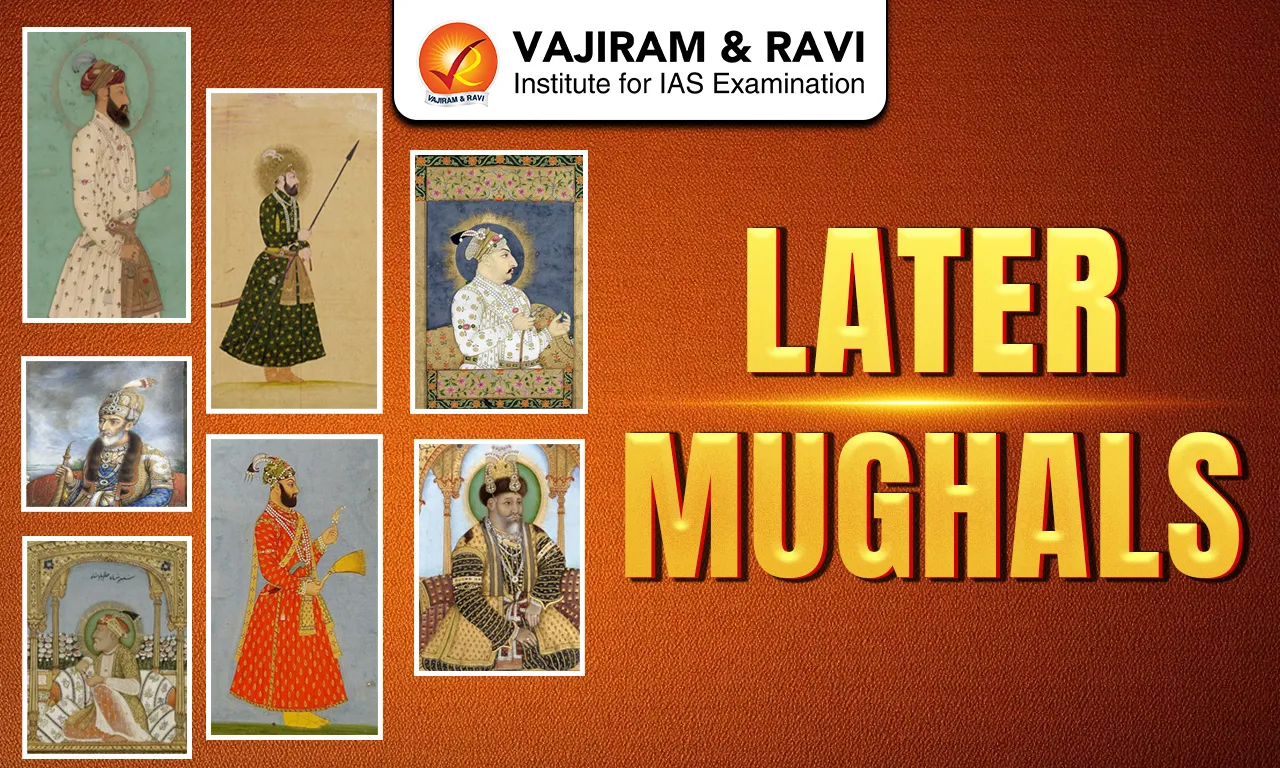
The period of the Later Mughals (1707-1858) marks the gradual disintegration of one of India’s greatest empires. After the death of Aurangzeb in 1707 CE, the Mughal Empire entered a phase of political instability, weak leadership, and regional fragmentation. This era is often contrasted with the earlier “Great Mughals” and is characterized by declining central authority, rise of regional powers, and increasing interference of foreign invaders and European trading companies.
1. Bahadur Shah I / Shah Alam I / Muazzam (1707-1712)
- Ascended the throne at the age of 63 after the death of Aurangzeb following a war of succession.
- Adopted a liberal and conciliatory policy towards nobles by granting jagirs and promotions, which weakened the financial condition of the empire.
- Real administrative power was largely exercised by his wazir Zulfiqar Khan, indicating declining imperial authority.
- Followed a policy of religious tolerance, but did not abolish jizya, showing a balanced but cautious approach.
- Recognized the independence of Marwar and Mewar, but failed to secure their full loyalty to the Mughal cause.
- Adopted a half-hearted policy towards the Marathas:
- Released Shahu but did not recognize him as the rightful ruler
- Granted Sardeshmukhi but denied Chauth, leading to dissatisfaction
- Continued conflicts with Marathas, who also fought among themselves
- Allied with Jat chief Churaman and Chhatrasal against the Sikhs
- Granted high mansab to Guru Gobind Singh
- Faced rebellion from Banda Singh Bahadur
- Died in 1712 during a campaign against Banda Bahadur
- Nicknamed “Shah-i-Bekhabar” by historian Khafi Khan
2. Jahandar Shah (1712-1713)
- First “puppet ruler” of the Mughal Empire, marking the rise of nobles as kingmakers
- Dependent on wazir Zulfiqar Khan, who controlled administration
- Zulfiqar Khan’s policies:
- Established friendly relations with Marathas, Rajputs, and Hindu chiefs
- Abolished jizya and promoted Hindu nobles
- Granted titles:
- “Maharaja” to Ajit Singh (Marwar)
- “Mirza Raj Sawai” to Jai Singh of Amber
- Granted Chauth and Sardeshmukhi to Marathas
- Continued suppression of Sikhs under Banda Bahadur
- Introduced Ijarah system (revenue farming), which led to peasant exploitation
- Tried to improve finances by:
- Controlling jagir grants
- Enforcing troop quotas for mansabdars
- Court dominated by his favourite Lal Kanwar, showing moral and political decline
- Defeated by Farrukh Siyar


3. Farrukh Siyar (1713-1719)
- Farrukh Siyar came to power with help of the Sayyid Brothers:
- Abdullah Khan (Wazir)
- Hussain Ali Khan (Mir Bakshi)
- Sayyid Brothers became powerful “kingmakers”
- Executed Zulfiqar Khan and dominated administration
- Followed a policy of reconciliation:
- Made peace with Marathas, Rajputs, Jats
- Suppressed Sikh revolt; executed Banda Singh Bahadur
- Issued 1717 Farman granting major trade privileges to East India Company:
- Duty-free trade in Bengal
- Strengthened British economic power
- Abolished jizya and pilgrimage taxes
- Conflict with Sayyid Brothers:
- Attempted to overthrow them multiple times
- Failed due to their military and political strength
- In 1719, Sayyid Brothers allied with Balaji Vishwanath
- Farrukh Siyar was killed by Sayyid Brothers
4. Rafi-ud-Darajat (1719)
- Installed by Sayyid Brothers as a puppet ruler
- One of the three short-lived emperors in 1719
- Reign lasted only a few months
- Faced rebellion by Nikusiyar, grandson of Aurangzeb
- Died due to ill health
5. Rafi-ud-Daulah / Shah Jahan II (1719)
- Rafi-ud-Daulah was the brother of Rafi-ud-Darajat
- Also controlled by Sayyid Brothers
- Hussain Ali Khan suppressed Nikusiyar’s revolt
- Died shortly due to tuberculosis
- Another example of political instability and puppet rule
6. Muhammad Shah (1719-1748)
- Original name Roshan Akhtar, grandson of Bahadur Shah I, ascended the throne in 1719 during a period of political instability and puppet rulers.
- Initially remained under the control of the Sayyid Brothers (kingmakers), who dominated Mughal administration and decision-making.
- In 1720, he overthrew the Sayyid Brothers with the help of Nizam-ul-Mulk, Chin Qilich Khan, and Muhammad Amin Khan, and ended their dominance after the assassination of Hussain Ali Khan.
- Known for his indulgence in music, dance (especially Kathak), and courtly pleasures, which earned him the title “Rangeela” (colourful).
- The Mughal court became a centre of cultural activities, art, and literature, leading to a revival of Hindustani classical music, despite declining political strength.
- Failed to manage powerful nobles, resulting in the rise of semi-independent regional states such as Hyderabad under Nizam-ul-Mulk, Awadh under Saadat Khan, and Bengal under Murshid Quli Khan.
- These provinces remained nominally under Mughal authority but functioned independently in practice, weakening the empire’s unity.
- The Mughal military became inefficient, undisciplined, and outdated, with a declining mansabdari system and lack of proper leadership and coordination.
- The most significant event of his reign was the invasion of Nadir Shah in 1739, which marked a major turning point in Mughal decline.
- Causes of invasion included breakdown of diplomatic relations, shelter given to Afghan rebels, detention of Persian envoys, and internal disunity among Mughal nobles.
- Nadir Shah captured key regions like Kabul, Peshawar, and Lahore, and decisively defeated the Mughal army in the Battle of Karnal.
- Muhammad Shah was forced to surrender and accompany Nadir Shah to Delhi, where a massive massacre and plunder took place.
- The Persian army looted enormous wealth including the Kohinoor diamond and Peacock Throne, severely damaging the Mughal treasury.
- The invasion resulted in huge economic loss, population suffering, and complete humiliation of the Mughal Empire.
- He was compelled to cede territories west of the Indus River, reducing Mughal territorial control.
- The invasion exposed the empire’s weaknesses to rising powers like the Marathas and foreign entities such as the East India Company.
- Overall, his period accelerated the decline of centralized authority, couraged the rise of regional kingdoms, and paved the way for British political expansion in India.
7. Ahmad Shah (1748-1754)
- Ascended throne (1748) as son of Muhammad Shah; lacked administrative and military ability.
- Became a puppet ruler, with real power in hands of nobles, especially Imad-ul-Mulk (wazir).
- Faced repeated invasions by Ahmad Shah Abdali, exposing Mughal military weakness.
- Lost Punjab and Multan to Abdali, leading to major territorial decline.
- Marathas expanded and captured Malwa and Bundelkhand, reducing Mughal influence further.
- Marked by court intrigues, factionalism, and weak governance, causing administrative collapse.
- Deposed, blinded, and imprisoned by Imad-ul-Mulk, symbol of complete decline of Mughal authority.
8. Alamgir II (1754-1759)
- Ascended throne (1754) after the deposition of Ahmad Shah Bahadur; placed on throne by Imad-ul-Mulk (wazir), a puppet ruler.
- Real authority remained with Imad-ul-Mulk, reflecting extreme decline of central power.
- Faced repeated invasions by Ahmad Shah Abdali, further weakening the empire.
- During his reign, the Battle of Plassey took place, enabling the East India Company to gain control over Bengal.
- Mughal Empire suffered from political instability, foreign invasions, and loss of territories.
- Emperor had no real administrative or military control, reduced to a symbolic figure.
- Murdered by Imad-ul-Mulk (1759), highlights the dominance of nobles and collapse of imperial authority.
9. Shah Alam II (1759-1806)
- Ascended throne (1759) as Ali Gauhar during a period of extreme Mughal decline and instability.
- Faced conflict with nobles; fled to Awadh (1761–1764) due to lack of control over Delhi.
- His reign saw the Third Battle of Panipat between Marathas and Ahmad Shah Abdali.
- Defeated in the Battle of Buxar against the East India Company.
- Under the Treaty of Allahabad (1765), granted Diwani rights of Bengal, Bihar, and Orissa to the Company.
- Became the first Mughal emperor to receive a pension from the East India Company, showing loss of sovereignty.
- Mughal authority reduced to Delhi region only reflected in saying “Kingdom from Delhi to Palam”.
10. Akbar II (1806-1837)
- Ascended the throne (1806) as the son of Shah Alam II, during a time when Mughal power was almost nominal.
- Functioned under the protection and control of the East India Company, with no real political authority.
- In 1835, the Company stopped issuing coins in the Mughal emperor’s name, symbolizing the end of Mughal sovereignty.
- Conferred the title “Raja” on Raja Ram Mohan Roy and sent him as an ambassador to Britain.
- Known for promoting Hindu-Muslim unity, associated with the Phool Walon Ki Sair festival.
- A patron of poetry and culture, though politically weak.
- His reign reflects the stage where the Mughal emperor was merely a symbolic figure under British dominance.
11. Bahadur Shah II (1837-1858)
- Ascended the throne (1837) as the son of Akbar II; the last Mughal emperor with only nominal authority under the East India Company.
- A distinguished poet, calligrapher, and patron of culture, wrote under the pen name “Zafar”.
- Had no real political or military power; authority limited mainly to Red Fort (Delhi).
- Became the symbolic leader of the Revolt of 1857, as rebels sought legitimacy under the Mughal name.
- After suppression of the revolt, he was captured by the British, and his sons were executed.
- Exiled to Rangoon (Myanmar) in 1858, marking the formal end of Mughal rule in India.
- Died in 1862 in exile, symbolizing the complete collapse of the Mughal Empire.
Causes of Decline of Mughal Empire
The decline of the Mughal Empire began after the death of Aurangzeb in 1707, when strong centralized control weakened and internal conflicts intensified. Over time, administrative inefficiency, economic crisis, regional revolts, and foreign invasions led to the gradual collapse of imperial authority.
- Responsibility of Aurangzeb’s Policies
-
- Over-expansion of the empire made administration difficult.
- Continuous Deccan campaigns drained treasury and resources.
- Religious policies created discontent among Sikhs, Jats, and Rajputs.
- Weak Successors
- Later rulers lacked leadership and administrative ability.
- Focus shifted to luxury and court pleasures instead of governance.
- Central authority weakened rapidly.
- Rise of Powerful Nobles
- Nobles became “kingmakers” and controlled emperors.
- Formation of factions and court intrigues destabilized administration.
- Many nobles established independent states.
- Military Weakness
- Army became undisciplined, outdated, and inefficient.
- Mansabdari system weakened loyalty to the emperor.
- Lack of modern weapons and poor coordination.
- Financial Crisis
- Empty treasury due to wars and lavish lifestyle of rulers.
- Decline in agriculture and trade revenue.
- Excessive jagir grants reduced state income.
- Rise of Regional Powers
- Emergence of Marathas, Sikhs, Jats challenged Mughal authority.
- Provinces like Hyderabad, Awadh, Bengal became independent.
- Foreign Invasions
- Invasion of Nadir Shah (1739) devastated Delhi and treasury.
- Repeated invasions by Ahmad Shah Abdali weakened northern India.
- Growth of European Powers
- East India Company gained economic and political power.
- Superior naval strength and trade control helped Europeans dominate India.
- Administrative Weakness
- Corruption, inefficiency, and lack of control over provinces.
- Communication and coordination problems in a vast empire.
Rise of Regional Powers
The decline of the Mughal Empire after the death of Aurangzeb led to the weakening of central authority and inability to control distant provinces. This resulted in the emergence of powerful regional states that asserted independence while the Mughal emperor became only a nominal ruler.
States Formed by Former Mughal Nobles
- These states were founded by powerful Mughal governors (subedars) and mansabdars who took advantage of imperial weakness.
- They maintained nominal allegiance to the Mughal emperor but exercised complete administrative and military autonomy.
- Developed efficient revenue systems and strong regional administration.
- Controlled rich agricultural and trade regions, which strengthened their economic base.
Bengal (Murshid Quli Khan)
- Founded by Murshid Quli Khan, originally a Mughal diwan.
- Shifted capital from Dhaka to Murshidabad for better control.
- Introduced strict revenue reforms and increased state income.
- Became one of the richest provinces due to flourishing trade and agriculture.
- Maintained internal stability but became vulnerable to the East India Company, leading to loss after the Battle of Plassey.
Awadh (Saadat Khan)
- Founded by Saadat Khan Burhan-ul-Mulk.
- Established a strong administrative and military system.
- Controlled fertile Gangetic plains, ensuring high revenue.
- Maintained a semi-independent status while recognizing Mughal authority.
- Became a major political center and later came under British influence after the Battle of Buxar.
Hyderabad (Nizam-ul-Mulk)
- Founded by Nizam-ul-Mulk in the Deccan.
- Established Asaf Jahi dynasty with Hyderabad as capital.
- Exercised complete independence in administration while maintaining formal ties with Mughals.
- Built a powerful army and bureaucracy.
- Frequently engaged in conflicts with Marathas and other regional powers.
Watan Jagir States (Rajput States)
- These were hereditary kingdoms that had accepted Mughal suzerainty earlier.
- Enjoyed internal autonomy and governed their territories independently.
- Provided military service to the Mughals when required.
- Maintained strong regional identity and traditions.
Rajput States (Marwar, Mewar, Amber)
- Ruled by powerful Rajput clans like Rathores and Sisodias.
- Asserted independence during Mughal decline.
- Maintained diplomatic relations and occasional alliances with Mughals.
- Played a key role in regional politics of North India.
Rebellion-Based States
- Emerged through armed resistance against Mughal authority.
- Based on ethnic, regional, or religious unity.
- Became powerful military forces challenging Mughal supremacy.
Marathas
- Emerged as the strongest regional power under the Peshwas.
- Followed expansionist policy aiming at a Hindu Empire.
- Introduced systems like Chauth and Sardeshmukhi.
- Extended control over large parts of India including Malwa, Bundelkhand, and Deccan.
- Played a decisive role in weakening the Mughal Empire.
Sikhs
- Organized under leaders after Guru Gobind Singh.
- Strengthened by resistance against Mughal oppression.
- Under leaders like Banda Bahadur, challenged Mughal authority in Punjab.
- Later evolved into a powerful political force in North India.
Jats
- Peasant-based uprising turned into a regional power.
- Established control in areas around Bharatpur and Mathura.
- Played an important role in weakening Mughal authority in North India.

 Last updated on Oct, 2026
→ UPSC 2027 Notification will be released on 13 January 2027 at upsconline.nic.in.
→ Check Nobel Prize 2026 Winners List here.
→ Download PIB PRiSM Monthly Magazine 2026 here.
→ Check UPSC Monthly Current Affairs Magazine The Recitals here.
→ Check out the latest UPSC Syllabus here.
→ Download UPSC Model Answers for Mains 2026
→ UPSC Mains Question Paper 2026 is out now for Essay & GS Paper 1, 2, 3 & 4.
→ UPSC Calendar 2027 has been released.
→ Enroll in Vajiram & Ravi’s UPSC Mains Test Series 2027 for structured answer writing practice, expert evaluation, and exam-oriented feedback.
→ Join Vajiram & Ravi’s UPSC Mentorship Program 2027 for personalized guidance, strategy planning, and one-to-one support from experienced mentors.
→ Go through the UPSC Mains Previous Year Papers to enhance your preparation.
→ UPSC has released UPSC Toppers List 2025 with the Civil Services final result on its official website.
→ Also check Best UPSC Coaching in India
Later Mughals FAQs
Q1. Who were the Later Mughals?+
Q2. Who was the first ruler of the Later Mughal period?+
Q3. Why did the Mughal Empire decline after 1707?+
Q4. Who were the Sayyid Brothers?+
Q5. What was the impact of Nadir Shah’s invasion?+
Q6. Which battle marked the rise of British power in India?+
Tags: modern history