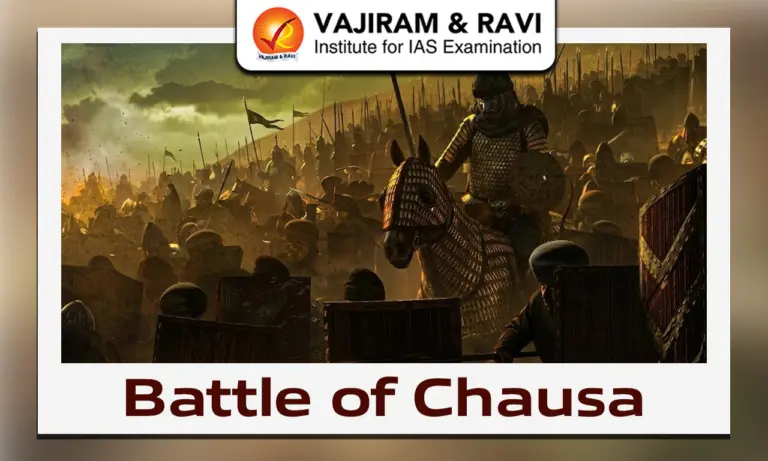
The Battle of Chausa, fought on 26 June 1539, was a decisive battle between the Mughal emperor Humayun and the Afghan ruler Sher Shah Suri near Chausa (present-day Buxar district, Bihar). It was Humayun’s first major military defeat after Babur had established the Mughal Empire in India. The battle greatly weakened Mughal authority, strengthened Sher Shah’s position, and paved the way for the rise of the Sur Empire.
Battle of Chausa Background
The Battle of Chausa was the result of the growing struggle between the Mughals and the Afghans for control over North India after the death of Babur.
When Humayun became emperor in 1530, the Mughal Empire was still new and not fully secure. Although Babur had defeated the Lodis and Rajputs, Mughal control remained weak in Bihar and Bengal, where many Afghan chiefs still held power.
Among them, Farid Khan, later known as Sher Shah Suri, emerged as the strongest leader. Through military ability, diplomacy and efficient administration, he established his control over Bihar and gradually expanded into Bengal.
By March 1538, Sher Shah had already secured the strategic Rohtasgarh Fort, where he kept his family and treasury safe. Later, in September 1538, Humayun captured Gaur, the capital of Bengal. However, instead of immediately pursuing Sher Shah, he stayed in Bengal for several months.
Sher Shah used this time wisely. He united the Afghan chiefs, strengthened his army, cut the Mughal supply routes between Agra and Bengal, and surrounded Humayun strategically. By the time Humayun started his return journey, Sher Shah held the advantage.
Causes of the Battle of Chausa
- Afghan Challenge to Mughal Rule: Sher Shah had become the most powerful Afghan leader and posed the biggest challenge to Mughal rule in eastern India.
- Humayun’s Strategic Mistakes: Humayun remained in Bengal for several months, giving Sher Shah enough time to prepare for war and strengthen his position.
- Control over Bihar and Bengal: Bihar and Bengal were rich provinces with fertile land, large revenues and important trade routes. Both sides wanted to control these regions.
- Disruption of Mughal Supply Lines: Sher Shah occupied the areas between Agra and Bengal, cutting off Humayun’s communication and supply routes.
- Struggle for Supremacy: The battle was ultimately a contest between the expanding Mughal Empire and the resurgent Afghan power under Sher Shah Suri.


Course of the Battle of Chausa
In early 1539, Humayun began his return journey from Bengal towards Agra. Sher Shah advanced quickly and blocked the Mughal army near Chausa, on the banks of the Ganga River.
For nearly three months, both armies remained camped opposite each other without fighting a major battle. Humayun hoped for negotiations, while Sher Shah patiently waited for the right opportunity to attack.
On the night of 25-26 June 1539, heavy monsoon rains flooded the Mughal camp and created confusion among the soldiers. Before dawn, Sher Shah launched a carefully planned surprise attack.
The Mughal army was completely unprepared. Afghan cavalry attacked from different directions, while the flooded ground prevented the Mughals from organising an effective defence. Many Mughal soldiers were killed, and many others drowned while trying to cross the swollen Ganga River.
Humayun narrowly escaped with the help of Nizam, a Bhisti (water carrier), who helped him cross the river. The Mughal army suffered a crushing defeat.
Outcome of the Battle of Chausa
The Battle of Chausa completely changed the political situation in North India.
- Humayun suffered his first major military defeat.
- The Mughal army lost thousands of soldiers, along with artillery and military supplies.
- Sher Shah emerged as the most powerful ruler in North India.
- The victory paved the way for the establishment of the Sur Empire, which was firmly consolidated after the Battle of Kannauj (1540).
- Mughal authority weakened significantly, forcing Humayun onto the defensive.
Significance of the Battle of Chausa
The Battle of Chausa was one of the turning points in medieval Indian history. It showed that better planning, leadership and military strategy could defeat a larger imperial army.
- Rise of the Sur Empire: The victory transformed Sher Shah Suri from a powerful Afghan chief into the dominant ruler of North India and paved the way for the establishment of the Sur Empire.
- Temporary Decline of Mughal Power: The battle exposed Humayun’s weak leadership and temporarily displaced Mughal authority from North India until his restoration in 1555.
- Superior Military Strategy: Sher Shah’s careful planning, strong intelligence network and surprise attack proved more effective than the Mughal army’s numerical strength.
- Beginning of Major Administrative Reforms: After his victories, Sher Shah introduced important reforms in land revenue, currency, roads, postal communication and governance, many of which were later adopted and improved by Akbar.
- Road to the Battle of Kannauj: The victory at Chausa prepared the ground for the Battle of Kannauj (1540), where Humayun was decisively defeated and forced into exile.

 Last updated on Sep, 2026
→ UPSC 2027 Notification will be released on 13 January 2027 at upsconline.nic.in.
→ Check out the latest UPSC Syllabus here.
→ Download UPSC Model Answers for Mains 2026
→ UPSC Mains Question Paper 2026 is out now for Essay & GS Paper 1, 2, 3 & 4.
→ UPSC Calendar 2027 has been released.
→ Enroll in Vajiram & Ravi’s UPSC Mains Test Series 2027 for structured answer writing practice, expert evaluation, and exam-oriented feedback.
→ Join Vajiram & Ravi’s UPSC Mentorship Program 2027 for personalized guidance, strategy planning, and one-to-one support from experienced mentors.
→ Go through the UPSC Mains Previous Year Papers to enhance your preparation.
→ UPSC has released UPSC Toppers List 2025 with the Civil Services final result on its official website.
→ Also check Best UPSC Coaching in India
Battle of Chausa FAQs
Q1. Who fought the Battle of Chausa and when was it fought?+
Q2. What was the outcome of the Battle of Chausa?+
Q3. Why did Humayun lose the Battle of Chausa?+
Q4. Why is the Battle of Chausa considered a turning point in medieval Indian history?+
Q5. Which important battle followed the Battle of Chausa?+
Tags: battle of chausa