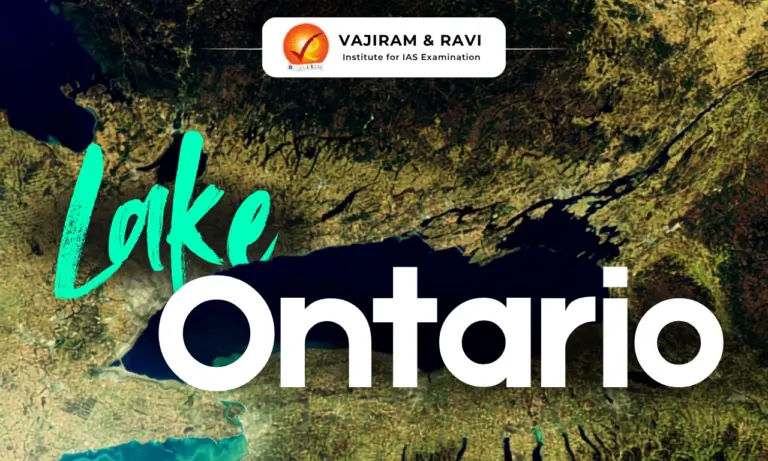
Lake Ontario is the smallest by surface area and the easternmost of North America’s five Great Lakes. It lies between Ontario, Canada and New York, United States. The lake covers 7,340 square miles (19,011 square km). It forms part of the Canada-United States boundary and drains into the Atlantic Ocean through the Saint Lawrence River.
Lake Ontario Latest News
US President Donald Trump signed an executive order on August 27, 2026, renaming the US designated portion of Lake Ontario as “Lake America”. The order applies only to federal usage in the United States. Canada and international organisations are not legally required to use the new name.
Canadian Prime Minister Mark Carney rejected the change and highlighted the lake’s Indigenous origins. New York Governor Kathy Hochul also said New York would continue using the name Lake Ontario. The controversy emerged amid an escalating US-Canada trade dispute involving tariffs and retaliatory measures.
Why has Lake Ontario Renamed?
The renaming was announced during heightened trade tensions between the United States and Canada. Trump had previously criticised Canada’s trade policies and raised the renaming idea before formally signing the executive order.
- Executive order: Trump directed that the lake be designated “Lake America” for US federal geographic usage. The order has no authority over Canadian or international naming practices.
- Trade tensions: The decision followed the imposition of 50% US tariffs on $20 billion worth of Canadian goods. Canada responded with retaliatory tariffs covering products including steel and dairy.
- Canadian response: Carney said Canadians would continue calling it Lake Ontario.
- Shared water body: Lake Ontario is jointly shared by Canada and the United States. Its water levels and cross border uses are managed through longstanding bilateral arrangements.


Lake Ontario Features
Lake Ontario is the final Great Lake in the hydrological chain and provides the connection between the Great Lakes system and the Atlantic Ocean.
- Location: Lake Ontario lies between Ontario in Canada and New York in the United States. About 52% of its surface area is in Canada, with the remainder in New York.
- Size: The lake has a surface area of 7,340 square miles (19,011 square km). Its drainage basin covers 24,720 square miles (64,025 square km), excluding the lake surface.
- Dimensions: Lake Ontario extends about 193 miles (311 km) from east to west. Its greatest width is 53 miles (85 km).
- Depth: Its mean depth is 283 feet (86 m). The deepest point reaches 802 feet (244 m) in the Rochester Basin.
- Water volume: Lake Ontario contains about 393 cubic miles (1,640 cubic km) of water. Despite being smaller in area than Lake Erie, it has a substantially greater volume.
- Main inlet: The Niagara River is the principal source of water entering Lake Ontario. It carries water from Lake Erie into the lake.
- Other rivers: Major rivers include the Genesee, Oswego, Black, Trent, Don, Humber, Rouge, Credit, Cataraqui, Ganaraska, Little Salmon and Salmon rivers.
- Outlet: The Saint Lawrence River carries Lake Ontario’s water toward the Atlantic Ocean. The lake therefore forms the final stage of the Great Lakes water system.
- Canals: The Welland Canal connects Lake Ontario with Lake Erie. The Trent-Severn Waterway links it with Georgian Bay, while the Rideau Canal connects Kingston with Ottawa.
- Shoreline: Including its islands, Lake Ontario has a shoreline of about 712 miles (1,146 km). Important Canadian cities include Toronto, Hamilton, Kingston and St. Catharines.
- Islands: Wolfe Island is the largest island. Other notable islands include Amherst Island, Garden Island, Howe Island, Simcoe Island and the Toronto Islands.
- Navigation: Major ports include Toronto, Hamilton, Kingston, Rochester and Oswego. The lake forms an important part of the Great Lakes-Saint Lawrence navigation system.
Lake Ontario Biodiversity
Lake Ontario supports diverse freshwater ecosystems, wetlands, forests, fish populations, birds, reptiles, amphibians and numerous plant species.
- Climate: Lake Ontario usually does not completely freeze. Ice normally develops along shallow shores and sheltered bays during winter.
- Marine sanctuary: The Lake Ontario National Marine Sanctuary was designated on September 6, 2024. It covers 1,722 square miles (4,460 square km) of US waters and protects historic shipwrecks and culturally important areas.
- Wetlands: Sand bars, lagoons and wetlands provide important habitats for plants, aquatic species and migratory birds. Presqu’ile and other wetland areas are particularly important for biodiversity.
- Forests: Surrounding forests mainly contain maple, oak, beech, ash and basswood. These forests form part of the broader Great Lakes ecological region.
- Fish diversity: Lake Ontario supports an important freshwater fishery. Overfishing, pollution and invasive species have adversely affected native fish populations.
Challenges
- Pollution: Agricultural fertilisers, municipal sewage, industrial chemicals and urban drainage have placed significant environmental pressure on the lake.
- Algal blooms: Increased pollution during the 1960s and 1970s caused frequent summer algal blooms. These events resulted in major fish deaths and shoreline accumulation of decomposing algae.
- Wetland threats: Stabilised water levels can reduce wetland diversity. Invasive cattails can also replace native plants and reduce habitat quality.
- Forest loss: Extensive deforestation around the lake reduced forest habitat and affected birds, native salmon and sediment movement into the lake.

 Last updated on August, 2026
→ UPSC Mains 2026 commenced on 21st August 2026 and will continue through 30th August 2026, as per the official examination schedule.
→ UPSC Mains Question Paper 2026 is out now for Essay & GS Paper 1, 2, 3 & 4.
→ UPSC Mains GS Paper 1 2026 is out now.
→ UPSC Mains GS Paper 2 2026 is out now.
→ UPSC Mains GS Paper 3 2026 is out now.
→ UPSC Mains GS Paper 4 2026 is out now.
→ Check out the latest UPSC Syllabus 2026 here.
→ UPSC Mains Admit Card 2026 is now out.
→ Enroll in Vajiram & Ravi’s UPSC Mains Test Series 2027 for structured answer writing practice, expert evaluation, and exam-oriented feedback.
→ Join Vajiram & Ravi’s UPSC Mentorship Program 2027 for personalized guidance, strategy planning, and one-to-one support from experienced mentors.
→ Go through the UPSC Mains Previous Year Papers to enhance your preparation.
→ Download UPSC Mains Essay Paper 2025, UPSC Mains GS Paper-I 2025, UPSC Mains GS Paper-II 2025, UPSC Mains GS Paper-III 2025, UPSC Mains GS Paper-IV 2025, UPSC Mains English (Compulsory) Paper 2025, UPSC Mains Hindi (Qualifying) Paper 2025 here.
→ UPSC has released UPSC Toppers List 2025 with the Civil Services final result on its official website.
→ UPSC Calendar 2027 has been released.
→ Also check Best UPSC Coaching in India
Lake Ontario FAQs
Q1. Where is Lake Ontario located?+
Q2. Why was Lake Ontario renamed Lake America?+
Q3. Which is the smallest among the Great Lakes?+
Q4. What is the new name of Lake Ontario in the United States?+
Q5. Which river flows out of Lake Ontario?+
Q6. Which river flows into Lake Ontario?+
Tags: geography great lakes lake ontario largest lakes in the world