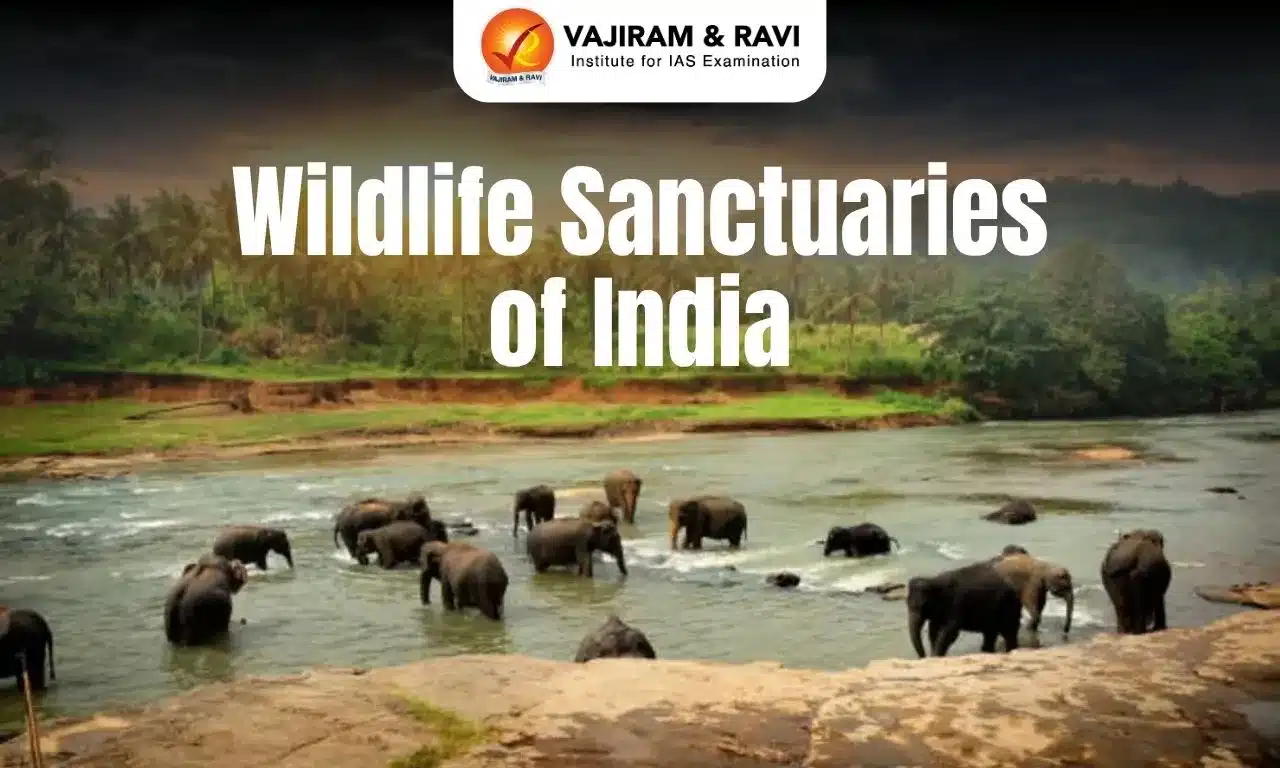
Wildlife Sanctuaries of India 2026 are special places where animals can live safely without human interference. These protected areas are designed to keep the natural habitats of animals safe, where activities like hunting, poaching, and trapping are strictly forbidden. India is home to a wide variety of these protected spaces, from lush forests and dense jungles to riverbanks and majestic mountains. Each sanctuary reflects the country’s commitment to preserving its incredible wildlife and diverse landscapes.
Wildlife Sanctuaries in India 2026
Wildlife Sanctuaries in India is a specially protected area dedicated to the preservation of both flora and fauna. These sanctuaries are established as natural habitats where tourism is typically restricted, focusing on undisturbed conservation. The inception of these protected zones began with the Wildlife Protection Act of 1947, with further reinforcements introduced through the Wildlife (Protection) Act of 1972, which empowered state governments to officially designate ecologically significant regions as sanctuaries.
Wildlife Sanctuaries in India Establishment
The legal framework for the establishment and management of the Wildlife Sanctuaries of India has been discussed below:
- Wildlife Sanctuaries are notified by State Governments under the Wildlife (Protection) Act 1972 to conserve wild animals, habitats, and biodiversity.
- Constitutional backing is provided through Article 48A and Article 51A(g), making wildlife protection a State duty and citizen responsibility.
- Entry, hunting, exploitation of wildlife, forest produce removal, and setting fires are strictly regulated or prohibited.
- Certain traditional rights of local communities may continue, and relocation is not compulsory.
- Sanctuaries are managed by State Forest Departments under the Chief Wildlife Warden.
- Eco-Sensitive Zones may be declared around sanctuaries to control developmental activities.
- Violations attract penalties including imprisonment and fines, with stricter punishment for offences involving endangered species.


How many Wildlife Sanctuaries in India 2026?
As of 2026, India hosts approximately 573 wildlife sanctuaries that collectively cover a vast area of conservation. Among these, some are designated as tiger reserves, primarily serving as safe place for Bengal tigers. Classified under IUCN Category IV, these sanctuaries aim to safeguard ecosystems with high ecological, geomorphologic, and natural significance, reinforcing India’s commitment to wildlife preservation.
The following table provides an updated List of Wildlife Sanctuaries of India, specifying their respective states and union territories along with the area they cover.
| Total Wildlife Sanctuaries of India State Wise 2026 | |||||
|
S.No. |
State & UT |
State Area (km²) |
No. of Wildlife Sanctuary |
Area (km²) |
% of State Area |
|
1. |
Andhra Pradesh |
160229 |
13 |
6771.40 |
4.23 |
|
2. |
Arunachal Pradesh |
83743 |
13 |
7614.56 |
9.09 |
|
3. |
Assam |
78438 |
17 |
1728.95 |
2.20 |
|
4. |
Bihar |
94163 |
12 |
2851.67 |
3.03 |
|
5. |
Chhattisgarh |
135191 |
11 |
3760.28 |
2.78 |
|
6. |
Goa |
3702 |
6 |
647.91 |
17.50 |
|
7. |
Gujarat |
196022 |
23 |
16618.42 |
8.48 |
|
8. |
Haryana |
44212 |
7 |
118.21 |
0.27 |
|
9. |
Himachal Pradesh |
55673 |
28 |
6115.97 |
10.99 |
|
10. |
Jharkhand |
79714 |
11 |
1955.82 |
2.45 |
|
11. |
Karnataka |
191791 |
38 |
8216.69 |
4.28 |
|
12. |
Kerala |
38863 |
18 |
2156.21 |
5.55 |
|
13. |
Madhya Pradesh |
308245 |
24 |
7046.19 |
2.29 |
|
14. |
Maharashtra |
307713 |
49 |
7861.70 |
2.55 |
|
15. |
Manipur |
22327 |
7 |
708.14 |
3.17 |
|
16. |
Meghalaya |
22429 |
4 |
94.11 |
0.42 |
|
17. |
Mizoram |
21081 |
9 |
1359.75 |
6.45 |
|
18. |
Nagaland |
16579 |
4 |
43.91 |
0.26 |
|
19. |
Odisha |
155707 |
19 |
7094.65 |
4.56 |
|
20. |
Punjab |
50362 |
13 |
326.60 |
0.65 |
|
21. |
Rajasthan |
342239 |
25 |
5592.38 |
1.63 |
|
22. |
Sikkim |
7096 |
7 |
399.10 |
5.62 |
|
23. |
Tamil Nadu |
130058 |
33 |
7096.54 |
5.46 |
|
24. |
Telangana |
114840 |
9 |
5672.70 |
4.94 |
|
25. |
Tripura |
10486 |
4 |
603.64 |
5.76 |
|
26. |
Uttar Pradesh |
240928 |
26 |
5822.20 |
2.42 |
|
27. |
Uttarakhand |
53483 |
7 |
2690.12 |
5.03 |
|
28. |
West Bengal |
88752 |
16 |
1440.18 |
1.62 |
|
29. |
Andaman & Nicobar |
8249 |
97 |
395.60 |
4.80 |
|
30. |
Chandigarh |
114 |
2 |
26.01 |
22.82 |
|
31. |
Dadra & Nagar Haveli |
491 |
1 |
92.17 |
18.77 |
|
32. |
Daman & Diu |
112 |
1 |
2.19 |
1.96 |
|
33. |
Delhi |
1483 |
1 |
19.61 |
1.32 |
|
34. |
Jammu & Kashmir |
163090 |
14 |
1815.04 |
1.11 |
|
35. |
Ladakh |
59146 |
2 |
9000.00 |
15.22 |
|
36. |
Lakshadweep |
32 |
1 |
0.01 |
0.03 |
|
37. |
Puducherry |
480 |
1 |
3.90 |
0.81 |
|
|
TOTAL |
3287263 |
573 |
123762.56 |
3.76 |
Wildlife Sanctuaries of India Map
The Wildlife Sanctuaries of India Map highlights the locations of over 570 Wildlife Sanctuaries across India including deserts and wetlands to forests and mangroves. Major clusters are visible in states like Andhra Pradesh, Assam, Gujarat, Kerala, and Madhya Pradesh, as well as the Andaman & Nicobar Islands.
Top 10 Largest Wildlife Sanctuaries in India 2026
| Top 10 Largest Wildlife Sanctuaries in India 2026 | |||
|---|---|---|---|
| Rank | Wildlife Sanctuary | Area (km²) | Location |
| 1 | Kutch Desert Wildlife Sanctuary | 7,506.22 | Gujarat |
| 2 | Indian Wild Ass Sanctuary | 4,954 | Gujarat |
| 3 | Desert National Park | 3,162 | Rajasthan |
| 4 | Great Indian Bustard Sanctuary | 1,222 | Maharashtra |
| 5 | Achanakmar Wildlife Sanctuary | 914.02 | Chhattisgarh |
| 6 | Manas Wildlife Sanctuary | 950 | Assam |
| 7 | Koyna Wildlife Sanctuary | 423.55 | Maharashtra |
| 8 | Bhadra Wildlife Sanctuary | 492.46 | Karnataka |
| 9 | Nagarjunsagar–Srisailam Wildlife Sanctuary | 3,568 | Andhra Pradesh |
| 10 | Sundarbans Wildlife Sanctuary | 362.4 | West Bengal |
Top 10 Smallest Wildlife Sanctuaries in India 2026
The Top 10 Smallest Wildlife Sanctuaries in India occupy limited geographical areas but play a vital role in protecting region-specific flora and fauna. Despite their small size, they significantly contribute to biodiversity conservation, bird protection, and local ecological balance. The Mayureshwar Wildlife Sanctuary is considered as the Smallest Wildlife Sanctuary in India as of 2026.
| Top 10 Smallest Wildlife Sanctuaries in India 2026 | |||
|---|---|---|---|
| Rank | Wildlife Sanctuary | Area (km²) | Location |
| 1 | Mayureshwar Wildlife Sanctuary | 5.14 | Maharashtra |
| 2 | Bor Wildlife Sanctuary | 61.1 | Maharashtra |
| 3 | Chilika Wildlife Sanctuary | 15.53 | Odisha |
| 4 | Bondla Wildlife Sanctuary | 7.98 | Goa |
| 5 | Mahavir Swami Wildlife Sanctuary | 5.4 | Uttar Pradesh |
| 6 | Kinnerasani Wildlife Sanctuary | 635.4 | Telangana |
| 7 | Pobitora Wildlife Sanctuary | 38.8 | Assam |
| 8 | Kutch Bustard Sanctuary | 2 | Gujarat |
| 9 | Nangal Wildlife Sanctuary | 3 | Punjab |
| 10 | Thol Wildlife Sanctuary | 7 | Gujarat |
List of Wildlife Sanctuaries of India 2026 State Wise
Below is the List of major famous Wildlife Sanctuaries in India according to the states:
| Wildlife Sanctuaries of India State Wise List 2026 | ||
|
S No. |
States |
Wildlife Sanctuaries |
|
1. |
Assam |
Nambor Wildlife Sanctuary |
|
Dihing Patkai Wildlife Sanctuary |
||
|
East Karbi Anglong Wildlife Sanctuary |
||
|
Chakrashila Wildlife Sanctuary |
||
|
Amchang Wildlife Sanctuary |
||
|
2. |
Bihar |
Kaimur Wildlife Sanctuary |
|
Gautam Budha Wildlife Sanctuary |
||
|
Pant (Rajgir) Wildlife Sanctuary |
||
|
Valmiki Wildlife Sanctuary |
||
|
3. |
Chhatisgarh |
Bhairamgarh Wildlife Sanctuary |
|
Badalkhol Wildlife Sanctuary |
||
|
Bhoramdev Wildlife Sanctuary |
||
|
Udanti Wild Buffalo Wildlife Sanctuary |
||
|
4. |
Goa |
Bondla Wildlife Sanctuary |
|
Madei Wildlife Sanctuary |
||
|
5. |
Gujarat |
Kutch Desert Wildlife Sanctuary |
|
Porbandar Lake Wildlife Sanctuary |
||
|
Jambugodha Wildlife Sanctuary |
||
|
Wild Ass Wildlife Sanctuary |
||
|
Ratanmahal Wildlife Sanctuary |
||
|
Thol Lake Wildlife Sanctuary |
||
|
Sasan Gir Sanctuary |
||
|
Mitiyala Wildlife Sanctuary |
||
|
6. |
Haryana |
Bhindawas Wildlife Sanctuary |
|
N Khaparwas Wildlife Sanctuary |
||
|
Kalesar Wildlife Sanctuary |
||
|
7. |
Himachal Pradesh |
Bandli Wildlife Sanctuary |
|
Daranghati Wildlife Sanctuary |
||
|
Dhauladhar Wildlife Sanctuary |
||
|
Talra Wildlife Sanctuary |
||
|
Pong Dam Lake Wildlife Sanctuary |
||
|
Nargu Wildlife Sanctuary |
||
|
9. |
Jharkhand |
Lawalong Wildlife Sanctuary |
|
Parasnath Wildlife Sanctuary |
||
|
Palkot Wildlife Sanctuary |
||
|
10. |
Karnataka |
Someshwara Wildlife Sanctuary |
|
Bhadra Wildlife Sanctuary |
||
|
Bhimgad Wildlife Sanctuary |
||
|
Brahmagiri Wildlife Sanctuary |
||
|
Cauvery Wildlife Sanctuary |
||
|
Pushpagiri Wildlife Sanctuary |
||
|
Sharavathi Valley Wildlife Sanctuary |
||
|
11. |
Kerala |
Periyar Wildlife Sanctuary |
|
Chinnar Wildlife Sanctuary |
||
|
Aralam Wildlife Sanctuary |
||
|
Chimmony Wildlife Sanctuary |
||
|
Idukki Wildlife Sanctuary |
||
|
Malabar Wildlife Sanctuary |
||
|
12. |
Madhya Pradesh |
Bori Wildlife Sanctuary |
|
Gandhi Sagar Wildlife Sanctuary |
||
|
Ken Gharial Wildlife Sanctuary |
||
|
National Chambal Wildlife Sanctuary |
||
|
Orcha Wildlife Sanctuary |
||
|
13. |
Maharashtra |
Koyana Wildlife Sanctuary |
|
Painganga Wildlife Sanctuary |
||
|
Bhimashankar Wildlife Sanctuary |
||
|
Tungareshwar Wildlife Sanctuary |
||
|
Great Indian Bustard Wildlife Sanctuary |
||
|
14. |
Manipur |
Yangoupokpi-Lokchao Wildlife Sanctuary |
|
15. |
Meghalaya |
— |
|
16. |
Mizoram |
Dampa Wildlife Sanctuary (TR) |
|
Ngengpui Wildlife Sanctuary |
||
|
Baghmara Pitcher Plant Wildlife Sanctuary |
||
|
17. |
Nagaland |
Fakim Wildlife Sanctuary |
|
Rangapahar Wildlife Sanctuary |
||
|
18. |
Odisha |
Baisipalli Wildlife Sanctuary |
|
Chilika (Nalaban) Wildlife Sanctuary |
||
|
Hadgarh Wildlife Sanctuary |
||
|
Satkosia Gorge Wildlife Sanctuary |
||
|
19. |
Punjab |
Abohar Wildlife Sanctuary |
|
Harike Lake Wildlife Sanctuary |
||
|
Jhajjar Bacholi Wildlife Sanctuary |
||
|
20. |
Rajasthan |
Keoladeo Bird Sanctuary |
|
Jawahar Sagar Wildlife Sanctuary |
||
|
Mount Abu Wildlife Sanctuary |
||
|
Ramsagar Wildlife Sanctuary |
||
|
Shergarh Wildlife Sanctuary |
||
|
21. |
Sikkim |
Fambong Lho Wildlife Sanctuary |
|
Kitam Wildlife Sanctuary (Bird) |
||
|
Maenam Wildlife Sanctuary |
||
|
22. |
Tamil Nadu |
Indira Gandhi (Annamalai) Wildlife Sanctuary |
|
Karaivetti Wildlife Sanctuary |
||
|
Pulicat Lake Wildlife Sanctuary |
||
|
Vedanthangal Wildlife Sanctuary |
||
|
Kalakad Wildlife Sanctuary |
||
|
23. |
Tripura |
Gumti Wildlife Sanctuary |
|
Rowa Wildlife Sanctuary |
||
|
Trishna Wildlife Sanctuary |
||
|
24. |
Uttarakhand |
Askot Musk Deer Wildlife Sanctuary |
|
Binsar Wildlife Sanctuary |
||
|
Govind Pashu Vihar Wildlife Sanctuary |
||
|
Kedarnath Wildlife Sanctuary |
||
|
Sonanadi Wildlife Sanctuary |
||
|
25. |
Uttar Pradesh |
Hastinapur Wildlife Sanctuary |
|
Ranipur Wildlife Sanctuary |
||
|
Sohagibarwa Wildlife Sanctuary |
||
|
Sur Sarovar Wildlife Sanctuary |
||
|
Chandraprabha Wildlife Sanctuary |
||
|
National Chambal Wildlife Sanctuary |
||
|
26. |
West Bengal |
Sunderbans Wildlife Sanctuary |
|
Chintamani Kar Bird Sanctuary |
||
|
Haliday Island Wildlife Sanctuary |
||
|
Ballavpur Wildlife Sanctuary |
||
|
Lothian Island Wildlife Sanctuary |
||
|
Mahananda Wildlife Sanctuary |
||
List of Wildlife Sanctuaries in India UT Wise List 2026
Below is the List of important Wildlife Sanctuaries in India according to the Union Territory.
| Wildlife Sanctuaries of India Union Territory List 2026 | ||
|
S No. |
UTs |
Wildlife Sanctuary |
|
1. |
Andaman and Nicobar Islands |
Bamboo Island Wildlife Sanctuary |
|
Barren Island Wildlife Sanctuary |
||
|
Chanel Island Wildlife Sanctuary |
||
|
Peacock Island Wildlife Sanctuary |
||
|
Turtle Islands Wildlife Sanctuary |
||
|
2. |
Jammu & Kashmir |
Gulmarg Wildlife Sanctuary |
|
Limber Wildlife Sanctuary |
||
|
Nandini Wildlife Sanctuary |
||
|
3. |
Lakshadweep |
Pitti Wildlife Sanctuary (Bird) |
|
4. |
Dadra Nagar Haveli and Daman and Diu |
Dadra & Nagar Haveli Wildlife Sanctuary |
|
Fudam Wildlife Sanctuary |
||
Wildlife Sanctuary in India Importance
Wildlife Sanctuaries of India serve as indispensable sanctuaries not only for animals but also for entire ecosystems. Acting as protected areas, these sanctuaries shield endangered species, natural landscapes, and even indigenous cultures from external threats. As vital resources for both nature and humanity, their conservation is crucial.
Protecting Endangered Species
Relocating endangered species is both costly and challenging, which is why preserving them in their natural habitat is essential. Sanctuaries enable these species to survive in an environment free from the risks of poaching and habitat destruction. Here, under the careful watch of sanctuary staff, species can breed, adapt, and grow their populations naturally. For researchers and biologists, sanctuaries provide a unique opportunity to study animal behaviors in a natural setting without disrupting their way of life.
Safeguarding Landscapes and Ecosystems
With urban expansion on the rise, natural forests are increasingly under threat. Wildlife Sanctuaries in India combat this trend by protecting forested areas and allowing natural landscapes to flourish. From dense forests to serene rivers, valleys, and waterfalls, these protected zones maintain essential features of our environment.
Preserving Indigenous Cultures
For many indigenous tribes, sanctuaries represent both home and heritage. Certain tribes, such as Odisha’s Saara Adivasis, have coexisted with nature for centuries, sustaining forest ecosystems through traditional practices. Sanctuaries not only protect the biodiversity within them but also help preserve these communities’ cultures and ways of life. Free from the pressures of urban development, these tribes can continue their customs, which, in turn, support forest conservation.
Conserving Biodiversity
Human activity has posed significant threats to global biodiversity. Sanctuaries offer a haven where ecosystems can exist without interference. Often described as in-situ conservation, sanctuaries maintain the natural balance, supporting ecosystems in their original configuration, thereby aiding species diversity and ecological health.
Promoting Ecotourism
Ecotourism has grown as more people seek meaningful travel experiences that support environmental conservation. Wildlife Sanctuaries in India provide a setting where people can observe animals in their natural, cage-free surroundings, often with their young, unhindered by the limitations of captivity. The revenue generated from ecotourism supports conservation efforts and aids in sanctuary development, creating a cycle where tourism funds the very habitats tourists come to appreciate.

 Last updated on Sep, 2026
→ UPSC 2027 Notification will be released on 13 January 2027 at upsconline.nic.in.
→ Check out the latest UPSC Syllabus here.
→ Download UPSC Model Answers for Mains 2026
→ UPSC Mains Question Paper 2026 is out now for Essay & GS Paper 1, 2, 3 & 4.
→ UPSC Calendar 2027 has been released.
→ Enroll in Vajiram & Ravi’s UPSC Mains Test Series 2027 for structured answer writing practice, expert evaluation, and exam-oriented feedback.
→ Join Vajiram & Ravi’s UPSC Mentorship Program 2027 for personalized guidance, strategy planning, and one-to-one support from experienced mentors.
→ Go through the UPSC Mains Previous Year Papers to enhance your preparation.
→ UPSC has released UPSC Toppers List 2025 with the Civil Services final result on its official website.
→ Also check Best UPSC Coaching in India
Wildlife Sanctuaries in India FAQs
Q1. How many wildlife sanctuaries are there in India as of 2026?+
Q2. Which is the 1st wildlife sanctuary in India?+
Q3. Which is the largest wildlife sanctuary of India?+
Q4. Which is the famous wildlife sanctuary in India?+
Q5. Which is the largest wildlife sanctuary in the world?+
Tags: protected area network wildlife sanctuaries of india