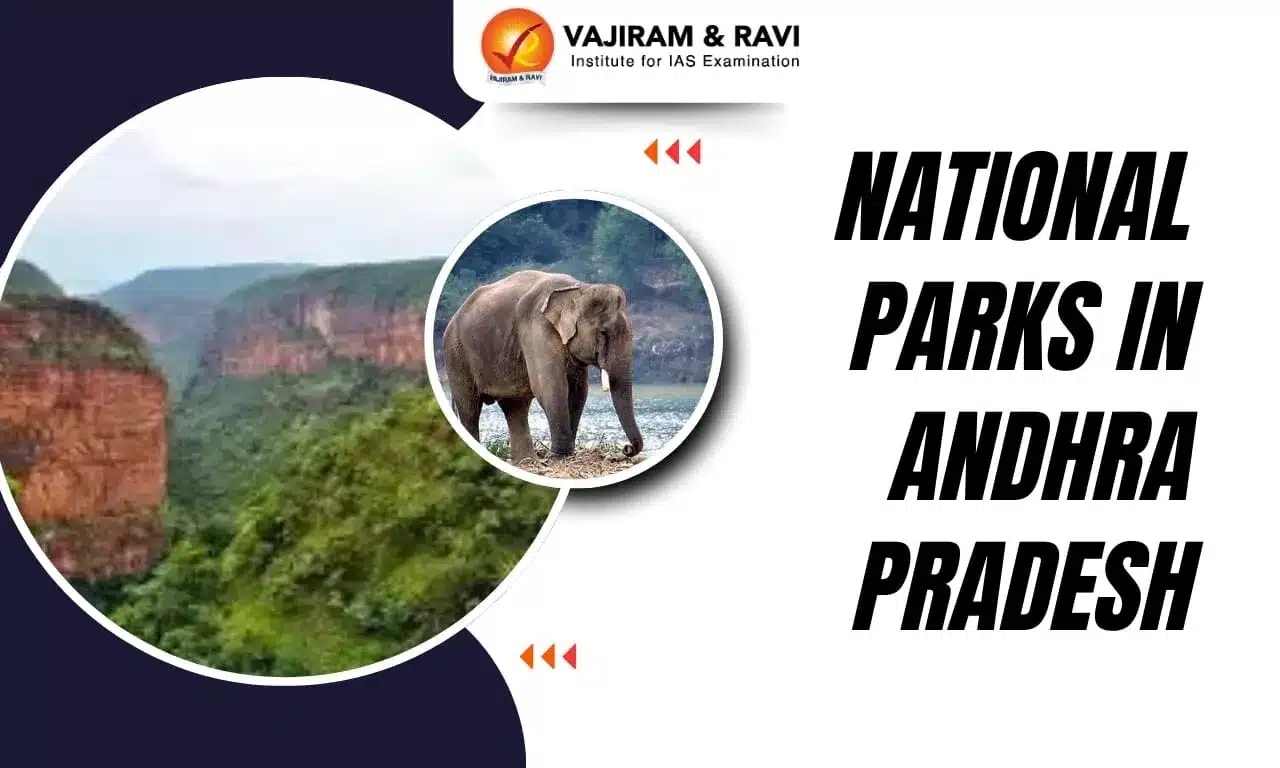
National Parks in Andhra Pradesh are the regions established to conserve wildlife, forests, landscapes and ecological systems. In India, they are governed under the Wild Life Protection Act 1972. These areas restrict human activities to protect endangered species, fragile habitats, and biodiversity hotspots. National Parks in India offer the highest protection level, while sanctuaries allow limited human use. Protected areas also support climate regulation, water security, ecological balance, scientific research, and long-term conservation of flora and fauna.
Protected Areas in Andhra Pradesh
Andhra Pradesh hosts diverse protected ecosystems across Eastern Ghats, coastal wetlands, riverine forests, and dry deciduous landscapes.
- National Parks: Strictly protected ecosystems conserving core biodiversity and endangered species.
- Tiger Reserves: Large landscapes managed under Project Tiger for Bengal tiger conservation.
- Wildlife Sanctuaries: Protected habitats allowing regulated human activities for conservation.
- Ramsar Sites: Internationally important wetlands conserving migratory birds and freshwater ecosystems.
National Parks in Andhra Pradesh
Andhra Pradesh has three National Parks representing hill forests, river valleys, and dry deciduous ecosystems. These parks are located in Eastern Ghats and central plains, protecting rare flora, large mammals, reptiles, birds, and endemic species. They play a critical role in conserving fragile hill ecosystems, wildlife corridors, riverine biodiversity, and endemic plant species. The National Parks include Papikonda National Park, Sri Venkateswara National Park, and Rajiv Gandhi National Park, each unique in geography, biodiversity, and ecological importance.

Papikonda National Park
Papikonda National Park lies in the northern Eastern Ghats along the Godavari River, covering rugged hills, valleys, and rich forest ecosystems with high biodiversity significance.
- Location and Area: Situated in East and West Godavari districts, covering 1,012.86 square kilometres.
- Elevation Gradient: Altitude ranges from 20 to 850 metres, creating diverse micro-habitats.
- River System: Godavari River bisects the park, acting as a major biogeographic divider.
- Climate Conditions: Annual rainfall averages 1,168 mm with temperatures rising to 47°C in summer.
- Forest Types: Southern tropical moist deciduous, semi-evergreen, and dry deciduous forests dominate.
- Floral Diversity: Home to 31 red-listed plant species and 96 wild crop relatives.
- Unique Fauna: Hosts the rare dwarf goat breed locally known as “kanchu mekha”.
- Mammals: Supports tiger, leopard, hyena, gaur, sambar, chital, barking deer, and chowsingha.
- Avifauna: Records 92 bird species including peacock and red jungle fowl.
- Reptiles: Includes king cobra, Indian python, freshwater crocodile, and golden gecko.
Rajiv Gandhi National Park
Rajiv Gandhi National Park, also called Rameswaram National Park, is a small urban-proximate protected forest located in Kadapa district.
- Geographic Location: Located within Proddatur town amidst Veligonda and Yerramala hill extensions.
- Area Coverage: Spreads across only 2.3 square kilometres, making it Andhra Pradesh’s smallest park.
- Forest Type: Dominated by tropical dry deciduous vegetation with sandy soils.
- Plant Diversity: Contains over 25 plant species including Dalbergia sissoo and Gymnema sylvestre.
- Invertebrates: Rich insect life including scorpions, spiders, butterflies, and grasshoppers.
- Amphibians: Supports bullfrogs and common Indian toads.
- Reptiles: Includes Russell’s viper, earth boa, and common skink.
- Birds: Over 50 species like peacocks, parakeets, and little egrets.
- Mammals: Hosts spotted deer, common mongoose, and black-naped hare.
Sri Venkateswara National Park
Sri Venkateswara National Park protects ancient Eastern Ghats hill ecosystems and is Andhra Pradesh’s first declared National Park.
- Location: Spread across Seshachalam and Tirumala hills in Kadapa and Chittoor districts.
- Area Extent: Covers 353.62 square kilometres carved from a larger wildlife sanctuary.
- Declaration Status: Notified as National Park in 1989 after sanctuary declaration in 1985.
- Geological Importance: Features Nagari Quartzite and ancient Cuddapah rock formations.
- Rainfall Pattern: Receives average rainfall of 1,190 mm annually.
- Forest Types: Includes dry deciduous, moist deciduous, and red sanders-bearing forests.
- Endemic Flora: Supports red sanders, sandalwood, Cycas beddomei, and Terminalia pallida.
- Mammals: Inhabited by tiger, leopard, wolf, sloth bear, chinkara, and four-horned antelope.
- Rare Species: Golden gecko rediscovered here after nearly 100 years.
- Avifauna: Over 150 bird species recorded across valleys and hill ranges.


Tiger Reserves in Andhra Pradesh
Andhra Pradesh has one notified Tiger Reserve conserving large forest landscapes of Eastern Ghats under Project Tiger. Nagarjunsagar-Srisailam Tiger Reserve is the only tiger reserve in the state. It is dominated by dry deciduous forests, deep valleys, gorges, and plateaus and Krishna River flows through the reserve supporting aquatic biodiversity. It plays a major role in protecting Bengal tigers and prey species.
Nagarjunsagar-Srisailam Tiger Reserve
This tiger reserve is among India’s largest, spread across Eastern Ghats hill ranges of Nallamalais.
- Total Area: Covers 5,937 square kilometres including core and buffer zones.
- Core Habitat: Critical tiger habitat spans 3,721 square kilometres.
- Biodiversity Richness: Hosts over 80 mammals, 303 birds, and 54 reptiles.
- Tiger Population: Estimated between 53 and 67 tigers during 2010 assessment.
- Flora Diversity: Records 1,581 plant taxa including several endemic medicinal species.
- Conservation Measures: Uses camera traps, M-STrIPES patrolling, and tribal participation.
Wildlife Sanctuaries in Andhra Pradesh
Wildlife sanctuaries in Andhra Pradesh protect diverse ecosystems including mangroves, lakes, forests, grasslands, and river deltas. These sanctuaries conserve migratory birds, endangered mammals, reptiles, and plant species while allowing regulated human use. Spread across coastal Andhra, Rayalaseema, and Eastern Ghats, they play a vital role in wetland conservation, coastal protection, forest regeneration, and biodiversity preservation under national conservation laws.
List of Major Wildlife Sanctuaries in Andhra Pradesh
Andhra Pradesh hosts multiple wildlife sanctuaries covering wetlands, mangroves, dry forests, and hill ecosystems.
- Coringa Wildlife Sanctuary: Mangrove ecosystem in East Godavari protecting estuarine birds and crocodiles.
- Gundla Brahmeswaram Sanctuary: Largest sanctuary conserving Eastern Ghats dry deciduous forests.
- Kambalakonda Sanctuary: Urban forest near Visakhapatnam protecting hill ecosystems and wildlife.
- Koundinya Sanctuary: Only Asian elephant habitat in Andhra Pradesh located in Chittoor.
- Kolleru Sanctuary: Freshwater wetland supporting millions of resident and migratory birds.
- Krishna Sanctuary: Deltaic wetland conserving mangroves and riverine biodiversity.
- Nagarjunsagar-Srisailam Sanctuary: Part of tiger reserve protecting large mammals.
- Nelapattu Bird Sanctuary: Critical pelican breeding ground near Tirupati.
- Pulicat Lake Sanctuary: Coastal lagoon supporting migratory waterbirds.
- Rollapadu Sanctuary: Grassland habitat conserving blackbuck populations.
- Sri Lankamalleswara Sanctuary: Hill forest supporting endemic plant species.
- Sri Penusila Narasimha Sanctuary: Large forest area preserving Eastern Ghats biodiversity.
- Sri Venkateswara Sanctuary: Buffer ecosystem supporting National Park wildlife.
Ramsar Site in Andhra Pradesh
Kolleru Lake is a globally significant freshwater wetland located between Krishna and Godavari deltas. It is the only Ramsar Site present in Andhra Pradesh.
- Ramsar Status: Designated Ramsar Site in 2002 for international wetland importance.
- Lake Area: Covers 245 square kilometres with Ramsar wetland area of 302 square kilometres.
- Bird Habitat: Supports nearly 20 million migratory and resident birds seasonally.
- Migratory Species: Hosts Siberian cranes, painted storks, pelicans, flamingos, and ibises.
- Hydrology: Fed by Budameru and Tammileru streams and irrigation canals.
- Conservation Issues: Impacted by aquaculture encroachment and pollution.
- Restoration Efforts: Addressed through Operation Kolleru and Operation Kolleru-2.0 initiatives.

 Last updated on Oct, 2026
→ UPSC 2027 Notification will be released on 13 January 2027 at upsconline.nic.in.
→ Asian Games 2026 are being held in Aichi-Nagoya, Japan, from 19 September to 4 October.
→ Check Nobel Prize 2026 Winners List here.
→ Download PIB PRiSM Monthly Magazine 2026 here.
→ Check UPSC Monthly Current Affairs Magazine The Recitals here.
→ Check out the latest UPSC Syllabus here.
→ Download UPSC Model Answers for Mains 2026
→ UPSC Mains Question Paper 2026 is out now for Essay & GS Paper 1, 2, 3 & 4.
→ UPSC Calendar 2027 has been released.
→ Enroll in Vajiram & Ravi’s UPSC Mains Test Series 2027 for structured answer writing practice, expert evaluation, and exam-oriented feedback.
→ Join Vajiram & Ravi’s UPSC Mentorship Program 2027 for personalized guidance, strategy planning, and one-to-one support from experienced mentors.
→ Go through the UPSC Mains Previous Year Papers to enhance your preparation.
→ UPSC has released UPSC Toppers List 2025 with the Civil Services final result on its official website.
→ Also check Best UPSC Coaching in India
National Parks in Andhra Pradesh FAQs
Q1. How many National Parks are there in Andhra Pradesh?+
Q2. Which is the largest National Park in Andhra Pradesh?+
Q3. Which was the first National Park of Andhra Pradesh?+
Q4. Which National Parks in Andhra Pradesh are located in an urban area?+
Q5. Why are National Parks important in Andhra Pradesh?+
Tags: national parks in andhra pradesh