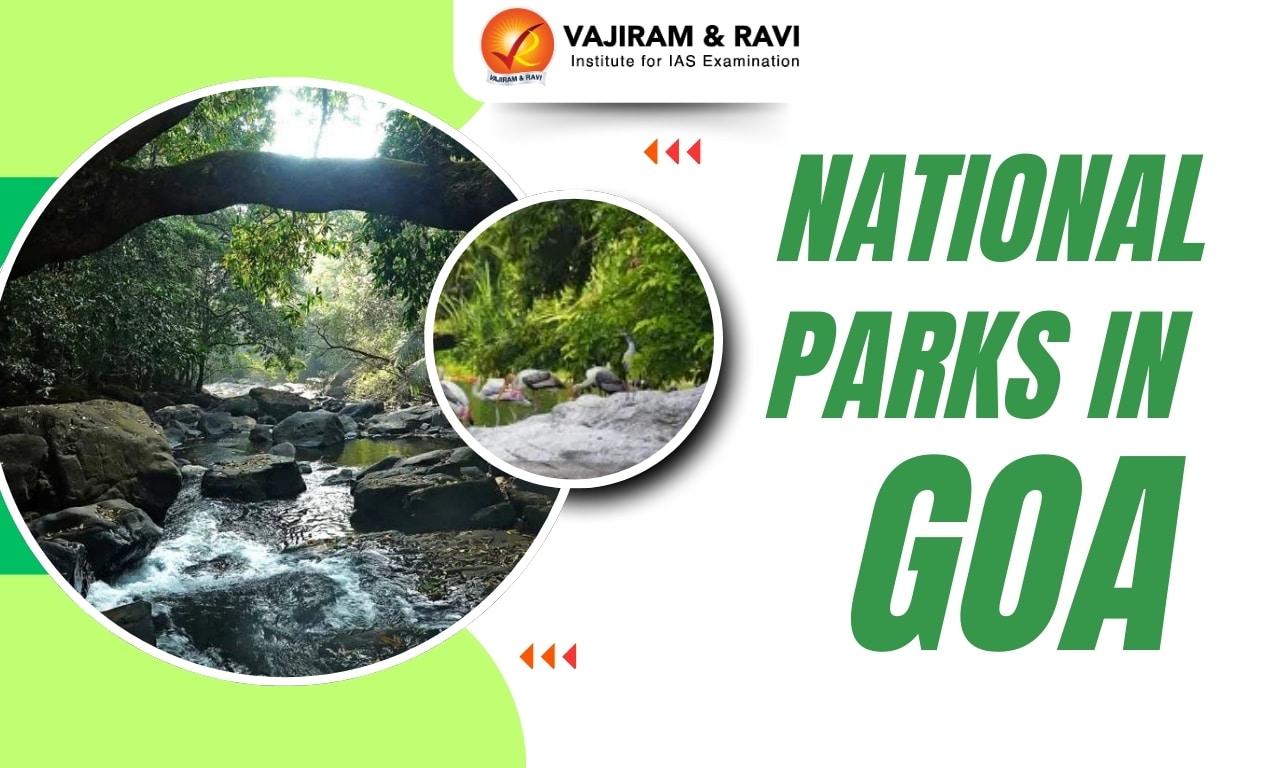
National Parks in Goa are specially protected natural areas set aside to conserve the state’s rich biodiversity and ecological systems. National Parks in India are defined under the Wild Life (Protection) Act 1972 and are IUCN Category II protected areas, meaning they are large regions maintained in their natural condition to safeguard wildlife, plants, and landscapes. No human activity such as grazing or forestry is allowed unless sanctioned for conservation purposes. These areas preserve biodiversity, protect endangered species, maintain climate stability, support river systems, and safeguard cultural and natural heritage for future generations.
Protected Areas in Goa
Goa, though India’s smallest state, has a dense network of protected forests within the Western Ghats biodiversity hotspot.
- National Parks: One notified park conserving core Western Ghats ecosystems.
- Wildlife Sanctuaries: Multiple sanctuaries protecting forests, rivers, wetlands, and fauna.
- Bird Sanctuaries: Mangrove and wetland habitats supporting resident and migratory birds.
- Ramsar Wetlands: Internationally recognized freshwater ecosystems of ecological importance.
National Parks in Goa
Goa has a single notified National Park, embedded within a larger sanctuary landscape of the Western Ghats. This park forms a crucial ecological corridor linking forests of Goa, Karnataka, and Maharashtra. It supports evergreen, semi evergreen, and moist deciduous forests, perennial rivers, waterfalls, and diverse wildlife. The park also protects cultural heritage sites, ancient temples, and traditional forest dependent communities, making it ecologically, hydrologically, and culturally significant.


Bhagwan Mahaveer (Mollem) National Park
Bhagwan Mahaveer National Park is Goa’s only National Park and its largest protected forest landscape.
- Location: Dharbandora taluk, eastern Goa, along Karnataka border.
- Area: Core national park covers 107 square kilometres.
- Total Landscape: Combined sanctuary and park span about 240 square kilometres.
- Connectivity: National Highway 4A and Mormugao-Londa railway pass through landscape.
- History: Declared wildlife sanctuary in 1969, national park notified in 1978.
- Forest Types: Tropical evergreen, semi evergreen, and moist deciduous forests dominate.
- Floral Diversity: Records 722 flowering plant species across 122 families.
- Endemism: Hosts 128 endemic plant species of Western Ghats and peninsular India.
- Rare Flora: Includes park restricted species like Glyphochloa veldkampii.
- Mammals: Leopard, Bengal tiger, gaur, sambar, wild dog, pangolin present.
- Avifauna: Greater Indian hornbill and Goa state bird thrive here.
- Reptiles: Known for king cobra and diverse venomous snake species.
- Water Resources: Multiple perennial streams ensure year round water availability.
- Waterfalls: Dudhsagar Falls stands 310 metres tall, India’s fifth highest.
- Cultural Sites: Tambdi Surla Temple dates back to Kadamba period.
- Communities: Traditional Dhangar buffalo herders depend on forest grasslands.
- Threats: Mining, transport corridors, and infrastructure expansion pressure ecosystems.
Wildlife Sanctuaries in Goa
Wildlife Sanctuaries in Goa protect diverse ecosystems ranging from mangroves and wetlands to dense evergreen forests and river valleys. Together, they form a continuous ecological corridor across the Western Ghats, supporting endangered mammals, birds, reptiles, amphibians, and insects. These sanctuaries regulate tourism, allow community presence, protect river origins, conserve sacred groves, and act as climate buffers. They are crucial for maintaining Goa’s water security, biodiversity, and ecological resilience. There are 6 sanctuaries in Goa as described below.
Bhagwan Mahavir Wildlife Sanctuary
Bhagwan Mahavir Wildlife Sanctuary surrounds the national park and forms Goa’s largest protected forest area.
- Area: Covers approximately 240 square kilometres including park landscape.
- Vegetation: Dominated by evergreen, semi evergreen, and moist deciduous forests.
- Mammals: Supports leopard, tiger, gaur, slender loris, Malabar giant squirrel.
- Bird Diversity: Habitat for hornbills, drongos, flycatchers, and endemic birds.
- Butterflies: Hosts southern birdwing, blue Mormon, and Malabar tree nymph.
- Reptiles: Famous for king cobra and Indian rock python presence.
- Hydrology: Mandovi River originates nearby, sustaining Goa’s freshwater needs.
Bondla Wildlife Sanctuary
Bondla Wildlife Sanctuary is Goa’s smallest sanctuary but a major education and rescue centre.
- Location: Northeastern Goa across Sattari, Ponda, and Sanguem talukas.
- Area: Spreads over about 7.98 square kilometres.
- Unique Feature: Houses Goa’s only zoological park.
- Rehabilitation Role: Shelters rescued leopards, bears, snakes, and conflict animals.
- Birdlife: Records over 275 bird species including Malabar trogon.
- Butterflies: Documents 91 butterfly species across five major families.
- Amphibians: Habitat for critically endangered Amboli bush frog.
Cotigao Wildlife Sanctuary
Cotigao Wildlife Sanctuary is known for tall forests and wildlife viewing infrastructure.
- Location: Canacona taluka, South Goa district.
- Established: Notified as sanctuary in 1968.
- Forest Structure: Trees reach heights of nearly 30 metres.
- Watchtower: Elevated 25 metres above waterhole for animal sightings.
- Fauna: Flying squirrel, pangolin, slender loris, mouse deer recorded.
- Bird Species: Malabar trogon, woodpeckers, velvet fronted nuthatch present.
- Tribal Presence: Velip and Kunbil communities inhabit surrounding regions.
Dr. Salim Ali Bird Sanctuary
Dr. Salim Ali Bird Sanctuary protects mangrove ecosystems vital for coastal biodiversity.
- Location: Chorão Island along Mandovi River estuary.
- Area: Covers about 178 hectares of mangrove forest.
- Habitat Type: Estuarine mangroves dominated by Rhizophora and Avicennia.
- Bird Species: Striated heron, bitterns, avocets, sandpipers recorded.
- Aquatic Life: Supports mudskippers, fiddler crabs, crustacean specialists.
- Access: Reached by ferry from Ribander to Chorão.
Madei Wildlife Sanctuary
Madei Wildlife Sanctuary forms the ecological backbone of northern Goa.
- Area: Spans about 208.5 square kilometres.
- River System: Madei River flows through, later called Mandovi.
- Biodiversity Status: Recognized as International Bird Area.
- Mammals: Tiger, leopard, sloth bear, gaur, dhole recorded.
- Bird Richness: Hosts over 255 bird species.
- Amphibians: Endemic bush frogs and caecilians documented.
- Threats: Mining, dams, and river diversion projects impact habitat.
Netravali Wildlife Sanctuary
Netravali Wildlife Sanctuary safeguards southern Goa’s forest and river origins.
- Location: South eastern Goa in Sanguem taluka.
- Area: Covers approximately 211 square kilometres.
- River Origin: Zuari River tributaries originate within sanctuary.
- Forest Types: Moist deciduous mixed with evergreen patches.
- Mammals: Leopard, gaur, four horned antelope thrive here.
- Birdlife: Hornbills, wood pigeons, laughingthrush regularly sighted.
- Ancient Ecosystems: Protects rare Myristica swamp forests.
Tiger Reserve in Goa (Proposed)
The Madei landscape is proposed as Goa’s first tiger reserve due to confirmed tiger presence and habitat continuity with Karnataka and Maharashtra reserves. Camera traps and pugmarks have recorded tigers repeatedly since 2009. The area lies within an identified tiger conservation unit of the Western Ghats. Declaring a tiger reserve would strengthen habitat protection, regulate mining and infrastructure, ensure corridor connectivity, and secure long term conservation of apex predators and associated biodiversity.
Ramsar Site in Goa (Nanda Lake)
Nanda Lake is Goa’s first internationally recognized wetland under Ramsar Convention.
- Designation Year: Declared Ramsar site in 2022.
- Habitat Type: Intermittent freshwater marsh linked to Zuari tributary.
- Birdlife: Supports ibis, jacana, kingfisher, egret, whistling duck.
- Community Value: Helps flood control, fishing, irrigation, and water storage.
- Threats: Invasive species, waste dumping, and overexploitation risks present.

 Last updated on Oct, 2026
→ UPSC 2027 Notification will be released on 13 January 2027 at upsconline.nic.in.
→ Asian Games 2026 are being held in Aichi-Nagoya, Japan, from 19 September to 4 October.
→ Check Nobel Prize 2026 Winners List here.
→ Download PIB PRiSM Monthly Magazine 2026 here.
→ Check UPSC Monthly Current Affairs Magazine The Recitals here.
→ Check out the latest UPSC Syllabus here.
→ Download UPSC Model Answers for Mains 2026
→ UPSC Mains Question Paper 2026 is out now for Essay & GS Paper 1, 2, 3 & 4.
→ UPSC Calendar 2027 has been released.
→ Enroll in Vajiram & Ravi’s UPSC Mains Test Series 2027 for structured answer writing practice, expert evaluation, and exam-oriented feedback.
→ Join Vajiram & Ravi’s UPSC Mentorship Program 2027 for personalized guidance, strategy planning, and one-to-one support from experienced mentors.
→ Go through the UPSC Mains Previous Year Papers to enhance your preparation.
→ UPSC has released UPSC Toppers List 2025 with the Civil Services final result on its official website.
→ Also check Best UPSC Coaching in India
National Parks in Goa FAQs
Q1. How many National Parks are there in Goa?+
Q2. Where is Bhagwan Mahaveer National Park located?+
Q3. Why is Bhagwan Mahaveer National Park important?+
Q4. What wildlife is found in Goa’s National Park?+
Q5. Is tourism allowed in National Parks in Goa?+
Tags: national parks in goa