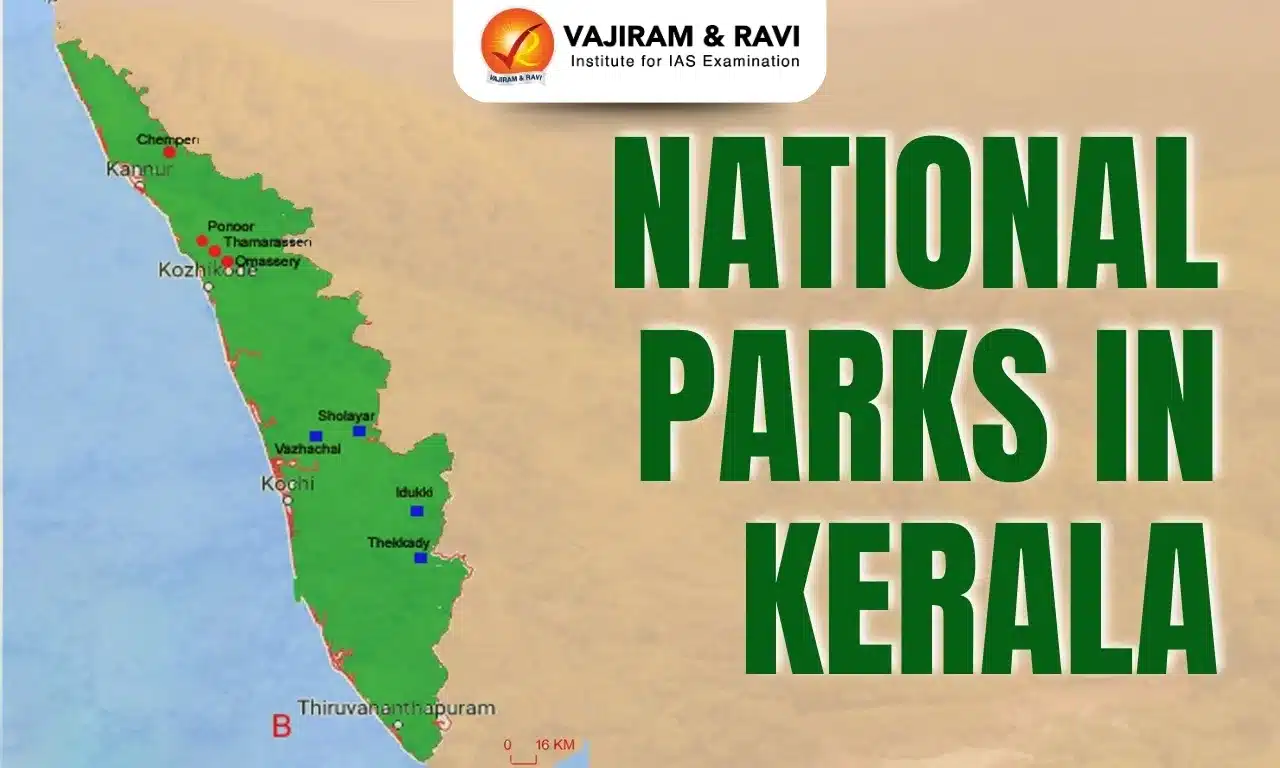
National Parks in Kerala are officially designated regions created to conserve ecosystems, wildlife, and ecological processes over the long term. In Kerala, these areas safeguard Western Ghats biodiversity, river catchments, endemic species, and tribal habitats. Protected areas are managed through legal frameworks to restrict destructive activities, maintain ecological balance, support scientific research, enable regulated tourism, and preserve ecosystem services such as water security, climate regulation, and soil conservation for present and future generations.
Protected Areas in Kerala
Kerala’s protected area network evolved to conserve shrinking forests, biodiversity hotspots, endemic species, and ecological connectivity across the Western Ghats.
- Wildlife Sanctuaries: Managed habitats protecting species through zonation and controlled human activity.
- National Parks: Strictly protected ecosystems preserving natural ecological processes.
- Tiger Reserves: Landscapes secured for tiger conservation under Project Tiger.
- Community Reserves: Biodiversity conserved through people’s participation and shared governance.
- Biosphere Reserves: Large ecological landscapes integrating conservation with sustainable use.
- Elephant Reserves: Migratory corridors and habitats managed under Project Elephant.
National Parks in Kerala
Kerala has five National Parks, all located within the Western Ghats biodiversity hotspot. These parks protect high-altitude grasslands, tropical evergreen forests, shola ecosystems, and critical river origins. Kerala has 6 National Parks in India that play a crucial role in conserving endangered species like the Nilgiri tahr and lion-tailed macaque, maintaining river systems such as Periyar and Bharathapuzha, and preserving ecological contiguity across mountain landscapes. Activities inside parks are strictly regulated, allowing only research, monitoring, and limited ecotourism.
Silent Valley National Park
Silent Valley National Park preserves one of India’s last undisturbed tropical rainforests within the Nilgiri Biosphere Reserve.
- Location: Located in Nilgiri Hills across Malappuram and Nilgiris districts.
- Rivers Origin: Source region for Bhavani, Kunthipuzha, and Kadalundi rivers.
- Vegetation: Tropical moist evergreen rainforest and shola forest ecosystems.
- Flagship Species: Largest global population of endangered lion-tailed macaque.
- Avifauna: Habitat for Nilgiri wood-pigeon and Malabar grey hornbill.
- Indigenous Communities: Home to Irulas, Kurumbas, Mudugas, and Kattunaikkars.
- Conservation Significance: Landmark people-led movement halted destructive hydel project.
Eravikulam National Park
Eravikulam National Park protects montane grasslands and shola forests in the southern Western Ghats.
- Location: Situated in Kannan Devan Hills of Idukki district.
- Anamudi Peak: Encloses highest peak in peninsular India at 2695 metres.
- Vegetation: Dominated by rolling grasslands interspersed with shola forests.
- Unique Flora: Famous for Neelakurinji flowering once every twelve years.
- Fauna: Stronghold of endangered Nilgiri tahr and Nilgiri langur.
- Hydrological Role: Catchment for east- and west-flowing rivers including Periyar.
Anamudi Shola National Park
Anamudi Shola National Park conserves high-altitude shola forests surrounding Anamudi massif.
- Location: Located along Western Ghats within Munnar Wildlife Division.
- Surrounding Areas: Bounded by Eravikulam, Pampadum Shola, and Mathikettan Shola parks.
- Vegetation: Tropical evergreen, montane shola, moist deciduous forests.
- Unique Ecology: Dense stunted trees with abundant lichens and mosses.
- Fauna: Habitat for Nilgiri tahr, lion-tailed macaque, Nilgiri marten.
- Threats: Tourism pressure, invasive species, and plantation expansion.
Pampadum Shola National Park
Pampadum Shola National Park protects eastern shola forests of the southern Western Ghats.
- Location: Part of Palani Hills spanning Kerala-Tamil Nadu border.
- River System: Tributaries of Pambar River originate within park landscape.
- Hydrological Link: Pambar flows into Amaravati River joining Cauvery basin.
- Vegetation: Shola forests with montane grassland interfaces.
- Ecological Role: Maintains eastern Western Ghats watershed integrity.
Mathikettan Shola National Park
Mathikettan Shola National Park preserves remnants of Cardamom Hill Reserve forests.
- Location: Situated in Idukki district along southern Western Ghats.
- Ecological Importance: Last surviving natural forest of Cardamom Hills.
- Connectivity: Lies between Eravikulam and Pampadum Shola parks.
- Inter-State Boundary: Shares border with Tamil Nadu forest landscapes.
- Conservation Concern: Region affected by developmental pressures nearby.
Periyar National Park
Periyar National Park forms the ecological core of the Periyar Tiger Reserve landscape.
- Location: Spread across Idukki and Pathanamthitta districts.
- Periyar Lake: Surrounds reservoir formed by Mullaperiyar Dam in 1895.
- River Systems: Watershed for Periyar and Pamba rivers.
- Vegetation: Evergreen, semi-evergreen, moist deciduous forests and wetlands.
- Fauna: Supports Nilgiri tahr, lion-tailed macaque, Nilgiri marten.
- Avifauna: Habitat for Malabar grey hornbill and Nilgiri flycatcher.
- Tribal Presence: Home to Mannans and Palians communities.


Tiger Reserve in Kerala
Kerala has two Tiger Reserves, established under Project Tiger to protect dwindling tiger populations and prey bases. These reserves ensure habitat connectivity, regulate tourism, manage buffer zones, and support coexistence with indigenous communities. The Wildlife Protection Act amendments strengthened reserve governance through NTCA oversight. Kerala’s tiger reserves also function as elephant habitats, watershed protectors, and biodiversity reservoirs within the Western Ghats landscape.
Periyar Tiger Reserve
Periyar Tiger Reserve is Kerala’s oldest and largest tiger conservation landscape.
- Core Area: Covers 881 square kilometres including Periyar Wildlife Sanctuary.
- Buffer Zone: Includes tourism zones, pilgrimage areas, and human settlements.
- Notification: Declared tiger reserve in 2007 under Project Tiger.
- Ecological Role: Major elephant reserve and river watershed.
Parambikulam Tiger Reserve
Parambikulam Tiger Reserve protects the Anamalai-Nelliampathy forest continuum.
- Core Area: Spans 390.89 square kilometres across Palakkad and Thrissur.
- UNESCO Status: Part of Western Ghats World Heritage Site.
- Indigenous Tribes: Home to Kadar, Malasar, Muduvar, Mala Malasar.
- Vegetation: Evergreen, moist deciduous forests and sholas.
Wildlife Sanctuaries in Kerala
Wildlife sanctuaries in Kerala are legally protected habitats divided into core, buffer, and tourism zones. These sanctuaries conserve species, forests, wetlands, and river basins while allowing regulated human activities. Kerala has 18 wildlife sanctuaries, covering over 2156 square kilometres, forming corridors for elephants and tigers, supporting endemic flora, and maintaining ecological stability across the Western Ghats and coastal ecosystems.
Wildlife Sanctuaries in Kerala List
There are 18 Wildlife Sanctuaries in Kerala as listed below:
- Periyar Wildlife Sanctuary: Largest sanctuary protecting elephant, tiger, lake ecosystems.
- Neyyar Wildlife Sanctuary: River basin sanctuary within Agasthyamala Biosphere Reserve.
- Peechi-Vazhani Sanctuary: Second oldest sanctuary safeguarding Palappilli forests.
- Parambikulam Sanctuary: Precursor to tiger reserve within Anamalai landscape.
- Wayanad Sanctuary: Critical elephant corridor linking Bandipur and Nagarhole.
- Idukki Sanctuary: Encloses major dams within Periyar river system.
- Peppara Sanctuary: Catchment of Karamana River and Peppara Dam.
- Thattekad Bird Sanctuary: Kerala’s first bird sanctuary along Periyar River.
- Shendurney Sanctuary: Reservoir-based sanctuary under Agasthyamalai Biosphere Reserve.
- Chinnar Sanctuary: Dry thorn forest habitat with rare albino gaur.
- Chimmony Sanctuary: Watershed forests surrounding Chimmony Dam.
- Aralam Sanctuary: Only Dipterocarpus evergreen forest sanctuary in Kerala.
- Mangalavanam Sanctuary: Urban mangrove ecosystem, green lung of Kochi.
- Kurinjimala Sanctuary: Core habitat of Neelakurinji flowering shrub.
- Choolannur Peafowl Sanctuary: Kerala’s only dedicated peafowl sanctuary.
- Malabar Sanctuary: Nilgiri Biosphere Reserve forest and elephant reserve.
- Kottiyoor Sanctuary: Bavali River forests linking Karnataka sanctuaries.
- Karimpuzha Sanctuary: Large protected forest notified in 2019.
Ramsar Sites in Kerala
Kerala has globally important wetlands recognised under the Ramsar Convention for biodiversity, hydrology, and livelihoods.
- Ashtamudi Wetland: Second-largest estuarine ecosystem, National Waterway-3 route.
- Sasthamkotta Lake: Kerala’s largest freshwater lake with exceptional water purity.
- Vembanad-Kol Wetland: India’s longest lake and second-largest Ramsar site.

 Last updated on Oct, 2026
→ UPSC 2027 Notification will be released on 13 January 2027 at upsconline.nic.in.
→ Asian Games 2026 are being held in Aichi-Nagoya, Japan, from 19 September to 4 October.
→ Check Nobel Prize 2026 Winners List here.
→ Download PIB PRiSM Monthly Magazine 2026 here.
→ Check UPSC Monthly Current Affairs Magazine The Recitals here.
→ Check out the latest UPSC Syllabus here.
→ Download UPSC Model Answers for Mains 2026
→ UPSC Mains Question Paper 2026 is out now for Essay & GS Paper 1, 2, 3 & 4.
→ UPSC Calendar 2027 has been released.
→ Enroll in Vajiram & Ravi’s UPSC Mains Test Series 2027 for structured answer writing practice, expert evaluation, and exam-oriented feedback.
→ Join Vajiram & Ravi’s UPSC Mentorship Program 2027 for personalized guidance, strategy planning, and one-to-one support from experienced mentors.
→ Go through the UPSC Mains Previous Year Papers to enhance your preparation.
→ UPSC has released UPSC Toppers List 2025 with the Civil Services final result on its official website.
→ Also check Best UPSC Coaching in India
National Parks in Kerala FAQs
Q1. How many National Parks are there in Kerala?+
Q2. Which is the most famous National Park in Kerala?+
Q3. Which National Park in Kerala has the highest peak?+
Q4. How many Tiger Reserves are present in Kerala?+
Q5. Why are National Parks important for Kerala?+
Tags: national parks in kerala