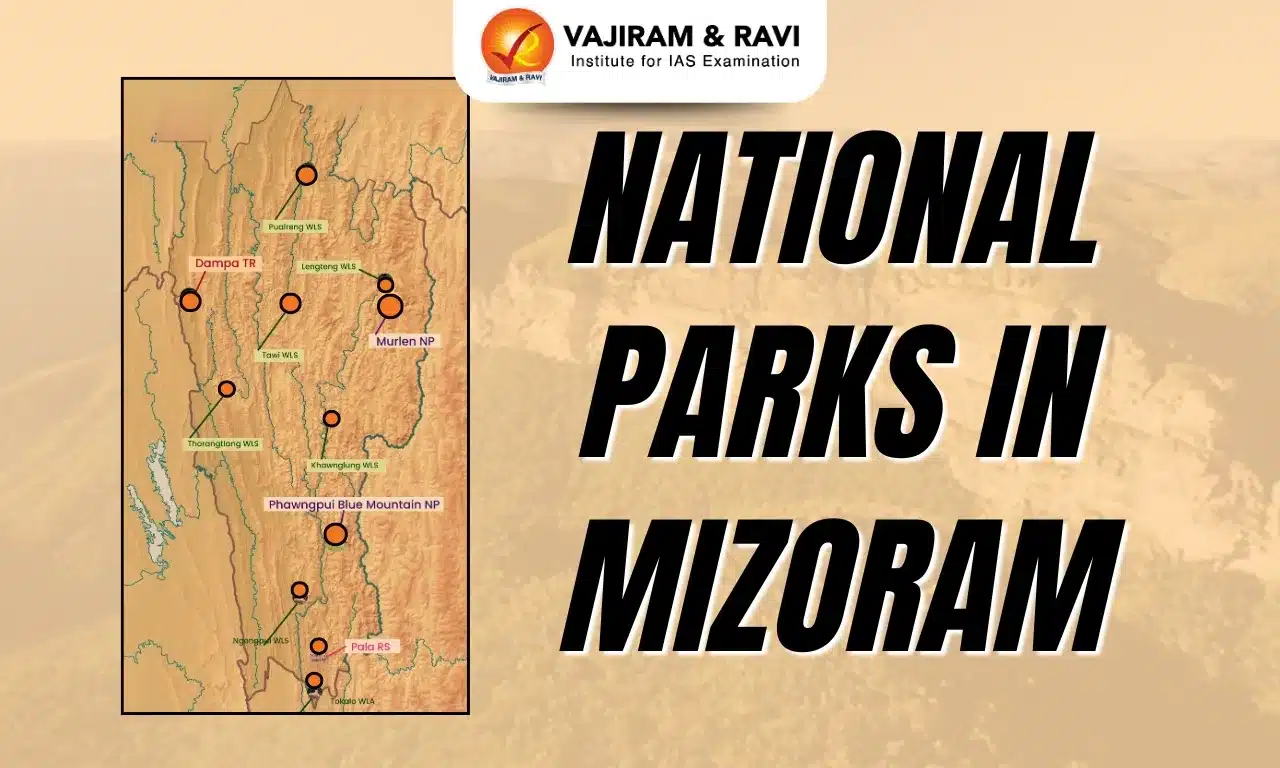
National Parks and other protected areas are legally defined natural regions created to conserve ecosystems, wildlife species, and ecological processes over long periods. According to the IUCN, these areas are clearly identified geographical spaces managed through legal means to protect biodiversity, ecosystem services, and cultural values. National Parks specifically focus on preserving large natural landscapes with minimal human interference while supporting education, research, recreation, and conservation-compatible tourism without harming wildlife or habitats.
Protected Areas in Mizoram
Mizoram has a well-defined protected area network conserving fragile Indo-Burma biodiversity hotspot ecosystems across hills, forests, rivers, and wetlands.
- Total Protected Area Coverage: 1,240.75 square kilometres forming 5.88% of state area.
- Legal Framework: All areas notified under state forest and wildlife protection laws.
- Ecological Significance: Part of Indo-Burma global biodiversity hotspot.
- Habitat Diversity: Includes montane forests, river valleys, wetlands, and hill ecosystems.
- Species Protection: Supports threatened mammals, birds, reptiles, and endemic flora.
Also Read: National Parks in India
National Parks in Mizoram
Mizoram has two notified National Parks covering ecologically sensitive hill ecosystems within the Patkai mountain range. These parks conserve high-altitude forests, river catchments, and rare wildlife species adapted to mountainous terrain. Located near international borders with Myanmar, both parks are vital for transboundary wildlife movement and biodiversity continuity. Together, they protect semi-evergreen and sub-montane forests supporting endangered mammals and birds while maintaining watershed stability for major rivers feeding the Barak and Kaladan basins.
Phawngpui Blue Mountain National Park
Phawngpui Blue Mountain National Park protects Mizoram’s highest peak and fragile high-altitude ecosystems along the India-Myanmar border.
- Location and District: Situated in Lawngtlai district near Myanmar international boundary.
- Altitude Significance: Covers Phawngpui peak rising to 2,157 metres above sea level.
- Mountain Range: Part of Mizo Hills within the larger Patkai mountain system.
- River System: Kolodyne River flows along eastern boundary forming international border.
- Major Mammals: Supports slow loris, tiger, leopard, serow, and goral populations.
- Key Avifauna: Habitat of Mrs. Hume’s pheasant, Mizoram’s state bird.
Murlen National Park
Murlen National Park conserves dense forest ecosystems of eastern Mizoram close to the Myanmar border.
- Location and District: Located in Champhai district near Chin Hills of Myanmar.
- Geographical Setting: Lies within Mizo Hills, part of the Patkai range.
- Nearby Protected Areas: Situated south of Lengteng Wildlife Sanctuary.
- River Systems: Influenced by Tiau, Tuivai, and Champhai river catchments.
- Vegetation Type: Dominated by semi-evergreen and sub-montane forests.
- Major Mammals: Tiger, leopard, Himalayan black bear, serow, hoolock gibbon present.
- Important Birds: Mrs. Hume’s pheasant and hill myna frequently recorded.


Tiger Reserves in Mizoram
Mizoram has one officially designated Tiger Reserve forming the largest protected forest landscape in the state. Located in western Mizoram, the reserve plays a critical role in conserving apex predators and maintaining ecological balance across the Lushai Hills. Although tigers were not recorded during the 2018 census, recent sightings confirm habitat viability. The reserve also supports globally significant clouded leopard populations and functions as a crucial watershed for major river systems.
Dampa Tiger Reserve
Dampa Tiger Reserve is Mizoram’s largest protected area conserving predator-rich forest ecosystems of the Lushai Hills.
- Location and District: Situated in Mamit district within Lushai Hills of Mizoram.
- Area Coverage: Spans approximately 500 square kilometres of dense forest.
- Tiger Status: No tiger in 2018 census, recent sightings confirm presence.
- Clouded Leopard Importance: One of South and Southeast Asia’s highest populations.
- Highest Peak: Chhawrpialtlang rises to 1,095 metres above sea level.
- Other Peaks: Dampatlang at 869 metres and Pathlawilunglentlang at 780 metres.
- River Drainage: Kaladan River drains west, Teirei River drains eastern slopes.
- Major Mammals: Tiger, Indian leopard, clouded leopard recorded.
- Key Birds: Great hornbill represents major avifaunal species.
- Conservation Threats: Shifting cultivation, oil palm expansion, teak plantations.
Wildlife Sanctuaries in Mizoram
Mizoram’s wildlife sanctuaries complement National Parks by protecting river valleys, forest corridors, wetlands, and border ecosystems critical for regional biodiversity conservation.
- Khawnglung Wildlife Sanctuary: Located in Lunglei district within Lushai Hills protecting forested hill landscapes.
- Lengteng Wildlife Sanctuary: Situated in Champhai district north of Murlen National Park conserving eastern hill forests.
- Ngengpui Wildlife Sanctuary: Located in Lawngtlai district along Ngengpui River valley joining Kolodyne River.
- Tawi Wildlife Sanctuary: Positioned in Serchhip district southwest of Murlen supporting mid-hill forest ecosystems.
- Thorangtlang Wildlife Sanctuary: Located in Lunglei district near Indo-Bangladesh border conserving border forests.
- Tokalo Wildlife Sanctuary: Situated in Saiha district south of Ngengpui protecting southern forest landscapes.
- Pualreng Wildlife Sanctuary: Located in Kolasib district conserving northern forest ecosystems and corridors.
Ramsar Site in Mizoram (Pala Wetland)
Pala Wetland is Mizoram’s only Ramsar-recognised wetland supporting aquatic biodiversity within the Indo-Burma hotspot.
- Local Names: Known as Pala Tipo, Pala Lake, and Palak Dil locally.
- Sanctuary Linkage: Forms core ecological component of Palak Wildlife Sanctuary.
- Biodiversity Hotspot: Located within Indo-Burma global biodiversity hotspot region.
- Major Mammals: Supports sambar deer, barking deer, and endangered hoolock gibbon.
- Ecological Role: Maintains wetland biodiversity, water regulation, and habitat stability.

 Last updated on Oct, 2026
→ UPSC 2027 Notification will be released on 13 January 2027 at upsconline.nic.in.
→ Asian Games 2026 are being held in Aichi-Nagoya, Japan, from 19 September to 4 October.
→ Check Nobel Prize 2026 Winners List here.
→ Download PIB PRiSM Monthly Magazine 2026 here.
→ Check UPSC Monthly Current Affairs Magazine The Recitals here.
→ Check out the latest UPSC Syllabus here.
→ Download UPSC Model Answers for Mains 2026
→ UPSC Mains Question Paper 2026 is out now for Essay & GS Paper 1, 2, 3 & 4.
→ UPSC Calendar 2027 has been released.
→ Enroll in Vajiram & Ravi’s UPSC Mains Test Series 2027 for structured answer writing practice, expert evaluation, and exam-oriented feedback.
→ Join Vajiram & Ravi’s UPSC Mentorship Program 2027 for personalized guidance, strategy planning, and one-to-one support from experienced mentors.
→ Go through the UPSC Mains Previous Year Papers to enhance your preparation.
→ UPSC has released UPSC Toppers List 2025 with the Civil Services final result on its official website.
→ Also check Best UPSC Coaching in India
National Parks in Mizoram FAQs
Q1. How many National Parks are there in Mizoram?+
Q2. Which is the highest National Park in Mizoram?+
Q3. Does Mizoram have a Tiger Reserve?+
Q4. Which bird is the state bird found in Mizoram’s protected areas?+
Q5. What is the Ramsar site of Mizoram?+
Tags: national parks in mizoram